Enhancing Self-Awareness in Late Adolescents and Emerging Adults in Pakistan: A Randomized Controlled Trial of UNICEF’s Basic Life Skills Program



Abstract
1. Introduction
- (1)
- Participants in the experimental group will show a significant increase in self-esteem after the application of the basic life skills training program BLSTP.
- (2)
- Participants in the experimental group will show a significant increase in stress-management skills after the application of the basic life skills training program BLSTP.
- (3)
- Participants in the experimental group will show a significant increase in emotional regulation after the application of the basic life skills training program BLSTP.
- (4)
- Participants in the experimental group will show a significant increase in positive thinking after the application of the basic life skills training program BLSTP.
2. Materials and Methods
2.1. Participants and Procedure
2.2. Measures and Questionnaires
2.2.1. The Rosenberg Self-Esteem Scale
2.2.2. The Coping Scale
2.2.3. The Emotional Regulation Scale
2.2.4. The Positive Thinking Scale
2.3. Statistical Analysis (SPSS 25)
3. Results
4. Discussion
5. Conclusions
Supplementary Materials
Author Contributions
Funding
Institutional Review Board Statement
Informed Consent Statement
Data Availability Statement
Conflicts of Interest
References
- Unicef. Annual Report; United Nations: New York, NY, USA, 2002.
- World Health Organization. Life Skills Educations in Schools; Division of Mental Health, World Health Organization: Geneva, Switzerland, 1997. Available online: https://www.orientamentoirreer.it/sites/default/files/materiali/1994%20OMS%20lifeskills%20edizione%201994.pdf (accessed on 10 October 2025).
- May, M. Basic Life Skills Course Facilitator’s Manual; UNICEF: New York, NY, USA, 2019.
- Unicef. Global Framework on Transferable Skills; United Nations: New York, NY, USA, 2019.
- Donnellan, L.; Mathews, E.S. Service providers’ perspectives on life skills and deaf and hard of hearing students with and without additional disabilities: Transitioning to independent living. Eur. J. Spec. Needs Educ. 2021, 36, 547–561. [Google Scholar] [CrossRef]
- Mertens, E.C.A.; Deković, M.; van Londen, M.; Reitz, E. Parallel Changes in Positive Youth Development and Self-awareness: The Role of Emotional Self-regulation, Self-esteem, and Self-reflection. Prev. Sci. Off. J. Soc. Prev. Res. 2022, 23, 502–512. [Google Scholar] [CrossRef] [PubMed]
- Dishon, N.; Oldmeadow, J.A.; Kaufman, J. Trait self-awareness predicts perceptions of choice meaningfulness in a decision-making task. BMC Res. Notes 2018, 11, 75. [Google Scholar] [CrossRef] [PubMed]
- Koo, O.-H. Relationship between Self-esteem, Self-awareness, and Empathy of Nursing Students in Un-tact Era. J. Ind. Converg. 2022, 20, 49–57. [Google Scholar] [CrossRef]
- Kalinin, V.; Edguer, N. The Effects of Self-Control and Self-Awareness on Social Media Usage, Self-Esteem, and Affect. Eureka 2023, 8. [Google Scholar] [CrossRef]
- Suarez Enciso, S.; Yang, H.M.; Chacon Ugarte, G. Skills for Life Series: Self-Awareness; Inter-American Development Bank: Washington, DC, USA, 2024. [Google Scholar] [CrossRef]
- Farooq, R.; Sarwar, M.; Arif, M. Meta-Analysis: Investigating the Emotional Intelligence among Undergraduate Students. Bull. Bus. Econ. (BBE) 2024, 13, 1134–1138. [Google Scholar] [CrossRef]
- Pistella, J.; Rosati, F.; Baiocco, R. Feeling safe and content: Relationship to internalized sexual stigma, self-awareness, and identity uncertainty in Italian lesbian and bisexual women. J. Lesbian Stud. 2023, 27, 41–59. [Google Scholar] [CrossRef]
- Rosenberg, M. Society and the Adolescent Self-Image; Princeton Press: Princeton, NJ, USA, 1965. [Google Scholar] [CrossRef]
- Gidi, N.W.; Horesa, A.; Jarso, H.; Tesfaye, W.; Tucho, G.T.; Siraneh, M.A.; Abafita, J. Prevalence of low self-esteem and mental distress among undergraduate medical students in Jimma University: A cross-sectional study. Ethiop. J. Health Sci. 2021, 31, 573–580. [Google Scholar] [CrossRef]
- Bodys-Cupak, I.; Ścisło, L.; Kózka, M. Psychosocial determinants of stress perceived among Polish nursing students during their education in clinical practice. Int. J. Environ. Res. Public Health 2022, 19, 3410. [Google Scholar] [CrossRef]
- Rudy, D.; Grusec, J.E. Authoritarian parenting in individualist and collectivist groups: Associations with maternal emotion and cognition and children’s self-esteem. J. Fam. Psychol. 2006, 20, 68. [Google Scholar] [CrossRef]
- Yıldırım, N.; Karaca, A.; Cangur, S.; Acıkgoz, F.; Akkus, D. The relationship between educational stress, stress coping, self-esteem, social support, and health status among nursing students in Turkey: A structural equation modeling approach. Nurse Educ. Today 2017, 48, 33–39. [Google Scholar] [CrossRef] [PubMed]
- Banappagoudar, S.; Ajetha, D.; Parveen, A.; Gomathi, S.; Subashini, S.; Malhotra, P. Self-esteem of undergraduate nursing students: A cross-sectional study. Int. J. Spec. Educ. 2022, 37, 4500–4510. [Google Scholar]
- Giotakos, O. Neurobiology of emotional trauma. Psychiatriki 2020, 31, 162–171. [Google Scholar] [CrossRef] [PubMed]
- Nakao, M.; Shirotsuki, K.; Sugaya, N. Cognitive–behavioral therapy for management of mental health and stress-related disorders: Recent advances in techniques and technologies. BioPsychoSoc. Med. 2021, 15, 16. [Google Scholar] [CrossRef]
- Kallianta, M.-D.K.; Katsira, X.E.; Tsitsika, A.K.; Vlachakis, D.; Chrousos, G.; Darviri, C.; Bacopoulou, F. Stress management intervention to enhance adolescent resilience: A randomized controlled trial. EMBnet J. 2021, 26, e967. [Google Scholar] [CrossRef]
- Smith, T.W.; Cundiff, J.M. An Interpersonal Perspective on the Physiological Stress Response. In Integrating Psychotherapy and Psychophysiology: Theory, Assessment, and Practice; Oxford University Press: Oxford, UK, 2024; p. 277. [Google Scholar] [CrossRef]
- Baumgartner, P.; Jennifer, N.; Schneider, P.; Tamera, R. A randomized controlled trial of mindfulness-based stress reduction on academic resilience and performance in college students. J. Am. Coll. Health 2023, 71, 1916–1925. [Google Scholar] [CrossRef]
- Groombridge, C.J.; Kim, Y.; Maini, A.; Smit, D.V.; Fitzgerald, M.C. Stress and decision-making in resuscitation: A systematic review. Resuscitation 2019, 144, 115–122. [Google Scholar] [CrossRef]
- Lemay, E.P., Jr.; Teneva, N.; Xiao, Z. Interpersonal emotion regulation as a source of positive relationship perceptions: The role of emotion regulation dependence. Emotion 2024, 25, 355–371. [Google Scholar] [CrossRef]
- Preece, D.A.; Ditzer, J.; Gross, J.J. Emotion Regulation. Oxf. Res. Encycl. Psychol. 2025. [Google Scholar] [CrossRef]
- Main, A.; Yung, S.T.; Chen, Y.; Zawadzki, M.J. Predicting emotion regulation strategies from aspects of the social context in everyday life. J. Soc. Pers. Relatsh. 2025, 42, 568–590. [Google Scholar] [CrossRef]
- Madden, L.; Reynolds, R. The Process of Emotional Regulation. In The Science of Emotional Intelligence; Guilford Press: New York, NY, USA, 2021. [Google Scholar] [CrossRef]
- Polizzi, C.P.; Lynn, S.J. Regulating emotionality to manage adversity: A systematic review of the relation between emotion regulation and psychological resilience. Cogn. Ther. Res. 2021, 45, 577–597. [Google Scholar] [CrossRef]
- Thompson, N.M.; Van Reekum, C.M.; Chakrabarti, B. Cognitive and affective empathy relate differentially to emotion regulation. Affect. Sci. 2022, 3, 118–134. [Google Scholar] [CrossRef]
- Barjoee, L.K.; Amini, N.; Keykhosrovani, M.; Shafiabadi, A. Effectiveness of positive thinking training on perceived stress, metacognitive beliefs, and death anxiety in women with breast cancer: Perceived stress in women with breast cancer. Arch. Breast Cancer 2022, 9, 195–203. [Google Scholar] [CrossRef]
- Fisher, N.R.; Mead, B.R.; Lattimore, P.; Malinowski, P. Dispositional mindfulness and reward motivated eating: The role of emotion regulation and mental habit. Appetite 2017, 118, 41–48. [Google Scholar] [CrossRef] [PubMed]
- Santos, B.; Pinho, L.; Nogueira, M.J.; Pires, R.; Sequeira, C.; Montesó-Curto, P. Cognitive restructuring during depressive symptoms: A scoping review. Healthcare 2024, 12, 1292. [Google Scholar] [CrossRef]
- Sancassiani, F.; Pintus, E.; Holte, A.; Paulus, P.; Moro, M.F.; Cossu, G.; Angermeyer, M.C.; Carta, M.G.; Lindert, J. Enhancing the emotional and social skills of the youth to promote their wellbeing and positive development: A systematic review of universal school-based randomized controlled trials. Clin. Pract. Epidemiol. Ment. Health CP EMH 2015, 11, 21. [Google Scholar] [CrossRef]
- Lesunyane, A.; Ramano, E.; Niekerk, K.v.; Boshoff, K.; Dizon, J. Life skills programmes for university-based wellness support services for students in health sciences professions: A scoping review. BMC Med. Educ. 2024, 24, 1418. [Google Scholar] [CrossRef]
- Spalding, K.G. Enhancing Occupational Performance Using the ‘LifeSkills’ Program: Evaluation of an Occupation-Based Group in an Inpatient Rehabilitation Setting. Master’s Thesis, University of Salford, Salford, UK, 2021. [Google Scholar] [CrossRef]
- Shah, R.; Sabir, I.; Zaka, A. Interdependence and waithood: Exploration of family dynamics and young adults’ life course trajectories in Pakistan. Adv. Life Course Res. 2025, 63, 100660. [Google Scholar] [CrossRef]
- Hussain, S. The Multifaceted Impact of Academic Pressure on the Mental Health and Well-being of University Students in Pakistan: Exploring the Interplay of Systemic Factors, Individual Vulnerabilities, and Coping Mechanisms. Int. Res. J. Educ. Innov. 2024, 5, 8–14. [Google Scholar]
- Farooq, A.; Alyana, S.I. Efficacy of Basic Life Skills Training Program to Enhance Social Emotional Competence among Adolescent Students in Pakistan. Int. Res. J. Arts Humanit. Soc. Sci. 2025, 2, 738–749. [Google Scholar]
- Wang, G.; Mao, L.; Ma, Y.; Yang, X.; Cao, J.; Liu, X.; Wang, J.; Wang, X.; Han, S. Neural representations of close others in collectivistic brains. Soc. Cogn. Affect. Neurosci. 2012, 7, 222–229. [Google Scholar] [CrossRef]
- Gul, S.; Ahmad, E.; Ali, I.; Ahmad, N. Millennial Parenting and Generation Z Social Adjustment: A Comparative Study of Urban and Rural Contexts in Pakistan. J. Soc. Sci. Res. Policy 2025, 3, 268–279. [Google Scholar]
- Keshf, Z.; Nadeem, A. Money Matters: How Economic Demographics Shape Wellbeing of Young Adults in a Collectivistic Culture. Pak. J. Prof. Psychol. Res. Pract. 2024, 15, 12–27. [Google Scholar] [CrossRef]
- Batool, I.; Gillani, N.P. Identity development: An overview of adolescents. Pak. J. Soc. Clin. Psychol. 2008, 6, 22. [Google Scholar]
- Bajaj, B.; Gupta, R.; Pande, N. Self-esteem mediates the relationship between mindfulness and well-being. Personal. Individ. Differ. 2016, 94, 96–100. [Google Scholar] [CrossRef]
- Rosenberg, M. Rosenberg self-esteem scale. J. Relig. Health 1965. [Google Scholar] [CrossRef]
- Hamby, S.; Grych, J.; Banyard, V. Life Paths Measurement Packet; Life Paths Research Program: Sewanee, TN, USA, 2015. [Google Scholar]
- Gross, J.J.; John, O.P. Individual differences in two emotion regulation processes: Implications for affect, relationships, and well-being. J. Personal. Soc. Psychol. 2003, 85, 348. [Google Scholar] [CrossRef]
- Diener, E.; Wirtz, D.; Biswas-Diener, R.; Harter, J.; Tov, W. New measures of well-being. In Assessing Well-Being: The Collected Works of Ed Diener; Social Indicators Research Series; Springer Science + Business Media: Dordrecht, The Netherlands, 2009; Volume 39, pp. 247–266. [Google Scholar]
- Surendran, G.; Sarkar, S.; Kandasamy, P.; Rehman, T.; Eliyas, S.; Sakthivel, M. Effect of life skills education on socio-emotional functioning of adolescents in urban Puducherry, India: A mixed-methods study. J. Educ. Health Promot. 2023, 12, 250. [Google Scholar] [CrossRef]
- Becker, M.; Vignoles, V.L.; Owe, E.; Easterbrook, M.J.; Brown, R.; Smith, P.B.; Bond, M.H.; Regalia, C.; Manzi, C.; Brambilla, M. Cultural bases for self-evaluation: Seeing oneself positively in different cultural contexts. Personal. Soc. Psychol. Bull. 2014, 40, 657–675. [Google Scholar] [CrossRef]
- Cathlin, C.A.; Salim, R.M.A. The effectiveness of a psychoeducation intervention program for enhancing self-esteem and empathy: A study of emerging adult college student. J. Paedagogy 2024, 11, 462–472. [Google Scholar] [CrossRef]
- Qian, Y.; Yu, X.; Liu, F. Comparison of two approaches to enhance self-esteem and self-acceptance in Chinese college students: Psychoeducational lecture vs. Group intervention. Front. Psychol. 2022, 13, 877737. [Google Scholar] [CrossRef]
- Flórez-Rodríguez, Y.N.; Sánchez-Aragón, R. El estrés visto como reto o amenaza y la rumia. Factores de Riesgo a la Salud. Rev. Salud Adm. 2020, 7, 17–27. [Google Scholar]
- O’Connor, D.B.; Thayer, J.F.; Vedhara, K. Stress and health: A review of psychobiological processes. Annu. Rev. Psychol. 2021, 72, 663–688. [Google Scholar] [CrossRef] [PubMed]
- Ghasemi, F.; Beversdorf, D.Q.; Herman, K.C. Stress and stress responses: A narrative literature review from physiological mechanisms to intervention approaches. J. Pac. Rim Psychol. 2024, 18, 18344909241289222. [Google Scholar] [CrossRef]
- Jia, L.; Cai, C.; Rawal, A.P. Examining the Impact of Mindfulness on Academic Emotions and Cognitive Flexibility among Undergraduates in Chinese Higher Education. SAGE Open 2025, 15, 21582440251361661. [Google Scholar] [CrossRef]
- Borjalilu, S. The efficacy of the Persian version of the mindfulness-based stress management app (aramgar) for college’s mindfulness skills and perceived stress. Int. J. Islam. Educ. Psychol. 2023, 4, 1–16. [Google Scholar] [CrossRef]
- Haibin, W.; Cheng, J.; Fei, H. A Study on University Students’ Emotional Awareness and Its Relationship with Emotion Regulation. J. Huangshan Univ. 2016, 18, 104–106. [Google Scholar]
- Bird, G.A.; Quinton, M.L.; Cumming, J. Promoting athlete mental health: The role of emotion regulation. J. Clin. Sport Psychol. 2023, 17, 112–130. [Google Scholar] [CrossRef]
- Thompson, N.M.; Uusberg, A.; Gross, J.J.; Chakrabarti, B. Empathy and emotion regulation: An integrative account. Prog. Brain Res. 2019, 247, 273–304. [Google Scholar] [CrossRef]
- Muda, S.N.; Arsini, Y. Application of Group Counselling With the Cognitive Reappraisal Technique to Enhance Empathy Among Students. Urwatul Wutsqo J. Studi Kependidikan Keislam. 2025, 14, 430–448. [Google Scholar] [CrossRef]
- Walsh, S.; Cassidy, M.; Priebe, S. The application of positive psychotherapy in mental health care: A systematic review. J. Clin. Psychol. 2017, 73, 638–651. [Google Scholar] [CrossRef]
- Mercan, N.; Bulut, M.; Yüksel, Ç. Investigation of the relatedness of cognitive distortions with emotional expression, anxiety, and depression. Curr. Psychol. 2023, 42, 2176–2185. [Google Scholar] [CrossRef]
- Diachkova, O.; Yeremenko, L.; Donets, I.; Klymenko, I.; Kononenko, A. Harnessing Positive Thinking: A Cognitive Behavioural Approach to Stress Management. Int. J. Relig. 2024, 5, 380–389. [Google Scholar] [CrossRef]



| Variables | Category | Overall | Groups | |||
|---|---|---|---|---|---|---|
| Characteristics | Experimental | Control | χ2/t | p | ||
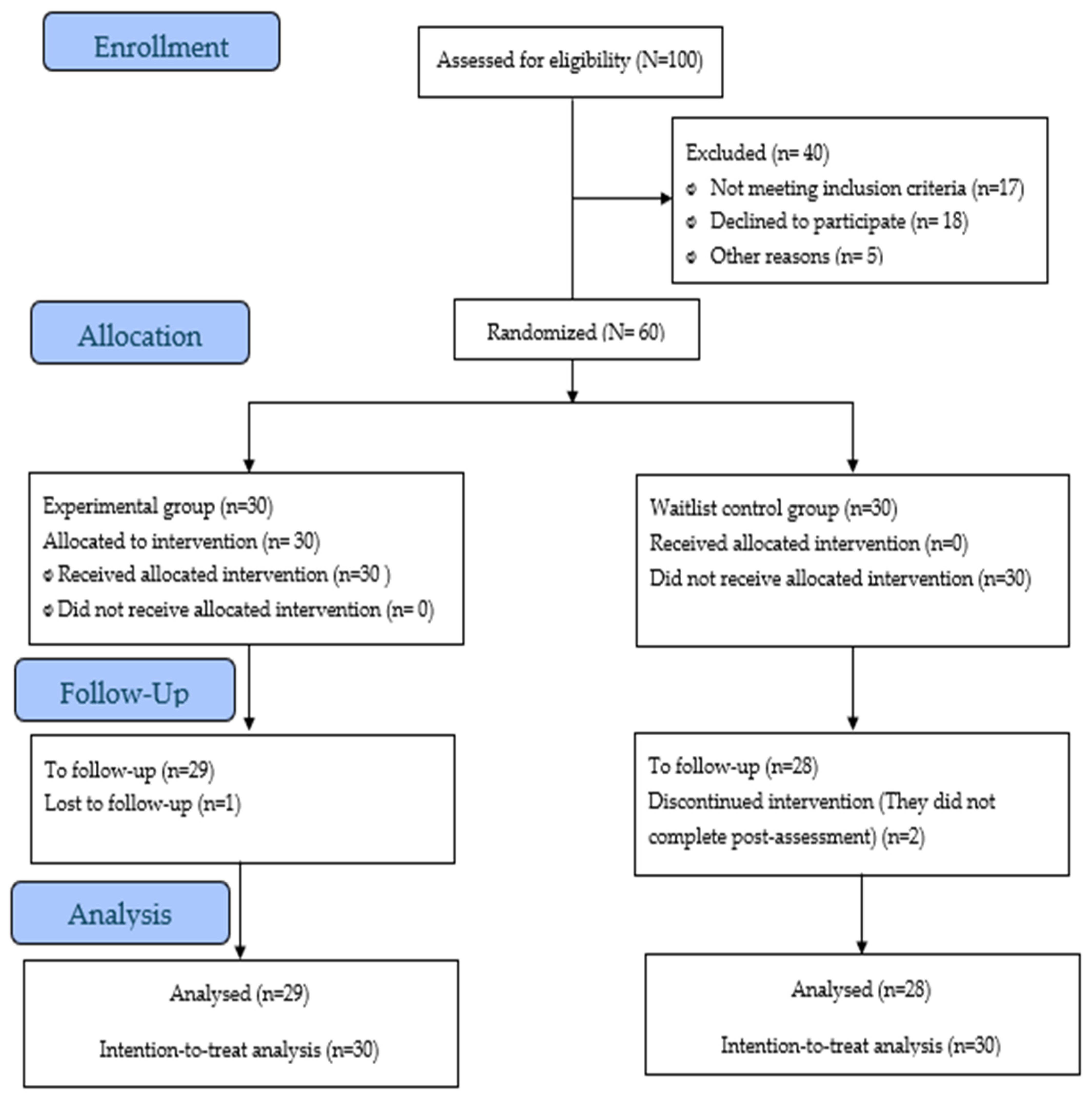
| N Total | 100 | _ | _ | |||
| N ineligible | 40 | 20 (50.0%) | 20 (50.0%) | |||
| N allocated | 60 | 30 (50.0%) | 30 (50.0%) | |||
| Age (MSD) | 60 | 20.10 (1.53) | 19.53 (1.88) | 1.24 | 0.208 | |
| Gender | Male (n%) | 36 | 18 (30.0%) | 18 (30.0%) | 0.000 | 1.00 |
| Female (n%) | 24 | 12 (20.0%) | 12 (20.0%) | |||
| Semester | First (n%) | 6 | 3 (5.0%) | 3 (5.0%) | 0.538 | 0.997 |
| Second (n%) | 10 | 5 (8.3%) | 5 (8.3%) | |||
| Third (n%) | 19 | 9(15.0%) | 10 (16.7%) | |||
| Fourth (n%) | 6 | 3 (5.0%) | 3 (5.0%) | |||
| Fifth (n%) | 7 | 4 (6.7%) | 3 (5.0%) | |||
| Sixth (n%) | 7 | 3 (5.0%) | 4 (6.7%) | |||
| Seventh (n%) | 5 | 3 (5.0%) | 2 (3.3%) | |||
| Birth Order | First (n%) | 18 | 11 (18.3) | 7 (11.7%) | 1.504 | 0.471 |
| Middle (n%) | 26 | 11 (18.3%) | 15 (25.0%) | |||
| Last (n%) | 16 | 8 (13.3%) | 8 (13.3%) | |||
| Family System | Nuclear (n%) | 27 | 11 (18.3%) | 16 (26.7%) | 1.684 | 0.194 |
| Joint (n%) | 33 | 19 (31.7%) | 14 (23.3%) | |||
| Fathers’ Education | Intermediate (n%) | 18 | 9 (15.0%) | 9 (15.0%) | 2.981 | 0.395 |
| Bachelors (n%) | 13 | 9 (15.0%) | 4 (6.75%) | |||
| Masters (n%) | 23 | 10 (16.7%) | 13 (21.7%) | |||
| PhD (n%) | 6 | 2 (3.3%) | 4 (6.7%) | |||
| Mothers’ Education | Intermediate (n%) | 20 | 11 (18.3%) | 9 (15.0%) | 1.122 | 0.772 |
| Bachelors (n%) | 17 | 7 (11.6%) | 10 (16.7%) | |||
| Masters (n%) | 16 | 9 (15.0%) | 7 (11.6%) | |||
| PhD (n%) | 7 | 3 (5.0%) | 4 (6.7%) | |||
| Groups | Repeated Measure ANOVA | ||||||||||||
|---|---|---|---|---|---|---|---|---|---|---|---|---|---|
| Experimental Group | Waitlist Control | Group | Time | Group × Time | ηp2 | ||||||||
| Variables | Baseline M (SD) | Post-Test M (SD) | Follow-Up M (SD) | Baseline M (SD) | Post-Test M (SD) | Follow-Up M (SD) | F | p- Value | F | p-Value | F | p- Value | |
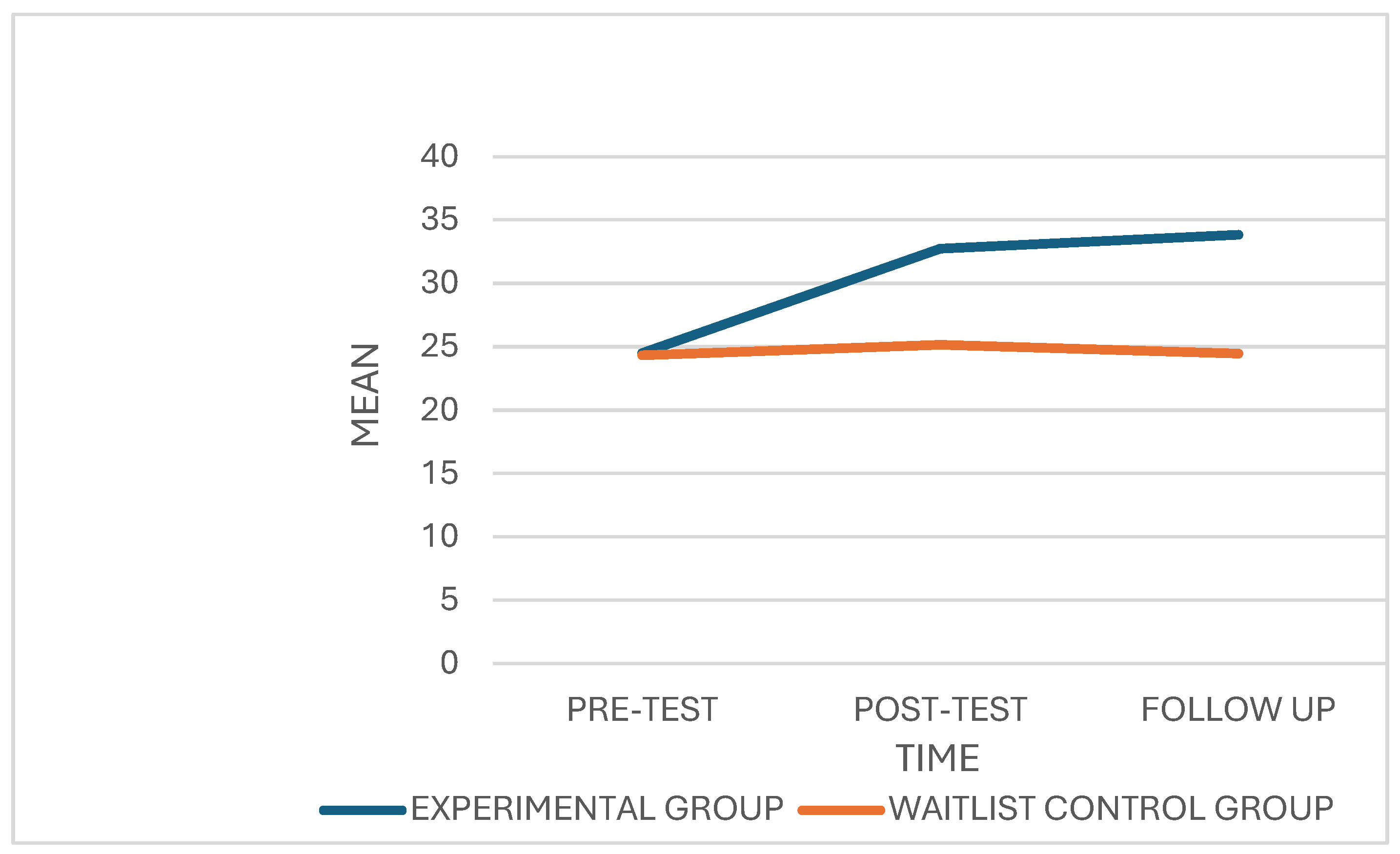
| Self-Esteem | 24.50 (2.70) | 32.73 (3.11) | 33.83 (2.13) | 24.33 (2.35) | 25.16 (1.89) | 24.46 (2.60) | 168.60 | 0.001 | 70.74 | 0.001 | 61.51 | 0.001 | 0.683 |
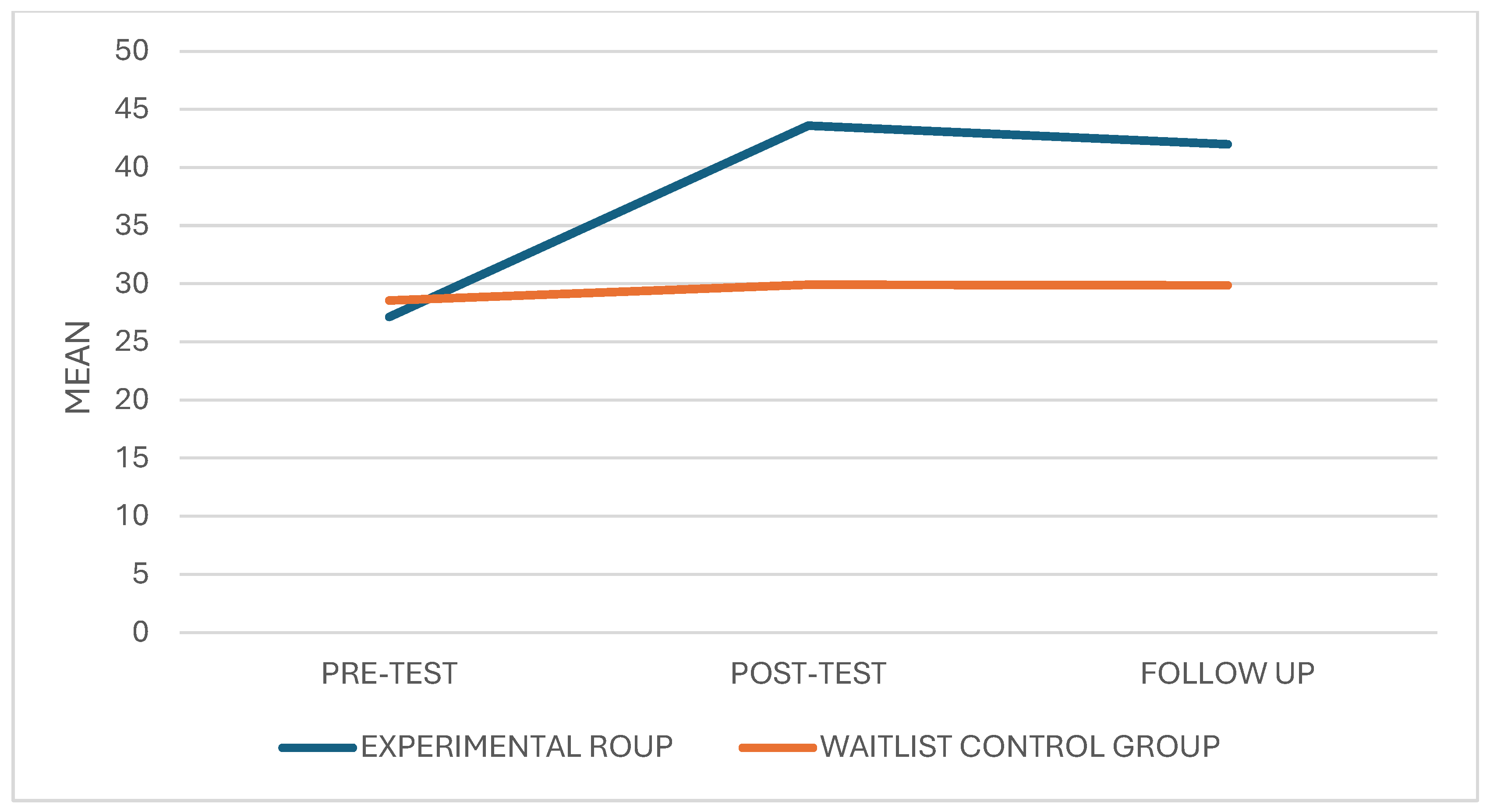
| Stress Management | 27.16 (3.95) | 43.60 (3.45) | 42.00 (3.27) | 28.56 (4.05) | 29.93 (4.08) | 29.86 (3.98) | 45.87 | 0.001 | 206.85 | 0.001 | 148.174 | 0.001 | 0.839 |
| Emotional regulation | - | - | - | - | - | - | - | - | - | - | - | - | - |
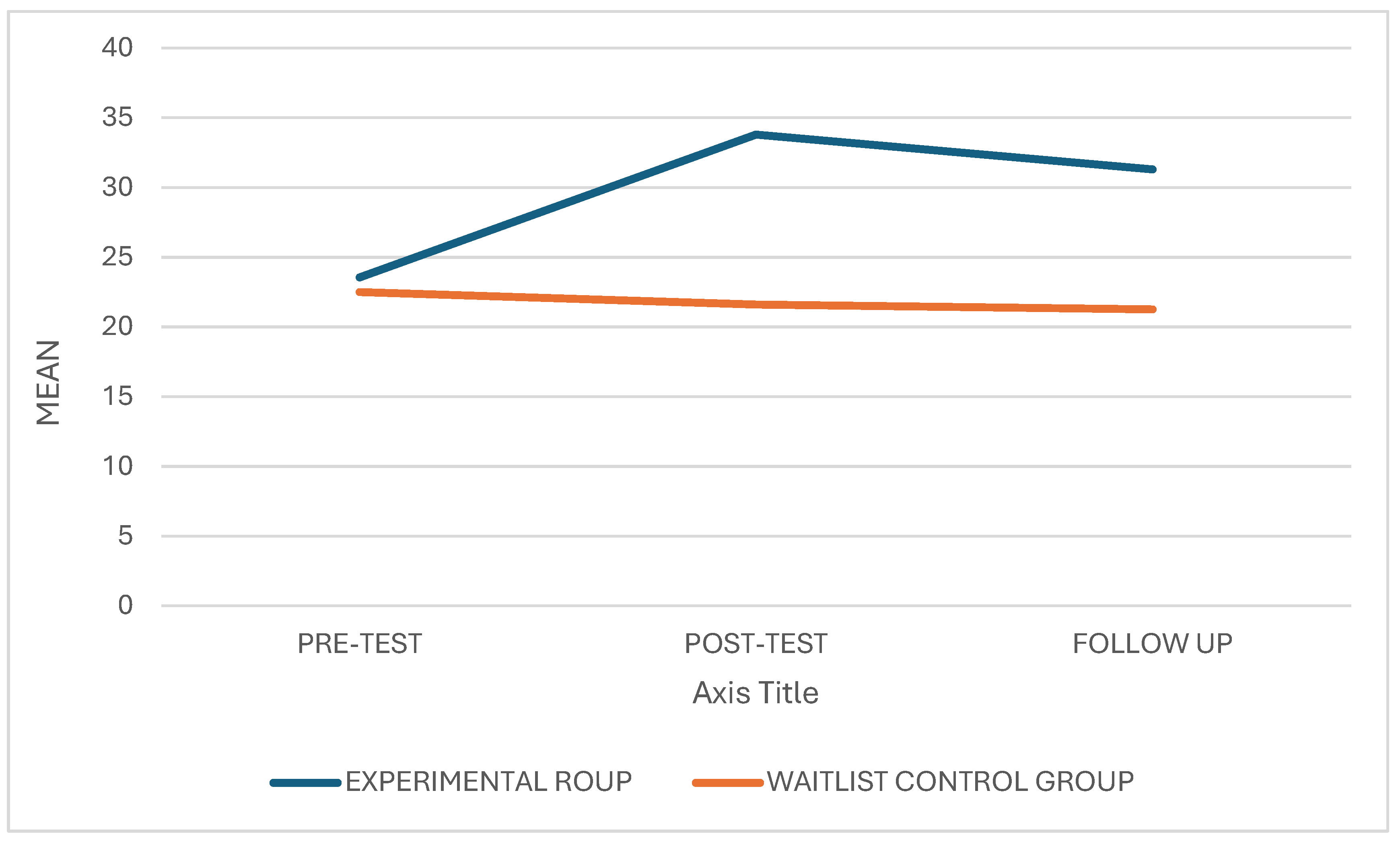
| Cognitive Reappraisal | 23.56 (4.71) | 33.80 (3.88) | 31.30 (4.25) | 22.50 (3.02) | 21.60 (4.94) | 21.26 (4.57) | 74.85 | 0.001 | 39.97 | 0.001 | 56.38 | 0.001 | 0.664 |
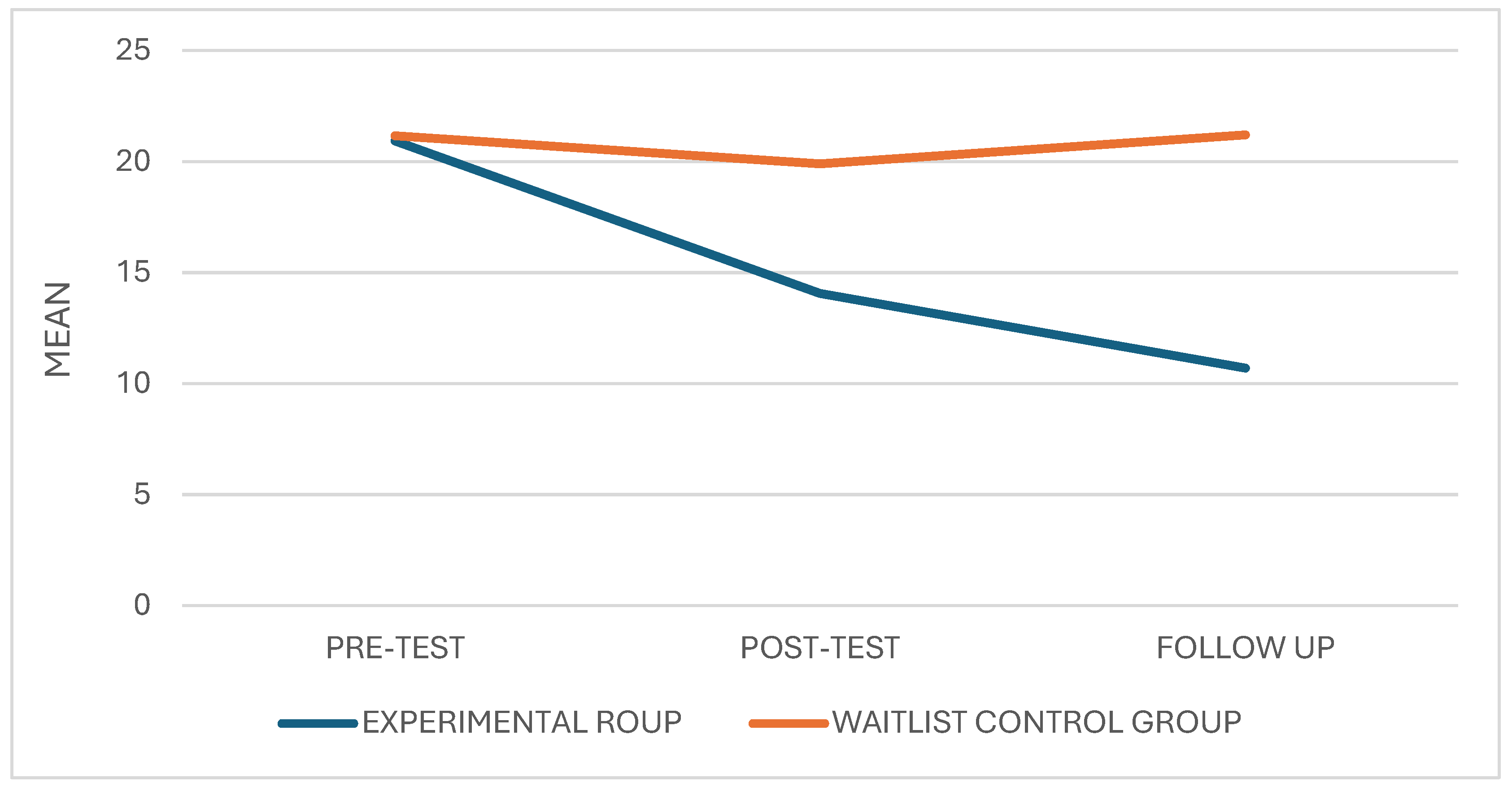
| Expressive suppression | 20.933 (1.43) | 14.06 (6.11) | 10.70 (2.89) | 21.16 (1.64) | 19.90 (3.63) | 21.20 (1.64) | 105.52 | 0.001 | 143.19 | 0.001 | 141.80 | 0.001 | 0.833 |
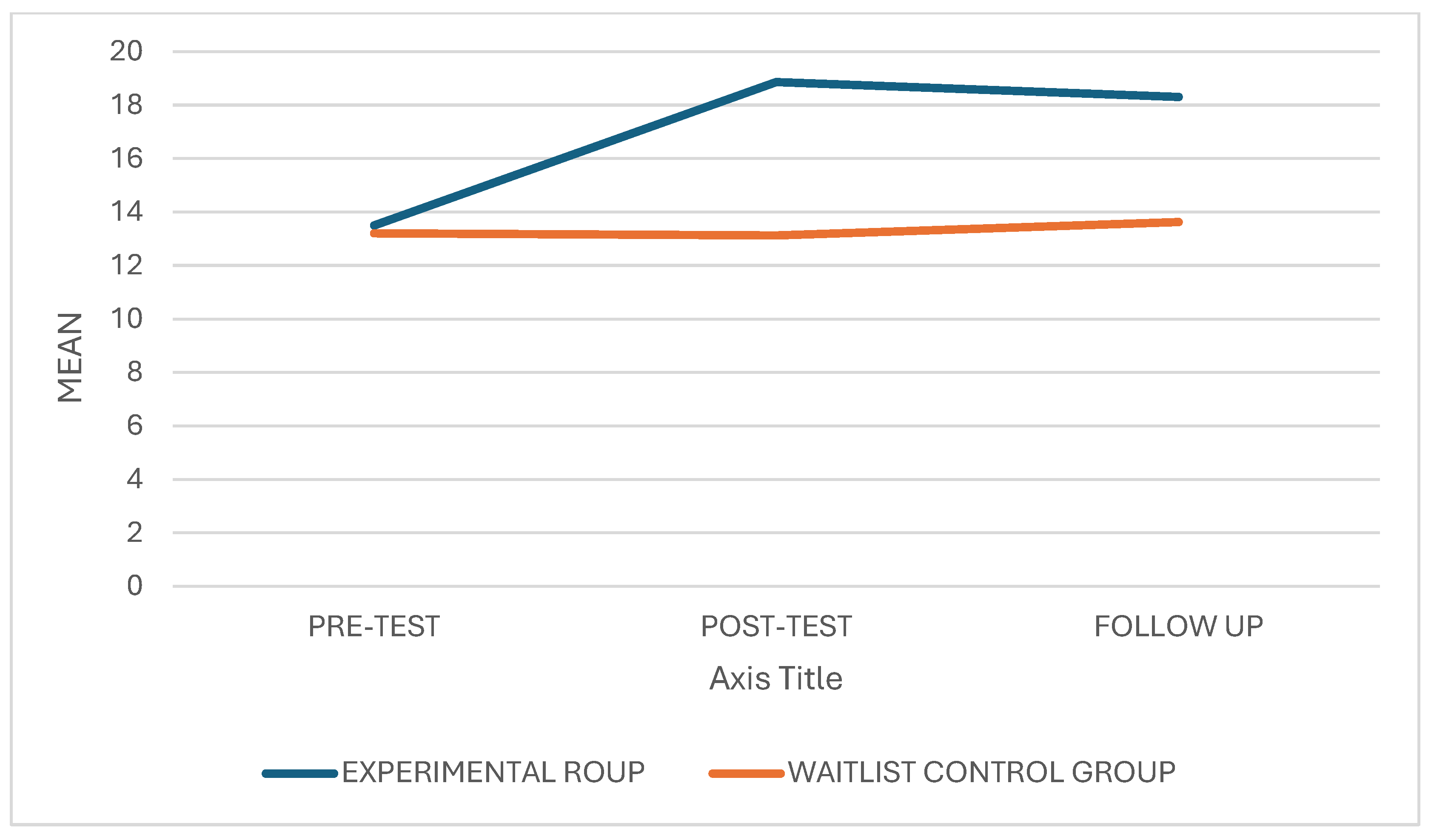
| Positive Thinking | 13.50 (2.11) | 18.86 (1.94) | 18.30 (1.87) | 13.20 (3.11) | 13.13 (2.41) | 13.63 (2.00) | 69.47 | 0.001 | 25.55 | 0.001 | 24.32 | 0.001 | 0.461 |
| Variable | Cohen’s d | CI95% | |
|---|---|---|---|
| LL | UL | ||
| Self-esteem | 2.94 | 1.64 | 4.24 |
| Stress Management | 4.56 | 2.83 | 6.29 |
| ER-Cognitive reappraisal | 2.82 | 1.55 | 4.09 |
| ER-Expressive suppression | 4.46 | 2.76 | 6.16 |
| Positive thinking | 1.85 | 0.79 | 2.91 |
Disclaimer/Publisher’s Note: The statements, opinions and data contained in all publications are solely those of the individual author(s) and contributor(s) and not of MDPI and/or the editor(s). MDPI and/or the editor(s) disclaim responsibility for any injury to people or property resulting from any ideas, methods, instructions or products referred to in the content. |
© 2026 by the authors. Licensee MDPI, Basel, Switzerland. This article is an open access article distributed under the terms and conditions of the Creative Commons Attribution (CC BY) license.
Share and Cite
Sadiq, U.; Irfan, A.; Baig, K.B.; Flesia, L. Enhancing Self-Awareness in Late Adolescents and Emerging Adults in Pakistan: A Randomized Controlled Trial of UNICEF’s Basic Life Skills Program. Adolescents 2026, 6, 27. https://doi.org/10.3390/adolescents6020027
Sadiq U, Irfan A, Baig KB, Flesia L. Enhancing Self-Awareness in Late Adolescents and Emerging Adults in Pakistan: A Randomized Controlled Trial of UNICEF’s Basic Life Skills Program. Adolescents. 2026; 6(2):27. https://doi.org/10.3390/adolescents6020027
Chicago/Turabian StyleSadiq, Urooj, Ayesha Irfan, Khawer Bilal Baig, and Luca Flesia. 2026. "Enhancing Self-Awareness in Late Adolescents and Emerging Adults in Pakistan: A Randomized Controlled Trial of UNICEF’s Basic Life Skills Program" Adolescents 6, no. 2: 27. https://doi.org/10.3390/adolescents6020027
APA StyleSadiq, U., Irfan, A., Baig, K. B., & Flesia, L. (2026). Enhancing Self-Awareness in Late Adolescents and Emerging Adults in Pakistan: A Randomized Controlled Trial of UNICEF’s Basic Life Skills Program. Adolescents, 6(2), 27. https://doi.org/10.3390/adolescents6020027