
Article

Facilitating and Hindering Factors for Adolescents with Disabilities Transitioning from Secondary to Post-Secondary Education: An Exploratory and Retrospective Study

Department of Social and Behavourial Sciences, City University of Hong Kong, Tat Chee Avenue, Kowloon, Hong Kong SAR, China
*
Author to whom correspondence should be addressed.
Adolescents 2026, 6(1), 5; https://doi.org/10.3390/adolescents6010005

Submission received: 1 September 2025 / Revised: 2 December 2025 / Accepted: 31 December 2025 / Published: 8 January 2026
(This article belongs to the Special Issue Youth in Transition)

Abstract

The transition from secondary to post-secondary levels has been seen as challenging and significant among adolescents, in particular adolescents with disabilities (ADWs). Given the increasing trend of students with disabilities pursuing higher education under the integrated education policy, it is unclear whether these students can receive appropriate support to enhance their learning and career exploration. This study investigated the experiences of ADWs during this transition. A group of 40 adolescents took part individually in a 1 h semi-structured interview. The interview data was analyzed with reference to five levels using an ecological model from microsystem, mesosystem, exosystem, macrosystem and chronosystem. Facilitating factors at each level were extracted, e.g., adequate use of assistive technologies helping them overcome their perceived limitations caused by disabilities, and accommodation in learning and assessments also helped unleash their potentials. However, difficulties were also identified, e.g., poor interaction with academic peers, issues with disability disclosure, and schools’ rigid arrangements. The results from this study corroborate the different systems as suggested by the ecological model and also align with the different components of the taxonomy of transition: (a) student-focused development and planning; (b) family involvement and support; and (c) the importance of interagency collaboration. It was recommended that a supporting network should be established between secondary schools and post-secondary institutions to enhance a smooth transition across different education sectors.

Graphical Abstract

1. Introduction

1.1. ADWs’ Unequal Outcomes to Life Compared to Non ADWs

In Hong Kong, about 7.4 per cent of the overall population has a disability, with approximately 39.1% of individuals with disabilities working much lower than the 72.8% of the overall population within the same age group [1,2]. Access and participation in post-secondary education (PSE) is critical for empowerment for marginalized groups such as adolescents with disabilities (ADWs) [3]. Access to accommodations in PSE is supported by legislation in Western countries; thus, educators have a duty to provide accommodations for students [4]. Yet, ADWs often face various barriers during PSE such as inadequate disability support, accessibility and transportation issues and discrimination attitudes [5,6,7]. There is also the phenomenon of greater educational attainment not leading to greater market success, and the underutilization of the talent and potential of ADWs will persist [8].

1.2. ADWs as Marginalized Individuals from Societal Attitudes

Previous research in the field of disability and youth focused on the ADW individual, boosting self-determination, and life skills for better developmental outcomes (e.g., [9]), whilst family support is one of the key determinants of better outcomes [10]. However, societal attitudes and other stakeholders (e.g., teachers) may play a role in the transitions of ADWs. More importantly, most of such research is based on populations from the West, and Chinese populations have been largely neglected. The social model perceives disability from social and structural barriers which impose limitations on ADWs to exclude them from fully participating in society, yet it has been criticized for insufficient consideration of interactions between social environment and the individual [11]. However, rejecting the medical model of disability may also be deemed inappropriate [12]. Yet, the ecological perspective, often considered as a hallmark of the social work profession directs social workers to understand clients’ needs on multiple interrelated levels [13]. The primary aim of this study is to extend the ecological perspective and discuss its applicability within a Chinese context, which emphasizes the cultural values of collectivism, which may further marginalize ADWs from the mainstream society [12,14]. This study will explore the experiences of ADWs’ transition from secondary school to post-secondary school and identify the facilitators and barriers for a better transition to inform policy implications. This study challenges the notion of simply providing accommodation, but rather points towards the inclusion in PSE by understanding the experiences of ADWs.

2. Literature Review

2.1. The Process of Seeking Accommodations in PSE as an Embarrassing Experience: Barrier Towards Positive Disability Identity

Accommodation within PSE is supported by human rights, such that ADWs in PSE have equal opportunity to participate in their studies as protected by legislation. Accommodation includes things such as modified environments, tasks and adaptive technology, which can optimize students’ engagement in PSE [3]. For example, students can request extra time for tests and assistive technologies [6]. Providing accommodation can improve engagement, and physical and psychological health of ADWs [12].
In secondary schools, no matter whether within the mainstream or special school contexts, staff are responsible for identifying and providing support for ADWs. However, when ADWs progress into PSE, they are required to self-identify and request accommodation by themselves [13]; an obvious shift from school to student [14]. ADWs who have not been actively involved in transition planning may be at disadvantage in the PSE environment [15]. Requesting accommodation can be embarrassing and be perceived as a sign of dependence at a time when students are seeking new levels of autonomy and control over their lives [15].
In Hong Kong, there are no standards of practice, policies or models that inform the support of ADWs in PSE [16]. Despite inadequate support, accommodation falls under five categories: (1) study and learning support; (2) accommodation and transportation support; (3) financial assistance; (4) campus accessibility; (5) other academic support (e.g., individualized management plan, academic advisory) [16].

2.2. ADWs Feeling Stigmatized: Barrier Towards Positive Disability Identity

ADWs often face attitudinal barriers no matter in schooling or other contexts. For example, ADWs often experience significant social exclusion, negative attitudes, discrimination and stigma [6,17,18]. According to Thornicroft and colleagues [19], stigma arises because of inadequate or biased knowledge about disability. ADWs can generally feel marginalized or uncomfortable by others’ awkwardness [20]. Self-stigma can result in ADWs internalizing negative stereotypes, which results in losing perception of their potential, and a lower self-esteem [21]. Disability identity can be a unique phenomenon that shapes individuals’ ways of seeing themselves and their disability. Disability identity development involves processes of social categorization and meaning-making [21]. People with disabilities must simultaneously negotiate their physical impairment and the social meaning of their disability to form an identity. The process for developing disability identity is a heterogeneous and complex process, which is influenced by the social environment [22]. To facilitate the processing of one’s disability identity, people with disabilities should engage in interactions with rehabilitation professionals, educators, and caregivers, who are often without disabilities [21]. For ADWs in PSE, disability identity can motivate ADWs towards purpose through determination and persistence, or as a burden, creating self-doubt even within the same student [15].

2.3. ADWs Viewed as Incompetent in Chinese Culture—Impacts Towards a Positive Disability Identity

ADWs are often viewed as incompetent and experience lowered expectations, which may be a form of ableism preventing ADWs from reaching their potentials [23]. In Chinese communities, ADWs are also perceived this way: as individuals who lack ability to perform activities and are positioned with a marginalized status [11]. In Chinese culture, strong familial bonds are upheld strongly, and parents are deeply dedicated to their children’s upbringing, and prolonged parenting is common [24]. Parents act as a shelter for their ADW children, providing financial support in every aspect of their lives [11]. Disability may be associated with a loss of ‘face’ [25].

2.4. College and Career Readiness for ADWs—The Importance of Peer Relationships

The college and career readiness framework for ADWs in secondary school by Morningstar and colleagues [26] emphasizes academic aspects and non-academic factors such as academic engagement, critical thinking and interpersonal engagement through forming positive and trusting social relationships [27]. Personal relationships can enhance ADWs’ self-determination skills, crucial for ADWs regarding access to support services, communicating with instructors, and engaging in academic and social activities [15]. A recent study with AWDs revealed that peer relationships, particularly within a supportive school context, can predict higher self-determination decision-making skills [27]. Positive student–teacher relationships are vital protective factors to foster self-determination skills consistent with international research [28]. It is important for students to feel connected to and cared for by educators, as their self-determination development at school is ultimately cultivated within the context of relationships.

2.5. The Importance of Collaboration in Transitional Support for ADWs

ADWs should have equal opportunity to further education. However, in many parts of the world there is no guarantee that the support they receive in school will continue into adulthood. Transitional support is often school-based and should continue into adulthood, utilizing a life course approach [29]. Moreover, a misalignment in support provided to ADWs can have significant or even detrimental consequences [30]. Hong Kong has been criticized for lacking a framework towards holistic support for ADWs as individuals and their families, who are unable to provide sustainable support for ADWs in their major transitions in life [31].
Parents play a key role in the secondary school transition process [32]. However, some parents of ADWs report having low confidence in facilitating their children [11,33], and have time constraints or insufficient resources. Moreover, family engagement and family involvement have a crucial role in contributing to the self-determination of the ADWs in the process of transiting to adulthood [34,35]. Family involvement is one of the five components of the taxonomy of transition. Alongside family involvement, other elements of the taxonomy include program structure, interagency collaboration, student-focused planning, and student development [33].

2.6. Theoretical Framework

The ecological model is useful because it incorporates the complexity of environmental influences, individual characteristics and other mediating factors and this model is often considered as a hallmark of the social work profession directs social workers to understand clients’ needs on multiple interrelated levels [36,37]. This study will use the ecological model as a framework for this study.
The ecological model highlights the impacts of various systems including the microsystem, the mesosystem, the exosystem, the macrosystem and the chronosystem, and their interaction on supporting ADWs in transition [6,7]. There are four dimensions from an ecological perspective, namely micro-, meso-, exo-, and macrosystem. The microsystem focuses on the relations between the person and environment where the person is embedded [6]. The mesosystem focuses on the relationships between two or more microsystems where an individual actively participates (e.g., home, school, work). The exosystem refers more to the system level that ADWs have little direct control on, such as education policies and legislation policies. Fourthly, the macrosystem refers to societal-level interactions such as social and economic forces that affect ADWs’ opportunities. Finally, the “chronosystem” posits different events at relevant timepoints across the transition from the lifespan. As Shakespeare [37] suggested, we must “move beyond the polarity of medical and social models” (p. 19). The use of an ecological perspective offers insights to bridge the two disability models and contributes to a more holistic approach to support ADWs.

3. Methodology

To address the diverse barriers that persons with disabilities encounter, the global disability movement emerged in the late 20th century. The movement urged for full participation and equal opportunities for, by, and with persons with disabilities, with the central motto of “nothing about us, without us”. This describes the phenomenon that expresses that PwDs know what is best for them and their community, and that PwDs must be valued as integral and essential contributors to every sector, industry, and community worldwide. The current research takes on this perspective; ADWs will be considered as research partners rather than merely research subjects. As suggested by Ethical Guidance for Research with People with Disabilities [38], such active involvement will encourage ADWs and improve the quality of this study and support the recruitment of participants. To align with this notion, this study focuses on understanding the issue of PSE transitions from the perspectives of ADWs. In line with our epistemological position [39], we consider reality is a product of social construction, and through interviews, we co-constructed the experiences of AWDs who underwent transition.

3.1. Participants

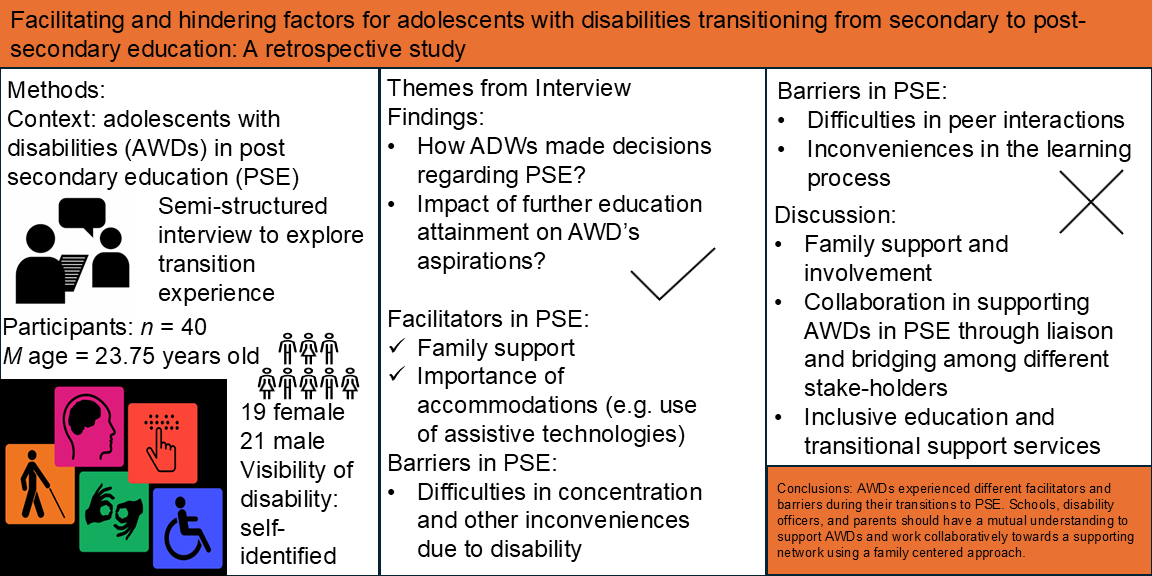
Participants were recruited through sending invitation letters to special schools and mainstream secondary schools, non-government organizations, and self-help groups serving young adults with disabilities in the community. Forty interviewees were recruited; 19 were female and 21 were male, with a mean age of 23.75 years old. A person’s disability visibility is determined by self-identification. The nature of disability (visible or invisible disabilities) amongst the interviewees were approximately equal. The socio-demographic characteristics of each interviewee can be found in Table 1. Supplementary Materials are available after the conclusions.

3.2. Data Collection Procedures

The research team conducted semi-structured in-depth interviews with ADWs to understand their experiences of the secondary-to-PSE transition. The interview data was a part of a commissioned study on school-to-work transition of young persons with disabilities in Hong Kong. Forty in-depth interviews were conducted from January 2020 to October 2021. Ethical approval was obtained from the affiliated university, and informed consent was obtained from each participant in the in-depth interviews. The research team recruited interviewees through various NGOs and schools. The selection criteria for participants of the in-depth interviews were as follows: (a) young ADLs diagnosed with disability by a medical professional, and (b) aged 16 to 30 years old. A person’s disability visibility is determined by self-identification. Data collection was conducted by research assistants or members of the research team. The in-depth interview guides can be found in Supplementary Sections S1 and S2. In-depth interviews were conducted in Cantonese, and each lasted approximately 45 to 60 min. Member checks were completed after the interviews, to verify the trustworthiness of the data [40]. All transcripts were recorded, professionally transcribed, and checked by the principal investigator and research assistants. Data collected from the in-depth interviews were imported into NVivo 12 for analysis.

3.3. Data Analysis

Braun and Clarke’s [41] six phases of thematic analysis were used. Initial codes were generated after repeated readings of the transcripts by the principal investigator and the research assistants. The research questions guided the analysis, where we applied an open-coding, thematic approach [41]. Initial codes were collated into potential themes related to the study. Potential themes were reviewed and assigned with meanings before the themes were collated into the final report. Representative quotes of each theme were selected to help illustrate different perspectives [41]. Reflexivity was employed to critically review the authors’ perspectives [42]. The deliberations and reflections among the authors provided the context in which to sensitize each other about each author’s respective assumptions and inform the final decisions recorded here.

4. Results

The findings were organized into five levels with reference to the ecological model, from microsystem, mesosystem, exosystem, macrosystem, and chronosystem. In each system, facilitators and barriers are identified. Table 2 shows the overview of the themes at each level.

4.1. Facilitators and Barriers in Microsystems of ADWs

4.1.1. Enhancing Self-Determination and Personal Aspiration in PSE

In the microlevel, self-determination and personal aspiration on educational attainments have created meaning in PSE and widened interests, social networks and career aspiration. Most ADWs were able to make autonomous decisions regarding their PSE studies. ADWs selected study programs with respect to their interests and career aspirations, usefulness, and anticipated difficulties. Despite ADWs anticipating PSE being difficult, they were willing to try and rather considered vocational rehabilitation a “hiding place” because teachers and social workers “particularly cared about our needs”.
ADWs are known to have a harder road ahead of them. Acquiring PSE is often regarded as a motivator towards social mobility and broadens the scope of competitive employment opportunities for ADWs. Those ADWs without PSE consider their future as “relatively difficult” compared to ADWs with PSE. Also, some ADWs regarded PSE to be not just about educational attainment, but PSE also helped in broadening their social networks.
“What I gained from this institution is knowledge and social networks…far more important than the graduation certificate.”
[Student in skills training center with dyslexia, ADHD, and high-functioning autism, aged 19, M, Interviewee #28]

4.1.2. Feeling Stigmatized by Perceived Limitations, Negative Views on PSE and Future Outlook

On the contrary, perceived limitations caused by disabilities have created doubts on usefulness of PSE and a negative outlook on future life and career pursuit. ADWs reported various learning challenges encountered in the context of PSE. First, difficulties in concentration were a consistent theme amongst ADWs with mental and emotional impairment and ADHD, which jeopardized their academic performance. ADWs felt that concentration difficulties led to “slow reactions”, irrelevant “thoughts running in my brain.. unstoppable” and “emotion management issues”.
“I think ADHD affected my study at university… When comparing [to] others, I cannot concentrate for a long time in class.”
[University student with ADHD, aged 21, F, Interviewee #1]
“We cannot concentrate [during learning]. If the stress level is too high, auditory hallucinations may arise which interfere and are harmful to learning.”
[University student with depression, aged 23, M, Interviewee #12]
ADWs who attended special schools prior to PSE found their new chapter of life particularly challenging, requiring extra effort because there was an absence of intensive and personalized support in PSE.
“In the past [attend school in special education settings], there were six students in class…I could ask the teacher individually when I didn’t understand what was taught in the class. I now feel uneasy and frustrated, as I now have 50 classmates. It has become a barrier to my learning.”
[Higher diploma student with physical disability, aged 21, F, Interviewee #33]
However, some ADWs had additional considerations in making PSE decisions given the instability of their condition. Interviewee #35 reported that her visual impairment limited her choice of subject areas.
“I did not select science subjects [at university] because there is a requirement of accuracy in scientific experiments.”
[University student with visual disability, aged 18, F, Interviewee #35]
Some ADWs also doubted the usefulness of PSE and realized that PSE did not provide them with more opportunities for the future as they envisioned. “[PSE] does not mean you can obtain a job” and “PSE does not make it easier for me in job-seeking”; rather, ADWs described their future as bleak as they feel hugely disadvantaged by their disability, having a negative outlook in life, “losing at the start line”, and “feeling inferior” even after they attained PSE.

4.2. Family, Peer, and Instrumental Supports and Barriers in the Mesosystem of ADWs

4.2.1. Contextual Support from Family, Peer, and Institutions

Family involvement and support, peers in PSE, instrumental support, and linking to PSE have enhanced the transitional experience in academic, social, and vocational functions.
“I think my family cares about me the most. My parents care for me, and they understand my difficulties. They support me emotionally.”
[Unemployed young person with physical disability and hearing impairment, finished a diploma, aged 27, F, Interviewee #4]
“My family members are all very supportive.”
[University student with chronic illness, aged 26, M, Interviewee #25]
Supportive peers have brought positive influence not only on social interactions, but also in part-time job opportunities referred to by peers, and stronger academic and occupational engagement. For example, Interviewee #16 did not limit the scope of his job-seeking for a very different reason. He wanted to conduct a broader job search to allow himself to gain a wide range of experiences as encouraged by peers.
“I am going to find a job and try it first. If I like it, I would stay. I know there are limited job opportunities. But I want to explore variety of them before I decide my career path.”
[Young person working part-time with ADHD, graduated from secondary school (mainstream), aged 19, M, Interviewee #16]
Despite encountering numerous challenges and obstacles, ADWs identified the support conducive to their learning at university. Assistive technologies were significant instrumental facilitators. “Everything is electronic… so we can read it easily.” One ADWs with visual disability reported:
“…we need to use assistive technology software on computers… according to the software [the text needs to be enlarged] to a [certain degree according to] vision level. Simply put, my software for enlarging [text] needs to enlarge the text of the whole screen to 12 times,”
[Young person working full-time with visual disability, graduated from university, aged 28, M, Interviewee #24]
Within the mesosystem, other significant linking agents include social workers, and counselors were often mentioned by the interviewees as a source of support in transition:
“[NGO] helped me a lot, but they [focus] those [ADWs] who obtained PSE in university, so getting into university successfully is an important milestone; otherwise, the chance of [obtaining] a job is dim.”
[Young person working full-time with physical disability, graduated from university, aged 26, F, Interviewee #18]

4.2.2. Unfavorable Contextual Factors in Family, Peers, and Institutions

Family was sometimes mentioned as a major source of support. Informants generally treasured the emotional support from their family members. However, some ADWs found that parents offered limited support, due to a lack of understanding and knowledge about the current labor market.
“My family does not understand this issue [finding jobs]. They are not helpful.”
[Unemployed young person with chronic illness, finished a Master’s degree, aged 25, M, Interviewee #2]
“I seldom talk to my parents because of their relatively low level of education, and they do not know how competitive the current labour market is. We have different mindset of job-seeking.”
[University student with physical disability and hearing impairment, aged 28, F, Interviewee #5]
Social interaction is a critical aspect of PSE. ADWs with visible disabilities in general did not report interpersonal difficulties with their peers at school. However, it was common for ADWs with invisible disabilities. A problem that arises was as follows: “hardest thing was… to cooperate with others…accept others’ views”. Other ADWs worried that their symptoms from their disability were not well-accepted by peers, being “last student to be included in a project group as usual”. ADWs who were on medication reported the side-effects aggravated their interpersonal difficulties.
“I often speak more slowly when I am doing a group presentation. It has embarrassed my course mates. I know they do not like me.”
[University student with depression and psychosis, aged 21, M, Interviewee #8]
“Conflicts with my classmates? I think I initially have problems living with my classmates. Medication makes things even worse.”
[University student with ADHD, aged 21, F, Interviewee #30]

4.3. Inclusive Education as a Policy and the Availability of Transitional Support Services in Exosystem

Other ADWs reported flexible examination arrangements and “extra time in examinations” and “deadline extensions” were important accommodations provided by PSE for ADWs to overcome their limitations and unleash their full potential. Also, the provision of assistive technology such as “speaking function” for visually impaired ADWs was crucial for adapting to PSE. Such arrangements can facilitate ADWs towards better symptom management and overcome limitations from their disability so they can strive to learn and make the most out of the PSE journey.
“I need to attend medical follow-ups, the university exercises flexibility in my case, allowing me to attend other available class time slots.”
[University student with depression, aged 23, M, Interviewee #12]
“Sometimes exams are only 2 to 3 h long. This makes me quite nervous. Having more time would alleviate my situation by allocating 60 to 70% of the time to complete the exam. [If not] I would be very nervous and forget the things that I had studied.”
[University student with ADHD, aged 21, F, Interviewee #1]
“I sat exams with a take-home arrangement, so it is like I wrote an essay in a given timeframe. Yes, I was given extensions [deadline extensions], but had take-home exams. That means other students may have to attend the exam on campus, but I can [complete the exam] at home.”
[Young person working full-time with visual impairment, graduated from university, aged 28, M, Interviewee #24]
Some ADWs reported that some schools’ arrangements impeded their learning whereby some accommodation was not appropriate and sometimes did not cater to their needs, jeopardizing their learning process in PSE.
“the attitude of the professors towards disability is very important. [For example], it is necessary for the professor to wear a microphone in class, so that his or her voice can be directly transmitted to my hearing aid…. In the past, there was a professor who rejected wearing it [microphone]… At the end he agreed to wear… I rather unwilling [ly]. The professor was not considerate… the professors’ awareness of disability should be strengthened and they should know how to accommodate us.”
[University student with hearing disability, aged 22, F, Interviewee #10]
“I got used to getting into classrooms via the same route every semester, but some professors preferred to conduct a class on the lawns, or they suddenly switched to another classroom by sending us an email two hours prior to class. This makes me feel panicky…you need to give me at least one day in advance to overcome anxiety.”
[University student with visual disability, aged 23, M, Interviewee #22]

4.4. A Negative Self-Perception and Disability Disclosure in Chinese Culture in the Macrosystem of ADWs

As some informants in the study described the difficulties that impeded their learning due to inadequate accommodation, they generally felt uneasy in disclosing their disability. Although accommodation is in place, ADWs may still encounter attitudinal barriers. Some informants were uneasy about disclosing their disability, as they did not want to draw unwanted attention and be misunderstood as taking advantage of their disability. Disability disclosure was a common issue among young PWDs. Disability is a label that confers uneasiness. The label embarrassed young PWDs when they were with their classmates. They felt uncomfortable about disclosing their disability to others at university, because it drew unwanted special attention.
“More than often [professors] intentionally came to me in person because they wanted to know my exam schedule or asked me if I needed more time [during exams]. I don’t like the way they reached out to me—my disability may be overheard by others, as they spoke loudly.”
[University student with ADHD, aged 21, F, Interviewee #1]
“When filling in the admission form, there should be a question asking if you have a disability. If you indicate it, you will be treated specially. But you don’t know how they [university staff] will perceive you and don’t know how they will handle your case.”
[University student with depression and psychosis, aged 21, M, Interviewee #8]
Some young PWDs worried that others may think that they wanted special treatment by disclosing their disability.
“Perhaps my academic performance at university is not bad, so some of my classmates who know my situation [my disability] said: Well, your disability is not serious, and it is hard for others to notice it. It sounded like they were saying that I wanted [use my disability] to take advantage [of my disability].”
[University student with ADHD, aged 21, F, Interviewee #30]

4.5. Continuous and Age-/Stage-Related Support During Transitions in the Chronosystem

Informants seldom mentioned any transitional support between secondary and post-secondary education levels. Some transitional support services mainly focused on the transition from school to work in special schools or skill centers offered by social workers.
“Social workers in the youth employment training programs understand my situation and referred me to suitable vocational training programs.”
[Unemployed young person with physical disability and high-functioning autism, graduated from secondary school (special), aged 25, M, Interviewee #19]
“Their [social workers] opinions are crucial, especially in my journey of job-seeking.”
[Unemployed young person with ASD and ADHD, finished secondary 3 (special), aged 18, M, Interviewee #14]
Some university students with disabilities considered the career support services provided by their university as not relevant to their special needs.
“The career centre does have some workshops which provide opinions [to us], like the one offered by the Labour Department, but I think there is nothing special and I am not impressed.”
[University student with ADHD, aged 21, F, Interviewee #1]

5. Discussion

The results of this study aligned with previous research are that ADWs in PSE tend to make decisions in consideration of their disability. This aligns with the development of disability identity. ADWs were able to shape their purpose and made meaning of their disability. ADWs in this study were able to demonstrate self-determination, with a central focus towards self-selected goals [24]. The results from this study corroborate the different systems as suggested by the ecological model [6] and also align with the different components of the taxonomy of transition at various levels: (a) student-focused planning, and student development; (b) family involvement at the mesosystem level; and (c) the importance of collaboration.
At the microsystem level of the ADWs as individuals, there are fundamental differences between secondary school and PSE in terms of structure, which demands ADWs’ self-regulation and autonomy, as PSE has vast majority of options for ADWs to explore [15]. Students who have not been actively involved in transition planning in secondary school may struggle in the college environment. However, the accommodation process in PSE has been found to involve excessive bureaucratic procedures and numerous rules [43,44]. It is very likely that without accommodation, ADWs will not succeed [15]. Therefore, ADWs should be encouraged to participate in tailored transition planning to boost their self-efficacy, empowering them to make informed choices during the early stages of PSE.
The academic success of ADWs is dependent on the willingness of academic staff to provide support to ADWs. However, some informants, on the other hand, are often reluctant to disclose their condition in fear of differential and discriminatory treatment from their professors and peers [6]. Research has indicated that faculty members in PSE had negative attitudes towards disability and were untrained, insensitive to students’ needs, and unwilling to provide the accommodations to which students were entitled [45]. ADWs in PSE often require accommodations and it is critical towards their academic success [46]. Some informants reported that they found academic staff very supportive, and it is important to foster their potential. Research has highlighted that ADWs disclosed their condition in person when they had a good rapport with their professor and when professors have positive behaviors, such as supporting gestures and encouraging an enabling environment, ADWs will be more willing to disclose their disability [47]. Thus, it is important to enhance the disability awareness of faculty staff in the aspect of providing accommodation.
In terms of environmental mastery, physical accessibility is another barrier. Whilst accommodation is often restricted within the PSE campus, students’ experiences on campus are part of a wider continuum of their daily experiences, surrounding issues such as housing and transportation, which have a detrimental impact towards ADWs’ ability to participate and succeed in PSE [7]. The physical inaccessibility of campuses also proves a lack of awareness or low priorities in the operation of PSE [7]. Some informants also highlight the issues regarding pedagogy and curriculum design accessibility, like a recent study conducted by Marom and Hardwick [7]. Non-inclusive classroom designs impacted ADWs’ learning process and sense of belonging in the classroom. The provision of different modalities is crucial to serve the diverse needs and abilities of students [7].
The importance of family support and involvement emphasized from Chinese culture and collaboration in supporting ADWs in PSE through liaison and bridging among different stakeholders. Parents are generally supportive of their studies, offering emotional support but some are incapable of providing support due to lack of understanding. Support systems are critical in facilitating ADWs’ positive identity development [48,49]. As informants in this study emphasized that the previous support in secondary school or special school is no longer available, the family may be able to step in and fill the gap. Given the emphasis of family in Chinese cultures, the family being willing to provide for ADWs and prolong parenting well into adulthood is common [11]. Family support is strong, and parents are deeply dedicated to their children’s upbringing [24]. Parents with ADWs tend to be involved in their transitional planning. Some parents may opt for an accelerated transition, whilst others opt for a more gradual approach [50]. However, parents, despite wanting to engage in their ADW children’s transition in special schools and realizing it being important, report a lack of information regarding transition planning [51]. Another study revealed that parents of ADWs valued communication as the most helpful tool in engaging the parents in the transitioning planning of their ADW children, whilst the collaboration of services were the least helpful. This further revealed that there is a need to collaborate and develop connections with schools and parents to foster better parent engagement in school–parent collaboration [51]. This study suggests that mutual understanding of ADWs’ goals and aspirations is important; relevant workshops and training programs should also be introduced to enable parents’ participation in ADWs’ learning process.
This demonstrates that ADWs in this study have a negative perception towards their disability, and this also may affect their self-identity. Strategies should be in place to enhance ADWs’ disability acceptance. Disability acceptance enables individuals to view themselves positively and improves their self-esteem and social participation [48]. The process towards disability acceptance accompanies value change and facilitates individuals to overcome feelings of inferiority and shame resulting from disability [52]. This may offer an explanation why accommodation is often underutilized, due to the low rate of disability disclosure [6] and the emphasis on self-identification. Therefore, initiatives are needed to better prepare faculty staff to support students with disabilities to help them identify lifegoals, strengths, and potentials [15].
Yet, there are still factors that are beyond ADWs’ control, such as the disability awareness of faculty members and peer interactions difficulties. This suggests that to facilitate ADWs’ transition into PSE, a holistic approach should be taken. This is to say, support should not be only targeted at an individual level only but target different stakeholders as well. Transitional support should not be placed on the shoulders of institutions alone, or the family. The literature on transitional research highlights the importance of individualized planning and the coordination of services [46]. Non-profit organizations can help address gaps among schools and agencies by providing students with experiences, connections, and support that will prepare them for adulthood [53]. PSE campuses can encourage students with disabilities to act as advocates and educators about their disability. The disability services unit in PSE can act as a liaison between faculty members and ADWs to foster mutual understanding, facilitate accommodation, and ensure a smooth transition.
Disability offices in PSE have an important mediating role in providing accommodation and ensuring students have access to the resources and support they require [53]. The special needs coordinator can connect with outside agencies to promote campus accessibility and assist in creating an inclusive campus culture through ambassador or mentoring programs. The results of this study corroborate that ADWs in PSE often face problems in social interaction. Students with disabilities often find that, in the culture of PSE, it is difficult to make friends [54]. Some students found it difficult to manage their social life at university [43]. However, such resources require sustainable funding, so it is suggested that the disability services in PSE should be supported by a recurrent government expenditure. It has been suggested that there should be a paradigm shift in PSE institutions to move beyond a framework of accessibility and accommodation to a culture of access where the needs of disability students are included as a default [7].
ADWs should have equal access to PSE [55]. ADWs should be empowered to make independent decisions, and transition planning should be person-centered and timely at the chronosystem level [56]. ADWs are not passive participants of their own transitions. Thus, this study demonstrates the importance of student-focused planning and student development, which are two of the taxonomies of transitions as suggested by Kohler and colleagues [35]. Individualized planning and positive student development may be particularly important as ADWs are generally perceived as dependent and inferior in Chinese culture. ADWs in Chinese culture may be predisposed to negative self-perceptions and may, therefore, internalize such negative expectations and have certain mental reactions that affect ADWs’ values, attitudes, and life-planning styles [57]. This internalization may lead to a self-fulfilling prophecy related to disability and affect ADWs’ motivation. ADWs with low perceived acceptance from society will be less motivated.

Limitations

This is perhaps the first exploratory study from an ecological perspective to understand the PSE transitions of ADWs in a Chinese context. Hence, the findings should be interpreted with caution. There are several limitations to the present study. The number of participants was biased towards those with physical or hearing disability. Researchers who do not want to limit their sample to certain forms of disability should at least acknowledge the variety in the data [58]. This also limits the generalizability of the results of this study, making it difficult to understand whether different disabilities differed in experience. In Hong Kong universities, unlike their Western counterparts, disability is based on self-report and identification [16]; only a small number of students choose to report their disability to receive support. Many of them choose not to disclose it because stigmatization is at stake, and they feel there is often no additional benefit. There was difficulty in participant recruitment and a small sample size. Researchers have highlighted that disability research is complex, there is great heterogeneity within the construct, and significant variability exists even within one type of disability [59]. The major limitation of this study is that the authors acknowledge the fact that a broad range of disability types were included in this study to capture the breadth of experiences of ADWs. This also limits the generalizability of the results of this study. Future studies should employ a quantitative approach to measure the role of different facilitators and barriers towards school-to-work transitions of ADWs. Also, the experience of different stakeholders such as social workers and teachers should be included for gaining understanding of a bigger picture.

6. Conclusions

This study revealed that the barriers faced by ADWs in PSE are a multi-level issue, as the ecological model suggests. First, from an individual-level perspective, ADWs should be empowered within the PSE environment, such that they can be fostered to reach their potential. Despite having disability, ADWs can breakthrough a negative spiral and believe that they are capable of success in PSE. There is no universal experience of disability. Physical and social barriers impact ADWs in PSE in diverse ways. The experiences of ADWs in this study are related to social positioning. ADWs in this study have experienced different facilitators and barriers during their transitions in PSE. Schools, disability officers, and parents should have mutual understanding in supporting ADWs and work collaboratively. It was recommended that a supporting network should be established between secondary schools and post-secondary institutions to enhance smooth transition across different education sectors. Moreover, a family-centered approach should be adopted to develop mutual understanding between the ADWs and different support systems, including the schools, special educational needs coordinators, the parents, and other personnel in the two school systems. This research study also provides important policy implications and targets the individual level and macro level in terms of enhancing the disability awareness of the community. Strategies should be in place to foster a warm and supportive PSE environment whilst offering training to teachers and students. Despite disabilities, ADWs can succeed in PSE, given various support, and be the potential talent in the community.

Supplementary Materials

The following supporting information can be downloaded at https://www.mdpi.com/article/10.3390/adolescents6010005/s1. Section S1. Study on Effective Strategies to Facilitate School-to-work Transition of Young Persons with Disabilities in Hong Kong—Young persons with disabilities studying at post-secondary institutions. In-depth Interview guide (approx. 1.5 h). Section S2. Study on Effective Strategies to Facilitate School-to-work Transition of Young Persons with Disabilities in Hong Kong—Young persons with disabilities graduated from post-secondary institutions. In-depth Interview guide (approx. 1.5 h). For more supplementary materials, please see: https://www.eoc.org.hk/en/policy-advocacy-and-research/research-reports/2023-2 (accessed on 15 December 2025).

Author Contributions

Conceptualization, C.K.K. and A.N.N.H.; methodology, C.K.K. and A.N.N.H.; software, P.S.Y.I.; validation, C.K.K. and A.N.N.H.; formal analysis, C.K.K. and P.S.Y.I.; investigation, C.K.K.; resources, C.K.K. and A.N.N.H.; data curation, C.K.K.; writing—original draft preparation, A.N.N.H., C.K.K. and P.S.Y.I.; writing—review and editing, C.K.K. and A.N.N.H.; visualization—C.K.K.; supervision, C.K.K.; project administration, C.K.K.; funding acquisition, C.K.K. and A.N.N.H. All authors have read and agreed to the published version of the manuscript.

Funding

This research was funded by the EQUAL OPPORTUNITIES COMMISSION, grant number 9211188.

Institutional Review Board Statement

The study was conducted in accordance with the Declaration of Helsinki and approved by the Human Subjects Ethics Sub-Committee of the CITY UNIVERSITY OF HONG KONG (Reference Number: 3-6-201908-02 approval on 13 September 2019).

Informed Consent Statement

Informed consent was obtained from all subjects involved in the study.

Data Availability Statement

The authors do not have permission to share the research data.

Acknowledgments

The authors would like to acknowledge the Equal Opportunities Commission for their funding support and the participants taking part in the interviews.

Conflicts of Interest

The authors declare no conflicts of interest. The funder had no role in the design of the study; in the collection, analyses, or interpretation of data; in the writing of the manuscript; or in the decision to publish the results.

Abbreviations

The following abbreviations are used in this manuscript:
ADWAdolescent with disabilities
PSEPost-secondary education
ADHDAttention Deficit and Hyperactivity Disorder
SS Special school
MSMainstream school
FTFull-time
PTPart-time

References

  1. Census and Statistics Department HKSAR. Hong Kong Poverty Situation Report on Disability 2013. 2014. Available online: https://www.censtatd.gov.hk/en/EIndexbySubject.html?pcode=B9XX0001&scode=461 (accessed on 20 August 2025).
  2. Census and Statistics Department HKSAR. Social Data Collected via the General Household Survey: Special Topics Report—Report No.62—Persons with Disabilities and Chronic Diseases. The HKSAR Government, 2014. Available online: https://www.censtatd.gov.hk/en/data/stat_report/product/C0000055/att/B11301622014XXXXB0100.pdf (accessed on 20 August 2025).
  3. Tuomi, M.; Lehtomäki, E.; Matonya, M. As capable as other students: Tanzanian women with disabilities in higher education. Int. J. Disabil. Dev. Educ. 2015, 62, 202–214. [Google Scholar] [CrossRef]
  4. Sanford, J.; Milchus, K. Evidence-based practice in workplace accommodations. Work 2006, 27, 329–332. [Google Scholar] [CrossRef]
  5. Dutta, A.; Kundu Madan, M.; Schiro-Geist, C. Coordination of postsecondary transition services for students with disabilities. J. Rehabil. 2009, 75, 10–17. [Google Scholar]
  6. Lindsay, S.; Duncanson, M.; Niles-Campbell, N.; McDougall, C.; Diederichs, S.; Menna-Dack, D. Applying an ecological framework to understand transition pathways to post-secondary education for youth with disabilities. Disabil. Rehabil. 2017, 40, 277–286. [Google Scholar] [CrossRef]
  7. Marom, L.; Hardwick, J. From access to inclusion: A call for a cultural shift in higher education. High. Educ. 2025, 89, 513–534. [Google Scholar] [CrossRef]
  8. Stewart, J.M.; Schwartz, S. Equal education, unequal jobs: College and university students with disabilities. Ind. Relat. 2018, 73, 369. [Google Scholar] [CrossRef]
  9. Wehmeyer, M.L.; Palmer, S.B.; Lee, Y.; Wiliams- Diehms, K.; Shogren, K. A randomized-trial evaluation of the effect of Whose Future Is It Anyway? On self-determination. Career Dev. Transit. Except. Individ. 2011, 34, 45–56. [Google Scholar] [CrossRef]
  10. Test, D.W.; Fowler, C.H.; Richter, S.M.; White, J.; Mazzotti, V.; Walker, A.R.; Kohler, P. Evidence-based practices in secondary transition. Career Dev. Transit. Except. Individ. 2009, 32, 112–128. [Google Scholar] [CrossRef]
  11. Lin, F.; Levy, S.; Campbell, F.K. Disability and employment in China: A Guangzhou case study. Disabil. Soc 2024, 40, 1646–1668. [Google Scholar] [CrossRef]
  12. Dong, S.; Oire, S.; MacDonald-Wilson, K.; Fabian, E. A comparison of perceptions of factors in the job accommodation process among employees with disabilities, employers and service providers. Rehabil. Couns. Bull. 2012, 56, 182–189. [Google Scholar] [CrossRef]
  13. Barnard-Brak, L.; Schmidt, M.; Wei, T. Providing postsecondary transition services to youth with disabilities: Results of a pilot program. J. Postsecond. Educ. Disabil. 2013, 26, 135–144. [Google Scholar]
  14. Anctil, T.M.; Ishikawa, M.E.; Tao Scott, A. Academic identity development through self-determination: Successful college students with learning disabilities. Career Dev. Transit. Except. Individ. 2008, 31, 164–174. [Google Scholar] [CrossRef]
  15. Newman, B.M.; Kimball, E.W.; Vaccaro, A.; Moore, A.; Troiano, P.F. Diverse pathways to purpose for college students with disabilities. Career Dev. Transit. Except. Individ. 2019, 42, 111–121. [Google Scholar] [CrossRef]
  16. Chan, B.L.F.; Yeung, P.P.S. Support for students with special educational needs in universities in Hong Kong: An overview of the issues. In Careers for Students with Special Educational Needs, Advancing Inclusive and Special Education in the Asia-Pacific; Yuen, M., Beamish, W., Scott, V., Solberg, H., Eds.; Springer Nature Singapore Pte Ltd.: Singapore, 2020; pp. 233–248. [Google Scholar]
  17. Flaherty, M.; Roussy, A. A failed game changer: Post-secondary education and the Accessibility or Ontarians with Disabilities Act. Educ. Law. J. 2013, 24, 1–23. [Google Scholar]
  18. Pennington, A. Disability disclosure: A literature review. J. Occup. Psychol. 2010, 12, 51–59. Available online: https://www.valeofglamorgan.gov.uk/Documents/Living/Social%20Care/Disability/Adult-Autism-Advice-Employment/Additional-Materials---Session-5---Disclosure/Article-on-Disability-Disclosure.pdf (accessed on 20 August 2025).
  19. Thornicroft, G.; Rose, D.; Kassam, A.; Sartorius, N. Stigma: Ignorance, prejudice or discrimination? Br. J. Psychiatry 2007, 190, 192–193. [Google Scholar] [CrossRef] [PubMed]
  20. Lindsay, S.; Cancelliere, S. A model for developing disability confidence. Disabil. Rehabil. 2017, 40, 2122–2130. [Google Scholar] [CrossRef]
  21. Forber-Pratt, A.J.; Lyew, D.A.; Mueller, C.; Samples, L.B. Disability identity development: A systematic review of the literature. Rehabil. Psychol. 2017, 62, 198–207. [Google Scholar] [CrossRef] [PubMed]
  22. Forber-Pratt, A.J.; Minotti, B.J.; Burdick, C.E.; Kate Brown, M.; Hanebutt, R.A. Exploring disability identity with adolescents. Rehabil. Psychol. 2021, 66, 550–564. [Google Scholar] [CrossRef] [PubMed]
  23. Lindsay, S.; Adams, T.; Sanford, R.; McDougall, C.; Kingsnorth, S.; Menna-Dack, D. Employers’ and employment counselors’ perceptions of desirable skills for entry-level positions for adolescents: How does it differ for youth with disabilities? Disabil. Soc. 2014, 29, 953–967. [Google Scholar] [CrossRef]
  24. Baker, D.; McCabe, H.; Kelly, K.; Jiang, T. 100 Years from now: Comparing parental perspectives about Supports for Adults with Autism in the USA and China. Adv. Autism 2020, 6, 241–254. [Google Scholar] [CrossRef]
  25. Yang, L.H.; Kleinman, A. ‘Face’ and the embodiment of stigma in China: The cases of schizophrenia and AIDS. Soc. Sci. Med. 2008, 67, 398–408. [Google Scholar] [CrossRef] [PubMed]
  26. Morningstar, M.E.; Lombardi, A.; Fowler, C.H.; Test, D.W. A college and career readiness framework for secondary students with disabilities. Career Dev. Transit. Except. Individ. 2017, 40, 79–91. [Google Scholar] [CrossRef]
  27. Ye, K.; McCoy, S. Examining the post-school decision-making and self-determination of disabled young adults in Ireland. Disabilities 2024, 4, 459–476. [Google Scholar] [CrossRef]
  28. Yang, L.; Chiu, H.M.; Sin, K.F.; Lui, M. The effects of school support on school engagement with self-determination as a mediator in students with special needs. Int. J. Disabil. Dev. Educ. 2022, 69, 399–414. [Google Scholar] [CrossRef]
  29. Shogren, K.A.; Wittenburg, D. Improving outcomes of transition-age youth with disabilities: A life course perspective. Career Dev. Transit. Except. Individ. 2020, 43, 18–28. [Google Scholar] [CrossRef]
  30. Yates, S.; Harris, A.; Sabates, R.; Staff, J. Early occupational aspirations and fractured transitions: A study of entry into ‘NEET’ status in the UK. J. Soc. Policy 2011, 40, 513–534. [Google Scholar] [CrossRef]
  31. Law, B.M.F.; Shek, D.T.L. Services for people with intellectual and developmental disabilities in Hong Kong. In Health Care for People with Intellectual and Developmental Disabilities Across the Lifespan; Rubin, I.L., Merrick, J., Greydanus, D.E., Patel, D.R., Eds.; Springer: New York, NY, USA, 2016; pp. 471–481. [Google Scholar] [CrossRef]
  32. Hirano, K.A.; Rowe, D.; Lindstrom, L.; Chan, P. Systemic barriers to family involvement in transition planning for youth with disabilities: A qualitative metasynthesis. J. Child. Fam. Stud. 2018, 27, 3440–3456. [Google Scholar] [CrossRef]
  33. Povenmire-Kirk, T.; Diegelmann, K.; Crump, K.; Schnorr, C.; Test, D.; Flowers, C.; Aspel, N. Implementing CIRCLES: A new model for interagency collaboration in transition planning. J. Vocat. Rehabil. 2015, 42, 51–65. [Google Scholar] [CrossRef]
  34. Albanese, A.M.; Russo, G.R.; Geller, P.A. The role of parental self-efficacy in parent and child well-being: A systematic review of associated outcomes. Child Care Health Dev. 2019, 45, 333–363. [Google Scholar] [CrossRef]
  35. Kohler, P.D.; Gothberg, J.E.; Fowler, C.; Coyle, J. Taxonomy for Transition Programming 2.0: A Model for Planning, Organizing, and Evaluating Transition Education, Services, and Programs; Western Michigan University: Kalamazoo, MI, USA, 2016; Available online: https://transitionta.org (accessed on 20 August 2025).
  36. Haegele, J.A.; Hodge, S. Disability discourse: Overview and critiques of the medical and social models. Quest 2016, 68, 193–206. [Google Scholar] [CrossRef]
  37. Shakespeare, T. The social model of disability. In The Disability Studies Reader, 5th ed.; Davis, L., Ed.; Taylor & Francis: New York, NY, USA, 2017; pp. 195–203. [Google Scholar]
  38. National Disability Authority. Ethical Guidance for Research with People with Disabilities. 2009. Available online: https://nda.ie/publications/ethical-guidance-for-research-with-people-with-disabilities-report (accessed on 20 October 2025).
  39. Creswell, J.W.; Poth, C.N. Qualitative Inquiry and Research Design: Choosing Among Five Approaches; Sage Publications: Thousand Oaks, CA, USA, 2016. [Google Scholar]
  40. Birt, L.; Scott, S.; Cavers, D.; Campbell, C.; Walter, F. Member checking: A tool to enhance trustworthiness or merely a nod to validation? Qual. Health Res. 2016, 26, 1802–1811. [Google Scholar] [CrossRef]
  41. Braun, V.; Clarke, V. Using thematic analysis in psychology. Qual. Res. Psychol. 2006, 3, 77–101. [Google Scholar] [CrossRef]
  42. Darawsheh, W. Reflexivity in research: Promoting rigour, reliability and validity in qualitative research. Int. J. Ther. Rehabil. 2014, 21, 560–568. [Google Scholar] [CrossRef]
  43. Mullins, L.; Preyde, M. The lived experience of students with an invisible disability at a Canadian university. Disabil. Soc. 2013, 28, 147–160. [Google Scholar] [CrossRef]
  44. Titchkosky, T. The bureaucratic making of disability. New Form. 2020, 100, 198–208. [Google Scholar] [CrossRef]
  45. Vergunst, R.; Swartz, L. Experiences with supervisors when students have a psychosocial disability in a university context in South Africa. Teach. High. Educ. 2022, 27, 695–708. [Google Scholar] [CrossRef]
  46. Ross-Lévesque, É.; Martin-Roy, S.; Julien-Gauthier, F.; Jacob, S.; Grandisson, M.; St-Pierre, M.-C.; Dahan-Oliel, N.; Lamontagne, M.-È.; Desmarais, C. Transition to adulthood of youth with disabilities: Mapping declared practices to recommended practices. J. Res. Spec. Educ. Needs 2024, 24, 542–554. [Google Scholar] [CrossRef]
  47. Cole, E.; Cawthon, S. Self-disclosure decisions of university students with learning disabilities. J. Postsecond. Educ. Disabil. 2015, 28, 163–179. Available online: https://files.eric.ed.gov/fulltext/EJ1074663.pdf (accessed on 20 August 2025).
  48. Jung, Y.H.; Kang, S.H.; Park, E.C.; Jang, S.Y. Impact of the acceptance of disability on self-esteem among adults with disabilities: A four-year follow-up study. Int. J. Environ. Res. Public Health 2022, 19, 3874. [Google Scholar] [CrossRef]
  49. Carroll, C. A review of the approaches investigating the post-16 transition of young adults with learning difficulties. Int. J. Incl. Educ. 2015, 19, 347–364. [Google Scholar] [CrossRef]
  50. Lo, L.; Bui, O. Transition planning: Voices of Chinese and Vietnamese parents of youth with autism and intellectual disabilities. Career Dev. Transit. Except. Individ. 2020, 43, 89–100. [Google Scholar] [CrossRef]
  51. Chang, W.H.; Lo, Y.Y.; Mazzotti, V.L.; Rowe, D.A.; Hung, P. Perceptions of parents of youth with disabilities toward school-based parent engagement. J. Fam. Stud. 2023, 29, 1847–1864. [Google Scholar] [CrossRef]
  52. Keany, K.C.; Glueckauf, R.L. Disability and value change: An overview and reanalysis of acceptance of loss theory. Rehabil. Psychol. 1993, 38, 199–210. [Google Scholar] [CrossRef]
  53. Bumble, J.L.; Carter, E.W.; Bethune, L.; Day, T.; McMillan, E. Community conversations on inclusive higher education for students with intellectual disability. Career Dev. Transit. Except. Individ. 2019, 42, 29–42. [Google Scholar] [CrossRef]
  54. Connor, D.J. Actively navigating the transition into college: Narratives of students with learning disabilities. Int. J. Qual. Stud. Educ. 2012, 25, 1005–1036. [Google Scholar] [CrossRef]
  55. Howell, S. Preparing for adulthood: Perspectives of young people with SEND on the transition from education to employment. Educ. Psychol. Pract. 2024, 40, 401–414. [Google Scholar] [CrossRef]
  56. Lawson, K.; Parker, R. How do young people with education, health and care plans make sense of relationships during transition to further education and how might this help to prepare them for adulthood? Educ. Child Psychol. 2020, 37, 48–67. [Google Scholar] [CrossRef]
  57. Chen, L.J. Effect of acceptance expectation on the employment development of individuals with disabilities: The self-fulfilling prophecy applied. J. Employ. Couns. 2015, 52, 98–109. [Google Scholar] [CrossRef]
  58. Dwertmann, D.J.G. Management research on disabilities: Examining methodological challenges and possible solutions. Int. J. Human Resour. Manag. 2016, 27, 1477–1509. [Google Scholar]
  59. Ren, L.R.; Paetzold, R.L.; Colella, A. A meta-analysis of experimental studies on the effects of disability on human resource judgments. Human Resour. Manag. Rev. 2008, 18, 191–203. [Google Scholar] [CrossRef]
Table 1. Demographic characteristics of participants of individual in-depth interviews.
No.GenderAgeEducational AttainmentStatusType(s) of Disability(-ies)
1Female21Year 2 undergraduateStudentADHD
2Male25Master’s graduateUnemployedChronic illness
3Male28Secondary school graduate (SS)UnemployedPhysical disability
4Female27Post secondary diplomaUnemployedMultiple (Physical disability and hearing disability)
5Female28Year 2 undergraduateStudentMultiple (Physical disability and hearing disability)
6Male30Secondary school
graduate (SS)
UnemployedPhysical disability
7Female27University graduateEmployed PTAutism spectrum disorder
8Male21Year 2 undergraduateStudentMental illness (Depression and psychosis)
9Male18Secondary 6 (SS)StudentIntellectual disability
10Female22Year 4 undergraduateStudentHearing disability
11Female16Secondary 4 (MS)StudentIntellectual disability (Down syndrome)
12Male23Year 2 undergraduateStudentMental illness (Depression)
13Male26Year 4 undergraduateStudentMultiple (ADHD, Bipolar disorder, generalized anxiety disorder
14Male18Secondary school leaver (Secondary 3) (SS)UnemployedMultiple (autism spectrum disorder and ADHD)
15 *Male24Secondary school graduate (SS)Employed FTMultiple (Specific Learning disability and ADHD)
16 *Male19Secondary school graduate (MS)Employed PTADHD
17 *Female28Secondary school (MS)Employed FTAutism spectrum disorder
18 *Female26University graduateEmployed FTPhysical disability
19 *Male25Secondary school graduate (SS)UnemployedMultiple (Physical disability and high-functioning autism)
20 *Female30University graduateEmployed FTHearing disability
21 *Female30VTC’s Shine Skills
Centre graduate
Employed FTHearing disability
22 *Male23Year 3 undergraduateStudentVisual disability
23 *Female29University graduateEmployed PTVisual disability
24 *Male28University graduateEmployed FTVisual disability
25 *Male26Year 4 undergraduateStudentChronic illness
26 *Male30University graduateEmployed FTMental illness
27 *Male22VTC’s Shine Skills Centre studentStudentIntellectual disorder
28 *Male19VTC’s Shine Skills Centre studentStudentMultiple (Dyslexia, ADHD, and high-functioning autism)
29 *Male16Secondary 4 (MS)StudentAutism spectrum disorder
30 *Female21Year 3 undergraduateStudentADHD
31 *Female23Year 4 undergraduateStudentPhysical disability
32 *Female20Year 3 undergraduateStudentVisual disability
33 *Female21Year 1 post-secondary diplomaStudentPhysical disability
34Female23Year 4 undergraduateStudentVisual disability
35 *Female18Year 2 undergraduate Bachelor’s
degree
StudentVisual impairment
36Male29Secondary school
graduate (SS)
UnemployedIntellectual disability
37Male30Secondary school
graduate (MS)
Unemployed Autism spectrum disorder
38 *Female25University graduateUnemployedDepression, psychosis
39 *Male30Secondary school
graduate (SS)
UnemployedAutism spectrum disorder
40Female30Secondary school completer (Secondary 3)UnemployedPhysical disability
SS: special education; MS: mainstream education. * conducted via zoom; FT: full-time; PT: part-time.
Table 2. Overview of themes of facilitators and barriers at each ecological level.
Ecological Model ComponentsFacilitatorsBarriers
MicrosystemsAutonomous decision makingLimitations caused by disabilities, e.g., concentration
Aspirations on educational attainment and future career Doubt on usefulness of PSE
Widened social networkNegative outlook on future
Mesosystem
Family involvement and PSEParental support Lack of knowledge among parents
Peers and PSESupportive peer support, e.g., part-time job engagementNegative experience in peer interactions
(Dis)ability and PSEInstrumental support on assistive technologies and accommodationLack of accommodation and instrumental support
Linking to PSE (intra and inter-agency collaboration)Active exploration of job and career pathUneasiness in disclosure to educators
Exosystem
PolicyFormal support on accessibility and accommodations Lack of barrier-free facilities in the community
Macrosystem
Societal attitudesAcceptance Stigma
ChronosystemAge/stage-related availability of career support servicesLack of career support services
Disclaimer/Publisher’s Note: The statements, opinions and data contained in all publications are solely those of the individual author(s) and contributor(s) and not of MDPI and/or the editor(s). MDPI and/or the editor(s) disclaim responsibility for any injury to people or property resulting from any ideas, methods, instructions or products referred to in the content.