1. Introduction
Marasmius Fr., typified by
Marasmius rotula (Scop.) Fr., is the type genus of the family Marasmiaceae Roze ex Kühner [
1]. The genus is distributed on all continents except Antarctica and is particularly diverse in tropical regions [
2,
3,
4,
5,
6,
7,
8,
9,
10,
11,
12,
13]. Approximately 700 species are currently recognized worldwide [
14]. Most species are saprotrophic, typically inhabiting woody debris or litter in forested environments, although some also occur on soil in grasslands [
12]. Members of the genus are not known to form ectomycorrhizae [
3]. Several species, such as
M. oreades (Bolton) Fr. and
M. heinemannianus Antonín, are edible and are traded in European and African markets, respectively [
15,
16]. Notably,
M. oreades is also recognized as a turfgrass pathogen and is considered economically important [
17,
18,
19].
Marasmius sect.
Globulares Kühner is characterized by medium- to large-sized tough basidiomata, often with a hygrophanous and ± sulcate pileus. The gills are spaced from distant to crowded and lack a collarium. The pileipellis is usually hymeniform, composed of smooth, non-diverticulate elements, although short branches may be present in some species (e.g., in
M. oreades) [
20,
21]. Basidiospores produce a white spore print and are smooth and ellipsoid to clavate; the hymenial trama is dextrinoid. Ecologically, species of this section are non-ectomycorrhizal and primarily occur on litter or soil in forested or grassland habitats, although some are known to be plant pathogens [
18,
19]. Phylogenetic studies based on LSU, SSU, ITS,
rpb2, and
ef1-α markers have demonstrated that
Marasmius is a complex and polyphyletic genus [
22,
23]. Furthermore, morphological and molecular studies of
Marasmius sect.
Globulares sensu Singer have revealed that species assigned to this section are intermixed across traditional sectional boundaries, leading to the proposal of further taxonomic subdivisions and further taxonomic subdivisions have since been proposed [
6,
23,
24,
25].
In Japan, seven species of sect.
Globulares have been reported:
M. aurantioferrugineus Hongo,
M. brunneospermus Har. Takah.,
M. macrocystidiosus Kiyashko & E.F. Malysheva,
M. maximus Hongo,
M. nivicola Har. Takah.,
M. oreades, and
M. purpureostriatus Hongo. Except for
M. oreades and
M. macrocystidiosus, all were originally described from Japan [
8,
9,
26,
27,
28,
29]. While
M. oreades typically occurs in turf habitats, the remaining Japanese species are mainly associated with forest environments. Nevertheless, several species of this section elsewhere in the world, such as
M. albogriseus (Peck) Singer,
M. heinemannianus,
M. oreades,
M. campestris N.K. Zeng, Zhi Q. Liang & M.S. Su,
M. collinus (Scopoli) Singer, and
M. pseudocollinus (Singer & Digilio ex Singer) Singer, are known to occur in turf habitats.
During surveys conducted in the Honshu region of Japan, we collected specimens of Marasmius sect. Globulares from turf environments. Detailed morphological examinations and molecular analyses revealed that these collections represent an undescribed taxon, distinguishable from known species by a unique combination of morphological characters and distinct DNA sequences. In this study, we describe this new species based on macro- and micromorphological observations in conjunction with molecular phylogenetic analyses. This study contributes to a better understanding of turf-inhabiting species of Marasmius sect. Globulares in East Asia.
2. Materials and Methods
Fresh basidiomata were photographed in situ with their surrounding habitat using a compact digital camera (TG-6, Olympus, Tokyo, Japan). Macromorphological features were examined shortly after collection in the laboratory. Color descriptions follow the color standards of Kornerup and Wanscher [
30], under ambient room light, using notations such as “orange white (5A2)” and “greyish orange (5B3–4)”. After macroscopic observations, specimens were dried for 48 h at 45 °C using a food dehydrator and preserved as dried vouchers for subsequent microscopic molecular analyses.
Microscopic features were examined from the dried specimens, with particular attention to basidiospore colors and dimensions, the morphology of hymenial cystidia, and the structure of the pileus. All tissues were mounted in 3% aqueous potassium hydroxide (KOH); Cotton Blue or Melzer’s reagent was applied as needed to enhance the visibility of specific structures. Spore measurements are expressed as (Lmin–) L5–L95% (–Lmax) × (Wmin–) W5–W95% (–Wmax), where Lmin and Lmax represent the minimum and maximum observed spore lengths and L5% and L95% indicate the 5th and 95th percentiles, respectively. Width measurements follow the same convention. Mean spore length and width (Lave and Wave) and their standard deviations (Lstd and Wstd) were calculated based on measurements of n spores from c specimens. The spore length-to-width ratio (Q) also is given as (Qmin–) Q5–Q95% (–Qmax), with Qave and Qstd representing the mean and standard deviation, respectively. Microscopic observations were conducted using a differential interference contrast microscope (BX53, Olympus, Tokyo, Japan). Photographs of the microstructures were taken with a digital microscope camera (TS-2500, J-SCOPE, Kawasaki, Japan) and analyzed using Piximètre software (version 5.10) to measure basidiospores, basidia, and other microscopic structures.
2.1. DNA Extraction
Genomic DNA was extracted from specimens using either a microwave-based rapid extraction method [
31] or a modified CTAB extraction method [
32]. For the microwave-based method, gill tissues were excised dried basidiomata and cut into approximately 1 × 1 mm fragments using fine forceps. The tissue fragments were placed in 0.5 mL microcentrifuge tubes containing 100 µL of 0.1× Tris-EDTA buffer and heated in a turntable-type microwave oven (RE-TX1-W5, Sharp Corporation, Osaka, Japan) at 600 W for 1 min and 10 s. After standing for 30 s, samples were reheated for an additional 1 min and 10 s and then stored at −30 °C until use.
In the modified CTAB method, tissue fragments prepared in the same manner were placed in 1.5 mL microcentrifuge tubes containing 300 µL of 2× CTAB solution. Sample were frozen at −30 °C and thawed at 65 °C; this freeze–thaw cycle was repeated three times. Powdered quartz sand (FUJIFILM Wako Pure Chemical Corporation, Osaka, Japan) was added, and the tissue was ground using a pestle (Thermo Fisher Scientific Inc., Waltham, MA, USA) attached to an electric drill. After grinding, samples were incubated at 65 °C for 30 min. Subsequently, 300 µL of CIA (chloroform : isoamyl alcohol = 24:1) solution was added, and the mixture was homogenized by vortexing. Samples were centrifuged at 6000 rpm for 15 min, and 150 µL of the supernatant was transferred to a new tube. An equal volume of isopropanol (FUJIFILM Wako Pure Chemical Corporation) was added, mixed by vortexing, and incubated at room temperature for 10 min. DNA was pelleted by centrifugation at 15,000 rpm for 30 min. The supernatant was discarded, and the pellet was washed with 1 mL of 70% ethanol (FUJIFILM Wako Pure Chemical Corporation), followed by centrifugation at 15,000 rpm for 3 min. After the removal of residual ethanol, the pellet was dried at 65 °C and resuspended in 50 µL of 0.1× Tris-EDTA buffer. DNA extracts were stored at −30 °C.
2.2. PCR and Sequencing
Polymerase chain reaction (PCR) was performed using two protocols. In the first protocol, each 25 µL reaction contained 14.375 µL of sterile distilled water, 2.5 µL of PCR buffer (Thermo Fisher Scientific), 2.5 µL each of forward and reverse primers (5 µM), 2.5 µL of dNTP mix (Thermo Fisher Scientific), 0.125 µL of polymerase (Thermo Fisher Scientific), and 0.5 µL of template DNA. Alternatively, PCRs were prepared in 0.2 mL tubes using 3.5 µL of sterile distilled water, 5 µL of EmeraldAmp MAX PCR Master Mix (TaKaRa, Kusatsu, Japan), 0.25 µL each of forward and reverse primers (10 µM), and 1 µL of template DNA. All reaction mixtures were prepared on ice.
PCR amplification was conducted using either a T100™ Thermal Cycler (BIO-RAD, Hercules, CA, USA) or a Veriti
® 96-Well Thermal Cycler (Applied Biosystems Inc., Foster City, CA, USA). The ITS region was amplified using primer pairs ITS5/ITS4 [
33] or ITS1F [
34]/ITS4, and the LSU region using LROR/LR5 [
35]. Thermal cycling conditions consisted of an initial denaturation at 95 °C for 3 min, followed by 35 cycles of denaturation at 94–95 °C for 30–35 s, annealing at 51–52 °C for 30 s, and extension at 72 °C for 1 min (all primer sets). Final extension was carried out at 72 °C for 5–10 min, depending on the primer pair.
PCR products were confirmed by electrophoresis on 1% agarose gel stained with ethidium bromide and visualized under UV light. Visible DNA bands were either column-purified using a DNA Purification Kit (Qiagen, Hilden, Germany) or cleaned using ExoSAP-IT (Millipore, Molsheim, France). Sequencing was performed either by a commercial sequence service (FASMAC Co., Ltd., Atsugi, Japan) or using a BigDye Terminator Cycle Sequencing Kit on an ABI 3500 Genetic Analyzer (Applied Biosystems Inc., Foster City, CA, USA), following the manufacturer’s instructions.
2.3. Phylogenetic Analyses
Raw sequence chromatograms were visually inspected using BioEdit ver. 7.2.5 [
36], and consensus sequences were assembled by aligning forward and reverse reads using Clustal W v2.1 [
37]. Consensus sequences were compared with those deposited in GenBank using BLAST web server (
https://blast.ncbi.nlm.nih.gov, accessed on 10 January 2026) to identify closely related taxa, and representative sequences showing high ITS similarity were selected for inclusion in the phylogenetic analyses. The accession numbers of all sequences used are listed in
Table 1.
For concatenated ITS + LSU analyses, individual loci were manually combined in BioEdit, with visual adjustments to ensure alignment accuracy. Multiple sequence alignments of the ITS and ITS + LSU datasets were generated using MUSCLE v3.8 [
38], as implemented in MEGA ver. 7.0.26 [
39]. Maximum likelihood (ML) analyses were performed using the IQ-TREE web server [
40]. The best-fit substitution models were selected automatically. For the ITS dataset, the HKY model with gamma-distributed rate heterogeneity (four rate categories) and empirical state frequencies were applied. For the ITS + LSU dataset, the ITS partition was modeled with gamma-distributed rate heterogeneity, whereas the LSU partition assumed a proportion of invariable sites both partitions used the HKY substitution model with empirical state frequencies.
Branch support was assessed by performing ultrafast bootstrap approximation (UFBoot [
41]) with 1000 replicates, the SH-aLRT test with 1000 replicates, and the approximate Bayes (aBayes) test. Species of
Crinipellis Pat. (JFK84, VPI3355, BRNM 751593) were selected as the outgroup, as this genus forms a sister lineage to
Marasmius [
4].
3. Results
3.1. Phylogeny
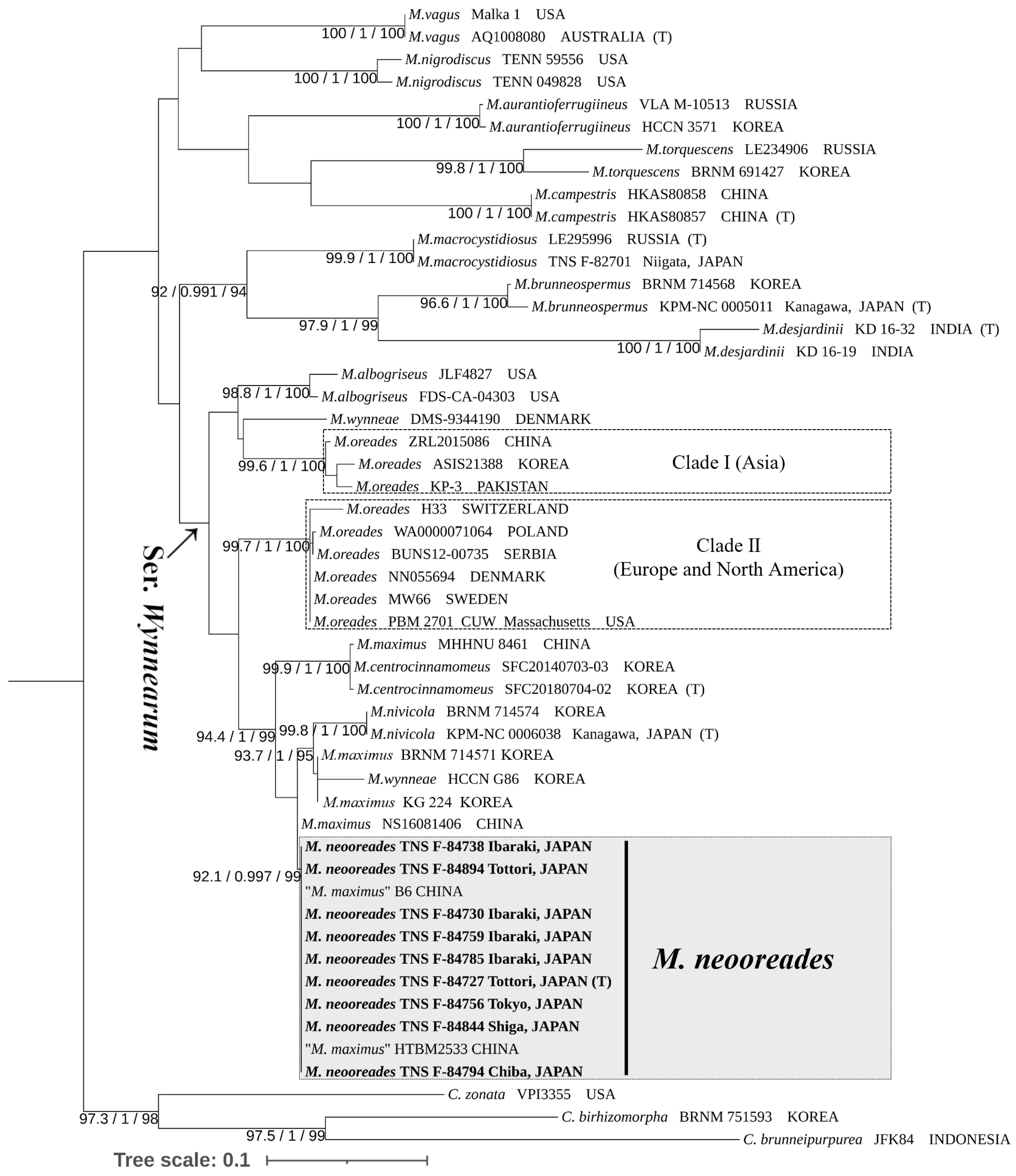
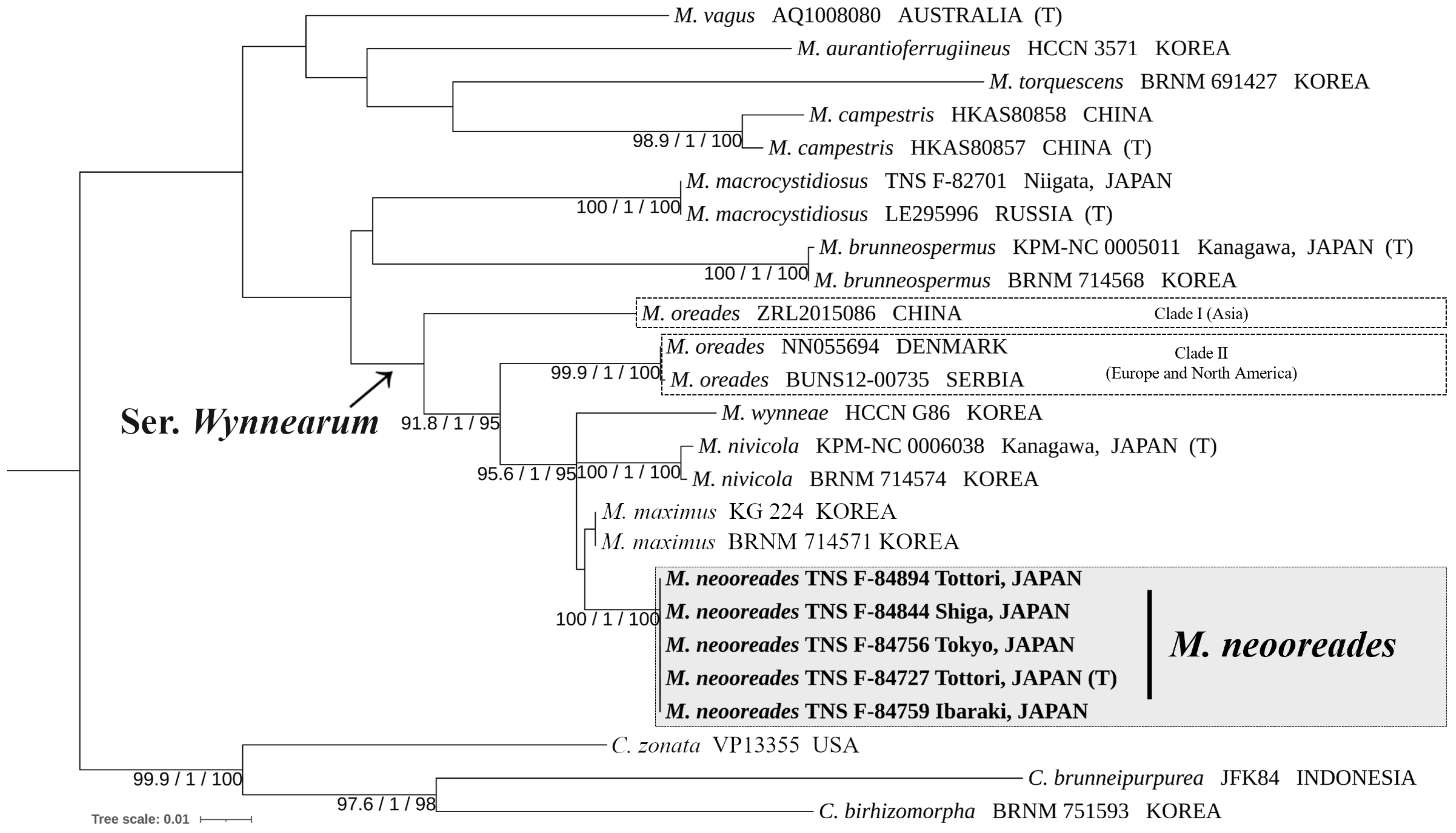
The Japanese specimens examined in this study (TNS F-84727, F-84730, F-84738, F-84756, F-84759, F-84785, F-84794, F-84844) formed a well-supported, independent clade in both the ITS and concatenated ITS + LSU phylogenetic trees (
Figure 1 and
Figure 2). In the ITS tree, two Chinese specimens labeled as “
Marasmius maximus” (B6 and HTBM2533) were nested within this clade.
The Japanese sequences were phylogenetically closely related to
M. maximus from China (NS16081406) and Korea (KG 224 and BRNM 714571),
M. wynneae Berk. & Broome from Korea (HCCN G86) and
M. nivicola from Japan (KPM-NC 0006038) and Korea (BRNM 714574). Together, these taxa formed a larger assemblage corresponding to Series
Wynnearum J.S. Oliveira & Moncalvo [
25].
Branch support values for the clade representing the Japanese specimens were high in both analyses, indicating strong phylogenetic support for their separation from previously described species of Marasmius.
Furthermore, following Oliveira et al. (2024) [
23], we performed an ITS-based phylogenetic analysis with limited taxon sampling, using the sister taxa of section
Globulares (
M. nigrobrunneus (Pat.) Sacc. NW223 and
M. ruforotula Singer BRNM 714674) as the outgroup. The SH-aLRT support values were slightly lower in this analysis, but the overall tree topology was identical to that obtained when
Crinipellis was used as the outgroup.
3.2. Taxonomic Treatment
MycoBank no.: MB862605.
Diagnosis: Differs from Marasmius oreades in having more slender basidiomata, the presence of cheilocystidia, and a distinct phylogenetic placement based on nuclear ribosomal DNA regions.
Etymology: The epithet “neooreades” refers to the macromorphological resemblance of the basidiomata to Marasmius oreades (Bolton) Fr.
HOLOTYPE: JAPAN: Tottori Prefecture, Tottori University, Koyama-chō-minami, Tottori-shi, 29 June 2023, K. Oguchi (TNS F-84727).
Gene sequences ex-holotype: PX091517 (ITS), PX090884 (LSU).
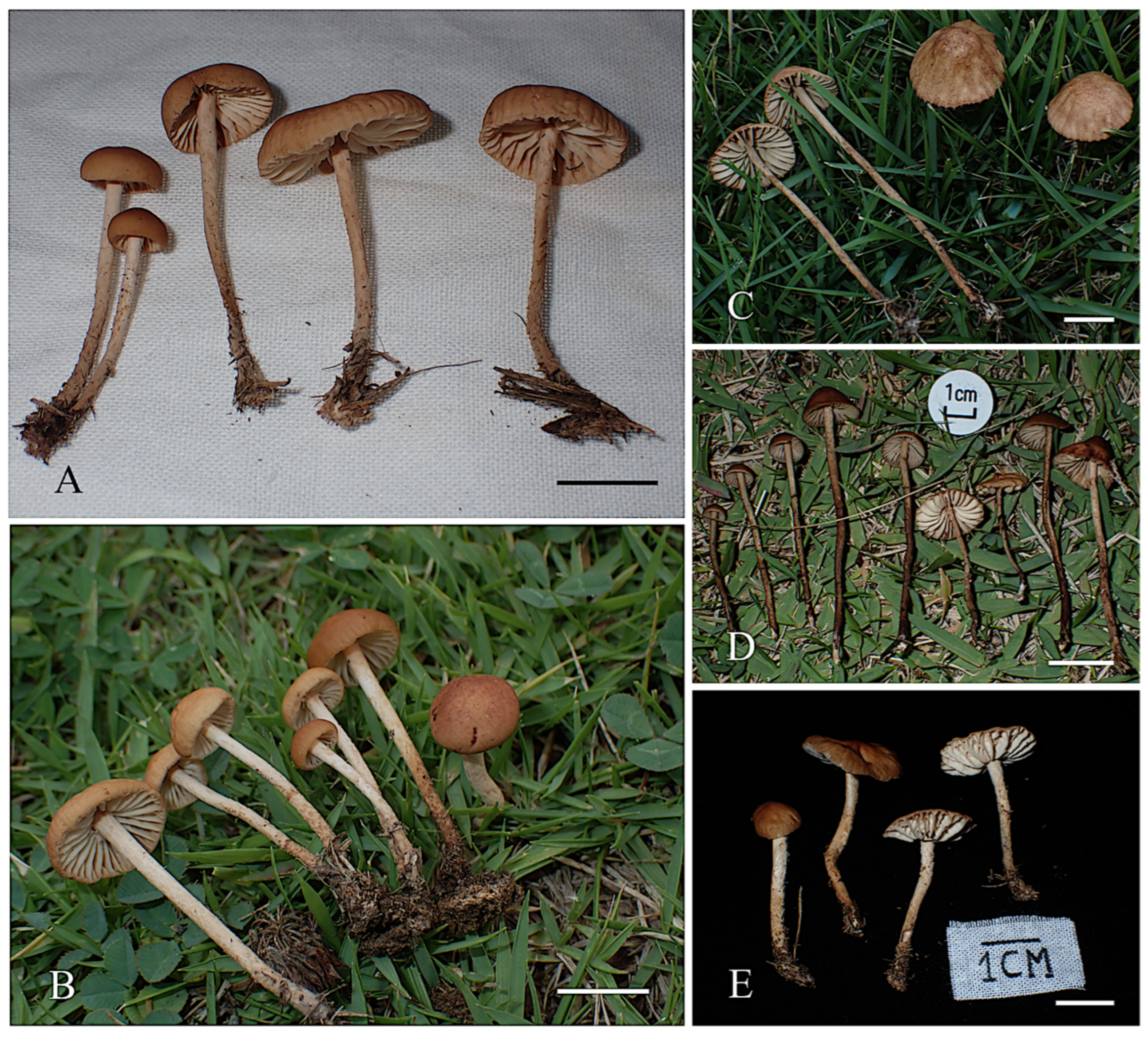
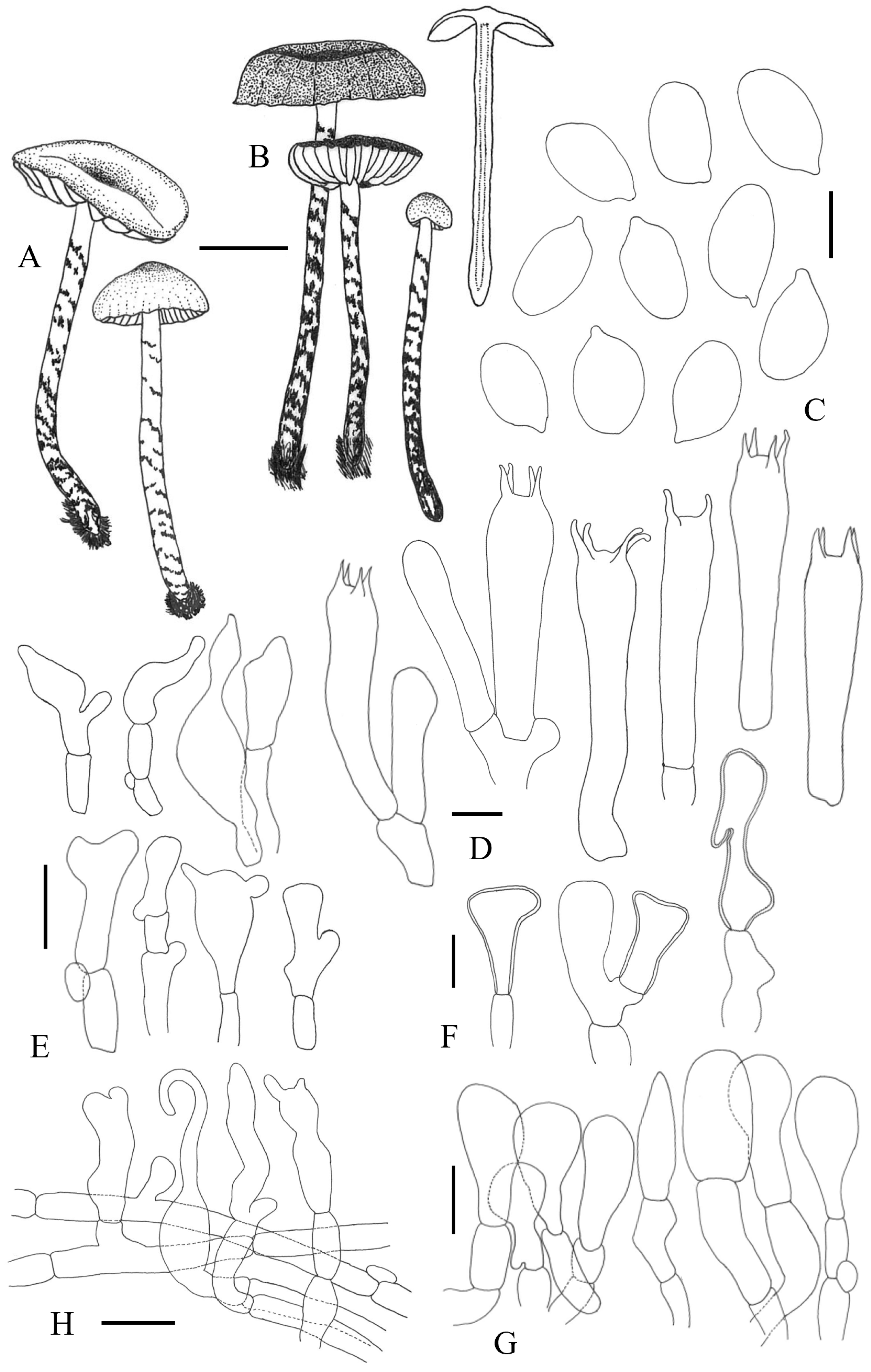
Basidiomata (
Figure 3 and
Figure 4A,B) medium-sized, marasmious, fleshy and tough.
Pileus 5–30 mm broad, up to 40 mm diam.; convex to plane, finally flattening to slightly upturned, usually with umbo; surface initially glabrous, becoming sulcate or rugulose toward the margin with age; dry to slightly oily when young; hygrophanous in most conditions, especially in mature basidiomata. When moist, pileus brown (6E7-cognac, 6E8-rust brown), becoming brownish orange (6C4-red hired, 6C5-sahara) to light brown (6D5-sunburn, 6D6-cinnamon, 6D7-raw sienna) when dry; when mature pale yellow (4A3-cream) to orange white (5A2-orange white) to pale orange (5A3-pale orange) to grayish orange (5B3–4) or brown (6E7-cognac, 6E8-rust brown, 7E7, 7E8-agate) at the margin when dry, the center light brown (6D5-sunburn, 6D6-cinnamon, 6D7-raw sienna) or brown (6E7-cognac, 6E8-rust brown) when dry, especially tinged dark brown (6F4-chocolate, 6F5-teak, 6F6-burnt umber, 6F7-dark brown chestnut, 6F8-brownish gray, 7F4—5, 7F6-eye brown, 7F7—8, 8F4—5, 8F6-liver, 8F7-caput mortuum, 8F8) when moist.
Gills 2–6 mm wide, distant to subdistant, relatively thick; edges smooth, non-marginate, intervenose; color yellowish white (4A2), pale yellow (4A3-cream), orange white (5A2-orange white), pale orange (5A3-pale orange) to grayish orange (5B3); collarium absent.
Stipe 30–80 mm long, 1.5–3 mm wide, equal or slightly tapering toward the apex or base; surface squamulose, light brown (6D4-camel, 6D5-sunburn, 6D6-cinnamon, 6D7-raw sienna) to brown (6E5, 6E6-cocoa, 6E7-cognac, 6E8-rust brown) except the apex, the apex showing ground color off-white or yellowish white (4A2) to pale yellow (4A3-cream) to orange white (5A2-orange white); context hollow.
Flesh white and tough.
Taste and
odor indistinct.
Spore print white.
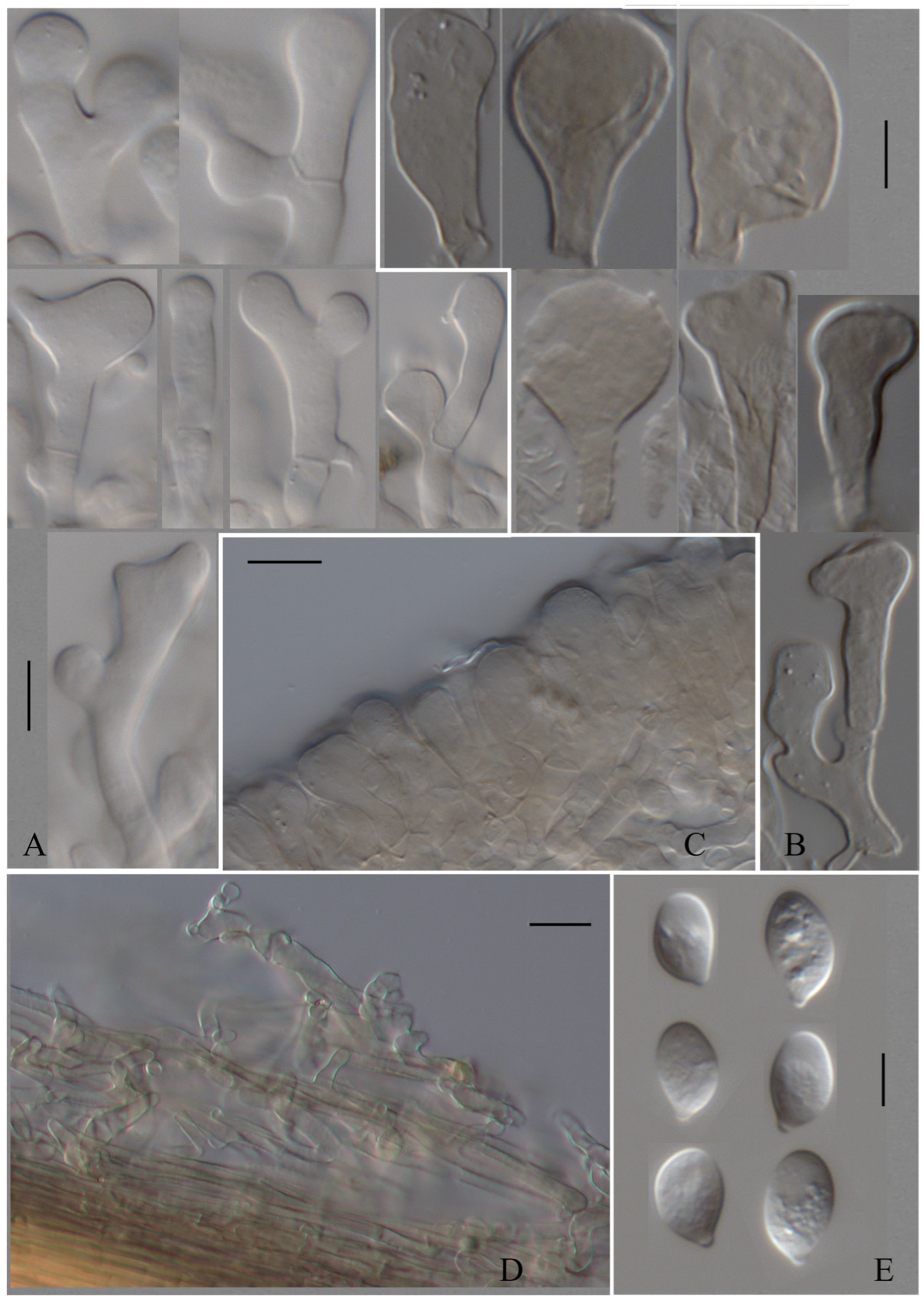
Basidiospores (
Figure 4C and
Figure 5E) (7.2–)8.1–10.7(–11.3) × (4.5–)4.9–6.7(–7.7) µm, mean = 9.6 ± 0.8 × 5.7 ± 0.6 µm, Q = (1.3–)1.4–2(–2.1), Qmean = 1.7 ± 0.2, (specimens = 6, n = 30), ellipsoid, smooth, thin-walled, with a distinct apiculus; oil droplets usually present; hyaline in KOH, inamyloid in Melzer’s reagent.
Basidia (
Figure 4D) 34–54.4 × 6.3–9.2 µm, mean = 43.3 ± 6.1 × 7.6 ± 0.7 µm, thin-walled, clavate to cylindrical, four-spored or occasionally two-spored, with basal clamp connections, hyaline in KOH, non-amyloid in Melzer’s reagent.
Pleurocystidia absent.
Cheilocystidia (
Figure 4E and
Figure 5A) present, very variable, 6–49 × 4–20 µm, clavate to irregular, sometimes diverticulate; thin-walled, smooth, with clamp connections, hyaline, inamyloid in Melzer’s reagent.
Hymenial trama subpararellel to interwoven, composed of hyphae 5–7 µm wide; smooth, with clamp connections, hyaline in KOH, dextrinoid in Melzer’s reagent.
Pileipellis (
Figure 4F,G and
Figure 5B,C) hymeniform, with clamp connections, composed of irregular, clavate to
Globulares-type terminal elements, 12–37 × 4–18 µm; walls thin to moderately thickened;
Globulares-type elements often with brownish pigment; pileus trama dextrinoid.
Stipitipellis (
Figure 5D) form cutis, composed of cylindrical hyphae 2–8 µm wide, hyaline to brownish, with clamp connections, sometimes make short branches, faintly encrusted; sometimes forming hyphal mass layer 100(–200) µm wide;
caulocystidia (
Figure 4H) present, fusiform and somewhat twisted shape, thin-walled, 24–42.4(–63.9) × 3.9–7.4 µm, inamyloid in Melzer’s reagent, stipe trama dextrinoid.
3.3. Additional Collections Examined (Paratypes)
JAPAN: Chiba: Shisui sōgō-kōen, Sumi, Shisui-chō, Imba-gun, 1 September 2024, K. Oguchi KO24-218NR (TNS F-84794). Ibaraki: Ami machi sōgō undo-koen, Yoshiwara, Ami-machi, Inashiki-gun, 2 July 2024, K. Oguchi KO24-81NR (TNS F-84748). Ayumizaki-kōen, Saka, Kasumigaura-shi, K. Oguchi & K. Fujii KO24-210NR (TNS F-84788). Oshibi, Chikusei-shi, 1 June 2024, K. Oguchi KO24-3NR (TNS F-84730). Hanabatake, Tsukuba-shi, 1 July 2024, K. Oguchi KO24-67 (TNS F-84738); the same locality, 15 July 2024, K. Oguchi KO24-111NR (TNS F-84759). In Tsukuba Botanical Garden, Amakubo, Tsukuba-shi, 1 September 2024, K. Oguchi KO24-206NR (TNS F-84785). Kagawa: Sanuki kodomono-kuni, Yusa, Konan-chō, Takamatsu-shi, 5 November 2025, K. Oguchi KO25-379NR (TNS F-110979). Shiga: Karasaki-jinja, Karasaki, Ōtsu-shi, 22 June 2023, K. Oguchi KO23-3AD (TNS F-84844); Nagisa-kōen, Hama-Ōtsu, 2 November 2025, K. Oguchi & Y. Aso KO25-331NR (TNS F-110980). Shibafu-hiroba, Oroshimo-chō, Kusatsu-shi, 24 June 2025, K. Oguchi KO25-123 (TNS F-110975); the same locality, 2 November 2025, K. Oguchi & Y. Aso KO25-327NR (TNS F-110976). Tokushima: Tsukimigaoka-kōen, Yamanote, Toyooka, Matsushige-chō, Itano-gun, 4 November 2025, K. Oguchi KO25-349NR (TNS F-110977). Tokyo: Yakushi-ike-kōen, Machida-ku, Machida-shi, 6 July 2024, K. Oguchi KO24-107NR (TNS F-84756). Tottori: In the campus of Tottori University, Koyama-chō-minami, Tottori-shi, 29 June 2023, K. Oguchi KO23-36AD (TNS F-84727). Tottori deaino-mori, Katsurami, Tottori-shi, 29 June 2019, K. Oguchi 000333 (TNS F-84851); the same locality, 19 June 2020, K. Oguchi KO20-1AD (TNS F-84894). Wakayama: Near Manyō-kan, Wakaura-minami, Wakayama-shi, 26 June 2025, K. Oguchi & Y. Aso KO25-125 (TNS F-110978).
4. Habitat and Distribution
Usually gregarious in rows, often forming rows or incomplete to complete fairy rings. On soil in turf habitats, mainly dominated by Zoysia Willd. spp. and other plants represented by Artemisia princeps Pamp., Capsella bursa-pastoris (L.) Medik., Cyperus rotundus L., Digitaria ciliaris (Retz.) Koel., Eleusine indica (L.) Gaertn., Equisetum arvense L., Euphorbia maculata (L.) Small, Glechoma hederacea subsp. grandis (A.Gray) H.Hara, Hydrocotyle sibthorpioides Lam. (1789), Ixeridium dentatum subsp. dentatum (Thunb.) Tzvelev, Oenothera laciniata Hill, Oxalis corniculata L., Persicaria capitata (Buch.-Ham. ex D.Don) H.Gross, Persicaria longiseta (Bruijn) Kitag., Plantago asiatica L., Poa annua L., Portulaca oleracea L., Pseudognaphalium affine (D.Don) Anderb. (1991), Sagina japonica (Sw.) Ohwi, Setaria viridis (L.) P. Beauv., Spiranthes sinensis var. amoena (Pers.) Ames (M.Bieb.) H.Hara, Taraxacum spp., Trifolium pratense L. (1753), Trifolium repens L., Veronica persica Poir. and Vicia sativa subsp. nigra (L.) Ehrh.
JAPAN: Honshu (Chiba, Ibaraki, Shiga, Tokyo, Tottori and Wakayama Prefs.) and Shikoku (Kagawa and Tokushima Prefs.). CHINA: Guangdong Province (labeled as “
M. maximus”, B6 and HTBM2533 in
Figure 1 and
Figure 2). Occurring in warm temperate to subtropical regions of East Asia.
5. Remarks
The basidiomata and habitat of
M. neooreades are superficially similar to those of the European species
M. oreades. However,
M. oreades differs from
M. neooreades by having larger and more robust basidiomata (pileus 13–50 mm and stipe 45–78 mm long × 2.5–6 mm wide) and, critically in lacking cheilocystidia [
21]. These diagnostic differences are also evident in descriptions based on the neotype of
Marasmius oreades (Bolton) F., which was designated based on the material from England [
42]. Although DNA sequence data from the neotype specimens are not yet available, its European origin supports the application of the name
M. oreades sensu stricto to European and North American populations.
Phylogenetically, sequences identified as
M. oreades are divided into two distinct clades: one comprising European and North American specimens (Clade II in
Figure 1 and
Figure 2) and another including Asian collections from China, Korea, and Pakistan (Clade I in
Figure 1 and
Figure 2). Although no material from the type locality (England) was examined in this study, the former clade (Clade II) is interpreted here as
M. oreades sensu stricto because all sequences from Europe were included in this clade. In contrast,
M. neooreades is not nested within either lineage, and forms an independent, well-supported clade, indicating that it represents a distinct species rather than a geographic variant of
M. oreades.
Several species of Marasmius sect. Globulares possess fleshy basidiomata and pilei that are off-white to brownish and thus resemble M. neooreades macroscopically, but all differ in key morphological, ecological, or phylogenetic characters. Marasmius albogrieseus, M. aurantioferrugineus, M. brunneospermus, M. collinus, M. desjardinii K.Das, Antonín & D.Chakr., M. heinemannianus, M. macrocystidiosus, M. maximus, M. nigrodiscus (Peck) Halling, M. nivicola, M. pseudocollinus, M. torquecens Quél., M. vagus Guard, M.D. Barrett & Farid and M. wynneae.
Marasmius albogriseus is similar in habit and habitat, but differs in its overall grayish coloration and the morphology of caulocystidia [
2,
21,
43,
44,
45].
Marasmius aurantioferrugineus is distinguished by its larger basidiomata, reddish-brown pileus with radially rugulose surface, and occurrence on litter beneath
Larix Mill. [
28,
46].
Marasmius brunneospermus differs in having a rugulose-reticulate pileus, strigose mycelium at the stipe base, a white to yellow-orange or brown spore print, and narrower basidiospores, and it occurs in forest habitats [
6,
11].
Marasmius collinus, although similar in basidiomata and grassland habitat, has crowded lamellae, a smooth stipe, a distinctive odor, and lacks cystidia [
21,
43,
47,
48].
The Indian species
M. desjardinii differs from
M. neooreades in its more slender basidiomata, closer lamellae, non-diverticulate cheilocystidia, forest habitat, and phylogenetic placement [
49].
Marasium heinemannianus, another grassland species, is readily distinguished by its very large basidiomata, pale yellowish-white spore print, and large, subfusoid basidiospores [
16].
Marasmius macrocystidiosus, known from Russia and Japan, differs in having a pubescent stipe surface, large clavate cheilocystidia, and a forest habitat, as well as in its phylogenetic position [
4,
29].
Marasmius maximus shares a similar pileus coloration and the presence of brownish squamules on the stipe, but is distinguished by its much larger basidiomata, radially sulcate-striate pileus surface, forest habitat, and smaller basidiospores [
27,
46].
Additional species can be distinguished from
M. neooreades as follows:
M. nigrodiscus possesses pleurocystidia [
44];
M. nivicola has white basidiomata and occurs in forest habitats [
8,
21];
M. pseudocollinus has smaller basidiospores [
43];
M. torquecens lacks stipe scales and shows a color transition from brown to black toward the stipe base [
21,
50];
M. vagus has orange to apricot pileus and
Siccus-type broom elements [
51]; and
M. wynneae is characterized by whitish pileus and dark-colored stipes except at the apex [
11].
Marasmius campestris, which also inhabits grasslands, differs markedly in its deeply sulcate, striate, purple-tinged pileus and exceptionally large basidiospores [
52].
Morphologically and ecologically,
M. neooreades accords well with the diagnostic features of Series
Wynnearum [
25], including fleshy basidiomata, distant and intervenose lamellae, absence of pleurocystidia, a hymeniform pileipellis composed of
Globulares-type elements, and a grassland habitat. Its phylogenetic placement within the
Wynnearum clade further supports this assignment.
In Japan,
M. oreades has long been reported [
26,
46,
53], but published accounts lack information on cheilocystidia, a critical character for distinguishing species within sect.
Globulares. Based on the macromorphological descriptions provided by Imai [
26] and Imazeki & Hongo [
46], Japanese specimens previously identified as
M. oreades show substantial overlap with
M. neooreades in pileus size, coloration, lamellar spacing, stipe dimensions, and grassland habitat. Although microscopic features were not documented in those early studies, these similarities suggest that many Japanese records of “
M. oreades” from temperate regions may in fact represent
M. neooreades.
To clarify this issue, we re-examined historical specimens identified as M. oreades by Imai from Hokkaido (voucher specimens TMI 5745–5747, collected in 1930–1932). These specimens are approximately a century old and are largely contaminated by molds, precluding DNA extraction and detailed examination of critical characters such as the lamellar edge and stipe surface. Nevertheless, the available morphological features, including basidiospore shape and dimensions and a hymeniform pileipellis composed of Globulares-type elements, indicate that these specimens belong to Marasmius sect. Globulares. At present, it remains unclear whether the Hokkaido material represents M. oreades, M. neooreades, or a different taxon altogether. Accordingly, the occurrence of M. oreades sensu stricto in Japan cannot be excluded, although our results strongly suggest that populations widely distributed in temperate regions of Japan (excluding Hokkaido) and long identified as “M. oreades” correspond to M. neooreades.
In the phylogenetic analyses,
M. neooreades formed a clade with two Chinese sequences labeled as
M. maximus (B6 and HTBM2533). BLAST comparisons of the ITS region revealed high sequence similarity between the ex-holotype of
M. neooreades (PX091517) and these Chinese sequences (99.84% for HTBM2533 and 98.80% for B6). However,
M. maximus is morphologically distinct from
M. neooreades, differing in its much larger basidiomata, forest habitat, felt-like mycelial mat, and smaller, more narrowly ellipsoid basidiospores. Moreover, other sequences identified as
M. maximus from China and Korea formed a separate clade. These results strongly suggest that the Chinese vouchers B6 and HTBM2533 were misidentified and instead represent
M. neooreades. Because HTBM2533 was collected from Guangdong Province (approximately 22° N) [
54],
M. neooreades is inferred to have a broad distribution spanning warm temperate to subtropical regions of East Asia. Further sampling from East and Southeast Asia will be necessary to understand its distributional range.