Article

Complete Mitochondrial Genome of Decametra tigrina (A.H. Clark, 1907) (Crinoidea, Comatulida, Colobometridae) and Phylogenetic Analysis


1
National Marine Biodiversity Institute of Korea, Seocheon 33662, Republic of Korea
2
Marine Animal Biodiversity Center, Sahmyook University, Seoul 01795, Republic of Korea
3
Department of Animal Resources Science, Sahmyook University, Seoul 01795, Republic of Korea
4
Department of Environmental Horticulture, Graduate School of Sahmyook University, Seoul 01795, Republic of Korea
*
Author to whom correspondence should be addressed.
Taxonomy 2026, 6(1), 2; https://doi.org/10.3390/taxonomy6010002
Submission received: 27 October 2025 / Revised: 23 December 2025 / Accepted: 23 December 2025 / Published: 25 December 2025

Abstract

The mitochondrial genome of Decametra tigrina (A.H. Clark, 1907) was fully sequenced and characterized. This circular, double-stranded genome spans 15,794 bp and encompasses 13 protein-coding genes (PCGs), 22 tRNA genes, and two rRNA genes. The arrangement of genes remains conserved, matching those of Cenometra bella and the MW405444 (submitted to GenBank as Oligometra serripinna). The base composition consists of 24.6% A, 47.6% T, 16.2% G, and 11.6% C. Most PCGs use ‘ATG’ as the initiation codon, with NADH4L and NADH5 initiating with ‘GTG’. Each PCG terminates with a complete stop codon (‘TAA’ or ‘TAG’). Twelve tRNA genes, three NADH genes, and two rRNA genes are located on the L strand, while the remaining genes reside on the H strand. Phylogenetic analysis utilizing all 13 PCGs demonstrated that D. tigrina forms a clade with MW405444 (submitted to GenBank as O. serripinna, reassessed here as D. tigrina) and Florometra sp. (MN883538). Decametra tigrina forms a sister group with C. bella; together, they cluster with Stephanometra indica (Mariametridae) and Zygometra comata (Zygometridae) in the ML tree.

1. Introduction

The genus Decametra A. H. Clark, 1911 belongs to Colobometridae A. H. Clark, 1909 within Comatulida A. H. Clark, 1908, class Crinoidea Miller, 1821, phylum Echinodermata Klein, 1778 [1]. Seventeen valid species are currently recognized in Decametra [1], and among these only D. tigrina (A. H. Clark, 1907) has been reported from Korean waters [2]. Decametra tigrina is characterized by a discoidal centrodorsal, a comparatively broad and flat polar area, and densely arranged cirrus sockets in a single or partially double marginal row. The species bears relatively long cirri, numbering 26 to 30, each with roughly 28 segments and ending in long, curved, sharply pointed claws [2]. Its distribution includes the southern coast and Jeju Island of South Korea, southern Japan, and the Philippines [2]. The species is associated with habitats influenced by warm currents and appears to be extending its range northward along the Korean coast, possibly in response to rising ocean temperatures. To date, only partial molecular data from Decametra have been available, including mitochondrial gene fragments and nuclear rRNA markers, and no complete mitochondrial genome has been deposited for the genus in public databases.
Mitochondrial genomes provide comparable characters for crinoids, such as gene content, gene order, strand assignment, base composition, codon usage, and tRNA secondary structures. These features allow tests of conserved patterns and lineage specific deviations at family and superfamily levels. However, the absence of a complete mitogenome for Decametra has limited direct comparisons within Colobometridae and across related families. Here, we sequence and annotate the complete mitochondrial genome of D. tigrina, assess gene order and compositional features, summarize codon usage and tRNA secondary structures, and infer a maximum likelihood phylogeny from all 13 protein coding genes. We use these data to evaluate the placement of D. tigrina relative to closely allied genera and to examine whether current family or superfamily limits align with the resulting topology. This genome fills a taxonomic gap for Decametra and provides a reference for future phylogenomic and evolutionary work on comatulids.

2. Materials and Methods

2.1. Collection and Storage of Decametra tigrina

A specimen of D. tigrina was collected by netting at a depth of 10 m in the adjacent water of Jwiseom Island in Busan (35°01′20.9″ N, 128°58′21.1″ E) on 13 March 2025 (Figure 1). It was immediately preserved in ethyl alcohol (>95%) after collection. The preserved specimen was subsequently deposited at the Marine Echinoderms Resources Bank of Korea (MERBK) (https://www.mbris.kr (accessed on 20 October 2025), contact: Taekjun Lee, leetj@syu.ac.kr) at Sahmyook University and assigned the voucher number MERBK-C0066.

2.2. DNA Extraction and Genome Sequencing

Genomic DNA was isolated from gonad tissue using the DNeasy Blood & Tissue Kit (Qiagen, Hilden, Germany), in accordance with the manufacturer’s protocol. Targeted primers were employed to amplify partial regions of the mitochondrial COI and 16S rRNA genes, which were then used for map-to-reference assembly in Geneious Prime (v.2024.0.7). To enhance DNA yield, the REPLI-g Mitochondrial DNA Kit (Qiagen, Hilden, Germany) was applied for additional amplification of the genomic DNA. The genome analysis teams at the National Instrumentation Centre for Environmental Management of Seoul National University (NICEM), Korea, conducted next-generation sequencing (NGS) analysis. A genomic library with an average insert size of 300 bp constructed with the KAPA Hyper Prep Kit (Kapa Biosystems, Woburn, MA, USA) was subjected to paired-end sequencing using the Illumina HiSeq 2500 platform (Illumina, San Diego, CA, USA) (pair-end 2 × 151 bp). Raw reads were deposited in the NCBI Short Read Archive (BioSample: SAMN48400990; BioProject: PRJNA1260676; SRA: SRR33479964).

2.3. Mitochondrial Genome Annotation and Analysis

Raw sequence data were initially processed in Geneious Prime v.2024.0.7, which included adapter trimming and reference-guided assembly. Gene annotation was conducted using the MITOS2 pipeline implemented on Galaxy.org (accessed on 23 September 2025) [3,4,5]. Protein-coding genes were identified using MITOS2, while transfer RNAs (tRNAs) were predicted using tRNAscan-SE 2.0 [6,7]. Finally, a circular graphical representation of the mitogenome was produced using OGDRAW v1.3.1 [8]. Sequencing depth across the assembled mitogenome was assessed by mapping the trimmed reads back to PV742399 in Geneious Prime, and the coverage profile is provided in Supplementary Figure S1.

2.4. Phylogenetic Analysis

The analysis incorporated 22 complete mitochondrial genomes from Comatulida and a single isocrinid used as an outgroup (Metacrinus rotundus), all sourced from NCBI (Table 1). The optimal nucleotide substitution models for the dataset comprising 13 protein-coding genes (PCGs) were determined using jModelTest v.2.1.1 [9,10] for each individual PCG. Maximum likelihood phylogenetic inference was conducted using RAxML GUI v.2.0 [11], applying the TrN+G model to ATPase8, TrN+I+G for NADH2, and the GTR+I+G model for the remaining PCGs. To assess branch reliability, bootstrap resampling was performed using the rapid bootstrapping option set to 1000 replicates. Visualization of the resulting phylogenetic tree was achieved with FigTree v.1.4.4 [12].

3. Results

3.1. Morphological Characteristics of Decametra tigrina

The identification of the examined specimen (voucher no. MERBK-C0066) as Decametra tigrina was based on the diagnostic morphological characters described in Shin [2]. Key diagnostic features observed in our specimen include a discoidal centrodorsal with a broad, flat polar area, and 26 cirri composed of 26 segments, terminating in long, curved, and sharply pointed claws (Figure 1). These morphological characters are consistent with the description of D. tigrina provided by Shin [2]. Furthermore, we re-examined the voucher specimen associated with MW405444, which had been originally submitted to GenBank as Oligometra serripinna, and reidentified it as D. tigrina based on the diagnostic characters defined by Shin [2]. All cirrals were broader than long, and indistinct dorsal spines were visible on the distal segments. Ten arms were present, and pinnule P2 was noticeably longer and stouter than P1 or P3. Collectively, these characters agree with the diagnostic description of D. tigrina and distinguish it from related congeners (e.g., Oligometra serripinna with stouter cirri composed of 20–24 segments).

3.2. Gene Arrangement and Characteristics of Decametra tigrina

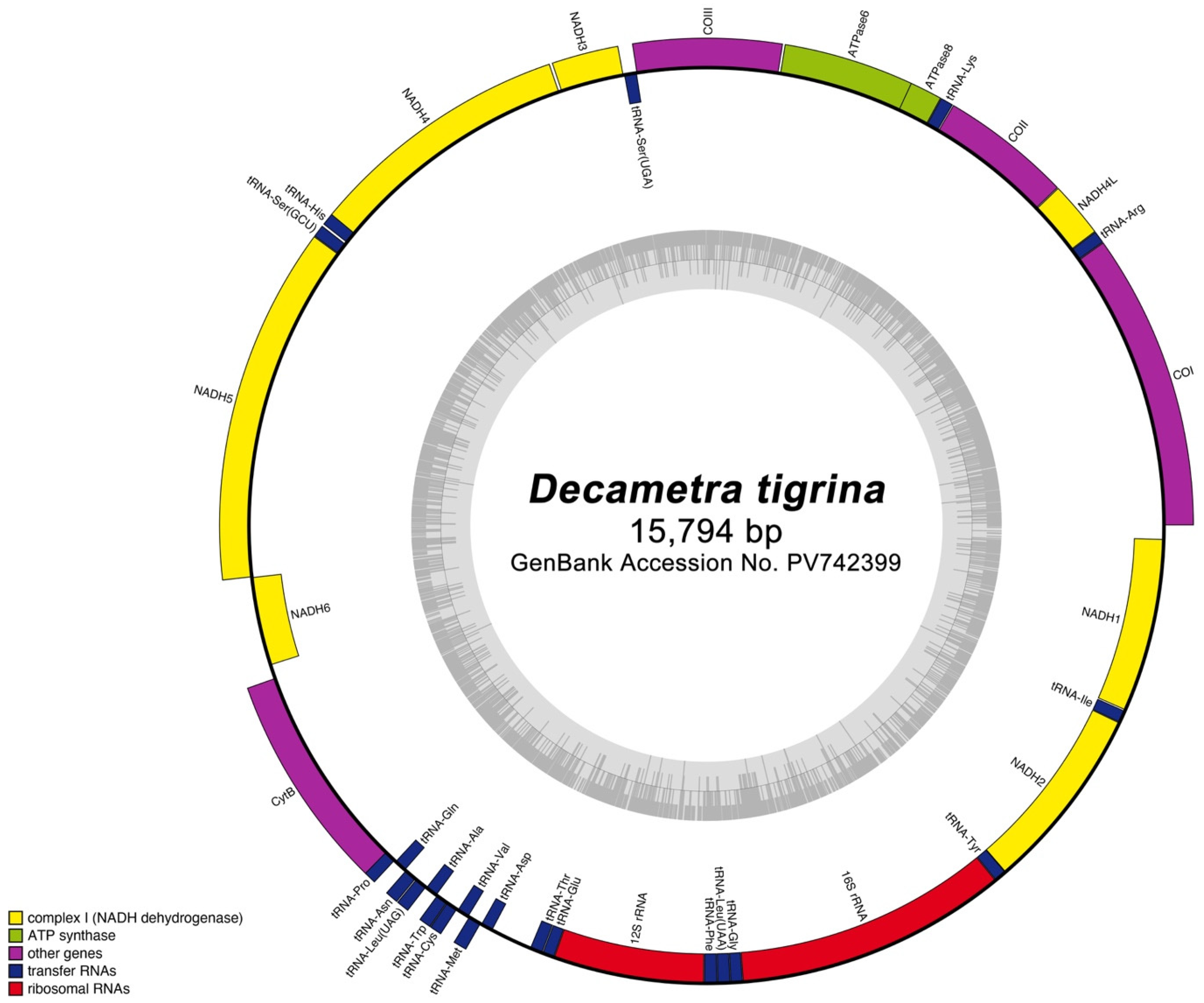
The mitochondrial genome of D. tigrina is circular and double-stranded (Figure 2). The annotated mitochondrial genome sequences have been registered in GenBank under accession number PV742399. The complete mitochondrial genome is 15,794 bp in length. The mitochondrial genome of D. tigrina contains 13 protein-coding genes (PCGs), 22 tRNA genes, and two rRNA genes (Figure 2, Table 2). No gene rearrangements, insertions, or deletions were detected in PV742399 relative to other available Colobometridae mitogenome records, and its gene arrangement mirrors that of two additional Colobometridae species (Cenometra bella and MW405444: submitted to GenBank as O. serripinna). The nucleotide composition in the mitochondrial genome of D. tigrina was A (24.6%), T (47.6%), G (16.2%), and C (11.6%). Three NADH genes (NADH 1, 2, and 6), two rRNA genes, and 12 tRNA genes in D. tigrina are located on the L strand, while the other mitochondrial genes are transcribed from the H strand (Figure 2). The total length of 13 protein-coding genes is 11,475 bp. Individual tRNA genes range in size from 67 bp (tRNA-Cys) to 75 bp (tRNA-Met). Both NADH4L and NADH5 initiate with the ‘GTG’ codon, in contrast to the other 11 PCGs which initiate with ‘ATG’. Prior research on echinoderm mitochondrial code has indicated that ‘GTG’ may function as a start codon, although there are some reservations [24]. All PCGs terminate with the canonical stop codons ‘TAA’ or ‘TAG’ (Table 2).

3.3. Phylogenetic Analysis of Comatulids Including Decametra tigrina

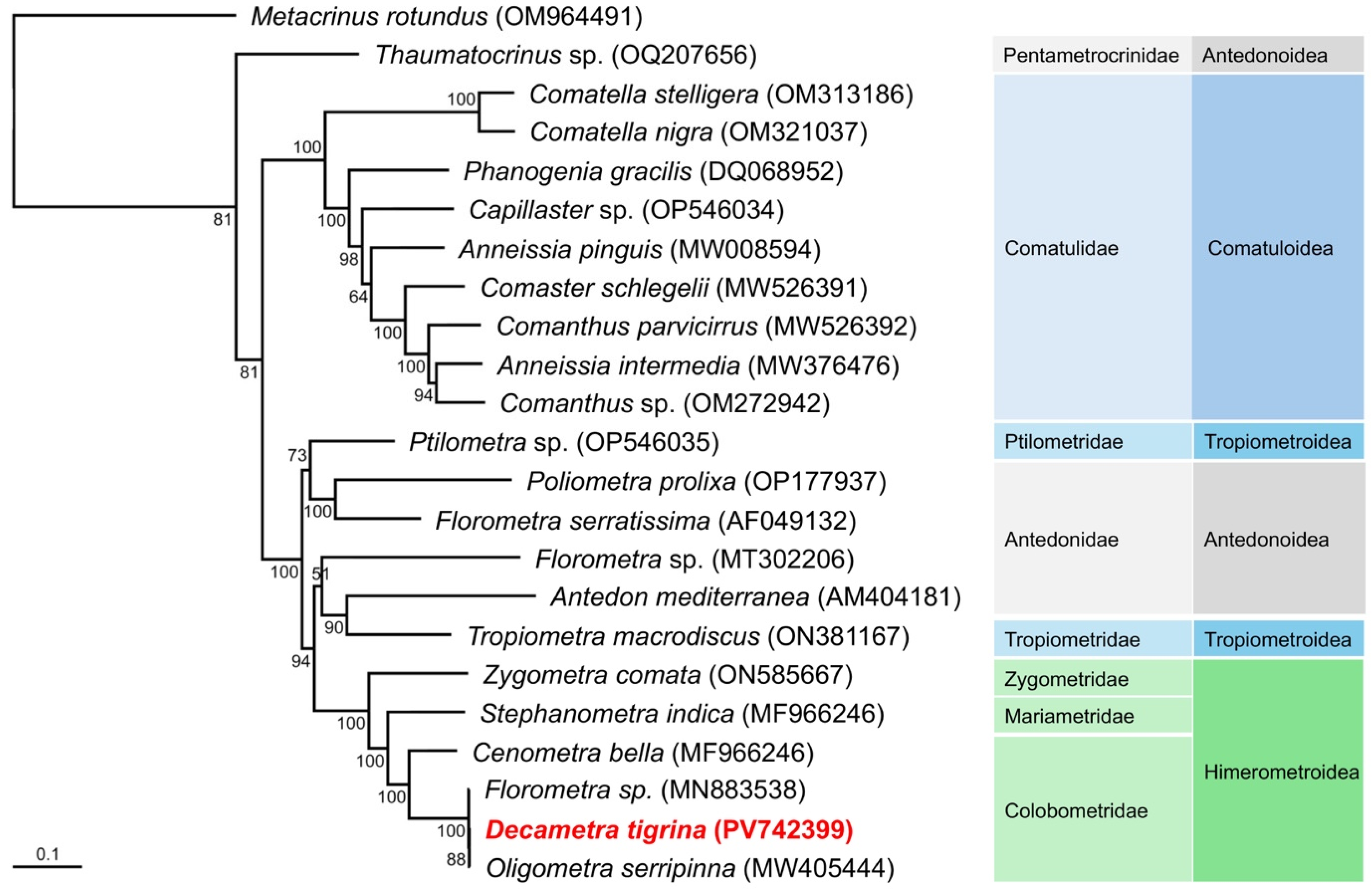
The maximum likelihood (ML) tree inferred from the 13 mitochondrial protein-coding genes clearly positioned D. tigrina (PV742399), newly sequenced in this study, within a distinct and well-supported clade (bootstrap 100%). This clade includes MN883538 (submitted to GenBank as Florometra sp.) and MW405444 (submitted to GenBank as O. serripinna), showing effectively no sequence divergence (very short branches) among PV742399–MN883538–MW405444. The voucher associated with MW405444 was re-examined and the specimen was reassessed as D. tigrina (see Section 3.1). The voucher for MN883538 (specimen ID 201904-Crinoid014) is reported to be deposited at the Research Institute of Basic Sciences, Incheon National University (Incheon, Republic of Korea) [18]. However, we were unable to access the specimen and obtain curator-provided photographs for re-examination in this study. Importantly, the other Florometra sp. record (MT302206) is not part of this near-identical group in our ML tree (Figure 3), but instead forms a clade with Antedon mediterranea (bootstrap 51%), with F. serratissima (AF049132) as sister to that pair.
In the broader phylogenetic framework, this group is part of a larger clade composed mainly of species traditionally classified within Tropiometroidea, including Florometra indica, Cenometra bella, and Decametra indica. This topology places MW405444 (submitted as O. serripinna) within the same broader clade, indicating an inconsistency between the current database identification and the mitochondrial phylogeny.
At the family level, Antedonidae and Tropiometridae are not recovered as monophyletic groups in our tree. For Antedonidae, records labeled as Antedon mediterranea and Florometra serratissima occur on separated branches. A similar pattern is seen for Tropiometridae, where records currently assigned to this family are distributed across distant parts of the topology. These patterns align with earlier findings reported by Xu et al. [21] and with multilocus phylogenies incorporating nuclear loci (e.g., [25,26]), underscore the need to interpret morphology-based groupings in light of molecular phylogenetic evidence, while noting that misidentification in public databases cannot be excluded without curated vouchers.

4. Discussion

The complete mitogenome of D. tigrina fills a gap for the genus and enables direct comparison within Colobometridae. The genome spans 15,794 bp and contains 13 protein-coding genes, 22 tRNAs, and two rRNAs, without any detected rearrangement, insertion, or deletion. The base composition is strongly AT-biased at 72.2 percent. L-strand localization of several loci, including nad1, nad2, nad6, both rRNAs, and 12 tRNAs, accords with strand asymmetry commonly reported for echinoderms. Most protein-coding genes initiate with ATG. Two genes, nad4L and nad5, initiate with GTG, a start codon previously reported under the echinoderm mitochondrial code [27]. All protein-coding genes terminate with complete stop codons, either TAA or TAG. Taken together, these features are consistent with conserved replication and transcription dynamics combined with mutational bias, rather than with annotation artifacts, and they agree with expectations for crinoid mitogenomes.
The phylogeny based on all 13 protein-coding genes recovers a fully supported group (bootstrap 100%) that includes PV742399 (D. tigrina), MW405444 (submitted to GenBank as O. serripinna), and MN883538 (submitted as Florometra sp.). MW405444 corresponds to a voucher specimen that we re-examined and reassessed as D. tigrina using the diagnostic characters in the morphological description and taxonomic keys of Shin [2] (see Section 3.1). Accordingly, the GenBank organism assignment for MW405444 should be corrected to D. tigrina. The genus Florometra has been described as having a low discoidal centrodorsal, more numerous but shorter flattened cirri, and well-developed spinulose pinnules, which differs from Decametra [2,28]. As mitochondrial genomes represent a single nonrecombining locus, the close clustering of these three records may reflect recent divergence, retention of an ancestral haplotype, or introgression, and synonymy should not be inferred without nuclear evidence.
Signals at higher ranks match earlier findings [22]. Members assigned to Tropiometroidea and Antedonoidea do not form single clades in our tree, and the position of the MW405444 record (submitted as O. serripinna) near Decametra and MN883538 (submitted as Florometra sp.) highlights the importance of curated vouchers when interpreting mitochondrial phylogenies. At the family level, Antedonidae and Tropiometridae are not monophyletic in the phylogenetic tree. Taxa attributed to Antedonidae, such as Antedon mediterranea and Florometra serratissima, occur on separated branches, and a similar dispersion is observed for Tropiometridae. These patterns argue for reassessment of family- and superfamily-level limits with broader taxon coverage and multilocus datasets. We also note that our topology places Florometra sp. (MT302206) separately from F. serratissima (AF049132), in contrast to [18]; this difference may reflect limited taxon sampling and the single-locus nature of mitochondrial data, and should be re-evaluated using nuclear markers.
Two constraints frame the present inferences. Only one Decametra mitogenome was newly generated here, and publicly available records remain sparse for several relevant genera. Geographic representation is also incomplete, and MN883538 (submitted as Florometra sp.) is reported to have a deposited voucher (specimen ID 201904-Crinoid014; [18]), but it was not re-examined in this study. Future work that combines nuclear markers, such as UCEs or exon capture, with curated vouchers and denser sampling across Colobometridae and Mariametridae will allow explicit tests of monophyly.
In summary, D. tigrina exhibits conserved gene content typical of Colobometridae, a pronounced AT bias with strand asymmetry consistent with echinoderm patterns, and a strongly supported placement with MW405444 (submitted as Oligometra serripinna) and MN883538 (submitted as Florometra sp.). Together with the non-monophyly signals for Antedonidae and Tropiometridae, these results motivate an integrative revision of higher-level classification that combines mitochondrial and nuclear data with vetted morphology [22,24,27,28].

Supplementary Materials

The following supporting information can be downloaded at: https://www.mdpi.com/article/10.3390/taxonomy6010002/s1, Figure S1: Read depth (coverage) across the complete mitogenome of Decametra tigrina (PV742399) obtained by mapping raw reads (SRA: SRR33479964) to the assembled mitogenome in Geneious Prime.

Author Contributions

Conceptualization, T.L.; methodology, software, validation, G.K., Y.C. and S.K.; formal analysis, T.L.; investigation, resources, G.K., Y.C. and S.K.; data curation, T.L.; writing—original draft preparation, writing—review and editing, G.K. and T.L.; visualization, Y.C. and S.K.; supervision, T.L.; project administration, funding acquisition, T.L. All authors have read and agreed to the published version of the manuscript.

Funding

This research was supported by the management of the Marine and Fishery Bio-resources Center (2025) through funding from the National Marine Biodiversity Institute of Korea (MABIK), as well as the Basic Science Research Program of the National Research Foundation of Korea (NRF), funded by the Ministry of Education, Republic of Korea, under grant number [2021R1I1A2058017].

Data Availability Statement

The original data presented in the study are openly available in Zenodo at https://doi.org/10.5281/zenodo.15663582, accessed on 22 December 2025.

Conflicts of Interest

The authors declare no conflicts of interest.

References

  1. Messing, C.; Gondim, A.I.; Markello, K.; Poatskievick Pierezan, B.; Taylor, K.; Eléaume, M. World List of Crinoidea. Decametra AH Clark, 1911. World Register of Marine Species. Available online: https://www.marinespecies.org/aphia.php?p=taxdetails&id=204374 (accessed on 12 December 2025).
  2. Shin, S. Feather stars, basket stars: Echinodermata: Crinozoa: Crinoidea: Comatulida, Asterozoa: Ophiuroidea: Euryalida. In Invertebrate Fauna of Korea, 1st ed.; National Institute of Biological Resources: Incheon, Republic of Korea, 2013; Volume 32, pp. 1–150. [Google Scholar]
  3. Bernt, M.; Donath, A.; Jühling, F.; Externbrink, F.; Florentz, C.; Fritzsch, G.; Pütz, J.; Middendorf, M.; Stadler, P.F. Mitos: Improved de novo metazoan mitochondrial genome annotation. Mol. Phylogenet. Evol. 2013, 69, 313–319. [Google Scholar] [CrossRef] [PubMed]
  4. Iwasaki, W.; Fukunaga, T.; Isagozawa, R.; Yamada, K.; Maeda, Y.; Satoh, T.P.; Sado, T.; Mabuchi, K.; Takeshima, H.; Miya, M.; et al. Mitofish and MitoAnnotator: A mitochondrial genome database of fish with an accurate and automatic annotation pipeline. Mol. Biol. Evol. 2013, 30, 2531–2540. [Google Scholar] [CrossRef] [PubMed]
  5. The Galaxy Community. The galaxy platform for accessible, reproducible and collaborative biomedical analyses: 2022 update. Nucleic Acids Res. 2022, 50, W345–W351. [Google Scholar] [PubMed]
  6. Lowe, T.M.; Eddy, S.R. tRNAscan-SE: A program for improved detection of transfer RNA genes in genomic sequence. Nucleic Acids Res. 1997, 25, 955–964. [Google Scholar] [CrossRef]
  7. Chan, P.P.; Lin, B.Y.; Mak, A.J.; Lowe, T.M. tRNAscan-SE 2.0: Improved detection and functional classification of transfer RNA genes. Nucleic Acids Res. 2021, 49, 9077–9096. [Google Scholar] [CrossRef]
  8. Greiner, S.; Lehwark, P.; Bock, R. OrganellarGenomeDRAW (OGDRAW) version 1.3.1: Expanded toolkit for the graphical visualization of organellar genomes. Nucleic Acids Res. 2019, 47, W59–W64. [Google Scholar] [CrossRef]
  9. Guindon, S.; Gascuel, O. A simple, fast, and accurate algorithm to estimate large phylogenies by maximum likelihood. Syst. Biol. 2003, 52, 696–704. [Google Scholar] [CrossRef]
  10. Darriba, D.; Taboada, G.L.; Doallo, R.; Posada, D. jModelTest 2: More models, new heuristics and parallel computing. Nat. Methods 2012, 9, 772. [Google Scholar] [CrossRef]
  11. Edler, D.; Klein, J.; Antonelli, A.; Silvestro, D. raxmlGUI 2.0: A graphical interface and toolkit for phylogenetic analyses using RAxML. Methods Ecol. Evol. 2020, 12, 373–377. [Google Scholar] [CrossRef]
  12. Rambaut, A. FigTree: Tree Figure Drawing Tool, Version 1.4.4. Available online: http://tree.bio.ed.ac.uk/software/figtree (accessed on 27 October 2025).
  13. Perseke, M.; Fritzsch, G.; Ramsch, K.; Bernt, M.; Merkle, D.; Middendorf, M.; Bernhard, D.; Stadler, P.F.; Schlegel, M. Evolution of mitochondrial gene orders in echinoderms. Mol. Phylogenet. Evol. 2008, 47, 855–864. [Google Scholar] [CrossRef]
  14. Scouras, A.; Smith, M.J. A novel mitochondrial gene order in the crinoid echinoderm Florometra serratissima. Mol. Biol. Evol. 2001, 18, 61–73. [Google Scholar] [CrossRef] [PubMed]
  15. Nam, S.-E.; Park, H.S.; Rhee, J.-S. Characterization and phylogenetic analysis of the complete mitochondrial genome of Florometra species (Echinodermata, Crinoidea). Mitochondrial DNA B Resour. 2020, 5, 2010–2011. [Google Scholar] [CrossRef]
  16. Kwon, H.; Park, H.S.; Rhee, J.S. Complete mitochondrial genome of the crinoid Poliometra prolixa (Crinoidea: Comatulida: Antedonidae). Mitochondrial DNA B Resour. 2023, 8, 927–931. [Google Scholar] [CrossRef] [PubMed]
  17. Chang, J.J.M.; Ip, Y.C.A.; Huang, D. Complete mitochondrial genome of the feather star Cenometra bella (Hartlaub, 1890) (Crinoidea: Colobometridae). Mitochondrial DNA B Resour. 2022, 7, 950–952. [Google Scholar] [CrossRef]
  18. Nam, S.-E.; Park, H.S.; Rhee, J.-S. Complete mitochondrial genome of the crinoid echinoderm, Florometra species (Echinodermata, Crinoidea). Mitochondrial DNA B Resour. 2020, 5, 852–853. [Google Scholar] [CrossRef]
  19. Kim, P.; Shin, S. The complete mitochondrial genome of Anneissia pinguis (Crinoidea, Articulata, Comatulidae), from South Korea. Mitochondrial DNA B Resour. 2021, 6, 2337–2338. [Google Scholar] [CrossRef]
  20. Kim, P.; Lee, T.; Shin, S. The complete mitochondrial genome of Anneissia intermedia (Crinoidea: Comatulida: Comatulidae). Mitochondrial DNA B Resour. 2021, 6, 1777–1778. [Google Scholar] [CrossRef]
  21. Xu, Q.; Lu, M.; Sun, Y.; Li, Z.; Li, Y.; Dong, Y.; Hu, X.; Zhang, Q.; Liu, B.; He, X. Structural features and phylogenetic implications of crinoid echinoderms based on thirteen novel mitochondrial genomes. J. Mar. Sci. Eng. 2024, 12, 361. [Google Scholar] [CrossRef]
  22. Scouras, A.; Smith, M.J. The complete mitochondrial genomes of the sea lily Gymnocrinus richeri and the feather star Phanogenia gracilis: Signature nucleotide bias and unique nad4L gene rearrangement within crinoids. Mol. Phylogenet. Evol. 2006, 39, 323–334. [Google Scholar] [CrossRef]
  23. Ma, S.; Zhang, H.; Wang, X.; Yin, J.; Shen, P.; Lin, Q. Characterization and phylogenetic analysis of the complete mitochondrial genome of Stephnometra indica (Pelmatozoa: Crinoidea). Mitochondrial DNA B Resour. 2019, 4, 2283–2284. [Google Scholar] [CrossRef]
  24. Sun, Y.; Liao, X.; Dong, Y.; Xia, S.; Xu, Q. The complete mitochondrial genome of Comaster schlegelii (Crinoidea, Comatulida). Mitochondrial DNA B Resour. 2022, 7, 314–316. [Google Scholar] [CrossRef]
  25. Rouse, G.W.; Jermiin, L.S.; Wilson, N.G.; Eeckhaut, I.; Lanterbecq, D.; Oji, T.; Young, C.M.; Browning, T.; Cisternas, P.; Helgen, L.E.; et al. Fixed, free, and fickle: The phylogeny of extant Crinoidea and their Permian–Triassic origin. Mol. Phy. Evol. 2013, 66, 161–181. [Google Scholar] [CrossRef]
  26. Hemery, L.G.; Roux, M.; Ameziane, N.; Eleaume, M. High-resolution crinoid phyletic inter-relationships derived from molecular data. Cah. Biol. Mar. 2013, 54, 511–523. [Google Scholar]
  27. Quek, Z.B.R.; Chang, J.J.M.; Ip, Y.C.A.; Chan, Y.K.S.; Huang, D. Mitogenomes reveal alternative initiation codons and lineage-specific gene order conservation in echinoderms. Mol. Biol. Evol. 2021, 38, 981–985. [Google Scholar] [CrossRef]
  28. Clark, A.H. A monograph of the existing crinoids. Bull. U.S. Natl. Mus. 1915, 1, 1–406. [Google Scholar]
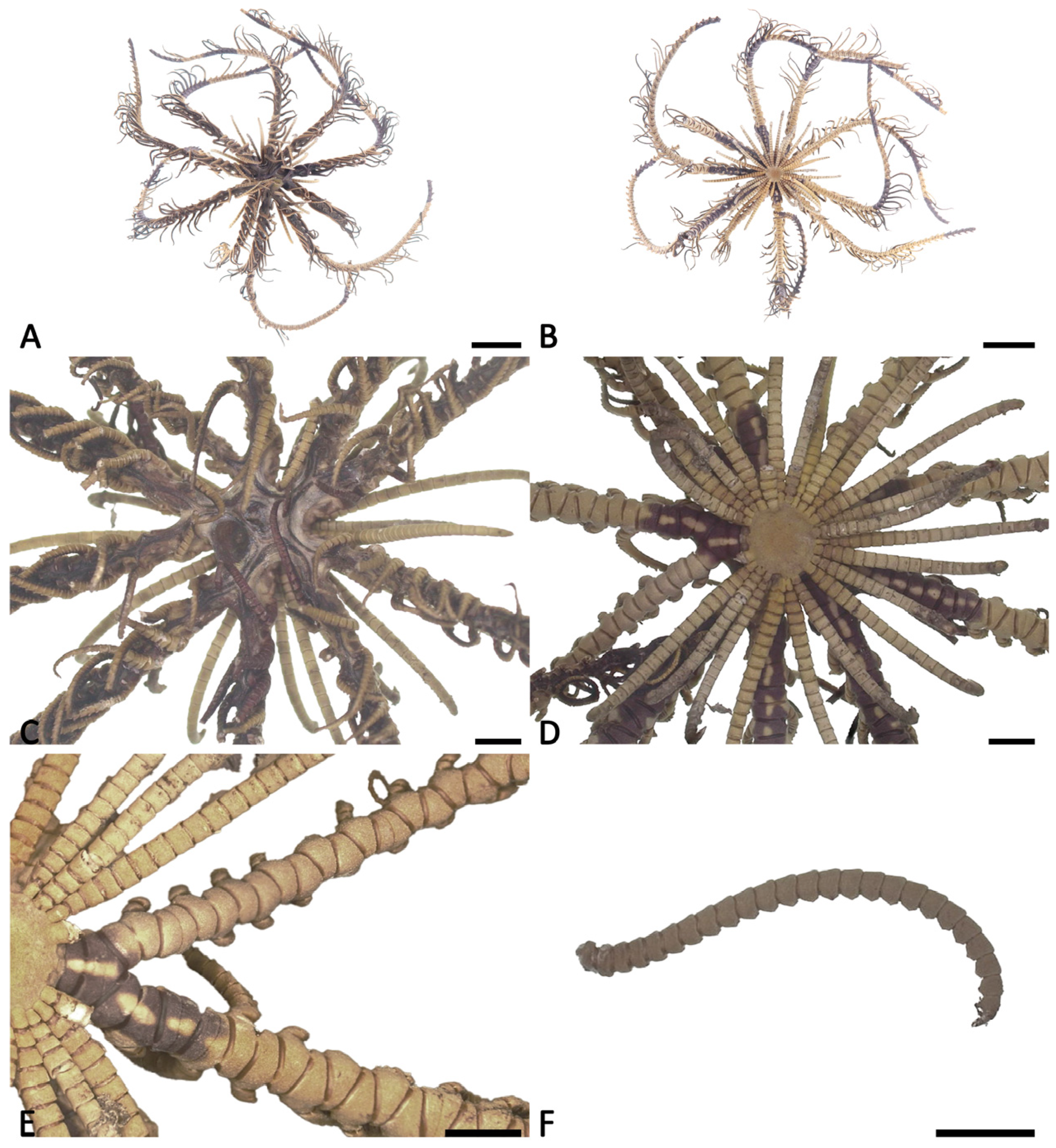
Figure 1. Decametra tigrina (A.H. Clark, 1907) in this study. (A), Oral side; (B), Aboral side; (C), Oral part and pinnules; (D), Centrodorsal and cirri; (E), Proximal arm segments; (F), Cirrus. The specimen is preserved in ethyl alcohol (95%) and maintained at the Marine Echinoderms Resources Bank of Korea (MERBK-C0066). Scale bars = (A,B) (2 cm) and (CF) (2 mm). Photograph by Gilpyo Kim.
Taxonomy 06 00002 g001
Figure 2. Circular mitochondrial genome map of Decametra tigrina generated in this study. The inner circle corresponds to the L strand, while the outer circle denotes the H strand.
Taxonomy 06 00002 g002
Figure 3. Phylogenetic tree constructed by the maximum likelihood (ML) approach using nucleotide sequences from 13 protein-coding genes across 23 crinoid species, including Decametra tigrina, with an isocrinoid species as the outgroup. The ML analyses employed the TrN + G model for ATPase8, TrN + I + G for NADH2, and GTR + I + G for other PCGs with 1000 bootstrap replicates. Bootstrap support values are shown near each node.
Taxonomy 06 00002 g003
Table 1. Detailed information of 22 crinoids mitochondrial complete genome sequences used for comparative and phylogenetic analysis in this study.
OrderFamilySpeciesAccession Number in GenBankReference
ComatulidaAntedonidaeAntedon mediterraneaAM404181[13]
Florometra serratissimaAF049132[14]
Florometra sp.MT302206[15]
Poliometra prolixaOP177937[16]
ColobometridaeCenometra bellaOK509084[17]
Decametra tigrinaPV742399This study
Florometra sp.MN883538[18]
Oligometra serripinnaMW405444Unpublished
ComatulidaeAnneissia pinguisMW008594[19]
Anneissia intermediaMW376476[20]
Capillaster sp.OP546034[21]
Comanthus parvicirrusMW526392[21]
Comenthus sp.OM272942[21]
Comaster schlegeliiMW526391[22]
Comatella nigraOM321037[21]
Comatella stelligeraOM313186[21]
Phanogenia gracilisDQ068952[22]
MariametridaeStephanometra indicaMF966246[23]
PentametrocrinidaeThaumatocrinus sp.OQ207656[21]
PtilometridaePtilometra sp.OP546035[21]
TropiometridaeTropiometra macrodiscusON381167[21]
ZygometridaeZygometra comataON585667[21]
IsocrinidaIsocrinidaeMetacrinus rotundusOM964491[21]
Table 2. The arrangement of Decametra tigrina mitochondrial complete genome.
NameSiteLength (bp)StrandStart CodonStop CodonAnti-Codon
COI1–15571557HATGTAA
tRNA-Arg1558–162568H UCG
NADH4L1626–1922297HGTGTAA
COII1924–2613690HATGTAG
tRNA-Lys2616–268570H CUU
ATPase82686–2859174HATGTAA
ATPase62853–3542690HATGTAA
COIII3552–4334783HATGTAA
tRNA-Ser4333–440371L UGA
NADH34407–4760354HATGTAA
NADH44773–61641392HATGTAA
tRNA-His6155–622369H GUG
tRNA-Ser6233–630068H GCU
NADH56301–81811881HGTGTAA
NADH68182–8676495LATGTAA
CytB8751–99021152HATGTAG
tRNA-Pro9893–996169H UGG
tRNA-Gln9967–10,03872L UUG
tRNA-Asn10,042–10,11473H GUU
tRNA-Leu10,117–10,18771H UAG
tRNA-Ala10,189–10,25971L UGC
tRNA-Trp10,262–10,32968H UCA
tRNA-Cys10,330–10,39667H GCA
tRNA-Val10,401–10,47070L UAC
tRNA-Met10,474–10,54875H CAU
tRNA-Asp10,552–10,62170L GUC
tRNA-Thr10,851–10,92272L UGU
tRNA-Glu10,924–10,99168L UUC
12S rRNA10,992–11,832841L
tRNA-Phe11,833–11,90573L GAA
tRNA-Leu11,906–11,97772L UAA
tRNA-Gly11,978–12,04669L UCC
16S rRNA12,047–13,5651519L
tRNA-Tyr13,566–13,63671L GUA
NADH213,635–14,6751041LATGTAA
tRNA-Ile14,676–14,74671L GAU
NADH114,751–15,719969LATGTAA
Disclaimer/Publisher’s Note: The statements, opinions and data contained in all publications are solely those of the individual author(s) and contributor(s) and not of MDPI and/or the editor(s). MDPI and/or the editor(s) disclaim responsibility for any injury to people or property resulting from any ideas, methods, instructions or products referred to in the content.