3.1. Euphorbia peruviandina V.W. Steinm., sp. nov.
urn:lsid:ipni.org:names:77373724-1
Type: PERU. Huancavelica: Prov. Huancavelica, Sachahuaccta, a 6 km SO de Conaica [Conayca], [12.558155° S, 75.040232° W], 3600 m, estepa de gramíneas con arbustos dispersos, 3 April 1952, O. Tovar 243 (holotype: USM accession number 278903 photo!; isotype: UC accession number 251157/barcode 1251157!). Note: The information about habitat and the precise date of 3rd April is only on the label of the isotype at UC. The date on the holotype is simply April 1952, and no habitat data is provided.
Diagnosis: Similar to Euphorbia orbiculata and E. jamesonii but differing by having glabrous (vs. pilose) stipules; a laciniate pseudocalyx (vs. pseudocalyx lacking); and rugose, brownish (vs. smooth to lightly dimpled, grayish to blackish) seeds.
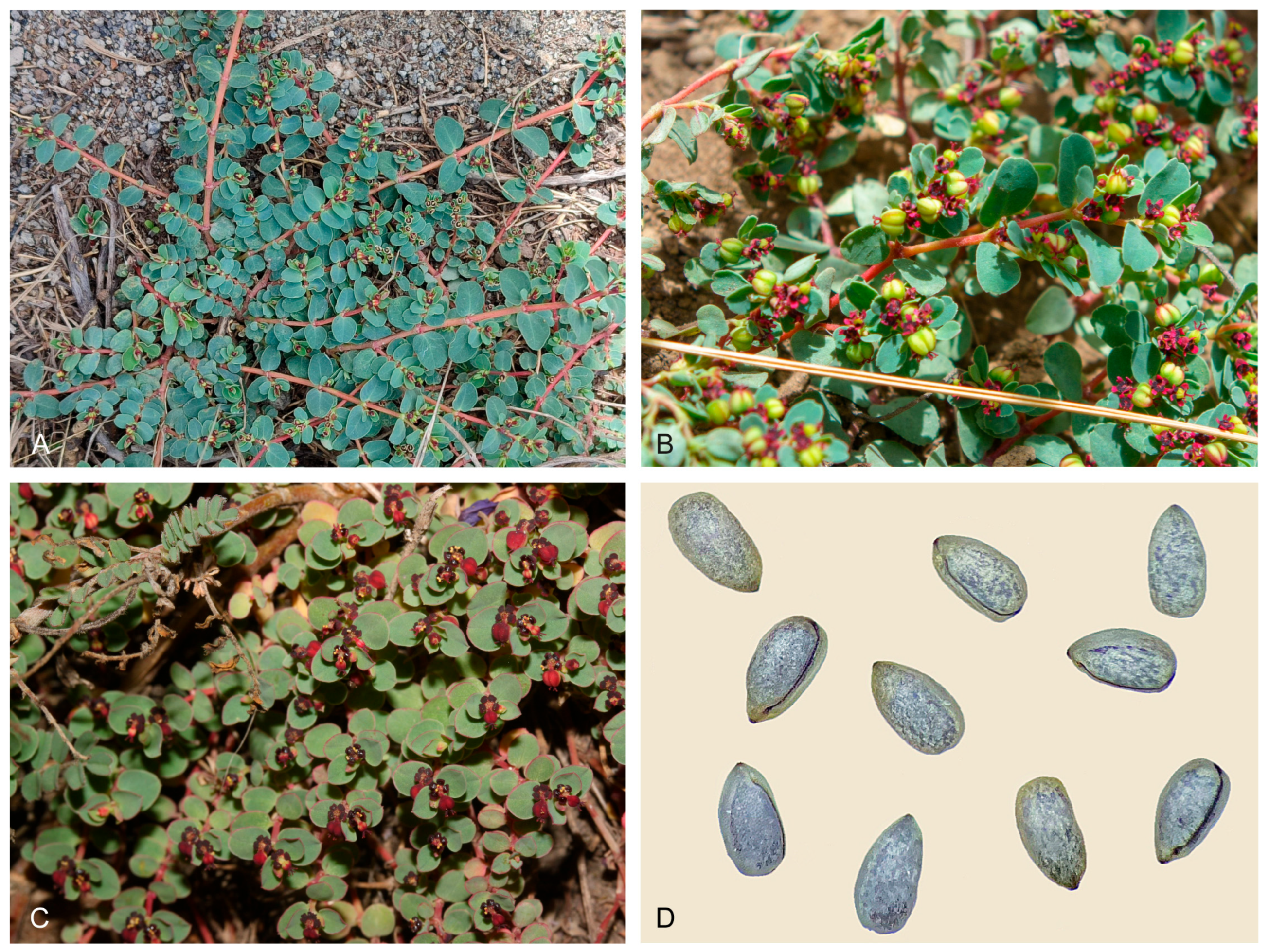
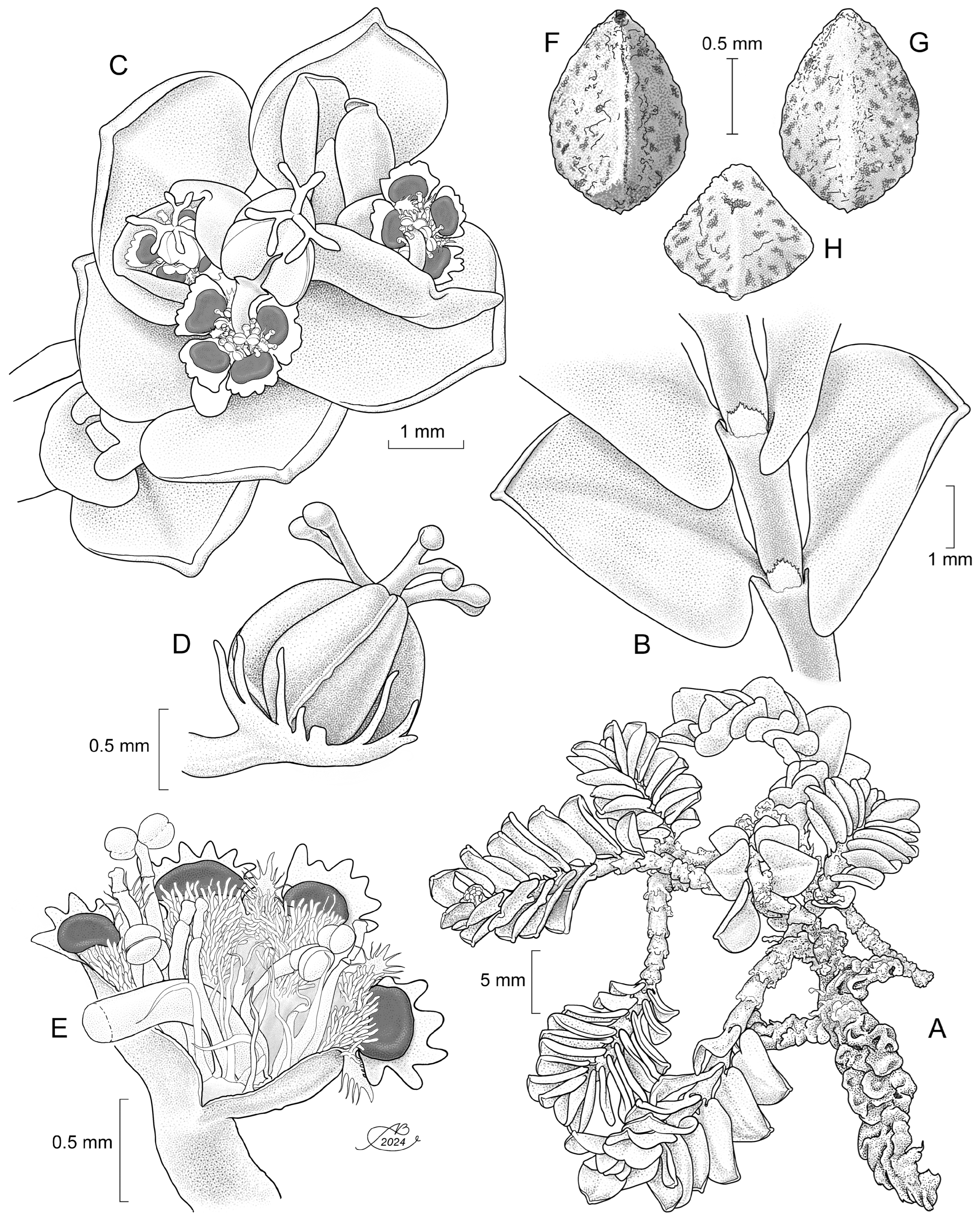
Description: Perennial herb, compact, from a thick, gnarled, woody rootstock to 1 cm in diameter, rhizomatous and much branched at or just below the soil level. Stems prostrate, 2–18 cm long, terete, glabrous, internodes at mid-stem of main branches 0.1–0.8 cm long. Leaves opposite, stipules interpetiolar, united into a white, scale-like sheath, this broadly ovate, deltoid, semi-circular, or subulate, 0.4–1.1 mm long, glabrous, entire to fimbriate, petiole flattened to caniculate, 0.1–0.6 mm long, glabrous, blade ovate, broadly ovate, oblong, broadly oblong, or orbicular, 0.15–0.4 cm long, 0.1–0.4 cm wide, often papillate after drying, base asymmetrical, one side attenuate to rounded or shallowly cordate, the other side rounded to strongly cordate, often clasping the stem, apex acute, rarely obtuse, mucronulate (even when obtuse), margin entire, usually hyaline, involute and fused towards tip, midvein faint, secondary veins generally not evident or rarely faintly 3-nerved from the base with two indistinct lateral nerves. Cyathia solitary in the distal stem nodes, peduncle 0.3–1.8 mm long, glabrous. Involucre funnelform, 1.0–1.3 mm long, 0.8–1.3 mm in diameter, outer surface glabrous, inner surface pilose towards the rim, lobes subulate, 0.2–0.3 mm long, sinus not pronounced or shallowly indented to less than ¼ the involucre length, glands 4, transversely oblong, plicate in age, equal, 0.15–0.25 mm long, 0.3–0.4 mm wide, purple black, appendages present, shortly flabellate or reduced to a narrow rim, 0.1–0.3 mm long, 0.3–1.0 mm wide, entire, undulate or lobed to base, glabrous, white or purple black from early on. Staminate flowers ca. 25–35, bracteoles abundant, filiform, often divided, pilose towards the apex. Pistillate flower on a glabrous gynophore exserted from the involucre 0.6–1.1 mm, with a laciniate pseudocalyx, ovary ovoid, strongly 3-lobed, glabrous, styles 3, free, 0.5–0.7 mm long, bifid 1/6–1/2 the length, glabrous, narrowly cylindric, slightly clavate at the apex. Capsule ovoid to slightly oblate-ovoid, 3-lobed, 1.5–1.8 mm long, 1.6–2.2 mm wide, widest below the middle, glabrous, columella 1.2–1.4 mm long. Seeds ovoid, 4-angular in cross-section, the dorsal facets longer than the ventral facets, strongly keeled, 1.0–1.4 mm long, 0.6–0.8 mm wide, apex pointed, base truncate, rugose, brownish, often mottled brown-dark brown, ecarunculate.
Figure 1 and
Figure 2.
Etymology: The specific epithet is a compound adjective that refers to the Andean region of Peru where the species occurs.
Distribution, habitat, and phenology:
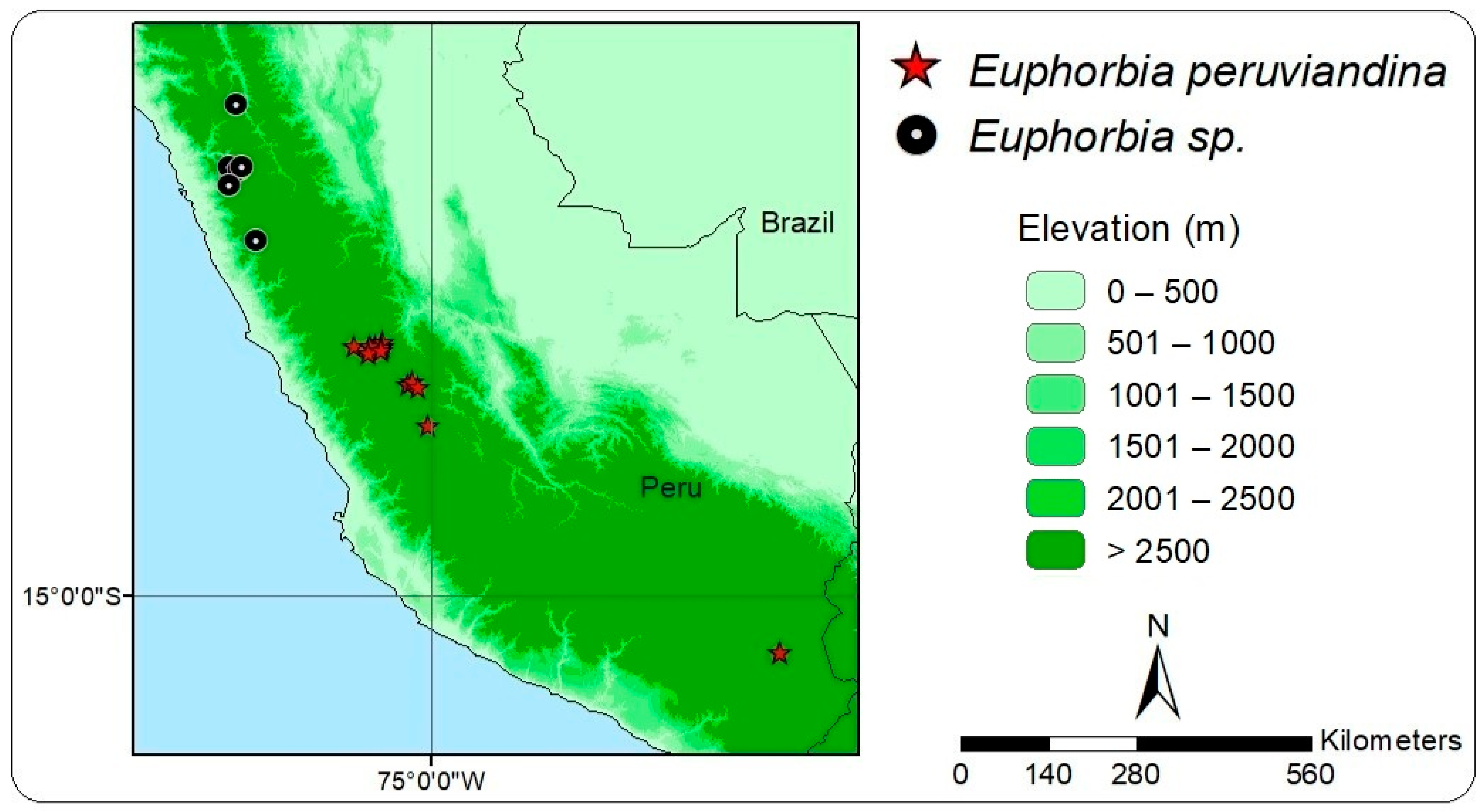
Euphorbia peruviandina is restricted to puna vegetation in the Andes of central and southern Peru, occurring in the departments of Huancavelica, Junín, and Puno at elevations of 3300 to 4200 m (
Figure 3). Given its wide distribution, extending more than 800 km from north to south, and the proximity of 75 km from one collection to Bolivia, it might also occur in adjacent northwestern Bolivia. Flowering and fruiting overlap broadly and reproductive plants have been found from March to July and in November.
Conservation status: There is no precise information about the number of mature individuals, generation length, or the direction of the current population trend of Euphorbia peruviandina. The extent of occurrence (EOO) is calculated to be 25,867 km2, and the known AOO is 52 km2. There are four known locations: 1) near Conayca, Huancavelica, 2) the vicinity of La Oroya and Tarma, Junín, 3) around Huancayo, Junín, and 4) northeast of Puno, Puno. Apparently, none of these populations occur in protected areas. Given that the puna vegetation of Peru is generally considered threatened by grazing, fire, and global warming, E. peruviandina is preliminary assessed as endangered (EN B2ab(iii)).
Additional specimens examined (Paratypes): PERU. Junín: Prov. Huancayo, hillside about 11 km from Huancayo towards Chamiseria, [12.013347° S, 75.175955° W], 11,000 ft, rocky hillside, 30 April 1961, S.G.E. Saunders 635 (BM); near Huancayo [12.067975° S, 75.210500° W], 3300–3500 m, April–May 1929, E.P. Killip & A.C. Smith 22023 (US); Prov. Tarma, 20 km W of Tarma, [11.420477° S, 75.876006° W], 4000 m, 9 April 1952, P.C. Hutchison 642 (UC); route 20B to Tarma, branching E of route 3, km 11 from Tarma, [11.421272° S, 75.789894° W], 11,300 ft, 6 November 1975, C. Davidson 3358 (RSA); Prov. Tarma, carr. Central, cerro 11–15 km W of Tarma, [11.421272° S, 75.789894° W], 3700–4200 m, 3 July 1966, G. Edwin & J. Schunke V. 3864 (F); Tarma, [11.421123° S, 75.691184° W], 3000 m], 1–6 June 1922, MacBride & Featherstone 1010 (F, US); La Oroya, [11.522074° S, 75.891173° W], 12,000 ft, 27 May–7 June 1922, MacBride & Featherstone 982 (F, US).
iNaturalist observations: Peru. Junín: 12296131, 12296132, 13306876, 13334604, 78667290, 225822922. Puno: 266302518, 266302500.
3.2. Euphorbia jamesonii [as “jamesoni”] Boiss., Cent. Euphorb. 11. 1860. Chamaesyce jamesonii (Boiss.) G.L. Webster, Monogr. Syst. Bot. Missouri Bot. Gard. 75: 954. 1999
urn:lsid:ipni.org:names:319630-2
Type: ECUADOR. “In Andibus Quitensibus,” 8000 ft, October 1848, W. Jameson 672 (holotype: G barcode 00441565 photo!; isotypes: BM barcode 552170!, BM barcode 000552156!, F accession number 515943!, K barcode 000253916!, US accession number 1496348/barcode 00409738!).
= Euphorbia melanocarpa Boiss. in DC., Prodr. l5(2): 41. 1862. Chamaesyce melanocarpa (Boiss.) G.L. Webster, Monogr. Syst. Bot. Missouri Bot. Gard. 75: 954. 1999.
Type: ECUADOR. “In Andibus Ecuadorensibus,” Páramo de Tiucajas [Tiocajas],” September 1859, R. Spruce 6061 (holotype: G-DC barcode 00310750!; isotypes: BM barcode 552170!, F accession number 516100!, F accession number 871696!, K barcode 201885!, K barcode 201885!, NY barcode 0002605!, W accession number 159426 photo!, W accession number 217843 photo!).
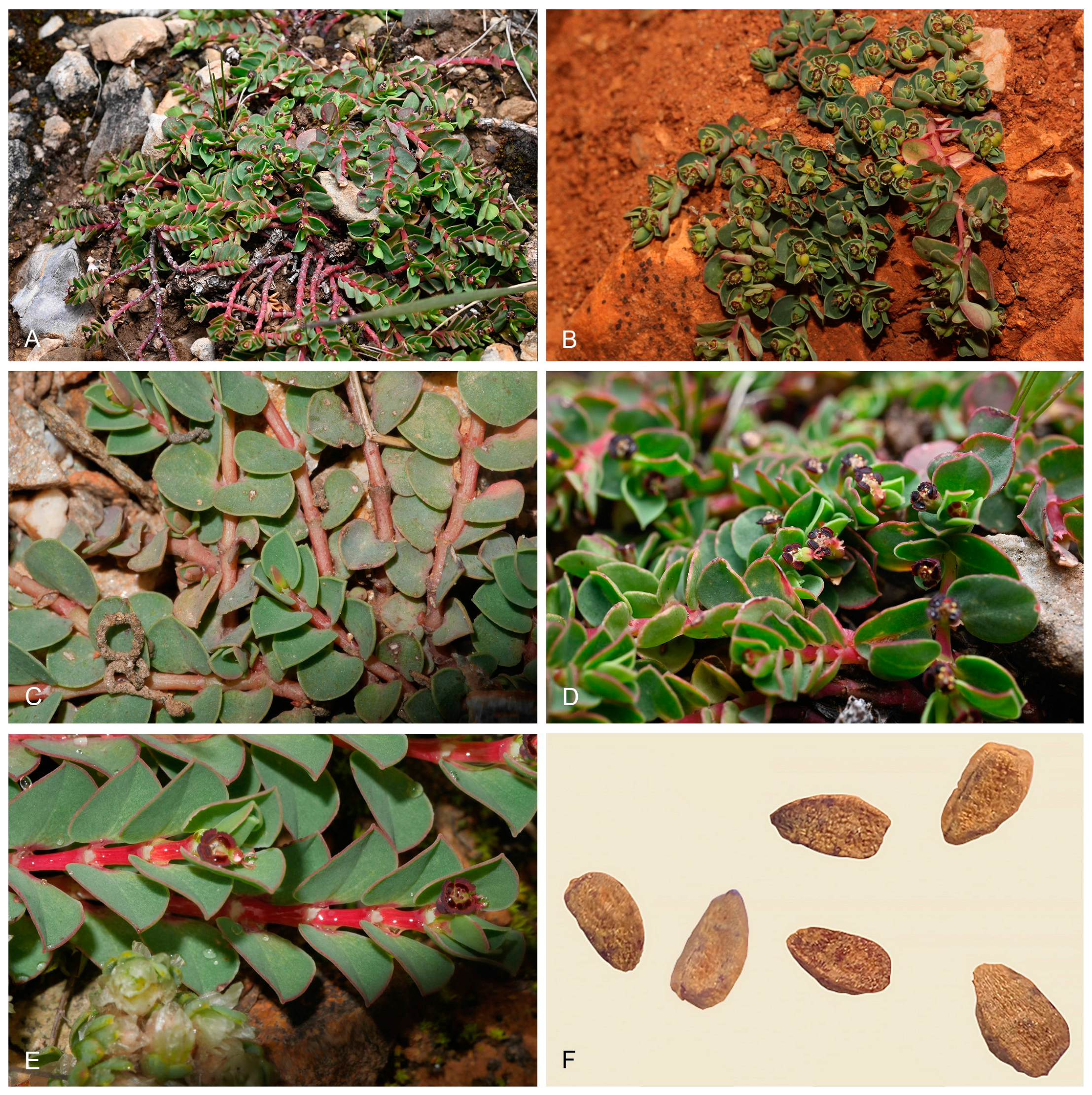
Description: Perennial herb from a thickened, often gnarled rootstock to 0.8 cm in diameter, this sometimes branched below the surface and producing many aerial stems or highly ramified rhizomes. Stems prostrate to ascending, 5–32 cm long, terete or slightly flattened when dried, glabrous or shortly hispid-puberulent on the upper surface, hairs when present white, stiff, straight, 0.1–0.25 mm long, internodes at mid-stem of the main branches 0.2–2.8 cm long. Leaves opposite, stipules interpetiolar, free and subulate when young, mostly united into scale-like sheath, this broadly deltoid, broadly ovate or a narrow transversely semi-elliptic rim, 0.1–0.5 mm long, glabrous on the outside, with a pilose tuft of hairs at the node and on the inner surface, entire to erose or laciniate, petiole flattened to caniculate, 0.2–0.9 mm long, glabrous, blade ovate, broadly ovate, broadly elliptic or orbicular, rarely obovate, 0.2–1 cm long, 0.15–0.7 cm wide, base asymmetrical, one side cordate to rounded, the other rounded, shallowly cordate to cuneate or attenuate, when both sides cordate, one more strongly so, apex obtuse, often retuse or with a minute (0.1 mm long or less) mucro, margin entire to sharply serrulate especially in the distal half, often whitish to reddish, usually only the midvein visible, and this obscurely so, but sometimes faint lateral veins also observable. Cyathia solitary in the distal stem nodes, peduncle 0.3–1.9 mm long, glabrous. Involucre funnelform, 0.6–1.2 mm long, 0.6–1.3 mm in diameter, strongly infused with dark purple to dark pink pigment, outer surface glabrous, inner surface pilose below the rim, especially below the glands, lobes triangular to subulate, 0.1–0.3 mm long, sinus not pronounced, glands 4(5), transversely oblong to transversely reniform, equal, 0.2–0.4 mm long, 0.3–0.7 mm wide, dark purple-black, appendages present, mostly shortly flabellate although sometimes highly reduced to a narrow rim, 0.1–0.5 mm long, 0.4–0.7 mm wide, shallowly undulate to deeply lobed (nearly to the base), the lobes ovate, oblong or deltoid, rarely entire, glabrous, pink to dark purple-black (rarely whitish). Staminate flowers ca. 20–25, bracteoles few, filiform, pilose to plumose. Pistillate flower on a glabrous gynophore exserted from the involucre 0.4–1.5 mm, pseudocalyx absent, ovary ellipsoid to ovoid, 3-lobed, glabrous, styles 3, free, 0.5–0.8 mm long, bifid 1/5 to ½ their length, glabrous, slender, reddish, not or only slightly dilated at the apex. Capsule ovoid to oblate-ovoid, roundly 3-lobed, 1.3–1.7 mm long, 1.5–2.0 mm wide, widest below the middle, glabrous, columella 1.1–1.5 mm long. Seeds narrowly ovoid, 4-angled in cross-section, the dorsal facets considerably longer than the ventral facets, strongly keeled, 1.0–1.2 mm long, 0.6–0.8 mm wide, smooth or with a few shallow dimples, base rounded to truncate, apex a rounded point, light gray, without a caruncle.
Figure 4.
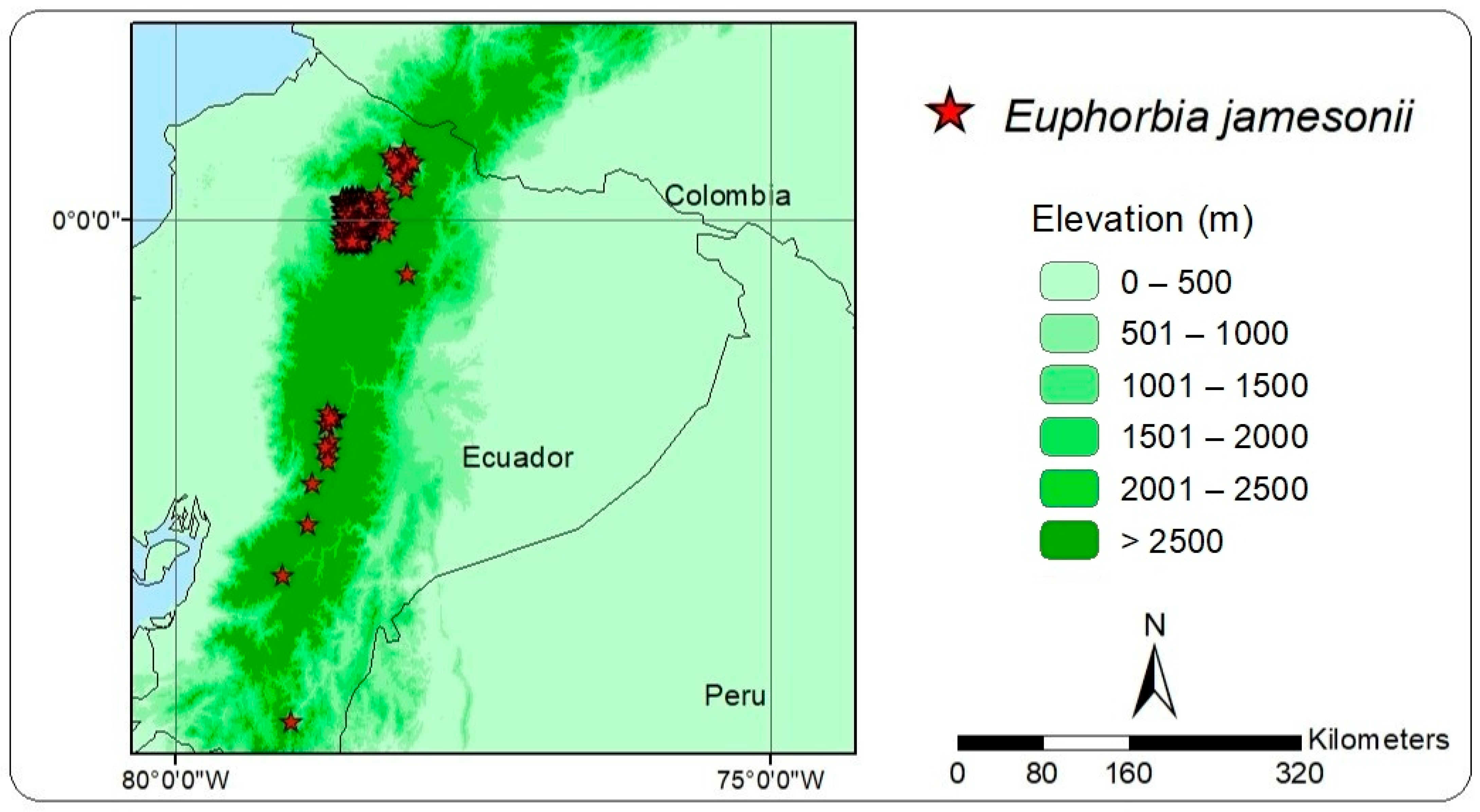
Distribution, habitat, and phenology: Restricted to the Inter-Andean region of Ecuador, in the provinces of Azuay, Cañar, Carchi, Chimborazo, Imbabura, Loja, and Pichincha, at elevations of 1600–3250 m (
Figure 5). Reports of its occurrence in Peru, e.g., MacBride [
15] and Brako [
16], are based on misidentifications of
Euphorbia peruviandina.
Euphorbia jamesonii occurs in grasslands, dry montane forests, and xerophytic scrub with cacti, on both rocky and sandy soils, sometimes in disturbed areas. Flowering and fruiting occur throughout the year.
Common name and uses: Known locally as “lechero,” the latex is used to heal wounds (Núnez & Chitapaxi 177).
Etymology: The specific epithet honors William Jameson (1796–1873), a prolific Ecuadorian plant collector and author of
Synopsis Plantarum Æquatoriensium [
17]. He made the first known collection of the species in 1848, and this gathering was used by Boissier [
18] to describe the species.
Conservation status: Both
Euphorbia jamesonii and its synonym
E. melanocarpa were proposed as being vulnerable to extinction (VU D2) by Santiana, Cerón & Pittman [
19,
20], and they continue to be listed as such in the Red List of the International Union for the Conservation of Nature. At the time of the earlier evaluations, in 2004, few localities were reported, and they were assessed as vulnerable due to having a limited area of occupancy (AOO) and few locations. Currently,
Euphorbia jamesonii is known from many locations throughout the Andes of Ecuador from Loja in the south to Carchi in the north. Therefore, the classification as VU D2 is no longer appropriate. There is no precise information about the number of mature individuals, generation length, or the direction of the current population trend. The extent of occurrence (EOO) is calculated to be 25,324 km
2, and the AOO is 500 km
2. Thus, it could qualify as vulnerable for having an AOO of less than 2000 km
2. However, the species is known from more than 10 locations, and although the threats of fire and grazing may affect the species, it also occurs in secondary vegetation such as disturbed roadsides. Therefore, the most appropriate IUCN Red List category for this species is Least Concern (LC).
Additional specimens examined: ECUADOR. Cañar: Ingapirca-Cañar rd, km 1–5 from Ingapirca, 3100–3150 m, 02°33′ S, 78°53′ W, 15 June 1979, B. Løjtnant, A. Molau & U. Molau 14905 (GB). Carchi: near San Vicente de Pusir, just N of Río Chota, 33 km S of El Ángel, [0.495307° N, 78.024061° W], 1900 m, 21 November 1980, H. Balslev & F. Quintana 934 (NY); 12 km by rd SW of Mira, 00°28′ N, 78°05′ W, 7 August 1978, G.L. Webster 23048 (DAV). Chimborazo: between Guamote and Palmira, 59 km from Riobamba on rd to Alausí, [2.009982° S, 78.718102° W], 3250 m, 19 February 1985, U. Molau & L. Öhman 1345 (GB); Riobampa, [1.664338° S, 78.658562° W], 2800 m, 1929, A. Rimbach 71 (F, NY); near Riobampa, 2900 m, May 1935, A. Rimbach 473 (F, MICH); Alausí, [2.201834° S, 78.8465151° W], 2500 m, 19, 27 July 1923, A.S. Hitchcock 20714 (NY); Guamote, [1.935235° S, 78.710124° W], 3100 m, 13 April 1939, E. Asplund 6922 (F); Punto Chipo, S of Guamote, 3180 m, 25, 26, 28 June 1959, H.G. Barclay & P. Juajibioy 8225 (MO). Imbabura: carr. Ibarra-Tulcán, a 15 km de Ibarra, Valle del Río Chota, [0.487090° N, 78.106541° W], aprox. 1700 m, 19 October 1985, B.B. Larsen & J. Madsen 285 (GB, NY); descenso Aloburo-Yaguarcocha, [0.407409° N, 78.068368° W], 2500 m, 4 June 1949, M. Acosta Solís 12908 (F); entre Aloburo y El Río Chota, [0.456494° N, 78.046915° W], 1600–2600 m, 17 July 1945, M. Acosta Solís 10410 (F); Hacienda Pimán, between Ibarra and Chota on the abandoned Pan American Highway, ca. 2300 m, 00°27′ S, 78°03′ W, 27 May 1973, L. Holm-Nielsen, S. Jeppesen, B. Løjtnant & B. Øllgaard 6531 (DAV); between Cahasqui and La Merced de Buenos Aires, ca. 30 km NW of Ibarra, 2200 m, 4 ago 1989, H. van der Werrf & E. Gudiño 10896 (DAV); cant. Ibarra, along rd 12 km N of Ibarra, 00°25′ N, 78°07′ W, 1965 m, 3 July 1996, G.L. Webster et al. 32108 (DAV); Salinas, [0.067758° N, 78.372927° W], 1700 m, 25 May 1949, M. Acosta Solís 12477 (F); N of Ibarra at Pinan Grande, S of San Alfonso, 22 April 1972, N. Beck Breuninger 372 (GB). Pichincha: San Antonio, La Providencia, al N de Quito, [0.005670° N, 78.446899° W], 2300–2400 m, 5 March 1950, M. Acosta Solís 16230 (F); La Josefina, camino a Puéllaro, 2200–2400 m, 15 April 1950, M. Acosta Solís 16420 (F); Quito-Ibarra rd, c. 3 km NE of Guayllabamba, 00°03′ S, 78°19′ W, c. 2300 m, 2 June 1979, B. Løjtnant, A. Molau & U. Molau 14068 (GB), same locality, B. Løjtnant, A. Molau & U. Molau 14082 (GB, NY); Oton, Huilabamba to Cayambe, [0.021907° S, 78.255725° W], ca. 8000 ft, 4 August 1939, E.K. Balls 7330 (BM, UC); cant. Tabacundo, lower slopes of Loma de Asuajato, near bridge across Río Pisque, 21.5 km W of Tabacundo, 00°01′ S, 78°20′ W, 1975 m, 1 July 1996, G.L. Webster et al. 32031 (DAV); 15 mi N of Quito, 9000 ft, 3 February 1953, G.W. Prescott 304 (NY); Guayallabamba Canyon, [0.067758° S, 78.372927° W, 1937 m], 15 January 1958, G.W. Prescott 1210 (NY); near Pomasqui, [0.040123° S, 78.454906° W, 2343 m], July 1859, W. Jameson 117 (NY); vía San Antonio de Pichincha-San José de Minas, Hacienda Tanlahua, límite con la Reserva Geobotánica Pululahua, 00°06′ N, 78°29′ W, 2100–3000, 21 June 1995, T. Núnez & F. Chitapaxi 177 (DAV, MO). Imbabura or Pichincha: Otavalo to Malchingui, 12 August 1923, A.S. Hitchcock 20835 (MO, NY).
iNaturalist observations: Ecuador. Azuay: 133823569. Chimborazo: 12231612, 12231613, 12231614, 12231615, 12231616, 12231617. Loja: 46792497. Imbabura: 46689327, 9093732, 12231619, 12231618, 9193471, 9102159, 9086546, 9060256, 282664029. Pichincha: 248380671, 248374189, 243655570, 243655568, 243443117, 242862181, 227377312, 212023573, 210787093, 210787077, 210787070, 210490292, 210119759, 210119757, 210119618, 210119142, 209920514, 209908741, 209908717, 209908704, 209894459, 209878700, 209878066, 209873141, 203647309, 192277233, 192274892, 192270694, 192270693, 192270681, 192268437, 192268427, 192268411, 192268401, 192268398, 192264916, 192264913, 192255585, 192252409, 159347116, 159344230, 159316702, 159281897, 159218143, 159218009, 158985928, 158426853, 158058079, 158049530, 157922695, 157528580, 157411665, 157378177, 157373254, 157361529, 157358605, 157342459, 141943497, 141941677, 141932849, 141754417, 141687012, 141664954, 141664947, 141664146, 141616398, 116425628, 116425609, 115206540, 115162906, 115128325, 115128147, 115127410, 114204584, 114204528, 114197016, 114063445, 114043862, 114016351, 113985491, 113916206, 112078785, 112078771, 108901338, 104775566, 95603188, 95577407, 95566196, 95561754, 95561749, 95483637, 95483633, 95394855, 95165746, 85281023, 83210463, 83158753, 83061921, 82491767, 77366157, 77332270,77325930, 77325913, 72953758, 71575335, 71420806, 71401576, 64651789, 64650486, 64479726, 57376687, 41330232, 37106942, 37106941, 37106940, 37106938, 37106937, 37106936, 36955579, 64628949, 114469956, 158988166, 258671639, 266311047, 266489438, 266491898, 266491917, 266491946, 266544317, 266549852, 266582531, 266766950, 266841311, 266843426, 267191683, 273225802,, 274037721, 274066469, 274191574, 274227067, 275848893, 275849435, 276687961, 276708636, 276724505, 282457379, 283785075, 283801136, 283801209, 283801250, 283830895, 283830946, 283830964, 283843885, 283843928, 283850365, 283850388, 283850418, 284385526, 299755884.
3.3. Euphorbia orbiculata Kunth, Nov. Gen. Sp. 2 [folio]: 42; [quarto]: 52. 1817. Chamaesyce orbiculata (Kunth) Soják, Čas. Nár. Muz. Praze, Rada Přír. 148(3–4): 199. 1980
urn:lsid:ipni.org:names:347590-1
Type: COLOMBIA. Cundinamarca: according to the protologue “crescit in alta planitie prope Santa Fé de Bogata, 1360 hex. [2487 m], floret Augusto,” A. J. A. Bonpland y F. W. H. A. Humboldt s.n. (holotype: P accession number 00669813!; isotypes: A barcode 00047892!, HAL barcode 118629!, P barcode 00136060!, P barcode 001360601!).
=Euphorbia meridensis Pittier, J. Wash. Acad. Sci. 19: 356. 1929.
Type: VENEZUELA. Mérida: Páramo de Apartaderos, [8.799014° N, 70.858106° W], 3300 m, 22 January 1922, A. Jahn 796 (holotype: VEN accession number 6886!; isotypes: A barcode 00047887!, NY barcode 263326!, US accession number 1186599/barcode 00095364!). Note: in the protologue, the number was erroneously given as “976.”
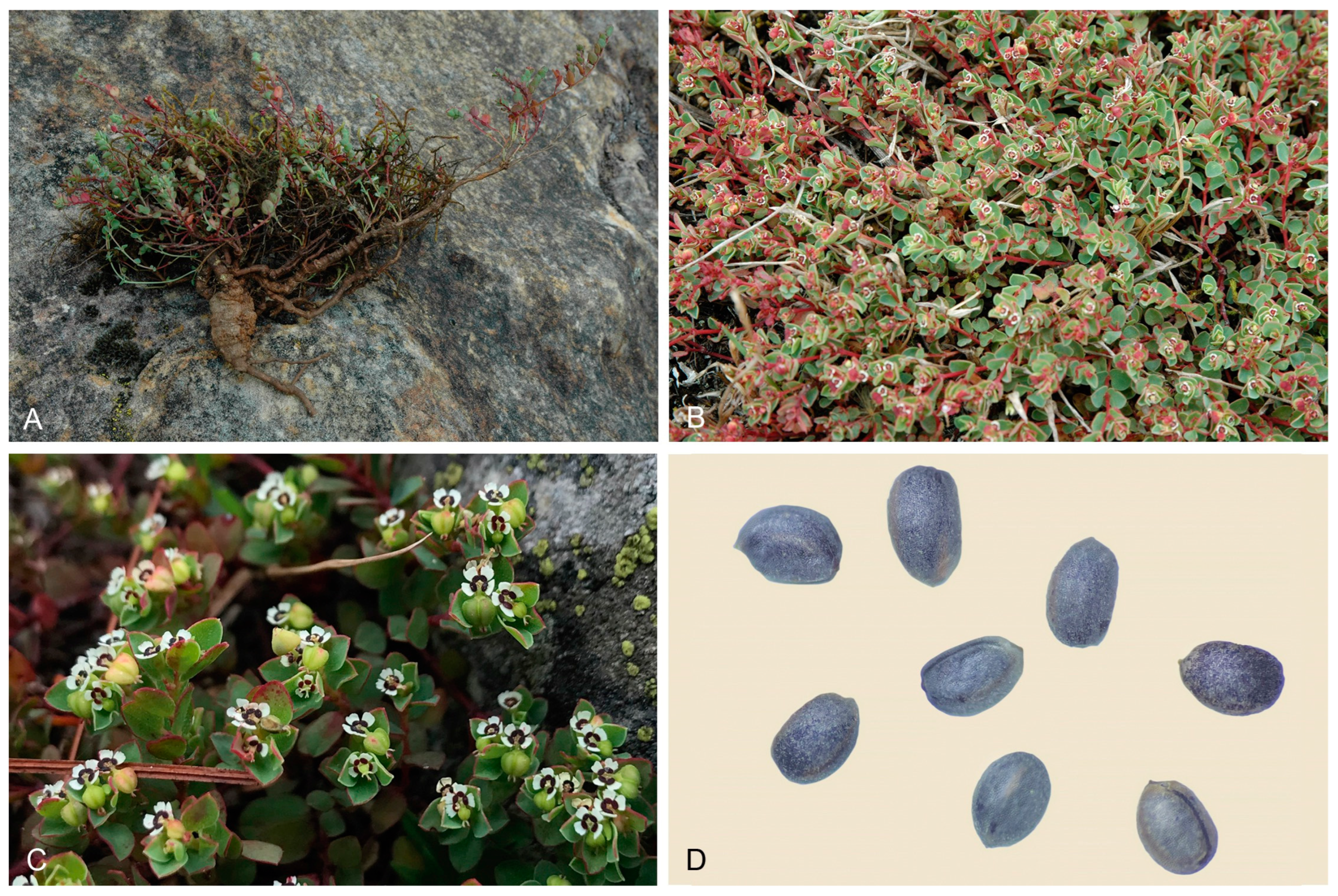
Description: Perennial herb from a thickened woody rootstock, rhizomatous and much branched below or at the soil level. Stems prostrate to ascending, 6–20 cm long, terete, drying striate, glabrous, internodes at mid-stem of main branches 0.2–1.2(2.1) cm long. Leaves opposite, stipules interpetiolar, narrowly triangular when young, becoming in age united into a white, deltoid, scale-like sheath, 0.4–0.6 mm long, pilose within, the hairs 0.1–0.2 mm long, straight, entire or erose, petiole 0.3–0.9 mm long, shallowly caniculate, blade oblong to obovate or almost orbicular, 0.2–0.6 cm long, 0.15–0.5 cm wide, base asymmetrical, one side cordate to slightly rounded, the other side rounded to truncate or acute, apex rounded to acute, often mucronulate, margin entire, usually only the midvein evident, this sometimes obscurely so, or rarely a fine network of tertiary veins also visible. Cyathia solitary in the distal stem nodes, peduncle 0.8–1.7 mm long, glabrous. Involucre campanulate to funnelform, 0.9–1.2 mm long, 0.6–1.1 mm in diameter, outer surface glabrous, inner surface pilose towards the rim, lobes subulate to triangular, 0.2 mm long, sinus not pronounced or shallowly indented to less than ¼ the involucre length, glands 4, transversely elliptic, equal, 0.2 –0.3 mm long, 0.4–0.5 wide, dark red to dark purple-black, appendages usually present, rarely reduced, variable, flabellate, oblong or reduced to a narrow margin around the gland, 0.2–0.4 mm long, 0.5–0.8 mm wide, entire, undulated or notched, glabrous, white turning in age to pink. Staminate flowers ca. 20–30, bracteoles many, filiform. Pistillate flower on a glabrous gynophore exserted from the involucre 0.3–1.6 mm, pseudocalyx absent, ovary ovoid, 3-lobed, glabrous, styles 3, free, 0.4–0.5 mm long, bifid to ½ their length, glabrous, narrowly cylindrical, sometimes slightly dilated at the apex. Capsule oblate-ovoid, 3-lobed, 1.5–1.8 mm long, 1.6–2.2 mm wide, widest toward the base, columella 1.0–1.3 mm long. Seeds obloid, faintly 4-angular in cross section, keel low and rounded, 1.0–1.1 mm long, 0.7–0.8 mm wide, base truncate to rounded, apex a low blunt point, smooth, blackish-gray, without a caruncle.
Figure 6.
Etymology: The specific epithet is a diminutive form of the Latin adjective “orbiculus,” meaning rounded or circular, and refers to the shape of the leaves.
Distribution, habitat, and phenology:
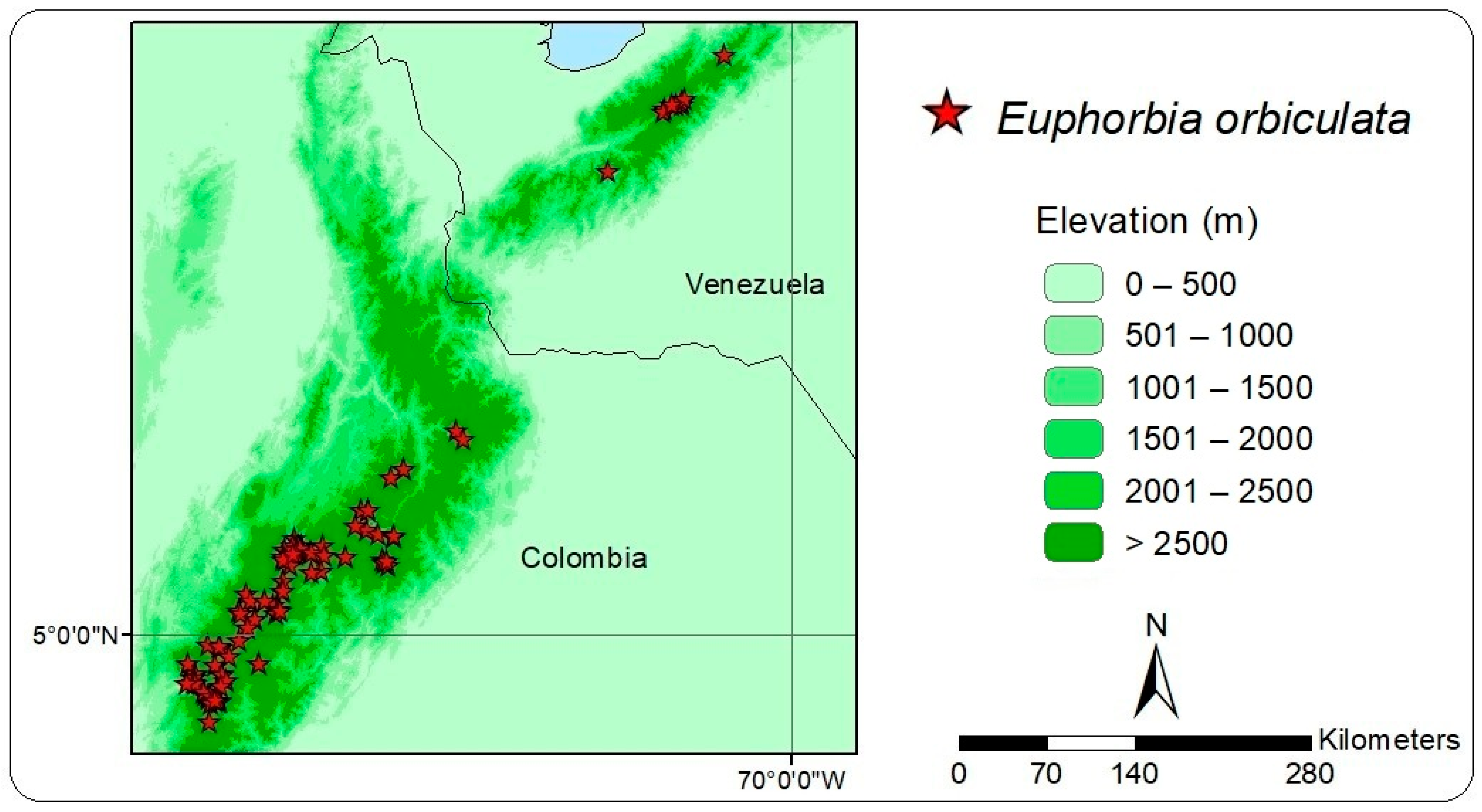
Euphorbia orbiculata is widespread in the Andes of north-central Colombia and western Venezuela, growing at elevations of 2200 to 3930 m (
Figure 7). Although it has been reported from Peru [
15,
16] and Ecuador [
21], these accounts are based on misidentified specimens.
Euphorbia orbiculata occurs in paramo and subparamo vegetation, as well as cloud forests of
Podocarpus, xerophytic scrub, and grasslands, on varied substrates including clay, limestone, and sandstone. It is often found in disturbed habitats, for example, eroded hillsides, cultivated fields, and roadsides. Flowering and fruiting occur throughout the year.
Common names and uses: Known locally as “antajura” (
Yepes-Agredo 3389), “lechera” (
Yepes-Agredo 3389), “lechero” (
Guarín & M. Villareal 965), “lecheterna” (
S. Yepes-Agredo 3139), “leche eterna” (
F. Sarmiento 1853), “tafurita” (
Triana 5766), “teología” (
Duque-Jaramillo 2737), and “yerba de humor” (
Chen 50). The name provided in iNaturalist [
9] is “canchalagua,” although this common name is more frequently applied to
Schkuhria pinnata (Lam.) Kuntze ex Thell. (Asteraceae).
Euphorbia orbiculata is reportedly used as a purgative (
Triana 5766,
Sarmiento 1853) and to treat gonorrhea and urinary ailments (
Chen 50).
Conservation status: There is no precise information about the number of mature individuals, generation length, or the direction of the current population trend. The extent of occurrence (EOO) is calculated to be 29,410 km2 and the known AOO is 332 km2. Although it could qualify for endangered for having an AOO of less than 500 km2, the actual AOO is likely greater but still probably less than 2000 km2, which would permit listing as vulnerable. However, the species is known from many more than 10 locations, and it also occurs in disturbed habitats such as eroded hillsides, cultivated fields, and roadsides. Therefore, the most appropriate IUCN Red List category for Euphorbia orbiculata is Least Concern (LC).
Note:
Euphorbia orbiculata var.
jawaharii Rajagopal & Panigrahi was proposed for plants from India [
22]. However, the type collection (
Panigrahi & Rajagopal 2491, isotype L photo!) represents
Euphorbia serpens Kunth. Similarly, the varieties
Chamaesyce orbiculata subsp.
galioides (Boiss.) Soják and
C. orbiculata subsp.
nilagirica (Miq.) Soják are currently accepted as
Euphorbia heyneana subsp.
galioides (Boiss.) Panigrahi and
E. heyneana subsp.
nilagirica (Boiss.) Panigrahi, respectively [
23].
Additional specimens examined: COLOMBIA. Boyacá: Vía Arcabuco-Tunja, desvío a Combita, [5.636660° N, 73.349748° W], 2900 m, 15 May 1996, J. L. Fernández Alonso et al. 14311 (COL); mpio. Aquitania, zona del “Lago de Tota,” [5.539224° N, 72.925610° W], 2700 m, November 1989, J.L. Fernández Alonso et al. 6982 (COL); Boyacá, [5.454474° N, 73.362085° W], 2700 m, 15 April 1964, C. Saravia 3925 (COL); mpio. Villa de Leyva, cerca de Sáchica, [5.581553° N, 73.5455550° W], 1990 m, August 1964, C. Saravia T. 4094 (COL); mpio. Ráquiera, cruce carreteras-Gachaneca, [5.497494° N, 73.589564° W], 2540 m, 13 August 1985, J. Molano et al. 537 (COL); entre Tunja y Villa de Leyva, [5.593154° N, 73.44652° W], 3000 m, 4 June 1989, S. Castroviejo et al. 10539C (COL); Raquiera, [5.539534° N, 73.636123° W], 3000 m, 4 June 1989, S. Castroviejo et al. 10579 (COL); Páramo de Huina, entre Belén y Susacón, [06.127079° N, 72.867832° W], 3300 m, 6 May 1959, H.G. Barclay 7644 (COL); mpio. Villa de Leyva, 6 km de la carretera de Sutamarchán a Villa de Leyva, 05°35′ N, 73°34′ W, 2200 m, 1 July 2002, R. Bernal & G. Galeano 3222 (COL); Páramo de Guantiva, valle Q. El Desaguadero, 4 km al NW de Sta. Rosita, [6.189679° N, 72.777915° W], 3275 m, 5 May 1973, A.M. Cleef 9767 (COL); Nevado de Cocuy, Las Lagunillas, Tabloncito [6°23′58″ N, 72°21′10″ W], 3930 m, 13 September 1938, J. Cuatrecasas & H. García Barriga 1604 (COL, F); Puente Boyacá [5°26′43″ N, 73°25′58″ W], 2 June 1971, R. Guarín & M. Villareal 965 (COL); Villa de Leyva, [5.636417° N, 73.526822° W], 2100 m, 3 March 1964, S. Espinal T. & E. Montenegro M. 1535 (COL); El Gran Hotel Termales, near Paipa, [5.780406° N, 73.116186° W], 2577 m, 6 May 1944, J.A. Ewan 15635 (NY, US); Tota, [5.514479° N, 72.916566° W], 2824 m, 1 September 1951, S. Yepes-Agredo 3139 (COL); mpio. Villa de Leyva, Cerro Morronegro [5.624742° N, 73.500966° W], 2280 m, 29 June 2003, M.A. Bello & F. González 298 (COL); mpio. Villa de Leyva, camino a Chíquiza, vareda “El Gacal, [5.616214° N, 73.504607° W], 2210 m, 23 August 2003, M.A. Bello et al. 539 (COL); mpio. Sora, vareda Caitoque, [5.593327° N, 73.429870° W], 25 December 2003, F. González 4125 (COL); mpio. Sutamarchán, Finca “Marte,” km 40 de la carretera Tunja-Chiquinquierá, [5.609734° N, 73.630656° W], 22 February 1981, F. Sarmiento 1853 (COL); Sierra Nevada de Cocuy, near Hacienda Ritacuba, 3600 m, 2 August 1957, P.J. Grubb et al. 228 (COL); Sierra Nevada de Cocuy, above Güicán, [6.466619° N, 72.402810° W], ca. 3100 m, 26 July 1957, P.J. Grubb et al. 55 (COL); Páramo de Guantiva, Valle Q. El Desaguadero, 4 km al NW de Santa Rosita, [6.189679° N, 72.777915° W], 3275 m, 5 May 1973, A.M. Cleef 9767 (COL); Páramo de Guantiva, 4 km W of Villa de Leyva, [5.636944° N, 73.563704° W], ca. 2200 m, 26 December 1971, A.M. Cleef 341 (COL, US), Páramo de La Rusia, NNW of Duitama, carr. Duitama-Virolín, Valle Río Surba, [5.892272° N, 73.031781° W], 3000 m, 11 December 1972, A.M. Cleef 7043 (COL); mpio. Sutamarchán, Finca “Marte,” km 40 de la carretera Tunja-Chiquinquierá, [5.609734° N, 73.630656° W], 21 February 1981, F. Sarmiento 1835 (COL), ibid., F. Sarmiento 1837 (COL); mpio. Toca, vereda La Colorada, Páramo de Santo Ecce Homo, 3400–3600 m, 15 October 1982, M. Bejarano B. 04 (COL); Boyacá, mpio. Aquitania, cerca al Cerrito, alrededores del Lago de Tota, [5.528030° N, 72.897719° W], 3025 m, 1976, O. Rangel & J. Aguirre 49 (COL); Boyacá, 55 km N of Tunja, 2900 m, 11 July 1968, F.A. Barkley 380068 (DAV); Nevado del Cocuy, Valle del Cocuy, 3400–3500 m, 13 September 1938, J. Cuatrecasa 1677B (F, US). Cundinamarca: mpio. Nemocón, [5.055549° N, 73.886581° W], Vereda Susatá, 2840 m, 3 June 1998, S.P. Cortés 2258 (COL); mpio. Madrid, Hacienda Casablanca, [4.722964° N, 74.263559° W], 20 June 1999, R. Sánchez 4287 (COL); Cundinamarca, mpio. Nemocón, Hacienda Susatá [5.055549° N, 73.886581° W], 1 March 2002, J. Struik & M. van der Linden 25 (COL); mpio. Mosquera, zona “La Herrera,” parte baja del “Zarjón de las Cátedras,” [4.692216° N, 74.272307° W], 12 August 1986, J.L. Fernández Alonso et al. 6660 (COL); mpio. Mosquera, around the lake La Herrera, [4.692216° N, 74.272307° W], 2750 m, 6 August 1963, D.D. Soejarto 336 (COL); mpio. Chía, without a precise locality or date, S.P. Cortés 264 (COL); mpio. Suesca, without a precise locality, 3000 m, February 1998, P. Cortés 1897 (COL); Laguna de La Herrera, [4.692216° N, 74.272307° W], 2600 m, junto al antiguo lecho de la laguna, 20 April 1989, J.M. Cardiel 277 (COL); mpio. Madrid, Hacienda Casablanca, [4.722964° N, 74.263559° W], 2560 m, 26 June 1999, Y.A. Mora & R. Sánchez 113 (COL); mpio. Mosquera, Cerro de Mondoñedo, [4.654774° N, 74.271315° W], 2780 m, February 1996, M. Cano & F. Sarmiento 76 (COL); Andes de Bogotá, 1851–1857, J.J. Triana 3541 (F); prov. de Bogotá, 2700 m, May 1853, J.J. Triana 5766 (COL); mpio. Cota, cerros vecinos a la población [4.787761° N, 74.122854° W], 2600 m, 8 June 1965, G. Huertas & L.A. Camargo 6180 (COL); mpio. Bogotá, Jardines Ciudad Universitaria, [4.637835° N, 74.086212° W], 2600 m, 8 October 1945, H. García-Barriga 11599 (COL); mpio. Bogotá, Suba, [4.727784° N, 74.075222° W], 2600 m, 27 January 1951, S. Yepes-Agredo 3389 (COL); W of Bogotá, 9000 ft, 6 July 1968, F.A. Barkley 38918 (DAV); mpio. Bogotá, about 5 km SW of Bogotá on rd to Usme [4.530360° N, 74.121177° W], 2800 m, 4 August 1950, S.G. Smith & J.M. Idrobo 1347 (COL, US); Represa de Neusa, [5.172870° N, 73.951949° W], cerros y alrededores de la laguna, 21–24 June 1957, H.G. Barclay 4139 (COL); Represa de Neusa [5.172870° N, 73.951949° W], borde del camino de la represa, 3 March 1964, G. Lozano-C. 26 (COL); mpio. Soacha, finca Terreros, vecindad de Bosa, [4.597490° N, 74.205532° W], 2800–2900 m, 2 April 1963, G. Huertas & L.A. Camargo 5622 (COL); valley between Mosquera and top of fila, ca. 16 km W on rd to La Mesa, [4.652294° N, 74.330307° W], 2500–2600 m, 31 July 1976, A. Gentry 17109 (COL, MO); NW end of the Sabana de Bogotá, Mosquera, hills around the Laguna de la Herrera, [4.692216° N, 74.272307° W], 2550–2700 m, 26 January 1965, J. Cuatrecasas & R. Jaramillo M. 26674 (COL, F); SW of Las Cruces, Bogotá, 2600–2700 m, 24–25 September 1917, F.W. Pennell 2145 (F, MO, NY, US); Páramo de Guasca [4.801342° N, 73.810254° W], 9800 ft, 15 December 1938, E.K. Balls B5705 (BM, COL, UC); Suesca, vareda Susatá, Hacienda Susatá, [5.113365° N, 73.843560° W], 2700–2800 m, 1 February 2001, G. Peñaloza et al. 122 (COL), ibid., G. Peñaloza et al. 126 (COL), ibid., G. Peñaloza et al. 161 (COL), ibid., G. Peñaloza et al. 164 (COL); mpio. Suesca, vareda de Hato Grande, 5.3 km al SE del caserío, [5.184364° N, 73.672399° W], 9300 ft, 18 December 1963, C. Saravia T. & G. Lozano C. 2988 (COL); mpio. Suesca, vareda de Hato Grande, 7.3 km al SE del caserío, “El Crucero,” [5.172846° N, 73.657195° W]. 9800 ft, 19 December 1963, C. Saravia T. & G. Lozano C. 3044 (COL); Bogotá, Suba Hill, [4.721631° N, 74.076944° W, 2574 m], 22 March 1945, H. Schiefer 599 (MO, UC); mpio. Suesca, vareda de Hato Grande, 7.5 km al SE del caserío, [5.216843° N, 73.707404° W], 9800 ft, 18 December 1963, C. Saravia T. & G. Lozano C. 3067 (COL); mpio. Cundinamarca, lomas alrededor del poblado de Chocontá, en el camino de Chocontá a Las Cruces, [05°09′ N, 73°41′ W], 2800 m, 23 January 2008, R. Riina & V. Steinmann 1589 (IEB); “Terreros” (Bosa), [4.597490° N, 74.205532° W], 2600–2700 m, 21 August 1952, T. van der Hammen 452 (COL); mpio. Subachoque [4.929091° N, 74.172338° W], en inmediaciones del pueblo, 2700 m, 9 July 2005, M. Hernández-Schmidt 1576 (COL); region de la laguna de “La Herrera,” [4.692216° N, 74.272307° W], 2600 m, 6 March 1985, R. Vink & V. Wijninga 89 (COL); region de la laguna de “La Herrera,” [4.692216° N, 74.272307° W], 2600–2700 m, 19 February 1985, R. Vink & V. Wijninga 21 (COL); mpio. Mosquera, Zanjón-Las Cátedras, [4°39′56″ N, 74°16′37″ W], 2680 m, 13 October 1962, C. Saravia 1080 (COL); mpio. Sutatausa, vereda El Resguardo, márgen izquierda de la Quebrada Aguasal, finca El Molino [5°14′39″ N, 73°52′28″ W], 2640 m, 15 April 1961, J.M. Idrobo & P. Pinto 4628 (COL); Sabana de Bogotá, Tabio, [4.915960° N, 74.097506° W], 2625 m, 1–20 March 1946, J.M. Duque-Jaramillo 2737 (COL, NY); mpio. Suesca-Nemocon, Hacienda Susata, [5.113365° N, 73.843560° W], 2650 m, 23 August 2000, J.L. Fernández Alonso et al. 19186 (COL); mpio. Suesca, Hda. Susatá, [5.113365° N, 73.843560° W], 2850–2900 m, 23 August 2000, G. Peñaloza Jiménez et al. 70 (COL); Páramo de Guasca, vertiente occidental, [4.801342° N, 73.810254° W], 3100–3300 m, 15 July 1945, H. García-Barriga 11651 (COL); below Peña Blanca nursery, [5.158285° N, 73.942702° W], 24 June 1957, H.G. Barclay 4250 (COL); alrededores de Bogotá, El Chicó, [4.674338° N, 74.040966° W], 2700 m, 28 October 1944, M. Schneider 39 (COL); mpio. Suesca, Hac. Susutá, [5.113439° N, 73.843581° W], 2650 m, 2 August 2000, J.P. Groenendijk 1529 (COL); mpio. Suesca-Nemocon, vereda Río Checua, hacienda Supata, [4.965322° N, 73.948503° W], 2600–2800, 7 July 2000, J.L. Fernández Alonso et al. 18933 (COL); al S de Usme, entre La Regadera y El Hato, Estación Agrícola Experimental “Usme,” [4.386983° N, 74.163442° W], 3000–3100 m, 15 June 1950, J.M. Idrobo et al. 340 (COL); mpio. Chía, La Caro, Finca San José de Guausa, [4.854226° N, 74.025418° W], 2660 m, 16 August 1984, F. Sarmiento 2092 (COL); Macizo de Bogotá, Quebrada de Chicó, [4.673240° N, 74.038546° W], 2640–2670 m, 25 May 1939, J. Cuatrecasas 5046 (COL, F, US). VENEZUELA. Mérida: 17 km rd distance WSW of Santo Domingo on the rd to Mérida, 08°48′ N, 70°47′ W, 3200 m, 22 April 1982, R. Liesner 13843 (MO, VEN); alrededores del hotel Los Frailes, al N de la carr. Mérida-Barinas, 08°49′ N, 70°47′ W, 3000–3300 m, 29 December 1991, W. Meier 1114 (DAV, VEN); El Quitasol, 3200 m, 20 August 1981, M. Ponce & B. Trujillo 169 (MY); 1 km más arriba del caserío ‘La Toma’ noreste de Mucuchíes, [8.764179° N, 70.903833° W, 3108 m], 21 August 1981, M. Ponce & B. Trujillo 169 (MY); Sierra Nevada, Páramo de Mucubají, Finca La Corcovada, nacientes del río Santo Domingo, [8.800565° N, 70.824544° W], ±3200 m, 11 November 1966, J.P. Schulz 749 (VEN); Páramo de Pozo Negro, between San José and Veguilla, [8.318698° N, 71.312182° W], 2590–3220 m, 03 May 1944, J.A. Steyermark 56264 (F, VEN); alrededores de Mucuchíes, [8.749469° N, 70.920076° W, 2966 m], 26 May 1967, B. Trujillo 7765 (MY); Distr. Rangel, rd Santo Domingo-Apartaderos, lower part of páramo, 08°50′ N, 70°46′ W, 2700 m, 06 August 1983, van der Werff & R. Ortíz 5980 (F, MO, VEN); Las Carbonderas, 25 December 1954, V. Vareschi 3729 (VEN). Trujillo: mcpo. Urdaneta, Sector La Loza, Pámaro de Cabimbú, Parroquia Cabimbú, centro poblado La Cueva, [9.147967° N, 70.477959° W], 3300 m, June 1991, M. Chen D. 50 (VEN).
iNaturalist observations: COLOMBIA. Boyacá: 230864985, 221306915, 220311562, 185693272, 178798970, 178128419, 151386748, 142000481, 141207316, 136760053, 125099303, 103098364, 70882087, 66789951, 66652733, 21179386, 9861795, 9851091, 264742866, 290751711. Cundinamarca: 211159108,209837206, 209641411, 190329525, 182558670, 157093346, 124905794, 94267929, 90691353, 82245416, 62921055, 58300488, 58176134, 56981104, 32990473, 32935574, 31580121, 24635001, 24083941, 22424961, 11845766, 11618428, 11471874, 263876084, 266798093.