


Abstract
The purpose of this systematic review was to identify the different methods used to measure artificial teeth wear and to determine which denture teeth (or which combination of tooth types) have better wear resistance. The focused patient, intervention, comparison, and outcome (PICO) question for this review was “which available denture teeth or combination of teeth have higher wear resistance?” The method of testing and measuring the artificial teeth wear was also evaluated as a secondary outcome. We searched OVID Medline, PubMed and SCOPUS using the following terms (MeSH words) with any synonyms and closed terms: “wear”, “denture teeth”, “denture tooth”, or “artificial tooth”, “tooth wear”, or combination of “denture tooth wear”. Database searches were limited to the English language and studies published between years 1997 and 2021. Further hand searches were carried out of studies identified from the bibliographies of relevant articles. The electronic data base search identified 293 articles of which 213 were eliminated after removing duplicates and screening the titles of the articles. A further 31 articles were eliminated upon application of the exclusion criterion and full text reading because they were either not in the English language or were review articles. Only 41 articles met the inclusion criterion; along with addition of one hand search article, a total of 42 articles were included in the review. The studies showed that rate of denture teeth wear is influenced by factors such as the material and composition of the artificial teeth, the denture tooth antagonist, the tooth being replaced, patient’s age and sex, the type of removable prosthesis and the amount of the superficial layer removed during occlusal adjustments. The testing parameters were inconsistent across all studies. In conclusion, artificial teeth of same material should be used as antagonists where possible, and the superficial outer layer of the teeth must be preserved as much as possible during occlusal adjustments to enhance wear resistance. Denture teeth should be selected taking into consideration the tooth being replaced, the age and sex of the patient, and the type of prosthesis. Incorporation of nano fillers into acrylic resin teeth does not increase wear resistance; therefore, there is no evidence to favour the use of nano-filled composite teeth over micro-filled or conventional acrylic resin teeth.
1. Introduction
Wear resistance is an important physical property of artificial teeth used in removable prosthodontics. It is also an important determinant of the longivity of dentures because it determines the ability of the prosthesis to maintain the established occlusal relationship [1]. In addition to aesthetics and speech, patient expectations of their new dentures are also high in respect of masticatory efficiency, which can be compromised if denture teeth wear occurs [2].
Denture teeth wear over time due to forces of mastication during functional and parafunctional movement is inevitable [3,4]. Bruxism and clenching habits have been stated to cause wear of composite restorations through what is known as a two-body tribochemical/biomechanical wear, and this process is referred to clinically as abrasive wear [5,6]. Turssi et al. further say that wear is a function of this tribological system, and the variable movements and loadings that can occur and the aggressive chemical, thermal, and biological components involved make the intraoral tribology of dental composites highly complex [5]. Surface loss is usually observed more on posterior teeth than on the anterior teeth [3]. Teeth wear is of great concern to both patients and clinicians because the altered teeth morphology can result in loss of occlusal vertical dimension, compromised masticatory efficiency, fatigue of the muscles of mastication and patient discomfort, as well as affecting aesthetics [7]. Ultimately dentures are considered inadequate when teeth wear compromises their stability and retention, as it plays a crucial role in occlusal stability on the preservation of crestal ridges. Extensive wear can lead to iatrogenic resorptions and flabby tissues [8]. Excessive wear of denture teeth has also even been reported to affect the quality of life of dentures wearers [3].
Wear resistance is an essential property of denture teeth, since this maintains the patients vertical dimension and masticatory efficiency [9,10]. Porcelain denture teeth were initially used for denture construction until the introduction of acrylic resin teeth in the 1940s, and then composite teeth in the 1980s [11,12]. Acrylic resin teeth are made of polymethyl methacrylate resin (PMMA). To enhance their wear resistance, the double cross-linked (DCL) and interpenetrating network teeth (IPN) are now available with cross linking agents having been added to the chemical structure [13]. Composite layered teeth were initially introduced as micro-filled composites in an effort to improve the wear resistance of artificial teeth; this was later refined by changing the filler particles to nanocomposite in order to improve the materials’ polishability [11]. By contrast, the Stober et al., 2010, study reported that acrylic resin teeth (DCL and PMMA) had higher wear resistance than human enamel [14]. It has also been reported that opposing teeth combinations of acrylic to acrylic showed less wear than feldspathic ceramic to ceramic [15]. Recent advances in digital dentistry have also seen introduction of digital dentures, whereby teeth are milled or printed from resin and bonded to the denture base [16]. However, there is a dearth of published data on the wear properties of this modern denture tooth material.
Several in vivo and in vitro studies of wear resistance of acrylic resin, composite and ceramic denture teeth have been conducted using the same teeth or zirconia and human teeth as antagonists [12,13,15]. However, there is no clear guideline in terms of which type of tooth has superior wear resistance properties and which combination of teeth better preserves the teeth morphology over time. Studies have used several methods to measure teeth wear either in vitro, such as the Ivoclar Vivadent method (IVOCLAR) [17], the Zurich method (ZURICH) [18], the Oregon Health Sciences University Oral Wear Simulator (OHSU) [19], the Munich Method (MUNICH) Oslo model [20], and the ACTA method (ACTA) [21], or in vivo, but there is a standard guideline as to which testing equipment or method is better or accurate [22].
Thus, the aims of this study are to: (1) systematically review the different methods used to measure artificial teeth wear and determine which methods are valid; and (2) determine which denture teeth or combination of type of teeth produces better wear resistance outcome.
2. Materials and Methods
2.1. Search Strategy
The focused patient, intervention, comparison, and outcome (PICO) question for this review was “which available denture teeth or combination of teeth have higher wear resistance?” The method of testing and measuring the artificial teeth wear was also evaluated as a secondary outcome. We searched OVID Medline, PubMed and SCOPUS using the following terms (MeSH words) with any synonyms and closed terms: “wear”, “denture teeth”, “denture tooth”, or “artificial tooth”, “tooth wear”, or combination of “denture tooth wear”. Database searches were limited to the English language and studies published between years 1997 and 2021. Further hand searches were carried out of studies identified from the bibliographies of relevant studies. The studies were then included or excluded from the total sample by following the inclusion and exclusion criteria (Table 1).
Table 1.
Inclusion and exclusion criteria.
2.2. Selection of Studies
Two independent reviewers (V.M., J.C.) initially reviewed the titles and abstracts of the selected studies. After applying the inclusion and exclusion criteria, full texts were selected for both reading and final selection. All differences in choices between the two authors were analysed by two further reviewers (A.P., M.T.T.), and agreement was established through discussion as per the Preferred Reporting Items for Systematic Reviews and Meta-Analyses (PRISMA) guidelines.
2.3. Data Extraction and Method of Analysis
The data were independently extracted by the reviewers from all the studies included using data extraction tables. These were double-checked and any questions arising during the screening and the data extraction stage were discussed until agreement was reached by the reviewers. The information extracted from the selected studies for analysis were author(s), years of publication, materials used for the study, testing methods (load applied, sliding distance, number of cycles, and frequency) and testing equipment, evaluation methods, and any further analysis of the worn tooth structure.
2.4. Risk of Bias
The assessment of risk of bias for all included studies used the Consolidated Standards of Reporting Trials (CONSORT) guidelines [23]. The assessment was done at the study level, with each rated as either “unclear”, “low risk” or “high risk”.
3. Results
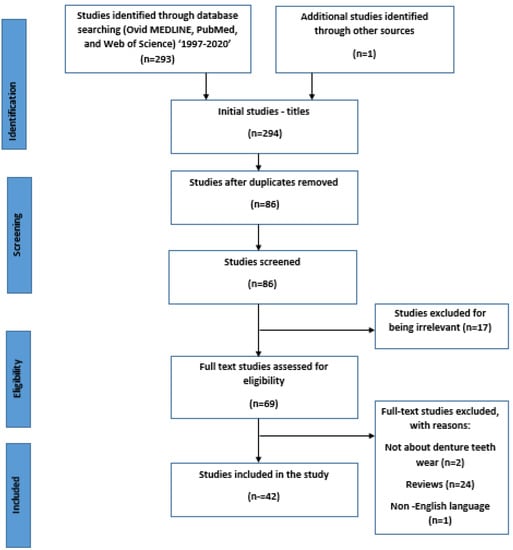
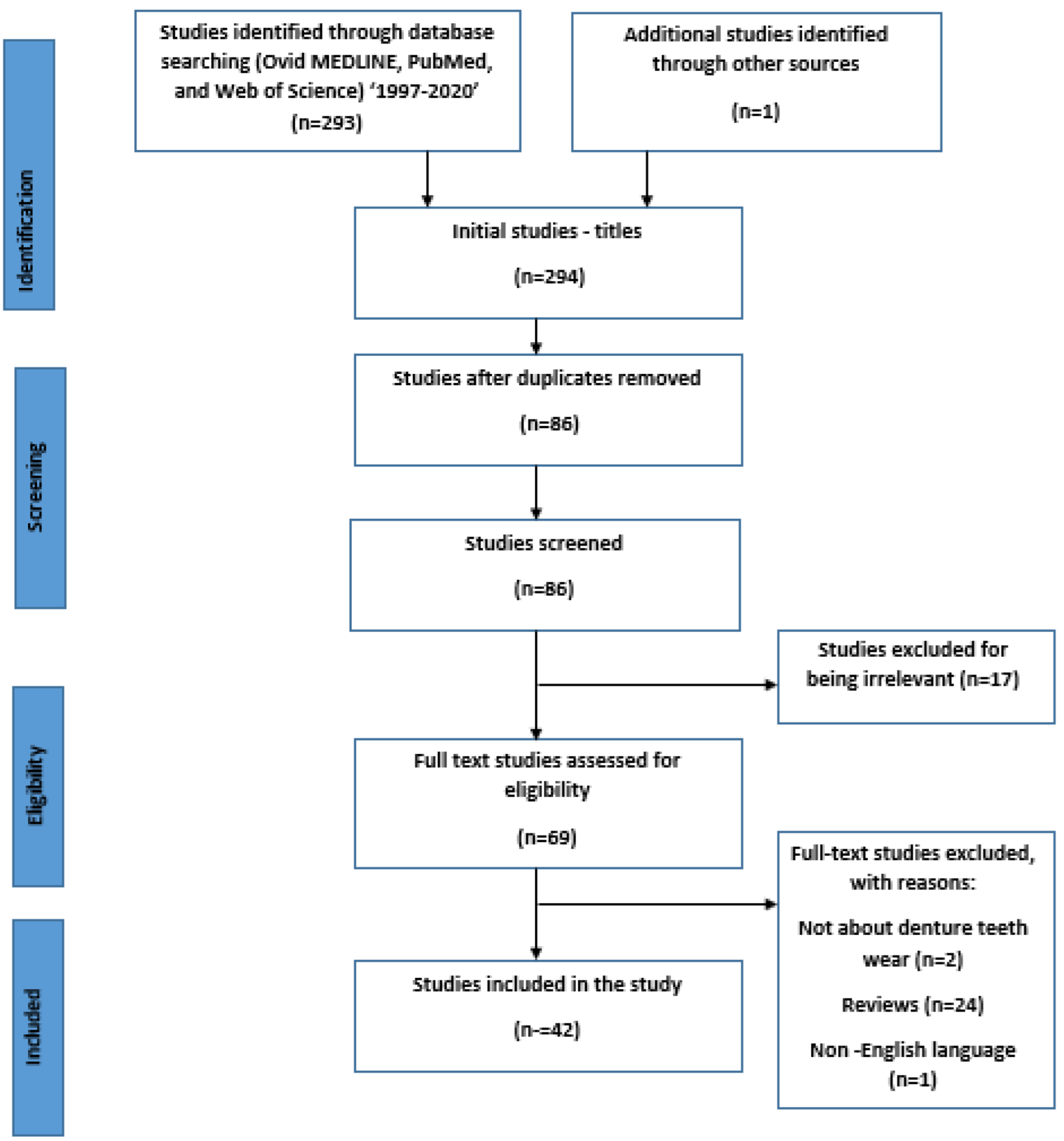
The electronic data base search identified 293 studies; upon application of the exclusion criterion and full text reading, only 41 studies met the inclusion criterion. Along with the addition of one hand search article [24], a total of 42 studies were included in the review (Figure 1). From the 42 included studies, 11 studies were conducted in vivo [3,24,25,26,27,28,29,30,31,32,33], and 31 were in vitro studies [1,7,9,10,11,12,13,16,25,33,34,35,36,37,38,39,40,41,42,43,44,45,46,47,48,49,50,51,52,53,54].
Figure 1.
PRISMA flow diagram of literature search and selection process.
The in vitro studies used a range of testing methods to evaluate teeth wear; pin-on-block/disc (n = 4), two-body wear testing machine (n = 5), three-body testing machine (n = 1), masticatory simulator (n = 7), wear testing machine (n = 3), dual-axis chewing simulator (n = 5), fatigue test (n = 1), stainless steel stylus loaded on the specimen (n = 1), and abrasive tester (n = 1) (Table 2). The testing load varied from 2 newtons to 2500 newtons, and the number of cycles ranged from 4.5–120,000 cycles. A total of 23 studies carried out further microscopic analysis of post-wear testing: Scanning Electron Microscopy (SEM) (n = 19), 3D profilometer (n = 3), and stereomicroscope image (n = 1).
Table 2.
Testing parameter of in vitro studies (Note: All loads converted to newtons 1 kg = 9.81 N; 1 pound = 4.448 N).
3.1. Assessment of Risk of Bias
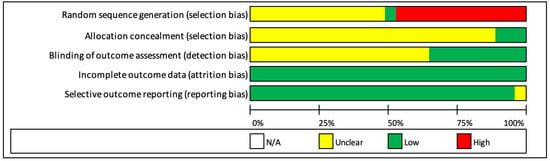
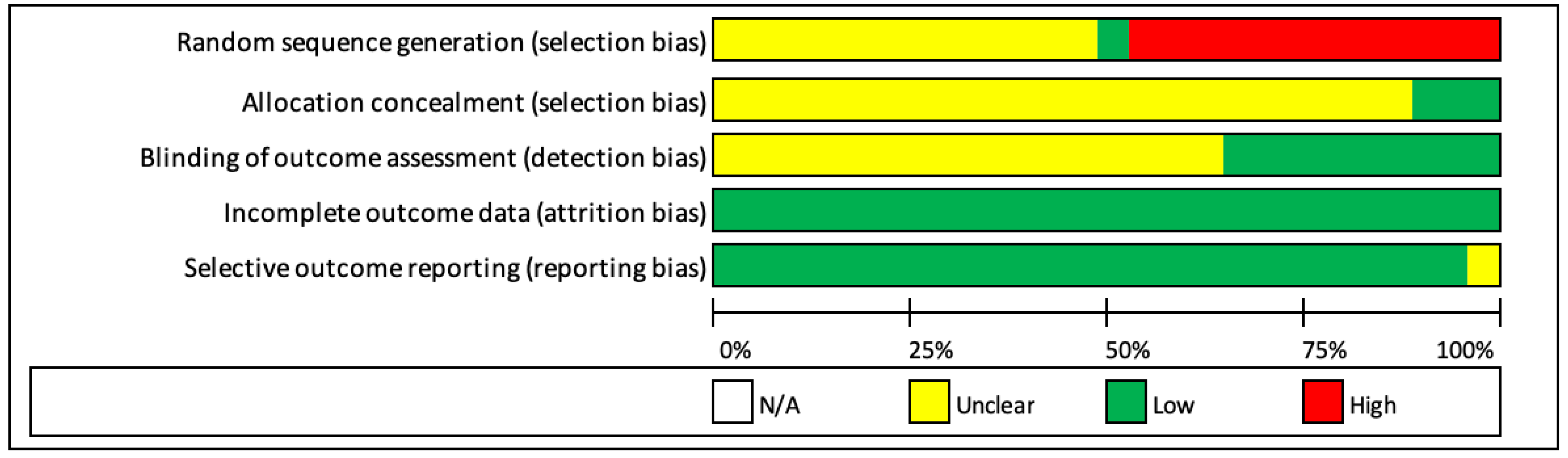
Most studies showed low risk of bias for outcome and reporting bias; however, it was unclear for allocation concealment and blinding of outcome assessment. Half the studies showed high risk of bias for randomising sequence generation; however, this may be due to the need to select the teeth for dentures in both in vivo and in vitro studies (Figure 2).
Figure 2.
Risk of bias summary of all selected studies.
3.2. PMMA Denture Teeth
A total of 27 studies evaluated the wear of artificial acrylic teeth (PMMA) (Table 3). The wear rate for PMMA denture teeth has been reported to be significantly lower against the same antagonist and human enamel [13,34]. A study also reported that acrylic resin causes minimal damage to opposing human enamel; the study did not record any measurable wear of the enamel [14]. Several studies have indicated that the composition of PMMA influences the wear resistance; the addition of filler particles such as silica and titanium dioxide improve the wear resistance of PMMA [4,9,10,27,40,41,43,47,48,50,51,52,53]. By contrast, the findings of Stober et al. (2006) and Ghazal et al. (2008) did not indicate any connection between the wear resistance and the chemical composition of the samples [13,49]. Removal of the superficial layer of certain artificial teeth during occlusal adjustment has also been shown to increase rate of wear [24,50]. Studies have also shown that wear was tooth dependent and the wear rate increased from incisors to molars [28,30]. Gender is another factor influencing the rate of artificial teeth wear with males demonstrating greater wear than females [28,29]. Wear rates of artificial teeth have also been reported to decrease with increasing age of the wearers [30]. A study has also shown that complete denture teeth exhibit lower wear rates than removable partial dentures [29].
Table 3.
Main findings of the selected studies on denture teeth wear (PMMA).
3.3. Double Cross-Linked Acrylic (DCL) Denture Teeth
Only four studies evaluated DCL denture teeth (Table 4). The study by Heintze et al., (2012), showed that wear of double cross link acrylic was influenced by the filler particles; DCL with nano-fillers recorded the lowest wear rate against the same denture teeth. However, the study further reported highest wear value for a flat DCL specimen against a conical ceramic antagonist, and interestingly, the lowest wear value for a flat specimen of DCL against a ball-like ceramic antagonist [54]. Wear of DCL denture teeth is also tooth dependent; teeth wear increased from incisors to molars [31,34]. Similar to PMMA, a consistent trend of decreasing wear with increasing age has also been reported for DCL teeth [26,34]. A study showed females denture wearers recorded less wear than men (Heintze et al., 2015). This study further reported a lower rate of wear among patients with good fit dentures and for smokers [26]. The study by Schmid-Schwap et al., (2009), showed greater wear of teeth on the maxillary dentures than mandibular dentures [31].
Table 4.
Main findings of the selected studies on denture teeth wear (DCL).
3.4. Composite Resin
A total of 12 studies evaluated composite resin denture teeth (Table 5). The vertical loss of composite resin has been reported to be lower than cross-linked and conventional acrylic resin artificial teeth [39,40]. A study by Stober et al., (2010), showed that incorporation of nano-fillers result in more wear compared to composite teeth with traditional micro fillers, while the study by Suzuki et al., (1990), reported that micro-filed composites were harder than other artificial teeth [10,48]. A study by Zeng et al., (2005), showed that the wear resistance was related to the Vickers hardness of the material; teeth wear increased as the hardness reduced [52]. This study further reported that the composites with 68% and 47% organic filler content had higher microhardness and showed better wear resistance than composite with 42% filler content [53]. However, the study by Suwannaroop et al., (2011), did not show any correlation between the material properties and wear resistance, and hence concluded that hardness cannot provide a forecast of teeth material wear resistance [50]. The investigators further stated that when selecting teeth, in-addition to composition, sub-enamel layer properties should also be considered [50].
Table 5.
Main findings of the selected studies on denture teeth wear (composite).
Type of antagonist material has also been reported to affect the wear resistance of composite teeth; using the same composite antagonist produces better results [36]. Several studies have shown that ceramic and partial denture antagonist result in greater wear of composite teeth [31,32,38,43]. However, a study evaluating wear behaviour of hybrid composite resin artificial teeth found that the hybrid composite against a hybrid composite resin antagonist resulted in lower wear depth, while also wider worn surfaces on the lower specimen than enamel and composite resin antagonist [43]. Irrespective of the type of antagonist, clinically relevant vertical loss of composite denture teeth occurs after 24 months [32].
3.5. Nanocomposite
A total of 12 studies evaluated nanocomposite denture teeth (Table 6). Nano-filled composite teeth has been reported to have greater wear resistance than conventional acrylic resin teeth [9,10,47]. Ghazal and Kern (2010) showed that nano-filled composite causes less wear of the opposing enamel of human teeth than ceramic [14]. Studies have reported that the wear depth of nano-filled composite was not statistically different from those of the micro-filled composite and cross-linked acrylic denture teeth [10,46]. On the contrary to this, the Stober et al., (2010), study showed that incorporation of nanofillers in composite resin teeth resulted in greater wear values compared to traditional microfillers [14]. However, the study by Ghazal et al., (2008), showed no statistical differences in the total vertical substance loss between the combination’s nano-filled composite resin against enamel antagonist and feldspathic ceramic against enamel antagonist [9]. The surface roughness of antagonist also influences the wear resistance of nano-filled composite; the wear increases with an increase in surface roughness [36]. Increase in loading force also increases the vertical loss of nano-filled composite teeth [14]. Nano-filled composite shows a high initial wear resistance; however, long-term wear resistance needs improvement to be comparable to natural tooth enamel [9]. The Ghazal et al., (2008), study showed that zirconia and alumina antagonists are better antagonist options against nano-filled composite than felspathic ceramic [9].
Table 6.
Main findings of the selected studies on denture teeth wear (nanocomposite).
3.6. Porcelain
A total of eight studies evaluated porcelain teeth (Table 7). A study by Abe et al., (2001), showed ceramic and enamel to be the worst antagonist combination for dental restorations; the study reported almost ten times more tooth surface loss of the opposing enamel [34]. Similar findings were also reported by Ghazal and Kern, (2010), which showed more wear of antagonistic enamel than that of feldspathic ceramic teeth [14]. In contrast, the study by Ghazal et al., (2008), showed that ceramic denture teeth demonstrated a two-body wear similar to human enamel [9]. A lower incidence of TMD (temporomandibular disorders) among complete denture wears with porcelain teeth was reported than those with acrylic resin teeth; this is associated to the high wear resistance of porcelain [3]. A study by Wang et al., (2010), which evaluated the effect of pH changes on tooth surface loss of ceramics, found that there was no association with tooth surface loss and pH changes; however, the presence of abrasive particles increased the tooth surface loss [51]. The Ghazal et al., (2008), study showed that zirconia- and alumina-based antagonists are better antagonists against ceramic than steatite due to their better wear resistance against ceramic [1]. A further study showed that although porcelain had the highest hardness value than the other artificial teeth tested, it showed the largest wear value against hybrid composite as the upper opposing specimen [43].
Table 7.
Main findings of the selected studies on denture teeth wear (porcelain and 3D-printed).
3.7. 3D-Printed Denture Teeth
Only one study was found which evaluated 3D-printed teeth (Table 7). The study reported that three-dimensional printing appeared to be useful for the fabrication of denture teeth with a sufficient level of wear resistance [16]. The results of this study showed that the wear resistance of 3D-printed teeth is comparable to conventional acrylic resin teeth. However, fine cracks were seen on the SEM images against metal antagonist.
4. Discussion
The rate of denture teeth wear is influenced by various factors such as the material and composition of the artificial teeth, the denture tooth antagonist, the tooth being replaced, patient’s age and sex, the type of removable prosthesis, and the amount of superficial layer removed during occlusal adjustments. From the eleven in vivo studies, there seems to be a correlation between volumetric loss and surface area of denture teeth. However, findings are inconsistent across all studies due to differing experimental conditions, including type of testing and load applied.
The wear behaviour of the artificial teeth examined differed with regards to their respective compositions. No consistent conclusions have been drawn from studies evaluating the wear resistance of the available denture teeth. In general, higher wear was observed in PMMA teeth without filler particles than PMMA teeth modified with fillers. A study found an association between wear resistance and the Vickers hardness of artificial teeth materials; rate of teeth wear increased as the hardness reduced [10]. In contrast, Suwannaroop et al., (2011), did not find any correlation between the material properties and wear resistance of denture teeth [50]. Composite and nanocomposite teeth have a greater wear resistance compared to PMMA and DCL teeth [39,46]. However, the wear resistance of PMMA teeth can be improved with incorporation of filler particles, such as silica and titanium dioxide [38,41,53]. Similarly, addition of nano-fillers to DCL acrylic resin also improves the wear behaviour of the teeth [53]. The wear property of denture teeth is associated with the micro-structure of the material. PMMA has a linear microstructure, while modified resin teeth with the addition of cross-linking agents have a cross-linked structure. The ideal cross-linking structure of modified resins improves the mechanical properties of denture teeth [10].
Moreover, a better outcome can be achieved in removable prosthodontics by selecting denture teeth according to the type of antagonist. In complete denture fabrication, the same denture teeth should be used for both arches where possible. The study by Heintze et al., (2012), reported the lowest wear rate against the same denture teeth [53]. Similarly, the wear rate of PMMA denture teeth has been reported to be significantly lower against PMMA denture teeth and a human enamel antagonist [12,13]. Ceramic with an enamel antagonist is not a good combination as it results in high rates of wear of the enamel [14,34]. Nano-filled composite as an antagonist against human enamel is a better alternative compared to feldspathic ceramic as it causes less wear of enamel [1]. However, composite teeth with nano-fillers have also been reported to result in more wear compared to teeth with traditional micro-fillers. Significant wear of composite teeth after 24 months has been reported as inevitable, irrespective of the type of antagonist [32].
Wear resistance is gender and tooth dependent, with higher vertical wear demonstrated in male subjects and posterior teeth [28]. Similarly, the study by Stober et al., (2014), also showed maximum vertical loss of the occlusal contact areas of premolars and molars [33]. Age is also an influencing factor for denture teeth wear; wear rates decrease with increasing age of denture wearers [30]. A possible reason for this could be that as individual’s age, the type and quantity of their food intake changes along with a decrease in the efficiency of the muscles of mastication.
Material composition of surface layer influences wear resistance. Therefore, the surface layer of artificial teeth should not be polished off or removed during occlusal adjustment to maintain good wear resistance. When compared with complete dentures, teeth on partial dentures exhibit a higher rate of wear [29]. This could be due to the different material of the antagonist, which in most cases are either enamel or ceramic.
The methodology of conducting experiments was inconsistent across all studies and therefore difficult to determine which method is more reliable to measure artificial teeth wear. Various wear testing machines or self-made wear machines, and different testing parameters for wear testing were adopted. This included occlusal wear in vivo, pin-on-block, pin-on-disc, two-body wear testing machine, three-body wear testing machine, and masticatory simulators. Among the methods to measure artificial teeth wear, the masticatory simulator was the most common type of testing, with 49 N load applied for 300,000 cycles. Thermocycling of 5 °C to 55 °C, varying between 30,000 and 60,000 cycles, is often the ageing protocol of choice by researchers.
The limitation of this study was that comparative evaluation of two studies could not be done. From the data search, only one study evaluating 3D-printed teeth was found, and this study’s evaluation antagonist was limited to zirconia and metal antagonists with 2-body wear. On the other hand, only one study evaluated the effect of pH changes on tooth surface loss. There are several types of teeth available from the market, and some of them are marketed as products with improved mechanical properties. The results of this systematic review may assist clinicians in selecting denture teeth from the perspective of wear resistance.
5. Conclusions
Based on the findings of this systematic review, the following conclusions were drawn:
- Artificial teeth should be selectively chosen for dentures taking into consideration the type of antagonist. The same denture teeth should be used as antagonists where possible for the best outcomes.
- During occlusal adjustment, the superficial layer should be preserved as much as possible to enhance wear resistance.
- The included studies demonstrated that the incorporation of nano-fillers into acrylic resin teeth does not increase wear resistance. Therefore, there is no evidence to favour the use of nano-filled composite teeth over micro-filled or conventional acrylic resin teeth.
- The studies reported that wear resistance was related to the tooth, age and sex of patients and the type of prosthesis; therefore, selecting teeth with higher wear resistance for replacement of posterior teeth, partial dentures and for male patients can produce a better outcome.
Author Contributions
Conceptualization, V.L.M. and J.J.E.C.; methodology, V.L.M. and J.J.E.C.; formal analysis, V.L.M., M.T.T., A.P. and J.J.E.C.; investigation, V.L.M., M.T.T., A.P. and J.J.E.C.; data curation, V.L.M., M.T.T., A.P. and J.J.E.C.; writing—original draft preparation, V.L.M., M.T.T., A.P., J.M.A. and J.J.E.C.; writing—review and editing, V.L.M., M.T.T., A.P., J.M.A. and J.J.E.C. All authors have read and agreed to the published version of the manuscript.
Funding
This research received no external funding.
Institutional Review Board Statement
Not applicable.
Informed Consent Statement
Not applicable.
Data Availability Statement
Not applicable.
Conflicts of Interest
The authors declare no conflict of interest.
References
- Ghazal, M.; Albashaireh, Z.; Kern, M. Wear resistance of nanofilled composite resin and feldspathic ceramic artificial teeth. J. Dent. 2008, 100, 441–448. [Google Scholar] [CrossRef] [Scilit]
- Smith, P.W.; McCord, J.F. What do patients expect from complete dentures? J. Dent. 2004, 32, 3–7. [Google Scholar] [CrossRef] [Scilit]
- Arafa, K.A. The effects of clinical wear on the incidence of temporomandibular disorders among patients with complete dentures. J. Taibah Univ. Med. Sci. 2016, 11, 250–254. [Google Scholar] [CrossRef] [Scilit]
- Kamonwanon, P.; Yodmongkol, S.; Chantarachindawong, R.; Thaweeboon, S.; Thaweeboon, B.; Srikhirin, T. Wear resistance of a modified polymethyl methacrylate artificial tooth compared to five commercially available artificial tooth materials. J. Prosthet. Dent. 2015, 114, 286–292. [Google Scholar] [CrossRef] [Scilit]
- Turssi, C.P.; Purquerio, B.; Serra, M.S. Wear of Dental Resin Composites: Insights into Underlying Processes and Assessment Methods—A Review. J. Biomed. Mater. Res. 2003, 65B, 280–285. [Google Scholar] [CrossRef] [Scilit] [PubMed]
- Lambrechts, P.; Debels, E.; Van Landuyt, K.; Peumans, M.; Van Meerbeek, B. How to simulate wear? Overview of existing methods. Dent. Mater. 2006, 22, 693–701. [Google Scholar] [CrossRef] [Scilit]
- Mello, P.C.; Coppedê, A.R.; Macedo, A.P.; de Mattos, M.d.G.C.; Rodrigues, R.C.S.; Ribeiro, R.F. Abrasion wear resistance of different artificial teeth opposed to metal and composite antagonists. J. Appl. Oral Sci. 2009, 17, 451–456. [Google Scholar] [CrossRef] [Scilit] [PubMed]
- Dallanora, A.F.; Grasel, C.E.; Heine, C.P.; Demarco, F.F.; Pereira-Cenci, T.; Presta, A.A.; Boscato, N. Prevalence of temporomandibular disorders in a population of complete denture wearers. Gerodontology 2012, 29, e865–e869. [Google Scholar] [CrossRef] [Scilit]
- Ghazal, M.; Yang, B.; Ludwig, K.; Kern, M. Two-body wear of resin and ceramic denture teeth in comparison to human enamel. Dent. Mater. 2008, 24, 502–507. [Google Scholar] [CrossRef] [Scilit]
- Suzuki, S. In vitro wear of Nano-composite denture teeth. J. Prosthodont. 2004, 13, 238–243. [Google Scholar] [CrossRef] [Scilit] [PubMed]
- Ilangkumaran, R.; Srinivasan, J.; Baburajan, K.; Balaji, N. Two Body Wear of Newly Introduced Nanocomposite Teeth and Cross Linked Four Layered Acrylic Teeth: A Comparitive In Vitro Study. J. Indian Prosthodont. Soc. 2014, 14, 126–131. [Google Scholar] [CrossRef] [Scilit] [PubMed]
- Reis, K.R.; Bonfante, G.; Pegoraro, L.F.; Conti, P.C.R.; De Oliveira, P.C.G.; Kaizer, O.B. In vitro wear resistance of three types of polymethyl methacrylate denture teeth. J. Appl. Oral Sci. 2008, 16, 176–180. [Google Scholar] [CrossRef] [Scilit]
- Ghazal, M.; Hedderich, J.; Kern, M. Wear of feldspathic ceramic, nano-filled composite resin and acrylic resin artificial teeth when opposed to different antagonists. Eur. J. Oral Sci. 2008, 116, 585–592. [Google Scholar] [CrossRef] [Scilit] [PubMed]
- Ghazal, M.; Kern, M. Wear of denture teeth and their human enamel antagonists. Quintessence Int. 2010, 41, 157–163. [Google Scholar]
- Ghazal, M.; Kern, M. Wear of human enamel and nano-filled composite resin denture teeth under different loading forces. J. Oral Rehabil. 2009, 36, 58–64. [Google Scholar] [CrossRef] [Scilit]
- Cha, H.S.; Park, J.M.; Kim, T.H.; Lee, J.H. Wear resistance of 3D-printed denture tooth resin opposing zirconia and metal antagonists. J. Prosthet. Dent. 2020, 124, 387–394. [Google Scholar] [CrossRef] [Scilit]
- Scheibenbogen, A.; Manhart, J.; Kunzelmann, K.H.; Hickel, R. One-year clinical evaluation of composite and ceramic inlays in posterior teeth. J. Prosthet. Dent. 1998, 80, 410–416. [Google Scholar] [CrossRef] [Scilit]
- Krejci, I.; Krejci, D.; Lutz, F. P-30.: In vivo study of a posterior composite during 2.5 years. Dtsch. Zahnarztl. Z. 1990, 45, 773–778. [Google Scholar]
- Ferracane, J.L.; Choi, K.K.; Condon, J.R. In vitro wear of packable dental composites. Compend. Contin. Educ. Dent. 1999, 25, S60–S66. [Google Scholar]
- Johnsen, G.F.; Taxt-Lamolle, S.F.; Haugen, H.J. Wear model simulating clinical abrasion on composite filling materials. Dent. Mater. J. 2011, 30, 739–748. [Google Scholar] [CrossRef] [Scilit]
- De Gee, A.J.; Pallav, P. Occlusal wear simulation with the ACTA wear machine. J. Dent. 1994, 22 (Suppl. S1), S21–S27. [Google Scholar] [CrossRef] [Scilit]
- Heintze, S.D. How to qualify and validate wear simulation devices and methods. Dent. Mater. 2006, 22, 712–734. [Google Scholar] [CrossRef] [Scilit] [PubMed]
- Faggion, C. Guidelines for Reporting Pre-clinical In Vitro Studies on Dental Materials. J. Evid. Based Dent. Pract. 2012, 12, 182–189. [Google Scholar] [CrossRef] [Scilit] [PubMed]
- Uehara, P.N.; Iegami, C.M.; Tamaki, R.; Ballester, R.Y.; de Souza, R.M.; Laganá, D.C. Analysis of behaviour of the wear coefficient in different layers of acrylic resin teeth. J. Prosthet. Dent. 2019, 121, 967.e1–967.e6. [Google Scholar] [CrossRef] [Scilit] [PubMed]
- Heintze, S.D.; Rousson, V.; Stober, T. Patient- and therapy-related factors on the wear of denture teeth—Results of a clinical trial. Dent. Mater. 2015, 31, 302–307. [Google Scholar] [CrossRef] [Scilit]
- Heintze, S.D.; Zellweger, G.; Sbicego, S.; Rousson, V.; Muñoz-Viveros, C.; Stober, T. Wear of two denture teeth materials in vivo—2-year results. Dent. Mater. 2013, 29, 191–204. [Google Scholar] [CrossRef] [Scilit] [PubMed]
- Jooste, C.; Geerts, G.; Adams, L. Comparison of the clinical abrasion resistance of six commercially available denture teeth. J. Prosthet. Dent. 1997, 77, 23–27. [Google Scholar] [CrossRef] [Scilit]
- Ogle, R.E.; Davis, E.L. Clinical wear study of three commercially available artificial tooth materials: Thirty-six-month results. J. Prosthet. Dent. 1998, 79, 145–151. [Google Scholar] [CrossRef] [Scilit]
- Ohlmann, B.; Rohstock, K.; Kugler, J.; Gilde, H.; Dreyhaupt, J.; Stober, T. Influences on clinical wear of acrylic denture teeth: A pilot study. Int. J. Prosthodont. 2007, 20, 496–498. [Google Scholar] [PubMed]
- Schmid-Schwap, M.; Rousson, V.; Vornwagner, K.; Heintze, S.D. Wear of two artificial tooth materials in vivo: A 12-month pilot study. J. Prosthet. Dent. 2009, 102, 104–114. [Google Scholar] [CrossRef] [Scilit]
- Stober, T.; Bermejo, J.L.; Rues, S.; Rammelsberg, P. Wear of resin denture teeth in partial removable dental prostheses. J. Prosthodont. Res. 2020, 64, 85–89. [Google Scholar] [CrossRef] [Scilit] [PubMed]
- Stober, T.; Geiger, A.; Rues, S.; Dreyhaupt, J.; Rammelsberg, P.; Ohlmann, B. Factors affecting wear of composite resin denture teeth-24-month results from a clinical study. Clin. Oral Investig. 2012, 16, 413–420. [Google Scholar] [CrossRef] [Scilit]
- Stober, T.; Heuschmid, N.; Zellweger, G.; Rousson, V.; Rues, S.; Heintze, S.D. Comparability of clinical wear measurements by optical 3D laser scanning in two different centers. Dent. Mater. 2014, 30, 499–506. [Google Scholar] [CrossRef] [Scilit] [PubMed]
- Abe, Y.; Sato, Y.; Taji, T.; Akagawa, Y.; Lambrechts, P.; Vanherle, G. An in vitro wear study of posterior denture tooth materials on human enamel. J. Oral Rehabil. 2001, 28, 407–412. [Google Scholar] [CrossRef] [Scilit] [PubMed]
- Bedini, R.; Pecci, R.; Notarangelo, G.; Zuppante, F.; Persico, S.; Di Carlo, F. Microtomography evaluation of dental tissue wear surface induced by in vitro simulated chewing cycles on human and composite teeth. Ann. Ist. Super. Sanita 2012, 48, 65–70. [Google Scholar] [CrossRef] [Scilit]
- Ghazal, M.; Kern, M. The influence of antagonistic surface roughness on the wear of human enamel and nanofilled composite resin artificial teeth. J. Prosthet. Dent. 2009, 101, 342–349. [Google Scholar] [CrossRef] [Scilit]
- Ghazal, M.; Steiner, M.; Kern, M. Wear resistance of artificial denture teeth. Int. J. Prosthodont. 2008, 21, 166–168. [Google Scholar] [PubMed]
- Hahnel, S.; Behr, M.; Handel, G.; Rosentritt, M. Two-body wear of artificial acrylic and composite resin teeth in relation to antagonist material. J. Prosthet. Dent. 2009, 101, 269–278. [Google Scholar] [CrossRef] [Scilit]
- Hao, Z.; Yin, H.; Wang, L.; Meng, Y. Wear behavior of seven artificial resin teeth assessed with three-dimensional measurements. J. Prosthet. Dent. 2014, 112, 1507–1512. [Google Scholar] [CrossRef] [Scilit]
- Hirano, S.; May, K.B.; Wagner, W.C.; Hacker, C.H. In vitro wear of resin denture teeth. J. Prosthet. Dent. 1998, 79, 152–155. [Google Scholar] [CrossRef] [Scilit]
- Muhammad, N.; Maitra, S.; Haq, I.U.; Farooq, M. Some studies on the wear resistance of artificial teeth in presence of amorphous SiO2 and TiO2 fillers’. Ceramica 2011, 57, 324–328. [Google Scholar] [CrossRef] [Scilit]
- Munshi, N.; Rosenblum, M.; Jiang, S.; Flinton, R. In Vitro Wear Resistance of Nano-Hybrid Composite Denture Teeth. J. Prosthodont. 2017, 26, 224–229. [Google Scholar] [CrossRef] [Scilit] [PubMed]
- Nishino, T.; Asao, T.; Nagamatsu, H.; Kojo, T.; Kakigawa, H.; Kozono, Y.; Uchida, Y. Wearing Behaviors of a Hybrid Composite Resin for Crown and Bridge. Dent. Mater. 2001, 20, 216–226. [Google Scholar] [CrossRef] [Scilit]
- Ohkubo, C.; Shimura, I.; Aoki, T.; Hanatani, S.; Hosoi, T.; Okabe, T. In vitro wear assessment of titanium alloy teeth. J. Prosthodont. 2002, 11, 263–269. [Google Scholar] [CrossRef] [Scilit] [PubMed]
- Popović, D.; Bobovnik, R.; Bolka, S.; Vukadinović, M.; Lazić, V.; Rudolf, R. Synthesis of PMMA/ZnO nanoparticles composite used for resin teeth. Mater. Technol. 2017, 51, 871–878. [Google Scholar] [CrossRef] [Scilit]
- Preis, V.; Hahnel, S.; Behr, M.; Rosentritt, M. Contact wear of artificial denture teeth. J. Prosthodont. Res. 2018, 62, 252–257. [Google Scholar] [CrossRef] [Scilit] [PubMed]
- Shetty, M.S.; Shenoy, K.K. An in vitro analysis of wear resistance of commercially available acrylic denture teeth. J. Indian Prosthodont. Soc. 2010, 10, 149–153. [Google Scholar] [CrossRef] [Scilit]
- Stober, T.; Henninger, M.; Schmitter, M.; Pritsch, M.; Rammelsberg, P. Three-body wear of resin denture teeth with and without nanofillers. J. Prosthet. Dent. 2010, 103, 108–117. [Google Scholar] [CrossRef] [Scilit]
- Stober, T.; Lutz, T.; Gilde, H.; Rammelsberg, P. Wear of resin denture teeth by two-body contact. Dent. Mater. 2006, 22, 243–249. [Google Scholar] [CrossRef] [Scilit] [PubMed]
- Suwannaroop, P.; Chaijareenont, P.; Koottathape, N.; Takahashi, H.; Arksornnukit, M. In vitro wear resistance, hardness and elastic modulus of artificial denture teeth. Dent. Mater. J. 2011, 30, 461–468. [Google Scholar] [CrossRef] [Scilit] [PubMed]
- Wang, H.C.; Stack, M.M.; Li, W.L.; Hong, T.F.; Wang, M.C. On the construction of wear maps for Y-TZP dental ceramics in aqueous environments: PH, exposure time and impact angle effects. Tribol. Int. 2010, 43, 2258–2267. [Google Scholar] [CrossRef] [Scilit]
- Zeng, J.; Sato, Y.; Ohkubo, C.; Hosoi, T. In vitro wear resistance of three types of composite resin denture teeth. J. Prosthet. Dent. 2005, 94, 453–457. [Google Scholar] [CrossRef] [Scilit] [PubMed]
- Heintze, S.D.; Zellweger, G.; Grunert, I.; Muñoz-Viveros, C.A.; Hagenbuch, K. Laboratory methods for evaluating the wear of denture teeth and their correlation with clinical results. Dent. Mater. 2012, 28, 261–272. [Google Scholar] [CrossRef] [Scilit] [PubMed]
- Hernandez, E.P.; Oshida, Y.; Platt, J.A.; Andres, C.J.; Barco, M.T.; Brown, D.T. Mechanical properties of four methylmethacrylate-based resins for provisional fixed restorations. Biomed. Mater. Eng. 2004, 14, 107–122. [Google Scholar]

Publisher’s Note: MDPI stays neutral with regard to jurisdictional claims in published maps and institutional affiliations. |
© 2022 by the authors. Licensee MDPI, Basel, Switzerland. This article is an open access article distributed under the terms and conditions of the Creative Commons Attribution (CC BY) license (https://creativecommons.org/licenses/by/4.0/).