Article

DFT Calculations on Electronic, Thermochemical and Vibrational Properties of Se6 Selenium Clusters as 5-Fluorouracil Drug Delivery System


by
Levi Isai Solano-González
1,
Raúl Mendoza-Báez
2,
Ricardo Agustín-Serrano
3,4,
José Isrrael Rodríguez-Mora
5,6,* and
Marco A. Morales
1,*
1
Facultad de Ingeniería Química, Benemérita Universidad Autónoma de Puebla, Av. San Claudio18 Sur S/N, San Manuel, Puebla C.P. 72570, Mexico
2
Departamento de Química, Centro de Investigaciónde Estudios Avanzados del IPN (Cinvestav), Av. IPN 2508, Col. San Pedro Zacatenco, Ciudad de México C.P. 07360, Mexico
3
Facultad de Físico Matemáticas, Benemérita Universidad Autónoma de Puebla, Av. San Claudio18 Sur S/N, San Manuel, Puebla C.P. 72570, Mexico
4
Laboratorio Interdisciplinario de Impresión 3D Para la Innovación Tecnológica, Benemérita Universidad Autónoma de Puebla, Av. San Claudio S/N, Cd. Universitaria, Puebla C.P. 72570, Mexico
5
Facultad de Ingeniería, Benemérita Universidad Autónoma de Puebla, Av. San Claudio18 Sur S/N, San Manuel, Puebla C.P. 72570, Mexico
6
Laboratorio de Investigación de AltaTecnología y Desarrollode Prototipos Patentes, Benemérita Universidad Autónoma de Puebla, Av. San Claudio S/N, Cd. Universitaria, Puebla C.P. 72570, Mexico
*
Authors to whom correspondence should be addressed.
BioTech 2026, 15(2), 29; https://doi.org/10.3390/biotech15020029
Submission received: 11 February 2026 / Revised: 24 March 2026 / Accepted: 25 March 2026 / Published: 31 March 2026
(This article belongs to the Section Computational Biology)

Abstract

In this work, the electronic, thermochemical, and vibrational characterization of the drug delivery system formed by clusters of selenium (Se6 allotrope) and 5-fluorouracil (5-FU) are studied, based on density functional theory (DFT) calculations. Computational calculations were performed using the B3LYP functional and the 6-31G(d,p) base set, considering an aqueous medium through the CPCM solvation model. We propose evaluating two different interaction modes based on experimental observations: Se–H(N) (through the amino groups of 5-FU) and Se–O(C) (through the carbonyl oxygen of 5-FU). All complexes proved to be energetically stable, exhibiting chemisorption as their adsorption process. Analysis of adsorption energy and thermodynamic parameters indicates that both interaction pathways are equally viable, which agrees with previous experimental findings. The theoretical FT-IR spectra of these complexes also coincide with the experimental results. Furthermore, global molecular descriptors show that the stability of the selenium carrier is not affected by post-functionalization, which is desirable for more controlled drug delivery systems.
Key Contribution: In recent studies, selenium nanoparticles functionalized with anticancer agents such as fluoropyrimidine are being used in pioneering research as a controlled drug delivery system in cancer treatment. We present a theoretical molecular simulation of a similar drug delivery system at the molecular scale: Se6 ring-like (Se6) functionalized with 5-fluoroacyl (5-FU). The results of this research open the door to a new molecular approach with a novel drug delivery system.

1. Introduction

Data from the International Agency for Research on Cancer (IARC) indicates that approximately 20 million new cases of cancer were diagnosed from 2022 to date, resulting in 9.7 million deaths from the disease. Estimates suggest that roughly one in five men or women will develop cancer during their lifetime. Demographic projections indicate that the number of new cancer cases will reach 35 million by 2050 [1]. Given this alarming reality, the development of new therapies and effective drugs for its treatment is becoming increasingly urgent. In this context, nanomaterial-based drug delivery systems have gained significant relevance. Several studies support the use of nanoparticles as delivery systems due to their structural, chemical, physical, and biological properties which make them highly functional as transport agents that can encapsulate or bind to specific drug components, thereby facilitating their more precise and efficient release [2,3,4,5,6]. However, despite their multiple benefits, these technologies still face significant challenges. Some nanoparticles, such as those of iron, gold, silver, or carbon, are not biodegradable, making them difficult to eliminate from the body once administered, and they can also present instability problems in biological environments, inhibiting their effectiveness [7,8,9,10,11]. For these reasons, current research is being directed toward finding new alternatives that offer safer drug delivery systems: biocompatible, stable, bifunctional and biodegradable. In this sense, selenium-based nanoparticles (SeNPs) have recently proven to be promising materials for these applications, being evaluated both in vitro and in vivo, and using pristine or functionalized nanoparticles [12,13,14,15,16,17,18]. In addition to their use as chemotherapy agents, SeNPs have interesting structural, electrical, magnetic, optical, antioxidant, and antibacterial properties [19,20,21,22,23,24]. Selenium is incorporated into polypeptides such as selenocysteine and seleno-methionine, two key amino acids involved in various biochemical processes, and it also stimulates the activation of immune cells [25,26,27]. Although selenium is an essential trace element that plays a key role in the regulation of redox reactions at the cellular level and is also involved in several fundamental physiological functions of the body (in form of seleno-proteins), exceeding its dosage (412 μ g/day) causes harmful side effects such as selenosis [28,29,30,31]. However, the advantage of using SeNPs is that they can be as effective as other organoselenium compounds but with lower toxicity [32,33,34].
On the other hand, 5-fluorouracil (5-FU, or fluoropyrimidine) has been widely used in the treatment of skin, colon, breast, gastric, and esophageal cancer [35,36,37,38]. It is an antimetabolite, whose chemical structure resembles that of the nucleotide uracil, one of the components of RNA, and this similarity allows it to be erroneously incorporated into nucleic acids during DNA and RNA synthesis in rapidly dividing cells, inhibiting their division and growth [39,40,41]. Liu et al. [42] experimentally studied the behavior of the system composed of SeNPs and 5-FU, revealing a remarkable synergy: a significant reduction in the cytotoxicity toward human normal cells and an improvement in the cellular uptake of SeNPs in cancer cells. These complementary properties make the system a promising drug delivery strategy, thus increasing interest in its study.
In this work, the Se6/5-fluorouracil (Se6/5-FU) system, a carrier–drug complex, is studied based on density functional theory (DFT) calculations to evaluate the intermolecular interactions that govern this complex and its structural, electronic, thermochemical and vibrational properties. In addition, the chemical reactivity of the complexes was studied using global chemical descriptors, as well as through cohesive and solvation energies. This computational study aims to elucidate the interaction mechanisms underlying the observed synergy between SeNPs and 5-FU, thus enabling the possible development of a safer and more effective drug delivery system.

2. Materials and Methods

Materials: Two nodes of the Laboratorio Nacional de Supercómputo del Sureste de México, Puebla, México, 600 Core Hours, storage space in the/home partition up to 1 GB were used for the development of the project.
Level of theory: Optimization and frequency calculations were performed based on density functional theory (DFT), considering a neutral charge ( Q = 0 ) and singlet multiplicity ( M = 1 ) for all molecules and complexes studied, using the B3LYP [43,44] functional with a 6-31G(d,p) basis set, and considering aqueous medium through the CPCM (Conductor-like Polarizable Continuum Model) implicit solvation model [45,46], as implemented in the Gaussian software package in their version 09 [47]. The CPCM model has recently been used as a suitable solvation model for the study of organoselenium compounds and Se–metal coordination complexes [48,49,50]. Previous work has shown that the B3LYP/aug-cc-pVDZ, B3LYP/6-31G(d) and PBE0/6-311G(d) methods adequately describe small selenium rings (Sen, n = 2–8), agreeing reasonably with what is experimentally observed in the solid state [51,52,53,54,55,56]. In this work, the basis set was expanded by adding p functions, namely B3LYP/6-31G(d,p). However, while the B3LYP/6-31G(d,p) level of theory has some limitations compared to other functionals/basis sets, recent studies have shown that B3LYP/6-31G(d,p) is suitable for describing the electronic, chemical, and optical properties of systems containing selenium atoms [57,58,59]. We do not consider the level of theory we employ to be obsolete, although other, more rigorous functionals/basis sets can certainly be evaluated. So, this is currently beyond the scope of our work and is a topic for future research.
Computational molecular models: The Se6 ring-like cluster with D3d symmetry was used as the drug–carrier complex, as this conformer has lower energy compared to Se6(D2) and Se6(C2v) [52,60]. Furthermore, the Se6(D3d) cluster is the one that has been experimentally observed. We considered two different interaction models between Se6 and the 5-FU molecule: (a) interaction between Se atoms and the carbonyl oxygen (Se6/5-FUOx), and (b) interaction between Se atoms and the amino group -NH belonging to the pyrimidine ring (Se6/5-FUNH) (see Figure 1). This was based on the experimental findings of Liu et al. [42], who suggested Se–O and Se–N bonds. We only considered the di-keto tautomer of 5-FU, since it is its most stable structure [61] and, in addition, the experiments of Liu et al. [42] were carried out at pH = 5.4–7.4, which would not favor the keto-enol tautomer. It was also evaluated whether a single Se6 cluster allows the carrying of two 5-FU molecules (see Figure 1c,d). Furthermore, we analyzed the effect of a larger selenium cluster on 5-FU adsorption. To do this, we designed a Se6 dimer, denoted as (Se6)2, which interacted again with one 5-FU molecule through Se–O(C) and Se–N(H) approaches (see Figure 2). It is worth mentioning that all optimizations were performed in an aqueous medium (CPCM, water). The (Se6)2 dimer shown in Figure 2a was the lowest energy conformer found, with an offset, stacked ring structure.
The reactivity of these systems was studied through global molecular descriptors (chemical potential μ , global hardness η , electrophilicity index ω , Equations (1)–(3)) derived from Koopmans’ theorem, ref. [62] which states that
μ = E N ν r = I + A 2
η = 2 E N 2 ν r = I A 2
ω = μ 2 2 η
where E is the total energy, N is the number of electrons, ν ( r ) is the external potential of the system, I is the ionization potential and A is the electron affinity [63,64,65]. All the aforementioned descriptors are calculated from the energies of frontier molecular orbitals (HOMO and LUMO), since I = E H O M O and A = E L U M O . The energy difference between the frontier molecular orbitals, E g a p (Equation (4)), was also calculated. As the stability of the structures decreases and chemical reactivity increases, the E g a p value decreases.
E g a p = E H O M O E L U M O
On the other hand, the stability of the systems was evaluated by calculating the cohesive energy ( E c o h , Equation (5)), which is defined as the energy required to break all the bonds of a molecule down to its individual atoms (eV/atom units). E c o m p l e x is the total energy of the complex formed (e.g., Se6/5-FU), the coefficient n i corresponds to the number of i -atoms (Se, C, H, N, O, F), and E i is the total energy of each i -atom. A more stable system is characterized by lower E c o h values [66,67,68].
E c o h = E c o m p l e x n i E i n i
To quantify the interaction between Se6 and 5-FU, the adsorption energy (Equation (6)) was calculated using
E a d s = E c o m p l e x n E S e 6 n + m E 5 F U m
The term E S e 6 n is the total energy of Se6 (if n = 1 ) or (Se6)2 (if n = 2 ), while E 5 F U m is the total energy of the number of drug molecules being adsorbed ( m = 1 , 2 ). There is a classification based on E a d s that defines physisorption when E a d s > 0.5 eV or chemisorption when E a d s < 0.5 eV [69,70]. Therefore, a more negative E a d s value indicates a stronger interaction between Se6 and 5-FU.
Vibrational frequency calculations were performed (at 298.15 K) to find that the molecules relax with local minima, demonstrating that all systems exhibit non-imaginary frequencies. The normalized transmittance ( T ) of the IR spectra was obtained from the molar absorptivity (Equation (7)).
T ( % ) = 100 · 1 ϵ i ϵ m a x
where ϵ i is each molar absorptivity (M−1cm−1) value obtained from the frequency calculations and ϵ m a x is the maximum molar absorptivity found. The frequency calculations were also used to calculate thermodynamic parameters such as enthalpy ( H ), Gibbs free energy ( G ) and entropy ( S ). By utilizing the internal electronic energy Ɛ0 combined with the thermal corrections for enthalpy Hcorr and Gibbs free energy Gcorr, the reaction values can be determined. Since the computational output provides the sum of electronic and thermal enthalpies, the total enthalpy of reaction is obtained by calculating the difference between the sums of these values for products and reactants [71].
r H ° 298.15   K = p r o d u c t s ( ε 0 + H c o r r ) r e a c t a n t s ( ε 0 + H c o r r )
r G ° 298.15   K = p r o d u c t s ( ε 0 + G c o r r ) r e a c t a n t s ( ε 0 + G c o r r )
T S = H G

3. Results

3.1. Structural Properties

The cyclic Se6 molecule showed a chair-type conformation, D3d symmetry, with an average Se–Se bond length of 2.355 Å, in accordance with what has been reported experimentally and theoretically [51,52,53,54,55,56]. The average bond angle is 100.25° and the dihedral angles are 77.5°. The dimeric cluster (Se6)2 exhibits slightly longer Se–Se bond lengths compared to Se6, of 2.363 Å. However, its bond angles show values in a range of 99.61–103.00°, indicating that the Se6 rings deform upon dimerization. (Se6)2 is arranged in an off-center stacked structure, with a distance of 3.970 Å between the two Se6 rings. Although (Se6)2 is a cluster-type structure, the intermolecular Se–Se bond lengths are longer (3.165 Å) than the intramolecular ones (2.363 Å). On the other hand, the optimized 5-FU molecule showed bond lengths consistent with those reported experimentally in the solid state, with distances C=O 1.223 Å, C–F 1.344 Å and C=C 1.348 Å for the calculated structure, and C=O 1.222 Å, C–F 1.343 Å and C=C 1.378 Å for those reported experimentally [72].

3.2. Electronic Properties

3.2.1. Frontier Molecular Orbitals and Global Molecular Descriptors

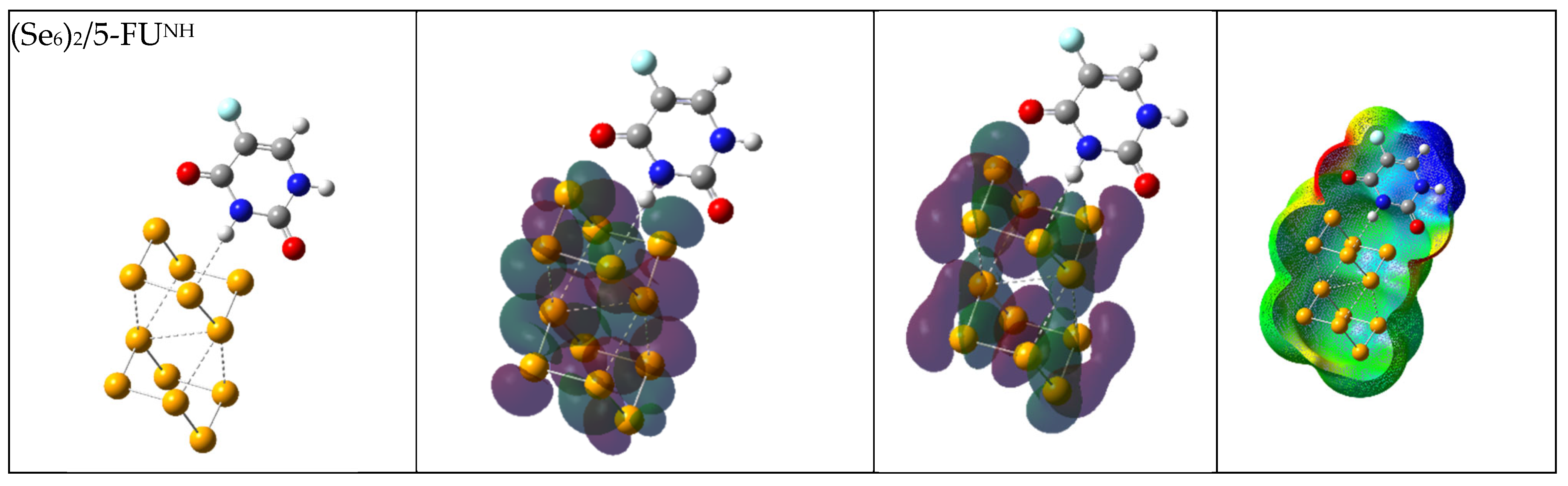
The density distributions of the HOMO and LUMO molecular orbitals, and the mapping of the molecular electrostatic potential (MEP), are shown in Figure 3, Figure 4 and Figure 5 for aqueous medium. Supplementary Materials Figures S1–S5 present the density distributions of the HOMO and LUMO molecular orbitals and the mapping of the molecular electrostatic potential (MEP) for vacuum medium. For electron density distributions in aqueous medium, the HOMO and LUMO of (Se6)2 are distributed throughout the cluster, showing the interaction between both rings. Figure 4 shows the frontier molecular orbitals (FMOs) of the Se/5-FU complexes connected by Se–H(N), namely Se6/5-FUNH, Se6/(5-FU)2NH and (Se6)2/5-FUNH. For those complexes with Se6, the HOMO is distributed on both Se6 and the 5-FU molecule. However, when the adsorption is carried out by the (Se6)2 dimer, the HOMO is located only on (Se6)2. In the case of LUMO, it is located at (Se6)n in all cases. This indicates that the selenium cluster is the most reactive site of the drug–carrier complex, thus preventing possible reactions on 5-FU. Figure 5 shows the frontier molecular orbitals (FMOs) of the Se/5-FU complexes connected by Se–O(C), namely Se6/5-FUOx and Se6/(5-FU)2Ox. Analogously to what was described above, HOMO and LUMO again fall on the (Se6)n-moiety. Regarding the MEPs, it is observed that in all complexes, the neutral potential region (green) lies on the selenium units, while the negative potential region (red) is located in the vicinity of the carbonyl oxygens of the 5-FU molecule. Furthermore, the region of lowest electron density (blue) is located on the N–H and C–H hydrogens adjacent to the fluorine atom. It is worth noting that the 5-FU MEP is not apparently disturbed after its adsorption on Se6, suggesting a retention of its electronic distribution even after its functionalization.
The stability and reactivity of the complexes are determined using global molecular descriptors, such as chemical potential (μ), global hardness (η), and electrophilicity index (ω), as well as the HOMO−LUMO energy gap ( E g a p ), cohesive energy ( E c o h ), and adsorption energy ( E a d s ). Table 1 and Table 2 summarize these quantities. Global hardness ( η ) and chemical potential ( μ ) are involved within the ω descriptor, the electrophilicity index, which measures a molecule’s ability to accept electrons in an electron-rich environment [64,65]. Therefore, a good electrophile (high ω value) will be characterized by high μ values and low η values. From Table 1, we observe that the E g a p value decreases from 4.112 to 2.995 eV as the Se–unit grows from Se6 to (Se6)2. This is mainly due to a destabilization of the HOMO, increasing its energy, while the LUMO remains almost invariant after cluster growth.
This also impacts the slight increase in electrophilicity of (Se6)2 ( ω = 5.476 eV) compared to Se6 ( ω = 4.872 eV). This suggests that, if the trend continues, larger SeNPs would be disadvantaged due to their greater chemical reactivity and instability. Regarding the formation of complexes with Se6, it is observed that the adsorption of 5-FU does not alter the reactivity of the system, since the differences in the values of the molecular descriptors are negligible between pristine Se6 and Se6/5-FU complexes ( ω = 4.7–4.9 eV). Furthermore, there are no differences due to the way in which Se6 and 5-FU interact, i.e., whether it is through Se–H(N) or Se–O(C). The complexes formed based on (Se6)2 exhibit higher electrophilicity index values, thought this is not due to the adsorption of 5-FU but to the electrophilic nature of the dimer, as discussed above.

3.2.2. Adsorption Energy and Cohesive Energy of Complexes

It is interesting to note that, in addition to the fact that the adsorption of 5-FU does not destabilize the Se cluster, there is a strong interaction between Se6 or (Se6)2 and 5-FU, as shown by the E a d s values summarized in Table 2. All values correspond to chemisorption, except for the Se6/5-FUNH complex (−0.46 eV), with the Se6/(5-FU)2NH complex having the highest adsorption energy (−1.04 eV). If we compare the complexes that adsorb a single 5-FU molecule (Se6/5-FUOx, Se6/5-FUNH, (Se6)2/5-FUOx and (Se6)2/5-FUNH), we will observe very similar E a d s values, suggesting that: (1) it would be indifferent to use Se6 or (Se6)2 as a 5-FU carrier in 1:1 ratio, and (2) both proposed interaction pathways are equally energetically favorable. Interestingly, complexes with a 1:2 ratio (Se6/(5-FU)2Ox, Se6/(5-FU)2NH) exhibit the strongest interaction, showing that the adsorption of a second 5-FU molecule favors not only the adsorption energy but also the stability of the complex, since these 1:2 complexes also exhibit the lowest cohesive energy. We also studied the (Se6)2/(5-FU)2Ox and (Se6)2/(5-FU)2NH systems but unfortunately the optimizations did not converge in both cases. Further computational calculations of systems with a larger number of 5-FU molecules are needed to determine the maximum number of 5-FU molecules that a Se6 cluster can carry. Furthermore, basis set superposition error (BSSE) methods were applied for the half-vacuum case, and the Boys–Bernardi correction [73] was performed to address energy errors that can occur in a system based on non-covalent interactions, such as the Se6/5-FU system. This correction involves reverting the substrate atoms to ghost atoms and the absorbate to the ground and vice versa states, as shown in Figure S5. The results of the calculations can also be seen in Tables S2 and S3 of the Supplementary Materials. Single-point calculations applying the Boys–Bernardi correction in the presence of an implicit solvent were performed using explicit fragment calculations with ghost atoms [73]. The corrected Boys–Bernardi energy value (BSSE) is −0.4709 eV, while the uncorrected value is −0.4643 eV. This corresponds to a difference of only 0.0066 eV (~0.15 kcal/mol).

3.2.3. Vibrational Analysis

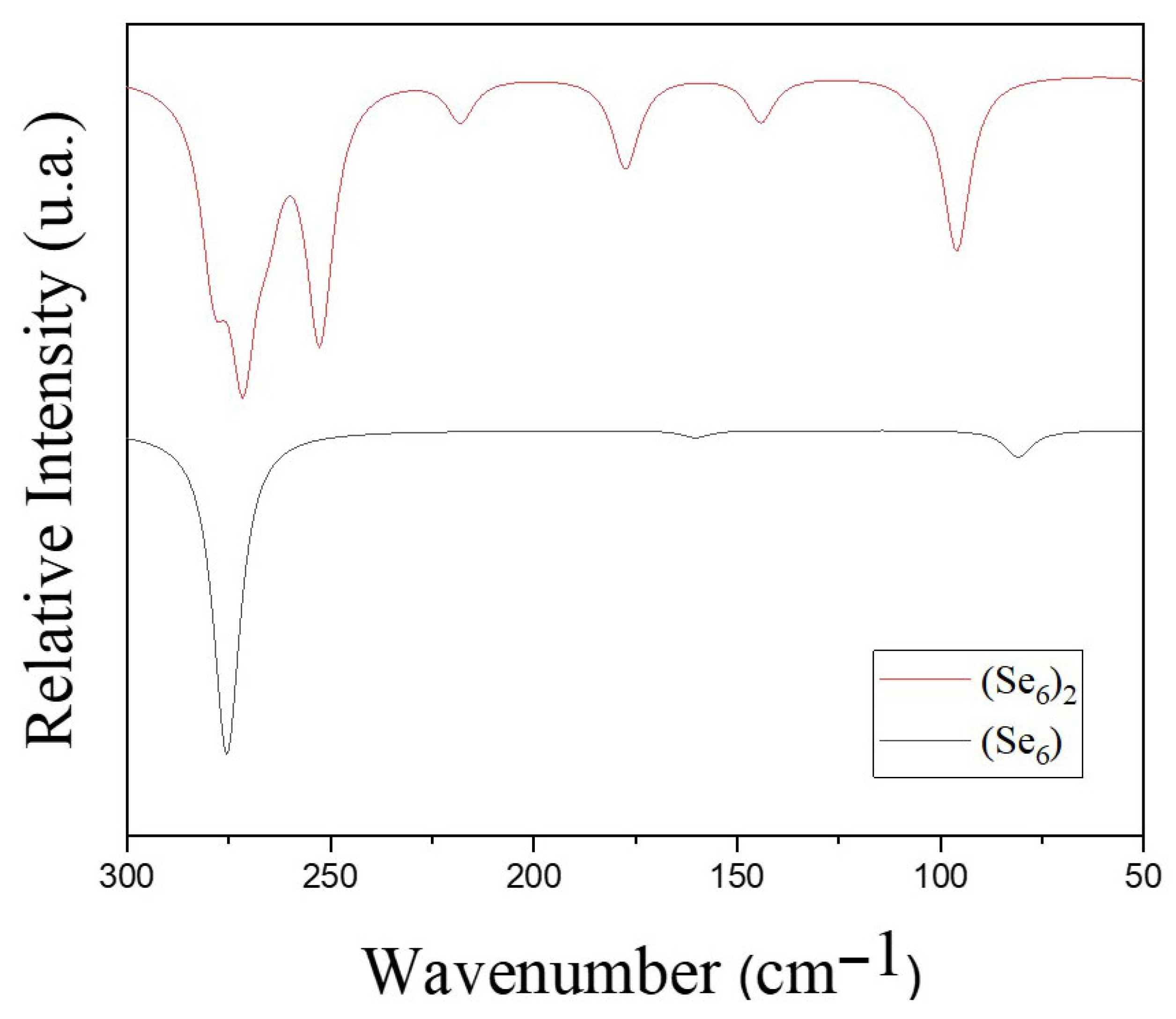
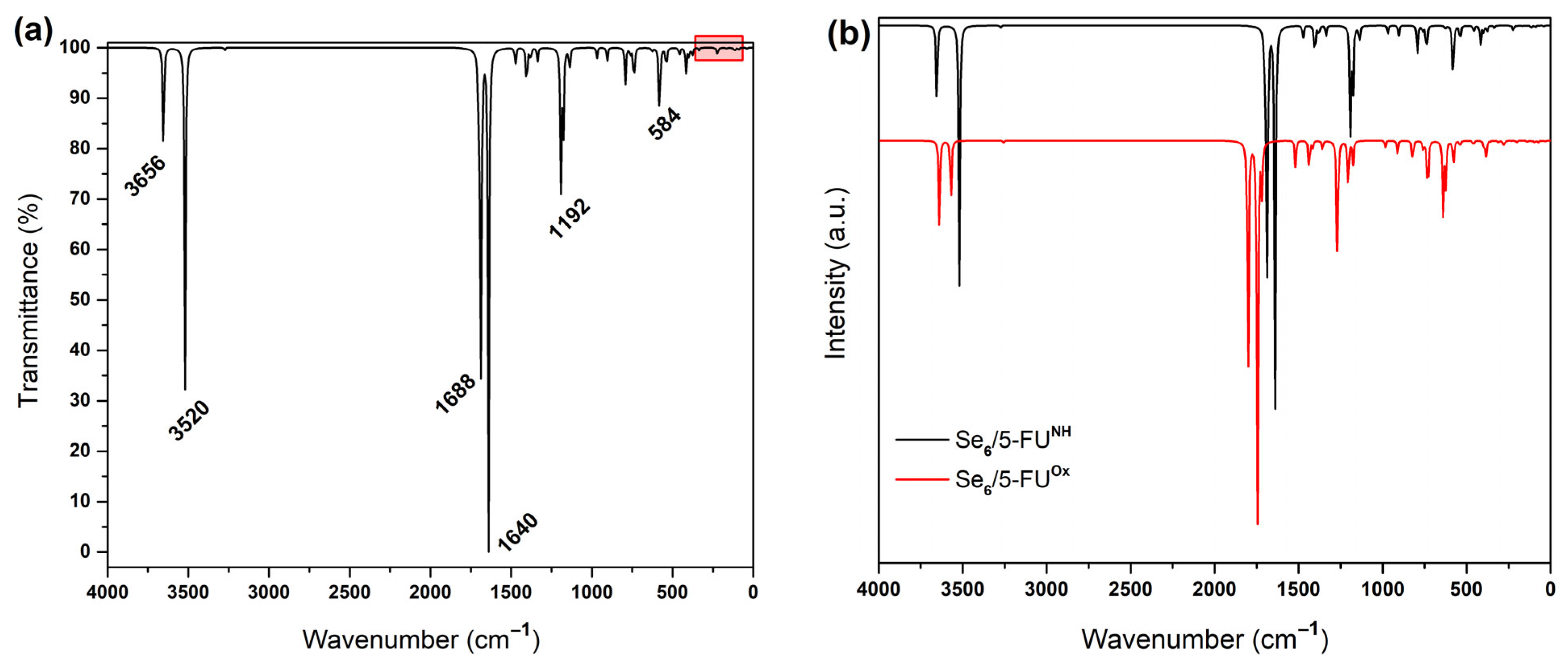
Figure 6, Figure 7, Figure 8 and Figure 9 show the calculated IR spectra for the molecules and complexes studied in this work. The frequency calculations have shown that all the systems studied exhibit non-imaginary frequency values, indicating that the structures reached global minima. First, it is observed that the IR spectrum of Se6 and (Se6)2 (see Figure 6) shows low wavenumber values (<300 cm−1), which is expected due to the large mass of the Se–atoms. (Se6)2 shows a greater number of peaks due to intermolecular Se–Se interactions. The calculated IR spectrum for 5-FU is shown in Figure 7, where peaks are observed at 1803 and 1760 cm−1 corresponding to C=O stretching, while experimentally they are reported at 1723 and 1672 cm−1, as well as a peak at 1266 cm−1 corresponding to C–N stretching [42]. The N–H stretching is at peak at 3637 cm−1. From the IR spectra of the Se6/5-FUOx and Se6/5-FUNH complexes (see Figure 8), we can observe that there is a redshift of the peaks corresponding to the C=O and C–N vibrations, the same finding reported experimentally by Liu et al. [42], where they suggest that this redshift is due to the possible formation of Se–N and Se–O bonds, with which our models would agree very well. Additionally, we also observed the redshift of the peak corresponding to the N–H stretching, indicating the interaction of Se–H(N) hydrogen bonds and not just Se–N bonds.
Figure 9 illustrates: (a) models showing interactions through Se–(H)N connections, and (b) models involving Se–O(C) interactions. The vibrational frequency analysis reveals a systematic shift in the signals toward lower wavenumbers, along with an increase in the intensity of characteristic C=O and N–H vibrational peaks as the number of 5-FU molecules in the system increases.

4. Thermochemistry

Table 3 shows the changes in the thermodynamic parameters of the reactions that give rise to the drug–carrier complexes; that is, the reaction enthalpy ( H ), Gibbs free energy ( G ) and entropy ( S ), considering conditions at 1 atm and 298 K, shown in Table S4 of the Supplementary Materials, also presents the values of the thermochemical parameters for a medium vacuum. An important aspect to consider in IR calculations, and due to the nature of Se6 and (Se6)2, is that they exhibit vibration modes below −100 cm−1. This can cause errors when estimating Gibbs free energy values calculated within the standard rigid-rotor harmonic oscillator (RRHO) approximation. To evaluate this effect, we performed a quasi-harmonic correction for a representative system, Se6/5-FUNH, using a frequency cutoff of 100 cm−1. This approach replaces low-frequency modes with a minimum threshold, thereby reducing the artificial entropic contribution associated with very soft vibrations. The correction was carried out using the GoodVibes program [74], which implements the quasi-harmonic approximation following the Grimme entropy treatment and Head-Gordon enthalpy correction [75]. The uncorrected Gibbs free energy change (ΔG) was found to be 15.9657 kcal/mol (as shown in the Supplementary Materials, Table S5, entry 4), while the quasi-harmonic corrected value is 15.8653 kcal/mol, corresponding to a difference of only 0.10 kcal/mol. This very small deviation indicates that low-frequency vibrational modes have a negligible impact on the computed thermodynamic quantities in this system. The H values are negative for all reactions in Table 3, indicating that the formation of the molecular complexes is enthalpically favorable and therefore an exothermic process, except for the Se6/5-FUNH complex ( H = 3.52 kcal/mol) which also exhibited the lowest adsorption energy (see above, Table 2). Only the (Se6)2/5-FUNH complex would exhibit a spontaneous chemisorption process due to its negative G value.

5. Discussion

In this study, our results of the molecular structure for the Se6/5-FUOx are consistent with previously reported theoretical and experimental results [51,52,53,54,55,56,68]. Furthermore, Se6 and its dimer (Se6)2 are electrophilic, a result of the molecular descriptors and a property of a stable molecular transport system that releases the drug when needed without altering the chemical properties of the 5-FUOx drug. In addition, we have discovered a new molecular structure for the Se6/5-FUNH system, which doubles the possibility of experimentally obtaining a new anticancer drug delivery system. FTIR spectra of all involved molecules were also calculated, with emphasis on the characteristic peaks of the drug-releasing system for its identification and experimental verification. Finally, our results on the thermochemistry of the 5-FUOx (or 5-FUNH) drug-releasing molecular system show that minimal energy at surround temperature is required to their obtention. This implies the opening of an approach new to the molecular level in aqueous phase where the anticancer drug (5-FUOx or 5-FUNH) is released into the cancer cells, while the molecular transport medium (Se6 or (Se6)2) is absorbed by the host in the appropriate doses [2,20,42]. Furthermore, in the calculations shown with other functional groups and bases with dispersion correction (see Appendix A and Table S1 of the Supplementary Materials), the surprising physisorption result of our drug delivery system should have a higher release efficiency of 5-FUOx or 5-FUNH from the transport medium (Se6 or (Se6)2) through water hydrolysis with interactions of the H and O bonds of the Se6/5-FUNH or 5-FUOx molecules. This point warrants further study. Moreover, our theoretical results show that it is feasible to generate the system in the laboratory by mixing the reactants 5-FU and Se6 at room temperature in a 50% 5-FU–50% Se6 concentration. Given the simplicity of obtaining the new drug delivery system, the next step is to determine the minimum and maximum doses in in vitro experiments with cancer cells [42]. Once the ideal dose is calculated, the new 5-FU drug delivery system in fluid phase should be tested in rat biomodels with some type of cancer [42]. Based on the results obtained, this inspires further studies on non-covalent interactions to determine precisely which types of interaction forces predominate in the system. With this precise information, a novel and potentially significant molecular drug delivery system can be scaled up, ready for in vitro and in vivo experimental and clinical trials.

6. Conclusions

In this work, we studied the electronic, thermochemical, and vibrational properties of a drug delivery system composed of selenium clusters and 5-fluorouracil (5-FU) molecules using quantum chemistry calculations via the DFT/B3LYP/6-31G(d,p) method in aqueous media. The results show that the stability of the Se–carrier unit is not affected post-functionalization, which is very important for its use in biological systems. The adsorption energy values show that chemisorption between 5-FU and Se6 occurs through both Se–H(N) and Se–O(C) interactions, consistent with experimental observations [42,51,52,53,54,55,56,68]. Similarly, calculated IR spectroscopy studies show findings analogous to those reported experimentally. This shows that we can study large and complex drug delivery systems at the molecular level (and using quantum chemistry methods) even considering only small clusters and molecules instead of nanoparticles of even hundreds of nanometers, which is computationally very exhaustive. This work motivates further study of other experimentally evaluated drug transport systems to understand the molecular mechanisms behind these drug–carrier interactions.

Supplementary Materials

The following supporting information can be downloaded at https://www.mdpi.com/article/10.3390/biotech15020029/s1. This file contains all the information regarding calculations in gaseous media and BSSE correction.

Author Contributions

Conceptualization, M.A.M., R.M.-B. and J.I.R.-M.; methodology, M.A.M. and L.I.S.-G.; software, L.I.S.-G. and J.I.R.-M.; validation, M.A.M., L.I.S.-G. and R.M.-B.; formal analysis, M.A.M., J.I.R.-M. and L.I.S.-G.; investigation, M.A.M., L.I.S.-G. and R.M.-B.; resources, J.I.R.-M. and L.I.S.-G.; data curation, R.A.-S., L.I.S.-G. and R.M.-B.; writing—original draft preparation, M.A.M. and L.I.S.-G.; writing—review and editing, R.M.-B.; visualization, R.A.-S. and L.I.S.-G.; supervision, M.A.M., R.M.-B. and R.A.-S.; project administration, M.A.M. and R.A.-S.; funding acquisition, M.A.M. All authors have read and agreed to the published version of the manuscript.

Funding

Vicerrectoría de Investigación Estudios de Postgrado of the Benemérita Universidad Autónoma de Puebla (VIEP-BUAP) No. assigned project 00094—PVG/2026.

Institutional Review Board Statement

Not applicable.

Informed Consent Statement

Not applicable.

Data Availability Statement

The original contributions presented in this study are included in the article/Supplementary Material. Further inquiries can be directed to the corresponding authors.

Acknowledgments

The authors thankfully acknowledge the computer resources, technical expertise and support provided by the Laboratorio Nacional de Supercomputo del Sureste de México, CONAHCYT, member of the network of national laboratories. No. assigned project 202201034C.

Conflicts of Interest

The authors declare no conflicts of interest.

Abbreviations

SeSelenium
Se6Selenium-6
CSe6Cluster Selenium-6
5-FU5-fluorouracil
Se6/5-FUOxSelenium-Oxygen
Se6/5-FU NHSelenium-Hydrogen
MAMMarco A. Morales
RMBRaúl Mendoza-Báez
LISGLevi Isai Solano-González
RASRicardo Agustín-Serrano
JIRMJosé Isrrael Rodríguez-Mora

Appendix A

We have recalculated the Se6/5-FUNH and Se6/5-FUOx systems with different functionals (with dispersion corrections: B3LYP-D3 and wB97XD) and more robust basis sets (def2SVP and 6-311G(d,p)).
B3LYP-D3/def2SVPwB97X-D/def2SVP
Energy Energy
MoleculehartreeeVE_ads (eV)MoleculehartreeeVE_ads (eV)
5-FU−513.702911−13,978.5749 5-FU−513.522936−13,973.6775
Se6−14,407.9045−392,059.239 Se6−14,408.0114−392,062.147
Se6/5FUNH−14,921.6187−406,038.119−0.30523024Se6/5FUNH−14,921.5409−406,036.002−0.1777994
Se6/5FUOx−14,921.6205−406,038.17−0.35568018Se6/5FUOx−14,921.5414−406,036.017−0.1924931
B3LYP-D3/6-311G(d,p)wB97X-D/6-311G(d,p)
Energy Energy
MoleculehartreeeVE_ads (eV)MoleculehartreeeVE_ads (eV)
5-FU−514.221016−13,992.6732 5-FU−514.034428−13,987.5959
Se6−14,409.4567−392,101.477 Se6−14,409.5574−392,104.215
Se6/5FUNH−14,923.6875−406,094.416−0.2662363Se6/5FUNH−14,923.5972−406,091.957−0.146724
Se6/5FUOx−14,923.6889−406,094.454−0.303788Se6/5FUOx−14,923.597−406,091.953−0.14283272
The results of the adsorption energy refinement show that in all cases, the adsorption energy values decrease compared to those obtained with B3LYP/6-31G(d,p). However, they remain negative in all cases, indicating a favorable adsorption process. Furthermore, in most cases (except for wB97XD/6-311G(d,p)), the Se6/5-FUOx system continues to exhibit the highest (most negative) adsorption value, as observed with B3LYP/6-31G(d,p). Finally, we observed that the wB97XD functional yields considerably lower adsorption energy values compared to B3LYP/6-31G(d,p). So, as mentioned previously, a more detailed evaluation of the influence of the level of theory employed can be addressed in future work.

References

  1. Bray, F.; Laversanne, M.; Sung, H.; Ferlay, J.; Siegel, R.L.; Soerjomataram, I.; Jemal, A. Global cancer statistics 2022: GLOBOCAN estimates of incidence and mortality worldwide for 36 cancers in 185 countries. CA Cancer J. Clin. 2024, 74, 229–263. [Google Scholar] [CrossRef] [PubMed]
  2. Patra, J.K.; Das, G.; Fraceto, L.F.; Campos, E.V.R.; Rodriguez-Torres, M.D.P.; Acosta-Torres, L.S.; Shin, H.S. Nano based drug delivery systems: Recent developments and future prospects. J. Nanobiotechnol. 2018, 16, 71. [Google Scholar] [CrossRef] [PubMed]
  3. De Jong, W.H.; Borm, P.J.A. Drug delivery and nanoparticles: Applications and hazards. Int. J. Nanomed. 2008, 3, 133–149. [Google Scholar] [CrossRef] [PubMed]
  4. Sultana, A.; Zare, M.; Thomas, V.; Kumar, T.S.S.; Ramakrishna, S. Nano-based drug delivery systems: Conventional drug delivery routes, recent developments and future prospects. Med. Drug Discov. 2022, 15, 100134. [Google Scholar] [CrossRef]
  5. Khan, I.; Saeed, K.; Khan, I. Nanoparticles: Properties, applications and toxicities. Arab. J. Chem. 2019, 12, 908–931. [Google Scholar] [CrossRef]
  6. Ratemi, E.; Sultana Shaik, A.; Al Faraj, A.; Halwani, R. Alternative approaches for the treatment of airway diseases: Focus on nanoparticle medicine. Clin. Exp. Allergy 2016, 46, 1033–1042. [Google Scholar] [CrossRef]
  7. Anık, Ü.; Timur, S.; Dursun, Z. Recent pros and cons of nanomaterials in drug delivery systems. Int. J. Polym. Mater. 2020, 69, 1090–1100. [Google Scholar] [CrossRef]
  8. Fernandez-Urrusuno, R.; Fattal, E.; Porquet, D.; Feger, J.; Couvreur, P. Evaluation of liver toxicological effects induced by polyalkylcyanoacrylate nanoparticles. Toxicol. Appl. Pharmacol. 1995, 130, 272–279. [Google Scholar] [CrossRef]
  9. Croitoru, G.A.; Pîrvulescu, D.C.; Niculescu, A.G.; Grumezescu, A.M.; Antohi, A.M.; Nicolae, C.L. Metallic nanomaterials—targeted drug delivery approaches for improved bioavailability, reduced side toxicity, and enhanced patient outcomes. Rom. J. Morphol. Embryol. 2024, 65, 145–158. [Google Scholar] [CrossRef]
  10. Dinh, T.; Dobó, Z.; Palotás, Á.B.; Kovács, H. A review of gold nanoparticle synthesis: Transitioning from conventional techniques to plant-mediated green nanofabrication. Mater. Today Chem. 2025, 48, 103003. [Google Scholar] [CrossRef]
  11. Mahaparale, S.; Patil, A. The multifaceted role of iron oxide nanoparticles in advancing modern pharmaceutical technology and drug delivery systems. Int. J. Pharm. Sci. Drug Res. 2024, 736–745. [Google Scholar] [CrossRef]
  12. Maiyo, F.; Singh, M. Selenium nanoparticles: Potential in cancer gene and drug delivery. Nanomedicine 2017, 12, 1075–1089. [Google Scholar] [CrossRef] [PubMed]
  13. Kumari, M.; Purohit, M.P.; Patnaik, S.; Shukla, Y.; Kumar, P.; Gupta, K.C. Curcumin loaded selenium nanoparticles synergize the anticancer potential of doxorubicin contained in self-assembled, cell receptor targeted nanoparticles. Eur. J. Pharm. Biopharm. 2018, 130, 185–199. [Google Scholar] [CrossRef] [PubMed]
  14. Xie, Q.; Deng, W.; Yuan, X.; Wang, H.; Ma, Z.; Wu, B.; Zhang, X. Selenium-functionalized liposomes for systemic delivery of doxorubicin with enhanced pharmacokinetics and anticancer effect. Eur. J. Pharm. Biopharm. 2018, 122, 87–95. [Google Scholar] [CrossRef]
  15. Nath, D.; Kaur, L.; Sohal, H.S.; Malhi, D.S.; Garg, S.; Thakur, D. Application of selenium nanoparticles in localized drug targeting for cancer therapy. Anti-Cancer Agents Med. Chem.-Anti-Cancer Agents 2022, 22, 2715–2725. [Google Scholar] [CrossRef]
  16. Haddadian, A.; Robattorki, F.F.; Dibah, H.; Soheili, A.; Ghanbarzadeh, E.; Sartipnia, N.; Hajrasouliha, S.; Pasban, K.; Andalibi, R.; Ch, M.H.; et al. Niosomes-loaded selenium nanoparticles as a new approach for enhanced antibacterial, anti-biofilm, and anticancer activities. Sci. Rep. 2022, 12, 21938. [Google Scholar] [CrossRef]
  17. Shehata, N.S.; Elwakil, B.H.; Elshewemi, S.S.; Ghareeb, D.A.; Olama, Z.A. In vitro and in vivo studies of selenium nanoparticles coated bacterial polysaccharide as anti-lung cancer agents. Microb. Cell Factories 2024, 23, 339. [Google Scholar] [CrossRef]
  18. Shirazi, A.N.; Vadlapatla, R.; Koomer, A.; Yep, K.; Parang, K. Selenium nanoparticles as versatile delivery tools. Pharmaceutics 2025, 17, 1556. [Google Scholar] [CrossRef]
  19. Dumore, N.S.; Mukhopadhyay, M. Antioxidant properties of aqueous selenium nanoparticles (ASeNPs) and its catalysts activity for 1, 1-diphenyl-2-picrylhydrazyl (DPPH) reduction. J. Mol. Struct. 2020, 1205, 127637. [Google Scholar] [CrossRef]
  20. MacFarquhar, J.K.; Broussard, D.L.; Melstrom, P.; Hutchinson, R.; Wolkin, A.; Martin, C. Acute selenium toxicity associated with a dietary supplement. Arch. Intern. Med. 2010, 170, 256–261. [Google Scholar] [CrossRef]
  21. Al-hakimi, A.N.; Asnag, G.M.; Alminderej, F.; Alhagri, I.A.; Al-Hazmy, S.M.; Abdallah, E.M. Enhanced structural, optical, electrical properties and antibacterial activity of selenium nanoparticles loaded PVA/CMC blend for electrochemical batteries and food packaging applications. Polym. Test. 2022, 116, 107794. [Google Scholar] [CrossRef]
  22. Dixit, R.; Gupta, A.; Jordan, N.; Zhou, S.; Schild, D.; Weiss, S.; Guillon, E.; Jain, R.; Lens, P. Magnetic properties of biogenic selenium nanomaterials. Environ. Sci. Pollut. Res. 2021, 28, 40264–40274. [Google Scholar] [CrossRef] [PubMed]
  23. Suslov, A.; Bikorimana, S.; Lama, P.; Sukharenko, V.; Walser, A.; Dorsinville, R. Synthesis of selenium nanoparticles and their nonlinear optical properties. J. Nonlinear Opt. Phys. Mater. 2017, 26, 1750016. [Google Scholar] [CrossRef]
  24. Chauhan, P.; Chaudhary, S. Role of surface modification on selenium nanoparticles: Enumerating the optical, thermal and structural properties. Opt. Mater. 2019, 97, 109380. [Google Scholar] [CrossRef]
  25. Hariharan, S.; Dharmaraj, S. Selenium and selenoproteins: It’s role in regulation of inflammation. Inflammopharmacology 2020, 28, 667–695. [Google Scholar] [CrossRef]
  26. Shahidin; Wang, Y.; Wu, Y.; Chen, T.; Wu, X.; Yuan, W.; Zhu, Q.; Wang, X.; Zi, C. Selenium and selenoproteins: Mechanisms, health functions, and emerging applications. Molecules 2025, 30, 437. [Google Scholar] [CrossRef]
  27. Zhang, F.; Li, X.; Wei, Y. Selenium and selenoproteins in health. Biomolecules 2023, 13, 799. [Google Scholar] [CrossRef]
  28. Bae, M.; Kim, H. Mini-review on the roles of vitamin C, vitamin D, and selenium in the immune system against COVID-19. Molecules 2020, 25, 5346. [Google Scholar] [CrossRef]
  29. Genchi, G.; Lauria, G.; Catalano, A.; Sinicropi, M.S.; Carocci, A. Biological activity of selenium and its impact on human health. Int. J. Mol. Sci. 2023, 24, 2633. [Google Scholar] [CrossRef]
  30. Mellinas, C.; Jiménez, A. Microwave-assisted green synthesis and antioxidant activity of selenium nanoparticles using Theobroma cacao L. bean shell extract. Molecules 2019, 24, 4048. [Google Scholar] [CrossRef]
  31. Prokopczyk, B.; Rosa, J.G.; Desai, D.; Amin, S.; Sohn, O.S.; Fiala, E.S.; El-Bayoumy, K. Chemoprevention of lung tumorigenesis induced by a mixture of benzo (a) pyrene and 4-(methylnitrosamino)-1-(3-pyridyl)-1-butanone by the organoselenium compound 1, 4-phenylenebis (methylene) selenocyanate. Cancer Lett. 2000, 161, 35–46. [Google Scholar] [CrossRef] [PubMed]
  32. Wang, H.; Zhang, J.; Yu, H. Elemental selenium at nano size possesses lower toxicity without compromising the fundamental effect on selenoenzymes: Comparison with selenomethionine in mice. Free Radic. Biol. Med. 2007, 42, 1524–1533. [Google Scholar] [CrossRef] [PubMed]
  33. Zhang, J.; Wang, X.; Xu, T. Elemental selenium at nano size (Nano-Se) as a potential chemopreventive agent with reduced risk of selenium toxicity: Comparison with se-methylselenocysteine in mice. Toxicol. Sci. 2008, 101, 22–31. [Google Scholar] [CrossRef] [PubMed]
  34. He, H.; Huang, D.; Xie, P.; Dong, J.; Huo, S.; Li, S.; Ma, L.; Chen, T. Research progress on selenium system in cancer therapy: Focus on interface modifications and improvement of interactions. Surf. Interfaces 2025, 56, 105642. [Google Scholar] [CrossRef]
  35. Azwar, S.; Seow, H.F.; Abdullah, M.; Faisal Jabar, M.; Mohtarrudin, N. Recent updates on mechanisms of resistance to 5-fluorouracil and reversal strategies in colon cancer treatment. Biology 2021, 10, 854. [Google Scholar] [CrossRef]
  36. Khan, M.A.; Pandit, J.; Sultana, Y.; Sultana, S.; Ali, A.; Aqil, M.; Chauhan, M. Novel carbopol-based transfersomal gel of 5-fluorouracil for skin cancer treatment: In vitro characterization and in vivo study. Drug Deliv. 2015, 22, 795–802. [Google Scholar] [CrossRef]
  37. Arıca, B.; Çalış, S.; Kaş, H.S.; Sargon, M.F.; Hıncal, A.A. 5-Fluorouracil encapsulated alginate beads for the treatment of breast cancer. Int. J. Pharm. 2002, 242, 267–269. [Google Scholar] [CrossRef]
  38. Liu, J.; Wang, Z.; Wu, K.; Li, J.; Chen, W.; Shen, Y.; Guo, S. Paclitaxel or 5-fluorouracil/esophageal stent combinations as a novel approach for the treatment of esophageal cancer. Biomaterials 2015, 53, 592–599. [Google Scholar] [CrossRef]
  39. Grem, J.L. 5-Fluorouracil: Forty-plus and still ticking. A review of its preclinical and clinical development. Investig. New Drugs 2000, 18, 299–313. [Google Scholar] [CrossRef]
  40. Parker, W.B.; Cheng, Y.C. Metabolism and mechanism of action of 5-fluorouracil. Pharmacol. Ther. 1990, 48, 381–395. [Google Scholar] [CrossRef]
  41. Parker, J.B.; Stivers, J.T. Dynamics of uracil and 5-fluorouracil in DNA. Biochemistry 2011, 50, 612–617. [Google Scholar] [CrossRef] [PubMed]
  42. Liu, W.; Li, X.; Wong, Y.S.; Zheng, W.; Zhang, Y.; Cao, W.; Chen, T. Selenium nanoparticles as a carrier of 5-fluorouracil to achieve anticancer synergism. ACS Nano 2012, 6, 6578–6591. [Google Scholar] [CrossRef] [PubMed]
  43. Becke, A.D. Becke’s three parameter hybrid method using the LYP correlation functional. J. Chem. Phys. 1993, 98, 5648–5652. [Google Scholar] [CrossRef]
  44. Becke, A.D. Density-functional exchange-energy approximation with correct asymptotic behavior. Phys. Rev. A 1988, 38, 3098. [Google Scholar] [CrossRef]
  45. Cossi, M.; Rega, N.; Scalmani, G.; Barone, V. Energies, structures, and electronic properties of molecules in solution with the C-PCM solvation model. J. Comput. Chem. 2003, 24, 669–681. [Google Scholar] [CrossRef]
  46. Barone, V.; Cossi, M. Quantum calculation of molecular energies and energy gradients in solution by a conductor solvent model. J. Phys. Chem. A 1998, 102, 1995–2001. [Google Scholar] [CrossRef]
  47. Frisch, M.J.; Trucks, G.W.; Schlegel, H.B.; Scuseria, G.E.; Robb, M.A.; Cheeseman, J.R.; Scalmani, G.; Barone, V.; Petersson, G.A.; Nakatsuji, H.; et al. Gaussian 09, Revision A.02; Gaussian, Inc.: Wallingford, CT, USA, 2016; Available online: https://gaussian.com/g09citation/ (accessed on 20 March 2026).
  48. Karpov, V.V.; Puzyk, A.M.; Tolstoy, P.M.; Tupikina, E.Y. Hydration of selenolate moiety: Ab initio investigation of properties of O–H … Se (–) hydrogen bonds in CH3Se (–) … (H2O) n clusters. J. Comput. Chem. 2021, 42, 2014–2023. [Google Scholar] [CrossRef]
  49. Tupikina, E.Y.; Karpov, V.V.; Tolstoy, P.M. On the influence of water molecules on the outer electronic shells of R–SeH, R–Se (−) and R–SeOH fragments in the selenocysteine amino acid residue. Phys. Chem. Chem. Phys. 2021, 23, 13965–13970. [Google Scholar] [CrossRef]
  50. Delre, P.; Chahine, A.; Mangiatordi, G.F.; Alberga, D.; Saviano, M.; Valverdu, G.; Ronga, L.; Miqueu, K.; Karamanis, P. Shedding light on the HSAB-guided sulfur–selenium antagonism in mercury coordination and reactivity toward biologically relevant systems: A DFT and MD study. Phys. Chem. Chem. Phys. 2025, 27, 16644–16663. [Google Scholar] [CrossRef]
  51. Kohara, S.; Goldbach, A.; Koura, N.; Saboungi, M.L.; Curtiss, L.A. Vibrational frequencies of small selenium molecules. Chem. Phys. Lett. 1998, 287, 282–288. [Google Scholar] [CrossRef]
  52. Alparone, A. Structural, energetic and response electric properties of cyclic selenium clusters: An ab initio and density functional theory study. Theor. Chem. Acc. 2012, 131, 1239. [Google Scholar] [CrossRef]
  53. Rautiainen, J.M.; Way, T.; Schatte, G.; Passmore, J.; Laitinen, R.S.; Suontamo, R.J.; Valkonen, J. A Computational and experimental study of the structures and Raman and 77Se NMR spectra of SeX3+ and SeX2 (X= Cl, Br, I): FT-Raman spectrum of (SeI3)[AsF6]. Inorg. Chem. 2005, 44, 1904–1913. [Google Scholar] [CrossRef]
  54. Hohl, D.; Jones, R.O.; Car, R.; Parrinello, M. The structure of selenium clusters—Se3 to Se8. Chem. Phys. Lett. 1987, 139, 540–545. [Google Scholar] [CrossRef]
  55. Donohue, J. The Structures of the Elements; Wiley: New York, NY, USA, 1974. [Google Scholar]
  56. Wirnsberger, G.; Fritzer, H.P.; Zink, R.; Popitsch, A.; Pillep, B.; Behrens, P. Isolated Se6 rings in the voids of a weakly interacting, electroneutral, and crystalline SiO2 matrix: Combined experimental and theoretical study. J. Phys. Chem. B 1999, 103, 5797–5801. [Google Scholar] [CrossRef]
  57. Chen, Z.; Zhou, C.H.; Wei, Y.R.; Sun, Z.H.; Deng, L.J. A theoretical study on the mechanism and rate constants of luteolin and selenium dioxide. J. Mol. Model. 2025, 31, 68. [Google Scholar] [CrossRef]
  58. Yaqoob, M.; Gul, S.; Zubair, N.F.; Iqbal, J.; Iqbal, M.A. Theoretical calculation of selenium N-heterocyclic carbene compounds through DFT studies: Synthesis, characterization and biological potential. J. Mol. Struct. 2020, 1204, 127462. [Google Scholar] [CrossRef]
  59. Altaf, A.; Jamil, F.; Yaqoob, M.; Iqbal, M.A.; Sadique, S.; Manahil, S.; Malik, S.N.; Shoukat, U.S.; khalid, M.; Zia, S.U.; et al. Preparation, characterization, DFT calculations, biological evaluations and molecular docking studies of benzimidazolium-based N-heterocyclic carbenes and selenium-adducts. Inorganica Chim. Acta 2025, 574, 122348. [Google Scholar] [CrossRef]
  60. Wang, Q.; Yang, J.; Fan, Y.; Liu, P.F. Molecular-Level Insights into Efficient Immobilization of Gas-Phase Elemental Mercury by a Selenium Cluster-Functionalized Carbon Surface: A DFT Study. Ind. Eng. Chem. Res. 2023, 62, 13773–13779. [Google Scholar] [CrossRef]
  61. Othmani, H.; Ben Said, R.; Terzi, N.; Jaidane, N.E.; Mogren Al Mogren, M.; Elmarghany, A.; Hochlaf, M. Structural, energetic and spectroscopic characterisation of 5-fluorouracil anticarcinogenic drug isomers, tautomers and ions. Mol. Phys. 2019, 117, 1589–1603. [Google Scholar] [CrossRef]
  62. Koopmans, T. Über die Zuordnung von Wellenfunktionen und Eigenwerten zu den einzelnen Elektronen eines Atoms. Physica 1934, 1, 104–113. [Google Scholar] [CrossRef]
  63. Parr, R.G.; Pearson, R.G. Absolute hardness: Companion parameter to absolute electronegativity. J. Am. Chem. Soc. 1983, 105, 7512–7516. [Google Scholar] [CrossRef]
  64. Parr, R.G.; Szentpály, L.V.; Liu, S. Electrophilicity index. J. Am. Chem. Soc. 1999, 121, 1922–1924. [Google Scholar] [CrossRef]
  65. von Szentpály, L.; Kaya, S.; Karakuş, N. Why and when is electrophilicity minimized? New theorems and guiding rules. J. Phys. Chem. A 2020, 124, 10897–10908. [Google Scholar] [CrossRef] [PubMed]
  66. Zunger, A. Self-consistent LCAO calculation of the electronic properties of graphite. I. The regular graphite lattice. Phys. Rev. B 1978, 17, 626. [Google Scholar] [CrossRef]
  67. Vatankhah, C.; Badehian, H.A. Structural, elastic, and optical properties of silicon carbide nanotubes using DFT. Solid State Commun. 2022, 344, 114672. [Google Scholar] [CrossRef]
  68. García-Toral, D.; Mendoza-Báez, R.; Chigo-Anota, E.; Flores-Riveros, A.; Vázquez-Báez, V.M.; Cocoletzi, G.H.; Rivas-Silva, J.F. Structural stability and electronic properties of boron phosphide nanotubes: A density functional theory perspective. Symmetry 2022, 14, 964. [Google Scholar] [CrossRef]
  69. MHenzler, M.; Göpel, W. Oberflächenphysik des Festkörpers, 2nd ed.; Vieweg+Teubner Verlag: Wiesbaden, Germany, 1994; ISBN 978-3519130475. [Google Scholar]
  70. Ngana, O.C.; Nwagu, A.D.; Oyebanji, O.M.; Mohammed, S.H.; Abdulhussein, N.A. A DFT study for volatile gas adsorption of surface modifications of carbon based fullerenes through mono doping and co doping. Sci. Rep. 2025, 15, 34691. [Google Scholar] [CrossRef]
  71. Ochterski, J.W. Thermochemistry in Gaussian; Gaussian, Inc.: Wallingford, CT, USA, 2000; Available online: https://gaussian.com/wp-content/uploads/dl/thermo.pdf (accessed on 27 February 2026).
  72. Grabowski, S.; Wojdyła-Parat, J.; Tyszka-Czochara, M.; Kozieł, M.; Chmylak, M.; Lalik, S.; Gryl, M. The whole is greater than the sum of its parts: Binary and ternary 5-fluorouracil co-crystals with enhanced selectivity towards metastatic cancer cells. Chem. Commun. 2025, 61, 16770–16773. [Google Scholar] [CrossRef]
  73. Boys, S.F.; Bernardi, F.J.M.P. The calculation of small molecular interactions by the differences of separate total energies. Some procedures with reduced errors. Mol. Phys. 1970, 19, 553–566. [Google Scholar] [CrossRef]
  74. Luchini, G.; Alegre-Requena, J.V.; Funes-Ardoiz, I.; Paton, R.S. GoodVibes: Automated thermochemistry for heterogeneous computational chemistry data. F1000Research 2020, 9, 291. [Google Scholar] [CrossRef]
  75. Li, Y.P.; Gomes, J.; Mallikarjun Sharada, S.; Bell, A.T.; Head-Gordon, M. Improved force-field parameters for QM/MM simulations of the energies of adsorption for molecules in zeolites and a free rotor correction to the rigid rotor harmonic oscillator model for adsorption enthalpies. J. Phys. Chem. C 2015, 119, 1840–1850. [Google Scholar] [CrossRef]
Figure 1. Interaction models used for the Se6/5-FU systems in 1:1 (a,b) and 1:2 (c,d) ratios. The initial distance was 2 Å, bringing the Se–O(C) atoms (a,c) and Se–H(N) atoms (b,d) closer together as the main interaction sites.
Biotech 15 00029 g001
Figure 2. (a) Ball and stick representation of the optimized dimer (Se6)2. Interaction models used for the (Se6)2/(5-FU) systems where the initial distance was 2 Å, bringing the (b) Se–O(C) atoms and (c) Se–H(N) atoms closer together as the main interaction sites.
Biotech 15 00029 g002
Figure 3. Optimized geometries of Se6 (Se6)2 and 5-FU molecules, HOMO and LUMO orbitals, and molecular electrostatic potential, obtained with B3LYP/6-31G(d,p) using CPCM solvation model (water).
Biotech 15 00029 g003
Figure 4. Optimized geometries of Se6/5-FUNH, Se6/(5-FU)2NH and (Se6)2/5-FUNH complexes, HOMO and LUMO orbitals, and molecular electrostatic potential, obtained with B3LYP/6-31G(d,p) using CPCM solvation model (water).
Biotech 15 00029 g004aBiotech 15 00029 g004b
Figure 5. Optimized geometries of Se6/5-FUOx, Se6/(5-FU)2Ox and (Se6)2/5-FUOx complexes, HOMO and LUMO orbitals, and molecular electrostatic potential, obtained with B3LYP/6-31G(d,p) using CPCM solvation model (water).
Biotech 15 00029 g005
Figure 6. IR spectra of (Se6)2 (red spectrum) and Se6 (black spectrum) obtained with B3LYP/6-31G(d,p) using CPCM solvation model (water).
Biotech 15 00029 g006
Figure 7. IR spectra of 5-FU obtained with B3LYP/6-31G(d,p) using CPCM solvation model (water).
Biotech 15 00029 g007
Figure 8. IR spectra of (a) Se6/5-FUNH with the 100 cm−1 to 500 cm−1 region shaded in red corresponding to Se6 and magnified in Figure 7; (b) Se6/5-FUNH (black line) and Se6/5-FUOx (red line) obtained with B3LYP/6-31G(d,p) using CPCM solvation model (water).
Biotech 15 00029 g008
Figure 9. (a) IR spectra of (Se6)2/5-FU)Ox (blue), Se6/(5-FU2)2Ox (red), Se6/5-FUOx (black), and (b) (Se6)2/5-FU) NH (blue), Se6/(5-FU2)2NH (red), Se6/5-FUNH (black spectra); all models obtained with B3LYP/6-31G(d,p) using CPCM solvation model (water).
Biotech 15 00029 g009
Table 1. Optimized Total Energy ( E T ), Energy of the Frontier Molecular Orbitals ( E H O M O and E L U M O ), Molecular Gap Energy (Eg), and global molecular descriptors ( η , μ , ω ) of all molecules and complexes (in aqueous media). All values in eV.
Molecule E T E H O M O E L U M O E g a p I A μ η ω
Se6−391,746.99−6.5318−2.41994.11196.53182.4199−4.47592.05604.8720
(Se6)2−783,495.39−5.5476−2.55242.99525.54762.5524−4.05001.49765.4764
5-FU−13,988.28−6.6137−1.23275.38116.61371.2327−3.92322.69052.8603
Se6/5-FUOx−405,735.79−6.3865−2.40273.98376.38652.4027−4.39461.99194.8479
Se6/(5-FU)2Ox−419,724.45−6.3811−2.37044.01076.38112.3704−4.37572.00534.7740
(Se6)2/5-FUOx−797,484.23−5.5326−2.53752.99525.53262.5375−4.03501.49765.4360
Se6/5-FUNH−405,735.74−6.4452−2.35954.08586.44522.3595−4.40242.04294.7435
Se6/(5-FU)2NH−419,724.60−6.2937−2.33263.96126.29372.3326−4.31311.98064.6964
(Se6)2/5-FUNH−797,484.23−5.5326−2.53752.99525.53262.5375−4.03501.49765.4360
Table 2. Adsorption energy ( E a d s ) and cohesion energy ( E c o h ) of all complexes. All values in eV.
Complex E a d s E c o h
Se6/5-FUOx−0.5207−5.7796
Se6/(5-FU)2Ox−0.8971−6.0800
(Se6)2/5-FUOx−0.5554−5.4579
Se6/5-FUNH−0.4643−5.7764
Se6/(5-FU)2NH−1.0403−6.0848
(Se6)2/5-FUNH−0.5554−5.4579
Table 3. Enthalpy, Gibbs free energy and entropy (kcal/mol), and dipole moment (Debyes) of the molecular complexes.
ReactionΔHΔGTΔS µ ( D )
(Se6 + 5-FU→Se6/5-FU) Ox−10.79560.73920−11.53485.5515
(Se6 + 2-5-FU→Se6/(5-FU)2) Ox−18.26933.1318−21.40123.3880
(2Se6 + 5-FU→(Se6)2/5-FU) Ox−3.18398.5535−11.73754.2108
(Se6 + 5-FU→Se6/5-FU) NH3.521515.9657−12.44416.0192
(Se6 + 2-5-FU→Se6/(5-FU)2) NH−21.35220.3093−21.66164.2590
(2Se6 + 5-FU→(Se6)2/5-FU) NH−10.8665−2.1222−8.74435.5568
Disclaimer/Publisher’s Note: The statements, opinions and data contained in all publications are solely those of the individual author(s) and contributor(s) and not of MDPI and/or the editor(s). MDPI and/or the editor(s) disclaim responsibility for any injury to people or property resulting from any ideas, methods, instructions or products referred to in the content.