Article

Density and Viscosity of CO2 Binary Mixtures with SO2, H2S, and CH4 Impurities: Molecular Dynamics Simulations and Thermodynamic Model Validation


by
Mohammad Hassan Mahmoodi
,
Pezhman Ahmadi
* and
Antonin Chapoy
Hydrates, Flow Assurance & Phase Equilibria Research Group, Institute of GeoEnergy Engineering, Heriot-Watt University, Edinburgh EH14 4AS, UK
*
Author to whom correspondence should be addressed.
Gases 2025, 5(4), 28; https://doi.org/10.3390/gases5040028
Submission received: 29 October 2025 / Revised: 24 November 2025 / Accepted: 26 November 2025 / Published: 28 November 2025

Abstract

The aim of this study is to generate density and viscosity data for carbon capture utilization and storage (CCUS) mixtures using equilibrium molecular dynamics (EMD) simulations. Binary CO2 mixtures with SO2 and H2S impurities at mole fractions of 0.05, 0.10, and 0.20 were constructed. Simulations were performed across a temperature range of 223–323.15 K and at pressures up to 27.5 MPa using ms2 software. The simulation results were compared with predictions from established models. These included the Multi-Fluid Helmholtz Energy Approximation (MFHEA) for density, and the Lennard-Jones (LJ), Residual Entropy Scaling (ES-NIST), and Extended Corresponding States (SUPERTRAPP) models for viscosity. Available experimental data from the literature were also used for validation. Density predictions showed excellent agreement with MFHEA, especially for CO2 + SO2 mixtures, with %AARD values below 1% for 0.05 and 0.10, and 1.60% for 0.20 mole fraction SO2. For CO2 + H2S mixtures, deviations also increased with impurity concentration, reaching a maximum %AARD of 4.72% at 0.20 mole fraction. Viscosity data were validated against experimental values from the literature for a CO2 + CH4 (xCH4 = 0.25) mixture, showing strong agreement with both models and experiments. This confirms the reliability of the MD approach and the thermodynamic models, even for systems lacking experimental data. However, viscosity estimates showed higher uncertainty at lower temperatures and higher densities, a known limitation of the Green–Kubo method. This highlights the importance of selecting an appropriate correlation time to ensure the pressure correlation functions reach a plateau, avoiding inaccurate or uncertain viscosity values.

Graphical Abstract

1. Introduction

To mitigate carbon emissions and confront global warming, one promising approach is the implementation of carbon capture, utilization, and storage (CCUS) projects [1]. A critical factor in the success of these projects is the safe and cost-effective transportation of CO2 from the capture point to the storage or utilization location. Depending on the CO2 source and the capture technology used, CCUS fluids may contain various impurities such as N2, O2, H2, CH4, Ar, CO, SO2, and H2S [2,3]. These impurities can significantly influence thermophysical properties, including vapor–liquid equilibrium (VLE), density, and viscosity [4,5,6]. Density and viscosity are particularly important for designing efficient transport systems. Density data are essential for validating equations of state and accurately estimating the mass flow rate. Viscosity, which reflects fluid’s resistance to flow, is crucial for developing thermodynamic models used in commercial software to design process facilities effectively. Two common impurities in CCUS fluids, namely H2S and SO2, are highly toxic and corrosive. Their presence poses serious risks to both the personnel and equipment, demanding careful consideration in system design and operation.
Many researchers have investigated the density and viscosity of CO2 mixtures containing impurities through experimental measurements. Buddenburg and Wilke [7] were among the first to estimate viscosities of gas mixtures, including CO2 + H2, using properties of the pure components. They built an apparatus similar to the one used by Rankine and Smith [8] which measured viscosity relative to nitrogen by timing a falling mercury pellet that pushed gases through a capillary tube. Using equations from Rankine and Smith [8], they attempted to estimate viscosities for binary mixtures. Jackson [9] measured viscosities of CO2 + CH4 mixtures at 298.15 K using a platinum capillary tube viscometer. Dewitt and Thodos [10] used an unsteady-state capillary viscometer to study CO2 + CH4 mixtures in the dense gaseous state. Esper et al. [11] examined volumetric properties, including density, for equimolar mixtures of CO2 + CH4 and CO2 + N2. Hobley et al. [12] developed a novel capillary flow viscometer to study CO2 + Ar mixtures. Stouffer et al. [13] applied the Burnett isochoric technique to measure densities of CO2 + H2S mixtures from 220 K to 450 K and at pressures up to 25 MPa. Loianno and Mensitieri [14] introduced a novel dynamic method using thermal mass flow controllers to retrieve thermodynamic data on pressure, temperature, and density for CO2 + CH4 gas mixtures. Li et al. [15] reviewed experimental data and theoretical models for the PVTxy properties of CO2 mixtures relevant to CCUS. Al-Siyabi [16] investigated how impurities affect CO2 stream properties. Locke et al. [17] introduced a clamped vibrating-wire instrument to measure viscosities of gas mixtures. Pinho et al. [18] used a microfluidic approach with HP/HT capillary devices to simultaneously measure density and viscosity. Nazari et al. [19] studied thermophysical properties, including density, for CO2 + H2S and CO2 + SO2 mixtures from 273 K to 353 K and at pressures up to 42 MPa, covering gas, liquid, and supercritical regions. Chapoy et al. [20] and Owuna et al. [21] generated extensive experimental data on density and viscosity for CO2 + CH4 and CO2 + H2 mixtures across temperatures from 238 K to 423 K and at pressures up to 80 MPa. Ahmadi et al. [22] measured density for three multicomponent CO2 mixtures with xCO2 values of 0.406, 0.693, and 0.987 over a temperature range of 220–422 K and at pressures up to 62 MPa. They studied mixtures with different impurities which included hydrocarbons, from methane to heptane, as well as nitrogen. Jung and Schmick [23] measured the viscosity of diluted gas systems including the CO2 + SO2 system in the range of 287.65 to 291.15 K. Chakraborti and Gray [24] measured gaseous mixtures containing polar gases. They studied seven binary mixtures including CO2 + SO2 at the 298.15 K, 308.15 K, and 353.15 K isotherms. Bhattacharyya and Ghosh [25] employed an oscillating-disk viscometer to measure viscosities of polar–quadrupolar gas mixtures. Viscosities of CO2 + SO2 were measured in the temperature range of 238.15 K to 308.15 K.
Our literature review shows that experimental data, especially on viscosity, are very limited for binary mixtures under extreme pressure and temperature conditions. While some density data exist [13,26,27,28], few viscosity data are available for CO2 + SO2 mixtures, and no viscosity data were found for CO2 + H2S mixtures. This is likely due to the safety considerations and hazards related to handling these fluids in laboratories. In such cases, molecular simulation offers a valuable alternative for generating semi-experimental thermodynamic data. Several researchers have used molecular simulations to study the density and viscosity of CCUS mixtures. Lachet et al. [29] calculated density, VLE, and transport properties for CO2 + N2O and CO2 + NO mixtures. Xue et al. [30] examined the effect of impurities on the shear viscosity of CO2. They used MD simulations to calculate viscosity for pure CO2 and a CO2 + N2 + O2 mixture, comparing results with theoretical models. Their findings showed that N2 and O2 increase viscosity when mixed with CO2. Fernandez et al. [31] performed molecular simulations to calculate viscosity and thermal conductivity for ten real fluids. They used two-center Lennard-Jones plus point quadrupole (2CLJQ) models, with parameters fitted to VLE data. Their MD results deviated by 10% from the experimental data. They also noted the slow convergence of the Green–Kubo integral for shear viscosity at low temperatures and high densities. Aimoli et al. [32] compared different force fields and predicted thermodynamic properties, including density, for CO2 and CH4 under supercritical conditions up to 900 K and 100 MPa. Their results showed that force fields fitted to VLE data can also predict other properties over wide temperature and pressure ranges. MD simulations were generally more accurate than the Peng–Robinson equation of state, especially near critical conditions and high-pressure conditions. In another study, Aimoli et al. [33] predicted transport properties of CO2 and CH4 from 273.15 K to 573.15 K and at pressures up to 800 MPa using MD simulations in the NVT ensemble using the LAMMPS package [34]. They tested seven CO2 models and three CH4 models, including single-site, multi-site, rigid, and flexible types. They found that the choice of molecular model strongly affected accuracy, but flexibility had little impact. At high densities, single-site models showed a caging effect that reduced mobility and led to viscosity overestimation. They concluded that the three-site TraPPE [35] and EPM2 [36] are suitable for CO2, while the single-site TraPPE model works best for methane. Recently, Raju et al. [37] generated a large dataset of thermophysical properties, including density and viscosity, for CO2-rich mixtures with N2, Ar, H2, and CH4 impurities using MD simulations.
Based on our literature review, most molecular simulation studies focus on calculating VLE properties. To the best of our knowledge, no viscosity data exist for CO2 binary mixtures with SO2 and H2S. This gap is likely due to the hazardous nature of these components, which pose safety risks in laboratory settings. To address this limitation, the aim of this study is to generate semi-experimental data for these mixtures, which are relevant to CCUS operations. We consider impurity concentrations up to 0.20 mole fraction, slightly more than typical CCUS candidate fluids, to support future model tuning. We first validate our molecular dynamics (MD) approach using available experimental data for the viscosity of CO2 + CH4 mixtures (xCH4 = 0.25). Then, new data are generated for mixtures with 0.05, 0.10, and 0.20 mole fractions of impurity. Finally, the MD results are compared with predictions from the MFHEA reference equations of state [38,39] and existing viscosity models, including Lennard-Jones (LJ) [40], Residual Entropy Scaling (SRES/ES-NIST) [41,42], and Extended Corresponding States (ECS/SUPERTRAPP) [43].

2. Theoretical Background

Molecular dynamics (MD) simulation is a powerful technique widely used across many scientific fields. In this method, molecular models describe interatomic forces, and phase space trajectories are generated by integrating classical equations of motion. The most accurate way to study thermophysical properties through simulations is to use the first-principles approaches. These involve solving the electronic structure of atomic configurations to determine interatomic forces. Such methods, introduced by Car and Parinello [44], are known as ab initio MD (AIMD) and typically rely on density functional theory (DFT). Although highly accurate, AIMD is limited to small systems with only a few hundred atoms and short simulation times typically in the picosecond (ps) range. Due to these limitations, empirical force field-based methods are often preferred. These allow simulations of much larger systems up to hundreds of thousands of atoms and longer timescales, reaching microseconds. Force fields are mathematical expressions that relate the system’s potential energy to particle coordinates. In molecular systems, interactions are divided into bonded and non-bonded types. Bonded interactions include bond stretching, angle bending, and dihedral rotations. Non-bonded interactions consist of short-range Van der Waals forces and long-range electrostatic forces.
Many functional forms exist to model these interactions. For simplicity, harmonic potentials are commonly used for bonds and angles (see Equation (1)). The 12-6 Lennard-Jones formula and Coulomb’s law are typically used for Van der Waals and electrostatic forces, respectively (see Equation (2)). In these equations, r is the distance between atoms, ϵ is the depth of the potential well (dispersion energy), and σ is the distance at which the potential is zero (often interpreted as particle size). The terms 1/r12 and 1/r6 represent repulsive and attractive forces, respectively. For interactions between different atom types, the Lorentz–Berthelot combination rules [45,46] are applied. In these rules, η and ξ are binary parameters, typically set to 1 as the standard form (see Equations (3) and (4)). To improve computational efficiency, both Van der Waals and electrostatic forces are truncated using a cutoff radius (rc).
U B o n d e d = K r ( r r e q ) 2 + K ϴ ( ϴ ϴ e q ) 2
U N o n b o n d e d = 4 ε σ i j r i j 12 σ i j r i j 6 + q i q j 4 π ε 0 r i j     r < r c
σ i j = 1 2 η · σ i i + σ j j
ϵ i j = ξ · ε i i ε j j 1 2
Newton’s classical equations of motion, combined with advanced finite-difference methods, are used to predict particle trajectories over small timesteps. All thermodynamic and structural properties can then be obtained using statistical mechanics. For transport properties, equilibrium MD (EMD) simulations are commonly used. In EMD, the system is first allowed to reach thermodynamic equilibrium. Then, transport coefficients are calculated using the Green–Kubo or Einstein methods. Nonequilibrium MD (NEMD) is another approach for studying transport properties, with more details available in the literature [45,47]. The Green–Kubo method is widely applied in EMD simulations. It defines transport coefficients as the time integration of the autocorrelation function of a flux [46,47], as presented in Equation (5). In simple terms, the decay of correlations between instantaneous fluctuations is directly related to the transport coefficient of that property [48,49,50]. Accordingly, shear viscosity can be calculated using Equation (6).
In this equation, p α β is the off-diagonal component of the pressure tensor, kB is the Boltzmann constant, and V is the system volume.
k 0 A ˙ t A ˙ ( 0 ) d t
η = V k B T 0 p α β t p α β 0 d t
A more refined version of this equation includes all independent components of the pressure tensor. This improves the statistical accuracy of the calculation [45].

Method

In this study, MD simulations were performed using ms2 software [51]. Two system sizes were considered: 1000 molecules for density calculations in the NPT ensemble, and 4000 molecules for viscosity calculations in the NVT ensemble. As viscosity is subjected to high statistical uncertainty, larger system sizes with longer simulation times are recommended [45]. However, for computational efficiency, fewer molecules were considered for density as larger systems had minimal impact on the results and only increased the computational time.
Each simulation began with energy minimization and equilibration stages, consisting of 100 and 200,000 steps, respectively. Production runs were then carried out for 1 million steps for density and 5 million steps for viscosity. A timestep of 1.2 femtoseconds (fs) was used throughout. The Gear predictor–corrector integrator [45] was applied to solve Newton’s equations of motions. Pairwise-additive 12-6 Lennard-Jones (LJ) potentials were used to model non-bonded interactions. The standard Lorentz–Berthelot combination rules [47] were applied for cross-species interactions. Viscosity was calculated using the Green–Kubo method [45,47]. The maximum correlation length was set to 6600 steps, and correlation functions were computed at every step, sampled every 5 steps, and spaced by 250 steps between successive functions. For CO2 and CH4, the TraPPE models were used while single-site models developed by Svehla et al. [52] were used for SO2 and H2S. These models are specifically designed for estimating viscosity and thermal conductivity. The force field parameters used in this study are listed in Table 1.
In this study, the relative deviation and percentage average absolute relative deviation, %AARD, were calculated using the following equations:
% D e v . = S i m u l a t i o n / E x p e r i m e n t m o d e l   S i m u l a t i o n / E x p e r i m e n t × 100
% A A R D = 1 N i = 1 N S i m u l a t i o n / E x p e r i m e n t m o d e l   S i m u l a t i o n / E x p e r i m e n t × 100
Statistical uncertainties were estimated using the block averaging method [47]. Regarding viscosity, first, MD-estimated values versus the correlation time were plotted. The values in the plateau region were then converted to multiple blocks of data. The standard deviation between the average data inside each block with a 95% confidence level was reported as the expanded uncertainty. In this study up to 27 blocks, each with 50 data points, were considered for calculating standard deviations. For density, 1 million simulation times were divided into 1000 blocks of data, each with 1000 data points. The blocks selected were large enough to ensure that they are independent and do not affect the standard deviation.

3. Results and Discussion

3.1. Validation with Model Predictions and Experimental Data

A binary mixture of CO2 + CH4 (xCH4 = 0.25) was selected to validate our molecular modeling. Initially, MD-estimated densities as illustrated in Figure 1a were compared against predictions from the MFHEA model [38,39]. As shown in Figure 1b for the deviation plot on density, good agreement with MFHEA was observed. In most cases, deviation was less than 2.0%, except at 273.15 K and 10.0 MPa, where 5.3% deviation due to being near the critical point (279.11 K and 8.55 MPa) was observed. Three viscosity models, namely the LJ, the ES-NIST, and the SUPERTRAPP, as well as experimental data from Chapoy et al. [20] at 238.15 K, 298.15 K, and 323.15 K, were used to further validate the MD modeling. Figure 1 shows that both the experimental data and the model predictions fall within the uncertainty bounds of the MD results, confirming the reliability of the simulation procedure.

3.2. Density

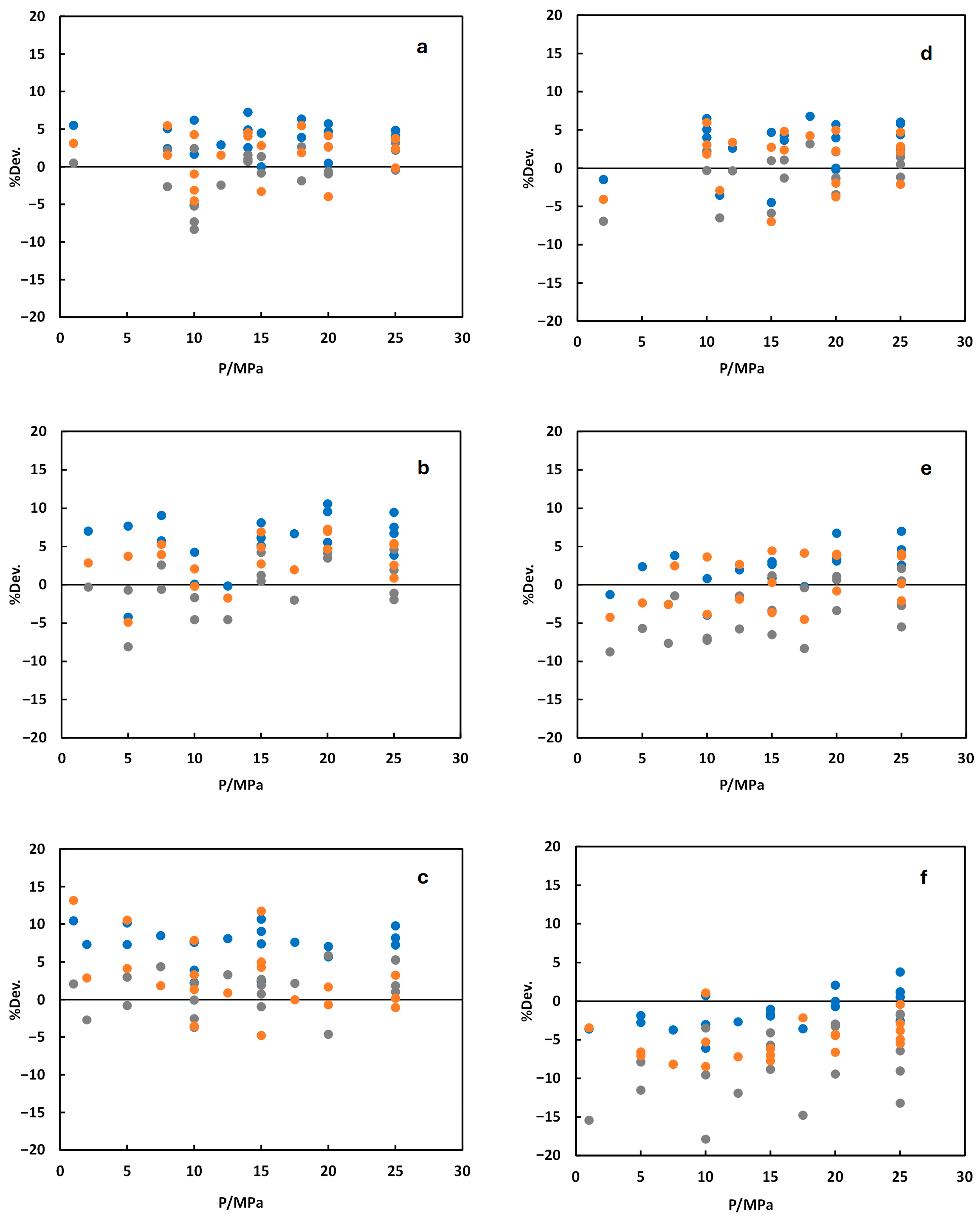
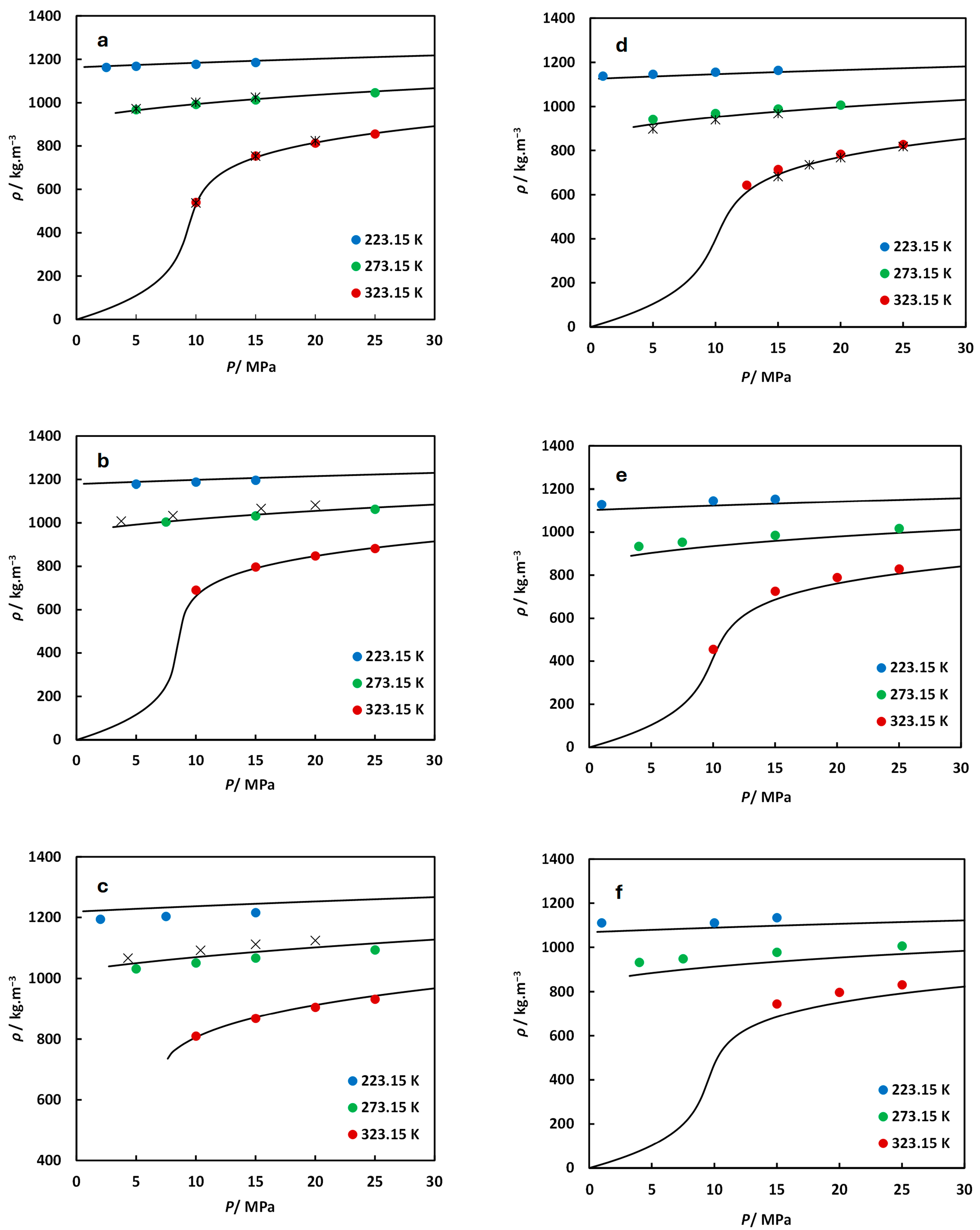
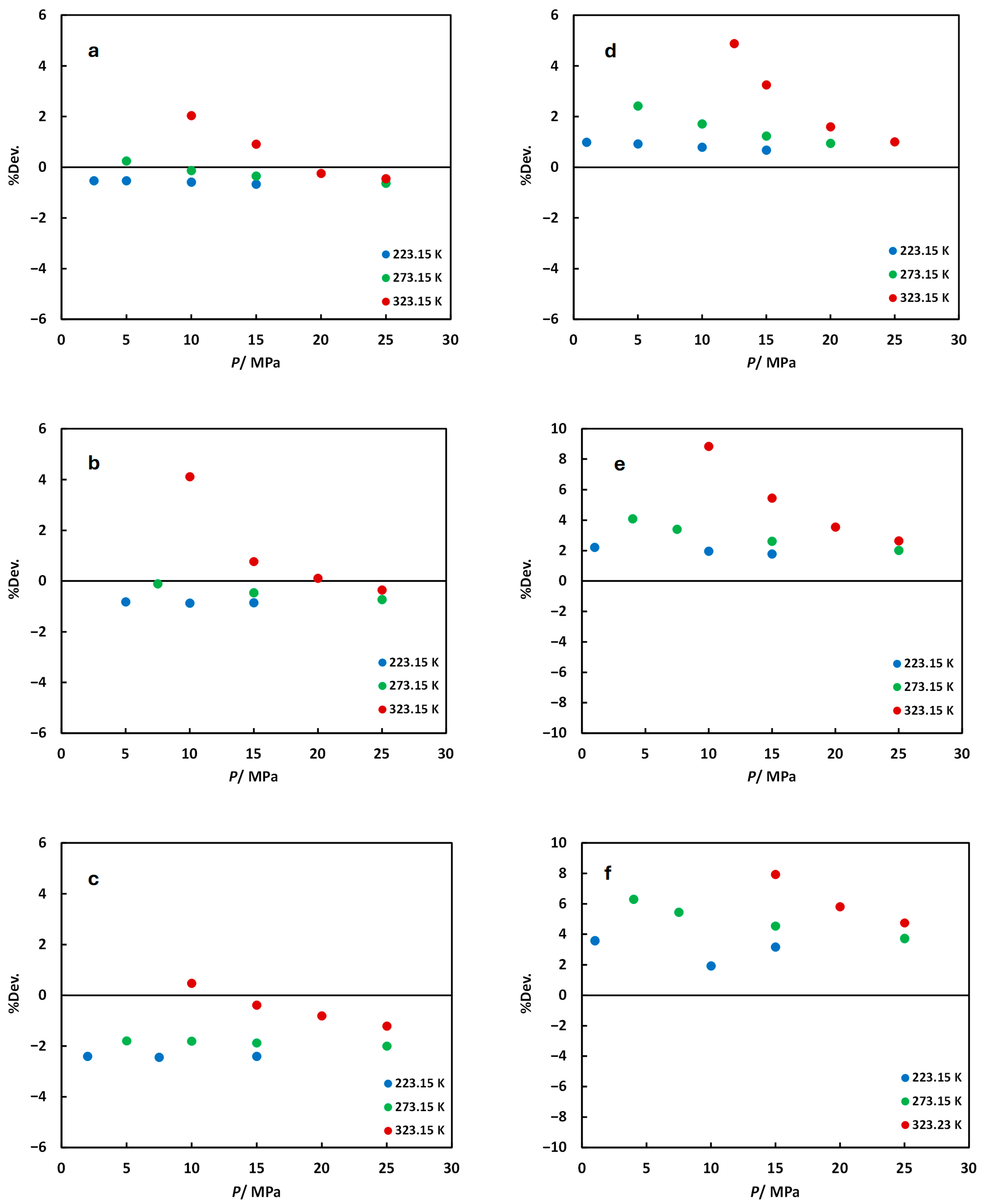
To estimate density, three isotherms of 223.15 K, 273.15 K, and 323.15 K were considered at pressures up to 25 MPa, covering the typical CCUS operating range. Initial density estimates for ms2 software were taken from the MFHEA equations of state [38,39]. Mixtures with 0.05, 0.10, and 0.20 mole fractions of impurity were studied. Figure 2a–c and Figure 2d–f show the density results for CO2 + SO2 and CO2 + H2S mixtures, respectively. Densities were evaluated in both the dense liquid and supercritical regions and compared with experimental data from the literature and MFHEA [38,39] predictions. In most MD simulations, the uncertainty was below 1 kg/m3, smaller than the symbol sizes. However, at 323.15 K and 10 MPa, uncertainties reached up to 6.88 kg/m3, possibly due to proximity to the Widom line [54,55], where the mixture fluctuates between liquid-like and gas-like behavior. Figure 3 shows the deviation plots of the MD-estimated densities compared to MFHEA model [38,39] predictions. For CO2 + SO2 mixtures with xSO2 = 0.05 and 0.10, excellent agreement was observed, with %AARD values below 1% across all isotherms. Slightly higher deviations were noted for the mixture with 0.20 mole fraction SO2. Experimental data from Nazari et al. [19] for 0.05 mole fraction SO2 and H2S at 273.15 K and 323.15 K and from Gimeno et al. [28] for 0.10 and 0.20 mole fraction SO2 at 273.15 K were used for comparison. For the mixture with xSO2 = 0.05, the %AARD values from the literature for MFHEA were 0.75% and 1.13% at 273.15 K and 323.15 K, respectively. However, in this study, lower deviations of 0.33% and 0.90% in the same conditions were observed. For CO2 + H2S mixtures, the literature data showed deviations of 1.60% and 0.56% from MFHEA, while MD-estimated results yielded 1.78% and 3.23% at 273.15 K and 323.15 K, respectively. Gimeno et al.’s data at 273.15 K showed %AARD values of 2.44% and 2.00% for mixtures with xSO2 = 0.10 and 0.20, compared to 0.43% and 1.86% from MD simulations. It is important to note that their CO2 mole fractions were 0.8969 and 0.8029, indicating impurity levels not exactly matching 0.10 and 0.20, which may explain the larger deviations from MFHEA predictions. Overall, MD-estimated densities for CO2 + H2S mixtures showed greater deviations than CO2 + SO2 mixtures, increasing with impurity concentration. This is likely due to stronger interactions between unlike species at higher impurity levels. The standard Lorentz–Berthelot mixing rule used in this study may not capture these effects accurately. Improved predictions would require specifying binary interatomic parameters, which were not included here. Density results, along with uncertainties and deviations from the MFHEA model, are presented in Table S1 through Table S6 in the Supplementary Materials.

3.3. Viscosity

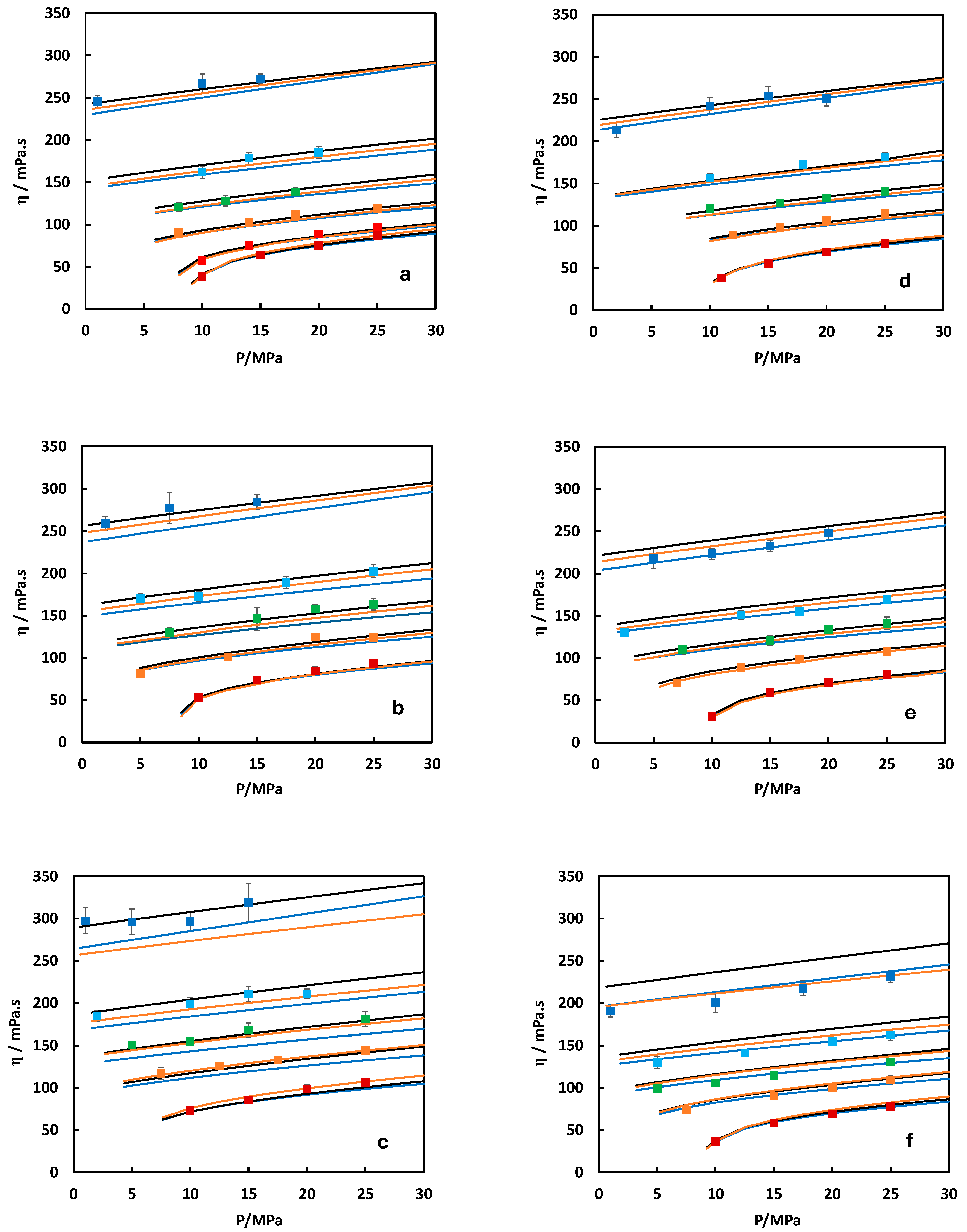
Figure 4 presents MD-estimated viscosities for six binary mixtures of CO2 with SO2 and H2S impurities across temperatures from 223 to 323 K and at pressures up to 25 MPa, covering both liquid and supercritical regions. These results were compared with predictions from various thermodynamic models (Appendix A). Since the reliability of the MD-estimated densities using ms2 was already investigated against MFHEA [38,39] predictions, no additional density calculations were performed. Instead, initial density values for the NVT ensemble were taken directly from the MFHEA equation of state. As with the density study, binary mixtures of CO2 with 0.05, 0.10, and 0.20 mole fractions of SO2 and H2S were constructed. Three thermodynamic models were selected for comparison: Lennard-Jones (LJ) [40], Residual Entropy Scaling (SRES/ES-NIST) [41,42], and Extended Corresponding States (ECS/SUPERTRAPP) [43]. As shown in Figure 4, all models demonstrated very good agreement with the MD results. In every case, model predictions fell within the uncertainty range of the MD simulations, confirming both the accuracy of the molecular modeling and the reliability of the thermodynamic models.
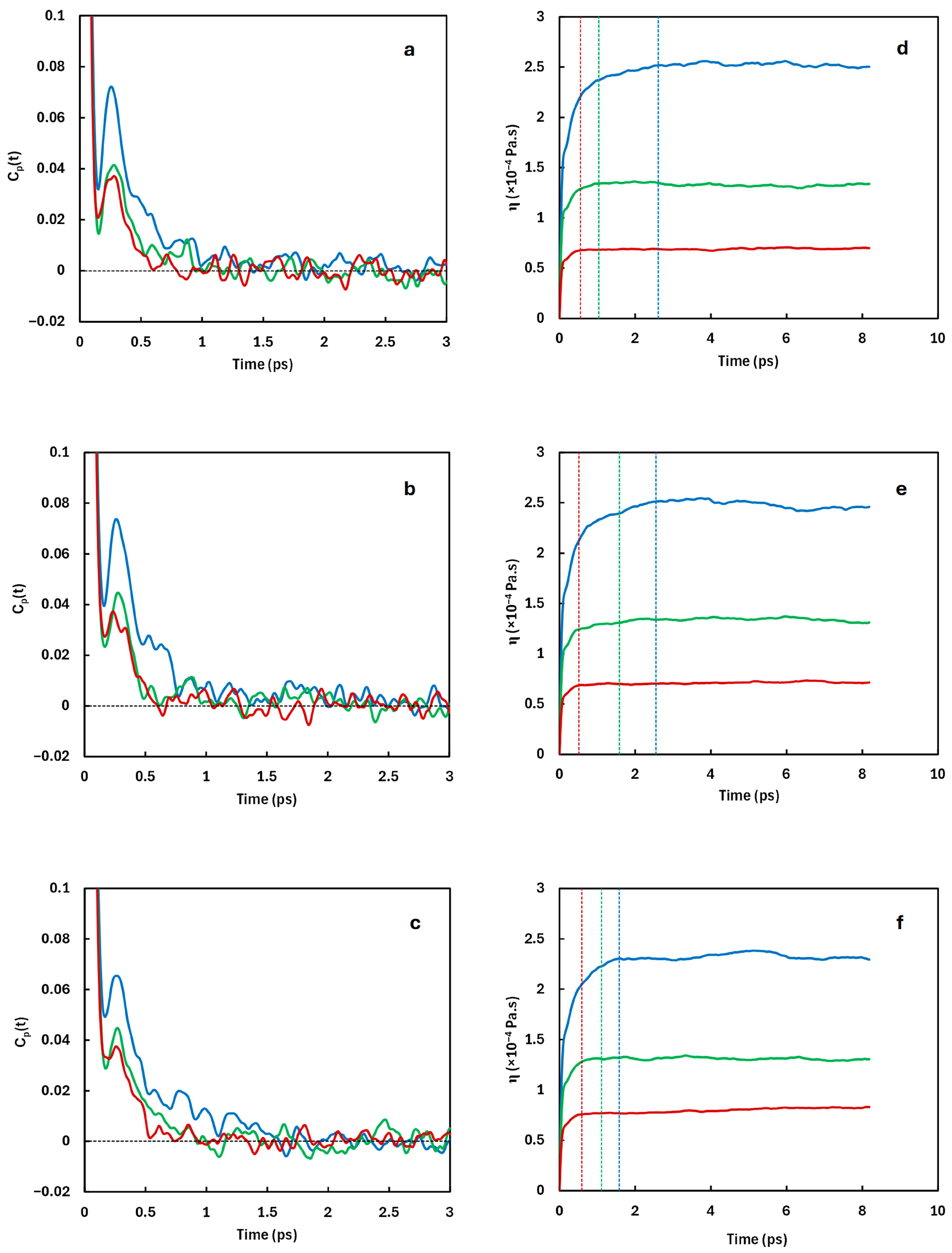
For CO2 + SO2 mixtures, the ES-NIST model showed the smallest deviations, with %AARD values of 2.44%, 2.78%, and 2.58% for mixtures with xSO2 = 0.05, 0.10, and 0.20, respectively. For binary mixture of CO2 with H2S (xH2S = 0.05), ES-NIST also performed best with a %AARD of 2.75%. However, for mixtures with xH2S = 0.10 and 0.20, the LJ model showed deviations up to 2.89% and 2.24%, respectively. Figure 5 presents deviation plots of MD-estimated viscosities versus pressure for all mixtures. Larger uncertainties were generally observed at low temperatures and high densities, contrasting with smaller uncertainties at higher temperatures in the supercritical region. This reflects a known limitation of the Green–Kubo method; at high densities, closely packed molecules make sampling pressure correlation functions more difficult [31,56]. Additional uncertainty arises near the critical region and along the Widom line [54,55], where fluid behavior fluctuates between liquid-like and gas-like states. As discussed in the methodology section, the Green–Kubo method calculates viscosity by integrating the pressure correlation function over time. Initially the pressure tensor components lose correlation, and the function decays, fluctuating around zero. Viscosity then grows and reaches a plateau. At longer times, statistical error accumulates, causing the plateau to break down or up. Correlation functions decay more slowly at high densities than in supercritical conditions, as also reported in previous studies [31,56] and observed here. Figure 6a–c and Figure 6d–f show the time evolution of pressure correlation functions and shear viscosity for CO2 + H2S mixtures. At 223 K (blue curves), slower decay and longer plateau formation are evident due to higher densities. In contrast, at 323 K (red curves), faster decay and quicker plateau formation occur. Choosing an appropriate correlation time is crucial when studying viscosity, especially at lower temperatures. A time that is too short may miss the plateau region, leading to inaccurate results, while a time that is too long may increase statistical error. Viscosity results, along with uncertainties and deviations from model predictions, are presented in Table S7 to Table S12 in the Supplementary Materials. Also, Table 2 presents the summary for the %AARD of the MD-estimated density and viscosity data against model predictions for all mixtures in this study.

4. Conclusions

MD simulations were performed to generate density and viscosity datasets for six binary mixtures of CO2 + SO2 and CO2 + H2S in CCUS-relevant conditions, aiming to validate existing thermodynamic models. For density, excellent agreement was found with MFHEA predictions and the literature data, especially for SO2 mixtures, where %AARD values were below 1% for mixtures with xSO2 = 0.05 and 0.10, and 1.60% for 0.20 mole fraction SO2. For CO2 + H2S mixtures, good agreement was also achieved, particularly at xH2S = 0.05 (1.69% deviation), though higher deviations of 3.51% and 4.72% were observed for 0.10 and 0.20 H2S mole fractions, respectively. It was observed that %AARD (compared to MFHEA) increased with the amount of impurity, with this effect being particularly pronounced in CO2 + H2S systems. This highlights the significant role of cross-species interactions in influencing system behavior. Viscosity results from MD simulations were compared with three models as well as experimental data from Chapoy et al. [20] for a CO2 + CH4 (xCH4 = 0.25) mixture. All comparisons showed good agreement, with model predictions and experimental data falling within the uncertainty range of MD results. This validates both the molecular modeling approach and the reliability of the models, even for mixtures lacking experimental data. Among the models, ES-NIST showed the least deviation for CO2 + SO2 and CO2 + H2S (xH2S = 0.05) mixtures, while the LJ model performed best for CO2 + H2S mixtures with xH2S = 0.10 and 0.20. In terms of uncertainty, larger values were generally observed at low temperatures and high densities, in contrast with smaller uncertainties in the supercritical region. This is a known limitation of the Green–Kubo method: at high densities, closely packed molecules make sampling pressure correlation functions more challenging. Additionally, analysis of pressure correlation functions and shear viscosity over time highlighted the importance of selecting an appropriate correlation time. A time that is too short may miss the plateau region, leading to inaccurate viscosity estimates, while a time that is too long can increase statistical error. Careful selection of this parameter is essential for reliable viscosity calculations.

Supplementary Materials

The following supporting information can be downloaded at: https://www.mdpi.com/article/10.3390/gases5040028/s1, Table S1: MD-estimated densities for CO2 + SO2 (xSO2 = 0.05); Table S2: MD-estimated densities for CO2 + SO2 (xSO2 = 0.10); Table S3: MD-estimated densities for CO2 + SO2 (xSO2 = 0.20); Table S4: MD-estimated densities for CO2 + H2S (xH2S = 0.05); Table S5: MD-estimated densities for CO2 + H2S (xH2S = 0.10); Table S6: MD-estimated densities for CO2 + H2S (xH2S = 0.20); Table S7: MD-estimated viscosities for CO2 + SO2 (xSO2 = 0.05); Table S8: MD-estimated viscosities for CO2 + SO2 (xSO2 = 0.10); Table S9: MD-estimated viscosities for CO2 + SO2 (xSO2 = 0.20); Table S10: MD-estimated viscosities for CO2 + H2S (xH2S = 0.05); Table S11: MD-estimated viscosities for CO2 + H2S (xH2S = 0.10); Table S12: MD-estimated viscosities for CO2 + H2S (xH2S = 0.20)).

Author Contributions

Methodology, M.H.M. and A.C.; formal analysis, M.H.M., P.A. and A.C.; investigation, M.H.M., P.A. and A.C.; writing—original draft, M.H.M.; writing—review and editing, P.A. and A.C.; supervision, P.A. and A.C.; funding acquisition, A.C. All authors have read and agreed to the published version of the manuscript.

Funding

This research was funded by Chevron, BP, Horisont Energi, Linde AG, Equinor ASA, Total Energies, Wintershall Dea, Repsol, Petrobras, and Petronas, which is gratefully acknowledged.

Data Availability Statement

The original contributions presented in this study are included in the article.

Acknowledgments

This work was part of an ongoing Joint Industrial Project (JIP) conducted jointly at the Institute of GeoEnergy Engineering, Heriot-Watt University, and the CTP laboratory of MINES ParisTech between 2022 and 2026. The JIP was supported by Chevron, BP, Horisont Energi, Linde AG, Equinor ASA, Total Energies, Wintershall Dea, Repsol, Petrobras, and Petronas, which is gratefully acknowledged. The authors would also like to thank the members of the steering committee for their fruitful comments and discussions. The use of the HWU high-performance computing facility (DMOG) and associated support services in the completion of this work is also fully acknowledged.

Conflicts of Interest

The authors declare no conflicts of interest.

Appendix A

Appendix A.1. Thermodynamic Models

  • Multi-Fluid Helmholtz Energy Approximation (MFHEA) Equations of States

To predict densities of CO2 binary mixtures with CH4, SO2 and H2S impurities the “Multi-Fluid Helmholtz Energy Approximation—MFHEA” [38] equations of states were used. These EoSs were selected because of their wide applications in industry.
This is a multi-parameter equation known as which was developed by Burgass et al. [1]. The MFHEA has a general structure in the form of a Helmholtz energy with two parts (expressed in Equation (A1)):
The ideal gas part ( α i g ), and the residual part ( α r ) which is further divided into regular part (contributions from the pure components) and binary-specific departure functions.
α x i , ρ , τ = α i g x i , ρ , τ + α r x i , ρ , τ
where α is the reduced molar Helmholtz Energy, i g refer to ideal gas, and r is the residual term.
MFHEA makes use of δ (reduced mixture density) and τ (inverse reduced mixture temperature) as follows (Equations (A2) and (A3)):
τ = T r ( x i ) T
δ = ρ ρ r ( x i )
where ρ r x i and T r ( x i ) are composition dependent reducing functions which are defined by Equations (A4) and (A5), respectively:
v r x i = 1 ρ r ( x i ) = i = 1 N j = 1 N x i x j β v , i j γ v , i j x   x i +   x j β v , i j 2 x i +   x j   x   1 8 1 ρ c , i 1 3 +   1 ρ c , j 1 3 3
T r x i = i = 1 N j = 1 N x i x j β T , i j γ T , i j   x   x i + x j β T , i j 2 x i + x i x T c , i   x   T c , j δ = ρ ρ r ( x i )
Here, the binary adjustable/reducing parameters β and γ ( β T , i j   , γ T , i j , β v , i j , γ v , i j ) in the Equations (A4) and (A5) are fitted to binary mixture data.
The residual part of Helmholtz energy (Equation (A1)) is expressed by (Equation (A6)):
α r x i , ρ , τ = i = 1 N x i α 0 i r ( δ , τ ) + α r x i , ρ , τ
The contribution of individual component ( i ) to the residual part of Equation (A6) is α 0 i r while α r accounts for mixing effect not adequately covered by the binary adjustable parameters ( β T , i j   , γ T , i j , β v , i j , γ v , i j ) [38] and it is given by (Equation (A7)):
α r =   i = 1 N 1 j = i + 1 N x i x j F i j α i j r x i , ρ , τ  
where F i j is the reduced binary interaction parameter which is set to zero for binary mixtures whose departure function is yet to be developed [57], while the Gernert & Span [58] provided the generic expression for α i j r x i , ρ , τ as follows (Equation (A8)):
α i j r x i , ρ , τ = k = 1 K P o l , i j n i j , k δ d i j , k τ t i j , k +   k = K P o l , i j   + 1 K P o l , i j +   K e x p , i j n i j , k δ d i j , k τ t i j , k e δ l i j , k + K P o l , i j + K s p e c , i j + 1 K P o l , i j +   K e x p , i j + K s p e c , i j n i j , k δ d i j , k τ t i j , k e Ƞ i j , k δ ϵ i j , k 2 β i j , k δ γ i j , k
where the indexes K P o l , i j , K e x p , i j , and K s p e c , i j , the coefficient n i j , k , as well as the exponents d i j , k , t i j , k , Ƞ i j , k , ϵ i j , k , β i j , k , and γ i j , k are applied to data of specific binary mixtures.
Table A1 and Table A2 present the references for the Helmholtz equations of state for pure components used in this study and the Binary-specific departure functions, respectively. Also, all the reducing parameters can be found from Neumann et al. [39].
Table A1. Helmholtz equations of state for the pure components in this work.
ComponentPure Fluid Equation of State
CO2Span and Wagner [59]
CH4Setzmann and Wagner [60]
SO2Gao et al. [61]
H2SLemmon and Span [62]
Table A2. Binary-specific departure functions used in this work.
Component 1Component 2Binary-Specific Departure Function
Carbon dioxideMethaneKunz and Wagner [63]
Sulfur dioxideNeumann et al. [39]
Hydrogen sulfideKunz and Wagner [63]

Appendix A.2. Viscosity Models

This work employed three different viscosity models to predict the viscosities a corresponding states models resulting from the molecular dynamics simulations of Lennard Jones (LJ) fluids [40], an extended corresponding states (ECS) model [43], and a residual entropy scaling approach (SRES) [41,42]. These viscosity models have been selected due to their industry applications for fluid flow predictions and in the field of engineering for determining pressure drops in transmission pipes. The density needed for viscosity predictions were calculated using a Multi-Fluid Helmholtz Energy Approximation (MFHEA) equation of state (EoS) – an equation of state with the structure of GERG-2008 that is designed for the prediction of natural gas thermodynamic and thermophysical properties. The reader can refer to all cited references for details of these models while we provided a brief description of the models in this work.
  • The Lennard Jones fluids (LJ)
A corresponding states approach that is based on molecular dynamics results from Lennard-Jones pair potentials was proposed by Galliéro et al. [40,64] for viscosity calculations from density and temperature of systems in gas, liquid, supercritical thermodynamic states. The following corresponding states rescaling procedures have been suggested by Galliéro et al. [40,64] (Equations (A9) and (A12))
Where T is the temperature, kB is the Boltzman constant, N is the number of particles, V is the volume of the simulation box, while σx and εx are the two characteristic LJ potential parameters of the studied fluid known to be the size of the particle ( σ ) and the dispersion energy or depth of the potential well ( ε ) respectively. The reduced pressure, which is a unique function of T* and ρ* for a given potential, and the reduced viscosity are given below:
T * = k B T ϵ x
ρ * = N σ x 3 V
P * ( T * , ρ * ) = P σ x 3 ϵ x
η * ( T * , ρ * ) = η σ x 2 M x ϵ x
where η is the dynamic viscosity and Mx is the molecular weight of the fluid.
  • The extended corresponding states (ECS)
The extended correspondence states (ECS) model was proposed by Hanley [43]. It led to a computer program for predicting transport properties known as TRAPP (TRAnsport Properties Prediction) [65,66]. In its original version, TRAPP had been used in the calculation of thermal conductivity and viscosity of fluids and their mixtures using methane as reference fluid. Propane has been recently used as a reference fluid.
  • The residual entropy viscosity (SRES)
Entropy scaling is a transport model that tries to relate thermodynamic properties (such as hard sphere or free/available volume) and dynamic properties (such as dynamic viscosity) [67,68]. Residual entropy scaling was developed by Rosenfeld [42] is based on the observation that transport properties such as viscosity η, after scaling with a reference viscosity ηref, exhibit a simple dependence on the molar residual entropy given in Equation (A13):
s r e s ( T , ρ )   = s ( T , ρ )   s i g ( T , ρ )
where T is the temperature, ρ is the density, and sig is the molar entropy of an ideal gas.
For the reference viscosity ηref, some studies [69,70] have shown that the Chapman–Enskog viscosity ηCE is a better option and so a dimensionless viscosity defined as η* = η/ηCE is used in this study. The Chapman–Enskog viscosity for a pure component is obtained from Equation (A14).
η C E = 5 16 M k b T / ( N A π ) σ 2 Ω 2,2
where, the molecular mass is the M, Boltzmann’s constant is the kB, Avogadro’s number is the NA, Lennard-Jones segment diameter is the σ, and collision integral is the Ω(2,2)*. The value for Ω(2,2)* is computed using the correlation of Neufeld et al. [71] as a function of Lennard-Jones energy parameter ε and temperature. In this work, values obtained from the correlations of Yang et al. [72] are used for ε and σ. Polynomial equations of Yang et al. [72] are also used to relate the scaled residual entropy to dimensionless residual entropy (s+= - sr/R). Here, sr is the mola residual entropy (J.mol−1.K−1) while R is the universal gas constant (R = 8.31446 J.mol−1. K−1).

References

  1. Council of the European Union. Paris Agreement on Climate Change. 2025. Available online: https://www.consilium.europa.eu/en/policies/paris-agreement-climate (accessed on 25 November 2025).
  2. Madejski, P.; Chmiel, K.; Subramanian, N.; Kuś, T. Methods and Techniques for CO2 Capture: Review of Potential Solutions and Applications in Modern Energy Technologies. Energies 2022, 15, 887. [Google Scholar] [CrossRef]
  3. Porter, R.T.J.; Fairweather, M.; Pourkashanian, M.; Woolley, R.M. The range and level of impurities in CO2 streams from different carbon capture sources. Int. J. Greenh. Gas Control 2015, 36, 161–174. [Google Scholar] [CrossRef]
  4. Vitali, M.; Corvaro, F.; Marchetti, B.; Terenzi, A. Thermodynamic challenges for CO2 pipelines design: A critical review on the effects of impurities, water content, and low temperature. Int. J. Greenh. Gas Control 2022, 114, 103605. [Google Scholar] [CrossRef]
  5. Onyebuchi, V.E.; Kolios, A.; Hanak, D.P.; Biliyok, C.; Manovic, V. A systematic review of key challenges of CO2 transport via pipelines. Renew. Sustain. Energy Rev. 2018, 81, 2563–2583. [Google Scholar] [CrossRef]
  6. Chapoy, A.; Nazeri, M.; Kapateh, M.; Burgass, R.; Coquelet, C.; Tohidi, B. Effect of impurities on thermophysical properties and phase behaviour of a CO2-rich system in CCS. Int. J. Greenh. Gas Control 2013, 19, 92–100. [Google Scholar] [CrossRef]
  7. Buddenberg, J.W.; Wilke, C.R. Viscosities of Some Mixed Gases; Remeen Press Division, Chemical Publishing Company: Gloucester, MA, USA, 1951; Available online: https://pubs.acs.org/doi/pdf/10.1021/j150492a008 (accessed on 25 November 2025).
  8. Rankine, A.O.; Smith, C.J. On the Viscous Properties and Molecular Dimensions of Silicane. Proc. Phys. Soc. Lond. 1921. [Google Scholar] [CrossRef][Green Version]
  9. Jackson, W.M. Viscosities of The Binary Gas Mixtures, Methane-Carbon Dioxide and Ethylent-Argon. J. Phys. Chem. 1956, 60, 789–791. [Google Scholar] [CrossRef]
  10. Dewitt, K.J.; Thodos, G. Viscosities of binary mixtures in the dense gaseous state: The methane-carbon dioxide system. Can. J. Chem. Eng. 1966, 44, 148–151. [Google Scholar] [CrossRef]
  11. Esper, G.J.; Bailey, D.M.; Holste, J.C.; Hall, K.R. Volumetric behavior of near-equimolar mixtures for CO2 + CH4 and CO2 + N2. Fluid Phase Equilibria 1989, 49, 35–47. [Google Scholar] [CrossRef]
  12. Hobley, A.; Matthews, G.P.; Townsend, A. The use of a novel capillary flow viscometer for the study of the argon/carbon dioxide system. Int. J. Thermophys. 1989, 10, 1165–1179. [Google Scholar] [CrossRef]
  13. Stouffer, C.E.; Kellerman, S.J.; Hall, K.R.; Holste, J.C.; Gammon, B.E.; Marsh, K.N. Densities of carbon dioxide + hydrogen sulfide mixtures from 220 K to 450 K at pressures up to 25 MPa. J. Chem. Eng. Data 2001, 46, 1309–1318. [Google Scholar] [CrossRef]
  14. Loianno, V.; Mensitieri, G. A novel dynamic method for the storage of calibration gas mixtures based on thermal mass flow controllers. Meas. Sci. Technol. 2022, 33, 65017. [Google Scholar] [CrossRef]
  15. Li, H.; Jakobsen, J.P.; Wilhelmsen, Ø.; Yan, J. PVTxy properties of CO2 mixtures relevant for CO2 capture, transport and storage: Review of available experimental data and theoretical models. Appl. Energy 2011, 88, 3567–3579. [Google Scholar] [CrossRef]
  16. Al-Siyabi, I. Effect of Impurities on CO2 Stream Properties. Ph.D. Thesis, Heriot-Watt University, Edinburgh, Scotland, 2013. Available online: http://hdl.handle.net/10399/2643 (accessed on 25 November 2025).
  17. Locke, C.R.; Stanwix, P.L.; Hughes, T.J.; Kisselev, A.; Goodwin, A.R.H.; Marsh, K.N.; May, E.F. Improved methods for gas mixture viscometry using a vibrating wire clamped at both ends. J. Chem. Eng. Data 2014, 59, 1619–1628. [Google Scholar] [CrossRef]
  18. Pinho, B.; Girardon, S.; Bazer-Bachi, F.; Bergeot, G.; Marre, S.; Aymonier, C. Simultaneous measurement of fluids density and viscosity using HP/HT capillary devices. J. Supercrit. Fluids 2015, 105, 186–192. [Google Scholar] [CrossRef]
  19. Ghojogh, M.N. Impact of Impurities on Thermo-Physical Properties of CO2-Rich Systems: Experimental and Modelling. Ph.D. Thesis, Heriot-Watt University, Edinburgh, Scotland, 2015. Available online: http://hdl.handle.net/10399/2963 (accessed on 25 November 2025).
  20. Chapoy, A.; Owuna, F.J.; Burgass, R.; Ahmadi, P.; Stringari, P. Viscosity of the CO2 + CH4 Binary Systems from 238 to 423 K at Pressures up to 80 MPa. J. Chem. Eng. Data 2024, 69, 2152–2166. [Google Scholar] [CrossRef]
  21. Owuna, F.J.; Chapoy, A.; Ahmadi, P.; Burgass, R. Densities and Viscosities of Carbon Dioxide and Hydrogen Binary Systems: Experimental and Modeling. J. Chem. Eng. Data 2025, 70, 1858–1881. [Google Scholar] [CrossRef]
  22. Ahmadi, P.; Chapoy, A.; Burgass, R. Thermophysical Properties of Typical CCUS Fluids: Experimental and Modeling Investigation of Density. J. Chem. Eng. Data 2020, 66, 116–129. [Google Scholar] [CrossRef]
  23. Jung, G.; Schmick, H. The Influence of Molecular Attractive Forces on the Viscosity of Gas Mixtures. Z. Phys. Chem. Abt. B 1930, 7, 130–147. [Google Scholar]
  24. Chakraborti, P.K.; Gray, P. Viscosities of Gaseous Mixtures Containing Polar Gases: Mixtures with One Polar Constituent. Trans. Faraday Soc. 1965, 61, 2422–2434. [Google Scholar] [CrossRef]
  25. Bhattacharyya, P.K.; Ghosh, A.K. Viscosity of Polar–Quadrupolar Gas Mixtures. J. Chem. Phys. 1970, 52, 2719–2723. [Google Scholar] [CrossRef]
  26. Nazeri, M.; Chapoy, A.; Valtz, A.; Coquelet, C. Tohidi, Densities and derived thermophysical properties of the 0.9505 CO2 + 0.0495 H2S mixture from 273 K to 353 K and pressures up to 41 MPa. Fluid Phase Equilibria 2016, 423, 156–171. [Google Scholar] [CrossRef]
  27. Nazeri, M.; Chapoy, A.; Valtz, A.; Coquelet, C. Tohidi, New experimental density data and derived thermophysical properties of carbon dioxide—Sulphur dioxide binary mixture (CO2—SO2) in gas, liquid and supercritical phases from 273 K to 353 K and at pressures up to 42 MPa. Fluid Phase Equilibria 2017, 454, 64–77. [Google Scholar] [CrossRef]
  28. Gimeno, B.; Artal, M.; Velasco, I.; Fernández, J.; Blanco, S.T. Influence of SO2 on CO2 Transport by Pipeline for Carbon Capture and Storage Technology: Evaluation of CO2/SO2 Cocapture. Energy Fuels 2018, 32, 8641–8657. [Google Scholar] [CrossRef]
  29. Lachet, V.; Creton, B.; De Bruin, T.; Bourasseau, E.; Desbiens, N.; Wilhelmsen, T.; Hammer, M. Equilibrium and transport properties of CO2 + N2O and CO2 + NO mixtures: Molecular simulation and equation of state modelling study. Fluid Phase Equilibria 2012, 322–323, 66–78. [Google Scholar] [CrossRef]
  30. Xue, J.; Nie, X.; Zhao, L.; Zhao, R.; Wang, J.; Yang, C.; Lin, A. Molecular dynamics investigation on shear viscosity of the mixed working fluid for supercritical CO2 Brayton cycle. J. Supercrit. Fluids 2022, 182, 105533. [Google Scholar] [CrossRef]
  31. Fernández, G.A.; Vrabec, J.; Hasse, H. Shear viscosity and thermal conductivity of quadrupolar real fluids from molecular simulation. Mol. Simul. 2005, 31, 787–793. [Google Scholar] [CrossRef]
  32. Aimoli, C.G.; Maginn, E.J.; Abreu, C.R.A. Force field comparison and thermodynamic property calculation of supercritical CO2 and CH4 using molecular dynamics simulations. Fluid Phase Equilibria 2014, 368, 80–90. [Google Scholar] [CrossRef]
  33. Aimoli, C.G.; Maginn, E.J.; Abreu, C.R.A. Transport properties of carbon dioxide and methane from molecular dynamics simulations. J. Chem. Phys. 2014, 141, 134101. [Google Scholar] [CrossRef]
  34. Thompson, A.P.; Aktulga, H.M.; Berger, R.; Bolintineanu, D.S.; Brown, W.M.; Crozier, P.S.; Veld, P.J.I.; Kohlmeyer, A.; Moore, S.G.; Nguyen, T.D. LAMMPS-a flexible simulation tool for particle-based materials modeling at the atomic, meso, and continuum scales. Comput. Phys. Commun. 2022, 271, 108171. [Google Scholar] [CrossRef]
  35. Potoff, J.J.; Siepmann, J.I. Vapor-liquid equilibria of mixtures containing alkanes, carbon dioxide, and nitrogen. AIChE J. 2001, 47, 1676–1682. [Google Scholar] [CrossRef]
  36. Harris, J.G.; Yung, K.H. Carbon Dioxide’s Liquid-Vapor Coexistence Curve and Critical Properties As Predicted by a Simple Molecular Model. J. Phys. Chem. 1995, 99, 12021–12024. [Google Scholar] [CrossRef]
  37. Raju, D.; Ramdin, M.; Vlugt, T.J.H. Thermophysical Properties and Phase Behavior of CO2 with Impurities: Insight from Molecular Simulations. J. Chem. Eng. Data 2024, 69, 2735–2755. [Google Scholar] [CrossRef] [PubMed]
  38. Burgass, R.; Chapoy, A. Dehydration requirements for CO2 and impure CO2 for ship transport. Fluid Phase Equilibria 2023, 572, 113830. [Google Scholar] [CrossRef]
  39. Neumann, T.; Herrig, S.; Bell, I.H.; Beckmüller, R.; Lemmon, E.W.; Thol, M.; Span, R. EOS-CG-2021: A Mixture Model for the Calculation of Thermodynamic Properties of CCS Mixtures. Int. J. Thermophys. 2023, 44, 178. [Google Scholar] [CrossRef]
  40. Galliero, G.; Boned, C.; Baylaucq, A.; Montel, F. High-pressure acid-gas viscosity correlation. SPE J. 2010, 15, 682–688. [Google Scholar] [CrossRef]
  41. Rosenfeld, Y. Relation between the transport coefficients and the internal entropy of simple systems. Phys. Rev. A 1977, 15, 2545. [Google Scholar] [CrossRef]
  42. Rosenfeld, Y. A quasi-universal scaling law for atomic transport in simple fluids. J. Phys. Condens. Matter 1999, 11, 5415. [Google Scholar] [CrossRef]
  43. Hanley, H.J.M.; Cohen, E.G.D. Analysis of the transport coefficients for simple dense fluids: The diffusion and bulk viscosity coefficients. Phys. A Stat. Mech. Its Appl. 1976, 83, 215–232. [Google Scholar] [CrossRef]
  44. Car, R.; Parrinello, M. Unified approach for molecular dynamics and density-functional theory. Phys. Rev. Lett. 1985, 55, 2471. [Google Scholar] [CrossRef]
  45. Raabe, G. Molecular Simulation Studies on Thermophysical Properties; Springer: Braunschweig, Germany, 2017. [Google Scholar] [CrossRef]
  46. Alavi, S. Molecular Simulations: Fundamentals and Practice; Wiley-VCH: Weinheim, Germany, 2020; Available online: https://search.worldcat.org/title/1002291342 (accessed on 25 November 2025).
  47. Allen, M.P.; Tildesley, D.J. Computer Simulation of Liquids, 2nd ed.; Oxford University Press: Oxford, UK, 2017. [Google Scholar] [CrossRef]
  48. Hoover, W.G.; Evans, D.J.; Hickman, R.B.; Ladd, A.J.C.; Ashurst, W.T.; Moran, B. Lennard-Jones triple-point bulk and shear viscosities. Green-Kubo theory, Hamiltonian mechanics, and nonequilibrium molecular dynamics. Phys. Rev. A 1980, 22, 1690. [Google Scholar] [CrossRef]
  49. Evans, D.J.; Morriss, G.P. Statistical Mechanics of Nonequilbrium Liquids; ANU Press: Canberra, Australia, 2007. [Google Scholar] [CrossRef]
  50. Zwanzig, R. Elementary derivation of time-correlation formulas for transport coefficients. J. Chem. Phys. 1964, 40, 2527–2533. [Google Scholar] [CrossRef]
  51. Deublein, S.; Eckl, B.; Stoll, J.; Lishchuk, S.V.; Guevara-Carrion, G.; Glass, C.W.; Merker, T.; Bernreuther, M.; Hasse, H.; Vrabec, J. Ms2: A molecular simulation tool for thermodynamic properties. Comput. Phys. Commun. 2011, 182, 2350–2367. [Google Scholar] [CrossRef]
  52. Svehla, R.A. Estimated Viscosities and Thermal Conductivities of Gases at High Temperatures; National Aeronautics and Space Administration: Washington, DC, USA, 1963. [Google Scholar]
  53. Zhang, L.; Siepmann, J.I. Pressure Dependence of the Vapor−Liquid−Liquid Phase Behavior in Ternary Mixtures Consisting of n-Alkanes, n-Perfluoroalkanes, and Carbon Dioxide. J. Phys. Chem. B 2005, 109, 2911–2919. [Google Scholar] [CrossRef]
  54. Liao, G.; Du, Y.; Zhang, F.; Jiaqiang, E.; Chen, J.; Leng, E. Widom line of supercritical CO2 calculated by equations of state and molecular dynamics simulation. J. CO2 Util. 2022, 62, 102075. [Google Scholar] [CrossRef]
  55. Widom, B. Some topics in the theory of fluids. J. Chem. Phys. 1963, 39, 2808–2812. [Google Scholar] [CrossRef]
  56. Maginn, E.J.; Messerly, R.A.; Carlson, D.J.; Roe, D.R.; Elliot, J.R. Best Practices for Computing Transport Properties 1. Self-Diffusivity and Viscosity from Equilibrium Molecular Dynamics [Article v1.0]. Living J. Comput. Mol. Sci. 2018, 1, 6324. [Google Scholar] [CrossRef]
  57. Baladão, L.F.; Soares, R.P.; Fernandes, P.R. Comparison of the GERG-2008 and Peng-Robinson Equations of State for Natural Gas Mixtures. J. Eng. Res. Appl. 2018, 8, 25–34. [Google Scholar] [CrossRef]
  58. Gernert, J.; Span, R. EOS–CG: A Helmholtz energy mixture model for humid gases and CCS mixtures. J. Chem. Thermodyn. 2016, 93, 274–293. [Google Scholar] [CrossRef]
  59. Span, R.; Wagner, W. A New Equation of State for Carbon Dioxide Covering the Fluid Region from the Triple-Point Temperature to 1100 K at Pressures up to 800 MPa. J. Phys. Chem. 1996, 25, 1509–1596. [Google Scholar] [CrossRef]
  60. Setzmann, U.; Wagner, W. A New Equation of State and Tables of Thermodynamic Properties for Methane Covering the Range from the Melting Line to 625 K at Pressures up to 1000 MPa. J. Phys. Chem. 1991, 20, 1061–1155. [Google Scholar] [CrossRef]
  61. Gao, K.; Wu, J.; Zhang, P.; Lemmon, E.W. A Helmholtz Energy Equation of State for Sulfur Dioxide. J. Chem. 2016, 61, 2859–2872. [Google Scholar] [CrossRef]
  62. Lemmon, E.W.; Span, R. Short Fundamental Equations of State for 20 Industrial Fluids. J. Chem. 2006, 51, 785–850. [Google Scholar] [CrossRef]
  63. Kunz, O.; Wagner, W. The GERG-2008 Wide-Range Equation of State for Natural Gases and Other Mixtures: An Expansion of GERG-2004. J. Chem. 2012, 57, 3032–3091. [Google Scholar] [CrossRef]
  64. Galliéro, G.; Boned, C.; Baylaucq, A. Molecular Dynamics Study of the Lennard−Jones Fluid Viscosity: Application to Real Fluids. Ind. Chem. 2005, 44, 6963–6972. [Google Scholar] [CrossRef]
  65. Ely, J.F.; Hanley, H.J.M. Prediction of Transport Properties.1. Viscosity of Fluids and Mixtures. Ind. Chem. 1981, 20, 323–332. Available online: https://pubs.acs.org/sharingguidelines (accessed on 25 November 2025). [CrossRef]
  66. Huber, J.F.; Ely, M.L. NIST Standard Rejerence Database 4: NIST Thermophysical Properties of Hydrocarbon Mixtures, Washington, DC, USA. 1990. Available online: https://www.nist.gov/system/files/documents/srd/Supertrapp.pdf (accessed on 25 November 2025).
  67. Young, J.M.; Bell, I.H.; Harvey, A.H. Entropy scaling of viscosity for molecular models of molten salts. J. Chem. Phys. 2023, 158, 024502. [Google Scholar] [CrossRef]
  68. Bell, I.H. Entropy Scaling of Viscosity—I: A Case Study of Propane. J. Chem. 2020, 65, 3203–3215. [Google Scholar] [CrossRef]
  69. Lötgering-Lin, O.; Gross, J. Group Contribution Method for Viscosities Based on Entropy Scaling Using the Perturbed-Chain Polar Statistical Associating Fluid Theory. Ind. Chem. 2015, 54, 7942–7952. [Google Scholar] [CrossRef]
  70. Lötgering-Lin, O.; Fischer, M.; Hopp, M.; Gross, J. Pure Substance and Mixture Viscosities Based on Entropy Scaling and an Analytic Equation of State. Ind. Chem. 2018, 57, 4095–4114. [Google Scholar] [CrossRef]
  71. Neufeld, P.D.; Janzen, A.R.; Aziz, R.A. Empirical Equations to Calculate 16 of the Transport Collision Integrals Ω(l, s)* for the Lennard-Jones (12–6) Potential. J. Chem. Phys. 1972, 57, 1100–1102. [Google Scholar] [CrossRef]
  72. Yang, X.; Xiao, X.; Thol, M.; Richter, M.; Bell, I.H. Linking Viscosity to Equations of State Using Residual Entropy Scaling Theory. Int. J. 2022, 43, 1–24. [Google Scholar] [CrossRef]
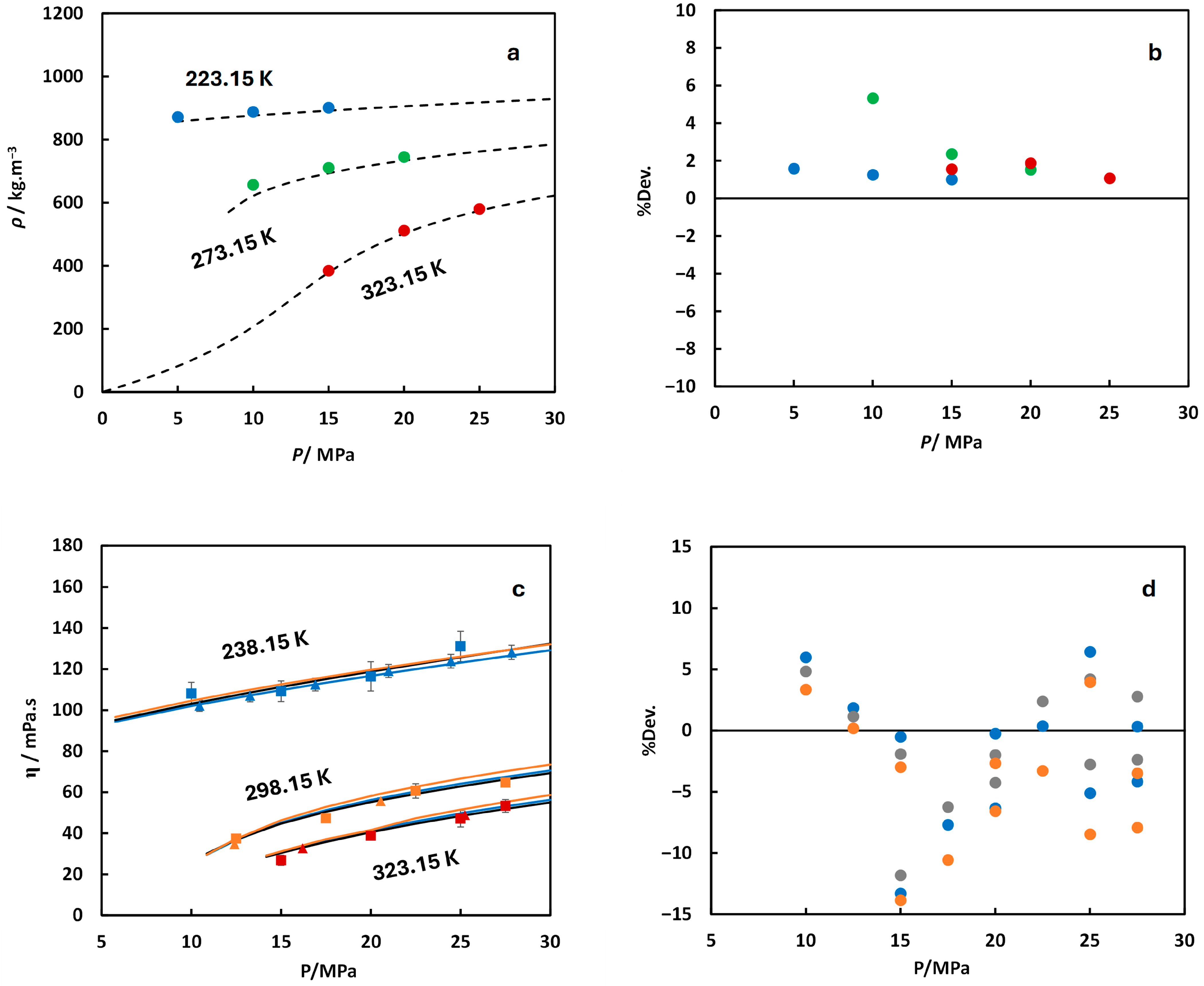
Figure 1. (a) Density of CO2 + CH4 (xCH4 = 0.25) mixtures and (b) their deviations against the MFHEA model; this work shown at () 223.15 K, () 273.15 K, and () 323.15 K; (– – –): MFHEA. (The average uncertainty was 0.54 kg/m3 smaller than the symbol sizes). (c) Viscosity of CO2 + CH4 (xCH4 = 0.25) mixtures; this work shown at () 238.15 K, () 298.15 K, and () 323.15 K; (triangles ): experimental data from Chapoy et al. [20]. Viscosity models: (▬): ES-NIST; (): LJ; (): SUPERTRAPP. (d): Deviation of the MD data against various models: (): LJ; (): SUPERTRAPP; (): ES-NIST.
Gases 05 00028 g001
Figure 2. Density vs. pressure for binary mixtures at different isotherms. (ac): CO2 + SO2 for 0.05, 0.10, and 0.20 molar fractions of SO2, respectively. (df): CO2 + H2S for 0.05, 0.10, and 0.20 molar fractions of H2S, respectively. This work shown at () 223.15 K, () 273.15 K, and () 323.15 K; (Gases 05 00028 i001): experimental data from Nazari et al. [19] (xSO2 = 0.0497 measured at 273.55 K and 322.49 K and xH2S = 0.0495 measured at 272.56 K and 322.42 K); (×): experimental data from Gimeno et al. [28] (xCO2 = 0.8969 and 0.8029 measured at 273.15 ± 0.05 K); (▬): predicted from MFHEA model.
Gases 05 00028 g002
Figure 3. Relative deviation plots against the MFHEA model predictions. This work shown at () 223.15 K, () 273.15 K, and () 323.15 K. (ac): CO2 + SO2 for xSO2 = 0.05, 0.10, and 0.20, respectively. (df): CO2 + H2S for xH2S = 0.05, 0.10, and 0.20, respectively.
Gases 05 00028 g003
Figure 4. Viscosity of binary mixtures at different isotherms. (ac): CO2 + SO2 with xSO2 = 0.05, 0.10, and 0.20, respectively. (df): CO2 + H2S with xH2S = 0.05, 0.10, and 0.20, respectively. This work shown at () 223 K, () 253 K, () 273 K, () 293 K, () 313 K, and () 323 K; (▬): predicted from ES-NIST; (): predicted from LJ; (): predicted from SUPERTRAPP.
Gases 05 00028 g004
Figure 5. Relative deviation of MD-estimated viscosities against predictions from various viscosity models. (ac): CO2 + SO2 for xSO2 = 0.05, 0.10, and 0.20, respectively. (df): CO2 + H2S for xH2S = 0.05, 0.10, and 0.20, respectively. (): against predictions from LJ; (): against predictions from SUPERTRAPP; (): against predictions from ES-NIST.
Gases 05 00028 g005
Figure 6. Pressure correlation functions (ac) and the corresponding shear viscosity versus time (df): (a,d) 20 MPa, (b,e) 20 MPa, and (c,f) 25 MPa for CO2 mixtures with xH2S = 0.05, 0.10, and 0.20, respectively. (): 223 K; (): 273 K; (): 323 K.
Gases 05 00028 g006
Table 1. Force fields used in this work for density and viscosity.
CO2
TraPPE [35]
CH4
TraPPE [53]
SO2
Svehla [52]
H2S
Svehla [52]
( ϵ a b / k B ) (K)C-C27.0148.00335.4301.1
O-O79.0
σ a b (Å)C-C2.83.734.1123.623
O-O3.05
q (e)C+0.7---
O−0.35
ϴ e q   ( d e g ) O-C-O180---
r e q ( Å ) C-O1.16
Table 2. Summary of %AARD of MD-estimated density and viscosities against model predictions.
MixturexDensityViscosity
MFHEALJSRESST
CO2 + CH4(xCH4 = 0.25)2.004.363.895.61
CO2 + SO2(xSO2 = 0.05)0.604.202.443.25
CO2 + SO2(xSO2 = 0.10)0.926.202.783.91
CO2 + SO2(xSO2 = 0.20)1.607.412.584.10
CO2 + H2S(xH2S = 0.05)1.693.982.753.67
CO2 + H2S(xH2S = 0.10)3.512.894.022.96
CO2 + H2S(xH2S = 0.20)4.722.248.335.17
Disclaimer/Publisher’s Note: The statements, opinions and data contained in all publications are solely those of the individual author(s) and contributor(s) and not of MDPI and/or the editor(s). MDPI and/or the editor(s) disclaim responsibility for any injury to people or property resulting from any ideas, methods, instructions or products referred to in the content.