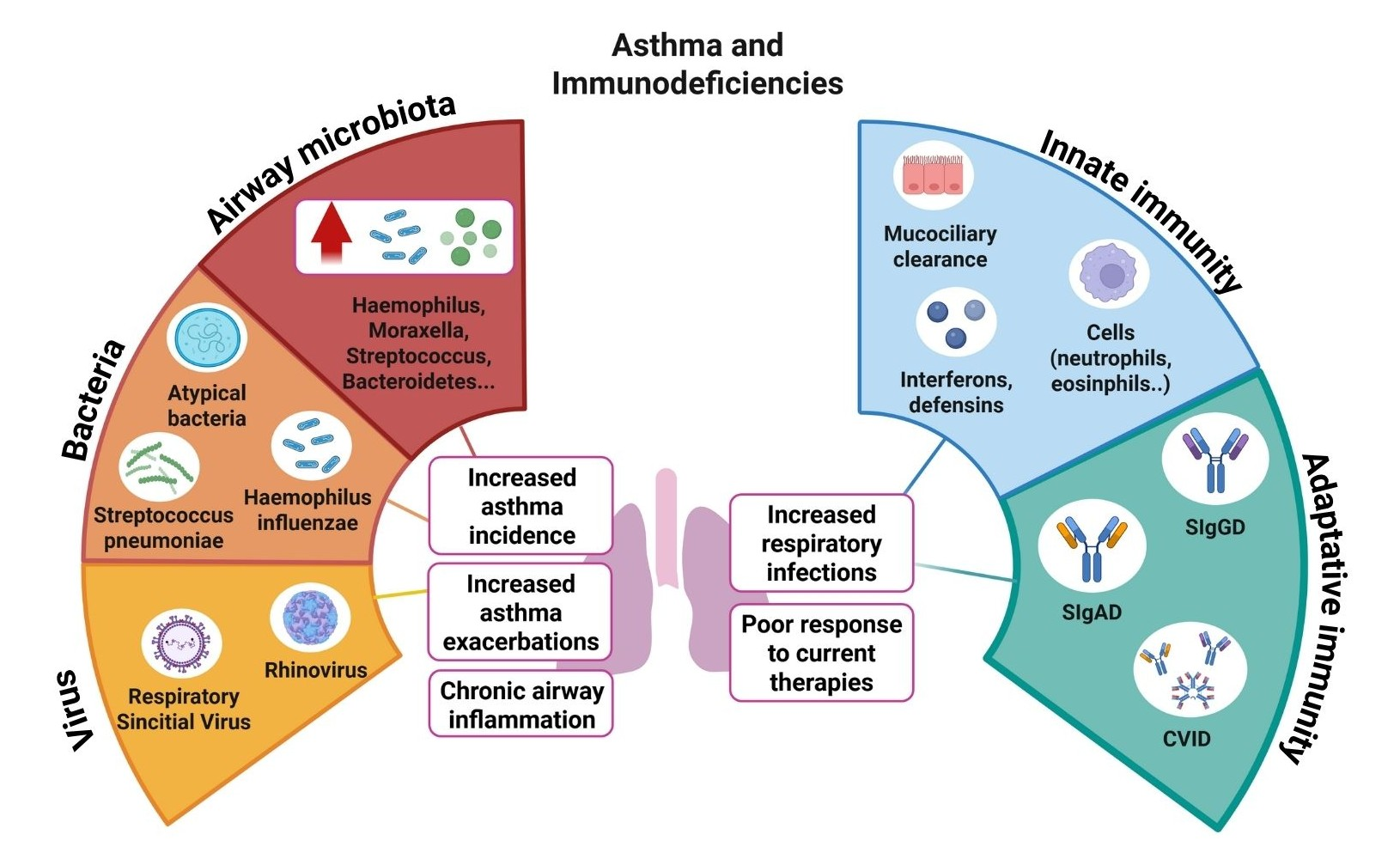

Asthma, Infections and Immunodeficiency

 , and
, and 
Abstract
1. Introduction
2. Asthma: Definition and Classification
3. Asthma and Infections
3.1. Viral Infections
3.2. Bacterial Infections
3.2.1. Pathogenic Bacteria
3.2.2. Atypical Bacteria
3.2.3. Airway Microbiota
4. Asthma and Immunodeficiencies
4.1. Innate Immunity and Asthma
4.1.1. Mucociliary Clearance
4.1.2. Defensins
4.1.3. Interferons
4.1.4. Cells
4.2. Adaptive Immunity and Asthma
4.2.1. Inborn Errors Immunity (IEIS)
4.2.2. Immunoglobulins
4.2.3. Immunoglobulin Deficiencies and Asthma
5. Asthma, Infections, Immunity and Therapies
6. Discussion
7. Conclusions
Author Contributions
Funding
Data Availability Statement
Conflicts of Interest
Abbreviations
| Antimicrobial peptide | AMP |
| Club cell secretory protein 16 | CCS16 |
| Common variable immunodeficiency | CVID |
| Chlamydia pneumoniae | CP |
| Chronic obstructive pulmonary disease | COPD |
| Hemophilus influenzae | (HI) |
| Human defensin | HD |
| IgG elective subclass deficiency | IGGSD |
| IL | interleukin |
| Immunoglobulin | Ig |
| Interferon | IFN |
| Matrix metalloproteinase | MMP |
| Moxarella catarrhalis | MC |
| MUC | mucin |
| Natural killer | NK |
| Neutrophil extracellular traps | NET |
| Plasmocytoid dendritic cell | pDC |
| Respiratory syncytial virus | RSV |
| Rhinovirus | RV |
| Secretory leukocyte protease inhibitor | SLPI |
| Selective IgA deficiency | SIgAD |
| Selective IgG deficiency | SIgGD |
| Selective IgE deficiency | SIgED |
| Selective IgM deficiency | SIgMD |
| Specific antibody deficiency | SAD |
| Thymic stromal lymphopoietin | TSLP |
| Tumor receptor factor | TNF |
References
- Hartert, T.; Kvysgaard, J.N.; Thaver, L.; Suara-Istanbouli, A.; Allinson, J.P.; Zar, H.J. Understanding the childhood origins of asthma and chronic obstructive pulmonary disease: Insights from birth cohorts and studies across the lifespan. J. Allergy Clin. Immunol. 2025, 155, 1703–1719. [Google Scholar] [CrossRef] [PubMed]
- Zar, H.J.; Cacho, F.; Kootbodien, T.; Mejias, A.; Ortiz, J.R.; Stein, R.T.; Hartet, T.V. Early-life respiratory syncytial virus disease and long-term respiratory health. Lancet Respir. Med. 2024, 12, 810–821. [Google Scholar] [CrossRef] [PubMed]
- Melén, E.; Zar, H.J.; Siroux, V.; Shaw, D.; Saglani, S.; Koppelman, G.H.; Hartet, T.V.; Germ, J.E.; Gaston, B.; Bush, A.; et al. Asthma Inception: Epidemiologic risk factors and natural history across the life course. Am. J. Respir. Crit. Care Med. 2024, 210, 737–754. [Google Scholar] [CrossRef] [PubMed]
- Christou, E.A.A.; Giardino, G.; Stefanaki, E.; Ladomenou, F. Asthma: An Undermined State of Immunodeficiency. Int. Rev. Immunol. 2019, 38, 70–78. [Google Scholar] [CrossRef] [PubMed]
- Porsbjerg, C.; Melén, E.; Lehtimäki, L.; Shaw, D. Asthma. Lancet 2023, 401, 858–873. [Google Scholar] [CrossRef]
- Fuhlbrigge, A.L.; Sharma, S. Unraveling the heterogeneity of asthma: Decoding subtypes of asthma. J. Allergy Clin. Immunol. 2025, 156, 41–50. [Google Scholar] [CrossRef]
- Global Initiative for Asthma (GINA) Guidelines. Available online: http://www.ginasthma.org/ (accessed on 1 November 2025).
- Grunwell, J.R.; Fitzpatrick, A.M. Asthma phenotypes and biomarkers. Respir. Care 2025, 70, 649–674. [Google Scholar] [CrossRef]
- Makrinioti, H.; Hasegawa, K.; Lakoumentas, J.; Xepapadaki, P.; Tsolia, M.; Castro-Rodriguez, J.A.; Feleszko, W.; Jarhi, J.; Johnston, S.L.; Bush, A.; et al. The role of respiratory syncytial virus- and rhinovirus-induced bronchiolitis in recurrent wheeze and asthma: A systematic review and meta-analysis. Pediatr. Allergy Immunol. 2022, 33, 13741. [Google Scholar] [CrossRef]
- Rosas-Salazar, C.; Hartert, T.V. Infant respiratory syncytial virus infection and childhood asthma: A shift in the paradigm? Clin. Transl. Med. 2023, 13, e1414. [Google Scholar] [CrossRef]
- Muñoz-Quiles, C.; Lopez-Lacort, M.; Diez Domingo, J.; Orrico-Snchez, A. Bronchiliis, regardless of its etiology and severity, is associated with increased risk of asthma: A population-bassed study. J. Infect. Dis. 2023, 228, 840–850. [Google Scholar] [CrossRef]
- Rosas-Salazar, C.; Chirkova, T.; Gebretsadik, T.; Chappell, J.D.; Peebles, R.S., Jr.; Dupont, W.D.; Jadhao, S.; Gergen, P.J.; Anderson, L.I.; Hartet, T.V. Respiratory syncytial virus infection during infancy and asthma during childhood in the USA (INSPIRE): A population-based, prospective birth cohort study. Lancet 2023, 401, 1669–1680. [Google Scholar] [CrossRef]
- Blanken, M.O.; Rovers, M.M.; Molenaar, J.M.; Winkler-Seinstra, P.L.; Meijer, A.; Kimpen, J.; Bont, L. Respiratory syncytial virus and recurrent wheeze in healthy preterm infants. N. Engl. J. Med. 2013, 368, 1791–1799. [Google Scholar] [CrossRef]
- Larkin, E.K.; Hartert, T.V. Genes associated with RSV lower respiratory tract infection and asthma: The application of genetic epidemiological methods to understand causality. Future Virol. 2015, 10, 883–897. [Google Scholar] [CrossRef]
- Scheltema, N.M.; Nibbelke, E.E.; Pouw, J.; Blanken, M.O.; Rovers, M.M.; Naaktgeboren, C.A.; Mazur, N.I.; Wildenbeest, J.G.; van der Ent, C.K.; Bont, L.J.; et al. Respiratory syncytial virus prevention and asthma in healthy preterm infants: A randomized controlled trial. Lancet Respir. Med. 2018, 6, 257–264. [Google Scholar] [CrossRef] [PubMed]
- Bonnelykke, K.; Coleman, A.T.; Evans, M.D.; Thorsen, J.; Waage, J.; Vissing, N.H.; Carlsson, C.J.; Stokholm, J.; Chawes, B.L.; Jessen, L.e.; et al. Cadherin-related family member 3 genetics and rhinovirus C respiratory illnesses. Am. J. Respir. Crit. Care Med. 2018, 197, 589–594. [Google Scholar] [CrossRef] [PubMed]
- Basnet, S.; Bochkov, Y.; Brockman-Schneider, R.; Kuipers, I.; Aesif, S.W.; Jackson, D.J.; Lemnaske, R.E., Jr.; Ober, C.; Palmenberg, A.C.; Gern, J.E. CDHR3 asthma-risk genotype affects susceptibility of airway epithelium to rhinovirus C infections. Am. J. Resp. Cell Mol. Biol. 2019, 61, 450–458. [Google Scholar] [CrossRef]
- Bonnelykke, K.; Sleiman, P.; Nielsen, K.; Kreiner-Moller, E.; Mercader, J.M.; Belgrave, D.; den Dekker, H.T.; Husby, A.; Sevelsted, A.; Faura-Tellez, G.; et al. A genome-wide association study identifies CDHR3 as a susceptibility locus for early childhood asthma with severe exacerbations. Nat. Genet. 2014, 46, 51–55. [Google Scholar] [CrossRef]
- Mikhail, I.; Grayson, M.H. Asthma and viral infections. An intricate relationship. Ann. Allergy Asthma Immunol. 2019, 123, 352–358. [Google Scholar] [CrossRef]
- Johnston, S.L.; Pattemore, P.K.; Sanderson, G.; Smith, S.; Campbell, M.J.; Josephs, L.K.; Cunningham, A.; Robinson, B.S.; Myint, S.H.; Ward, M.E.; et al. The relationship between upper respiratory infections and hospital admissions for asthma: A time-trend analysis. Am. J. Respir. Crit. Care Med. 1996, 154, 654–660. [Google Scholar] [CrossRef] [PubMed]
- Papadopoulos, N.G.; Christodoulou, I.; Rohde, G.; Agache, I.; Almqvist, C.; Bruno, A.; Bonini, S.; Bont, L.; Bossios, A.; Bousquet, J.; et al. Viruses and bacteria in acute asthma exacerbations–a GA2 Len-dare systematic review. Allergy 2011, 66, 458–468. [Google Scholar] [CrossRef]
- Duong, K.E.; Henry, S.S.; Cabana, M.D.; Duong, T.Q. Longer-Term Effects of SARS-CoV-2 Infection on Asthma Exacerbation. J. Allergy Clin. Immunol. Pract. 2025, 13, 2087–2094.e3. [Google Scholar] [CrossRef] [PubMed]
- Guilbert, T.W.; Denlinger, L.C. Role of infection in the development and exacerbation of asthma. Expert Rev. Respir. Med. 2010, 4, 71–83. [Google Scholar] [CrossRef]
- Jounio, U.; Juvonen, R.; Bloigu, A.; Silvennoinen-Kassinen, S.; Kaijalainen, T.; Kauma, H.; Peitso, A.; Saukkoriipi, A.; Vainio, O.; Harju, T.; et al. Pneumococcal carriage is more common in asthmatic than in non-asthmatic young men. Clin. Respir. J. 2010, 4, 222–229. [Google Scholar] [CrossRef]
- Talbot, T.R.; Hartert, T.V.; Mitchel, E.; Halasa, N.B.; Arbogast, P.G.; Poehling, K.A.; Schaffner, W.; Craig, A.S.; Griffin, M.R. Asthma as a risk factor for invasive pneumococcal disease. N. Engl. J. Med. 2005, 352, 2082–2090. [Google Scholar] [CrossRef]
- Zhang, J.; Zhu, Z.; Zuo, X.; Pan, H.; Gu, Y.; Yuan, Y.; Wang, G.; Wang, S.; Zheng, R.; Liu, Z.; et al. The role of NTHi colonization and infection in the pathogenesis of neutrophilic asthma. Respir. Res. 2020, 21, 170. [Google Scholar] [CrossRef]
- Simpson, J.L.; Daly, J.; Baines, K.J.; Yang, I.A.; Upham, J.W.; Reynolds, P.N.; Hodge, S.; James, A.L.; Hugenholtz, P.; Willner, D.; et al. Airway dysbiosis: Haemophilus influenza and Tropheryma in poorly controlled asthma. Eur. Respir. J. 2016, 47, 792–800. [Google Scholar] [CrossRef]
- Versi, A.; Azim, A.; Ivan, F.X.; Abdel-Aziz, M.I.; Bates, S.; Riley, J.; Uddin, M.; Zounemat Kermani, N.; Maitland-Van Der Zee, A.H.; Dahlen, S.-E.; et al. A severe asthma phenotype of excessive airway Haemophilus influenzae relative abundance associated with sputum neutrophilia. Clin. Transl. Med. 2024, 14, 70007. [Google Scholar] [CrossRef]
- Taylor, S.L.; Leong, L.E.X.; Mobegi, F.M.; Choo, J.M.; Wesselingh, S.; Yang, I.A.; Upham, J.W.; Reynolds, P.N.; Hodge, S.; James, A.L.; et al. Long-term azithromycin reduces Haemophilus influenzae and increases antibiotic resistance in severe asthma. Am. J. Respir. Crit. Care Med. 2019, 200, 309–317. [Google Scholar] [CrossRef]
- Romero-Espinoza, J.A.; Moreno-Valencia, Y.; Coronel-Tellez, R.H.; Castillejos-Lopez, M.; Hernandez, A.; Dominguez, A.; Miliar-Garcia, A.; Barbachano-Guerrero, A.; Perez-Padilla, R.; Alejandre-Garcia, A.; et al. Virome and bacteriome characterization of children with pneumonia and asthma in Mexico City during winter seasons 2014 and 2015. PLoS ONE 2018, 13, e0192878. [Google Scholar] [CrossRef] [PubMed]
- McCauley, K.; Durack, J.; Valladares, R.; Fadrosh, D.W.; Lin, D.L.; Calatroni, A.; LeBeau, P.K.; Tran, H.T.; Fujimura, K.E.; LaMere, B.; et al. Distinct nasal airway bacterial microbiotas differentially relate to exacerbation in pediatric patients with asthma. J. Allergy Clin. Immunol. 2019, 144, 1187–1197. [Google Scholar] [CrossRef] [PubMed]
- Kubota, Y.; Nakajima, M.; Niki, Y.; Kawane, H.; Matsushima, T. Chlamydia pneumoniae and exacerbations of asthma in adults. Ann. Allergy Asthma Immunol. 1998, 80, 405–409. [Google Scholar]
- Zhou, A.; Dai, Y.; Shen, X.; Chen, Z.; Shen, H. Correlations of Mycoplasma pneumonia infection with airway inflammation and asthma control in patients with bronchial.asthma. Chin. J. Pract. Intern. Med. 2014, 34, 794–796. [Google Scholar]
- Kocabas, A.; Avsar, M.; Hanta, I.; Koksal, F.; Kuleci, S. Chlamydophila pneumoniae infection in adult asthmatics patients. J. Asthma 2008, 45, 39–43. [Google Scholar] [CrossRef]
- Bébéar, C.; Raherison, C.; Nacka, F.; de Barbeyrac, B.; Pereyre, S.; Renaudin, H.; Girodet, P.O.; Marquant, F.; Desjardins, S.; Chêne, G.; et al. Comparison of Mycoplasma pneumoniae infections in asthmatic children versus asthmatic adults. Pediatr. Infect. Dis. J. 2014, 33, 71–75. [Google Scholar] [CrossRef] [PubMed]
- Chen, X.; Zhang, P.; Ma, Y. Prevalence of acute infection in adults with asthma exacerbation: A systematic review and meta-analysis. Ann. Thorac. Med. 2023, 18, 132–151. [Google Scholar] [CrossRef]
- Tang, H.H.F.; Lang, A.; Teo, S.M.; Judd, L.M.; Gangnon, R.; Evans, M.D.; Lee, K.E.; Vrtis, R.; Holt, P.G.; Lemanske, R.F., Jr.; et al. Developmental patterns in the nasopharyngeal microbiome during infancy are associated with asthma risk. J. Allergy Clin. Immunol. 2021, 147, 1683–1691. [Google Scholar] [CrossRef]
- Teo, S.M.; Mok, D.; Pham, K.; Kusel, M.; Serralha, M.; Troy, N.; Holt, B.J.; Hales, B.J.; Walker, M.L.; Hollams, E.; et al. The infant nasopharyngeal microbiome impacts severity of lower respiratory infection and risk of asthma development. Cell Host Microbe 2015, 17, 704–715. [Google Scholar] [CrossRef]
- Fazlollahi, M.; Lee, T.D.; Andrade, J.; Oguntuyo, K.; Chun, Y.; Grishina, G.; Grishin, A.; Bunyavanich, S. The nasal microbiome in asthma. J. Allergy Clin. Immunol. 2018, 142, 834–843. [Google Scholar] [CrossRef] [PubMed]
- Durack, J.; Lynch, S.V.; Nariya, S.; Bhakta, N.R.; Beigelman, A.; Castro, M.; Dyer, A.M.; Israel, E.; Kraft, M.; Martin, R.J.; et al. Features of the bronchial bacterial microbiome associated with atopy, asthma, and responsiveness to inhaled corticosteroid treatment. J. Allergy Clin. Immunol. 2017, 140, 63–75. [Google Scholar] [CrossRef]
- Liu, S.; Lin, Z.; Zhou, J.; Yang, X.; You, L.; Yang, Q.; Li, T.; Hu, Z.; Zhan, X.; Jiang, Y.; et al. Distinct Airway Microbiome and Metabolite Profiles in Eosinophilic and Neutrophilic Asthma. J. Asthma Allergy 2025, 18, 1003–1022. [Google Scholar] [CrossRef]
- Huang, Y.J.; Nariya, S.; Harris, J.M.; Lynch, S.V.; Choy, D.F.; Arron, J.R.; Boushey, H. The airway microbiome in patients with severe asthma: Associations with disease features and severity. J. Allergy Clin. Immunol. 2015, 136, 874–884. [Google Scholar] [CrossRef]
- McCauley, K.E.; Flynn, K.; Calatroni, A.; DiMassa, V.; LaMere, B.; Fadrosh, D.W.; Lynch, K.V.; Gill, M.A.; Pongracic, J.A.; Khurana Hershey, G.K.; et al. Seasonal airway microbiome and transcriptome interactions promote childhood asthma exacerbations. J. Allergy Clin. Immunol. 2022, 150, 204–213. [Google Scholar] [CrossRef]
- Li, S.; Chen, F.; Huang, C.; Huang, G.; Cheng, Y.; Li, T.; Hou, D.; Liu, W.; Xu, T.; Liu, J. Relationships between antibiotic exposure and asthma in adults in the United States: Results of the National Health and Nutrition Examination Survey between 1999 and 2018. Front. Public Health 2023, 11, 1123555. [Google Scholar] [CrossRef]
- Patrick, D.M.; Sbihi, H.; Dai, D.L.Y.; Al Mamun, A.; Rasali, D.; Rose, C.; Marra, F.; Boutin, R.C.T.; Petersen, C.; Stiemsma, L.T.; et al. Decreasing antibiotic use, the gut microbiota, and asthma incidence in children: Evidence from population-based and prospective cohort studies. Lancet Respir. Med. 2020, 8, 1094–1105. [Google Scholar] [CrossRef]
- Fahy, J.V.; Dickey, B.F. Airway mucus function and dysfunction. N. Engl. J. Med. 2010, 363, 2233–2247. [Google Scholar] [CrossRef]
- Birchenough, G.M.H.; Johansson, M.E.V.; Gustafsson, J.K.; Bergström, J.H.; Hansson, G.C. New developments in goblet cell mucus secretion and function. Mucosal Immunol. 2015, 8, 712–719. [Google Scholar] [CrossRef] [PubMed]
- Ma, J.; Rubin, B.K.; Voynow, J.A. Sputum mucins, mucus, and goblet cells. Chest 2018, 154, 169–176. [Google Scholar] [CrossRef] [PubMed]
- Bonser, L.R.; Erle, D.J. The airway epithelium in asthma. Adv. Immunol. 2019, 142, 1–34. [Google Scholar] [PubMed]
- Lachowicz-Scroggins, M.E.; Yuan, S.; Kerr, S.C.; Dunican, E.M.; Yu, M.; Carrington, S.D.; Fahy, J.V. Abnormalities in MUC5AC and MUC5B protein in airway mucus in asthma. Am. J. Respir. Crit. Care Med. 2016, 194, 1296–1299. [Google Scholar] [CrossRef]
- Parker, D.; Ahn, D.; Cohen, T.; Prince, A. Innate immune signaling activated by MDR bacteria in the airway. Physiol. Rev. 2016, 96, 19–53. [Google Scholar] [CrossRef]
- Schleimer, R.P.; Kato, A.; Kern, R.; Kuperman, D.; Avila, P.C. Epithelium: At the interface of innate and adaptive immune responses. J. Allergy Clin. Immunol. 2007, 120, 1279–1284. [Google Scholar] [CrossRef]
- Di, Y.P.; Kuhn, J.M.; Mangoni, M. Lung antimicrobial proteins and peptides: From host defense to therapeutic strategies. Physiol. Rev. 2024, 104, 1643–1677. [Google Scholar] [CrossRef]
- Semple, F.; Dorin, J.R. Beta-Defensins: Multifunctional modulators of infection, inflammation and more? J. Innate Immun. 2014, 4, 337–348. [Google Scholar] [CrossRef]
- Hazlett, L.; Wu, M. Defensins in innate immunity. Cell Tissue Res. 2011, 343, 175–188. [Google Scholar] [CrossRef]
- Vandamme, D.; Landuyt, B.; Luyten, W.; Schoofs, L. A comprehensive summary of LL-37, the factotum human cathelicidin peptide. Cell. Immunol. 2012, 280, 22–35. [Google Scholar] [CrossRef]
- Oppenheim, F.G.; Xu, T.; McMillian, F.M.; Levitz, S.M.; Diamond, R.D.; Offner, G.D.; Troxler, R.F. Histatins, a novel family of histidine-rich proteins in human parotid secretion. Isolation, characterization, primary structure, and fungistatic effects on Candida albicans. J. Biol. Chem. 1988, 263, 7472–7477. [Google Scholar] [CrossRef]
- Majchrzak-Gorecka, M.; Majewski, P.; Grygier, B.; Murzyn, K.; Cichy, J. Secretory leukocyte protease inhibitor (SLPI), a multifunctional protein in the host defense response. Cytokine Growth Factor Rev. 2016, 28, 79–93. [Google Scholar] [CrossRef] [PubMed]
- Berlutti, F.; Pantanella, F.; Natalizi, T.; Frioni, A.; Paesano, R.; Polimeni, A.; Valenti, P. Antiviral properties of lactoferrin–a natural immunity molecule. Molecules 2011, 16, 6992–7018. [Google Scholar] [CrossRef]
- Cane, J.; Tregidgo, L.; Thulborn, S.; Finch, D.; Bafadhel, M. Antimicrobial Peptides SLPI and Beta Defensin-1 in Sputum are Negatively Correlated with FEV1. Int. J. Chron. Obstruct. Pulmon. Dis. 2021, 16, 1437–1447. [Google Scholar] [CrossRef] [PubMed]
- Raundhal, M.; Morse, C.; Khare, A.; Oriss, T.B.; Milosevic, J.; Trudeau, J.; Huff, R.; Pilewski, J.; Holguin, F.; Kolls, J.; et al. High IFN-gamma and low SLPI mark severe asthma in mice and humans. J. Clin. Investig. 2015, 125, 3037–3050. [Google Scholar] [CrossRef] [PubMed]
- Thijs, W.; Janssen, K.; van Schadewijk, A.M.; Papapoulos, S.E.; le Cessie, S.; Middeldorp, S.; Melissant, C.F.; Rabe, K.F.; Hiemstra, P.S. Nasal Levels of Antimicrobial Peptides in Allergic Asthma Patients and Healthy Controls: Differences and Effect of a Short 1, 25(OH)2 Vitamin D3 Treatment. PLoS ONE 2015, 10, 0140986. [Google Scholar] [CrossRef]
- Beisswenger, C.; Kandler, K.; Hess, C.; Garn, H.; Felgentreff, K.; Wegmann, M.; Renz, H.; Vogelmeier, C.; Bals, R. Allergic airway inflammation inhibits pulmonary antibacterial host defense. J. Immunol. 2006, 177, 1833–1837. [Google Scholar] [CrossRef]
- Negishi, H.; Taniguchi, T.; Yanai, H. The Interferon (IFN) Class of Cytokines and the IFN Regulatory Factor (IRF) Transcription Factor Family. Cold Spring Harb. Perspect. Biol. 2018, 10, 028423. [Google Scholar] [CrossRef] [PubMed]
- Wark, P.A.; Johnston, S.L.; Bucchieri, F.; Powell, R.; Puddicombe, S.; Laza-Stanca, V.; Holgate, S.T.; Davies, D.E. Asthmatic bronchial epithelial cells have a deficient innate immune response to infection with rhinovirus. J. Exp. Med. 2005, 201, 937–947. [Google Scholar] [CrossRef] [PubMed]
- Contoli, M.; Message, S.D.; Laza-Stanca, V.; Edwards, M.R.; Wark, P.A.B.; Bartlett, N.W.; Kebadze, T.; Mallia, P.; A Stanciu, L.; Parker, H.L.; et al. Role of deficient type III interferon-λ production in asthma exacerbations. Nat. Med. 2006, 12, 1023–1026. [Google Scholar] [CrossRef] [PubMed]
- Sykes, A.; Edwards, M.R.; Macintyre, J.; del Rosario, A.; Bakhsoliani, E.; Trujillo-Torralbo, M.B.; Kon, O.M.; Mallia, P.; McHale, M.; Johnston, S.L. Rhinovirus 16-induced IFN-alpha and IFN-beta are deficient in bronchoalveolar lavage cells in asthmatic patients. J. Allergy Clin. Immunol. 2012, 129, 1506–1514. [Google Scholar] [CrossRef] [PubMed]
- Baraldo, S.; Contoli, M.; Bazzan, E.; Turato, G.; Padovani, A.; Marku, B.; Calabrese, F.; Caramori, G.; Ballarin, A.; Snijders, D.; et al. Deficient antiviral immune responses in childhood: Distinct roles of atopy and asthma. J. Allergy Clin. Immunol. 2012, 130, 1307–1314. [Google Scholar] [CrossRef]
- Edwards, M.R.; Regamey, N.; Vareille, M.; Kieninger, E.; Gupta, A.; Shoemark, A.; Saglani, S.; Sykes, A.; Macintyre, J.; Davies, J.; et al. Impaired innate interferon induction in severe therapy resistant atopic asthmatic children. Mucosal Immunol. 2013, 6, 797–806. [Google Scholar] [CrossRef]
- Patel, D.A.; You, Y.; Huang, G.; Byers, D.E.; Kim, H.J.; Agapov, E.; Moore, M.L.; Peebles, R.S.; Castro, M.; Sumino, K.; et al. Interferon response and respiratory virus control are preserved in bronchial epithelial cells in asthma. J. Allergy Clin. Immunol. 2014, 134, 1402–1412.e7. [Google Scholar] [CrossRef]
- Sykes, A.; Macintyre, J.; Edwards, M.R.; del Rosario, A.; Haas, J.; Gielen, V.; Kon, O.M.; McHale, M.; Johnston, S.L. Rhinovirus-induced interferon production is not deficient in well controlled asthma. Thorax 2014, 69, 240–246. [Google Scholar] [CrossRef]
- Zhu, J.; Message, S.D.; Mallia, P.; Kebadze, T.; Contoli, M.; Ward, C.K.; Barnathan, E.S.; Mascelli, M.A.; Kon, O.M.; Papi, A.; et al. Bronchial mucosal IFN-α/β and pattern recognition receptor expression in patients with experimental rhinovirus-induced asthma exacerbations. J. Allergy Clin. Immunol. 2019, 143, 114–125. [Google Scholar] [CrossRef]
- Gaberino, C.L.; Altman, M.C.; Gill, M.A.; Bacharier, L.B.; Gruchalla, R.S.; O’cOnnor, G.T.; Kumar, R.; Hershey, G.K.K.; Kattan, M.; Liu, A.H.; et al. Dysregulation of airway and systemic interferon responses promotes asthma exacerbations in urban children. J. Allergy Clin. Immunol. 2025, 155, 1499–1509. [Google Scholar] [CrossRef]
- Djukanovic, R.; Harrison, T.; Johnston, S.L.; Gabbay, F.; Wark, P.; Thomson, N.C.; Niven, R.; Singh, D.; Reddel, H.K.; Davies, D.E.; et al. The effect of inhaled IFN-beta on worsening of asthma symptoms caused by viral infections. a randomized trial. Am. J. Respir. Crit. Care Med. 2014, 190, 145–154. [Google Scholar] [CrossRef] [PubMed]
- A Gay, A.C.; Banchero, M.; Carpaij, O.; Kole, T.M.; Apperloo, L.; van Gosliga, D.; Fajar, P.A.; Koppelman, G.H.; Bont, L.; Hendriks, R.W.; et al. Airway epithelial cell response to RSV is mostly impaired in goblet and multiciliated cells in asthma. Thorax 2024, 79, 811–821. [Google Scholar] [CrossRef] [PubMed]
- Cui, H.; Wang, M.; Jiao, S.; Tian, S.; Liu, H.; Luo, B. Macrophages in chronic infections: Regulation and remodeling. Front. Immunol. 2025, 16, 1594988. [Google Scholar] [CrossRef]
- Britt, R.D., Jr.; Ruwanpathirana, A.; Ford, M.L.; Lewis, B.W. Macrophages Orchestrate Airway Inflammation, Remodeling, and Resolution in Asthma. Int. J. Mol. Sci. 2023, 24, 10451. [Google Scholar] [CrossRef] [PubMed]
- Draijer, C.; Boorsma, C.E.; Robbe, P.; Timens, W.; Hylkema, M.N.; Ten Hacken, N.H.; van den Berge, M.; Postma, D.S.; Melgert, B.N. Human asthma is characterized by more IRF5þ M1 and CD206þ M2 macrophages and less IL-10þ M2-like macrophages around airways compared with healthy airways. J. Allergy Clin. Immunol. 2017, 140, 280–283. [Google Scholar] [CrossRef]
- Grunwell, J.R.; Stephenson, S.T.; Tirouvanziam, R.; Brown, L.A.S.; Brown, M.R.; Fitzpatrick, A.M. Children with Neutrophil-Predominant Severe Asthma Have Proinflammatory Neutrophils with Enhanced Survival and Impaired Clearance. J. Allergy Clin. Immunol. Pract. 2019, 7, 516–525. [Google Scholar] [CrossRef]
- Alexis, N.E.; Soukup, J.; Nierkens, S.; Becker, S. Association between airway hyperreactivity and bronchial macrophage dysfunction in individuals with mild asthma. Am. J. Physiol. Lung Cell. Mol. Physiol. 2001, 280, 369–375. [Google Scholar] [CrossRef]
- Lay, J.C.; Alexis, N.E.; Zeman, K.L.; Peden, D.B.; Bennett, W.D. In vivo uptake of inhaled particles by airway phagocytes is enhanced in patients with mild asthma compared with normal volunteers. Thorax 2009, 64, 313–320. [Google Scholar] [CrossRef]
- Kulkarni, N.; Kantar, A.; Costella, S.; Ragazzo, V.; Piacentini, G.; Boner, A.; O’Callaghan, C. Macrophage phagocytosis and allergen avoidance in children with asthma. Front. Pediatr. 2018, 6, 206. [Google Scholar] [CrossRef]
- Mace, E.M. Human natural killer cells: Form, function, and development. J. Allergy Clin. Immunol. 2023, 151, 371–385. [Google Scholar] [CrossRef] [PubMed]
- Pianigiani, T.; Paggi, I.; Cooper, G.E.; Staples, K.J.; McDonnell, M.; Bergantini, L. Natural killer cells in the lung: Novel insight and future challenge in the airway diseases. ERJ Open Res. 2025, 1, 00683–02024. [Google Scholar] [CrossRef]
- Devulder, J.; Chenivesse, C.; Ledroit, V.; Fry, S.; Lobert, P.E.; Hober, D.; Tsicopoulos, A.; Duez, C. Aberrant anti-viral response of natural killer cells in severe asthma. Eur. Respir. J. 2020, 55, 1802422. [Google Scholar] [CrossRef]
- Lepretre, F.; Gras, D.; Chanez, P.; Duez, C. Natural killer cells in the lung: Potential role in asthma and virus-induced exacerbation? Eur. Respir. Rev. 2023, 32, 230036. [Google Scholar] [CrossRef]
- Fahy, J.V.; Kim, K.W.; Liu, J.; Boushey, H.A. Prominent neutrophilic inflammation in sputum from subjects with asthma exacerbation. J. Allergy Clin. Immunol. 1995, 95, 843–852. [Google Scholar] [CrossRef] [PubMed]
- Crisford, H.; Sapey, E.; Rogers, G.B.; Taylor, S.; Nagakumar, P.; Lokwani, R.; Simpson, J.L. Neutrophils in asthma: The good, the bad and the bacteria. Thorax 2021, 76, 835–844. [Google Scholar] [CrossRef]
- Kuks, P.; Kole, T.; Kraft, M.; Siddiqui, S.; Fabbri, L.; Rabe, K.; Nicolini, G.; Papi, A.; Brightling, C.; Singh, D.; et al. Neutrophilic inflammation in sputum or blood does not define a clinically distinct asthma phenotype in ATLANTIS. ERJ Open Res. 2025, 11, 00616-2024. [Google Scholar] [CrossRef] [PubMed]
- Ravindran, M.; Khan, M.A.; Palaniyar, N. Neutrophil Extracellular Trap Formation: Physiology, Pathology, and Pharmacology. Biomolecules 2019, 9, 365. [Google Scholar] [CrossRef]
- Cheng, O.Z.; Palaniyar, N. NET balancing: A problem in inflammatory lung diseases. Front. Immunol. 2013, 4, 1. [Google Scholar] [CrossRef]
- Dworski, R.; Simon, H.U.; Hoskins, A.; Yousefi, S. Eosinophil and neutrophil extracellular DNA traps in human allergic asthmatic airways. J. Allergy Clin. Immunol. 2011, 127, 1260–1266. [Google Scholar] [CrossRef]
- Alexis, N.E.; Eldridge, M.W.; Peden, D.B. Effect of inhaled endotoxin on airway and circulating inflammatory cell phagocytosis and CD11b expression in atopic asthmatic subjects. J. Allergy Clin. Immunol. 2003, 112, 353–361. [Google Scholar] [CrossRef]
- McDowell, P.J.; Azim, A.; Busby, J.; Diver, S.; Yang, F.; Borg, C.; Brown, V.; Shrimanker, R.; Haldar, K.; Chaudhuri, R.; et al. Analysis of airway inflammation demonstrates a mechanism for T2-biologic failure in asthma. J. Allergy Clin. Immunol. 2025, 156, 911–922. [Google Scholar] [CrossRef]
- Zambrano, F.; Uribe, P.; Schulz, M.; Hermosilla, C.; Taubert, A.; Sánchez, R. Antioxidants as Modulators of NETosis: Mechanisms, Evidence, and Therapeutic Potential. Int. J. Mol. Sci. 2025, 26, 5272. [Google Scholar] [CrossRef]
- Tonello, S.; Vercellino, N.; D’onghia, D.; Fracchia, A.; Caria, G.; Sola, D.; Tillio, P.A.; Sainaghi, P.P.; Colangelo, D. Extracellular Traps in Inflammation: Pathways and Therapeutic Targets. Life 2025, 15, 627. [Google Scholar] [CrossRef]
- Janson, C.; Bjermer, L.; Lehtimäki, L.; Kankaanranta, H.; Karjalainen, J.; Altraja, A.; Yasinska, V.; Aarli, B.; Rådinger, M.; Hellgren, J.; et al. Eosinophilic airway diseases: Basic science, clinical manifestations and future challenges. Eur. Clin. Respir. J. 2022, 9, 2040707. [Google Scholar] [CrossRef] [PubMed]
- Kerkhof, M.; Tran, T.N.; Berge, M.v.D.; Brusselle, G.G.; Gopalan, G.; Jones, R.C.M.; Kocks, J.W.H.; Menzies-Gow, A.; Nuevo, J.; Pavord, I.D.; et al. Association between blood eosinophil count and risk of readmission for patients with asthma:Historical cohort study. PLoS ONE 2018, 13, 0201143. [Google Scholar] [CrossRef] [PubMed]
- Jackson, D.J.; Akuthota, P.; Roufosse, F. Eosinophils and eosinophilic immune dysfunction in health and disease. Eur. Respir. Rev. 2022, 31, 210150. [Google Scholar] [CrossRef] [PubMed]
- Pope, S.M.; Brandt, E.B.; Mishra, A.; Hogan, S.P.; Zimmermann, N.; Matthaei, K.I.; Foster, P.S.; Rothenberg, M.E. IL-13 induces eosinophil recruitment into the lung by an IL-5-and eotaxin-dependent mechanism. J. Allergy Clin. Immunol. 2001, 108, 594–601. [Google Scholar] [CrossRef]
- Kandikattu, H.K.; Upparahalli Venkateshaiah, S.; Mishra, A. Synergy of interleukin (IL)-5 and IL-18 in eosinophil mediated pathogenesis of allergic diseases. Cytokine Growth Factor Rev. 2019, 47, 83–98. [Google Scholar] [CrossRef]
- Piñeros, Y.S.S.; Bal, S.M.; Dijkhuis, A.; Majoor, C.J.; Dierdorp, B.S.; Dekker, T.; Hoefsmit, E.P.; Bonta, P.I.; Picavet, D.; van der Wel, N.N.; et al. Eosinophils capture viruses, a capacity that is defective in asthma. Allergy 2019, 74, 1898–1909. [Google Scholar] [CrossRef] [PubMed]
- Rosenberg, H.F.; Domachowske, J.B. Eosinophils, eosinophil ribonucleases, and their role in host defense against respiratory virus pathogens. J. Leukoc. Biol. 2001, 70, 691–698. [Google Scholar] [CrossRef]
- Fujieda, S.; Imoto, Y.; Kato, Y.; Ninomiya, T.; Tokunaga, T.; Tsutsumiuchi, T.; Yoshida, K.; Kidoguchi, M.; Takabayashi, T. Eosinophilic chronic rhinosinusitis. Allergol. Int. 2019, 68, 403–412. [Google Scholar] [CrossRef]
- Barroso, M.V.; Gropillo, I.; Detoni, M.A.A.; Thompson-Souza, G.A.; Muniz, V.S.; Vasconcelos, C.R.I.; Figueiredo, R.T.; Melo, R.C.N.; Neves, J.S. Structural and signaling events driving Aspergillus fumigatus-induced human eosinophil extracellular trap release. Front. Microbiol. 2021, 12, 633696. [Google Scholar] [CrossRef] [PubMed]
- Sasaki, H.; Miyata, J.; Kawana, A.; Fukunaga, K. Antiviral roles of eosinophils in asthma and respiratory viral infection. Front. Allergy 2025, 6, 1548338. [Google Scholar] [CrossRef]
- Dill-McFarland, K.A.; Schwartz, J.T.; Zhao, H.; Shao, B.; Fulkerson, P.C.; Altman, M.C.; Gill, M.A. Eosinophil-mediated suppression and anti-IL-5 enhancement of plasmacytoid dendritic cell interferon responses in asthma. J. Allergy Clin. Immunol. 2022, 150, 666–675. [Google Scholar] [CrossRef]
- Hatchwell, L.; Collison, A.; Girkin, J.; Parsons, K.; Li, J.; Zhang, J.; Phipps, S.; Knight, D.; Bartlett, N.W.; Johnston, S.L.; et al. Toll-like receptor 7 governs interferon and inflammatory responses to rhinovirus and is suppressed by IL-5-induced lung eosinophilia. Thorax 2015, 70, 854–861. [Google Scholar] [CrossRef]
- Veerati, P.C.; Troy, N.M.; Reid, A.T.; Li, N.F.; Nichol, K.S.; Kaur, P.; Maltby, S.; Wark, P.A.B.; Knight, D.A.; Bosco, A.; et al. Airway Epithelial Cell Immunity Is Delayed During Rhinovirus Infection in Asthma and COPD. Front. Immunol. 2020, 15, 974. [Google Scholar] [CrossRef]
- Li, N.S.; Yeh, Y.W.; Li, L.; Xiang, Z. Mast cells: Key players in host defense against infection. Scand. J. Immunol. 2025, 102, 70046. [Google Scholar] [CrossRef]
- Portales-Cervantes, L.; Crump, O.M.; Dada, S.; Liwski, C.R.; Gotovina, J.; Haidl, I.D.; Marshall, J.S. IL-4 enhances interferon production by virus-infected human mast cells. J. Allergy Clin. Immunol. 2020, 146, 675–677. [Google Scholar] [CrossRef] [PubMed]
- Barra, J.; Liwski, C.R.; Phonchareon, P.; Portales-Cervantes, L.; Gaston, D.; Karakach, T.K.; Haidl, I.D.; Marshall, J.S. IL-5 enhances human mast cell survival and interferon responses to viral infection. J. Allergy Clin. Immunol. 2025, 155, 1968–1980. [Google Scholar] [CrossRef]
- Lam, N.; Lee, Y.; Farber, D.L. A guide to adaptive immune memory. Nat. Rev. Immunol. 2024, 24, 810–829. [Google Scholar] [CrossRef] [PubMed]
- Bousfiha, A.; Moundir, A.; Tangye, S.G.; Picard, C.; Jeddane, L.; Al-Herz, W.; Rundles, C.C.; Franco, J.L.; Holland, S.M.; Klein, C.; et al. The 2022 Update of IUIS Phenotypical Classification for Human Inborn Errors of Immunity. J. Clin. Immunol. 2022, 42, 1508–1520. [Google Scholar] [CrossRef] [PubMed]
- Gerek, M.E.; Colkesen, F.; Onalan, T.; Akkus, F.A.; Kilinc, M.; Evcen, R.; Kahraman, S.; Arslan, S. Selective immunoglobulin E deficiency and its association with autoimmune and autoinflammatory diseases. Allergy Asthma Proc. 2025, 46, 91–97. [Google Scholar] [CrossRef]
- Agress, A.; Oprea, Y.; Roy, S.; Strauch, C.; Rosenstreich, D.; Ferastraoaru, D. The Association Between Malignancy, Immunodeficiency, and Atopy in IgE-Deficient Patients. J. Allergy Clin. Immunol. Pract. 2024, 12, 185–194. [Google Scholar] [CrossRef]
- Noonan, E.; Straesser, M.D.; Makin, T.; Williams, A.; Al-Hazaymeh, A.; Routes, J.M.; Verbsky, J.; Borish, L.; Lawrence, M.G. Impaired Response to Polysaccharide Vaccine in Selective IgE Deficiency. J. Clin. Immunol. 2023, 43, 1448–1454. [Google Scholar] [CrossRef]
- Picado, C.; de Landazuri, I.O.; Vlagea, A.; Bobolea, I.; Arismendi, E.; Amaro, R.; Sellarés, J.; Bartra, J.; Sanmarti, R.; Hernandez-Rodriguez, J.; et al. Spectrum of Disease Manifestations in Patients with Selective Immunoglobulin E Deficiency. J. Clin. Med. 2021, 10, 4160. [Google Scholar] [CrossRef]
- Schroeder, H.W., Jr.; Cavacini, L. Structure and function of immunoglobulins. J. Allergy Clin. Immunol. 2010, 125 (Suppl. 2), S41–S52. [Google Scholar] [CrossRef] [PubMed]
- Bonilla, F.A.; Barlan, I.; Chapel, H.; Costa-Carvalho, B.T.; Cunningham-Rundles, C.; de la Morena, M.T.; Espinosa-Rosales, F.J.; Hammarström, L.; Nonoyama, S.; Quinti, I.; et al. International Consensus Document (ICON): Common Variable Immunodeficiency Disorders. J. Allergy Clin. Immunol. Pract. 2016, 4, 38–59. [Google Scholar] [CrossRef]
- Ameratunga, R.; Lehnert, K.; Woon, S.T. All patients with common variable immunodeficiency disorders (CVID) should be routinely offered diagnostic genetic testing. Front. Immunol. 2019, 10, 2678. [Google Scholar] [CrossRef]
- Moazzami, B.; Mohayeji Nasrabadi, M.A.; Abolhassani, H.; Olbrich, P.; Azizi, G.; Shirzadi, R.; Modaresi, M.; Sohani, M.; Delavari, S.; Shahkarami, S.; et al. Comprehensive assessment of respiratory complications in patients with common variable immunodeficiency. Ann. Allergy Asthma Immunol. 2020, 124, 05–511. [Google Scholar] [CrossRef] [PubMed]
- Filion, C.A.; Taylor-Black, S.; Maglione, P.J.; Radigan, L.; Cunningham-Rundles, C. Differentiation of Common Variable Immunodeficiency from IgG Deficiency. J. Allergy Clin. Immunol. Pract. 2019, 7, 1277–1284. [Google Scholar] [CrossRef]
- Bjelac, J.A.; Blanch, M.B.; Fernandez, J. Allergic disease in patients with common variable immunodeficiency at a tertiary care referral center. Ann. Allergy Asthma Immunol. 2018, 120, 90–92. [Google Scholar] [CrossRef] [PubMed]
- Agondi, R.C.; Barros, M.T.; Rizzo, L.V.; Kalil, J.; Giavina-Bianchi, P. Allergic asthma in patients with common variable immunodeficiency. Allergy 2010, 65, 510–515. [Google Scholar] [CrossRef]
- Rubin, L.; Shamriz, O.; Toker, O.; Kadish, E.; Ribak, Y.; Talmon, A.; Hershko, A.Y.; Tal, Y. Allergic-like disorders and asthma in patients with common variable immunodeficiency: A multi-center experience. J. Asthma 2022, 59, 476–483. [Google Scholar] [CrossRef]
- Milota, T.; Bloomfield, M.; Parackova, Z.; Sediva, A.; Bartunkova, J.; Horvath, R. Bronchial Asthma and Bronchial Hyperresponsiveness and Their Characteristics in Patients with Common Variable Immunodeficiency. Int. Arch. Allergy Immunol. 2019, 178, 192–200. [Google Scholar] [CrossRef]
- Urm, S.H.; Yun, H.D.; Fenta, Y.A.; Yoo, K.H.; Abraham, R.S.; Hagan, J.; Juhn, Y.J. Asthma and risk of selective IgA deficiency or common variable immunodeficiency: A population-based case-control study. Mayo Clin. Proc. 2013, 88, 813–821. [Google Scholar] [CrossRef]
- Correa-Jimenez, O.; Restrepo-Gualteros, S.; Nino, G.; Cunningham-Rundles, C.; Sullivan, K.E.; Fuleihan, R.L.; Gutierrez, M.J. Respiratory Comorbidities Associated with Bronchiectasis in Patients with Common Variable Immunodeficiency in the USIDNET Registry. J. Clin. Immunol. 2023, 43, 2208–2220. [Google Scholar] [CrossRef]
- Ozcan, C.; Metin, A.; Erkocoglu, M.; Kocabas, C.N. Bronchial hyperreactivity in children with antibody deficiencies. Allergol. Immunopathol. 2015, 43, 57–61. [Google Scholar] [CrossRef]
- Ibrahim, H.; Walsh, J.; Casey, D.; Murphy, J.; Plant, B.J.; O’Leary, P.; Murphy, D.M. Recurrent asthma exacerbations: Co-existing asthma and common variable immunodeficiency. J. Asthma 2022, 59, 1177–1180. [Google Scholar] [CrossRef] [PubMed]
- Akaba, T.; Kondo, M.; Toriyama, M.; Kubo, A.; Hara, K.; Yamada, T.; Yoshinaga, K.; Tamaoki, J. Common variable immunodeficiency diagnosed during the treatment of bronchial asthma: Unusual cause of wheezing. Respir. Med. Case Rep. 2015, 16, 41–44. [Google Scholar] [CrossRef][Green Version]
- Petrov, A.A.; Adatia, A.; Jolles, S.; Nair, P.; Azar, A.; Walter, J.E. Antibody Deficiency, Chronic Lung Disease, and Comorbid Conditions: A Case-Based Approach. J. Allergy Clin. Immunol. Pract. 2021, 9, 3899–3908. [Google Scholar] [CrossRef]
- Tiotiu, A.; Salvator, H.; Jaussaud, R.; Jankowski, R.; Couderc, L.-J.; Catherinot, E.; Devillier, P. Efficacy of immunoglobulin replacement therapy and azithromycin in severe asthma with antibody deficiency. Allergol. Int. 2020, 69, 215–222. [Google Scholar] [CrossRef]
- Barton, J.C.; Barton, J.C.; Bertoli, L.F.; Acton, R.T. Factors associated with IgG levels in adults with IgG subclass deficiency. BMC Immunol. 2021, 22, 53. [Google Scholar] [CrossRef] [PubMed]
- Ayres, J.G.; Thompson, R.A. Low IgG subclass levels in brittle asthma and in patients with exacerbations of asthma associated with respiratory infection. Respir. Med. 1997, 91, 464–469. [Google Scholar] [CrossRef]
- Visca, D.; Ardesi, F.; Centis, R.; Pignatti, P.; Spanevello, A. Brittle Asthma: Still on Board? Biomedicines 2023, 11, 3086. [Google Scholar] [CrossRef] [PubMed]
- Abrahamian, F.; Agrawal, S.; Gupta, S. Immunological and clinical profile of adult patients with selective immunoglobulin subclass deficiency: Response to intravenous immunoglobulin therapy. Clin. Exp. Immunol. 2010, 159, 344–350. [Google Scholar] [CrossRef]
- Vivarelli, E.; Perlato, M.; Accinno, M.; Brugnoli, B.; Milanese, M.E.; Cataudella, E.; Licci, G.; Maggiore, G.; Rossi, O.; Parronchi, P.; et al. Asthma Phenotype Can Be Influenced by Recurrent Respiratory Infections in Patients with Primary Antibody Deficiency: The Impact of Ig Therapy. Respiration 2025, 104, 457–465. [Google Scholar] [CrossRef] [PubMed]
- Kim, J.H.; Ye, Y.M.; Ban, G.Y.; Shin, Y.S.; Lee, H.Y.; Nam, Y.H.; Lee, S.K.; Cho, Y.S.; Jang, S.H.; Jung, K.S.; et al. Effects of Immunoglobulin Replacement on Asthma Exacerbation in Adult Asthmatics with IgG Subclass Deficiency. Allergy Asthma Immunol. Res. 2017, 9, 526–533. [Google Scholar] [CrossRef]
- Hatcher, V.R.; Alix, V.C.; Hellu, T.S.; Schuldt, M.M. Primary Immunodeficiency: Specific antibody deficiency with normal IgG. Allergy Asthma Proc. 2024, 45, 321–325. [Google Scholar] [CrossRef]
- Perrard, N.; Stabler, S.; Sanges, S.; Terriou, L.; Lamblin, C.; Gaillard, S.; Vuotto, F.; Chenivesse, C.; Mortuaire, G.; Batteux, F.; et al. Diagnosis, Characteristics, and Outcome of Selective Anti-polysaccharide Antibody Deficiencies in a Retrospective Cohort of 55 Adult Patients. J. Clin. Immunol. 2025, 45, 82. [Google Scholar] [CrossRef]
- Bonilla, F.A.; Khan, D.A.; Ballas, Z.K.; Chinen, J.; Frank, M.M.; Hsu, J.T.; Keller, M.; Kobrynski, L.J.; Komarow, H.D.; Mazer, B.; et al. Practice Parameter for the diagnosis and management of primary immunodeficiency. J. Allergy Clin. Immunol. 2015, 136, 1186–1205. [Google Scholar] [CrossRef] [PubMed]
- Keswani, A.; Dunn, N.M.; Manzur, A.; Kashani, S.; Bossuyt, X.; Grammer, L.C.; Conley, D.B.; Tan, B.K.; Kern, R.C.; Schleimer, R.P.; et al. The Clinical Significance of Specific Antibody Deficiency (SAD) Severity in Chronic Rhinosinusitis (CRS). J. Allergy Clin. Immunol. Pract. 2017, 5, 1105–1111. [Google Scholar] [CrossRef] [PubMed]
- Schwartz, H.J.; Hostoffer, R.W.; McFadden, E.R., Jr.; Berger, M. The response to intravenous immunoglobulin replacement therapy in patients with asthma with specific antibody deficiency. Allergy Asthma Proc. 2006, 27, 53–58. [Google Scholar]
- Weber-Mzell, D.; Kotanko, P.; Hauer, A.C.; Goriup, U.; Haas, J.; Lanner, N.; Erwa, W.; Ahmaida, I.A.; Haitchi-Petnehazy, S.; Stenzel, M.; et al. Gender, age and seasonal effects on IgA deficiency: A study of 7293 Caucasians. Eur. J. Clin. Investig. 2004, 34, 224–228. [Google Scholar] [CrossRef]
- Yel, L. Selective IgA deficiency. J. Clin. Immunol. 2010, 30, 10–16. [Google Scholar] [CrossRef]
- El-Sayed, Z.A.; El-Ghoneimy, D.H.; Ortega-Martell, J.A.; Radwan, N.; Aldave, J.C.; Al-Herz, W.; Al-Nesf, M.A.; Condino-Neto, A.; Cole, T.; Eley, B.E.; et al. Allergic manifestations of inborn errors of immunity and their impact on the diagnosis: A world-wide study. World Allergy Organ. J. 2022, 15, 100657. [Google Scholar] [CrossRef]
- Cunningham-Rundles, C. Physiology of IgA and IgA Deficiency. J. Clin. Immunol. 2001, 21, 303–330. [Google Scholar] [CrossRef]
- Vosughimotlagh, A.; Rasouli, S.E.; Rafiemanesh, H.; Safarirad, M.; Sharifinejad, N.; Madanipour, A.; Vilela, M.M.D.S.; Heropolitańska-Pliszka, E.; Azizi, G. Clinical manifestation for immunoglobulin A deficiency: A systematic review and meta-analysis. Allergy Asthma Clin. Immunol. 2023, 19, 75. [Google Scholar] [CrossRef]
- Pastorino, A.C.; Accioly, A.P.; Lanzellotti, R.; Camargo, M.C.; Jacob, C.M.; Grumach, A.S. Asthma—Clinical and epidemiological aspects of 237 outpatients in a specialized pediatric unit. J. Pediatr. 1998, 74, 4958. [Google Scholar] [CrossRef] [PubMed]
- Morawska, I.; Kurkowska, S.; Bebnowska, D.; Hrynkiewicz, R.; Becht, R.; Michalski, A.; Piwowarska-Bilska, H.; Birkenfeld, B.; Załuska-Ogryzek, K.; Grywalska, E.; et al. The epidemiology and clinical presenta-tions of atopic diseases in selective IgA deficiency. J. Clin. Med. 2021, 10, 3809. [Google Scholar] [CrossRef]
- Gupta, S.; Gupta, A. Defining Primary Selective IgM Deficiency. J. Clin. Immunol. 2019, 39, 350–352. [Google Scholar] [CrossRef]
- Taietti, I.; Votto, M.; De Filippo, M.; Naso, M.; Montagna, L.; Montagna, D.; Licari, A.; Marseglia, G.L.; Castagnoli, R. Selective IgM Deficiency: Evidence, Controversies, and Gaps. Diagnostics 2023, 13, 2861. [Google Scholar] [CrossRef]
- Cassidy, J.T.; Nordby, G.L. Human serum immunoglobulin concentrations: Prevalence of immunoglobulin deficiencies. J. Allergy Clin. Immunol. 1975, 55, 35–48. [Google Scholar] [CrossRef]
- Entezari, N.; Adab, Z.; Zeydi, M.; Saghafi, S.; Jamali, M.; Kardar, G.A.; Pourpak, Z. The prevalence of Selective Immunoglobulin M Deficiency (SIgMD) in Iranian volunteer blood donors. Hum. Immunol. 2016, 77, 7–11. [Google Scholar] [CrossRef]
- Caka, C.; Cimen, O.; Kahyaoglu, P.; Tezcan, I.; Cagdas, D. Selective IgM deficiency: Follow-up and outcome. Pediatr. Allergy Immunol. 2021, 32, 1327–1334. [Google Scholar] [CrossRef]
- Goldstein, M.F.; Goldstein, A.L.; Dunsky, E.H.; Dvorin, D.J.; Belecanech, G.A.; Shamir, K. Pediatric Selective IgM Immunodeficiency. J. Immunol. Res. 2008, 2008, 624850. [Google Scholar] [CrossRef] [PubMed]
- Lucuab-Fegurgur, D.L.; Gupta, S. Comprehensive clinical and immunological features of 62 adult patients with selective primary IgM deficiency. Am. J. Clin. Exp. Immunol. 2019, 8, 55–67. [Google Scholar] [PubMed]
- Chovancova, Z.; Kralickova, P.; Pejchalova, A.; Bloomfield, M.; Nechvatalova, J.; Vlkova, M.; Litzman, J. Selective IgM Deficiency: Clinical and Laboratory Features of 17 Patients and a Review of the Literature. J. Clin. Immunol. 2017, 37, 559–574. [Google Scholar] [CrossRef]
- Goldstein, M.F.; Goldstein, A.L.; Dunsky, E.H.; Dvorin, D.J.; Belecanech, G.A.; Shamir, K. Selective IgM immunodeficiency: Retrospective analysis of 36 adult patients with review of the literature. Ann. Allergy Asthma Immunol. 2006, 97, 717–730. [Google Scholar] [CrossRef] [PubMed]
- Patel, S.S.; Fergeson, J.E.; Glaum, M.C.; Lockey, R.F. Symptomatic Primary Selective Immunoglobulin M Deficiency with Nonprotective Pneumococcal Titers Responsive to Subcutaneous Immunoglobulin Treatment. Int. Arch. Allergy Immunol. 2016, 170, 138–140. [Google Scholar] [CrossRef]
- Wu, L.C.; Zarrin, A.A. The production and regulation of IgE by the immune system. Nat. Rev. Immunol. 2014, 14, 247–259. [Google Scholar] [CrossRef]
- Vinnes, E.W.; Røys, E.Å.; Renstrøm, R.; Karlsen Sletten, I.S.; Chakraborty, S. A systematic review of total IgE reference intervals—A 2024 update. Clin. Chim. Acta 2025, 566, 120024. [Google Scholar] [CrossRef]
- Lawrence, M.G.; Palacios-Kibler, T.V.; Workman, L.J.; Alexander, J.; Steinke, J.W.; Payne, S.C.; McGowan, E.C.; Patrie, J.; Fuleihan, R.L.; Sullivan, K.E.; et al. Low Serum IgE is a Sensitive and Specific Marker for Common Variable Immunodeficiency (CVID). J. Clin. Immunol. 2019, 38, 225–233. [Google Scholar] [CrossRef] [PubMed]
- Smith, J.K.; Krishnaswamy, G.H.; Dykes, R.; Reynolds, S.; Berk, S.L. Clinical manifestations of IgE hypogammaglobulinemia. Ann. Allergy Asthma Immunol. 1997, 78, 313–318. [Google Scholar] [CrossRef] [PubMed]
- Magen, E.; Schlesinger, M.; David, M.; Ben-Zion, I.; Vardy, D. Selective IgE deficiency, immune dysregulation, and autoimmunity. Allergy Asthma Proc. 2014, 35, 27–168. [Google Scholar] [CrossRef] [PubMed]
- Ünsal, H.; Ekinci, A.; Aliyeva, G.; Bildik, H.N.; Esenboğa, S.; Çağdaş, D. Characteristics of patients with low serum IgE levels and selective IgE deficiency: Data from an immunodeficiency referral center. Clin. Immunol. 2025, 270, 110403. [Google Scholar] [CrossRef]
- Picado, C.; García-Herrera, A.P.; Hernández-Rodríguez, J.; Vlagea, A.; Pascal, M.; Bartra, J.; Mascaró, J.M. Skin Manifestations in Patients with Selective Immunoglobulin E Deficiency. J. Clin. Med. 2022, 11, 6795. [Google Scholar] [CrossRef]
- Nemet, S.; Elbirt, D.; Cohen, R.; Mahlab-Guri, K.; Bezalel-Rosenberg, S.; Asher, I.; Rubin, L.; Talmon, A.; Ribak, Y.; Sergienko, R.; et al. IgE deficiency (2.5 IU/mL) in children: Clinical insights from a population-based study of 123, 393 subjects. Pediatr. Allergy Immunol. 2025, 36, 70092. [Google Scholar] [CrossRef]
- Zhang, J.; Ni, J.; Kong, W.; Liu, J.; Chen, Y. Various clinical manifestations of 223 patients with IgE deficiency in a tertiary hospital in China: A cross-sectional study. Medicine 2024, 103, 38397. [Google Scholar] [CrossRef]
- Ferastraoaru, D.; Goodman, B.; Rosenstreich, D. Higher rates of malignancy in patients with immunoglobulin E deficiency and negative immediate hypersensitivity tests. Ann. Allergy Asthma Immunol. 2021, 126, 194–195. [Google Scholar] [CrossRef]
- Ferastraoaru, D.; Schwartz, D.; Rosenstreich, D. Increased Malignancy Rate in Children with IgE Deficiency: A Single-center Experience. J. Pediatr. Hematol. Oncol. 2021, 43, 472–477. [Google Scholar] [CrossRef]
- Uygun, D.F.K.; Uygun, V.; Başaran, A.; Kocatepe, G.; Kazlı, T.; Bingöl, A. High malignancy rate in IgE-deficient children. Int. J. Cancer 2025, 156, 964–968. [Google Scholar] [CrossRef]
- O’Byrne, P.M.; Barnes, P.J.; Rodriguez-Roisin, R.; Runnerstrom, E.; Sandstrom, T.; Svensson, K.; Tattersfield, A. Low dose inhaled budesonide and formoterol in mild persistent asthma: The OPTIMA randomized trial. Am. J. Respir. Crit. Care Med. 2001, 164 Pt 1, 1392–1397. [Google Scholar] [CrossRef] [PubMed]
- Pauwels, R.A.; Löfdahl, C.G.; Postma, D.S.; Tattersfield, A.E.; O’Byrne, P.; Barnes, P.J.; Ullman, A. Effect of inhaled formoterol and budesonide on exacerbations of asthma. Formoterol and Corticosteroids Establishing Therapy (FACET) International Study Group. N. Engl. J. Med. 1997, 337, 1405–1411. [Google Scholar] [CrossRef] [PubMed]
- Edwards, M.R.; Haas, J.; Panettieri, R.A., Jr.; Johnson, M.; Johnston, S.L. Corticosteroids and beta2 agonists differentially regulate rhinovirus-induced interleukin-6 via distinct Cis-acting elements. J. Biol. Chem. 2007, 282, 15366–15375. [Google Scholar] [CrossRef]
- Van Ly, D.; King, N.J.; Moir, L.M.; Burgess, J.K.; Black, J.L.; Oliver, B.G. Effects of β2 Agonists, Corticosteroids, and Novel Therapies on Rhinovirus-Induced Cytokine Release and Rhinovirus Replication in Primary Airway Fibroblasts. J. Allergy 2011, 2011, 457169. [Google Scholar] [CrossRef]
- Kan-O, K.; Washio, Y.; Oki, T.; Fujimoto, T.; Ninomiya, T.; Yoshida, M.; Fujita, M.; Nakanishi, Y.; Matsumoto, K. Effects of treatment with corticosteroids on human rhinovirus-induced asthma exacerbations in pediatric inpatients: A prospective observational study. BMC Pulm. Med. 2023, 23, 487. [Google Scholar] [CrossRef] [PubMed]
- Tacon, C.E.; Newton, R.; Proud, D.; Leigh, R. Rhinovirus-induced MMP-9 expression is dependent on Fra-1, which is modulated by formoterol and dexamethasone. J. Immunol. 2012, 188, 4621–4630. [Google Scholar] [CrossRef]
- Skevaki, C.L.; Christodoulou, I.; Spyridaki, I.S.; Tiniakou, I.; Georgiou, V.; Xepapadaki, P.; Kafetzis, D.A.; Papadopoulos, N.G. Budesonide and formoterol inhibit inflammatory mediator production by bronchial epithelial cells infected with rhinovirus. Clin. Exp. Allergy 2009, 39, 1700–1710. [Google Scholar] [CrossRef]
- Maeda, K.; Caldez, M.J.; Akira, S. Innate immunity in allergy. Allergy 2019, 74, 1660–1674. [Google Scholar] [CrossRef]
- Kalmarzi, R.N.; Fakhimi, R.; Manouchehri, F.; Ataee, P.; Naleini, N.; Babaei, E.; Azadi, N.; Rabeti, K.; Kooti, W. The relationship between B7 homologous 1 with interleukin-4, interleukin-17 and interferon gamma in patients with allergic rhinitis. Expert Rev. Clin. Immunol. 2019, 15, 897–901. [Google Scholar] [CrossRef]
- Contoli, M.; Ito, K.; Padovani, A.; Poletti, D.; Marku, B.; Edwards, M.R.; Stanciu, L.A.; Gnesini, G.; Pastore, A.; Spanevello, A.; et al. Th2 cytokines impair innate immune responses to rhinovirus in respiratory epithelial cells. Allergy 2015, 70, 910–920. [Google Scholar] [CrossRef] [PubMed]
- Grutters, J.; Brinkman, L.; Aslander, M.; van den Bosch, J.; Koenderman, L.; Lammers, J. Asthma therapy modulates priming-associated blood eosinophil responsiveness in allergic asthmatics. Eur. Respir. J. 1999, 14, 915–922. [Google Scholar] [CrossRef] [PubMed]
- Berthon, B.S.; Gibson, P.G.; Wood, L.G.; MacDonald-Wicks, L.K.; Gibson, P.G.; Wood, L.G. A sputum gene expression signature predicts oral corticosteroid response in asthma. Eur. Respir. J. 2017, 49, 1700180. [Google Scholar] [CrossRef]
- Gibson, P.G.; Yang, I.A.; Upham, J.W.; Reynolds, P.N.; Hodge, S.; James, A.L.; Jenkins, C.; Peters, M.J.; Marks, G.B.; Baraket, M.; et al. Efficacy of azithromycin in severe asthma from the AMAZES randomised trial. ERJ Open Res. 2019, 5, 00056-2019. [Google Scholar] [CrossRef]
- Thomas, D.; McDonald, V.M.; Stevens, S.; Baraket, M.; Hodge, S.; James, A.; Jenkins, C.; Marks, G.B.; Peters, M.; Reynolds, P.N.; et al. Effect of Azithromycin on Asthma Remission in Adults with Persistent Uncontrolled Asthma: A Secondary Analysis of a Randomized, Double-Anonymized, Placebo-Controlled Trial. Chest 2024, 166, 262–270. [Google Scholar] [CrossRef]
- Lavoie, G.; Howell, I.; Melhorn, J.; Borg, C.; Bermejo-Sanchez, L.; Seymour, J.; Jabeen, M.F.; Fries, A.; Hynes, G.; Pavord, I.D.; et al. Effects of azithromycin in severe eosinophilic asthma with concomitant monoclonal antibody treatment. Thorax 2025, 80, 113–116. [Google Scholar] [CrossRef]
- Ghanizada, M.; Malm Tillgren, S.; Praeger-Jahnsen, L.; Said, N.M.; Ditlev, S.; Dyhre-Petersen, N.; Cerps, S.; Sverrild, A.; Porsbjerg, C.; Uller, L.; et al. Effects of in vitro azithromycin treatment on bronchial epithelial antiviral immunity in asthma phenotypes. Front. Allergy 2025, 6, 1605109. [Google Scholar] [CrossRef] [PubMed]
- Gielen, V.; Johnston, S.L.; Edwards, M.R. Azithromycin induces anti-viral responses in bronchial epithelial cells. Eur. Respir. J. 2010, 36, 646–654. [Google Scholar] [CrossRef]
- Niessen, N.M.; Gibson, P.G.; Baines, K.J.; Barker, D.; Yang, I.A.; Upham, J.W.; Reynolds, P.N.; Hodge, S.; James, A.L.; Jenkins, C.; et al. Sputum TNF markers are increased in neutrophilic and severe asthma and are reduced by azithromycin treatment. Allergy 2021, 76, 2090–2101. [Google Scholar] [CrossRef]
- Lin, S.J.; Lee, W.J.; Liang, Y.W.; Yan, D.C.; Cheng, P.J.; Kuo, M.L. Azithromycin inhibits IL-5 production of T helper type 2 cells from asthmatic children. Int. Arch. Allergy Immunol. 2011, 156, 179–186. [Google Scholar] [CrossRef]
- MacDonald, K.M.; Kavati, A.; Ortiz, B.; Alhossan, A.; Lee, C.S.; Abraham, I. Short- and long-term real-world effectiveness of omalizumab in severe allergic asthma: Systematic review of 42 studies published 2008–2018. Expert Rev. Clin. Immunol. 2019, 15, 553–569. [Google Scholar] [CrossRef]
- Bousquet, J.; Humbert, M.; Gibson, P.G.; Kostikas, K.; Jaumont, X.; Pfister, P.; Nissen, F. Real-World Effectiveness of Omalizumab in Severe Allergic Asthma: A Meta-Analysis of Observational Studies. J. Allergy Clin. Immunol. Pract. 2021, 9, 2702–2714. [Google Scholar] [CrossRef]
- van Rensen, E.L.; Evertse, C.E.; van Schadewijk, W.A.; van Wijngaarden, S.; Ayre, G.; Mauad, T.; Hiemstra, P.S.; Sterk, P.J.; Rabe, K.F. Eosinophils in bronchial mucosa of asthmatics after allergen challenge: Effect of anti-IgE treatment. Allergy 2009, 64, 72–80. [Google Scholar] [CrossRef] [PubMed]
- Busse, W.W.; Morgan, W.J.; Gergen, P.J.; Mitchell, H.E.; Gern, J.E.; Liu, A.H.; Gruchalla, R.S.; Kattan, M.; Teach, S.J.; Pongracic, J.A.; et al. Randomized trial of omalizumab (anti-IgE) for asthma in inner-city children. N. Engl. J. Med. 2011, 364, 1005–1015. [Google Scholar] [CrossRef] [PubMed]
- Teach, S.J.; Gill, M.A.; Togias, A.; Sorkness, C.A.; Arbes, S.J., Jr.; Calatroni, A.; Wildfire, J.J.; Gergen, P.J.; Cohen, R.T.; Pongracic, J.A.; et al. Preseasonal treatment with either omalizumab or an inhaled corticosteroid boost to prevent fall asthma exacerbations. J. Allergy Clin. Immunol. 2015, 136, 1476–1485. [Google Scholar] [CrossRef]
- Kantor, D.B.; McDonald, M.C.; Stenquist, N.; Schultz, B.J.; Smallwood, C.D.; Nelson, K.A.; Phipatanakul, W.; Hirschhorn, J.N. Omalizumab Is Associated with Reduced Acute Severity of Rhinovirus-triggered Asthma Exacerbation. Am. J. Respir. Crit. Care Med. 2016, 194, 1552–1555. [Google Scholar] [CrossRef] [PubMed]
- Esquivel, A.; Busse, W.W.; Calatroni, A.; Togias, A.G.; Grindle, K.G.; Bochkov, Y.A.; Gruchalla, R.S.; Kattan, M.; Kercsmar, C.M.; Khurana Hershey, G.; et al. Effects of Omalizumab on Rhinovirus Infections, Illnesses, and Exacerbations of Asthma. Am. J. Respir. Crit. Care Med. 2017, 196, 985–992. [Google Scholar] [CrossRef]
- Ke, X.; Kavati, A.; Wertz, D.; Huang, Q.; Wang, L.; Willey, V.J.; Stephenson, J.J.; Ortiz, B.; Panettieri, R.A.; Corren, J. Real-world Clinical Characteristics, Treatment Patterns, and Exacerbations in US Patients with Asthma Newly Treated with Omalizumab. Clin. Ther. 2018, 40, 1140–1158. [Google Scholar] [CrossRef]
- Gill, M.A.; Liu, A.H.; Calatroni, A.; Krouse, R.Z.; Shao, B.; Schiltz, A.; Gern, J.E.; Togias, A.; Busse, W.W. Enhanced plasmacytoid dendritic cell antiviral responses after omalizumab. J. Allergy Clin. Immunol. 2018, 141, 1735–1743. [Google Scholar] [CrossRef]
- Sheehan, W.J.; Krouse, R.Z.; Calatroni, A.; Gergen, P.J.; Gern, J.E.; Gill, M.A.; Gruchalla, R.S.; Hershey, G.K.K.; Kattan, M.; Kercsmar, C.M.; et al. Aeroallergen Sensitization, Serum IgE, and Eosinophilia as Predictors of Response to Omalizumab Therapy During the Fall Season Among Children with Persistent Asthma. J. Allergy Clin. Immunol. Pract. 2020, 8, 3021–3028. [Google Scholar] [CrossRef] [PubMed]
- Deeks, E.D. Mepolizumab: A Review in Eosinophilic Asthma. BioDrugs 2016, 30, 361–370. [Google Scholar] [CrossRef] [PubMed]
- Deeks, E.D.; Brusselle, G. Reslizumab in Eosinophilic Asthma: A Review. Drugs 2017, 77, 777–784. [Google Scholar] [CrossRef] [PubMed]
- Chupp, G.L.; Bradford, E.S.; Albers, F.C.; Bratton, D.J.; Wang-Jairaj, J.; Nelsen, L.M.; Trevor, J.L.; Magnan, A.; ten Brinke, A. Efficacy of mepolizumab add-on therapy on health-related quality of life and markers of asthma control in severe eosinophilic asthma (MUSCA): A randomised, double-blind, placebo-controlled, parallel-group, multicentre, phase 3b trial. Lancet Respir. Med. 2017, 5, 390–400. [Google Scholar] [CrossRef]
- Ortega, H.G.; Liu, M.C.; Pavord, I.D.; Brusselle, G.G.; Fitzgerald, J.M.; Chetta, A.; Humbert, M.; Katz, L.E.; Keene, O.N.; Yancey, S.W.; et al. Mepolizumab treatment in patients with severe eosinophilic asthma. N. Engl. J. Med. 2014, 371, 1198–1207. [Google Scholar] [CrossRef]
- Pavord, I.D.; Korn, S.; Howarth, P.; Bleecker, E.R.; Buhl, R.; Keene, O.N.; Ortega, H.; Chanez, P. Mepolizumab for severe eosinophilic asthma (DREAM): A multicentre, double-blind, placebo-controlled trial. Lancet 2012, 380, 651–659. [Google Scholar] [CrossRef] [PubMed]
- Pilette, C.; Canonica, G.W.; Chaudhuri, R.; Chupp, G.; Lee, F.E.-H.; Lee, J.K.; Almonacid, C.; Welte, T.; Alfonso-Cristancho, R.; Jakes, R.W.; et al. REALITI-A Study: Real-World Oral Corticosteroid-Sparing Effect of Mepolizumab in Severe Asthma. J. Allergy Clin. Immunol. Pract. 2022, 10, 2646–2656. [Google Scholar] [CrossRef]
- Castro, M.; Zangrilli, J.E.; Wechsler, M.E.; Bateman, E.D.; Brusselle, G.G.; Bardin, P.; Murphy, K.; Maspero, J.F.; O’Brien, C.; Korn, S. Reslizumab for inadequately controlled asthma with elevated blood eosinophil counts: Results from two multicentre, parallel, double-blind, randomised, placebo-controlled, phase 3 trials. Lancet Respir. Med. 2015, 3, 355–366. [Google Scholar] [CrossRef]
- Jackson, D.J.; Bacharier, L.B.; Gergen, P.J.; Gagalis, L.; Calatroni, A.; Wellford, S.; A Gill, M.; Stokes, J.; Liu, A.H.; Gruchalla, R.S.; et al. Mepolizumab for urban children with exacerbation-prone eosinophilic asthma in the USA (MUPPITS-2): A randomised, double-blind, placebo-controlled, parallel-group trial. Lancet 2022, 400, 502–511. [Google Scholar] [CrossRef]
- Piñeros, Y.S.S.; Bal, S.M.; van de Pol, M.A.; Dierdorp, B.S.; Dekker, T.; Dijkhuis, A.; Brinkman, P.; van der Sluijs, K.F.; Zwinderman, A.H.; Majoor, C.J.; et al. Anti-IL-5 in Mild Asthma Alters Rhinovirus-induced Macrophage, B-Cell, and Neutrophil Responses (MATERIAL). A Placebo-controlled, Double-Blind Study. Am. J. Respir. Crit. Care Med. 2019, 199, 508–517. [Google Scholar] [CrossRef] [PubMed]
- Domvri, K.; Tsiouprou, I.; Bakakos, P.; Steiropoulos, P.; Katsoulis, K.; Antoniou, K.M.; Papaioannou, A.I.; Rovina, N.; Katsaounou, P.; Papamitsou, T.; et al. Effect of mepolizumab in airway remodeling in patients with late-onset severe asthma with an eosinophilic phenotype. J. Allergy Clin. Immunol. 2025, 155, 425–435. [Google Scholar] [CrossRef] [PubMed]
- Matera, M.G.; Calzetta, L.; Rinaldi, B.; Cazzola, M. Pharmacokinetic/pharmacodynamic drug evaluation of benralizumab for the treatment of asthma. Expert Opin. Drug Metab. Toxicol. 2017, 13, 1007–1013. [Google Scholar] [CrossRef]
- Bleecker, E.R.; FitzGerald, J.M.; Chanez, P.; Papi, A.; Weinstein, S.F.; Barker, P.; Sproule, S.; Gilmartin, G.; Aurivillius, M.; Werkström, V.; et al. Efficacy and safety of benralizumab for patients with severe asthma uncontrolled with high-dosage inhaled corticosteroids and long-acting β2-agonists (SIROCCO): A randomised, multicentre, placebo-controlled phase 3 trial. Lancet 2016, 388, 2115–2127. [Google Scholar] [CrossRef]
- Korn, S.; Bourdin, A.; Chupp, G.; Cosio, B.G.; Arbetter, D.; Shah, M.; Gil, E.G. Integrated Safety and Efficacy Among Patients Receiving Benralizumab for Up to 5 Years. J. Allergy Clin. Immunol. Pract. 2021, 9, 4381–4392. [Google Scholar] [CrossRef] [PubMed]
- DuBuske, L.; Newbold, P.; Wu, Y.; Trudo, F. Seasonal variability of exacerbations of severe, uncontrolled eosinophilic asthma and clinical benefits of benralizumab. Allergy Asthma Proc. 2018, 39, 345–349. [Google Scholar] [CrossRef]
- McCann, M.R.; Kosloski, M.P.; Xu, C.; Davis, J.D.; Kamal, M.A. Dupilumab: Mechanism of action, clinical, and translational science. Clin. Transl. Sci. 2024, 17, 13899. [Google Scholar] [CrossRef]
- Castro, M.; Corren, J.; Pavord, I.D.; Maspero, J.; Wenzel, S.; Rabe, K.F.; Busse, W.W.; Ford, L.; Sher, L.; FitzGerald, J.M.; et al. Dupilumab Efficacy and Safety in Moderate-to-Severe Uncontrolled Asthma. N. Engl. J. Med. 2018, 378, 2486–2496. [Google Scholar] [CrossRef]
- Geng, B.; Bachert, C.; Busse, W.W.; Gevaert, P.; Lee, S.E.; Niederman, M.S.; Chen, Z.; Lu, X.; Khokhar, F.A.; Kapoor, U.; et al. Respiratory Infections and Anti-Infective Medication Use from Phase 3 Dupilumab Respiratory Studies. J. Allergy Clin. Immunol. Pract. 2022, 10, 732–741. [Google Scholar] [CrossRef]
- Peters, A.T.; Sagara, H.; Corren, J.; Domingo, C.; Altincatal, A.; Soler, X.; Pandit-Abid, N.; Crikelair, N.; Rowe, P.J.; Jacob-Nara, J.A.; et al. Impact of dupilumab across seasons in patients with type 2, uncontrolled, moderate-to-severe asthma. Ann. Allergy Asthma Immunol. 2024, 132, 477–484. [Google Scholar] [CrossRef]
- Boomer, J.; Choi, J.; Alsup, A.; McGregor, M.C.; Lieu, J.; Johnson, C.; Hall, C.; Shi, X.; Kim, T.; Goss, C.; et al. Increased Muc5AC and Decreased Ciliated Cells in Severe Asthma Partially Restored by Inhibition of IL-4Rα Receptor. Am. J. Respir. Crit. Care Med. 2024, 210, 1409–1420. [Google Scholar] [CrossRef]
- Murai, Y.; Koya, T.; Koda, H.; Uji, W.; Tanaka, M.; Endo, M.; Oshima, K.; Matsuda, T.; Ueno, H.; Aoki, A.; et al. Dupilumab efficacy in relation to changes in club cell secretory protein 16. Ann. Allergy Asthma Immunol. 2025, 134, 556–562. [Google Scholar]
- Martinu, T.; Todd, J.L.; Gelman, A.E.; Guerra, S.; Palmer, S.M. Club cell secretory protein (CCSP/SCGB1A1) in lung disease: Emerging concepts and potential therapeutics. Annu. Rev. Med. 2023, 74, 427–441. [Google Scholar] [CrossRef] [PubMed]
- Stanbery, A.G.; Smita, S.; Von Moltke, J.; Tait Wojno, E.D.; Ziegler, S.F. TSLP, IL-33, and IL-25: Not just for allergy and helminth infection. J. Allergy Clin. Immunol. 2022, 150, 1302–1313. [Google Scholar] [CrossRef] [PubMed]
- Gauvreau, G.M.; Sehmi, R.; Ambrose, C.S.; Griffiths, J.M. Thymic stromal lymphopoietin:its role and potential as a therapeutic target in asthma. Expert Opin. Ther. Targets 2020, 24, 777–792. [Google Scholar] [CrossRef]
- Lugogo, N.L.; Akuthota, P.; Sumino, K.; Mathur, S.K.; Burnette, A.F.; Lindsley, A.W.; Llanos, J.-P.; Marchese, C.; Ambrose, C.S.; Emmanuel, B. Effectiveness and Safety of Tezepelumab in a Diverse Population of US Patients with Severe Asthma: Initial Results of the PASSAGE Study. Adv. Ther. 2025, 42, 3334–3353. [Google Scholar] [CrossRef]
- Diver, S.; Khalfaoui, L.; Emson, C.; Wenzel, S.E.; Menzies-Gow, A.; Wechsler, M.E.; Johnston, J.; Molfino, N.; Parnes, J.R.; Megally, A.; et al. Effect of tezepelumab on airway inflammatory cells, remodelling, and hyperresponsiveness in patients with moderate-to-severe uncontrolled asthma (CASCADE): A double-blind, randomised, placebo-controlled, phase 2 trial. Lancet Respir. Med. 2021, 9, 1299–1312. [Google Scholar] [CrossRef]
- Corren, J.; Menzies-Gow, A.; Chupp, G.; Israel, E.; Korn, S.; Cook, B.; Ambrose, C.S.; Hellqvist, Å.; Roseti, S.L.; Molfino, N.A.; et al. Efficacy of Tezepelumab in Severe, Uncontrolled Asthma:Pooled Analysis of the PATHWAY and NAVIGATOR Clinical Trials. Am. J. Respir. Crit. Care Med. 2023, 208, 13–24. [Google Scholar] [CrossRef]
- Pavord, I.D.; Hoyte, F.C.; Lindsley, A.W.; Ambrose, C.S.; Spahn, J.D.; Roseti, S.L.; Cook, B.; Griffiths, J.M.; Hellqvist, Å.; Martin, N.; et al. Tezepelumab reduces exacerbations across all seasons in patients with severe, uncontrolled asthma (NAVIGATOR). Ann. Allergy Asthma Immunol. 2023, 131, 587–597. [Google Scholar] [CrossRef]
- Sverrild, A.; Cerps, S.; Nieto-Fontarigo, J.J.; Ramu, S.; Hvidtfeldt, M.; Menzel, M.; Kearley, J.; Griffiths, J.M.; Parnes, J.R.; Porsbjerg, C.; et al. Tezepelumab decreases airway epithelial IL-33 and T2-inflammation in response to viral stimulation in patients with asthma. Allergy 2024, 79, 656–666. [Google Scholar] [CrossRef] [PubMed]
- van Heerden, D.; van Binnendijk, R.S.; Tromp, S.A.M.; Savelkoul, H.F.J.; van Neerven, R.J.J.; den Hartog, G. Asthma-Associated Long TSLP Inhibits the Production of IgA. Int. J. Mol. Sci. 2021, 22, 3592. [Google Scholar] [CrossRef]
- Lee, S.H.; Ban, G.Y.; Kim, S.C.; Chung, C.G.; Lee, H.Y.; Lee, J.H.; Park, H.S. Association between primary immunodeficiency and asthma exacerbation in adult asthmatics. Korean J. Intern. Med. 2020, 35, 449–456. [Google Scholar] [CrossRef] [PubMed]
- Jarjour, N.N.; Erzurum, S.C.; Bleecker, E.R.; Calhoun, W.J.; Castro, M.; Comhair, S.A.; Chung, K.F.; Curran-Everett, D.; Dweik, R.A.; Fain, S.B.; et al. Severe asthma: Lessons learned from the National Heart, Lung, and Blood Institute Severe Asthma Research Program. Am. J. Respir. Crit. Care Med. 2012, 185, 356–362. [Google Scholar] [CrossRef]
- Tanosaki, T.; Kabata, H.; Matsusaka, M.; Miyata, J.; Masaki, K.; Mochimaru, T.; Okuzumi, S.; Kuwae, M.; Watanabe, R.; Suzuki, Y.; et al. Clinical characteristics of patients with not well-controlled severe asthma in Japan: Analysis of the Keio Severe Asthma Research Program in Japanese population (KEIO-SARP) registry. Allergol. Int. 2021, 70, 61–67. [Google Scholar] [CrossRef]
- Pembrey, L.; Barreto, M.L.; Douwes, J.; Cooper, P.; Henderson, J.; Mpairwe, H.; Ardura-Garcia, C.; Chico, M.; Brooks, C.; Cruz, A.A.; et al. Understanding asthma phenotypes: The World Asthma Phenotypes (WASP) international collaboration. ERJ Open Res. 2018, 4, 00013–02018. [Google Scholar] [CrossRef]
- Lee, T.; Kim, J.; Kim, S.; Kim, K.; Park, Y.; Kim, Y.; Lee, Y.S.; Kwon, H.-S.; Kim, S.-H.; Chang, Y.-S.; et al. Risk factors for asthma-related healthcare use: Longitudinal analysis using the NHI claims database in a Korean asthma cohort. PLoS ONE 2014, 9, 112844. [Google Scholar] [CrossRef][Green Version]
- Simpson, A.J.; Hekking, P.; Shaw, D.E.; Fleming, L.J.; Roberts, G.; Riley, J.H.; Bates, S.; Sousa, A.R.; Bansal, A.T.; Pandis, I.; et al. Treatable traits in the European U-BIOPRED adult asthma cohorts. Allergy 2019, 74, 406–411. [Google Scholar] [CrossRef]
- Fahy, J.V.; Jackson, N.D.; Sajuthi, S.P.; Pruesse, E.; Moore, C.M.; Everman, J.L.; Rios, C.; Tang, M.; Gauthier, M.; Wenzel, S.E.; et al. Type 1 Immune Responses Related to Viral Infection Influence Corticosteroid Response in Asthma. Am. J. Respir. Care Med. 2025, 211, 194–204. [Google Scholar] [CrossRef] [PubMed]
- Moore, W.C.; Bleecker, E.R.; Curran-Everett, D.; Erzurum, S.C.; Ameredes, B.T.; Bacharier, L.; Calhoun, W.J.; Castro, M.; Chung, K.F.; Clark, M.P.; et al. Characterization of the severe asthma phenotype by the National Heart, Lung, and Blood Institute’s Severe Asthma Research Program. J. Allergy Clin. Immunol. 2007, 119, 405–413. [Google Scholar] [CrossRef] [PubMed]
- Mikus, M.S.; Kolmert, J.; Andersson, L.I.; Östling, J.; Knowles, R.G.; Gómez, C.; Ericsson, M.; Thörngren, J.-O.; Khoonsari, P.E.; Dahlén, B.; et al. Plasma proteins elevated in severe asthma despite oral steroid use and unrelated to Type-2 inflammation. Eur. Respir. J. 2022, 59, 2100142. [Google Scholar] [CrossRef]
- Hahn, D.L.; Webley, W. U-BIOPRED/BIOAIR proteins: Inflammation or infection? Eur. Respir. J. 2022, 60, 2200571. [Google Scholar] [CrossRef] [PubMed]
- Sparreman Mikus, M.; Kolmert, J.; Andersson, L.I.; Dahlén, S.E.; James, A. Reply: U-BIOPRED/BIOAIR proteins: Inflammation or infection? Eur. Respir. J. 2022, 60, 2201795. [Google Scholar] [CrossRef] [PubMed]
Disclaimer/Publisher’s Note: The statements, opinions and data contained in all publications are solely those of the individual author(s) and contributor(s) and not of MDPI and/or the editor(s). MDPI and/or the editor(s) disclaim responsibility for any injury to people or property resulting from any ideas, methods, instructions or products referred to in the content. |
© 2025 by the authors. Licensee MDPI, Basel, Switzerland. This article is an open access article distributed under the terms and conditions of the Creative Commons Attribution (CC BY) license (https://creativecommons.org/licenses/by/4.0/).
Share and Cite
García de la Fuente, A.; Arismendi, E.; Pascal, M.; Picado, C. Asthma, Infections and Immunodeficiency. J. Respir. 2025, 5, 20. https://doi.org/10.3390/jor5040020
García de la Fuente A, Arismendi E, Pascal M, Picado C. Asthma, Infections and Immunodeficiency. Journal of Respiration. 2025; 5(4):20. https://doi.org/10.3390/jor5040020
Chicago/Turabian StyleGarcía de la Fuente, Alberto, Ebymar Arismendi, Mariona Pascal, and César Picado. 2025. "Asthma, Infections and Immunodeficiency" Journal of Respiration 5, no. 4: 20. https://doi.org/10.3390/jor5040020
APA StyleGarcía de la Fuente, A., Arismendi, E., Pascal, M., & Picado, C. (2025). Asthma, Infections and Immunodeficiency. Journal of Respiration, 5(4), 20. https://doi.org/10.3390/jor5040020