


Abstract
Hypoxia-inducible factor prolyl hydroxylase (HIF-PHD) inhibitors, clinically established for treating renal anemia, are emerging as potent immunomodulators with therapeutic potential far beyond erythropoiesis. This review dissects the mechanistic basis of their action, centered on the stabilization of hypoxia-inducible factor-alpha (HIF-α), a master transcription factor that orchestrates fundamental shifts in immune cell function. We synthesize evidence showing how HIF-α stabilization alters innate immunity, recalibrates T- and B-cell responses, and reshapes inflammatory signaling. This activity translates to significant efficacy in preclinical models of autoimmune disorders, organ fibrosis, and ischemia–reperfusion injury. However, their broader clinical translation is hindered by a critical paradox in oncology. While HIF-α can potentiate anti-tumor immunity, its sustained activation risks promoting malignancy by driving angiogenesis, metabolic reprogramming, and fostering an immunosuppressive tumor microenvironment. Addressing this duality, alongside the potential for long-term immune dysregulation, is paramount. Future development must therefore prioritize precision-targeting strategies to harness the therapeutic benefits of HIF-PHD inhibitors while mitigating their pro-tumorigenic liabilities.
1. Introduction
The development of hypoxia-inducible factor prolyl hydroxylase (HIF-PHD) inhibitors is rooted in foundational research into the body’s response to hypoxic stress. The field’s origin can be traced to 1992, when Gregg Semenza first identified hypoxia-inducible factor-1 (HIF-1), a protein that enhances the transcription of the erythropoietin (EPO) gene under low-oxygen conditions [1,2]. This discovery laid the groundwork for understanding cellular oxygen-sensing. The critical breakthrough occurred nearly a decade later, when studies in 2002 by the teams of William Kaelin and Peter Ratcliffe identified prolyl hydroxylases (PHDs) as the key enzymes that regulate the stability and activity of HIF-α subunits, effectively acting as the “switch” for the entire pathway [3,4]. The elucidation of this elegant HIF-PHD oxygen-sensing mechanism provided a clear and druggable target for therapeutic intervention.
Following this discovery, researchers began developing targeted inhibitors. As structural analogs of the PHD co-substrate 2-oxoglutarate (2-OG), the HIF-PHD inhibitors function by competitively binding to the active site of the enzyme, thereby preventing the hydroxylation and subsequent degradation of HIF-α. Notably, strategies such as overexpression of HIF-1α in mesenchymal stem cells [5,6]. This stabilization of HIF-α allows it to accumulate, translocate to the nucleus, and activate a cascade of downstream genes, including Erythropoietin (EPO). First-generation compounds like N-oxalylglycine, Dimethyloxallyl Glycine (DMOG), and IOX2 validated this approach, demonstrating significant efficacy in preclinical models of renal anemia [2,6,7,8]. This research culminated in a major clinical milestone in 2018 with the approval of Roxadustat in China, the world’s first oral HIF-PHD inhibitor for treating anemia in patients with chronic kidney disease, irrespective of dialysis status [9]. Subsequently, a new class of therapeutics has emerged, with drugs such as Daprodustat, Vadadustat, Molidustat, and Enarodustat gaining approval in Japan, the European Union, and other regions [10].
While their success in treating anemia is well-established, the therapeutic potential of HIF-PHD inhibitors extends far beyond erythropoiesis. Emerging evidence supports their utility in cardiovascular diseases, neurodegenerative disorders, and, most notably, immune-related conditions [11,12,13,14]. The HIF pathway is now recognized as a master regulator of cellular metabolism and a pivotal player in immune cell differentiation, inflammatory responses, and tissue repair [15,16,17,18,19]. Furthermore, recent studies suggest that the HIF-PHD axis may serve not only as a therapeutic target but also as a potential molecular marker for neuroprotection, ischemic tolerance, and metabolic adaptation in diabetes-related oxidative stress [20,21,22]. These findings highlight the integral role of hypoxia signaling in coordinating redox and immune homeostasis, thereby broadening the translational relevance of HIF-PHD modulation beyond erythropoiesis toward neuroprotective and metabolic interventions [23,24,25].
2. Mechanistic Basis of HIF-PHD Inhibitor Action
2.1. Overview of the HIF Pathway
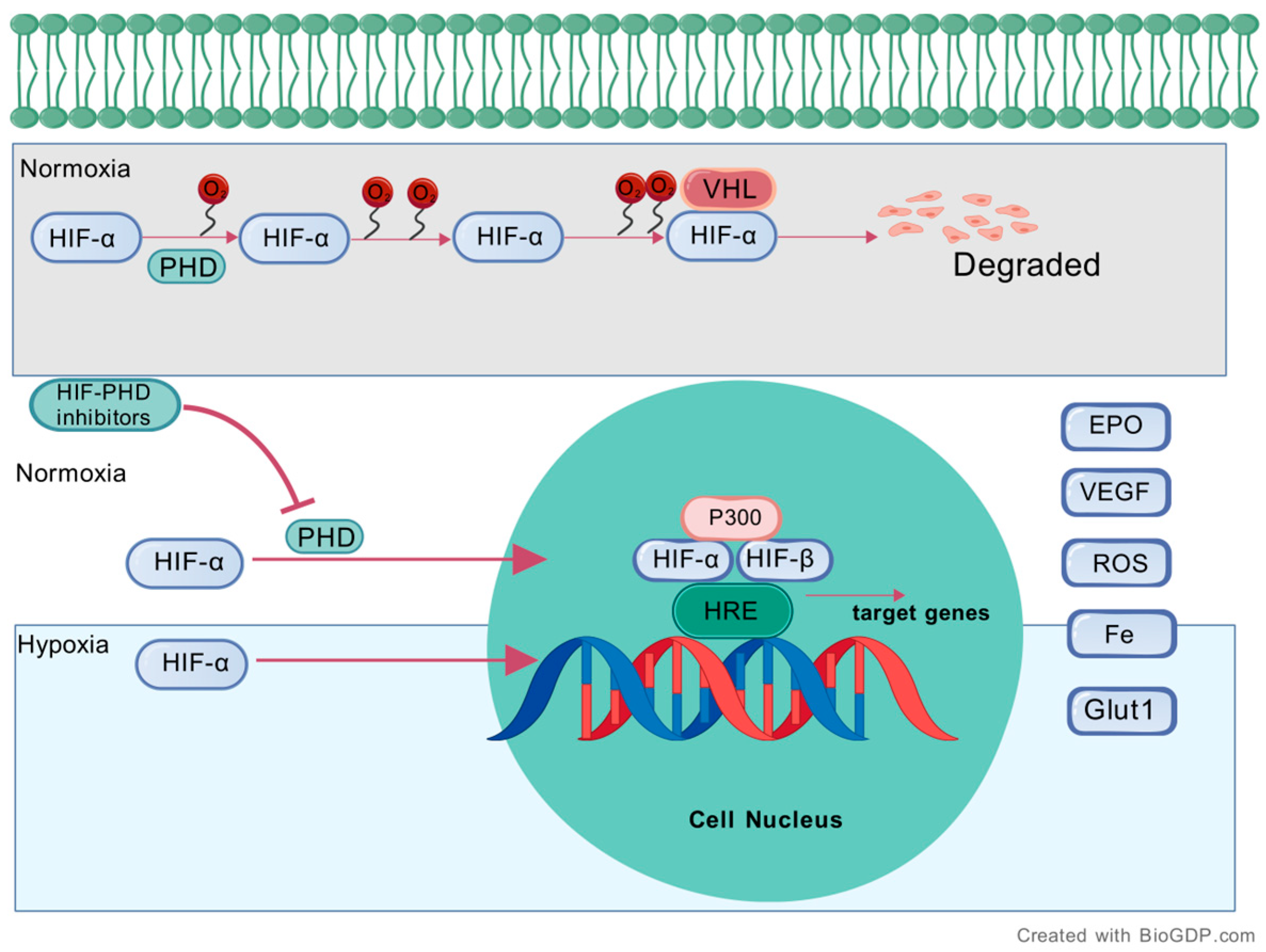
The therapeutic action of HIF-PHD inhibitors is predicated on their ability to modulate the hypoxia-inducible factor (HIF) signaling pathway, a master regulator of cellular adaptation to oxygen availability. HIF is a heterodimeric transcription factor consisting of an oxygen-labile α-subunit (HIF-α) and a constitutively expressed β-subunit (HIF-β). Under normoxic conditions, specific proline residues on the HIF-α subunit are hydroxylated by HIF prolyl hydroxylases (PHDs), a family of 2-oxoglutarate-dependent dioxygenases. This post-translational modification creates a recognition site for the von Hippel-Lindau (VHL) E3 ubiquitin ligase complex, which targets HIF-α for rapid proteasomal degradation, thereby precluding its transcriptional activity [26,27].
In a hypoxic environment, the lack of molecular oxygen limits PHD activity, allowing HIF-α to escape degradation. It accumulates, translocates to the nucleus, and dimerizes with HIF-β. This active complex then binds to hypoxia response elements (HREs) in the promoter regions of hundreds of target genes, orchestrating systemic physiological responses including erythropoiesis, iron metabolism, angiogenesis, and metabolic reprogramming to restore oxygen homeostasis (Figure 1) [28,29].
The two major isoforms of HIF-α, HIF-1α and HIF-2α, play distinct yet complementary roles in cellular responses to hypoxia [30]. HIF-1α is rapidly activated under acute hypoxic conditions, inducing glycolysis-related genes such as GLUT1 and HK2 to enhance cellular energy supply. It also exerts dual regulatory effects on cell fate—promoting survival under mild hypoxia while facilitating apoptosis under severe hypoxia. In contrast, HIF-2α predominates during chronic hypoxia, upregulating genes such as EPO and TfR1 to stimulate erythropoiesis and iron utilization. It further promotes cell proliferation and tissue repair, although in tumor cells, HIF-2α activation may contribute to tumor progression [31].
The prolyl hydroxylase domain (PHD) enzyme family comprises three members—PHD1, PHD2, and PHD3—all of which catalyze hydroxylation of HIF-α. Among them, PHD2 is the principal isoform, accounting for approximately 80% of hydroxylation activity and preferentially targeting HIF-2α. PHD1 acts as an auxiliary enzyme, specifically hydroxylating HIF-1α, with prominent roles in skeletal muscle and cardiac tissues. PHD3 functions as a stress-inducible enzyme whose expression increases under hypoxia; although it exhibits lower hydroxylation efficiency toward both HIF-1α and HIF-2α, it can enhance cellular stress resistance through HIF-independent pathways [32].
Figure 1.
Schematic Diagram of the Regulatory Mechanism of the HIF (Hypoxia-Inducible Factor) Pathway (Created with BioGDP.com [33]).
2.2. Regulation of the HIF Pathway by HIF-PHD Inhibitors
Hypoxia-inducible factor prolyl hydroxylase (HIF-PHD) inhibitors, including Roxadustat, Daprodustat, Vadadustat, and Enarodustat [9,34,35,36], are a novel class of agents that pharmacologically activate the HIF signaling pathway by mimicking hypoxia. Originally developed to treat chronic kidney disease–related anemia, they have shown expanding potential in hypoxia-associated disorders and tissue repair. These inhibitors block the hydroxylation of HIF-α by PHD enzymes, preventing its recognition and degradation via the VHL–proteasome pathway. Stabilized HIF-α translocates to the nucleus, dimerizes with HIF-β, and induces transcription of genes regulating erythropoiesis (EPO, TfR1), angiogenesis (VEGF, Ang-2), and metabolic adaptation (GLUT1, LDHA) [9,37]. This mechanism, which promotes a coordinated, multi-gene network response, differs fundamentally from supplementation with exogenous agents like EPO. It is this capacity to modulate a core physiological pathway that provides the molecular foundation for the broad immunomodulatory and anti-inflammatory effects of these inhibitors [38,39]. Despite a shared mechanism, individual agents differ in selectivity, pharmacoki-netics, and biological profiles. Roxadustat broadly stabilizes HIF-1α and HIF-2α, pro-moting both erythropoiesis and angiogenesis. Daprodustat, more selective for PHD2, preferentially activates HIF-2α with potent EPO induction and cardiovascular safety. Vadadustat shows renal-targeted efficacy, Desidustat features a long half-life and excellent oral compliance, [40,41,42,43], their shared ability to stabilize HIF-α has positioned them as potent regulators within the complex network of immune signaling and inflammatory cascades.
3. Modulation of Innate Immunity by HIF-PHD Inhibitors
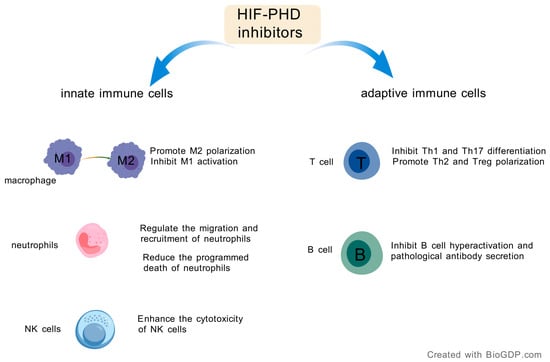
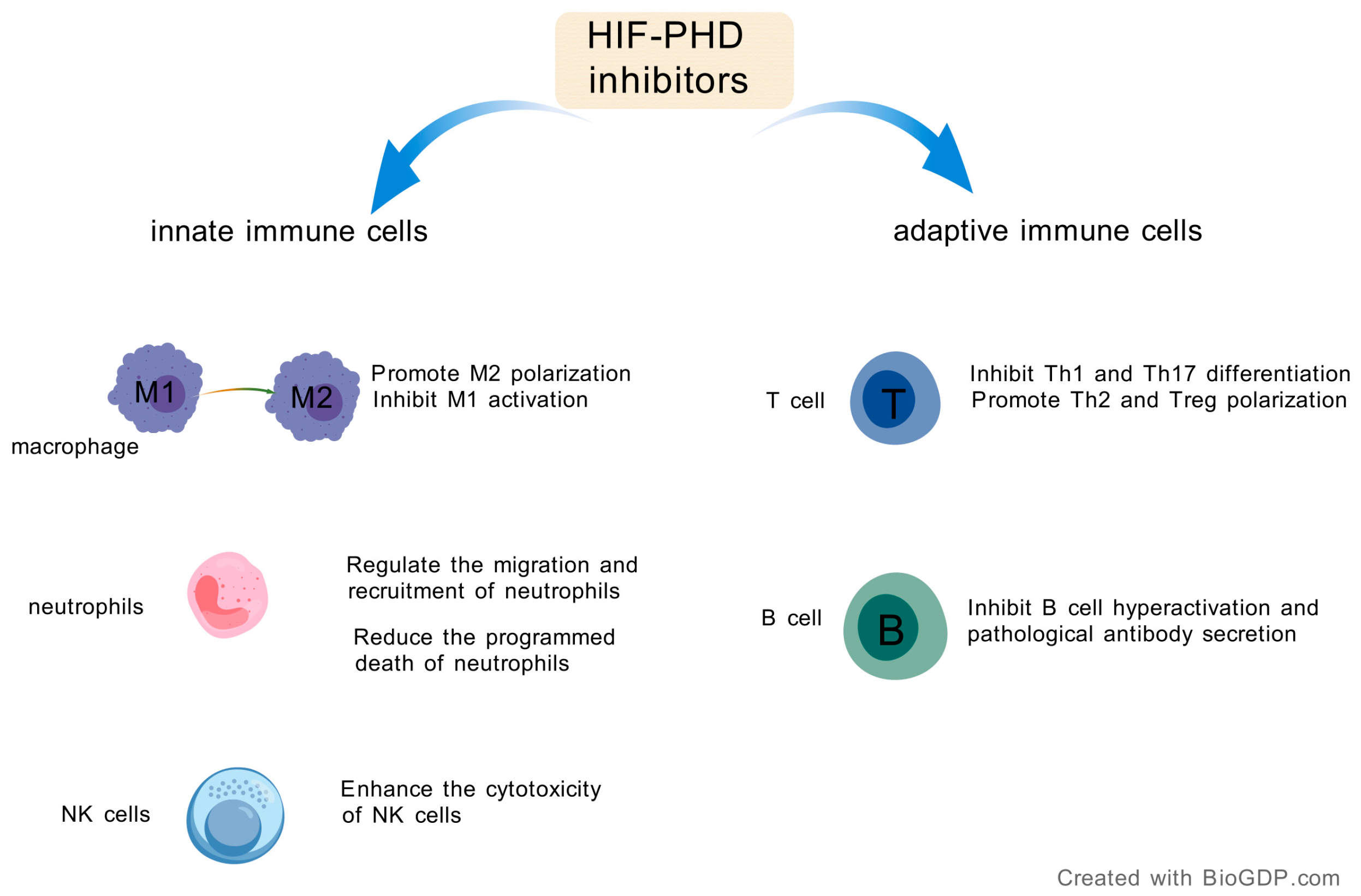
HIF-PHD inhibitors fundamentally reshape the immune landscape by stabilizing hypoxia-inducible factor-alpha (HIF-α), a master regulator of immune cell metabolism and function. By pharmacologically inducing a state of “pseudo-hypoxia,” these agents reprogram the behavior of key innate immune cells, including macrophages, neutrophils, and natural killer (NK) cells, providing a mechanistic basis for their therapeutic effects in inflammatory and neoplastic diseases (Figure 2).
Figure 2.
Effects of HIF-PHD inhibitors on Innate and Adaptive Immune Cells (Created with BioGDP.com [33]).
3.1. Recalibrating Macrophage Polarization
Macrophage polarization denotes the dynamic transformation of macrophages into distinct functional phenotypes in response to microenvironmental cues, including cytokines and pathogen-derived components. Classically activated M1 macrophages, triggered by Lipopolysaccharide (LPS) and Interferon-gamma (IFN-γ), express proinflammatory cytokines and inducible Nitric Oxide Synthase (iNOS), mediating antibacterial or antitumor activities.
HIF-PHD inhibitors, by suppressing the activity of prolyl hydroxylases, stabilize HIF-α (HIF-1α/HIF-2α) accumulation in macrophages, thereby exerting a “bidirectional tuning” effect on macrophage polarization through the regulation of polarization-related gene transcription, metabolic reprogramming, and inflammatory signaling blockade, promoting the transition toward anti-inflammatory M2 phenotypes while inhibiting pro-inflammatory M1 activation [44,45,46,47]. HIF-1α can directly bind to HRE sequences in genes such as Arg-1 and Mrc1 and enhance glycolysis, providing energy support for M2 polarization. In IBD models, treatment with HIF-PHD inhibitors (e.g., roxadustat) significantly increased CD206+ and CD163+ M2 macrophages in colonic tissues, accompanied by a 30–50% elevation in IL-10 and TGF-β secretion [44]. In myocardial infarction models, HIF-PHD inhibitors upregulated the CXCL12/CXCR4/ACKR3 axis in cardiac tissue, recruited bone marrow-derived monocytes to the infarcted region, and induced their differentiation into CD206+ M2 macrophages via the PI3K-AKT signaling pathway, ultimately reducing myocardial fibrosis by 20–30% [45]. In contrast, HIF-2α preferentially induces immunotolerant M2 macrophages by directly regulating CSF1R transcription, enhancing macrophage sensitivity to CSF1, and promoting differentiation into “immunosuppressive” M2 phenotypes, which prolong graft survival in cardiac transplant tolerance models [47]. Within the tumor microenvironment, HIF-2α stabilization can also promote CAF-mediated CCL2 secretion, recruit monocytes, induce their polarization into M2-like TAMs, and upregulate VEGF to support angiogenesis, thereby maintaining an immunosuppressive state [48]. Notably, the effects of HIF-PHD inhibitors on macrophage polarization are disease-specific: in tumors, they may enhance TAM-mediated immunosuppression [48], whereas in infectious diseases such as tuberculosis, they potentiate M2 polarization to enhance both antimicrobial and anti-inflammatory effects [8]. Furthermore, the functional division between HIF-1α and HIF-2α remains controversial, and excessive HIF-α stabilization may increase macrophage apoptosis, suggesting that activation should be maintained at an optimal level [45,47,49]. In summary, HIF-PHD inhibitors achieve precise regulation of macrophage polarization balance via bidirectional modulation—promoting M2 while suppressing M1—offering substantial therapeutic potential in inflammatory diseases, ischemic injuries, and tumors, while highlighting the need for further exploration of HIF isoform specificity, activation thresholds, and microenvironmental dependencies to optimize clinical application.
3.2. Regulating Neutrophil Function and Trafficking
The HIF-PHD axis is a key determinant of neutrophil trafficking, survival, and effector functions. For instance, PHD2 deficiency stabilizes HIF-2α and enhances neutrophil migration by downregulating RhoA GTPase activity, promoting their accumulation at sites of inflammation [50]. Pharmacological inhibitors like Roxadustat have been shown to prolong neutrophil survival by stabilizing HIF-1α. Critically, this stabilization also suppresses the formation of neutrophil extracellular traps (NETs) by inhibiting NADPH oxidase activity and reducing reactive oxygen species (ROS) production [51].
HIF regulation is further shaped by integrin signaling. Kling et al. demonstrated that β2-integrin activation enhances HIF-1α translation through the mTOR–eIF4E axis, thereby augmenting neutrophil responsiveness to inflammatory chemokines; conversely, β2-integrin deficiency suppresses HIF-1α expression, impairing glucose uptake and TNF secretion [52]. Roxadustat has also been shown to dampen neutrophil-derived inflammatory mediators through the HIF-1α/NF-κB pathway in migraine models [53]. Interestingly, neutrophil-specific HIF-1α deletion does not impair antibacterial defense in pneumonia models, suggesting context-dependent roles for HIF signaling in inflammation [54,55].
3.3. Enhancing Natural Killer (NK) Cell Cytotoxicity
HIF-PHD inhibition also enhances the activity of natural killer (NK) cells, which are critical mediators of antiviral and antitumor immunity.
Activation of the HIF pathway upregulates activating receptors on the NK cell surface, increasing their ability to recognize and eliminate tumor or virus-infected cells [56,57,58]. This enhanced function is underpinned by profound metabolic reprogramming. By stabilizing HIF-1α, inhibitors drive the shift to glycolysis required for the robust production of effector molecules like interferon-gamma (IFN-γ) and granzyme B [59,60]. Furthermore, HIF-1α is critical for NK cell survival and homeostasis; it maintains metabolic balance by preserving tryptophan metabolism and NAD+ levels, which suppresses mitochondrial reactive oxygen species (ROS) to prevent DNA damage and apoptosis [60].
By augmenting NK cell cytotoxicity directly while concurrently alleviating micro environmental suppression, HIF-PHD inhibitors can effectively unleash the therapeutic potential of NK cell-mediated immune surveillance.
4. Regulatory Effects of HIF-PHD Inhibitors on Adaptive Immune Cells
The influence of HIF–PHD inhibitors on innate immunity is closely interconnected with adaptive immune regulation. By stabilizing HIF-α, these inhibitors coordinate a bidirectional network between innate and adaptive immune cells, thereby reshaping the immune microenvironment. Innate immune cells such as macrophages, neutrophils, and natural killer (NK) cells initiate early inflammatory responses, and their phenotypes, modified by HIF-PHD inhibition, establish the foundation for adaptive immunity. Conversely, adaptive immune cells—particularly T and B lymphocytes—feed back to modulate innate immune activity through cytokine secretion and antibody production. This reciprocal interaction highlights the central role of HIF signaling in integrating both arms of the immune response.
4.1. HIF-PHD Inhibition and T Cell-Mediated Immunity
HIF-PHD inhibitors exhibit complex and seemingly paradoxical dual effects on T cell function and adaptive immunity, with their core mechanisms centered on the downstream molecular regulation following activation of the HIF signaling pathway. Gojkovic et al. [61] demonstrates that HIF-PHD inhibitors suppress adaptive immune responses by activating the HIF pathway in myeloid cells, inducing nitric oxide (NO) production, which subsequently inhibits CD8+ T cell proliferation and reduces the expression of activation markers. Conversely, Chen et al. [62] found that HIF-PHD inhibitors like Roxadustat and Vadadustat induce IL-2 production in CD4+ T cells, stimulating CD8+ T cell proliferation, differentiation, effector functions, and tumor infiltration to enhance anti-tumor immunity.
According to research by Eleftheriadis et al. [63], the stabilization of HIF-1α/HIF-2α exerts a significant inhibitory effect on CD4+ T cells. This manifests as suppressed proliferation, induced apoptosis, and a shift in differentiation from pro-inflammatory Th1/Th17 subtypes toward immunomodulatory Th2, regulatory T cell (Treg), and follicular helper T cell (Tfh) phenotypes, while concurrently suppressing humoral antibody production. Eleftheriadis [64] notes that this CD4+ T cell suppression and immune skewing is clinically associated with increased incidences of urinary tract infections, pneumonia, and upper respiratory tract infections in chronic kidney disease (CKD) patients receiving Roxadustat for anemia treatment. The mechanism likely involves impaired adaptive immune responses against pathogens, thereby contributing to elevated infection risk.
4.2. HIF-PHD Inhibition and B Cell Responses
In the context of B lymphocytes, HIF-PHD inhibitors primarily act to resolve pathological inflammation by strategically modulating B cell activation and function. These agents are not blunt instruments of suppression; rather, they fine-tune B cell responses to be more conducive to tissue repair. Evidence from multiple disease models shows a consistent pattern of dampening harmful, pro-inflammatory B cell activities. For instance, in settings of intestinal and renal injury, inhibitors curb the differentiation of B cells into antibody-secreting plasma cells and reduce the release of inflammatory factors like IgM, [65,66]. Similarly, in a model of cardiac injury, the inhibitor Daprodustat mitigated damage by reducing the aberrant activation of B cells and their secretion of pathogenic antibodies [34].
This functional modulation is deeply intertwined with the metabolic reprogramming governed by HIF-α. While the outcomes are anti-inflammatory, HIF stabilization is also known to support the fundamental bioenergetics of B cells by upregulating glycolytic genes essential for proliferation [47]. Therefore, the therapeutic effect of these inhibitors lies in their ability to selectively restrain the inflammation-driving functions of B cells while preserving their core metabolic fitness. This targeted modulation effectively shifts the B cell response away from exacerbating tissue damage and towards participating in its resolution, highlighting a key mechanism for their therapeutic benefit in inflammatory diseases.
5. Regulatory Effects of HIF-PHD Inhibitors on Inflammatory Signaling Pathways
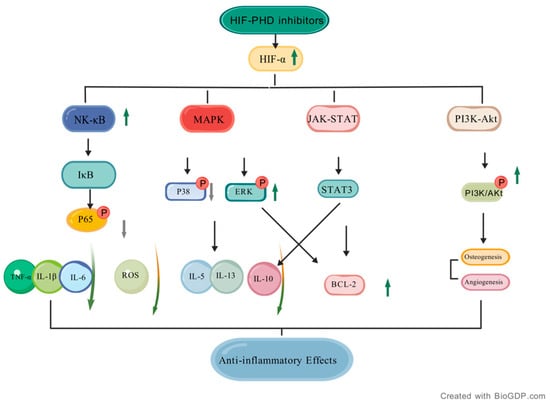
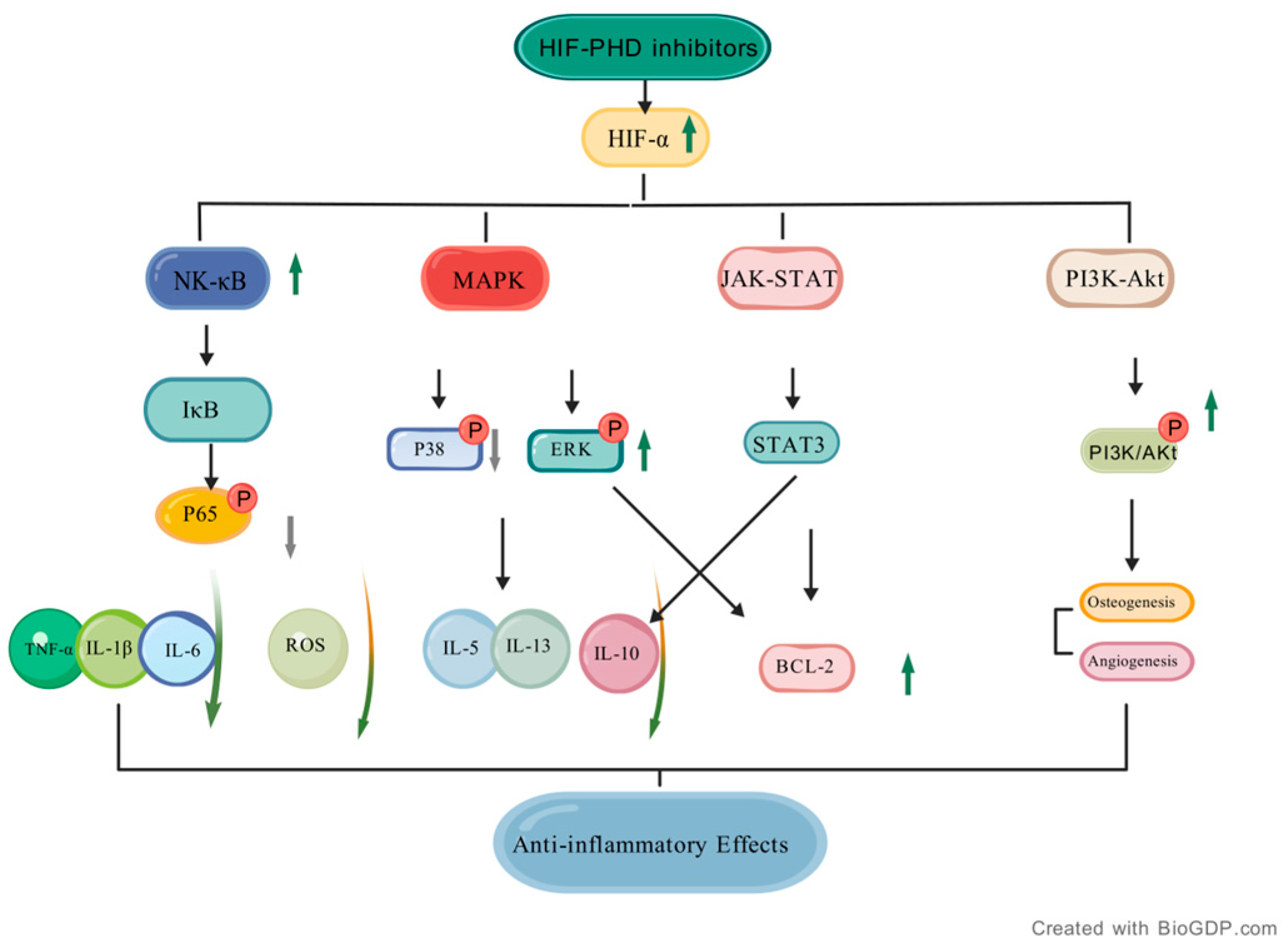
Building on their regulation of immune cell functions, HIF-PHD inhibitors exert their influence by directly targeting the intracellular signaling cascades that orchestrate inflammation. By modulating canonical pathways such as NF-κB and MAPK, these agents intervene at the molecular core of the inflammatory response, recalibrating the balance between pro- and anti-inflammatory signals to reshape the tissue microenvironment (Figure 3).
Figure 3.
Comprehensive Mechanism of HIF-PHD Inhibitors on NF-κB, MAPK, JAK-STAT and PI3K-Akt Pathways (Created with BioGDP.com [33]).
5.1. NF-κB Signaling Pathway
NF-κB, as a core molecule regulating the body’s inflammatory response, usually exists in an inactive form under physiological conditions—it is tightly bound to the inhibitory protein IκB, “confined” in the cytoplasm and unable to enter the nucleus to initiate the transcription of downstream genes [67,68]. However, when the body is subjected to stimuli such as pathogen invasion and tissue damage, IκB will be phosphorylated and degraded, allowing NF-κB to be released and translocated to the nucleus, where it activates the expression of many pro-inflammatory genes, triggering a cascading inflammatory response.
In recent years, studies have found that HIF-PHD inhibitors can regulate the activity of NF-κB by stabilizing the key molecule HIF-1α. Taking the neuroinflammation model as an example, in the experiment of lipopolysaccharide (LPS)-induced microglial activation, the prolyl hydroxylase inhibitor FG-4592 can significantly enhance the stability of intracellular HIF-1α, and then inhibit the phosphorylation of the NF-κB p65 subunit through the HIF-1/BNIP3 signaling axis. In this process, the reduced phosphorylation level of p65 will directly weaken its ability to translocate to the nucleus, leading to a significant decrease in the release of downstream pro-inflammatory cytokines such as interleukin-1β (IL-1β), interleukin-6 (IL-6), and tumor necrosis factor-α (TNF-α), thereby alleviating neuroinflammatory damage [69]. Studies by Yang et al. found that in LPS-stimulated BV-2 microglia, Roxadustat, by stabilizing HIF-1α, can not only directly inhibit the activation of the NF-κB pathway but also reduce the production of intracellular reactive oxygen species (ROS) [53].
5.2. MAPK Signaling Pathway
The MAPK signaling pathway contains encompassing ERK, JNK, and p38 MAPK subfamilies, which orchestrates inflammatory cell proliferation, differentiation, and cytokine production. Research indicates that HIF-PHD inhibitors modulate inflammation and related diseases by targeting the phosphorylation of the MAPK signaling pathway. HIF-PHD inhibitors exert bidirectional regulatory effects on the mitogen-activated protein kinase (MAPK) pathway through multiple mechanisms. Y. Li et al. [70] demonstrated that these inhibitors enhance the stability of the tight junction protein occludin, thereby blocking MKK3/6-mediated phosphorylation of p38 MAPK.
Nagashima et al. [71] found that HIF-PHD inhibitors downregulate ST2L expression on renal group 2 innate lymphoid cells (ILC2s), inhibiting IL-33-induced p38 phosphorylation, reducing secretion of related cytokines, and suppressing renal fibrosis. Zhang et al. confirmed in a deep hypothermic circulatory arrest (DHCA) model that the HIF-PHD inhibitor Enarodustat alleviates renal inflammation and apoptosis by inhibiting PHD3, reducing reactive oxygen species (ROS) accumulation, and suppressing transforming growth factor-β1 (TGF-β1)/p38 pathway activation [72]. Conversely, Li et al. [73] discovered that HIF-PHD inhibitors activate the ERK pathway, upregulating anti-apoptotic proteins while downregulating pro-apoptotic factors, thereby mitigating cardiomyocyte apoptosis. Gambini et al. [74] propose that this reflects cross-regulation between the HIF and MAPK pathways, and that such bidirectional modulation expands their therapeutic value for organ protection.
5.3. JAK-STAT Pathway
Despite the absence of dedicated drug studies specifically targeting JAK-STAT modulation by HIF-PHD inhibitors, their mechanistic insights hold significant theoretical value; in neuroinflammatory models, HIF-1α stabilization (e.g., via ketosis induction) activates the IL-10-mediated JAK1-STAT3 and AKT/ERK pathways in an oxygen-independent manner, suppressing proinflammatory factor transcription, antagonizing NF-κB, and modulating MAPK pathways to drive neuroprotective phenotypes [18,75]. The JAK-STAT pathway critically intersects with NF-κB and MAPK cascades, where STAT3 plays a dual antagonistic role: competing with the NF-κB subunit p65 for DNA-binding elements to dampen proinflammatory signals and phosphorylating ERK1/2 and p38 MAPK to modulate immune cell differentiation and cytokine secretion [76], conversely, in cervical cancer, high HIF-1A expression via JAK-STAT3 upregulates CCL2 and IL-6 to recruit Tregs and MDSCs while impairing NK and CD8+ T cell function, and hypoxia-induced HIF-1A enhances integrin β1 (ITGB1) expression through JAK-STAT3, exacerbating immune escape [77]. This profoundly context-dependent dual impact of HIF-α overexpression on JAK-STAT-delivering anti-inflammatory and neuroprotective effects in neuroinflammation yet driving pro-tumor immunosuppression in cancer-underscores its mechanistic complexity and therapeutic potential as a target.
5.4. PI3K-Akt Pathway
The PI3K-Akt pathway is also intimately linked to inflammatory processes. HIF-PHD inhibitors can modulate the activity of this pathway to influence cellular metabolism and the production of inflammatory mediators [78], offering novel intervention targets for the treatment of inflammatory diseases. HIF-PHD inhibitors, represented by Roxadustat, mainly exert an activating effect on the PI3K-Akt pathway. They stabilize the expression of HIF-1α by inhibiting HIF-PHD activity, directly increasing the phosphorylation levels of PI3K and Akt, thereby activating the PI3K-Akt signaling pathway. Meanwhile, in different scenarios, this pathway forms synergistic regulation through downstream molecules: for instance, in diabetic myocardial injury, it can upregulate HIF-1α and UCP2, activate the PI3K-Akt/Nrf2 pathway, reduce oxidative stress and improve mitochondrial function [78]; during bone defect repair, it can activate the PI3K-Akt/HIF-1α and PI3K-Akt/HSP90 pathways, promoting the synergistic effect of angiogenesis and osteogenesis [79]; in heart and kidney protection, when used in combination with other drugs, it enhances cell survival signals through the PI3K-Akt/mTOR pathway [80]. This activating effect, across various disease models, helps improve tissue hypoxia, promote cell survival, enhance antioxidant capacity and angiogenesis, ultimately achieving the protection or repair of target organs.
The mechanistic insights outlined in Section 5.1, Section 5.2, Section 5.3 and Section 5.4—encompassing oxidative stress regulation, cytokine signaling, immune cell activation, and metabolic reprogramming—have been validated across a wide range of disease models. Multiple HIF-PHD inhibitors, including roxadustat, molidustat, desidustat, and others, have consistently demonstrated the ability to modulate immune and inflammatory pathways in cardiovascular, renal, infectious, and oncological contexts. Table 1 summarizes these findings, providing an integrative overview of the inhibitors tested, disease settings, and the specific immune or inflammatory pathways implicated, thereby consolidating the translational relevance of the mechanistic evidence discussed above.
Table 1.
Effects of HIF-PHD Inhibitors on Immune and Inflammatory Signaling Pathways.
6. Conclusions and Future Perspectives
HIF-PHD inhibitors are recognized to pose a tumor-promoting risk, with no evidence supporting anticancer benefits to date. By stabilizing HIF-1α, these agents activate pro-tumorigenic pathways that enhance angiogenesis [85], metabolic reprogramming, chemoresistance, and DNA repair [23], thereby facilitating tumor survival and progression. Mechanistic studies demonstrate that HIF-PHD inhibitors synergize with oncogenes (e.g., MYC, RAS), upregulate proliferative genes (e.g., Cyclin D1), suppress tumor suppressors (e.g., p53) [86], and remodel the tumor microenvironment by promoting invasion, metastasis [76], and immune evasion [87]. Clinical observations further suggest a modest increase in recurrence risk, particularly in hypoxia-sensitive tissues such as kidney, liver, and gastrointestinal tract, as well as in epithelial malignancies including breast and lung cancers [23,76]. Collectively, current evidence underscores that HIF-PHD inhibitors predominantly exert tumor-promoting effects, highlighting the need for cautious clinical use and long-term surveillance.
Hypoxia-inducible factor prolyl hydroxylase (HIF-PHD) inhibitors have transcended their initial role as erythropoietic agents to emerge as powerful modulators of the immune-metabolic axis. As this review has detailed, their ability to stabilize HIF-α allows them to recalibrate innate and adaptive immunity, suppress key inflammatory pathways, and promote tissue protection, offering significant therapeutic potential across a spectrum of diseases, from renal fibrosis to cancer.
However, this core mechanism is also the source of their primary clinical challenge: a profound context-dependency. The paradoxical role of HIF signaling in oncology—capable of either augmenting anti-tumor immunity or driving malignancy—along with the risks of impaired host defense against infections or unforeseen pharmacodynamic interactions, highlights the complexities of systemic immunomodulation.
Therefore, realizing the full potential of this drug class requires moving beyond a “one-size-fits-all” approach. The future of HIF-PHD inhibitor therapy lies in precision medicine. Key research priorities must include the development of next-generation, tissue-specific inhibitors, the identification of predictive biomarkers to stratify patient populations, and the rational design of combination therapies that synergistically enhance therapeutic effects while mitigating risks. By embracing these strategies, the scientific community can harness the immense promise of HIF-α stabilization, transitioning these versatile agents into a new era of safe and targeted immunomodulatory treatment.
Author Contributions
Conceptualization, N.N.N.R.; writing—original draft preparation, Q.L.; writing—review and editing, N.N.N.R. and Q.L. All authors have read and agreed to the published version of the manuscript.
Funding
This study was supported by The Affiliated Hospital of North Sichuan Medical College (Project No. 2024MPZK011).
Institutional Review Board Statement
Not applicable.
Informed Consent Statement
Not applicable.
Data Availability Statement
This research does not contain new data.
Conflicts of Interest
The authors declare no conflicts of interest.
Abbreviations
The following abbreviations are used in this manuscript:
| HIF-α | Hypoxia-Inducible Factor-alpha |
| NF-κB | Nuclear Factor-kappa B |
| MAPK | Mitogen-Activated Protein Kinase |
| JAK-STAT | Janus Kinase-Signal Transducer and Activator of Transcription |
| PI3K-Akt | Phosphoinositide 3-Kinase-Protein Kinase B |
| IκB | Inhibitor of kappa B |
| P38 | P38 Mitogen-Activated Protein Kinase |
| ERK | Extracellular Signal-Regulated Kinase |
| STAT3 | Signal Transducer and Activator of Transcription 3 |
| PI3K/Akt | Phosphoinositide 3-Kinase/Protein Kinase B |
| TNF-α | umor Necrosis Factor-alpha |
| IL-1β | Interleukin-1 beta |
| IL-6 | Interleukin-6 |
| ROS | Reactive Oxygen Species |
| IL-5 | Interleukin-5 |
| IL-13 | Interleukin-13 |
| IL-10 | Interleukin-10 |
| BCL-2 | B-Cell Lymphoma-2 |
| P65 | Nuclear Factor-kappa B p65 |
| HIF-PHD | Hypoxia-Inducible Factor Prolyl Hydroxylase |
| IOX2 | 2-(1-benzyl-4-hydroxy-2-oxo-1,2-dihydroquinoline-3-carboxamido) acetic acid |
| VHL | von Hippel-Lindau |
| RhoA GTPase | RhoA Guanosine Triphosphatase |
| NAD+ | Nicotinamide Adenine Dinucleotide |
| CXCL12 | C-X-C motif chemokine ligand 12 |
| CXCR4 | C-X-C motif chemokine receptor 4 |
| ST2L | Suppression of Tumorigenicity 2, Long isoform |
| JNK | c-Jun N-terminal Kinase |
| MKK3 | Mitogen-Activated Protein Kinase Kinase 3 |
| MKK6 | Mitogen-Activated Protein Kinase Kinase 6 |
| mTOR | mechanistic Target of Rapamycin |
| eIF4E | Eukaryotic Translation Initiation Factor 4E |
| VEGFA | Vascular Endothelial Growth Factor A |
| UCP2 | Uncoupling Protein 2 |
| HSP90 | Heat Shock Protein 90 |
References
- Semenza, G.L.; Wang, G.L. A Nuclear Factor Induced by Hypoxia via de Novo Protein Synthesis Binds to the Human Erythropoietin Gene Enhancer at a Site Required for Transcriptional Activation. Mol. Cell. Biol. 1992, 12, 5447–5454. [Google Scholar] [CrossRef] [Scilit]
- Hirota, K. HIF-α Prolyl Hydroxylase Inhibitors and Their Implications for Biomedicine: A Comprehensive Review. Biomedicines 2021, 9, 468. [Google Scholar] [CrossRef] [Scilit]
- Jaakkola, P.; Mole, D.R.; Tian, Y.M.; Wilson, M.I.; Gielbert, J.; Gaskell, S.J.; Von Kriegsheim, A.; Hebestreit, H.F.; Mukherji, M.; Schofield, C.J.; et al. Targeting of HIF-α to the von Hippel-Lindau Ubiquitylation Complex by O2-Regulated Prolyl Hydroxylation. Science 2001, 292, 468–472. [Google Scholar] [CrossRef] [Scilit]
- Ivan, M.; Kondo, K.; Yang, H.; Kim, W.; Valiando, J.; Ohh, M.; Salic, A.; Asara, J.M.; Lane, W.S.; Kaelin, J. HIFα Targeted for VHL-Mediated Destruction by Proline Hydroxylation: Implications for O2 Sensing. Science 2001, 292, 464–468. [Google Scholar] [CrossRef] [Scilit]
- Sabnis, R.W. Novel Compounds as PHD Inhibitors for Treating Heart, Lung, Liver, and Kidney Diseases. ACS Med. Chem. Lett. 2021, 12, 1868–1869. [Google Scholar] [CrossRef] [Scilit]
- Maxwell, P.H.; Eckardt, K.U. HIF Prolyl Hydroxylase Inhibitors for the Treatment of Renal Anaemia and Beyond. Nat. Rev. Nephrol. 2016, 12, 157–168. [Google Scholar] [CrossRef] [Scilit] [PubMed]
- Semenza, G.L. HIF-1 and Mechanisms of Hypoxia Sensing. Curr. Opin. Cell Biol. 2001, 13, 167–171. [Google Scholar] [CrossRef] [Scilit] [PubMed]
- Zenk, S.F.; Hauck, S.; Mayer, D.; Grieshober, M.; Stenger, S. Stabilization of Hypoxia-Inducible Factor Promotes Antimicrobial Activity of Human Macrophages Against Mycobacterium tuberculosis. Front. Immunol. 2021, 12, 678354. [Google Scholar] [CrossRef] [Scilit] [PubMed]
- Dhillon, S. Roxadustat: First Global Approval. Drugs 2019, 79, 563–572. [Google Scholar] [CrossRef] [Scilit]
- Macdougall, I.C. Hypoxia-Inducible Factor Prolyl Hydroxylase Enzyme Inhibitors: Ready for Primetime? Curr. Opin. Nephrol. Hypertens. 2022, 31, 399–405. [Google Scholar] [CrossRef] [Scilit]
- Fujimaki, A.; Ohuchi, K.; Takizawa, S.; Murakami, T.; Kurita, H.; Hozumi, I.; Wen, X.; Kitamura, Y.; Wu, Z.; Maekawa, Y.; et al. The Neuroprotective Effects of FG-4592, a Hypoxia-Inducible Factor-Prolyl Hydroxylase Inhibitor, against Oxidative Stress Induced by Alpha-Synuclein in N2a Cells. Sci. Rep. 2023, 13, 15629. [Google Scholar] [CrossRef] [Scilit]
- Su, K.; Li, Z.; Yu, Y.; Zhang, X. The Prolyl Hydroxylase Inhibitor Roxadustat: Paradigm in Drug Discovery and Prospects for Clinical Application beyond Anemia. Drug Discov. Today 2020, 25, 1262–1269. [Google Scholar] [CrossRef] [Scilit]
- Mashayekhi, S.; Majedi, H.; Dehpour, A.R.; Dehghan, S.; Jafarian, M.; Hadjighassem, M.; Hosseindoost, S. Ferroptosis as a therapeutic target in glioblastoma: Mechanisms and emerging strategies. Mol. Ther. Nucleic Acids 2025, 36, 102649. [Google Scholar] [CrossRef] [Scilit]
- Sharma, D.; Khan, H.; Kumar, A.; Grewal, A.K.; Dua, K.; Singh, T.G. Pharmacological Modulation of HIF-1 in the Treatment of Neuropsychiatric Disorders. J. Neural Transm. 2023, 130, 1523–1535. [Google Scholar] [CrossRef] [Scilit]
- Zhang, C.; Zhao, R.; Dong, Z.; Liu, Y.; Liu, M.; Li, H.; Yin, Y.; Che, X.; Wu, G.; Guo, L.; et al. IHH–GLI-1–HIF-2α Signalling Influences Hypertrophic Chondrocytes to Exacerbate Osteoarthritis Progression. J. Orthop. Translat. 2024, 49, 207–217. [Google Scholar] [CrossRef] [Scilit] [PubMed]
- Xu, X.; Yang, M.; Zhang, B.; Dong, J.; Zhuang, Y.; Ge, Q.; Niu, F.; Liu, B. HIF-1α Participates in Secondary Brain Injury through Regulating Neuroinflammation. Transl. Neurosci. 2023, 14, 20220272. [Google Scholar] [CrossRef] [Scilit] [PubMed]
- Li, H.; Wu, Q.Y.; Teng, X.H.; Li, Z.P.; Zhu, M.T.; Gu, C.J.; Chen, B.J.; Xie, Q.Q.; Luo, X.J. The Pathogenesis and Regulatory Role of HIF-1 in Rheumatoid Arthritis. Cent. Eur. J. Urol. 2023, 48, 338–345. [Google Scholar] [CrossRef] [Scilit]
- Puchowicz, M.A.; Parveen, K.; Sethuraman, A.; Ishrat, T.; Xu, K.; LaManna, J. Pro-Survival Phenotype of HIF-1α: Neuroprotection Through Inflammatory Mechanisms. Adv. Exp. Med. Biol. 2023, 1438, 33–36. [Google Scholar] [CrossRef] [Scilit] [PubMed]
- Taylor, C.T.; Scholz, C.C. The Effect of HIF on Metabolism and Immunity. Nat. Rev. Nephrol. 2022, 18, 573–587. [Google Scholar] [CrossRef] [Scilit]
- Tarmizi, A.A.; Adam, S.H.; Nik Ramli, N.N.; Hadi, N.A.; Abdul Mutalib, M.; Tang, S.G.H.; Mokhtar, M.H. The ameliorative Effects of selenium nanoparticles (SENPs) on Diabetic rat model: A Narrative review. Sains Malays. 2023, 52, 2037–2053. [Google Scholar] [CrossRef] [Scilit]
- Nik Ramli, N.N.; Omar, N.; Husin, A.; Ismail, Z.; Siran, R. Preconditioning effect of (S)-3,5-dihydroxyphenylglycine on ischemic injury in middle cerebral artery occluded Sprague-Dawley rats. Neurosci. Lett. 2015, 588, 137–141. [Google Scholar] [CrossRef] [Scilit]
- Nik Ramli, N.N.; Siran, R. The neuroprotective effects of (S)-3,5-dihydroxyphenylglycine preconditioning in middle cerebral artery occluded rats: A perspective as a contrivance for stroke. Neural Regen. Res. 2015, 10, 1221–1222. [Google Scholar] [CrossRef] [Scilit] [PubMed]
- Pewklang, T.; Chansaenpak, K.; Bakar, S.N.; Lai, R.; Kue, C.S.; Kamkaew, A. Aza-BODIPY based carbonic anhydrase IX: Strategy to overcome hypoxia limitation in photodynamic therapy. Front. Chem. 2022, 10, 1015883. [Google Scholar] [CrossRef] [Scilit] [PubMed]
- Grzeszczak, W.; Szczyra, D.; Śnit, M. Whether Prolyl Hydroxylase Blocker—Roxadustat—In the Treatment of Anemia in Patients with Chronic Kidney Disease Is the Future? Int. J. Environ. Res. Public Health 2021, 18, 1612. [Google Scholar] [CrossRef] [Scilit]
- Fang, T.; Ma, C.; Zhang, Z.; Sun, L.; Zheng, N. Roxadustat, a HIF-PHD Inhibitor with Exploitable Potential on Diabetes-Related Complications. Front. Pharmacol. 2023, 14, 1088288. [Google Scholar] [CrossRef] [Scilit]
- Lee, J.W.; Bae, S.H.; Jeong, J.W.; Kim, S.H.; Kim, K.W. Hypoxia-Inducible Factor (HIF-1) α: Its Protein Stability and Biological Functions. Exp. Mol. Med. 2004, 36, 1–12. [Google Scholar] [CrossRef] [Scilit]
- Ke, Q.; Costa, M. Hypoxia-Inducible Factor-1 (HIF-1). Mol. Pharmacol. 2006, 70, 1469–1480. [Google Scholar] [CrossRef] [Scilit]
- Marxsen, J.H.; Stengel, P.; Doege, K.; Heikkinen, P.; Jokilehto, T.; Wagner, T.; Jelkmann, W.; Jaakkola, P.; Metzen, E. Hypoxia-Inducible Factor-1 (HIF-1) Promotes Its Degradation by Induction of HIF-α-Prolyl-4-Hydroxylases. Biochem. J. 2004, 381, 761–767. [Google Scholar] [CrossRef] [Scilit]
- Voit, R.A.; Sankaran, V.G. Stabilizing HIF to Ameliorate Anemia. Cell 2020, 180, 6. [Google Scholar] [CrossRef] [Scilit]
- Bakleh, M.Z.; Al Haj Zen, A. The Distinct Role of HIF-1α and HIF-2α in Hypoxia and Angiogenesis. Cells 2025, 14, 673. [Google Scholar] [CrossRef] [Scilit] [PubMed]
- Bracken, C.P.; Fedele, A.O.; Linke, S.; Balrak, W.; Lisy, K.; Whitelaw, M.L.; Peet, D.J. Cell-Specific Regulation of Hypoxia-Inducible Factor (HIF)-1α and HIF-2α Stabilization and Transactivation in a Graded Oxygen Environment. J. Biol. Chem. 2006, 281, 22575–22585. [Google Scholar] [CrossRef] [Scilit]
- Kennel, K.B.; Burmeister, J.; Schneider, M.; Taylor, C.T. The PHD1 Oxygen Sensor in Health and Disease. J. Physiol. 2018, 596, 3899–3913. [Google Scholar] [CrossRef] [Scilit]
- Jiang, S.; Li, H.; Zhang, L.; Mu, W.; Zhang, Y.; Chen, T.; Wu, J.; Tang, H.; Zheng, S.; Liu, Y.; et al. Generic Diagramming Platform (GDP): A Comprehensive Database of High-Quality Biomedical Graphics. Nucleic Acids Res. 2025, 53, D1670–D1676. [Google Scholar] [CrossRef] [Scilit]
- Iso, T.; Matsue, Y.; Mizukami, A.; Tokano, T.; Isoda, K.; Suwa, S.; Miyauchi, K.; Yanagisawa, N.; Okumura, Y.; Minamino, T. Daprodustat for Anaemia in Patients with Heart Failure and Chronic Kidney Disease: A Randomized Controlled Study. ESC Heart Fail. 2022, 9, 4291–4297. [Google Scholar] [CrossRef] [Scilit]
- Mimura, I.; Tanaka, T.; Nangaku, M. Evaluating the Safety and Efficacy of Vadadustat for the Treatment of Anemia Associated with Chronic Kidney Disease. Expert Opin. Pharmacother. 2024, 25, 1111–1120. [Google Scholar] [CrossRef] [Scilit]
- Markham, A. Enarodustat: First Approval. Drugs 2021, 81, 169–174. [Google Scholar] [CrossRef] [Scilit] [PubMed]
- Chen, N.; Hao, C.; Liu, B.-C.; Lin, H.; Wang, C.; Xing, C.; Liang, X.; Jiang, G.; Liu, Z.; Li, X.; et al. Roxadustat Treatment for Anemia in Patients Undergoing Long-Term Dialysis. N. Engl. J. Med. 2019, 381, 1011–1022. [Google Scholar] [CrossRef] [Scilit] [PubMed]
- Li, Z.L.; Tu, Y.; Liu, B.C. Treatment of Renal Anemia with Roxadustat: Advantages and Achievement. Kidney Dis. 2020, 6, 65–73. [Google Scholar] [CrossRef] [Scilit]
- Robles, N.R. The Safety of Erythropoiesis-Stimulating Agents for the Treatment of Anemia Resulting from Chronic Kidney Disease. Clin. Drug Investig. 2016, 36, 421–431. [Google Scholar] [CrossRef] [Scilit] [PubMed]
- Imai, E.; Imai, A. The Comparison of Four Hypoxia-Inducible Factor Prolyl Hydroxylase Inhibitors on Drug Potency and Cost for Treatment in Patients with Renal Anemia. Clin. Exp. Nephrol. 2024, 28, 1090–1096. [Google Scholar] [CrossRef] [Scilit]
- Dhillon, S. Desidustat: First Approval. Drugs 2022, 82, 1207–1212. [Google Scholar] [CrossRef] [Scilit]
- Joharapurkar, A.; Pandya, V.; Patel, H.; Jain, M.; Desai, R. Desidustat: A Novel PHD Inhibitor for the Treatment of CKD-Induced Anemia. Front. Nephrol. 2024, 4, 1459425. [Google Scholar] [CrossRef] [Scilit]
- Miao, M.; Wu, M.; Li, Y.; Zhang, L.; Jin, Q.; Fan, J.; Xu, X.; Gu, R.; Hao, H.; Zhang, A.; et al. Clinical Potential of Hypoxia Inducible Factors Prolyl Hydroxylase Inhibitors in Treating Nonanemic Diseases. Front. Pharmacol. 2022, 13, 837249. [Google Scholar] [CrossRef] [Scilit] [PubMed]
- Han, Y.; Xun, J.; Li, T.; Jiang, X.; Liu, B.; Hu, Z.; Yang, H.; Gao, Q.; Wu, Z.; Wu, X.; et al. FATS alleviates ulcerative colitis by inhibiting M1 macrophage polarization and aerobic glycolysis through promoting the ubiquitination-mediated degradation of HIF-1α. Biochem. Pharmacol. 2025, 240, 117053. [Google Scholar] [CrossRef] [Scilit] [PubMed]
- Zaruba, M.M.; Staggl, S.; Ghadge, S.K.; Maurer, T.; Gavranovic-Novakovic, J.; Jeyakumar, V.; Schönherr, P.; Wimmer, A.; Pölzl, G.; Bauer, A.; et al. Roxadustat Attenuates Adverse Remodeling Following Myocardial Infarction in Mice. Cells 2024, 13, 1074. [Google Scholar] [CrossRef] [Scilit]
- Kong, G.; Hua, H.; Lu, Y.; Yan, K.; Zheng, Y.; Jia, Z.; Guo, H.; Li, M.; Jin, Y.; Liu, Z. Roxadustat Ameliorates Experimental Colitis in Mice by Regulating Macrophage Polarization through Increasing HIF Level. Biochim. Biophys. Acta Gen. Subj. 2024, 1868, 130548. [Google Scholar] [CrossRef] [Scilit]
- DeBerge, M.; Schroth, S.; Du, F.; Yeap, X.Y.; Wang, J.J.; Zhang, Z.J.; Ansari, M.J.; Scott, E.A.; Thorp, E.B. Hypoxia Inducible Factor 2α Promotes Tolerogenic Macrophage Development during Cardiac Transplantation through Transcriptional Regulation of Colony Stimulating Factor 1 Receptor. Proc. Natl. Acad. Sci. USA 2024, 121, e2319623121. [Google Scholar] [CrossRef] [Scilit]
- Chu, X.; Wang, Z.; Wang, W.; Liu, W.; Cao, Y.; Feng, L. Roles of Hypoxic Environment and M2 Macrophage-Derived Extracellular Vesicles on the Progression of Non-Small Cell Lung Cancer. BMC Pulm. Med. 2023, 23, 239. [Google Scholar] [CrossRef] [Scilit] [PubMed]
- Sato, T.; Takeda, N. The Roles of HIF-1α Signaling in Cardiovascular Diseases. J. Cardiol. 2023, 81, 202–208. [Google Scholar] [CrossRef] [Scilit]
- Sormendi, S.; Deygas, M.; Sinha, A.; Bernard, M.; Krüger, A.; Kourtzelis, I.; Le Lay, G.; Sáez, P.J.; Gerlach, M.; Franke, K.; et al. HIF2α Is a Direct Regulator of Neutrophil Motility. Blood 2021, 137, 3416–3427. [Google Scholar] [CrossRef] [Scilit]
- Dölling, M.; Eckstein, M.; Singh, J.; Schauer, C.; Schoen, J.; Shan, X.; Bozec, A.; Knopf, J.; Schett, G.; Muñoz, L.E.; et al. Hypoxia Promotes Neutrophil Survival After Acute Myocardial Infarction. Front. Immunol. 2022, 13, 726153. [Google Scholar] [CrossRef] [Scilit]
- Kling, L.; Eulenberg-Gustavus, C.; Jerke, U.; Rousselle, A.; Eckardt, K.; Schreiber, A.; Kettritz, R. B2-Integrins Control HIF1α Activation in Human Neutrophils. Front. Immunol. 2024, 15, 1406967. [Google Scholar] [CrossRef] [Scilit]
- Yang, D.G.; Gao, Y.Y.; Yin, Z.Q.; Wang, X.R.; Meng, X.S.; Zou, T.F.; Duan, Y.J.; Chen, Y.L.; Liao, C.Z.; Xie, Z.L.; et al. Roxadustat Alleviates Nitroglycerin-Induced Migraine in Mice by Regulating HIF-1α/NF-ΚB/Inflammation Pathway. Acta Pharmacol. Sin. 2023, 44, 308–320. [Google Scholar] [CrossRef] [Scilit]
- Liu, J.; Yang, F.; Waheed, Y.; Li, S.; Liu, K.; Zhou, X. The Role of Roxadustat in Chronic Kidney Disease Patients Complicated with Anemia. Korean J. Intern. Med. 2023, 38, 147–156. [Google Scholar] [CrossRef] [Scilit]
- Otto, N.A.; Pereverzeva, L.; Leopold, V.; Ramirez-Moral, I.; Roelofs, J.J.T.H.; Van Heijst, J.W.J.; De Vos, A.F.; Van Der Poll, T. Hypoxia-Inducible Factor-1 α in Macrophages, but Not in Neutrophils, Is Important for Host Defense during Klebsiella pneumoniae—Induced Pneumosepsis. Mediat. Inflamm. 2021, 2021, 9958281. [Google Scholar] [CrossRef] [Scilit] [PubMed]
- Lim, S.A.; Moon, Y.; Shin, M.H.; Kim, T.J.; Chae, S.; Yee, C.; Hwang, D.; Park, H.; Lee, K.M. Hypoxia-Driven Hif-1α Activation Reprograms Pre-Activated Nk Cells towards Highly Potent Effector Phenotypes via Erk/Stat3 Pathways. Cancers 2021, 13, 1904. [Google Scholar] [CrossRef] [Scilit] [PubMed]
- Río, A.G.D.; Prieto-Fernández, E.; Egia-Mendikute, L.; Antoñana-Vildosola, A.; Jimenez-Lasheras, B.; Lee, S.Y.; Barreira-Manrique, A.; Zanetti, S.R.; De Blas, A.; Velasco-Beltrán, P.; et al. Factor-Inhibiting HIF (FIH) Promotes Lung Cancer Progression. JCI Insight 2023, 8, e167394. [Google Scholar] [CrossRef] [Scilit]
- Jiang, X.; Wu, A.; Yan, J.; Chen, J.; Wen, Y.; Wu, H.; Yan, N.; Yang, Z.; Liu, F.; Li, P. Eleutheroside A Inhibits PI3K/AKT1/MTOR-Mediated Glycolysis in MDSCs to Alleviate Their Immunosuppressive Function in Gastric Cancer. Int. Immunopharmacol. 2025, 159, 114907. [Google Scholar] [CrossRef] [Scilit]
- Cluff, E.; Magdaleno, C.C.; Fernandez, E.; House, T.; Swaminathan, S.; Varadaraj, A.; Rajasekaran, N. Hypoxia-Inducible Factor-1 Alpha Expression Is Induced by IL-2 via the PI3K/MTOR Pathway in Hypoxic NK Cells and Supports Effector Functions in NKL Cells and Ex Vivo Expanded NK Cells. Cancer Immunol. Immunother. 2022, 71, 1989–2005. [Google Scholar] [CrossRef] [Scilit]
- Pelletier, A.; Nelius, E.; Fan, Z.; Khatchatourova, E.; Alvarado-Diaz, A.; He, J.; Krzywinska, E.; Sobecki, M.; Nagarajan, S.; Kerdiles, Y.; et al. Resting Natural Killer Cell Homeostasis Relies on Tryptophan/ NAD+ Metabolism and HIF-1α. EMBO Rep. 2023, 24, e56156. [Google Scholar] [CrossRef] [Scilit]
- Gojkovic, M.; Cunha, P.P.; Darmasaputra, G.S.; Barbieri, L.; Rundqvist, H.; Veliça, P.; Johnson, R.S. Oxy gen-Mediated Suppression of CD8+ T Cell Proliferation by Macrophages: Role of Pharmacological Inhibitors of HIF Degradation. Front. Immunol. 2021, 12, 633586. [Google Scholar] [CrossRef] [Scilit]
- Chen, Y.; Ohara, T.; Hamada, Y.; Wang, Y.; Tian, M.; Noma, K.; Tazawa, H.; Fujisawa, M.; Yoshimura, T.; Matsukawa, A. HIF-PH Inhibitors Induce Pseudohypoxia in T Cells and Suppress the Growth of Microsatellite Stable Colorectal Cancer by Enhancing Antitumor Immune Responses. Cancer Immunol. Immunother. 2025, 74, 192. [Google Scholar] [CrossRef] [Scilit] [PubMed]
- Eleftheriadis, T.; Pissas, G.; Mavropoulos, A.; Nikolaou, E.; Filippidis, G.; Liakopoulos, V.; Stefanidis, I. In Mixed Lymphocyte Reaction, the Hypoxia-Inducible Factor Prolyl-Hydroxylase Inhibitor Roxadustat Suppresses Cellular and Humoral Alloimmunity. Arch. Immunol. Ther. Exp. 2020, 68, 31. [Google Scholar] [CrossRef] [Scilit] [PubMed]
- Eleftheriadis, T.; Pissas, G.; Liakopoulos, V.; Stefanidis, I. On the Increased Event Rate of Urinary Tract Infection and Pneumonia in CKD Patients Treated with Roxadustat for Anemia. J. Am. Soc. Nephrol. 2021, 32, 1537. [Google Scholar] [CrossRef] [Scilit]
- Strowitzki, M.J.; Kimmer, G.; Wehrmann, J.; Ritter, A.S.; Radhakrishnan, P.; Opitz, V.M.; Tuffs, C.; Biller, M.; Kugler, J.; Keppler, U.; et al. Inhibition of HIF-Prolyl Hydroxylases Improves Healing of Intestinal Anastomoses. JCI Insight 2021, 6, e139191. [Google Scholar] [CrossRef] [Scilit]
- Miao, A.F.; Liang, J.X.; Yao, L.; Han, J.L.; Zhou, L.J. Hypoxia-Inducible Factor Prolyl Hydroxylase Inhibitor Roxadustat (FG-4592) Protects against Renal Ischemia/Reperfusion Injury by Inhibiting Inflammation. Ren. Fail. 2021, 43, 803. [Google Scholar] [CrossRef] [Scilit]
- Yu, H.; Lin, L.; Zhang, Z.; Zhang, H.; Hu, H. Targeting NF-ΚB Pathway for the Therapy of Diseases: Mechanism and Clinical Study. Signal Transduct. Target. Ther. 2020, 5, 209. [Google Scholar] [CrossRef] [Scilit]
- Guo, Q.; Jin, Y.; Chen, X.; Ye, X.; Shen, X.; Lin, M.; Zeng, C.; Zhou, T.; Zhang, J. NF-ΚB in Biology and Targeted Therapy: New Insights and Translational Implications. Signal Transduct. Target. Ther. 2024, 9, 53. [Google Scholar] [CrossRef] [Scilit]
- Ruan, Q.; Geng, Y.; Zhao, M.; Zhang, H.; Cheng, X.; Zhao, T.; Yue, X.; Jiang, X.; Jiang, X.; Hou, X.Y.; et al. Prolyl Hydroxylase Inhibitor FG-4592 Alleviates Neuroin-flammation via HIF-1/BNIP3 Signaling in Microglia. Biomed. Pharmacother. 2024, 173, 116342. [Google Scholar] [CrossRef] [Scilit]
- Li, Y.; Yuan, T.; Zhang, H.; Liu, S.; Lun, J.; Guo, J.; Wang, Y.; Zhang, Y.; Fang, J. PHD3 Inhibits Colon Cancer Cell Metastasis through the Occludin-P38 Pathway. Acta Biochim. Biophys. Sin. 2023, 55, 1749–1757. [Google Scholar] [CrossRef] [Scilit] [PubMed]
- Nagashima, R.; Ishikawa, H.; Kuno, Y.; Kohda, C.; Iyoda, M. HIF-PHD Inhibitor Regulates the Function of Group2 Innate Lymphoid Cells and Polarization of M2 Macrophages. Sci. Rep. 2023, 13, 1867. [Google Scholar] [CrossRef] [Scilit]
- Zhang, P.; Bai, L.; Tong, Y.; Guo, S.; Lu, W.; Yuan, Y.; Wang, W.; Jin, Y.; Gao, P.; Liu, J. CIRP Attenuates Acute Kidney Injury after Hypothermic Cardiovascular Surgery by Inhibiting PHD3/HIF-1α-Mediated ROS-TGF-Β1/P38 MAPK Activation and Mitochondrial Apoptotic Pathways. Mol. Med. 2023, 29, 61. [Google Scholar] [CrossRef] [Scilit] [PubMed]
- Li, X.F.; Shen, G.Z.; Gong, P.F.; Yang, Y.; Tuerxun, P. Mechanisms of Action of the Proline Hydroxylase-Adenosine Pathway in Regulating Apoptosis and Reducing Myocardial Ischemia-Reperfusion Injury. Clin. Hemorheol. Microcirc. 2025, 89, 280–294. [Google Scholar] [CrossRef] [Scilit]
- Gambini, J.; Ortega, Á.L.; Guryanova, S.V.; Maksimova, T.V.; Azova, M.M.; Shemyakin, M.M.; Ovchinnikov, Y.A. Transcription Factors and Methods for the Pharmacological Correction of Their Activity. Int. J. Mol. Sci. 2025, 26, 6394. [Google Scholar] [CrossRef] [Scilit]
- Sethuraman, A.; Rao, P.; Pranay, A.; Xu, K.; LaManna, J.C.; Puchowicz, M.A. Chronic Ketosis Modulates HIF1α-Mediated Inflammatory Response in Rat Brain. Adv. Exp. Med. Biol. 2021, 1269, 3–7. [Google Scholar] [CrossRef] [Scilit] [PubMed]
- Feng, J.; Byrne, N.M.; Al Jamal, W.; Coulter, J.A. Exploiting Current Understanding of Hypoxia Mediated Tumour Progression for Nanotherapeutic Development. Cancers 2019, 11, 1989. [Google Scholar] [CrossRef] [Scilit]
- Li, Z.; Wei, R.; Yao, S.; Meng, F.; Kong, L. HIF-1A as a Prognostic Biomarker Related to Invasion, Migration and Immunosuppression of Cervical Cancer. Heliyon 2024, 10, e24664. [Google Scholar] [CrossRef] [Scilit]
- Fang, T.; Ma, C.; Yang, B.; Zhao, M.; Sun, L.; Zheng, N. Roxadustat Improves Diabetic Myocardial Injury by Upregulating HIF-1α/UCP2 against Oxidative Stress. Cardiovasc. Diabetol. 2025, 24, 67. [Google Scholar] [CrossRef] [Scilit]
- You, J.; Li, Y.; Wang, C.; Lv, H.; Zhai, S.; Liu, M.; Liu, X.; Sezhen, Q.; Zhang, L.; Zhang, Y.; et al. Mild Ther motherapy-Assisted GelMA/HA/MPDA@Roxadustat 3D-Printed Scaffolds with Combined Angiogenesis-Osteogenesis Functions for Bone Regeneration. Adv. Healthc. Mater. 2024, 13, 2400545. [Google Scholar] [CrossRef] [Scilit]
- Sung, P.H.; Yue, Y.; Chen, Y.L.; Chiang, J.Y.; Cheng, B.C.; Yang, C.C.; Chai, H.T.; Yip, H.K. Combined Dapagliflozin and Roxadustat Effectively Protected Heart and Kidney against Cardiorenal Syndrome-Induced Damage in Rodent through Activation of Cell Stress-Nfr2/ARE Signalings and Stabilizing HIF-1α. Biomed. Pharmacother. 2024, 180, 117567. [Google Scholar] [CrossRef] [Scilit] [PubMed]
- Li, L.; Li, A.; Gan, L.; Zuo, L. Roxadustat Improves Renal Osteodystrophy by Dual Regulation of Bone Re modeling. Endocrine 2023, 79, 180–189. [Google Scholar] [CrossRef] [Scilit]
- Long, G.; Chen, H.; Wu, M.; Li, Y.; Gao, L.; Huang, S.; Zhang, Y.; Jia, Z.; Xia, W. Antianemia Drug Roxadustat (FG-4592) Protects Against Doxorubicin-Induced Cardio-toxicity by Targeting Antiapoptotic and Antioxidative Pathways. Front. Pharmacol. 2020, 11, 556041. [Google Scholar] [CrossRef] [Scilit] [PubMed]
- Salman, S.; Meyers, D.J.; Wicks, E.E.; Lee, S.N.; Datan, E.; Thomas, A.M.; Anders, N.M.; Hwang, Y.; Lyu, Y.; Yang, Y.; et al. HIF Inhibitor 32-134D Eradicates Murine Hepatocellular Carcinoma in Combination with Anti-PD1 Therapy. J. Clin. Investig. 2022, 132, e156774. [Google Scholar] [CrossRef] [Scilit]
- Cowman, S.J.; Koh, M.Y. Revisiting the HIF Switch in the Tumor and Its Immune Microenvironment. Trends Cancer 2022, 8, 28–42. [Google Scholar] [CrossRef] [Scilit]
- Abdolahi, F.; Shahraki, A.; Sheervalilou, R.; Mortazavi, S.S. Identification of Differentially Expressed Genes Associated with the Pathogenesis of Gastric Cancer by Bioinformatics Analysis. BMC Med. Genom. 2023, 16, 311. [Google Scholar] [CrossRef] [Scilit]
- Scholz, C.C.; Taylor, C.T. Targeting the HIF Pathway in Inflammation and Immunity. Curr. Opin. Pharmacol. 2013, 13, 646–653. [Google Scholar] [CrossRef] [Scilit] [PubMed]
- Zerdes, I.; Matikas, A.; Foukakis, T. The Interplay between Eosinophils and T Cells in Breast Cancer Immunotherapy. Mol. Oncol. 2023, 17, 545–547. [Google Scholar] [CrossRef] [Scilit] [PubMed]

Disclaimer/Publisher’s Note: The statements, opinions and data contained in all publications are solely those of the individual author(s) and contributor(s) and not of MDPI and/or the editor(s). MDPI and/or the editor(s) disclaim responsibility for any injury to people or property resulting from any ideas, methods, instructions or products referred to in the content. |
© 2025 by the authors. Licensee MDPI, Basel, Switzerland. This article is an open access article distributed under the terms and conditions of the Creative Commons Attribution (CC BY) license (https://creativecommons.org/licenses/by/4.0/).