
Proceeding Paper

Silver Nanostars Spread on Cu(OH)2 Nanowires for SERS Substrates †

by
José Luis Zamora Navarro
1,
Diana Jiménez Girón
1,
Hector Ariel Renteral Rodríguez
2,
Yuri Okolodkov
3,
Marcos Luna Cervantes
1,
Guillermo Santana Rodríguez
4,
Julián Hernández Torres
1 and
Luis Zamora Peredo
1,*
1
Centro de Investigación en Micro y Nanotecnología, Universidad Veracruzana, Boca del Río 94294, Veracruz, Mexico
2
Facultad de Ciencias Quimicas, Universidad Veracruzana, Boca del Río 94294, Veracruz, Mexico
3
Instituto de Ciencias Marinas y Pesquerías, Universidad Veracruzana, Boca del Río 94294, Veracruz, Mexico
4
Instituto de Investigación en Materiales, Universidad Nacional Autónoma de México (UNAM), Mexico City 04510, Mexico
*
Author to whom correspondence should be addressed.
Presented at the International Symposium on Nanotechnology for Medicine, Environment and Energy, Veracruz, Mexico, 5–7 November 2025.
Mater. Proc. 2025, 28(1), 7; https://doi.org/10.3390/materproc2025028007
Published: 11 December 2025

Abstract

In this work, the plasmonic performance of SERS substrates fabricated by two methods was evaluated: the first method involves simultaneously reducing and depositing silver nanostars (AgNSs) onto copper hydroxide nanowires (Cu(OH)2-NWs), and the second method involves dripping a pre-synthesized and concentrated solution of AgNSs onto the surface of the Cu(OH)2-NWs. The distribution of AgNSs was characterized by SEM and compared with those deposited on glass after reaction times from 1 to 21 h. A more homogeneous AgNS distribution was observed on the nanowires. The SERS performance was evaluated using methylene blue (MB) as a probe molecule. The SERS intensity on substrates with Cu(OH)2-NWs was 10 times better than the substrates with glass. Furthermore, the SERS intensity was tripled by dripping a more concentrated solution of AgNSs. This demonstrates that Cu(OH)2-NWs significantly improve the homogeneity of SERS substrates by increasing the distribution of the metallic nanostructures.

1. Introduction

Surface-Enhanced Raman Scattering (SERS) spectroscopy has emerged as one of the most promising techniques for the ultrasensitive detection of molecules due to its ability to strongly amplify vibrational signals through the interaction with plasmonic metallic nanostructures. This amplification arises mainly from the electromagnetic mechanism—associated with localized surface plasmon resonances at “hot spots”—and secondarily from chemical contributions involving charge-transfer effects [1].
Among the different nanostructures investigated, silver nanostars (AgNSs) have gained increasing attention as active SERS substrates owing to their branched morphology, which generates multiple sharp tips with high local field density. Several studies have demonstrated that AgNSs provide higher sensitivity than conventional spherical nanoparticles [2,3,4]. For instance, Bakar et al. reported that thin films of AgNSs deposited on solid substrates exhibited good reproducibility and stability as SERS platforms [5], while other authors have successfully employed AgNSs for the highly sensitive detection of pesticides [6].
To improve both the density of hot spots and the spatial uniformity of the SERS signal, hybrid substrates combining nanostars with structured supports have been explored. An interesting approach involves the use of copper hydroxide nanowires (Cu(OH)2-NWs) as three-dimensional scaffolds onto which metallic nanoparticles are deposited, forming interconnected 3D networks that favor localized field enhancement. Zhou et al. reported the fabrication of a hierarchical 3D SERS substrate based on Ag-coated Cu(OH)2-NWs, achieving a high density of active sites and excellent signal reproducibility [7]. Such surfaces provide diffusion channels and a larger effective interaction area for target molecules, improving sensitivity and uniformity.
Other hybrid strategies include the modification of metallic supports with silver or gold nanoparticles. For example, Dai et al. developed Ag-modified copper “SERS chips” through galvanic replacement reactions, achieving an enhancement factor of approximately 7.6 × 10⁶ for crystal violet and a detection limit in the 10−11 M range, attributed to the strong plasmonic coupling between Cu and Ag [8]. In the field of two-dimensional materials, AgNSs have also been integrated with MXenes (Ti3C2Tₓ) to form AgNS/MXene composites exhibiting high stability and sensitivity for pesticide detection, reaching limits of detection on the order of 10−8 M with good reproducibility [9].
In terms of biomolecular applications, AgNS-based substrates have already been employed for bacterial discrimination using chemometric analysis [10], demonstrating the broad potential of these nanomaterials in biosensing. Moreover, recent works have utilized bimetallic Au–Ag nanostar arrays arranged in two-dimensional architectures to detect aromatic hydrocarbons with high sensitivity [11].

2. Experimental Section

2.1. Chemicals and Materials

All materials used were of analytical grade and used as received without further treatment. Silver nitrate (AgNO3, 98%) was purchased from Meyer (Mexico city, Mexico). L-ascorbic acid (L-AA, C6H8O6, >99%), polyvinylpyrrolidone (PVP, (C6H9NO)n, MW—40,000, 99%), and methylene blue (C16H18ClN3S·3H2O, ≥99%) were purchased from Sigma-Aldrich (Saint Louis, MO, United States). Sodium–calcium glass microscope slides from the brand Superior Marienfeld (Lauda-Königshofen, Alemaia) were used as substrates. Deionized water was used to dissolve the reagents in all experiments.

2.2. Instruments

Absorbance spectroscopy was performed with a Genesys 50 UV-Vis spectrometer (Thermo Fisher Scientific, Waltham, MA, United States). Scanning electron microscopy (SEM) images were obtained using a JEOL JSM-7600F instrument (JEOL, Tokyo, Japan) with a 2.0 kV of acceleration voltage and a working distance of 9.6 mm. Atomic force microscopy (AFM) measurements were conducted with a JEOL JSPM-4210 (JEOL, Tokyo, Japan). SERS measurements were performed with a QEPro Raman spectrophotometer (Ocean Insight, Orlando, FL, United States) with a 785 nm excitation laser and a spectral resolution of 0.72 nm, covering a spectral range of 150 cm−1 to 3000 cm−1.

2.3. Silver Nanostar Synthesis

Colloidal suspensions of silver nanostars (AgNSs) were prepared following a previously reported one-step chemical reduction method [12]. In brief, AgNO3 was reduced using L-ascorbic acid (L-AA) as the reducing agent and polyvinylpyrrolidone (PVP) as a stabilizing agent. A mixture of a 3.6 mM AgNO3 solution and a 1 µM PVP solution was magnetically stirred. Subsequently, a 71.5 mM L-AA solution was added dropwise to the mixture without stirring. The color change of the final suspension, from colorless to light gray, indicates the formation of silver nanostructures. Various reaction times were analyzed in this study to observe the morphological evolution of the nanostars. L-ascorbic acid plays a crucial role as a strong reducing agent that allows rapid nucleation and growth of the nanostructures, while PVP acts as a stabilizer, preventing aggregation and controlling the size and shape of the nanostars.

2.4. Preparation of SERS Substrates

Glass substrates and copper hydroxide nanowires (Cu(OH)2-NWs) [13] were immersed in the solution during the silver reduction reaction to achieve deposition nearly simultaneous with the reaction. This methodology is based on the premise that in situ deposition can improve the adherence and distribution of nanostructures on the substrate. Subsequently, the processes were separated, allowing the reaction to complete before washing and concentrating. A drop of the concentrate was deposited on both types of substrates to increase the density of nanostructures on a smaller area, thus optimizing the active surface for SERS detection. This technique allows for greater coverage of nanostructures, which is essential for improving the sensitivity of the SERS substrate.

3. Results and Discussion

Silver nanostars (AgNSs) were synthesized at different reaction time intervals to analyze morphological growth. Each sample was characterized by absorbance spectroscopy (Figure 1). The evolution of the samples revealed the formation of silver nanostars with multiple tips and an increase in the number of nanostars formed as the reaction time progressed. All samples showed an absorption spectrum characteristic of silver nanostars, attributable to the rapid reaction induced by L-AA, which allows the formation of nanostars from the first hour, without observing the common absorption spectrum of silver nanospheres. Increasing the reaction time resulted in higher absorbance, mainly in the 500–800 nm range, which can be attributed to the increase in the quantity and size of the nanostructure core. These results confirm that reaction time is a critical parameter directly influencing the morphology and optical properties of silver nanostructures.
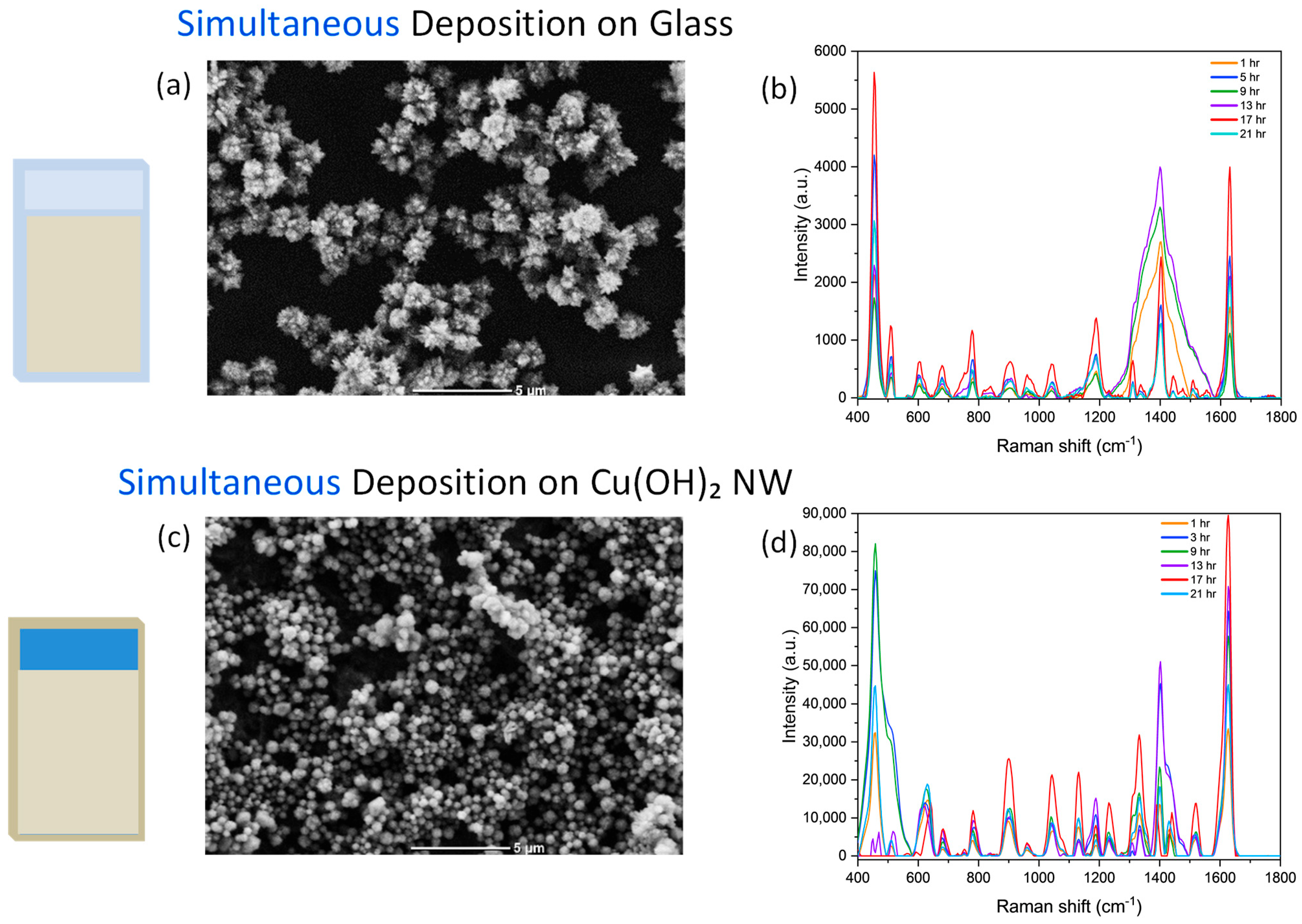
Silver nanostars exhibit an intrinsic plasmonic effect that can be utilized for SERS. However, when deposited on a substrate, the interparticle distance can change, affecting the SERS measurement. To investigate this effect, a glass substrate and a copper hydroxide nanowire (Cu(OH)2-NW) substrate were used, as shown in Figure 2. The lack of porosity of the glass substrate allowed the structures to distribute over a larger surface area, although SEM micrographs revealed aggregation in small clusters and uncovered areas (Figure 2a). In contrast, simultaneous deposition on the Cu(OH)2-NW substrate improved distribution and reduced aggregation (Figure 2c), although the acidity of ascorbic acid degraded the nanowires in several areas. It is also observed that the nanostars exhibit a smaller apparent diameter when deposited on the Cu(OH)2 nanowires. Nevertheless, there is a clear change in homogeneous distribution compared to a smooth surface like glass.
The layer of nanostars deposited on both substrates spontaneously settled upon contact with the newly formed nanostructures. Based on the absorbance analysis as a function of reaction time, nanostars were synthesized on both substrates at reaction times of 1 to 21 h, in 4 h intervals, and analyzed by SERS detection of 25 µL of methylene blue at a concentration of 1 × 10⁻⁵ M. In Figure 2b, the 1624 cm−1 mode, attributed to the stretching of the C–C ring of methylene blue [14], is shown, with intensity varying with reaction time. Measurements with the glass substrate exhibited an intense photoluminescence (PL) band at 1400 cm−1 [15] due to uncovered areas and the 785 nm laser used. In contrast, the Cu(OH)2-NW substrate did not show this effect, allowing better appreciation of MB modes (Figure 2d).
This substrate also exhibited a progressive increase in SERS intensity with reaction time, reaching a maximum at 17 h. This behavior suggests that, up to this point, the growth of well-defined branched nanostars favors the formation of a greater number of electromagnetic hotspots. However, for reaction times beyond 17 h, the acidic nature of the synthesis medium begins to chemically attack the nanostructures themselves, altering their morphology and reducing the sharpness of the branches. These structural modifications consequently diminish the density and effectiveness of hotspots, which explains the decrease in SERS performance observed at 21 h.
Thus, within the range of reaction times evaluated, 17 h represents the optimum synthesis time, providing the best balance between nanostar growth, morphological stability, and hotspot formation.
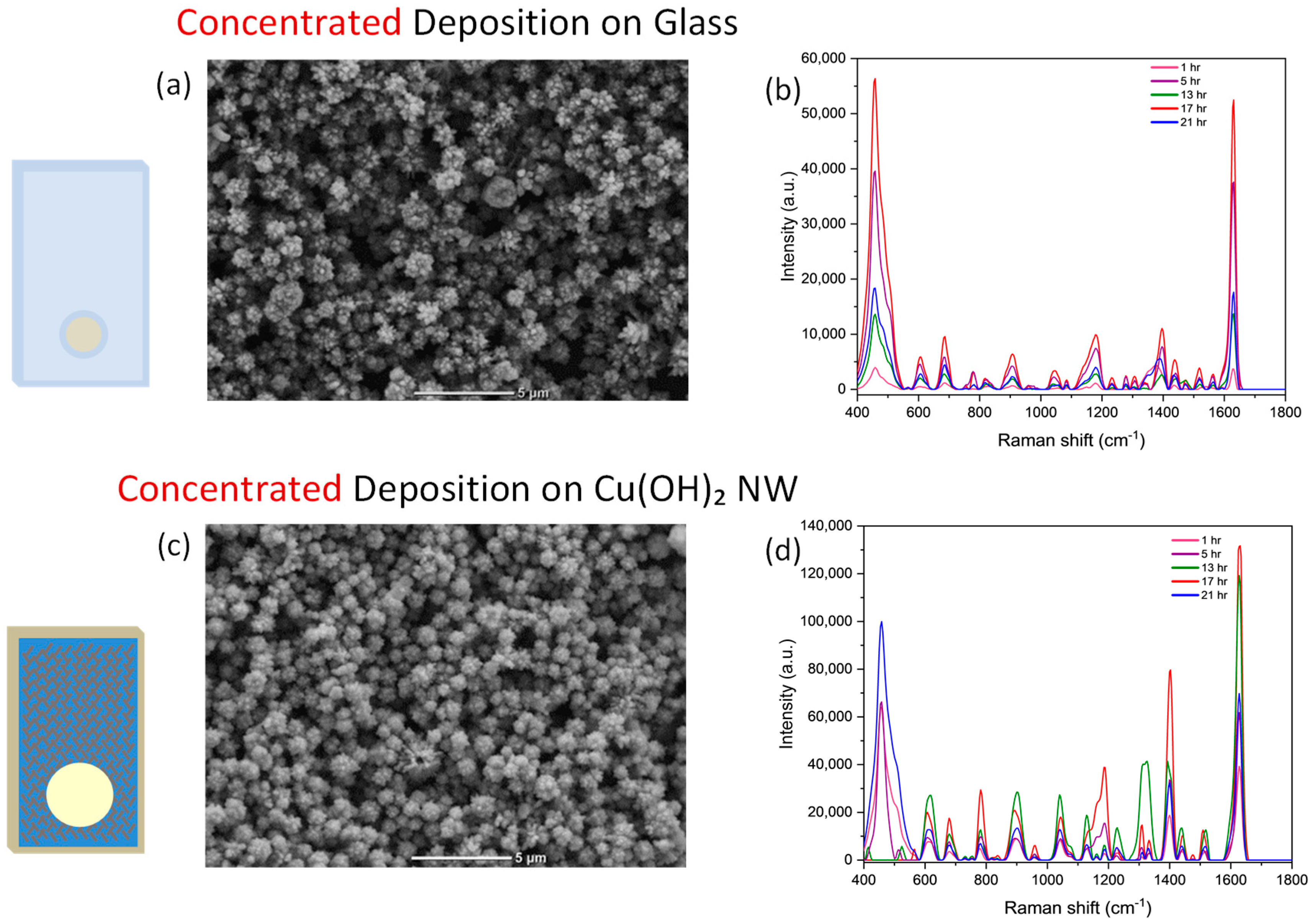
To enhance SERS amplification, the AgNS deposition method was modified. AgNSs were synthesized separately, washed to remove acid residues, and a concentrated drop was deposited on the substrate. Figure 3 shows that for both substrates, glass (a) and Cu(OH)2-NWs (c), the nanostars were more evenly distributed, reducing noise in the Raman signal. With methylene blue as the SERS probe, the glass substrate did not exhibit the PL band at 1400 cm−1, and the symmetric C–N stretching band at 1391 cm−1 was observed (Figure 3c). The 1624 cm−1 band was notably amplified, attributable to the higher density of nanostructures in a smaller area. The Cu(OH)2-NW substrate showed improved distribution, and without the presence of acid, the nanowires were not chemically compromised, contributing to the deposition. Compared to the glass substrate, the Cu(OH)2-NWs achieved higher SERS intensity, doubling at the 1624 cm−1 band (Figure 3d), with increasing intensity and a maximum value at 21 h of reaction time.
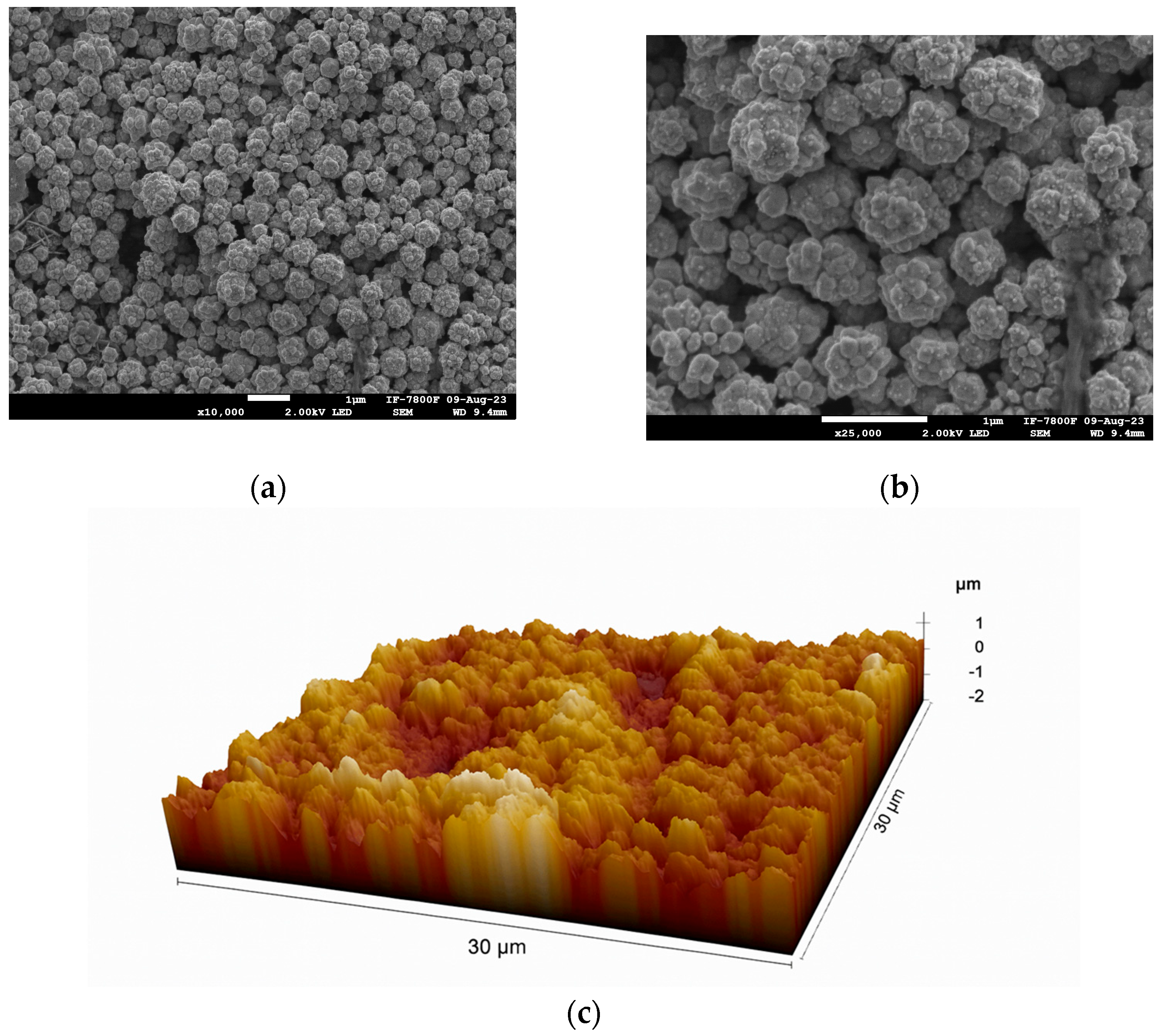
Figure 4 presents two SEM micrographs of silver nanostars with a reaction time of 17 h, deposited on the substrate in a concentrated form. The first micrograph shows a general view of the dispersed nanostars on Cu(OH)2-NWs, revealing their morphology and distribution (Figure 4a). The second micrograph offers a magnified view, highlighting the uniformity and structural similarity between the nanostars (Figure 4b). These details are crucial for functionality in SERS applications, as the tips can significantly amplify the electromagnetic field. Figure 4c presents a three-dimensional model of the nanostar surface, generated from AFM measurements. This model allows for a detailed visualization of the topography, showing roughness and morphology, which can influence the ability to enhance SERS signals.

4. Conclusions

In this work, SERS substrates were fabricated by depositing a solution of silver nanostars (AgNSs) onto copper hydroxide nanowires (Cu(OH)2-NWs). The distribution of AgNSs was evaluated by SEM and compared with nanostars deposited on glass. A more homogeneous distribution was achieved on the Cu(OH)2 nanowires, while the simultaneous deposition process additionally revealed that the nanostars exhibited a smaller apparent diameter in the presence of the hydroxide substrate. Using methylene blue (MB) as a test molecule, we evaluated the SERS performance of the substrates and confirmed that the Cu(OH)2-NW platform provided an intensity ten times higher than glass. Furthermore, a controlled deposition of a more concentrated AgNS solution resulted in a threefold enhancement compared to the initial deposition method and clearly outperformed the simultaneous deposition approach.

Author Contributions

Conceptualization, J.L.Z.N. and L.Z.P.; methodology, J.L.Z.N.; software, D.J.G.; validation, H.A.R.R.; formal analysis, G.S.R.; investigation, J.L.Z.N.; resources, L.Z.P.; data curation, J.H.T.; writing—original draft preparation, J.L.Z.N.; writing—review and editing, M.L.C.; visualization, Y.O.; supervision and project administration, L.Z.P. All authors have read and agreed to the published version of the manuscript.

Funding

This research received no external funding.

Institutional Review Board Statement

Not applicable.

Informed Consent Statement

Not applicable.

Data Availability Statement

The data are unavailable due to privacy and being part of ongoing research.

Conflicts of Interest

The authors declare no conflicts of interest.

References

  1. Le Ru, E.C.; Etchegoin, P.G. Principles of Surface-Enhanced Raman Spectroscopy: And Related Plasmonic Effects; Elsevier: Amsterdam, The Netherlands, 2008. [Google Scholar]
  2. Garcia-Leis, A.; García-Ramos, J.V.; Sanchez-Cortes, S. Silver Nanostars with High SERS Perfomance. J. Front. Chem. 2013, 117, 7791–7795. [Google Scholar] [CrossRef]
  3. Cañamares, M.V.; García-Ramos, J.V.; Sanchez-Cortes, S.; Castillejo, M.; Oujja, M. Comparative SERS effectiveness of silver nanoparticles prepared by different methods: A study of the enhancement factor and the interfacial properties. J. Colloid Interface Sci. 2008, 326, 103–109. [Google Scholar] [CrossRef] [PubMed]
  4. Khoury, C.G.; Vo-Dinh, T. Gold nanostars for surface-enhanced Raman scattering: Synthesis, characterization and optimization. J. Phys. Chem. C 2008, 112, 18849–18859. [Google Scholar] [CrossRef] [PubMed]
  5. Bakar, N.A.; Shapter, J.G. Silver nanostars films for surface-enhanced Raman spectroscopy (SERS) of the pesticide imidacloprid. Heliyon 2023, 9, e14686. [Google Scholar] [CrossRef] [PubMed]
  6. Liu, L.; Zhao, Q.; Yin, N.; Xue, Z.; Sun, Y.; Wu, Y. Self-assembled bimetallic Au@Ag nanostars monolayer flexible substrates for ultrasensitive SERS. Anal. Chim. Acta 2025, 1043, 184277. [Google Scholar] [CrossRef]
  7. Zhou, Q.; Meng, G.; Liu, J.; Huang, Z.; Han, F.; Zhu, C.; Kim, D.; Kim, T.; Wu, N. A Hierarchical Nanostructure-Based Surface-Enhanced Raman Scattering Sensor for Preconcentration and Detection of Antibiotic Pollutants. Adv. Mat. Technol. 2017, 2, 1700028. [Google Scholar] [CrossRef]
  8. Guo, T.L.; Li, J.G.; Sun, X.; Sakka, Y. Improved galvanic replacement growth of Ag microstructures on Cu micro-grid for enhanced SERS detection of organic molecules. Mater. Sci. Eng. 2016, 61, 97–104. [Google Scholar] [CrossRef] [PubMed]
  9. Yusoff, N.N.; Nor Azmi, F.S.; Abu Bakar, N.; Aziz, T.H.T.A.; Shapter, J.G. Titanium carbide MXene/silver nanostars composite as SERS substrate for thiram pesticide detection. Chem. Pap. 2024, 78, 2855–2865. [Google Scholar] [CrossRef]
  10. De Almeida, M.P.; Rodrigues, C.; Novais, A.; Grosso, F.; Leopold, N.; Peixe, L.; Franco, R.; Pereira, E. Silver Nanostar-Based SERS for the Discrimination of Clinically Relevant Acinetobacter baumannii and Klebsiella pneumoniae Species and Clones. Biosensors 2023, 13, 149. [Google Scholar] [CrossRef] [PubMed]
  11. Xing, H.; Chen, T.; Qian, Y.; Huang, Q.; Wei, T.; Hu, X.; Zhao, J.; Wang, B. A gold–silver nanostar 2D array composite structure for rapid SERS determination of PAHs. Anal. Methods 2025, 18, 3825–3835. [Google Scholar] [CrossRef] [PubMed]
  12. Zamora-Navarro, J.L.; Gonzalez-Zarate, D.; Diaz-Solis, M.A.; Soriano-Rosales, M.G.; Okolodkov, Y.B.; Zamora-Peredo, L. SERS Detection of Methylene Blue and Crystal Violet Using Silver Nanostars. Mater. Proc. 2022, 9, 27. [Google Scholar]
  13. Diaz Solis, M.A.; Pinilla Rodriguez, J.A.; Pozos Texon, F.d.J.; Delfín Ruiz, M.E.; Zamora Peredo, L.; Hernández Torres, J. Assessment via SERS of Two Simple Chemical Methods for Silver Nanoparticle Deposition Onto Copper Hydroxide Nanowires. In Proceedings of the 2023 IEEE International Conference on Engineering Veracruz (ICEV), Boca del Río, Veracruz, Mexico, 23–26 October 2023; pp. 1–5. [Google Scholar]
  14. Xu, T.; Wang, X.; Huang, Y.; Lai, K.; Fan, Y. Rapid detection of trace methylene blue and malachite green in four fish tissues by ultra-sensitive surface-enhanced Raman spectroscopy coated with gold nanorods. Food Control 2019, 106, 106720. [Google Scholar] [CrossRef]
  15. Tuschel, D. Selecting an excitation wavelength for Raman spectroscopy. Spectroscopy 2016, 3, 14–23. [Google Scholar]
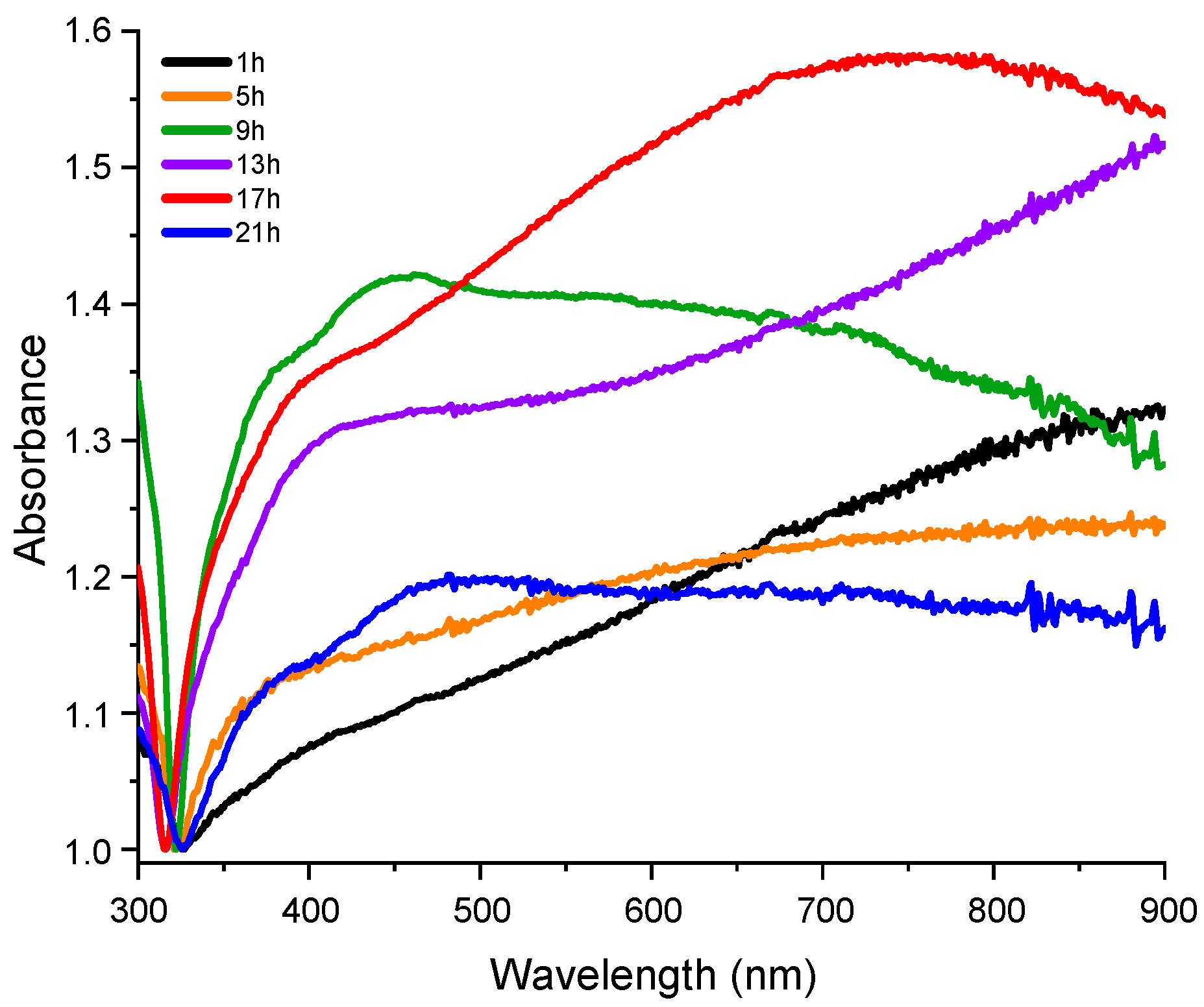
Figure 1. Absorption spectra of silver nanostars synthesized with reaction times of 1, 5, 9, 13, 17, and 21 h, respectively.
Materproc 28 00007 g001
Figure 2. SEM micrographs of silver nanostars formed on (a) glass and (c) copper hydroxide nanowires; SERS detection of 25 µL of methylene blue at a concentration of 1 × 10⁻⁵ M on (b) glass and (d) Cu(OH)2-NWs.
Materproc 28 00007 g002
Figure 3. SEM micrographs of concentrated silver nanostars on (a) glass and (c) copper hydroxide nanowires; SERS detection of 25 µL of methylene blue at a concentration of 1 × 10⁻⁵ M on (b) glass and (d) Cu(OH)2-NWs.
Materproc 28 00007 g003
Figure 4. SEM micrographs of silver nanostars, with a reaction time of 17 h, on a substrate of copper hydroxide nanowires deposited in a concentrated manner, with a magnification of (a) 10,000× and (b) 25,000×. Additionally, (c) a three-dimensional model of the surface of the nanostars was generated from AFM measurements.
Materproc 28 00007 g004
Disclaimer/Publisher’s Note: The statements, opinions and data contained in all publications are solely those of the individual author(s) and contributor(s) and not of MDPI and/or the editor(s). MDPI and/or the editor(s) disclaim responsibility for any injury to people or property resulting from any ideas, methods, instructions or products referred to in the content.