Abstract
This study presents an advanced co-optimization model for water–energy nexus systems (WENSs), illustrating considerable benefits in both energy conservation and cost reduction through synergistic operations. Case studies compare the co-optimized operations of a 33-bus power distribution network (PDN) coupled with a commercial-scale 15-node water distribution network (WDN) via water pumps and a standalone operations of a PDN and WDN, revealing that co-optimization notably decreases the operational costs for both networks by 23% and 49%, respectively, leading to substantial daily savings. In addition, this paper summarizes the current problems based on previous research, delineating the challenges in the co-optimization and management of WENSs, such as modeling inaccuracies, uncertainty management, and multi-stakeholder governance, providing meaningful insights and potential directions for future research.
1. Introduction
Water and energy systems are critical, intertwined infrastructures pivotal to modern societal functions. On the one hand, energy systems, which include energy production, processing, and conversion, rank as the second-largest water consumers globally, accounting for approximately 10% of total water utilization [1]. On the other hand, water management systems heavily rely on electricity for water extraction, purification, distribution, and desalination, with water-related energy consumption in the United States constituting 4% of the national total, of which 60% is used in water supply systems [2]. This delicate dependence indicates that a crisis affecting one system might potentially cripple both, as witnessed by the 2021 Texas hurricane, which left over 4.5 million houses without power and disrupted water supplies to approximately 13 million people [3].
In practical applications, the operation of PDNs and WDNs is overseen by their operators, who only focus on their own operating objectives (e.g., operating costs) and operational constraints, rather than joint management. This paper presents a co-optimization model for WENSs, showcasing the considerable benefits of synergistic operation in terms of energy conservation and cost reduction compared to uncoordinated strategies.
2. WENS Model
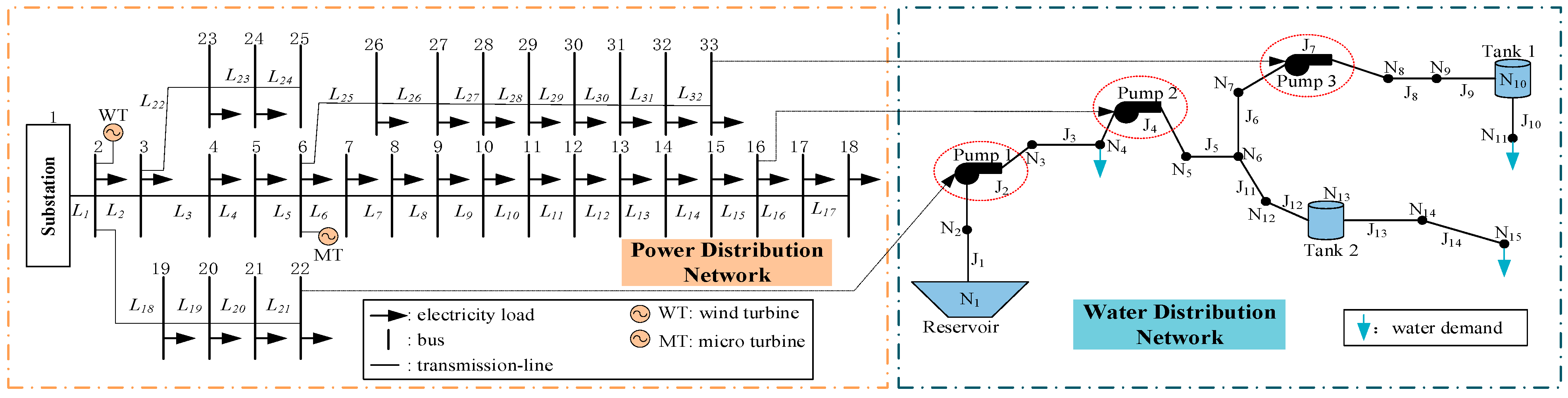
Figure 1 shows a typical WENS model adapted from [4], composed of a modified IEEE 33-bus PDN coupling with a 15-node commercial WDN through three water pumps. The operator of the WENS ensures the daily household power demands and supplies the WDN with sufficient electricity for pump stations in transporting water between reservoirs, storage tanks, and customers via pipelines. The proposed framework aims to minimize the total energy consumption cost of the WENS by optimally scheduling water flow, operation of pumps, and the electricity procurement and distributed generation every hour while meeting the operating constraints of the WDN and PDN at the same time.
Figure 1.
WENS test system model.
Equation (1) illustrates the objective function of the proposed WENS model, representing the total power cost, where represent the purchase price and purchase power from the upstream power grid, respectively; the second to fourth terms in (1) are the operation costs of the distributed generators, where are the coefficients, and represents the power output of distributed generator .
Equation (2) shows the water flow balance requirements for node in the WDN, where and represent the water flow into node from node and reservoir, respectively. represent the water flow from node to node and water flow to the users and tanks at node respectively. Equation (3) illustrates the water head loss caused by the friction in the pipes based on the Hazen–Williams equation [5], where and are the water pressure head at node i and node j, and is the resistance coefficient of pipe i–j. As the coupling components in the WENS, pumps convert electricity to the water head in order to compensate for the water head loss. The water head gained and the power consumed by pumps are shown in Equations (4) and (5), where , are the coefficients of pump u and are the water flow and speed of pump u. The power balance for node i in the PDN is illustrated by Equation (6), where represents the power injection from distributed generator u to node i, is the power demand at node i, and and are the power supply from node i to pump u and the power flow between nodes i and j, respectively. is the set of nodes in the PDN. As indicated by Equation (6), the operator of the WENS can meet the power consumption of the pumps in the WDN and other electricity demand in the PDN by either purchasing electricity from the upstream power grid or generating power with the distributed generators, e.g., microturbines (MTs) or wind turbines (WTs).
3. Case Study
The efficacy of the proposed WENS model is tested by a modified IEEE 33-bus PDN, including an MT, a WT, 32 transmission lines, and 32 load points, connected to a 15-node WDN comprising 11 pipelines, 2 storage tanks, and 3 water demand nodes through 3 pumps (Figure 1). The simulations leverage the Gurobi solver (version 10.0.3) and MATLAB (R2020a) on a Notebook PC of ASUS, Guangzhou, China, equipped with an Intel® Core™ i5-8500 CPU, 8 GB RAM, and a 64-bit operating system. The following two cases in comparison are used to demonstrate the performance of the proposed model. Case I presents the standalone operation of a PDN and WDN under the control of their respective operators who only focus on their own operating costs. Case II illustrates the performance of the co-optimization of a WENS, with the operator jointly optimizing the dispatch decisions of both the PDN and WDN at the same time.
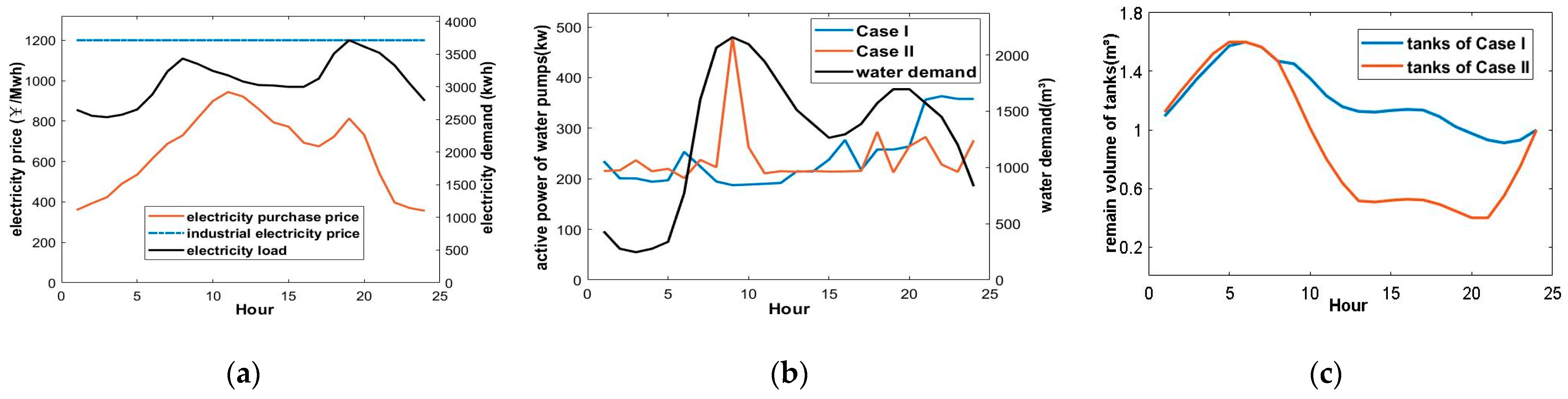
In Case I, the operational costs for the WDN are predicated on the industrial electricity rates, as depicted in Figure 2a. Both cases are subjected to identical electricity purchasing prices from upstream grid, electrical loads, and water demands, etc.
Figure 2.
(a) Electricity purchase price from upstream grid, the industrial electricity price for pumps in Case I, and the electricity loads in both cases. (b) Power of water pumps and the water demand in both cases. (c) The remaining volume of water in tanks in both cases.
It can be observed that during peak-hour power loads (at about 9 a.m. and 9 p.m.), which is also the high electricity price period and peak hour of water demand, the operator of the WENS actively utilizes the storage water tanks to reduce the power consumption of pumps and thus avoids high operating costs, while the operator of the WDN in Case I merely schedules the pumps to meet the water requirements, since the electricity prices for pumps are flat. Conversely, during off-peak hours of power demand, characterized by lower energy costs, pumps are utilized more intensively to replenish water tanks in WDN, optimizing both the PDN and WDN through economic signals, thereby minimizing total operational costs.
A comparative analysis of operational expenditures for the WDN and PDN in the two cases is presented in Table 1. The results clearly show that the co-optimization of the WENS not only reduces electricity costs for the PDN but also significantly lowers operational expenses for the WDN by 23% and 49%, respectively. Consequently, this integrated approach yields a daily saving of approximately RMB 18,699 through co-optimization strategies.
Table 1.
Operational costs for WDN and PDN under two cases.
4. Challenges and Prospects
Even though the proposed co-optimization of the WENS model has significant economic benefits and many research efforts have been extended lately, the journey towards fully optimized WENSs is fraught with the following challenges.
4.1. System Modeling
When it comes to the modeling of WENSs, water leakage in WDNs is often overlooked, which may cause over-idealization of the model. Previous studies have demonstrated that reducing leakage rates can save considerable energy consumption costs. Consequently, the over-idealization of WDNs compromises their feasibility and effectiveness. Besides, due to the nonlinear hydraulic constraints in WDNs, precise and efficient general linearization and relaxation methods have yet to be explored.
4.2. Uncertainty Management and Solution Robustness
Characterized by inherent uncertainties, including wind and load forecasting as well as the detection of leakage amount and location, the simple single-uncertainty management methods no longer work for WENSs, resulting in an urgent need for new methodologies addressing these mixed uncertainties to improve model robustness and accuracy.
4.3. Multi-Stakeholder Management
The governance of WENSs involves a wide range of stakeholders, including utility providers, operators, and regulatory bodies. The divergent interests and concerns regarding data privacy and risk distribution among these entities present a considerable challenge. Thus, the development of robust data transmission protocols and equitable risk-sharing mechanisms, possibly through multiparty game-theory approaches, is critical.
5. Conclusions
This study introduces a co-optimization method for the operation of WENSs and proves the economic benefits through rigorous case study analysis. Considering the challenges and future research for the optimization of WENSs, it calls for a concerted research effort focused on the precision of system models, uncertainty management, and multi-stakeholder engagement.
Author Contributions
Conceptualization, supervision and writing—review and editing are finished by Z.L.; methodology, software, validation, formal analysis, investigation, data curation, writing—original draft preparation and visualization are done by J.Z. All authors have read and agreed to the published version of the manuscript.
Funding
The research is supported by Guangdong Basic and Applied Basic Research Foundation (Program No. 2023A1515011171).
Institutional Review Board Statement
Not applicable.
Informed Consent Statement
Not applicable.
Data Availability Statement
The original data presented in the study are openly available in reference [6] and https://usmart.ece.utah.edu/datasets/.
Conflicts of Interest
The authors declare no conflicts of interest.
References
- Birol, F. World Energy Outlook 2016—Analysis. Available online: https://www.iea.org/reports/world-energy-outlook-2016 (accessed on 13 March 2024).
- Grubert, E.; Sanders, K.T. Water Use in the United States Energy System: A National Assessment and Unit Process Inventory of Water Consumption and Withdrawals. Environ. Sci. Technol. 2018, 52, 6695–6703. [Google Scholar] [CrossRef] [PubMed]
- Busby, J.W.; Baker, K.; Bazilian, M.D.; Gilbert, A.Q.; Grubert, E.; Rai, V.; Rhodes, J.D.; Shidore, S.; Smith, C.A.; Webber, M.E. Cascading Risks: Understanding the 2021 Winter Blackout in Texas. Energy Res. Soc. Sci. 2021, 77, 102106. [Google Scholar] [CrossRef]
- Rodriguez-Garcia, L.; Hosseini, M.M.; Mosier, T.M.; Parvania, M. Resilience Analytics for Interdependent Power and Water Distribution Systems. IEEE Trans. Power Syst. 2022, 37, 4244–4257. [Google Scholar] [CrossRef]
- Liou, C.P. Limitations and Proper Use of the Hazen-Williams Equation. J. Hydraul. Eng. 1998, 124, 951–954. [Google Scholar] [CrossRef]
- Baran, M.E.; Wu, F.F. Network Reconfiguration in Distribution Systems for Loss Reduction and Load Balancing. IEEE Trans. Power Deliv. 1989, 4, 1401–1407. [Google Scholar] [CrossRef]
Disclaimer/Publisher’s Note: The statements, opinions and data contained in all publications are solely those of the individual author(s) and contributor(s) and not of MDPI and/or the editor(s). MDPI and/or the editor(s) disclaim responsibility for any injury to people or property resulting from any ideas, methods, instructions or products referred to in the content. |
© 2024 by the authors. Licensee MDPI, Basel, Switzerland. This article is an open access article distributed under the terms and conditions of the Creative Commons Attribution (CC BY) license (https://creativecommons.org/licenses/by/4.0/).