


Abstract
In crucial applications, sensor node coverage of the objective zone must be stabilized in Wireless Sensor Networks (WSN). A network with holes in coverage is more susceptible to node failures or malicious attacks. According to the total number of hops used to transport data, nodes may calculate their distance from the sink node. A coverage hole may be present if a node notices a much higher hop count than its neighbors. The network becomes more robust and resilient to diverse problems by proactively recognizing and correcting coverage holes. Coverage hole identification aids in the efficient use of network resources. By identifying places with poor coverage, resources such as electricity and bandwidth may be efficiently deployed to increase coverage in specific areas or extend the network lifetime overall. However, some node sensors die while the network operates due to energy restrictions, which may disturb the inclusion of the objective zone, resulting in a coverage hole. Due to limited battery life, the existence of impediments and physical damage to sensor nodes, coverage holes may emerge in sensor networks. Early identification of coverage holes enables prompt maintenance and troubleshooting, which minimizes the need for future major and expensive replacements or reconfigurations. The loss on the region of interest may be calculated by locating the coverage holes and identifying the malfunctioning node that created it. This article discusses many coverage-hole-detecting methods, classification approaches, and different performance comparison assessments. Compared to conventional techniques for detecting coverage holes, the investigated methods contribute to the universal viewpoint on holes and compute the number of holes quite precisely.
1. Introduction
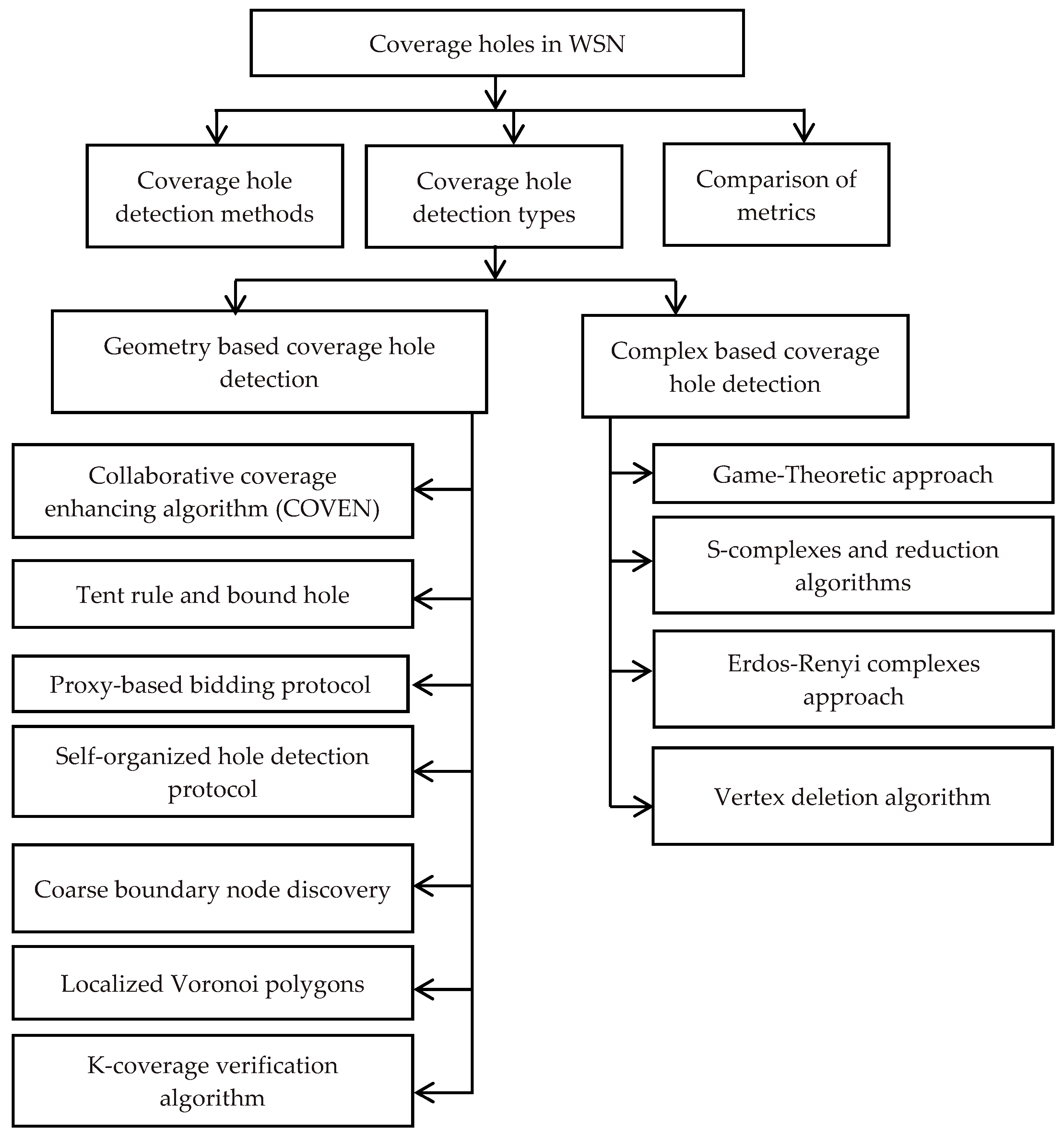
WSNs vary from typical wireless networks in several ways, including restricted memory, limited processing capabilities, a limited energy supply, and an explicit nature [1,2]. The objective zone describes the region or area where the network hopes to provide a specified amount of coverage. This goal zone may encompass the full deployment area or just a portion of it. Identification of regions inside the objective zone where actual coverage is less than expected is the main purpose of coverage hole identification. This zone denotes the region where the network should have adequate coverage to suit the needs of the application. When compared to wireless networks, radio transmission of sensor nodes, for example, has low power and short range [3]. A coverage hole can be formed for a variety of reasons. Aside from subjective node categorization, improper network topology [4] node replacement, the ROI’s potential for blockage, aggressive condition, and energy waste all contribute to coverage hole As a result, identifying such coverage holes is critical [5], since the presence of such holes can devastate a WSN’s performance in terms of poor communication and unnecessary energy [6]. Data fusion is principally supplied, and scaling measures for coverage, network compactness, and SNR are established to detect coverage through sensor collaboration [7,8]. In any case, a few explanations indicate a drop in system coverage, such as random distribution, location changes, and node energy depletion. As a result, data restriction or information loss will happen [9]. The three categories of current hole recognition algorithms include computation techniques, probabilistic approaches, and topographical strategies [10]. Figure 1 depicts the review’s hierarchical chart.
Figure 1.
WSN coverage hole detection and categorization hierarchical diagram.
The rest of this article is divided into the following sections. The existing coverage hole methods are covered in Section 2. Section 3 provides the details of the experimental setup, Section 4 provides a discussion and comparison of the performance of various approaches, and Section 5 concludes with a summary.
2. Methodology
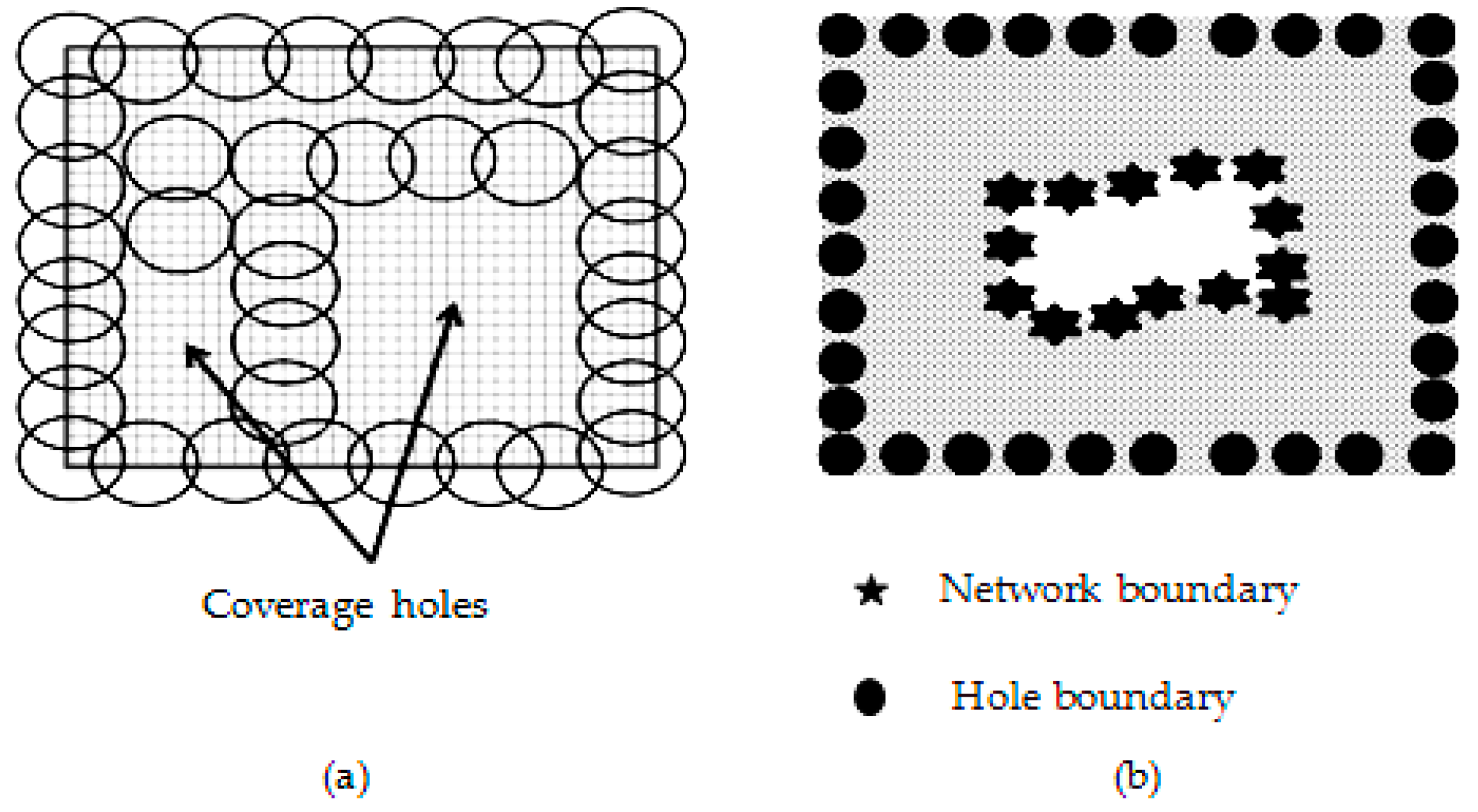
Coverage, specifically regional coverage, has been identified as a critical necessity since the beginning of WSN research [11]. Coverage indicates if at least one sensor has detected each place inside the Region of Interest (ROI). In terms of coverage, each sensor must enclose certain sub-regions, and by aggregating the whole secure sub-regions, a protected region in the WSN may be achieved [11,12]. A coverage hole might be built for a variety of reasons. In addition to the random arrangement of nodes, faulty network architecture [12], node replacement [13], a lack of friendliness in the surroundings, issues with ROI [14], and power draining [15] all contribute to coverage hole formation. There are two categories of nodes in a WSN as a result of the arbitrary organization. The outer node participates in the border arrangement and the interior nodes do not [16]. Outside nodes have an active role in security and research activities. While the arrangement of nodes inside each other may be enhanced, however, Figure 2a shows possibly fewer coverage hole areas without any sensors protecting them, and Figure 2b indicates the network boundary. Circle indicates the sensing range of the sensor. The arrow indicates the coverage hole, due to node failure.
Figure 2.
Coverage holes: (a) multiple in a WSN; (b) coverage holes and network boundary.
The network-boundary recognizing or connecting ROI is difficult, whereas the organization limits hubs around the ROI of the whole organization. The hole boundary is mostly made up of nodes, but it may also consist of functions. Malfunctioning hubs may even contribute from the interior nodes to the nodes that define the boundaries of another hole. As a result, detecting the hole boundary is important for the following reasons:
- The nonfunctional nodes can be accurately identified by the hole boundary;
- By identifying hole borders, effective routing can stop data from being lost in the network;
- Detecting the hole boundary precisely determines the hole region;
- Geographic multicasting is enhanced by the introduction of a hole restriction;
- The number of additional nodes required for hole correction may be determined with proper hole boundary detection.
Coverage hole detection algorithms can discover more about the physical placement of sensor nodes, their communication ranges, and any gaps or obstructions that can impair coverage by utilizing computational geometry. Accuracy is improved by combining geometric approaches with energy-conscious algorithms and communication protocols.
2.1. Techniques for Detecting Coverage Holes
Three categories will be used to categorize the existing coverage hole identification techniques. They are connectivity-based, range-based, and location-based. Any coverage holes in the target zone may be properly located using location-based algorithms [9]. The necessity for precise geographic data has a significant impact on the applicability of some data since it might be challenging to obtain in specific circumstances. Range-based techniques only employ restricted distance data between nearby sensors to discover coverage holes in the classification that follows. Furthermore, it could still be too costly to collect accurate distance information between nodes. Connectivity-based estimations are particularly significant because the availability of data is anything but trustworthy. Homology-theory-based algorithms stand out among the rest of these, which use logarithmic devices to evaluate systems’ topological characteristics.
2.2. Algorithm for Detecting Coverage Holes Based on Simplified Rips Complex
A reliable approach for identifying coverage holes was developed by Jing Zhang et al. [17] and is based on the fundamental Rips complex. The notion of the whole outline then states that recurring edges must be eliminated by excess edge cancellation requirements. Based on the previous two levels, the Rips complex has been masterfully streamlined. The development of boundary loop filtering and boundary rules from the viewpoint of the loop is the last step in making it possible to identify coverage holes in WSNs. The pseudocode for coverage hole detection is as follows.
| function detectCoverageHoles(): initializeGrid()//Create a grid over the network area markGridCellsAsCovered()//Mark grid cells with sensor nodes for each grid cell: if isEmpty(grid cell) or isLowDensity(grid cell): markAsPotentialHole(grid cell) identifyConnectedComponents()//Analyze connectivity among grid cells for each potential hole: if isConnectedToBoundary(potential hole): markAsCoverageHole(potential hole) function initializeGrid(): //Divide the network area into grid cells function markGridCellsAsCovered(): for each sensor node: calculateGridCell(node position) markGridCellAsOccupied(grid cell) function isEmpty(grid cell): //Check if a grid cell has no sensors function isLowDensity(grid cell): //Check if the sensor density in a grid cell is below a threshold function markAsPotentialHole(grid cell): //Mark a grid cell as a potential coverage hole function identifyConnectedComponents(): //Use graph traversal algorithms (e.g., Depth-First Search or Breadth-First Search) //to find connected components of grid cells function isConnectedToBoundary(potential hole): //Check if a potential hole is connected to the network boundary function markAsCoverageHole(potential hole): //Mark a potential hole as a coverage hole |
2.3. Coverage Hole Detection Technique with Low Energy Consumption
Energy restrictions have a substantial influence on the network’s performance and operating lifespan, and they can cause coverage holes in several ways. Low-battery nodes might abruptly fail, leaving coverage holes in their surrounding areas. These holes may widen when nearby nodes boost their energy consumption rates to make up for the coverage lost by the failing node. The operating lifespan of a sensor node is directly influenced by battery capacity. Shorter lives of nodes with smaller battery capacity may result in early failures and possible coverage holes when nodes go inactive [18].
2.4. Sensing Coverage Hole Detection and Repair Algorithms for WSNs
To find coverage holes, Parmod Singh et al. [19] describe a successful chord-based method. The CBHC technique uses the fewest possible sensor nodes while providing complete detecting network coverage by limiting the detecting coverage region overlay. The simulation findings demonstrate that the suggested methodologies for hole detection and healing are effective at finding coverage holes and effectively overlaying the holes that were detected.
2.5. Reinforcement-Learning-Based Distributed Coverage Hole Recovery Approach
Faten Hajjej et al. [20] provide a unique game theory strategy for randomly increasing coverage holes based on reinforcement learning. Sensor nodes can increase coverage holes using only nearby colleagues in the stated likely scenario. Every sensor node chooses the aggregated activity of node movement and detects range adjustment to reduce coverage holes. Contrary to previous methodologies, the simulation findings demonstrate that the proposed strategy may maintain a network that fully accounts for arbitrary destruction.
2.6. List of Coverage Holes Found in WSN
The sensor node and the sink node are both included in WSN. Therefore, the productive positioning of the sensor and sink is critical to extending the network lifetime. If sensors are constantly transmitted in even symmetrical regions, such as circular or rectangular regions, a static sink will be placed at the region’s focus point, or a mobile sink may be used. In any event, if the monitoring zone is in a remote location, the static sink should be placed outside the monitoring zone. The WSN may feature static nodes, portable nodes, or a combination of the two. Although static nodes are less expensive, they cannot relocate or migrate to another location without the assistance of another. Portable sensors, on the other hand, can help enhance network analysis, but they are pricey. A combination of static and portable sensors is used to provide better cost–performance tradeoffs. The haphazard placement of static nodes does not provide coverage or connection. It is critical to deliver the sensor node without coverage holes to maximize the organization’s longevity. Coverage hole identification and repair are critical for energy-efficient information collection from WSN. Table 1 shows a summary of coverage hole detection in WSN.
Table 1.
Comparison of performance metrics.
3. Experimental Setup
The resulting experimental example has a 40 m range, since it is anticipated that the transmitter and receiver distance will be twice as great as what the sensors can detect. Each node is given a set of instructions on how to find the sensor array of its failed neighbor to learn more about that node’s options from its one-hop neighbors.
4. Discussion
WSNs can have a homogeneous or heterogeneous network architecture. If every node in a network is the same, the network is said to be homogenous. This indicates that they are equal in terms of their capabilities, including processor speed, memory capacity, and communication range. In general, heterogeneous networks are more difficult to deploy and maintain than homogeneous networks. Several real-world situations, including environmental monitoring, military surveillance, industrial automation, and smart cities, can use coverage hole detection to locate places where a sensor network is not providing sufficient coverage. When more sensor nodes are deployed, the coverage gaps will be filled, and the area’s security will be enhanced. Coverage hole detection can be used in industrial automation to locate places where the network does not offer sufficient coverage for monitoring equipment or managing production procedures. To find places where the network is not gathering information on air quality, water quality, or other environmental factors, for instance, coverage hole detection can be utilized in environmental monitoring. In this research, we looked at certain imperative execution estimates from various authors, such as energy consumption, network lifespan, time consumption, cost efficiency, coverage performance, and network lifetime, which are shown in Table 1 and Table 2.
Table 2.
A summary of typical problems on energy and computational complexity in WSNs.
Coverage hole detection can be used in military surveillance to pinpoint regions where the network does not offer sufficient coverage for spotting adversary activities. The “√” mark denote the corresponding energy consumption and computational complexity measures against each strategy proposed by various authors.
5. Conclusions
The issue of coverage hole identification and mending is investigated in this study. When compared to typical border node identification approaches, the investigated methodologies provide a more accurate overall image of holes and determine the diameter of holes. As a result, this evaluation is a helpful tool for identifying and fixing coverage flaws. Machine learning algorithms can pick up new information and revise their predictions in response to changes in the network topology or the appearance of new barriers. The machine learning algorithms can find patterns and correlations that might not be obvious using conventional approaches by learning from previous occurrences of coverage holes. In future research, we may work on these techniques to adapt dynamic WSN environments for more accurate hole detection.
Author Contributions
Conceptualization, A.C.A. and S.S.; methodology, A.C.A.; formal analysis, A.C.A. and S.S.; investigation, A.C.A.; resources, A.C.A.; writing—original draft preparation, A.C.A. and S.S.; writing—review and editing, A.C.A. and S.S.; visualization, A.C.A. and S.S.; supervision, S.S.; project administration, S.S.; funding acquisition, A.C.A. and S.S. All authors have read and agreed to the published version of the manuscript.
Funding
This research received no external funding.
Institutional Review Board Statement
Not applicable.
Informed Consent Statement
Not applicable.
Data Availability Statement
Not applicable.
Conflicts of Interest
The authors declare no conflict of interest.
References
- Guleria, K.; Verma, A.K. Comprehensive review for energy efficient hierarchical routing protocols on wireless sensor networks. Wirel. Netw. 2019, 25, 1159–1183. [Google Scholar] [CrossRef] [Scilit]
- Bhushan, B.; Gadadhar, S. Recent advances in attacks, technical challenges, vulnerabilities and their countermeasures in wireless sensor networks. Wirel. Pers. Commun. 2018, 98, 2037–2077. [Google Scholar] [CrossRef] [Scilit]
- Shaikh, F.K.; Sherali, Z. Energy harvesting in wireless sensor networks: A comprehensive review. Renew. Sustain. Energy Rev. 2016, 55, 1041–1054. [Google Scholar] [CrossRef] [Scilit]
- Ayadi, A.; Ghorbel, O.; Obeid, A.M.; Abid, M. Outlier detection approaches for wireless sensor networks: A survey. Comput. Netw. 2019, 129, 319–333. [Google Scholar] [CrossRef] [Scilit]
- Das, S.; DebBarma, M.K. Hole detection in wireless sensor network: A review. In Recent Findings in Intelligent Computing Techniques: Proceedings of the 5th ICACNI 2017; Springer: Singapore, 2018; Volume 2, pp. 87–96. [Google Scholar]
- Das, S.; Debbarma, M.K. A Review on Coverage-Hole Boundary Detection Algorithms in Wireless Sensor Networks. Comput. Y Sist. 2021, 24, 121–140. [Google Scholar] [CrossRef]
- Deng, X.; Jiang, Y.; Yang, L.T.; Lin, M.; Yi, L.; Wang, M. Data fusion based coverage optimization in heterogeneous sensor networks: A survey. Inf. Fusion 2020, 52, 90–105. [Google Scholar] [CrossRef] [Scilit]
- Yang, H. A practical method for connectivity and coverage reliability analysis for linear wireless sensor networks. Ad Hoc Netw. 2023, 146, 103183. [Google Scholar] [CrossRef] [Scilit]
- Sung, T.-W.; Yang, C.-S. Voronoi-based coverage improvement approach for wireless directional sensor networks. J. Netw. Comput. Appl. 2014, 39, 202–213. [Google Scholar] [CrossRef] [Scilit]
- Soundarya, A.; Santhi, V. An efficient algorithm for coverage hole detection and healing in wireless sensor networks. In Proceedings of the 2017 1st International Conference on Electronics, Materials Engineering and Nano-Technology (IEMENTech), Kolkata, India, 28–29 April 2017; pp. 1–5. [Google Scholar]
- Das, S.; Debbarma, M.K. A survey on coverage problems in wireless sensor network based on the monitored region. Adv. Data Inf. Sci. 2019, 2, 349–359. [Google Scholar]
- Kröller, A.; Fekete, S.P.; Pfisterer, D.; Fischer, S. Deterministic boundary recognition and topology extraction for large sensor networks. In Proceedings of the Seventeenth Annual ACM-SIAM Symposium on Discrete Algorithm, Miami, FL, USA, 22–26 January 2006; Society for Industrial and Applied Mathematics: Philadelphia, PA, USA, 2006; pp. 1000–1009. [Google Scholar]
- Wang, Y.; Gao, J.; Mitchell, J.S. Boundary recognition in sensor networks by topological Methods. In Proceedings of the 12th Annual International Conference on Mobile Computing and Networking, Los Angeles, CA, USA, 23–29 September 2006; ACM: New York, NY, USA, 2006; pp. 122–133. [Google Scholar]
- Sharma, P.; Singh, R.P. Coverage hole identification & healing in Wireless Underground Sensor Networks. Meas. Sens. 2022, 24, 100540. [Google Scholar]
- Wang, F.; Hu, H. Coverage hole detection method of wireless sensor network based on clustering algorithm. Measurement 2021, 179, 109449. [Google Scholar] [CrossRef] [Scilit]
- Li, W.; Zhang, W. Coverage hole and boundary nodes detection in wireless sensor networks. J. Netw. Comput. Appl. 2015, 48, 35–43. [Google Scholar] [CrossRef] [Scilit]
- Zhang, J.; Chu, H.; Feng, X. Efficient Coverage Hole Detection Algorithm Based on the Simplified Rips Complex in Wireless Sensor Networks. J. Sens. 2020, 2020, 3236970. [Google Scholar] [CrossRef] [Scilit]
- Abdellatief, W.; Abdelkader, H.; Hadhoud, M. An energy-efficient coverage hole detection technique for randomly deployed wireless sensor networks. In Proceedings of the 2016 11th International Conference on Computer Engineering & Systems (ICCES), Cairo, Egypt, 20–21 December 2016; pp. 340–347. [Google Scholar]
- Singh, P.; Chen, Y.C. Sensing coverage hole identification and coverage hole healing methods for wireless sensor networks. Wirel. Netw. 2021, 26, 2223–2239. [Google Scholar] [CrossRef] [Scilit]
- Hajjej, F.; Hamdi, M.; Ejbali, R.; Zaied, M. A distributed coverage hole recovery approach based on reinforcement learning for Wireless Sensor Networks. Ad Hoc Netw. 2020, 101, 102082. [Google Scholar] [CrossRef] [Scilit]

Disclaimer/Publisher’s Note: The statements, opinions and data contained in all publications are solely those of the individual author(s) and contributor(s) and not of MDPI and/or the editor(s). MDPI and/or the editor(s) disclaim responsibility for any injury to people or property resulting from any ideas, methods, instructions or products referred to in the content. |
© 2023 by the authors. Licensee MDPI, Basel, Switzerland. This article is an open access article distributed under the terms and conditions of the Creative Commons Attribution (CC BY) license (https://creativecommons.org/licenses/by/4.0/).