Proceeding Paper

Ginger Leaf Diseases Detection Using Deep Learning: A Comparative Study of Pre-Trained Models †
by
Wai Zhong Wong
*,
Yiqi Tew
and
Chi Wee Tan
Faculty of Computing and Information Technology, Tunku Abdul Rahman University of Management and Technology (TAR UMT), Kuala Lumpur 56100, Malaysia
*
Author to whom correspondence should be addressed.
Presented at 2025 IEEE International Conference on Computation, Big-Data and Engineering (ICCBE), Penang, Malaysia, 27–29 June 2025.
Eng. Proc. 2026, 128(1), 1; https://doi.org/10.3390/engproc2026128001
Published: 4 March 2026

Abstract

Ginger (Zingiber officinale) is an essential crop that is widely cultivated for its medical and culinary value. In 2023, ginger was considered one of the highest value herbs, with approximately 9089.85 tons produced in Malaysia. However, the ginger cultivation suffers from plant diseases, which lead to plant death and eventually cause crop losses. Furthermore, the lack of studies in ginger leaf disease detection using deep learning techniques is a limitation that hinders the early diagnosis and management of ginger diseases. To address this limitation, we collected 968 ginger plant images cropped into single leaf images and labelled into 4 classes: leaf blight, dehydrated, damaged pest, and healthy, using the Encordplatform. The generated dataset consisted of 4033 leaf images. Through data augmentation, the dataset was expanded into 10,910 leaf images to improve the model’s generalization. As deep learning techniques are popular in plant disease detection, we evaluated several popular pre-trained models using TensorFlow and PyTorch libraries and compared the performance with that of other models. For all of these models, the same settings were applied with minimal modification to the model’s layers. Among the compared models, EfficientNetB3 achieved the highest accuracy of 94.3% in detecting ginger leaf diseases. It surpassed other models and exceeded the next-best model in this experiment, MobileNetV2, which achieved 89.66% accuracy, by 4.64%.

1. Introduction

Ginger (Zingiber officinale) is an essential crop widely cultivated for its medical and culinary value. In Malaysia, ginger has been considered one of the highest commercial potential herbs [1]. In 2023, approximately 9089.85 tons were produced in Malaysia, which shows the importance of ginger in Malaysia’s crop market [2]. However, ginger cultivation is facing challenges, especially diseases that affect the growth and cause the loss of ginger crops. Bacterial wilt, a type of ginger plant disease, has contributed to the significant drop in the ginger production in Sabah, Malaysia, from 5848.4 tons in 2006 to 1076.6 tons in 2022 [3,4]. There are two factors leading to ginger plant disease: biotic and abiotic. Biotic factors are related to infectious diseases when fungi, bacteria, viruses, and nematodes infect the plants, while non-infectious diseases appear due to unfavorable environmental conditions (abiotic factors), including water, temperature, nutrition, and other factors [5].
Traditional disease identification methods rely on manual inspection and laboratory-based methods. These techniques are time-consuming and labor-intensive for large-scale farming [6]. With the advancement of deep learning, automated disease detection has become a feasible solution, offering better accuracy and efficiency [7]. Deep learning methods, particularly convolutional neural networks (CNNs), have demonstrated successful plant disease detection. Pre-trained models with EfficientNet, ResNet, and MobileNet have been widely used due to their capabilities in feature extraction. At the same time, researchers have proposed diverse methods for detecting ginger diseases. However, the datasets used were not publicly available, making it hard to apply the model. Therefore, we gathered a dataset that consisted of four classes: healthy, leaf blight, dehydrated, and pest damage, and evaluated the performance of MobileNetV2, VGG16, and EfficientNetB3 models on the TensorFlow and PyTorch libraries. We compared and evaluated the methods using the self-collected ginger leaf dataset.

2. Related Works

Deep learning has been extensively applied in plant disease detection due to its strong feature extraction capabilities. Recently, researchers have proposed custom convolutional neural network (CNN) models for detecting diseases in ginger plants.
Yigezu et al. developed a CNN model for the early detection of ginger diseases, with a particular focus on bacterial wilt [8]. They compiled a dataset of 7014 images of healthy and infected ginger leaves collected from farms in Ethiopia. Before training, they preprocessed the images for background removal, data augmentation, and resizing. The proposed CNN architecture consisted of five convolutional layers, three pooling layers, and three fully connected layers. Rectified linear unit was used as the activation function for hidden layers, while Sigmoid was applied in the final fully connected layer. The model showed a test accuracy of 95.2% following experimentation and hyperparameter tuning. However, its scope was limited to binary classification and did not address the detection of multiple disease types. Additionally, the model relied heavily on color features, which may reduce its robustness in identifying diverse disease symptoms.
Kumar et al. introduced a hybrid deep learning model combining CNN with a random forest (RF) classifier for ginger leaf disease detection [9]. Their model was trained on a dataset of 7583 images encompassing various disease types, including Downy Mildew, Powdery Mildew, Anthracnose, Angular Leaf Spot, Ginger Mosaic Virus, and Bacterial Wilt. This ensemble approach integrated a 10-layer CNN for feature extraction with an RF classifier. The hybrid CNN–RF model demonstrated strong classification performance, achieving precision values between 95.85 and 98.04%, and an overall accuracy of 96.79%. The model effectively addressed issues such as feature redundancy and overfitting while improving generalization across disease types. Nevertheless, the model’s complexity and computational demands pose challenges for practical implementation. Moreover, the absence of benchmark comparisons with other models limits the ability to evaluate its relative performance.
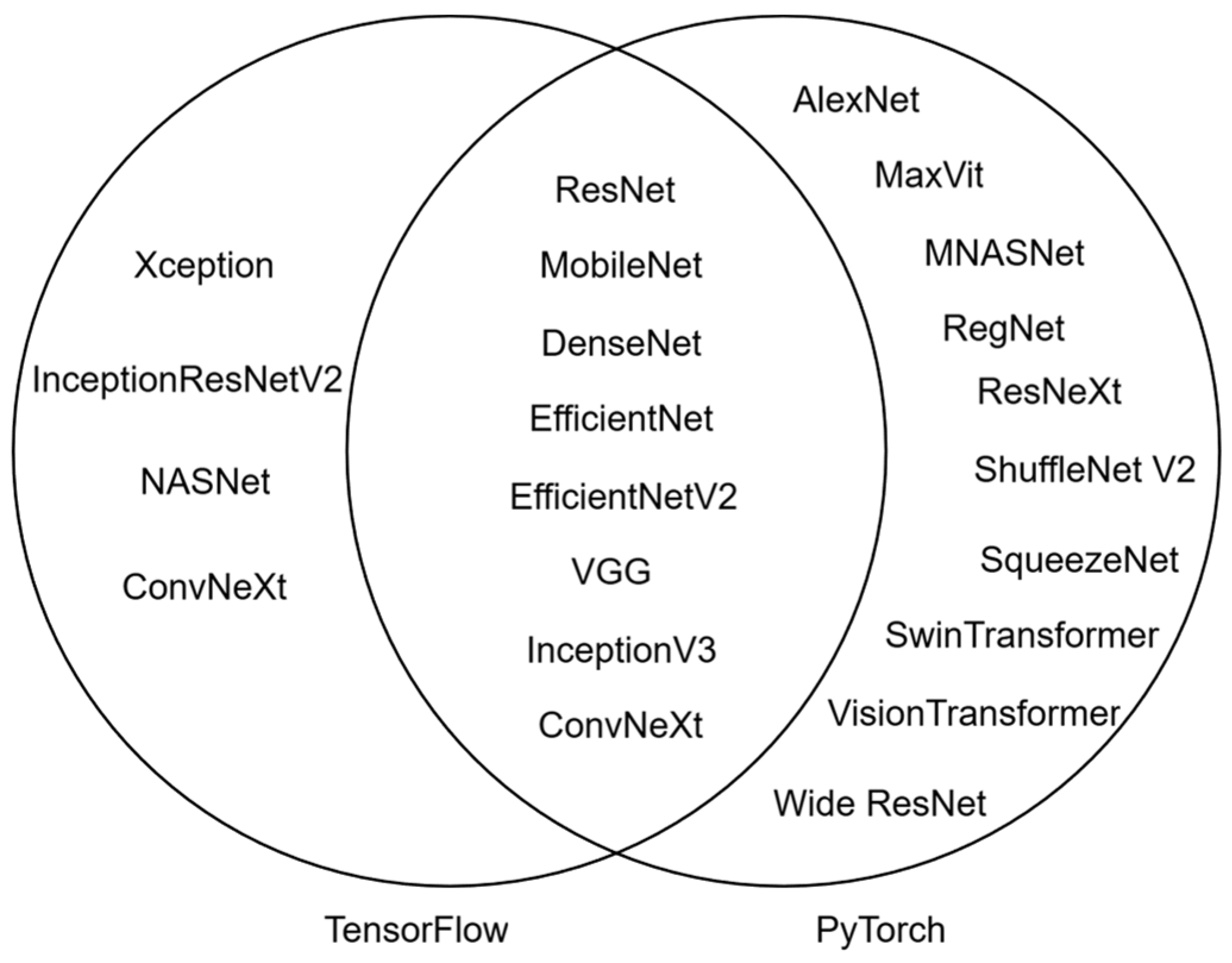
Although custom CNN models have shown promise in ginger disease detection, they require substantial computational resources for training, as parameters must be learned from scratch. To mitigate this, transfer learning using pre-trained models has been used. VGG16, MobileNetV2, and AlexNet models, originally trained on large-scale datasets such as ImageNet, present generalized features that can be adapted to new tasks, enabling faster training and improved performance [10]. Contemporary deep learning libraries such as TensorFlow 2.9.0 and PyTorch 2.3.0 are widely used for pre-trained models, facilitating their implementation and fine-tuning for specific applications. Figure 1 provides an overview of pre-trained models available in these libraries.
Based on the results of Yigezu et al. [8], Ref. [11] employed MobileNetV2 through transfer learning. Two experimental approaches were tested: feature extraction and fine-tuning. In the first approach, a classification layer was added atop the MobileNetV2 base model, utilizing pre-trained ImageNet weights, resulting in 91% accuracy. In the second approach, the top layers of MobileNetV2 were unfrozen for additional training, yielding a higher accuracy of 97%. These results underscore the advantages of transfer learning in reducing training time and enhancing model performance. However, only binary classification was used, and MobileNetV2 was compared with other CNN architectures for performance.
Waheed et al. applied deep learning techniques to detect ginger diseases such as nutrient deficiency, pest patterns, and soft rot [12]. They used binary classification to determine whether a ginger leaf was diseased. A dataset of 4396 images was divided into three subsets for separate training: deficiency-healthy, pest pattern-healthy, and soft rot-healthy. Multiple models were evaluated, including CNN, VGG16, MobileNetV2, and an artificial neural network (ANN). The CNN model showed the highest accuracy of 99% for detecting soft rot on rhizomes, while the VGG16 and ANN models reached 96% accuracy for pest pattern and nutrient deficiency detection, respectively. Despite these promising results, the dataset was imbalanced across disease categories and primarily limited to binary classification, which constrains the model’s generalizability. Additionally, the CNN model was not well-described, hindering reproducibility and comparative analysis.

3. Methodology

3.1. Dataset

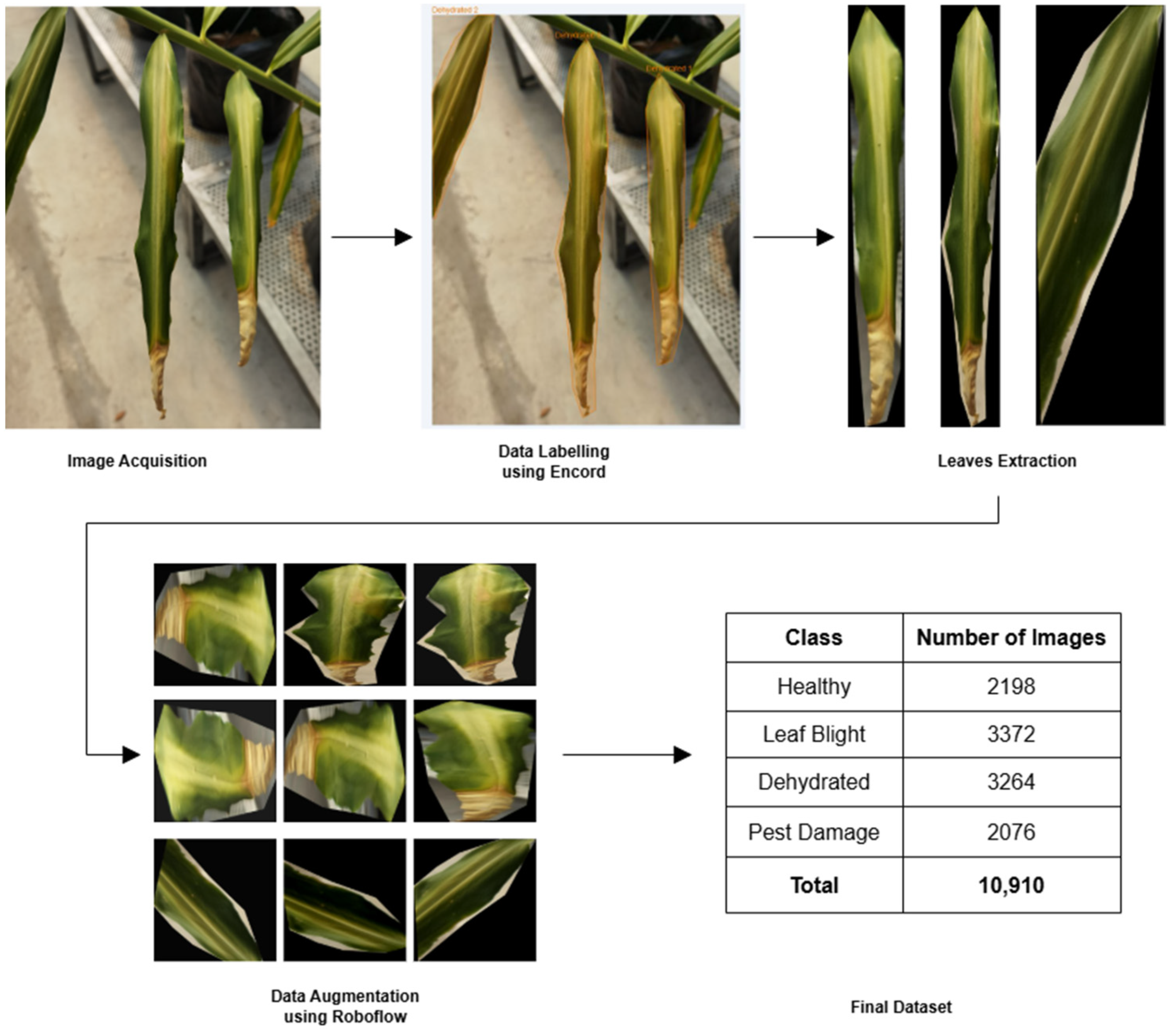
In this study, a ginger leaf dataset was prepared, encompassing stages from image acquisition to data augmentation. An overview of the dataset preparation process is illustrated in Figure 2.
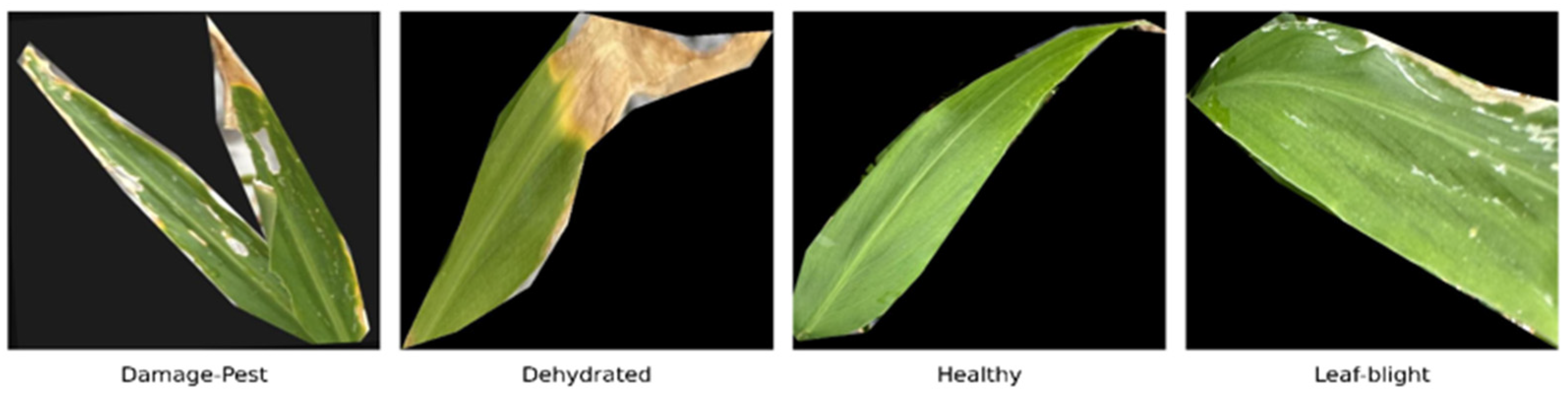
A total of 968 ginger plant images were captured at a ginger farm located at Tunku Abdul Rahman University of Management and Technology, Kuala Lumpur, Malaysia. High-resolution images were then obtained using a Huawei P40 Pro (Huawei Technologies Co., Ltd., Shenzhen, China) and an iPhone 14 Pro (Apple Inc., Cupertino, CA, USA). Following image acquisition, data were labeled using the Encord (Encord, London, UK) platform, where all visible ginger leaves in each image were manually labeled by plotting a polygon shape. The labels consisted of ‘healthy, leaf blight, dehydrated, and pest damage’, as shown in Figure 3. The leaf extraction process was then carried out based on polygon coordinates provided in the exported JSON annotation files. Table 1 presents the detailed distribution of the resulting dataset.
As shown in Table 1, class imbalance was evident, with certain disease categories significantly underrepresented relative to others. Such an imbalance adversely affects model performance by reducing generalization capability and biasing predictions toward majority classes [13]. To address this issue, data augmentation was performed using the Roboflow (Roboflow, Des Moines, IA, USA) platform. All images were standardized to a resolution of 640 × 640 to facilitate consistent and efficient augmentation. Table 2 outlines the augmentation techniques applied to the dataset. Each original image was augmented to produce an additional two to three samples, thereby increasing dataset diversity and mitigating class imbalance. As a result, the dataset was expanded to 10,910 images, achieving a more balanced distribution across the four disease classes [14].

3.2. Model Selection and Architecture

A range of deep learning models was evaluated to identify the most effective architecture for ginger leaf disease detection. Based on the successful image classification tasks of CNNs, two categories of CNN models were considered: self-proposed models from prior studies and a pre-trained model, EfficientNetB3, implemented via transfer learning. The self-proposed models refer to CNN architectures developed in the same domain, including the CNN model introduced in Ref. [8] and the CNN–RF hybrid model [9]. Although Ref. [12] also employed a custom CNN model, the architectural details were not disclosed, rendering replication and inclusion in this study infeasible.

3.3. Experiment Settings

To ensure a consistent evaluation across all models, the same experiment was conducted in training and testing. The dataset, consisting of 10,910 images, was split into training, validation, and test sets using a ratio of 70:20:10. All images were resized to 640 × 640 and normalized to a [0, 1] scale. For training, the Riemannian Adam optimizer was used with a learning rate of 0.001, and cross-entropy was selected as the loss function. Each model was trained for 50 epochs with a batch size of 16. An early stopping strategy with a patience of 10 epochs was implemented to prevent overfitting and stop the training process when no improvement in loss was observed. Additionally, a learning rate scheduler was implemented to reduce the learning rate when the loss was not decreased. To ensure consistency, each model was trained and evaluated three times, and the average performance metrics were reported. All experiments were conducted using a computer equipped with an NVIDIA GeForce RTX 4070 Ti (NVIDIA, Santa Clara, CA, USA), Intel Core i7 processor (Intel Corporation, Santa Clara, CA, USA), and 64 GB RAM (Kingston Technology Corp., Fountain Valley, CA, USA). The PyTorch 2.3.0 library was used for model training.

3.4. Evaluation Metrics

To evaluate the performance of the classification models, an accuracy was calculated to measure the correctness of the model by dividing the number of correctly predicted samples by the total number of samples.
A c c u r a c y = T P + T N T P + T N + F P + F N
where TP is the true positives, TN is the true negatives, FP is the false positives, and FN is the false negatives.

4. Results and Discussion

4.1. Model Performances

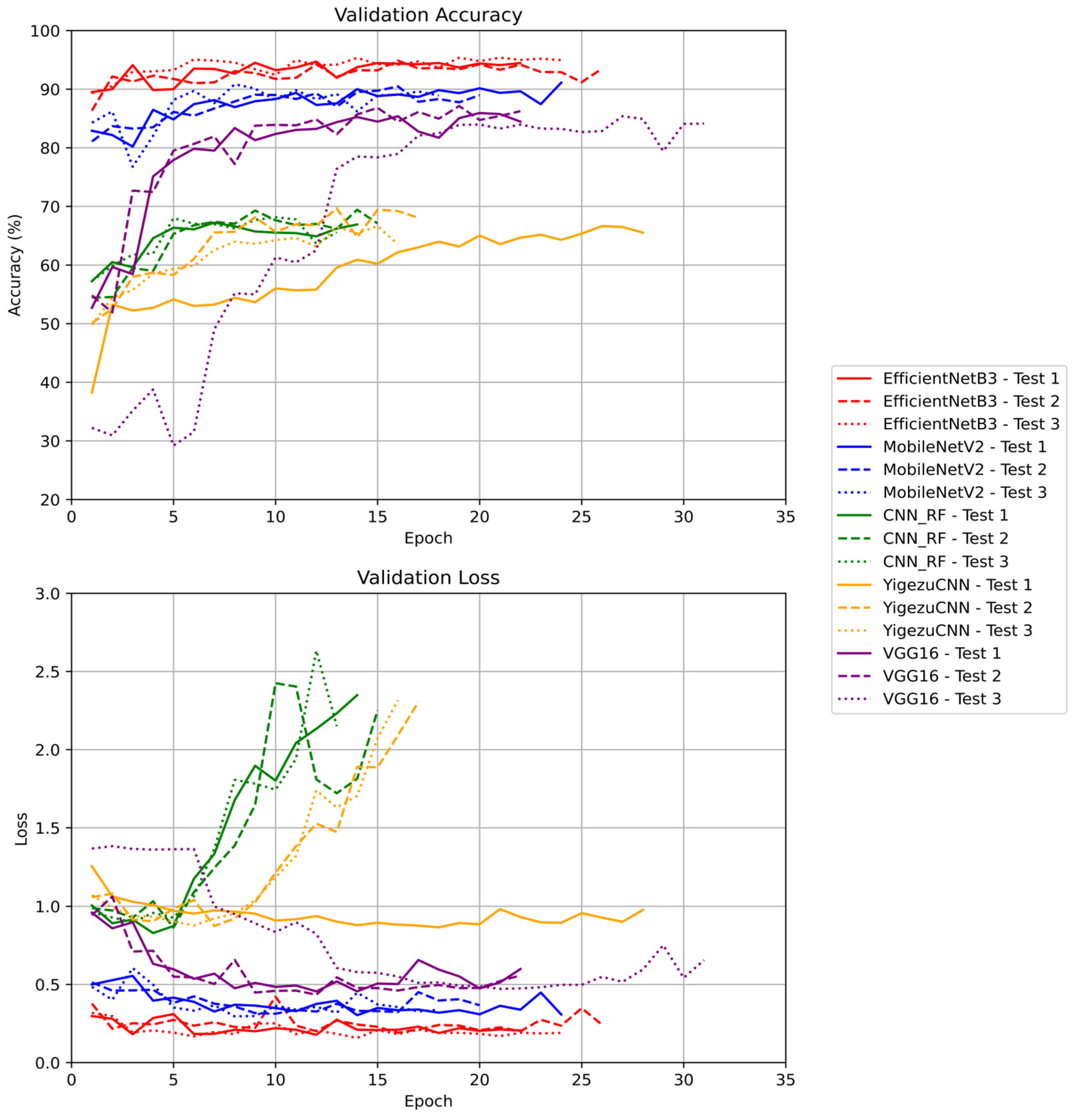
Figure 4 presents the classification accuracies and losses of all models evaluated throughout 3 trials in this study.
Among the five tested models, EfficientNetB3 (red lines) showed the highest average accuracy of 94.30% and the lowest average loss of 0.2167. This model outperformed all others, demonstrating the effectiveness of EfficientNetB3’s compound scaling technique. The compound scaling approach simultaneously adjusts network width, depth, and resolution using a fixed scaling coefficient (ϕ), enabling the model to capture complex and relevant features from input images—in this case, ginger leaf images [15].
MobileNetV2 (blue lines) showed the second-highest performance, with an accuracy of 89.66% and a loss of 0.3281. Despite being a lightweight CNN architecture designed for mobile and embedded systems, MobileNetV2 exhibited strong classification capabilities, making it a viable option for real-time disease detection in resource-constrained environments [16].
VGG16 (purple lines), a deeper but older CNN model, achieved an accuracy of 84.95% and a loss of 0.5775. While it was able to extract meaningful features from ginger leaf images, its larger model size and susceptibility to overfitting rendered it less efficient compared to more modern architectures [17]. In contrast, the self-proposed models, CNN + RF (green lines) and YigezuCNN (yellow lines), performed significantly worse, with accuracies of 66.53 and 65.71%, and losses of 2.2501 and 1.8656, respectively. These models lacked the depth and optimization necessary to generalize effectively across the diverse and augmented dataset used in this study. Their limited capacity to extract complex features likely contributed to their suboptimal performance.

4.2. Discussion

The results of this study demonstrate the advantages of employing pre-trained models with transfer learning, particularly when utilizing recent architectures such as EfficientNet. The high accuracy achieved by EfficientNetB3 demonstrates its capability to classify ginger leaf diseases across four categories—Healthy, Leaf Blight, Dehydrated, and Pest Damage—an essential requirement for early and accurate disease detection. The lower performance of the CNN + RF and YigezuCNN models underscores the importance of using well-optimized and deeper architectures. These models, with only 11 or fewer layers, may struggle to extract discriminative features, especially when diseases exhibit similar visual symptoms. The substantial performance gap between the top-performing and underperforming models emphasizes the need for rigorous model evaluation. While simpler or hybrid models may be suitable for binary classification or constrained environments, they may not scale effectively to more complex, multi-class scenarios such as the one addressed in this study.

5. Conclusions

We developed a deep learning-based model for ginger leaf disease detection using both self-proposed and pre-trained CNN models. A ginger leaf dataset was collected and annotated with four disease classes: healthy, leaf blight, dehydrated, and pest damage. To address class imbalance and enhance model generalization, data augmentation techniques were applied, expanding the dataset to 10,910 images.
Different CNN models were evaluated, including self-proposed architectures such as YigezuCNN [8] and the CNN–RF hybrid model [9], as well as pre-trained models, including EfficientNetB3, VGG16, and MobileNetV2 available in the PyTorch and TensorFlow libraries. EfficientNetB3 showed the highest accuracy of 94.30%, outperforming all other models. The results demonstrate that pre-trained models with transfer learning significantly improve performance and generalization across diverse classification tasks.
In this study, we validated the effectiveness of transfer learning and pre-trained models in ginger disease detection. However, it is necessary to explore advanced techniques such as hyperparameter optimization to enhance model performance. Additionally, the development of a multi-label ginger leaf dataset is recommended to improve robustness, as multiple diseases may co-occur on a single leaf.

Author Contributions

Conceptualization, W.Z.W., Y.T. and C.W.T.; methodology, W.Z.W., Y.T. and C.W.T.; software, W.Z.W., Y.T. and C.W.T.; validation, W.Z.W., Y.T. and C.W.T.; formal analysis, W.Z.W., Y.T. and C.W.T.; investigation, W.Z.W., Y.T. and C.W.T.; resources, W.Z.W., Y.T. and C.W.T.; data curation, W.Z.W.; writing—original draft preparation, W.Z.W.; writing—review and editing, Y.T. and C.W.T.; visualization, W.Z.W., Y.T. and C.W.T.; supervision, Y.T. and C.W.T.; project administration, Y.T. and C.W.T.; funding acquisition, Y.T. and C.W.T. All authors have read and agreed to the published version of the manuscript.

Funding

This research received no external funding.

Institutional Review Board Statement

Not applicable.

Informed Consent Statement

Not applicable.

Data Availability Statement

The data are presented in this study.

Acknowledgments

The authors would like to express their sincere gratitude to Tunku Abdul Rahman University of Management and Technology (TAR UMT) for providing the resources, facilities, and support necessary to conduct this study. The guidance and infrastructure offered by the university played a crucial role in the completion of this study.

Conflicts of Interest

The authors declare no conflict of interest.

References

  1. Ibrahim, H.; Khalid, N.; Hussin, K. Cultivated Gingers of Peninsular Malaysia: Utilization, Profiles and Micropropagation. Gard. Bull. Singap. 2007, 59, 71–88. [Google Scholar]
  2. FAOSTAT. Available online: https://www.fao.org/faostat/en/#data/QCL (accessed on 25 March 2025).
  3. Maklumat Pertanian—Jabatan Pertanian Sabah. Available online: https://tani.sabah.gov.my/maklumat-pertanian/ (accessed on 26 March 2025).
  4. Cosmas, L.L.; Atong, M.; Poili, E. Preliminary Studies towards Identification of Ginger Wilt Disease in Sabah, Malaysia. Pertanika J. Trop. Agric. Sci 2016, 39, 373–380. [Google Scholar]
  5. Nazarov, P.A.; Baleev, D.N.; Ivanova, M.I.; Sokolova, L.M.; Karakozova, M.V. Infectious Plant Diseases: Etiology, Current Status, Problems and Prospects in Plant Protection. Acta Naturae 2020, 12, 46. [Google Scholar] [CrossRef] [PubMed]
  6. Sankaran, S.; Mishra, A.; Ehsani, R.; Davis, C. A Review of Advanced Techniques for Detecting Plant Diseases. Comput. Electron. Agric. 2010, 72, 1–13. [Google Scholar] [CrossRef]
  7. Lu, J.; Tan, L.; Jiang, H. Review on Convolutional Neural Network (CNN) Applied to Plant Leaf Disease Classification. Agriculture 2021, 11, 707. [Google Scholar] [CrossRef]
  8. Yigezu, M.G.; Woldeyohannis, M.M.; Tonja, A.L. Early Ginger Disease Detection Using Deep Learning Approach. In Lecture Notes of the Institute for Computer Sciences, Social-Informatics and Telecommunications Engineering, LNICST; Springer International Publishing: Cham, Switzerland, 2022; Volume 411 LNICST, pp. 480–488. [Google Scholar] [CrossRef]
  9. Kumar, V.; Banerjee, D.; Upadhyay, D.; Singh, M.; Ravi Chythanya, K. CNN-Random Forest Hybrid Model for Improved Ginger Leaf Disease Classification. In Proceedings of the 2024 International Conference on E-Mobility, Power Control and Smart Systems (ICEMPS); IEEE: Thiruvananthapuram, India, 2024; pp. 1–6. [Google Scholar]
  10. Srivastava, M.; Meena, J. Plant Leaf Disease Detection and Classification Using Modified Transfer Learning Models. Multimed. Tools Appl. 2024, 83, 38411–38441. [Google Scholar] [CrossRef]
  11. Kolesnikova, O.; Yigezu, M.G.; Tonja, A.L.; Woldeyohannis, M.M.; Sidorov, G.; Gelbukh, A. Ginger Disease Detection Using a Computer Vision Pre-Trained Model. In Innovations in Machine and Deep Learning; Rivera, G., Rosete, A., Dorronsoro, B., Rangel-Valdez, N., Eds.; Springer: Cham, Switzerland, 2023; Volume 134, pp. 419–432. [Google Scholar] [CrossRef]
  12. Waheed, H.; Zafar, N.; Akram, W.; Manzoor, A.; Gani, A.; Islam, S.U. Deep Learning Based Disease, Pest Pattern and Nutritional Deficiency Detection System for “Zingiberaceae” Crop. Agriculture 2022, 12, 742. [Google Scholar] [CrossRef]
  13. Lemley, J.; Bazrafkan, S.; Corcoran, P. Smart Augmentation Learning an Optimal Data Augmentation Strategy. IEEE Access 2017, 5, 5858–5869. [Google Scholar] [CrossRef]
  14. Wong, W.Z.; Tew, Y.; Tan, C.W. Smart Agriculture—Ginger Leaf Disease Dataset. Available online: https://sites.google.com/tarc.edu.my/focs-ciot-farm/ginger-leaf-disease-dataset (accessed on 23 May 2025).
  15. Tan, M.; Le, Q.V. EfficientNet: Rethinking Model Scaling for Convolutional Neural Networks. In Proceedings of the 36th International Conference on Machine Learning (ICML), Long Beach, CA, USA, 9–15 June 2019; JMLR, Inc.: Cambridge, MA, USA, 2019. [Google Scholar]
  16. Sandler, M.; Howard, A.; Zhu, M.; Zhmoginov, A.; Chen, L.C. MobileNetV2: Inverted Residuals and Linear Bottlenecks. In Proceedings of the IEEE Computer Society Conference on Computer Vision and Pattern Recognition 2018, Lake City, UT, USA, 18–22 June 2018; pp. 4510–4520. [Google Scholar] [CrossRef]
  17. Simonyan, K.; Zisserman, A. Very Deep Convolutional Networks for Large-Scale Image Recognition. In Proceedings of the 3rd International Conference on Learning Representations (ICLR 2015), San Diego, CA, USA, 7–9 May 2015. [Google Scholar]
Figure 1. Models in TensorFlow and PyTorch.
Engproc 128 00001 g001
Figure 2. Dataset preparation.
Engproc 128 00001 g002
Figure 3. Examples of each class in the generated ginger leaf dataset.
Engproc 128 00001 g003
Figure 4. Performances of the evaluated models in this study.
Engproc 128 00001 g004
Table 1. Ginger leaf dataset distribution.
ClassNumber of
Images
(Before Augmentation)
Distribution Before AugmentationNumber of
Images
(After Augmentation)
Distribution After Augmentation
Healthy278 6.9%219820.1%
Leaf Blight2146 53.2%3372 30.9%
Dehydrated146636.4%326429.9%
Pest Damage1433.5%207619.0%
Total4033 10,910
Table 2. Data augmentation techniques used in this study.
TechniqueDescription/Parameters
FlipHorizontal and vertical
90° RotationClockwise and counter-clockwise
Crop/Zoom0% minimum zoom, 30% maximum zoom
BrightnessBetween −15 and +15%
Disclaimer/Publisher’s Note: The statements, opinions and data contained in all publications are solely those of the individual author(s) and contributor(s) and not of MDPI and/or the editor(s). MDPI and/or the editor(s) disclaim responsibility for any injury to people or property resulting from any ideas, methods, instructions or products referred to in the content.