Localization of Unknown Nodes on UWSN Using the Linear Constraint Optimization Technique Based on Energy and Distance (LUCOTED) †

Abstract
1. Introduction

2. Localization of Unknown Node’s Factors and Constraints
2.1. Localization Process
2.1.1. Distance/Angle Estimation
2.1.2. Position Computation
2.1.3. Localization Algorithm
2.2. Main Challenges and Constraints
3. Related Works
4. Methodology of Research
4.1. Mathematical Approach
4.1.1. Objective Function and Constraints
- Distance between nodes must be shorter than the range of communication;
- Each node (x, y, z) must be in an area defined by (xmax, ymax, zmax) as 3D dimensions;
- Anchor nodes chosen for localization should both present the highest residual energy and the nearest distance to the unknown node.
4.1.2. Resolution Methods
- Generate anchor nodes randomly according to the number of nodes, area dimension (x.y.z), communication range, and node energy;
- Select top anchors based on energy and distance;
- Select a random initial position of the unknown node.
- Results: final estimated position, best iteration, average accuracy, energy used.
| Algorithm 1: LUCOTED Method |
| Function 1: Generate Random Anchors Input (constraints):
//Choose the list of anchors with the highest residual energy and the closest distance to the unknown node. Input:
Inputs:
For each anchor i in anchors: Compute Euclidean distance from estimated_position to anchor[i]. position = distance[i] (3) Compute range error: error = (estimated_distance − measured_range[i]) Update gradient using: gradient.x += λ × (x − xi/distance[i]) × error gradient.y += λ × (y − yi/distance[i]) × error (4) gradient.z += λ × (z − zi/distance[i]) × error Compute energy: energy_i = (txPower × distance + rxPower) × dataSize TotalEnergyConsumption += energy_i (5) Normalize gradient: (6) Update estimated position: estimated_position −= gradient/norm (7) If norm < tolerance: Break
|
| Algorithm 2: Trilateration Method |
| Trilateration is a fundamental technique in Wireless Sensor Network, that calculates the position of an unknown node by measuring its distance from known anchor nodes. Linearization: By deleting the square terms from distance equations, we receive a linear system. Direct Solution: We keep away of iterative techniques by solving the resulting linear equations. Let us considering the following three anchors’ nodes: A1 ((x1, y1, z1), E1), A2 ((x2, y2, z2), E2), A3 ((x3, y3, z3), E3); where (xi, yi, zi) are coordinate and Ei energy of anchor node Ai for i = 1 to i =3. where di define Euclidean distance between anchor node Ai and unknown node, from 0 = i to N measured by one of methods RSSI, AOA, and AOT…. etc. We follow those steps to solve our system:
(8) − (9) = − (9) − (10) = − (11) (10) − (8) = − As a result, we obtain a system of three linear equations for x, y, z that is easy to resolve. Finally, the algorithm returns: Final position (x, y, z) of the localized unknown node, energy consumption, and accuracy. |
| Algorithm 3: Gradient Descent Method |
dy = estimated_position.y − anchors[i].position.y; dz = estimated_position.z − anchors[i].position.z; (12) error = distance − range;
gradient_y += (error×dy)/distance (13) gradient_z += (error×dz)/distance
estimated_position.y − = stepSize × gradient_y; (14) estimated_position.z − = stepSize × gradient_z;
< tolerance (15)
|
5. Simulation Implementation Approach and Results
5.1. Simulation Approach
5.1.1. Simulation Design Overview
5.1.2. Parameters of Simulation
5.1.3. Performance Metric Indicators
- (a)
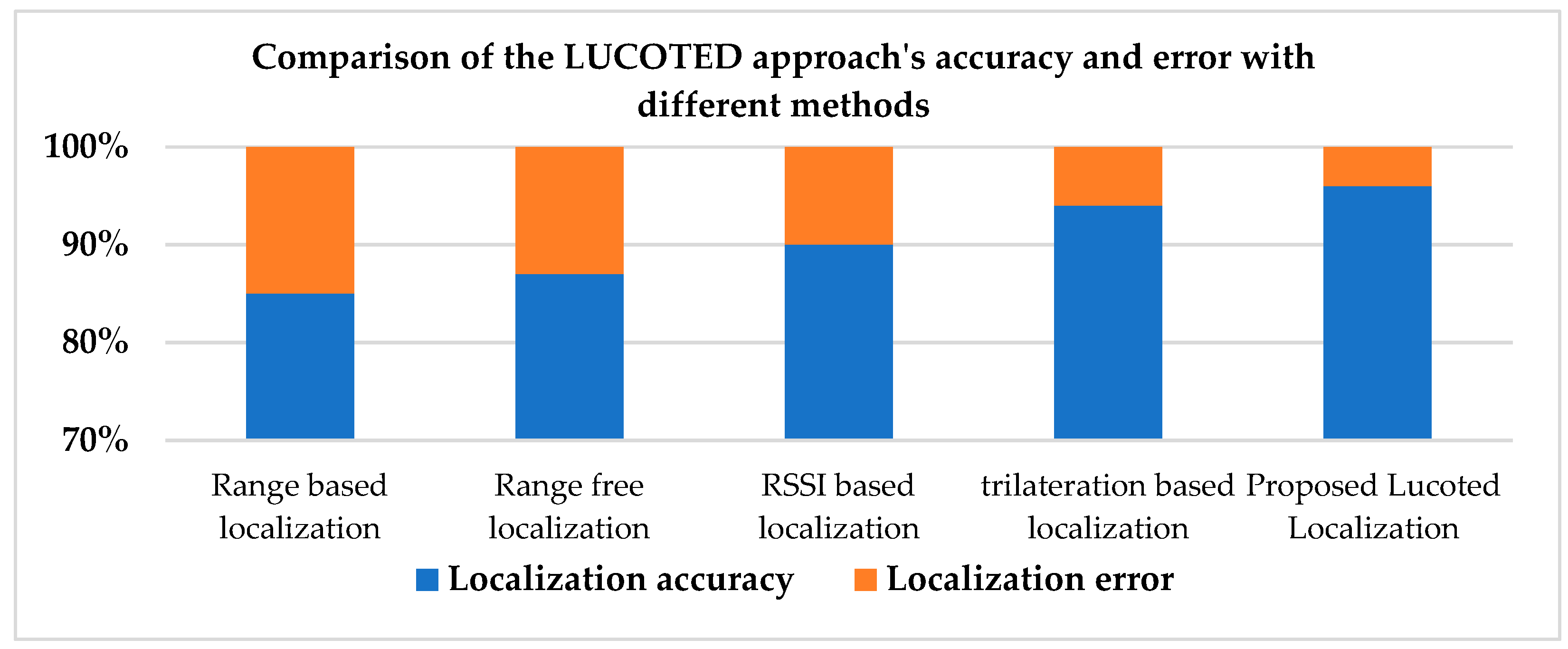
- Accuracy and error of localization:
- ✓
- Mathematical Relationship
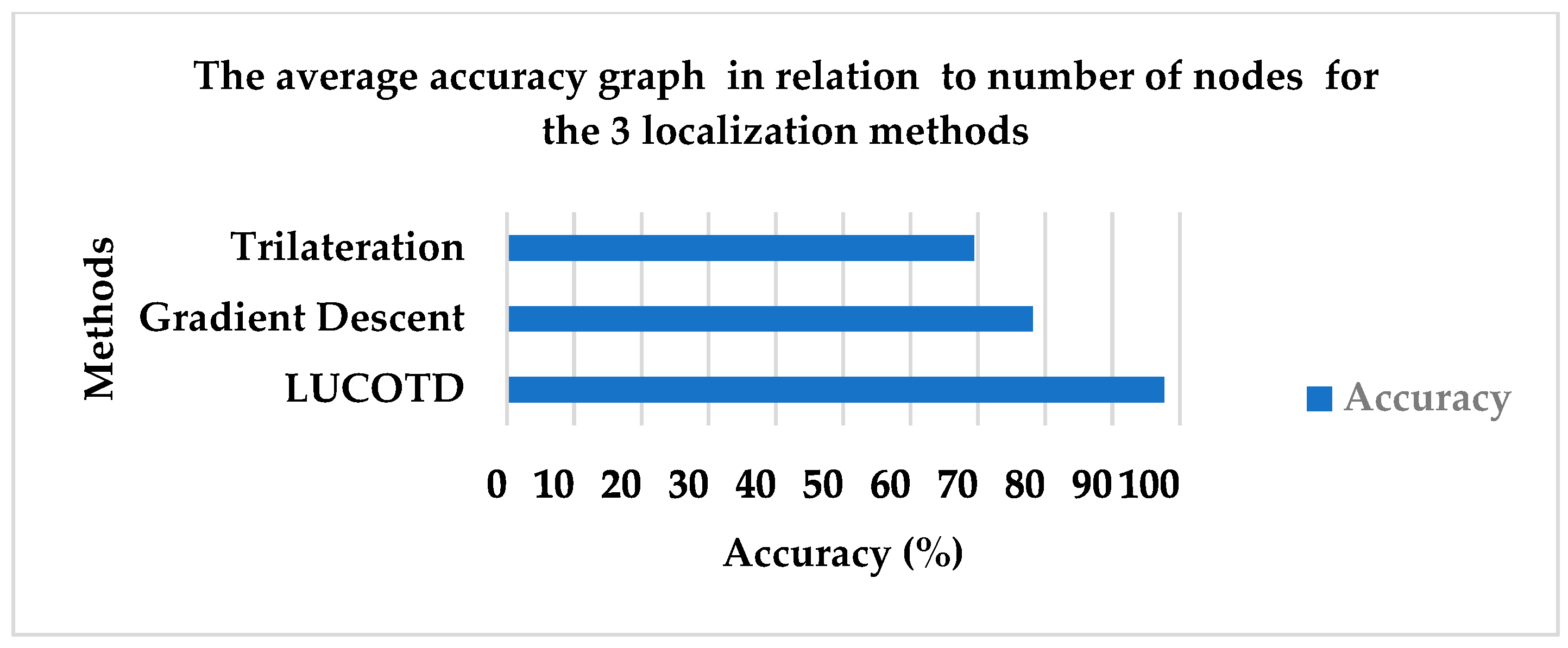
- Accuracy: Accuracy can be defined as follows:Accuracy = 100 − (True Value/Error) × 100%
- This expresses accuracy as a percentage by comparing the error to the true value.
- Lower error leads to higher accuracy.
- Error: Error is the absolute or relative deviation from the true value:Error = Measured Value − True Value
- Or, in magnitude form as follows:Absolute Error = |Measured Value − True Value|
- ✓
- The Localization Formula
- Accuracy can be defined as the opposite of error or as the difference between the estimated and true positions in localization problems, such as those concerning a node’s location in a network [33]:
- (b)
- Energy consumed
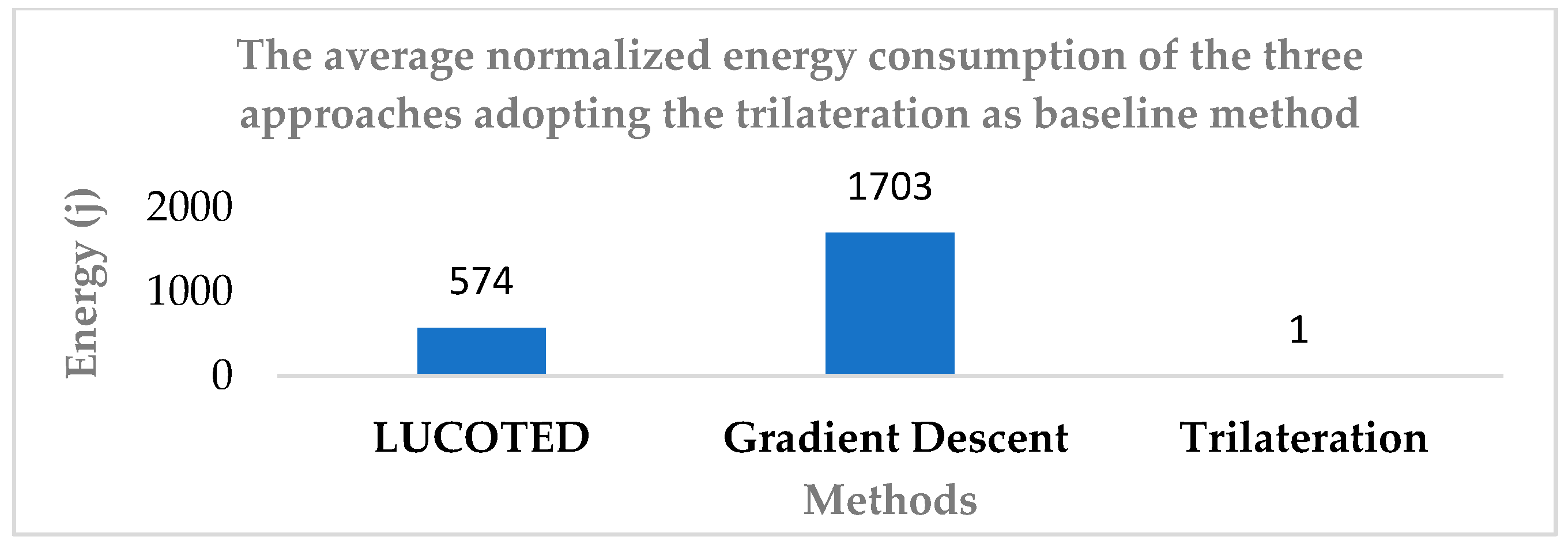
- The formula: Energy = (txPower × distance + rxPower) × dataSize
- It is a simplified mathematical model that is frequently used to estimate energy consumption in underwater wireless sensor networks (UWSNs) in simulations and real-world applications.
- ✓
- Transmission Energy Contribution:
- The term “txPower × distance» determines the energy used for underwater communication signal propagation. Generally, txPower (transmission power) is proportional to the signal strength required to go a specific distance. Distance is included because path loss and attenuation, which are factors of distance, determine how much energy is used in underwater acoustic settings.
- ✓
- Reception Energy Contribution:
- The energy needed to receive the given data packet is taken into consideration by the term “rxPower”.
- ✓
- Data Size Scaling:
- The total energy needed to send and receive a packet’s bits is calculated by multiplying the sum of the transmission and reception power components by dataSize [34]. Noted that in [35] the U-New Reno transmission control protocol, designed for marine environments, significantly improves packet retransmission rates, and the delivery number evolution can be used in our study.
- (c)
- Convergence’s degree
5.2. Results and Interpretation
6. Conclusions
- Primarily through simulation:
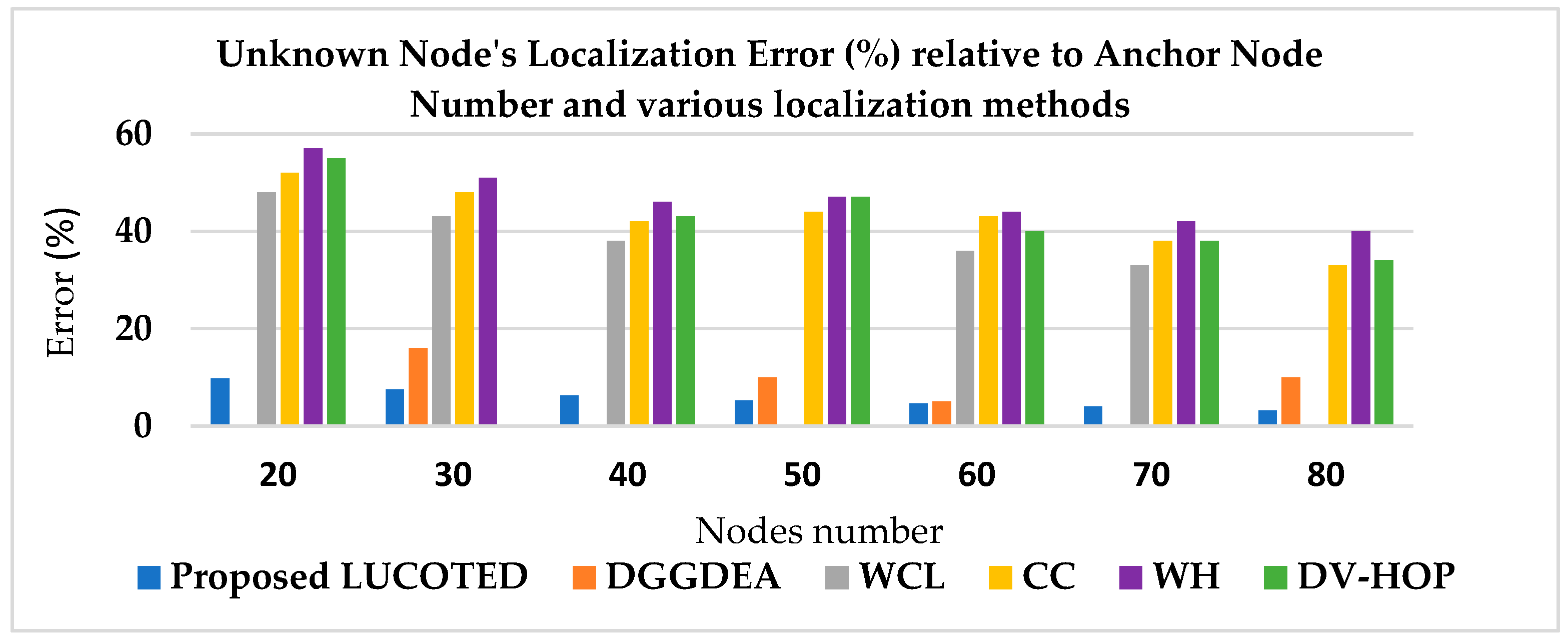
- It offers better location accuracy compared to trilateration and gradient descent methods and to other recent approaches.
- It consumes less energy than gradient descent as an iterative method.
- It provides solutions that respect constraints related to the communication range and boundary of the simulation’s area.
- It guarantees always convergence.
- Secondly, through the algorithmic aspect:
- LUCOTED outperforms other methods because it allows the solving of a localization problem with constraints independently of the simulation’s initial condition.
- The UWSN makes it possible to prevent the risk of human losses by monitoring watery environments.
Author Contributions
Funding
Informed Consent Statement
Data Availability Statement
Conflicts of Interest
References
- FAO. The State of World Fisheries and Aquaculture; Blue Transformation in Action: Rome, Italy, 2024. [Google Scholar]
- Jahanbakht, M.; Xiang, W.; Hanzo, L.; Azghadi, M.R. Internet of Underwater Things and Big Marine Data Analytics—A Comprehensive Survey. IEEE Commun. Surv. Tutorials 2021, 23, 904–956. [Google Scholar] [CrossRef]
- Yang, G.; Dai, L.; Wei, Z. Challenges. Threats, Security Issues and New Trends of Underwater Wireless Sensor Networks. Sensors 2018, 18, 3907. [Google Scholar] [CrossRef] [PubMed]
- Oliveira, H.A.; Nakamura, E.; Loureiro, A.; Boukerche, A. Directed Position Estimation: A Recursive Localization Approach for Wireless Sensor Networks. In Proceedings of the 14th International Conference on Computer Communications and Networks, San Diego, CA, USA, 17–19 October 2005; pp. 557–562. [Google Scholar] [CrossRef]
- Xu, Z.; He, D.; Li, J.; Jiang, L.; Wang, H. Correction method for TOA measurement of target signal based on Kalman Filter. In Proceedings of the 2017 IEEE 2nd Advanced Information Technology, Electronic and Automation Control Conference (IAEAC), Chongqing, China, 25–26 March 2017; pp. 230–235. [Google Scholar] [CrossRef]
- Cao, H.; Chan, Y.T.; So, H.C. Compressive TDOA Estimation: Cramér-Rao Bound and Incoherent Processing. IEEE Trans. Aerosp. Electron. Syst. 2020, 56, 3326–3331. [Google Scholar] [CrossRef]
- Arenas, M.; Podhorski, A.; Arrizabalaga, S.; Goya, J.; Sedano, B.; Mendizabal, J. Implementation and validation of an Angle of Arrival (AOA) determination system. In Proceedings of the 2015 Conference on Design of Circuits and Integrated Systems (DCIS), Estoril, Portugal, 25–27 November 2015; pp. 1–7. [Google Scholar] [CrossRef]
- Xe, W.; Li, Q.; Hua, X.; Yu, K.; Qiu, W.; Zhou, B. A New Algorithm for Indoor RSSI Radio Map Reconstruction. IEEE Access 2018, 6, 76118–76125. [Google Scholar] [CrossRef]
- Luo, Q.; Yang, K.; Yan, X.; Li, J.; Wang, C.; Zhou, Z. An Improved Trilateration Positioning Algorithm with Anchor Node Combination and K-Means Clustering. Sensors 2022, 22, 6085. [Google Scholar] [CrossRef]
- Rajagopal, A.; Somasundaram, S.; Sowmya, B.; Suguna, T. Soft computing-based cluster head selection in wireless sensor network using bacterial foraging optimization algorithm. Int. J. Electron. Commun. Eng. 2015, 3, 379–384. [Google Scholar] [CrossRef]
- Beniwal, M.; Singh, R. Localization techniques and their challenges in underwater wireless sensor networks. Int. J. Comput. Sci. Inf. Technol. 2014, 5, 4706–4710. [Google Scholar]
- Niculescu, D.; Nath, B. Ad Hoc Positioning System (APS). In Proceedings of the IEEE GLOBECOM ’01, San Antonio, TX, USA, 25–29 November 2001; pp. 2926–2931. [Google Scholar] [CrossRef]
- Boukerche, A.; Oliveira, H.A.B.; Nakamura, E.F.; Loureiro, A.A.F. Secure localization algorithms for wireless sensor networks. IEEE Commun. Mag. 2008, 46, 96–101. [Google Scholar] [CrossRef]
- Nain, M.; Goyal, N.; Dhurandher, S.K.; Dave, M.; Verma, A.K.; Malik, A. A survey on node localization technologies in UWSNs: Potential solutions, recent advancements, and future directions. Int. J. Commun. Syst. 2024, 37, e5915. [Google Scholar] [CrossRef]
- Pu, W.Y. A Survey of Localization Techniques for Underwater Wireless Sensor Networks. J. Comput. Electron. Inf. Manag. 2023, 11, 10–15. [Google Scholar] [CrossRef]
- Jouhari, M.; Ibrahimi, K.; Tembine, H.; Ben-Othman, J. Underwater wireless sensor networks: A survey on enabling technologies, localization protocols, and internet of underwater things. IEEE Access 2019, 7, 96879–96899. [Google Scholar] [CrossRef]
- Jim, P.; Kurose, J.; Levine, B.N. A survey of practical issues in underwater networks. ACM SIGMOBILE Mob. Comput. Commun. Rev. 2007, 11, 23–33. [Google Scholar] [CrossRef]
- Heidemann, J.; Ye, W.; Wills, J.; Syed, A.; Li, Y. Research challenges and applications for underwater sensor networking. In Proceedings of the IEEE Wireless Communications and Networking Conference, WCNC2006, Las Vegas, NV, USA, 3–6 April 2006; Volume 1, pp. 228–235. [Google Scholar] [CrossRef]
- Alkan, R.M.; Kalkan, Y.; Aykut, N.O. Sound velocity determination with empirical formulas and bar check. In Proceedings of the 23rd FIG Congress, Munich, Germany, 8–13 October 2006; pp. 1–14. [Google Scholar]
- Ouidir, H.; Berqia, A.; Aouad, S. Improving UWSN Performance using Reinforcement Learning Algorithm QENDIP. In Proceedings of the 2024 11th International Conference on Wireless Networks and Mobile Communications (WINCOM), Leeds, UK, 23–25 July 2024. [Google Scholar] [CrossRef]
- Li, H.; He, Y.; Cheng, X.; Zhu, H.; Sun, L. Security and privacy in localization for underwater sensor networks. IEEE Commun. Mag. 2015, 53, 56–62. [Google Scholar] [CrossRef]
- Nanthakumar, S.; Jothilakshmi, P. A comparative study of range based and range free algorithms for node localization in underwater. E-Prime—Adv. Electr. Eng. Electron. Energy 2024, 9, 100727. [Google Scholar] [CrossRef]
- Agarwal, A.K.; Khan, G.; Qamar, S.; Lal, N. Localization and correction of location information for nodes in UWSN-LCLI. Adv. Eng. Softw. 2022, 173, 103265. [Google Scholar] [CrossRef]
- Han, G.; Jiang, J.; Shu, L.; Xu, Y.; Wang, F. Localization Algorithms of Underwater Wireless Sensor. Sensors 2012, 12, 2026–2061. [Google Scholar] [CrossRef]
- Rani, S.; Anju; Sangwan, A.; Kumar, K.; Nisar, K.; Soomro, T.R.; Ibrahim, A.A.A.; Gupta, M.; Chand, L.; Khan, S.A. Review and Analysis of Localization Techniques in Underwater Wireless Sensor Networks. Computer. Mater. Contin. 2023, 75, 5697–5715. [Google Scholar] [CrossRef]
- Xu, T.; Hu, Y.; Zhang, B.; Leus, G. RSS-based sensor localization in underwater acoustic sensor networks. In Proceedings of the IEEE International Conference on Acoustics, Speech and Signal Processing (ICASSP), Shanghai, China, 20–25 March 2016. [Google Scholar] [CrossRef]
- Yang, B.; Guo, L.Y.; Guo, R.J.; Zhao, M.M.; Zhao, T.T. A Novel Trilateration Algorithm for RSSI-Based Indoor Localization. IEEE Sens. J. 2020, 20, 8164–8172. [Google Scholar] [CrossRef]
- Yan, X.; Luo, Q.; Yang, Y.; Liu, S.; Li, H.; Hu, C. ITL-MEPOSA: Improved Trilateration Localization with Minimum Uncertainty Propagation and Optimized Selection of Anchor Nodes for Wireless Sensor Networks. IEEE Access 2019, 7, 53136–53146. [Google Scholar] [CrossRef]
- Zhou, Z.; Zhou, X.; Xing, G.; Jin, Z.; Chen, Y.; Yang, Q. Localization of Underwater Wireless Sensor Networks for Ranging Interference based on the AdaDelta Gadient Descent Algorithm. Wireless. Pers. Commun. 2024, 137, 1189–1216. [Google Scholar] [CrossRef]
- Wang, P.; Wang, X.; Li, W.; Fan, X.; Zhao, D. DV-Hop localization based on Distance Estimation using Multi-node and Hop Loss in IoT. TechRxiv 2024. [Google Scholar] [CrossRef]
- Martin, R.; Zhu, Y.; Pu, L.; Dou, F.; Peng, Z.; Cui, J.-H.; Rajasekaran, S. Aqua-Sim Next Generation: A NS-3 Based Simulator for UWSN. In Proceedings of the 10th International Conference on Underwater Networks & Systems, Arlington, VA, USA, 22–24 October 2015. [Google Scholar] [CrossRef]
- Namesh, C.; Ramakrishnan, B. Analysis of VBF protocol in underwater sensor network for static and moving nodes. Int. J. Computer. Netw. Appl. 2015, 2, 20–26. [Google Scholar]
- Shenbagharaman, A.; Paramasivan, B. Trilateration method-based node localization and energy efficient routing using rsa for under water wireless sensor network. Sustain. Comput. Inform. Syst. 2024, 41, 100952. [Google Scholar] [CrossRef]
- Sehgal, A.; David, C.; Schonwalder, J. Energy Consumption in Underwater Acoustic Sensor Networks. In Proceedings of the OCEANS’11 MTS/IEEE KONA, Waikoloa, HI, USA, 19–22 September 2011. [Google Scholar] [CrossRef]
- Bennouri, H.; Berqia, A.; Patrick, N.K. U-NewReno transmission control protocol to improve TCP performance in UWSN. J. King Saud Univ.-Comput. Inf. Sci. 2022, 34, 5746–5758. [Google Scholar] [CrossRef]
- Aroba, O.J.; Naicker, N.; Adeliyi, T.T. Node localization in wireless sensor networks using a hyper-heuristic DEEC-Gaussian gradient distance algorithm. Sci. Afr. 2023, 19, e01560. [Google Scholar] [CrossRef]





| Parameter | Label | Value | Unit |
|---|---|---|---|
| simStop | Time of simulations | 60 | second |
| numAnchors | anchor nodes ’s Number | 10 | |
| Nodes | unknown node’s Number | 1 | |
| Range | Communication range | 100 | meter |
| dataSize | Size of data packet | 1000 | Bytes |
| [x_min, x_max] | dimension x axis | [0.0, 500] | meter |
| [y_min, y_max] | dimension y axis | [0.0, 500] | meter |
| [z_min, z_max] | dimension z axis | [−500, 0.0] | meter |
| Energy [min, max] | Initial residual energy | [10, 100] | joule |
| stepSize | Step for gradient descent | 0.1 | |
| Protocol | aquasimVBF | VBF |
| Average Value | X | Y | Z | Accuracy | Energy (104j) | Iterations |
|---|---|---|---|---|---|---|
| LUCOTD | 64.07 | 49.34 | 38.45 | 97.70 | 796.15 | 600 |
| Gradient Descent | 45.81 | 43.52 | 43.10 | 78.19 | 2361.94 | 600 |
| Trilateration | 54.98 | 49.78 | 52.33 | 69.44 | 1.39 |
Disclaimer/Publisher’s Note: The statements, opinions and data contained in all publications are solely those of the individual author(s) and contributor(s) and not of MDPI and/or the editor(s). MDPI and/or the editor(s) disclaim responsibility for any injury to people or property resulting from any ideas, methods, instructions or products referred to in the content. |
© 2025 by the authors. Licensee MDPI, Basel, Switzerland. This article is an open access article distributed under the terms and conditions of the Creative Commons Attribution (CC BY) license (https://creativecommons.org/licenses/by/4.0/).
Share and Cite
Ouidir, H.; Berqia, A.; Aouad, S. Localization of Unknown Nodes on UWSN Using the Linear Constraint Optimization Technique Based on Energy and Distance (LUCOTED). Eng. Proc. 2025, 112, 79. https://doi.org/10.3390/engproc2025112079
Ouidir H, Berqia A, Aouad S. Localization of Unknown Nodes on UWSN Using the Linear Constraint Optimization Technique Based on Energy and Distance (LUCOTED). Engineering Proceedings. 2025; 112(1):79. https://doi.org/10.3390/engproc2025112079
Chicago/Turabian StyleOuidir, Hamid, Amine Berqia, and Siham Aouad. 2025. "Localization of Unknown Nodes on UWSN Using the Linear Constraint Optimization Technique Based on Energy and Distance (LUCOTED)" Engineering Proceedings 112, no. 1: 79. https://doi.org/10.3390/engproc2025112079
APA StyleOuidir, H., Berqia, A., & Aouad, S. (2025). Localization of Unknown Nodes on UWSN Using the Linear Constraint Optimization Technique Based on Energy and Distance (LUCOTED). Engineering Proceedings, 112(1), 79. https://doi.org/10.3390/engproc2025112079