

Asymmetric Transfer Hydrogenation of Aryl Heteroaryl Ketones and o-Hydroxyphenyl Ketones Using Noyori-Ikariya Catalysts †
 ,
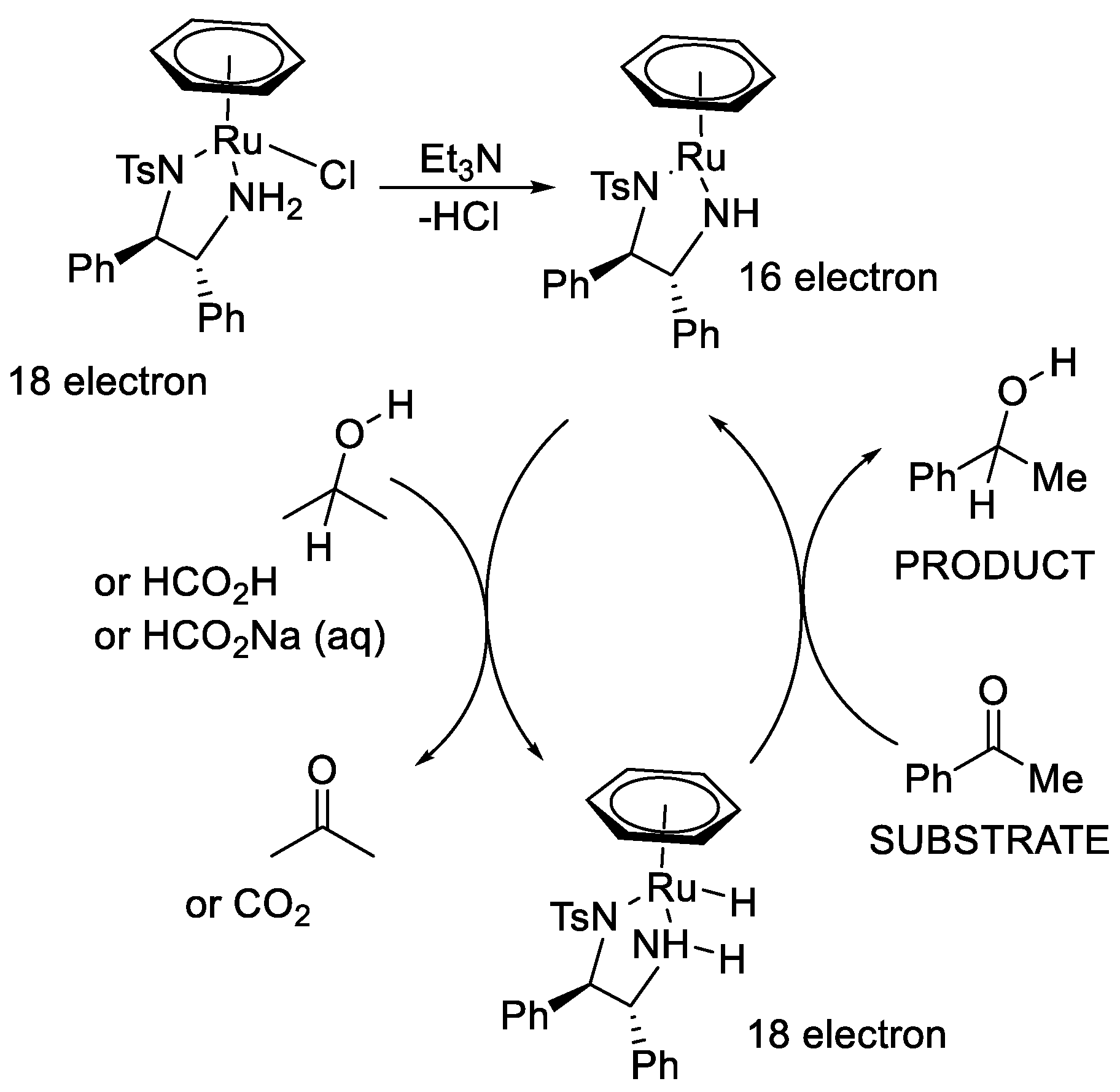
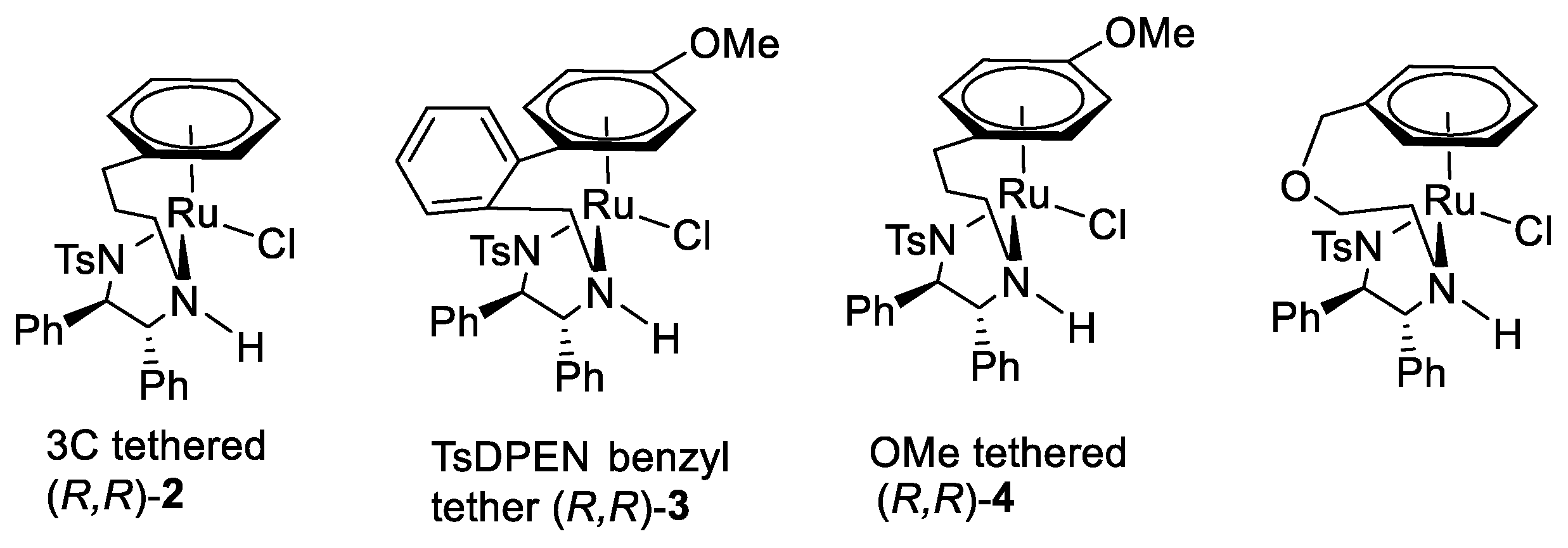
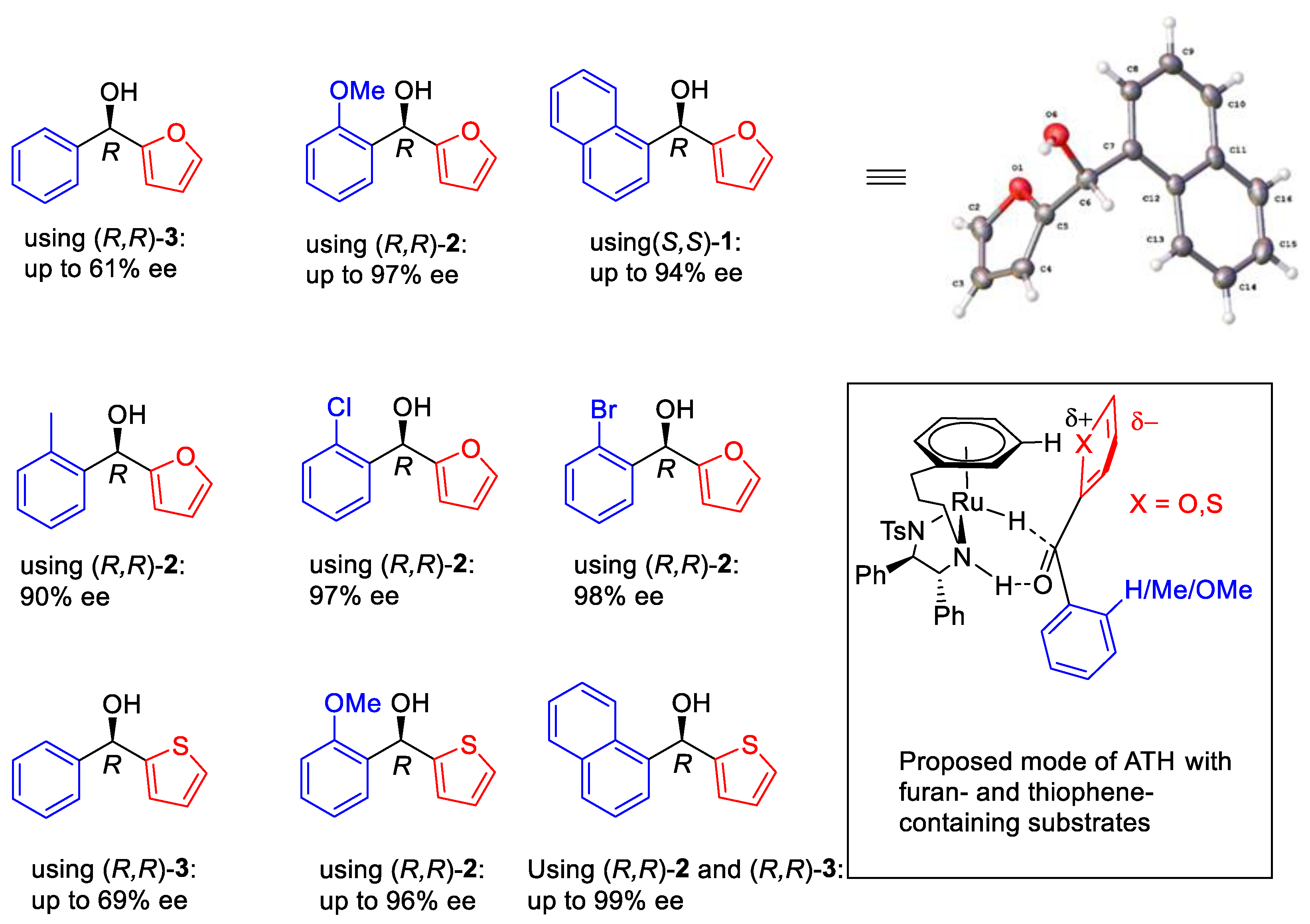
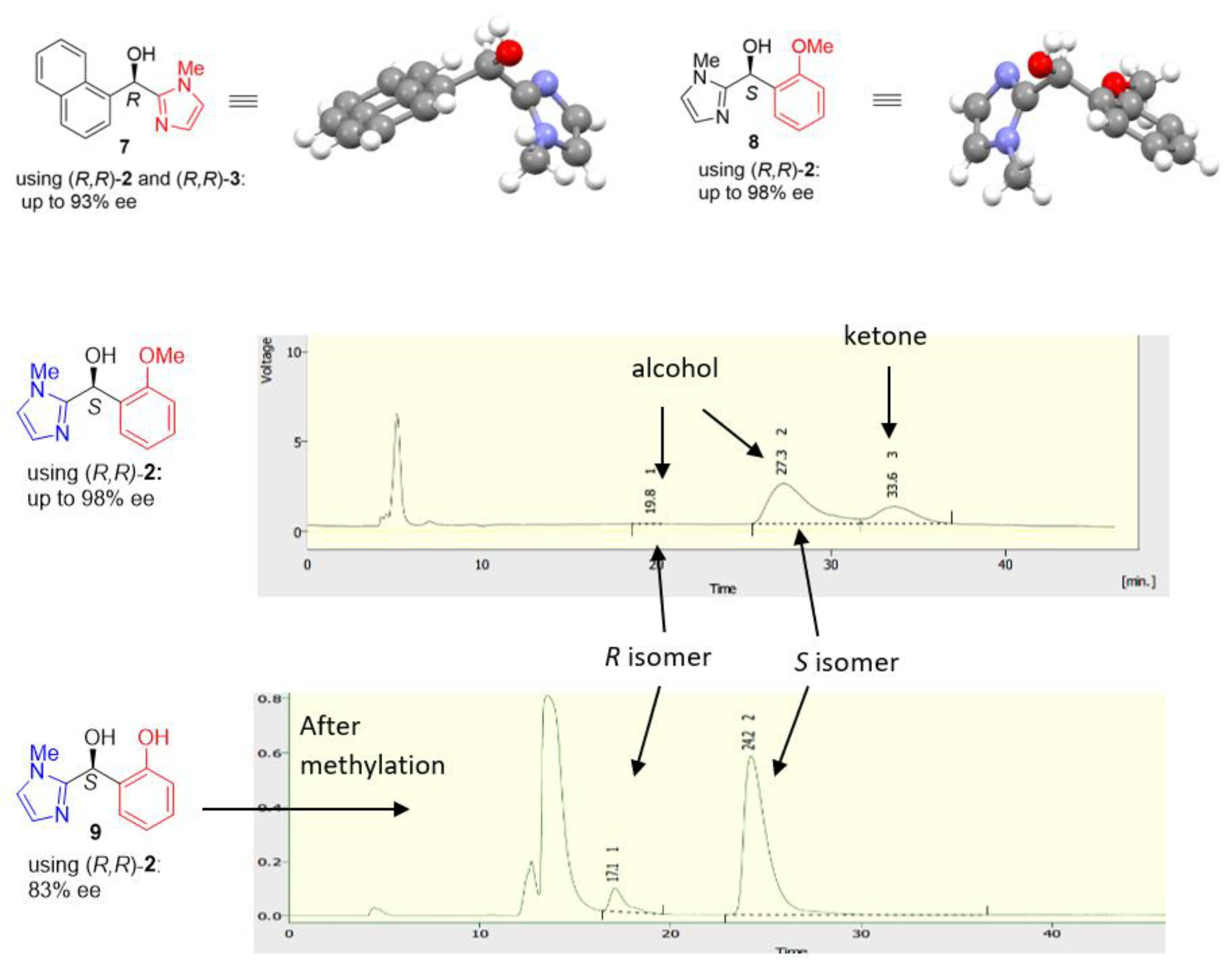
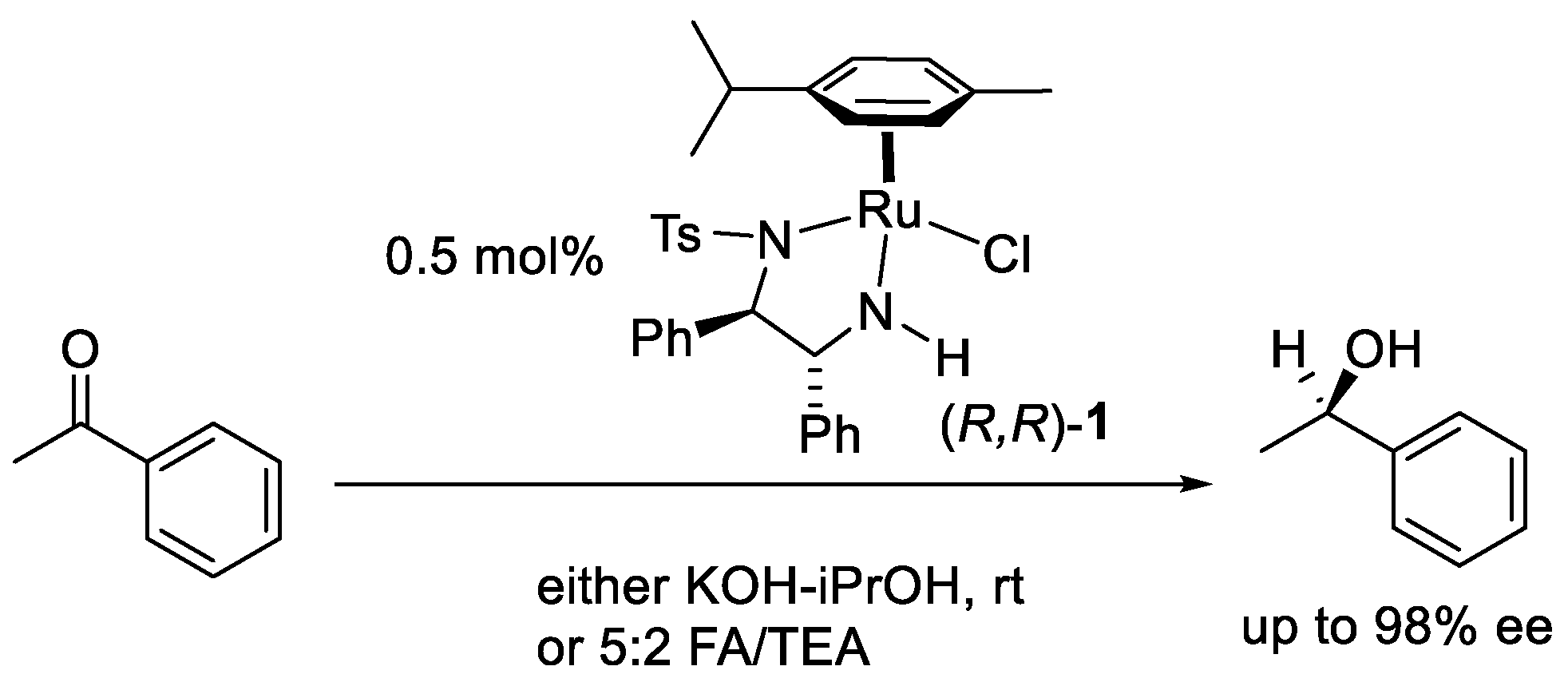
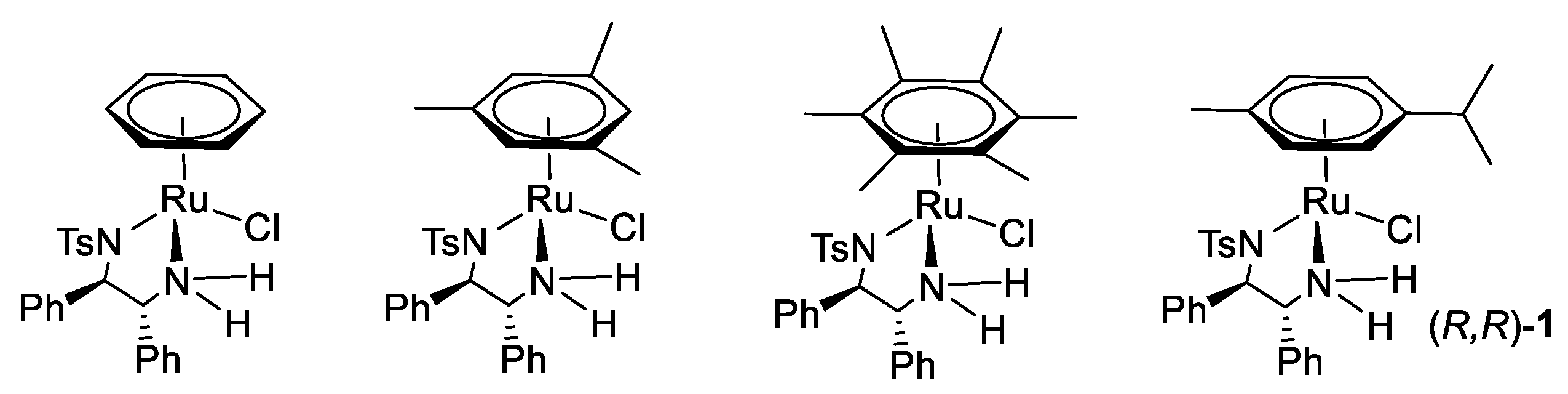
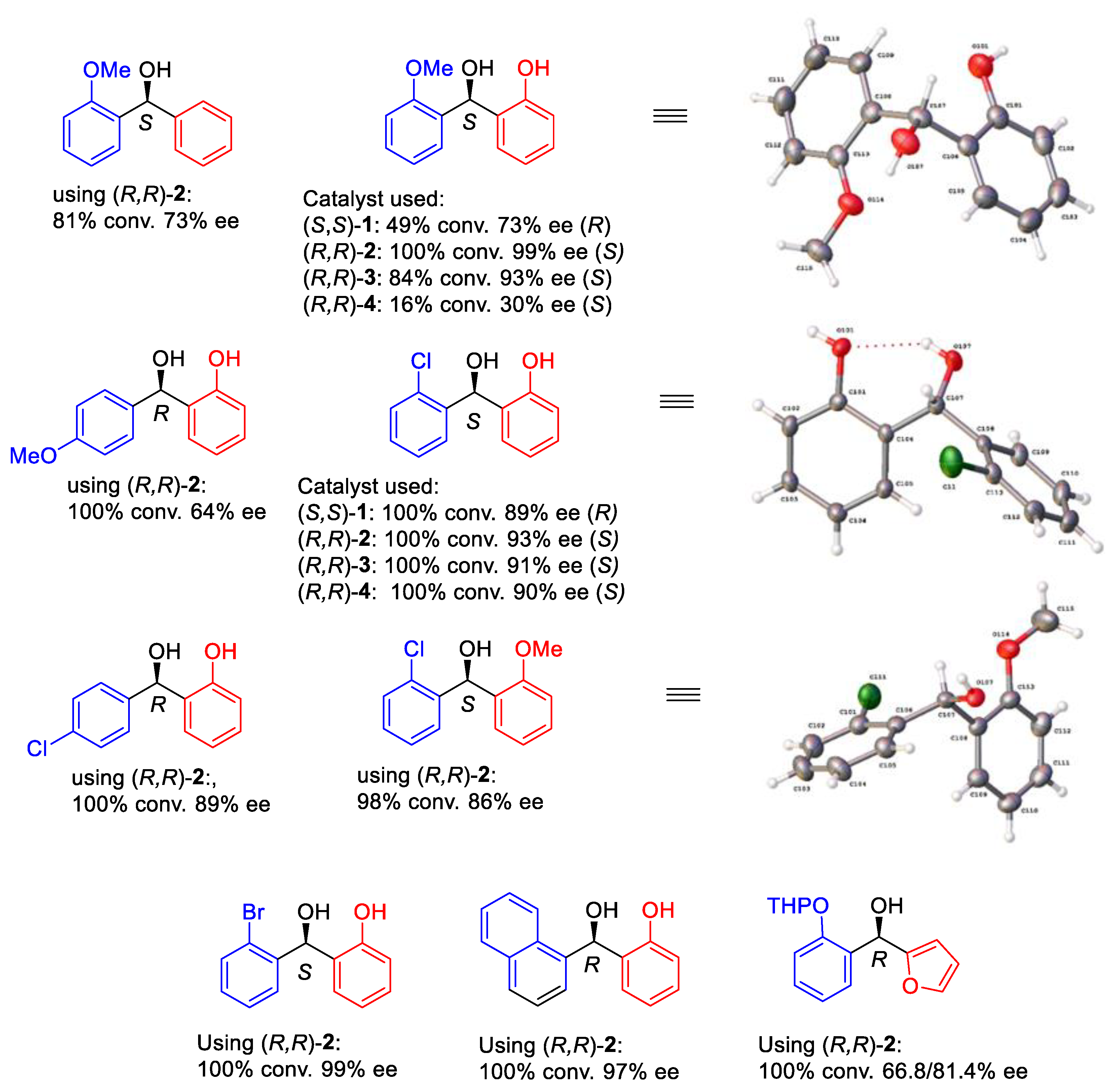
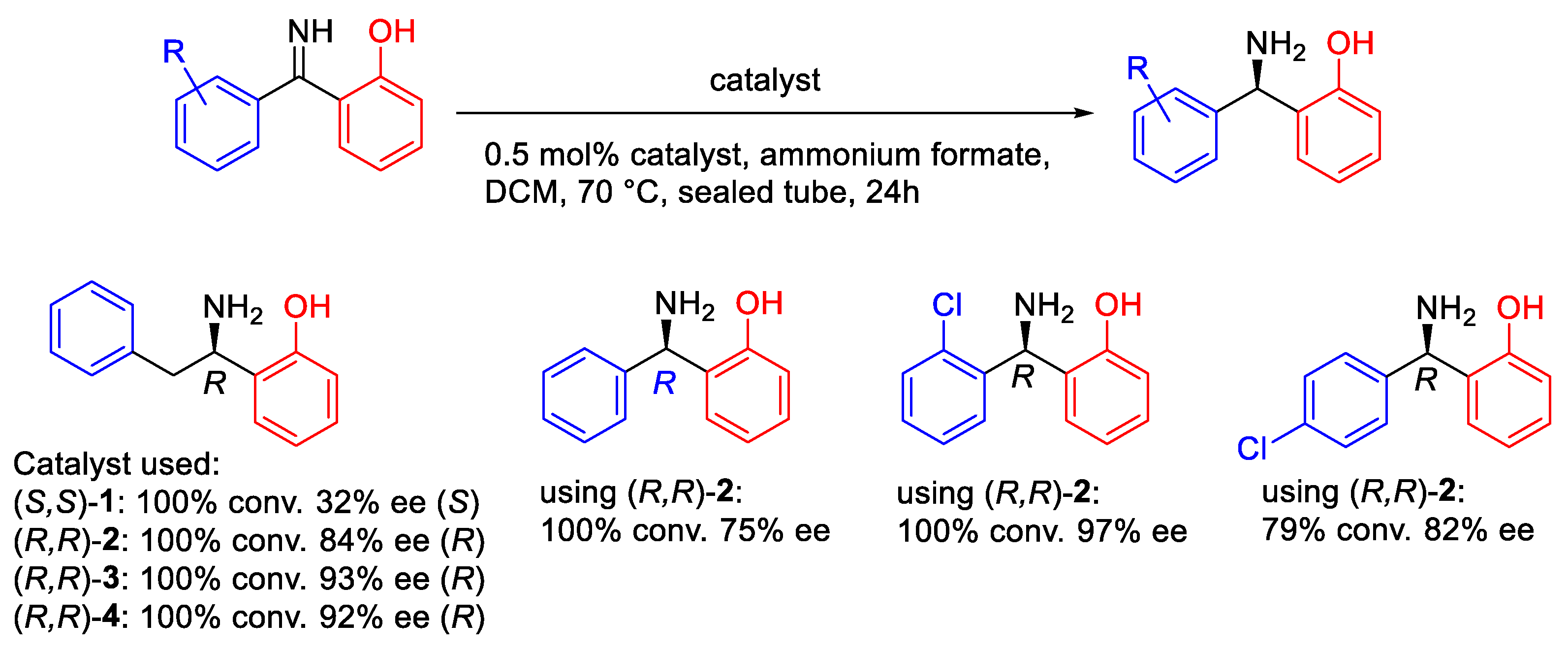
, - (R,R)-3C-tethered catalyst 2 was found to be the most active catalyst for ATH of a series of ortho-hydroxy benzophenone and aromatic/heterocyclic ketones.
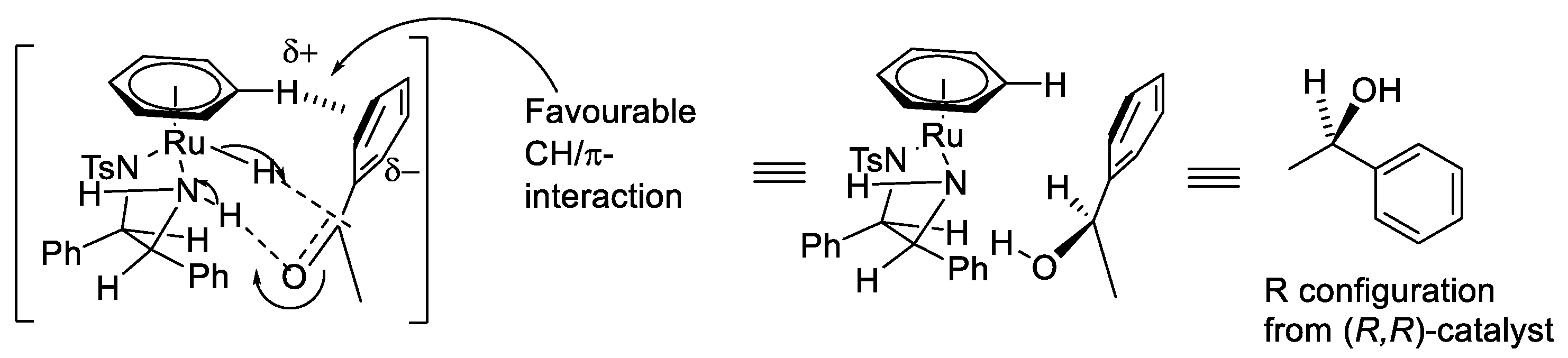
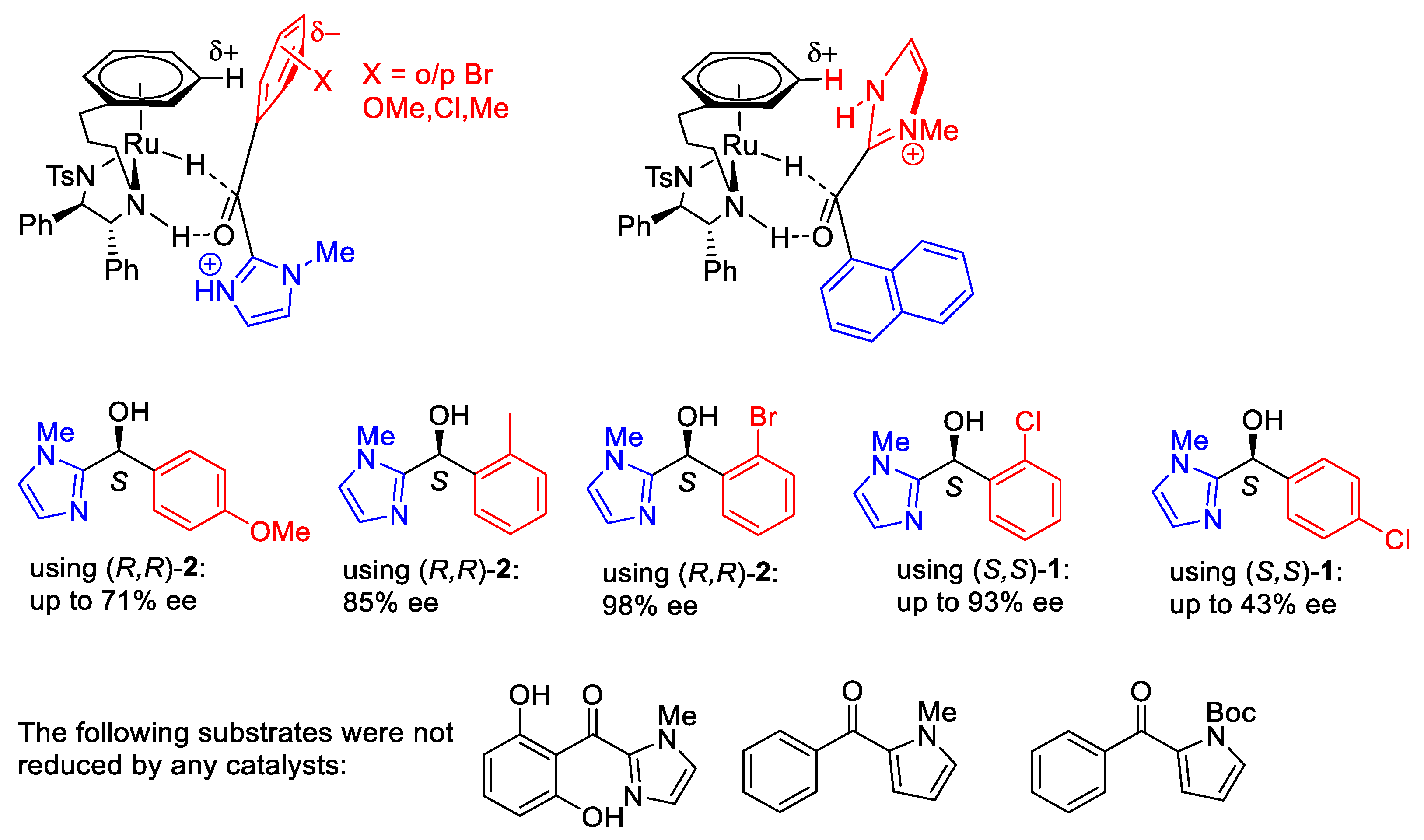
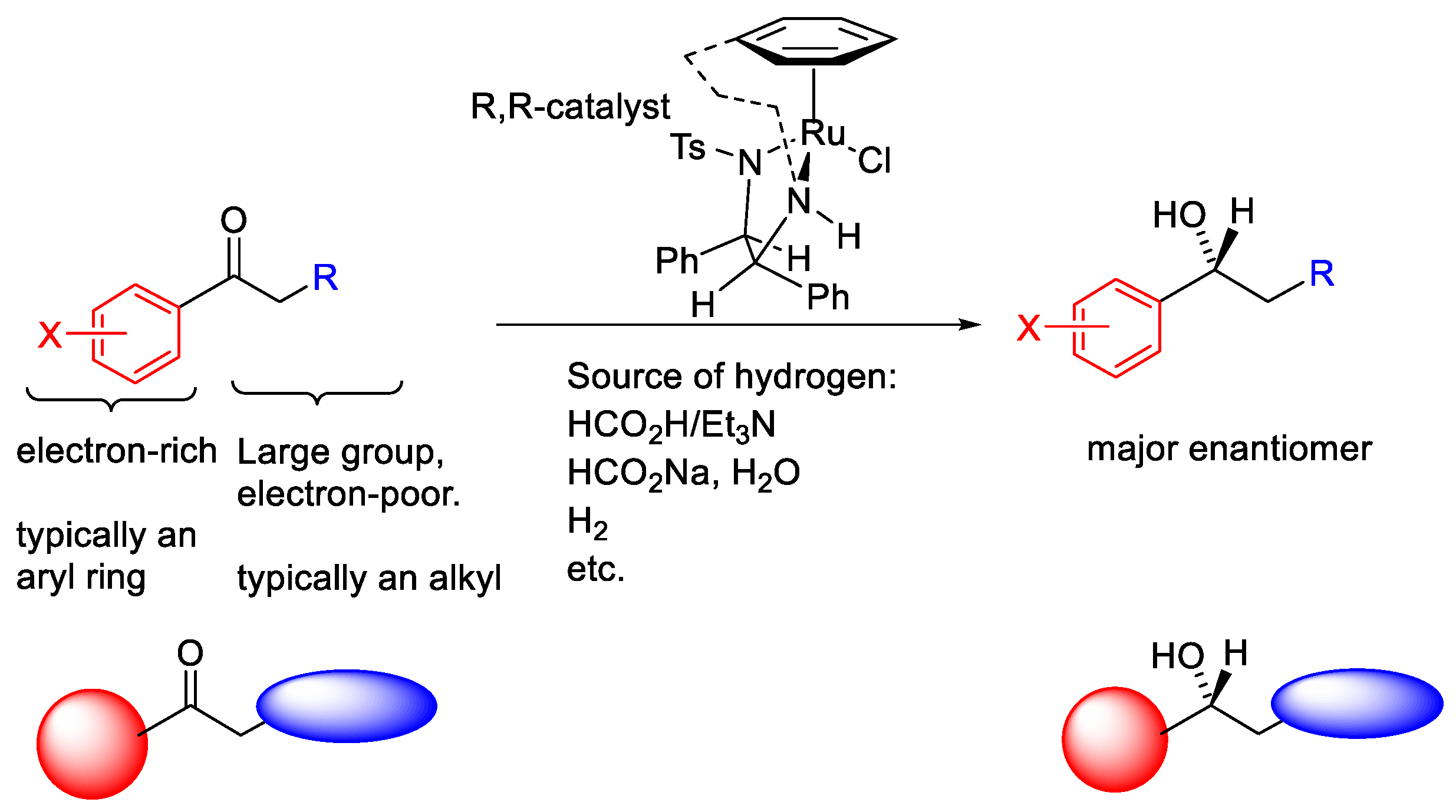
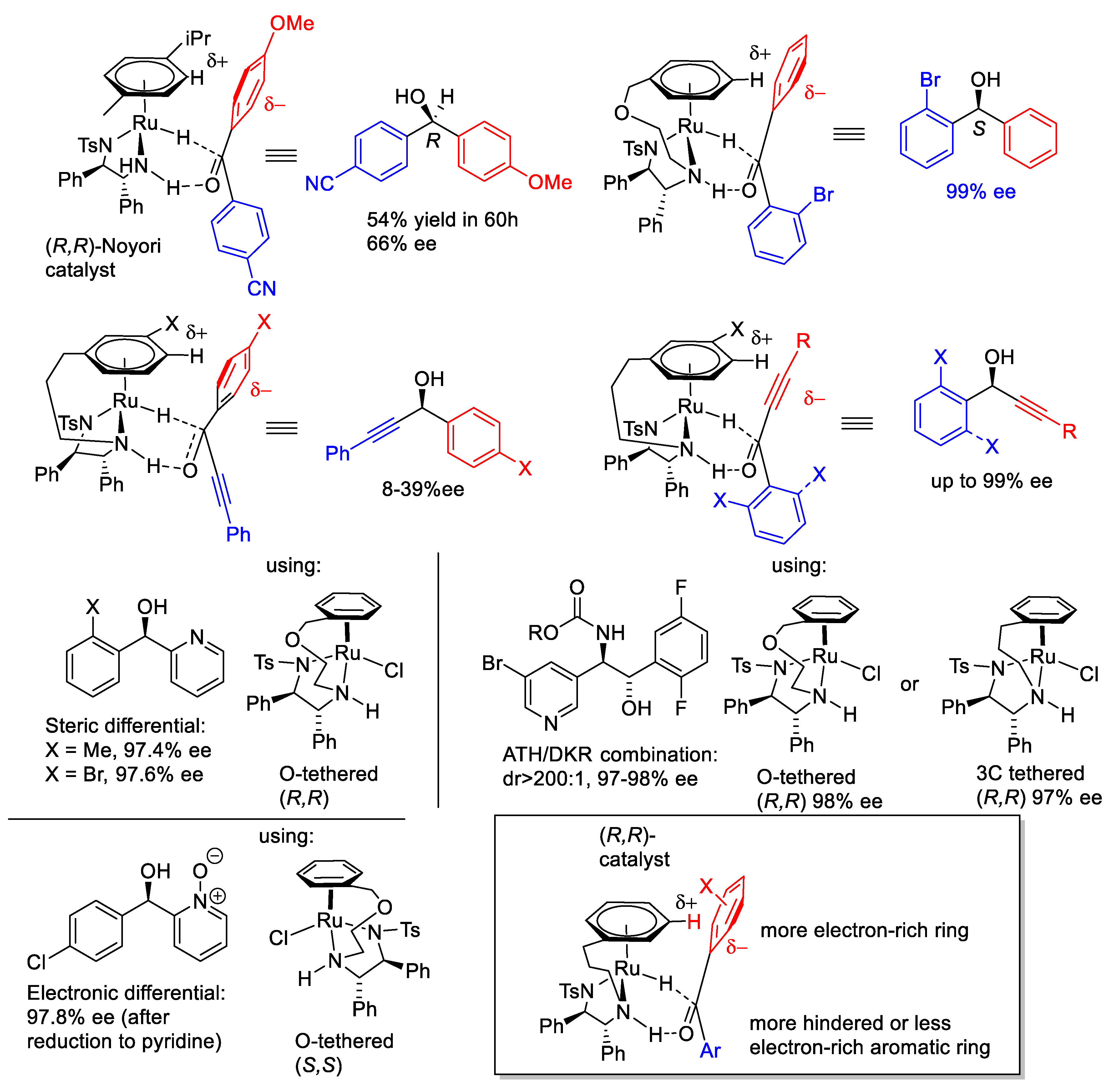
- The enantioselectivity can be influenced by a combination of steric and electronic factors.
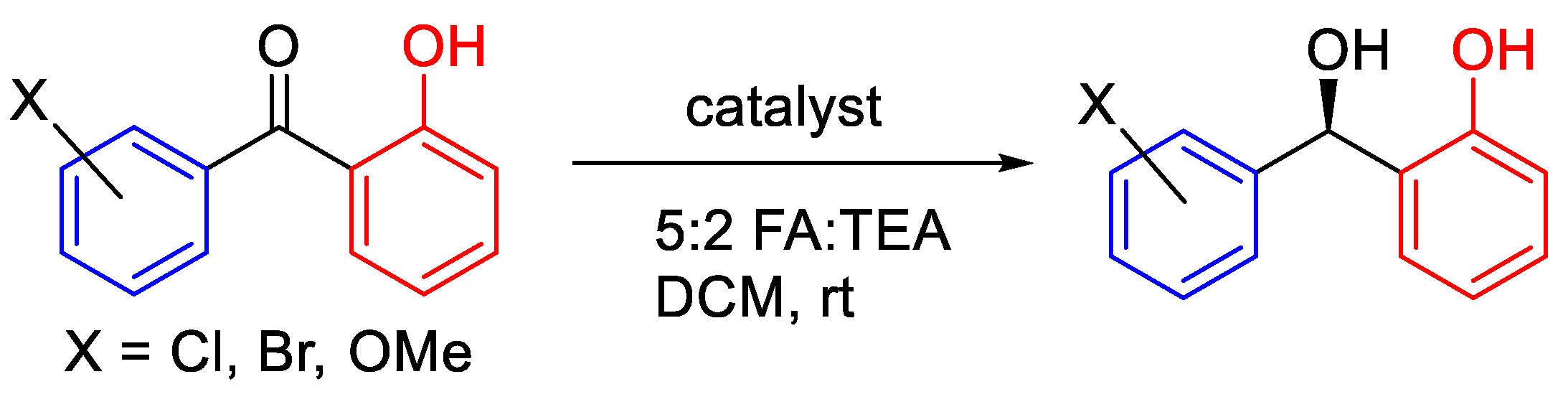
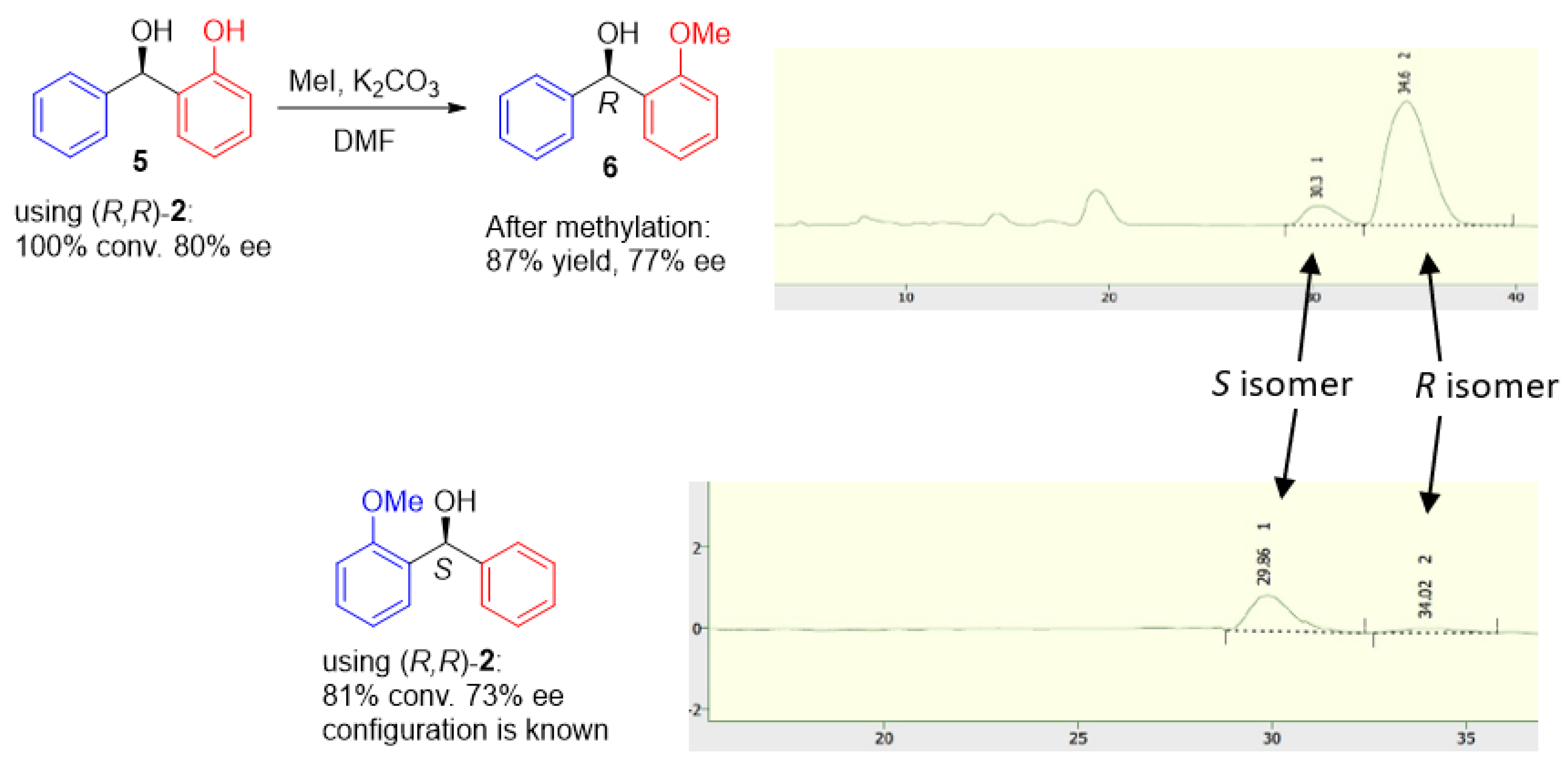
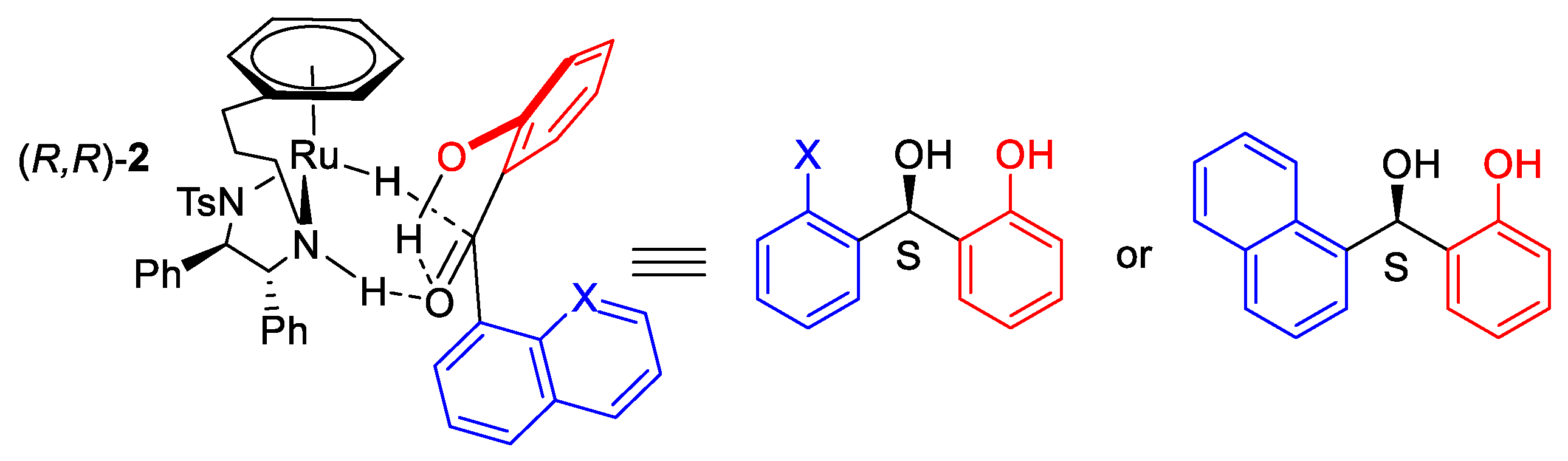
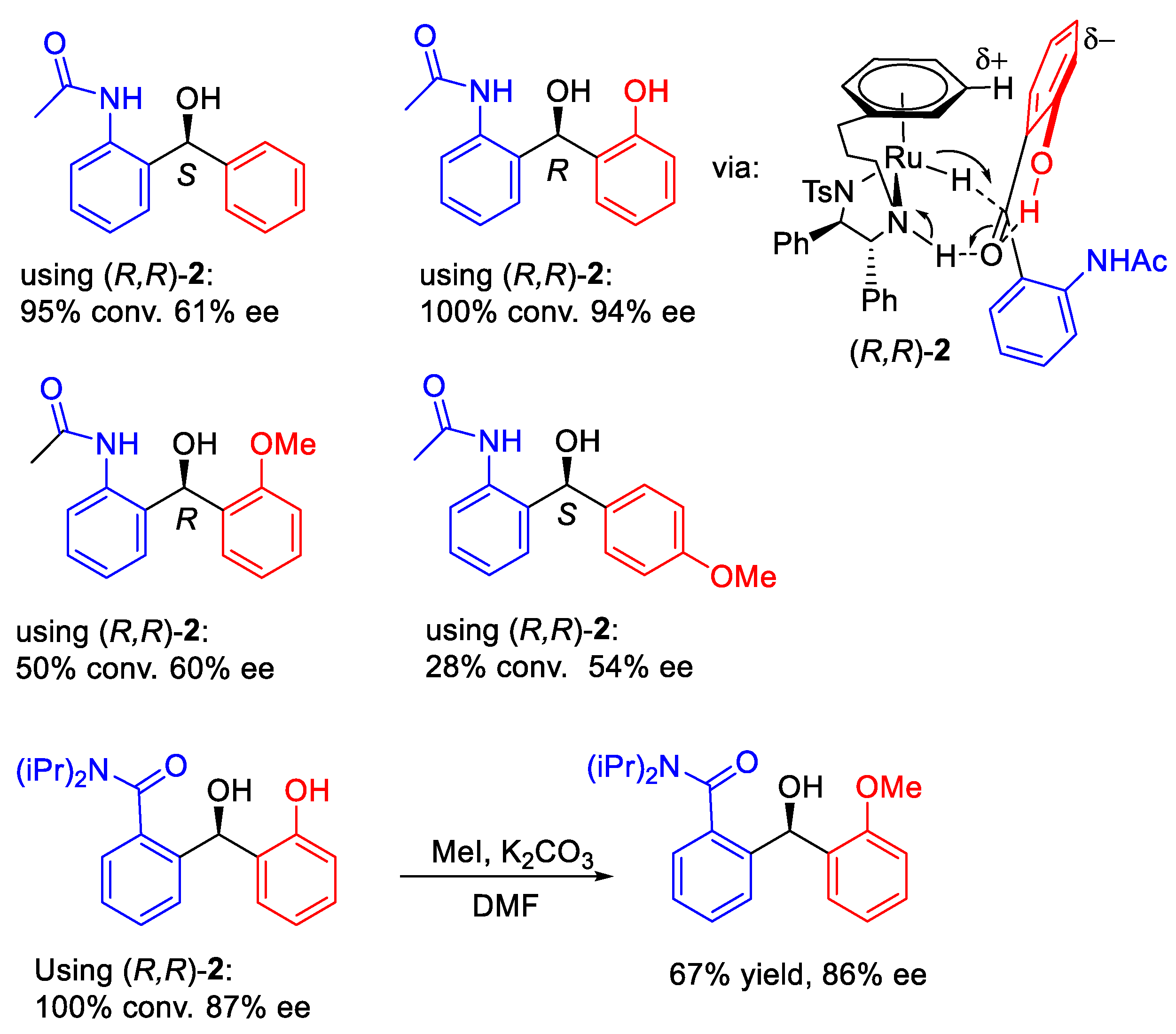
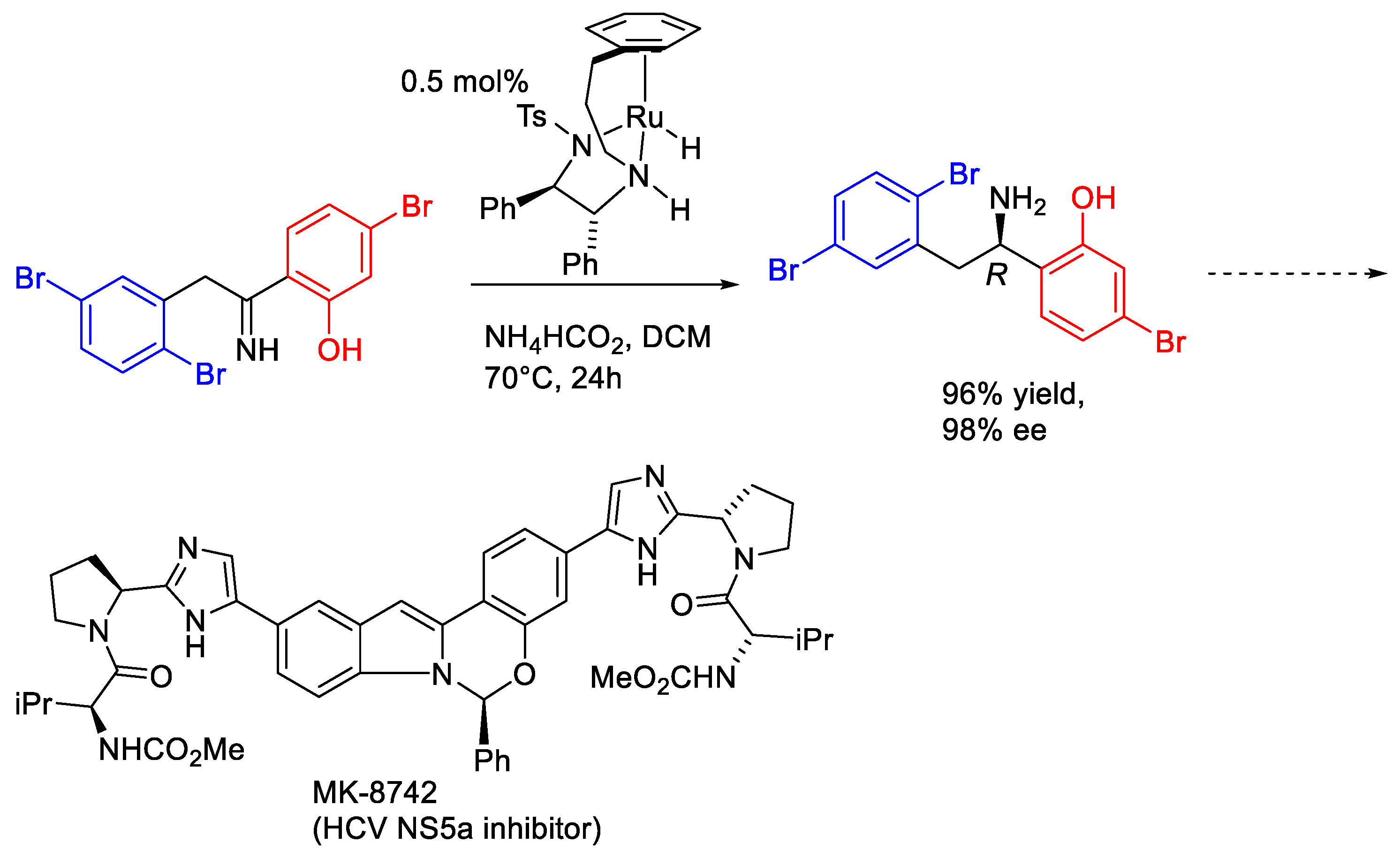
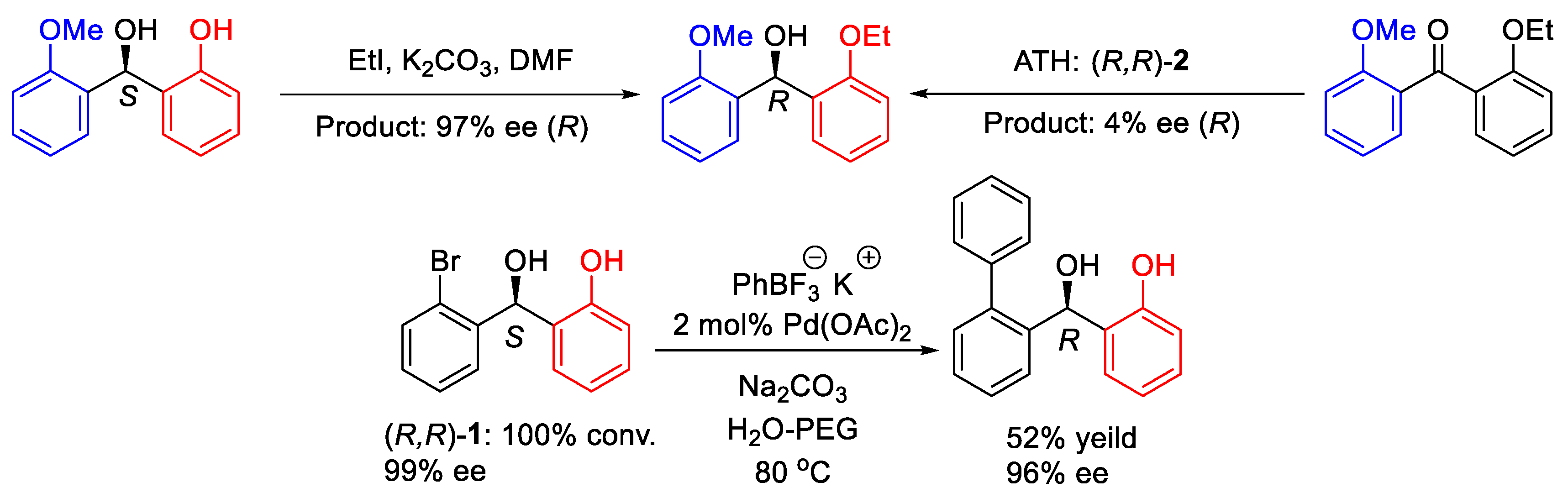
- The directing effect of the o-OH group in hindered ketones and imines can provide products with high enantioselectivity.
- The reduction enantioselectivity of a range of ketones flanked by a combination of an aromatic and a heterocyclic ring (furan, thiophene, N-methylimidazole) was high (up to 99% ee) in cases where the aromatic ring contained an ortho-substituent.
Author Contributions
Funding
Institutional Review Board Statement
Informed Consent Statement
Conflicts of Interest
References
- Hashiguchi, S.; Fujii, A.; Takehara, J.; Ikariya, T.; Noyori, R.J. Asymmetric transfer hydrogenation of aromatic ketones catalyzed by chiral ruthenium (II) complexes. Am. Chem. Soc. 1995, 117, 7562–7563. [Google Scholar] [CrossRef] [Scilit]
- Fujii, A.; Hashiguchi, S.; Uematsu, N.; Ikariya, T.; Noroyi, R. Ruthenium (II)-catalyzed asymmetric transfer hydrogenation of ketones using a formic acid–triethylamine mixture. J. Am. Chem. Soc. 1996, 118, 2521–2522. [Google Scholar] [CrossRef] [Scilit]
- Dub, P.A.; Ikariya, T.J. Quantum chemical calculations with the inclusion of nonspecific and specific solvation: Asymmetric transfer hydrogenation with bifunctional ruthenium catalysts. Am. Chem. Soc. 2013, 135, 2604–2619. [Google Scholar] [CrossRef] [Scilit] [PubMed]
- Dub, P.A.; Gordon, J.C. The mechanism of enantioselective ketone reduction with Noyori and Noyori–Ikariya bifunctional catalysts. Dalton Trans. 2016, 45, 6756–6781. [Google Scholar] [CrossRef] [Scilit] [PubMed]
- Nedden, H.G.; Zanotti-Gerosa, A.; Wills, M. The Development of Phosphine-Free “Tethered” Ruthenium (II) Catalysts for the Asymmetric Reduction of Ketones and Imines. Chem. Rec. 2016, 16, 2619–2639. [Google Scholar] [CrossRef] [Scilit] [PubMed]
- Alonoso, D.A.; Brandt, P.; Nordin, S.J.M.; Andersson, P.G.J. Ru (arene)(amino alcohol)-catalyzed transfer hydrogenation of ketones: Mechanism and origin of enantioselectivity. Am. Chem. Soc. 1999, 121, 9580–9588. [Google Scholar] [CrossRef] [Scilit]
- Yamakawa, M.; Noyori, R. CH/π Attraction: The Origin of Enantioselectivity in Transfer Hydrogenation of Aromatic Carbonyl Compounds Catalyzed by Chiral η6-Arene-Ruthenium (ii) Complexes. Angew. Chem Int. Ed. 2001, 40, 2818–2821. [Google Scholar] [CrossRef] [Scilit]
- Dub, P.A.; Henson, N.J.; Martin, R.L.; Gordon, J.C. Unravelling the Mechanism of the Asymmetric Hydrogenation of Acetophenone by [RuX2 (diphosphine)(1,2-diamine)] Catalysts. J. Am. Chem. Soc. 2014, 136, 3505–3521. [Google Scholar] [CrossRef] [Scilit] [PubMed]
- Hashiguchi, S.; Noyori, R. Asymmetric Transfer Hydrogenation Catalyzed by Chiral Ruthenium Complexes. Acc. Chem. Res. 1997, 30, 97–102. [Google Scholar]
- Soni, R.; Jolley, K.E.; Clarkson, G.J.; Wills, M. Direct formation of tethered Ru (II) catalysts using arene exchange. Org. Lett. 2013, 15, 5110–5113. [Google Scholar] [CrossRef] [Scilit] [PubMed]
- Soni, R.; Jolley, K.E.; Gosiewska, S.; Clarkson, G.J.; Fang, Z.; Hall, T.H.; Treloar, B.N.; Knighton, R.C.; Wills, M. Synthesis of enantiomerically pure and racemic benzyl-tethered Ru (II)/TsDPEN complexes by direct arene substitution: Further complexes and applications. Organometallics 2018, 37, 48–64. [Google Scholar] [CrossRef] [Scilit]
- Touge, T.; Hakamata, T.; Nara, H.; Kobayashi, T.; Sayo, N.; Saito, T.; Kayaki, Y.; Ikariya, T.J. Oxo-tethered ruthenium (II) complex as a bifunctional catalyst for asymmetric transfer hydrogenation and H2 hydrogenation. Am. Chem. Soc. 2011, 133, 14960–14963. [Google Scholar] [CrossRef] [Scilit] [PubMed]
- Touge, T.; Nara, H.; Fujiwhara, M.; Kayaki, Y.; Ikariya, T. Efficient Access to Chiral Benzhydrols via Asymmetric Transfer Hydrogenation of Unsymmetrical Benzophenones with Bifunctional Oxo-Tethered Ruthenium Catalysts. J. Am. Chem. Soc. 2016, 138, 10084–10087. [Google Scholar] [CrossRef] [Scilit] [PubMed]
- Vyas, V.K.; Knighton, R.C.; Bhanage, B.M.; Wills, M. Combining Electronic and Steric Effects To Generate Hindered Propargylic Alcohols in High Enantiomeric Excess. Org. Lett. 2018, 20, 975–978. [Google Scholar] [CrossRef] [Scilit] [PubMed]
- Wang, B.; Zhou, H.; Lu, G.; Liu, Q.; Jiang, X. Bifunctional oxo-tethered ruthenium complex catalyzed asymmetric transfer hydrogenation of aryl N-heteroaryl ketones. Org. Lett. 2017, 19, 2094–2097. [Google Scholar] [CrossRef] [Scilit] [PubMed]
- Liu, Q.; Wang, C.; Zhou, H.; Wang, B.; Lv, J.; Cao, L.; Fu, Y. Iridium-catalyzed highly enantioselective transfer hydrogenation of aryl N-heteroaryl ketones with N-oxide as a removable ortho-substituent. Org. Lett. 2018, 20, 971–974. [Google Scholar] [CrossRef] [Scilit] [PubMed]
- Gonzalez-Bobes, G.; Hanson, R.; Strotman, N.; Guo, Z.; Goswami, A. Enantioselective Synthesis of a Positive Allosteric Modulator of the Metabotropic Glutamate Receptor 5 (mGluR5) Receptor via Dynamic Kinetic Resolution of α-Amino Ketones. Adv. Synth. Catal. 2016, 358, 2077–2082. [Google Scholar] [CrossRef] [Scilit]
- Zheng, Y.; Clarkson, G.J.; Wills, M. Asymmetric transfer hydrogenation of o-hydroxyphenyl ketones: Utilizing directing effects that optimize the asymmetric synthesis of challenging alcohols. Org. Lett. 2020, 22, 3717–3721. [Google Scholar] [CrossRef] [Scilit] [PubMed]
- Mangion, I.K.; Chen, C.Y.; Li, H.; Maligres, P.; Chen, Y.; Christensen, M.; Cohen, R.; Jeon, I.; Klapars, A.; Krska, S.; et al. Enantioselective synthesis of an HCV NS5a antagonist. Org. Lett. 2014, 16, 2310–2313. [Google Scholar] [CrossRef] [Scilit] [PubMed]
- Zheng, Y.; Martinez-Acosta, J.A.; Khimji, M.; Barbosa, L.C.A.; Clarkson, G.J.; Wills, M. Asymmetric Transfer Hydrogenation of Aryl Heteroaryl Ketones using Noyori-Ikariya Catalysts. ChemCatChem 2021, 13, 4384–4391. [Google Scholar] [CrossRef] [Scilit]










Publisher’s Note: MDPI stays neutral with regard to jurisdictional claims in published maps and institutional affiliations. |
© 2021 by the authors. Licensee MDPI, Basel, Switzerland. This article is an open access article distributed under the terms and conditions of the Creative Commons Attribution (CC BY) license (https://creativecommons.org/licenses/by/4.0/).
Share and Cite
Zheng, Y.; Martinez-Acosta, J.A.; Khimji, M.; Barbosa, L.C.A.; Clarkson, G.J.; Wills, M. Asymmetric Transfer Hydrogenation of Aryl Heteroaryl Ketones and o-Hydroxyphenyl Ketones Using Noyori-Ikariya Catalysts. Chem. Proc. 2022, 8, 35. https://doi.org/10.3390/ecsoc-25-11774
Zheng Y, Martinez-Acosta JA, Khimji M, Barbosa LCA, Clarkson GJ, Wills M. Asymmetric Transfer Hydrogenation of Aryl Heteroaryl Ketones and o-Hydroxyphenyl Ketones Using Noyori-Ikariya Catalysts. Chemistry Proceedings. 2022; 8(1):35. https://doi.org/10.3390/ecsoc-25-11774
Chicago/Turabian StyleZheng, Ye, Jaime A. Martinez-Acosta, Mohammed Khimji, Luiz C. A. Barbosa, Guy J. Clarkson, and Martin Wills. 2022. "Asymmetric Transfer Hydrogenation of Aryl Heteroaryl Ketones and o-Hydroxyphenyl Ketones Using Noyori-Ikariya Catalysts" Chemistry Proceedings 8, no. 1: 35. https://doi.org/10.3390/ecsoc-25-11774
APA StyleZheng, Y., Martinez-Acosta, J. A., Khimji, M., Barbosa, L. C. A., Clarkson, G. J., & Wills, M. (2022). Asymmetric Transfer Hydrogenation of Aryl Heteroaryl Ketones and o-Hydroxyphenyl Ketones Using Noyori-Ikariya Catalysts. Chemistry Proceedings, 8(1), 35. https://doi.org/10.3390/ecsoc-25-11774