2. Case Report
We report the case of a 4-year-and-8-month-old Caucasian boy with T1D at onset, presenting with recurrent fasting hypoglycemia. The boy was born at term (41 weeks’ gestational age) after a normal pregnancy. The birth weight was 3830 g (0.84 SD), length 53 cm (1.38 SD), and head circumference 35 cm (−0.76 SD). Past medical history was not relevant. The family history revealed a medulloblastoma in the father.
The patient was referred to our unit after a one-week history of polydipsia and polyuria. Anthropometric parameters were: weight 16 kg (−0.83 SD), height 103.5 cm (−1.04 SD), and body mass index (BMI) 15.1 kg/m2 (0.58 SD). Capillary blood glucose (BG) measurements at home showed recurrent hyperglycemia (up to 32.2 mmol/L). The plasma BG at admission in the emergency room was 3 mmol/L. The patient presented with weakness that resolved postprandially. Upon admission to the pediatric department, we performed glucose monitoring without any drug or fluid treatment, and, in the morning, he exhibited weakness associated with a capillary BG of 3.4 mmol/L after 12 h of fasting, along with glycosuria (5.6 mmol/L) and ketonuria (3 mmol/L), without significant metabolic acidosis (pH 7.38, HCO3 20.1 mEq/L, BE −3.7 mEq/L). Hypoglycemia was confirmed through plasma glucose analysis (3.1 mmol/L). Blood exams also showed markedly elevated glycated hemoglobin (HbA1c) (98 mmol/moL, normal values [n.v.] 20–42 mmol/moL) and low C-peptide levels (0.05 nmol/L, n.v. 0.27–1.28); autoantibody screening (without Anti-ZnT8 Ab) was only slightly positive for antibodies to glutamic acid decarboxylase (Anti-GAD) (38.3 KUI/L, n.v. < 10). Thyroid function, anti-thyroid antibodies, and anti-transglutaminase antibodies were all negative. The liver was not palpable. A nasopharyngeal swab tested positive for SARS-CoV-2 using molecular PCR.
A 24 h capillary glycemic profile was recorded (
Supplementary Materials Table S1), and a basal–bolus insulin regimen with morning Glargine was initiated. After insulin titration, he was discharged on a total daily insulin dose of 1 IU/kg/day. In the following weeks, the boy experienced recurrent episodes of fasting hypoglycemia (nadir: 1.7 mmol/L), prompting a gradual reduction in insulin doses. Due to persistent fasting hypoglycemia and postprandial hyperglycemia, a diagnosis of glycogen storage disease type 0 (GSD-0) was considered. A fasting test performed two days after stopping insulin showed ketotic hypoglycemia (capillary BG 2.8 mmol/L, plasma BG 3 mmol/L, ketonemia 3.1 mmol/L, ketonuria 3 mmol/L) after 19 h of fasting (
Table 1). Blood samples collected during hypoglycemia also revealed suppressed insulin levels (0.6 μU/mL) and borderline normal C-peptide levels (0.26 nmol/L). Ammonia, cortisol, somatomedin C (IGF-1), and thyroid hormone levels were within normal ranges. A low GH level was not considered the cause of hypoglycemia, as the sample was collected during a fasting-induced hypoglycemic episode, rather than during an insulin tolerance test-induced hypoglycemia [
2]. No metabolic acidosis was detected. Elevated non-esterified fatty acids (NEFAs) and the urinary organic acid profile were consistent with ketotic hypoglycemia. For the first time, we detected high glucagon levels in our patient (93 pmol/L, n.v. 3–60).
A glucagon stimulation test (
Supplementary Materials Table S2) revealed a suboptimal glycemic response (i.e., normal delta glucose > 1.7 mmol/L within 30 min, after 1 mg i.m. glucagon), supporting the suspicion of GSD-0. A complex-carbohydrate diet with raw cornstarch at bedtime was tested.
The boy maintained good glycemic control for 10 days (time-in-range: 73%) without any pharmacological treatment. However, a progressive increase in morning ketonemia (up to 3.1 mmol/L) and postprandial hyperglycemia (up to 16 mmol/L) was noted despite dietary compliance.
Anti-ZnT8 antibodies were tested and found to be markedly elevated (537 U/mL; normal < 15); therefore, we classified the T1D as immune-mediated.
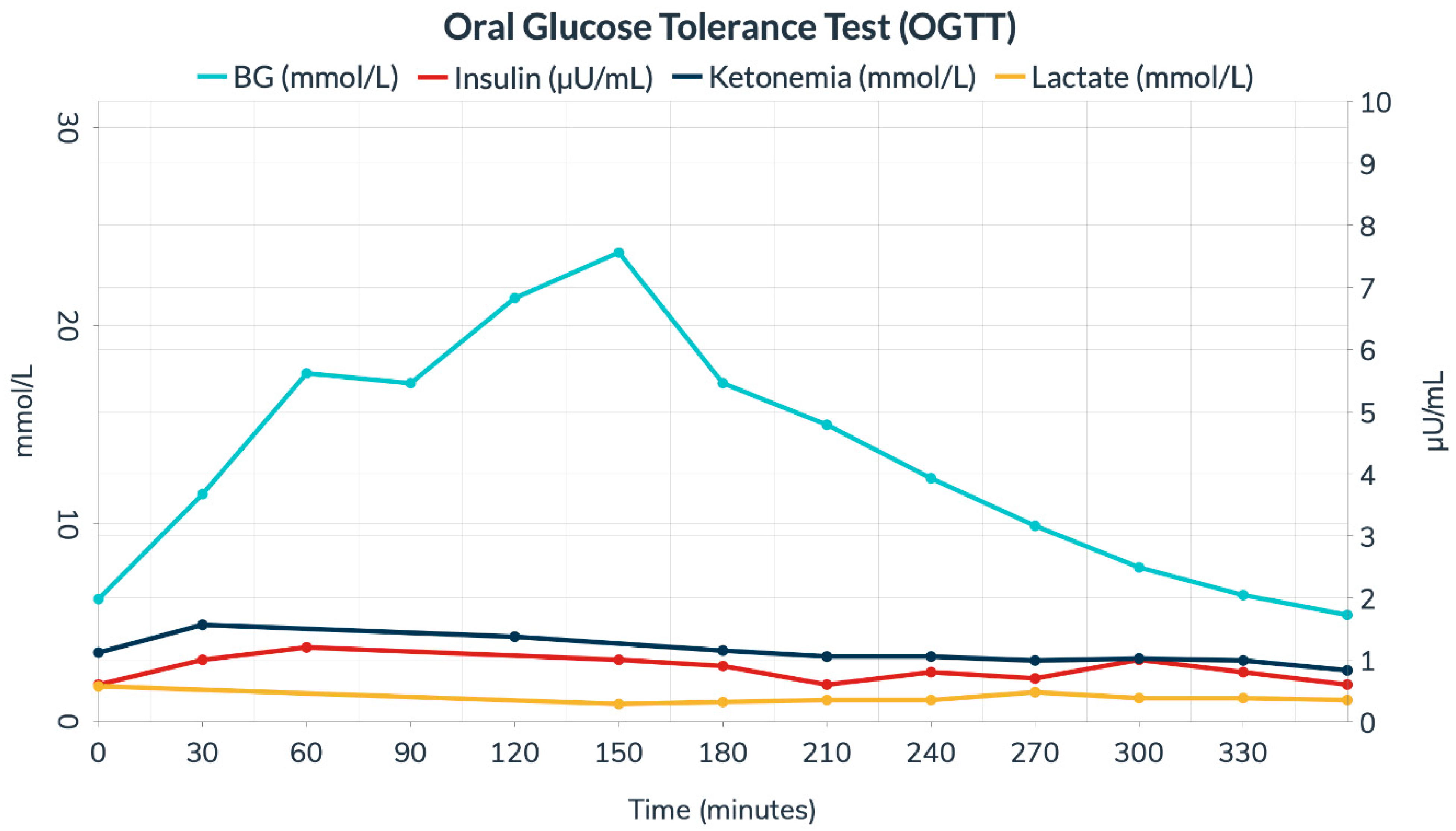
After 6.5 h of fasting and in the absence of insulin therapy, the boy again exhibited ketotic hypoglycemia (capillary BG 2.3 mmol/L). An Oral Glucose Tolerance Test (OGTT) with a concurrent measurement of blood lactate revealed marked hyperglycemia, an inadequate insulin response, persistent ketonemia and normal lactate values (
Supplementary Materials Table S3,
Figure 1). Interestingly, after 3 h, a progressive decline in BG levels was observed without a contextual insulin increase. Normal lactate levels throughout the hyperglycemic phase definitively exclude GSD-0.
A panel of genes associated with hypoglycaemia, including the GYS2 gene, was performed and revealed no variants.
Plasma glucagon levels were randomly tested on three additional occasions both in the fasting and postprandial states, and were consistently elevated (75, 66, 84 pmol/L; n.v. 3–60). As expected, the higher value was recorded during fasting (84 pmol/L).
Brain and abdominal MRI pituitary imaging and PET-CT excluded neuroendocrine tumors. Tumor markers (NSE, chromogranin A) and hormonal panels (PRL, ACTH, PTH, gastrin, VIP) were normal. A genetic analysis of a gene panel involved in hypoglycemia, including the GYS2 gene, and in monogenic diabetes (MODY) through next generation sequencing (NGS) did not identify any variation.
Two months after the diabetes onset, in view of the trend towards persistent and marked hyperglycemia, according to the autoimmune T1D diagnosis, the boy was provided with an insulin pump (basal 7.5 U/day and bolus 6.7 U/day), and within a few days he reached a good control with time in the range of 67% in the last week. He received a hybrid closed-loop (HCL) system, and no further recurrent hypoglycemic episodes were recorded.
4. Results
Among children with T1D onset, episodes of hypoglycemia before the initiation of insulin therapy have been reported in four studies.
Yamaguchi et al. [
3] conducted a retrospective cohort study on 87 children with newly diagnosed T1D. They observed that 6.9% (6/87) of patients experienced spontaneous hypoglycemia before insulin initiation. In the 44 recorded hypoglycemic episodes, seven were in the 40–49 mg/dL range, 11 were in the 50–59 mg/dL range, and 26 were in the 60–70 mg/dL range. Neither patient experienced severe symptoms during the hypoglycemic episode; the only symptoms were hunger and irritability. In the 44 hypoglycemic episodes, fasting hypoglycemia before breakfast (after an overnight fasting) occurred only once (2%). In total, 43/44 (98%) hypoglycemic episodes occurred at times other than before breakfast. Interestingly, the HbA1c levels at the diagnosis of T1D in the hypoglycemia group were lower than in the non-hypoglycemia group (median: 7.3% (56 mmol/moL) vs. 11.9% (106 mmol/moL),
p < 0.0001). Similarly, the 24 h urinary C-peptide (UCPR) levels of the former group were higher than those of the latter group (16.5 μg/day/m
2 vs. 7.0 μg/day/m
2,
p = 0.0075). In short, the hypoglycemia group demonstrated a greater conservation of their endogenous insulin secretion capacity.
Heinrich et al. [
4] compared the frequency of hypoglycemic fasting blood glucose levels in 48 autoantibody-negative and 167 multiple β-cell autoantibody-positive children aged 2 to 5 years with presymptomatic T1D. They observed that, in the autoantibody-positive children, 5.1% of the fasting samples were hypoglycemic, while in the autoantibody-negative children no hypoglycemia was observed. Hypoglycemia occurred more often in autoantibody-positive children who had already entered stage 2 or stage 3 of T1D than in stage 1 patients (
p = 0.02). In addition, children who had hypoglycemic compared to normoglycemic fasting blood glucose values had higher 120 min blood glucose values under OGTT challenge and a higher rate of pathological OGTTs (
p = 0.04). HbA1c, however, was comparable in both groups.
Poon et al. [
5] described a single patient with severe postprandial hyperinsulinaemic hypoglycaemia (PPHH) before T1D onset. This patient had severe PPHH for 4 years, experienced a hypoglycemic seizure, and then acutely developed T1D. Her hypoglycaemia was not related to fasting or provocation (such as exercise or protein sensitivity). She had no insulin or insulin receptor antibodies but was positive for islet cell antibodies (ICA) and anti-GAD antibodies.
Prolonged fasting hypoglycemia and postprandial hyperglycemia, as observed in our case, have been reported as prodromal features of T1D in another single case described in 2012 [
6]. That child experienced recurrent postprandial hyperglycemia and fasting hypoglycemia over a six-month period. At the initial evaluation, ICA and anti-GAD antibodies were both negative. Fasting glucagon levels were within the normal range, and the OGTT demonstrated an appropriate insulin response. Over time, the frequency of hypoglycemic episodes decreased, leaving only persistent hyperglycemia with ketosis. The boy was eventually started on insulin therapy, and repeat antibody testing six months later revealed seroconversion with new-onset autoantibody positivity.
5. Discussion
Although hypoglycemia is one of the most common emergencies in the neonatal period and childhood, a universal consensus on its definition and diagnostic work-up is still lacking. Some diagnostic approaches for pediatric patients define hypoglycemia based on clinical symptoms, while others rely on specific plasma glucose thresholds [
7,
8].
The definition based on the so-called “Whipple triad” [(I) symptoms of hypoglycemia, (II) blood glucose level below 60 mg/dL, (III) resolutions of symptoms after glucose intake] appears inadequate for neonates and younger children, in which symptoms are often subtle, and with the child being unable to communicate them [
8]. Currently, an acceptable threshold for younger children without T1D unable to communicate hypoglycemia is still considered 60 mg/dL (i.e., the normal threshold for neurogenic responses) [
8]. On the contrary, in patients with diabetes taking insulin and/or other medications lowering blood sugar, a blood glucose value < 70 mg/dL is considered hypoglycemia because these patients are indeed at an increased risk of hypoglycaemia [
1].
Recurrent hypoglycemia occurring prior to the initiation of insulin therapy is an uncommon finding at the onset of pediatric T1D. It has been reported only in four studies.
Notably, the plasma blood glucose threshold to define hypoglycemia is not available in four studies; it is <70 mg/dL in one study and <60 mg/dL in the other one.
Yamaguchi et al. [
3] observed that 6.9% of children with newly diagnosed T1D may experience spontaneous hypoglycaemia (<70 mg/dL by self-monitoring of blood glucose) before insulin initiation. Notably, these hypoglycemic episodes were mostly (98%) postprandial and diminished over time as insulin secretion declined. As a consequence, the authors speculated that hypoglycemia before insulin treatment may develop only in individuals with early-stage T1D with some degree of residual endogenous insulin secretion. The authors explain episodes of postprandial hypoglycemia in their cohort as related to delayed insulin secretion after meals, suggesting the role of residual endogenous insulin secretion. However, they observed that hypoglycemic episodes did not directly follow the increase in BG after meals.
On the contrary, Heinrich et al. [
4] observed that children with an advanced T1D disease stage and who were multiple beta-cell autoantibody-positive presented a higher frequency of fasting hypoglycemia (BG < 60 mg/dL) in comparison to autoantibody-negative children. MultiAb children with fasting hypoglycemia more often had pathological OGTTs compared to those with normoglycemic fasting blood glucose values. The authors speculated that this is most likely because of the fact that the hypoglycemic fasting blood glucose values balanced the elevated postprandial blood glucose values. Hypoglycemic fasting blood glucose values were also associated with a diminished decrease in blood glucose after peaking, indicating a decreased insulin secretion response.
Taken together, the previously reported cases suggest either residual endogenous insulin secretion or delayed postprandial insulin release as potential mechanisms underlying hypoglycemia at T1D onset. In contrast, our patient showed minimal endogenous insulin secretion, absent insulin response during OGTT, and persistent hyperglucagonemia, supporting a distinct pathophysiological mechanism.
Unlike most previously reported cases, our patient presented with recurrent fasting hypoglycemia and postprandial hyperglycemia in the context of persistently elevated glucagon levels.
In our case, the child with new-onset T1D presented with an unusual combination of recurrent fasting hypoglycemia and postprandial hyperglycemia prior to the initiation of insulin therapy. The patient presented with high HbA1c (11.1%, 98 mmol/moL) levels, very low C-peptide levels (0.05 nmol/L), and hypoglycemia predominantly during fasting rather than postprandial periods. OGTT failed to demonstrate any increase in insulin levels, excluding the main role of residual endogenous insulin secretion for explaining the observed unusual biochemical features. At the onset of hypoglycemia, autoantibody screening (without Anti-ZnT8 Ab) was only slightly positive for antibodies to glutamic acid decarboxylase (Anti-GAD).
The diagnostic workup required the exclusion of GSD-0, a rare inherited metabolic disorder. GSD0 is an autosomal recessive condition caused by a deficiency in hepatic glycogen synthase, an enzyme essential for glycogen production [
9]. It is typically characterized by fasting ketotic hypoglycemia and postprandial hyperglycemia. Unlike other glycogen storage disorders, subjects with GSD-0 usually do not develop hepatomegaly [
10]. Notably, GSD-0 was also considered in the differential diagnosis in the case presented by Rafeullah et al. in 2012 [
6]. In both cases, GSD-0 was definitely ruled out.
Interestingly, we documented persistently elevated glucagon levels, both in fasting and postprandial states, that have not been previously reported in this clinical context. These findings may suggest alpha-cell acute damage or dysregulation and loss of intra-islet paracrine signaling as potential key contributors to this atypical T1D presentation.
It is known that individuals with T1D may have a deficient glucagon response to hypoglycemia and may present an inappropriate high glucagon secretion after meals. This dysregulation is attributed to the autoimmune destruction of pancreatic beta cells, leading to the loss of intra-islet paracrine signaling, contributing to both hyperglycemia and inadequate counterregulatory responses [
11,
12]. Previous studies have explored this phenomenon. Porksen et al. [
13] documented a 17% increase in postprandial glucagon secretion within 12 months of T1D onset. Brown et al. [
14] also described a progressive 37% rise in meal-stimulated glucagon secretion over 12 months after diagnosis of T1D, paralleled by a 45% decline in C-peptide secretion. Interestingly, fasting glucagon levels remained normal in these individuals, suggesting that dysregulation becomes evident only during postprandial conditions.
To our knowledge, persistently elevated glucagon levels in both fasting and postprandial states have not been previously reported in children presenting with hypoglycemia at the onset of type 1 diabetes. This finding distinguishes our case from previously described patterns and suggests a unique form of early alpha-cell dysregulation. The boy described here exhibited a rare pattern of recurrent fasting hypoglycemia and postprandial hyperglycemia in the context of persistently elevated glucagon levels. The underlying cause of this presentation remains unclear. One hypothesis is that acute damage to alpha-cell regulation occurred, with a persistent release of glucagon in the blood and concurrent altered functionality in the counterregulatory response to hypoglycemia. Many factors might have contributed to this process, and, in our opinion, SARS-CoV-2 infection and ZnT8 autoimmunity are plausible contributors. Recent studies suggest a role of SARS-CoV-2 in accelerating beta-cell damage and increasing the risk of new-onset T1D, particularly in children under 11 years [
15]. Moreover, the COVID-19 pandemic has been associated with more severe diabetic presentations, including higher rates of diabetic ketoacidosis (DKA), potentially linked to impaired glycemic control involving both beta and alpha cells [
15,
16]. Although alpha cells are not traditionally viewed as autoimmune targets, it has been observed that alpha cells from islets isolated from normoglycemic GADA-positive donors and donors with T1D may show an impaired suppression of glucagon secretion by glucose [
17,
18]. This would indicate that autoimmunity may interfere with their function.
Moreover, genetic and genomic factors may influence the heterogeneity of T1D onset and progression. In particular, variants in immune-related or metabolic genes may dictate the sequence and severity of beta- and alpha-cell dysfunction [
19,
20].
Our patient reached good glycemic control within a few days of the insulin pump starting. The decision to initiate pump therapy was based on the literature evidence indicating that these systems improve patients’ quality of life and reduce episodes of hypo- and hyperglycemia [
21].
The available evidence on hypoglycemia at T1D onset is limited and largely based on case reports and small observational studies, often characterized by heterogeneous definitions and incomplete metabolic characterization. Consequently, the true prevalence and underlying mechanisms of this phenomenon remain difficult to determine.



 ,
,