
Article

Associations Between First-Trimester Cytokines and Gestational Diabetes

by
Ying Meng
1,*,
Loralei L. Thornburg
2,
Susan W. Groth
1,
Emily S. Barrett
2,3,4,
Richard K. Miller
2,5,6,7 and
Thomas G. O’Connor
2,8,9,10,11
1
School of Nursing, University of Rochester, Rochester, NY 14642, USA
2
Department of Obstetrics and Gynecology, University of Rochester Medical Center, Rochester, NY 14642, USA
3
Department of Biostatistics and Epidemiology, Rutgers School of Public Health, Piscataway, NJ 08854, USA
4
Environmental and Occupational Health Sciences Institute, Rutgers University, Piscataway, NJ 08854, USA
5
Department of Pediatrics, University of Rochester Medical Center, Rochester, NY 14642, USA
6
Department of Environmental Medicine, University of Rochester Medical Center, Rochester, NY 14642, USA
7
Pathology and Clinical Laboratory Medicine, University of Rochester Medical Center, Rochester, NY 14642, USA
8
Department of Psychiatry, University of Rochester Medical Center, Rochester, NY 14642, USA
9
Department of Neuroscience, University of Rochester Medical Center, Rochester, NY 14642, USA
10
Wynne Center for Family Research, University of Rochester Medical Center, Rochester, NY 14642, USA
11
Department of Psychology, University of Rochester, Rochester, NY 14627, USA
*
Author to whom correspondence should be addressed.
Diabetology 2026, 7(2), 22; https://doi.org/10.3390/diabetology7020022
Submission received: 28 November 2025 / Revised: 3 January 2026 / Accepted: 20 January 2026 / Published: 27 January 2026

Abstract

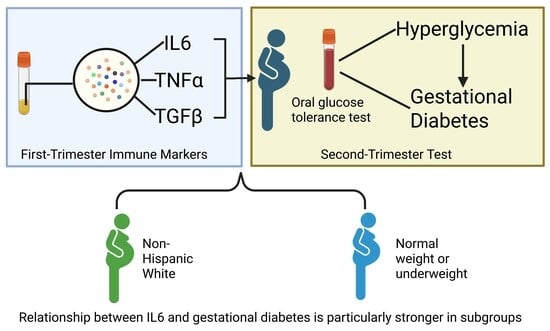
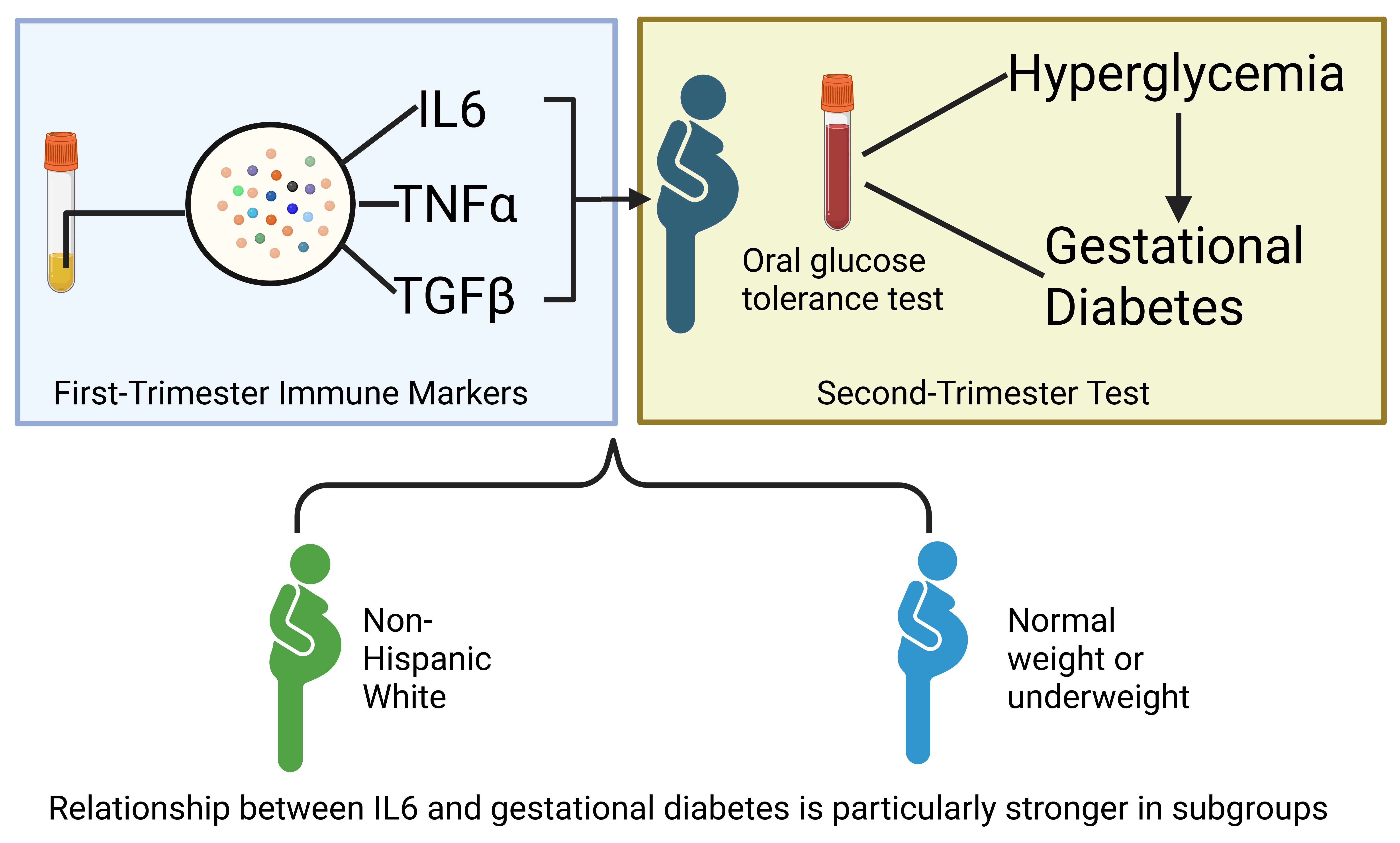
Background/Objectives: Inflammation may play a critical role in the pathogenesis of gestational diabetes mellitus (GDM). However, evidence linking early-pregnancy cytokines to subsequent GDM risk remains inconsistent, with most prior research focusing only on CRP, IL6, and TNFα. In this study, we expand on prior work by evaluating a broader range of immune markers and assessing sociodemographic factors as potential moderators. Methods: Data from a prospective U.S. pregnancy cohort (n = 308) were analyzed. Twenty cytokines were quantified in maternal first-trimester plasma using the MILLIPLEX High-Sensitivity Human Cytokine Magnetic Bead Panel. One-hour oral glucose (50 g) tolerance test (OGTT) values assessed at an average gestational age of 27.7 weeks (SD = 2.9) and GDM diagnosis were abstracted from medical records. Multivariable linear and logistic regression models were used to examine associations between cytokines and 1 h 50 g OGTT levels or GDM diagnosis, adjusting for key sociodemographic factors. Interactions terms were included to evaluate whether sociodemographic factors moderated cytokine–GDM relationships. Results: Sixteen women (5.1%) were diagnosed with GDM. Higher first-trimester high-sensitivity-IL6 levels were significantly associated with increased 1 h 50 g OGTT values (b = 3.76; 95% CI: 0.21, 7.32; p = 0.04) and greater odds of GDM (OR = 2.36; 95% CI: 1.17, 4.77; p = 0.02). These associations were more pronounced among Non-Hispanic White women compared to Non-Hispanic Black women (p for interaction = 0.03) and potentially those with normal weight or underweight during early pregnancy compared to overweight or obese women (p for interaction = 0.08). Conclusions: Elevated inflammatory markers, particularly high-sensitivity IL6, in early pregnancy are linked to impaired glucose metabolism and increased GDM risk later in pregnancy. These relationships appeared stronger in Non-Hispanic White women and women with normal weight or underweight during early pregnancy, underscoring the potential to develop serology-based early identification and prevention strategies.

Graphical Abstract

1. Introduction

Gestational diabetes mellitus (GDM) is impaired glucose tolerance first identified during pregnancy [1,2]. According to the International Diabetes Federation, the global prevalence of GDM is approximately 15.6%. This corresponds to about one in six live births worldwide. But the prevalence of GDM varies widely, ranging from 2% to over 30%, depending on geographic and ethnic factors [2,3]. GDM impacts both fetal and maternal health during pregnancy, increasing risks such as large for gestational age, cesarean delivery, and other obstetric complications [4]. Beyond pregnancy, GDM significantly raises the long-term risk of type 2 diabetes mellitus by an average of seven folds [1,5]. Offspring of mothers with GDM also face increased risks for childhood obesity, impaired glucose tolerance, and metabolic disorders later in life [6].
Prediagnostic markers of GDM in early pregnancy could inform efforts for early diagnosis and prevention. Epidemiological and preclinical studies have underscored a role of inflammation in the pathogenesis of GDM [7]. Previous prospective cohort and case–control studies have primarily focused on assessing three cytokines—C-reactive protein (CRP), interleukin 6 (IL6), and tumor necrosis factor-alpha (TNFα)—in early pregnancy. Some studies have reported their associations with a later GDM diagnosis [8,9,10,11,12,13], while others have not supported these findings [11,13,14,15,16]. Animal and mechanistic studies further suggest that additional cytokines, such as IL8 and IL1β, play important roles in insulin production and insulin resistance [17,18]. However, evidence regarding the relevance of these cytokines for GDM in humans remains limited [13,16].
Additionally, GDM risk varies across sociodemographic groups, including women of different racial/ethnic backgrounds, body weight status, and age groups [2,19,20]. These factors may influence immune and metabolic responses during pregnancy [21,22]. However, no prior studies have examined whether sociodemographic characteristics modify the associations between early-pregnancy immune markers and subsequent GDM development.
Therefore, we measured a broad panel of immune markers, representing complementary inflammatory pathways relevant to glucose metabolism and insulin resistance, including CRP, TNFα, IL6, IL1β, and IL8, in early pregnancy [8,9,10,11,12,16,17]. We evaluated these biomarkers in association with subsequent routine clinical glucose screening and GDM diagnosis. Additionally, we assessed sociodemographic factors that may modify these associations to further identify women at a high risk for GDM in the milieu of elevated immune markers that contribute to the pathogenesis of GDM.

2. Materials and Methods

2.1. Study Overview

This study analyzed data from the Understanding Pregnancy Signals and Infant Development (UPSIDE) cohort [23], a prospective pregnancy study that enrolled pregnant women (n = 353) during their first trimester from University of Rochester Medical Center-affiliated obstetric clinics between 2015 and 2019. Eligible participants were at least 18 years old, at less than 14 weeks of gestation, carrying a singleton pregnancy, able to communicate in English, and without known substance abuse and history of psychotic illness. Exclusion criteria included major endocrine disorders (e.g., polycystic ovary syndrome and type 2 diabetes) and other baseline conditions that classified the pregnancy as high-risk, such as significant obstetric complications at baseline. This study was approved by the University of Rochester Institutional Review Board, and all participants provided written informed consent. The current analysis included participants with plasma immune markers measured during the first trimester and either a 1 h oral glucose (50 g) tolerance test (OGTT) result or a GDM diagnosis (Figure 1).

2.2. Circulating Immune Markers

Blood samples were collected during routine study visits each trimester, except when participants showed signs of acute illness [24]. Samples were typically processed within one hour of collection, and plasma was stored at −80 °C until analysis. First-trimester blood samples were collected at a mean gestational age of 12.19 weeks (SD = 1.33). Circulating plasma cytokines were quantified using the MILLIPLEX High-Sensitivity Human Cytokine Magnetic Bead Panel (Millipore, Billerica, MA, USA) and the Bio-Plex 200 Luminex platform (Bio-Rad, Hercules, CA, USA). Plasma samples (50–100 µL) were analyzed in duplicate when sufficient volume was available for a total of 21 immune markers, of which 20 markers were detectable. The minimum detectable concentration for this assay was 0.34 pg/mL. High-sensitivity IL6 (hs-IL6) was measured using the Quantikine HS ELISA kit (R&D Systems, Minneapolis, MN, USA) to improve detection of low circulating IL6 concentrations. Six immune markers (CRP, TNFα, IL6, hs-IL6, IL8, and IL1β) and three cytokine ratios (IL6/IL10, TNFα/IL10, and TNFα/IL4) were prioritized as the primary immune markers of interest for analysis based on prior research. Analyses focused on the remaining cytokines [fractalkine, granulocyte–macrophage colony-stimulating factor (GM-CSF), interferon gamma (IFNγ), IL2, IL4, IL5, IL7, IL10, IL12, IL17A, IL21, IL23, macrophage migration inhibitory factor (MIF), placental growth factor (PlGF), and Transforming Growth Factor Beta (TGFβ)] were considered exploratory.

2.3. Glucose Measures

As part of routine obstetric care, participants were screened for GDM using the 1 h 50 g OGTT at an average gestational age of 27.7 weeks (SD = 2.9). Participants with a 1 h OGTT value ≥ 135 mg/dL underwent a follow-up diagnostic 3 h 100 g OGTT. Per the clinical protocol, GDM was diagnosed according to the National Diabetes Data Group (NDDG) criteria, defined as meeting or exceeding two or more of the following glucose thresholds: fasting ≥ 105 mg/dL, 1 h ≥ 190 mg/dL, 2 h ≥ 165 mg/dL, and 3 h ≥ 145 mg/dL. A small number of participants (n = 5) were diagnosed with GDM without completing the 3 h OGTT due to one of the following reasons: (1) 1 h 50 g OGTT > 200 mg/dL, (2) fasting glucose levels > 125 mg/dL, or (3) alternative blood glucose measurements when the 3 h OGTT was not feasible (e.g., due to intolerance or a history of gastric bypass surgery). All OGTT results and GDM diagnoses were abstracted from electronic medical records by trained study coordinators.

2.4. Covariates

Analyses were adjusted for social, life-style, and medical factors selected based on prior evidence, including maternal age, race/ethnicity, education, parity, smoking during pregnancy, health insurance, early-pregnancy body mass index (BMI), gestational age at blood collection, and gestational age at the 1 h 50 g OGTT [19,20,25,26]. Race/ethnicity was classified as Non-Hispanic White (NHW), Non-Hispanic Black (NHB), Hispanic, or others. Maternal education was categorized as high school or less, some college, and bachelor’s degree and above. Parity was grouped as nulliparous or parous. Smoking during pregnancy was coded as yes/no. Health insurance was categorized by Medicaid coverage during pregnancy (yes/no). Early-pregnancy BMI was calculated from weight and height from the first prenatal visit (<14 weeks’ gestation). Early-pregnancy BMI was categorized as underweight/normal weight (BMI < 25 kg/m2), overweight (BMI ≥ 25 kg/m2 and BMI < 30 kg/m2), or obese (BMI ≥ 30 kg/m2). Gestational dating was primarily based on the earliest ultrasound, with the last menstrual period used when an early ultrasound was unavailable (7%).

2.5. Statistical Analysis

Descriptive statistics were calculated for all variables. Cytokine concentrations, which were not normally distributed, were log2-transformed. Early-pregnancy BMI, which was right-skewed, was inverse-transformed. Primary analyses used multivariable linear regression models to assess associations between individual cytokines and 1 h 50 g OGTT levels. Logistic regression models were used to examine associations between cytokines and GDM diagnosis, adjusting for all covariates except for smoking during pregnancy and gestational age at the OGTT. Smoking during pregnancy was excluded because only one participant both smoked and had GDM, precluding reliable estimation. Modification by maternal sociodemographic factors was evaluated by including interaction terms between individual sociodemographic factors and identified cytokines. Additional multivariable linear regression models were fitted to identify sociodemographic factors associated with the identified cytokines. All analyses were conducted using STATA version 19.0 (StataCorp LLC, College Station, TX, USA).

3. Results

3.1. Characteristics of the Study Cohort

Participant characteristics are summarized in Table 1. Participants ranged in age from 18 to 41 years. Most pregnant women were NHW (55%), had some college education or a bachelor’s degree or higher (61.9%), and had a prior birth (66.3%). During early pregnancy, 26.3% of women were overweight and 30.9% were obese. The average 1 h 50 g OGTT level was 113.7 mg/dL (n = 301, SD = 26.4). Participant characteristics were generally similar between women who completed the 1 h 50 g OGTT and those who did not, except that a higher proportion of women who completed the OGTT were nulliparous (35.6%) compared with those who did not complete the test (5.3%; p < 0.01) (Supplementary Table S1). Sixteen women (5.1%) were diagnosed with GDM. Women with GDM had significantly higher 1 h 50 g OGTT values than those without GDM (mean 159.9 vs. 111.0 mg/dL, p < 0.001). Participant characteristics were otherwise similar between women with and without GDM, except that women with GDM were older on average (mean age: 30.75 vs. 28.77 years; p = 0.03) (Supplementary Table S2). Immune markers, including IL6, TNFα, IL1β, and IL8, were positively correlated with each other (r: 0.2–0.8, p < 0.05). hs-IL6 was significantly correlated only with CRP (r = 0.34, p < 0.05) and TNFα (r = 0.15, p < 0.05) (Supplementary Figure S1). The concentrations of the immune markers are presented in Supplementary Table S3.

3.2. Associations Between Immune Markers and GDM

Of the first-trimester immune markers assessed, higher hs-IL6 concentrations were significantly associated with higher 1 h 50 g OGTT levels (b = 3.76 mg/dL; 95% CI: 0.21, 7.32; p = 0.04) and with increased odds of a GDM diagnosis (OR = 2.36; 95% CI: 1.17, 4.77; p = 0.02) (Table 2). The TNFα/IL10 ratio showed a trend toward a positive association with GDM diagnosis (OR = 7.07; 95% CI: 0.73, 68.67; p = 0.09). Additionally, higher TGFβ levels demonstrated a trend toward increased odds of GDM (OR = 1.73; 95% CI: 0.98, 3.06, p = 0.06) (Supplementary Table S4).
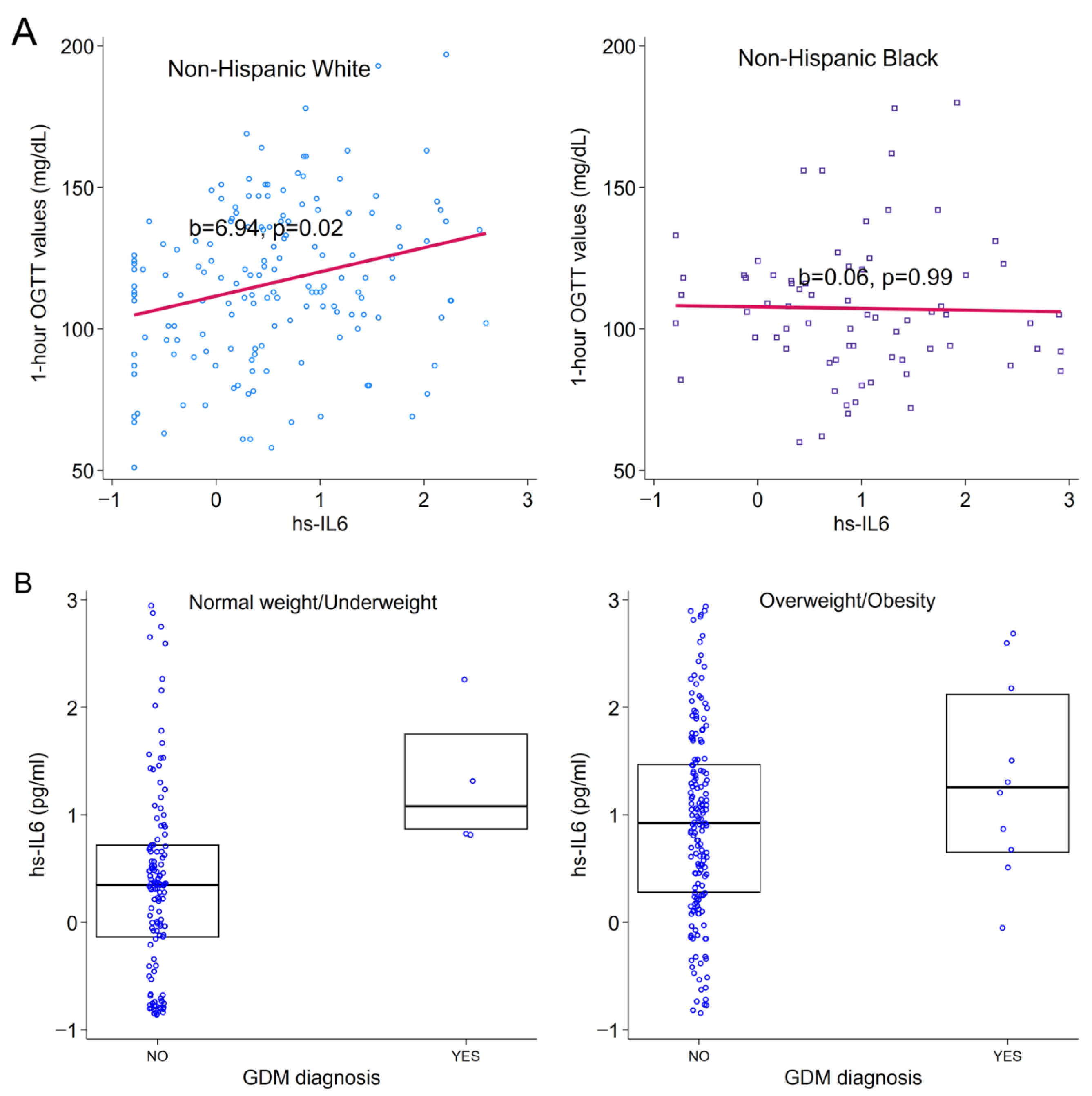
The modification analyses were conducted to assess why women with similar immune marker levels exhibited a different risk for GDM. Among participants, 6.1% of NHW women developed GDM compared with 2.4% of NHB women. A significant interaction between hs-IL6 and race (NHW vs. NHB) was observed for 1 h 50 g OGTT levels (p = 0.03), although no significant interaction was found for GDM. Higher hs-IL6 levels were associated with higher 1 h 50 g OGTT levels among NHW women (b = 6.94; 95% CI: 1.39, 12.49; p = 0.02), whereas no significant association was observed among NHB women (b = 0.06, p = 0.99) (Figure 2A). Similarly, the association between hs-IL6 and GDM was stronger, though not significant, among NHW compared with NHB women (OR = 2.06, p = 0.09 vs. OR = 1.02, p = 0.99). There was also a trend toward an interaction between hs-IL6 and early-pregnancy BMI (p = 0.08). Among normal-weight or underweight women, approximately 3% developed GDM. In this group, higher hs-IL6 levels were associated with higher 1 h 50 g OGTT values (b = 8.10, 95% CI: 2.31, 13.89; p = 0.01) and a greater odds of GDM (OR = 3.32; 95% CI: 0.88, 12.50; p = 0.08) (Figure 2B). In contrast, these associations were not significant among overweight or obese women (1 h 50 g OGTT: overweight b = 2.26, p = 0.62; obese b = −2.79, p = 0.46; GDM: overweight OR = 3.56, p = 0.19; obese OR = 1.44, p = 0.57), among whom 4.9% and 8.2% developed GDM, respectively.

3.3. Associations Between Sociodemographic Characteristics and Immune Markers

Higher early-pregnancy BMI values (untransformed values) were significantly associated with higher hs-IL6 levels (b = 0.04, 95% CI: 0.02, 0.05; p < 0.001) after adjusting for other covariates. In addition, women of other racial/ethnic group compared with NHW women had higher hs-IL6 levels (b = 0.45, 95% CI: 0.04, 0.85; p = 0.03). The other sociodemographic factors, including maternal age, education, health insurance, smoking, parity, and gestational age of blood collection, were not significantly associated with hs-IL6 levels.

4. Discussion

In this study, higher hs-IL6 levels in the first trimester were significantly associated with increased 1 h 50 g OGTT levels and a greater risk of GDM later in pregnancy. These associations were particularly evident among NHW women and those with normal weight or underweight in early pregnancy. Women with higher early-pregnancy BMI and those from other racial/ethnic groups exhibited higher hs-IL6 levels during the first trimester.
Findings from prior studies examining early-pregnancy IL6 in relation to GDM have been inconsistent [8,9,10,14,15,16], although the largest case–control study, which included 321 participants, reported a positive association [8]. Mechanistically, elevated IL6 during pregnancy may contribute to insulin resistance [8]. Beyond the physiological insulin resistance typically induced by placental hormones during pregnancy [27], IL6 may further exacerbate insulin resistance by downregulating the gene expression of insulin receptor substrate 1 (IRS-1) and glucose transporter type 4 (GLUT-4), thereby reducing insulin-stimulated glucose uptake, especially in adipose tissue [28]. Additionally, IL6 upregulates suppressor of cytokine signaling 3 (SOCS3), which binds to insulin receptors and inhibits IRS-1 and IRS-2 activation. This suppression impairs insulin signaling—particularly in the liver—by reducing IRS-1 phosphorylation and protein kinase B activation, ultimately decreasing hepatic glycogen synthesis and systemic insulin sensitivity [29,30,31].
We also found that the associations between hs-IL6 and GDM were particularly stronger among NHW women. Also, although early-pregnancy BMI was positively associated with hs-IL6 levels—consistent with prior findings linking pre-pregnancy BMI and mid- to late-pregnancy IL6 levels [32,33]—the association between hs-IL6 and GDM was more prominent among women with normal or low early-pregnancy BMI. While no prior studies have examined sociodemographic modifiers of the IL6-GDM association, a recent cohort study of IL6 and type 2 diabetes reported that the link was strongest among White participants without central adiposity [34], whereas associations were weaker and nonsignificant among Black participants after adjusting for other risk factors. The mechanisms underlying why the relationship between IL6 and GDM appears stronger among NHW women and those with normal or low BMI remain unclear and warrant further investigation. One possible explanation is that women with higher body weight may be less sensitive to elevated IL6 levels due to a chronic inflammatory state driven by excess adiposity [35]. In contrast, high IL6 levels in women with normal or low BMI may reflect metabolic stress from other resources, such as epithelial cells and placental trophoblasts, during inflammation and stress [36] and therefore may have a greater impact on GDM risk.
Overall, the prospective nature of this pregnancy cohort enabled us to establish the temporal relationship between first-trimester cytokine levels—particularly hs-IL6—and subsequent development of GDM. Moreover, we identified high-risk groups, including NHW women and women with normal or low early-pregnancy BMI, in whom the associations between hs-IL6, GDM, and 1 h 50 g OGTT levels were more pronounced. However, several limitations should be considered. First, the number of GDM cases was small, limiting statistical power to detect associations with specific cytokines. To address this limitation, we additionally analyzed 1 h 50 g OGTT levels as a continuous measure, which improved power and were, as expected, significantly higher among women with GDM. Second, insulin production and resistance were not assessed, precluding exploration of the underlying biological mechanisms. Replication in larger pregnancy cohorts—including direct measures of insulin—will be essential to further clarify cytokine-related pathways involved in GDM development, particularly in Non-Hispanic White women and those with lower pre-pregnancy BMI. Third, while the Luminex multiplex panel allowed for the efficient profiling of 20 immune markers from a limited sample volume, it may possess lower sensitivity for certain low-abundance markers compared to high-sensitivity ELISA assays [37]. Consequently, the lack of significant associations should be interpreted with caution, as subtle differences might have been obscured by the assay’s detection limits. Future studies utilizing high-sensitivity ELISA kits for individual cytokines are warranted to confirm these null findings. Finally, future studies may also examine whether changes in hs-IL6 during pregnancy and postpartum are linked to GDM resolution after delivery and the subsequent risk of developing type 2 diabetes.

5. Conclusions

This study provides evidence that elevated hs-IL6 levels during the first trimester are associated with higher 1 h 50 g OGTT levels and an increased risk of GDM later in pregnancy, particularly among NHW women and those with normal or low early-pregnancy BMI. These findings suggest that inflammatory dysregulation early in pregnancy may contribute to impaired glucose metabolism and the subsequent development of GDM. Early identification of high-risk women with elevated cytokine levels may offer an opportunity for timely preventive interventions.

Supplementary Materials

The following supporting information can be downloaded at https://www.mdpi.com/article/10.3390/diabetology7020022/s1, Figure S1: Correlations among immune markers; Table S1: Characteristics of pregnant participants with and without h-hour 50g OGTT in the UPSIDE study (n = 320 *); Table S2: Characteristics of pregnant participants with and without GDM diagnosis in the UPSIDE study (n = 313 *); Table S3: Concentrations of Immune Markers (pg/mL); Table S4: Associations between first-trimester cytokines and subsequent glucose measures during pregnancy.

Author Contributions

Conceptualization, methodology, formal analysis, Y.M.; investigation, resources, and data curation, L.L.T., E.S.B., R.K.M. and T.G.O.; writing—original draft preparation, Y.M.; writing—review and editing, Y.M., L.L.T., S.W.G., E.S.B., R.K.M. and T.G.O.; visualization, Y.M.; supervision, T.G.O.; project administration and funding acquisition, E.S.B., R.K.M. and T.G.O. All authors have read and agreed to the published version of the manuscript.

Funding

Funding for the UPSIDE-ECHO study is provided by the Eunice Kennedy Shriver National Institute of Child Health and Human Development (R01HD083369), NIH Office of the Director grants (UG3OD023349; UH3OD023349), and the National Institute of Environmental Health Sciences (P30ES005022).

Institutional Review Board Statement

This study was approved by the University of Rochester Institutional Review Board (approve code RSRB00058456, approved on 27 August 2015).

Informed Consent Statement

Informed consent was obtained from all subjects involved in the study.

Data Availability Statement

The data of this project are available through the National Institute of Child Health and Human Development (NICHD) Data and Specimen Hub (DASH) https://echochildren.org/dash/ (accessed on 19 January 2026).

Acknowledgments

We thank the participants and staff who contributed to the UPSIDE study.

Conflicts of Interest

The authors declare no conflicts of interest.

References

  1. Zhu, Y.; Zhang, C. Prevalence of Gestational Diabetes and Risk of Progression to Type 2 Diabetes: A Global Perspective. Curr. Diabetes Rep. 2016, 16, 7. [Google Scholar] [CrossRef]
  2. Duncan, B.B.; Magliano, D.J.; Boyko, E.J. IDF diabetes atlas 11th edition 2025: Global prevalence and projections for 2050. Nephrol. Dial. Transpl. 2025, 41, 7–9. [Google Scholar] [CrossRef]
  3. Damm, P.; Houshmand-Oeregaard, A.; Kelstrup, L.; Lauenborg, J.; Mathiesen, E.R.; Clausen, T.D. Gestational diabetes mellitus and long-term consequences for mother and offspring: A view from Denmark. Diabetologia 2016, 59, 1396–1399. [Google Scholar] [CrossRef] [PubMed]
  4. Sweeting, A.; Wong, J.; Murphy, H.R.; Ross, G.P. A Clinical Update on Gestational Diabetes Mellitus. Endocr. Rev. 2022, 43, 763–793. [Google Scholar] [CrossRef]
  5. Bellamy, L.; Casas, J.P.; Hingorani, A.D.; Williams, D. Type 2 diabetes mellitus after gestational diabetes: A systematic review and meta-analysis. Lancet 2009, 373, 1773–1779. [Google Scholar] [CrossRef] [PubMed]
  6. Garcia-Vargas, L.; Addison, S.S.; Nistala, R.; Kurukulasuriya, D.; Sowers, J.R. Gestational Diabetes and the Offspring: Implications in the Development of the Cardiorenal Metabolic Syndrome in Offspring. Cardiorenal Med. 2012, 2, 134–142. [Google Scholar] [CrossRef]
  7. Firouzi, F.; Ramezani Tehrani, F.; Shaharki, H.; Mousavi, M.; Moradi, N.; Saei Ghare Naz, M. First Trimester Hematological Indices in Gestational Diabetes Mellitus: A Meta-Analysis. J. Endocr. Soc. 2025, 9, bvaf043. [Google Scholar] [CrossRef]
  8. Francis, E.C.; Li, M.; Hinkle, S.N.; Cao, Y.; Chen, J.; Wu, J.; Zhu, Y.; Cao, H.; Kemper, K.; Rennert, L.; et al. Adipokines in early and mid-pregnancy and subsequent risk of gestational diabetes: A longitudinal study in a multiracial cohort. BMJ Open Diabetes Res. Care 2020, 8, e001333. [Google Scholar] [CrossRef]
  9. Abell, S.K.; Shorakae, S.; Harrison, C.L.; Hiam, D.; Moreno-Asso, A.; Stepto, N.K.; De Courten, B.; Teede, H.J. The association between dysregulated adipocytokines in early pregnancy and development of gestational diabetes. Diabetes Metab. Res. Rev. 2017, 33, e2926. [Google Scholar] [CrossRef] [PubMed]
  10. Hassiakos, D.; Eleftheriades, M.; Papastefanou, I.; Lambrinoudaki, I.; Kappou, D.; Lavranos, D.; Akalestos, A.; Aravantinos, L.; Pervanidou, P.; Chrousos, G. Increased Maternal Serum Interleukin-6 Concentrations at 11 to 14 Weeks of Gestation in Low Risk Pregnancies Complicated with Gestational Diabetes Mellitus: Development of a Prediction Model. Horm. Metab. Res. 2016, 48, 35–41. [Google Scholar] [CrossRef]
  11. Dasanayake, A.P.; Chhun, N.; Tanner, A.C.; Craig, R.G.; Lee, M.J.; Moore, A.F.; Norman, R.G. Periodontal pathogens and gestational diabetes mellitus. J. Dent. Res. 2008, 87, 328–333. [Google Scholar] [CrossRef]
  12. Syngelaki, A.; Visser, G.H.; Krithinakis, K.; Wright, A.; Nicolaides, K.H. First trimester screening for gestational diabetes mellitus by maternal factors and markers of inflammation. Metabolism 2016, 65, 131–137. [Google Scholar] [CrossRef]
  13. Tian, S.; Liu, M.; Han, S.; Wu, H.; Qin, R.; Ma, K.; Liu, L.; Zhao, H.; Li, Y. Novel first-trimester serum biomarkers for early prediction of gestational diabetes mellitus. Nutr. Diabetes 2025, 15, 15. [Google Scholar] [CrossRef] [PubMed]
  14. Al-Musharaf, S.; Sabico, S.; Hussain, S.D.; Al-Tawashi, F.; AlWaily, H.B.; Al-Daghri, N.M.; McTernan, P. Inflammatory and Adipokine Status from Early to Midpregnancy in Arab Women and Its Associations with Gestational Diabetes Mellitus. Dis. Markers 2021, 2021, 8862494. [Google Scholar] [CrossRef] [PubMed]
  15. Lain, K.Y.; Daftary, A.R.; Ness, R.B.; Roberts, J.M. First trimester adipocytokine concentrations and risk of developing gestational diabetes later in pregnancy. Clin. Endocrinol. 2008, 69, 407–411. [Google Scholar] [CrossRef]
  16. Georgiou, H.M.; Lappas, M.; Georgiou, G.M.; Marita, A.; Bryant, V.J.; Hiscock, R.; Permezel, M.; Khalil, Z.; Rice, G.E. Screening for biomarkers predictive of gestational diabetes mellitus. Acta Diabetol. 2008, 45, 157–165. [Google Scholar] [CrossRef]
  17. Dinarello, C.A.; Donath, M.Y.; Mandrup-Poulsen, T. Role of IL-1beta in type 2 diabetes. Curr. Opin. Endocrinol. Diabetes Obes. 2010, 17, 314–321. [Google Scholar] [CrossRef] [PubMed]
  18. Fousteri, G.; Jones, M.; Novelli, R.; Boccella, S.; Brandolini, L.; Aramini, A.; Pozzilli, P.; Allegretti, M. Beyond inflammation: The multifaceted therapeutic potential of targeting the CXCL8-CXCR1/2 axis in type 1 diabetes. Front. Immunol. 2025, 16, 1576371. [Google Scholar] [CrossRef]
  19. Hedderson, M.; Ehrlich, S.; Sridhar, S.; Darbinian, J.; Moore, S.; Ferrara, A. Racial/ethnic disparities in the prevalence of gestational diabetes mellitus by BMI. Diabetes Care 2012, 35, 1492–1498. [Google Scholar] [CrossRef]
  20. Li, Y.; Ren, X.; He, L.; Li, J.; Zhang, S.; Chen, W. Maternal age and the risk of gestational diabetes mellitus: A systematic review and meta-analysis of over 120 million participants. Diabetes Res. Clin. Pract. 2020, 162, 108044. [Google Scholar] [CrossRef]
  21. Gyllenhammer, L.E.; Entringer, S.; Buss, C.; Simhan, H.N.; Grobman, W.A.; Borders, A.E.; Wadhwa, P.D. Racial differences across pregnancy in maternal pro-inflammatory immune responsivity and its regulation by glucocorticoids. Psychoneuroendocrinology 2021, 131, 105333. [Google Scholar] [CrossRef]
  22. Wallace, J.G.; Bellissimo, C.J.; Yeo, E.; Fei Xia, Y.; Petrik, J.J.; Surette, M.G.; Bowdish, D.M.E.; Sloboda, D.M. Obesity during pregnancy results in maternal intestinal inflammation, placental hypoxia, and alters fetal glucose metabolism at mid-gestation. Sci. Rep. 2019, 9, 17621. [Google Scholar] [CrossRef]
  23. O’Connor, T.; Best, M.; Brunner, J.; Ciesla, A.A.; Cunning, A.; Kapula, N.; Kautz, A.; Khoury, L.; Macomber, A.; Meng, Y.; et al. Cohort profile: Understanding Pregnancy Signals and Infant Development (UPSIDE): A pregnancy cohort study on prenatal exposure mechanisms for child health. BMJ Open 2021, 11, e044798. [Google Scholar] [CrossRef] [PubMed]
  24. Serrano, J.; Womack, S.; Yount, C.; Chowdhury, S.F.; Arnold, M.; Brunner, J.; Duberstein, Z.; Barrett, E.S.; Scheible, K.; Miller, R.K.; et al. Prenatal maternal immune activation predicts observed fearfulness in infancy. Dev. Psychol. 2024, 60, 2052–2061. [Google Scholar] [CrossRef] [PubMed]
  25. Anna, V.; van der Ploeg, H.P.; Cheung, N.W.; Huxley, R.R.; Bauman, A.E. Sociodemographic Correlates of the Increasing Trend in Prevalence of Gestational Diabetes Mellitus in a Large Population of Women Between 1995 and 2005. Diabetes Care 2008, 31, 2288–2293. [Google Scholar] [CrossRef] [PubMed]
  26. Feferkorn, I.; Badeghiesh, A.; Baghlaf, H.; Dahan, M.H. The relationship of smoking with gestational diabetes: A large population-based study and a matched comparison. Reprod. Biomed. Online 2023, 46, 338–345. [Google Scholar] [CrossRef] [PubMed]
  27. Kampmann, U.; Knorr, S.; Fuglsang, J.; Ovesen, P. Determinants of Maternal Insulin Resistance during Pregnancy: An Updated Overview. J. Diabetes Res. 2019, 2019, 5320156. [Google Scholar] [CrossRef]
  28. Rotter, V.; Nagaev, I.; Smith, U. Interleukin-6 (IL-6) induces insulin resistance in 3T3-L1 adipocytes and is, like IL-8 and tumor necrosis factor-alpha, overexpressed in human fat cells from insulin-resistant subjects. J. Biol. Chem. 2003, 278, 45777–45784. [Google Scholar] [CrossRef]
  29. Senn, J.J.; Klover, P.J.; Nowak, I.A.; Mooney, R.A. Interleukin-6 Induces Cellular Insulin Resistance in Hepatocytes. Diabetes 2002, 51, 3391–3399. [Google Scholar] [CrossRef]
  30. Klover, P.J.; Clementi, A.H.; Mooney, R.A. Interleukin-6 Depletion Selectively Improves Hepatic Insulin Action in Obesity. Endocrinology 2005, 146, 3417–3427. [Google Scholar] [CrossRef]
  31. Liu, J.; Wang, T.; Yang, F.; Pubu, C. Advancements in the understanding of mechanisms of the IL-6 family in relation to metabolic-associated fatty liver disease. Front. Endocrinol. 2025, 16, 1642436. [Google Scholar] [CrossRef]
  32. Sominsky, L.; O’Hely, M.; Drummond, K.; Cao, S.; Collier, F.; Dhar, P.; Loughman, A.; Dawson, S.; Tang, M.L.K.; Mansell, T.; et al. Pre-pregnancy obesity is associated with greater systemic inflammation and increased risk of antenatal depression. Brain Behav. Immun. 2023, 113, 189–202. [Google Scholar] [CrossRef] [PubMed]
  33. Bauer, I.; Schleger, F.; Hartkopf, J.; Veit, R.; Breuer, M.; Schneider, N.; Pauluschke-Fröhlich, J.; Peter, A.; Preissl, H.; Fritsche, A.; et al. Pre-pregnancy BMI but not mild stress directly influences Interleukin-6 levels and insulin sensitivity during late pregnancy. Front. Biosci. (Landmark Ed.) 2022, 27, 56. [Google Scholar] [CrossRef] [PubMed]
  34. Palermo, B.J.; Wilkinson, K.S.; Plante, T.B.; Nicoli, C.D.; Judd, S.E.; Kamin Mukaz, D.; Long, D.L.; Olson, N.C.; Cushman, M. Interleukin-6, Diabetes, and Metabolic Syndrome in a Biracial Cohort: The Reasons for Geographic and Racial Differences in Stroke Cohort. Diabetes Care 2024, 47, 491–500. [Google Scholar] [CrossRef]
  35. Ellulu, M.S.; Patimah, I.; Khaza’ai, H.; Rahmat, A.; Abed, Y. Obesity and inflammation: The linking mechanism and the complications. Arch. Med. Sci. 2017, 13, 851–863. [Google Scholar] [CrossRef] [PubMed]
  36. Prins, J.R.; Gomez-Lopez, N.; Robertson, S.A. Interleukin-6 in pregnancy and gestational disorders. J. Reprod. Immunol. 2012, 95, 1–14. [Google Scholar] [CrossRef]
  37. Breen, E.C.; Reynolds, S.M.; Cox, C.; Jacobson, L.P.; Magpantay, L.; Mulder, C.B.; Dibben, O.; Margolick, J.B.; Bream, J.H.; Sambrano, E.; et al. Multisite comparison of high-sensitivity multiplex cytokine assays. Clin. Vaccine Immunol. 2011, 18, 1229–1242. [Google Scholar] [CrossRef]
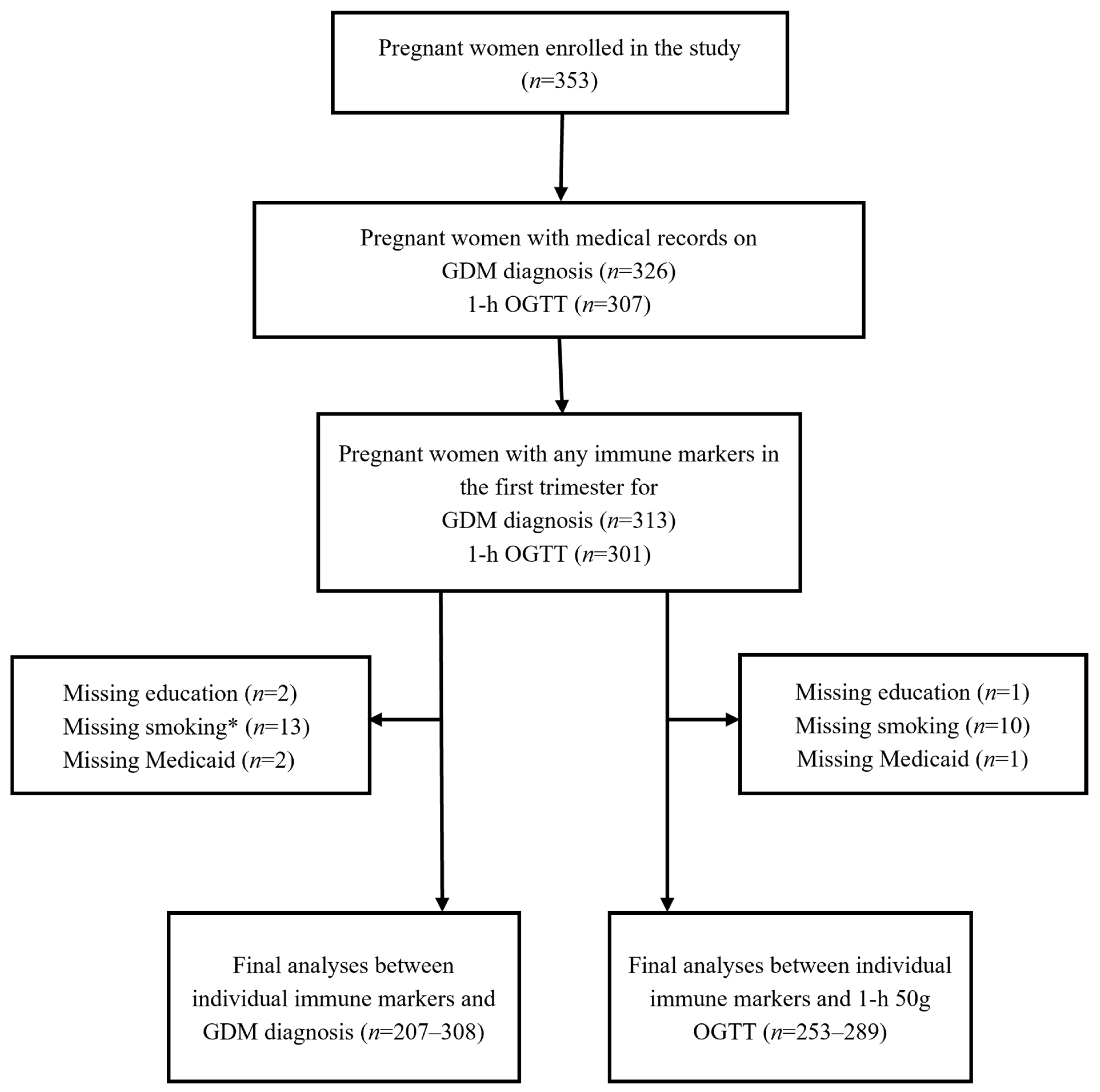
Figure 1. Consort figure. * Smoking was not adjusted in the final model assessing the relationship between cytokines and GDM.
Diabetology 07 00022 g001
Figure 2. (A) The association between first-trimester hs-IL6 levels and 1 h 50 g OGTT levels in Non-Hispanic white vs. Non-Hispanic black women. (B) The association between first-trimester hs-IL6 and GDM diagnosis in women with normal weight or underweight vs. women with overweight or obesity during early pregnancy.
Diabetology 07 00022 g002
Table 1. Characteristics of pregnant participants in the UPSIDE study (n = 320 *).
Mean (SD) or n (%)
Age (years)28.9 (4.68)
Race
     Non-Hispanic White176 (55.0%)
     Non-Hispanic Black83 (25.9%)
     Hispanic34 (10.6%)
     Others27 (8.4%)
Education
     High school or less121 (38.1%)
     Some college45 (14.1%)
     Bachelor or above152 (47.8%)
Early-pregnancy BMI (kg/m2)28.2 (7.03)
Nulliparous108 (33.7%)
Medicaid coverage150 (47.2%)
Smoking during pregnancy23 (7.5%)
* indicates participants with data on at least one immune marker and either a GDM diagnosis (yes/no) or 1 h 50 g OGTT measurements from medical records.
Table 2. Associations between first-trimester cytokines and subsequent glucose measures during pregnancy.
Cytokines1 h 50 g OGTT Levels aGDM Diagnosis b
nB95% CInOR95% CI
CRP2770.63−0.86, 2.122950.850.65, 1.11
TNFα2850.42−7.67, 8.503032.740.64, 11.75
hs-IL62703.760.21, 7.322952.361.17, 4.77
IL6272−1.77−6.63, 3.082880.520.20, 1.36
IL1β272−0.14−6.79, 6.522890.810.26, 2.58
IL8270−0.65−5.74, 4.442840.800.33, 1.97
IL6/IL10263−3.80−19.53, 11.932790.110.003, 3.69
TNFα/IL102761.38−15.84, 18.602947.070.73, 68.67
TNFα/IL426311.58−19.12, 42.2728426.390.46, 1512.13
Note. a The regression models of OGTT adjusted for maternal age, race/ethnicity, education, smoking, parity, health insurance, gestational age at blood sample collection, and gestational age at the OGTT. b The logistic regression models of GDM adjusted for maternal age, race/ethnicity, education, parity, health insurance, and gestational age at blood sample collection. Bolded results are significant at p < 0.05.
Disclaimer/Publisher’s Note: The statements, opinions and data contained in all publications are solely those of the individual author(s) and contributor(s) and not of MDPI and/or the editor(s). MDPI and/or the editor(s) disclaim responsibility for any injury to people or property resulting from any ideas, methods, instructions or products referred to in the content.