Article

Covalent Arabinoxylans Nanoparticles Enable Oral Insulin Delivery and Gut Microbiota Modulation in Diabetes


by
Yubia Berenice De Anda-Flores
1,
Elizabeth Carvajal-Millan
1,*,
Marcel Martínez-Porchas
1,*,
Agustin Rascon-Chu
1,
Karla G. Martinez-Robinson
1,
Jaime Lizardi Mendoza
1,
Judith Tanori-Cordova
2,
Ana Luisa Martínez-López
3,
Estefanía Garibay-Valdez
1 and
José Isidro Mendez-Romero
1
1
Centro de Investigación en Alimentación y Desarrollo, A.C. (CIAD, AC), Carretera Gustavo Enrique Astiazarán Rosas No. 46, Hermosillo 83304, Sonora, Mexico
2
Departamento de Investigación en Polímeros y Materiales, Universidad de Sonora, Blvd. Luis Encinas y Rosales S/N, Hermosillo 83000, Sonora, Mexico
3
NANO-VAC, Departamento de Ciencias Farmacéuticas, Universidad de Navarra, 31008 Pamplona, Spain
*
Authors to whom correspondence should be addressed.
Polysaccharides 2026, 7(1), 3; https://doi.org/10.3390/polysaccharides7010003 (registering DOI)
Submission received: 2 October 2025 / Revised: 6 November 2025 / Accepted: 26 December 2025 / Published: 30 December 2025

Abstract

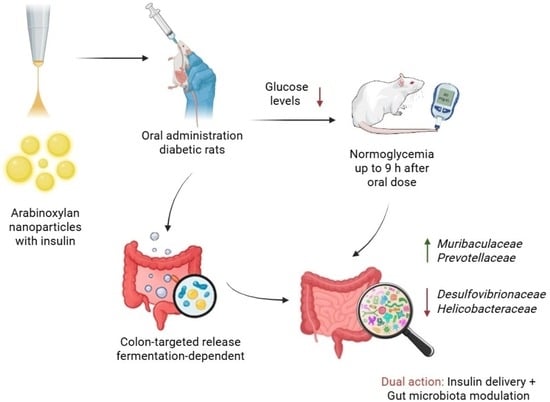
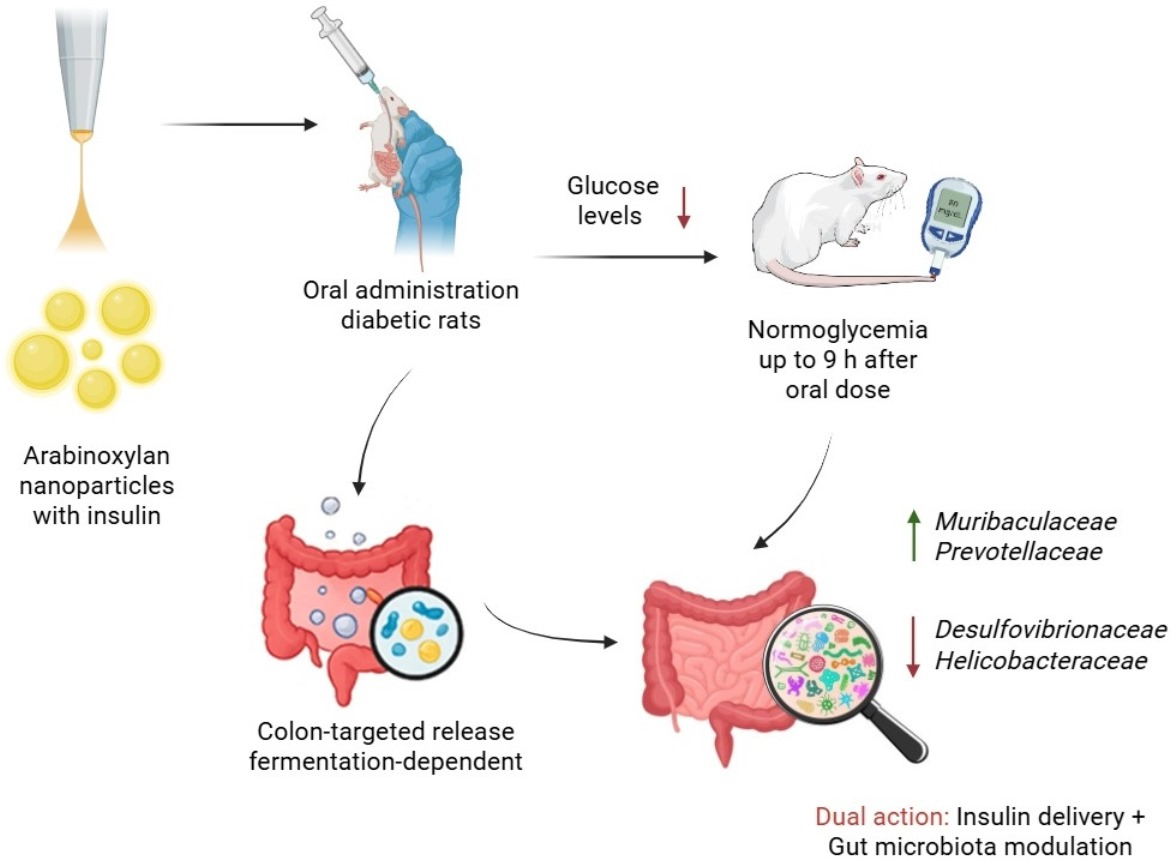
Arabinoxylans (AX) are polysaccharides capable of forming covalent gels stable under variations in pH and temperature. They are fermentable by the colonic microbiota, making them appropriate carriers for colon-targeted oral drug delivery, including insulin. This study aimed to fabricate covalent AX nanoparticles loaded with insulin (NPAXI) using a 0.25 (AX/insulin) mass ratio and to evaluate their colon-targeted capacity to improve glycemic control in diabetic rats. In parallel, we assessed gut microbiota modulation as a secondary outcome, derived from the prebiotic fermentation of AX, considered an additional benefit. NPAXI, produced by coaxial electro spraying, displayed a mean diameter of 661 nm, a zeta potential of −31 mV, and high insulin encapsulation efficiency. Bioassay demonstrated that a single oral NPAXI dose restored normoglycemia for 9 h, starting 15 h post-administration. Gut microbiota analysis revealed that while insulin alone increased Lactobacillaceae, it failed to suppress Enterobacteriaceae. NPAXI treatment, however, promoted beneficial taxa such as Muribaculaceae and Prevotellaceae and reduced proinflammatory families like Desulfovibrionaceae and Helicobacteraceae. These microbial shifts paralleled the improved glycemic profile, suggesting a synergistic interaction between AX and insulin in reestablishing gut microbial homeostasis and metabolic regulation. Overall, NPAXI represents a promising strategy for colon-targeted oral insulin delivery, offering additional microbiota-modulating benefits.

Graphical Abstract

1. Introduction

Diabetes is a chronic disease affecting millions worldwide and constitutes a significant public health concern in Mexico. According to the National Health and Nutrition Survey [1], the prevalence of diabetes rose from 14.4% in 2006 to 18.3% in 2022. This high occurrence presents a growing challenge for the healthcare system in terms of patient care and long-term management. Despite advancements in therapeutic interventions, subcutaneous injections remain the standard method for insulin administration. However, this approach is invasive and often painful, which can lead to poor treatment adherence [2,3].
Additionally, subcutaneous insulin delivery may present limitations such as poor systemic absorption and risk of hypoglycemia, prompting intensive efforts to develop alternative oral delivery systems [4,5]. Multiple animal studies support the potential of colon-targeted oral insulin delivery systems as adjunctive strategies for diabetes management [6,7,8,9]. Among natural polysaccharides used for drug encapsulation, arabinoxylans (AX) have arisen as favorable candidates due to their covalent gel-forming capacity and prebiotic, antioxidant, and biocompatible properties [10,11]. In addition, the oral intake of AX has been associated with gut microbiota protection or even beneficial modifications in the microbiota structure [12,13].
The gut microbiota comprises a diverse set of microorganisms residing in the digestive tract, comprising bacteria, archaea, viruses, and eukaryotic microbes. It is estimated that around 100 trillion of these microorganisms reside primarily in the distal colon [14,15]. This microbial community performs essential functions, including digestion and nutrient metabolism, protection against pathogens, and systemic immunomodulation. In healthy individuals, the predominant phyla are Bacteroidetes and Firmicutes. However, its composition can be altered by various factors, such as disease, genetic predisposition, drug use, and diet [16,17]. These alterations, known as dysbiosis, involve an imbalance between commensal symbionts and pathobionts and have been related to the occurrence of diabetes [18,19]. Several studies have shown that dietary interventions with prebiotic fibers can restore microbial balance, increase the generation of short-chain fatty acids, and improve glycemic control [20,21,22,23]. Due to their fermentability and their capability to specifically stimulate the development of favorable bacteria, AX is emerging as a promising dietary component for the modulation of intestinal microbiota in patients with diabetes, with the potential to generate synergistic effects when used as colon-targeted insulin delivery systems [24,25,26].
AX are non-starch polysaccharides present in cereals, such as maize, rye, rice, sorghum, and wheat, as well as in their by-products. The study of AX and its properties have regained interest worldwide, considering that they have been recognized as safe ingredients (GRAS) [27]. Chemically, AX consist of a β-(1-4)-linked xylose main backbone beside side α-L-arabinoses linked through α-(1-3) or α-(1-2) glycosidic bonds [28,29]. Arabinose residues might be esterified with ferulic acid (FA) via O-5 position, forming ferulated AX [10,30]. These AX resist enzymatic hydrolysis in the superior gastrointestinal tract (GIT), reaching the colon region intact, where they are fermented through the resident microbiota, producing short-chain fatty acids and promoting the growth of beneficial bacteria [31,32].
The esterified FA present in AX enables oxidative cross-linking into stable covalent gels via enzymatic (e.g., laccase or peroxidase) or chemical agents (e.g., ferric chloride or ammonium persulfate), resulting in dimeric and trimeric structures that link AX chains into a three-dimensional network [10]. These gels are pH-stable, porous, hydrophilic, and fermentable in the colon, making them ideal for encapsulating bioactive molecules, such as insulin [33]. Previous reports have demonstrated the potential of AX-based beads and microspheres as insulin carriers [33,34,35].
Our research group was the first to develop AX-based nanoparticles incorporating insulin [36], with a patent in Mexico and internationally [37]. Nevertheless, in those preceding studies, the AX used presented very high FA acid content (8–12 μg/mg), which impaired fermentability and delayed hypoglycemic effects up to 24 h post-administration in diabetic rats [36]. One promising source of AX is dried distillers’ grains with soluble (DDGS), a by-product of the maize bioethanol industry, which yields ferulated AX suitable for nanoparticle formation [38,39]. Nonetheless, before the present study, no research had explored the use of DDGS-derived AX for colon-targeted insulin delivery. This work aimed to fabricate covalently cross-linked insulin-loaded AX nanoparticles (NPAXI) using AX extracted from DDGS at a 0.25 (AX/insulin) mass ratio and to evaluate their colon-targeted capacity to improve glycemic control in diabetic rats following oral administration. In parallel, we assessed gut microbiota modulation as a secondary outcome, derived from AX fermentation, considered an additional benefit.

2. Materials and Methods

AX were isolated from DDGS and characterized as previously reported [40]. The AX exhibited an arabinose-to-xylose branching ratio of 1.16 and a FA content of 7.30 µg/mg. Laccase from Trametes versicolor (E.C. 1.10.3.2) was used as the cross-linking agent. Recombinant human insulin and other analytical-grade reagents were acquired from Sigma Chemical Co. (St. Louis, MO, USA). For subcutaneous administration, a commercial isophane insulin suspension (NPH 100 IU/mL, Humulin®, Eli Lilly and Company, Indianapolis, IN, USA) was used.

2.1. Cross-Linking Process

Gelling kinetics of AX dispersions with and without insulin were monitored in the presence of laccase (1.675 nkat/mg AX) using a dynamic oscillatory rheometer (Discovery HR-2, TA Instruments, New Castle, DE, USA). The insulin-to-AX ratio was 0.25 (w/w). Storage modulus (G′) and loss modulus (G″) values were recorded for 1.5 h at 25 °C, with a frequency of 0.25 Hz and 5% strain. After gelation, a frequency sweep from 0.01 to 10 Hz at 5% strain was conducted [33].

2.2. Phenolic Acid Analysis

The content of FA, FA dimers (di-FA), and FA trimers (tri-FA) in the gels was quantified by high-performance liquid chromatography (HPLC) using an Alltima C18 column (250 × 4.6 mm, Alltech Associates, Deerfield, IL, USA) with a diode-array detector (Waters 996, Millipore Co., Milford, MA, USA) [41].

2.3. Nanoparticle Fabrication

Covalent AX nanoparticles (NPAX) and insulin-loaded AX nanoparticles (NPAXI) were fabricated using a coaxial electrospray system (Profector Life Sciences, Dublin, Ireland) as described by De Anda-Flores et al. [39]. The core solution (1% w/v AX with 0.25% insulin) was loaded into the inner needle, and the laccase solution (1.675 nkat/mg AX) was placed in the external needle. Both solutions were delivered at a flow rate of 1 mL/h under a voltage of 10 kV. Nanoparticles were collected in mineral oil under continuous stirring (500 rpm) at 25 °C for 24 h.

2.4. Characterization of Nanoparticles

Size distribution, polydispersity index, and zeta potential of NPAX and NPAXI were determined by dynamic light scattering (DLS) using a Möbiuζ instrument (Wyatt Technology Corp., Santa Barbara, CA, USA) at a wavelength of 532 nm and detection angle of 163.5°. Particle morphology was assessed by transmission electron microscopy (TEM) using a JEM 2010F microscope (JEOL, Tokyo, Japan) [39]. Insulin encapsulation efficiency was determined by quantifying the unencapsulated insulin using the Bradford assay [42]. Insulin encapsulation efficiency was determined by quantifying the non-encapsulated (free) and total insulin content using the Bradford assay [42]. The encapsulated insulin was calculated by subtracting the free insulin from the total insulin. A bovine serum albumin (BSA) standard curve was used (0.1 to 1.4 mg/mL). 100 µL of free or total insulin was mixed with 3 mL of Bradford reagent and gently vortexed. Samples were incubated for 15 min at room temperature, transferred to UV-VIS cuvettes, and the absorbance was recorded at 595 nm using a Cary 60 UV-VIS spectrophotometer (Agilent Technologies, Santa Clara, CA, USA). All measurements were performed in triplicate and confirmed across independent batches.

2.5. Bioassay

Male Wistar rats (200–250 g) were used in this study, provided by the Universidad de Sonora. Animals were acclimatized for 15 days with free access to water and a standard diet (Formulab Diet 5008, LabDiet, St. Louis, MO, USA). Environmental conditions were maintained at 23 ± 2 °C, with 12-h light/dark cycles and 60 ± 5% humidity. All procedures were approved by the Ethics Committee of the Centro de Investigación en Alimentación y Desarrollo (CIAD) for studies involving animals (CE/001/2015, 14 April 2015) and followed NOM-062-ZOO-1999 guidelines for laboratory animal care [43].
Diabetes was induced in rats by intraperitoneal injection of streptozotocin (STZ) (55 mg/kg body weight). On day 3 post-induction, rats with blood glucose values over 250 mg/dL (tail vein employing an Accu-Chek Performa glucometer, Roche, Mannheim, Germany) were considered diabetic [44,45].
After a 12-h fasting period, five experimental groups of three rats each were randomly formed based on glucose levels: (1) healthy controls (no intraperitoneal injection), (2) untreated diabetic rats, (3) diabetic rats with subcutaneous insulin (2 IU/kg), (4) diabetic rats treated with NPAX, and (5) diabetic rats treated with NPAXI (50 IU insulin/kg body weight). Mature NPAX and NPAXI were washed with ethanol:water (30:70, 50:50, 70:30 v/v), vortexed for 1 min, and centrifuged (2000× g, 10 min, 20 °C). The supernatant was removed, and the nanoparticles were resuspended in ultrapure water. Washed nanoparticles were incorporated in 1 mL of Milli-Q water and administered orally via stainless-steel gavage. Blood glucose levels were monitored from 0 to 24 h post-administration using a glucometer.

2.6. Gut Microbiota Analysis

2.6.1. DNA Extraction and Sequencing

Fecal samples obtained at the end of the trial were homogenized using a FastPrep 5G (MP Biomedicals, Solon, OH, USA) for a final sample size of n = 3 per treatment. DNA from fecal samples was extracted according to the instructions of the manufacturer using the FastDNA® SPIN Kit for Soil (MP Biomedicals, Solon, OH, USA). The construction of libraries was performed following the 16S Metagenomic Sequencing Library guide with modifications. PCR amplification of 16S rRNA V3 regions was performed using the 338F/533R bacterial primer pair (338F: 5′-TCGTCGGCAGCGTCAGATGTGTATAAGAGACAGACTCCTACGGGAGGCAGCAG-3′ and 533R: 5′-GTCTCGTGGGCTCGGAGATGTGTATAAGAGACAGTTACCGCGGCTGCTGGCAC-3′), with a 24 µL reaction volume containing 10 µL Platinum® PCR SuperMix (Invitrogen, Carlsbad, CA, USA), 0.2 M of each forward and reverse primer, 6 μL nuclease-free water and 1 µL of DNA template. The following PCR conditions were used: an initial denaturation at 95 °C for 30 s, followed by 30 cycles of 95 °C for 30 s, 58 °C for 30 s, and 72 °C for 30 s. A final extension was performed at 72 °C for 7 min. The first-stage PCR was cleaned using magnetic beads, and samples were visualized on a 1.5% agarose gel and quantified using the Qubit 3.0 fluorometer (Invitrogen, Carlsbad, CA, USA). A second PCR to index the amplicons was performed with Platinum® PCR SuperMix to add Nextera DNA indexes and sample multiplexing. The resulting amplicons were cleaned again using magnetic beads and quantified using the Qubit 3.0 fluorometer (Invitrogen). Before pooling the libraries, the PCR products were normalized to 4 nM and then pooled by adding 10 μL of each library. Libraries were diluted at 1 nM, denatured with 0.1 N NaOH, and combined with 5% (v/v) denatured 4 nM PhiX as a control. The sequencing was performed in an Illumina MiniSeq platform, using the MiniSeq Reagent Kit v2, yielding 2 × 150 bp paired-end reads. Raw reads were uploaded to NCBI, BioProject SRA accession: SUB15369900.

2.6.2. Sequence Data Preprocessing and Diversity Analysis

An initial set of 750,263 raw reads of the V3 16S rRNA hyper-variable region was imported and processed using Quantitative Insights Into Microbial Ecology 2 (QIIME2), version 2023.5 [46]. Raw sequences were preprocessed using the plugin DADA2 to apply the denoise-16S method to the sequences [47]. Reads were trimmed at the 1-pb position and truncated at the 150-bp position, according to the median quality score of <Q30, and the detected chimeric sequences were removed. Then, 506,423 filtered reads from 15 samples were considered for further analysis. After the sequence quality control step, 428 amplicon sequence variants (ASVs) were assigned to taxonomy using a full-length, pre-trained classifier (SILVA_138) with OTUs clustered at 99% identity. A rooted phylogenetic tree was constructed to measure phylogenetic diversity (Faith and UniFrac). ASVs were aligned with MAFFT [48], and the resulting alignment was used to build a phylogenetic tree with FastTree software (version 2.1.11) [49] by using the align-to-tree-might-fast tree pipeline from the q2-phylogeny plugin. Before diversity analysis, library samples were rarefied to 29,113 sequences. The sequencing depth was evaluated through rarefaction curves, which reached a clear asymptote for all samples, indicating sufficient coverage and even sequencing effort across treatments (Figure S1).
The statistical significance of diversity analysis was estimated and performed with the online software based on R MicrobiomeAnalyst (https://www.microbiomeanalyst.ca, accessed on 26 May 2025) [50,51]. Alpha diversity profiling was estimated using the diversity measures Chao1, Shannon, Simpson, and Fisher at the feature level. The Kruskal-Wallis statistical test (p < 0.05) was used to estimate differences. Beta diversity was calculated to estimate differences between pairs of intestinal microbial communities in rats. Distance matrices were calculated at the feature level using the Bray–Curtis dissimilarity, Jaccard, Weighted, and Unweighted UniFrac distances. Distance matrices were visualized using the 2D ordination plot. A pairwise comparison of distance matrices was performed using the PERMANOVA (Permutational Multivariate Analysis of Variance) statistical analysis.

2.7. Statistical Analysis

Results were reported as mean ± standard deviation. Student’s t-test and Mann-Whitney U test were used for group comparisons, with significance set at p < 0.05.

3. Results and Discussion

3.1. Cross-Linking Process

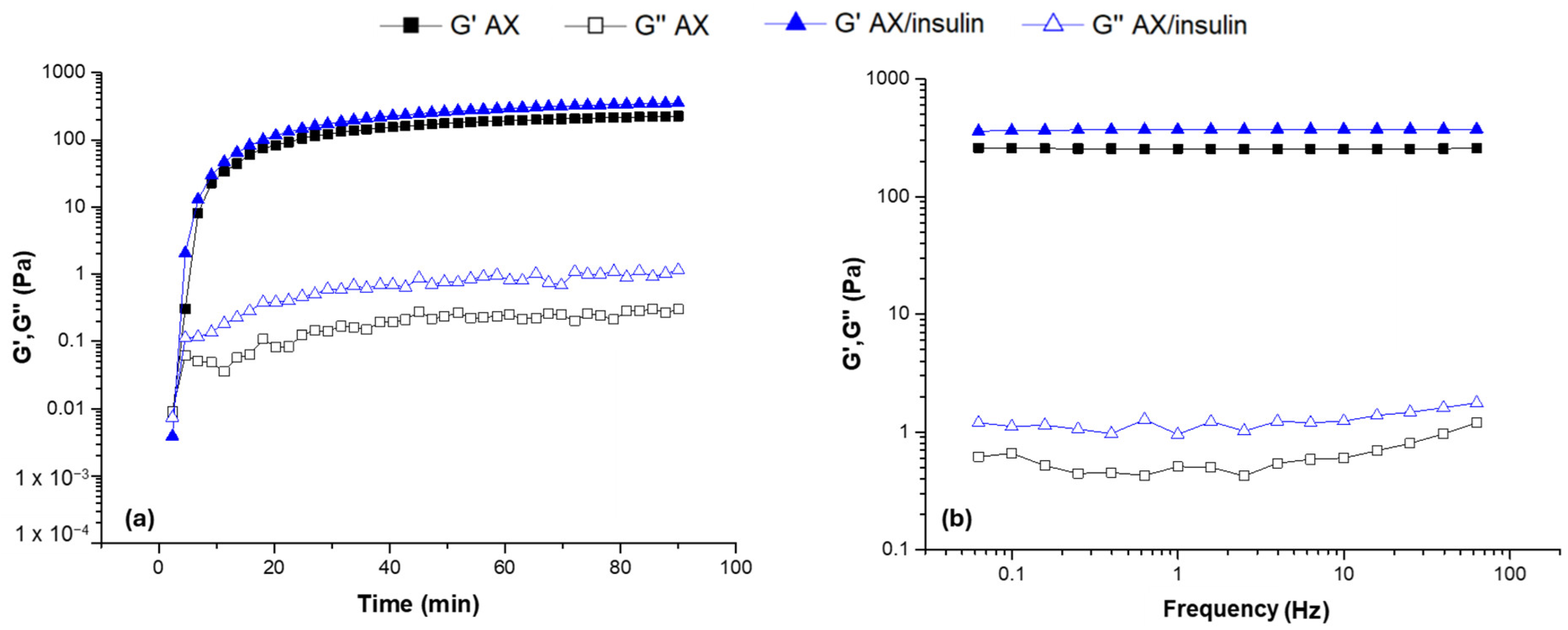
To evaluate the gelation capacity of the AX used and confirm that insulin incorporation did not inhibit cross-linking, the gelation kinetics of 1% (w/v) AX dispersions with and without insulin were recorded (Figure 1a). Both formulations showed a continuous increase in storage modulus (G′), indicating progressive gel formation, with G″ remaining lower, characteristic of solid-like behavior. The gelation time (tg), defined as the time at which tan δ = 1 (G″/G′), occurred at approximately 2 min for AX and 4 min for AX-insulin dispersions, consistent with previous reports using maize AX [36,52].
At the end of the kinetics, AX-insulin gels exhibited a higher G′ (344 Pa) compared to AX-only gels (224 Pa). This increased elasticity has been associated with polymer phase separation and has been reported in similar insulin-containing AX gels [33]. Mechanical spectra (Figure 1b) demonstrated that G′ remained constant across the frequency range, while G″ values were lower and frequency-dependent, typical behavior of covalently cross-linked hydrogels [53].

3.2. Phenolic Acid Analysis

The HPLC analysis of the final gels confirmed the generation of FA dimers (di-FA) and trimers (tri-FA), supporting the creation of a covalently cross-linked network capable of retaining insulin. Isomeric forms such as 8-5′, 8-O-4′, and 5-5′ di-FA were detected, with 8-5′ being the most abundant (74%) in both formulations (Table 1). The total content of di-FA and tri-FA was significantly higher in AX-insulin gels, correlating with the increased G′ value. It has been suggested that AX-insulin phase separation promotes local areas of denser cross-linking [33].

3.3. Nanoparticle Fabrication and Characterization

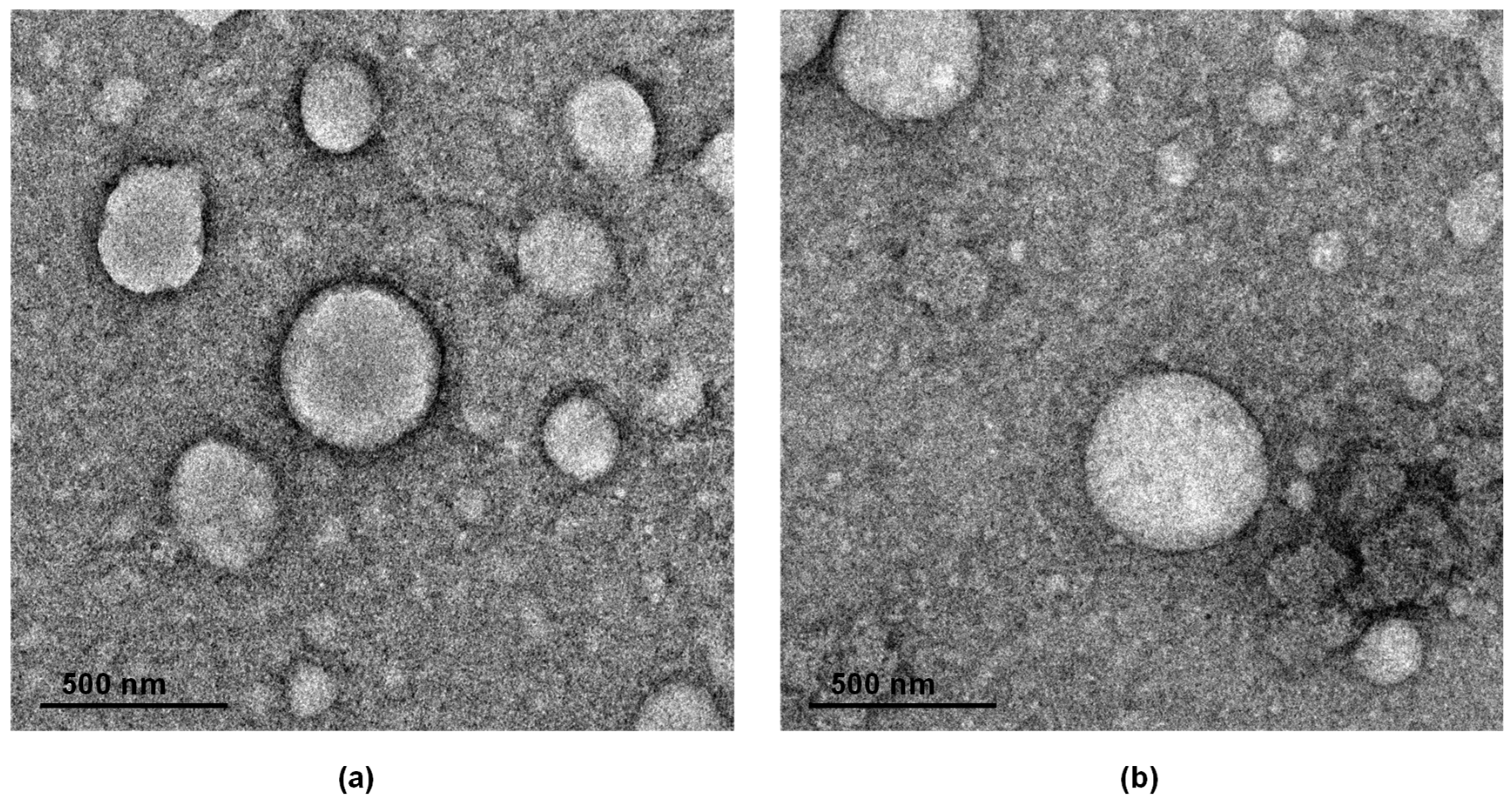
Coaxial electrospraying enabled the successful production of NPAX and NPAXI at low polymer concentrations (1% w/v), with rapid gelation (2–4 min). Transmission electron microscopy (TEM) confirmed the spherical morphology and smooth surfaces of the nanoparticles (Figure 2). The resulting particles showed minimal aggregation. Insulin encapsulation efficiency in NPAXI reached 95%, indicating high retention within the nanoparticles.
Particle size and zeta potential results are presented in Table 2. NPAX and NPAXI exhibited average diameters of 731 nm and 661 nm, respectively, and polydispersity index (PDI) ranges of 12–198% and 12–220%, respectively, for NPAX and NPAXI. These results align with previous work using AX from maize pericarp [36]. Both NPAX and NPAXI showed negative zeta potential (~−31 mV), with no statistically significant differences between them.
From a pharmaceutical perspective, positively charged nanoparticles can enhance cellular uptake via interactions with negatively charged cell membranes [54]. However, the negative zeta potential observed in NPAXI could reduce cell internalization in the upper GIT, limiting premature absorption and promoting insulin delivery to the colon. Once in the colon, fermentation by local microbiota enables insulin release, which can then be absorbed via transcytosis [55]. Regarding the influence of nanoparticle size on gastrointestinal transit and release kinetics, intestinal mucus pores are typically in the 100–200 nm range while NPAX and NPAXI present average diameters of 731 nm and 661 nm, respectively, favoring to stay within the gastrointestinal lumen and resist absorption or rapid clearance by the mucus layer in the upper GIT, thus facilitating transit to the colon [56]. Concerning the high PDI registered in NPAX and NPAXI, for a colon-delivery mechanism, it is not necessarily a drawback; indeed, it may be advantageous by preventing the entire dose from being rapidly degraded, thereby favoring a sustained release [57].

3.4. Bioassay

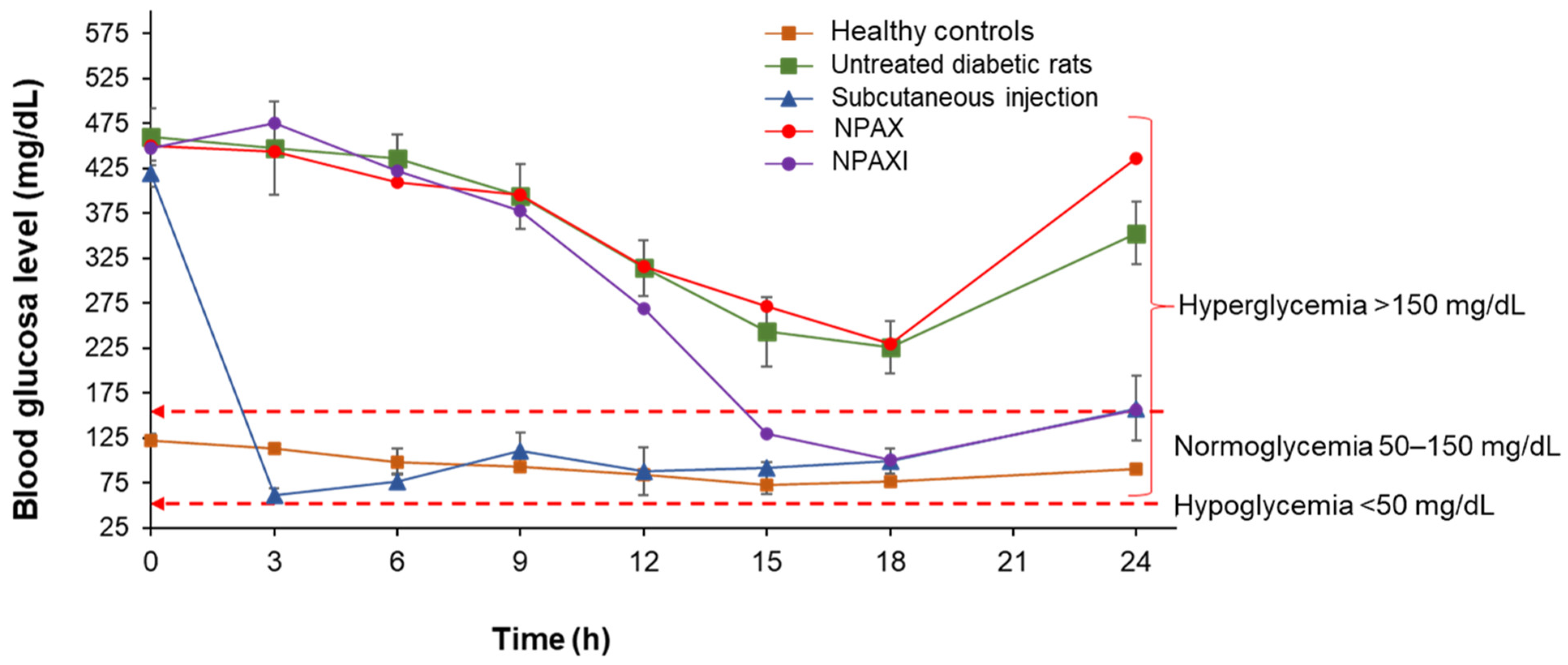
The bioassay results are shown in Figure 3. Healthy (normoglycemic) rats maintained fasting blood glucose levels between 70 and 150 mg/dL throughout the experiment. STZ-treated rats exhibited glucose levels greater than 250 mg/dL, along with polydipsia and polyuria, confirming the induction of diabetes [58,59]. During fasting, a mild drop in glucose was observed in all groups, followed by a rebound at 24 h, likely due to hepatic glycogen mobilization, a known response in rodents after prolonged fasting [60,61].
Untreated diabetic rats remained hyperglycemic (with blood glucose levels greater than 150 mg/dL) throughout the study. Rats receiving subcutaneous insulin-maintained glucose levels within the physiological fasting range from 3 to 18 h post-injection, returning to hyperglycemia (158 mg/dL) by 24 h, consistent with the known pharmacokinetics of intermediate-acting insulin [62,63]. NPAXI-treated rats exhibited a delayed glucose-lowering response, reaching a value within the normoglycemic range (50–150 mg/dL) at the 15-h time point after oral administration, consistent with insulin release triggered by gastrointestinal transit and colonic fermentation; this effect was sustained for ~9 h. Notably, the NPAXI effect observed here (15 h) was earlier than in previous AX-based nanoparticles (24 h) [36], likely due to the enhanced fermentability of DDGS-derived AX [38].
NPAXI produced a glucose-lowering effect in diabetic rats for up to ~9 h following a single oral dose, with a delayed onset consistent with colonic fermentation-dependent release. After 15, 18, and 24 h of NAPXI administration, glucose levels in diabetic rats were maintained within the normoglycemic range (50–150 mg/dL). These findings confirm that DDGS-derived AX covalent nanoparticles enable oral insulin delivery targeted to the colon. The proposed mechanism involves oral administration of NPAXI, followed by colonic fermentation, insulin release, and absorption. A hypothetical administration schedule could involve dosing at 5:00 PM to ensure circulating insulin by 8:00 AM the following day, thereby eliminating the need for a pre-breakfast subcutaneous injection. Nevertheless, complementary subcutaneous insulin may be necessary at the beginning of NPAXI treatment, depending on several patient characteristics, such as age, diet, activity levels, and colonic microbiota, among others. Future clinical trials are necessary to explore this strategy.

3.5. Gut Microbiota Analysis

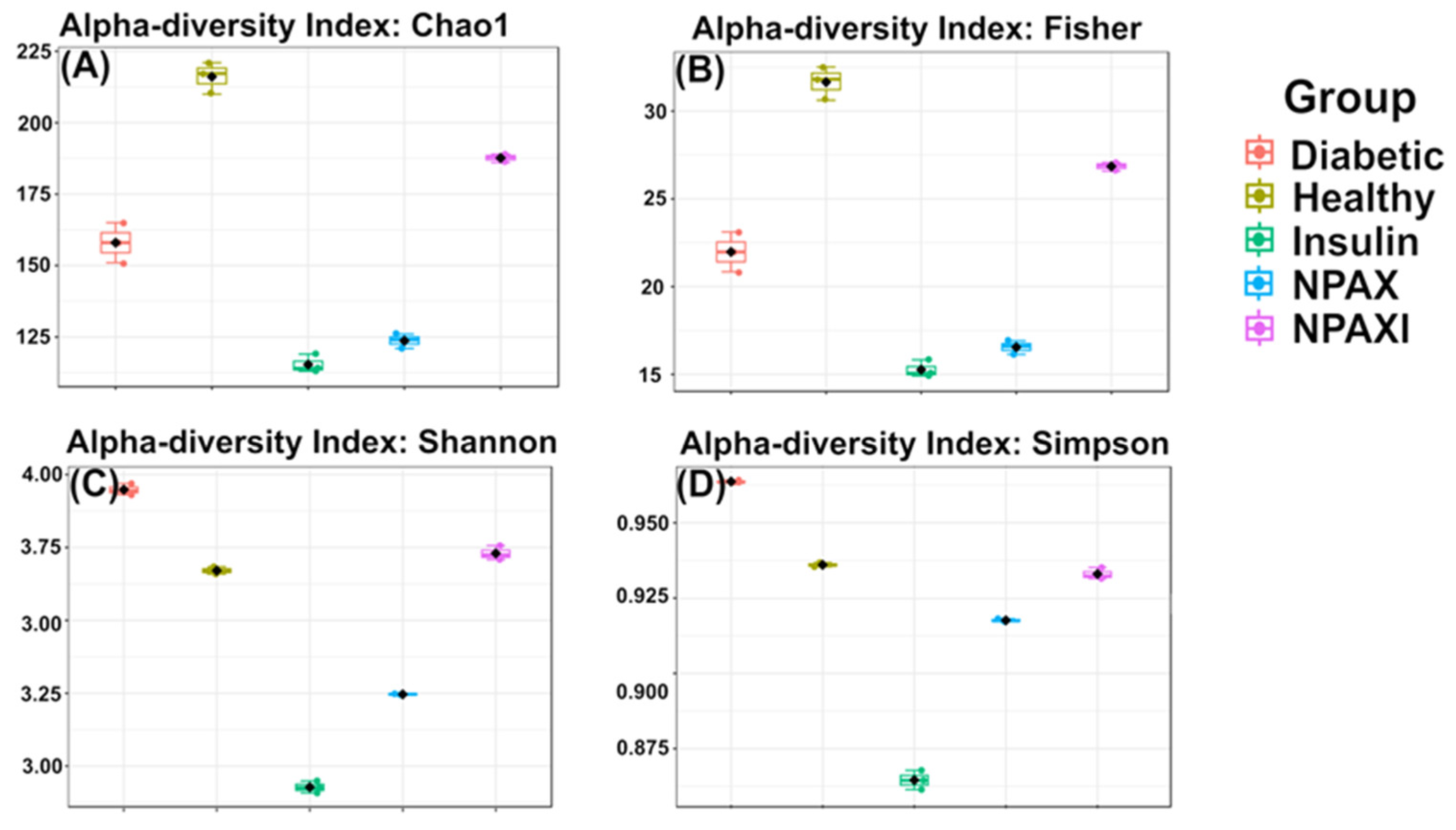
The diversity of gut microbiota compared to that of healthy organisms was influenced by both the diabetic condition and the treatments. Healthy rats exhibited higher diversity, as measured by the Chao1, Fisher, and Simpson indexes, compared with the treated groups (Insulin, NPAX, and NPAXI). Diabetic rats exhibited lower richness (Chao1 and Fisher) but increased evenness (Shannon and Simpson) (Figure 4, Table 3), indicating a simplified yet more evenly distributed microbial community, likely reflecting the selective pressure imposed by hyperglycemia and inflammation.
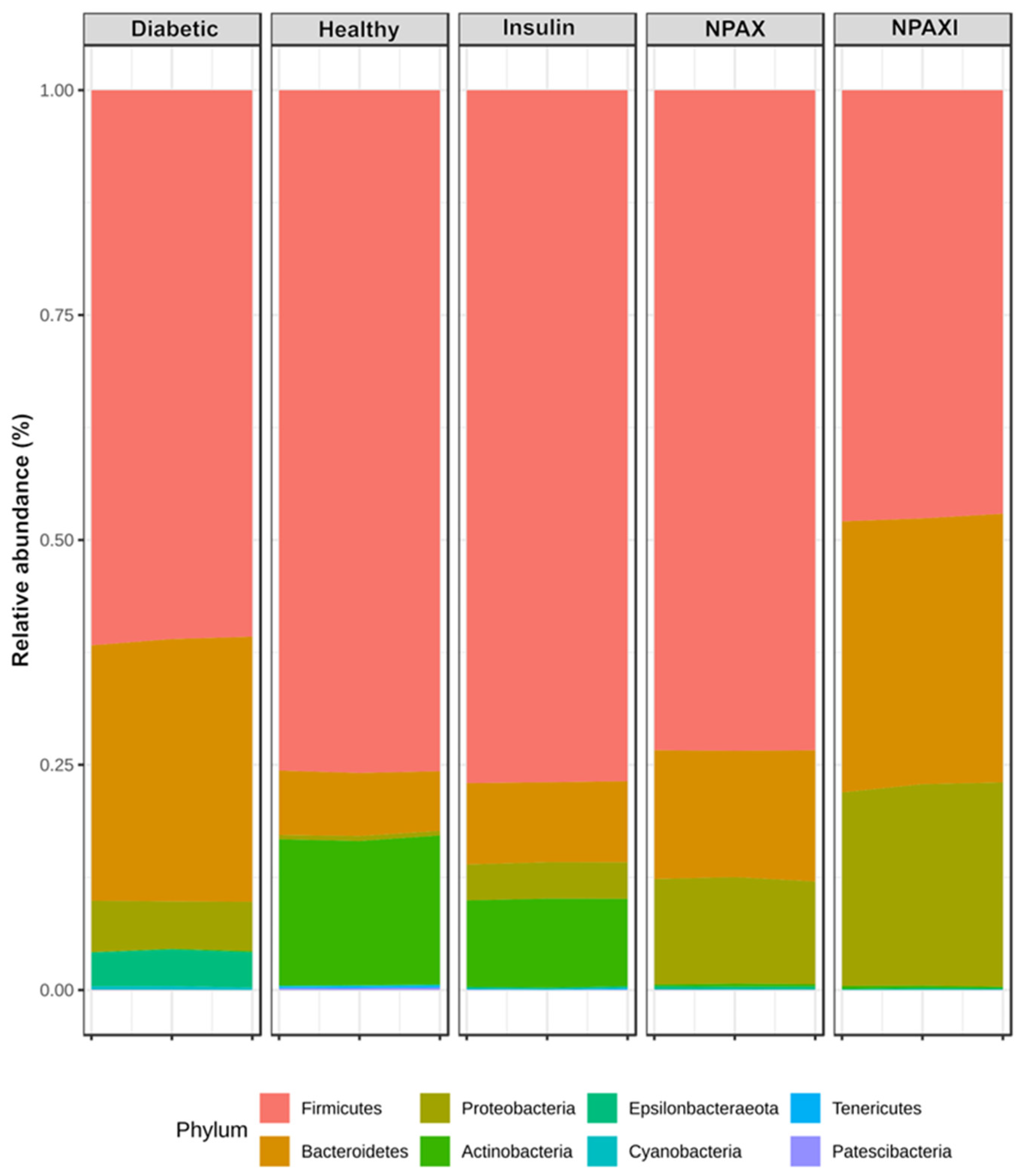
At the phylum level, diabetic rats exhibited an altered gut microbiota profile with increased Bacteroidetes (29%) and Proteobacteria (5.5%), and a severe reduction in Actinobacteria (0.08%), compared to healthy controls with higher Actinobacteria (16.3%) and Firmicutes (75.7%) (Figure 4). Insulin treatment partially restored this balance by increasing Actinobacteria (9.71%) and maintaining Firmicutes at 76.93%, suggesting a moderate reversion of dysbiosis. NPAX treatment alone was less effective in restoring Actinobacteria while causing a marked increase in Proteobacteria (11.65%). The NPAXI group exhibited further increases in Bacteroidetes (29.84%) and Proteobacteria (22.17%), accompanied by a decrease in Firmicutes (47.55%), indicating complex microbial shifts likely influenced by both insulin and AX fermentation. This could be associated with the conditions generated by insulin, probably regulating hyperglycemia, oxidative stress, and intestinal motility and secretions [64,65].
Importantly, all treatments prevented the expansion of Epsilonbacteraeota, a phylum associated with gut barrier dysfunction and inflammation, indicating a protective effect on gut integrity [66,67].
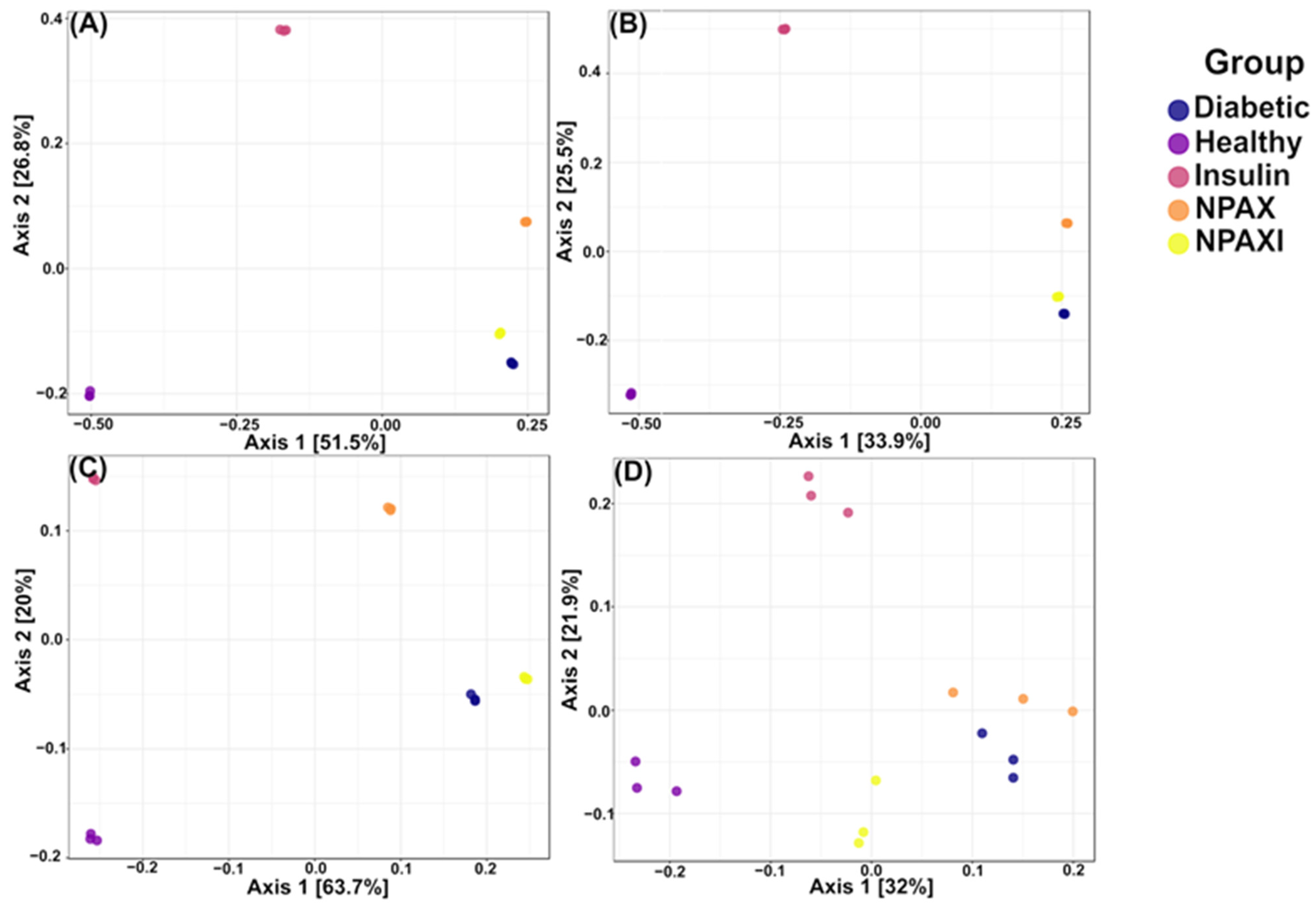
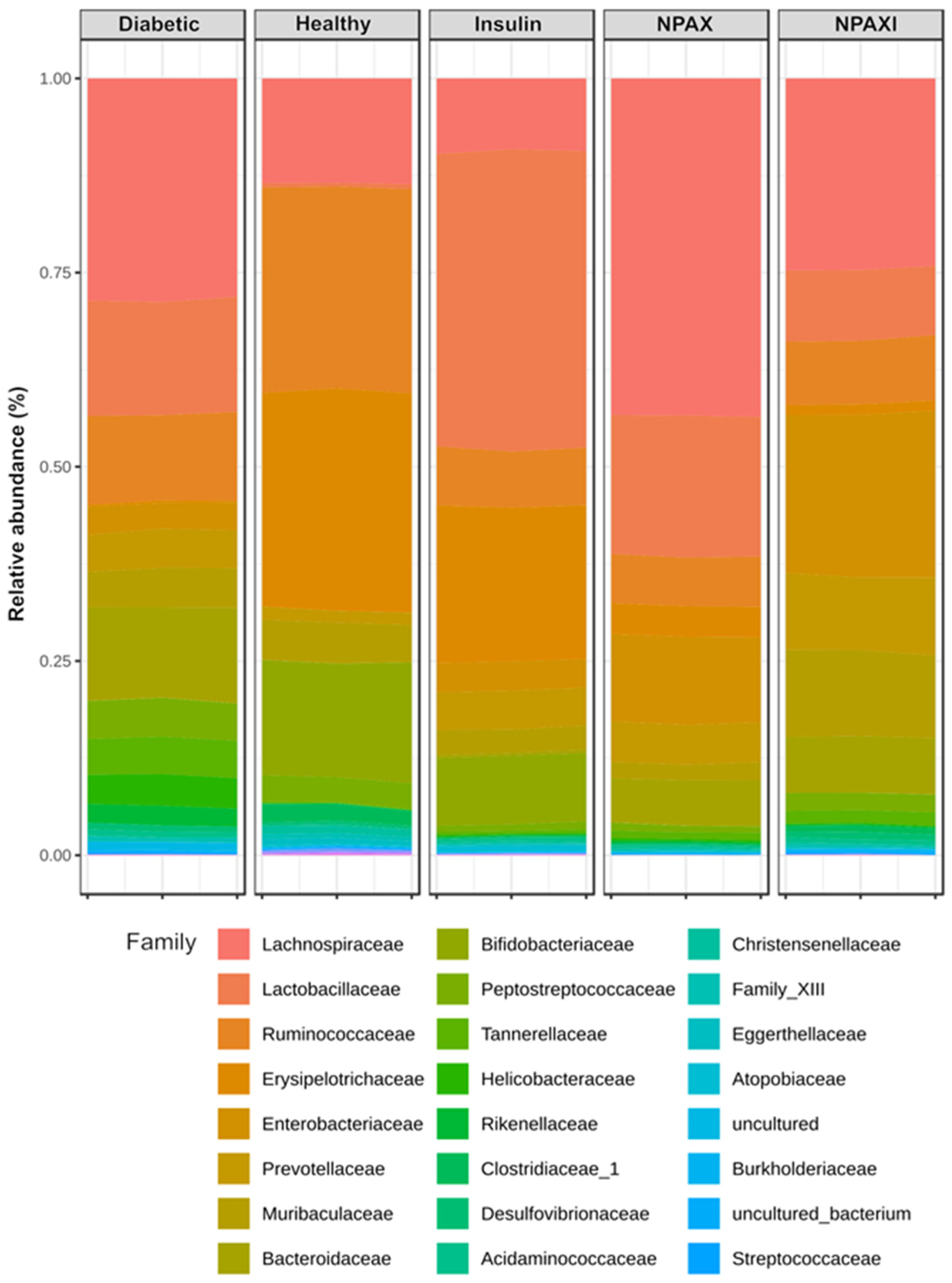
The effect of disease and treatments was reflected in changes to the overall microbiota profile, as shown by all beta diversity analyses (Figure 5), which were also translated into significant changes at the family level (Figure 6 and Figure 7). In this regard, insulin alone increased Lactobacillaceae (38.25%) and Atopobiaceae (0.69%), two families associated with healthy microbiota in rodents [68,69], while failing to reduce Enterobacteriaceae (3.72%), a family associated with inflammation and microbiota imbalance [70]. NPAX treatment increased beneficial Lachnospiraceae (43.44%) but also promoted Enterobacteriaceae (11.16%). The most favorable microbial profile was observed in the NPAXI group, with enrichment of fermentative taxa such as Muribaculaceae (10.97%) and Prevotellaceae (9.75%), and reductions in pro-inflammatory families like Desulfovibrionaceae and Helicobacteraceae [71]. These compositional changes indicate enhanced microbial metabolic function and a reduced inflammatory tone in the gut.
Although the observed microbial shifts parallel the metabolic improvements, the present findings could also be interpreted as associative, not purely mechanistic. The microbiota analysis relied on 16S rRNA amplicon sequencing, which provides compositional but not functional resolution. In particular, the production of short-chain fatty acids (SCFAs), a key metabolic output linking microbiota activity to glycemic control, was not directly quantified. Furthermore, given that AX contain esterified FA residues capable of oxidation and radical scavenging, it is plausible that FA monomers or crosslinking dimers exerted direct antioxidant or microbiota-modulating effects independent of insulin. Future work integrating metabolomic assays and targeted SCFA quantification will be required to confirm these functional interactions and clarify the contribution of FA-derived structures to the overall bioactivity of NPAXI.
Interestingly, these microbiota shifts paralleled the glycemic responses observed in vivo. The delayed onset and prolonged duration of normoglycemia in NPAXI-treated rats coincided with an increased abundance of SCFA-producing and fiber-degrading bacteria, which are known to enhance insulin sensitivity and glucose metabolism. The reduction of pro-inflammatory taxa further supports the hypothesis that microbiota modulation contributed to improved systemic glycemic control. Therefore, the hypoglycemic effect of NPAXI appears to result not only from colonic insulin release but also from microbiota-mediated enhancement of intestinal and metabolic homeostasis.

4. Conclusions

This study demonstrates that covalent nanoparticles loaded with insulin (NPAXI), fabricated from DDGS-derived AX, represent an encouraging strategy for colon-targeted oral insulin delivery. NPAXI effectively restored normoglycemia in diabetic rats for up to 9 h following a single oral dose, with a delayed onset consistent with colonic fermentation-dependent release. Importantly, NPAXI not only delivered insulin efficiently but also favorably modulated the gut microbiota. The treatment enriched fermentative and health-associated bacterial families, such as Muribaculaceae and Prevotellaceae, while reducing pro-inflammatory taxa, including Desulfovibrionaceae and Helicobacteraceae. These microbiota changes likely contributed to improved metabolic outcomes, highlighting the dual therapeutic action of NPAXI through both pharmacological insulin delivery and microbiota-mediated support of intestinal and systemic homeostasis. Together, these results confirm the capability of NPAXI as a multifunctional platform for diabetes management and justify further preclinical and clinical evaluation.

Supplementary Materials

The following supporting information can be downloaded at: https://www.mdpi.com/article/10.3390/polysaccharides7010003/s1, Figure S1: Rarefaction curves for all treatments according to their sequence, sample size and species richness.

Author Contributions

Conceptualization, E.C.-M., Y.B.D.A.-F. and M.M.-P.; methodology, E.C.-M., Y.B.D.A.-F. and M.M.-P.; software, M.M.-P., E.G.-V. and J.I.M.-R.; validation, E.C.-M. and M.M.-P.; formal analysis, E.C.-M., Y.B.D.A.-F., M.M.-P., E.G.-V. and J.I.M.-R.; investigation, E.C.-M., Y.B.D.A.-F., M.M.-P., E.G.-V., J.I.M.-R., J.L.M., K.G.M.-R., A.R.-C., J.T.-C. and A.L.M.-L.; resources, E.C.-M., M.M.-P., A.R.-C. and J.T.-C.; data curation, E.C.-M., Y.B.D.A.-F., E.G.-V. and M.M.-P.; writing—original draft preparation, E.C.-M., Y.B.D.A.-F. and M.M.-P.; writing—review and editing, E.C.-M., Y.B.D.A.-F., M.M.-P., J.L.M., K.G.M.-R., A.R.-C., J.T.-C. and A.L.M.-L., visualization, E.C.-M., Y.B.D.A.-F. and M.M.-P.; supervision, E.C.-M., M.M.-P., J.L.M., K.G.M.-R., A.R.-C., J.T.-C. and A.L.M.-L.; project administration, E.C.-M.; funding acquisition, E.C.-M. and M.M.-P. All authors have read and agreed to the published version of the manuscript.

Funding

This research was funded by Fondo Institucional CONACyT—Investigación en Fronteras de la Ciencia, México (Grant FONT.INST./31/2016 to Elizabeth Carvajal-Millan).

Institutional Review Board Statement

The animal study protocol was approved by the Ethics Committee of CIAD (CE/001/2015, 14 April 2015) for studies involving animals.

Data Availability Statement

The original contributions presented in this study are included in the article/Supplementary Material. Further inquiries can be directed to the corresponding author(s).

Acknowledgments

The authors are pleased to acknowledge Alma C. Campa-Mada and Jorge A. Marquez-Escalante for technical support in the Biopolymers laboratory; to J. Alfonso Sánchez Villegas for technical assistance in the electrospray system, and to Eduardo A. Larios for transmission electron microscopy analysis. The TEM experiments were performed at the TEM Laboratory of the Universidad de Sonora.

Conflicts of Interest

The authors declare no conflicts of interest.

References

  1. Instituto Nacional de Salud Pública (INSP). Prevalencia de Prediabetes y Diabetes En México: Ensanut. 2022. Available online: https://www.insp.mx/avisos/prevalencia-de-prediabetes-y-diabetes-en-mexico-ensanut-2022 (accessed on 12 August 2025).
  2. Magliano, D.J.; Boyko, E.J.; Genitsaridi, I.; Piemonte, L.; Riley, P.; Salpea, P. IDF Diabetes Atlas, 11th ed.; International Diabetes Federation: Brussels, Belgium, 2025. [Google Scholar]
  3. World Health Organization Diabetes. Available online: https://www.who.int/news-room/fact-sheets/detail/diabetes (accessed on 12 August 2025).
  4. Souto, E.B.; Souto, S.B.; Campos, J.R.; Severino, P.; Pashirova, T.N.; Zakharova, L.Y.; Silva, A.M.; Durazzo, A.; Lucarini, M.; Izzo, A.A.; et al. Nanoparticle delivery systems in the treatment of diabetes complications. Molecules 2019, 24, 4209. [Google Scholar] [CrossRef] [PubMed]
  5. Low, C.Y.; Gan, W.L.; Lai, S.J.; Tam, R.S.M.; Tan, J.F.; Dietl, S.; Chuah, L.H.; Voelcker, N.; Bakhtiar, A. Critical updates on oral insulin drug delivery systems for type 2 diabetes mellitus. J. Nanobiotechnol. 2025, 23, 16. [Google Scholar] [CrossRef] [PubMed]
  6. Kaklotar, D.; Agrawal, P.; Abdulla, A.; Singh, R.P.; Mehata, A.K.; Singh, S.; Mishra, B.; Pandey, B.L.; Trigunayat, A.; Muthu, M.S. Transition from passive to active targeting of oral insulin nanomedicines: Enhancement in bioavailability and glycemic control in diabetes. Nanomedicine 2016, 11, 1465–1486. [Google Scholar] [CrossRef] [PubMed]
  7. Sudhakar, S.; Chandran, S.V.; Selvamurugan, N.; Nazeer, R.A. Biodistribution and pharmacokinetics of thiolated chitosan nanoparticles for oral delivery of insulin in vivo. Int. J. Biol. Macromol. 2020, 150, 281–288. [Google Scholar] [CrossRef]
  8. Seyam, S.; Choukaife, H.; Al Rahal, O.; Alfatama, M. Colonic targeting insulin-loaded trimethyl chitosan nanoparticles coated pectin for oral delivery: In Vitro and In Vivo studies. Int. J. Biol. Macromol. 2024, 281, 136549. [Google Scholar] [CrossRef]
  9. Ramadan, H.; Moustafa, N.; Ahmed, R.R.; El-Shahawy, A.A.G.; Eldin, Z.E.; Al-Jameel, S.S.; Amin, K.A.; Ahmed, O.M.; Abdul-Hamid, M. Therapeutic effect of oral insulin-chitosan nanobeads pectin-dextrin shell on streptozotocin-diabetic male albino rats. Heliyon 2024, 10, e35636. [Google Scholar] [CrossRef]
  10. Carvajal-Millan, E.; Landillon, V.; Morel, M.-H.; Rouau, X.; Doublier, J.-L.; Micard, V. Arabinoxylan gels: Impact of the feruloylation degree on their structure and properties. Biomacromolecules 2005, 6, 309–317. [Google Scholar] [CrossRef]
  11. Liu, C.; Zhao, Z.; Zhong, W.; Su, Z.; Zhang, Q.; Zhang, Y.; Lin, S.; Lu, X.; Qin, W. Hydrogel formation of enzymatically solubilized corn bran feruloylated arabinoxylan by laccase-catalyzed cross-linking. Foods 2025, 14, 2819. [Google Scholar] [CrossRef]
  12. Carvajal-Millan, E.; Vargas-Albores, F.; Fierro-Islas, J.M.; Gollas-Galván, T.; Magdaleno-Moncayo, D.; Rascon-Chu, A.; Martínez-Porchas, M.; Lago-Lestón, A. Arabinoxylans and gelled arabinoxylans used as anti-obesogenic agents could protect the stability of intestinal microbiota of rats consuming high-fat diets. Int. J. Food Sci. Nutr. 2020, 71, 74–83. [Google Scholar] [CrossRef]
  13. Chudan, S.; Ishibashi, R.; Nishikawa, M.; Tabuchi, Y.; Nagai, Y.; Ikushiro, S.; Furusawa, Y. Effect of wheat-derived arabinoxylan on the gut microbiota composition and colonic regulatory T cells. Molecules 2023, 28, 3079. [Google Scholar] [CrossRef]
  14. Anwar, H.; Iftikhar, A.; Muzaffar, H.; Almatroudi, A.; Allemailem, K.S.; Navaid, S.; Saleem, S.; Khurshid, M. Biodiversity of gut microbiota: Impact of various host and environmental factors. Biomed. Res. Int. 2021, 2021, 5575245. [Google Scholar] [CrossRef] [PubMed]
  15. Eckburg, P.B.; Bik, E.M.; Bernstein, C.N.; Purdom, E.; Dethlefsen, L.; Sargent, M.; Gill, S.R.; Nelson, K.E.; Relman, D.A. Diversity of the Human Intestinal Microbial Flora. Science 2005, 308, 1635–1638. [Google Scholar] [CrossRef] [PubMed]
  16. Gurung, M.; Li, Z.; You, H.; Rodrigues, R.; Jump, D.B.; Morgun, A.; Shulzhenko, N. Role of gut microbiota in type 2 diabetes pathophysiology. EBioMedicine 2020, 51, 102590. [Google Scholar] [CrossRef] [PubMed]
  17. Huttenhower, C.; Gevers, D.; Knight, R.; Abubucker, S.; Badger, J.H.; Chinwalla, A.T.; Creasy, H.H.; Earl, A.M.; Fitzgerald, M.G.; Fulton, R.S.; et al. The Human Microbiome Project Consortium. Structure, function and diversity of the healthy human microbiome. Nature 2012, 486, 207–214. [Google Scholar] [CrossRef]
  18. Hasain, Z.; Mokhtar, N.M.; Kamaruddin, N.A.; Mohamed Ismail, N.A.; Razalli, N.H.; Gnanou, J.V.; Raja Ali, R.A. Gut microbiota and gestational diabetes mellitus: A review of host-gut microbiota interactions and their therapeutic potential. Front. Cell Infect. Microbiol. 2020, 10, 188. [Google Scholar] [CrossRef]
  19. Larsen, N.; Vogensen, F.K.; Van Den Berg, F.W.J.; Nielsen, D.S.; Andreasen, A.S.; Pedersen, B.K.; Al-Soud, W.A.; Sørensen, S.J.; Hansen, L.H.; Jakobsen, M. Gut microbiota in human adults with type 2 diabetes differs from non-diabetic adults. PLoS ONE 2010, 5, e9085. [Google Scholar] [CrossRef]
  20. Holmes, Z.C.; Villa, M.M.; Durand, H.K.; Jiang, S.; Dallow, E.P.; Petrone, B.L.; Silverman, J.D.; Lin, P.H.; David, L.A. Microbiota responses to different prebiotics are conserved within individuals and associated with habitual fiber intake. Microbiome 2022, 10, 114. [Google Scholar] [CrossRef]
  21. Qin, Y.; Fan, X.; Gao, Y.; Wang, P.; Chang, J.; Liu, C.; Wang, L.; Yin, Q. Effects of physicochemical and biological treatment on structure, functional and prebiotic properties of dietary fiber from corn straw. Foods 2024, 13, 1976. [Google Scholar] [CrossRef]
  22. Rezende, E.S.V.; Lima, G.C.; Naves, M.M.V. Dietary fibers as beneficial microbiota modulators: A proposed classification by prebiotic categories. Nutrition 2021, 89, 111217. [Google Scholar] [CrossRef]
  23. De Freitas Pedrosa, L.; de Vos, P.; Fabi, J.P. From structure to function: How prebiotic diversity shapes gut integrity and immune balance. Nutrients 2024, 16, 4286. [Google Scholar] [CrossRef]
  24. Nie, Q.; Hu, J.; Chen, H.; Geng, F.; Nie, S. Arabinoxylan ameliorates type 2 diabetes by regulating the gut microbiota and metabolites. Food Chem. 2022, 371, 131106. [Google Scholar] [CrossRef] [PubMed]
  25. Schupfer, E.; Pak, S.C.; Wang, S.; Micalos, P.S.; Jeffries, T.; Ooi, S.L.; Golombick, T.; Harris, G.; El-Omar, E. The effects and benefits of arabinoxylans on human gut microbiota—A narrative review. Food Biosci. 2021, 43, 101267. [Google Scholar] [CrossRef]
  26. Nie, Q.; Hu, J.; Gao, H.; Li, M.; Sun, Y.; Chen, H.; Zuo, S.; Fang, Q.; Huang, X.; Yin, J.; et al. Bioactive dietary fibers selectively promote gut microbiota to exert antidiabetic effects. J. Agric. Food Chem. 2021, 69, 7000–7015. [Google Scholar] [CrossRef] [PubMed]
  27. FDA, U.S. Food and Drug Administration. GRN No. 1073 Corn Bran Arabinoxylan. 2022. Available online: https://hfpappexternal.fda.gov/scripts/fdcc/index.cfm?set=GRASNotices&id=1073 (accessed on 30 October 2025).
  28. Izydorczyk, M.S.; Biliaderis, C.G. Cereal arabinoxylans: Advances in structure and physicochemical properties. Carbohydr. Polym. 1995, 28, 33–48. [Google Scholar] [CrossRef]
  29. He, H.J.; Qiao, J.; Liu, Y.; Guo, Q.; Ou, X.; Wang, X. Isolation, structural, functional, and bioactive properties of cereal arabinoxylan—A critical review. J. Agric. Food Chem. 2021, 69, 15437–15457. [Google Scholar] [CrossRef]
  30. Elschner, T.; Fischer, S. Reconsidering the feruoylation of arabinoxylan by Mitsunobu reaction with a di-arabinofuranosyl-xylotriose model. Cellulose 2023, 30, 7389–7392. [Google Scholar] [CrossRef]
  31. Martínez-López, A.L.; Carvajal-Millan, E.; Micard, V.; Rascón-Chu, A.; Brown-Bojorquez, F.; Sotelo-Cruz, N.; López-Franco, Y.L.; Lizardi-Mendoza, J. In vitro degradation of covalently cross-linked arabinoxylan hydrogels by bifidobacteria. Carbohydr. Polym. 2016, 144, 76–82. [Google Scholar] [CrossRef]
  32. Mendez-Encinas, M.A.; Carvajal-Millan, E.; Rascon-Chu, A.; Astiazaran-Garcia, H.F.; Valencia-Rivera, D.E. Ferulated arabinoxylans and their gels: Functional properties and potential application as antioxidant and anticancer agent. Oxid. Med. Cell. Longev. 2018, 2018, 2314759. [Google Scholar] [CrossRef]
  33. Martínez-López, A.L.; Carvajal-Millan, E.; Sotelo-Cruz, N.; Micard, V.; Rascón-Chu, A.; López-Franco, Y.L.; Lizardi-Mendoza, J.; Canett-Romero, R. Enzymatically cross-linked arabinoxylan microspheres as oral insulin delivery system. Int. J. Biol. Macromol. 2019, 126, 952–959. [Google Scholar] [CrossRef]
  34. Morales-Burgos, A.M.; Carvajal-Millan, E.; Rascón-Chu, A.; Martínez-López, A.L.; Lizardi-Mendoza, J.; López-Franco, Y.L.; Brown-Bojorquez, F. Tailoring reversible insulin aggregates loaded in electrosprayed arabinoxylan microspheres intended for colon-targeted delivery. J. Appl. Polym. Sci. 2019, 136, 47960. [Google Scholar] [CrossRef]
  35. Paz-Samaniego, R.; Rascón-Chu, A.; Brown-Bojorquez, F.; Carvajal-Millan, E.; Pedroza-Montero, M.; Silva-Campa, E.; Sotelo-Cruz, N.; López-Franco, Y.L.; Lizardi-Mendoza, J. Electrospray- assisted fabrication of core-shell arabinoxylan gel particles for insulin and probiotics entrapment. J. Appl. Polym. Sci. 2018, 135, 46411. [Google Scholar] [CrossRef]
  36. Astiazarán-Rascón, I. Obtención y Caracterización Parcial de Nanopartículas de Arabinoxilanos Cargadas con Insulina. Bachelor’s Thesis, Universidad de Sonora, Hermosillo, Mexico, 2017. [Google Scholar]
  37. Carvajal-Millan, E.; Rascon-Chu, A.; Morales-Burgos, A.M.; Campa-Mada, A.C.; Martinez-Robinson, K.G.; Marquez-Escalante, J.A.; Toledo-Guillen, A.R. Method for Obtaining Functionalized Arabinoxylans to Form Covalent Gelled Nanoparticles and Enhance Beneficial Health Effects. Mexican Patent 392,415, 28 February 2024. [Google Scholar]
  38. Mendez-Encinas, M.A.; Valencia-Rivera, D.E.; Carvajal-Millan, E.; Astiazaran-Garcia, H.; Micard, V.; Rascón-Chu, A. Fermentation of ferulated arabinoxylan recovered from the maize bioethanol industry. Processes 2021, 9, 165. [Google Scholar] [CrossRef]
  39. De Anda-Flores, Y.B.; Carvajal-Millán, E.; Lizardi-Mendoza, J.; Rascón-Chu, A.; Martinez-López, A.L.; Marquez-Escalante, J.A.; Brown, F.; Tánori-Córdova, J.C. Covalently cross-linked nanoparticles based on ferulated arabinoxylans recovered from a distiller’s dried grains byproduct. Processes 2020, 8, 691. [Google Scholar] [CrossRef]
  40. De Anda-Flores, Y.; Carvajal-Millan, E.; Lizardi-Mendoza, J.; Rascon-Chu, A.; Tanori-Cordova, J.; Martínez-López, A.L.; Burgara-Estrella, A.J.; Pedroza-Montero, M.R. Conformational behavior, topographical features, and antioxidant activity of partly de-esterified arabinoxylans. Polymers 2021, 13, 2794. [Google Scholar] [CrossRef]
  41. Vansteenkiste, E.; Babot, C.; Rouau, X.; Micard, V. Oxidative gelation of feruloylated arabinoxylan as affected by protein. Influence on protein enzymatic hydrolysis. Food Hydrocoll. 2004, 18, 557–564. [Google Scholar] [CrossRef]
  42. Bradford, M.M. A rapid and sensitive method for the quantitation of microgram quantities of protein utilizing the principle of protein-dye binding. Anal. Biochem. 1976, 72, 248–254. [Google Scholar] [CrossRef]
  43. Norma Oficial Mexicana NOM-062-ZOO-1999; Especificaciones Técnicas Para La Producción, Cuidado y Uso de Los Animales de Laboratorio. NOM Secretaría de Agricultura, Ganadería, Desarrollo Rural, Pesca y Alimentación: Mexico City, Mexico, 1999.
  44. Martínez-López, A.L.; Carvajal-Millan, E.; Sotelo-Cruz, N.; Micard, V.; Rascon-Chu, A.; Prakash, S.; Lizardi-Mendoza, J.; López-Franco, Y.L.; Cannet-Romero, R.; Toledo-Guillén, A.R. Biodegradable Covalent Matrices for Insulin Delivery by Oral Route Directed to the Colon Activated by the Microbiota and Process for its Obtaining. European Patent EP3666264, 29 December 2022. [Google Scholar]
  45. Martínez-López, A.L.; Carvajal-Millan, E.; Canett-Romero, R.; Prakash, S.; Rascón-Chu, A.; López-Franco, Y.L.; Lizardi-Mendoza, J.; Micard, V. Arabinoxylans-based oral insulin delivery system targeting the colon: Simulation in a human intestinal microbial ecosystem and evaluation in diabetic rats. Pharmaceuticals 2022, 15, 1062. [Google Scholar] [CrossRef]
  46. Bolyen, E.; Rideout, J.R.; Dillon, M.R.; Bokulich, N.A.; Abnet, C.C.; Al-Ghalith, G.A.; Alexander, H.; Alm, E.J.; Arumugam, M.; Asnicar, F.; et al. Reproducible, interactive, scalable and extensible microbiome data science using QIIME 2. Nat. Biotechnol. 2019, 37, 852–857. [Google Scholar] [CrossRef]
  47. Callahan, B.J.; McMurdie, P.J.; Rosen, M.J.; Han, A.W.; Johnson, A.J.A.; Holmes, S.P. DADA2: High resolution sample inference from Illumina amplicon data. Nat. Methods 2016, 13, 581. [Google Scholar] [CrossRef]
  48. Katoh, K.; Standley, D.M. MAFFT Multiple Sequence Alignment Software Version 7: Improvements in Performance and Usability. Mol. Biol. Evol. 2013, 30, 772–780. [Google Scholar] [CrossRef]
  49. Price, M.N.; Dehal, P.S.; Arkin, A.P. FastTree 2—Approximately maximum-likelihood trees for large alignments. PLoS ONE 2010, 5, e9490. [Google Scholar] [CrossRef] [PubMed]
  50. Chong, J.; Liu, P.; Zhou, G.; Xia, J. Using MicrobiomeAnalyst for comprehensive statistical, functional, and meta-analysis of microbiome data. Nat. Protoc. 2020, 15, 799–821. [Google Scholar] [CrossRef] [PubMed]
  51. Dhariwal, A.; Chong, J.; Habib, S.; King, I.L.; Agellon, L.B.; Xia, J. MicrobiomeAnalyst: A web-based tool for comprehensive statistical, visual and meta-analysis of microbiome data. Nucleic Acids Res. 2017, 45, W180–W188. [Google Scholar] [CrossRef] [PubMed]
  52. Niño-Medina, G.; Carvajal-Millan, E.; Rascon-Chu, A.; Marquez-Escalante, J.A.; Guerrero, V.; Salas-Muñoz, E. Feruloylated arabinoxylans and arabinoxylan gels: Structure, sources and applications. Phytochem. Rev. 2010, 9, 111–120. [Google Scholar] [CrossRef]
  53. Doublier, J.-L.; Garnier, C.; Cuvelier, G. Gums and Hydrocolloids: Functional Aspects. In Carbohydrates in Food, 3rd ed.; Eliasson, A.-C., Ed.; CRC Press: Boca Raton, FL, USA, 2017; pp. 285–332. [Google Scholar]
  54. Ow, V.; Lin, Q.; Wong, J.H.M.; Sim, B.; Tan, Y.L.; Leow, Y.; Goh, R.; Loh, X.J. Understanding the interplay between pH and charges for theranostic nanomaterials. Nanoscale 2025, 17, 6960–6980. [Google Scholar] [CrossRef]
  55. Bendayan, M.; Ziv, E.; Gingras, D.; Ben-Sasson, R.; Bar-On, H.; Kidron, M. Biochemical and morpho-cytochemical evidence for the intestinal absorption of insulin in control and diabetic rats. Comparison between the effectiveness of duodenal and colon mucosa. Diabetologia 1994, 37, 119–126. [Google Scholar] [CrossRef]
  56. De Anda-Flores, Y.; Carvajal-Millan, E.; Campa-Mada, A.C.; Lizardi-Mendoza, J.; Rascon-Chu, A.; Tanori-Cordova, J.; Martínez-López, A.L. Polysaccharide-based nanoparticles for colon-targeted drug delivery systems. Polysaccharides 2021, 2, 626–647. [Google Scholar] [CrossRef]
  57. Jung, N.; Schreiner, J.; Baur, F.; Vogel-Kindgen, S.; Windbergs, M. Predicting nanocarrier permeation across the human intestine in vitro: Model matters. Biomater. Sci. 2024, 12, 5775–5788. [Google Scholar] [CrossRef]
  58. Furman, B.L. Streptozotocin -induced diabetic models in mice and rats. Curr. Protoc. 2021, 1, 78. [Google Scholar] [CrossRef]
  59. Qinna, N.A.; Badwan, A.A. Impact of streptozotocin on altering normal glucose homeostasis during insulin testing in diabetic rats compared to normoglycemic rats. Drug Des. Devel Ther. 2015, 9, 2515–2525. [Google Scholar] [CrossRef]
  60. Jensen, T.L.; Kiersgaard, M.K.; Sørensen, D.B.; Mikkelsen, L.F. Fasting of mice: A review. Lab. Anim. 2013, 47, 225–240. [Google Scholar] [CrossRef] [PubMed]
  61. Dimitriadis, G.D.; Maratou, E.; Kountouri, A.; Board, M.; Lambadiari, V. Regulation of postabsorptive and postprandial glucose metabolism by insulin-dependent and insulin-independent mechanisms: An integrative approach. Nutrients 2021, 13, 159. [Google Scholar] [CrossRef] [PubMed]
  62. Roy, B.; Chou, M.C.Y.; Field, J.B. Time-action characteristics of regular and NPH insulin in insulin-treated diabetics. J. Clin. Endocrinol. Metab. 1980, 50, 475–479. [Google Scholar] [CrossRef] [PubMed]
  63. Hirsch, I.B.; Juneja, R.; Beals, J.M.; Antalis, C.J.; Wright, E.E. The evolution of insulin and how it informs therapy and treatment choices. Endocr. Rev. 2020, 41, 733–755. [Google Scholar] [CrossRef]
  64. Reddy, P.R.M.K.; Dkhar, S.A.; Ramaswamy, S.; Naveen, A.T.; Shewade, D.G. An inherent acceleratory effect of insulin on small intestinal transit and its pharmacological characterization in normal mice. World J. Gastroenterol. 2006, 12, 2593–2600. [Google Scholar] [CrossRef]
  65. Rains, J.L.; Jain, S.K. Oxidative stress, insulin signaling, and diabetes. Free Radic. Biol. Med. 2011, 50, 567–575. [Google Scholar] [CrossRef]
  66. Zhang, J.; Zhang, Y.; Yuan, Y.; Liu, L.; Zhao, Y.; Wang, X. Gut Microbiota alteration is associated with cognitive deficits in genetically diabetic (Db/db) mice during aging. Front. Aging Neurosci. 2022, 13, 815562. [Google Scholar] [CrossRef]
  67. Han, Y.; Liu, L.; Chen, Y.; Zheng, H.; Yao, M.; Cao, L.; Sferra, T.J.; Ke, X.; Peng, J.; Shen, A. Qing Hua Chang Yin alleviates chronic colitis of mice by protecting intestinal barrier function and improving colonic microflora. Front. Pharmacol. 2023, 14, 1176579. [Google Scholar] [CrossRef]
  68. Zhao, R.; Huang, F.; Shen, G.X. Dose-responses relationship in glucose lowering and gut dysbiosis to Saskatoon berry powder supplementation in high fat-high sucrose diet-induced insulin resistant mice. Microorganisms 2021, 9, 1553. [Google Scholar] [CrossRef]
  69. Ojo, B.A.; O’Hara, C.; Wu, L.; El-Rassi, G.D.; Ritchey, J.W.; Chowanadisai, W.; Lin, D.; Smith, B.J.; Lucas, E.A. Wheat germ supplementation increases Lactobacillaceae and promotes an anti-inflammatory gut milieu in C57BL/6 mice fed a high-fat, high-sucrose diet. J. Nutr. 2019, 149, 1107–1115. [Google Scholar] [CrossRef]
  70. Baldelli, V.; Scaldaferri, F.; Putignani, L.; Del Chierico, F. The role of Enterobacteriaceae in gut microbiota dysbiosis in inflammatory bowel diseases. Microorganisms 2021, 9, 697. [Google Scholar] [CrossRef]
  71. Peng, C.; Xu, X.; He, Z.; Li, N.; Ouyang, Y.; Zhu, Y.; Lu, N.; He, C. Helicobacter pylori infection worsens impaired glucose regulation in high-fat diet mice in association with an altered gut microbiome and metabolome. Appl. Microbiol. Biotechnol. 2021, 105, 2081–2095. [Google Scholar] [CrossRef]
Figure 1. (a) Gelation kinetics of 1% (w/v) AX dispersions with and without insulin induced with laccase at 0.25 Hz and 5% strain; (b) Mechanical spectra of AX gels with and without insulin measured at 5% strain. Samples were analyzed at 25 °C.
Polysaccharides 07 00003 g001
Figure 2. Transmission electron microscopy images of (a) NPAX and (b) NPAXI. Negative staining with 1% (w/v) phosphotungstic acid.
Polysaccharides 07 00003 g002
Figure 3. Blood glucose levels of healthy controls, untreated diabetic rats, diabetic rats treated with intermediate-acting subcutaneous insulin (2 IU/kg animal), and diabetic rats treated with NPAX and NPAXI (50 IU/kg animal).
Polysaccharides 07 00003 g003
Figure 4. Alpha diversity indices of intestinal microbiota in rats estimated as Chao1 (A), Fisher (B), Shannon (C), and Simpson (D). Alpha diversity analyses were assessed at the feature level.
Polysaccharides 07 00003 g004
Figure 5. Stacked bar plot representing the bacterial relative abundance at the phylum level of the rat intestinal microbiota.
Polysaccharides 07 00003 g005
Figure 6. The 2D ordination plots show the β diversity (qualitative and quantitative (dis)similarities) between rat gut microbiota samples. Matrices were estimated by the Bray-Curtis distance (A), Jaccard (B), Weighted Unifrac (C), and Unweighted Unifrac (D) (p < 0.05) indices.
Polysaccharides 07 00003 g006
Figure 7. Stacked bar plot representing the bacterial relative abundance at the family level of the rat intestinal microbiota.
Polysaccharides 07 00003 g007
Table 1. Covalent cross-linking content in AX and AX-insulin gels.
Cross-Linking StructureContent (µg/mg)
NPAXNPAXI
Dimers of ferulic acid isomers
(di-FA)
8-5′1.10 ± 0.12 a1.39 ± 0.08 a
8-O-4′0.22 ± 0.04 a0.28 ± 0.03 a
5-5′0.17 ± 0.03 a0.24 ± 0.04 a
Total of di-FA1.49 ± 0.32 b1.91 ± 0.05 a
Trimer of ferulic acid (tri-FA)0.31 ± 0.07 b0.42 ± 0.04 a
Values are presented as means ± standard deviations of triplicates (n = 3). Different letters between columns indicate significant differences (p ≤ 0.05).
Table 2. Size distribution, polydispersity, and zeta potential of NPAX and NPAXI determined by dynamic light scattering.
MaterialSize Range (nm)Polydispersity Index Range (%)Zeta Potential (mV)
NPAX346–111512–198−41 ± 5 a
NPAXI191–113112–220−31 ± 7 a
Values are means and standard deviation of three replicates. Equal letters within the same column indicate no significant differences (p ≤ 0.05).
Table 3. Alpha diversity indexes pairwise comparison. p-value significance was estimated by using the Kruskal-Wallis statistical method among treatments.
Pair ComparisonChao1FisherShannonSimpson
Healthy vs. Diabetic4.628 × 10−44.0396 × 10−41.0427 × 10−44.0617 × 10⁻⁶
Healthy vs. Insulin7.0322 × 10−51.2223 × 10−46.3367 × 10−63.9715 × 10⁻⁴
Healthy vs. NPAX7.0322 × 10−53.1141 × 10−42.5006 × 10−49.646 × 10⁻⁶
Healthy vs. NPAXI7.0322 × 10−50.00916120.0340110.10046
Diabetic vs. Insulin0.00314490.00916124.3355 × 10−72.774 × 10⁻⁴
Diabetic vs. NPAX0.00758450.00916122.4175 × 10−42.8435× 10⁻⁸
Diabetic vs. NPAXI0.0147020.00916123.5553 × 10−48.4495 × 10⁻⁴
Insulin vs. NPAX0.026440.0261950.00136969.6871 × 10−4
Insulin vs. NPAXI7.3359 × 10−54.5554 × 10−52.2479 × 10−63.2062 × 10⁻⁵
NPAX vs. NPAXI1.8496 × 10−51.1479 × 10−58.2555 × 10−40.0035253
Disclaimer/Publisher’s Note: The statements, opinions and data contained in all publications are solely those of the individual author(s) and contributor(s) and not of MDPI and/or the editor(s). MDPI and/or the editor(s) disclaim responsibility for any injury to people or property resulting from any ideas, methods, instructions or products referred to in the content.