Article

Sustainable Production of Chitin from Supercritical CO2 Defatted Domestic Cricket (Acheta domesticus L.) Meal: One-Pot Preparation, Characterization, and Effects of Different Deep Eutectic Solvents


by
Fredrick Nwude Eze
1,2,*,
Rattana Muangrat
2,3,*,
Wachira Jirarattanarangsri
2,
Thanyaporn Siriwoharn
2 and
Yongyut Chalermchat
2
1
Office of Research Administration, Chiang Mai University, Chiang Mai 50200, Thailand
2
Faculty of Agro-Industry, Chiang Mai University, Chiang Mai 50100, Thailand
3
Division of Food Process Engineering, Faculty of Agro-Industry, Chiang Mai University, Chiang Mai 50100, Thailand
*
Authors to whom correspondence should be addressed.
Polysaccharides 2025, 6(4), 115; https://doi.org/10.3390/polysaccharides6040115
Submission received: 21 August 2025 / Revised: 24 October 2025 / Accepted: 9 December 2025 / Published: 16 December 2025

Abstract

Current resource and processing constraints on conventional chitin production call for novel sources and more sustainable methods for its production. Herein, domestic cricket (Acheta domesticus L.) meal obtained from supercritical CO2 oil extraction was investigated as a viable source of chitin via a one-pot approach using acidic (choline chloride: glycerol, CCG) and alkaline (potassium carbonate: glycerol, KG) deep eutectic solvents (DESs). The chitin samples obtained were compared with those obtained using conventional acid-alkaline extraction (CE) and commercial crab shell chitin (CS chitin) by robust characterization of their composition and physicochemical properties employing color, FTIR, XRD, XPS, and SEM analysis. The results showed that KG DES and recovered KG DES exhibited high demineralization and deproteinization capacity, producing chitin with high purity, α-chitin form, high acetylation degree (>77%), crystallinity (crystallinity index > 81%), and micro-fibrous morphology closely similar to those of CE chitin and CS chitin. Whereas CCG DES demonstrated excellent demineralization, it was less effective at deproteinization, leading to chitin with lower purity and crystalline properties. Together, the results demonstrated that cricket meal could be an alternative source of chitin, while KG DES one-pot extraction holds strong potential as a sustainable and eco-friendly approach for obtaining commercial-grade chitin.

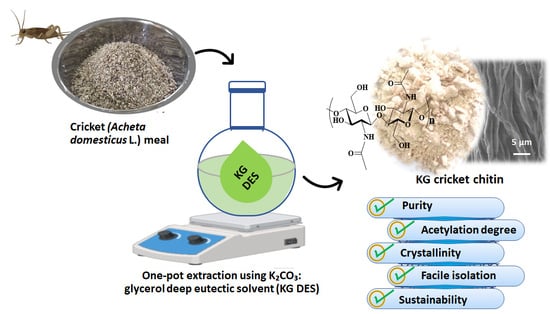
Graphical Abstract

1. Introduction

Chitin, a linear structural polysaccharide chemically known as poly-(β-(1→4)-N-acetyl-D-glucosamine), is the most abundant biopolymer found in nature after cellulose. Over the years, there has been immense interest in chitin owing to its renewable nature, non-toxic attribute, and versatile applications in areas as wide as food preservation and packaging, encapsulation of bioactive ingredients, drug delivery, tissue engineering, and filtration membrane technology, amongst others [1]. Commercial chitin is mainly obtained from the shells of crabs and shrimps generated as waste by-products from food processing. However, due to overfishing and climate change, which may shift the habitats of marine species, a stable supply of chitin may be impeded [2]. Moreover, as interest in sustainable resource utilization grows, the demand for chitin as a naturally derived biopolymer is expected to increase. To avoid the environmental pressures that may arise from securing chitin from conventional marine sources, there is a need to explore new sources of raw materials.
Insects have been proposed as an alternative, viable source for the extraction of chitin. Insects can contain up to 60% of chitin in their exoskeleton, which suggests a good prospect for high-yielding. In addition, they are the most abundant species in the animal kingdom [3]. In addition, insects have a rapid growth cycle and can rely on organic waste as food with a high conversion efficiency. This has a dual positive effect, that is, sustainable resource management and waste reduction. Unlike crustaceans, which are subject to seasonal variability, insects are available year-round, which allows for a consistent supply. Moreover, insect cultivation is sustainable, eco-friendly, and a low-carbon footprint endeavor [3,4,5]. As a result, there has been heightened research interest in the valorization of insect derived biomass for the production of chitin with recent reports highlighting chitin production from black soldier fly (Hermetia illucens) breeding waste [1,6], and H. illucens at different processing steps in the insect farm (Flake, Puparia and adults black soldier fly) as well as from domestic cricket (Acheta domesticus L.) [7,8]. One of the major obstacles impeding the successful utilization of insect-derived biomass for industrial chitin production is the absence of a standard extraction and isolation protocol for the production of high-quality chitin in an efficient and sustainable manner.
Conventional extraction of chitin consists of demineralization and deproteinization of the chitinous biomass to remove residual minerals (e.g., calcium carbonate) and proteinaceous impurities, respectively. These processes require substantial volumes of corrosive chemicals (mineral acids and bases) as solvents [9]. The noxious nature of these chemicals makes them difficult to handle on a large scale, and their disposal constitutes a serious threat to environmental health. In addition, chitin-rich sources are inherently recalcitrant materials with chitin strongly integrated with other components, i.e., impurities. As a result, conventional extraction typically requires not only large volumes of harsh solvents but also an extended duration [10]. With the push towards sustainability, green extraction methods are now taking center stage in materials recovery as alternatives to conventional extraction, affording milder, benign, eco-friendly, and yet effective extraction and purification. A deep eutectic solvent (DES) is a eutectic mixture that exhibits a lower melting point than that of its individual components—typically a hydrogen bond donor and a hydrogen bond acceptor [11]. DESs possess several notable advantages over traditional extraction solvents, including the lack of toxicity, being non-inflammable, biodegradable, cheap, easy to handle, recyclable, sustainable, scalable, and easy to prepare, and the ability to dissolve hydrophobic components [11]. These attributes have led to the recognition of DES as a green extraction solvent for the extraction and processing of a diverse array of biomasses, including proteins [12], cellulose [13], and lignin [14]. As an alternative to the conventional chemical extraction, the use of DES-based extraction for the preparation of chitin from diverse sources is currently gaining traction [15]. Recent records show that the use of DES for chitin extraction from cricket has been accompanied by varying levels of success. While some authors claimed that DES is effective for producing high-purity insect chitin [16], others disagree [17,18].
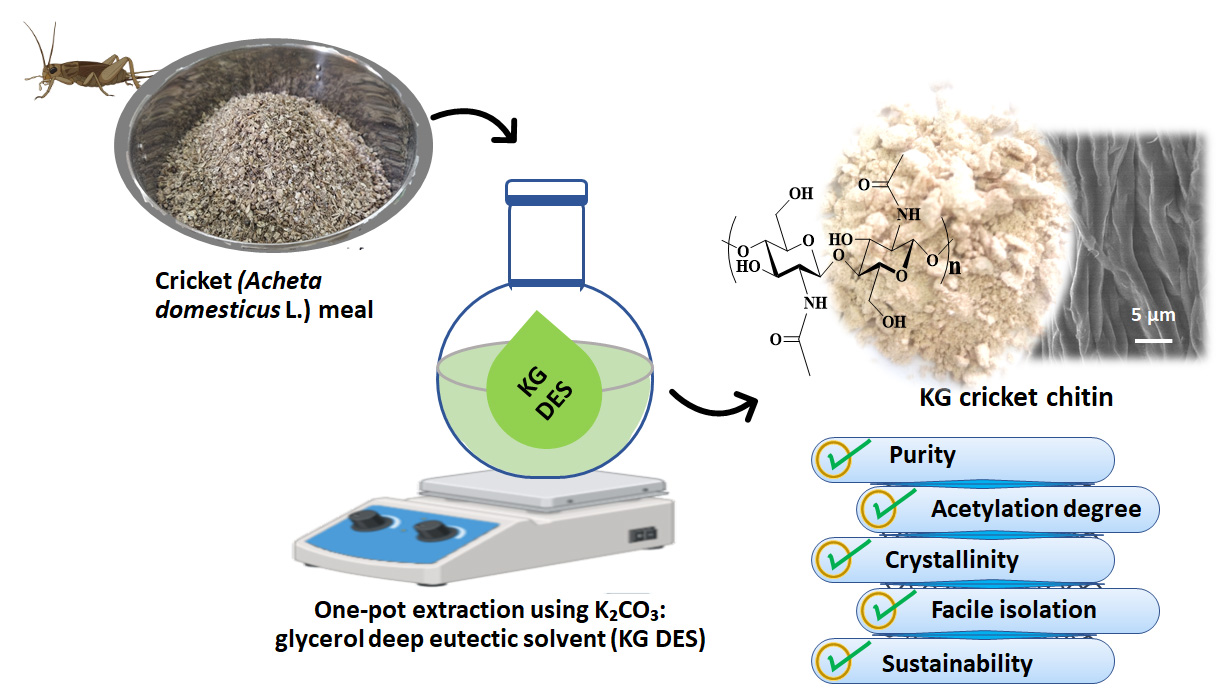
To remove any ambiguity and therefore clarify the potential of DES-based extraction in the preparation of cricket chitin, this work focuses on examining the effect of acidic and alkaline eutectic solvents in the extraction of chitin from domestic cricket (Acheta domesticus L.) meal. The cricket meal was a by-product obtained from the production of cricket oil using supercritical CO2 extraction. In other words, the cricket meal is essentially a waste or by-product, and its use as a source for chitin extraction not only leads to a sustainable approach for waste management but also promotes high-value resource recovery. Meanwhile, the chitin obtained using deep eutectic solvent will be compared with cricket chitin obtained by the conventional method (Figure 1), as well as commercially obtained crab shell chitin. It is anticipated that insights obtained from this work will further advance the utilization of cricket-derived biomass and waste as sustainable sources for the preparation of chitin that can find widespread application in areas including food, agriculture, biomedicine, and the environment.

2. Materials and Methods

2.1. Materials

Practical grade chitin coarse flakes from crab shell (Product No. C-4666) were obtained from Sigma-Aldrich (St. Louis, MO, USA). Domestic cricket (A. domesticus) was obtained locally in Chiang Mai province, Thailand. Choline chloride (98%) and sodium hydroxide were purchased from Loba Chemie Pvt. Ltd. (Palghar, India), while glycerol (99.5%) was obtained from Namsiang Company Ltd. (Bangkok, Thailand). Potassium carbonate, hydrogen peroxide, and 10% sodium hypochlorite solution were obtained from Union Science, Ltd. (Chiang Mai, Thailand). Hydrochloric acid (35%) was obtained from RCI Labscan, Ltd. (Bangkok, Thailand). Except for those stated otherwise, all other chemical reagents used in this work were of analytical grade.

2.2. Obtaining Domestic Cricket Meal

The cricket samples were boiled in water at 100 °C for 3–5 min and then frozen. After thawing, the samples were dried for 12 h at 65 °C using a tray dryer. Cricket samples were defatted using supercritical CO2 extraction. Briefly, the samples were processed through a hammer mill. Thereafter, defatting of the milled cricket sample (500 g) was performed using a supercritical CO2 extraction at 60 °C and 200 bar pressure for 5 h using a 5 L supercritical CO2 extractor, provided by Guangzhou Heaven-Sent Co., Ltd. (Guangzhou, China), at an average CO2 flow rate of 134.94 L/h. The residue (marc) or cricket meal obtained after oil extraction was vacuum-sealed and stored in a desiccator prior to further analyses.

2.3. Preparation of Cricket Chitin

2.3.1. Preparation of Deep Eutectic Solvents (DESs)

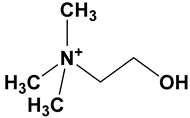
Firstly, DES based on choline chloride and glycerol (CCG DES) as hydrogen bond acceptor and donor, respectively, was prepared as previously reported [12] with minor modification. Choline chloride and glycerol (mass ratio: 1:2) were carefully weighed into an Erlenmeyer flask. The mixture was stirred using a magnetic stirrer at 80 °C until a clear, colorless, and viscous solution was formed. The solution was allowed to cool to room temperature.
For the preparation of potassium carbonate: glycerol deep eutectic solvent (KG DES), potassium carbonate and glycerol (mass ratio 1:7) were carefully weighed into an Erlenmeyer flask. The mixture was stirred at 80 °C using a magnetic stirrer until a clear, colorless, and viscous solution was formed (see Table 1 for DES composition).

2.3.2. Extraction of Cricket Chitin

One-pot preparation of chitin from cricket meal was performed following the method described by [19] with minor modifications. Cricket meal (20 g) was added to 400 mL of DES in order to achieve a powder to solvent ratio of 1:20. The mixture was then stirred for 3 h at 120 °C. This was followed by the addition of hot water at a 1:1 ratio to reduce the viscosity of the cricket meal-DES liquor. The obtained mixture was centrifuged at 4000× g for 20 min. The supernatant containing proteins and salts was collected in a flask and briefly kept at 4 °C. The pellet was collected and resuspended in distilled water. This was followed by filtration under gravity using Whatman No. 1 filter paper. This washing process was repeated at least seven times until the aqueous solution dropping from the filter paper was neutral. The pellet was then dried in an oven at 80 °C for 24 h to obtain the cricket chitin. The cricket chitin was stored in a desiccator prior to further analysis.
To prepare decolorized cricket chitin samples, a decolorization step was added immediately after the washing step was completed. Decolorization of cricket chitin was performed by bleaching using 5% v/v aqueous solution of hydrogen peroxide at a solid to solvent ratio of 1:30 and stirring at 90 °C for 60 min. The bleached sample was then filtered and washed with distilled water until a neutral pH was attained. The sample was dried at 80 °C for 24 h to obtain the decolorized cricket chitin samples.

2.3.3. Recovery of Deep Eutectic Solvents

The deep eutectic solvents were recovered from the extraction liquor (supernatant of cricket meal-DESs after centrifugation) using the method described by [16,20] with minor modification. Chilled 95% ethanol (4 °C) was added to the extraction liquor at a ratio of 4:1 v/v. After shaking, the mixture was left at 4 °C for 12 h to induce precipitation of proteins and organic mineral salts. The proteins and salts were removed as pellets by centrifuging the dispersion at 4000× g for 30 min at 4 °C. Then, the supernatant was collected and vacuum-filtered through Whatman No. 1 filter paper. The hydro-ethanolic component of the supernatant was evaporated using a rotary evaporator at 50 °C, leaving behind the recovered DESs. The chemical profile of the recovered DES was verified using FTIR spectroscopy analysis (please refer to the Supplementary Materials Section, Figure S1) [21,22,23] and then used to extract cricket chitin as described in Section 2.3.2.

2.3.4. Preparation of Chitin by Conventional Extraction

Chitin was also prepared from cricket meal using the conventional extraction (CE) approach in a two-step process [24]. Firstly, cricket meal was demineralized by adding the powder into 1 M HCl at a powder: solvent ratio of 1:20. The mixture was then stirred for 2 h at 30 °C, followed by centrifugation at 4000× g for 30 min. The pellet was collected and re-dispersed in distilled water. The mixture was filtered via Whatman No. 4 filter paper and washed at least seven times. Secondly, the collected solid material was subjected to deproteinization by extracting with 2 M NaOH at a solid/solvent ratio of 1:20 via stirring at 80 °C for 2 h. This was followed by centrifugation at 4000× g for 30 min, collection of the precipitate, and washing of the collected precipitate with distilled water until the pH became neutral. Furthermore, the precipitate was decolorized by dispersing it in an aqueous solution of sodium hypochlorite (1% v/v) at a solid-to-solvent ratio of 1:20 g/mL, followed by stirring at room temperature for 3 h. The decolorized dispersion was filtered using Whatman No. 1 filter paper and washed with distilled water until a neutral pH was achieved. The precipitate was then dried at 80 °C for 24 h to obtain decolorized cricket chitin [25,26] (Figure 1). Table 2 presents the different chitin samples along with a simplified explanation of their respective method of preparation.

2.4. Chemical Composition Analysis of Cricket Chitin

The prepared chitin samples were examined for their physical appearance and chemical composition.

2.4.1. Moisture Content

The moisture content (%) of the chitin powders was measured using a Precisa XM60 moisture analyzer, Pricisa Instruments, Ltd. (Dietikon, Switzerland). Samples were heated at a temperature of 105 °C until the weight became constant. The moisture content of the samples was presented as the percent (%) of at least three replicates.

2.4.2. Ash Content

The total ash content of the cricket chitin powders was estimated according to [16] with minor modification using a Carbolite CFW 11/13 furnace, Carbolite Furnaces (Hope Valley, UK). Samples were placed in crucibles and introduced into the furnace. The samples were heated at 550 °C for 5.5 h and then kept in a desiccator at room temperature for 30 min. The weight of the sample before and after incineration was recorded and used to calculate the ash content in percentage. The data was presented as the mean ± standard deviation of at least three replicates.

2.4.3. Protein Content

The protein content of the cricket chitin powders was estimated as previously described [16]. For each sample, a 50 mg sample was mixed with 10 mL of 5% sodium hydroxide solution. The mixture was then stirred for 150 min at 95 °C. This was followed by centrifugation at 8000× g for 10 min. Subsequently, the supernatant was collected and analyzed for protein content using the Bradford assay. Bovine serum albumin was used as a standard [27]. The data was presented as protein content in percentage derived from at least three replicates.

2.5. Evaluation of Chitin Yield and Purity

The yield of chitin obtained using the respective methods was calculated based on the equation below.
Yield (%) = (Wchitin/Wsample) × 100
where Wchitin and Wsample represent the weight of the obtained chitin powder and the weight of the cricket meal, respectively [24].
The purity of the chitin powders was estimated using the following formula:
Purity (%) = 100 − (moisture content% + ash content% + protein content%)

2.6. Determination of Physical Characterization of Cricket Chitin

2.6.1. Colorimetric Analysis

The color of the cricket chitin powders was examined using a handheld color meter, Minolta CR-400 chroma meter, Konica Minolta Optics, Inc. (Tokyo, Japan). Three primary color attributes, viz. L*, a*, and b* were recorded from the color meter, while ΔE and Whiteness Index (WI) values were calculated as previously reported [28].
Δ E = L 0 * L 1 * 2 + a 0 *     a 1 * 2 + b 0   *   b 1 * 2
where L0*, a0*, and b0* represent the primary color parameters of crab shell chitin while L1*, a1*, and b1* depict the primary color parameters of cricket chitin samples.
Whiteness Index = 100 − [(100 − L*)2 + a*2 + b*2]1/2

2.6.2. FTIR Analysis

FTIR analysis was performed on the chitin samples. Briefly, each chitin powder (1 mg) was ground together with KBr (100 mg) and pressed into a thin translucent disk. The disk was then carefully inserted into the sample holder and introduced into the sample chamber of the JASCO FT/IR-4700 spectrometer, JASCO Ltd. (West Yorkshire, UK). Infra-red spectrum was collected for each sample from 4000 cm−1 to 500 cm−1 following a total of 32 scans at a scanning speed of 2 mm/S and a resolution of 4 cm−1. The degree of acetylation (DA) of the cricket chitin was estimated from the spectral data using the equation below [16]:
DA (%) = 100 − [(31.92 × A1320/A1420) − 12.2]
where A1320 and A1420 are the absorbance values at wavenumber 1320 cm−1 and 1420 cm−1, respectively.

2.6.3. X-Ray Diffraction

The crystalline structure of the chitin powders was analyzed by X-ray diffraction. XRD analysis was performed on an Empyrean X-ray diffractometer (PANalytical, Almelo, The Netherlands), and data was collected within a goniometer scanning range of 5–80° under an operating voltage of 40 kV. The degree of crystallinity was estimated using the following equation [29]:
Crystallinity index (%) = [(I110 − Iam)/I110] × 100
where I110 represents the maximum intensity of the diffraction peak at 2θ = 19–20°, and Iam denotes the diffraction of the amorphous region with intensity at 2θ = 13–14°.

2.6.4. X-Ray Photoelectron Spectroscopy Analysis

The surface chemical composition of the chitin powders was examined using an AXIS ULTRADLD X-ray photoelectron spectrometer by Kratos Analytical (Manchester, UK). The base pressure in the XPS analysis chamber was set at 5 × 10⁻⁹ torr, and the samples were excited with X-ray hybrid mode 700 × 300 µm spot area with a monochromatic Al Kα 1,2 radiation at 1.4 keV. The X-ray anode was operated at 15 kV, 10 mA, and 150 W. The photoelectrons were detected with a hemispherical analyzer positioned at an angle of 90° with respect to the normal to the sample surface. The spectra were calibrated using the C1s line (BE = 285 eV), and the spectra were processed using XPS VISION II software by Kratos Analytical Co. Ltd. (Manchester, UK).

2.6.5. Scanning Electron Microscopy Analysis

Scanning electron microscopy (SEM) was used to examine the surface morphology of the isolated cricket chitins, as well as those of cricket meal and crab shell chitin. Samples were observed using a JEOL JSM-IT200 electron microscope, JEOL Ltd. (Tokyo, Japan), operated under an accelerating voltage of 10 kV. Electron micrographs were captured at magnifications of 500× and 3000×.

2.7. Statistical Analysis

Analysis of data was performed by one-way ANOVA using GraphPad Prism ver. 10, GraphPad Software, Inc. (San Diego, CA, USA). Post hoc multiple comparison was accomplished via the Tukey test with a p-value of <0.05 as the limit for statistical significance. Data are presented as the mean ± SD of three replicates.

3. Results and Discussion

Chitin and chitosan are highly sought-after polysaccharide biomacromolecules due to their manifold biological, biomedical, materials, and food applications. When acetyl groups of chitins are removed in a process known as deacetylation, the product obtained is chitosan (deacetylated chitin) [30]. In principle, chitin has a greater percentage of N-acetyl glucosamine than glucosamine, giving it a degree of acetylation (DA) (≥50%). Conversely, in chitosan, the percentage of glucosamine is greater than that of N-acetyl-glucosamine, giving it a DA value below 50% [31]. In the present work, chitin was extracted from domestic cricket using pristine deep eutectic solvents (KG and CCG DESs) and their recovered counterpart (RKG and RCCG DESs). For comparison, commercial crab shell (CS) chitin was used along with chitin extracted from the insect using conventional acid–alkaline treatment (CE chitin). All the samples were thoroughly evaluated to ascertain how the different modes of extractions affected the physicochemical and structural properties of chitin and determine the suitability of the DES-based approach as a sustainable method and cricket meal as a viable source of high-quality chitin. The findings obtained from this investigation demonstrate that KG DES-based extraction represents a pragmatic and facile technique for the isolation of chitin and that domestic cricket meal could be used as an alternative source for isolating high-quality chitin.

3.1. Preparation of Cricket Protein from Cricket Powder

The DA of chitin is known to affect crucial physicochemical [32] and biological properties of the chitin and chitin-derived structures, such as nanofibers [33]. Here, the DA of chitin was measured in order to understand whether the different methods of extraction affected this key parameter. As shown in Table 3, CS chitin has a DA value of 79% confirming that the material is chitin (DA ≥ 50%) [30,31]. The results also revealed that all the materials extracted from domestic cricket meal exhibited DA values greater than 77%, confirming their chitinous nature. Of note, the DA of chitin samples obtained by CE and DESs were comparable to that of CS chitin, revealing that the deep eutectic solvents were effective in extracting chitin with high acetylation content.
Concerning the sample yield, pristine and recovered CCG DESs featured the highest sample yield (18.17% and 22.94%), while DCE displayed the lowest (6.54%). In fact, the amount of material recovered by CCG/RCCG was greater than the actual content of chitin in domestic cricket. Acheta domesticus L. has chitin content that ranges from 2.6 to 12.6% depending on the source and body part [26,34]. The higher recovery of chitin demonstrated by the CCG and RCCG DESs might be due to the presence of chitinous materials, that is, materials that are not strictly chitin. This material is most likely a complex of chitin and proteins, which were not sufficiently hydrolyzed due to strong and stable molecular interactions that often impede complete deproteinization [35,36]. This notion is supported by the high amount of proteins present in the CCG samples (Table 3). With respect to the purity of the samples obtained, as expected, the chitin obtained by conventional extraction was among the highest, with DCE chitin (93.16%) and CE chitin (92.26%). This was closely followed by the chitin obtained by KG DES. In fact, chitin obtained by KG and CE displayed comparable or superior purity compared to CS chitin. Meanwhile, CCG chitin and RCCG chitin displayed the least purity. It therefore seems that although CCG was effective at demineralization, as evinced by the low ash content of the recovered materials, it was less effective at deproteinization of the cricket meal biomass.

3.2. Physicochemical Characterization of Cricket Chitin

3.2.1. Physical Appearance of Cricket Chitin

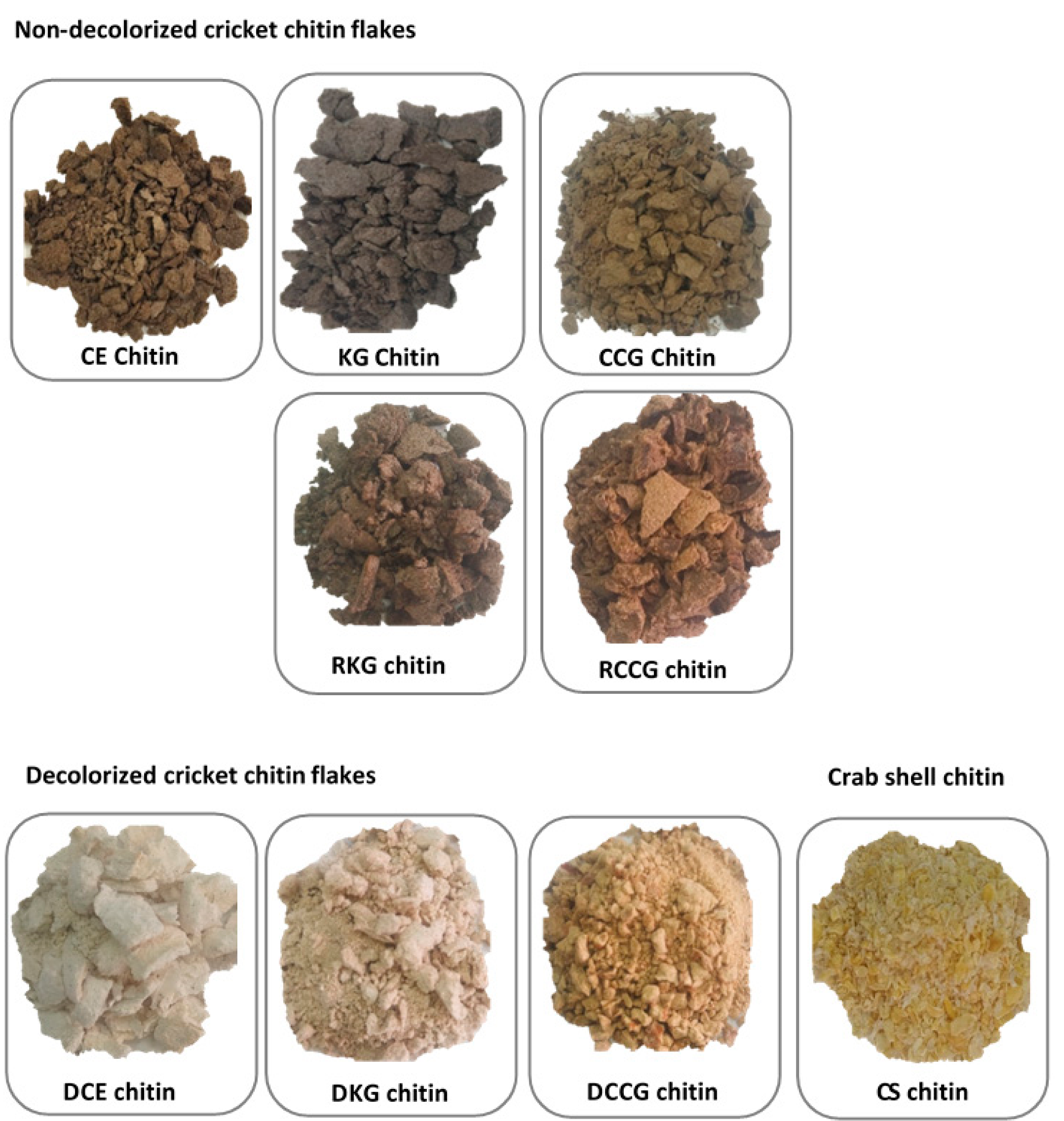
The physical appearance of chitin is important since it influences consumer acceptability. More importantly, it can be used as a crude yardstick for the purity of chitin samples, where dark brown or black colored chitin is regarded as less pure compared to their beige or yellow-white counterpart. Insect cuticles are often imbued with structural colors and pigments. These pigments, e.g., melanins, are products of the cuticle-tanning pathway. Alternatively, they can be derived from dopamine and 3,4-dihydroxydopamine during sclerotization and cuticular tanning [37,38]. While a tiny fraction of the pigments is removed during the process of demineralization and deproteinization, the color of chitin obtained from insects typically varies from brown to black [24]. The dark color in insect chitin is mainly attributed to the presence of melanin, which forms a complex with the chitin sample [39]. While this may be desirable in certain applications, e.g., preparation of UV-shielding film materials [40], in others, such as chitosan, it may constitute a limitation. In general, commercial chitin is often bleached to a color as close to white as possible. This is often accompanied by an increase in purity [24].
As shown in Table 4 and Figure 2, the color parameters show that there is great variability in the appearance of cricket chitin obtained using different approaches. The commercial CS chitin featured a light-yellow appearance with relatively high lightness (L* value of 74.31) and whiteness (WI value of 64.78). Among the isolated cricket chitin samples, the decolorized samples (DCE, DKG, and DCCG), as expected, displayed the highest lightness (L* values of 64.78–83.83) and whiteness (WI values of 59.24–78.83), whereas, cricket chitin obtained using recovered DES (RKG and RCCG chitin) exhibited the least lightness (L* values of 43.41–46.07) and whiteness (WI values of 43.14–45.87). Intermediate values of lightness (L* values of 50.54–51.68) and whiteness (WI values of 50.34–51.26) were observed for the non-decolorized cricket chitin samples (CE, RKG, and CCG). When compared to the commercial CS chitin, the decolorized cricket chitin samples exhibited similar or superior lightness and whiteness. The exception was DCCG chitin, which displayed slightly lower lightness and whiteness. The remarkably whiter appearance of the DCE chitin could be partly attributed to the use of sodium hypochlorite in the decolorization of the chitin sample. Sodium hypochlorite is a potent oxidant. Exposure of chitin to it causes the chitin sample to be oxidized, with the melanin probably degraded. In the same vein, hydrogen peroxide was also effective in decolorization of the chitin obtained using deep eutectic solvents, especially the DKG chitin sample. The data also showed that DCCG chitin had the highest redness value, while DCE chitin had the least. In terms of yellowness, the highest values were displayed by the commercial chitin as well as the decolorized cricket chitin. The ∆E values depict the total color difference relative to the commercial chitin. The data show that the decolorized chitins were closest in color to the commercial CS chitin. In fact, as seen from the whiteness, both DCE chitin and DKG chitin were on par with the commercial CS chitin and whiter than purified crab shell chitin from a previous report [41]. Since hydrogen peroxide is a more benign chemical reagent, these results suggest that it can be used for the production of cricket chitin with color that meets commercial standards.

3.2.2. FTIR Analysis of Domestic Cricket Chitin

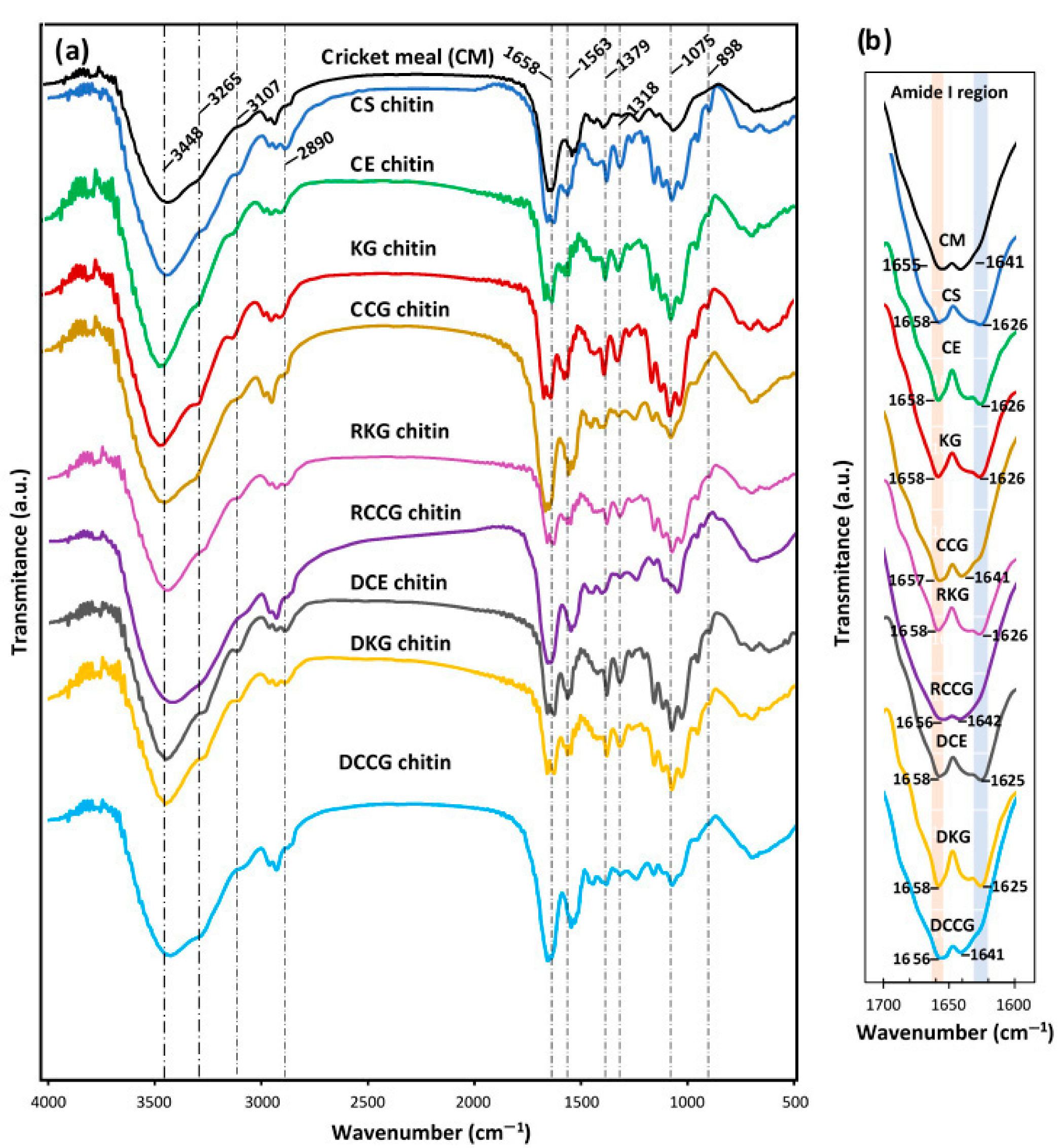
The chemical structure of cricket chitin was analyzed using infrared spectroscopy. The IR spectra of the chitin powders displayed prominent peaks around 1658 cm−1 and 1560 cm−1 (Figure 3a), which are consistent with the stretching vibration of the C=O group in the Amide I region and the N-H bending and C-N stretching vibrations of the Amide II region, respectively [1]. Major peaks were also found around 3448 cm−1 and 3265/3107 cm−1, attributable to the stretching vibrations of O-H and N-H groupings. The cluster of peaks around 2932 cm−1 and 2890 cm−1 can be ascribed to CH3 symmetric/CH2 asymmetric stretching vibrations and CH3 symmetric stretching vibrations, respectively [42]. In addition, the peaks around 890 cm−1 correspond to the ring stretching band that is a fingerprint of the β-1,4 glycosidic bonds, while the peak around 1075 cm−1 is assigned to the asymmetric ring stretching vibration of the -C-O-C bridge of the glucosamine ring [43]. Furthermore, the IR peak featured around 1318 cm−1 is classified as the Amide III band (C-H and N-H) originating from proteins and attributed to the CH2 wagging vibrations, while the peak at 1379 cm−1 emanates from the vibrations of -CH bending and CH3 symmetric deformation [6]. The functional group composition, as evinced by the peak positions, properly aligns with the chemical composition of chitin [42]. Besides minor shifts in the position of the major peaks, the FTIR spectra of all the samples were broadly similar, indicating that chitin was the main component of all the samples.
Depending on the source from which it was isolated, chitin can be found in alpha, beta, or gamma crystalline form. A notable feature of the beta crystalline form of chitin is a weak peak around 1650 cm−1, corresponding to intramolecular hydrogen bonds [44]. The alpha crystalline form of chitin displays three prominent bands around 1660 cm−1, 1620 cm−1, and 1550 cm−1, representing vibrations from C=O secondary amide stretch (Amide I), C=O secondary amide stretch (Amide I), as well as N-H bend and C-N stretch (Amide II), respectively. In other words, the Amide I band around 1655–1660 cm−1 is distinctly split into two peaks. This is indicative of a doublet resulting from differential hydrogen bonding [42].
In CS chitin, a prominent peak can be seen at 1658 cm−1 (Figure 3b). This band represents hydrogen bonds formed between the carbonyl groups (-C=O) of Amide I and (-NH-) of Amide II. In other words, the peak represents intra-chain or intermolecular hydrogen bonding between the -C=O group and the NH groups (-CO..NH-). The secondary amide peak at 1626 cm−1 originated from the inter-chain or intermolecular hydrogen bond between the carbonyl group (-C=O) and the primary hydroxyl of the CH2OH group (–CO···HO–CH2). This splitting is a characteristic feature of alpha-chitin [1,42] and is clearly present in the Amide I spectrum of CS (Figure 3b). This feature was also prominently displayed in the Amide I spectra of cricket chitin obtained using CE and KG DESs, confirming that they are constituted by the alpha-crystalline form of chitin [6]. In contrast, the Amide I spectra (ca. 1658 cm−1) of cricket chitin obtained via CCG DESs, CCG chitin, RCCG chitin, and DCCG chitin were not clearly separated. The absorption band at 1626 cm−1, representing intermolecular hydrogen bonding, was not apparent. This was due to overlapping protein bands [45], indicating that the chitin prepared using CCG was not completely deproteinated. A similar behavior was also observed for the IR spectrum obtained from the cricket meal (CM) sample (Figure 3b). Secondly, the disappearance of the -NH band (3107 cm−1) associated with the formation of chitosan from chitin (deacetylation) [1] did not occur, as evinced by the presence of an absorption peak at 3107 cm−1 in all the chitin samples. Taken together, the FTIR analysis reveals that CE and KG DES were effective in obtaining alpha-chitin from domestic cricket via the elimination of proteins and mineral contaminants, while at the same time retaining a minimal extent of deacetylation.

3.2.3. XRD Analysis of Domestic Cricket Chitin

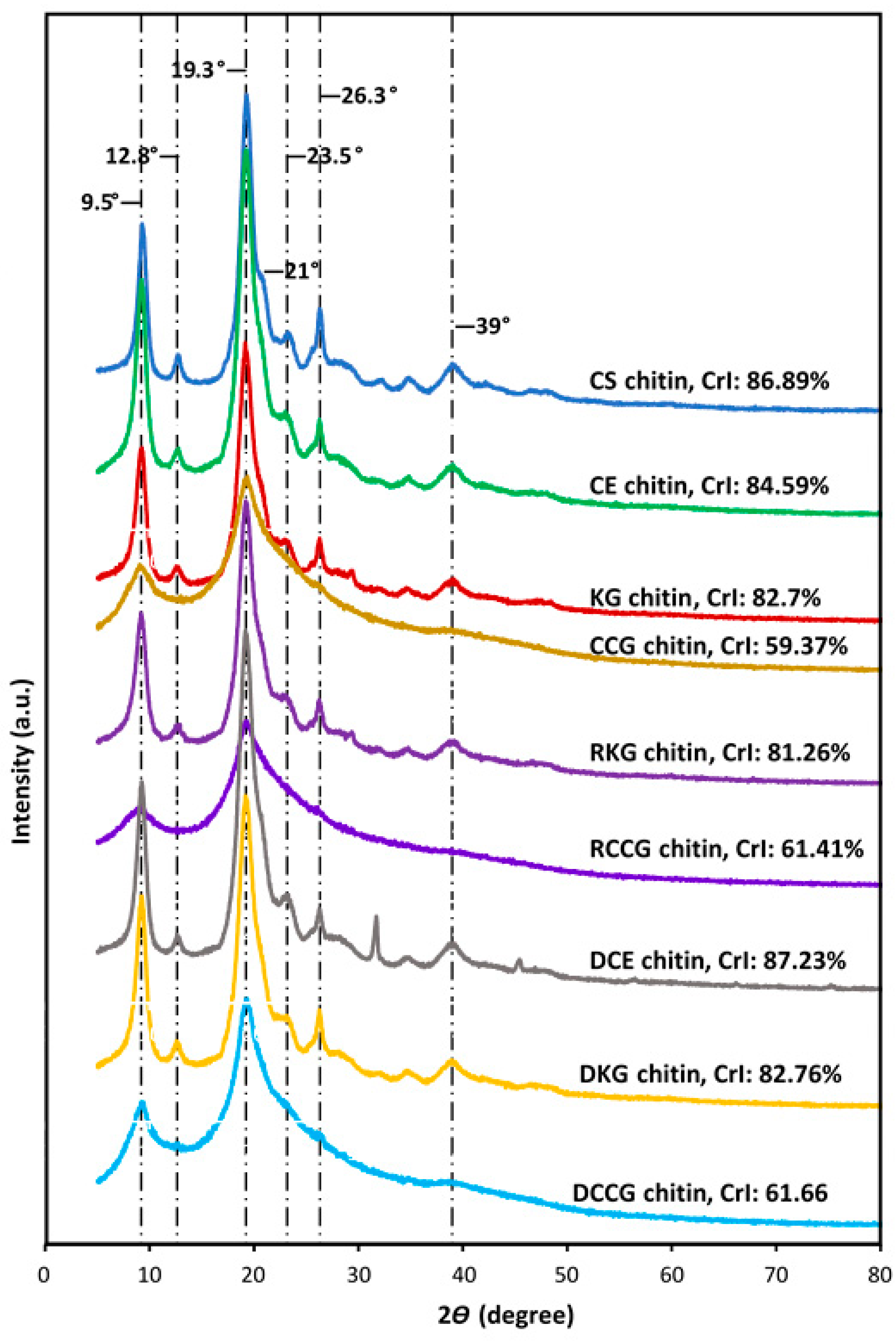
The crystalline structure of the extracted domestic cricket chitin samples, as well as commercial CS chitin, was examined via XRD analysis. The XRD patterns of all the samples are presented in Figure 4. CS chitin displayed a pattern with noticeable peaks at 2ϴ positions around 9.5°, 12.8°, 19.3°, 21°, 23.5°, 26.3°, and 39°, which is very similar to the pattern of alpha-chitin from previous reports [1,46,47]. The two prominent peaks of the CS diffractogram at 2ϴ positions of 9.5° and 19.3° are attributable to the (020) and (110) crystal planes, whereas the minor peaks at 2ϴ positions around 23.5°, 26.3°, and 39° are assigned to the (130), (140), and (171) crystal planes. The sharp crystalline reflections around 9.5°, 19.3°, 21°, and 23.5° are characteristic planes, which correspond to the orthorhombic crystal structure of alpha-chitin from crustaceans, fungi, and insects [47,48,49].
The diffraction pattern of CE chitin matched closely with that of CS chitin, indicating that conventionally extracted chitin from domestic cricket has similar crystal features to those from crab shell. Meanwhile, the cricket chitin obtained by KG DES also exhibited the same sharp reflections seen in both CS and CE chitin samples. In contrast, the chitin sample produced by CCG DESs featured an XRD pattern with the two main peaks at 9.5° and 19.3°. However, the minor peaks were noticeably absent. Importantly, the peak at 19.3° broadens, suggesting a reduction in crystallinity of the CCG chitin samples compared to those of CS, CE, and KG chitin flakes.
Previous studies on insect chitin and insect cuticle have noted that the monoclinic CaCO3 structure presents diffraction peaks at 29.7°, 36.2°, 39.7°, 43.5°, 47.8°, 48.9°, 57.8°, and 61.3°, representing the (200), (020), (211), (022), (312), (222), (130), and (132) crystal planes of the solid mineral compound. Among these peaks, the most prominent calcite reflection is typically featured around 29.46–29.7° [47,50]. It is ostensible from Figure 4 results that none of the peaks attributable to CaCO3 were present in the XRD pattern of the cricket chitin samples, suggesting that the obtained samples did not contain meaningful amounts of mineral impurity, thus indicating that demineralization was effective [51].
The cricket chitin samples obtained by different methods displayed a clear variation in the degree of crystallinity (CrI). Cricket chitin obtained by conventional extraction exhibited the highest crystalline property with CrI values of 87.23% and 84.59% for DCE chitin and CE chitin, respectively. The crystallinity was enhanced with the addition of the decolorization step (DCE chitin CrI of 87.23% > CE chitin CrI of 84.59%), suggesting that crystallinity increased with an increase in chitin purity. This was followed by chitin samples extracted using KG DESs with CrI values of 82.56% and 82.7% for DKG chitin and KG chitin, respectively. Cricket chitin with the least crystalline property was that obtained using CCG DESs with CrI values of 61.66 and 59.37 for DCCG chitin and CCG chitin, respectively. The chitin samples obtained using the recovered DES displayed similar crystalline properties as the original solvent, with CrI values of 81.26% and 61.41% for RKG chitin and RCCG chitin, respectively. This shows that the DESs retained their extractive prowess even after recovery. The higher crystalline attribute of CE chitin and KG chitin reflects their higher degree of purity [19], whereas the lower CrI values of the CCG obtained samples are a testament that the recovered chitin flakes contained considerable amounts of impurities, especially proteins. This result was similar to a previous observation by Zhao et al., who noted a low CrI value of 69.5% for shrimp chitin that was obtained using CCG. Albeit the authors employed a prior pre-treatment step, which partly accounted for the higher CrI values compared to those seen in this work [45]. Of note, the chitin recovered by conventional extraction (CrI values of 84.59/87.23%) and KG DESs (CrI values of 82.7/82.56) were within the same range as those from commercial source crab shell–CS chitin (CrI value of 86.86%). These results showed that domestic cricket meal could be a valuable source for the production of chitin of similar crystalline quality to that from conventional sources.

3.2.4. XPS Analysis

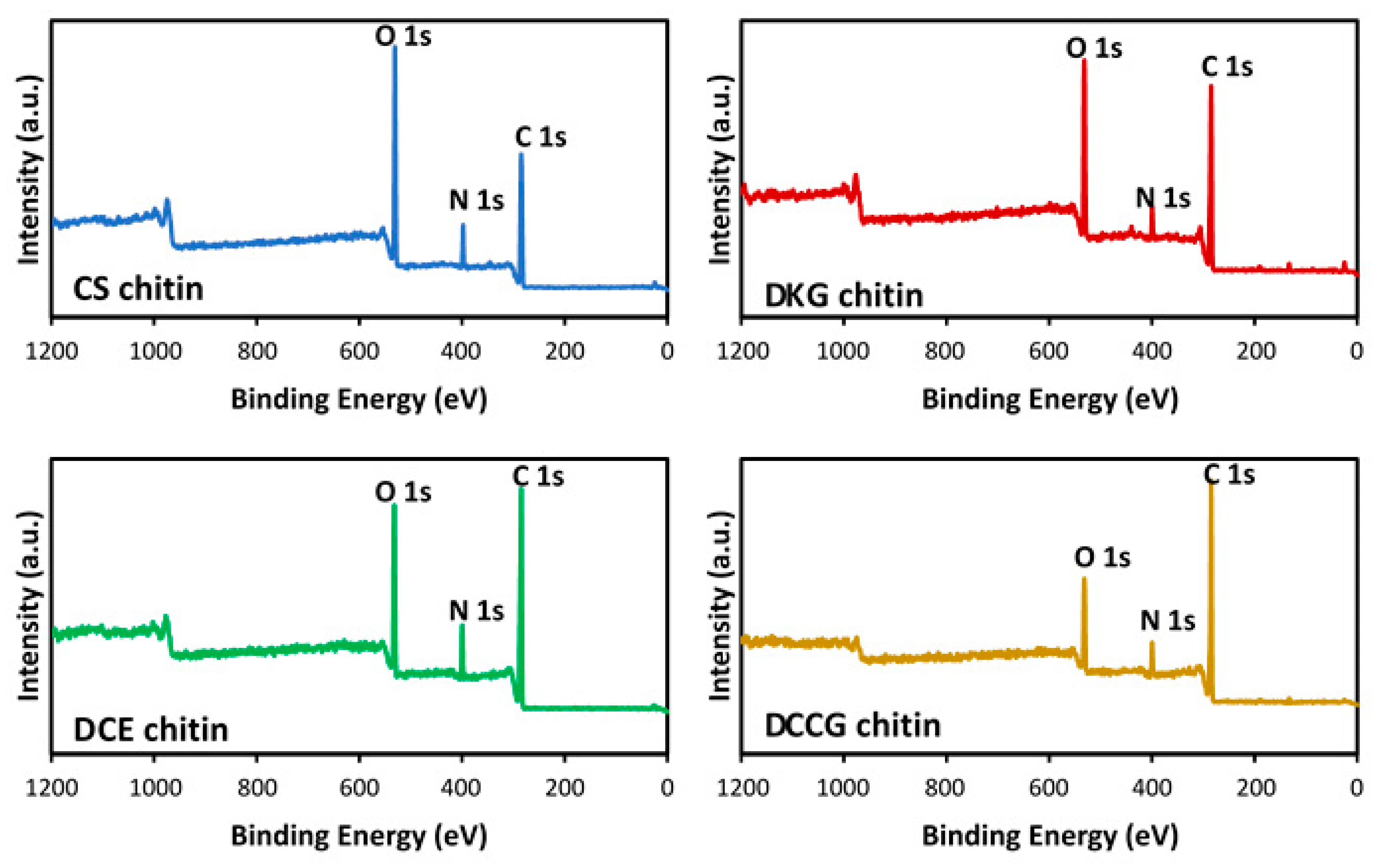
XPS was used to examine the chemical components on the surface of chitin extracted using the different methods. A full survey scan of XPS spectra and surface elemental composition is presented in Figure 5 and Table 5, respectively. In the CS chitin spectrum, prominent peaks can be seen at 532 eV, 400 eV, and 285 eV representing O 1s, N 1s, and C 1s of oxygen, nitrogen, and carbon. The position of the major peaks in this XPS spectrum is similar to the one reported for α-chitin from shrimp shells and consistent for O 1s, N 1s, and C 1s peaks around 532, 400, and 285 eV [52].
A similar spectral pattern was observed for the DCE chitin sample. The absence of other major peaks in the spectra of CS and DCE chitin samples is an indication of the high level of purity in the commercial chitin from crab shell and cricket chitin obtained by conventional extraction. The sample extracted by KG DES (DKG chitin) displayed O 1s, C 1s, and N 1s peaks at the same binding energy position as those seen for crab shell chitin and CE chitin. This indicated that the DKG chitin shares a similar α-form and chemical profile as the ones extracted by CE (DCE chitin). Meanwhile, the spectrum for DCCG chitin displayed the same pattern of peaks as those for CS chitin and DCE chitin, albeit with a relatively lower intensity for the O 1s peak.
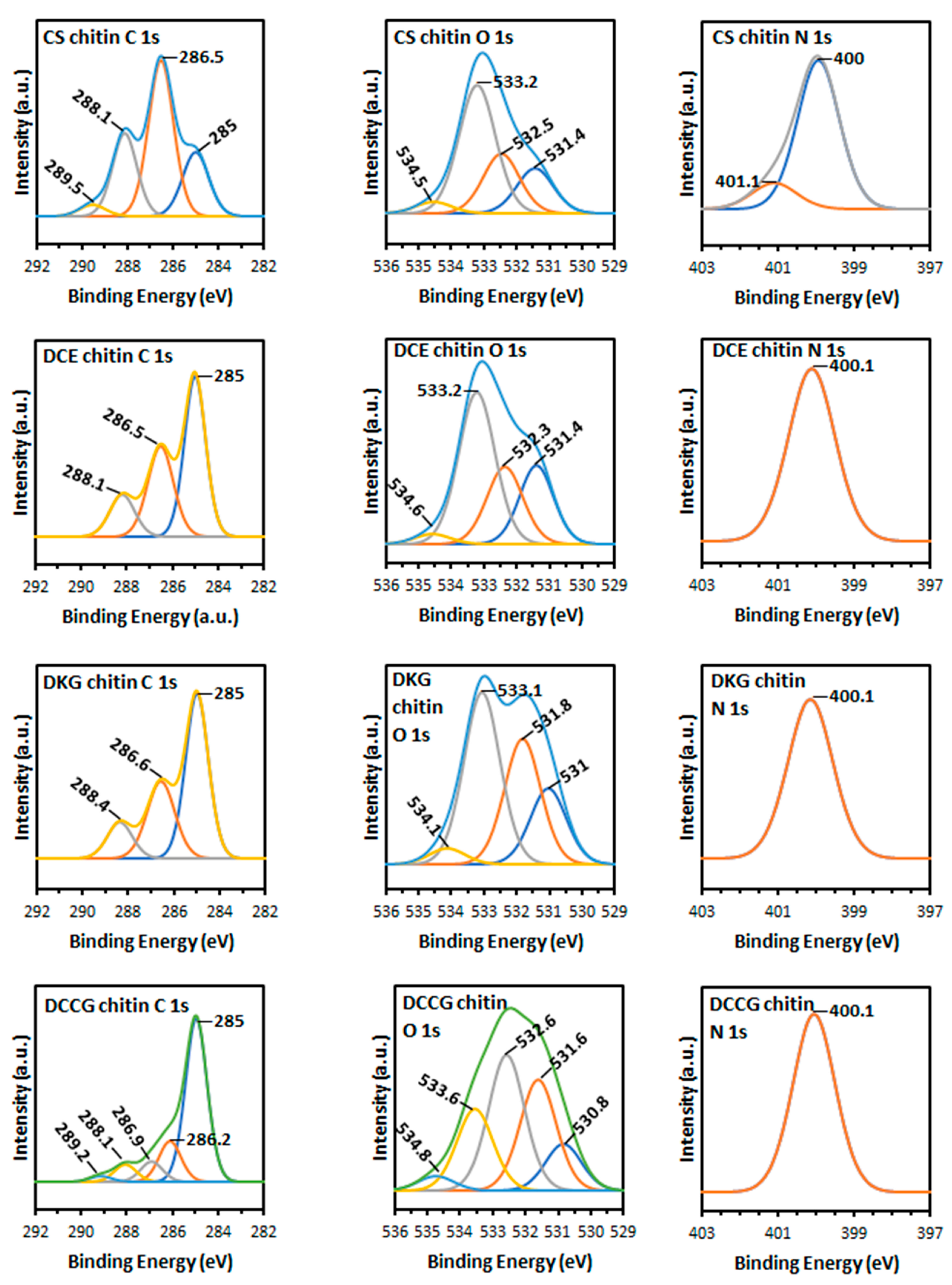
The high-resolution spectra of the chitin samples were deconvoluted into various component peaks. The deconvoluted C 1s, O 1s, and N 1s spectra are presented in Figure 6. The C 1s peak was resolved into four main peaks. These included peaks with binding energy centered around 285 eV corresponding to C-C and/or C=C bonds; 286.5 eV depicting the presence of C-OH, C-O, C-N, and/or Cl groups, as well as the C-O-C linkages (C4) of the chitin structure; 288.1 eV attributed to the presence of C=O, N-C=O, as well as C-O-C (C1) groups of the chitin ring; and 289.5 eV representing -COOH and/or O-C=O groups. The O 1s high-resolution spectra were deconvoluted into four prominent peaks with centers around 531.4 eV, 532.5 eV, 533.2 eV, and 534 eV, indicating the presence of O=C/O-Si, C-O-C, and O-C, as well as OH bonds and adsorbed water (H2Oads), respectively [52]. Meanwhile, two peaks were resolved from the N 1s deconvoluted spectra with maximum peak intensity at binding energies around 400 eV and 401.1 eV. The peak at 400 eV corresponded to contributions from neutral amine (C-NH2)-type bond from chitosan and/or amide (N-C=O)-type bonds from chitin. The peak centered around 401.1 eV denotes the presence of protonated amine groups (-NH3+) of organic type from the chitin extraction [52,53].
In CS chitin, the most dominant peak, as evinced by the relative area in the deconvoluted C 1s spectrum, is the peak at 286.5 eV (46.8%). It is important to point out that although the cricket chitin samples all displayed the three main peaks in the high-resolution C 1s spectrum, concerning the peak at 286.5 eV, the relative peak area was considerably diminished for DCE chitin, DKG chitin, and DCCG chitin, that is, 34.1%, 31.4%, and 25%, respectively. This decrease in peak area might be linked to some partial breakage of glycosidic bonds (C-O-C) during the dissolution step in the course of chitin extraction [54] This effect was most prominent in DCCG chitin. In addition, the C 1s resolved spectrum also displayed an additional peak at 289.2 eV, which can be attributed to C of CO32− from calcite [55] existing as a residual impurity in the DCCG chitin. The N 1s resolved spectra of DCE chitin, DKG chitin, and DCCG chitin all displayed only one peak, around 400 eV, typical for the primary and secondary amine groups present in α-chitin. The CS chitin, on the other hand, exhibited an additional peak, around 401 eV, which is attributed to -NH3+, suggesting that some N atoms in the sample existed in a more oxidized state [56]. These lines of evidence presented in the full survey and high-resolution XPS spectra demonstrate that DKG chitin shares a similar chemical composition to both CS chitin and DCE chitin, and that KG DES is capable of producing cricket chitin with a very minimal level of impurity.

3.3. Microstructure Morphology of Cricket Chitin

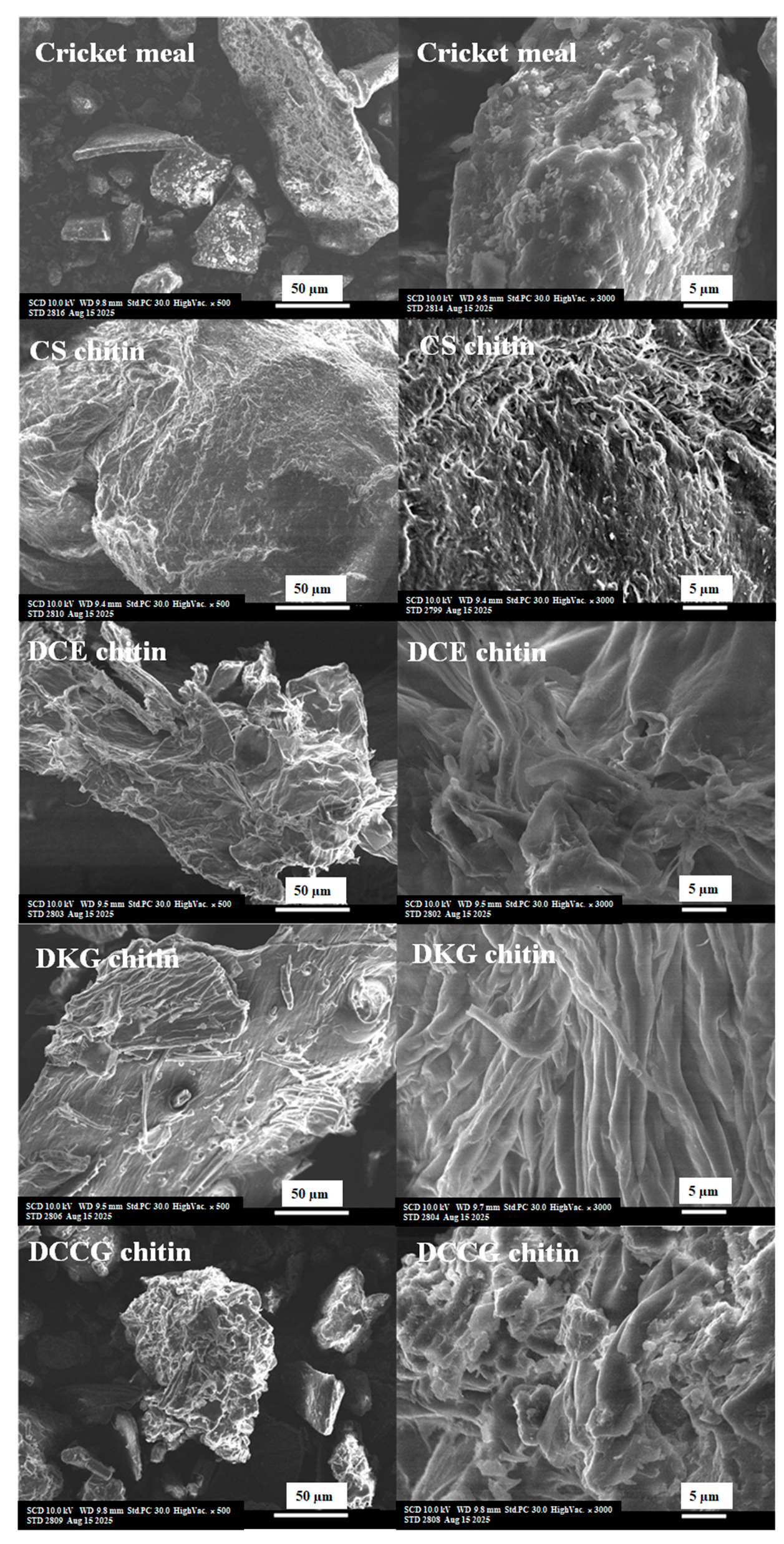
A scanning electron microscope was used to examine the isolated cricket chitin as well as the untreated chitin meal and chitin from crab shell. Electron microscopy images were obtained at magnifications of 500× and 3000× (Figure 7). As shown in the electron micrographs, the surface morphologies of the samples were remarkably different. This was especially the case between the untreated cricket meal and the chitin samples, where the former displayed a contiguous mass upon which numerous globular particles were dispersed. These particles are most likely proteinaceous masses. In sharp contrast, the crab shell chitin samples exhibited a clear micro-fibrous structure, indicating that the proteins and minerals had been removed from the sample, leaving only chitin. The morphology of CS chitin concurred with the fibrous structure of crab shell chitin previously reported in the literature by [57]. Of note, the isolated cricket chitin exhibited the same micro-fibrous nature as chitin from crab shell, especially DCE chitin and DKG chitin. The images of DKG showed long, smooth fibrillar structures, which indicated that the chitin was free of proteins and minerals. This was less so for DCCG chitin. The DCCG chitin microfibrils appear to be shorter and enmeshed with other amorphous small globular masses, indicating the presence of proteins. The SEM micrographs indicated that, similar to CS chitin and DCE chitin, DKG chitin was of high purity and structural integrity.
The CCG-based DESs provide a greener, milder extraction environment due to the strong hydrogen bonding and molecular packing between choline chloride and glycerol. The relatively high density, viscosity, and moderate pH typically observed in CCG-based DESs are due to these molecular interactions [58]. Consequently, chitin samples extracted by CCG-based DESs retained their high degree of acetylation but are of low purity and crystallinity because of less efficacious removal of protein (the bulk of the waste material in the cricket biomass) due to the mild pH. In contrast, the KG-based DESs exhibited greater extraction efficiency, purity, and crystalline property mainly because the alkaline strength of K2CO3 imparts the KG deep eutectic mixture with a stronger capacity to dissolve proteins and minerals [59]. It is worth reiterating that the chitin extraction yield obtained using KG-based DESs was lower relative to the CCG-based DESs. With its modest yield and higher purity, an optimized KG-based DES extraction approach would be especially suited for industrial-scale chitin applications where maximizing purity and yield is often crucial.

4. Conclusions

Domestic cricket meal is the by-product obtained following edible cricket oil extraction. Although this side-stream is considered as waste, it can, however, be valorized towards the production of chitin—a high-value biopolymer with multifarious applications. Herein, a facile one-pot approach based on deep eutectic solvents was presented for the production of chitin from supercritical CO2-defatted domestic cricket meal. The results revealed that DES, particularly potassium carbonate: glycerol (KG DES), yielded cricket chitin (KG/DKG chitin) of high purity, crystallinity, degree of acetylation, and structural integrity comparable to those obtained by the multi-step conventional extraction approach (CE/DCE chitin) and commercial crab shell chitin (CS chitin). Furthermore, the recovered KG DES retained its extractive prowess and presented chitin (RKG chitin) with a similar profile to the one obtained by pristine KG DES (KG/DKG chitin). Meanwhile, the eutectic solution of choline chloride/glycerol (CCG DES) was also found to be capable of extracting chitin (CCG/DCCG chitin) from cricket meal; however, the level of purity and crystalline attributes were low due to ineffective deproteinization. With increasing demand for chitin as a bio-based and natural polymer coupled to the environmental imperative of identifying more sustainable alternative sources besides the conventional marine source, the findings presented here provide a framework for the valorization of cricket meal as a viable and pragmatic option and the use of KG DES-based one-pot approach as an effective, eco-friendly, and sustainable extraction alternative technique for obtaining high-quality chitin. In addition, this study showed that a process workflow beginning with supercritical CO2 extraction of oil from crickets, followed by protein extraction from the defatted meal, and subsequent extraction of high-quality chitin defatted and deproteinated material can be successfully developed. This approach offers an integrated strategy for effective isolation of high-value products, including cricket oil, proteins, and chitin, as well as a zero-waste management strategy, which together present a strong prospect for industrial development.

Supplementary Materials

The following supporting information can be downloaded at: https://www.mdpi.com/article/10.3390/polysaccharides6040115/s1. Figure S1. FTIR spectra of (a) potassium carbonate: glycerol deep eutectic solvent (KG DES) and recovered potas-sium carbonate: glycerol deep eutectic solvent (RKG DES) as well as (b) choline chloride: glycerol deep eutectic sol-vent (CCG DES) and recovered choline chloride: glycerol deep eutectic solvent (RCCG DES).

Author Contributions

Conceptualization, F.N.E. and R.M.; methodology, F.N.E.; validation, F.N.E., R.M., W.J., T.S. and Y.C.; formal analysis, F.N.E., R.M., W.J., T.S. and Y.C.; investigation, F.N.E.; resources, F.N.E. and R.M.; data curation, F.N.E.; writing—original draft preparation, F.N.E.; writing—review and editing, F.N.E., R.M., W.J., T.S. and Y.C.; supervision, R.M. All authors have read and agreed to the published version of the manuscript.

Funding

This work was partially supported by the CMU Proactive Researcher Scheme, Chiang Mai University, Thailand.

Data Availability Statement

The raw data supporting the conclusions of this article will be made available by the authors on request.

Acknowledgments

This work was partially supported by the CMU Proactive Researcher Scheme, Chiang Mai University, Thailand.

Conflicts of Interest

The authors declare no conflicts of interest.

References

  1. Elouali, S.; Ait Hamdan, Y.; Benali, S.; Lhomme, P.; Gosselin, M.; Raquez, J.-M.; Rhazi, M. Extraction of Chitin and Chitosan from Hermetia illucens Breeding Waste: A Greener Approach for Industrial Application. Int. J. Biol. Macromol. 2025, 285, 138302. [Google Scholar] [CrossRef]
  2. Morgan, K.; Conway, C.; Faherty, S.; Quigley, C. A Comparative Analysis of Conventional and Deep Eutectic Solvent (DES)-Mediated Strategies for the Extraction of Chitin from Marine Crustacean Shells. Molecules 2021, 26, 7603. [Google Scholar] [CrossRef]
  3. Zainol Abidin, N.A.; Kormin, F.; Zainol Abidin, N.A.; Mohamed Anuar, N.A.F.; Abu Bakar, M.F. The Potential of Insects as Alternative Sources of Chitin: An Overview on the Chemical Method of Extraction from Various Sources. Int. J. Mol. Sci. 2020, 21, 4978. [Google Scholar] [CrossRef]
  4. Pedrazzani, C.; Righi, L.; Vescovi, F.; Maistrello, L.; Caligiani, A. Black Soldier Fly as a New Chitin Source: Extraction, Purification and Molecular/Structural Characterization. LWT 2024, 191, 115618. [Google Scholar] [CrossRef]
  5. Xiong, A.; Ruan, L.; Ye, K.; Huang, Z.; Yu, C. Extraction of Chitin from Black Soldier Fly (Hermetia illucens) and Its Puparium by Using Biological Treatment. Life 2023, 13, 1424. [Google Scholar] [CrossRef] [PubMed]
  6. Brigode, C.; Hobbi, P.; Jafari, H.; Verwilghen, F.; Baeten, E.; Shavandi, A. Isolation and Physicochemical Properties of Chitin Polymer from Insect Farm Side Stream as a New Source of Renewable Biopolymer. J. Clean. Prod. 2020, 275, 122924. [Google Scholar] [CrossRef]
  7. Ibitoye, E.B.; Lokman, I.H.; Hezmee, M.N.M.; Goh, Y.M.; Zuki, A.B.Z.; Jimoh, A.A. Extraction and Physicochemical Characterization of Chitin and Chitosan Isolated from House Cricket. Biomed. Mater. 2018, 13, 025009. [Google Scholar] [CrossRef]
  8. Kitagawa, G.; Mizuta, T.; Akamatsu, M.; Ifuku, S. High-Yield Chitin Extraction and Nanochitin Production from Cricket Legs. Carbohydr. Polym. Technol. Appl. 2025, 10, 100816. [Google Scholar] [CrossRef]
  9. Zhong, Y.; Cai, J.; Zhang, L.-N. A Review of Chitin Solvents and Their Dissolution Mechanisms. Chin. J. Polym. Sci. 2020, 38, 1047–1060. [Google Scholar] [CrossRef]
  10. Dahmane, E.M.; Taourirte, M.; Eladlani, N.; Rhazi, M. Extraction and Characterization of Chitin and Chitosan from Parapenaeus longirostris from Moroccan Local Sources. Int. J. Polym. Anal. Charact. 2014, 19, 342–351. [Google Scholar] [CrossRef]
  11. Li, Z.; Liu, C.; Hong, S.; Lian, H.; Mei, C.; Lee, J.; Wu, Q.; Hubbe, M.A.; Li, M.-C. Recent Advances in Extraction and Processing of Chitin Using Deep Eutectic Solvents. Chem. Eng. J. 2022, 446, 136953. [Google Scholar] [CrossRef]
  12. Hewage, A.; Olatunde, O.O.; Nimalaratne, C.; House, J.D.; Aluko, R.E.; Bandara, N. Improved Protein Extraction Technology Using Deep Eutectic Solvent System for Producing High Purity Fava Bean Protein Isolates at Mild Conditions. Food Hydrocoll. 2024, 147, 109283. [Google Scholar] [CrossRef]
  13. Wang, H.; Li, J.; Zeng, X.; Tang, X.; Sun, Y.; Lei, T.; Lin, L. Extraction of Cellulose Nanocrystals Using a Recyclable Deep Eutectic Solvent. Cellulose 2020, 27, 1301–1314. [Google Scholar] [CrossRef]
  14. Wang, S.; Su, S.; Xiao, L.-P.; Wang, B.; Sun, R.-C.; Song, G. Catechyl Lignin Extracted from Castor Seed Coats Using Deep Eutectic Solvents: Characterization and Depolymerization. ACS Sustain. Chem. Eng. 2020, 8, 7031–7038. [Google Scholar] [CrossRef]
  15. Li, R.; Hsueh, P.-H.; Ulfadillah, S.A.; Wang, S.-T.; Tsai, M.-L. Exploring the Sustainable Utilization of Deep Eutectic Solvents for Chitin Isolation from Diverse Sources. Polymers 2024, 16, 3187. [Google Scholar] [CrossRef] [PubMed]
  16. Zhou, P.; Li, J.; Yan, T.; Wang, X.; Huang, J.; Kuang, Z.; Ye, M.; Pan, M. Selectivity of Deproteinization and Demineralization Using Natural Deep Eutectic Solvents for Production of Insect Chitin (Hermetia illucens). Carbohydr. Polym. 2019, 225, 115255. [Google Scholar] [CrossRef]
  17. Huet, G.; Hadad, C.; González-Domínguez, J.M.; Courty, M.; Jamali, A.; Cailleu, D.; van Nhien, A.N. IL versus DES: Impact on Chitin Pretreatment to Afford High Quality and Highly Functionalizable Chitosan. Carbohydr. Polym. 2021, 269, 118332. [Google Scholar] [CrossRef]
  18. Psarianos, M.; Ojha, S.; Schneider, R.; Schlüter, O.K. Chitin Isolation and Chitosan Production from House Crickets (Acheta domesticus) by Environmentally Friendly Methods. Molecules 2022, 27, 5005. [Google Scholar] [CrossRef] [PubMed]
  19. Rodrigues, L.A.; Radojčić Redovniković, I.; Duarte, A.R.C.; Matias, A.A.; Paiva, A. Low-Phytotoxic Deep Eutectic Systems as Alternative Extraction Media for the Recovery of Chitin from Brown Crab Shells. ACS Omega 2021, 6, 28729–28741. [Google Scholar] [CrossRef]
  20. Zhang, J.; Xu, W.-R.; Zhang, Y.-C. Facile Production of Chitin from Shrimp Shells Using a Deep Eutectic Solvent and Acetic Acid. RSC Adv. 2022, 12, 22631–22638. [Google Scholar] [CrossRef] [PubMed]
  21. Wang, Z.; Wu, C.; Wang, Z.; Zhang, S.; Yang, D. CO2 Capture by 1,2,3-Triazole-Based Deep Eutectic Solvents: The Unexpected Role of Hydrogen Bonds. Chem. Commun. 2022, 58, 7376–7379. [Google Scholar] [CrossRef]
  22. Zhou, Y.; Chen, M.; Dong, X.; Yang, D. The Reaction between K2CO3 and Ethylene Glycol in Deep Eutectic Solvents. Molecules 2024, 29, 4113. [Google Scholar] [CrossRef] [PubMed]
  23. Banjare, M.K.; Behera, K.; Rub, M.A.; Ghosh, K.K. Micellization Behavior of an Imidazolium Surface-Active Ionic Liquid within Aqueous Solutions of Deep Eutectic Solvents: A Comparative Spectroscopic Study. RSC Adv. 2025, 15, 15879–15892. [Google Scholar] [CrossRef] [PubMed]
  24. Triunfo, M.; Tafi, E.; Guarnieri, A.; Salvia, R.; Scieuzo, C.; Hahn, T.; Zibek, S.; Gagliardini, A.; Panariello, L.; Coltelli, M.B.; et al. Characterization of Chitin and Chitosan Derived from Hermetia illucens, a Further Step in a Circular Economy Process. Sci. Rep. 2022, 12, 6613. [Google Scholar] [CrossRef]
  25. Eze, F.N.; Jayeoye, T.J.; Eze, R.C.; Ovatlarnporn, C. Construction of Carboxymethyl Chitosan/PVA/Chitin Nanowhiskers Multicomponent Film Activated with Cotylelobium Lanceolatum Phenolics and in Situ SeNP for Enhanced Packaging Application. Int. J. Biol. Macromol. 2024, 255, 128073. [Google Scholar] [CrossRef]
  26. Kishida, K.; Mizuta, T.; Izawa, H.; Ifuku, S. Preparation of Nanochitin from Crickets and Comparison with That from Crab Shells. J. Compos. Sci. 2022, 6, 280. [Google Scholar] [CrossRef]
  27. Ernst, O.; Zor, T. Linearization of the Bradford Protein Assay. J. Vis. Exp. 2010, 38, e1918. [Google Scholar] [CrossRef]
  28. Eze, F.N.; Muangrat, R.; Singh, S.; Jirarattanarangsri, W.; Siriwoharn, T.; Chalermchat, Y. Upcycling of Defatted Sesame Seed Meal via Protein Amyloid-Based Nanostructures: Preparation, Characterization, and Functional and Antioxidant Attributes. Foods 2024, 13, 2281. [Google Scholar] [CrossRef] [PubMed]
  29. Huang, S.; Liu, T.; Liu, Y.; Duan, Y.; Zhang, J. Gradient Heating Activated Ammonium Persulfate Oxidation for Efficient Preparation of High-Quality Chitin Nanofibers. Carbohydr. Polym. 2024, 340, 122308. [Google Scholar] [CrossRef]
  30. Rinaudo, M. Chitin and Chitosan: Properties and Applications. Prog. Polym. Sci. 2006, 31, 603–632. [Google Scholar] [CrossRef]
  31. Yadav, M.; Goswami, P.; Paritosh, K.; Kumar, M.; Pareek, N.; Vivekanand, V. Seafood Waste: A Source for Preparation of Commercially Employable Chitin/Chitosan Materials. Bioresour. Bioprocess. 2019, 6, 8. [Google Scholar] [CrossRef]
  32. Machida, J.; Suenaga, S.; Osada, M. Effect of the Degree of Acetylation on the Physicochemical Properties of α-Chitin Nanofibers. Int. J. Biol. Macromol. 2020, 155, 350–357. [Google Scholar] [CrossRef]
  33. Song, X.; Zhao, Y.; Liu, Y.; Zhang, W.; Yuan, X.; Xu, L.; Zhang, J. Effects of Degree of Deacetylation on Hemostatic Performance of Partially Deacetylated Chitin Sponges. Carbohydr. Polym. 2021, 273, 118615. [Google Scholar] [CrossRef]
  34. Ajdini, B.; Biancarosa, I.; Cardinaletti, G.; Illuminati, S.; Annibaldi, A.; Girolametti, F.; Fanelli, M.; Tulli, F.; Pinto, T.; Truzzi, C. Modulating the Nutritional Value of Acheta domesticus (House Cricket) through the Eco-Sustainable Ascophyllum nodosum Dietary Supplementation. J. Food Compos. Anal. 2025, 140, 107263. [Google Scholar] [CrossRef]
  35. da Silva, F.K.P.; Brück, D.W.; Brück, W.M. Isolation of Proteolytic Bacteria from Mealworm (Tenebrio molitor) Exoskeletons to Produce Chitinous Material. FEMS Microbiol. Lett. 2017, 364, fnx177. [Google Scholar] [CrossRef]
  36. Nessa, F.; Masum, S.M.; Asaduzzaman, M.; Roy, S.K.; Hossain, M.M.; Jahan, M.S. A Process for the Preparation of Chitin and Chitosan from Prawn Shell Waste. Bangladesh J. Sci. Ind. Res. 2010, 45, 323–330. [Google Scholar] [CrossRef]
  37. Hahn, T.; Tafi, E.; Paul, A.; Salvia, R.; Falabella, P.; Zibek, S. Current State of Chitin Purification and Chitosan Production from Insects. J. Chem. Technol. Biotechnol. 2020, 95, 2775–2795. [Google Scholar] [CrossRef]
  38. Popadić, A.; Tsitlakidou, D. Regional Patterning and Regulation of Melanin Pigmentation in Insects. Curr. Opin. Genet. Dev. 2021, 69, 163–170. [Google Scholar] [CrossRef]
  39. Khayrova, A.; Lopatin, S.; Varlamov, V. Obtaining Chitin, Chitosan and Their Melanin Complexes from Insects. Int. J. Biol. Macromol. 2021, 167, 1319–1328. [Google Scholar] [CrossRef]
  40. Eze, F.N.; Eze, R.C.; Singh, S.; Okpara, K.E. Fabrication of a Versatile and Efficient Ultraviolet Blocking Biodegradable Composite Film Consisting of Tara Gum/PVA/Riceberry Phenolics Reinforced with Biogenic Riceberry Phenolic-Rich Extract-Nano-silver. Int. J. Biol. Macromol. 2024, 278, 134914. [Google Scholar] [CrossRef]
  41. Yen, M.-T.; Yang, J.-H.; Mau, J.-L. Physicochemical Characterization of Chitin and Chitosan from Crab Shells. Carbohydr. Polym. 2009, 75, 15–21. [Google Scholar] [CrossRef]
  42. Kaya, M.; Sofi, K.; Sargin, I.; Mujtaba, M. Changes in Physicochemical Properties of Chitin at Developmental Stages (Larvae, Pupa and Adult) of Vespa crabro (wasp). Carbohydr. Polym. 2016, 145, 64–70. [Google Scholar] [CrossRef]
  43. Ait Hamdan, Y.; Oudadesse, H.; Elouali, S.; Eladlani, N.; Lefeuvre, B.; Rhazi, M. Exploring the Potential of Chitosan from Royal Shrimp Waste for Elaboration of Chitosan/Bioglass Biocomposite: Characterization and “in Vitro” Bioactivity. Int. J. Biol. Macromol. 2024, 278, 134909. [Google Scholar] [CrossRef]
  44. Cárdenas, G.; Cabrera, G.; Taboada, E.; Miranda, S.P. Chitin Characterization by SEM, FTIR, XRD, and 13C Cross Polarization/Mass Angle Spinning NMR. J. Appl. Polym. Sci. 2004, 93, 1876–1885. [Google Scholar] [CrossRef]
  45. Zhao, D.; Huang, W.-C.; Guo, N.; Zhang, S.; Xue, C.; Mao, X. Two-Step Separation of Chitin from Shrimp Shells Using Citric Acid and Deep Eutectic Solvents with the Assistance of Microwave. Polymers 2019, 11, 409. [Google Scholar] [CrossRef]
  46. Kaya, M.; Baran, T.; Erdoğan, S.; Menteş, A.; Özüsağlam, M.A.; Çakmak, Y.S. Physicochemical Comparison of Chitin and Chitosan Obtained from Larvae and Adult Colorado Potato Beetle (Leptinotarsa decemlineata). Mater. Sci. Eng. C Mater. Biol. Appl. 2014, 45, 72–81. [Google Scholar] [CrossRef]
  47. Witono, J.R.B.; Tan, D.; Deandra, P.P.; Miryanti, Y.I.P.A.; Wanta, K.C.; Santoso, H.; Bulin, C.D.Q.M.; Astuti, D.A. Strategic Advances in Efficient Chitin Extraction from Black Soldier Fly Puparia: Uncovering the Potential for Direct Chitosan Production. Polysaccharides 2025, 6, 26. [Google Scholar] [CrossRef]
  48. Jang, M.-K.; Kong, B.-G.; Jeong, Y.-I.; Lee, C.H.; Nah, J.-W. Physicochemical Characterization of α-Chitin, β-Chitin, and γ-Chitin Separated from Natural Resources. J. Polym. Sci. Part A Polym. Chem. 2004, 42, 3423–3432. [Google Scholar] [CrossRef]
  49. Kaya, M.; Erdogan, S.; Mol, A.; Baran, T. Comparison of Chitin Structures Isolated from Seven Orthoptera Species. Int. J. Biol. Macromol. 2015, 72, 797–805. [Google Scholar] [CrossRef]
  50. Rebora, M.; Salerno, G.; Piersanti, S.; Saitta, V.; Morelli Venturi, D.; Li, C.; Gorb, S. The Armoured Cuticle of the Black Soldier Fly Hermetia illucens. Sci. Rep. 2023, 13, 22101. [Google Scholar] [CrossRef]
  51. Hong, S.; Yuan, Y.; Yang, Q.; Zhu, P.; Lian, H. Versatile Acid Base Sustainable Solvent for Fast Extraction of Various Molecular Weight Chitin from Lobster Shell. Carbohydr. Polym. 2018, 201, 211–217. [Google Scholar] [CrossRef]
  52. Szadkowski, B.; Marzec, A. Chitosan vs. Chitin: Comparative Study of Functional pH Bioindicators Synthesized from Natural Red Dyes and Biopolymers as Potential Packaging Additives. Food Hydrocoll. 2024, 150, 109670. [Google Scholar] [CrossRef]
  53. Ozel, N.; Elibol, M. Chitin and Chitosan from Mushroom (Agaricus bisporus) Using Deep Eutectic Solvents. Int. J. Biol. Macromol. 2024, 262, 130110. [Google Scholar] [CrossRef]
  54. Liu, Z.; Nie, L.; Pei, X.; Zhang, L.; Long, S.; Li, Y.; Jiao, H.; Gong, W. Seafood Waste Derived Pt/Chitin Nanocatalyst for Efficient Hydrogenation of Nitroaromatic Compounds. Int. J. Biol. Macromol. 2024, 264, 130598. [Google Scholar] [CrossRef]
  55. Ni, M.; Ratner, B.D. Differentiating Calcium Carbonate Polymorphs by Surface Analysis Techniques—An XPS and TOF-SIMS Study. Surf. Interface Anal. 2008, 40, 1356–1361. [Google Scholar] [CrossRef]
  56. Feng, M.; Lu, X.; Jiang, K.; Zhang, J.; Xin, J.; Shi, C.; Wang, K.; Zhang, S. One-Step Preparation of an Antibacterial Chitin/Zn Composite from Shrimp Shells Using Urea-Zn(OAc)2·2H2O Aqueous Solution. Green Chem. 2018, 20, 2212–2217. [Google Scholar] [CrossRef]
  57. Huang, W.-C.; Zhao, D.; Xue, C.; Mao, X. An Efficient Method for Chitin Production from Crab Shells by a Natural Deep Eutectic Solvent. Mar. Life Sci. Technol. 2022, 4, 384–388. [Google Scholar] [CrossRef]
  58. Sazali, A.L.; AlMasoud, N.; Amran, S.K.; Alomar, T.S.; Pa’ee, K.F.; El-Bahy, Z.M.; Yong, T.-L.K.; Dailin, D.J.; Chuah, L.F. Physicochemical and Thermal Characteristics of Choline Chloride-Based Deep Eutectic Solvents. Chemosphere 2023, 338, 139485. [Google Scholar] [CrossRef]
  59. Lv, J.; Fang, Y.; Wang, D.; Wu, M.; Zhang, W.; Ou, X.; Li, H.; Shang, L.; Li, Z.; Zhao, Y. Green Preparation of β-Chitins from Squid Pens by Using Alkaline Deep Eutectic Solvents. Int. J. Biol. Macromol. 2023, 253, 126767. [Google Scholar] [CrossRef]
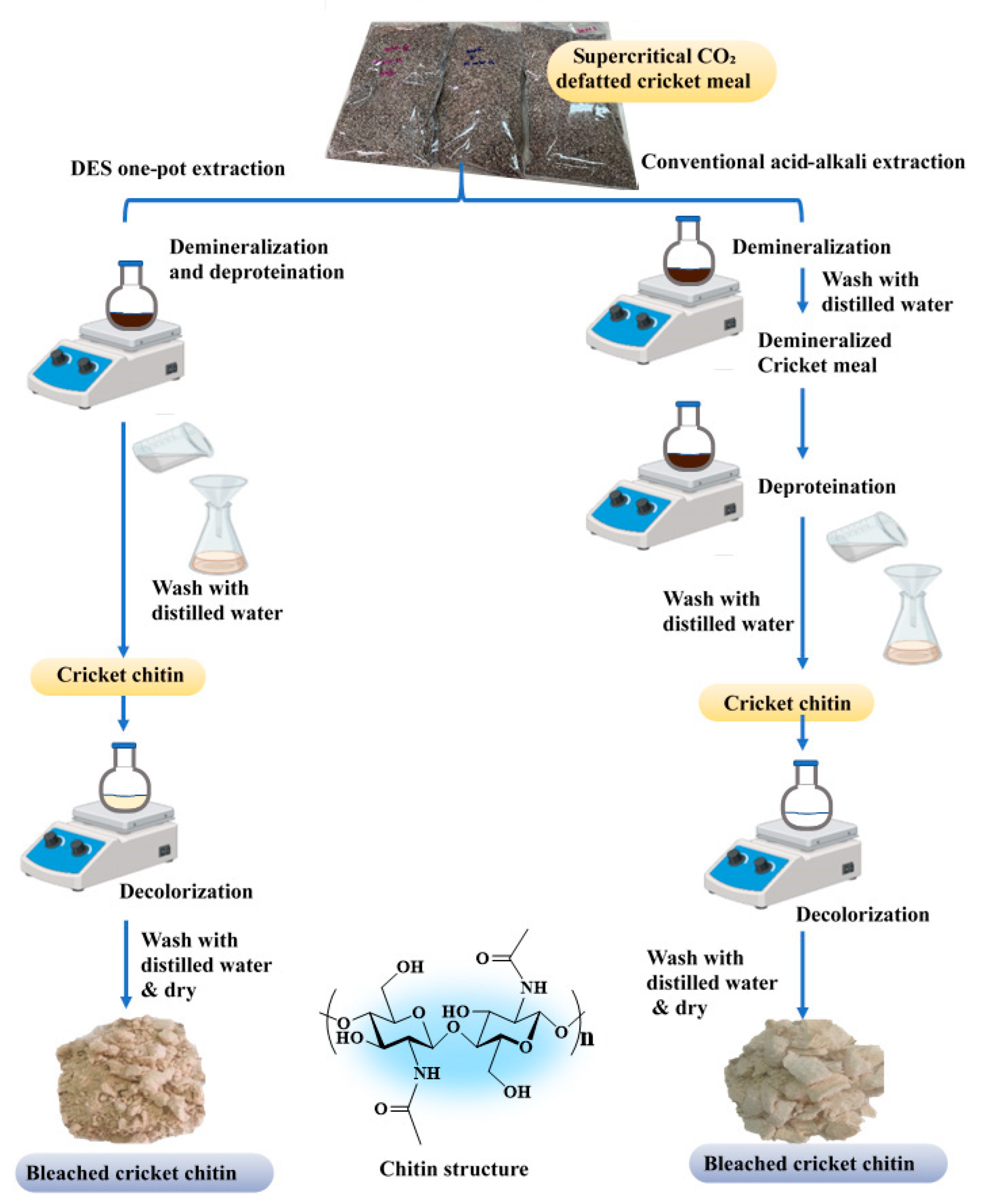
Figure 1. Schematic illustration depicting the production of cricket chitin from supercritical CO2 defatted cricket meal using a one-pot deep eutectic solvent approach and via conventional extraction.
Polysaccharides 06 00115 g001
Figure 2. Chitin flakes obtained from domestic cricket meal using deep eutectic solvents (KG and CCG DESs), recovered deep eutectic solvent (RKG and RCCG), conventional extraction (CE), alongside commercial crab shell chitin (CS chitin).
Polysaccharides 06 00115 g002
Figure 3. (a) Full-scan FTIR spectra and (b) enlarged Amide I band of chitin flakes obtained from domestic cricket meal using deep eutectic solvents (KG and CCG DESs), recovered deep eutectic solvent (RKG and RCCG), conventional extraction (CE), alongside commercial crab shell chitin (CS chitin).
Polysaccharides 06 00115 g003
Figure 4. X-ray diffraction pattern of chitin flakes obtained from domestic cricket meal using deep eutectic solvents (KG and CCG DESs), recovered deep eutectic solvent (RKG and RCCG), conventional extraction (CE), alongside commercial crab shell chitin (CS chitin). CrI depicts the crystallinity index.
Polysaccharides 06 00115 g004
Figure 5. XPS survey scan of commercial crab shell chitin (CS chitin), and cricket chitin extracted via conventional method (DCE chitin), as well as potassium carbonate/glycerol DES (DKG chitin) and choline chloride/glycerol DES (DCCG chitin).
Polysaccharides 06 00115 g005
Figure 6. High-resolution C 1s, O 1s, and N 1s XPS deconvoluted spectra of commercial crab shell chitin (CS chitin), and cricket chitin extracted via conventional method (DCE chitin), as well as potassium carbonate/glycerol DES (DKG chitin) and choline chloride/glycerol DES (DCCG chitin).
Polysaccharides 06 00115 g006
Figure 7. Scanning electron microscopy images of cricket meal, crab shell (CS) chitin, and chitin obtained by conventional extraction (DCE chitin), by potassium carbonate/glycerol DES (DKG DES), and by choline chloride/glycerol DES (DCCG chitin).
Polysaccharides 06 00115 g007
Table 1. DESs used in this study and their respective composition.
DESHydrogen Bond AcceptorHydrogen Bond DonorMolar RatiopH
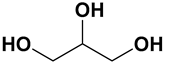
Potassium carbonate: glycerol (KG DES)Potassium carbonatePolysaccharides 06 00115 i001GlycerolPolysaccharides 06 00115 i0021:711
Choline chloride: glycerol
(CCG DES)
Choline chloridePolysaccharides 06 00115 i003GlycerolPolysaccharides 06 00115 i0041:25.5
Table 2. Chitin samples and their simplified, concise method of preparation.
Chitin AbbreviationDescription of Chitin SampleConcise Method of Preparation
CS chitinCrab shell chitin flakes obtained commercially from Sigma-Aldrich.Commercially obtained crab shell chitin flakes.
CE chitinCricket chitin obtained using conventional extraction (without decolorization).Cricket meal → Demineralization (1 M HCl) → Deproteinization (2 M NaOH) → CE chitin.
KG chitinCricket chitin obtained using potassium carbonate/glycerol deep eutectic solvent (without decolorization).Cricket meal → one-pot extraction with freshly prepared KG DES → KG chitin.
CCG chitinCricket chitin obtained using choline chloride: glycerol deep eutectic solvent (without decolorization).Cricket meal → one-pot extraction with freshly prepared CCG DES → CCG chitin.
RKG chitinCricket chitin obtained using recovered potassium carbonate/glycerol deep eutectic solvent (without decolorization).Cricket meal → one-pot extraction with recovered KG DES (i.e., RKG DES) → RKG chitin.
RCCG chitinCricket chitin obtained using recovered choline chloride/glycerol deep eutectic solvent (without decolorization).Cricket meal → one-pot extraction with recovered CCG DES (i.e., RCCG DES) → RCCG chitin.
DCE chitinDecolorized cricket chitin obtained using conventional extraction and decolorization.Cricket meal → Demineralization (1 M HCl) → Deproteinization (2 M NaOH) → CE chitin → Decolorization (aqueous NaOCl: 1% v/v) → DCE chitin
DKG chitinDecolorized cricket chitin obtained using potassium carbonate/glycerol deep eutectic solvent and decolorization.Cricket meal → one-pot extraction with freshly prepared KG DES → KG chitin → Decolorization (5% v/v H2O2) → DKG chitin
DCCG chitinDecolorized cricket chitin obtained using choline chloride/glycerol deep eutectic solvent with decolorization.Cricket meal → one-pot extraction with freshly prepared CCG DES → CCG chitin → Decolorization (5% v/v H2O2) → DCCG chitin.
Note: For the detailed method of preparation, please refer to the Section 2 (Materials and Methods) of the text.
Table 3. Chemical composition of extracted cricket chitin coarse flakes.
SampleYield (%)DA (%)Moisture (%)Ash (%)Protein (%)Purity (%)
CS chitin***79.42 ± 1.02 b4.56 ± 0.03 g1.87 ± 0.05 e2.64 ± 0.03 a89.93 ± 0.04 f
CE chitin8.74 ± 0.13 b77.22 ± 2.89 a4.04 ± 0.01 c0.41 ± 0.02 b3.29 ± 0.01 c92.26 ± 0.01 h
KG chitin9.94 ± 0.21 c77.97 ± 1.41 a3.75 ± 0.02 a1.41 ± 0.07 d5.54 ± 0.04 e89.3 ± 0.14 e
CCG chitin18.17 ± 0.50 d81.28 ± 2.13 b4.14 ± 0.01 d0.73 ± 0.07 c22.18 ± 0.52 h72.95 ± 0.20 b
RKG chitin10.33 ± 0.32 c78.27 ± 1.07 ab4.27 ± 0.05 e1.39 ± 0.01 d5.72 ± 0.06 f88.62 ± 0.03 d
RCCG chitin22.94 ± 0.42 e84.27 ± 1.21 c5.82 ± 0.03 h0.80 ± 0.02 c22.49 ± 0.83 h70.89 ± 0.30 a
DCE chitin6.54 ± 0.16 a77.08 ± 0.98 a3.89 ± 0.01 b0.09 ± 0.01 a2.86 ± 0.03 b93.16 ± 0.02 i
DKG chitin8.65 ± 0.21 b77.71 ± 1.61 a4.45 ± 0.02 f0.62 ± 0.03 c4.37 ± 0.05 d90.56 ± 0.03 g
DCCG chitin17.00 ± 0.53 d81.48 ± 0.77 b5.78 ± 0.03 h0.39 ± 0.07 b20.62 ± 1.38 g73.21 ± 0.50 c
Different superscript letters within the same column represent mean values that are significantly different (p < 0.05). *** CS chitin was commercially purchased from crab shells. Percentage yield from crab shells was not determined, unlike chitin extracted from cricket meal using various methods.
Table 4. Color analysis of isolated cricket chitin alongside commercial crab shell chitin.
Samples Color Parameters
L*a*b*WIΔE
CS chitin74.31 ± 0.33 f2.66 ± 0.04 b23.93 ± 0.9 g64.78 ± 0.38 g
CE chitin51.32 ± 0.22 d3.34 ± 0.08 cd1.83 ± 0.09 a51.17 ± 0.22 d31.9 ± 0.72 d
KG chitin50.45 ± 0.14 c2.85 ± 0.02 bc1.54 ± 0.07 a50.34 ± 0.14 c32.72 ± 0.97 d
CCG chitin51.68 ± 0.14 d4.39 ± 0.23 e4.63 ± 0.42 d51.26 ± 0.20 d29.79 ± 0.67 c
RKG chitin46.07 ± 0.91 b3.08 ± 0.10 c3.58 ± 0.32 b45.87 ± 0.88 b34.81 ± 0.85 e
RCCG chitin43.41 ± 0.25 a3.69 ± 0.37 d4.03 ± 0.58 c43.14 ± 0.20 a36.77 ± 0.48 f
DCE chitin83.81 ± 0.05 f1.16 ± 0.09 a13.60 ± 0.12 e78.83 ± 0.03 h 14.13 ± 0.45 b
DKG chitin65.41 ± 0.51 e4.59 ± 0.38 e14.25 ± 0.23 e62.31 ± 0.60 f13.30 ± 1.00 b
DCCG chitin64.78 ± 0.50 e6.09 ± 0.19 f19.60 ± 0.29 f59.24 ± 0.39 e11.03 ± 0.15 a
Different superscript letters within the same column represent mean values that are significantly different (p < 0.05). WI represents Whiteness Index.
Table 5. Surface composition (%) of chitin flake derived from curve fitting of the deconvoluted XPS spectra.
C 1sN 1sO 1s
Binding Energy (eV)285.0286.5288.1289.5400.0401.1531.4532.5533.2534.5
Bonds/functional groupC-C; C=CC-OH; C-O; C-N; C-ClC=O;
N-C=O;
C-O-C
-COOH; O-C=OC-NH2;
N-C=O
-NH3+O=C;
O-Si
C-O-CO-C-OH; H2Oads
CS chitin21.4%48.8%25.6%4.2%83.9%16.1%18.5%24.3%52.8%4.4%
DCE chitin50.3%34.1%15.6%-100%-23.4%24.7%48.6%3.3%
DKG chitin55.1%31.4%13.5%-100%-19.6%32.1%44%4.4%
DCCG chitin65.1%16.5 + 8.5%7.1%2.7%100%-28.6%24.9%21.1%3.7%
Note: H2Oads represents adsorbed water.
Disclaimer/Publisher’s Note: The statements, opinions and data contained in all publications are solely those of the individual author(s) and contributor(s) and not of MDPI and/or the editor(s). MDPI and/or the editor(s) disclaim responsibility for any injury to people or property resulting from any ideas, methods, instructions or products referred to in the content.