Article

Is Crime Associated with Obesity and High Blood Pressure? Repeated Cross-Sectional Evidence from a Peruvian Study


by
Rosmery Ramos-Sandoval
1,*,
Janina Bazalar Palacios
2,
Milagros Leonardo Ramos
1,
Emily Baca Marroquín
2,
Arelly Fernanda Vega Peche
3 and
Nicolas Ismael Alayo Arias
3
1
Facultad de Administración y Negocios, Campus Lima Sur, Universidad Tecnológica del Perú, Lima 15412, Peru
2
Campus Lima Centro, Universidad Tecnológica del Perú, Lima 15046, Peru
3
Facultad de Ingeniería de Sistemas e Informática, Campus Chimbote, Universidad Tecnológica del Perú, Chimbote 02710, Peru
*
Author to whom correspondence should be addressed.
Obesities 2025, 5(4), 95; https://doi.org/10.3390/obesities5040095
Submission received: 21 October 2025 / Revised: 8 December 2025 / Accepted: 9 December 2025 / Published: 17 December 2025

Abstract

Violence is an emerging social determinant of health in Latin America; however, empirical evidence from Peru remains limited. This study examined the association between crime rates and the prevalence of obesity and high blood pressure in Peru from 2019 to 2023. Using a repeated cross-sectional design with department–year aggregates, we analyzed nationally representative data from the Demographic and Family Health Survey, adjusting for sociodemographic, mental health, and geographic factors. Regional statistics on crime were incorporated into the analysis. The findings revealed a significant association between higher levels of crime and increased prevalence of self-reported high blood pressure and obesity. The association with obesity was particularly pronounced in border regions such as Tumbes, Madre de Dios, and Callao, where criminal activity is more prevalent. The findings indicate that prolonged exposure to violence may negatively impact biological stress responses, limit physical activity, and encourage the emergence of detrimental behaviors, consequently increasing the cardiometabolic risk burden in affected populations.

1. Introduction

The high prevalence of crime and violence in Latin America and the Caribbean poses a substantial barrier to sustainable development and economic growth. According to the Global Study on Homicide 2023, the region’s homicide rate is nearly thrice the global average of 5.6–18 per 100,000 inhabitants [1]. Similarly, the Global Organized Crime Index [2] identified organized crime as the principal concern for Latin American countries, highlighting both widespread insecurity and the increasingly transnational nature of criminal organizations. Over the past decade, homicide trends have varied across subregions; however, criminal activity has increased markedly in South America and the Caribbean [3] and has experienced a subsequent increase, which has eventually spread to Peru [4,5]. Although crime levels and insecurity perceptions differ among countries, underlying structural and often less visible causes play a significant role, with broad implications for well-being and behavior. Addressing the wider economic, social, and health-related consequences of crime and violence is essential.
Concurrently, populations worldwide have undergone behavioral changes linked to epidemiological and nutritional transitions. These shifts—driven by socioeconomic growth, urbanization, globalization of technology, and food production—have adversely affected health outcomes [6]. In Latin America, overweight and obesity rates have tripled in recent decades. This trend has been attributed to rapid economic development, which has been accompanied by lifestyle changes with direct consequences for health [7]. Within this context, conditions inherent to Latin American countries—such as inequality and precarious employment and limited educational opportunities—emerge as key social determinants of health and major contributors to adverse health outcomes.
Recent studies have demonstrated an association between socioeconomic factors and an increased prevalence of cardiovascular diseases [8,9,10,11]. In Peru, the prevalence of chronic non-communicable diseases, particularly cardiovascular diseases, has risen significantly in recent years. The prevalence of metabolic syndrome in various locations in Peru ranges from 10% to 45%, with a higher prevalence observed among women, older adults, and those residing in urban areas and at low altitudes. Conversely, the prevalence of excess weight is 39.7% in young adults, 62.3% in adults, and 32.4% in older adults [12]. Although obesity and high blood pressure are showing slight downward trends, both remain interlinked through shared socioeconomic drivers. From 2014 to 2022, a significant decrease in the prevalence of hypertensive crisis was observed, from 1.7% in 2014 to 1.4% in 2022 (p < 0.001) [13,14]. Cavero et al. [15] further observed that Peruvian regions with high crime rates (citizen insecurity increased 8.7 PP between 2010 and 2019 (from 73.5 to 82.2%; p < 0.001)) often coincide with areas where access to healthy food, safe recreational spaces, and healthcare services is limited. Such environments may foster elevated rates of obesity and high blood pressure while contributing to criminal activity. Recognizing the role of socioeconomic factors is thus critical in understanding adverse cardiovascular outcomes in Peru.
The main goal of this research is to evaluate the association between crime rates and the prevalence of obesity and high blood pressure in Peru from 2019 to 2023. Thus, based on the evidence presented, we hypothesized that crime rates are significantly associated with the prevalence of high blood pressure and obesity after controlling for sociodemographic, mental health, and geographic variables across Peruvian regions between 2019 and 2023.

2. Background

2.1. Conceptual Connection Between Crime, Obesity, and High Blood Pressure

Crime’s impact on public health has been widely documented, and studies have shown a link between criminal activity and an increased risk of obesity and high blood pressure—conditions linked to reduced physical activity, chronic stress, and food insecurity in violence-ridden communities [11,16,17]. This study examines the intersection of crime and public health conditions, focusing on the underlying determinants and their relevance for designing effective health and safety policies.
Building on prior research, scholars have investigated the mechanisms through which neighborhood-level crime and perceptions of insecurity influence cardiometabolic outcomes. Previous research highlights how neighborhood conditions influence obesity and high blood pressure risk [11,18,19]. Neighborhood social and physical environments, specifically those affected by crime and insecurity, have a significant impact on obesity, high blood pressure, and metabolic syndrome. While Topel et al. [19] use neighborhood incarceration rates as indicators of adversity—emphasizing structural impacts of crime—Martinez et al. [18] focus on residents’ subjective perceptions of crime and drug use, highlighting the influence of lived experiences. These perspectives differ partly because of the populations studied. Topel et al. [19] examined adults and focused on racial disparities, disproportionately affecting Black individuals, whereas Martinez et al. [18] studied adolescents, allowing for temporal precedence. Nevertheless, Tebar et al. [11] observed that adults who reported experiencing a perceived barrier to physical activity were more likely to be obese than those who reported no such barrier. However, the results of these studies indicate that environments characterized as barriers to physical activity, such as crime or the risk of incarceration, have a considerable impact on cardiometabolic health.

2.2. Relation Between Crime and Obesity

Studies addressing the relation between crime and obesity employ diverse methodological and conceptual approaches, emphasizing both direct and indirect effects of violent contexts on health. Christie and Matthews [20] examined childhood poly-victimization, including exposure to community violence and its association with obesity by considering body mass index (BMI) and waist circumference (WC). Their findings showed a positive correlation between exposure to violence and increased BMI in adulthood, with women experiencing poly-victimization displaying significantly higher BMI.
Other research highlights reduced physical activity as a key pathway. In high-crime neighborhoods, residents often avoid public spaces such as parks and streets, limiting opportunities for exercise, and promoting sedentary behavior [21]. Crime also affects food access: High-crime areas tend to have fewer supermarkets and more convenience stores and fast-food outlets, encouraging unhealthy diets and weight gain [22]. Letarte et al. [23] confirmed that deprivation in violent neighborhoods negatively affects dietary habits and obesity risk, with variations by gender and socioeconomic status.
Yip et al. [24] found an indirect relationship between crime and obesity, showing that higher social cohesion is associated with lower crime rates, increased physical activity, and reduced obesity risk. Similarly, Martinez et al. [18] reported that adolescents in high-crime Chilean neighborhoods had higher BMI, fat mass, and a greater likelihood of meeting metabolic syndrome criteria. From a structural perspective, Topel et al. [19] linked neighborhood incarceration rates with dysregulation of the hypothalamic–pituitary–adrenal (HPA) axis and elevated cortisol, mechanisms contributing to obesity. Dangerfield et al. [25] also noted that the crime–obesity association appears in both urban and rural settings, where limited mobility and poor food access contribute to obesity despite different environments.
Taken together, these studies underscore community violence as a key social determinant of obesity. Whether through chronic stress, food insecurity, reduced physical activity, or perceptions of neighborhood disorder, crime shapes environments that adversely affect metabolic health, raising critical implications for integrated public health and safety policies.

2.3. Connection Between Crime and High Blood Pressure

The association between crime and high blood pressure has been increasingly studied through interdisciplinary perspectives that examine both direct and structural pathways. Rivara et al. [26] argue that chronic exposure to violence induces sustained stress responses that elevate blood pressure and increase cardiovascular risk. Tung et al. [27] reported that Chicago residents in high-crime neighborhoods had higher blood pressure rates, independent of socioeconomic status, suggesting that fear of crime itself may activate prolonged stress responses that disrupt hormonal regulation. Schiff et al. [28] found that neighborhood vulnerability and socioeconomic disadvantage in high-crime areas were associated with blood pressure changes, particularly among middle-aged women.
Martinez et al. [18] explored crime perceptions among Chilean adolescents and observed that although adjusted models did not show a statistically significant link with blood pressure ≥ 90th percentile, high-risk groups exposed to crime and drug activity had higher rates of elevated diastolic pressure. Adolescents who perceived less threat of crime were less likely to be hypertensive, underscoring the role of perceived safety. Topel et al. [19] added structural evidence, showing that residents—particularly Black individuals—of high-incarceration neighborhoods faced greater odds of developing high blood pressure. These findings suggest that vulnerable population groups exposed to criminality contexts are more likely to have chronic stress, inflammation, and HPA axis dysregulation, which are mechanisms tied to high blood pressure.
In summary, crime—whether experienced directly, perceived subjectively, or embedded in structural inequalities—significantly shapes high blood pressure risk through psychosocial stress and physiological dysregulation, particularly among vulnerable populations.

2.4. Connection Between Crime, Obesity, and High Blood Pressure

Emerging evidence highlights the interconnected effects of crime on both obesity and high blood pressure, revealing shared pathways through which unsafe environments undermine cardiometabolic health. Zimmerman and Posick [29] argued that violence functions as a chronic stressor, altering eating behaviors and discouraging physical activity, thereby increasing risk for both conditions. Martinez et al. [18] similarly reported that adolescents in high-crime neighborhoods exhibited higher BMI, greater fat mass, and more frequent metabolic syndrome, alongside elevated diastolic blood pressure.
Topel et al. [19] provided a structural view, linking neighborhood incarceration rates with increased odds of both high blood pressure and metabolic syndrome, with obesity (via waist circumference) serving as a defining component. They proposed that chronic stress and inflammatory responses caused by adverse environments, including crime, lead to HPA axis dysfunction and cortisol overproduction, driving both obesity and high blood pressure. Other studies [26,30] reinforce the role of persistent fear and insecurity in triggering physiological stress responses that increase cardiovascular risk.
Collectively, these findings demonstrate that crime is not only a public safety issue but also a determinant of physical health. Individual-level experiences and structural conditions converge to shape obesity and high blood pressure risks through behavioral, psychological, and physiological mechanisms. Public health strategies should therefore integrate crime prevention, community safety initiatives, and urban development policies that improve neighborhood environments. Efforts to reduce structural inequalities, enhance access to healthy food, and create safe spaces for exercise may help mitigate the dual burden of obesity and high blood pressure—particularly in low-income and marginalized communities. Exploring the intersections between crime, stress physiology, and chronic disease through longitudinal and intersectional research can inform more equitable and sustainable health policies.

3. Materials and Methods

3.1. Study Design

This study is a secondary analysis of data from Peru’s 2019–2023 Demographic and Family Health Survey (ENDES, in its Spanish acronym) [31,32,33,34,35], which is an annual, nationally representative survey conducted by the National Institute of Statistics and Informatics (INEI, in its Spanish acronym) using a stratified, cluster sampling design. It comprises three components—a household questionnaire, an individual questionnaire administered to women of childbearing age, and a health questionnaire—which together provide comprehensive information on health indicators in the Peruvian population. The ENDES uses a two-stage probability sampling method, stratified by rural and urban areas across Peru’s 25 regions, ensuring nationally representative estimates (Figure S1). This study uses data from the health questionnaire, specifically variables related to high blood pressure and obesity. Furthermore, to reconstruct the population structure of persons aged 15 and over and adjust for non-response, we employ the ENDES’s weighting factor for persons aged 15 and over, which can be found in module CSALUD01 of each year’s database.

3.2. Population

The initial dataset included 187,872 participants recruited between 2019 and 2023. After excluding participants with incomplete information (47,041) and those meeting other exclusion criteria: (a) >20% missing data, (b) respondents ages < 18 years, (c) Invalid coordinates, respondents do not reside in Peru; data from 140,794 participants were analyzed (Figure 1). For cross-referencing crime data, integration was conducted on a department-by-year basis. The variable diagnosis of high blood pressure, recorded as “don’t know/don’t remember,” was imputed according to regional distribution using a Multiple Imputation by Chained Equations method based on regional probabilities. The predictors employed were (1) age; (2) sex; (3) BMI; (4) Region; (5) year; (6) location of residence; and (7) PHQ-9. Furthermore, to calculate BMI, the variables height (385 missing cases) and weight (388 missing cases) were imputed using a multiple linear regression model (R2 model weight = 0.162, R2 model height = 0.503, R2 average = 0.333; F statistic = 970.9, N = 140,423, AIC = 1,107,000). The following sensitivity parameters were obtained for the imputation model: (1) Average difference = 0.03%; (2) Standard deviation = 0.07%; (3) Range = −0.07–0.31%.

3.3. Measures

3.3.1. Crime Incidence

The neighborhood variable of theoretical interest was the crime rate, measured as the number of reported crime index per 100,000 population. Typologies of Crime were defined in accordance with the Peruvian Penal Code (Legislative Decree No. 635, 1991) and included crimes against property (e.g., theft and robbery); liberty (e.g., housebreaking); public security (e.g., drug trafficking); tranquility (e.g., terrorism); and life, body, and health (e.g., homicide). Data corresponded to crimes reported to the Public Prosecutor’s Office between 2019 and 2023, published by its Office of Rationalisation and Statistics and made available through the Peruvian National Open Data Platform [36].

3.3.2. High Blood Pressure and Obesity

The two dependent variables were the prevalence of high blood pressure and obesity among adults (aged ≥18 yr), obtained from the Peruvian Demographic and Health Survey (ENDES in its Spanish acronym). Moreover, the frequency of these diseases is indicated by the prevalence rate measure, as determined by cross-sectional studies [37]. Therefore, this measure gives us the probability of an individual in the ENDES population being affected by high blood pressure or obesity between 2019 and 2023.

3.3.3. Covariates

Analyses were adjusted for demographic characteristics, mental health status, and time. Demographic variables included sex, age, region, and area of residence. Mental health was assessed using several indicators, with the Patient Health Questionnaire-9 being the primary tool to evaluate depressive symptoms over the previous two weeks [38].

3.4. Statistical Analysis

Descriptive statistics were calculated for both the ENDES survey data and crime incidence data reported to the Public Prosecutor’s Office. The study adopted a repeated cross-sections (RCS) approach, as described by Brady and Johnston [39], to compare annual changes in health outcomes and crime incidence from 2019 to 2023.
We used ordinary least squares (OLS) regression to estimate associations between independent variables, covariates, and outcome variables The OLS model will be estimated on the independent cross-sectional data, since the ENDES Survey on different individuals over time.
Separate OLS models were run for high blood pressure and obesity prevalence. Both models were adjusted for the same covariates and crime incidence rates. OLS regression was selected given its robustness in handling noisy real-world data [40].

3.5. Ethical Considerations

This study used open data, defined as data freely available for use, reuse, and distribution provided that authorship is acknowledged [41]. The dataset was obtained from the Peruvian National Open Data Platform (Supreme Decree No. 157-2021-PCM, 2021), which ensures privacy, dissociation, or anonymization of information as required.

4. Results

4.1. Cross-Sectional Descriptive Statistics

In RCS designs, analyses of change can only be performed at the aggregate level across different samples or subsamples [42]. In this preliminary phase, RCS data from 2019 to 2023 (N = 140,831) were examined.
The ENDES respondents diagnosed with high blood pressure or obesity were predominantly female, regardless of the specific diagnosis (Table 1). The mean age of participants diagnosed with high blood pressure was >55 yr (55.72–58.03), whereas those diagnosed with obesity were younger, with a mean age of approximately 42 years (40.69–42.75).
With respect to high blood pressure classification, individuals diagnosed with high blood pressure remained, on average, at stage 1 throughout the study period. In contrast, respondents with obesity presented elevated blood pressure levels, although these did not reach the threshold for high blood pressure. Regarding obesity classification, hypertensive individuals typically demonstrated an average BMI within the overweight range, whereas obese individuals were classified as obesity level 1.
For mental health, respondents across both groups (high blood pressure and obesity) reported minimal average depressive symptoms (M = 2.09). In terms of residence, most individuals diagnosed with either condition lived in urban areas during the study years.

4.2. Region-Level High Blood Pressure, Obesity Prevalence, and Crime Rates (2019–2023)

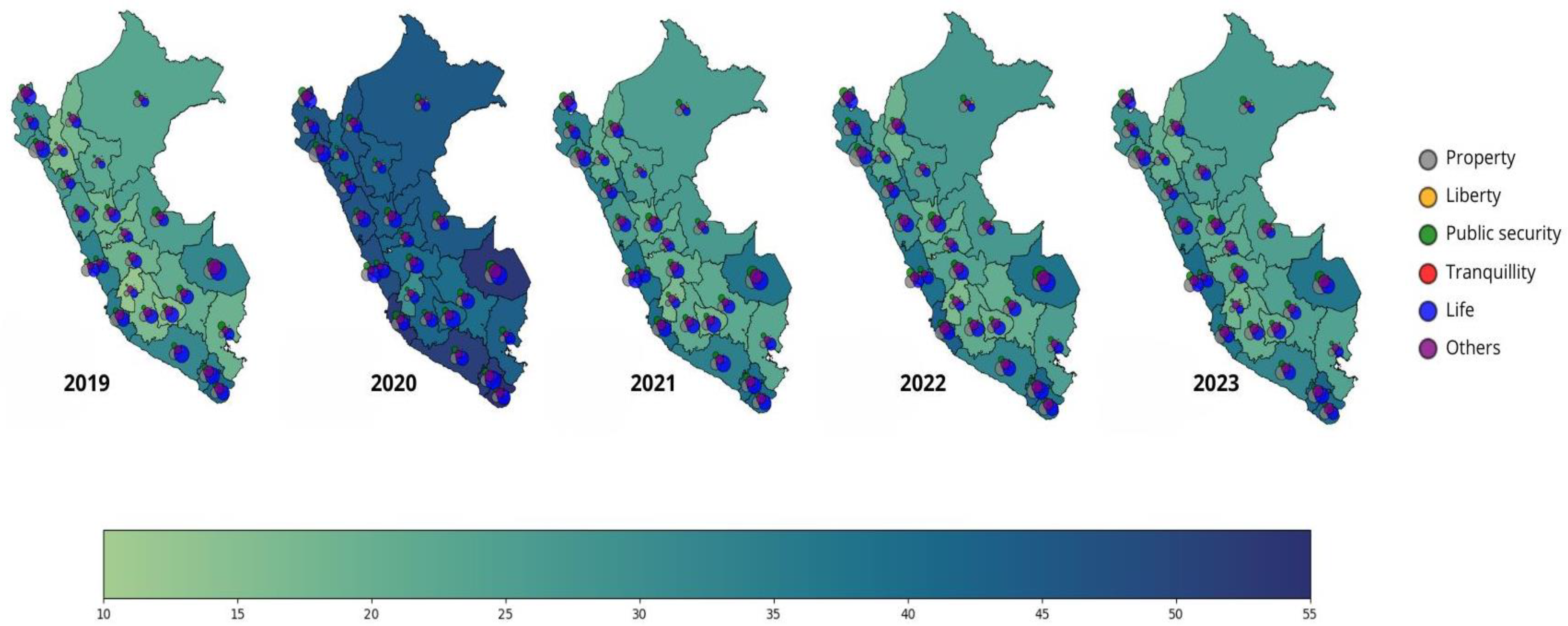
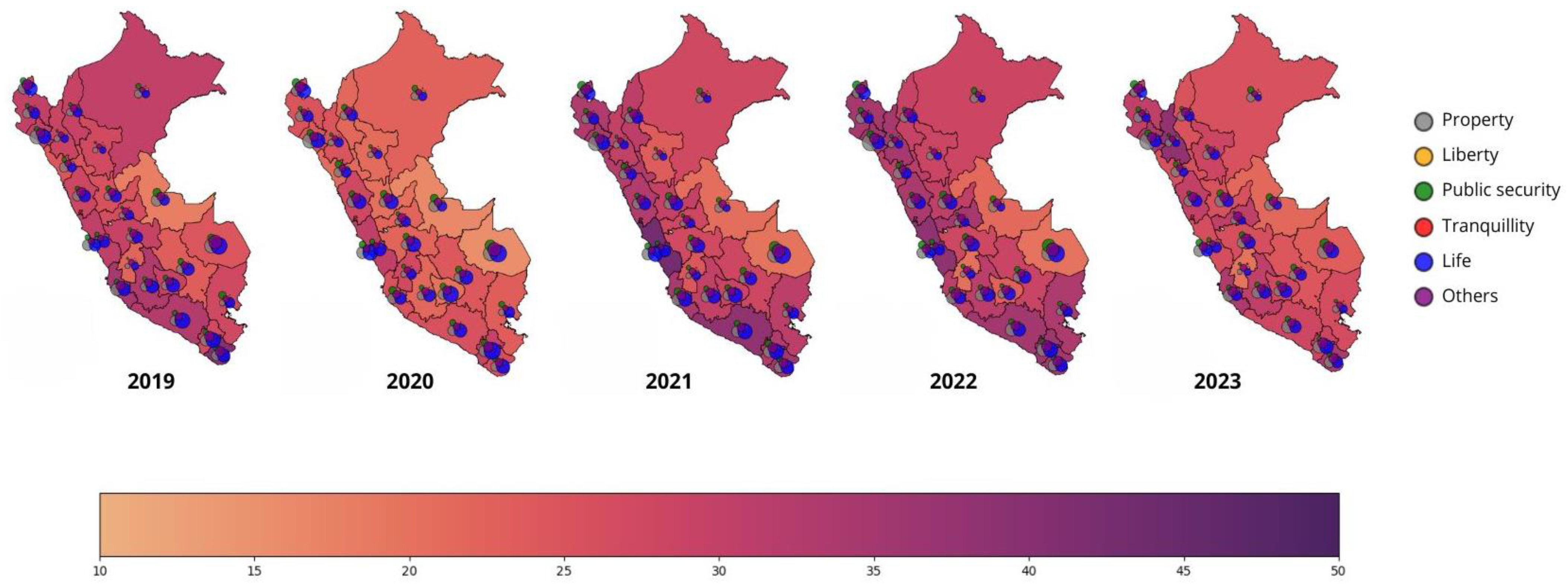
The territorial variables employed in this study were derived from a crime incidence dataset, and the prevalence rates of high blood pressure and obesity were obtained from the ENDES survey. Maps illustrate the regional distribution of crime in relation to the prevalence of high blood pressure and obesity across 24 Peruvian regions between 2019 and 2023. Darker horizontal bar tracts indicate regions with the highest prevalence of high blood pressure and obesity (per 100,000 individuals). Crime incidence was displayed using a bubble plot, with different colors representing crime categories (property = gray; liberty = yellow; public security = green; tranquility = red; life, body, and health offenses = blue; others = purple).
Regarding crime incidence, crimes—including life, body, and health offenses (e.g., homicide)—were the most frequently reported during the study period, followed by crimes against property (e.g., robbery) across the 24 regions (Figure 2 and Figure 3). Regions with the highest incidence of crimes against life, body, and health were primarily concentrated in border areas (Tumbes, Tacna, Madre de Dios) and in cities along the northern coast (Lambayeque), central regions (Callao and Ica), and southern areas (Arequipa and Moquegua). Additionally, central highland regions (Apurímac, Ayacucho, Junín, and Cusco) also reported considerable prevalence of such crimes. Crimes against property were most prevalent in Lambayeque and Madre de Dios during the study period.
As shown in Figure 2, high blood pressure prevalence (10–50%) was concentrated in coastal regions throughout the study period, particularly in the central-south region of Peru. Notable examples include Tacna (2019), Callao (2020, 2022), and Lima (2021). An exception was Cajamarca (2023), located in the north-central region.
As shown in Figure 3, obesity prevalence (10–55%) was also spatially correlated with crime. The central-south region of Peru emerged as a key area, with Callao, Ica, Moquegua, and Tacna consistently exhibiting high obesity prevalence between 2019 and 2023.

4.3. Correlation Analyses

Table 2 summarizes the results of the correlation models for each year of observation, based on the repeated cross-sectional design. The study assessed associations between the dependent variables (prevalence of high blood pressure and obesity), the independent variable (crime rates), and covariates (geographic location, age, sex, mental health, and BMI).
High blood pressure prevalence from 2019 to 2023 was assessed, and crimes against public security showed a consistent indirect correlation with high blood pressure across all years. In contrast, the prevalence of high blood pressure demonstrated increasing associations with property-related and tranquility-related crime rates over the study period.
In contrast, data on obesity prevalence from 2019 to 2023 demonstrated a consistent correlation with BMI level as well as an increased correlation with geographic location. Additionally, significant associations were identified between obesity prevalence and the different types of crimes analyzed. This relationship was particularly evident for property crimes, public safety violations, and life safety offenses, although these associations showed a declining trend over time.

4.4. Regression Coefficients

Table 3 presents the regression coefficients obtained from the OLS models. The objective was to assess the contribution of covariates and independent variables in estimating the prevalence of high blood pressure by conducting regression analysis. Prior to regression analysis, diagnostic tests for multicollinearity were conducted. The variance inflation factor (VIF) was calculated for 41 variables, with all variables standardized by mean and standard deviation. After excluding two variables (crime rate = other variables, liberty; covariate = year, location of residence), VIF values were <5, indicating minimal multicollinearity. Thus, the final analyses were conducted using 37 variables.
The regression models explained 58.0% of the variance in high blood pressure prevalence (adjusted R2 = 0.580) and 75.8% in obesity prevalence (adjusted R2 = 0.758). These results suggest that violent crime rates and covariates adequately account for variability in the dependent variables.
The findings indicate a statistically significant positive correlation between violent crime rates and high blood pressure prevalence. Property crimes, however, exhibited a negative association (β = −0.004; S.E. = 6.89; p < 0.001), whereas tranquility-related crimes showed a weak positive association (β = 0.005; S.E. = 0.002; p < 0.05). Conversely, all violent crime categories demonstrated negative associations with obesity prevalence (e.g., tranquility: β = −0.051; S.E. = 0.003; p < 0.001). These findings are consistent with earlier correlation analyses, suggesting that crime rates may be predictors of cardiovascular disease prevalence in Peru.
Regarding covariates, individual characteristics were significantly associated with both dependent variables, with the exception of sex in the high blood pressure model (β = −0.001; S.E. = 0.024; p = 0.972). Notably, the majority of respondents were female. Mental health covariates showed no significant associations with either dependent variable, except for the minimal depression category in the obesity model (β = −0.105; S.E. = 0.048; p < 0.05), which demonstrated a negative relationship.
For geographic covariates, area of residence was not a significant predictor of high blood pressure or obesity. However, regional associations were significant in most cases, regardless of direction. For example, high blood pressure in Madre de Dios showed a strong negative association (β = −15.084; S.E. = 0.143; p < 0.001), whereas obesity prevalence in Arequipa demonstrated a strong positive association (β = 26.825; S.E. = 0.128; p < 0.001). By contrast, Arequipa did not show significance in the high blood pressure model (β = −0.070; S.E. = 0.095; p = 0.460). These findings align with earlier analyses, where obesity appeared more strongly associated with geographic location than high blood pressure, in addition to variations in violent crime rates across specific cities (Figure 2 and Figure 3).

5. Discussion

To the best of our knowledge, this is the first study in Peru to evaluate whether violent crime rates are associated with the prevalence of high blood pressure and obesity, after adjusting for sociodemographic, mental health, and geographic variables between 2019 and 2023. Using data from the ENDES survey, a nationally representative database of the Peruvian population, we identified significant associations between violent crime and both conditions. Notably, obesity demonstrated a stronger association with region of residence than high blood pressure. During the study period, the most frequently reported violent crimes were against life, body, and health, particularly in border regions.
Our findings align with growing international evidence suggesting that chronic exposure to violence influences biological stress responses and health behaviors, thereby contributing to cardiovascular [43] and metabolic disorders [20,44]. Prolonged stress in unsafe environments can elevate cortisol levels and foster maladaptive coping behaviors such as poor diet and physical inactivity, which increase the risk of obesity and high blood pressure [45]. Similar patterns have been reported in U.S. studies, where residents of high-crime neighborhoods showed increased risks of high blood pressure and metabolic syndrome [19]. In Chile, associations between crime and health outcomes were also observed but were based on individuals’ perceptions of neighborhood danger rather than official statistics [18]. Such findings suggest that both objective and perceived measures of violence may drive chronic stress, with subsequent impacts on blood pressure and body weight. These results underscore the need to integrate public health and safety interventions to reduce stress-related health risks, particularly in urban settings where crime is most prevalent.
We also discovered a high concentration of violent crimes in Peru’s border regions, particularly in the north and south. This pattern is consistent with prior research linking border areas to higher crime due to cross-border trafficking, weak enforcement, and sociopolitical instability [24,46]. In Brazil, mortality rates in border regions remain higher than those observed in non-border areas, despite a 15.7% reduction in risk between 2002 and 2012 [47]. A similar pattern has been documented in Mexico [48] and other Latin American countries [49]. In such contexts, insecurity undermines social cohesion and trust, which are protective for health [24,50,51]. Residents of high-crime neighborhoods may avoid outdoor activity due to fear, reducing physical activity and reinforcing sedentary lifestyles. They may also face limited access to healthy food and healthcare services due to neighborhood disinvestment. In Peru, these dynamics are particularly evident in Callao, Madre de Dios, and Tumbes, where high levels of illicit activity and weak infrastructure may exacerbate health risks [4]. These findings emphasize the value of integrated approaches that simultaneously improve public safety and reduce health vulnerabilities.
An important finding was that obesity showed stronger regional variation than high blood pressure. This may reflect obesity’s greater sensitivity to environmental and cultural factors such as food systems, urban design, and socioeconomic inequalities. Evidence from Latin America indicates that disparities in access to nutritious foods, green spaces, and recreational facilities strongly influence obesity prevalence [9]. For example, a study in Rhode Island reported lower obesity rates in areas with better access to green spaces [52], illustrating how environmental features can protect against obesity, even outside the Latin American context. By contrast, high blood pressure is more strongly linked to biological aging and genetic predisposition, which vary less across regions. Studies have demonstrated that biological aging, including phenotypic age acceleration, is closely associated with increased mortality in hypertensive individuals [53,54]. These findings point to the need for targeted, region-specific interventions to address structural and environmental determinants of obesity in Peru.

5.1. Implications for Public Policy

The observed associations between violent crime, high blood pressure, and obesity carry important implications for public policy. Traditional health strategies that focus on individual behavior change—such as promoting physical activity or healthier diets—are unlikely to be sufficient when structural determinants, including community safety and environmental conditions, constrain individuals’ ability to adopt healthier behaviors. Addressing these challenges requires multisectoral interventions that integrate crime prevention, urban planning, nutritional support, and mental health services. Place-based modifications—such as improved lighting, green corridors, and safe public spaces—may further mitigate stress-related biological responses and support healthier lifestyles. Strengthening coordination among health, security, and social development sectors is therefore critical to reduce the burden of noncommunicable diseases shaped by structural violence and persistent regional inequalities.

5.2. Limitations and Future Research

This study has several limitations. First, its cross-sectional design precludes causal inference between exposure to violent crime and the prevalence of obesity or high blood pressure. Second, crime rate statistics were analyzed at the regional rather than neighborhood level, which may obscure local variations where the health impacts of insecurity are more pronounced. Future studies should incorporate geospatially detailed crime data to better capture community-level exposures.
Third, the study relied on officially reported crime data, which may underestimate actual crime due to underreporting, institutional weaknesses, and regional differences in reporting practices. We were also unable to assess perceived neighborhood safety, which has been shown in Latin American studies to strongly influence stress and health behaviors. Future research should combine objective crime data with subjective perceptions of safety for a more comprehensive assessment.
Finally, although we adjusted for key sociodemographic and mental health variables, residual confounding from unmeasured structural determinants—such as poverty, housing conditions, food environments, and access to healthcare—cannot be excluded. This may help explain why obesity was more strongly associated with region of residence than with high blood pressure. Future research should consider applying alternative modeling strategies better suited to bounded or clustered ecological data—such as beta regression, fractional logit models, hierarchical (multilevel) generalized linear models, or dynamic panel methods—to examine whether results remain robust under different functional forms and error structures.

6. Conclusions

This study provides novel evidence of a significant association between violent crime rates and the prevalence of high blood pressure and obesity in Peru after adjusting for sociodemographic, mental health, and geographic factors. The relationship was particularly strong for obesity, which showed greater regional variation and appeared more sensitive to environmental stressors.
Our findings highlight the importance of adopting broad, multisectoral strategies in public health policy. Addressing social determinants such as community safety, infrastructure, and social vulnerability is critical for reducing the burden of cardiovascular and metabolic diseases in Peru. By integrating public safety with health interventions, policymakers can more effectively target the structural drivers of poor health in high-crime communities.

Supplementary Materials

The following supporting information can be downloaded at https://www.mdpi.com/article/10.3390/obesities5040095/s1, Figure S1: Political-Administrative Regions of Perú.

Author Contributions

Conceptualization, R.R.-S. and J.B.P.; methodology, R.R.-S.; software, R.R.-S.; validation, R.R.-S. and J.B.P.; formal analysis, R.R.-S. and J.B.P.; investigation, M.L.R., E.B.M., A.F.V.P. and N.I.A.A.; data curation, R.R.-S., A.F.V.P. and N.I.A.A.; writing—original draft preparation, R.R.-S., J.B.P., M.L.R. and E.B.M.; visualization, R.R.-S. and A.F.V.P.; project administration, R.R.-S.; funding acquisition, R.R.-S.; writing—review and editing, R.R.-S., J.B.P., M.L.R., E.B.M. and A.F.V.P. All authors have read and agreed to the published version of the manuscript.

Funding

This research received funding from the 2024 R&D Research Project Competition—Lima Region at Universidad Tecnológica del Perú, grant number P-2024-LIM-07. The APC was funded by the Universidad Tecnológica del Perú.

Institutional Review Board Statement

The present study utilized open data. The utilization of publicly obtainable data is exempt from the requirement for Institutional Review Board approval, given that the data does not encompass any private, identifiable information.

Informed Consent Statement

Not applicable.

Data Availability Statement

Anonymized data collected and utilized in this project can be accessed as open data via Plataforma Nacional de Datos Abiertos, available online: https://www.datosabiertos.gob.pe/ (accessed on 1 September 2024).

Conflicts of Interest

The authors declare that they have no known competing financial interest or personal relationships that could have appeared to influence the work reported in this paper.

Abbreviations

The following abbreviations are used in this manuscript:
BMIBody Mass Index
WCWaist Circumference
HPAHypothalamic–Pituitary–Adrenal
ENDESDemographic and Family Health Survey
INEINational Institute of Statistics and Informatics
RCSRepeated Cross-Sections
OLSOrdinary least squares

References

  1. United Nations Office on Drugs and Crime (UNODC). Global Study on Homicide 2023; United Nations: Vienna, Austria, 2023. [Google Scholar]
  2. Global Initiative Against Transnational Organized Crime (GI-TOC). Global Organized Crime Index 2023; GI-TOC: Geneva, Switzerland, 2023. [Google Scholar]
  3. Bisca, P.M.; Chau, V.; Dudine, P.; Espinoza, R.A.; Fournier, J.-M.; Guérin, P.; Hansen, N.-J.; Salas, J. Violent Crime and Insecurity in Latin America and the Caribbean; International Monetary Fund: Washington, DC, USA, 2024. [Google Scholar] [CrossRef]
  4. Bernet Kempers, E. Between informality and organized crime: Criminalization of small-scale mining in the Peruvian rainforest. In Illegal Mining; Zabyelina, Y., van Uhm, D., Eds.; Palgrave Macmillan: Cham, Switzerland, 2020. [Google Scholar] [CrossRef]
  5. Inquilla, J.; López, M.; Catacora, E.; Flores, E. La morfología de la criminalidad urbana en el Perú: Un análisis de tendencias, niveles y factores de riesgo. Andamios 2024, 21, 411–435. [Google Scholar] [CrossRef]
  6. World Health Organization. Noncommunicable Diseases. Available online: https://www.who.int/news-room/fact-sheets/detail/noncommunicable-diseases (accessed on 15 September 2024).
  7. FAO; IFAD; PAHO; UNICEF; WFP. Latin America and the Caribbean–Regional Overview of Food Security and Nutrition 2023: Statistics and Trends; FAO: Santiago, Chile, 2023. [Google Scholar]
  8. Bazoukis, G.; Loscalzo, J.; Hall, J.L.; Bollepalli, S.C.; Singh, J.P.; Armoundas, A.A. Impact of social determinants of health on cardiovascular disease. J. Am. Heart Assoc. 2025, 14, e039031. [Google Scholar] [CrossRef]
  9. Gutierrez, L.E.; Elorriaga, N.; Gibbons, L.; Melendi, S.; Chaparro, M.; Calandrelli, M.; Lanas, F.; Mores, N.; Ponzo, J.; Poggio, R.; et al. Attributes of the food and physical activity built environments from the Southern Cone of Latin America. Sci. Data 2021, 8, 291. [Google Scholar] [CrossRef] [PubMed]
  10. Metkus, T.S. New dimensions assessing poverty and cardiovascular disease. JACC Adv. 2024, 3, 100931. [Google Scholar] [CrossRef]
  11. Tebar, W.R.; Gil, F.C.S.; Delfino, L.D.; Souza, J.M.; Mota, J.; Christofaro, D.G.D. Relationship of obesity with lifestyle and comorbidities in public school teachers—A cross-sectional study. Obesities 2022, 2, 52–63. [Google Scholar] [CrossRef]
  12. Villena Chávez, J.E. Prevalencia de sobrepeso y obesidad en el Perú. Rev. Peru. Ginecol. Obstet. 2017, 63, 593–598. [Google Scholar] [CrossRef]
  13. Calderon-Ocon, V.; Cueva-Peredo, F.; Bernabe-Ortiz, A. Prevalence, trends, and factors associated with hypertensive crisis among Peruvian adults. Cad. Saude Publica 2024, 40, e00155123. [Google Scholar] [CrossRef]
  14. Villarreal-Zegarra, D.; Carrillo-Larco, R.M.; Bernabe-Ortiz, A. Short-term trends in the prevalence, awareness, treatment, and control of arterial hypertension in Peru. J. Hum. Hypertens. 2021, 35, 462–471. [Google Scholar] [CrossRef] [PubMed]
  15. Cavero, V.; Hernández-Vásquez, A.; Miranda, J.J.; Alata, P.; Alegre, M.; Diez-Canseco, F. Satisfacción y percepciones sobre aspectos de la ciudad que afectan la salud en Lima Metropolitana, 2010–2019. Rev. Peru. Med. Exp. Salud Publica 2022, 39, 83–90. [Google Scholar] [CrossRef]
  16. Churchill, A.; Asante, S.A. Neighbourhood crime and obesity: Longitudinal evidence from Australia. Soc. Sci. Med. 2023, 337, 116289. [Google Scholar] [CrossRef]
  17. Stolzenberg, L.; D’Alessio, S.J.; Flexon, J.L. The impact of violent crime on obesity. Soc. Sci. 2019, 8, 329. [Google Scholar] [CrossRef]
  18. Martinez, S.M.; Blanco, E.; Delva, J.; Burrows, R.; Reyes, M.; Lozoff, B.; Gahagan, S. Perception of neighborhood crime and drugs increases cardiometabolic risk in Chilean adolescents. J. Adolesc. Health 2014, 54, 718–723. [Google Scholar] [CrossRef]
  19. Topel, M.L.; Kelli, H.M.; Lewis, T.T.; Dunbar, S.B.; Vaccarino, V.; Taylor, H.A.; Quyyumi, A.A. High neighborhood incarceration rate and cardiometabolic disease in nonincarcerated Black individuals. Ann. Epidemiol. 2018, 28, 489–492. [Google Scholar] [CrossRef]
  20. Christie, A.J.; Matthews, K.A. Childhood poly-victimization and body mass index in college women. Ann. Behav. Med. 2019, 53, 563–572. [Google Scholar] [CrossRef]
  21. Laurito, A.; Schwartz, A.E.; Elbel, B. Exposure to local violent crime and childhood obesity and fitness. Health Place 2022, 78, 102937. [Google Scholar] [CrossRef]
  22. Singleton, C.R.; Winata, F.; Adams, A.M.; McLafferty, S.L.; Sheehan, K.M.; Zenk, S.N. County-level associations between food retailer availability and violent crime rate. BMC Public Health 2022, 22, 14415. [Google Scholar] [CrossRef]
  23. Letarte, L.; Samadoulougou, S.; McKay, R.; Quesnel-Vallée, A.; Waygood, E.O.D.; Lebel, A. Neighborhood deprivation and obesity: Sex-specific effects. Soc. Sci. Med. 2022, 306, 115049. [Google Scholar] [CrossRef] [PubMed]
  24. Yip, C.; Sarma, S.; Wilk, P. Association between social cohesion and physical activity in Canada: A multilevel analysis. SSM–Popul. Health 2016, 2, 718–723. [Google Scholar] [CrossRef] [PubMed]
  25. Dangerfield, F.; Ball, K.; Dickson-Swift, V.; Thornton, L.E. Understanding regional food environments. Health Place 2021, 71, 102652. [Google Scholar] [CrossRef] [PubMed]
  26. Rivara, F.; Adhia, A.; Lyons, V.; Massey, A.; Mills, B.; Morgan, E.; Simckes, M.; Rowhani-Rahbar, A. The effects of violence on health. Health Aff. 2019, 38, 1622–1629. [Google Scholar] [CrossRef]
  27. Tung, E.L.; Wroblewski, K.E.; Boyd, K.; Makelarski, J.A.; Peek, M.E.; Lindau, S.T. Police-recorded crime and disparities in obesity and blood pressure. J. Am. Heart Assoc. 2018, 7, e008030. [Google Scholar] [CrossRef]
  28. Schiff, M.D.; Mair, C.F.; Barinas-Mitchell, E.; Brooks, M.M.; Méndez, D.D.; Naimi, A.I.; Reeves, A.; Hedderson, M.; Janssen, I.; Fabio, A. Neighborhood socioeconomic vulnerability and midlife blood pressure. Health Place 2023, 82, 103033. [Google Scholar] [CrossRef]
  29. Zimmerman, G.M.; Posick, C. Risk factors for direct vs. indirect exposure to violence. Am. J. Public Health 2016, 106, 178–188. [Google Scholar] [CrossRef]
  30. Dustmann, C.; Fasani, F. The effect of local area crime on mental health. J. Econ. Behav. Organ. 2013, 85, 136–151. [Google Scholar] [CrossRef]
  31. Instituto Nacional de Estadística e Informática (INEI). Perú–Encuesta Demográfica y de Salud 2019; INEI: Lima, Peru, 2020. Available online: https://proyectos.inei.gob.pe/microdatos/ (accessed on 15 September 2024).
  32. Instituto Nacional de Estadística e Informática (INEI). Perú–Encuesta Demográfica y de Salud 2020; INEI: Lima, Peru, 2021. Available online: https://proyectos.inei.gob.pe/microdatos/ (accessed on 15 September 2024).
  33. Instituto Nacional de Estadística e Informática (INEI). Perú–Encuesta Demográfica y de Salud 2021; INEI: Lima, Peru, 2022. Available online: https://proyectos.inei.gob.pe/microdatos/ (accessed on 15 September 2024).
  34. Instituto Nacional de Estadística e Informática (INEI). Perú–Encuesta Demográfica y de Salud 2022; INEI: Lima, Peru, 2023. Available online: https://proyectos.inei.gob.pe/microdatos/ (accessed on 15 September 2024).
  35. Instituto Nacional de Estadística e Informática (INEI). Perú–Encuesta Demográfica y de Salud 2023; INEI: Lima, Peru, 2024. Available online: https://proyectos.inei.gob.pe/microdatos/ (accessed on 15 September 2024).
  36. Peruvian National Open Data Platform. Cantidad de Delitos Denunciados en el Ministerio Público a Nivel Nacional 2019–2023. Available online: https://www.datosabiertos.gob.pe (accessed on 15 September 2024).
  37. Ferrer, M.; del Prado González, N. Medidas de frecuencia y de asociación en epidemiología clínica. An. Pediatr. Contin. 2013, 11, 346–349. [Google Scholar]
  38. Spitzer, R.L.; Kroenke, K.; Williams, J.B. Validation and utility of a self-report version of PRIME-MD (PHQ). JAMA 1999, 282, 1737–1744. [Google Scholar] [CrossRef]
  39. Brady, H.E.; Johnston, R. Repeated cross-sections in survey data. In Emerging Trends in the Social and Behavioral Sciences; Wiley: New York, NY, USA, 2015. [Google Scholar] [CrossRef]
  40. Igual, L.; Seguí, S. Introduction to Data Science: A Python Approach to Concepts, Techniques and Applications; Springer International Publishing: Cham, Switzerland, 2024. [Google Scholar]
  41. Aleixandre-Benavent, R.; Sapena, A.F.; Peset, F. Compartir recursos útiles para la investigación: Datos abiertos. Educ. Med. 2019, 22, 208–215. [Google Scholar] [CrossRef]
  42. Arnau, J.; Bono, R. Estudios longitudinales: Modelos de diseño y análisis. Escr. Psicol. 2008, 2, 32–41. [Google Scholar] [CrossRef]
  43. Sharma, N.; Khatib, M.N.; Balaraman, A.K.; Kaur, M.; Srivastava, M.; Barwal, A.; Prasad, G.V.S.; Rajput, P.; Syed, R.; Sharma, G.; et al. Association of exposure to violence and risk of hypertension. Public Health 2025, 243, 105722. [Google Scholar] [CrossRef] [PubMed]
  44. Hamm, A.; Karayeva, E.; Oliveira, M.L.; Kahouadji, N.; Grippo, P.; Wolf, P.G.; Mutlu, E.; Tussing-Humphreys, L.; Kim, S.J. Neighborhood homicide rate and colorectal adenoma. JNCI Cancer Spectr. 2024, 8, pkae110. [Google Scholar] [CrossRef]
  45. Aiyer, S.M.; Heinze, J.E.; Miller, A.L.; Stoddard, S.A.; Zimmerman, M.A. Exposure to violence and cortisol response. J. Youth Adolesc. 2014, 43, 1066–1079. [Google Scholar] [CrossRef]
  46. Carrión-Mena, F.; Gottsbacher, M. Border violence in Latin America: An expression of complementary asymmetries. In The Oxford Handbook of the Sociology of Latin America; Bada, X., Rivera-Sánchez, L., Eds.; Oxford University Press: Oxford, UK, 2021. [Google Scholar] [CrossRef]
  47. Nogueira, V.D.; Xavier-Gomes, L.M.; Barbosa, T.L.D.A. Mortalidade por homicídios em linha de fronteira no Paraná, Brasil. Ciência Saúde Coletiva 2020, 25, 3107–3118. [Google Scholar] [CrossRef]
  48. Widner, B.; Reyes-Loya, M.L.; Enomoto, C.E. Crimes and violence in Mexico: Evidence from panel data. Soc. Sci. J. 2011, 48, 604–611. [Google Scholar] [CrossRef]
  49. Vo, L.U.T.; Anderson, C.; Thomas, S.; Vernia, H.; Howe, J.K.; Tyroch, A.H.; Fitzgerald, T.N. Penetrating trauma in children on the United States-Mexico border: Hispanic ethnicity is not a risk factor. Injury 2018, 49, 1358–1364. [Google Scholar] [CrossRef]
  50. Cooper, C.H.; Fone, D.L.; Chiaradia, A.J. Impact of spatial network layout on social cohesion. Int. J. Health Geogr. 2014, 13, 11. [Google Scholar] [CrossRef] [PubMed]
  51. Gorman-Smith, D.; Garthe, R.C.; Schoeny, M.E.; Cosey-Gay, F.N.; Harris, C.; Brown, C.H.; Villamar, J.A. Impact of the Communities That Care approach. Prev. Sci. 2024, 25, 863–877. [Google Scholar] [CrossRef] [PubMed]
  52. Mylona, E.K.; Shehadeh, F.; Fleury, E.; Kalligeros, M.; Mylonakis, E. Accessibility to fast food/open green spaces and obesity. Am. J. Med. 2020, 133, 340–346.e1. [Google Scholar] [CrossRef]
  53. Feng, Y.; Lin, H.; Tan, H.; Liu, X. Aging and mortality risk among hypertensive individuals. J. Nutr. Health Aging 2024, 28, 100203. [Google Scholar] [CrossRef]
  54. Zhu, X.; Wang, X.; Tian, X.; Kong, Y. Biological aging and cardiovascular health. Arch. Gerontol. Geriatr. 2025, 132, 105785. [Google Scholar] [CrossRef] [PubMed]
Figure 1. Flow diagram of participant selection for the study. Source: Prepared by the authors.
Obesities 05 00095 g001
Figure 2. Maps showing the spatial distribution of high blood pressure prevalence relative to crime rates in Peruvian regions between 2019 and 2023 (per 100,000 individuals). Source: Prepared by the authors. Crime categories: property = gray; liberty = yellow; public security = green; tranquility = red; life, body, and health offenses = blue; others = purple.
Obesities 05 00095 g002
Figure 3. Maps showing the spatial distribution of obesity prevalence relative to crime rates in Peruvian regions between 2019 and 2023 (per 100,000 individuals). Source: Prepared by the authors. Crime categories: property = gray; liberty = yellow; public security = green; tranquility = red; life, body, and health offenses = blue; others = purple.
Obesities 05 00095 g003
Table 1. Descriptions of ENDES variables of survey respondents diagnosticated with high blood pressure and obesity by year (2019–2023).
Variable2019
n = 31,227
2020
n = 20,900
2021
n = 29,576
2022
n = 29,599
2023
n = 29,529
DiagnosedHigh blood pressure
n h b p = 2858
Obesity
n o b = 7283
High blood pressure
n h b p = 1874
Obesity
n o b = 5347
High blood pressure
n h b p = 2370
Obesity
n o b = 7811
High blood pressure
n h b p = 2685
Obesity
n o b = 7702
High blood pressure
n h b p = 2722
Obesity
n o b = 7387
Sex0.380.320.360.330.370.330.370.330.360.31
Age57.8042.2758.0342.7555.7240.6955.9741.3557.5241.58
High blood pressure category2.652.102.672.172.652.202.622.252.562.11
Mental Health2.241.852.261.912.251.852.321.952.331.93
BMI
category
3.324.293.394.323.384.323.364.323.314.32
Residential area1.651.771.691.761.681.761.651.751.621.75
Location of residence2.812.632.712.632.762.642.812.652.902.67
Note. Coding: sex (0 = female, 1 = male); age (mean); high blood pressure category (normal = 1, elevated = 2, stage 1 high blood pressure = 3, stage 2 high blood pressure = 4, high blood pressure crisis = 5); mental health (no depression = 1, minimal depression = 2, mild depression = 3, moderate depression = 4, moderately severe depression = 5, severe depression = 6); BMI category (low = 1; normal = 2; overweight = 3; obesity 1 = 4; obesity 2 = 5, obesity 3 = 6); residential area (rural = 1, urban = 2); location of residence (capital city = 1, small city = 2, town = 3, countryside = 4).
Table 2. A summary of correlation coefficients between high blood pressure and obesity prevalence to covariate and independent variables (2019–2023).
Years2019202020212022202320192020202120222023
VariablesHigh BLOOD Pressure PrevalenceObesity Prevalence
rrrrrrrrrr
CovariatesGeographic
location
−0.12−0.12−0.110.04−0.040.360.290.390.370.32
Age0.000.030.010.010.00−0.05−0.02−0.02−0.02−0.02
Sex0.010.020.000.00−0.030.010.010.010.000.01
Mental health−0.030.00−0.02−0.04−0.06−0.10−0.09−0.05−0.04−0.04
BMI0.090.070.110.100.040.200.200.200.210.19
Typology crime rateLiberty0.13−0.020.05−0.16−0.040.570.490.290.190.20
Other0.02−0.40−0.34−0.280.050.300.310.170.120.08
Property0.080.020.100.130.170.660.510.400.390.38
Public
security
−0.24−0.38−0.23−0.26−0.250.310.480.330.310.22
Tranquility0.340.070.18−0.12−0.440.610.230.00−0.09−0.30
Life, body, and health offenses0.220.140.19−0.070.030.450.410.380.290.35
Note. Pearson coefficient: positive correlation: r > 0; negative correlation: r < 0; no correlation: r = 0.
Table 3. Regression coefficients obtained via the OLS model for high blood pressure and obesity prevalence (2019–2023).
VariablesHigh Blood Pressure PrevalenceObesity
Prevalence
Coefficient p > |β|Coefficient p > |β|
Individual characteristicsSex (female)−0.0010.083 *
Age−0.004 ***0.003 **
BMI0.010 ***0.008 *
Mental healthNo depression−0.00030.0153
Minimal depression0.0622−0.105 *
Moderate depression0.0814−0.0305
Moderately severe depression0.1742−0.016
Severe depression−0.07830.1786
Geographic locationAncash1.277 ***13.267 ***
Apurimac−6.988 ***6.185 ***
Arequipa−0.070226.8246 ***
Ayacucho−0.325 ***7.756 ***
Cajamarca6.177 ***−8.861 ***
Callao3.762 ***27.660 ***
Cusco−4.711 ***5.025 ***
Huancavelica−4.001 ***−14.893 ***
Huánuco−3.643 ***7.750 ***
Ica3.257 ***27.291 ***
Junín−3.818 ***6.728 ***
La Libertad0.965 ***10.737 ***
Lambayeque4.678 ***31.913 ***
Lima6.087 ***19.045 ***
Loreto2.633 ***−2.323 ***
Madre de Dios−15.084 ***46.497 ***
Moquegua−3.429 ***36.004 ***
Pasco2.174 ***−6.811 ***
Piura4.401 ***10.319 ***
Puno0.460 ***−2.202 ***
San Martin0.539 ***−3.837 ***
Tacna4.166 ***27.380 ***
Tumbes−0.996 ***16.756 ***
Ucayali−5.289 ***5.253 ***
Residential area (urban)0.0068−0.0142
Typology crime rateProperty−0.004 ***−0.011 ***
Public security0.002 ***−0.002 ***
Tranquility0.005 *−0.051 ***
Life, body and health offenses0.008 ***−0.012 ***
Note. High blood pressure—Obs.: 98,581, F(3578); p value < 0.001, adjusted R2: 0.580, AIC: 5.329, BIC: 5.333. Obesity—Obs.: 98,581, F(8121); p value < 0.001, adjusted R2: 0.758, AIC: 5.913, BIC: 5.916. * p < 0.05. ** p < 0.01. *** p < 0.001. S.E. = Standard Error.
Disclaimer/Publisher’s Note: The statements, opinions and data contained in all publications are solely those of the individual author(s) and contributor(s) and not of MDPI and/or the editor(s). MDPI and/or the editor(s) disclaim responsibility for any injury to people or property resulting from any ideas, methods, instructions or products referred to in the content.