
Diversity, Environmental Drivers, and Niche Overlap of Native and Invasive Gastropods in Southern Iraq’s Freshwater Ecosystems

 ,
, 
Abstract
1. Introduction
2. Materials and Methods
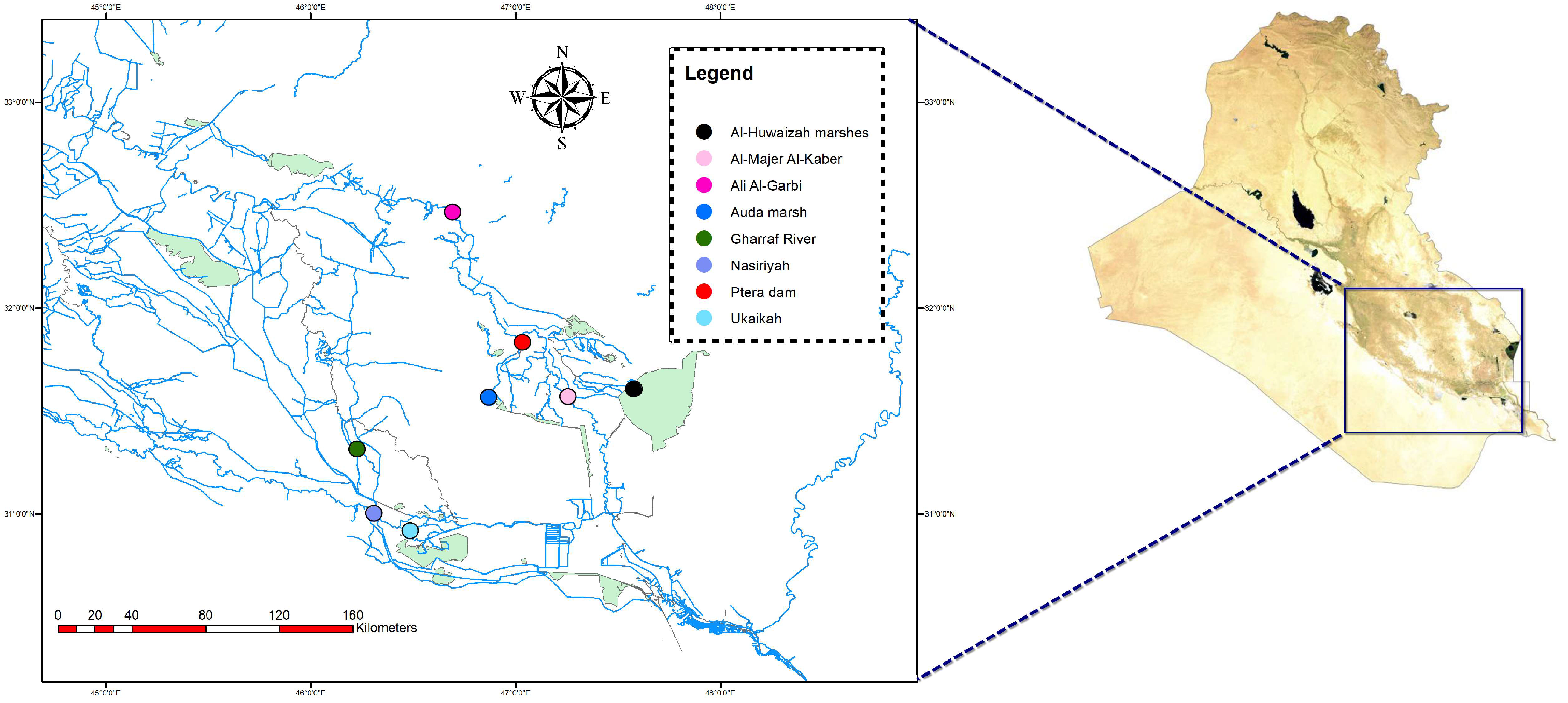
2.1. Study Area
2.2. Gastropod Collection and Sampling Design
2.3. Identification and Taxonomy
2.4. Data Analysis
2.4.1. Diversity and Evenness
2.4.2. Relative Abundance
2.4.3. Niche Overlap
2.4.4. Niche Overlap Significance Testing
2.4.5. Environmental Data Collection and Analysis
3. Results
3.1. Species and Taxonomic Composition
3.2. Diversity and Evenness
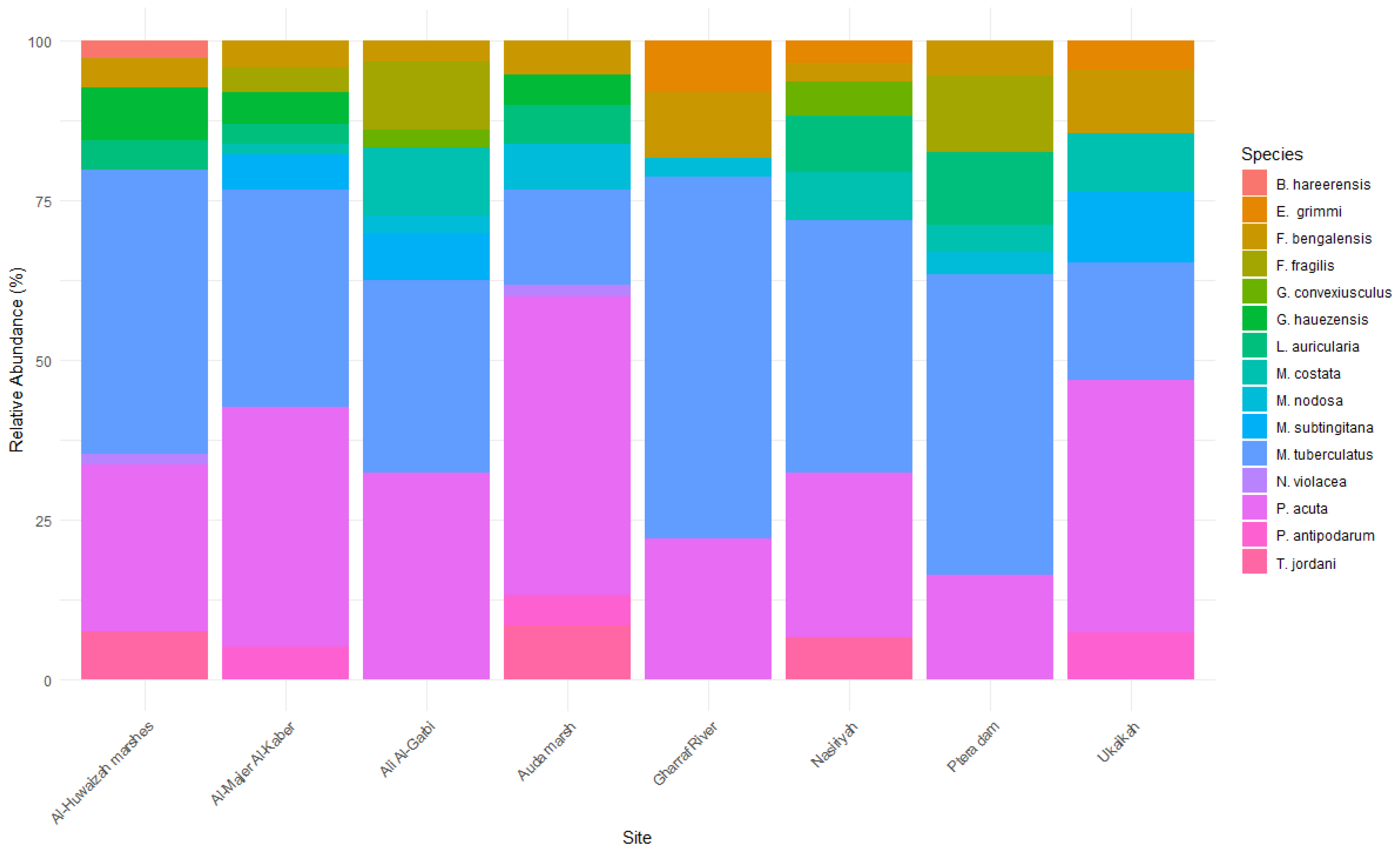
3.3. Relative Abundance Patterns
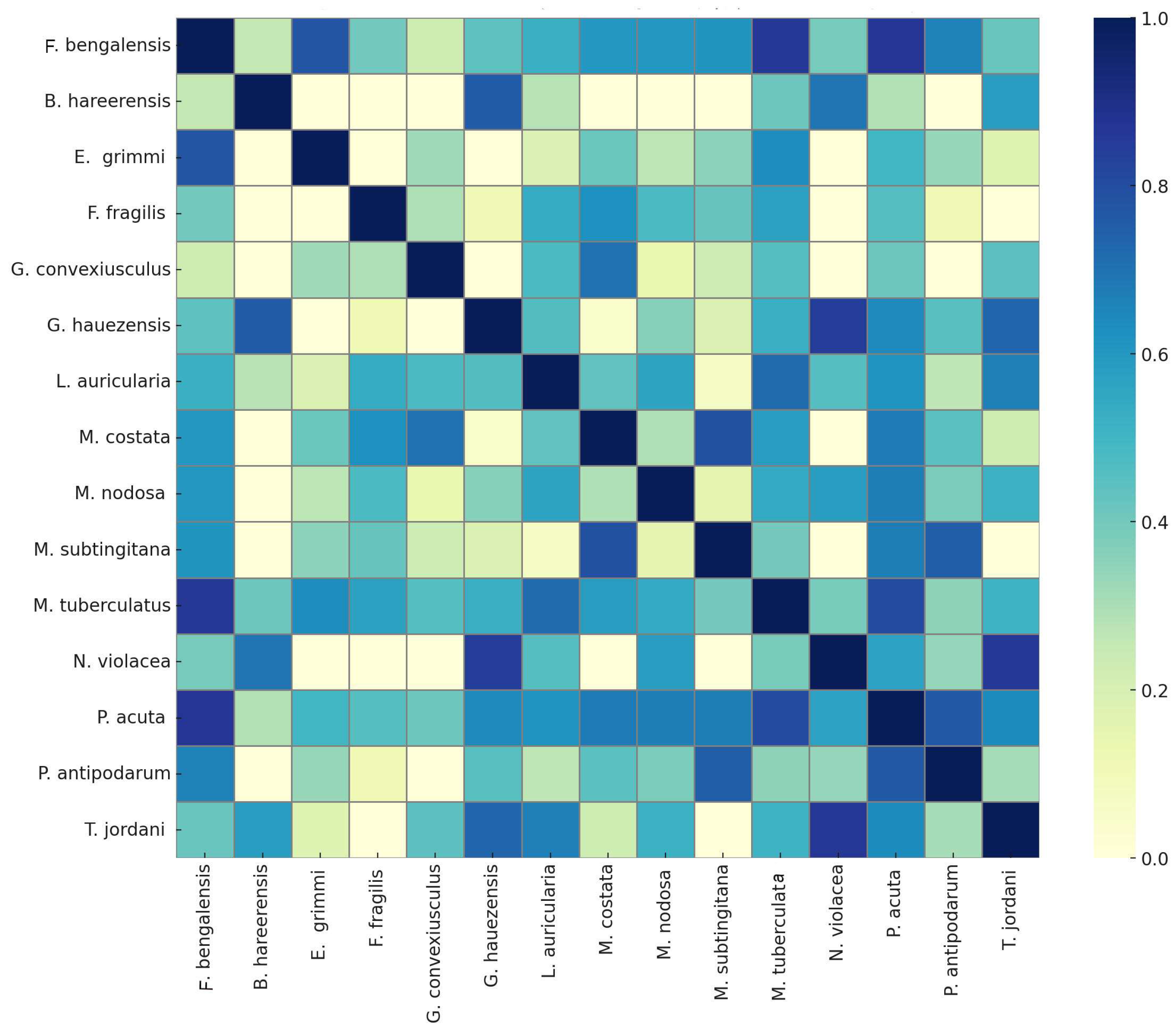
3.4. Spatial Distribution and Niche Overlap
3.5. Niche Overlap and Statistical Significance
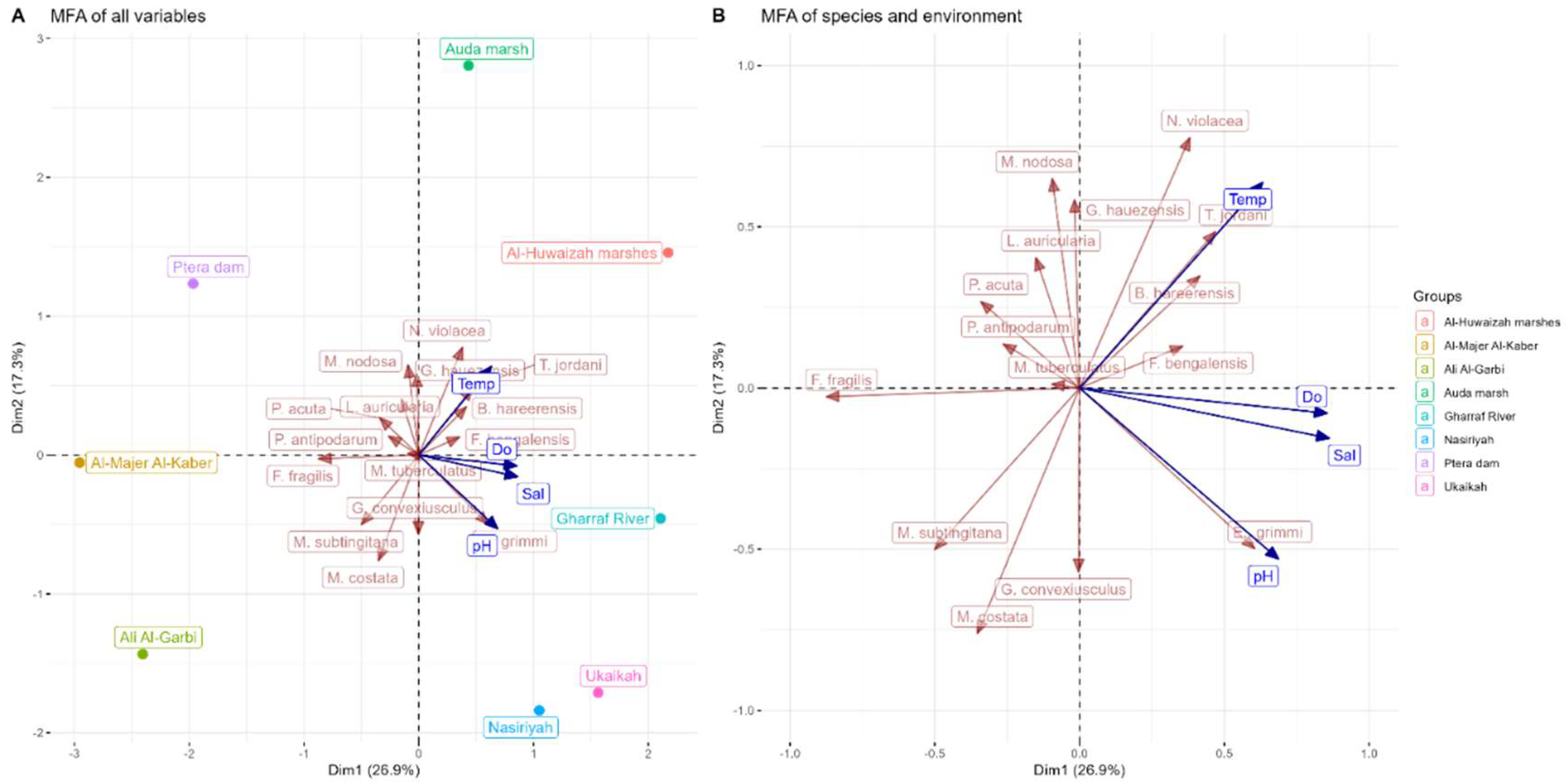
3.6. Environmental Patterns and Ecological Correlations
4. Discussion
4.1. Diversity and Community Composition
4.2. Dominance of Invasive Species
4.3. Impact on Native Species and Ecosystem Dynamics
4.4. Niche Overlap Patterns and Null Model Interpretation
4.5. Environmental Filtering and Community Structuring
5. Conclusions
Author Contributions
Funding
Institutional Review Board Statement
Informed Consent Statement
Data Availability Statement
Acknowledgments
Conflicts of Interest
References
- Covich, A.P.; Palmer, M.A.; Crowl, T.A. The role of benthic invertebrate species in freshwater ecosystems. BioScience 1999, 49, 119–127. [Google Scholar] [CrossRef]
- Strong, E.E.; Gargominy, O.; Ponder, W.F.; Bouchet, P. Global diversity of gastropods (Gastropoda; Mollusca) in freshwater. Hydrobiologia 2008, 595, 149–166. [Google Scholar] [CrossRef]
- Bae, M.J.; Park, Y.S. Key determinants of freshwater gastropod diversity and distribution: The implications for conservation and management. Water 2020, 12, 1908. [Google Scholar] [CrossRef]
- Vilenica, M.; Lajtner, J.; Rebrina, F.; Kepčija, M.; Rumišek, M.; Brigić, A. Gastropod assemblages in the harsh environment of Mediterranean Dinaric karst intermittent rivers. Ecol. Montenegrina 2024, 71, 200–209. [Google Scholar] [CrossRef]
- Linares, M.; Macedo, D.; Massara, R.; Callisto, M. What physical habitat factors determine the distribution of gastropods in neotropical headwater streams? Water Biol. Secur. 2022, 1, 100076. [Google Scholar] [CrossRef]
- Amini-Yekta, F.; Shokri, M.; Maghsoudlou, A.; Rajabi-Maham, H. Intertidal gastropod assemblages shaped by key environmental variables across the northern Persian Gulf and the Gulf of Oman. Mar. Ecol. 2019, 40, e12545. [Google Scholar] [CrossRef]
- Karatayev, A.Y.; Burlakova, L.E.; Padilla, D.K. Introduction, distribution, spread, and impacts of exotic freshwater gastropods in Texas. Hydrobiologia 2009, 619, 181–194. [Google Scholar] [CrossRef]
- Dillon, R.T.; Wethington, A.R.; Rhett, J.M.; Smith, T.P. Populations of the European freshwater pulmonate Physa acuta are not reproductively isolated from American Physa heterostropha or Physa integra. Invertebr. Biol. 2002, 121, 226–234. [Google Scholar] [CrossRef]
- Wan, J.; Huang, C.; Li, C.; Zhou, H.; Ren, Y.; Li, Z.; Xing, L.; Zhang, B.; Qiao, X.; Liu, B.; et al. Biology, invasion and management of the agricultural invader: Fall armyworm, Spodoptera frugiperda (Lepidoptera: Noctuidae). J. Integr. Agric. 2021, 20, 646–663. [Google Scholar] [CrossRef]
- Allen, W.; Street, S.; Capellini, I. Fast life history traits promote invasion success in amphibians and reptiles. Ecol. Lett. 2017, 20, 222–230. [Google Scholar] [CrossRef]
- Harris, S.A. Ecology of the freshwater mollusca of Iraq. Can. J. Zool. 1965, 43, 509–526. [Google Scholar] [CrossRef]
- Pešić, V.; Glöer, P. The freshwater molluscs of the Mesopotamian Plain. In Tigris and Euphrates Rivers: Their Environment from Headwaters to Mouth; Springer International Publishing: Cham, Switzerland, 2021; pp. 763–777. [Google Scholar]
- Pointier, J.P. The introduction of Melanoides tuberculatus to Saint Lucia (West Indies) and its role in the decline of Biomphalaria glabrata. Acta Trop. 1993, 54, 13–18. [Google Scholar] [CrossRef] [PubMed]
- Facon, B.; Pointier, J.P.; Jarne, P.; Sarda, V.; David, P. High genetic variance in life-history strategies within invasive populations by way of multiple introductions. Curr. Biol. 2008, 18, 363–367. [Google Scholar] [CrossRef] [PubMed]
- Mirza, N.; Nashaat, M. Abundance, diversity and distribution of Mollusca in the Gharaf River, southern Iraq. Iraqi J. Sci. 2019, 60, 469–485. [Google Scholar]
- Plaziat, J.C.; Younis, W.R. The modern environments of molluscs in southern Mesopotamia, Iraq: A guide to paleogeographical reconstructions of Quaternary fluvial, palustrine and marine deposits. Carnets Geol. 2005, 1–18. [Google Scholar] [CrossRef]
- Yasser, A.G.; Naser, M. Acute toxicity and histopathological effects of Malathion on shrimp Macrobrachium nipponense. J. Biol. Stud. 2023, 5, 774–779. [Google Scholar] [CrossRef]
- Yasser, A.; Al-Kaaby, I.; Shabeeb, A.; Naser, M.; Auda, N.; Ajeel, S.; Lebepe, J. Histopathology and micronuclei induction as pollution biomarkers in common carp Cyprinus carpio from southern Iraq. J. Biol. Stud. 2024, 7, 11–30. [Google Scholar] [CrossRef]
- Naser, M.D.; Yasser, A.G.; Dobrzycka-Krahel, A.; Lo Brutto, S.; Auda, N.M.; De los Ríos-Escalante, P.R.; Essl, F. Aquatic non-native invertebrate species in large river basins of southern Iraq. BioInvasions Rec. 2024, 13, 963–978. [Google Scholar] [CrossRef]
- Naser, M.; Yasser, A.; Schoelynck, J.; Essl, F. Threatened aquatic plants of the southern Tigris–Euphrates Basin: Status, threats, and conservation priorities. Plants 2025, 14, 1914. [Google Scholar] [CrossRef]
- Naser, M.; Yasser, A.; Geist, J.; Douda, K.; Essl, F. Probable extirpation of Anodonta vescoiana in Iraq: A case study of unionid displacement by Sinanodonta woodiana. Diversity 2025, 17, 415. [Google Scholar] [CrossRef]
- Vivó-Pons, A.; van Denderen, P.D.; Flensborg, L.; Jaspers, C.; Lindegren, M. Disentangling the effects of abiotic and biotic processes on non-indigenous species dominance. NeoBiota 2024, 94, 159–177. [Google Scholar] [CrossRef]
- Glöer, P.; Naser, M.D. Gyraulus huwaizahensis n. sp.—A new species from Mesopotamia, Iraq (Mollusca: Gastropoda: Planorbidae). Mollusca 2007, 25, 147–152. [Google Scholar]
- Naser, M.D.; Son, M.O. First record of the New Zealand mud snail Potamopyrgus antipodarum from Iraq: The start of expansion to Western Asia. Aquat. Invasions 2009, 4, 369–372. [Google Scholar] [CrossRef]
- Cowie, R.H. Invertebrate invasions on Pacific islands and the replacement of unique native faunas: A synthesis of the land and freshwater snails. Biol. Invasions 2001, 3, 119–136. [Google Scholar] [CrossRef]
- Karatayev, A.Y.; Burlakova, L.E.; Padilla, D.K. Can introduced species replace lost biodiversity? A test with freshwater molluscs. Hydrobiologia 2018, 810, 45–56. [Google Scholar] [CrossRef]
- Cheng, H.; Feng, M.; Zhang, P.; Zhang, H.; Wang, H.; Xu, J.; Zhang, M. Effects of warming on aquatic snails and periphyton in freshwater ecosystems with and without predation by common carp. Water 2022, 15, 153. [Google Scholar] [CrossRef]
- Gotelli, N.J.; Graves, G.R. Null Models in Ecology; Smithsonian Institution Press: Washington, DC, USA, 1996. [Google Scholar]
- Kraft, N.J.B.; Adler, P.B.; Godoy, O.; James, E.C.; Fuller, S.; Levine, J.M. Community assembly, coexistence and the environmental filtering metaphor. Funct. Ecol. 2015, 29, 592–599. [Google Scholar] [CrossRef]
- Ahmed, M.M. Systematic Study on Mollusca from Persian Gulf and Shatt Al-Arab; Center for Gulf Studies, Basrah University: Basrah, Iraq, 1975; pp. 1–75. [Google Scholar]
- Naser, M.D. Some notes on Melanopsidae (Gastropoda) of Mesopotamia. Iraqi J. Aquac. 2006, 2, 85–90. [Google Scholar] [CrossRef]
- Glöer, P.; Naser, M.D. Bithynia hareerensis n. sp., a new species from Mesopotamia (Iraq) (Gastropoda: Bithyniidae). Mollusca 2008, 26, 159–162. [Google Scholar]
- Naser, M.D.; Yasser, A.G.; Al-Khafaji, K.K.; Aziz, N.M.; Gmais, S.A. The genus Lymnaea (Lamarck, 1799) from southern Mesopotamia: Are morphological and anatomical studies enough to solve its complexity? Mar. Mesopotamica 2008, 23, 349–362. [Google Scholar]
- Haase, M.; Naser, M.D.; Wilke, T. Ecrobia grimmi in brackish Lake Sawa, Iraq: Indirect evidence for long-distance dispersal of hydrobiid gastropods by birds. J. Molluscan Stud. 2010, 76, 101–105. [Google Scholar] [CrossRef]
- Marrone, F.; Naser, M.D.; Yasser, A.G.; Sacco, F.; Arculeo, M. First record of the North American cryptic invader Ferrissia fragilis (Tryon, 1863) in the Middle East. Zool. Middle East 2014, 60, 39–45. [Google Scholar] [CrossRef]
- Magurran, A.E. Measuring Biological Diversity; Blackwell Publishing: Oxford, UK, 2004. [Google Scholar]
- Pielou, E.C. The measurement of diversity in different types of biological collections. J. Theor. Biol. 1966, 13, 131–144. [Google Scholar] [CrossRef]
- Pianka, E.R. The structure of lizard communities. Annu. Rev. Ecol. Syst. 1973, 4, 53–74. [Google Scholar] [CrossRef]
- R Core Team. R: A Language and Environment for Statistical Computing; R Foundation for Statistical Computing: Vienna, Austria, 2025; Available online: https://www.r-project.org/ (accessed on 21 March 2025).
- Posit Software PBC. RStudio, Version 2025.05.0 Build 496; RStudio: Integrated Development Environment for R; Posit: Boston, MA, USA, 2025. Available online: https://posit.co/ (accessed on 21 March 2025).
- Thomaz, S.M.; Dibble, E.D.; Evangelista, L.R.; Higuti, J.; Bini, L.M. Influence of aquatic macrophyte complexity on invertebrate assemblages in tropical lagoons. Freshw. Biol. 2008, 53, 358–367. [Google Scholar] [CrossRef]
- Batzer, D.P.; Sharitz, R.R. Ecology of Freshwater and Estuarine Wetlands; University of California Press: Berkeley, CA, USA, 2014. [Google Scholar]
- Brönmark, C. Freshwater snail diversity: Effects of pond area, habitat heterogeneity and isolation. Oecologia 1985, 67, 127–131. [Google Scholar] [CrossRef]
- Scheffer, M.; van Nes, E.H. Shallow lakes theory revisited. Hydrobiologia 2007, 584, 455–466. [Google Scholar] [CrossRef]
- Duarte, L.; Santos, R.; Fernandes, I. Habitat complexity and freshwater mollusk diversity: A global synthesis. Hydrobiologia 2020, 847, 243–255. [Google Scholar]
- Lajtner, J.; Kozak, A.; Špoljar, M.; Kuczyńska-Kippen, N.; Dražina, T.; Sertić Perić, M.; Zrinščak, I. Gastropod assemblages associated with habitat heterogeneity and hydrological shifts in two shallow waterbodies. Water 2022, 14, 2290. [Google Scholar] [CrossRef]
- Palmer, M.A.; Menninger, H.L.; Bernhardt, E. River restoration, habitat heterogeneity and biodiversity: A failure of theory or practice? Freshw. Biol. 2010, 55, 205–222. [Google Scholar] [CrossRef]
- Naser, M.D. First record of the freshwater crab Potamon mesopotamicum from the Al-Huwaizah marshes, Iraq. Crustaceana 2009, 82, 1599–1602. [Google Scholar] [CrossRef]
- Mueller, A.; Detges, A.; Pohl, B.; Reuter, M.H.; Rochowski, L.; Volkholz, J.; Woertz, E. Climate change, water and future cooperation and development in the Euphrates–Tigris basin. CASCADE Policy Brief 2021, 17, 1–16. [Google Scholar] [CrossRef]
- Mohammed, I.I.M.; Ibrahim, L.F.; Al-Tufaily, H.M.A. Analysis of the environmental reality of the marshes and its sustainable development. IOP Conf. Ser. Earth Environ. Sci. 2022, 1002, 012010. [Google Scholar]
- Koutsikos, N.; Vavalidis, T.; Perdikaris, C.; Zogaris, S.; Vardakas, L. Anthropogenic influences reshape lentic fish diversity: Patterns of homogenization and differentiation across a Mediterranean biodiversity hotspot. Sci. Total Environ. 2025, 973, 179154. [Google Scholar] [CrossRef]
- Gutiérrez-Rial, E.; Guareschi, S.; Abellán, P. Anthropogenic stressors reduce river biodiversity and functional integrity. Sci. Total Environ. 2023, 858, 160066. [Google Scholar]
- Ouedraogo, I.; Kpoda, N.W.; Oueda, A.; Bance, V.; Mano, K.; Kabre, G.B. Establishment of an invasive snail Melanoides tuberculata (Müller, 1774) in a Sahelian urban reservoir in Ouagadougou, Burkina Faso. BioInvasions Rec. 2023, 12, 797–808. [Google Scholar] [CrossRef]
- Tolley-Jordan, L.R.; Chadwick, M.A.; Triplett, J.K. DNA barcoding indicates multiple invasions of Melanoides tuberculatus in Florida. PLoS ONE 2023, 18, e0292164. [Google Scholar] [CrossRef]
- Taybi, A.F.; Mabrouki, Y.; Glöer, P.; Piscart, C. Factors explaining the distribution of the invasive gastropod Physella acuta in Morocco. Water 2024, 16, 803. [Google Scholar] [CrossRef]
- Gregoric, D.E.G.; Lucía, M.D.; Torres, S.H.; Copa, J.L.E.; Darrigran, G. Invasive freshwater gastropods in South America. Pap. Avulsos Zool. 2024, 64, e202464029. [Google Scholar] [CrossRef]
- Pinto, H.A.; Melo, A.L. Melanoides tuberculatus as an intermediate host of Centrocestus formosanus in Brazil. Rev. Inst. Med. Trop. Sao Paulo 2010, 52, 207–210. [Google Scholar] [CrossRef]
- Collado, G.A.; Vidal, M.A.; Torres-Díaz, C. Spatial distribution of two invasive freshwater snails and environmental correlates of molluscan community abundance in Chile. Anim. Biodivers. Conserv. 2023, 46, 187–198. [Google Scholar] [CrossRef]
- Banha, F.; Marques, M.; Anastácio, P.M. Dispersal of two freshwater invasive macroinvertebrates by off-road vehicles. Aquat. Conserv. Mar. Freshw. Ecosyst. 2014, 24, 582–591. [Google Scholar] [CrossRef]
- Karmakar, R.U.; Paul, P.R.; De, S.U.; Mondal, D.E.; Aditya, G. Temperature dependent interaction between an invasive and a native freshwater gastropod. Biol. Lett. 2021, 55, 17–29. [Google Scholar]
- Savić, A.; Dmitrović, D.; Pešić, V. Ecological impact of freshwater invaders: A case study of gastropod assemblages in karstic spring ecosystems. Freshw. Biol. 2024, 69, 1899–1913. [Google Scholar] [CrossRef]
- Pearson, J.; Gerber, R.; Malherbe, W.; Smit, N.; De Necker, L. A review of the reported and future potential ecological impacts of the invasive freshwater snail Tarebia granifera in South Africa. Afr. J. Aquat. Sci. 2024, 49, 179–195. [Google Scholar] [CrossRef]
- Weir, S.M.; Salice, C.J. High tolerance to abiotic stressors and invasion success of Melanoides tuberculatus. Biol. Invasions 2012, 14, 385–394. [Google Scholar] [CrossRef]
- Karatayev, A.Y.; Karatayev, V.A.; Burlakova, L.E.; Rowe, M.D.; Mehler, K.; Clapsadl, M.D. Food depletion regulates the demography of invasive dreissenid mussels in a stratified lake. Limnol. Oceanogr. 2018, 63, 2065–2079. [Google Scholar] [CrossRef]
- Brönmark, C. Interactions between epiphytes, macrophytes and freshwater snails: A review. J. Molluscan Stud. 1989, 55, 299–311. [Google Scholar] [CrossRef]
- Brereton, J.E.; Rose, P.E. The Zone Overlap Index: A new measure of shared resource use. J. Zoo Biol. 2023, 42, 811–817. [Google Scholar] [CrossRef]
- Zheng, C.; Shi, H.; Wei, J.; Cui, M.; Lin, Z.; Gao, Y.; Wen, Z. Spatial scale and environmental factors explain grassland community assembly. Ecol. Evol. 2024, 14, e11644. [Google Scholar] [CrossRef]
- Strayer, D.L. Alien species in fresh waters: Ecological effects and prospects. Freshw. Biol. 2010, 55, 152–174. [Google Scholar] [CrossRef]
- Gotelli, N.J. Null model analysis of species co-occurrence patterns. Ecology 2000, 81, 2606–2621. [Google Scholar] [CrossRef]
- Ulrich, W.; Gotelli, N.J. Disentangling community patterns of nestedness and co-occurrence. Oikos 2007, 116, 2053–2061. [Google Scholar] [CrossRef]
- Escofier, B.; Pagès, J. Multiple factor analysis (AFMULT package). Comput. Stat. Data Anal. 1994, 18, 121–140. [Google Scholar] [CrossRef]
- Pagès, J.; Tenenhaus, M. Multiple factor analysis combined with PLS path modelling. Chemom. Intell. Lab. Syst. 2001, 58, 261–273. [Google Scholar] [CrossRef]
- Stanimirova, I.; Walczak, B.; Massart, D.L. Multiple factor analysis in environmental chemistry. Anal. Chim. Acta 2005, 545, 1–12. [Google Scholar] [CrossRef]
- Abdi, H.; Valentin, D. Multiple factor analysis. In Encyclopedia of Measurement and Statistics; SAGE Publications: Thousand Oaks, CA, USA, 2007; pp. 657–663. [Google Scholar]
- Abdi, H.; Williams, L.J.; Valentin, D. Multiple factor analysis: Principal component analysis for multitable and multiblock data sets. WIREs Comput. Stat. 2013, 5, 149–179. [Google Scholar] [CrossRef]
- Früh, D.; Stoll, S.; Haase, P. Physico-chemical variables determining the invasion risk of freshwater habitats. Ecol. Evol. 2012, 2, 2843–2853. [Google Scholar] [CrossRef]
- Hah, H.E.; Liew, T.S.; Rama Rao, S.; Yow, Y.Y.; Ratnayeke, S. Distribution and environmental associations of invasive freshwater Pomacea snails in Peninsular Malaysia. Biol. Invasions 2022, 24, 189–204. [Google Scholar] [CrossRef]
- Saito, T.; Šlachtová, E.; Nováková, M.; Horsáková, V.; Ye, B.; Beran, L.; Horsák, M. Invasion history of Gyraulus chinensis in Europe. Hydrobiologia 2025, 852, 1359–1371. [Google Scholar]
- Chapuis, E.; Lamy, T.; Pointier, J.P.; Juillet, N.; Ségard, A.; Jarne, P.; David, P. Bioinvasion triggers rapid evolution of life histories in freshwater snails. Am. Nat. 2017, 190, 694–706. [Google Scholar] [CrossRef] [PubMed]
- Salamon, M.; Astorg, L.; Paccard, A.; Chain, F.; Hendry, A.P.; Derry, A.M.; Barrett, R.D.H. Limited migration from physiological refugia constrains rescue of native gastropods. Evol. Appl. 2024, 17, e70004. [Google Scholar] [CrossRef] [PubMed]
- Sîrbu, I.; Benedek, A.; Brown, B.; Sîrbu, M. Disentangling structural and functional responses of native versus alien communities by canonical ordination analyses and variation partitioning with multiple matrices. Sci. Rep. 2022, 12, 16860. [Google Scholar] [CrossRef]



| No | Site | Shannon (H′) | Species_Richness (S) | Evenness (J) |
|---|---|---|---|---|
| 1 | Al-Huwaizah marshes | 1.565557 | 8 | 0.752874 |
| 2 | Al-Majer Al-Kaber | 1.631852 | 9 | 0.742688 |
| 3 | Ali Al-Garbi | 1.706264 | 8 | 0.820539 |
| 4 | Auda marsh | 1.726206 | 9 | 0.78563 |
| 5 | Gharraf River | 1.196642 | 5 | 0.743515 |
| 6 | Nasiriyah | 1.682072 | 8 | 0.808906 |
| 7 | Ptera dam | 1.562939 | 7 | 0.803192 |
| 8 | Ukaikah | 1.704646 | 7 | 0.876015 |
| Species 1 | Species 2 | Observed Pianka’s Index | p-Value | Pair | Significance |
|---|---|---|---|---|---|
| F. bengalensis | E. grimmi | 0.776873 | 0.045045 | F. bengalensis vs. E. grimmi | * |
| M. costata | M. subtingitana | 0.791084 | 0.043043 | M. costata vs. M. subtingitana | * |
| N. violacea | T. jordani | 0.866409 | 0.021021 | N. violacea vs. T. jordani | * |
| P. acuta | P. antipodarum | 0.763579 | 0.023023 | P. acuta vs. P. antipodarum | * |
Disclaimer/Publisher’s Note: The statements, opinions and data contained in all publications are solely those of the individual author(s) and contributor(s) and not of MDPI and/or the editor(s). MDPI and/or the editor(s) disclaim responsibility for any injury to people or property resulting from any ideas, methods, instructions or products referred to in the content. |
© 2026 by the authors. Licensee MDPI, Basel, Switzerland. This article is an open access article distributed under the terms and conditions of the Creative Commons Attribution (CC BY) license.
Share and Cite
Naser, M.; Yasser, A.; Vivó-Pons, A.; Gümüş, B.A.; De los Ríos-Escalante, P.R. Diversity, Environmental Drivers, and Niche Overlap of Native and Invasive Gastropods in Southern Iraq’s Freshwater Ecosystems. Ecologies 2026, 7, 22. https://doi.org/10.3390/ecologies7010022
Naser M, Yasser A, Vivó-Pons A, Gümüş BA, De los Ríos-Escalante PR. Diversity, Environmental Drivers, and Niche Overlap of Native and Invasive Gastropods in Southern Iraq’s Freshwater Ecosystems. Ecologies. 2026; 7(1):22. https://doi.org/10.3390/ecologies7010022
Chicago/Turabian StyleNaser, Murtada, Amaal Yasser, Antoni Vivó-Pons, Burçin Aşkım Gümüş, and Patricio R. De los Ríos-Escalante. 2026. "Diversity, Environmental Drivers, and Niche Overlap of Native and Invasive Gastropods in Southern Iraq’s Freshwater Ecosystems" Ecologies 7, no. 1: 22. https://doi.org/10.3390/ecologies7010022
APA StyleNaser, M., Yasser, A., Vivó-Pons, A., Gümüş, B. A., & De los Ríos-Escalante, P. R. (2026). Diversity, Environmental Drivers, and Niche Overlap of Native and Invasive Gastropods in Southern Iraq’s Freshwater Ecosystems. Ecologies, 7(1), 22. https://doi.org/10.3390/ecologies7010022