You are currently viewing a new version of our website. To view the old version click .
Ecologies
  • Article
  • Open Access

27 February 2025

Environmental Heterogeneity Drives Secondary Metabolite Diversity from Mesquite Pods in Semiarid Regions


,
,

,
,
,
,
,
,
and
1
Doctorado de Ciencias Básicas, Universidad Autónoma de Zacatecas, Calle Preparatoria, s/n, Colonia Hidráulica, Zacatecas 98068, Mexico
2
Unidad Académica de Ciencias Biológicas, Universidad Autónoma de Zacatecas, Calle Preparatoria, s/n, Colonia Hidráulica, Zacatecas 98068, Mexico
3
División de Ingenierías, Departamento de Ingeniería Civil Ambiental, Universidad de Guanajuato, Av. Juárez #77, Col. Centro, Guanajuato 36000, Mexico
4
Instituto de Ciencias Agrícolas (ICA), Carretera a Delta s/n Ejido Nuevo León, Mexicali 21705, Mexico

Abstract

Secondary metabolites (SM) in plants play crucial pharmacological, ecological, and nutritional roles for humans, wildlife, and livestock. Environmental Heterogeneity (EH) encompasses the variability of biotic and abiotic factors that influence biological responses of plant species. Advancements in remote sensing have enhanced the ability to assess plant functional traits more affordably and comprehensively by integrating spectral reflectance data with detailed plant metabolomics. However, studies investigating the relationship between EH—quantified using Rao’s Q heterogeneity index from remote sensing data—and SM diversity remain limited. Here, we present the first report demonstrating that the biotic component of EH, measured as Rao’s Q, is positively associated with SM diversity in mesquite pod extracts—higher Rao’s Q values correspond to greater SM diversity. Generalized additive models (GAMs) revealed that Rao’s Q contributed the most explanatory power, accounting for 21.2% of the deviance, compared to pod weight (13.7%) and pod length (2.03%). However, only the relationship between Rao’s Q and SM diversity was statistically significant (p = 0.029). The Rao’s Q index derived from remote sensing serves as a scalable proxy for identifying SM hotspots, facilitating the targeted discovery of regions with high pharmacological or nutritional value.

1. Introduction

Plants’ interactions with their variable biotic and abiotic environments are directly mediated by chemical phenotypes expressed in the plants metabolomes [1,2]. Various ecologically limiting factors, such as temperature, carbon dioxide, light, ozone, and soil fertility, significantly impact the physiological and biochemical responses of plants, influencing their secondary metabolism [2]. The diversity of plant metabolites arises from different accumulation patterns in species and tissues, which are involved in plant responses to the environment, influencing developmental processes and enabling rapid adaptation to environmental changes [3,4]. Understanding plant responses to ecological factors that promote metabolite diversity is essential and requires knowledge of the spatial and temporal dynamics of these factors [4].
Recent studies have shown that plant populations experiencing greater environmental variation exhibit higher diversity in their metabolome [5]. Environmental variations, defined as Environmental Heterogeneity (hereafter EH), include biotic and abiotic factors [6], and have been shown to positively correlate with species richness [7,8,9]. Biotic EH can be estimated from remote sensing imagery using vegetation spectral indices [10,11], such as the Normalized Difference Vegetation Index (NDVI) or the Soil-Adjusted Vegetation Index (SAVI). These spectral indices utilize the spectral reflectance properties of vegetation to infer functional traits such as chlorophyll content, leaf area, biomass, and foliar nitrogen content [12,13]. NDVI exploits the contrast between near-infrared and red reflectance, serving as a proxy for photosynthetic activity and canopy density, but is sensitive to soil backgrounds in sparse vegetation [13]. SAVI addresses this issue by incorporating a soil adjustment factor, reducing soil brightness interference, particularly in arid ecosystems [14,15,16]. Some authors have demonstrated the ability of spectral data to infer secondary metabolite levels [17,18]. For example, Melandri et al. [18] demonstrate that the hyperspectral signature of cotton leaves can be used for the quantitative estimation and prediction of various leaf metabolites. Recent studies have demonstrated that EH can be assessed using the Rao’s Q heterogeneity index derived from spectral vegetation indices [19,20]. Although Rao’s Q has widely been used to explain plant diversity [10], studies exploring its application to infer plant metabolites, particularly in arid zones, are limited.
Secondary metabolites (hereafter SM) are diverse chemical compounds that help plants defend against stress, attract pollinators, and adapt to their environment [21]. Some plant species in arid zones exhibit remarkable traits, thriving under adverse growth conditions (e.g., low precipitation and high temperature variability), which promote the production of SM [2,22]. Semi-arid regions of Mexico are host to diverse plants rich in SM which have been traditionally used for centuries [22]. These regions harbor diverse plant communities, including trees and shrublands species such as huizache scrub, xerophilous scrub, and mesquite scrub [23]. The natural flora includes various species of the genus Neltuma (= Prosopis; Fabaceae; subfam: Mimosoideae) [24], one of the most abundant plant genera in the semi-arid regions of Mexico. Mexico is home to nine Neltuma species (hereafter mesquites), with three species—N. juliflora, N. laevigata and N. glandulosa— distributed in Zacatecas [25].
Mesquites have various uses; for instance, their leaves and pods have been used in traditional medicine [22], for their biomedical properties [26], and as food for domestic and wild fauna [27]. Mesquite trees generally begin flowering and pod production at three to five years of age [28,29]. SM from mesquite pods have bioactive properties with high pharmacological value, such as oxidative stress reduction and pathogen inhibition [26,30]. Research on the utilization of SM from mesquite pods has been limited to only a few mesquite species. A recent meta-analysis revealed that the bioactive components of N. juliflora pods have been widely used as an alternative to enhance productive performance and reduce methane emissions in small ruminants, such as sheep [31]. Furthermore, the antibacterial activity of SM derived from pod extracts of N. strombulifera and N. juliflora, along with the beneficial effects of ground pods from N. glandulosa and N. juliflora on animals has been documented [26]. Other studies on the use of SMs from other mesquite species, such as N. laevigata and N. velutina, have primarily focused on leaf extracts [26,32]. However, the influence of EH on the production of these metabolites remains unclear.
To address this gap, the main objective of this study was to evaluate the relationship between EH estimated with the Rao’s Q heterogeneity index and the number of classes of secondary metabolites detected (i.e., SM diversity) from mesquite pod extracts in the semi-arid central region of Mexico. Because the expression of metabolites in plants is primarily influenced by the environment [33,34,35], we hypothesized that SM diversity in the pods is influenced by the environmental conditions experienced by mesquite trees before pod collection. Therefore, Rao’s Q will positively correlate with SM diversity in mesquite pods. This study advances the identification of optimal environmental data from remote sensing related to SM diversity in mesquite pods, which is critical for conservation strategies in agricultural ecosystems and the extraction of medical bioactive SMs.

2. Materials and Methods

2.1. Field Survey and Plant Materials

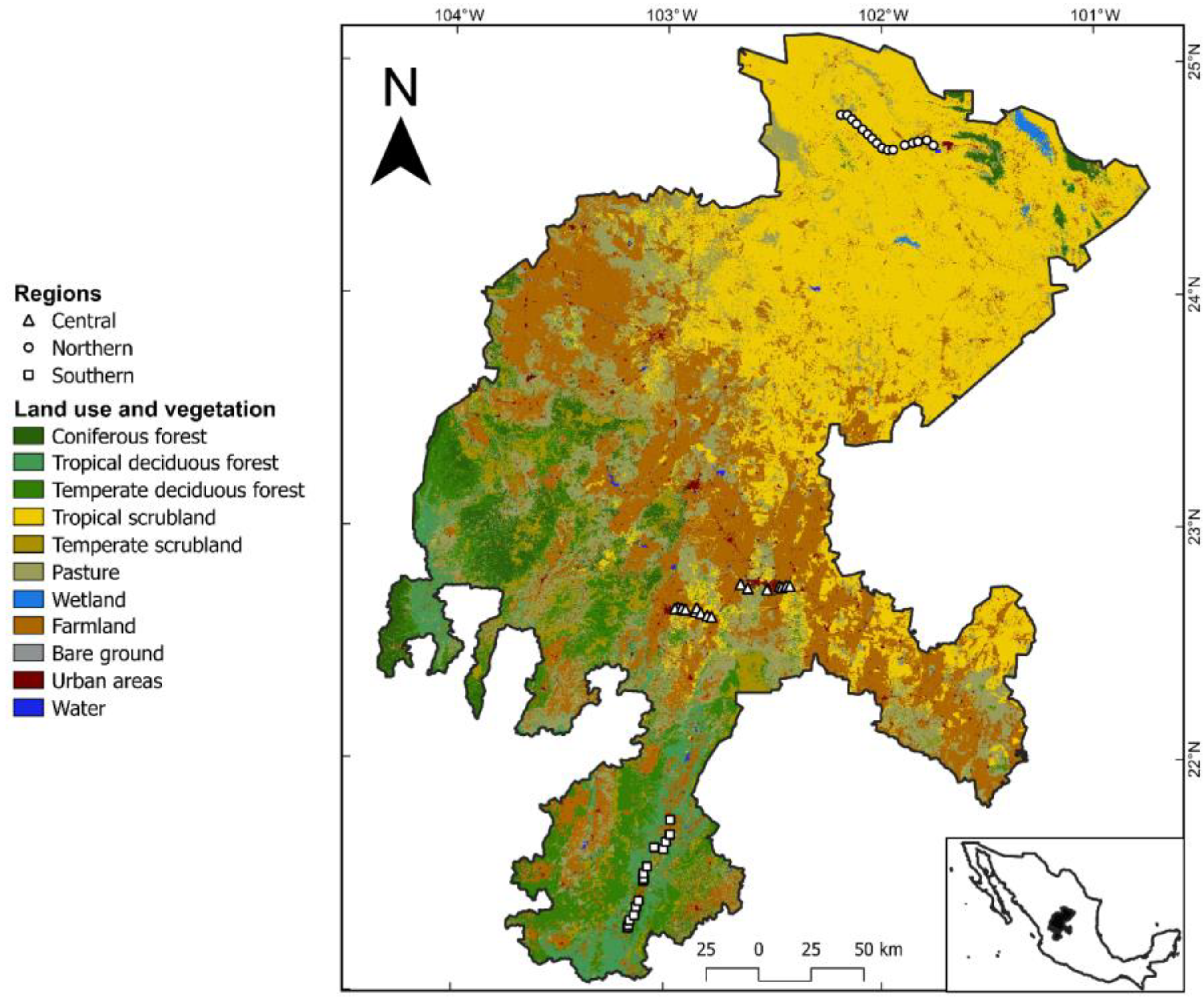
Mesquite (Neltuma spp.) trees were sampled during the fruiting season in Zacatecas, Mexico. The fruiting season for mesquites in the Zacatecas region occurs once a year and lasts for two months. During this study, mesquite fruiting began in May (2023), and sampling was conducted on the 11th, 12th, and 19th of that month. Three transects were established in the southern (sampled on May 11), central (sampled on 12 May), and northern (sampled on 19 May) regions of the Zacatecas State (Figure 1). For each region, 16 trees were sampled, with a minimum distance of three kilometers maintained between them. These trees were tall perennial plants with lignified stems branching above the base and generally exceeding three meters in high. From each tree, 500 g of mature pods and a botanical sample (the terminal portion of a branch with leaves of approximately 30 to 35 cm in length) were collected. Pods were randomly collected, placed in labeled plastic bags, transported, and stored at −20 °C until processing. The botanical samples were used to identify each mesquite tree sampled to species level using taxonomic keys [36] and high-resolution digital materials from the National Herbarium of the National Autonomous University of Mexico (https://datosabiertos.unam.mx/biodiversidad/ (accessed on 5 June 2023)).
Figure 1. Geographic distribution of mesquite trees sampled in three regions. The background shows the 30 × 30 m pixel scale map for land use and vegetation of Zacatecas, Mexico [37]. The map was created using the QGIS version 3.28.7 [38] software.

2.2. Secondary Metabolite Extraction

To extract SMs, a subsample of 50 pods was randomly selected from each of the 48 sampled trees. Each subsample was measured and weighed. To prepare the extracts, the pods were frozen in liquid nitrogen, manually crushed in a mortar, further ground in a grinder and stored at −20 °C until processing. Two extraction methods [39] were employed (48 extracts for each):
Ultrasound-assisted extraction (hereafter UAE): A solution of methanol, water, and formic acid (80:18:2 ratio) was prepared, and 3 g of ground sample was mixed with 30 mL of the solution. This mixture was stirred for 30 s, then subjected to ultrasound in five cycles of one minute each at 60 Hz, with a temperature of 4 °C maintained between cycles. The extracts obtained were macerated for 30 days in amber jars at room temperature. After the maceration period, the supernatant was recovered by filtration and stored at room temperature in the dark.
Ethanolic extraction (hereafter EE): A 70% ethanol solution was prepared, and 12.5 g of ground sample was mixed with 100 mL of solution. The mixture was macerated in amber jars at room temperature for 30 days. After the maceration period, the supernatant was recovered by filtration and stored at room temperature in the dark.

2.3. Qualitative Tests for Chemical Profile

To detect the presence of SM classes in mesquite pod extracts, various phytochemical tests were performed in duplicate for both extraction methods (UAE and EE), following the methodologies described by Domínguez [40], Bañuelos-Valenzuela et al. [41], and Rivero-Pérez et al. [42] (Table 1). The methods used in this study are qualitative colorimetric tests designed to detect different classes of SMs in plants [39]. SM detection results were compiled into a presence–absence matrix with 48 rows and 17 columns, where rows represent the sampled mesquite trees (i.e., sites or localities) and columns represent the SM classes detected in extracts of mesquite pods (Supplementary Materials).
Table 1. List of phytochemical tests and procedures to detect secondary metabolites classes in mesquite pod extracts.

2.4. Remote-Sensing Data

We obtained 40 raster satellite images from the EarthExplorer (https://earthexplorer.usgs.gov/ (accessed on 26 July 2023)) platform for the period from July 2022 to June 2023. Each image covered ~170 × 183 km with a pixel resolution of 30 × 30 m. The images were from Landsat 8 Collection 2 Level-1, with a revisit period of 16 days. Each image included three spectral bands: Band 4 (red), Band 5 (near-infrared), and the pixel quality band. The pixel quality band provided information on the presence of shadows and clouds that could negatively affect the spectral values of pixels. As part of preprocessing, we used the pixel quality band to exclude poor-quality pixels.

2.5. Environmental Heterogeneity Estimation

To estimate biotic EH in terms of Rao’s Q, we first calculated the Soil-Adjusted Vegetation Index (SAVI) for each of the 40 satellite images following Equation (1):
SAVI = ((NIR − R)/(NIR + R + L)) × (1 + L)
where NIR represents the near-infrared band (Band 5, spectrum range 0.85–0.88 µm), R represents the red band (Band 4, spectrum range 0.64–0.67 µm), and L is the soil brightness correction factor set at 0.5. SAVI was computed with an 8-bit pixel depth, producing values ranging from 0 to 255, where values near 0 indicate little to no vegetation, and values near 255 indicate dense vegetation. After SAVI measures were obtained for the 40 images, they were used as input data to calculate biotic EH with the Rao’s Q heterogeneity index [43] following the methodology proposed by Rocchini et al. [44] (Equation (2)):
R a o   Q = i = 1 N j = 1 N d i j   ×   p i ×   p j
Rao’s Q considers the values of different pixels i and j, their relative abundances pi and the spectral distances between pixel values dij. Biotic EH was analyzed at the landscape scale using a circular analysis unit with a 1 km radius. This calculation was performed using the “Rao Q” function from the “rasterdiv” package [44] in R [45], allowing us to estimate the spatio-temporal biotic EH in terms of Rao’s Q (hereafter, Rao’s Q) surrounding each sampled tree.

2.6. Data Analysis

To examine relationships between SM diversity and Rao’s Q from sampling mesquite trees, we selected the extraction method that detected the highest number of SMs classes from pods and conducted a principal component analysis (PCA). Variables included Rao’s Q recorded at each sampled tree, pod weight (g), pod length (cm), and SM diversity. The presence–absence matrix of SM classes was standardized to Chi-square distances using the “decostand” function from the “vegan” package [46] in R [45], as this transformation is suitable for multivariate ordering of binary data [47,48]. All variables were scaled to zero mean (μ = 0) and unit standard deviation (σ = 1), and the PCA was conducted using the “PCA” function from the “FactoMineR” package [49] in R [45].
To assess the direction and strength of the relationships between the explanatory variables (Rao’s Q, pod weight, and pod length) and SM diversity in extracts from mesquite pods, we used generalized additive models (GAMs) with the Poisson link function. Additionally, ANOVA with a Tukey post hoc test was applied to assess the effects of Rao’s Q, pod weight, and size on SM diversity. All analyses were conducted in R [45] with statistical significance tested at α = 0.05.

3. Results

In this study, we covered approximately 190 km in field surveys across the three regions studied. A total of 48 Neltuma trees were sampled, with 16 trees per region. In the southern region, only N. laevigata was recorded. The central region had N. laevigata, N. juliflora and N. velutina, while in northern region had N. laevigata and N. juliflora (Table 2). The species with the highest number of records was N. laevigata, which was recorded in all three regions, and was the only species recorded in the southern region. The species N. juliflora was the second abundant species and one individual of N. velutina was recorded exclusively in the central region (Table 2).
Table 2. Mesquite trees sampled on 11, 12, and 19 May 2023, by region (southern, central, and northern, respectively). The sampled individuals were tall trees—perennial plants with lignified stems branching above the base and generally exceeding three meters in height. Pods were randomly collected from all individuals (see Materials and Methods section for details).
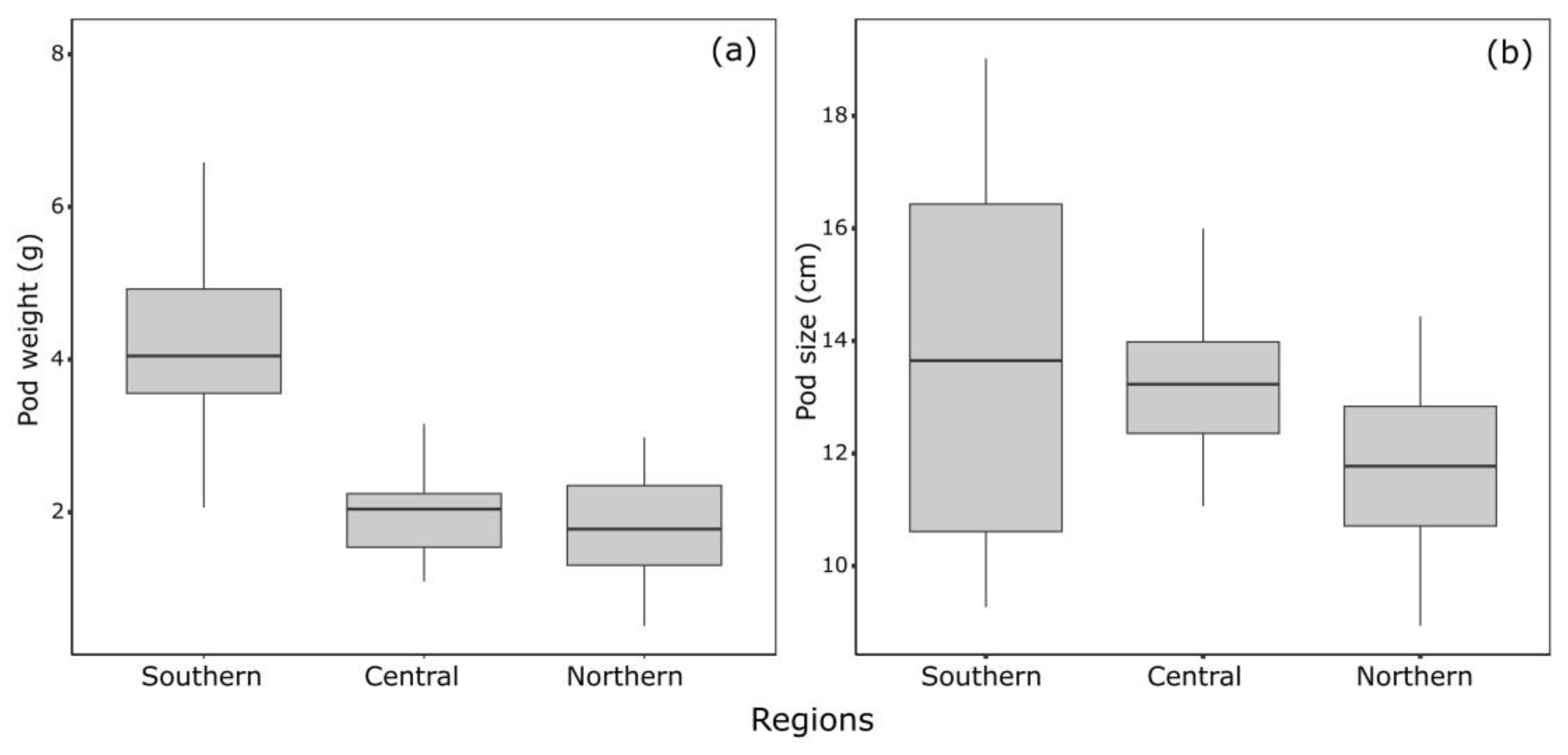
The average weight of mesquite pods was highest in the southern region (M = 4.42 g, SD = 1.72 g) and lower in the central (M = 1.97 g, SD = 0.58 g) and northern regions (M = 1.78 g, SD = 0.71 g) (Figure 2a). The longest pods were recorded in the central (M = 13.50 cm, SD = 2.00 cm) and southern regions (M = 13.82 cm, SD = 3.21 cm), while the northern region had the shortest pods (M = 11.68 cm, SD = 1.65 cm) (Figure 2b).
Figure 2. Boxplot of (a) pod weight and (b) pod size across the southern, central, and northern regions. Each box represents the interquartile range (IQR), spanning from the first quartile (Q1) to the third quartile (Q3). The line inside the box indicates the median (Q2). The whiskers extend to the smallest and largest values within 1.5 × IQR beyond the quartiles.
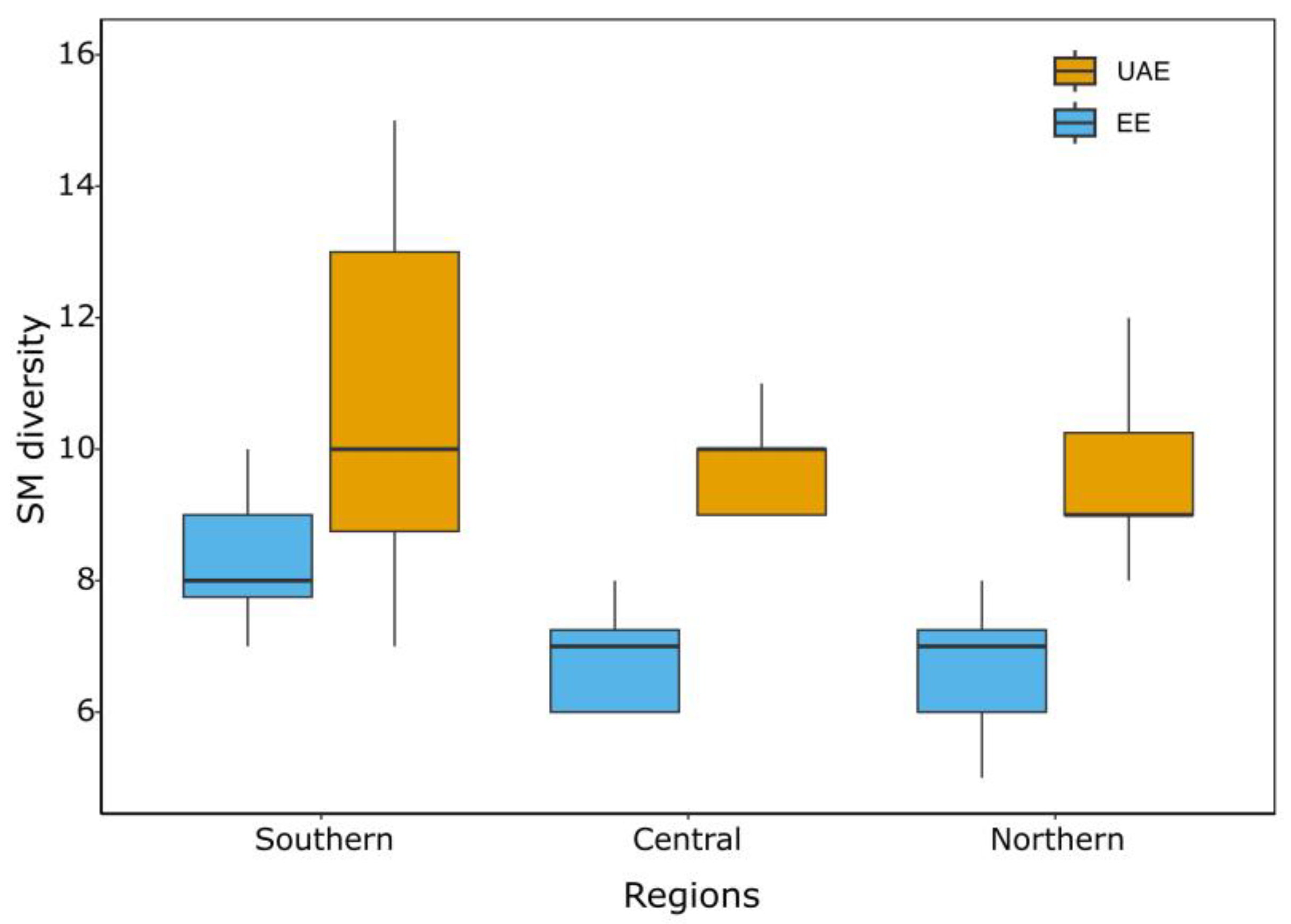
According to the phytochemical profile tests, 17 SM classes were detected in mesquite pods with the two extraction methods applied (Table 3). Not all regions exhibited the same SM diversity (Table 3, Figure 3). Extracts obtained by UAE recorded a greater diversity of SMs compared to EE (Figure 3). UAE detected an average of 11 (SD = 3) SM classes in the southern region, and 10 (SD = 2) SM classes in the central and northern regions. EE detected an average of eight (SD = 1) SM classes in the southern and seven SMs in the central and northern regions (SD = 2 and SD = 1, respectively). Since greater SM diversity was obtained with UAE, all subsequent analyses focused on this extraction method.
Table 3. Number of trees (out of 16 per region) in which different classes of secondary metabolites were detected in mesquite pods by two extraction methods: ultrasound-assisted extraction (UAE) and ethanolic extraction (EE), across the southern, central, and northern regions.
Figure 3. Boxplot showing the number of secondary metabolite classes detected in mesquite pod extracts (SM diversity; y axis) across the southern, central, and northern regions (x axis) using two extraction methods: ultrasound-assisted extraction (UAE) and ethanolic extraction (EE). Each box represents the interquartile range (IQR), spanning from the first quartile (Q1) to the third quartile (Q3). The line inside the box indicates the median (Q2). The whiskers extend to the smallest and largest values within 1.5 × IQR beyond the quartiles.
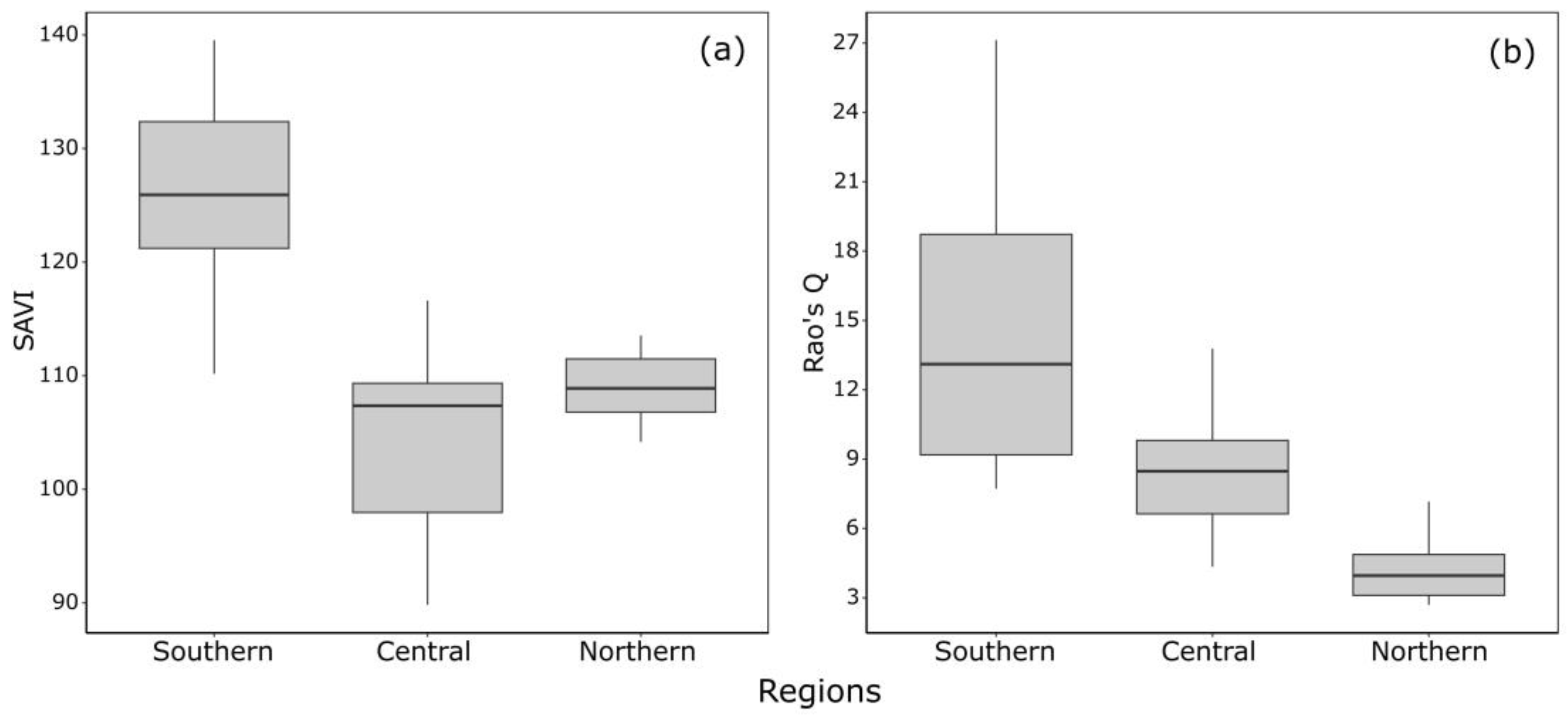
The average vegetation cover estimated using the SAVI was high in the southern (M = 126, SD = 9.31) regions, whereas the central (M = 104.21, SD = 8.19) and northern (M = 109.90, SD = 4.66) regions showed lower average SAVI values (Figure 4). According to EH measured as Rao’s Q, the southern region displayed higher heterogeneity compared to the central and northern regions (Figure 4). The average Rao’s Q in each region was significantly different; F(2,45) = 21.51, p = 2.78 × 10⁻⁷: the southern region showed the highest Rao’s Q (M = 14.82, SD = 6.82), while the central and northern regions recorded average Rao’s Q values of 8.71 (SD = 2.92) and 4.53 (SD = 2.12), respectively (Figure 4).
Figure 4. Boxplot of the (a) Soil-Adjusted Vegetation Index (SAVI) and (b) environmental heterogeneity in terms of Rao’s Q observed across the southern, central, and northern regions. Each box represents the interquartile range (IQR), spanning from the first quartile (Q1) to the third quartile (Q3). The line inside the box indicates the median (Q2). The whiskers extend to the smallest and largest values within 1.5 × IQR beyond the quartiles.
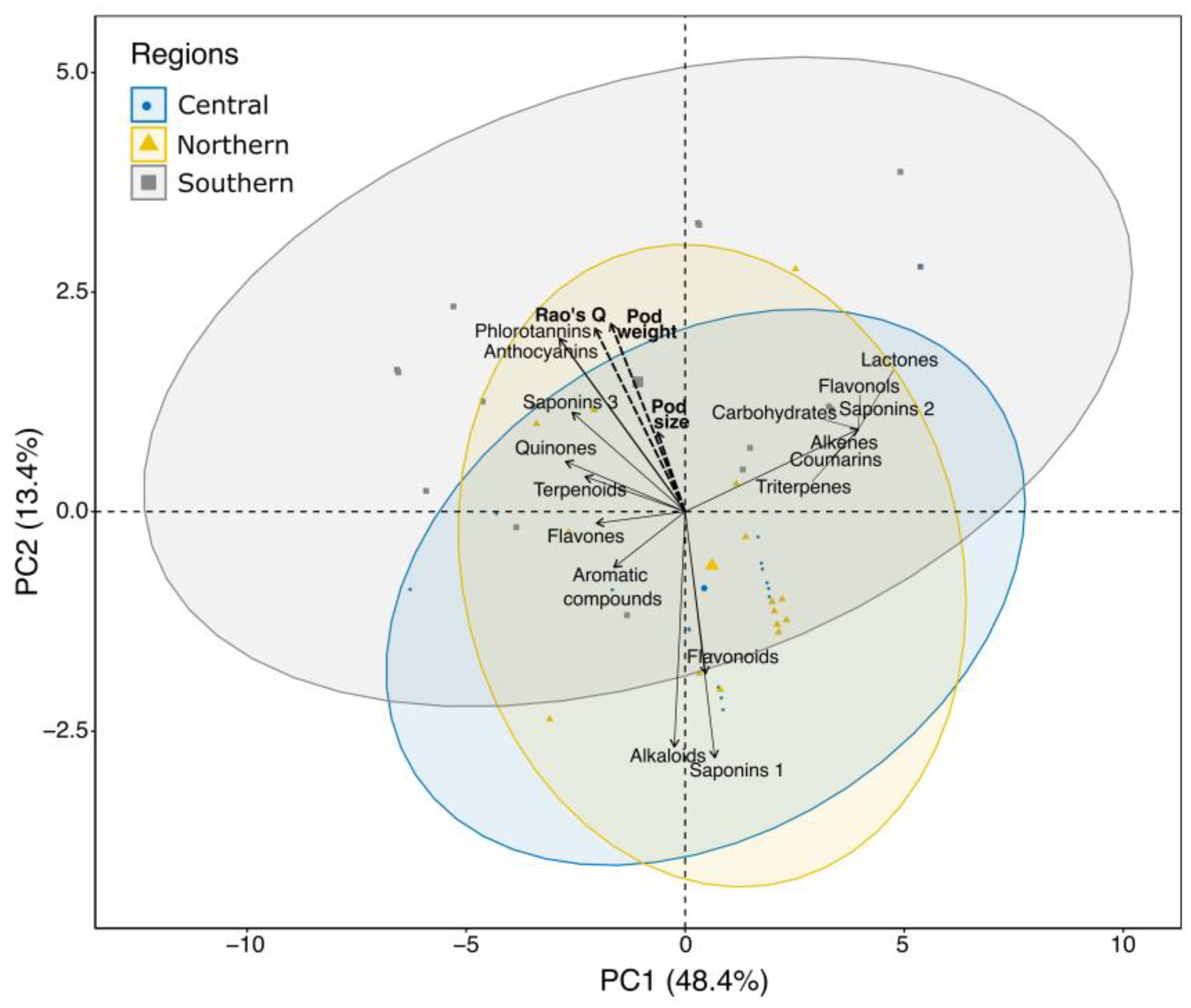
According to the PCA, the first principal component (PC1) explained 48.4% of the variance, while the second principal component (PC2) explained 13.4%. Rao’s Q and pod weight appeared to be related and strongly contributed to the model, whereas pod length had a low contribution (Figure 5). Some SM classes, such as phlorotannins and anthocyanins, were strongly associated with Rao’s Q and pod weight (Figure 5). Conversely, SM classes such as flavonoids, alkaloids, and saponins 1 showed a negative association with Rao’s Q, pod weight, and length (Figure 5). Additionally, various SM classes, such as lactones, alkenes, and coumarins, did not show any apparent relationship with Rao’s Q, pod weight, or length of mesquite pods (Figure 5).
Figure 5. Principal component analysis (PCA) biplot shows the relationships between explanatory variables (dashed lines)—environmental heterogeneity in terms of Rao’s Q, pod length (cm), and pod weight (g)—and secondary metabolite classes detected (solid lines) in mesquite pods from ultrasound-assisted extraction (UAE), across the southern (gray color), central (blue color), and northern (yellow color) regions. The ellipses represent the three sampled regions based on the abundance of SM classes in each region.
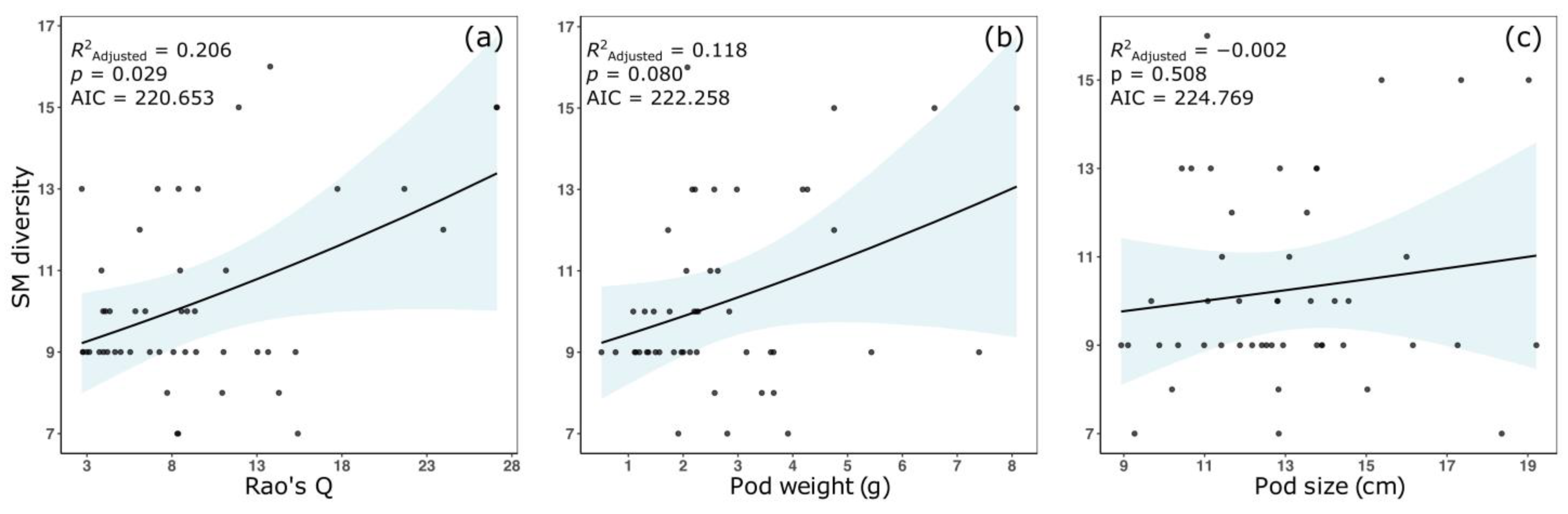
The GAM fits showed that SM diversity was positively related to Rao’s Q and pod weight, while the relationship with pod length appeared to be neutral (Figure 6). The relationship between SM diversity and Rao’s Q was strong (R2Adjusted = 0.206), whereas the relationships with pod length and weight were weak (R2Adjusted = 0.118 and R2Adjusted = −0.002, respectively) (Figure 6). Rao’s Q had the highest explanatory contribution (deviance explained = 21.2%) compared to pod weight (deviance explained = 13.7%) and length (deviance explained = 2.03%). However, only the relationship between Rao’s and SM diversity was statistically significant (p = 0.029), and based on Akaike’s Information Criterion (AIC), the best model was the one fitted with Rao’s Q (AIC = 220.653). In contrast, models fitted with pod weight and length had relatively poorer fits (AIC = 222.258 and AIC = 224.769, respectively) (Figure 6).
Figure 6. Relationships between secondary metabolite diversity (SM diversity; y-axis) and (a) environmental heterogeneity in terms of Rao’s Q, mesquite (b) pod weight and (c) pod size. The black line showed that the generalized additive models fit with the 95% confidence intervals (shaded blue area). The Adjusted coefficient of determination, Adjusted (R2Adjusted); probability (p); and Akaike Information Criterion (AIC) are shown.
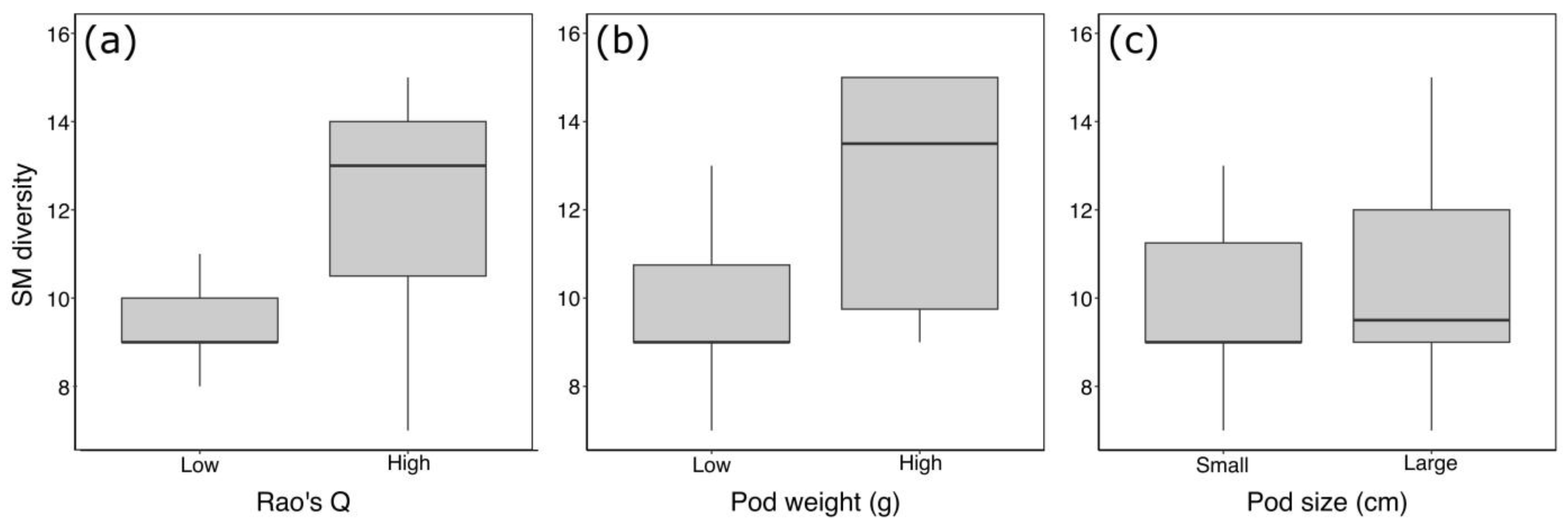
According to the ANOVA, Rao’s Q had the most significant effect on SM classes’ variation in mesquite pod extracts; F(1,44) = 11.9252; p = 0.001. In contrast, no significant effects were observed for pod weight: F(1,44) = 0.129; p = 0.721; nor pod length: F(1,44) = 0.483; p = 0.490. The Tukey post hoc test revealed that high Rao’s Q levels had a significant effect on SM diversity F(1,44) = 5.875, p = 0.019 (Figure 7). However, the effects of high or low levels of pod weight and pod length were not significant: F(1,44) = 4.190; p = 0.131; and F(1,44) = 0.011; p = 0.922; respectively (Figure 7).
Figure 7. Boxplot showing the secondary metabolite diversity (SM diversity) across the low and high levels of (a) environmental heterogeneity in terms of Rao’s Q, (b) mesquite pod weight, (c) small and large sizes of mesquite pods. Each box represents the interquartile range (IQR), spanning from the first quartile (Q1) to the third quartile (Q3). The line inside the box indicates the median (Q2). The whiskers extend to the smallest and largest values within 1.5 × IQR beyond the quartiles.

4. Discussion

This study presents the first report showing that the habitat factor of EH, measured with Rao’s Q, is positively associated with the diversity of SMs in mesquite pods—higher Rao’s Q values correspond to greater SM diversity. Conversely, pod length and weight have limited explanatory power for SM diversity. These findings highlight the role of Rao’s Q in understanding the environmental processes that may promote SM synthesis in mesquite pods. Our results on the influence of Rao’s Q as a driver of SM diversity complement and extend the work of Fuica-Carrasco et al. [5], who identified key elements linking metabolome variation to ecological niche structure and temporal fluctuations in environmental conditions. Their study suggests that plant populations at the periphery of their ecological niche exhibit higher metabolomic diversity than those near the niche centroid, emphasizing the role of environmental variation in shaping metabolite expression. Similarly, metabolic profiles in soybean seeds were found to be influenced more by environmental factors than by genetic background [50]. Our findings reinforce the idea that high SM diversity may only be expressed under specific environmental conditions in certain ecosystems. This is particularly relevant when considering the viability of using mesquite pods as livestock forage, as regions with low SM diversity may not provide sufficient nutritional or medical benefits.
Our results showed that the southern region experiences greater environmental variability than the central and northern regions, leading to higher SM diversity. This suggests that vegetation phenology in the southern region has a stronger environmental influence than in the central and northern regions. The southern region is characterized by dominant tropical dry forest vegetation, whereas the central and northern regions are more strongly associated with xerophilous scrub (see Figure 1). These contrasting ecosystems likely shape the specific characteristics of Rao’s Q and its influence as a driver of SM diversity. The higher SM diversity observed in the southern region may be attributed to its relatively less arid conditions compared to the central and northern regions. Certain SM classes, such as phlorotannins, anthocyanins, and saponins, were associated with Rao’s Q, suggesting that SMs respond to the climatic conditions of the environmental gradient where mesquites grow. Studies by Fuica-Carrasco et al. [5] confirm that environmental conditions can significantly influence SM synthesis, with factors such as temperature fluctuations, humidity, soil nutrients, osmotic pressure, and seasonal changes playing a role. For example, Zhang et al. [51] reported that increased solar radiation enhances anthocyanin concentration in plants, while Gershenzon [52] found that water stress conditions in Raphanus sativus and Prunus domestica increased tannin and phenol concentrations.
EH comprises multiple biotic and abiotic factors [6,7,9,53]. While this study focused on the relationship between the temporal variability of a biotic component of EH—estimated using remote sensing (i.e., Rao’s Q)—and SM diversity, our results suggest that the residual variance may be influenced by other factors such as biotic interactions, soil composition, water availability, or other environmental variables. However, evaluating all potential contributing factors is beyond the scope of this study, leaving opportunities for future research to explore additional aspects of EH through remote sensing. Recent review showed that the influence of the environment on SM production and accumulation is not only species-specific but can also lead to fluctuations of up to 50% in SM levels [2]. Future studies could focus on the most abundant species (e.g., Neltuma laevigata) and employ advanced techniques such as high-performance liquid chromatography (HPLC) or liquid chromatography–mass spectrometry (LC-MS) to detect a broader range of secondary metabolites [5]. Fine et al. [17] found strong correlations between SM diversity detected trough metabolomic data and visible-to-shortwave infrared spectral reflectance in Amazonian trees, highlighting the potential of spectral data in characterizing plant defense chemistry. This underscores the crucial role of environmental conditions in shaping SM accumulation beyond species-specific genetic factors [50].
Understanding interactions between plants and the variability of biotic and abiotic environmental factors is an increasingly important topic in plant ecology [1]. Identifying ecological drivers of SM diversity from remote sensing in heterogeneous ecosystems remains a key challenge. This study provides a valuable approach for identifying regions where ecological factors promote SM diversity. By monitoring environmental influences on SM diversity in mesquite pods, we can pinpoint regions containing pharmacologically or nutritionally significant metabolites for humans as well as wild and domestic fauna [27,39,54,55].
This study advances our understanding of how remote sensing data can serve as a proxy for ecological factors that influence SM diversity. This approach provides a valuable tool for assessing SM diversity across ecosystems and identifying potential regions with high SM diversity. Such insights can help guide priority actions for implementing agricultural, pharmaceutical, or food production practices that maximize the potential of SMs.

5. Conclusions

This study establishes that EH, quantified using Rao’s Q index, exhibits a significant positive correlation with SM diversity in mesquite pod extracts, highlighting its potential as a predictive metric for SM variability. In contrast, pod morphological traits (length and weight) showed minimal explanatory power, emphasizing the stronger influence of ecological factors over morphology in shaping SM diversity.
Geospatial analysis revealed high SM diversity in southern regions dominated by tropical dry forests, likely due to greater environmental variability and lower aridity compared to the xerophilous scrub ecosystems of the central and northern regions. Specific SM classes, such as phlorotannins, anthocyanins, and saponins, were strongly associated with Rao’s Q, supporting previous findings that spatio-temporal heterogeneity, detected through remote sensing, can serve as a proxy for SM diversity in plants. The residual variance between Rao’s Q and SM diversity suggests that additional environmental factors, such as soil composition or biotic interactions, may further refine predictive models.
The Rao’s Q index derived from remote sensing serves as a scalable proxy for mapping SM hotspots, enabling the targeted identification of regions with high pharmacological or nutritional value. This study advocates for integrating hyperspectral remote sensing with advanced metabolomic techniques to enhance SM diversity assessments at finer taxonomic and chemical resolutions, particularly in dominant species like Neltuma laevigata. Such approaches hold significant potential for optimizing agricultural practices, phytopharmaceutical exploration, and ecosystem management in heterogeneous landscapes. Future research should focus on identifying species-specific environmental thresholds and validating spectral biomarkers for SM characterization, bridging ecological theory with applied resource utilization.

Supplementary Materials

The following supporting information can be downloaded at https://www.mdpi.com/article/10.3390/ecologies6010019/s1.

Author Contributions

A.E.-O., L.D.-R. and L.C.-B. contributed to the study’s conceptualization and design. Formal analysis, writing—original draft, writing—review and edition were performed by L.D-R., L.C.-B. and A.E.-O. Methodology, supervision, writing—review and edition were performed by A.E.-O., E.D.-R., C.Y.M.-L., C.D.M.-G. and B.V.-C. Methodology, supervision, validation, writing-revision and editing were performed by L.D.-R., J.H.-G., J.J.B.y.G. and H.E.V.-M. Field surveys, laboratory experiments, data curation, lab supervision, writing, were performed by L.C.-B., N.A.G.-S. and L.D.-R. All authors have read and agreed to the published version of the manuscript.

Funding

This research received no external funding.

Institutional Review Board Statement

Not applicable.

Data Availability Statement

Data are contained within the article and Supplementary Materials.

Acknowledgments

To the Doctorado en Ciencias Básicas of the Universidad Autónoma de Zacatecas, for supporting AE-O during his PhD of Science studies, and to the Secretaría de Ciencia, Humanidades, Tecnología e Innovación (SECIHTI) of Mexico for supporting AE-O’s graduate studies (CVU 812306).

Conflicts of Interest

The authors declare no conflicts of interest.

References

  1. Uthe, H.; van Dam, N.M.; Hervé, M.R.; Sorokina, M.; Peters, K.; Weinhold, A. A Practical Guide to Implementing Metabolomics in Plant Ecology and Biodiversity Research. In Advances in Botanical Research; Pétriacq, P., Bouchereau, A., Eds.; Academic Press: Cambridge, MA, USA, 2021; Volume 98, pp. 163–203. [Google Scholar]
  2. Pant, P.; Pandey, S.; Dall’Acqua, S. The Influence of Environmental Conditions on Secondary Metabolites in Medicinal Plants: A Literature Review. Chem. Biodivers. 2021, 18, e2100345. [Google Scholar] [CrossRef]
  3. Wang, S.; Alseekh, S.; Fernie, A.R.; Luo, J. The Structure and Function of Major Plant Metabolite Modifications. Mol. Plant 2019, 12, 899–919. [Google Scholar] [CrossRef] [PubMed]
  4. Burow, M.; Halkier, B.A. How Does a Plant Orchestrate Defense in Time and Space? Using Glucosinolates in Arabidopsis as Case Study. Curr. Opin. Plant Biol. 2017, 38, 142–147. [Google Scholar] [CrossRef]
  5. Fuica-Carrasco, C.; Toro-Núñez, Ó.; Lira-Noriega, A.; Pérez, A.J.; Hernández, V. Metabolome Expression in Eucryphia Cordifolia Populations: Role of Seasonality and Ecological Niche Centrality Hypothesis. J. Plant Res. 2023, 136, 827–839. [Google Scholar] [CrossRef] [PubMed]
  6. Wilson, S.D. Heterogeneity, Diversity and Scale in Plant Communities. In The Ecological Consequences of Environmental Heterogeneity; Hutchings, M.J., John, E.A., Stewart, A.J.A., Eds.; Blackwell Scientic: Oxford, UK, 2000; pp. 53–69. [Google Scholar]
  7. Stein, A.; Gerstner, K.; Kreft, H. Environmental Heterogeneity as a Universal Driver of Species Richness across Taxa, Biomes and Spatial Scales. Ecol. Lett. 2014, 17, 866–880. [Google Scholar] [CrossRef]
  8. Costanza, J.K.; Moody, A.; Peet, R.K. Multi-Scale Environmental Heterogeneity as a Predictor of Plant Species Richness. Landsc. Ecol. 2011, 26, 851–864. [Google Scholar] [CrossRef]
  9. Stein, A.; Kreft, H. Terminology and Quantification of Environmental Heterogeneity in Species-Richness Research. Biol. Rev. 2014, 90, 815–836. [Google Scholar] [CrossRef]
  10. Torresani, M.; Rossi, C.; Perrone, M.; Hauser, L.T.; Féret, J.B.; Moudrý, V.; Simova, P.; Ricotta, C.; Foody, G.M.; Kacic, P.; et al. Reviewing the Spectral Variation Hypothesis: Twenty Years in the Tumultuous Sea of Biodiversity Estimation by Remote Sensing. Ecol. Inform. 2024, 82, 102702. [Google Scholar] [CrossRef]
  11. MacFadyen, S.; Hui, C.; Verburg, P.H.; Van Teeffelen, A.J.A. Quantifying Spatiotemporal Drivers of Environmental Heterogeneity in Kruger National Park, South Africa. Landsc. Ecol. 2016, 31, 2013–2029. [Google Scholar] [CrossRef]
  12. Zeng, Y.; Hao, D.; Huete, A.; Dechant, B.; Berry, J.; Chen, J.M.; Joiner, J.; Frankenberg, C.; Bond-Lamberty, B.; Ryu, Y.; et al. Optical Vegetation Indices for Monitoring Terrestrial Ecosystems Globally. Nat. Rev. Earth Environ. 2022, 3, 477–493. [Google Scholar] [CrossRef]
  13. Gamon, J.A.; Field, C.B.; Goulden, M.L.; Griffin, K.L.; Hartley, A.E.; Joel, G.; Penuelas, J.; Valentini, R. Relationships Between NDVI, Canopy Structure, and Photosynthesis in Three Californian Vegetation Types. Ecol. Appl. 1995, 5, 28–41. [Google Scholar] [CrossRef]
  14. Xiao, J.; Chevallier, F.; Gomez, C.; Guanter, L.; Hicke, J.A.; Huete, A.R.; Ichii, K.; Ni, W.; Pang, Y.; Rahman, A.F.; et al. Remote Sensing of the Terrestrial Carbon Cycle: A Review of Advances over 50 Years. Remote Sens. Environ. 2019, 233, 111383. [Google Scholar] [CrossRef]
  15. Gao, X.; Huete, A.R.; Ni, W.; Miura, T. Optical-Biophysical Relationships of Vegetation Spectra without Background Contamination. Remote Sens. Environ. 2000, 74, 609–620. [Google Scholar] [CrossRef]
  16. Huete, A.; Didan, K.; Miura, T.; Rodriguez, E.; Gao, X.; Ferreira, L. Overview of the Radiometric and Biophysical Performance of the MODIS Vegetation Indices. Remote Sens. Environ. 2002, 83, 195–213. [Google Scholar] [CrossRef]
  17. Fine, P.V.A.; Salazar, D.; Martin, R.E.; Metz, M.R.; Misiewicz, T.M.; Asner, G.P. Exploring the Links between Secondary Metabolites and Leaf Spectral Reflectance in a Diverse Genus of Amazonian Trees. Ecosphere 2021, 12, e03362. [Google Scholar] [CrossRef]
  18. Melandri, G.; Thorp, K.R.; Broeckling, C.; Thompson, A.L.; Hinze, L.; Pauli, D. Assessing Drought and Heat Stress-Induced Changes in the Cotton Leaf Metabolome and Their Relationship With Hyperspectral Reflectance. Front. Plant Sci. 2021, 12, 751868. [Google Scholar] [CrossRef] [PubMed]
  19. Rocchini, D.; Marcantonio, M.; Ricotta, C. Measuring Rao’s Q Diversity Index from Remote Sensing: An Open Source Solution. Ecol. Indic. 2017, 72, 234–238. [Google Scholar] [CrossRef]
  20. Torresani, M.; Rocchini, D.; Sonnenschein, R.; Zebisch, M.; Marcantonio, M.; Ricotta, C.; Tonon, G. Estimating Tree Species Diversity from Space in an Alpine Conifer Forest: The Rao’s Q Diversity Index Meets the Spectral Variation Hypothesis. Ecol. Inform. 2019, 52, 26–34. [Google Scholar] [CrossRef]
  21. Ahmed, S.; Jamil, S.; Siddiqui, M.U.A. Secondary Metabolites-God Gifted Arsenal for Plants. J. Pharmacogn. Phytochem. 2024, 13, 38–43. [Google Scholar] [CrossRef]
  22. Dávila-Rangel, I.E.; Charles-Rodríguez, A.V.; López-Romero, J.C.; Flores-López, M.L. Plants from Arid and Semi-Arid Zones of Mexico Used to Treat Respiratory Diseases: A Review. Plants 2024, 13, 792. [Google Scholar] [CrossRef] [PubMed]
  23. Rzedowski, J. Vegetación de México. 1ra. Edición Digital, Comisión Nacional Para El Conocimiento y Uso de La Biodiversidad. Taxon 2006, 31, 504. [Google Scholar]
  24. Hughes, C.E.; Ringelberg, J.J.; Lewis, G.P.; Catalano, S.A. Disintegration of the Genus Prosopis L. (Leguminosae, Caesalpinioideae, Mimosoid Clade). PhytoKeys 2022, 205, 147–189. [Google Scholar] [CrossRef] [PubMed]
  25. Villaseñor, J.L. Checklist of the Native Vascular Plants of Mexico. Rev. Mex. Biodivers. 2016, 87, 559–902. [Google Scholar] [CrossRef]
  26. Persia, F.; Rinaldini, E.; Hapon, M.; Gamarra, L.C. Overview of Genus Prosopis Toxicity Reports and Its Beneficial Biomedical Properties. J. Clin. Toxicol. 2016, 6, 1000326. [Google Scholar]
  27. Rodríguez, S.E.N.; Rojo, M.G.E.; Ramírez, V.B.; Martínez, R.R.; Cong, H.M.D.L.C.; Medina, T.S.M.; Piña, R.H.H. Análisis Técnico Del Árbol Del Mezquite (Prosopis Laevigata Humb. & Bonpl. Ex Willd.) En México. Ra Ximhai 2014, 10, 173–193. [Google Scholar] [CrossRef]
  28. Pasiecznik, N.M.; Vall, A.O.M.; Nourissier-Mountou, S.; Danthu, P.; Murch, J.; McHugh, M.J.; Harris, P.J.C. Discovery of a Life History Shift: Precocious Flowering in an Introduced Population of Prosopis. Biol. Invasions 2006, 8, 1681–1687. [Google Scholar] [CrossRef]
  29. Yoda, K.; Elbasit, M.A.; Hoshino, B.; Nawata, H.; Yasuda, H. Root System Development of Prosopis Seedlings under Different Soil Moisture Conditions. J. Arid L. Stud. 2012, 22, 13–16. [Google Scholar]
  30. Valencia, D.; Rueda Puente, E.O.; Leyva Peralta, M.A.; Mazón-López, S.R.; Ortega-García, J. Compuestos Bioactivos, Actividad Antioxidante y Perfil de Ácidos Grasos En Aceite de Semilla de Mezquite (Prosopis Spp). Rev. Soc. Latinoam. Nutr. 2020, 70, 50–59. [Google Scholar] [CrossRef]
  31. Angeles-Hernandez, J.C.; Santiago, E.D.J.F.; Cardoso-Gutiérrez, E.; Valencia-Salazar, S.S.; Rodriguez, O.E.D.R.; Paz, E.A.; Ku-Vera, J.C.; Kebreab, E.; Benaouda, M.; Garduño García, Á. The Use of Mesquite Pods (Prosopis spp.) as an Alternative to Improve the Productive Performance and Methane Mitigation in Small Ruminants: A Meta-Analysis. Fermentation 2024, 10, 625. [Google Scholar] [CrossRef]
  32. Ramírez, M.; Vargas, D.; Hernández, J.; Martínez, E.; Sánchez, J.; Torrescano, G.; Sánchez, A. Antioxidant Activity of Mesquite Leaf Extracts (Prosopis velutina). Rev. Cienc. Biológicas Salud 2019, 20, 113–119. [Google Scholar]
  33. Jan, R.; Asaf, S.; Numan, M.; Lubna; Kim, K.M. Plant Secondary Metabolite Biosynthesis and Transcriptional Regulation in Response to Biotic and Abiotic Stress Conditions. Agronomy 2021, 11, 968. [Google Scholar] [CrossRef]
  34. Padilla-González, G.F.; Frey, M.; Gómez-Zeledón, J.; Da Costa, F.B.; Spring, O. Metabolomic and Gene Expression Approaches Reveal the Developmental and Environmental Regulation of the Secondary Metabolism of Yacón (Smallanthus sonchifolius, Asteraceae). Sci. Rep. 2019, 9, 13178. [Google Scholar] [CrossRef] [PubMed]
  35. Hannah, M.A.; Caldana, C.; Steinhauser, D.; Balbo, I.; Fernie, A.R.; Willmitzer, L. Combined Transcript and Metabolite Profiling of Arabidopsis Grown under Widely Variant Growth Conditions Facilitates the Identification of Novel Metabolite-Mediated Regulation of Gene Expression. Plant Physiol. 2010, 152, 2120–2129. [Google Scholar] [CrossRef] [PubMed]
  36. Palacios, R. Los Mezquites Mexicanos: Biodiversidad y Distribución Geográfica. Bol. Soc. Argent. Bot. 2006, 41, 99–121. [Google Scholar]
  37. CONABIO. Cobertura Del Suelo de México a 30 Metros, 2020, Escala: 1:100000; Comisión Nacional Para El Conocimiento y Uso de La Biodiversidad: Mexico City, Mexico, 2020.
  38. QGIS. QGIS Geographic Information System. Open Source Geospatial Foundation Project. 2024. Available online: http://qgis.org (accessed on 2 December 2024).
  39. Morales-Márquez, R.; Delgadillo-Ruiz, L.; Esparza-Orozco, A.; Delgadillo-Ruiz, E.; Bañuelos-Valenzuela, R.; Valladares-Carranza, B.; Chávez-Ruvalcaba, M.I.; Chávez-Ruvalcaba, F.; Valtierra-Marín, H.E.; Gaytán-Saldaña, N.A.; et al. Evaluation of Larrea Tridentata Extracts and Their Antimicrobial Effects on Strains of Clinical Interest. Int. J. Mol. Sci. 2025, 26, 1032. [Google Scholar] [CrossRef] [PubMed]
  40. Domínguez, X.A. Métodos de Investigación Fitoquímica; Editorial Limusa: Mexico City, Mexico, 1973; 281p. [Google Scholar]
  41. Bañuelos-Valenzuela1, R.; Delgadillo-Ruiz, L.; Echavarría-Cháirez, F.; Delgadillo-Ruiz, O.; Meza-López, C. Chemical Composition and FTIR of Ethane Extracts of Larrea Tridentata, Origanum Vulgare, Artemisa Ludoviciana and Ruta Graveolens. Agrociencia 2018, 52, 309–321. [Google Scholar]
  42. Rivero-Pérez, N.; Jaramillo, A. Anthelmintic Activity of Leucaena Leucocephala Pod on Gastrointestinal Nematodes of Sheep (in Vitro). Abanico Vet. 2019, 9, 1–9. [Google Scholar]
  43. Rao, R. Diversity and Dissimilarity Coefficients: A Unified Approach. Theor. Popul. Biol. 1982, 21, 24–43. [Google Scholar] [CrossRef]
  44. Rocchini, D.; Thouverai, E.; Marcantonio, M.; Iannacito, M.; Da Re, D.; Torresani, M.; Bacaro, G.; Bazzichetto, M.; Bernardi, A.; Foody, G.M.; et al. Rasterdiv—An Information Theory Tailored R Package for Measuring Ecosystem Heterogeneity from Space: To the Origin and Back. Methods Ecol. Evol. 2021, 12, 1093–1102. [Google Scholar] [CrossRef] [PubMed]
  45. R Core Team. R: A Language and Environment for Statistical Computing, version 4.2.3; R Foundation for Statistical Computing: Vienna, Austria, 2023; Available online: https://www.r-project.org/ (accessed on 2 December 2024).
  46. Oksanen, J.; Blanchet, F.G.; Friendly, M.; Kindt, R.; Legendre, P.; McGlinn, D.; Minchin, P.R.; O’Hara, R.B.; Simpson, G.L.; Solymos, P.; et al. Vegan: Community Ecology Package. R Package Version 2019, 2, 321–326. [Google Scholar]
  47. Esparza-Orozco, A.; Lira-Noriega, A.; Martínez-Montoya, J.F.; Pineda-Martínez, L.F.; Méndez-Gallegos, S.D.J. Influences of Environmental Heterogeneity on Amphibian Composition at Breeding Sites in a Semiarid Region of Mexico. J. Arid Environ. 2020, 182, 104259. [Google Scholar] [CrossRef]
  48. Borcard, D.; Gillet, F.; Legendre, P. Numerical Ecology with R; Springer: New York, NY, USA, 2011. [Google Scholar]
  49. Lê, S.; Josse, J.; Husson, F. FactoMineR: An R Package for Multivariate Analysis. J. Stat. Softw. 2008, 25, 253–258. [Google Scholar] [CrossRef]
  50. Cohen, H.; Shir, O.M.; Yu, Y.; Hou, W.; Sun, S.; Han, T.; Amir, R. Genetic Background and Environmental Conditions Drive Metabolic Variation in Wild Type and Transgenic Soybean (Glycine Max) Seeds. Plant Cell Environ. 2016, 39, 1805–1817. [Google Scholar] [CrossRef]
  51. Zhang, W.; Curtin, C.; Kikuchi, M.; Franco, C. Integration of Jasmonic Acid and Light Irradiation for Enhancement of Anthocyanin Biosynthesis in Vitis Vinifera Suspension Cultures. Plant Sci. 2002, 162, 459–468. [Google Scholar] [CrossRef]
  52. Gershenzon, J. Changes in the Levels of Plant Secondary Metabolites Under Water and Nutrient Stress. In Phytochemical Adaptations to Stress; Springer US: Boston, MA, USA, 1984; pp. 273–320. [Google Scholar]
  53. Scheiner, S.M.; Willig, M.R. A General Theory of Ecology. Theor. Ecol. 2008, 1, 21–28. [Google Scholar] [CrossRef]
  54. Armijo-Nájera, M.G.; Moreno Reséndez, A.; Blanco Contreras, E.; Borroel-García, V.J.; Reyes-Carrillo, J.L. Vaina de Mezquite (Prosopis Spp.) Alimento Para El Ganado Caprino En El Semidesierto. Rev. Mex. Ciencias Agrícolas 2019, 10, 113–122. [Google Scholar] [CrossRef]
  55. Méndez, T.V.; Ibarra, F.E.B.; Gonzalez, M.D. Caracterización Química y Nutricional de La Harina de Mezquite (Prosopis juliflora, Prosopis granulosa) Para La Formulación de Un Alimento Funcional Para La Diabetes Mellitus Tipo 2; OmniaScience: Barcelona, Spain, 2024. [Google Scholar]
Disclaimer/Publisher’s Note: The statements, opinions and data contained in all publications are solely those of the individual author(s) and contributor(s) and not of MDPI and/or the editor(s). MDPI and/or the editor(s) disclaim responsibility for any injury to people or property resulting from any ideas, methods, instructions or products referred to in the content.

Article Metrics

Citations

Article Access Statistics

Multiple requests from the same IP address are counted as one view.