


Abstract
Due to increasing life expectancy and improved diagnostic sensitivity, a growing number of older patients are presenting with resectable pancreatic disease entities and are being evaluated for surgery. Intended as an internal quality control for patient selection, we aimed at evaluating septuagenarians and octogenarians compared with patients younger than 70 years of age regarding early postoperative outcome in general, and long-term oncologic outcome in the case of resection for pancreatic adenocarcinoma. A total number of 1231 patients who underwent pancreatic resection for any entity between 2007 and 2019 at our tertiary university medical center in Germany were retrospectively analyzed, accessing a prospectively maintained database. Participants were divided into three groups based on age (<70 years: N = 761; 70–79 years: N = 385; 80–89 years: N = 85) and were evaluated with regard to perioperative variables, postoperative morbidity, mortality and overall survival for the subgroup of patients with pancreatic adenocarcinoma. Pancreatic resection in older individuals was not infrequent. When surgery was performed for carcinoma, patients >70 years of age even constituted almost half of the cases. In spite of increased American Society of Anesthesiologists physical status classification (ASA)-scores and more frequent comorbidities in older patients, similar rates for postoperative morbidity and mortality were observed in all age groups. A significant disparity in the use of (neo-) adjuvant therapy between younger and older pancreatic adenocarcinoma patients was detected. However, median overall survival did not significantly differ between all age groups (<70 years: 28 (95%-CI: 22–34) months; 70–79 years: 21 (17–25) months; 80–89 years: 15 (9–21) months). In conclusion, elderly patients can experience similar perioperative outcomes to those of younger individuals after major pancreatic surgery. The survival benefit from resection of localized pancreatic adenocarcinoma is largely independent of patient age. The results are reassuring with respect to our preoperative practice and clinical judgment regarding careful patient selection. Future randomized trials should decidedly include elderly patients to generate more robust evidence to further optimize treatment recommendation and choice.
1. Introduction
The world’s population is aging. In 2015, there were more than 600 million people aged 65 or over, representing about 8% of the global population. This group is projected to double and comprise 16%, equaling about 1.5 billion people, by 2050. In more developed regions, it is expected to then represent even more than a quarter of the population [1]. The risk for pancreatic malignancy increases with age [2]. Pancreatic cancer incidence peaks at an age of 70–85 years [3] and continues to rise, at least in part as a consequence of population aging [2]. In addition, improvements in diagnostics over the past decades, such as in computed tomography and magnetic resonance imaging, did not only have a positive impact on the incidence of pancreatic malignancy, but also raised the detection frequency of potentially premalignant cystic lesions of the pancreas, even in the absence of related symptoms [4]. Pancreatic surgery followed by adjuvant chemotherapy is the only potential cure for pancreatic cancer and is central in the therapy of carcinomas of the distal bile duct, ampulla of vater and duodenum. Furthermore, it is the sole treatment option for cystic neoplasms suspicious for the development of malignancy, such as intraductal papillary mucinous neoplasms (IPMN) or mucinous cystic neoplasms (MCN) [5]. As a consequence, increasing numbers of older patients are diagnosed with pancreatic disorders and are referred for surgical evaluation and treatment. Safety in pancreatic surgery has considerably increased over the past few years. Today, due to centralization of patient care and improved perioperative management, historically high-risk pancreatic resections can be performed with tolerable mortality rates of 3–5%, especially in high volume centers [2,6]. Thus, surgery is also offered to patients aged 70 years or over. Of note, patient selection is critical here, since older individuals more frequently present with relevant comorbidities and frailty, putting them at risk for postoperative complications, mortality, loss of self-reliance and low quality of life [7,8]. A considerable body of literature has accumulated, mostly in the form of single-institution series but also accompanied by a number of multi-institutional and population-based studies, reporting postoperative morbidity/mortality and in part oncologic outcome after pancreatic resection in older people. However, data and results are fairly inconsistent. Cut-offs for age range from 65 to 90 years; studies either include all disease entities or focus on pancreatic cancer; they cover all pancreatic resections or address pancreatoduodenectomies exclusively. In some cohorts, postoperative morbidity and/or mortality are reported to be equal for the two age groups and in others to be higher in older patients. Some studies report equal long-term oncologic outcome after resection for pancreatic cancer; in others, survival of the older patients is inferior (summary of available literature: see Supplementary Tables S1 and S2). However, three meta-analyses, while still heterogeneous and limited by the selection of certain age cut-offs, mostly document increased postoperative morbidity and mortality rates for older individuals [9,10,11]. Nevertheless, especially for pancreatic cancer, pancreatic resection in carefully selected older patients is generally advocated for.
Intended as an internal quality control for patient selection, we therefore performed an evaluation of our own single-institution pancreatic surgery series at a tertiary university medical center in Germany. We compared septuagenarians and octogenarians with patients younger than 70 years of age regarding early postoperative outcome after pancreatic resection in general, and long-term oncologic outcome in the case of resection for pancreatic adenocarcinoma.
2. Patients and Methods
2.1. Study Design and Reporting
The checklist for reporting of observational studies by the STROBE (Strengthening the Reporting of Observational studies in Epidemiology) initiative and statement was adhered to [12].
2.2. Patient Collective
All patients, having undergone pancreatic resection in our department from January 2007 to April 2019, were evaluated retrospectively. All cases where pancreatic resection was performed for primary pancreato-duodenal and distal bile duct disease entities, including pancreatic metastasis and rare cases of emergency pancreatic procedures were included. Patients with multivisceral resection procedures involving pancreatic surgery for, e.g., sarcoma or colorectal cancer (cytoreductive surgery) were excluded. There were no patients ≥90 years of age in the resulting cohort.
2.3. Data Collection and Variables
Data collection is performed continuously in our prospectively maintained institutional pancreatic surgery database. Next to demographic data, preoperative body mass index (BMI), American Society of Anesthesiologists physical status classification (ASA)-score and comorbidities, variables including details on procedures performed, blood loss, transfusion, histopathological diagnosis (and grading + staging), as well as postoperative complications and morbidity, duration of hospital stay and in-hospital mortality are being collected. Follow-up with general practitioners or oncologists and regional cancer registries provides data on long-term survival. Additional variables in the case of malignant disease are neoadjuvant and adjuvant therapy.
Complications specific for pancreatic surgery were graded according to the recommendations and definitions of the International Study Group of Pancreatic Surgery (ISGPS): delayed gastric emptying (DGE) [13], postoperative pancreatic fistula (POPF) [14] and post-pancreatectomy hemorrhage (PPH) [15].
2.4. Surgical Techniques and Histopathological Analysis
For pancreatoduodenectomy (PD), whenever possible, the pylorus was preserved. Lymphadenectomy was performed in the hepatic ligament, right of the celiac trunk and right of the mesenteric artery. Venous structures were resected whenever necessary to achieve complete resection. Intraoperative histopathological evaluation was routinely performed at gastric/duodenal and jejunal margins, common bile duct and pancreatic transection margins and at the mesopancreatic retroperitoneal margin (circumferential resection margin since 2010). Other margins underwent frozen section analysis if procedurally indicated, such as in cases of venous resection at both venous resection margins. For distal pancreatectomy (DP) with splenectomy, lymphadenectomy was performed left of the celiac trunk and left of the mesenteric artery according to Strasberg et al. [16,17] in the case of suspected malignancy. Intraoperative histopathological evaluation was performed at the pancreatic resection margin. After formalin fixation, standard histopathological evaluation was performed on all operative specimens in which definitive diagnosis, and if applicable, tumor size, grading, lymph node status and resection margins, were assessed. “Negative resection margins” (R0) was defined as a tumor remote to the resection margins, independent of the exact distance. Laparoscopic procedures for DP as well as PD increased in number over time, here pancreatic reconstruction (PD) was mostly accomplished via mini-laparotomy. In rare cases, enucleation for small peripheral lesions or segmental resection for localized lesions followed by pancreatojejunostomy were performed (cystic lesions or low-grade neuroendocrine tumor). In some cases of chronic pancreatitis, drainage of the main pancreatic duct was accomplished via lateral longitudinal pancreaticojejunostomy according to Partington-Rochelle or Frey, as previously described [18,19].
2.5. Perioperative Therapy
Neoadjuvant (or induction) therapy was administered in a small subgroup of cases with locally advanced pancreatic cancer as (radio-) chemotherapy, preferentially in clinical trials. Postoperative adjuvant chemotherapy for resected pancreatic cancer was recommended in most cases and regularly administered. In case of positive resection margins after resection for pancreatic cancer, postoperative chemoradiation or additive chemotherapy was applied, preferentially in clinical trials.
2.6. Statistical Analysis
Statistical analysis was performed with SPSS (IBM SPSS Statistics for Windows, Version 26.0. Armonk, NY, USA: IBM Corp.) In addition to descriptive statistics, inferential analysis was carried out: χ2 or Fisher’s exact test was used for categorical variables, ANOVA for continuous variables; simple univariate and multivariable binary logistic regression analysis was performed to determine independent risk factors and predictors for postoperative morbidity and mortality. Variable selection for multivariable logistic regression with simultaneous variable entry (“Enter” method) was based on an inclusion threshold of p < 0.05 in univariate analysis for the respective variable. Survival estimates were calculated with the Kaplan–Meier method and compared by log-rank Mantel Cox test. Using univariate and multivariable Cox proportional hazards regression, independent risk factors for overall survival were determined. Again, variable selection for multivariable regression was based on an inclusion criterion of p < 0.05 in univariate analysis for the respective variable and the model was set to simultaneous variable entry (“Enter” method) Final results with a p-value < 0.05 were considered to be statistically significant.
2.7. Ethics
Data collection and analysis were performed in accordance with the Declaration of Helsinki and were approved by the local ethics committee (Ethik-Kommission der Albert-Ludwigs-Universität Freiburg, Germany: EK-Nr. 244/20).
3. Results
3.1. Descriptive Analysis of All Pancreatic Resections and Histopathology
From January 2007 to April 2019, a total number of 1231 pancreatic resections were performed in our institution for primary pancreato-duodenal and distal bile duct disease entities, including pancreatic metastasis and rare cases of emergency pancreatic procedures. By far the most frequent procedure applied was pancreatoduodenectomy, usually with a preservation of the pylorus and in more than one quarter of cases in a laparoscopically assisted fashion. In frequency, distal pancreatectomy followed, with half of the procedures having been minimally invasive, demonstrating the change in the standard of care in the last decade. Extended distal resections involving the celiac trunk (Appleby’s procedure [20]) were rare and were not performed in older individuals. Infrequently, total pancreatectomy and rarely, segmental resections or enucleations, were carried out, but were restricted to patients younger than 80 years of age. Only a small number of lateral longitudinal pancreaticojejunostomies according to Partington-Rochelle or Frey [18,19] were performed, most of them in younger patients (Table 1).
Table 1.
Comprehensive overview of all pancreatic resections performed including postoperative histopathological diagnoses according to age groups.
With regard to definitive postoperative histopathological diagnosis, pancreatic adenocarcinoma was the by far most common entity, with location in the pancreatic head in about 78% of cases. Other malignancies, in descending order of their frequencies, were neuroendocrine tumor, ampullary carcinoma, distal bile duct carcinoma, pancreatic metastasis and duodenal carcinoma. A substantial number of pancreatic resections were performed in a preventive fashion for lesions with radiographically premalignant potential, yielding the final diagnosis of IPMN or (cyst-) adenoma and other benign entities in, together, 12.7% of all cases. For 15% of all resections performed, histopathological evaluation revealed chronic pancreatitis (CP) (Table 1).
Septuagenarians and octogenarians comprised 31.3% and 6.9% of all patients in the full cohort, respectively. However, when looking into the subgroups of patients having undergone pancreatic resection for carcinoma in general or pancreatic adenocarcinoma in particular, their shares rose to 37.8% and 10.1% or 37.4% and 9.3%, respectively, thereby together representing almost half of the patients (Table 1).
3.2. Postoperative Outcome after Pancreatoduodenectomy (PD) and Distal Pancreatectomy (DP)
For a comparative analysis of preoperative risk factors and postoperative complications, morbidity and mortality between the age groups, we excluded procedures other than pancreatoduodenectomy (PD) and distal pancreatectomy (DP), since they were infrequently or virtually never performed in septuagenarians or octogenarians, respectively (Table 1). The remaining number of procedures was N = 1096.
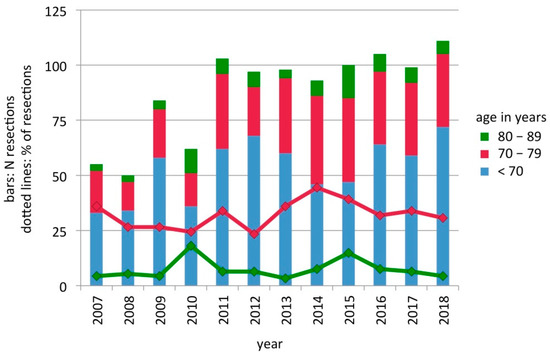
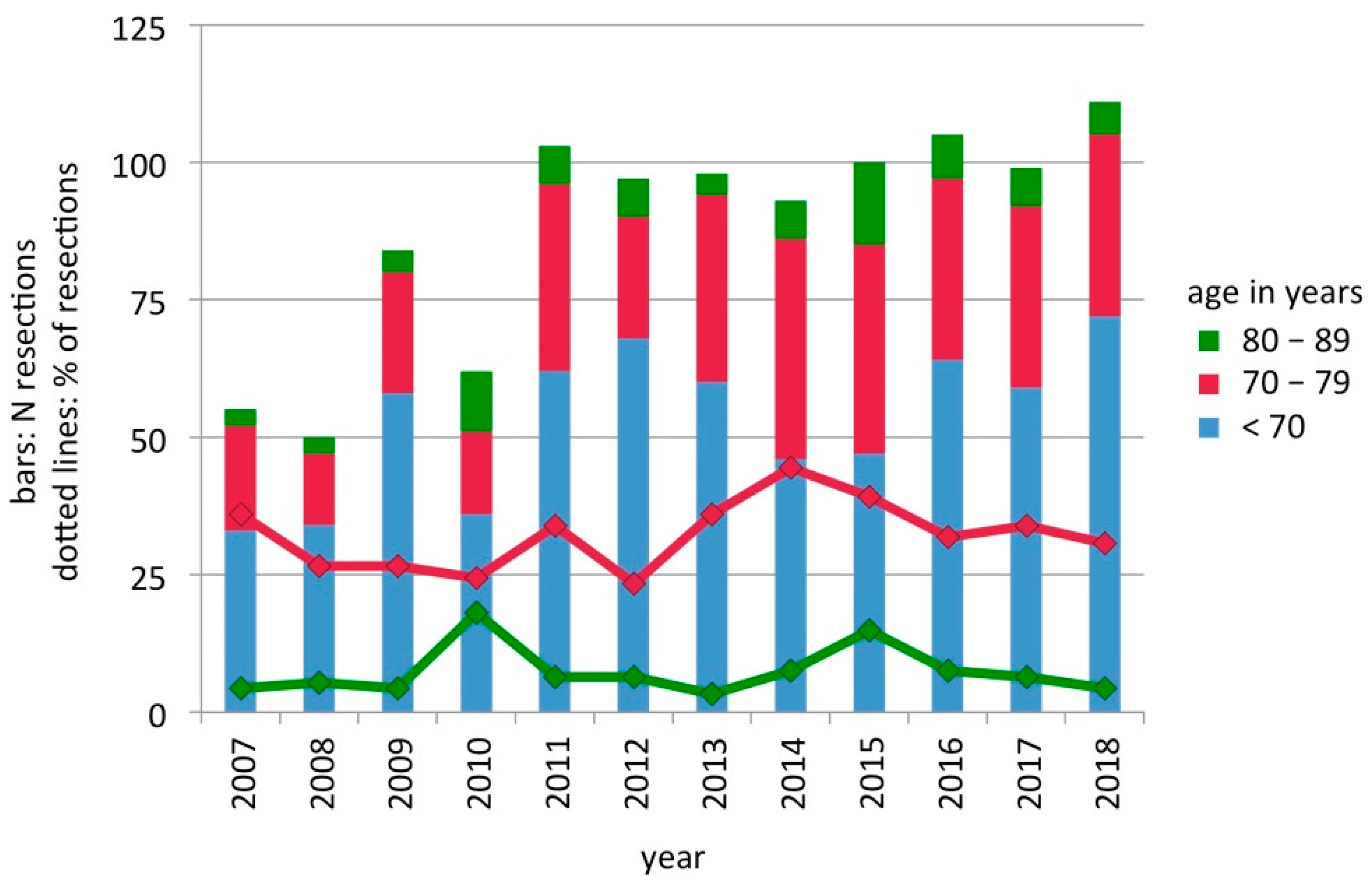
In this subgroup, the relative frequency of older patients per year did not change substantially over the course of time (Figure 1). Patients were distributed equally gender- (p = 0.403) and BMI-wise (p = 0.124). However, septuagenarians and octogenarians preoperatively more frequently displayed higher ASA-scores III and IV (p < 0.001) and presented with more overall comorbidities (p < 0.001), especially with cardiovascular (coronary artery disease and arterial hypertension, both p < 0.001), chronic renal insufficiency (p < 0.001), diabetes mellitus (p = 0.048) and preoperative anemia (hemoglobin <10 g/dL) diagnoses, while pulmonary and hepatic comorbidities were not different in frequency between the age groups (p = 0.782 and p = 0.852, respectively). Positive history for alcohol abuse (p = 0.001) and nicotine consumption (p < 0.001) was less likely in older persons undergoing pancreatic resection (Table 2).
Figure 1.
Pancreatic resections per year from the “PD and DP only” study subpopulation (N = 1096) according to age groups.
Table 2.
Demographic, clinical and perioperative characteristics of the “PD and DP only” study subpopulation (N = 1096) according to age groups.
The distribution between PD and DP was similar in all age groups (p = 0.092). Yet, a final histopathological diagnosis of carcinoma was more frequent and one of neuroendocrine tumor or benign lesion less frequent in older patients (p < 0.001). Compared with younger patients, portal vein resection was significantly more often performed in septuagenarians and octogenarians (p = 0.008), but frequency of multivisceral resection was not different (+stomach: p = 0.881; +colon: p = 0.600; +liver: p = 0.191). Overall operative time (0.792), amount of blood loss (p = 0.582) and transfusion of packed red blood cells (p = 0.264) were similar (Table 2).
Regarding postoperative complications, only delayed gastric emptying (grades B+C, according to the ISGPS-definition) occurred significantly more frequently in older patients (p < 0.001). All other measures, including biliary leak (p = 0.627), clinically relevant postoperative pancreatic fistula (grades B+C, according to ISGPS-definition; p = 0.303), post-pancreatectomy hemorrhage (grades B+C, according to ISGPS-definition; p = 0.980), surgical site infection (p = 0.838), necessity for reoperation (p = 0.709) or intervention (p = 0.111), postoperative sepsis (p = 0.609), renal failure (p = 0.501), pneumonia (p = 0.761), thromboembolism (p = 0.458) and the need for reintubation (p = 0.232) were not different between the age groups. Length of intensive care/intermediate care unit (ICU) stay was not different accordingly (p = 0.192), but overall hospital stay appeared to have been slightly longer for septuagenarians and octogenarians (p = 0.031) (Table 2). In univariate binary logistic regression, analyses for exploration of age group as a risk factor for postoperative morbidity (biliary leak, DGE, POPF, PPH, postoperative sepsis, renal failure, pneumonia, thromboembolism and length of hospital stay) after DP and PD, only the analysis for DGE yielded results suggestive for significant difference (octogenarians vs. <70: OR 1.75, p = 0.079; septuagenarians vs. <70: OR 2.15, p < 0.001; septuagenarians vs. octogenarians: OR 1.23, p = 0.533).
Importantly, there was no statistical difference between age groups regarding postoperative in-hospital mortality (p = 0.187), although the numbers (<70: 2.3%; septuagenarians: 3.1%; octogenarians: 6%) suggested a trend (Table 2). Interestingly, the final determining etiologic factor for in-hospital mortality of older individuals compared with patients <70 years of age was rather related to surgical complications and less frequently of a mere medical nature (Table 3). In addition, we performed binary logistic regression analyses for the identification of independent risk factors for postoperative mortality after PD and DP. Univariate analyses revealed a p < 0.05 not for age groups, but for biliary leak, POPF (grades B+C), PPH (grades B+C), surgical site infection (SSI), reoperation and intervention, postoperative sepsis, renal failure, pneumonia, thromboembolism, reintubation, ICU- and overall hospital-stay. When including all variables with p < 0.05 in univariate analyses (except for ICU-stay, due to a relevant N = 300 of missing data), as defined a priori as inclusion threshold, into a multivariable regression model, only postoperative sepsis (OR 7.84, p = 0.033) and reintubation (OR 8.53, p = 0.020) remained statistically relevant and independent risk factors for postoperative in-hospital mortality (Table 4).
Table 3.
Etiologic factors for postoperative mortality of patients in the “PD and DP only” study subpopulation (N = 1096) according to age groups.
Table 4.
Binary logistic regression analysis for identification of independent risk factors for postoperative mortality after pancreatic resection within the “PD and DP only” study subpopulation (N = 1096).
3.3. Oncological Outcome for Pancreatic Adenocarcinoma Patients after PD and DP
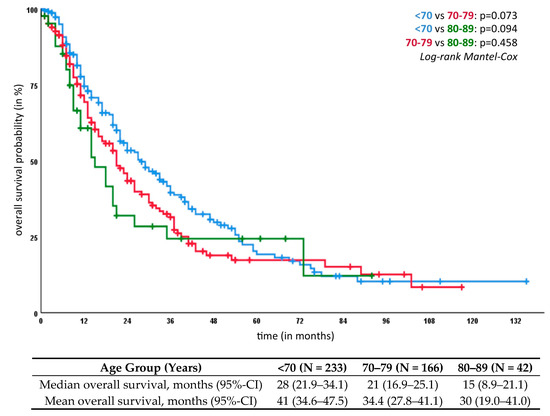
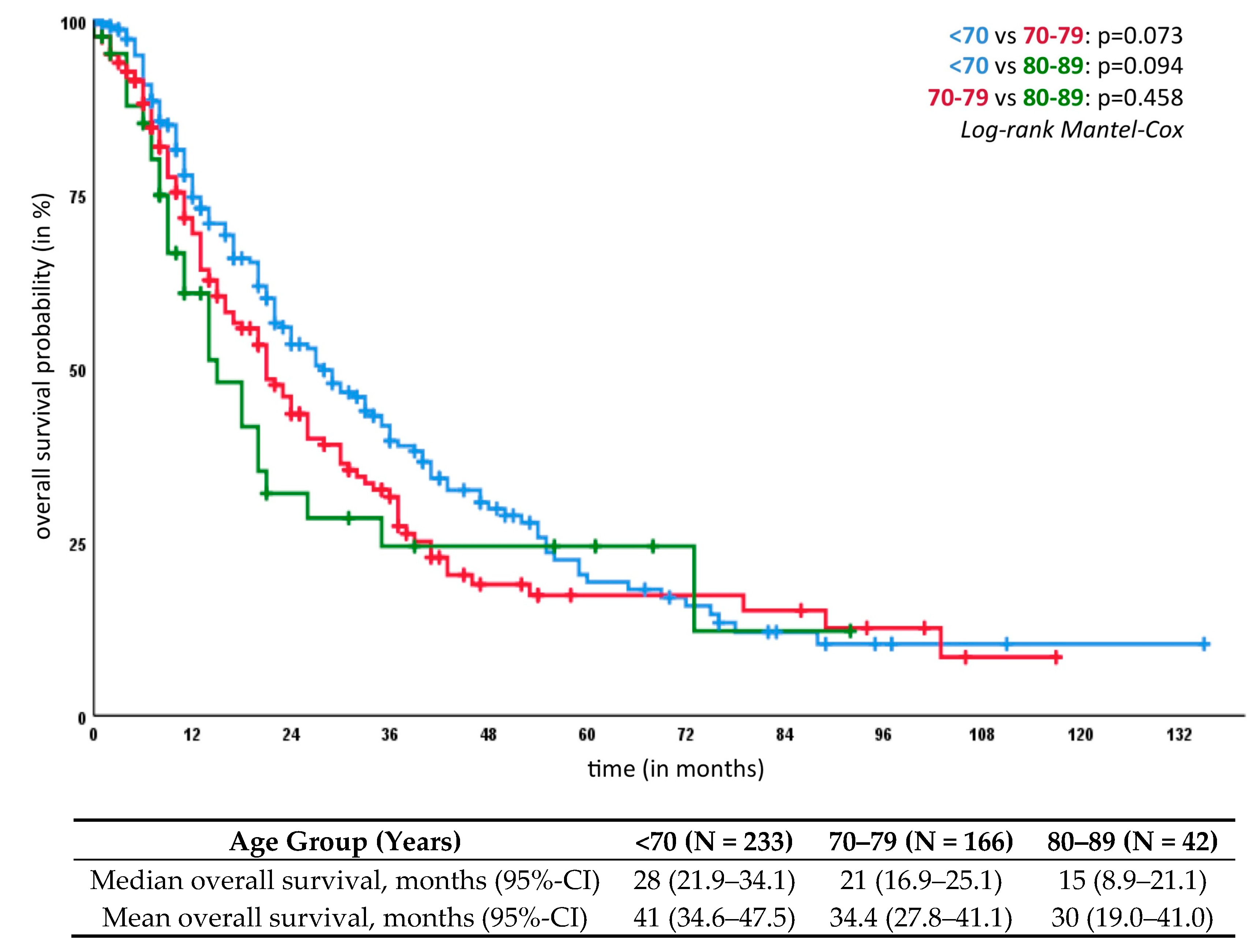
We further aimed at evaluating oncological outcomes for the subgroup of patients having undergone PD and DP for pancreatic adenocarcinoma. Specimens from the eligible 463 patients did not display differences in histopathological findings between the age groups, including tumor grade (p = 0.193), tumor size (p = 0.523), Union for International Cancer Control (UICC) stage (all parameters: p ≥ 0.390), and resection margin status (p = 0.934). However, neoadjuvant/induction chemotherapy was administered significantly less frequently for older patients (p = 0.013), and adjuvant chemotherapy was more likely to be omitted in the postoperative care for septuagenarians and octogenarians (p < 0.001) (Table 5). Nevertheless, with regard to overall survival (OS), older patients virtually equally benefitted from surgical resection. Mean OS was 28 months, 21 months and 15 months for patients <70 years of age, septuagenarians and octogenarians, respectively (all Log-rank Mantel–Cox comparisons: not significant). However, the differences in the steepness of the Kaplan–Meier curves in the first 24–48 months postoperatively suggest a trend for worse OS with increasing age. Yet, the curves align after 60 months, resulting in an equal frequency of long-term survivors (Figure 2) across the different age groups.
Table 5.
Oncological characteristics of patients with PAC within the “PD and DP only” study subpopulation (N = 463) according to age groups.
Figure 2.
Kaplan-Meier survival estimate of patients with PAC within the “PD and DP only” study subpopulation (N = 441) according to age groups.
Cox proportional hazards regression modeling was used for identification of independent risk factors for shortened OS after PD and DP for pancreatic adenocarcinoma. In univariate analysis, only portal vein resection, operative time and histopathological variables (tumor grade, UICC pT/pN/pV/pL/pPn, lymph nodes ratio (LNR) and R-status), but not age group or BMI, ASA, comorbidities, procedure performed (including multivisceral resection), blood transfusion, tumor size or, surprisingly, (neo-) adjuvant therapy yielded a p-value of <0.05, defined a priori as inclusion criterion for multivariable analysis. When including all these variables with p < 0.05 in univariate analyses into a multivariable regression model, only tumor grade (G1/2 vs. G3/4: HR 0.59, p < 0.001) LNR (from 0 to 1: HR 3.93, p = 0.001) and R-status (R0 vs. R1/2: HR 0.65, p = 0.008) remained statistically relevant and independent risk factors for overall survival after resection of pancreatic adenocarcinoma (Table 6).
Table 6.
Cox proportional hazards regression analysis for identification of independent risk factors for overall survival after pancreatic resection for PAC within the “PD and DP only” study subpopulation (N = 441).
4. Discussion
In spite of substantial progress regarding postoperative outcomes and patient safety through improvement in surgical and anesthetic techniques, perioperative care and centralization, pancreatic resections still represent procedures with a risk for relevant postoperative morbidity and mortality [2,6]. Especially pancreatic cancer and carcinomas of the periampullary area, if feasible, require surgical resection for optimal disease control. Incidence of these tumors naturally increases with age and an overall aging population will multiply prevalence in the future [1,3]. Our data, spanning a period of more than 12 years, did not yet confirm a substantial increase in relative frequency of older persons undergoing pancreatic resection in our institution. Still, older individuals are often not even referred for surgical therapy if a diagnosis of aggressive pancreatic malignancy has been made [21,22]. However, patients ≥70 years of age already represented almost 50% of cases having undergone pancreatic surgery for carcinoma in our series. Clarification of the risk-benefit profile and internal quality control of an aggressive therapy approach such as pancreatic resection in patients of advanced age is therefore of importance to guide future clinical decision-making and recommendation. This study sought to examine how perioperative and oncological outcomes differ between younger and older patients.
4.1. Perioperative Outcome
Although older patients presented with significantly higher ASA-scores and more comorbidities than younger ones, they less frequently had a positive history of alcohol or nicotine abuse, likely suggestive of a healthier life-style in general and of—an intended—surgeon-driven selection bias. Postoperative complications and morbidity were virtually equal between the age groups. The only statistically meaningful difference was increased rates of delayed gastric emptying (grades B+C) in older patients—a very manageable complication. We did not detect increased rates of respiratory or cardiac events as previously reported in meta-analyses [9,10,11]. In addition, postoperative mortality was statistically similar for patients in the three age groups, although there appeared to be a trend towards a greater risk with increasing age. Surprisingly, the main etiologic factor for postoperative mortality in older individuals was more frequently related to surgical complications than to medical morbidity, compared with younger patients. This observation might suggest an explanation for lower potential for wound healing and successful control of septic foci in older patients. The analysis of factors associated with postoperative mortality identified only postoperative sepsis and reintubation as independent risk factors. Age group was not found to predict postoperative mortality. Overall, these findings support a positive quality assessment of patient selection in our department and, in line with previous reports [23], the notion that pancreatic resection is safe and feasible in carefully selected older people.
4.2. Oncological Outcome
The final histopathological diagnosis after resection was significantly more often carcinoma in older patients, and segmental resections or enucleations were not performed in octogenarians. This is to be interpreted as a positive quality measure of the preoperative decision process, in which, weighing the risks and potential benefits, pancreatic surgery was recommended to older individuals virtually only in the case of radiographically suspected or histologically proven malignancy, with the aggressiveness of the lesion justifying the procedural risk profile. In the subgroup analysis for pancreatic adenocarcinoma patients, final histopathological variables regarding tumor size, tumor grading, UICC TNM staging and resection status were similar between the age groups. Interestingly, in our cohort, equal resection status was achieved by a significantly higher frequency of superior mesenteric/portal venous resections. Overall survival after resection for pancreatic adenocarcinoma was not significantly different between the age groups, although there appeared to be a trend for a decrease with advancing age. One important contributor could be the lower likelihood for older patients of having received adjuvant chemotherapy in spite of recommendation, suggesting slower full convalescence and/or some reluctance of patients or health care providers to undergo or support additional aggressive therapy after surgical resection, respectively. Importantly, pancreatic resection was able to achieve an equal fraction of long-term survivors in all age groups, comprising about 10% of patients in each group. When analyzing for independent risk factors for overall survival, only measures of aggressiveness of the disease, such as tumor grade and lymph nodes ratio, and of surgical quality in the form of resection status, turned out to be significant. Age group was not found to predict overall survival. In agreement with previous studies [24], these results stress the oncological prognostic benefit with a resection of localized pancreatic cancer even for patients with advanced age. In our center, neoadjuvant or induction therapy is only performed within clinical trials and is mostly restricted to borderline resectable or locally advanced tumors. Thus, most likely due to selection bias, the older patients of our cohort are underrepresented in the neoadjuvant category, given the higher likelihood of recommendation of a palliative therapeutic approach for older persons in a locally advanced disease setting. Confirming this notion, limited survival benefit of a surgical approach for borderline and locally advanced pancreatic cancer in patients ≥80 years of age has been reported by others [25].
4.3. Outlook
Due to its retrospective single-center character, this study has several shortcomings. It is prone to institutional bias and as for most of the previously reported studies covering this topic, generalizability is limited. Data and analyses regarding subjective quality of life and maintained self-reliance or dependence on nursing homes after resection are lacking. Yet, while there is general consensus that biological age and not chronological age is to be considered when counseling older patients towards a decision for or against pancreatic surgery [26], it is equally obvious that older patients are more likely to have significant comorbidity and present with frailty [27,28]. Despite the increasing incidence of pancreatic malignancy in older patients, they are heavily underrepresented in clinical trials. Thus, management of an obviously more vulnerable group of patients is extrapolated from results of prospective studies performed in younger patients [26] and depends on physicians’ individually tailored recommendations or surgeons’ personal clinical judgment. More robust evidence is therefore desirable and should be aimed for in (specific) prospective trials including older individuals. As an example, performing a structured and validated geriatric assessment preoperatively has already been shown to be able to increase the successful identification of older patients at high risk for complications after PD [8] and thus may support the surgical recommendation and decision process.
5. Conclusions
Given the here-presented findings of equal rates of postoperative complications, morbidity and mortality, together with a similar survival benefit for pancreatic cancer patients ≥70 years or ≥80 years of age and younger individuals, pancreatic resection is reasonable in carefully selected older patients. The results reassure us with respect to our preoperative clinical judgment regarding patient selection. Future surgical and oncological randomized trials should decidedly include older subjects to generate more robust evidence to further optimize treatment recommendation and choice.
Supplementary Materials
The following are available online at https://www.mdpi.com/2673-4095/1/1/5/s1, Table S1: Single-institution studies; Table S2: Population-based/multi-institutional studies.
Author Contributions
Conceptualization, D.A.R. and U.A.W.; Formal analysis, D.A.R., E.A.B. and U.A.W.; Methodology, D.A.R. and U.A.W.; Resources, S.F.-F., U.T.H. and U.A.W.; Supervision, U.A.W.; Writing—original draft, D.A.R.; Writing—review and editing, D.A.R., E.A.B., C.M.K., S.C., J.H., J.L., S.F.-F., U.T.H. and U.A.W. All authors have read and agreed to the published version of the manuscript.
Funding
This research received no specific external funding. The article processing charge was balanced by the Baden-Württemberg Ministry of Science, Research and Art and the University of Freiburg in the funding program Open Access Publishing.
Conflicts of Interest
The authors declare no conflict of interest.
References
- World Population Prospects—Population Division—United Nations. Available online: https://population.un.org/wpp/ (accessed on 28 June 2020).
- Kleeff, J.; Korc, M.; Apte, M.; La Vecchia, C.; Johnson, C.D.; Biankin, A.V.; Neale, R.E.; Tempero, M.; Tuveson, D.A.; Hruban, R.H.; et al. Pancreatic cancer. Nat. Rev. Dis. Primers 2016, 2, 16022. [Google Scholar] [CrossRef] [Scilit] [PubMed]
- Pancreatic Cancer Incidence Statistics. Available online: https://www.cancerresearchuk.org/health-professional/cancer-statistics/statistics-by-cancer-type/pancreatic-cancer/incidence (accessed on 3 July 2020).
- Tanaka, M.; Chari, S.; Adsay, V.; Carlos Castillo, F.-D.; Falconi, M.; Shimizu, M.; Yamaguchi, K.; Yamao, K.; Matsuno, S. International Consensus Guidelines for Management of Intraductal Papillary Mucinous Neoplasms and Mucinous Cystic Neoplasms of the Pancreas. Pancreatology 2006, 6, 17–32. [Google Scholar] [CrossRef] [Scilit]
- Tanaka, M.; Fernández-del Castillo, C.; Adsay, V.; Chari, S.; Falconi, M.; Jang, J.-Y.; Kimura, W.; Levy, P.; Pitman, M.B.; Schmidt, C.M.; et al. International consensus guidelines 2012 for the management of IPMN and MCN of the pancreas. Pancreatol. Off. J. Int. Assoc. Pancreatol. IAP Al 2012, 12, 183–197. [Google Scholar] [CrossRef] [Scilit] [PubMed]
- De Wilde, R.F.; Besselink, M.G.H.; van der Tweel, I.; de Hingh, I.H.J.T.; van Eijck, C.H.J.; Dejong, C.H.C.; Porte, R.J.; Gouma, D.J.; Busch, O.R.C.; Molenaar, I.Q.; et al. Impact of nationwide centralization of pancreaticoduodenectomy on hospital mortality. Br. J. Surg. 2012, 99, 404–410. [Google Scholar] [CrossRef] [Scilit]
- Fortin, M.; Bravo, G.; Hudon, C.; Vanasse, A.; Lapointe, L. Prevalence of Multimorbidity among Adults Seen in Family Practice. Ann. Fam. Med. 2005, 3, 223–228. [Google Scholar] [CrossRef] [Scilit]
- Dale, W.; Hemmerich, J.; Kamm, A.; Posner, M.C.; Matthews, J.B.; Rothman, R.; Palakodeti, A.; Roggin, K.K. Geriatric assessment improves prediction of surgical outcomes in older adults undergoing pancreaticoduodenectomy: A prospective cohort study. Ann. Surg. 2014, 259, 960–965. [Google Scholar] [CrossRef] [Scilit]
- Sukharamwala, P.; Prashant, S.; Thoens, J.; Jonathan, T.; Szuchmacher, M.; Mauricio, S.; Smith, J.; James, S.; DeVito, P.; Peter, D. Advanced age is a risk factor for post-operative complications and mortality after a pancreaticoduodenectomy: A meta-analysis and systematic review. HPB 2012, 14, 649–657. [Google Scholar] [CrossRef] [Scilit]
- Casadei, R.; Ricci, C.; Lazzarini, E.; Taffurelli, G.; D’Ambra, M.; Mastroroberto, M.; Morselli-Labate, A.M.; Minni, F. Pancreatic resection in patients 80 years or older: A meta-analysis and systematic review. Pancreas 2014, 43, 1208–1218. [Google Scholar] [CrossRef] [Scilit]
- Tan, E.; Song, J.; Lam, S.; D’Souza, M.; Crawford, M.; Sandroussi, C. Postoperative outcomes in elderly patients undergoing pancreatic resection for pancreatic adenocarcinoma: A systematic review and meta-analysis. Int. J. Surg. 2019, 72, 59–68. [Google Scholar] [CrossRef] [Scilit] [PubMed]
- Von Elm, E.; Altman, D.G.; Egger, M.; Pocock, S.J.; Gøtzsche, P.C.; Vandenbroucke, J.P. The Strengthening the Reporting of Observational Studies in Epidemiology (STROBE) Statement: Guidelines for reporting observational studies. Int. J. Surg. 2014, 12, 1495–1499. [Google Scholar] [CrossRef] [Scilit] [PubMed]
- Wente, M.N.; Bassi, C.; Dervenis, C.; Fingerhut, A.; Gouma, D.J.; Izbicki, J.R.; Neoptolemos, J.P.; Padbury, R.T.; Sarr, M.G.; Traverso, L.W.; et al. Delayed gastric emptying (DGE) after pancreatic surgery: A suggested definition by the International Study Group of Pancreatic Surgery (ISGPS). Surgery 2007, 142, 761–768. [Google Scholar] [CrossRef] [Scilit] [PubMed]
- Bassi, C.; Marchegiani, G.; Dervenis, C.; Sarr, M.; Abu Hilal, M.; Adham, M.; Allen, P.; Andersson, R.; Asbun, H.J.; Besselink, M.G.; et al. The 2016 update of the International Study Group (ISGPS) definition and grading of postoperative pancreatic fistula: 11 Years After. Surgery 2017, 161, 584–591. [Google Scholar] [CrossRef] [Scilit] [PubMed]
- Wente, M.N.; Veit, J.A.; Bassi, C.; Dervenis, C.; Fingerhut, A.; Gouma, D.J.; Izbicki, J.R.; Neoptolemos, J.P.; Padbury, R.T.; Sarr, M.G.; et al. Postpancreatectomy hemorrhage (PPH): An International Study Group of Pancreatic Surgery (ISGPS) definition. Surgery 2007, 142, 20–25. [Google Scholar] [CrossRef] [Scilit] [PubMed]
- Strasberg, S.M.; Drebin, J.A.; Linehan, D. Radical antegrade modular pancreatosplenectomy. Surgery 2003, 133, 521–527. [Google Scholar] [CrossRef] [Scilit] [PubMed]
- Strasberg, S.M.; Linehan, D.C.; Hawkins, W.G. Radical Antegrade Modular Pancreatosplenectomy Procedure for Adenocarcinoma of the Body and Tail of the Pancreas: Ability to Obtain Negative Tangential Margins. J. Am. Coll. Surg. 2007, 204, 244–249. [Google Scholar] [CrossRef] [Scilit]
- Partington, P.F.; Rochelle, R.E. Modified Puestow procedure for retrograde drainage of the pancreatic duct. Ann. Surg. 1960, 152, 1037–1043. [Google Scholar] [CrossRef] [Scilit]
- Frey, C.F.; Smith, G.J. Description and rationale of a new operation for chronic pancreatitis. Pancreas 1987, 2, 701–707. [Google Scholar] [CrossRef] [Scilit]
- Appleby, L.H. The coeliac axis in the expansion of the operation for gastric carcinoma. Cancer 1953, 6, 704–707. [Google Scholar] [CrossRef] [Scilit]
- He, W.; Zhao, H.; Chan, W.; Lopez, D.; Shroff, R.T.; Giordano, S.H. Underuse of surgical resection among elderly patients with early-stage pancreatic cancer. Surgery 2015, 158, 1226–1234. [Google Scholar] [CrossRef] [Scilit]
- Bilimoria, K.Y.; Bentrem, D.J.; Ko, C.Y.; Stewart, A.K.; Winchester, D.P.; Talamonti, M.S. National failure to operate on early stage pancreatic cancer. Ann. Surg. 2007, 246, 173–180. [Google Scholar] [CrossRef] [Scilit]
- Di Franco, G.; Palmeri, M.; Guadagni, S.; Furbetta, N.; Gianardi, D.; Bronzoni, J.; Palma, A.; Bianchini, M.; Musetti, S.; Bastiani, L.; et al. Pancreatic resections in elderly patients with high American Society of Anesthesiologists’ risk score: A view from a tertiary care center. Aging Clin. Exp. Res. 2020, 32, 935–950. [Google Scholar] [CrossRef] [Scilit] [PubMed]
- Park, H.M.; Park, S.-J.; Han, S.-S.; Kim, S.H. Surgery for elderly patients with resectable pancreatic cancer, a comparison with non-surgical treatments: A retrospective study outcomes of resectable pancreatic cancer. BMC Cancer 2019, 19, 1090. [Google Scholar] [CrossRef] [Scilit] [PubMed]
- Kondo, N.; Uemura, K.; Nakagawa, N.; Okada, K.; Seo, S.; Takahashi, S.; Murakami, Y. Reappraisal of the validity of surgery for patients with pancreatic cancer aged 80 years or older stratified by resectability status. J. Hepato Biliary Pancreat. Sci. 2020, 27, 64–74. [Google Scholar] [CrossRef] [Scilit] [PubMed]
- Higuera, O.; Ghanem, I.; Nasimi, R.; Prieto, I.; Koren, L.; Feliu, J. Management of pancreatic cancer in the elderly. World J. Gastroenterol. 2016, 22, 764–775. [Google Scholar] [CrossRef] [Scilit]
- Makary, M.A.; Segev, D.L.; Pronovost, P.J.; Syin, D.; Bandeen-Roche, K.; Patel, P.; Takenaga, R.; Devgan, L.; Holzmueller, C.G.; Tian, J.; et al. Frailty as a predictor of surgical outcomes in older patients. J. Am. Coll. Surg. 2010, 210, 901–908. [Google Scholar] [CrossRef] [Scilit]
- Olotu, C.; Weimann, A.; Bahrs, C.; Schwenk, W.; Scherer, M.; Kiefmann, R. The Perioperative Care of Older Patients. Dtsch. Arztebl. Int. 2019, 116, 63–69. [Google Scholar] [CrossRef] [Scilit]

© 2020 by the authors. Licensee MDPI, Basel, Switzerland. This article is an open access article distributed under the terms and conditions of the Creative Commons Attribution (CC BY) license (http://creativecommons.org/licenses/by/4.0/).