4. Results
4.1. Visual Analysis of SDGI and Sustainable Development Goals Across Countries
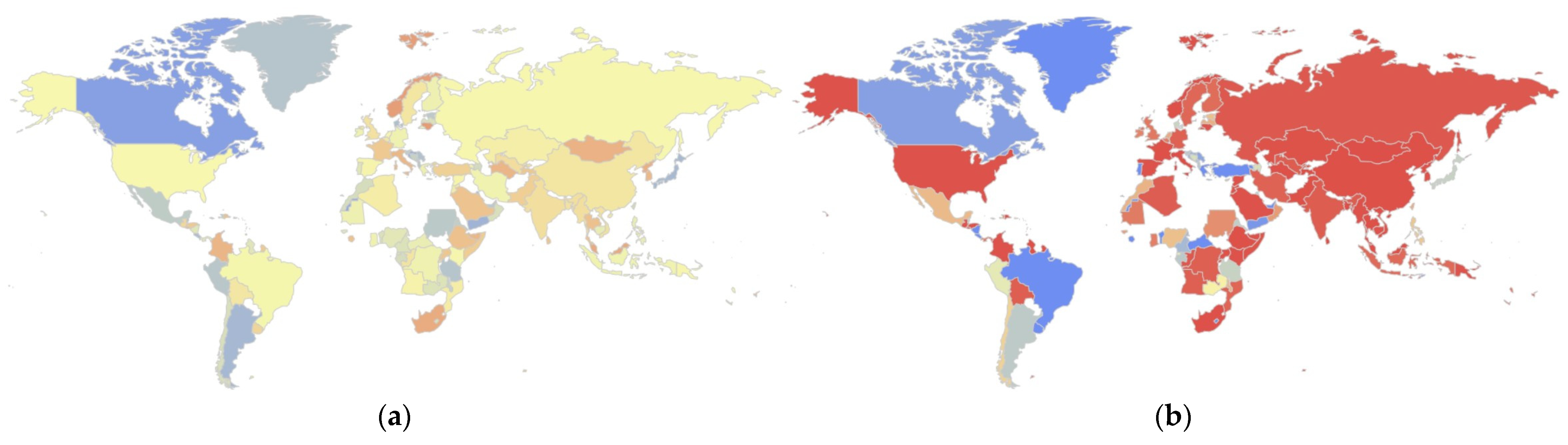
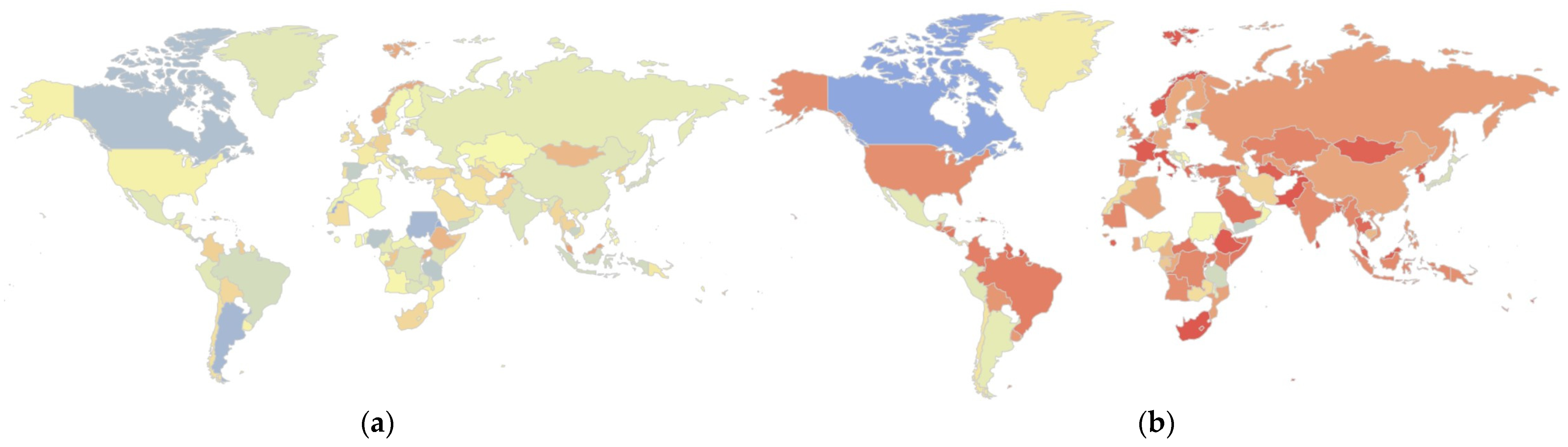
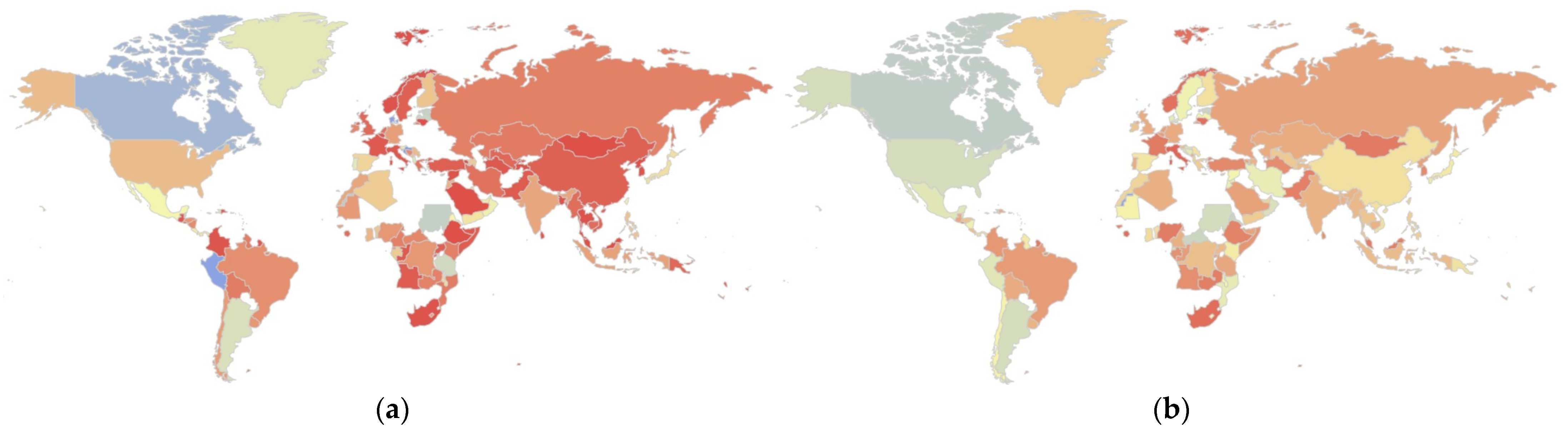
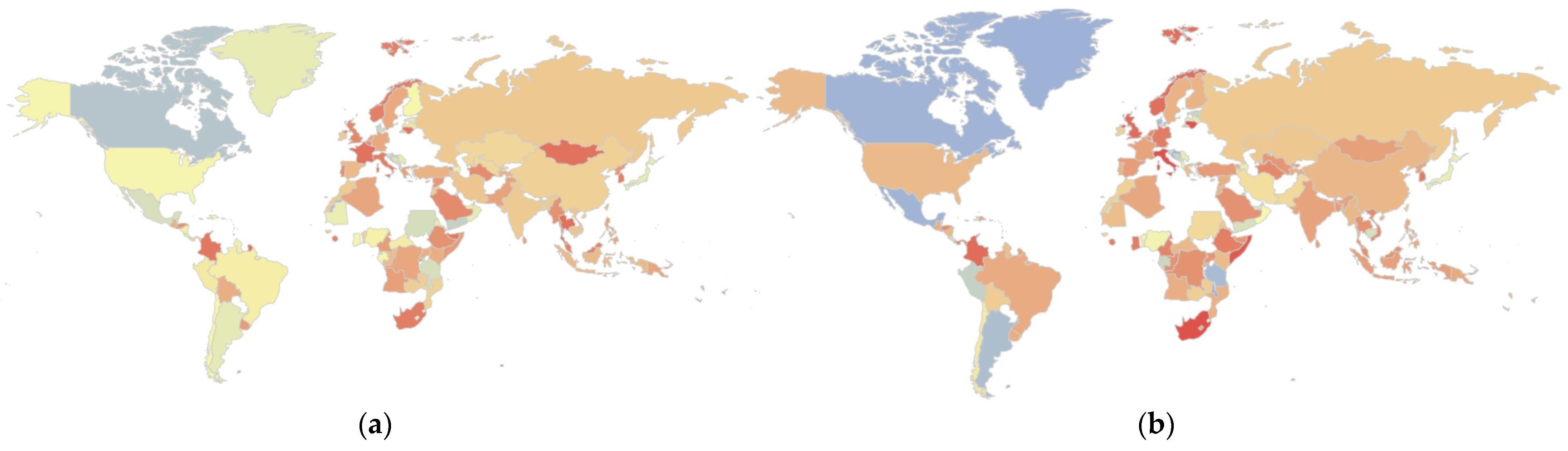
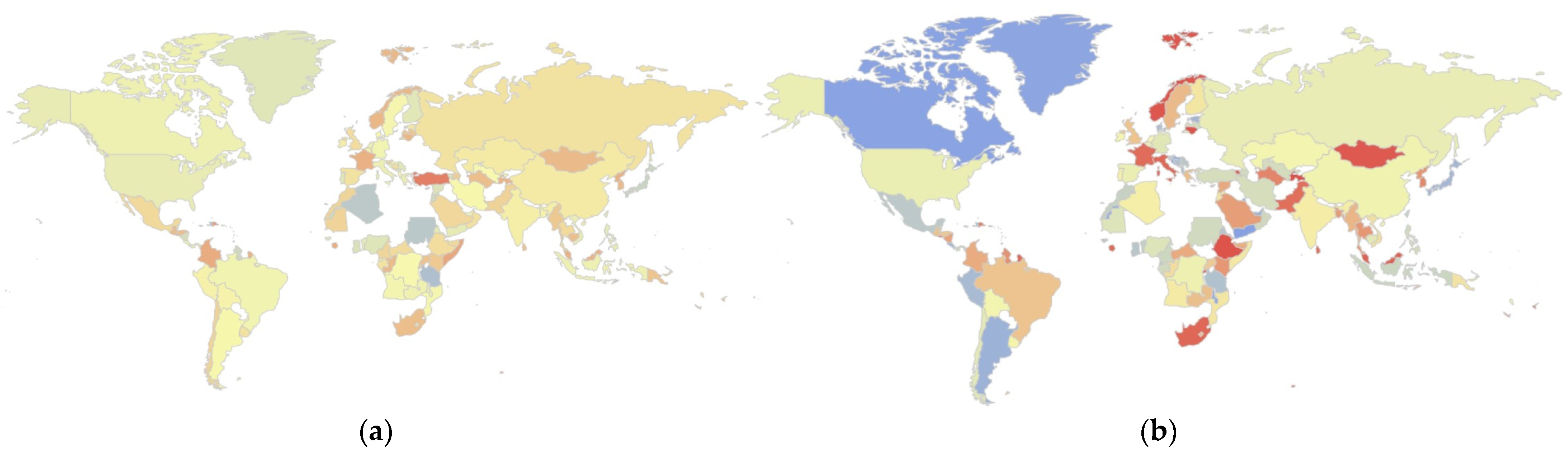
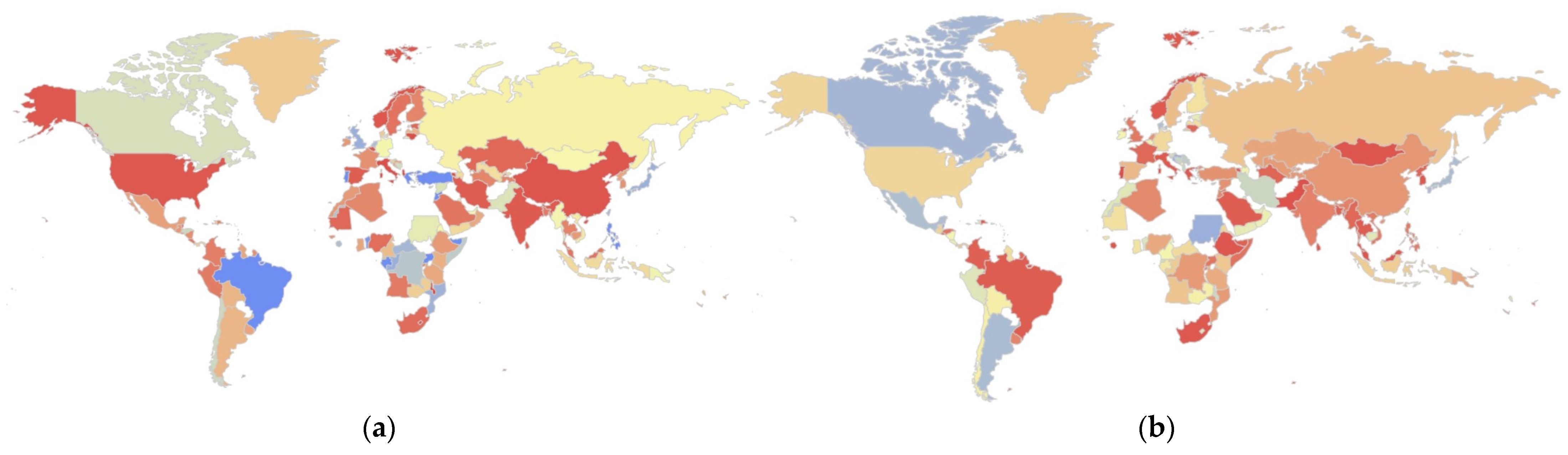
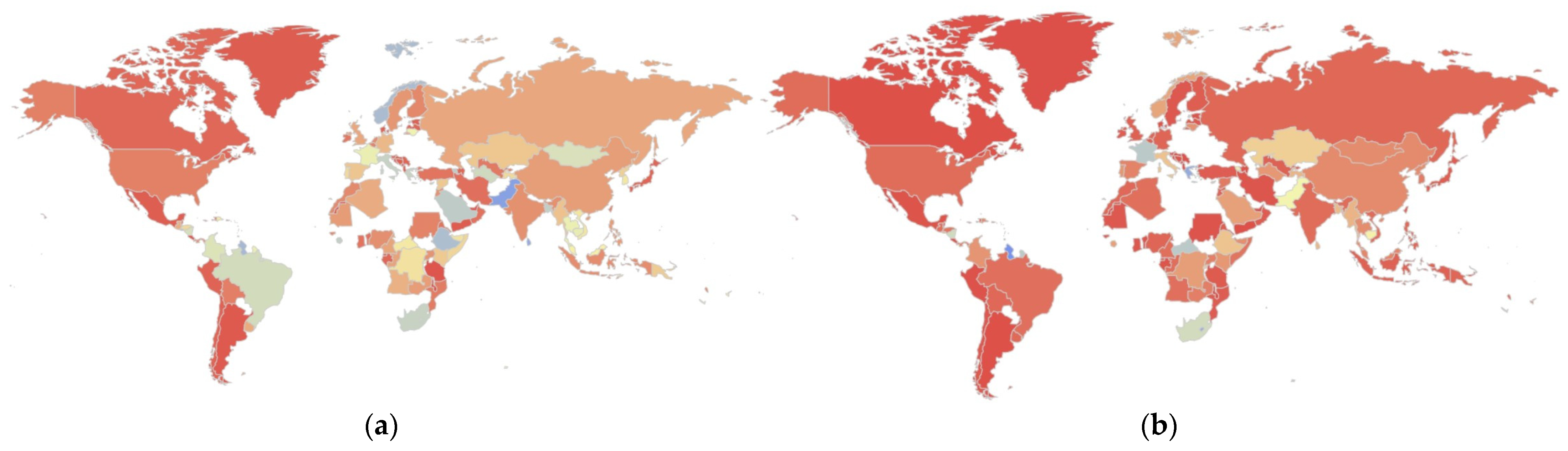
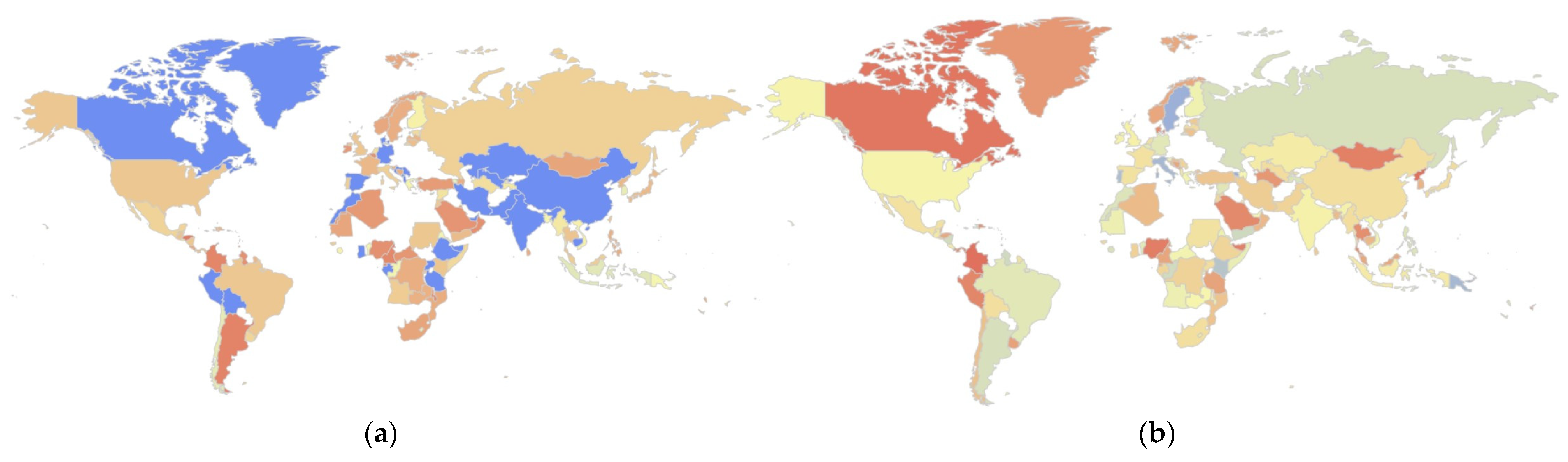
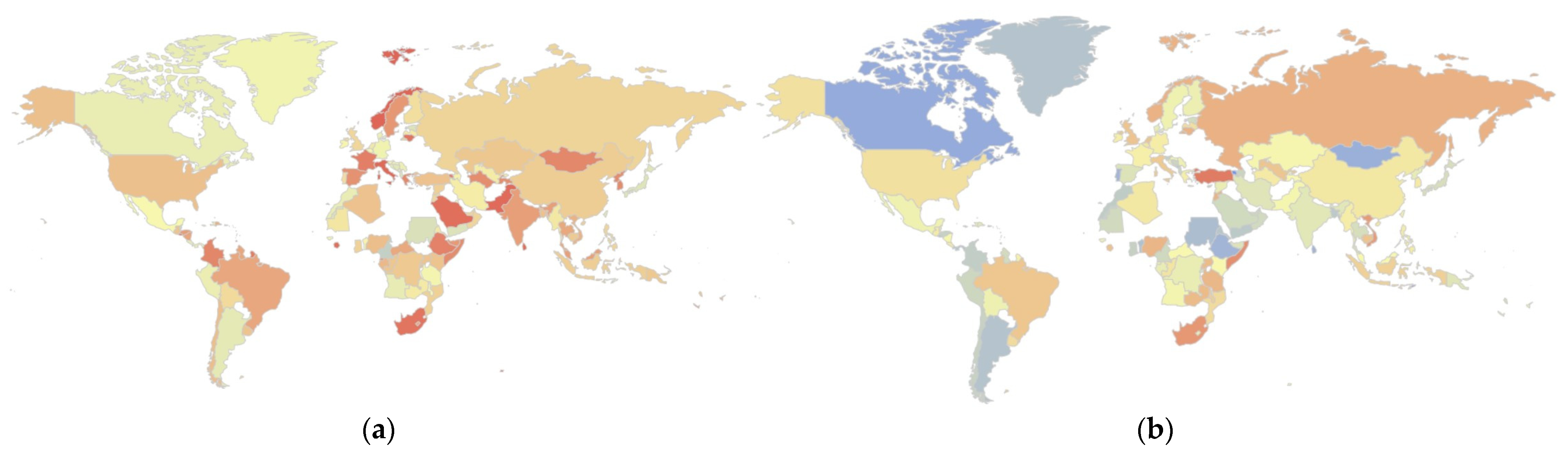
At the initial stage of research, to identify relationships between SDGI values and quantitative assessments of their development in achieving each of the 17 sustainable development goals for 2024 across 154 countries [
2], choropleth maps were constructed for all studied indicators (
Appendix A). The conducted comparative visual analysis revealed interesting patterns and regularities.
SDGI vs. Goal 1 (No Poverty)
A clear positive correlation was identified between SDGI and indicators of achieving Goal 1 on poverty eradication. Specifically, Scandinavian countries exhibit the highest values for both SDGI and Goal 1, confirming the effectiveness of comprehensive development strategies in ensuring social welfare. The European continent demonstrates an analogous pattern, where states with high overall development indices are also characterized by high poverty eradication indicators, evidencing a systematic approach to social policy in the region. The North American region maintains this trend with high values for both indicators, emphasizing the connection between economic development and social protection. Latin American countries reveal moderate positive correlation, where states with higher SDGI predominantly demonstrate better results for Goal 1, although variability within the region remains notable. The Asian macroregion is characterized by significant differentiation, where East Asian economies with high overall indices show high results in poverty eradication, whereas South Asian states with lower SDGI demonstrate correspondingly lower indicators for the first goal. The African continent exhibits the lowest values for both indicators, confirming the systemic nature of development challenges in this region and the necessity for comprehensive interventions. The identified global pattern confirms the existence of a direct relationship between a country’s overall level of sustainable development and its success in poverty eradication, indicating that Goal 1 is an integral component of overall progress in achieving sustainable development goals.
SDGI vs. Goal 2 (Zero Hunger, Achieving Food Security and Improved Nutrition)
A weak and ambiguous correlation is observed between SDGI and countries’ achievement of Goal 2 on hunger eradication. In Scandinavian countries, with the highest SDGI indicators, moderate values are recorded for Goal 2, indicating the existence of specific food security challenges even in highly developed states. The European continent demonstrates a heterogeneous picture, where Western European states with high overall indices are characterized by average results in hunger eradication, not reaching maximum values despite their overall level of development. The North American region reveals a similar tendency with high SDGI alongside moderate Goal 2 indicators, which may reflect structural peculiarities of food systems or methodological aspects of measuring food security. The Asian macroregion is characterized by the greatest variability, where individual states demonstrate high results for the second goal with moderate overall index values, evidencing the possibility of targeted achievements in food security regardless of overall development level. Latin American countries with relatively high SDGI show average values for Goal 2, supporting the general trend of absence of direct proportionality between indicators. The African continent demonstrates predominantly low indicators for both indices, although individual states reveal relatively better results specifically for the second goal. The identified patterns indicate that a high level of overall sustainable development does not automatically ensure high achievements in hunger eradication, emphasizing the specific nature of food security challenges and the necessity for specialized agricultural policies regardless of a country’s overall level of economic and social development.
SDGI vs. Goal 3 (Good Health and Well-being)
A strong positive correlation exists between SDGI and the achievement of Goal 3 on good health and well-being. Specifically, in Scandinavian countries, the highest SDGI indicators are accompanied by the highest values for Goal 3, evidencing the effectiveness of healthcare systems in highly developed states. The European continent demonstrates a clear pattern, where Western European states with high overall indices are characterized by high results in the health sphere, confirming the direct link between development level and quality of medical services. The North American region reveals high indicators for both indices, supporting the general trend of positive correlation between economic development and population health. The Asian macroregion is characterized by significant differentiation, where East Asian economies with high SDGI demonstrate high results for the third goal, whereas Central Asian and South Asian states with moderate overall indices show moderate values in healthcare. Latin American countries with relatively high SDGI demonstrate moderately high results for Goal 3, indicating the persistence of certain challenges in healthcare systems despite overall development level. The African continent exhibits the lowest indicators for both indices, emphasizing the critical state of healthcare systems in the region and their close connection with overall economic and social development level. The Middle Eastern region demonstrates a heterogeneous picture with moderate values for both indicators, reflecting variability in healthcare sector investments. The identified patterns confirm the existence of a direct and strong relationship between a country’s overall sustainable development and its achievements in ensuring population health, indicating that Goal 3 is one of the key components of overall progress in achieving sustainable development goals.
SDGI vs. Goal 4 (Quality Education)
A very strong positive correlation was determined between the Sustainable Development Goal Index (SDGI) and the achievement of Goal 4 on quality education. In Scandinavian countries, the highest SDGI indicators are accompanied by the highest values for Goal 4, confirming the central role of educational systems in ensuring sustainable development of highly developed states. The European continent demonstrates almost absolute correspondence between indicators, where Western European states with high overall indices are characterized by the highest results in education, reflecting the priority of educational policy in the region. The North American region reveals high indicators for both indices, although slight variability in achieving educational goals is observed. The Asian macroregion is characterized by a clear pattern, where East Asian economies with high SDGI demonstrate maximum results for the fourth goal, whereas South Asian states with moderate overall indices show moderate values in education, confirming the direct dependency between development level and access to quality education. Latin American countries with relatively high SDGI demonstrate high results for Goal 4, indicating the success of educational reforms and investments in human capital in the region. The African continent exhibits the lowest indicators for both indices, emphasizing critical challenges in ensuring access to education and its quality in the world’s least developed states. The Middle Eastern region demonstrates significant variability with predominantly moderate and high values for Goal 4 even with moderate SDGI indicators, which may reflect targeted investments in the educational sector in individual states of the region. The identified patterns confirm the existence of the strongest relationship among all studied goals between overall sustainable development and achievements in education, indicating that Goal 4 is a fundamental foundation for achieving all other sustainable development goals and a central element of a country’s progress.
SDGI vs. Goal 5 (Gender Equality)
A moderate positive correlation was identified between SDGI and the achievement of Goal 5 on gender equality, although the relationship is significantly weaker compared to other goals. In Scandinavian countries, the highest SDGI indicators are accompanied by the highest values for Goal 5, confirming the leadership of Northern European states in ensuring gender equality. The European continent demonstrates a heterogeneous picture, where Western European states with high overall indices are characterized by high results in gender equality, however Eastern European countries with relatively high SDGI show moderate or even low values for the fifth goal, indicating the persistence of cultural and structural barriers. The North American region reveals high SDGI indicators with moderately high Goal 5 values, evidencing the existence of certain challenges in achieving full gender equality even in economically developed states. The Asian macroregion is characterized by the greatest variability and weakest correlation, where states with high overall indices demonstrate a wide range of results for the fifth goal from moderate to high values, reflecting cultural peculiarities and different approaches to gender policy. Latin American countries with relatively high SDGI show moderately high results for Goal 5, supporting the general trend of positive but non-absolute correlation. The African continent reveals the greatest unpredictability in indicator relationships, where individual states with low SDGI demonstrate relatively high gender equality values, whereas others with similar development levels show low results for the fifth goal. The Middle Eastern region is characterized by predominantly low Goal 5 indicators even with moderate overall index values, emphasizing the influence of cultural and religious factors on gender policy regardless of economic development. The identified patterns indicate that a high level of overall sustainable development does not automatically guarantee high achievements in gender equality, as this aspect largely depends on sociocultural norms, historical traditions, and political will, making Goal 5 one of the least economically determined among all sustainable development goals.
SDGI vs. Goal 6 (Clean Water and Sanitation)
A strong positive correlation is observed between SDGI and the achievement of Goal 6 on clean water and sanitation. In Scandinavian countries, the highest SDGI indicators are accompanied by high values for Goal 6, confirming the effectiveness of water supply infrastructure systems in highly developed states. The European continent demonstrates a clear pattern, where Western European states with high overall indices are characterized by high results in ensuring access to clean water and sanitation, reflecting the development of municipal infrastructure in the region. The North American region reveals high indicators for both indices, supporting the general trend of direct dependency between development level and water supply quality. The Asian macroregion is characterized by significant differentiation, where East Asian economies with high SDGI demonstrate moderately high results for the sixth goal, whereas South Asian and Central Asian states with moderate overall indices show moderate values in water supply and sanitation, indicating the existence of infrastructure challenges even with relatively high economic development. Latin American countries with relatively high SDGI demonstrate moderately high and high results for Goal 6, evidencing the success of investments in water infrastructure, although individual states reveal lower indicators, reflecting uneven development in the region. The African continent exhibits predominantly low and moderate indicators for both indices, emphasizing critical challenges in ensuring access to clean water and basic sanitation in the world’s least developed states. The Middle Eastern region demonstrates significant variability with a wide range of values for Goal 6 at moderate SDGI indicators, which may reflect both natural limitations of water resources in arid zones and varying levels of investment in water infrastructure. The identified patterns confirm the existence of a strong relationship between overall sustainable development and achievements in ensuring access to clean water and sanitation, indicating that Goal 6 is an important component of basic infrastructure necessary for ensuring a decent standard of living and achieving other sustainable development goals.
SDGI vs. Goal 7 (Affordable and Clean Energy)
A moderate relationship was identified between SDGI and the achievement of Goal 7 on ensuring access to affordable, reliable, sustainable, and modern energy sources. Specifically, the Scandinavian region exhibits a high SDGI level and simultaneously high level of Goal 7 achievement, evidencing systemic integration of energy policy into the sustainable development strategy. The Central European region demonstrates high overall index indicators with somewhat lower values for the energy goal, which may indicate challenges in energy system transformation. The Latin American region reveals a heterogeneous picture, where the southern part of the continent demonstrates relatively high Goal 7 achievement indicators with moderate overall index values. This may reflect successful hydropower development and targeted electrification policy. The African continent is characterized by the lowest indicators for both indices, especially in the sub-Saharan region, confirming the critical role of energy poverty as a barrier to sustainable development. The Asian region demonstrates significant variability with moderate indicators for both parameters. The North American region is characterized by high SDGI with moderate energy goal achievement indicators. The Middle Eastern region does not exhibit the expected leadership in energy accessibility despite natural resources. The identified patterns indicate the absence of direct linear correlation between the overall index and energy achievements, emphasizing the necessity for targeted strategies to achieve Goal 7 regardless of a country’s overall development level.
SDGI vs. Goal 8 (Decent Work and Economic Growth)
The results of comparative visual analysis provide grounds to assert the existence of a complex and ambiguous relationship between SDGI and the achievement of Goal 8 on promoting sustained, inclusive, and sustainable economic growth, full and productive employment, and decent work for all. The Scandinavian region demonstrates high overall index indicators with moderate Goal 8 achievement values, which may reflect peculiarities of measuring economic growth in post-industrial economies. The Central European region is characterized by high levels of both the overall index and Goal 8 achievement. The Eastern European space reveals relatively high Goal 8 achievement indicators with moderate overall index values. The Latin American region demonstrates notably higher Goal 8 indicators compared to the overall development index, especially in the northern part of the continent. The African continent presents a heterogeneous picture, where unlike energy accessibility, relatively better indicators are observed in the sphere of economic growth and employment. The Asian region is characterized by moderate and high Goal 8 achievement indicators at various overall index levels. The North American region is characterized by high indicators for both indices. The Middle Eastern region reveals moderate indicators for both parameters. The identified patterns indicate that economic growth and employment are more dynamic indicators that can rapidly change even in countries with moderate overall development levels, but do not automatically convert into comprehensive sustainable development.
SDGI vs. Goal 9 (Industry, Innovation and Infrastructure)
A clear correlation is observed between SDGI and the achievement of Goal 9 on building resilient infrastructure, promoting inclusive and sustainable industrialization, and fostering innovation. The Scandinavian and North American regions demonstrate the highest indicators for both indices with practically complete correspondence between the overall development level and achievements in infrastructure and innovation. Central and Western Europe are characterized by high indicators for both parameters. The East Asian region demonstrates a pronounced advantage of Goal 9 indicators over the overall development index, reflecting the priority of industrialization and infrastructure development. The Latin American region reveals contrasts, where lower Goal 9 achievement indicators are observed compared to the overall index in certain parts of the continent. The African continent presents the lowest indicators for both indices, confirming infrastructure deficit as a fundamental barrier to development. The Middle Eastern region demonstrates a heterogeneous picture. The identified patterns indicate the strongest correlation of Goal 9 with the overall sustainable development index, emphasizing the critical role of infrastructure and innovation as prerequisites for progress in achieving the entire complex of sustainable development goals.
SDGI vs. Goal 10 (Reduced Inequalities)
A weak and ambiguous relationship was identified between the overall Sustainable Development Goal Index (SDGI) and the achievement of Goal 10 on reducing inequalities. The Scandinavian region demonstrates a high SDGI level with moderate Goal 10 achievement indicators, indicating that even in the most developed countries, challenges remain in fully overcoming inequality. The North American region reveals a contrast, where high overall index indicators are accompanied by low Goal 10 achievement values. This emphasizes that a high overall development level does not guarantee equitable distribution of opportunities in society. Central and Eastern Europe are characterized by high levels of both the overall index and Goal 10 achievement, reflecting a certain development balance. The Latin American region demonstrates high overall index indicators with low Goal 10 achievement values, indicating the persistence of deep social inequality despite overall development. The African continent presents a heterogeneous picture with variable Goal 10 achievement indicators at low overall index values. The Asian region is characterized by significant variability of Goal 10 indicators at various overall index levels. The Middle Eastern region demonstrates low Goal 10 achievement indicators with moderate overall index values. The identified geographical patterns indicate the absence of clear correlation between the overall sustainable development index and success in reducing inequality, emphasizing the necessity for targeted policy decisions to achieve Goal 10 regardless of a country’s overall development level.
SDGI vs. Goal 11 (Sustainable Cities and Communities)
A moderate positive correlation was identified between SDGI and the achievement of Goal 11 on making cities and human settlements inclusive, safe, resilient, and sustainable. The Scandinavian region demonstrates high indicators for both indices, evidencing successful urban policy and development of sustainable urban infrastructure as a component of overall high development level. The North American region is characterized by high SDGI level with high Goal 11 achievement indicators, reflecting developed urban infrastructure and settlement system. Central and Western Europe reveal high indicators for both parameters, indicating balanced development of urban territories and their integration into the overall sustainable development strategy. Eastern Europe demonstrates a high level of both the overall index and Goal 11 achievement, which may reflect the legacy of planned urban development and their subsequent modernization. The Latin American region is characterized by high Goal 11 achievement indicators with moderate overall index values, especially in the southern part of the continent. This may reflect a high urbanization level and urban infrastructure development as a priority development direction. The African continent presents a heterogeneous picture, where low indicators are observed for both indices in most regions, indicating urbanization challenges and insufficient urban infrastructure development. The Asian region is characterized by significant variability, where individual territories demonstrate moderate indicators for both parameters. The Middle Eastern region reveals moderate indicators for both the overall index and Goal 11 achievement. The identified patterns provide grounds to assert that the development of sustainable cities and communities is closely related to a country’s overall development level, however urban policy can be successful even with moderate overall index indicators, emphasizing the role of targeted investments in urban infrastructure for achieving Goal 11.
SDGI vs. Goal 12 (Responsible Consumption and Production)
A paradoxical and inverse relationship is observed between SDGI and the achievement of Goal 12 on ensuring sustainable consumption and production patterns. The Scandinavian region demonstrates a high SDGI level with low Goal 12 achievement indicators, indicating that a high development level is accompanied by intensive resource consumption and a significant ecological footprint. The North American region reveals an analogous pattern, where high overall index indicators are accompanied by low Goal 12 achievement values. This emphasizes that developed economies are characterized by high consumption levels that contradict the principles of rational resource use. Central and Western Europe are characterized by a high overall index level with low Goal 12 achievement indicators, reflecting high living standards and intensive consumption in developed European countries. The Latin American region demonstrates an opposite tendency, where moderate overall index indicators are accompanied by high Goal 12 achievement values. This may reflect a lower consumption level and smaller ecological footprint with less intensive resource use. The African continent presents the highest Goal 12 achievement indicators with the lowest overall index values, indicating minimal resource consumption and low ecological footprint, conditioned by limited economic development. The Asian region is characterized by significant variability, where high Goal 12 achievement indicators are observed with moderate overall index values in most territories. The Middle Eastern region reveals moderate or low Goal 12 achievement indicators with moderate overall index values. The identified geographical patterns indicate a clear inverse correlation between the overall sustainable development index and Goal 12 achievement. Countries with high economic development levels demonstrate the lowest responsible consumption indicators, whereas the least developed countries reveal the highest values for this goal. This emphasizes the fundamental conflict between traditional economic growth models and ecological sustainability principles, indicating the necessity for consumption model transformation in developed countries to achieve genuine sustainable development.
SDGI vs. Goal 13 (Climate Action)
An unexpected inverse relationship exists between SDGI and the achievement of Goal 13 on taking urgent action to combat climate change and its impacts. Specifically, the Scandinavian region demonstrates a high SDGI level with moderate or low Goal 13 achievement indicators, indicating high greenhouse gas emissions and a significant carbon footprint of developed economies despite overall orientation toward sustainable development. The North American region reveals an analogous pattern, where high overall index indicators are accompanied by low Goal 13 achievement values. This emphasizes that a high level of economic development and consumption is accompanied by significant climate emissions. Central and Western Europe are characterized by a high overall index level with moderate Goal 13 achievement indicators, reflecting high greenhouse gas emissions even in countries with developed climate policy. The Latin American region demonstrates moderate overall index indicators with high Goal 13 achievement values, which may reflect lower per capita emissions and a smaller carbon footprint of the region’s economies. The African continent presents the highest Goal 13 achievement indicators with the lowest overall index values, indicating minimal greenhouse gas emissions conditioned by limited industrialization and low energy consumption levels. The Asian region is characterized by significant variability, where high Goal 13 achievement indicators are observed in less developed territories with moderate or low values in highly industrialized countries. The Middle Eastern region reveals low Goal 13 achievement indicators with moderate overall index values, reflecting high emissions of hydrocarbon-exporting countries. Thus, countries with high economic development levels demonstrate the lowest climate efficiency indicators due to high greenhouse gas emissions, whereas the least developed countries reveal the highest values for this goal. This emphasizes the fundamental conflict between traditional economic growth models and climate goals, indicating the necessity for deep decarbonization of developed countries’ economies to achieve genuine sustainable development and fulfill the Paris Agreement.
SDGI vs. Goal 14 (Life Below Water)
A weak and specific relationship was identified between SDGI and the achievement of Goal 14 on conserving and sustainably using the oceans, seas, and marine resources. Specifically, the Scandinavian region demonstrates a high SDGI level with high Goal 14 achievement indicators, indicating a balanced approach to sustainable development, including marine ecosystem protection. The North American region reveals a contrast, where high overall index indicators are accompanied by moderate Goal 14 achievement values. This emphasizes that a high overall development level does not guarantee effective marine resource conservation. Central and Eastern Europe are characterized by a high overall index level with significant variability in Goal 14 achievement indicators. Coastal countries demonstrate high results, whereas landlocked states have zero indicators due to lack of sea access. The Latin American region demonstrates moderate overall index indicators with high Goal 14 achievement values, indicating the priority of marine resources for the region’s economies. The African continent presents a heterogeneous picture: coastal countries show high Goal 14 achievement indicators with low overall index values, whereas landlocked countries have zero Goal 14 indicators. The Asian region is characterized by significant variability in Goal 14 indicators at various overall index levels, reflecting diversity in marine resource management approaches. The Middle Eastern region demonstrates moderate Goal 14 achievement indicators with average overall index values for coastal countries. The identified geographical patterns indicate the absence of clear correlation between SDGI and success in marine ecosystem conservation, emphasizing the necessity for targeted policy decisions to achieve Goal 14 regardless of a country’s overall development level.
SDGI vs. Goal 15 (Life on Land)
A weak and ambiguous relationship was determined between SDGI and the achievement of Goal 15 on protecting and restoring terrestrial ecosystems. The Scandinavian region demonstrates a high SDGI level with moderate Goal 15 achievement indicators, indicating that even in the most developed countries, challenges remain in fully preserving terrestrial ecosystems. The North American region reveals high overall index indicators with moderate Goal 15 achievement values. This emphasizes that a high overall development level does not guarantee effective protection of forest and other terrestrial ecosystems. Central and Eastern Europe are characterized by high levels of both the overall index and Goal 15 achievement, reflecting a certain balance in natural ecosystem conservation against the backdrop of economic development. The Latin American region demonstrates moderate overall index indicators with moderate and variable Goal 15 achievement values, indicating diversity in terrestrial ecosystem management approaches in the region’s countries. The African continent presents a heterogeneous picture with high and variable Goal 15 achievement indicators at low overall index values. This indicates the preservation of significant areas of natural ecosystems regardless of economic development level. The Asian region is characterized by significant variability in Goal 15 indicators at various overall index levels, reflecting diverse approaches to balancing economic development and nature conservation. The Middle Eastern region demonstrates moderate Goal 15 achievement indicators with moderate overall index values. The absence of clear correlation between SDGI and success in terrestrial ecosystem protection emphasizes the necessity for targeted policy decisions to achieve Goal 15 regardless of a country’s overall development level.
SDGI vs. Goal 16 (Peace, Justice and Strong Institutions)
A moderate interdependence is observed between SDGI and the achievement of Goal 16 on promoting peaceful and inclusive societies, ensuring access to justice, and building effective, accountable institutions. The Scandinavian region demonstrates a high SDGI level with very high Goal 16 achievement indicators, indicating direct dependency between overall development level and institutional quality, rule of law, and societal security level. The North American region reveals high overall index indicators with high Goal 16 achievement values, emphasizing the importance of strong institutions and the rule of law for achieving a high sustainable development level. Central and Eastern Europe are characterized by high levels of both the overall index and Goal 16 achievement, reflecting successful transformation of institutional systems and strengthening of the rule of law in the region. The Latin American region demonstrates moderate overall index indicators with variable Goal 16 achievement values, indicating heterogeneity in institutional capacity development and security provision across different countries in the region. The African continent presents a heterogeneous picture with predominantly low Goal 16 achievement indicators at low overall index values. This indicates complex challenges in building effective institutions, ensuring the rule of law, and overcoming conflicts. The Asian region is characterized by significant variability in Goal 16 indicators at various overall index levels, reflecting diverse political systems and governance approaches in the region’s countries. The Middle Eastern region demonstrates low and moderate Goal 16 achievement indicators with moderate overall index values, reflecting the complex security situation and challenges in building stable institutions in the region. The identified patterns indicate the presence of relatively clear correlation between the overall sustainable development index and success in achieving Goal 16, emphasizing the fundamental role of peaceful, just societies and effective institutions for a country’s overall sustainable development.
SDGI vs. Goal 17 (Partnerships for the Goals)
A moderate and ambiguous relationship was established between SDGI and the achievement of Goal 17 on strengthening the means of implementation and revitalizing the global partnership for sustainable development. The Scandinavian region demonstrates a high SDGI level with high Goal 17 achievement indicators, indicating active participation in international cooperation, provision of development assistance, and support for global sustainable development initiatives. The North American region reveals high overall index indicators with moderate and high Goal 17 achievement values, reflecting significant contribution to global partnership and international cooperation. Central and Eastern Europe are characterized by a high overall index level with moderate Goal 17 achievement indicators, which may reflect limited capacity for providing international assistance and participating in global partnerships compared to the most developed countries. The Latin American region demonstrates moderate overall index indicators with high Goal 17 achievement values, indicating active participation in regional and global cooperation regardless of economic development level. The African continent presents a heterogeneous picture with variable Goal 17 achievement indicators at low overall index values. This indicates varying levels of continent countries’ integration into global partnerships and international cooperation. The Asian region is characterized by significant variability in Goal 17 indicators at various overall index levels, reflecting diverse approaches to international cooperation and participation in global sustainable development initiatives. The Middle Eastern region demonstrates moderate and high Goal 17 achievement indicators with moderate overall index values, which may reflect significant financial resources for participation in international cooperation. The identified geographical patterns indicate the absence of clear correlation between the overall sustainable development index and success in achieving Goal 17, emphasizing the diversity of countries’ participation forms in global partnership regardless of a country’s overall development level.
The comparative visual analysis of choropleth maps did not reveal clear or consistent spatial patterns between the SDGI and the achievement indicators of individual Sustainable Development Goals across countries. Geographic patterns display considerable variability and heterogeneity in the correlation structure between the composite index and its individual components, indicating the complex and nonlinear nature of interactions among various aspects of sustainable development. The absence of visually discernible trends in the cartographic material highlights the need for more precise analytical tools. Consequently, further quantitative analysis of these indicators is warranted using statistical methods such as correlation and regression analysis, clustering, and machine learning algorithms to uncover hidden patterns, identify key drivers of sustainable development, and construct predictive models for SDG achievement.
4.2. Correlation Analysis of SDGI and Sustainable Development Goals
To identify the key determinants of sustainable development progress across countries, nations were grouped according to their SDGI levels. For this purpose, the numerical values of the SDGI were stratified into five categories:
very low,
low,
middle,
high, and
very high.
Table 2 presents the distribution ranges of SDGI values corresponding to these groups.
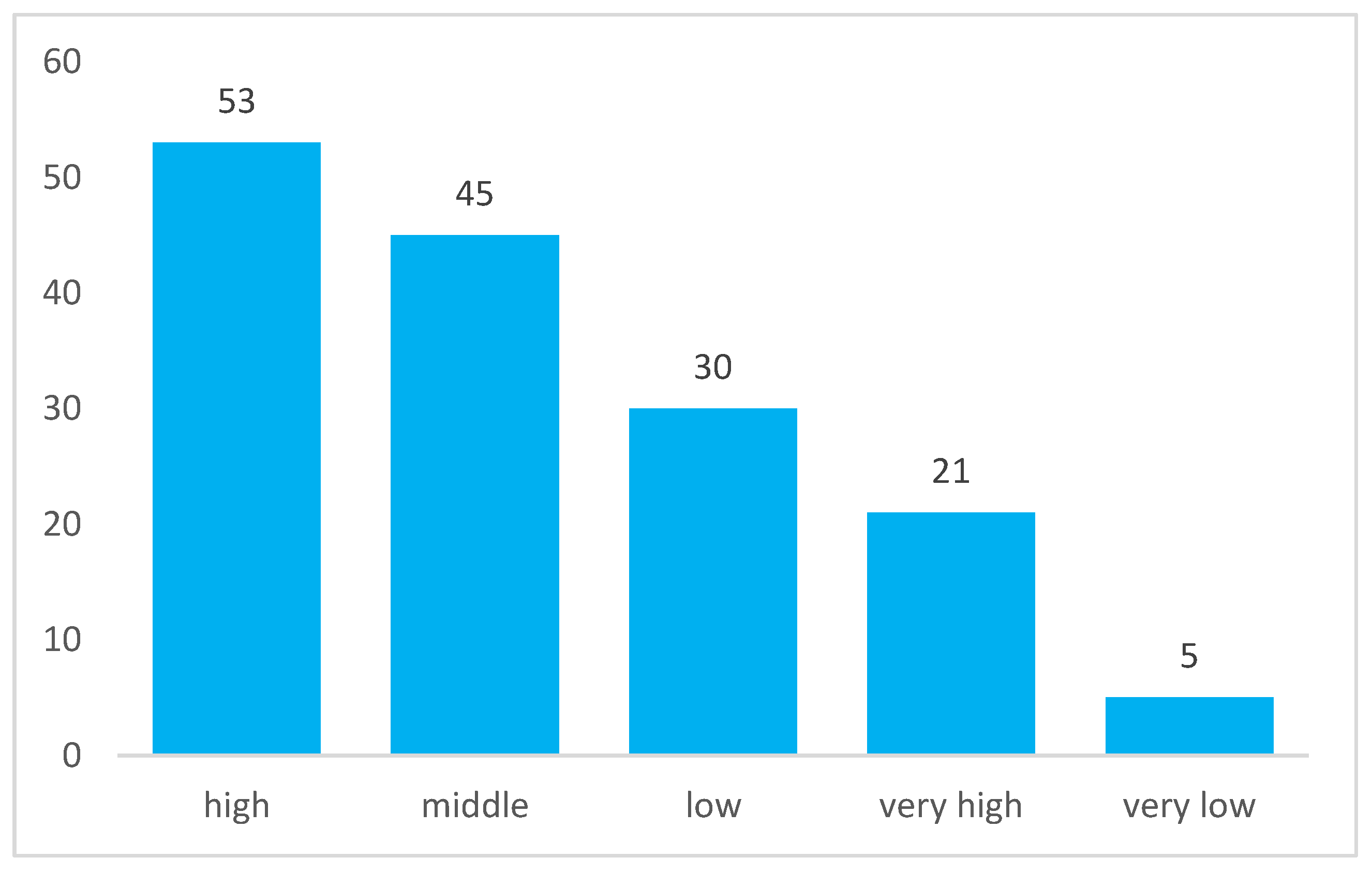
As a result, the following country groups were formed (
Figure 1).
Among the countries analyzed, five were classified in the very low SDGI group: Afghanistan (49.1), Central African Republic (45.2), Chad (46.0), Congo Dem. Rep. (48.2), Yemen Rep. (47.7).
The low group includes 30 countries: Angola (52.8), Benin (57.8), Burkina Faso (53.8), Burundi (55.5), Cameroon (57.8), Congo Rep. (52.8), Djibouti (54.3), Eswatini (57.5), Gambia The (58.4), Guatemala (59.9), Guinea (57.2), Haiti (52.5), Lesotho (55.6), Liberia (52.5), Madagascar (51.0), Malawi (57.1), Mali (56.3), Mauritania (57.9), Mozambique (53.7), Niger (50.3), Nigeria (54.7), Pakistan (57.0), Papua New Guinea (53.4), Sierra Leone (59.4), Syrian Arab Republic (58.4), Tanzania (57.7), Togo (59.2), Uganda (55.8), Zambia (54.8), Zimbabwe (57.4).
The middle group comprises 45 countries: Bahamas The (65.2), Bahrain (64.4), Bangladesh (63.9), Barbados (69.6), Belize (67.0), Bolivia (67.8), Botswana (64.5), Brunei Darussalam (68.0), Cabo Verde (67.3), Cambodia (66.4), Cote d’Ivoire (63.2), Egypt Arab Rep. (68.1), El Salvador (68.4), Gabon (65.6), Ghana (63.1), Honduras (61.7), India (67.0), Iran Islamic Rep. (69.6), Iraq (63.9), Jamaica (69.8), Kenya (61.9), Kuwait (63.3), Lao PDR (62.6), Lebanon (61.7), Malaysia (69.5), Mongolia (66.7), Myanmar (63.6), Namibia (65.5), Nepal (68.6), Nicaragua (64.8), Oman (67.1), Panama (68.2), Paraguay (68.1), Philippines (68.3), Qatar (65.1), Rwanda (62.3), Sao Tome and Principe (63.9), Saudi Arabia (65.2), Senegal (63.5), South Africa (64.1), Sri Lanka (67.9), Tajikistan (68.3), Turkmenistan (67.3), United Arab Emirates (69.8), Venezuela RB (63.8).
The high SDGI level includes 53 countries: Albania (75.2), Algeria (70.1), Argentina (74.8), Armenia (74.3), Australia (77.9), Azerbaijan (72.9), Bhutan (70.5), Bosnia and Herzegovina (73.8), Brazil (73.8), Bulgaria (76.3), Canada (79.2), Chile (78.1), China (74.4), Colombia (70.5), Costa Rica (73.4), Cuba (76.5), Cyprus (73.8), Dominican Republic (74.1), Ecuador (70.1), Fiji (72.9), Georgia (73.7), Greece (79.1), Indonesia (70.2), Ireland (78.6), Israel (74.5), Jordan (71.0), Kazakhstan (71.5), Korea Rep. (78.1), Kyrgyz Republic (74.5), Lithuania (78.8), Luxembourg (76.7), Malta (79.3), Mauritius (70.3), Mexico (70.8), Montenegro (73.8), Morocco (71.7), Netherlands (80.0), New Zealand (79.0), Peru (72.7), Romania (77.7), Russian Federation (74.1), Serbia (78.2), Singapore (71.5), Suriname (71.8), Switzerland (79.2), Thailand (75.3), Tunisia (72.0), Türkiye (70.6), Ukraine (75.7), United States (75.2), Uruguay (77.4), Uzbekistan (73.1), Vietnam (73.4).
The very high group includes 21 countries: Austria (83.0), Belgium (80.7), Croatia (82.4), Czechia (81.9), Denmark (85.3), Finland (87.0), France (83.1), Germany (83.7), Hungary (80.4), Iceland (80.8), Italy (80.3), Japan (80.7), Latvia (81.2), Norway (82.7), Poland (82.1), Portugal (80.6), Slovak Republic (80.8), Slovenia (81.2), Spain (81.0), Sweden (85.7), United Kingdom (81.9).
According to the 2025 SDGI assessment, there is a pronounced differentiation among countries in terms of Sustainable Development Goals (SDGs) attainment levels. The largest group consists of countries with high SDGI scores (50 countries), including both advanced economies and dynamically developing nations across Asia, Latin America, and Eastern Europe. The very high SDGI group (23 countries) is composed almost entirely of European states, with Scandinavian countries leading the ranking: Finland (87.0), Sweden (85.7), and Denmark (85.3). Outside Europe, only Japan (80.7) joins this elite group, demonstrating that non-European countries can also achieve high standards of sustainable development.
The very low SDGI group (5 countries) raises the greatest concern, with all states scoring below 50 points. These are predominantly African nations affected by armed conflicts, political instability, and humanitarian crises, such as the Central African Republic (45.2), Chad (46.0), and Yemen (47.7). The middle group (42 countries) mostly includes countries from the Middle East, Southeast Asia, and Latin America, which are currently undergoing transitional development phases.
The heterogeneous performance across different SDGs underlines the need to identify which goals contribute most significantly to the composite index. These SDGs may serve as leverage points for designing effective national policies.
Table 3 presents the pairwise correlation coefficients between SDGI levels (very high, high, middle, and low) and the 17 Sustainable Development Goals.
The correlation matrix reveals the heterogeneous nature of relationships between SDGI levels and the 17 Sustainable Development Goals, highlighting the complex multidimensional character of sustainable development.
For the “very high” SDGI group, moderate positive correlations are observed with most SDGs. The strongest associations are with G9 (Industry, Innovation, and Infrastructure, r = 0.53), G15 (Life on Land, r = 0.37), and G16 (Peace, Justice, and Strong Institutions, r = 0.51). These findings support the hypothesis that highly developed countries achieve comprehensive progress through technological advancement, institutional capacity, and environmental awareness. A negative correlation with G13 (Climate Action, r = −0.16) may reflect the paradox of high industrialization and associated carbon emissions.
The “high” SDGI group shows stable moderate positive correlations (r = 0.19–0.42) with G2 (Zero Hunger), G10 (Reduced Inequalities), G11 (Sustainable Cities), and G12 (Responsible Consumption), indicating balanced socio-economic progress in these countries.
For the “middle” SDGI group, correlations are generally weak (r < 0.25), except for a moderate association with G10 (r = 0.32), suggesting fragmented progress and a lack of systematic policy implementation in mid-level development countries.
The “low” SDGI group demonstrates strong positive correlations with G6 (Clean Water, r = 0.58), G7 (Affordable Energy, r = 0.66), G12 (r = 0.52), and G16 (r = 0.54), but negative ones with G3 (Health, r = −0.66), G4 (Education, r = −0.62), and G9 (Industry, r = −0.57). This illustrates a compensation effect, where countries with lower SDGI improve basic infrastructure while still lagging in human capital and institutional development.
The “very low” SDGI group shows no statistically significant correlations due to multicollinearity and the limited variability of consistently low indicators in this cohort.
4.3. Discriminant Model of SDGI Based on Sustainable Development Goals
To identify the Sustainable Development Goals that significantly influence the SDGI levels across countries, a discriminant analysis was conducted [
47].
Table 4 presents the statistical significance of the discriminant function and the independent variables used in constructing the classification function.
The Wilks’ Lambda statistic equals 0.03, falling within the interval [0, 1]. This value, being very close to zero, indicates excellent discrimination between the groups. The F-statistic F(68,516) = 10.349 at p < 0.00 significantly exceeds the critical value of the F-distribution. Therefore, the null hypothesis that observations belong to a single group is rejected. The discriminant analysis is thus valid and appropriate. It can be concluded that the classification of countries into five SDGI levels (very low, low, middle, high, very high) is statistically justified.
The most significant Sustainable Development Goals contributing to the differentiation of SDGI levels include:
Goal 10 (Reduced Inequalities): with the lowest Partial Lambda (0.81) and the highest F-remove (7.70, p = 0.01), indicating the strongest discriminatory power;
Goal 6 (Clean Water and Sanitation): Partial Lambda = 0.87, F-remove = 5.03 (p = 0.01);
Goal 15 (Life on Land): Partial Lambda = 0.88, F-remove = 4.65 (p = 0.01);
Goal 5 (Gender Equality): Partial Lambda = 0.89, F-remove = 3.96 (p = 0.01).
In addition, Goal 2 (Zero Hunger), Goal 4 (Quality Education), Goal 11 (Sustainable Cities and Communities), and Goal 16 (Peace, Justice and Strong Institutions) also demonstrated statistically significant contributions (p = 0.01).
Conversely, Goal 8 (Decent Work and Economic Growth), Goal 13 (Climate Action), Goal 14 (Life Below Water), and Goal 17 (Partnerships for the Goals) showed the highest Partial Lambda values (close to 1) and the lowest F-remove values with high p-values (p > 0.05), indicating their minimal impact in differentiating between SDGI groups.
Tolerance values (Toler.) indicate the absence of critical multicollinearity among the variables, although some Goals, such as Goal 9 and Goal 12, exhibit lower tolerance values, suggesting a degree of correlation with other predictors in the model.
To evaluate classification accuracy on the training samples, a classification matrix was employed (
Table 5).
The overall classification accuracy reached 94.08%, indicating the high quality of the constructed discriminant model. The model successfully classifies countries by SDGI level in the vast majority of cases, confirming both the adequacy of the training samples and the relevance of the selected discriminant variables.
An analysis of classification accuracy by group reveals heterogeneous results. Countries with very low, middle, and very high SDGI levels were all classified with 100% accuracy. Specifically, all 5 countries in the “very low” group, all 43 countries in the “middle” group, and all 21 countries in the “very high” group were correctly identified without a single error. This demonstrates that these groups possess distinct characteristics, enabling the model to recognize them flawlessly.
The “low” SDGI group also shows high classification accuracy at 96.67%. Of the 30 countries in this group, 29 were accurately classified, with only one misclassified into the “middle” group. This indicates a slight overlap in characteristics between the “low” and “middle” SDGI categories.
The lowest classification accuracy was observed in the “high” SDGI group, at 84.91%. Out of 53 countries in this group, 45 were correctly classified. However, 2 countries were misclassified into the “middle” group, and 6 were incorrectly assigned to the “very high” group. These errors may reflect the transitional status of certain countries within this category or the proximity of their indicators to those of neighboring groups. The relatively higher number of misclassifications in this group can also be attributed to its larger size and greater internal heterogeneity.
Overall, the constructed discriminant model demonstrates excellent classification performance and can be effectively used to predict country membership across SDGI achievement levels.
Table 6 presents the eigenvalues of the discriminant function and the corresponding statistical significance based on the chi-square criterion.
The first discriminant function exhibits the highest eigenvalue (12.97) and canonical correlation (0.96), indicating its superior discriminating power. The Wilks’ Lambda statistic (0.03), which is close to zero, along with a chi-square value of 472.41 at p = 0.00, confirms the strong statistical significance of the model.
The second and third functions are also statistically significant (p = 0.00 and p = 0.04, respectively), though their discriminating ability gradually decreases, as evidenced by increasing Wilks’ Lambda values (0.48 and 0.73) and declining eigenvalues.
In contrast, the fourth function was found to be statistically insignificant (p = 0.26), indicating that its inclusion in the model does not contribute meaningfully to group separation.
Thus, for effective classification of countries based on SDGI levels, the first three discriminant functions are sufficient, offering reliable differentiation among the five categories.
Table 7 presents the classification function coefficients for each SDGI category.
Based on the discriminant analysis results, the following SDGI discriminant model was constructed using sustainable development goals:
Goal 12 (Responsible Consumption and Production) has the highest coefficients across all classification functions (ranging from 2.54 to 3.23), indicating its defining role in classification. Goal 16 (Peace, Justice and Strong Institutions), Goal 6 (Clean Water and Sanitation), and Goal 3 (Good Health and Well-being) also exhibit high coefficients, confirming their importance. Goal 1 has negative coefficients in all groups, which may reflect the specific nature of its impact on classification. The coefficients increase consistently from the “very low” to the “high” group, indicating a progressive improvement in the level of Sustainable Development Goal (SDG) achievement.
The developed discriminant model is of significant practical value for countries not included in the official SDGI ranking or those with incomplete data on the Sustainable Development Goals Index. Provided data on performance in individual SDGs (Goals 1–17) is available, the values of the classification functions can be calculated for any country, allowing the assignment of that country to a category (very low, low, middle, high, very high) based on its SDG achievement level.
This model enables a rapid assessment of a country’s overall level of sustainable development without the need to calculate the composite SDGI. This is particularly relevant for countries with limited statistical reporting or for conducting a preliminary analysis ahead of more detailed research. Additionally, the model can be used to forecast potential shifts in category resulting from improvements in specific SDG indicators, thereby helping to identify strategic development priorities.
In particular, given the high coefficients for Goal 12, Goal 16, Goal 6, and Goal 3, countries may focus their efforts on improving these areas to enhance their classification level. The model may also be employed by international organizations and donors to identify countries in greatest need of support in achieving the SDGs and to monitor the effectiveness of implemented development programs.
4.4. Random Forest Model
At the fourth stage of our study, we employed the non-parametric machine learning method Random Forest Model to overcome the limitations of discriminant analysis, particularly the assumptions regarding linear relationships and the normal distribution of all analyzed variables [
47]. This approach allowed us to identify complex nonlinear dependencies and interactions among the Sustainable Development Goals while ensuring robustness against outliers and multicollinearity. Additionally, it enabled verification of the previously obtained results by assessing variable importance and comparing classification accuracy to select the optimal approach for predicting SDGI levels.
Table 8 presents the results of applying the Random Forest Model to predict SDGI levels based on the numerical values of the Sustainable Development Goals for 154 analyzed countries.
The Confusion Matrix illustrates the classification results of countries by SDGI level using the Random Forest model, with an overall model accuracy of 73%. Analyzing classification accuracy across individual categories reveals significant variability in performance.
The “very low” category shows the weakest performance (class precision 0.00%), as neither of the two countries in this group was correctly classified—they were both misclassified as “low.”
The “low” category achieved 75.00% accuracy, with six out of eight countries correctly identified; the remaining two were mistakenly assigned to the “very low” category.
The “middle” category achieved the highest recall (90.91%), with ten of eleven countries correctly classified; one was incorrectly assigned to the “very high” group.
The “high” category demonstrated 80.00% accuracy, where twelve countries were correctly classified, while three were misclassified as “low” and four as “middle.”
The “very high” category achieved perfect recall (100.00%), with all five countries correctly identified. However, due to one misclassification from the “middle” category into this group, its precision stands at 83.33%.
Table 9 presents the relative importance of each Sustainable Development Goal in classifying countries by SDGI level within the Random Forest model.
The most influential variables in the classification process are Goal 4 (Quality Education) and Goal 9 (Industry, Innovation and Infrastructure), each with an importance score of 0.13. Goal 2 (Zero Hunger) also plays a significant role, contributing 0.12 to the model. Goal 1 (No Poverty) holds a weight of 0.10, making it the fourth most important variable. Goal 10 (Reduced Inequalities) and Goal 5 (Gender Equality) both contribute 0.09, indicating a moderate impact on classification.
Variables with medium importance include Goal 3 (Good Health and Well-being) at 0.08, Goal 6 (Clean Water and Sanitation) and Goal 7 (Affordable and Clean Energy) at 0.07 each, and Goal 15 (Life on Land) at 0.06.
The least influential variables are Goal 8 (Decent Work and Economic Growth) with a weight of 0.05, Goal 11 (Sustainable Cities and Communities) and Goal 12 (Responsible Consumption and Production) at 0.04 each. Goals 13 (Climate Action), 14 (Life Below Water), 16 (Peace, Justice and Strong Institutions), and 17 (Partnerships for the Goals) share the lowest importance score of 0.03.
The obtained results revealed a substantial divergence between the outcomes of the Random Forest and discriminant analysis. While Goal 10, Goal 6, Goal 15, and Goal 12 emerged as the most significant variables in the discriminant analysis, the Random Forest model identified Goal 4, Goal 9, and Goal 2 as the most influential.
This discrepancy can be explained by the different approaches used to assess variable importance: discriminant analysis evaluates the linear contribution of variables to group separation, whereas Random Forest considers a variable’s ability to reduce uncertainty during decision tree construction and its interactions with other variables.
This contrast further supports the rationale for employing a complementary analytical approach, using multiple classification methods. Each technique captures different dimensions of the complex interrelations between the Sustainable Development Goals and the overall SDGI score.
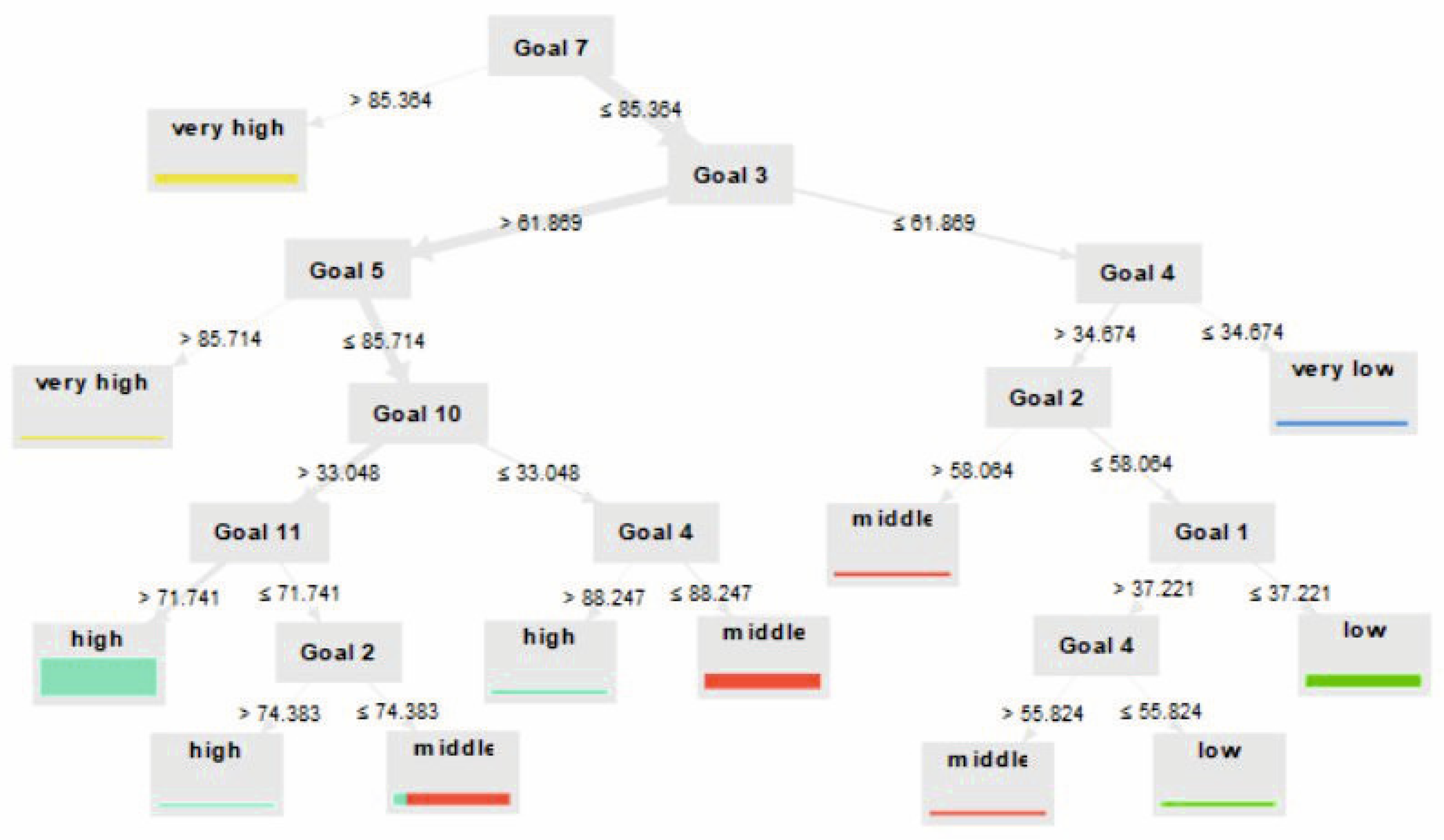
Figure 2 presents the Forest Production Model, which illustrates the structure of the constructed Random Forest and the hierarchy of decision trees used to classify countries according to their SDGI level.
The constructed Random Forest model illustrates the process of classifying countries by SDGI level through a sequence of splits based on threshold values of various Sustainable Development Goals. The tree begins with the root node Goal 7 (Affordable and Clean Energy) with a threshold value of 85.384, dividing the dataset into two branches: countries with Goal 7 values greater than 85.384 are potentially classified as “very high”, while those with lower values continue through further classification steps.
The left branch of the tree demonstrates a complex hierarchy of splits, sequentially using Goal 5 (Gender Equality) with a threshold of 85.714, Goal 10 (Reduced Inequalities) with a threshold of 33.048, Goal 11 (Sustainable Cities and Communities) with a threshold of 71.741, and Goal 2 (Zero Hunger) with a threshold of 74.383. These successive divisions enable the separation of countries with high SDGI levels (“very high” and “high”) from those at a medium level (“middle”). Specifically, countries with high Goal 5 indicators (greater than 85.714) are classified as “very high”, while countries with lower Goal 5 values but high Goal 11 indicators (greater than 71.741) are assigned to the “high” category.
The right branch of the tree utilizes Goal 3 (Good Health and Well-being) with a threshold of 61.865 for further splitting. Countries with lower Goal 3 values (less than or equal to 61.865) are classified through Goal 4 (Quality Education) with a threshold of 34.874 and Goal 2 (Zero Hunger) with a threshold of 58.094, allowing their categorization into “very low” and “middle”. Countries with higher Goal 3 values (above 61.865) are further split by Goal 1 (No Poverty) with a threshold of 37.221 and Goal 4 with a threshold of 55.824, which differentiates between the “low” and “middle” categories.
The structure of the tree reflects a complex non-linear classification logic, where various combinations of Sustainable Development Goals determine the classification of a country within a specific SDGI category. It is important to note that each tree in the Random Forest ensemble has its own unique structure, built from different subsamples of the data, and the final prediction is made through the aggregation of all tree outputs. This ensures greater model robustness and reliability.
The conducted comprehensive analysis of factors determining countries’ achievement levels of the Sustainable Development Goals demonstrated discrepancies in the results produced by the two applied alternative methods. This confirms the necessity of employing an integrated approach when modeling complex socio-economic phenomena, as each method reveals different dimensions of the examined issue. The developed classification models are practically significant for countries not included in the official SDGI rankings, enabling rapid assessments of their positioning and identification of priority areas for sustainable development policies based on the analysis of the most influential Goals.
6. Conclusions
This study identified key determinants shaping countries’ Sustainable Development Goals performance and developed classification models for predicting country group membership based on the SDGI. The comprehensive methodological approach, integrating visual analysis, correlation analysis, discriminant analysis, and Random Forest modeling, provided a multidimensional understanding of complex interrelations between individual SDGs and sustainable development achievement, addressing the urgent need to optimize development policies amid limited resources and the approaching 2030 Agenda deadline.
The central finding demonstrates that key SDG determinants depend fundamentally on the analytical method employed. Discriminant analysis identified Goals 10, 6, 15, and 5 as most influential for differentiating countries by SDGI level, while Random Forest identified Goals 4, 9, and 2 as the most important predictors. This divergence reflects fundamentally different analytical perspectives: discriminant analysis captures linear contributions to group separation, while Random Forest identifies complex nonlinear interactions and synergies between goals. This methodological finding has critical policy implications—optimal prioritization strategies depend on countries’ strategic objectives. Countries that focus on addressing direct developmental gaps benefit from prioritizing goals identified through linear analysis, which serve as direct markers of the development stage. Countries seeking to leverage multiplicative synergies across multiple domains should emphasize goals identified through nonlinear analysis, which operate through complex interaction effects.
Specific policy recommendations emerge from these findings. For goals identified through discriminant analysis, Goal 10 (Reduced Inequalities) requires progressive taxation reforms and inclusive growth policies that directly signal development stage advancement; Goal 6 (Clean Water and Sanitation) necessitates infrastructure investment as a foundational marker of basic service provision; Goal 15 (Life on Land) demands ecosystem protection frameworks that differentiate development levels; and Goal 5 (Gender Equality) requires institutional reforms in legal frameworks and economic participation. For goals identified through Random Forest analysis, Goal 4 (Quality Education) operates through multiplicative effects on human capital formation across multiple domains; Goal 9 (Industry, Innovation and Infrastructure) generates synergies through technological spillovers and productivity enhancements; and Goal 2 (Zero Hunger) creates interaction effects linking agricultural productivity with health outcomes and economic stability. Countries should select prioritization strategies based on whether they seek to close the developmental gap directly (discriminant analysis goals) or leverage cross-domain synergies (Random Forest goals).
The correlation analysis revealed heterogeneous relationships across SDGI groups, demonstrating that sustainable development dynamics operate differently across development stages. High-development countries showed the strongest associations with technological advancement and institutional capacity, while low-development countries exhibited compensation effects where basic infrastructure provision occurs alongside lagging human capital development. This pattern reveals that resource-constrained countries follow sequential rather than simultaneous development pathways, contradicting the implicit assumption in the 2030 Agenda that all 17 goals can be pursued in parallel. For low-sustainability countries specifically, the compensation effects suggest that simultaneous investment in basic infrastructure and human capital development is essential to break sequential patterns and accelerate progress.
The discriminant model achieved high classification accuracy with perfect results for extreme SDGI categories, indicating clear differentiation in their characteristics and demonstrating model reliability for countries at these development levels. Lower accuracy for intermediate groups reflects their transitional nature and greater heterogeneity, requiring a more nuanced country-specific assessment. The Random Forest model’s alternative hierarchy of variable importance, despite lower overall accuracy, provides complementary insights into which goals drive classification through complex interactive pathways rather than direct linear effects.
The developed classification models provide practical tools for multiple stakeholder groups. National governments excluded from official SDGI rankings or with incomplete data can use the discriminant functions for rapid preliminary assessment of sustainable development positioning and identification of strategic priorities. International development organizations and donors can utilize the models to identify countries requiring targeted support and monitor intervention effectiveness through forecasting potential category shifts based on improved SDG performance. Policymakers in transitional economies should recognize that greater complexity in their development stage necessitates a nuanced assessment rather than reliance solely on group-based strategies.
Several limitations contextualize these findings. The cross-sectional design using 2024 data identifies associations and discriminatory patterns but cannot establish causal relationships between specific SDGs and overall SDGI levels—a limitation inherent to classification approaches analyzing a single time point. The analysis focuses exclusively on the 17 SDGs as independent variables, not capturing contextual factors such as governance quality, geopolitical stability, or natural resource endowments that may mediate SDG-SDGI relationships. Model performance varies across SDGI categories, with particularly weak results for crisis-affected states in the very low category, potentially reflecting genuinely distinct dynamics that do not follow predictable SDG relationships. The global-level analysis may mask important regional patterns—continent-specific or income-level-specific models might achieve higher accuracy and provide more actionable guidance for regional policy coordination.
Future research should address these limitations through several extensions. Panel data analysis incorporating temporal dynamics would enable the identification of how key discriminators evolve and the examination of causal relationships through techniques such as Granger causality testing or structural equation modeling. Application of alternative machine learning algorithms (including Gradient Boosting, Neural Networks, and ensemble methods) would enable systematic comparison of prediction performance and potentially improve classification accuracy for underperforming categories. Development of regional models accounting for geographical, cultural, and economic context would test whether context-specific models achieve superior performance compared to global approaches. Incorporation of additional explanatory variables beyond the 17 SDGs—such as governance indicators, conflict measures, and historical development patterns—would provide a richer understanding of factors driving sustainable development differentiation. This integrated classification methodology applies to other composite indices (Human Development Index, Environmental Performance Index), corporate ESG assessment, urban sustainability classification, and sector-specific sustainability evaluation, wherever researchers seek to understand which factors most effectively discriminate between performance categories in complex multidimensional systems.
The research confirms the complex, multidimensional nature of sustainable development, where universal solutions are ineffective and differentiated strategies aligned with development stage and national context are necessary. The identification of method-dependent key drivers—demonstrating that perceived variable importance depends on analytical framework rather than representing objective reality—advances theoretical understanding of SDG interdependencies and provides practical guidance for resource allocation under the intensifying constraints facing 2030 Agenda implementation. By offering both conceptual frameworks for understanding how different analytical perspectives reveal different leverage points and operational tools for rapid assessment in data-limited contexts, this research contributes to evidence-based policymaking in the critical final years of the SDG implementation period.