2.1. Conceptual Definition of the Productivity Model
This study adopts a radiation-based biophysical model to estimate theoretical potential productivity, defined as the maximum biomass yield determined exclusively by climatic energy supply and physiological conversion efficiency.
Crop production efficiency can be defined in thermodynamic terms as the ratio between energy output, expressed as carbohydrate accumulation, and energy input supplied by solar radiation. Within this framework, total dry matter production depends primarily on two factors: the amount of solar radiation intercepted by the crop canopy during the growing season and the efficiency with which intercepted radiation is converted into biomass. Temperature and water availability do not generate productivity per se but regulate crop development by controlling leaf area expansion and the duration of phenological phases, which determine the capacity of the canopy to intercept radiation. Consequently, productivity reaches a theoretical upper limit imposed by physical and physiological constraints rather than by management practices or soil conditions [
6].
Yield potential represents the upper physiological limit of crop productivity under conditions in which water and nutrient availability do not limit growth and biotic stresses remain controlled. This potential is defined by the crop’s assimilatory capacity and by inherent metabolic efficiencies governing the conversion of solar energy into biomass. Classical yield theory establishes that productivity potential reflects intrinsic physiological and energetic constraints rather than achievable field yields, providing a theoretical reference ceiling for comparative analysis [
9].
Potential yield has been formally incorporated as a benchmark in yield-gap analysis, where it functions as a reference level against which attainable and observed yields are compared. In this framework, potential yield does not represent an empirically validated outcome but a biophysically defined ceiling determined by climate and crop characteristics, whose relevance lies in its internal consistency with physical and physiological principles [
7].
Based on these scientific premises and considering that sugarcane (
Saccharum officinarum L.) operates a C4 photosynthetic pathway [
12], this study adopts the hypothesis that, when agronomic conditions are non-limiting, solar radiation constitutes the primary determinant of potential productivity. The C4 photosynthetic apparatus confers high efficiency of CO
2 fixation under conditions of high irradiance and elevated temperatures, which supports the use of radiation-based approaches to estimate theoretical productivity limits.
Studies focused on sugarcane yield estimation under commercially managed conditions have shown that even calibrated crop simulation models present substantial discrepancies when compared with observed yields. Using FAO-AZM, DSSAT/CANEGRO and APSIM-Sugarcane models [
8], reported mean absolute errors exceeding 29 t ha
−1 and coefficients of determination lower than 0.54 when management effects were not explicitly represented. After introducing a management factor associated with yield decline across successive crop cycles, errors decreased to values ≤ 12.9 t ha
−1 during calibration and between 13.0 and 14.9 t ha
−1 during validation, with R
2 increasing to 0.58–0.72. These results indicate that management-related variability strongly constrains yield realization in commercial fields, reinforcing the conceptual distinction between observed productivity and an upper-bound productivity potential defined independently of management [
8].
Under this hypothesis, soil properties, management practices, and genetic material are assumed to be agronomically adequate and non-limiting. In this context, solar radiation availability emerges as the key variable controlling biomass formation and, therefore, as a critical factor for ensuring that the crop reaches its maximum theoretical potential productivity. This assumption justifies the exclusion of soil variables from the model and supports the use of solar energy as the central input in the estimation of theoretical potential productivity.
2.2. Methodological Assumptions of the M3P Model
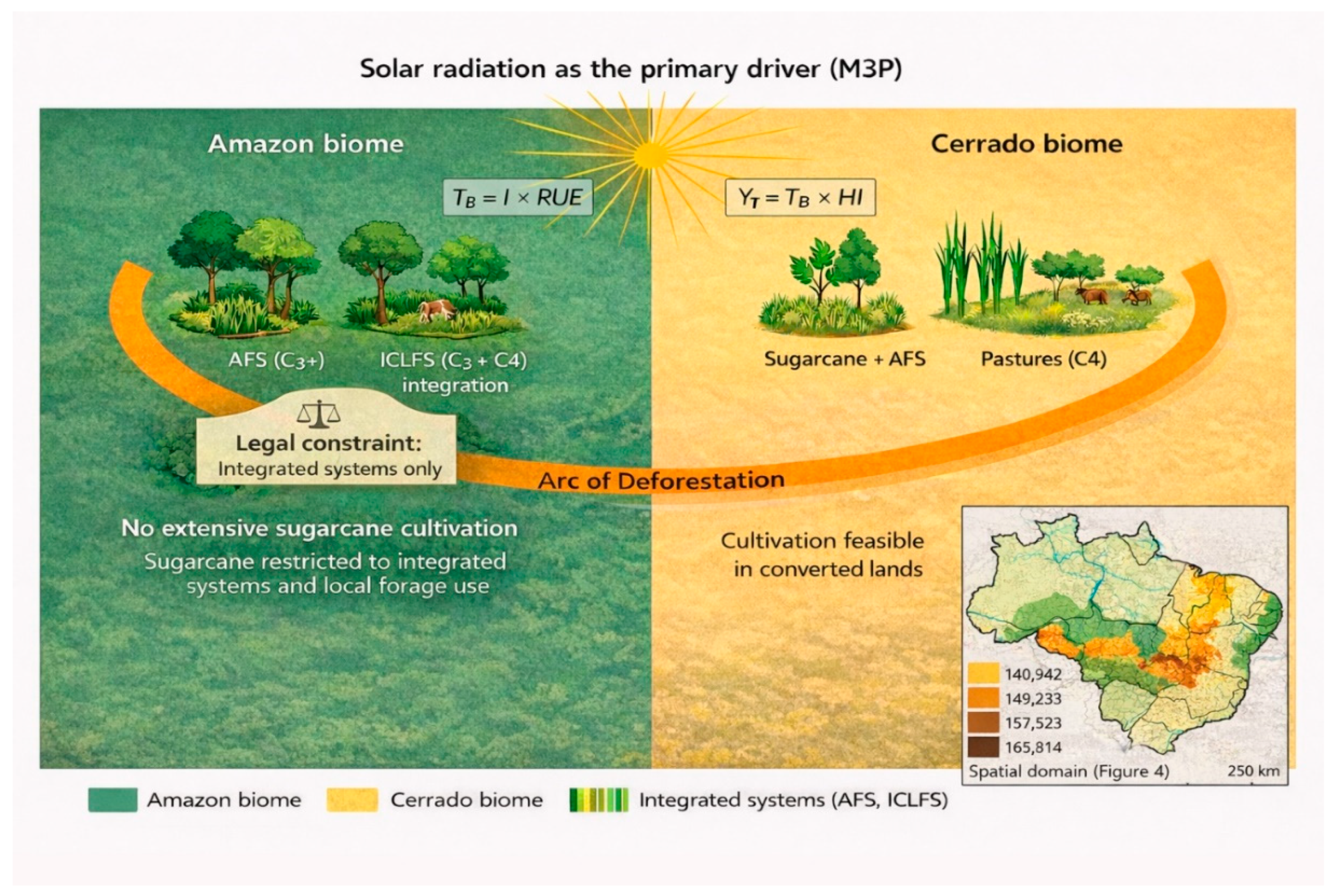
The Potential Productivity Model (M3P) estimates the theoretical maximum productivity of sugarcane (Saccharum officinarum L.) in the Amazon Deforestation Arc under idealized conditions. The model defines the upper yield limit by isolating the effect of incident solar radiation on biomass production, if all other biophysical and management related factors fully comply with established agronomic recommendations. Within this framework, the M3P represents potential productivity as an upper bound estimate derived from physical and physiological principles rather than from field-based calibration.
Sugarcane is a C4 species with a photosynthetic apparatus characterized by high radiation use efficiency and low photorespiration losses, a trait widely documented for C4 grasses [
14,
15]. Biomass accumulation in sugarcane responds strongly to the cumulative amount of photosynthetically active radiation intercepted over the crop cycle. This physiological characteristic provides the conceptual basis for assigning a dominant role to incoming solar energy in the M3P framework, while treating other environmental and management variables as non-limiting by assumption.
The M3P adopts the following methodological assumptions.
The model assumes an unrestricted and optimal supply of water and nutrients throughout the entire crop cycle, consistent with agronomic recommendations for high yielding sugarcane systems. Under this assumption, neither water stress nor nutritional limitations constrain photosynthesis, biomass accumulation, or yield formation.
The model assumes effective and complete control of pests and diseases. Consequently, biotic stress does not reduce photosynthetic efficiency, biomass accumulation, or final yield.
The model considers a high yielding sugarcane genotype with broad adaptability and a photosynthetic apparatus typical of C4 grasses, capable of efficiently converting intercepted solar radiation into biomass. Radiation use efficiency values reported for sugarcane under optimal growth conditions support this assumption [
14,
15].
Incident global solar radiation (I) represents the sole limiting factor for potential productivity in the M3P framework, as it defines the total amount of energy available for photosynthesis and therefore establishes the theoretical upper bound of biomass production.
The model incorporates air temperature (T) as a secondary variable exclusively for estimating longwave radiation emission within the surface energy balance, based on the Stefan–Boltzmann law [
10]. Temperature does not directly constrain potential productivity in the model and does not act as a limiting factor for biomass accumulation, provided that agronomically recommended thermal conditions are met.
Under these assumptions, solar radiation availability constitutes the primary determinant of sugarcane productivity, since photosynthesis converts radiant energy into chemical energy stored as biomass, which is subsequently allocated to products such as sugar, ethanol, and bioelectricity [
5]. Thermal radiation exchange follows fundamental physical principles established since the seventeenth century, particularly the Stefan–Boltzmann law, which relates the energy radiated by a body to its absolute temperature [
10].
in which A is the emitting surface area, T is the temperature in kelvin, σ is the Stefan–Boltzmann constant (5.67 × 10
−8 W·m
−2·K
4), and Q/Δt is the emitted power.
Applied to the Sun, the total radiated power is:
in which R = 6.96 × 10
8 m and T = 5770 K, yielding approximately 3.83 × 10
26 W.
At Earth’s distance, intensity decreases with the square of the distance, resulting in a mean solar constant of ~1350 W·m
−2 (Equation (3)). When passing through the atmosphere, radiation is attenuated by scattering and absorption, particularly due to cloud cover, producing spatial and temporal variability.
Solar radiation data were obtained from the Global Solar Atlas [
16], which provides daily and annual estimates of global horizontal irradiance (GHI) at a spatial resolution of up to 1 km
2. The original GHI values, expressed in kWh·m
−2·day
−1, were converted to MJ·m
−2·day
−1 using the standard conversion factor of 1 kWh = 3.6 MJ.
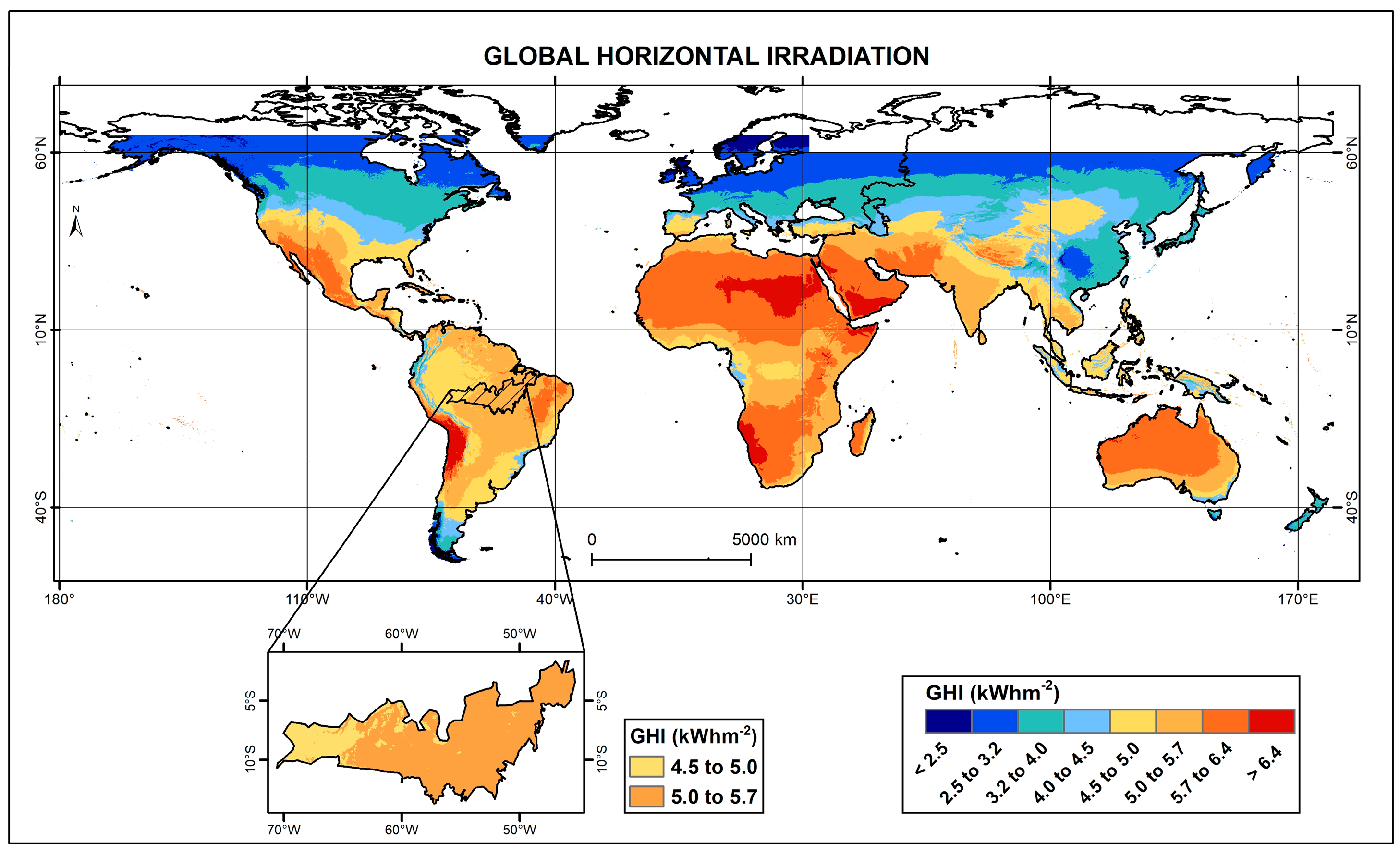
The analysis of the long-term spatial distribution of solar irradiance combined satellite-based observations with meteorological modeling to classify insolation zones across the Brazilian Amazon, with particular emphasis on the Arc of Deforestation (
Figure 1 and
Figure 2).
To represent the conversion of intercepted solar energy into biomass, the model adopted physiological parameters reported in the literature. The quantum yield (Rq) was set to 0.0534 mol CO
2·Einstein
−1, corresponding to the theoretical maximum for C
3 photosynthesis, with a mean conversion factor of 4.6 Einsteins·MJ
−1 [
10]. The biomass energy content (Em) was assumed to be 15.9 MJ·kg
−1, consistent with reported values for dry plant biomass [
17]. The harvest index (HI) was fixed at 0.7, in agreement with values reported for sugarcane grown under favorable conditions [
18,
19].
Optimal climatic ranges associated with high sugarcane productivity were defined as reference thresholds (
Table 1), including irradiance between 18 and 25 MJ·m
−2·day
−1, photoperiod between 10 and 14 h, and air temperature between 27 and 38 °C. Total dry biomass accumulated over the crop cycle (Tb) was estimated as:
in which I represent the total incident irradiance (MJ·m
−2·cycle
−1). The theoretical harvestable yield (Yt) was then derived by applying the harvest index:
Global Horizontal Irradiation (GHI) data were obtained from the Global Solar Atlas [
16], a globally recognized database that integrates satellite derived observations with meteorological reanalysis products, provided at an approximate spatial resolution of 1 km
2. The dataset represents long term climatological averages of solar irradiance incident on a horizontal surface, expressed as daily values in kWh·m
−2·day
−1.
Figure 1 illustrates the global spatial distribution of GHI, clearly highlighting the tropical belt as one of the regions with the highest solar energy availability worldwide. Within South America, elevated GHI levels are observed across large portions of Brazil, with prominence in the central and northern regions. The inset map explicitly delineates the Brazilian Arc of Deforestation, where GHI values predominantly range between 4.5 and 5.7 kWh·m
−2·day
−1, indicating a consistently high solar energy supply under tropical continental conditions.
To ensure methodological consistency with the parameters adopted in the M3P model, all GHI values were converted to megajoules (MJ·m−2·day−1) using the standard conversion factor of 1 kWh = 3.6 MJ. Solar irradiance was treated as the primary driving variable of the model, reflecting its central role in defining the upper theoretical limit of biomass production under potential productivity conditions, independent of management limitations.
The analytical framework integrated spatially explicit solar irradiance data with climatic variables, specifically air temperature and precipitation. These variables were used to characterize the prevailing agroclimatic context of the region rather than to impose direct constraints on potential productivity. Crop physiological parameters associated with sugarcane growth and radiation use efficiency were incorporated to support the identification of agroclimatically suitable zones under tropical conditions.
All spatial analyses were conducted within a geographic information system environment. Solar irradiance and climatic layers were spatially intersected with the geographic extent of the Arc of Deforestation to contextualize the potential productivity patterns within an area of active land-use transformation in the Brazilian Amazon. This approach allows the identification of territories with high climatic aptitude for sugarcane cultivation while explicitly acknowledging the environmental and territorial context relevant to land-use planning in the region.
Based on benchmarks reported in the peer reviewed literature and on the climatic ranges observed across the Amazon region, we defined optimal environmental thresholds for sugarcane growth. These thresholds delineate the agroclimatic suitability domain adopted in the model and are summarized in
Table 2. The analysis indicates that areas characterized by global solar irradiance between 20.5 and 23.0 MJ·m
−2·day
−1, photoperiods ranging from 10 to 14 h, and mean annual air temperatures between 27 and 38 °C correspond to conditions favorable for high potential sugarcane productivity.
Climatic data were obtained from WorldClim v2 [
14], a high-resolution global dataset that provides interpolated monthly climate surfaces for the period 1970–2000 at an approximate spatial resolution of 1 km
2. WorldClim v2 was developed using observations from approximately 9000 to 60,000 meteorological stations worldwide and applies thin plate spline interpolation, incorporating covariates such as elevation, distance to the coast, and satellite derived variables, including MODIS land surface temperature and cloud cover. Independent validation indicates high model performance, with cross validation correlation coefficients exceeding 0.99 for temperature, 0.86 for precipitation, and 0.76 for wind speed [
14]. Owing to these characteristics, WorldClim v2 represents a widely accepted baseline dataset for ecological and agroclimatic analyses.
In this study, WorldClim v2 data were used to characterize the thermal and hydric environment of the study area through mean annual air temperature (°C) and total annual precipitation (mm). These variables were incorporated to define the agroclimatic suitability domain for sugarcane cultivation, rather than to impose direct constraints on potential productivity. Temperature and precipitation were selected because they exert fundamental control over sugarcane physiological processes, including photosynthetic activity, phenological development, and water availability, which together condition the feasibility of crop establishment and growth under rainfed tropical systems.
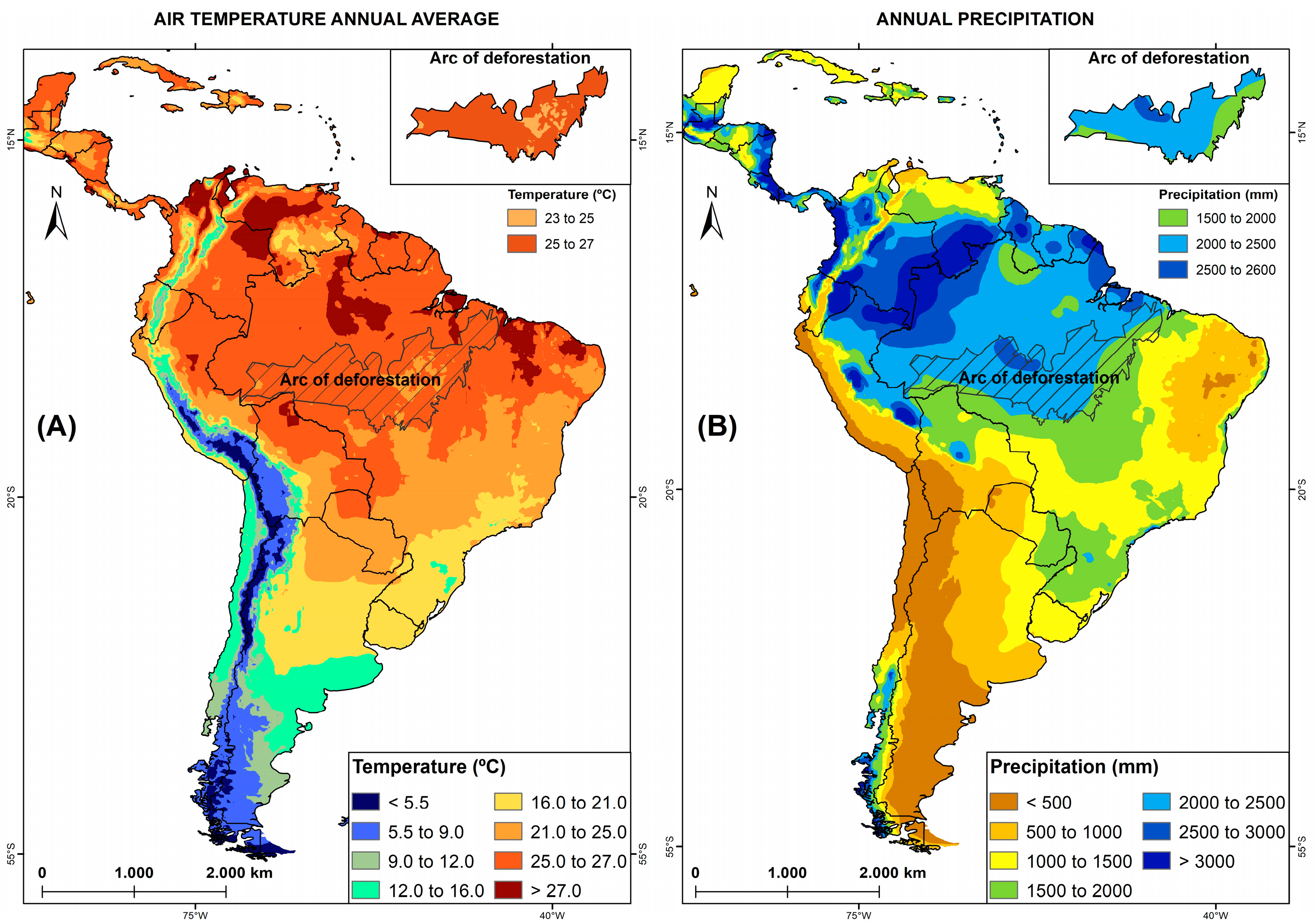
Figure 2 presents the spatial distribution of key climatic variables used to characterize the agroclimatic context of the Amazon Deforestation Arc. Panel (A) shows the mean annual air temperature across South America, while panel (B) depicts the spatial pattern of total annual precipitation. In both panels, the geographic extent of the Arc of Deforestation is explicitly delineated to support regional interpretation.
In
Figure 2A, mean annual air temperature exhibits a clear latitudinal gradient, with the highest values concentrated in tropical regions. The Amazon Deforestation Arc is predominantly characterized by mean annual temperatures above 27 °C, with extensive areas exceeding this threshold. This thermal regime falls within the range commonly reported as favorable for sugarcane physiological activity, including photosynthesis, growth, and biomass accumulation under tropical conditions.
Figure 2B illustrates the spatial distribution of total annual precipitation, revealing pronounced spatial variability across South America. Within the Amazon Deforestation Arc, annual precipitation generally ranges between 1500 and 2500 mm, with localized areas exceeding 2500 mm. These precipitation levels indicate a predominantly humid environment, which is generally sufficient to sustain sugarcane cultivation under rainfed conditions, provided that soil and management constraints are adequately addressed.
Together, the temperature and precipitation patterns shown in
Figure 2 define the thermal and hydric envelope of the study region. These climatic variables were used to characterize the agroclimatic suitability domain of sugarcane cultivation, rather than to impose direct limitations on potential productivity. The integration of these climatic layers with solar irradiance data (
Figure 1) supports the spatial identification of regions where the theoretical potential productivity estimated by the M3P model can be expressed under favorable climatic conditions.
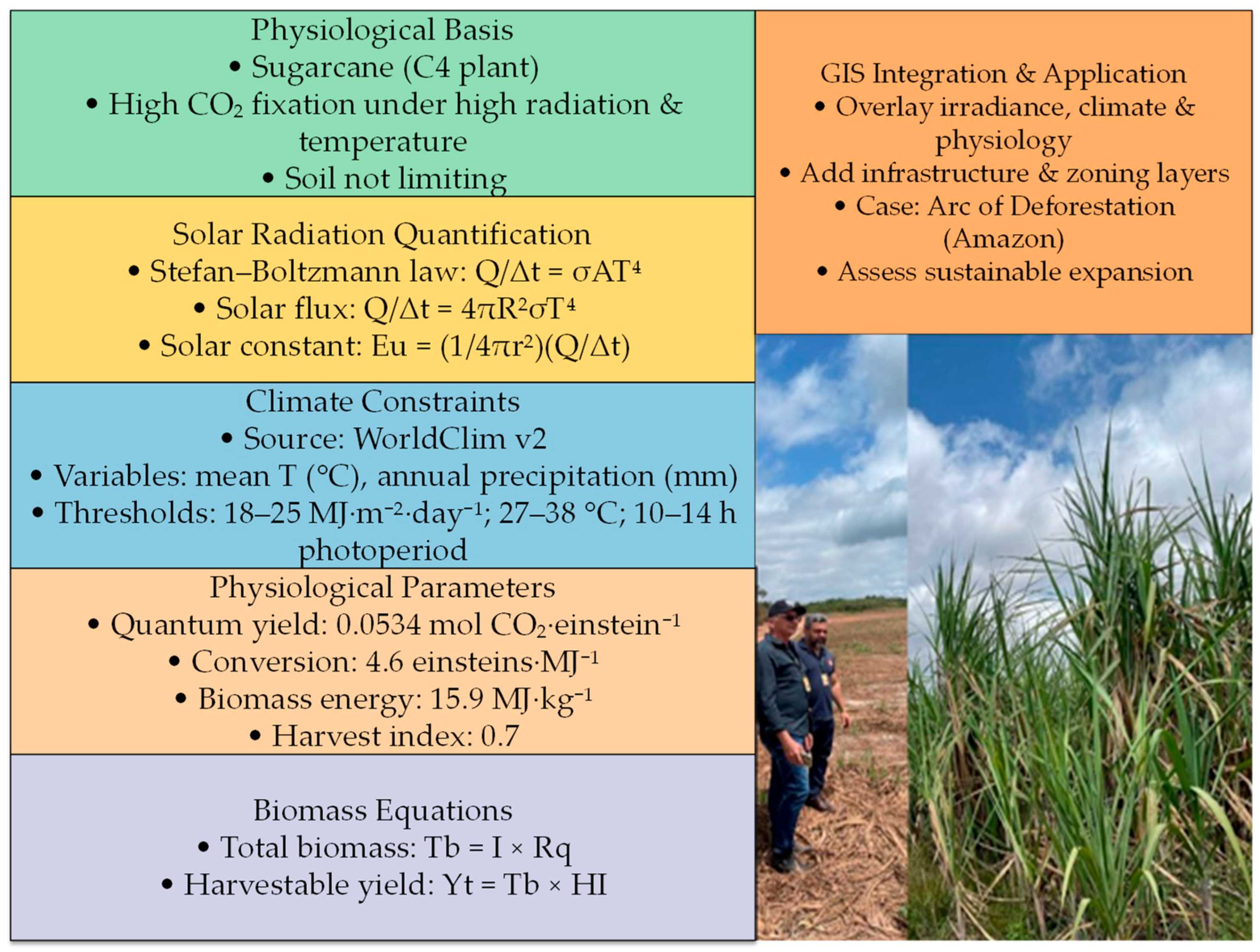
The overall methodological framework integrates fundamental physiological principles of sugarcane growth with quantitative assessment of solar radiation, agroclimatic characterization, and biomass conversion processes within a spatially explicit modeling approach. Solar irradiance was quantified using physically based formulations (Equations (1)–(3)) supported by satellite derived datasets and represents the primary driver of potential productivity in the model.
Climatic variables, specifically air temperature and precipitation, were derived from WorldClim v2 and incorporated to define the thermal and hydric suitability domain of the study region, as illustrated in
Figure 2, rather than to impose direct constraints on potential productivity. Biomass accumulation and potential yield were subsequently estimated using established radiation use efficiency parameters and harvest indices reported for sugarcane under optimal growth conditions (Equations (4) and (5)).
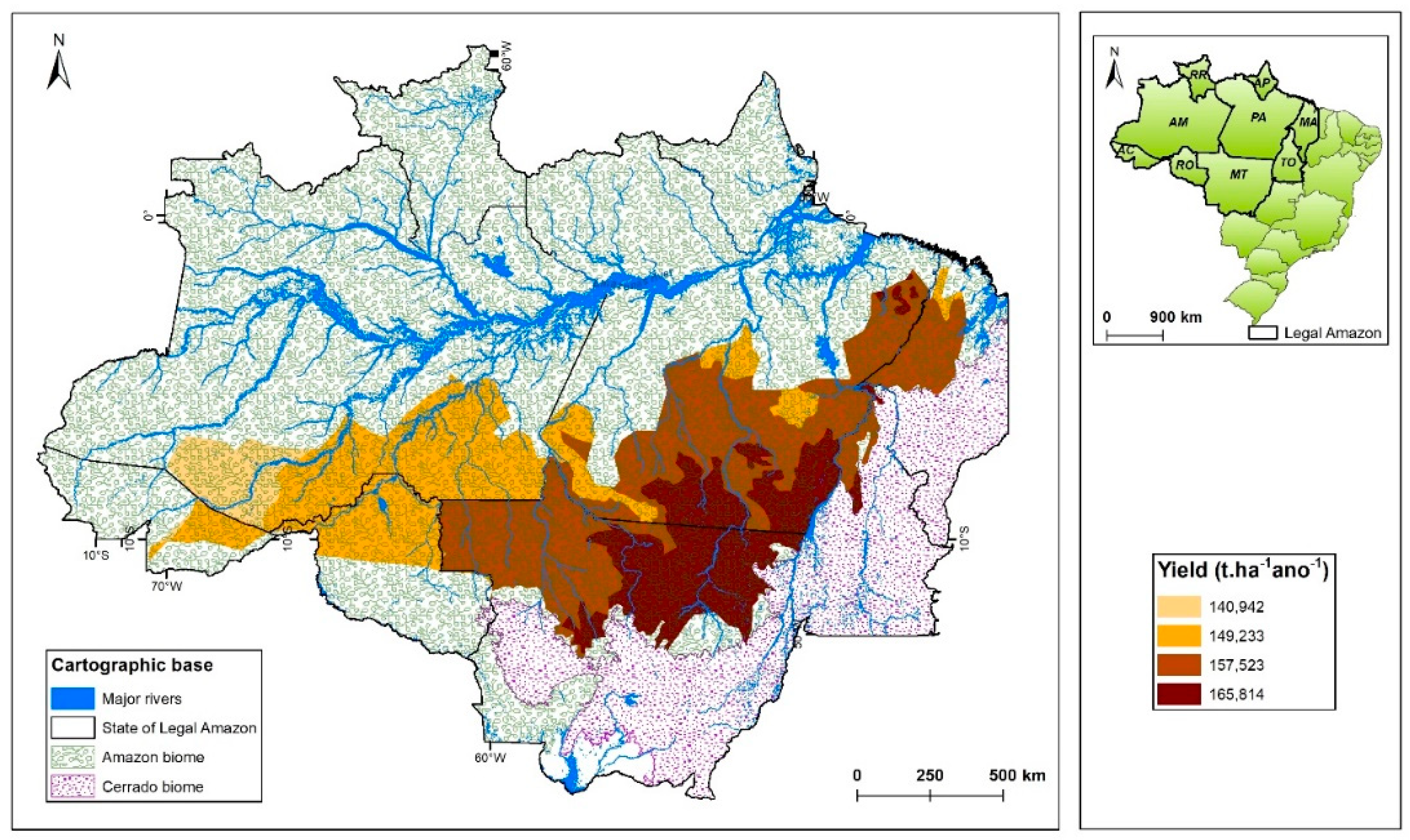
In the final step of the methodological framework, geospatial integration combined solar irradiance, climatic variables, crop physiological parameters, and infrastructure layers to delineate agroclimatically suitable zones for sugarcane cultivation in the Brazilian Amazon.
Figure 3 synthesizes this methodological sequence, illustrating the logical progression from theoretical assumptions to spatial implementation of the M3P model.
The framework supports a spatially explicit assessment of sugarcane potential productivity under agroclimatically favorable conditions and provides a structured basis for evaluating improved management practices aimed at enhancing production efficiency and environmental performance within the sugarcane supply chain [
20].




 ,
,