


Abstract
The Amazon Deforestation Arc remains a critical region for environmental governance, where land-use strategies must consider distinct legal and institutional frameworks across the Amazon and Cerrado biomes. This study applies the Potential Productivity Model (M3P), a theoretical radiation-based framework, to estimate the upper physiological limits of sugarcane (Saccharum officinarum L.) productivity on degraded pastures within the Arc of Deforestation. The model integrates satellite-derived solar radiation with climatic variables to quantify potential productivity under optimal biophysical conditions, providing an objective benchmark for planning-oriented bioenergy assessments. Estimated potential yields range from 153 to 178 t·ha−1·yr−1, consistent with global reference values reported for sugarcane in high-radiation environments and relevant for informing public policies such as Brazil’s Agroecological Zoning of Sugarcane. The results demonstrate that agroclimatic potential alone is insufficient to guide land-use decisions. While degraded pastures associated with the Cerrado biome may accommodate sugarcane cultivation as part of productive land recovery strategies, areas belonging to the Amazon biome require priority actions focused on ecological restoration through agroforestry and integrated crop–livestock–forest systems. Overall, the M3P model offers a scalable and scientifically grounded decision-support framework for strategic planning in environmentally sensitive tropical regions.
1. Introduction
The Amazon Deforestation Arc represents one of the most dynamic and environmentally sensitive land-use frontiers in Brazil. Shaped by successive waves of agricultural expansion, infrastructure development, and institutional change, the region has concentrated on intense land-use pressure since the early 2000s, giving rise to complex interactions between agricultural production, environmental regulation, and governance mechanisms [1,2,3]. As a result, land-use planning in the Arc requires analytical approaches capable of distinguishing biophysical potential from legal, ecological, and institutional constraints.
Degraded lands within the Amazon Deforestation Arc are heterogeneous. Their legal status, management options, and land-use trajectories differ substantially depending on whether they occur within the Amazon or Cerrado biomes, which are governed by distinct environmental regulations and land-use policies in Brazil [4,5]. Consequently, strategies aimed at agricultural expansion or land restoration must explicitly account for biome-specific constraints to avoid unintended outcomes such as biodiversity loss, indirect land-use change, and increased greenhouse-gas emissions [1].
In this context, spatially explicit modeling approaches have been widely applied to support decision-making in tropical regions, particularly for evaluating bioenergy crop potential under diverse climatic and land-use conditions [6,7,8]. Productivity potential models grounded in biophysical principles play a central role in this process by defining theoretical upper yield limits independently of management constraints. These models provide a reference framework for assessing yield gaps and for supporting strategic planning and sustainable intensification pathways [7,9,10].
Sugarcane (Saccharum officinarum L.) is a C4 crop characterized by high radiation use efficiency and strong biomass accumulation capacity under high irradiance and temperature regimes [11,12,13]. These physiological attributes make sugarcane a strategic crop for bioenergy production in tropical environments, while also emphasizing the role of solar radiation as a primary driver of potential productivity [6]. However, translating agroclimatic suitability into sustainable land-use strategies requires careful differentiation between theoretical productivity potential and land-use feasibility, particularly in environmentally sensitive regions such as the Amazon Deforestation Arc.
Within this analytical framework, the Potential Productivity Model (M3P) is applied as a theoretical, radiation-based approach to estimate the upper physiological limits of sugarcane productivity on degraded pastures within the Arc. By integrating satellite-derived solar radiation with climatic variables, the model provides an objective benchmark for planning-oriented assessments, without presuming field-level yield realization. Its application is especially relevant for evaluating degraded lands in Cerrado-dominated areas, while in portions of the Arc that belong to the Amazon biome, sugarcane incorporation is compatible only with agroforestry systems and integrated crop–livestock–forest arrangements, in accordance with current Brazilian environmental legislation.
Therefore, the objective of this study is to apply the Potential Productivity Model (M3P) to estimate the theoretical productivity potential of sugarcane on degraded pastures within the Amazon Deforestation Arc, providing a planning-oriented framework that explicitly distinguishes between agroclimatic potential and biome-specific land-use feasibility.
2. Materials and Methods
2.1. Conceptual Definition of the Productivity Model
This study adopts a radiation-based biophysical model to estimate theoretical potential productivity, defined as the maximum biomass yield determined exclusively by climatic energy supply and physiological conversion efficiency.
Crop production efficiency can be defined in thermodynamic terms as the ratio between energy output, expressed as carbohydrate accumulation, and energy input supplied by solar radiation. Within this framework, total dry matter production depends primarily on two factors: the amount of solar radiation intercepted by the crop canopy during the growing season and the efficiency with which intercepted radiation is converted into biomass. Temperature and water availability do not generate productivity per se but regulate crop development by controlling leaf area expansion and the duration of phenological phases, which determine the capacity of the canopy to intercept radiation. Consequently, productivity reaches a theoretical upper limit imposed by physical and physiological constraints rather than by management practices or soil conditions [6].
Yield potential represents the upper physiological limit of crop productivity under conditions in which water and nutrient availability do not limit growth and biotic stresses remain controlled. This potential is defined by the crop’s assimilatory capacity and by inherent metabolic efficiencies governing the conversion of solar energy into biomass. Classical yield theory establishes that productivity potential reflects intrinsic physiological and energetic constraints rather than achievable field yields, providing a theoretical reference ceiling for comparative analysis [9].
Potential yield has been formally incorporated as a benchmark in yield-gap analysis, where it functions as a reference level against which attainable and observed yields are compared. In this framework, potential yield does not represent an empirically validated outcome but a biophysically defined ceiling determined by climate and crop characteristics, whose relevance lies in its internal consistency with physical and physiological principles [7].
Based on these scientific premises and considering that sugarcane (Saccharum officinarum L.) operates a C4 photosynthetic pathway [12], this study adopts the hypothesis that, when agronomic conditions are non-limiting, solar radiation constitutes the primary determinant of potential productivity. The C4 photosynthetic apparatus confers high efficiency of CO2 fixation under conditions of high irradiance and elevated temperatures, which supports the use of radiation-based approaches to estimate theoretical productivity limits.
Studies focused on sugarcane yield estimation under commercially managed conditions have shown that even calibrated crop simulation models present substantial discrepancies when compared with observed yields. Using FAO-AZM, DSSAT/CANEGRO and APSIM-Sugarcane models [8], reported mean absolute errors exceeding 29 t ha−1 and coefficients of determination lower than 0.54 when management effects were not explicitly represented. After introducing a management factor associated with yield decline across successive crop cycles, errors decreased to values ≤ 12.9 t ha−1 during calibration and between 13.0 and 14.9 t ha−1 during validation, with R2 increasing to 0.58–0.72. These results indicate that management-related variability strongly constrains yield realization in commercial fields, reinforcing the conceptual distinction between observed productivity and an upper-bound productivity potential defined independently of management [8].
Under this hypothesis, soil properties, management practices, and genetic material are assumed to be agronomically adequate and non-limiting. In this context, solar radiation availability emerges as the key variable controlling biomass formation and, therefore, as a critical factor for ensuring that the crop reaches its maximum theoretical potential productivity. This assumption justifies the exclusion of soil variables from the model and supports the use of solar energy as the central input in the estimation of theoretical potential productivity.
2.2. Methodological Assumptions of the M3P Model
The Potential Productivity Model (M3P) estimates the theoretical maximum productivity of sugarcane (Saccharum officinarum L.) in the Amazon Deforestation Arc under idealized conditions. The model defines the upper yield limit by isolating the effect of incident solar radiation on biomass production, if all other biophysical and management related factors fully comply with established agronomic recommendations. Within this framework, the M3P represents potential productivity as an upper bound estimate derived from physical and physiological principles rather than from field-based calibration.
Sugarcane is a C4 species with a photosynthetic apparatus characterized by high radiation use efficiency and low photorespiration losses, a trait widely documented for C4 grasses [14,15]. Biomass accumulation in sugarcane responds strongly to the cumulative amount of photosynthetically active radiation intercepted over the crop cycle. This physiological characteristic provides the conceptual basis for assigning a dominant role to incoming solar energy in the M3P framework, while treating other environmental and management variables as non-limiting by assumption.
The M3P adopts the following methodological assumptions.
- Hydric and nutritional conditions
The model assumes an unrestricted and optimal supply of water and nutrients throughout the entire crop cycle, consistent with agronomic recommendations for high yielding sugarcane systems. Under this assumption, neither water stress nor nutritional limitations constrain photosynthesis, biomass accumulation, or yield formation.
- Pest and disease control
The model assumes effective and complete control of pests and diseases. Consequently, biotic stress does not reduce photosynthetic efficiency, biomass accumulation, or final yield.
- Genetic factors
The model considers a high yielding sugarcane genotype with broad adaptability and a photosynthetic apparatus typical of C4 grasses, capable of efficiently converting intercepted solar radiation into biomass. Radiation use efficiency values reported for sugarcane under optimal growth conditions support this assumption [14,15].
- Single limiting factor
Incident global solar radiation (I) represents the sole limiting factor for potential productivity in the M3P framework, as it defines the total amount of energy available for photosynthesis and therefore establishes the theoretical upper bound of biomass production.
- Climatic role of air temperature
The model incorporates air temperature (T) as a secondary variable exclusively for estimating longwave radiation emission within the surface energy balance, based on the Stefan–Boltzmann law [10]. Temperature does not directly constrain potential productivity in the model and does not act as a limiting factor for biomass accumulation, provided that agronomically recommended thermal conditions are met.
Under these assumptions, solar radiation availability constitutes the primary determinant of sugarcane productivity, since photosynthesis converts radiant energy into chemical energy stored as biomass, which is subsequently allocated to products such as sugar, ethanol, and bioelectricity [5]. Thermal radiation exchange follows fundamental physical principles established since the seventeenth century, particularly the Stefan–Boltzmann law, which relates the energy radiated by a body to its absolute temperature [10].
in which A is the emitting surface area, T is the temperature in kelvin, σ is the Stefan–Boltzmann constant (5.67 × 10⁻⁸ W·m−2·K4), and Q/Δt is the emitted power.
Applied to the Sun, the total radiated power is:
in which R = 6.96 × 10⁸ m and T = 5770 K, yielding approximately 3.83 × 1026 W.
At Earth’s distance, intensity decreases with the square of the distance, resulting in a mean solar constant of ~1350 W·m−2 (Equation (3)). When passing through the atmosphere, radiation is attenuated by scattering and absorption, particularly due to cloud cover, producing spatial and temporal variability.
Solar radiation data were obtained from the Global Solar Atlas [16], which provides daily and annual estimates of global horizontal irradiance (GHI) at a spatial resolution of up to 1 km2. The original GHI values, expressed in kWh·m−2·day−1, were converted to MJ·m−2·day−1 using the standard conversion factor of 1 kWh = 3.6 MJ.
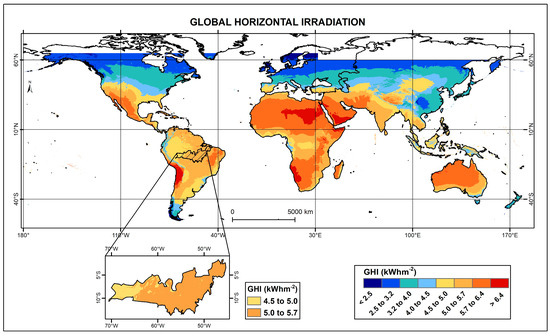
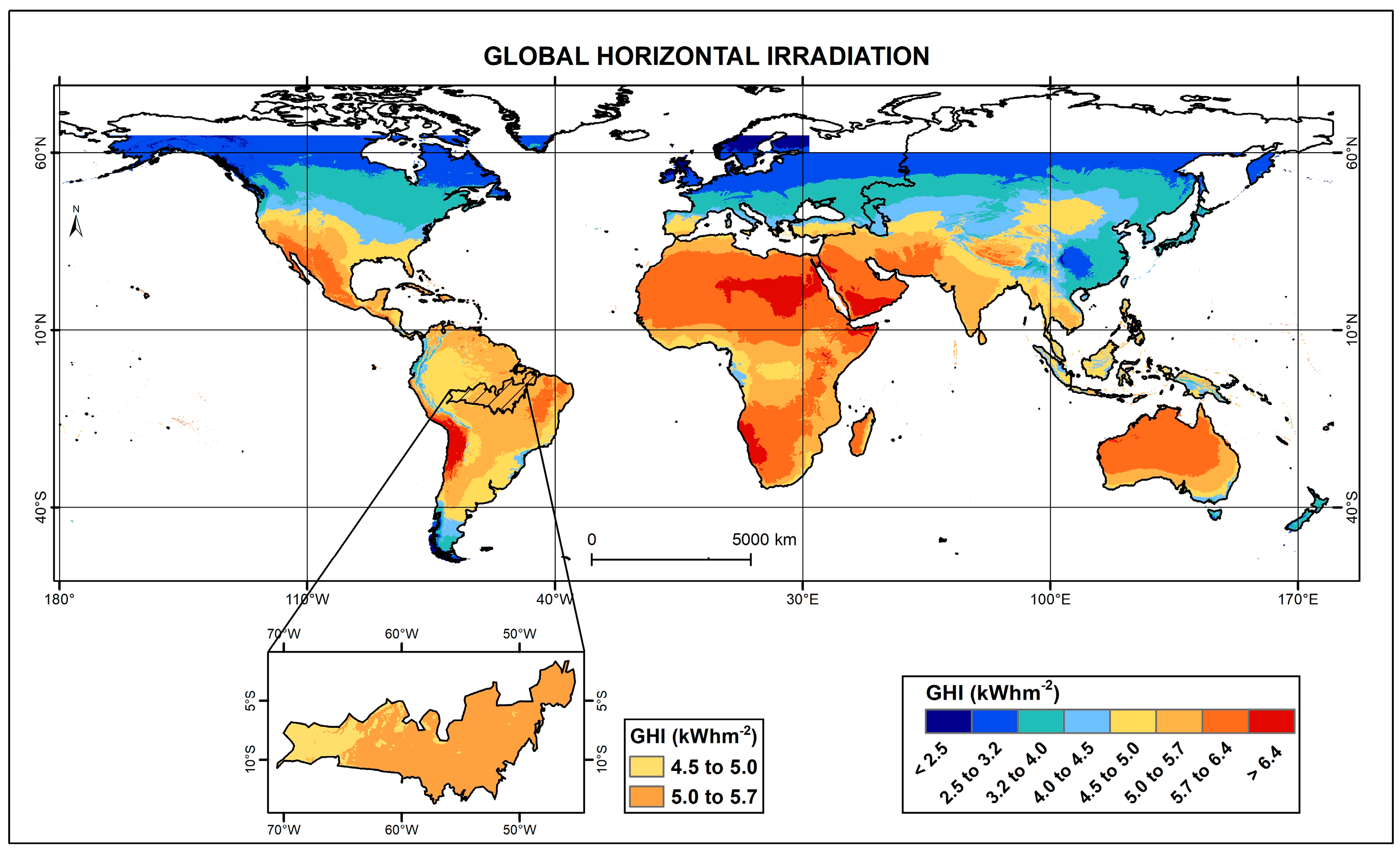
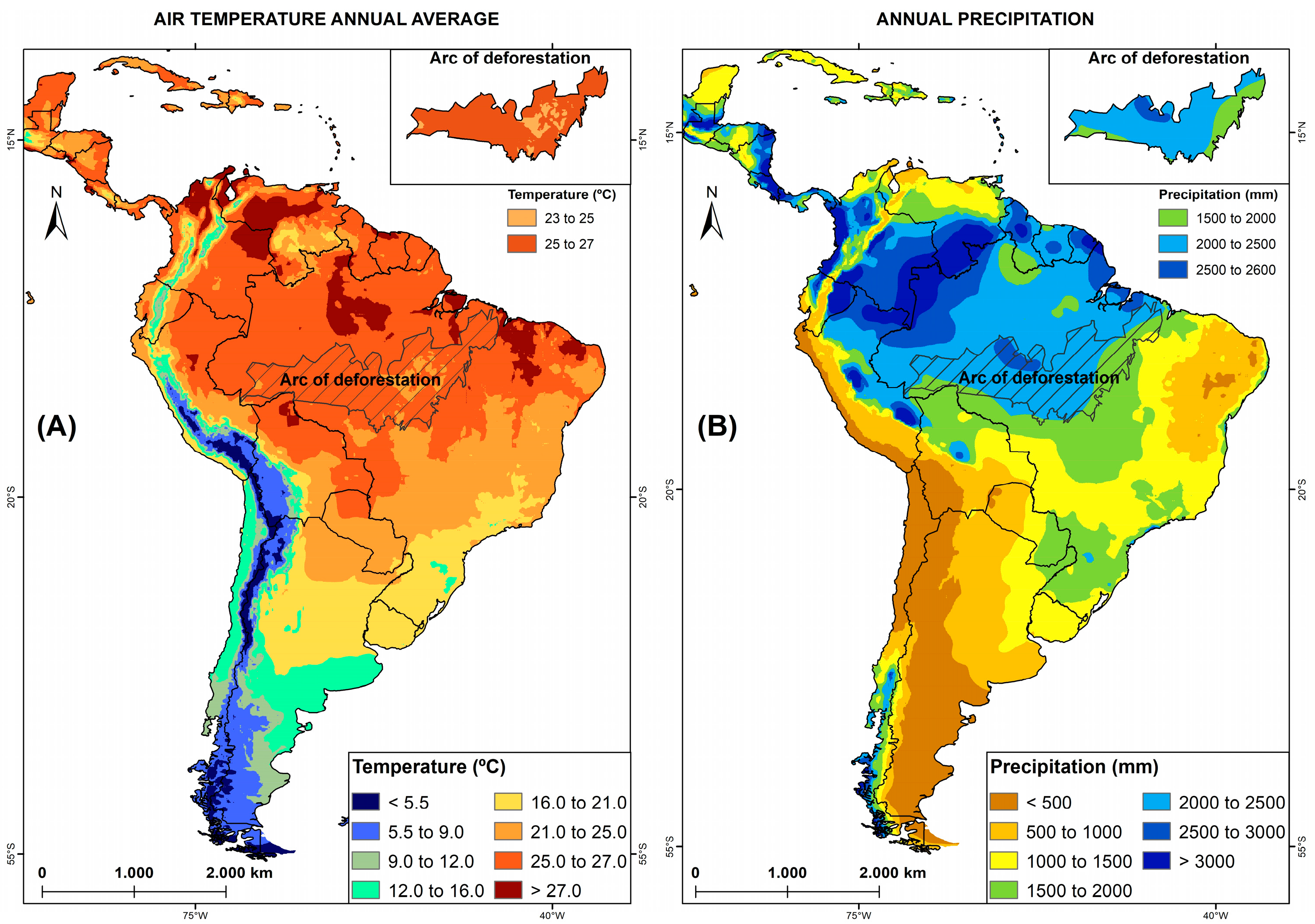
The analysis of the long-term spatial distribution of solar irradiance combined satellite-based observations with meteorological modeling to classify insolation zones across the Brazilian Amazon, with particular emphasis on the Arc of Deforestation (Figure 1 and Figure 2).
Figure 1.
Global spatial distribution of mean annual Global Horizontal Irradiation (GHI, kWh·m−2·day−1) derived from the Global Solar Atlas (1999–2018) [16]. The map highlights the tropical belt as a region of high solar irradiance worldwide. In South America, elevated GHI levels are observed across large portions of Brazil. The inset map delineates the Brazilian Arc of Deforestation, where mean daily GHI values predominantly range between 4.5 and 5.7 kWh·m−2·day−1, according to the classes shown in the legend.
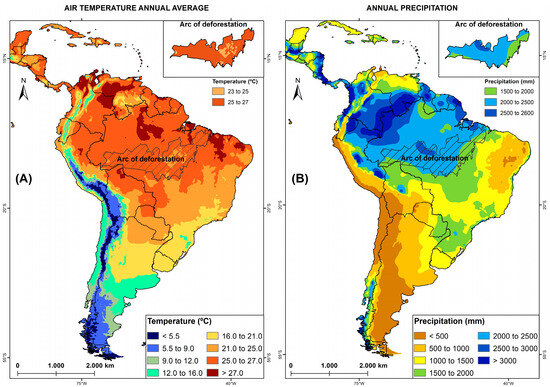
Figure 2.
Spatial distribution of key climatic variables across South America derived from WorldClim v2 interpolated climate normals for the period 1970–2000. Panel (A) shows mean annual air temperature (°C), and panel (B) shows total annual precipitation (mm). The geographic extent of the Amazon Deforestation Arc is explicitly delineated in both panels.
To represent the conversion of intercepted solar energy into biomass, the model adopted physiological parameters reported in the literature. The quantum yield (Rq) was set to 0.0534 mol CO2·Einstein−1, corresponding to the theoretical maximum for C3 photosynthesis, with a mean conversion factor of 4.6 Einsteins·MJ−1 [10]. The biomass energy content (Em) was assumed to be 15.9 MJ·kg−1, consistent with reported values for dry plant biomass [17]. The harvest index (HI) was fixed at 0.7, in agreement with values reported for sugarcane grown under favorable conditions [18,19].
Optimal climatic ranges associated with high sugarcane productivity were defined as reference thresholds (Table 1), including irradiance between 18 and 25 MJ·m−2·day−1, photoperiod between 10 and 14 h, and air temperature between 27 and 38 °C. Total dry biomass accumulated over the crop cycle (Tb) was estimated as:
in which I represent the total incident irradiance (MJ·m−2·cycle−1). The theoretical harvestable yield (Yt) was then derived by applying the harvest index:
Table 1.
Nomenclature and Definition of Variables Used in the M3P Model.
Global Horizontal Irradiation (GHI) data were obtained from the Global Solar Atlas [16], a globally recognized database that integrates satellite derived observations with meteorological reanalysis products, provided at an approximate spatial resolution of 1 km2. The dataset represents long term climatological averages of solar irradiance incident on a horizontal surface, expressed as daily values in kWh·m−2·day−1.
Figure 1 illustrates the global spatial distribution of GHI, clearly highlighting the tropical belt as one of the regions with the highest solar energy availability worldwide. Within South America, elevated GHI levels are observed across large portions of Brazil, with prominence in the central and northern regions. The inset map explicitly delineates the Brazilian Arc of Deforestation, where GHI values predominantly range between 4.5 and 5.7 kWh·m−2·day−1, indicating a consistently high solar energy supply under tropical continental conditions.
To ensure methodological consistency with the parameters adopted in the M3P model, all GHI values were converted to megajoules (MJ·m−2·day−1) using the standard conversion factor of 1 kWh = 3.6 MJ. Solar irradiance was treated as the primary driving variable of the model, reflecting its central role in defining the upper theoretical limit of biomass production under potential productivity conditions, independent of management limitations.
The analytical framework integrated spatially explicit solar irradiance data with climatic variables, specifically air temperature and precipitation. These variables were used to characterize the prevailing agroclimatic context of the region rather than to impose direct constraints on potential productivity. Crop physiological parameters associated with sugarcane growth and radiation use efficiency were incorporated to support the identification of agroclimatically suitable zones under tropical conditions.
All spatial analyses were conducted within a geographic information system environment. Solar irradiance and climatic layers were spatially intersected with the geographic extent of the Arc of Deforestation to contextualize the potential productivity patterns within an area of active land-use transformation in the Brazilian Amazon. This approach allows the identification of territories with high climatic aptitude for sugarcane cultivation while explicitly acknowledging the environmental and territorial context relevant to land-use planning in the region.
Based on benchmarks reported in the peer reviewed literature and on the climatic ranges observed across the Amazon region, we defined optimal environmental thresholds for sugarcane growth. These thresholds delineate the agroclimatic suitability domain adopted in the model and are summarized in Table 2. The analysis indicates that areas characterized by global solar irradiance between 20.5 and 23.0 MJ·m−2·day−1, photoperiods ranging from 10 to 14 h, and mean annual air temperatures between 27 and 38 °C correspond to conditions favorable for high potential sugarcane productivity.
Table 2.
Environmental parameters associated with high sugarcane productivity.
Climatic data were obtained from WorldClim v2 [14], a high-resolution global dataset that provides interpolated monthly climate surfaces for the period 1970–2000 at an approximate spatial resolution of 1 km2. WorldClim v2 was developed using observations from approximately 9000 to 60,000 meteorological stations worldwide and applies thin plate spline interpolation, incorporating covariates such as elevation, distance to the coast, and satellite derived variables, including MODIS land surface temperature and cloud cover. Independent validation indicates high model performance, with cross validation correlation coefficients exceeding 0.99 for temperature, 0.86 for precipitation, and 0.76 for wind speed [14]. Owing to these characteristics, WorldClim v2 represents a widely accepted baseline dataset for ecological and agroclimatic analyses.
In this study, WorldClim v2 data were used to characterize the thermal and hydric environment of the study area through mean annual air temperature (°C) and total annual precipitation (mm). These variables were incorporated to define the agroclimatic suitability domain for sugarcane cultivation, rather than to impose direct constraints on potential productivity. Temperature and precipitation were selected because they exert fundamental control over sugarcane physiological processes, including photosynthetic activity, phenological development, and water availability, which together condition the feasibility of crop establishment and growth under rainfed tropical systems.
Figure 2 presents the spatial distribution of key climatic variables used to characterize the agroclimatic context of the Amazon Deforestation Arc. Panel (A) shows the mean annual air temperature across South America, while panel (B) depicts the spatial pattern of total annual precipitation. In both panels, the geographic extent of the Arc of Deforestation is explicitly delineated to support regional interpretation.
In Figure 2A, mean annual air temperature exhibits a clear latitudinal gradient, with the highest values concentrated in tropical regions. The Amazon Deforestation Arc is predominantly characterized by mean annual temperatures above 27 °C, with extensive areas exceeding this threshold. This thermal regime falls within the range commonly reported as favorable for sugarcane physiological activity, including photosynthesis, growth, and biomass accumulation under tropical conditions.
Figure 2B illustrates the spatial distribution of total annual precipitation, revealing pronounced spatial variability across South America. Within the Amazon Deforestation Arc, annual precipitation generally ranges between 1500 and 2500 mm, with localized areas exceeding 2500 mm. These precipitation levels indicate a predominantly humid environment, which is generally sufficient to sustain sugarcane cultivation under rainfed conditions, provided that soil and management constraints are adequately addressed.
Together, the temperature and precipitation patterns shown in Figure 2 define the thermal and hydric envelope of the study region. These climatic variables were used to characterize the agroclimatic suitability domain of sugarcane cultivation, rather than to impose direct limitations on potential productivity. The integration of these climatic layers with solar irradiance data (Figure 1) supports the spatial identification of regions where the theoretical potential productivity estimated by the M3P model can be expressed under favorable climatic conditions.
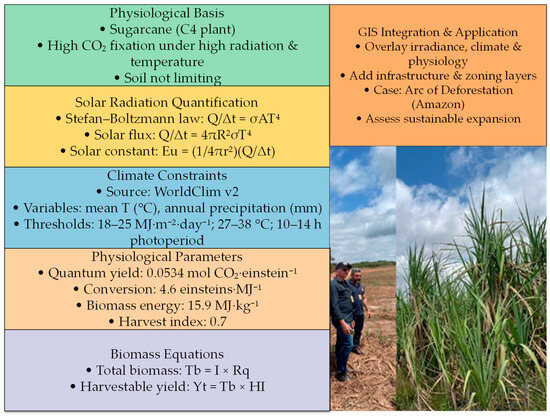
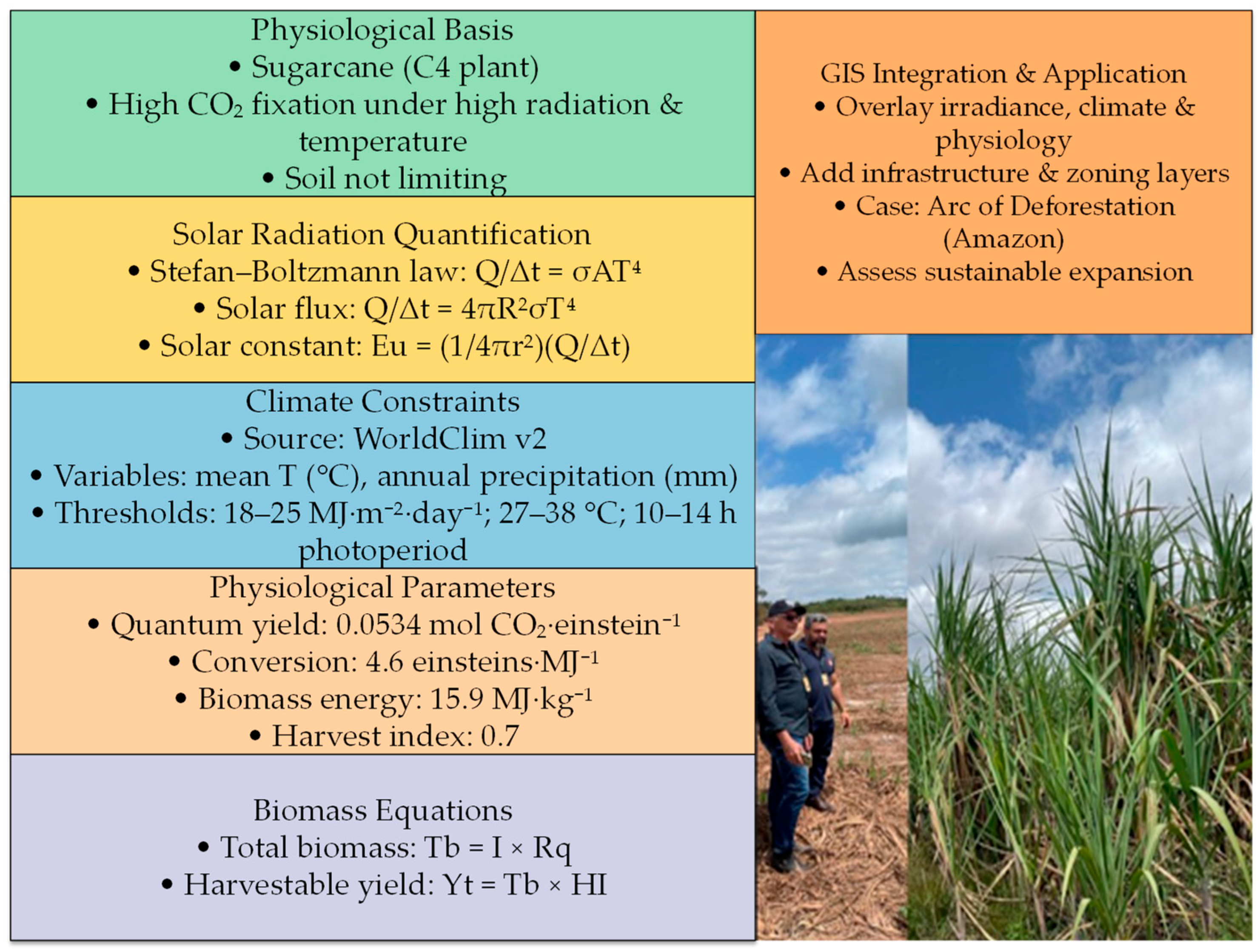
The overall methodological framework integrates fundamental physiological principles of sugarcane growth with quantitative assessment of solar radiation, agroclimatic characterization, and biomass conversion processes within a spatially explicit modeling approach. Solar irradiance was quantified using physically based formulations (Equations (1)–(3)) supported by satellite derived datasets and represents the primary driver of potential productivity in the model.
Climatic variables, specifically air temperature and precipitation, were derived from WorldClim v2 and incorporated to define the thermal and hydric suitability domain of the study region, as illustrated in Figure 2, rather than to impose direct constraints on potential productivity. Biomass accumulation and potential yield were subsequently estimated using established radiation use efficiency parameters and harvest indices reported for sugarcane under optimal growth conditions (Equations (4) and (5)).
In the final step of the methodological framework, geospatial integration combined solar irradiance, climatic variables, crop physiological parameters, and infrastructure layers to delineate agroclimatically suitable zones for sugarcane cultivation in the Brazilian Amazon. Figure 3 synthesizes this methodological sequence, illustrating the logical progression from theoretical assumptions to spatial implementation of the M3P model.
Figure 3.
Conceptual diagram of the methodological sequence for assessing sugarcane suitability.
The framework supports a spatially explicit assessment of sugarcane potential productivity under agroclimatically favorable conditions and provides a structured basis for evaluating improved management practices aimed at enhancing production efficiency and environmental performance within the sugarcane supply chain [20].
3. Results
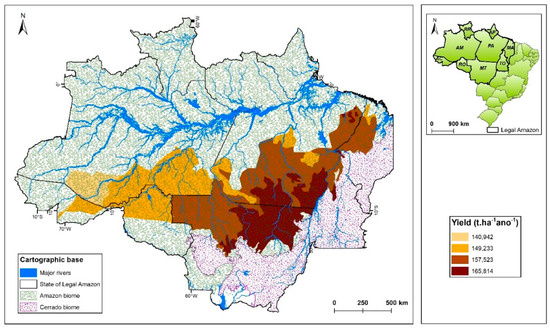
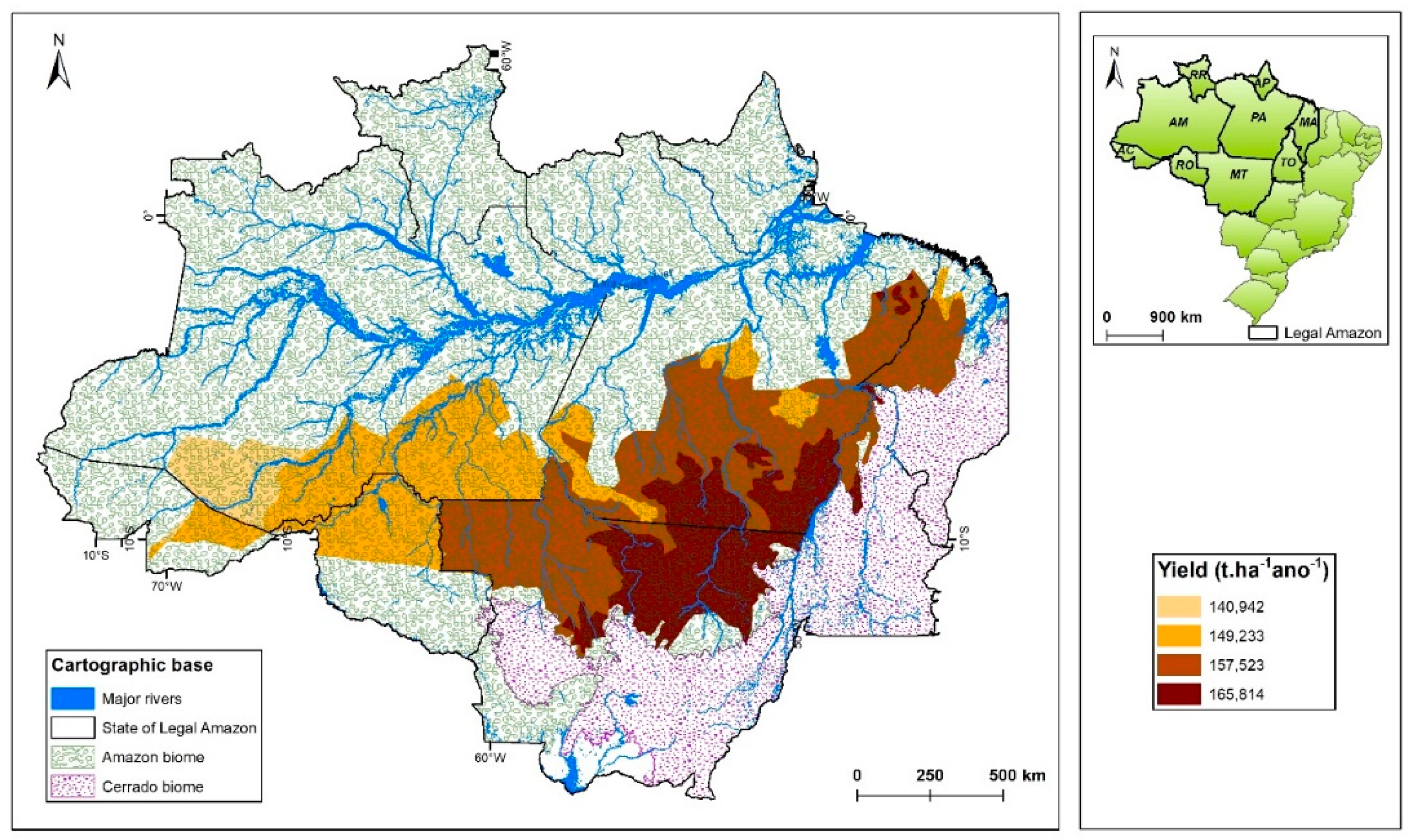
Figure 4 presents the spatial distribution of the theoretical potential productivity of sugarcane across the Arc of Deforestation in the Brazilian Amazon, as estimated by the M3P model. Legally protected areas, including Indigenous Lands and Conservation Units, are displayed in gray and were excluded from the agroclimatic suitability assessment, in accordance with current land-use regulations.
Figure 4.
Spatial distribution of potential sugarcane yield (t·ha−1·yr−1) across the Arc of Deforestation in the Brazilian Amazon, estimated with the M3P model. Predicted values in historically cultivated areas range from 153 to 178 t·ha−1·yr−1, approaching global maximum reference levels for sugarcane productivity. Gray shading indicates legally protected zones, including Indigenous Lands and Conservation Units, where agricultural expansion is restricted.
Within areas historically occupied by agricultural activities, estimated potential productivity ranges from approximately 153 to 178 t·ha−1·yr−1, values consistent with physiological upper limits reported for sugarcane under favorable tropical conditions. The spatial pattern reveals three distinct gradients. The northern portion of the Arc exhibits moderate potential productivity, with values closer to the lower bound of the estimated range. The central and eastern sectors concentrate the highest productivity levels, coinciding with regions of higher solar irradiance. In contrast, the southern portion of the Arc combines high irradiance with greater interannual climatic variability, resulting in elevated potential productivity accompanied by increased uncertainty.
These spatial patterns highlight the importance of spatially explicit land-use planning that prioritizes sugarcane expansion in previously converted or degraded areas, while maintaining legally protected zones outside the scope of agricultural suitability analyses.
Table 3 presents sugarcane yield and harvested area for the main producing countries, allowing a comparative assessment of land-use intensity and productivity levels worldwide. The data reveal a clear dissociation between cultivated area and yield performance. Brazil leads global sugarcane production in terms of harvested area, exceeding 10 million hectares; however, its average yield of 74.37 t·ha−1 remains lower than that achieved by several countries with much smaller cultivated areas. Guatemala stands out with the highest reported yield, reaching 118.46 t·ha−1 while cultivating approximately 300,246 hectares, followed by Colombia with an average yield of 88.76 t·ha−1 on less than 500,000 hectares.
Table 3.
Sugarcane yield and harvested area in the main producing countries.
Major Asian producers, including India (79.68 t·ha−1), China (76.93 t·ha−1), and Thailand (76.06 t·ha−1), exhibit intermediate yield levels, combining extensive cultivated areas with productivity values only marginally higher than those observed in Brazil. In contrast, countries characterized by limited technological input and management intensity, such as Indonesia (52.19 t·ha−1) and Cuba (39.78 t·ha−1), present some of the lowest yields, reflecting structural constraints in traditional production systems.
This global comparison highlights a central challenge for Brazil. Although the country dominates sugarcane cultivation in absolute area, substantial yield gains remain achievable when compared with the performance of leading producers such as Guatemala and Colombia. The observed gap indicates that future gains should rely primarily on productivity improvements and resource use optimization rather than further expansion of cultivated land.
Table 4 summarizes commercial, experimental, and theoretical yield levels for sugarcane, providing a reference framework for assessing the outputs of the M3P model. The contrast between observed yields and estimated potential productivity is pronounced. Commercial production systems report average yields of approximately 84 t·ha−1·yr−1, with maximum field records reaching around 148 t·ha−1·yr−1 under favorable conditions. Experimental trials conducted under controlled or optimized conditions have achieved yields as high as 212 t·ha−1·yr−1, yet these values remain well below the upper limits suggested by theoretical modeling.
Table 4.
Comparative performance of sugarcane yields according to source and methodology.
Commercial production systems report average yields of approximately 84 t·ha−1·yr−1, with maximum field records reaching about 148 t·ha−1·yr−1 under favorable conditions. Experimental trials conducted under optimized environments have achieved higher yields, up to 212 t·ha−1·yr−1; however, these values remain substantially below the upper limits estimated by the M3P model.
The model estimates a theoretical maximum yield of 381 t·ha−1·yr−1, corresponding to a biomass production of 177 t·ha−1·yr−1 and an accumulation rate of 48.5 g·m−2·day−1. When compared with commercial and experimental yields, these estimates reflect the definition of M3P as a potential productivity model operating under idealized conditions. The magnitude of the projected values is consistent with the high efficiency of C4 crops in converting solar radiation into biomass and highlights the physiological capacity of sugarcane as a bioenergy crop.
Beyond the numerical comparison, these results illustrate the analytical contribution of the M3P approach. By explicitly linking potential productivity to solar irradiance and a limited set of physiological coefficients, the model delineates the upper bounds of biomass accumulation achievable in tropical environments. The comparison indicates that current commercial production levels represent only a portion of the crop’s physiological potential, suggesting that productivity gains may be achieved primarily through improvements in management practices and resource use efficiency, rather than through expansion of cultivated areas. The estimated physiological ceiling provided by M3P thus serves as a reference framework for exploring the bioenergy potential of sugarcane in tropical regions.
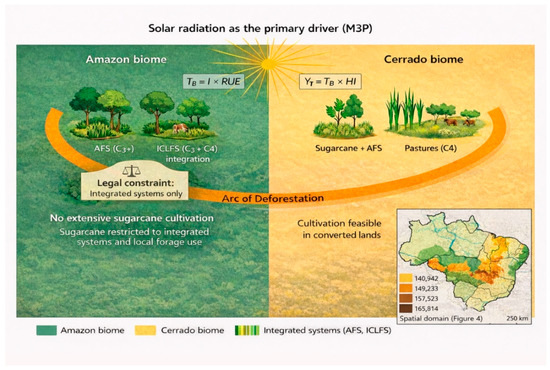
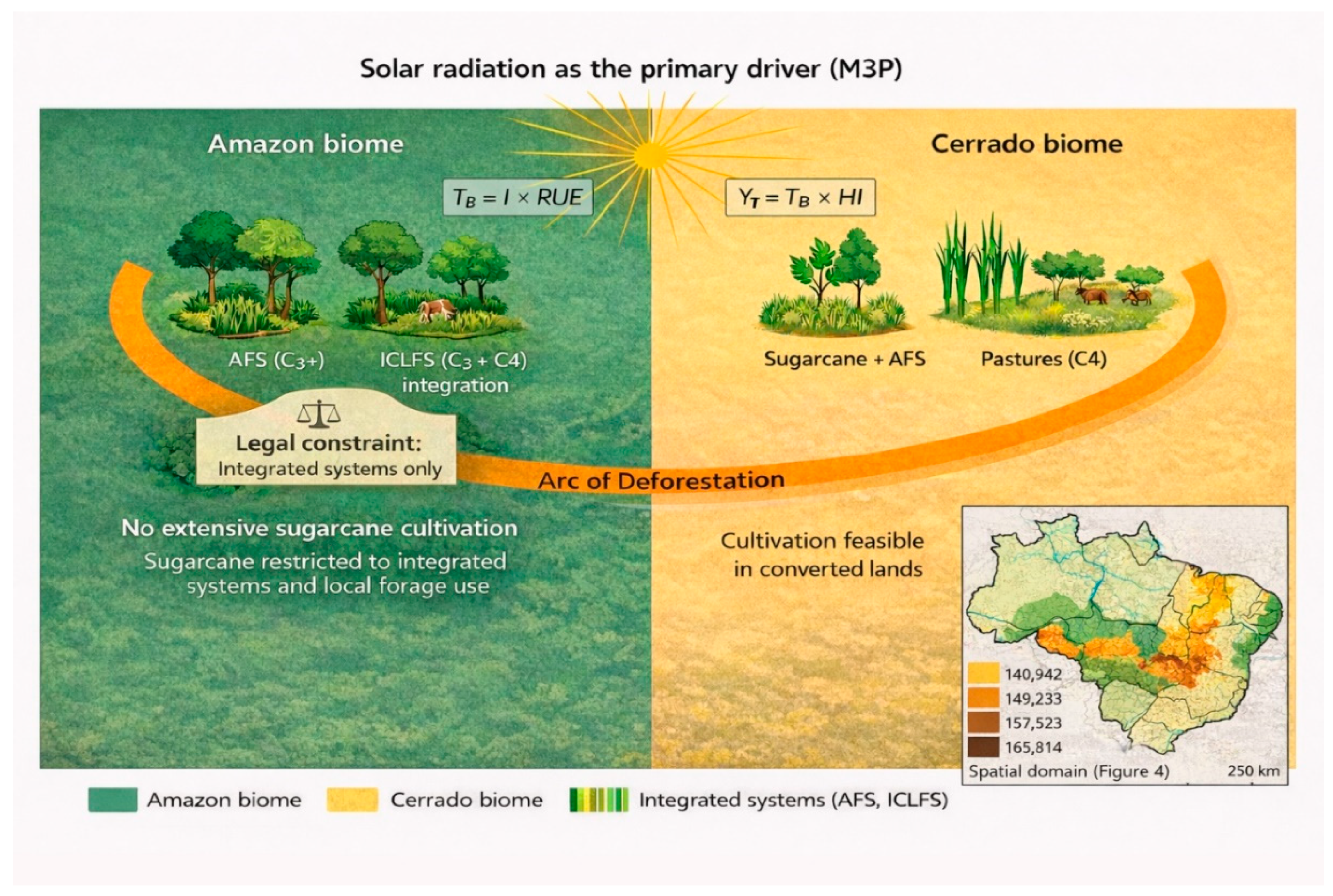
Figure 5 provides a conceptual synthesis of the M3P framework by integrating biophysical principles, crop physiology, and biome specific land-use constraints across the Amazon Deforestation Arc. The scheme highlights solar radiation as the primary driver of potential productivity, consistent with radiation use efficiency theory, while explicitly differentiating land-use feasibility between the Amazon and Cerrado biomes.
Figure 5.
Conceptual representation of the M3P model integrating solar radiation driven potential productivity with biome-specific land-use constraints in the Amazon Deforestation Arc.
In the Amazon biome, sugarcane cultivation is constrained by legal and environmental restrictions and is therefore limited to integrated systems, such as agroforestry systems (AFS) and crop livestock forest integration (ICLFS), or to local forage use. In contrast, within the Cerrado biome, extensive areas of previously converted lands, particularly degraded pastures dominated by C4 grasses, offer greater feasibility for sugarcane cultivation without additional conversion of native vegetation.
The Arc of Deforestation emerges as a transition zone where high agroclimatic potential intersects with biome boundaries, legal frameworks, and governance capacity. In this context, the M3P model does not represent a prescription for land-use change but rather a theoretical tool to quantify upper bound productivity under optimal radiation conditions, supporting planning-oriented assessments that explicitly account for ecological limits and institutional constraints.
4. Discussion
Comparative analyses of global sugarcane production consistently show that Brazil, despite leading worldwide in harvested area, exhibits average yields lower than those achieved by several smaller producing countries. This pattern reflects a persistent yield gap, a phenomenon widely documented across cropping systems and agroecological regions. Yield gap theory demonstrates that crop productivity is bounded by biophysical limits, while the divergence between potential and realized yields is primarily explained by management practices, environmental constraints, and institutional conditions rather than by crop physiology itself [7,9,10].
From a biophysical perspective, radiation use efficiency theory establishes that biomass accumulation is fundamentally constrained by the amount of intercepted solar radiation and the efficiency with which it is converted into dry matter [6]. Within this theoretical context, the M3P model contributes analytically by explicitly quantifying the upper physiological limits of sugarcane productivity under optimal radiation conditions. The large contrast between observed commercial yields and the radiation-defined productivity ceiling should not be interpreted as an attainable target under field conditions, but rather as an indicator of unrealized biophysical potential constrained by agronomic, climatic, and socio-institutional factors.
This interpretation is fully consistent with established physiological evidence. C4 crops exhibit higher quantum yield and photosynthetic efficiency than C3 species, particularly under high irradiance and temperature regimes [13]. Sugarcane combines high assimilatory capacity with favorable carbon partitioning toward sucrose accumulation, as demonstrated by comprehensive physiological and biochemical assessments [11,12]. Accordingly, the magnitude of the productivity ceiling estimated by the M3P model aligns with well-established physiological principles and reinforces the conceptual distinction between theoretical potential productivity and achievable yield.
This distinction is also supported by crop modeling literature. Comparative evaluations of operational simulation models indicate that models calibrated for managed systems are designed to reproduce observed yields rather than to define physiological upper limits [8]. In contrast, radiation-based approaches explicitly aim to estimate potential productivity, providing a reference framework against which yield gaps can be quantified and the relative influence of management, climate variability, and land-use constraints can be assessed [6,7]. Similar radiation-driven methods have been successfully applied to estimate potential productivity across different crops and tropical environments [6,7,21]. Building on these principles, the M3P model is employed here as a robust, parsimonious, and planning-oriented theoretical framework under Brazilian conditions.
Figure 5 integrates these biophysical insights with biome-specific land-use constraints across the Amazon Deforestation Arc. In the Amazon biome, agroclimatic suitability alone does not translate into land-use feasibility. Empirical evidence demonstrates that bioenergy expansion into forested regions can offset potential carbon savings and intensify biodiversity loss, particularly through indirect land-use change processes [1]. In transition zones between the Amazon and the Cerrado, land-use outcomes are strongly conditioned by ecological thresholds, legal restrictions, and governance arrangements, indicating that even anthropized landscapes within the Amazon biome require differentiated strategies [5]. Recent assessments of sugarcane sustainability and land suitability emphasize that agroclimatic evaluations must be interpreted jointly with institutional and regulatory constraints in Brazil, including those affecting the Amazon Basin [4].
The decisive role of governance in shaping land-use trajectories in the Amazon is well documented. Policy-driven interventions, monitoring systems, and enforcement mechanisms have been central to slowing deforestation over recent decades, while forest degradation remains a growing challenge driven by interacting climatic, ecological, and socio-economic pressures [2,3]. These findings underscore that land-use decisions in the region depend not only on biophysical potential but also on political and institutional contexts.
By contrast, the Cerrado biome encompasses extensive areas of degraded pastures that may accommodate sugarcane cultivation without additional conversion of native vegetation, if expansion is strictly directed toward already altered lands. Scenario-based assessments demonstrate that future ethanol demand can be met with markedly different land-use outcomes depending on spatial planning, intensification pathways, and governance effectiveness [1,15]. Poorly planned expansion can negate environmental benefits through displacement effects, whereas sustainable intensification on degraded lands can reduce land-use pressure and greenhouse-gas emissions.
The Arc of Deforestation therefore represents a critical frontier where agroclimatic potential intersects with ecological limits, legal frameworks, and institutional capacity. In this zone, governance mechanisms play a dual role: when robust, they can stabilize deforestation trends and enable restoration-oriented land-use strategies; when weak, they exacerbate environmental degradation and undermine climate mitigation efforts [2,3].
Finally, the representation of solar radiation in Figure 5 highlights its role as the fundamental energy source underlying the M3P framework. While radiation availability defines the upper physiological limits of sugarcane productivity, the realization of this potential depends on land-use governance, agronomic management, and institutional contexts. In this sense, the M3P model offers a scientifically grounded hypothesis that can be tested through technological demonstration units, experimental research, and strategic restoration initiatives. In Cerrado areas characterized by degraded pastures, sugarcane cultivation may represent a viable opportunity for productive land recovery. In contrast, within areas of the Amazon biome located in the Arc of Deforestation, the incorporation of sugarcane should be restricted to agroforestry and integrated systems, in accordance with Brazilian environmental legislation, contributing to income diversification and resilience of family-based rural agriculture rather than to extensive monoculture expansion.
5. Conclusions
This study demonstrates that the Potential Productivity Prediction Model (M3P) provides a robust theoretical framework to estimate the upper physiological limits of sugarcane productivity under tropical conditions. By integrating satellite-derived solar irradiance with fundamental biophysical principles, the model quantifies potential yields that reflect radiation-driven biomass accumulation in C4 crops, with estimated values ranging from 153 to 178 t·ha−1·yr−1, consistent with global reference levels reported for high-radiation environments.
The model was recalled: it was applied to the Amazon Deforestation Arc as a planning-oriented exercise, not as a field-calibrated yield prediction. In this context, M3P enables the spatial identification of agroclimatically favorable domains based on the combined influence of solar radiation, air temperature, and precipitation, which define the environmental envelope within which sugarcane potential productivity can be expressed. Its parsimonious structure, which avoids dependence on detailed soil datasets or complex zoning indices, makes it suitable for large-scale territorial assessments and strategic planning.
From a land-use perspective, the results highlight the importance of distinguishing between biophysical potential and land-use feasibility. In areas of the Cerrado biome, including degraded pastures located within the Amazon Legal boundary, sugarcane cultivation may represent an opportunity for productive land recovery without additional conversion of native vegetation, provided that expansion is strictly directed toward already altered lands. In contrast, within areas that belong to the Amazon biome, even when agroclimatic conditions are favorable, sugarcane incorporation should be restricted to agroforestry systems and integrated crop–livestock–forest arrangements, in accordance with Brazilian environmental legislation and with a focus on strengthening income generation in family-based rural agriculture.
Overall, the integration of radiation-based productivity modeling with spatial land-use analysis offers a scientifically grounded and testable framework to support low-carbon bioenergy planning in tropical regions. By explicitly separating theoretical productivity potential from practical land-use constraints, the M3P approach provides a transparent basis for technological demonstration units, experimental research, and restoration-oriented strategies in regions characterized by strong ecological sensitivity and complex institutional contexts.
Author Contributions
P.G.M., C.S.P., L.G.M. and J.F.d.S.-J. made substantial contributions to the conception and design of the study, the structuring of the work, the interpretation and discussion of the results, and the drafting and critical revision of the manuscript for important intellectual content. P.G.M., N.K.N.N., L.S.S.L. and C.E.R.-P. performed the geoprocessing analyses, while C.S.P. was responsible for the radiation estimates, and C.T.d.S.D. participated in review and statistics analysis. All authors critically reviewed the manuscript and provided constructive feedback that significantly improved its clarity, coherence, and overall quality. All authors have read and agreed to the published version of the manuscript.
Funding
This research received no external funding.
Data Availability Statement
The data are contained within this article and are available from the corresponding author.
Acknowledgments
The authors gratefully acknowledge the efforts of meteorological observers and the academic, research, and operational institutions that continuously provide open-access environmental data. The availability of meteorological, climatic, and remote sensing databases was fundamental for the development of this study and for the implementation of the proposed modeling framework. We also recognize the collective commitment to maintaining and ensuring the transparency of environmental monitoring systems, which are essential for advancing science-based sustainability strategies. Finally, we thank all colleagues and institutions that contribute to strengthening the scientific foundations for sustainable land-use planning and bioenergy development.
Conflicts of Interest
The authors declare no conflicts of interest.
References
- Lapola, D.M.; Schaldach, R.; Alcamo, J.; Bondeau, A.; Koch, J.; Koelking, C.; Priess, J.A. Indirect Land-Use Changes Can Overcome Carbon Savings from Biofuels in Brazil. Proc. Natl. Acad. Sci. USA 2010, 107, 3388–3393. [Google Scholar] [CrossRef] [Scilit] [PubMed]
- Nepstad, D.; McGrath, D.; Stickler, C.; Alencar, A.; Azevedo, A.; Swette, B.; Bezerra, T.; Di Giano, M.; Shimada, J.; Seroa Da Motta, R.; et al. Slowing Amazon Deforestation through Public Policy and Interventions in Beef and Soy Supply Chains. Science 2014, 344, 1118–1123. [Google Scholar] [CrossRef] [Scilit] [PubMed]
- Lapola, D.M.; Pinho, P.; Barlow, J.; Aragão, L.E.O.C.; Berenguer, E.; Carmenta, R.; Liddy, H.M.; Seixas, H.; Silva, C.V.J.; Silva-Junior, C.H.L.; et al. The Drivers and Impacts of Amazon Forest Degradation. Science 2023, 379, eabp8622. [Google Scholar] [CrossRef] [Scilit] [PubMed]
- Bordonal, R.D.O.; Carvalho, J.L.N.; Lal, R.; De Figueiredo, E.B.; De Oliveira, B.G.; La Scala, N. Sustainability of Sugarcane Production in Brazil. A Review. Agron. Sustain. Dev. 2018, 38, 13. [Google Scholar] [CrossRef] [Scilit]
- Lima, M.; Silva Junior, C.A.D.; Pelissari, T.D.; Lourençoni, T.; Luz, I.M.S.; Lopes, F.J.A. Sugarcane: Brazilian Public Policies Threaten the Amazon and Pantanal Biomes. Perspect. Ecol. Conserv. 2020, 18, 210–212. [Google Scholar] [CrossRef] [Scilit]
- Monteith, J.L. Climate and the Efficiency of Crop Production in Britain. Philos. Trans. R. Soc. Lond. B Biol. Sci. 1977, 281, 277–294. [Google Scholar] [CrossRef] [Scilit]
- Van Ittersum, M.K.; Cassman, K.G.; Grassini, P.; Wolf, J.; Tittonell, P.; Hochman, Z. Yield Gap Analysis with Local to Global Relevance—A Review. Field Crops Res. 2013, 143, 4–17. [Google Scholar] [CrossRef] [Scilit]
- Dias, H.B.; Sentelhas, P.C. Evaluation of Three Sugarcane Simulation Models and Their Ensemble for Yield Estimation in Commercially Managed Fields. Field Crops Res. 2017, 213, 174–185. [Google Scholar] [CrossRef] [Scilit]
- Loomis, R.S.; Amthor, J.S. Yield Potential, Plant Assimilatory Capacity, and Metabolic Efficiencies. Crop Sci. 1999, 39, 1584–1596. [Google Scholar] [CrossRef] [Scilit]
- Monteith, J.L.; Unsworth, M.H. Principles of Environmental Physics: Plants, Animals, and the Atmosphere, 4th ed.; Academic Press: Amsterdam, The Netherlands, 2013. [Google Scholar]
- Waclawovsky, A.J.; Sato, P.M.; Lembke, C.G.; Moore, P.H.; Souza, G.M. Sugarcane for Bioenergy Production: An Assessment of Yield and Regulation of Sucrose Content. Plant Biotechnol. J. 2010, 8, 263–276. [Google Scholar] [CrossRef] [Scilit] [PubMed]
- Moore, P.H.; Paterson, A.H.; Tew, T. Sugarcane: The Crop, the Plant, and Domestication. In Sugarcane: Physiology, Biochemistry, and Functional Biology; Moore, P.H., Botha, F.C., Eds.; Wiley: Hoboken, NJ, USA, 2013; pp. 1–17. ISBN 978-0-8138-2121-4. [Google Scholar]
- Ehleringer, J.; Björkman, O. Quantum Yields for CO2 Uptake in C3 and C4 Plants: Dependence on Temperature, CO2, and O2 Concentration. Plant Physiol. 1977, 59, 86–90. [Google Scholar] [CrossRef] [Scilit] [PubMed]
- Fick, S.E.; Hijmans, R.J. WorldClim 2: New 1-km Spatial Resolution Climate Surfaces for Global Land Areas. Intl. J. Climatol. 2017, 37, 4302–4315. [Google Scholar] [CrossRef] [Scilit]
- de Andrade Junior, M.A.U.; Valin, H.; Soterroni, A.C.; Ramos, F.M.; Halog, A. Exploring Future Scenarios of Ethanol Demand in Brazil and Their Land-Use Implications. Energy Policy 2019, 134, 110958. [Google Scholar] [CrossRef] [Scilit]
- World Bank Group. Global Solar Atlas 2.0, 2019. Available online: https://globalsolaratlas.info/map (accessed on 3 January 2026).
- McKendry, P. Energy Production from Biomass (Part 1): Overview of Biomass. Bioresour. Technol. 2002, 83, 37–46. [Google Scholar] [CrossRef] [Scilit] [PubMed]
- Inman-Bamber, N.G.; Bonnett, G.D.; Smith, D.M.; Thorburn, P.J. Sugarcane Physiology: Integrating from Cell to Crop to Advance Sugarcane Production. Field Crops Res. 2005, 92, 115–117. [Google Scholar] [CrossRef] [Scilit]
- Marin, F.R.; Jones, J.W.; Singels, A.; Royce, F.; Assad, E.D.; Pellegrino, G.Q.; Justino, F. Climate Change Impacts on Sugarcane Attainable Yield in Southern Brazil. Clim. Change 2013, 117, 227–239. [Google Scholar] [CrossRef] [Scilit]
- Jaiswal, D.; De Souza, A.P.; Larsen, S.; LeBauer, D.S.; Miguez, F.E.; Sparovek, G.; Bollero, G.; Buckeridge, M.S.; Long, S.P. Brazilian Sugarcane Ethanol as an Expandable Green Alternative to Crude Oil Use. Nat. Clim. Change 2017, 7, 788–792. [Google Scholar] [CrossRef] [Scilit]
- He, Y.; Wang, Z.; Sun, S.; Zhu, L.; Li, Y.; Wang, X.; Shi, J.; Chen, S.; Qi, D.; Peng, J.; et al. Using Crop Intercepted Solar Radiation and Vegetation Index to Estimate Dry Matter Yield of Choy Sum. Front. Plant Sci. 2023, 14, 1208404. [Google Scholar] [CrossRef] [Scilit] [PubMed]

Disclaimer/Publisher’s Note: The statements, opinions and data contained in all publications are solely those of the individual author(s) and contributor(s) and not of MDPI and/or the editor(s). MDPI and/or the editor(s) disclaim responsibility for any injury to people or property resulting from any ideas, methods, instructions or products referred to in the content. |
© 2026 by the authors. Licensee MDPI, Basel, Switzerland. This article is an open access article distributed under the terms and conditions of the Creative Commons Attribution (CC BY) license.