


Digital Twins in Smart Tourist Destinations: Addressing Overtourism, Sustainability, and Governance Challenges



Abstract
1. Introduction
2. Literature Review
3. Materials and Methods
3.1. Quantitative Component
3.2. Qualitative Component
3.3. Analytic Strategy
4. Results
5. Discussion
5.1. Interpretation of Quantitative Findings
5.2. Interpretation of Qualitative Findings
5.3. Integration of Quantitative and Qualitative Findings
5.4. Theoretical Contributions
5.5. Practical Contributions
6. Conclusions
Author Contributions
Funding
Institutional Review Board Statement
Informed Consent Statement
Data Availability Statement
Conflicts of Interest
Appendix A
- I am concerned about sharing personal data through the app.
- I could easily learn how to use a digital twin app.
- I have heard of digital twin technologies in other fields (e.g., engineering).
- I would trust the organizations that manage the app.
- Such an app could save me time during my trip.
- I worry that my location data could be misused.
- I would like to learn more about how digital twins can be applied in tourism.
- I would be willing to pay a small fee for advanced features.
- I fear that using such an app reduces the authenticity of my travel.
- I think such apps can protect cultural heritage by managing visitor flows.
- Using such an app would not require much technical support.
- I would prefer destinations that offer such an app.
- Tourists should be encouraged to use apps that promote sustainability.
- I believe the design of these apps would be intuitive.
- I intend to use digital twin applications in my future travels.
- I am familiar with mobile applications used in tourism.
- I think depending on technology might reduce spontaneity in tourism.
- I feel responsible for using tools that reduce negative impacts.
- I have previously used apps that provide real-time destination information.
- I would download a digital twin–based app if available.
- I would not need prior experience to use such an app.
- I consider myself open to trying new tourism technologies.
- A digital twin app could help me avoid crowded sites.
- I would share my location data if it improved my experience.
- I believe tourism technology should balance profit with sustainability.
- I think there is a risk of excessive surveillance through smart technologies.
- Personalized recommendations from the app would make my trip more memorable.
- I feel confident that I could adapt to new digital tools while traveling.
- I believe the app would give accurate, real-time data.
- Clear instructions would make the app simple to use.
- I would recommend such an app to friends and family.
- I am aware of the concept of smart cities or smart destinations.
- The app could support me in making more sustainable travel choices.
- I worry that not all tourists will have equal access to such tools.
- I believe such apps will become standard in tourism.
- The app would be easy for me to navigate.
- I believe the app would present unbiased information.
- Interactive features (e.g., 3D maps, AR guides) would enrich my travel experience.
- I think tourists are ready and willing to use such applications.
- I would trust the app to integrate data from multiple reliable sources.
- I am concerned about possible technical failures when using such an app.
- I believe tourism destinations increasingly rely on digital tools.
- I think destinations need stronger partnerships with tech companies and universities to scale digital twins.
- I believe the app would be a credible and professional tool.
- It could improve the quality of my trip planning.
- I believe digital twins can promote environmentally friendly tourism.
- I support the use of technology to reduce overcrowding.
- It could enhance my enjoyment of cultural and heritage sites.
- I prefer visiting destinations that use sustainable technology.
Appendix B. Interview Guide, Raw Data, and Coding Process
- A1.
- Interview Guide
- A2.
- Raw Data (Selected Excerpts)
“I know digital twins mainly from urban planning. In tourism, the idea is newer, but we see potential to simulate visitor flows, test policies virtually, and then apply them with less risk.”(Manager, Valencia)
“Our main challenge is overcrowding at Sagrada Familia and Park Güell. A digital twin could allow us to monitor real-time visitor density and redirect flows before congestion occurs.”(Manager, Barcelona)
“We see digital twins as a tool to enhance sustainability. They can help optimize transport, energy use, and even predict how weather or cruise ship arrivals will impact the city.”(Manager, Málaga)
“Funding is a major obstacle. Advanced simulation requires infrastructure and data integration that small municipalities often cannot afford without state or EU support.”(Manager, Benidorm)
“Data privacy is another issue. Tourists may not feel comfortable sharing real-time location data. We need transparent policies and strong communication to build trust.”(Manager, Granada)
“Tourists benefit through better experiences, locals through reduced congestion, and businesses through more efficient marketing. But small local businesses could be left behind if they lack digital skills or resources to join the system.”(Manager, Valencia)
“We already have elements of a smart city infrastructure. The step toward digital twins is logical, but we need stronger partnerships with tech companies and universities to scale it.”(Manager, Málaga)
“Politically, there is interest, but implementation is slower. Public acceptance and budget allocation are the main hurdles.”(Manager, Barcelona)
- A3.
- Coding Process
References
- Chang, G.; Wang, K.; Voda, M. Does Tourism Development Become an Accelerator of Low-Carbon Transition? The Moderating Role of Digital Economy and Green Finance. J. Environ. Manag. 2025, 385, 125664. [Google Scholar] [CrossRef]
- Bekele, H.; Raj, S. Digitalization and Digital Transformation in the Tourism Industry: A Bibliometric Review and Research Agenda. Tour. Rev. 2025, 80, 894–913. [Google Scholar] [CrossRef]
- Ye, X.; Miao, L. Digital Transformation and Green Finance Efficiency of Tourism Enterprises: The Effect of Credit Ratings. Int. Rev. Financ. Anal. 2025, 106, 104527. [Google Scholar] [CrossRef]
- Lin, J.; Ye, Z. Wilds to Wonders: Digital Empowerment and the Vitality of Rural Tourism in Z Village. J. Rural. Stud. 2025, 120, 103817. [Google Scholar] [CrossRef]
- Nouri, I.; Zorgati, H.; Bouzaabia, R. The Impact of Immersive Virtual Reality Tour on Visit Intentions: The Moderating Role of Cybersickness and Destination Preference. Int. J. Tour. Cities 2025, 11, 432–447. [Google Scholar] [CrossRef]
- Rogowski, M. A Method for Overtourism Optimisation for Protected Areas. J. Outdoor Recreat. Tour. 2025, 49, 100859. [Google Scholar] [CrossRef]
- Foronda-Robles, C.; Galindo-Pérez-de-Azpillaga, L.; Armario-Pérez, P. The Sustainable Management of Overtourism via User Content. Ann. Tour. Res. Empir. Insights 2025, 6, 100184. [Google Scholar] [CrossRef]
- Wu, S.; Wang, S. Exploring the Impact of AI-Enhanced Virtual Tourism on Tourists’ Pro-Environmental Behavior: A Stimulus–Organism–Response Model Perspective. Acta Psychol. 2025, 253, 104773. [Google Scholar] [CrossRef]
- Chen, T.; Liu, G. Global Perspectives on Environmental Policy Innovations: Driving Green Tourism and Consumer Behavior in Circular Economy. J. Environ. Manag. 2025, 374, 124138. [Google Scholar] [CrossRef]
- Reina-Usuga, L.; Camino, F.; Gomez-Casero, G.; Alba, C.A.J. Rural Tourism Initiatives and Their Relationship to Collaborative Governance and Perceived Value: A Review of Recent Research and Trends. J. Destin. Mark. Manag. 2024, 34, 100926. [Google Scholar] [CrossRef]
- Liao, S.M.; Haykel, I.; Cheung, K.; Matalon, T. Navigating the Complexities of AI and Digital Governance: The 5W1H Framework. J. Responsible Technol. 2025, 23, 100127. [Google Scholar] [CrossRef]
- Wang, Y.; Gao, B.W. Dynamic Construction and Maintenance of Destination Competitiveness Based on Interpretable Machine Learning. J. Destin. Mark. Manag. 2025, 37, 101020. [Google Scholar] [CrossRef]
- Alvi, M.; Dutta, H.; Minerva, R.; Crespi, N.; Raza, S.M.; Herath, M. Global Perspectives on Digital Twin Smart Cities: Innovations, Challenges, and Pathways to a Sustainable Urban Future. Sustain. Cities Soc. 2025, 126, 106356. [Google Scholar] [CrossRef]
- Xu, B.; Xiao, X.; Wang, Y.; Kang, Y.; Chen, Y.; Wang, P.; Lin, H. Concept and Framework of Digital Twin Human Geographical Environment. J. Environ. Manag. 2025, 373, 123866. [Google Scholar] [CrossRef] [PubMed]
- Kumar, V.; Budhiraja, I.; Singh, A.; Garg, S.; Kaddoum, G.; Hassan, M.M. Energy Efficient Resource Allocation and Trajectory Optimization Method for Secure Digital Twin-Enabled UAV-Assisted MEC in 6G Networks. Comput. Netw. 2025, 272, 111679. [Google Scholar] [CrossRef]
- Monteiro, J.; Barata, J. Mirroring the Regional Food Supply Chain: A Multidimensional Digital Twin for Estrela Geopark. Sustain. Futures 2025, 10, 101306. [Google Scholar] [CrossRef]
- Suhardono, S.; Fitria, L.; Prayogo, W.; Lee, C.-H.; Suryawan, I.W.K. Enhancing Community Engagement with Digital Twins: Technological Adoption in Marine Debris Management. J. Urban Manag. 2025; advance online publication. [Google Scholar] [CrossRef]
- Ali, Z.A.; Hasan, R.; Alsanad, A.; Alhogail, A.; Gumaei, A.H. Multiple Knowledge Depiction of Digital Twin-Driven Circular Economy: Concepts, Integrated Advanced Technologies, Triple Bottom Line of Smart Construction, and Exploratory Case Studies. J. Eng. Res. 2025; advance online publication. [Google Scholar] [CrossRef]
- Rahmadian, E.; Feitosa, D.; Virantina, Y. Digital Twins, Big Data Governance, and Sustainable Tourism. Ethics Inf. Technol. 2023, 25, 61. [Google Scholar] [CrossRef]
- Myrovali, G.; Tzanis, G.; Morfoulaki, M. Sustainable Tourism through Digitalization and Smart Solutions. Sustainability 2025, 17, 5383. [Google Scholar] [CrossRef]
- Song, J.; Yeo, J.; Son, M. Exploring Public Acceptance of Climate Technologies: A Study on Key Influences in South Korea. Sustainability 2024, 16, 9036. [Google Scholar] [CrossRef]
- Kenesei, Z.; Kökény, L.; Ásványi, K.; Jászberényi, M. The Central Role of Trust and Perceived Risk in the Acceptance of Autonomous Vehicles in an Integrated UTAUT Model. Eur. Transp. Res. Rev. 2025, 17, 8. [Google Scholar] [CrossRef]
- Mirčetić, V.; Mihić, M. Smart Tourism as a Strategic Response to Challenges of Tourism in the Post-COVID. In Sustainable Business Management and Digital Transformation: Challenges and Opportunities in the Post-COVID Era; Springer: Berlin/Heidelberg, Germany, 2022; pp. 445–463. [Google Scholar] [CrossRef]
- Mirčetić, V.; Mihić, M. Developing Smart Tourism as a Strategic Approach to Tourism Challenges in the Post-COVID Era. In SYMORG; Faculty of Organisational Sciences, University of Belgrade: Belgrade, Serbia, 2022; pp. 116–117. [Google Scholar]
- Keeley, A.R.; Koo, K.; Chapman, A.; Managi, S. Psychological and Socio-Economic Drivers of Public Acceptance for Direct Air Capture and Utilization Technology. J. Clean. Prod. 2025, 519, 145962. [Google Scholar] [CrossRef]
- Florido-Benítez, L. The Use of Digital Twins to Address Smart Tourist Destinations’ Future Challenges. Platforms 2024, 2, 234–254. [Google Scholar] [CrossRef]
- Liu, Y.; Feng, J.; Lu, J.; Zhou, S. A Review of Digital Twin Capabilities, Technologies, and Applications Based on the Maturity Model. Adv. Eng. Inform. 2024, 62, 102592. [Google Scholar] [CrossRef]
- Semeraro, C.; Ababneh, R.F.; Alkhatib, L.A.; Saqallah, D.; Al Koutoubi, R.; Aljaghoub, H.; Alami, A.H.; Abdelkareem, M.A.; Olabi, A.G. Data-Driven Digital Twin for Fault Detection in Compressed Air Energy Storage Systems: Design and Experimental Validation. Energy 2025, 336, 138401. [Google Scholar] [CrossRef]
- Tavitiyaman, P.; Qu, H.; Tsang, W.-S.L.; Lam, C.-W.R. The Influence of Smart Tourism Applications on Perceived Destination Image and Behavioral Intention: The Moderating Role of Information Search Behavior. J. Hosp. Tour. Manag. 2021, 46, 476–487. [Google Scholar] [CrossRef]
- Pereira, G.B.; Soardi, G.; Attanasio, A.; Frazzon, E.M. Applying Theory of Constraints (TOC) to Digital Twins: Simulation and Managerial Outputs. Procedia CIRP 2025, 134, 717–722. [Google Scholar] [CrossRef]
- Davis, F.D. Perceived Usefulness, Perceived Ease of Use, and User Acceptance of Information Technology. MIS Q. 1989, 13, 319–340. [Google Scholar] [CrossRef]
- Venkatesh, V.; Morris, M.G.; Davis, G.B.; Davis, F.D. User Acceptance of Information Technology: Toward a Unified View. MIS Q. 2003, 27, 425–478. [Google Scholar] [CrossRef]
- Karim, R.; Goh, G.G.G.; Lee, Y.L.-E.; Zeb, A. To Be Digital Is to Be Sustainable—Tourist Perceptions and Tourism Development Foster Environmental Sustainability. Sustainability 2025, 17, 1053. [Google Scholar] [CrossRef]
- Orejon-Sanchez, R.D.; Crespo-Garcia, D.; Andres-Diaz, J.R.; Gago-Calderon, A. Smart Cities’ Development in Spain: A Comparison of Technical and Social Indicators with Reference to European Cities. Sustain. Cities Soc. 2022, 81, 103828. [Google Scholar] [CrossRef]
- Donaire, J.A.; Galí, N.; Coromina, L. Evaluating Tourism Scenarios within the Limit of Acceptable Change Framework in Barcelona. Ann. Tour. Res. Empir. Insights 2024, 5, 100145. [Google Scholar] [CrossRef]
- Gorji, A.S.; Hosseini, S.; Seyfi, S.; Almeida-García, F.; Macías, R.C.; Navarro, A.M. ‘Málaga for Living, Not Surviving’: Resident Perceptions of Overtourism, Social Injustice and Urban Governance. J. Destin. Mark. Manag. 2026, 39, 101044. [Google Scholar] [CrossRef]
- Nieuwland, S.; Lavanga, M.; Koens, K. Using Adaptive Cycles and Panarchy to Understand Processes of Touristification and Gentrification in Valencia, Spain. Tour. Manag. 2025, 106, 105011. [Google Scholar] [CrossRef]
- Cisneros-Martínez, J.D.; McCabe, S.; Fernández-Morales, A. Assessing the Contribution of Different Markets in Combatting Destination Seasonality: The Case of Benidorm, Spain. J. Destin. Mark. Manag. 2023, 29, 100802. [Google Scholar] [CrossRef]
- Kauttonen, J.; Rousi, R.; Alamäki, A. Trust and Acceptance Challenges in the Adoption of AI Applications in Health Care: Quantitative Survey Analysis. J. Med. Internet Res. 2025, 27, e65567. [Google Scholar] [CrossRef]
- Romanov, B.; Cid, D.D.; Leets, P. State versus Technology: What Drives Trust in and Usage of Internet Voting, Institutional or Technological Trust? Gov. Inf. Q. 2025, 42, 102068. [Google Scholar] [CrossRef]
- Kebab, M. Travel App Adoption Intentions: Extending the Technology Acceptance Model with Trust. Mark. Sci. Inspir. 2025, 20, 45–58. [Google Scholar] [CrossRef]
- Bitencourt, J.; Osho, J.; Wooley, A.; Harris, G. Do You Trust Digital Twins? A Framework to Support the Development of Trusted Digital Twins through Verification and Validation. Int. J. Prod. Res. 2025, 1–21. [Google Scholar] [CrossRef]
- Haraguchi, M.; Funahashi, T.; Biljecki, F. Assessing Governance Implications of City Digital Twin Technology: A Maturity Model Approach. Technol. Forecast. Soc. Change 2024, 204, 123409. [Google Scholar] [CrossRef]
- Chen, X.; Jiang, L.; Zhou, Z.; Li, D. Impact of Perceived Ease of Use and Perceived Usefulness of Humanoid Robots on Students’ Intention to Use. Acta Psychol. 2025, 258, 105217. [Google Scholar] [CrossRef]
- Şeker, F.; Kadirhan, G.; Erdem, A. The Factors Affecting Tourism Mobile Apps Usage. Tour. Manag. Stud. 2023, 19, 7–14. [Google Scholar] [CrossRef]
- Hussain, A.; Zhiqiang, M.; Li, M.; Jameel, A.; Kanwel, S.; Ahmad, S.; Ge, B. The Mediating Effects of Perceived Usefulness and Perceived Ease of Use on Nurses’ Intentions to Adopt Advanced Technology. BMC Nurs. 2025, 24, 33. [Google Scholar] [CrossRef] [PubMed]
- Gupta, S.; Shaw, R. Risk Perception and Adoption of Digital Innovation in Stock Trading: A Behavioral Study. J. Consum. Behav. 2024, 23, 639–654. [Google Scholar] [CrossRef]
- Nieves-Pavón, S.; López-Mosquera, N.; González, M.J.S. The Impact of Technology Risks and Innovation on Smart Tourism Destination Management. Anatolia 2025, 1–25. [Google Scholar] [CrossRef]
- Kokkhangplu, A.; Suwanthep, D. Travel Intention to Destination via Virtual Tour: Role of Perceived Travel Risks and Behavioral. Cogent Soc. Sci. 2024, 10, 2406304. [Google Scholar] [CrossRef]
- Yao, E.; Guo, D.; Liu, S.; Zhang, J. The Role of Technology Belief, Perceived Risk and Initial Trust in Users’ Acceptance of Urban Air Mobility: An Empirical Case in China. Multimodal Transp. 2024, 3, 100169. [Google Scholar] [CrossRef]
- Bian, X.; Wang, B.; Li, K.; Zhang, Y.; Chen, L.; Zhao, H.; Xu, T. Navigating Ethical Decision-Making in Digital Transformation: Ethical Climate, Digital Competence, and Person–Organization Fit in China’s Banking Sector. Humanit. Soc. Sci. Commun. 2025, 12, 920. [Google Scholar] [CrossRef]
- Ozdemir, G.; Zonah, S. Revolutionising Heritage Interpretation with Smart Technologies: A Blueprint for Sustainable Tourism. Sustainability 2025, 17, 4330. [Google Scholar] [CrossRef]
- Pinto, H.; Barboza, M.; Nogueira, C. Perceptions and Behaviors Concerning Tourism Degrowth and Sustainable Tourism: Latent Dimensions and Types of Tourists. Sustainability 2025, 17, 387. [Google Scholar] [CrossRef]
- Vujko, A.; Knežević, M.; Arsić, M. The Future Is in Sustainable Urban Tourism: Technological Innovations, Emerging Mobility Systems and Their Role in Shaping Smart Cities. Urban Sci. 2025, 9, 169. [Google Scholar] [CrossRef]
- Guo, Y.; Liu, L.; Huang, W.; Shen, M.; Yi, X.; Zhang, J.; Lu, S. Extending X-Reality Technologies to Digital Twin in Cultural Heritage Risk Management: A Comparative Evaluation from the Perspective of Situation Awareness. Herit. Sci. 2024, 12, 245. [Google Scholar] [CrossRef]
- Radović, N.; Vujko, A.; Stanišić, N.; Ljubisavljević, T.; Lunić, D. Digital Hospitality as a Socio-Technical System: Aligning Technology and HR to Drive Guest Perceptions and Workforce Dynamics. World 2025, 6, 134. [Google Scholar] [CrossRef]
- Tudu, P.N.; Mishra, V. Toward Smart and Green: A Sustainable IT-HRM Framework. Technol. Forecast. Soc. Change 2025, 218, 124201. [Google Scholar] [CrossRef]
- Cruz-Ruiz, E.; de la Cruz, E.R.-R.; Zamarreño-Aramendia, G.; Cristòfol, F.J. Strategic Management of the Malaga Brand through Open Innovation: Tourists and Residents’ Perception. J. Open Innov. Technol. Mark. Complex. 2022, 8, 28. [Google Scholar] [CrossRef]
- Soursou, V.; Campo, J.; Picó, Y. Spatio-Temporal Variation and Ecological Risk Assessment of Microplastics along the Touristic Beaches of a Mediterranean Coast Transect (Valencia Province, East Spain). J. Environ. Manag. 2024, 354, 120315. [Google Scholar] [CrossRef]
- Brandajs, F.; Russo, A.P. Smarter City, Less Just Destination? Mobilities and Social Gaps in Barcelona. J. Place Manag. Dev. 2023, 16, 291–308. [Google Scholar] [CrossRef]
- Aguirre, A.; Zayas, A.; Gómez-Carmona, D.; Sánchez, J.A.L. Smart Tourism Destinations Really Make Sustainable Cities: Benidorm as a Case Study. Int. J. Tour. Cities 2023, 9, 51–69. [Google Scholar] [CrossRef]
- McKnight, D.H.; Choudhury, V.; Kacmar, C. Developing and Validating Trust Measures for E-Commerce: An Integrative Typology. Inf. Syst. Res. 2002, 13, 334–359. [Google Scholar] [CrossRef]
- Pavlou, P.A. Consumer acceptance of electronic commerce: Integrating trust and risk with the TAM. Int. J. Electron. Commer. 2003, 7, 101–134. [Google Scholar] [CrossRef]
- Gretzel, U.; Sigala, M.; Xiang, Z.; Koo, C. Smart tourism: Foundations and developments. Electron. Mark. 2015, 25, 179–188. [Google Scholar] [CrossRef]
- Buhalis, D.; Amaranggana, A. Smart tourism destinations: Enhancing tourism experience through personalisation of services. In Information and Communication Technologies in Tourism 2015; Springer: Cham, Switzerland, 2015; pp. 377–389. [Google Scholar] [CrossRef]
- Kritzinger, W.; Karner, M.; Traar, G.; Henjes, J.; Sihn, W. Digital twin in manufacturing: A categorical literature review and classification. IFAC-PapersOnLine 2018, 51, 1016–1022. [Google Scholar] [CrossRef]
- Choi, H.C.; Sirakaya, E. Sustainability indicators for managing community tourism. Tour. Manag. 2006, 27, 1274–1289. [Google Scholar] [CrossRef]
- Ko, T.G. Development of a tourism sustainability assessment procedure: A conceptual approach. Tour. Manag. 2005, 26, 431–445. [Google Scholar] [CrossRef]
- Kontogianni, A.; Alepis, E. Smart Tourism: State of the Art and Literature Review for the Last Six Years. Array 2020, 6, 100020. [Google Scholar] [CrossRef]
- Lee, T.H.; Jan, F.-H. How Do Smart Tourism Experiences Affect Visitors’ Environmentally Responsible Behavior? Influence Analysis of Nature-Based Tourists in Taiwan. J. Hosp. Tour. Manag. 2023, 55, 1–10. [Google Scholar] [CrossRef]
- Shi, J.; Zhou, Q.; Pan, C. A Credibility Evaluation Method for Digital Twin Based on Improved Evidence Theory. Simul. Model. Pract. Theory 2025, 143, 103152. [Google Scholar] [CrossRef]
- Jia, X.; Xu, Y.; Zhao, B.; Li, H.; Li, L.; Zhang, J. Sustainable Tourism at Nature-Based Cultural Heritage Sites: Visitor Density and Its Influencing Factors. NPJ Herit. Sci. 2025, 13, 175. [Google Scholar] [CrossRef]
- Guest, G.; Bunce, A.; Johnson, L. How Many Interviews Are Enough? An Experiment with Data Saturation and Variability. Field Methods 2006, 18, 59–82. [Google Scholar] [CrossRef]
- Braun, V.; Clarke, V. Using Thematic Analysis in Psychology. Qual. Res. Psychol. 2006, 3, 77–101. [Google Scholar] [CrossRef]
- Hair, J.F.; Black, W.C.; Babin, B.J.; Anderson, R.E. Multivariate Data Analysis, 8th ed.; Cengage Learning: Boston, MA, USA, 2019. [Google Scholar]
- Kline, R.B. Principles and Practice of Structural Equation Modeling, 4th ed.; The Guilford Press: New York, NY, USA, 2016. [Google Scholar]


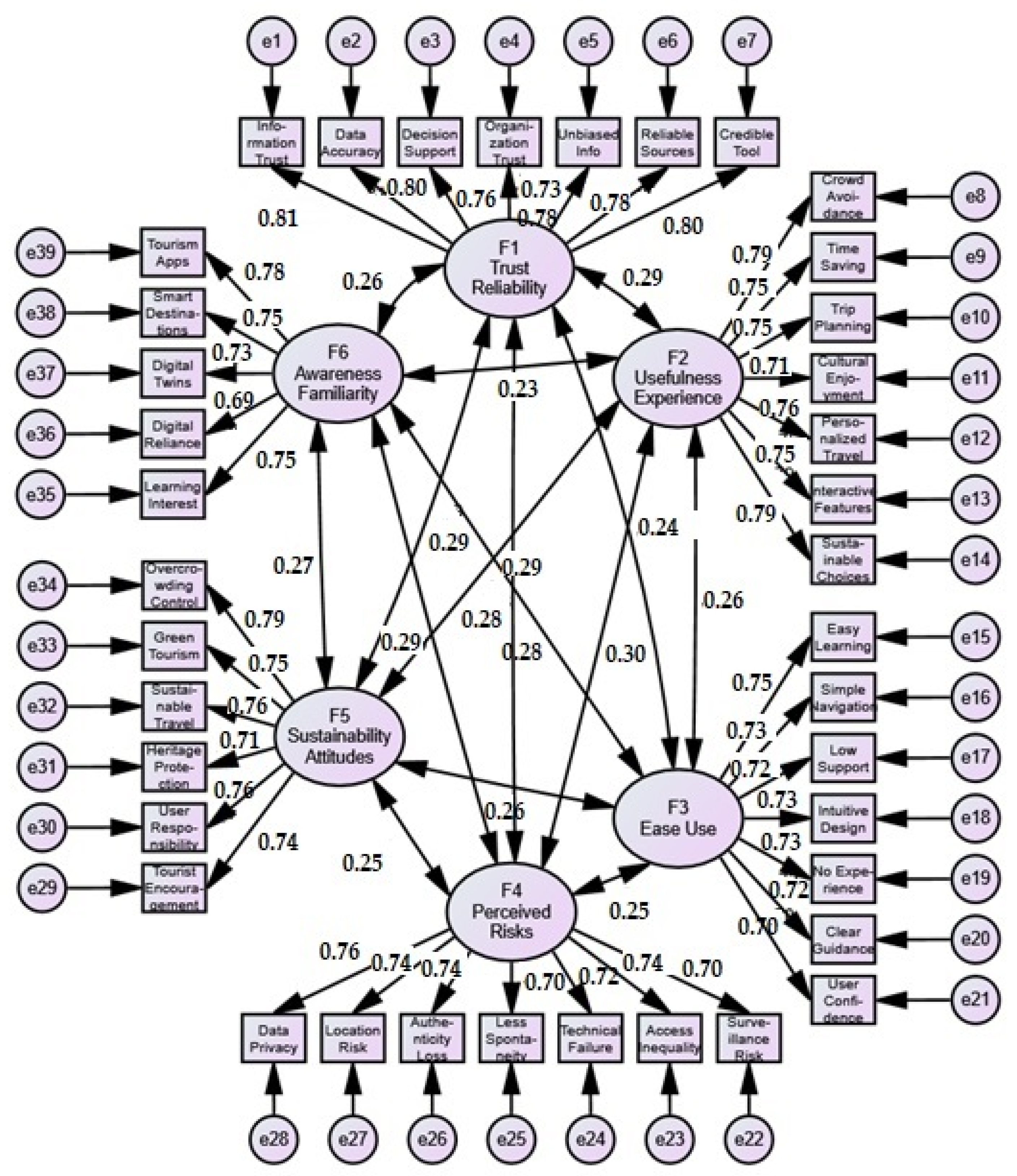
| Factor | Eigenvalue (Initial) | % of Variance (Rotated) | Cumulative % (Rotated) |
|---|---|---|---|
| 1 | 9.059 | 10.857 | 10.857 |
| 2 | 3.446 | 10.339 | 21.196 |
| 3 | 3.317 | 9.587 | 30.783 |
| 4 | 3.193 | 9.515 | 40.298 |
| 5 | 2.958 | 8.727 | 49.025 |
| 6 | 2.499 | 6.982 | 56.007 |
| Factor | ||||||
|---|---|---|---|---|---|---|
| Trust Reliability | Usefulness Experience | Ease Use | Perceived Risks | Sustainability Attitudes | Awareness Familiarity | |
| Tourism Apps | 0.099 | 0.086 | 0.062 | 0.108 | 0.082 | 0.758 |
| Smart Destinations | 0.085 | 0.055 | 0.125 | 0.090 | 0.118 | 0.714 |
| Digital Twins | 0.060 | 0.096 | 0.108 | 0.105 | 0.084 | 0.697 |
| Digital Reliance | 0.110 | 0.083 | 0.111 | 0.094 | 0.058 | 0.657 |
| Learning Interest | 0.089 | 0.048 | 0.097 | 0.086 | 0.097 | 0.725 |
| Crowd Avoidance | 0.088 | 0.768 | 0.122 | 0.069 | 0.104 | 0.066 |
| Time Saving | 0.102 | 0.721 | 0.065 | 0.104 | 0.089 | 0.074 |
| Trip Planning | 0.106 | 0.718 | 0.121 | 0.089 | 0.090 | 0.078 |
| Cultural Enjoyment | 0.097 | 0.687 | 0.086 | 0.097 | 0.068 | 0.056 |
| Personalized Travel | 0.088 | 0.743 | 0.075 | 0.069 | 0.102 | 0.054 |
| Interactive Features | 0.066 | 0.727 | 0.108 | 0.099 | 0.083 | 0.051 |
| Sustainable Choices | 0.109 | 0.767 | 0.113 | 0.064 | 0.088 | 0.050 |
| Easy Learning | 0.087 | 0.113 | 0.093 | 0.718 | 0.104 | 0.067 |
| Simple Navigation | 0.067 | 0.059 | 0.059 | 0.715 | 0.093 | 0.084 |
| Low Support | 0.088 | 0.102 | 0.055 | 0.697 | 0.038 | 0.099 |
| Intuitive Design | 0.056 | 0.083 | 0.119 | 0.706 | 0.062 | 0.069 |
| No Experience | 0.069 | 0.095 | 0.065 | 0.708 | 0.065 | 0.072 |
| Clear Guidance | 0.101 | 0.061 | 0.054 | 0.708 | 0.085 | 0.051 |
| User Confidence | 0.033 | 0.052 | 0.088 | 0.681 | 0.084 | 0.082 |
| Information Trust | 0.784 | 0.088 | 0.094 | 0.111 | 0.078 | 0.097 |
| Data Accuracy | 0.769 | 0.134 | 0.097 | 0.077 | 0.090 | 0.069 |
| Decision Support | 0.729 | 0.078 | 0.102 | 0.081 | 0.114 | 0.074 |
| Organization Trust | 0.701 | 0.107 | 0.094 | 0.076 | 0.067 | 0.098 |
| Unbiased Info | 0.759 | 0.096 | 0.074 | 0.060 | 0.104 | 0.044 |
| Reliable Sources | 0.757 | 0.101 | 0.095 | 0.071 | 0.085 | 0.051 |
| Credible Tool | 0.773 | 0.069 | 0.101 | 0.067 | 0.110 | 0.093 |
| Data Privacy | 0.107 | 0.122 | 0.725 | 0.088 | 0.084 | 0.069 |
| Location Risk | 0.078 | 0.094 | 0.718 | 0.040 | 0.100 | 0.096 |
| Authenticity Loss | 0.116 | 0.098 | 0.713 | 0.079 | 0.044 | 0.084 |
| Less Spontaneity | 0.073 | 0.083 | 0.683 | 0.068 | 0.056 | 0.079 |
| Technical Failure | 0.103 | 0.085 | 0.692 | 0.096 | 0.081 | 0.050 |
| Access Inequality | 0.080 | 0.083 | 0.717 | 0.067 | 0.067 | 0.088 |
| Surveillance Risk | 0.061 | 0.098 | 0.676 | 0.101 | 0.051 | 0.087 |
| Overcrowding Control | 0.095 | 0.079 | 0.099 | 0.084 | 0.768 | 0.066 |
| Green Tourism | 0.092 | 0.112 | 0.080 | 0.112 | 0.727 | 0.040 |
| Sustainable Travel | 0.084 | 0.113 | 0.100 | 0.068 | 0.737 | 0.096 |
| Heritage Protection | 0.110 | 0.087 | 0.039 | 0.105 | 0.687 | 0.085 |
| User Responsibility | 0.088 | 0.093 | 0.100 | 0.064 | 0.733 | 0.076 |
| Tourist Encouragement | 0.124 | 0.098 | 0.052 | 0.090 | 0.704 | 0.109 |
Disclaimer/Publisher’s Note: The statements, opinions and data contained in all publications are solely those of the individual author(s) and contributor(s) and not of MDPI and/or the editor(s). MDPI and/or the editor(s) disclaim responsibility for any injury to people or property resulting from any ideas, methods, instructions or products referred to in the content. |
© 2025 by the authors. Licensee MDPI, Basel, Switzerland. This article is an open access article distributed under the terms and conditions of the Creative Commons Attribution (CC BY) license (https://creativecommons.org/licenses/by/4.0/).
Share and Cite
Ljubisavljević, T.; Vujko, A.; Arsić, M.; Mirčetić, V. Digital Twins in Smart Tourist Destinations: Addressing Overtourism, Sustainability, and Governance Challenges. World 2025, 6, 148. https://doi.org/10.3390/world6040148
Ljubisavljević T, Vujko A, Arsić M, Mirčetić V. Digital Twins in Smart Tourist Destinations: Addressing Overtourism, Sustainability, and Governance Challenges. World. 2025; 6(4):148. https://doi.org/10.3390/world6040148
Chicago/Turabian StyleLjubisavljević, Tijana, Aleksandra Vujko, Martina Arsić, and Vuk Mirčetić. 2025. "Digital Twins in Smart Tourist Destinations: Addressing Overtourism, Sustainability, and Governance Challenges" World 6, no. 4: 148. https://doi.org/10.3390/world6040148
APA StyleLjubisavljević, T., Vujko, A., Arsić, M., & Mirčetić, V. (2025). Digital Twins in Smart Tourist Destinations: Addressing Overtourism, Sustainability, and Governance Challenges. World, 6(4), 148. https://doi.org/10.3390/world6040148