Article

Salophen-Type Ni(II) Schiff Base Complexes Derived from Naphthalene Aldehydes and Their Application as Catalysts for the Methanol Electro-Oxidation Reaction


by
Fabiola Hernández-García
1,
Emanuel Pérez-Martínez
2,
Raúl Colorado-Peralta
2,
Jesús Antonio Cruz-Navarro
3,* and
David Morales-Morales
4,*
1
Área Académica de Química, Universidad Autónoma del Estado de Hidalgo, Carretera Pachuca-Tulancingo Km 4.5, Mineral de la Reforma 42184, Mexico
2
Facultad de Ciencias Químicas, Universidad Veracruzana, Ote. 6 1009, Rafael Alvarado, Veracruz 94340, Mexico
3
Centro de Investigación en Materiales Avanzados, Complejo Industrial Chihuahua, Chihuahua 31136, Mexico
4
Instituto de Química, Universidad Nacional Autónoma de México, Ciudad Universitaria, Circuito Exterior s/n, Ciudad de México 04510, Mexico
*
Authors to whom correspondence should be addressed.
Organics 2026, 7(1), 14; https://doi.org/10.3390/org7010014
Submission received: 24 December 2025 / Revised: 16 February 2026 / Accepted: 3 March 2026 / Published: 19 March 2026

Abstract

Salophen-type Schiff base ligands derived from salicylaldehyde and naphthalene aldehydes were synthesized and coordinated to Ni(II) to obtain three nickel complexes (NiL1–NiL3), which were evaluated as heterogeneous electrocatalysts for the methanol electro-oxidation reaction (MOR) in alkaline media. The ligands and complexes were fully characterized by FT-IR, 1H NMR, EPR, DART-MS, and elemental analysis, confirming tetradentate coordination through imine nitrogen and phenoxide oxygen donors. Electrochemical studies were carried out using carbon paste electrodes modified with 15 wt % of each complex. Cyclic voltammetry revealed that the electrocatalytic activity is mediated by the Ni(II)/Ni(III) redox couple, with Ni(III) oxohydroxide species acting as the active sites for methanol oxidation. Among the evaluated systems, NiL1@CPE showed superior performance at low methanol concentrations, while NiL2@CPE and NiL3@CPE exhibited higher current densities at elevated methanol concentrations. Scan-rate studies indicated that the oxidation process is diffusion-controlled, and a linear response to methanol concentration was observed over a wide concentration range. The results demonstrate that ligand structure and coordination geometry play a crucial role in modulating the electrocatalytic behavior of Ni(II) Schiff base complexes, highlighting their potential as cost-effective molecular catalysts for alkaline methanol oxidation.

1. Introduction

The growing global demand for energy, along with increasing environmental concerns associated with fossil fuel consumption, has intensified research efforts toward sustainable and efficient energy conversion technologies. In this context, direct alcohol fuel cells (DAFCs) have attracted considerable attention as promising power sources due to their high energy density, low operating temperatures, and reduced emissions compared to conventional combustion-based systems [1,2]. Among the various alcohol fuels, methanol stands out for its high hydrogen content, low cost, ease of storage, and well-established production and distribution infrastructure [3,4]. Consequently, the methanol oxidation reaction (MOR) has become a key electrochemical process in the development of alkaline fuel cells and electrochemical energy devices [5,6,7].
Platinum-based materials are traditionally regarded as the most effective electrocatalysts for MOR; however, their high cost, limited availability, and susceptibility to poisoning by reaction intermediates, such as CO, severely restrict large-scale applications. These limitations have motivated the search for alternative, earth-abundant, and cost-effective electrocatalysts capable of promoting methanol oxidation with acceptable activity and stability. In this regard, nickel-based materials have emerged as attractive candidates, particularly in alkaline media, where the formation of high-valence nickel oxyhydroxide species (NiOOH) plays a central role in alcohol electro-oxidation processes [8].
Nickel coordination compounds, especially those bearing Schiff base ligands, have been extensively studied due to their structural versatility, tunable electronic properties, and ability to stabilize multiple oxidation states of the metal center [9]. Salen- and salophen-type ligands, featuring tetradentate N2O2 coordination environments, provide robust frameworks that facilitate efficient electron transfer and promote the reversible Ni(II)/Ni(III) redox couple, which is widely recognized as a dual-function material with important roles in MOR and OER reactions [10]. Moreover, ligand modification offers a powerful strategy to tailor the electronic density, coordination geometry, and accessibility of the nickel center, thereby modulating catalytic activity and selectivity [11].
Recent studies have demonstrated that immobilizing nickel Schiff base complexes on conductive supports, such as carbon paste or glassy carbon electrodes, enables their use as heterogeneous electrocatalysts while minimizing catalyst leaching and improving operational stability [12,13]. In particular, the incorporation of extended π-conjugated systems within the ligand backbone has been shown to influence electron delocalization, redox behavior, and interaction with alcohol substrates. Naphthalene-derived Schiff bases, in comparison to their salicylaldehyde analogs, introduce increased conjugation and hydrophobic character, which may enhance methanol adsorption and electron transfer during electro-oxidation.
In this work, we report the synthesis and comprehensive characterization of three salophen-type Ni(II) Schiff base complexes derived from salicylaldehyde and two regioisomeric naphthalene aldehydes. The obtained complexes were immobilized onto carbon paste electrodes and evaluated as heterogeneous electrocatalysts for methanol electro-oxidation in alkaline media. By systematically comparing the electrochemical performance of the three systems, this study aims to elucidate the influence of ligand structure, aromatic extension, and coordination environment on MOR activity. The results provide valuable insight into structure–activity relationships in molecular nickel-based electrocatalysts and highlight the potential of salophen-type Ni(II) complexes as cost-effective platforms for alkaline methanol oxidation.

2. Materials and Methods

2.1. Materials

All reagents and solvents were commercially acquired and employed without additional purification. The 1H NMR spectra of all ligands were recorded on a JEOL GX300 spectrometer (JEOL Ltd, Tokyo, Japan), using CDCl3. Chemical shifts are reported in ppm downfield using the residual signal of CDCl3 (7.27 ppm) as the internal standard. IR spectra of all compounds were obtained in a FT-IR Perkin Elmer Frontier spectrometer. (PerkinElmer, Inc., Waltham, MA, USA) Electronic paramagnetic resonance (EPR) was recorded in a solid at 77 K in a JEOL JES-TE300 (JEOL Ltd, Tokyo, Japan) equipped with a cryogenic system. DART-MS determinations were acquired in an AccuTOF-DART 4G (JEOL Ltd, Tokyo, Japan). CH analyses were determined in a PerkinElmer 240 analyzer (PerkinElmer, Inc., Waltham, MA, USA). SEM and EDS images were acquired in a JEOL-LA 6490 microscope (JEOL Ltd, Tokyo, Japan).

2.2. Synthesis

2.2.1. Synthesis of Ligands (L1–L3)

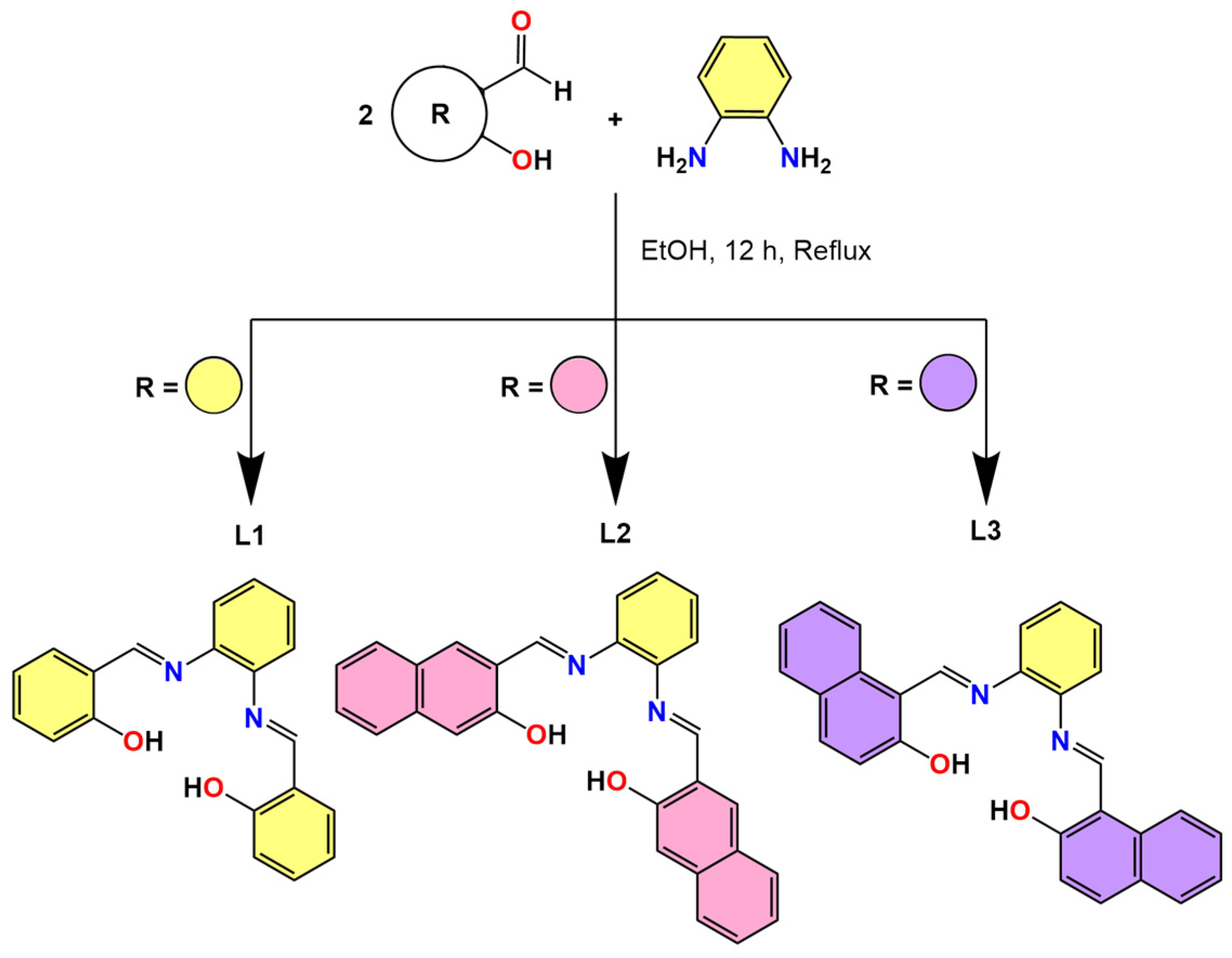
Schiff base ligands were obtained by an equimolar condensation reaction of the corresponding aldehyde with o-Phenylenediamine in a 2:1 ratio (Scheme 1) in anhydrous ethanol. The mixture was refluxed for 12 h until an orange precipitate formed. The solid was filtered and washed with diethyl ether, after which a crystalline powder was obtained.
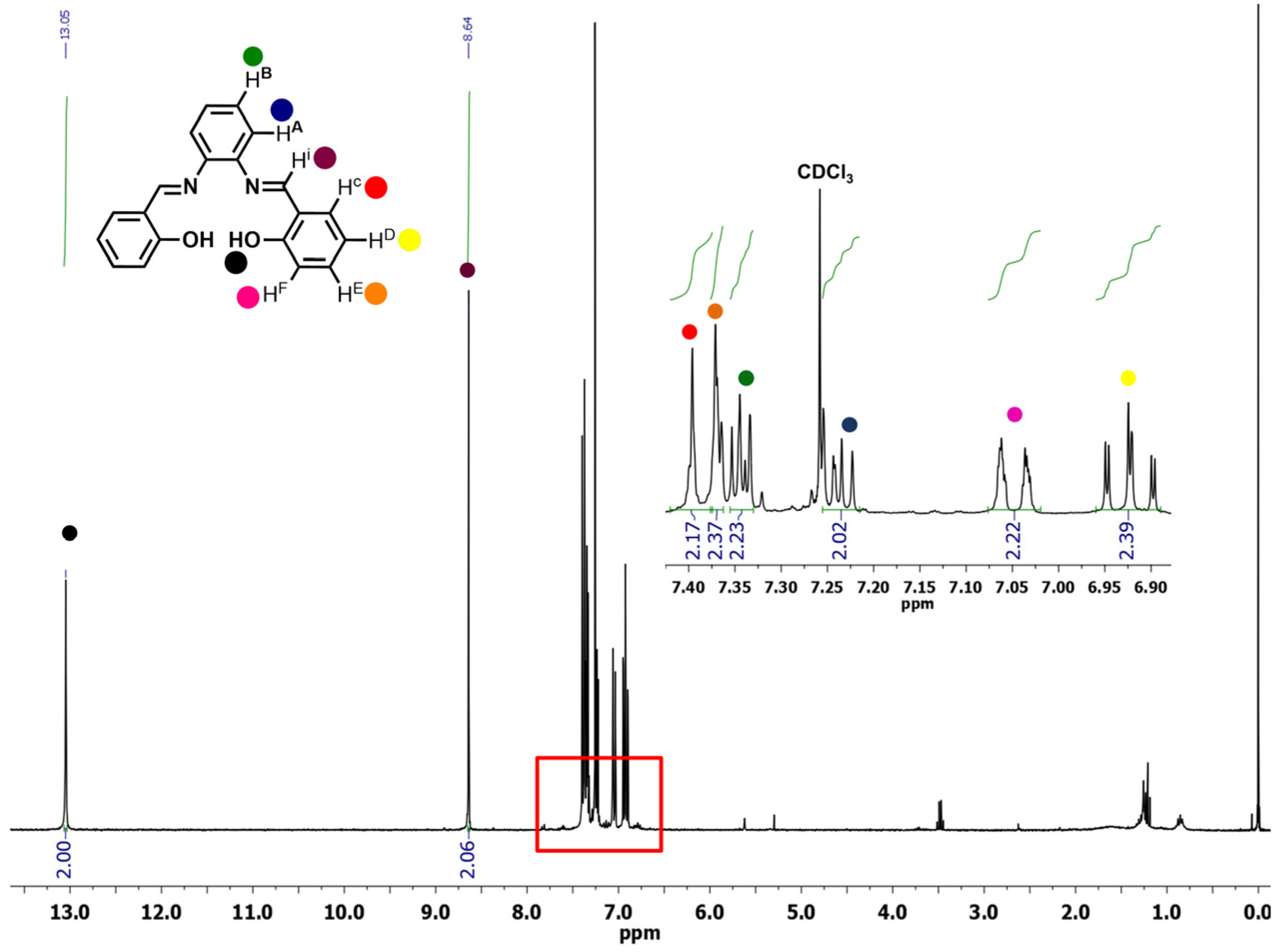
For N,N′-bis(salicylidene)-1,2-phenylenediamine (L1): 0.924 mmol (100 mg) of O-Phenylenediamine; 1.849 mmol (225 mg) of salicylaldehyde. Yellowish crystalline solid, yield 96%, m.p. 189 °C. FT-IR (cm−1) (Figure S1): 3410 (-OH), 3059 (C-H aromatic), 1612 (C=N), 1486 (C=C aromatic), 750 (o-substituted ring). 1H NMR (CDCl3, 25 °C, 300.52 Hz) (Figure S2) δ (ppm): 13.05 (s, 2H, -OH), 8.64 (s, 2H, imine), 7.40 (s, 2H, salicyl ring), 7.37 (m, 2H, salicyl ring), 7.34 (m, 2H, O-phenylen ring), 7.24 (m, 2H, O-phenylen ring), 7.05 (d, 2H, salicyl ring), 6.93 (m, 2H salicyl, ring). MS (DART; m/z) (Figure S3): 317 [M + H]+. Elem. Anal. Calcd. for C20H16N2O2: C (75.93%); H (5.10%). Found: C (76.14%), H (5.82%).
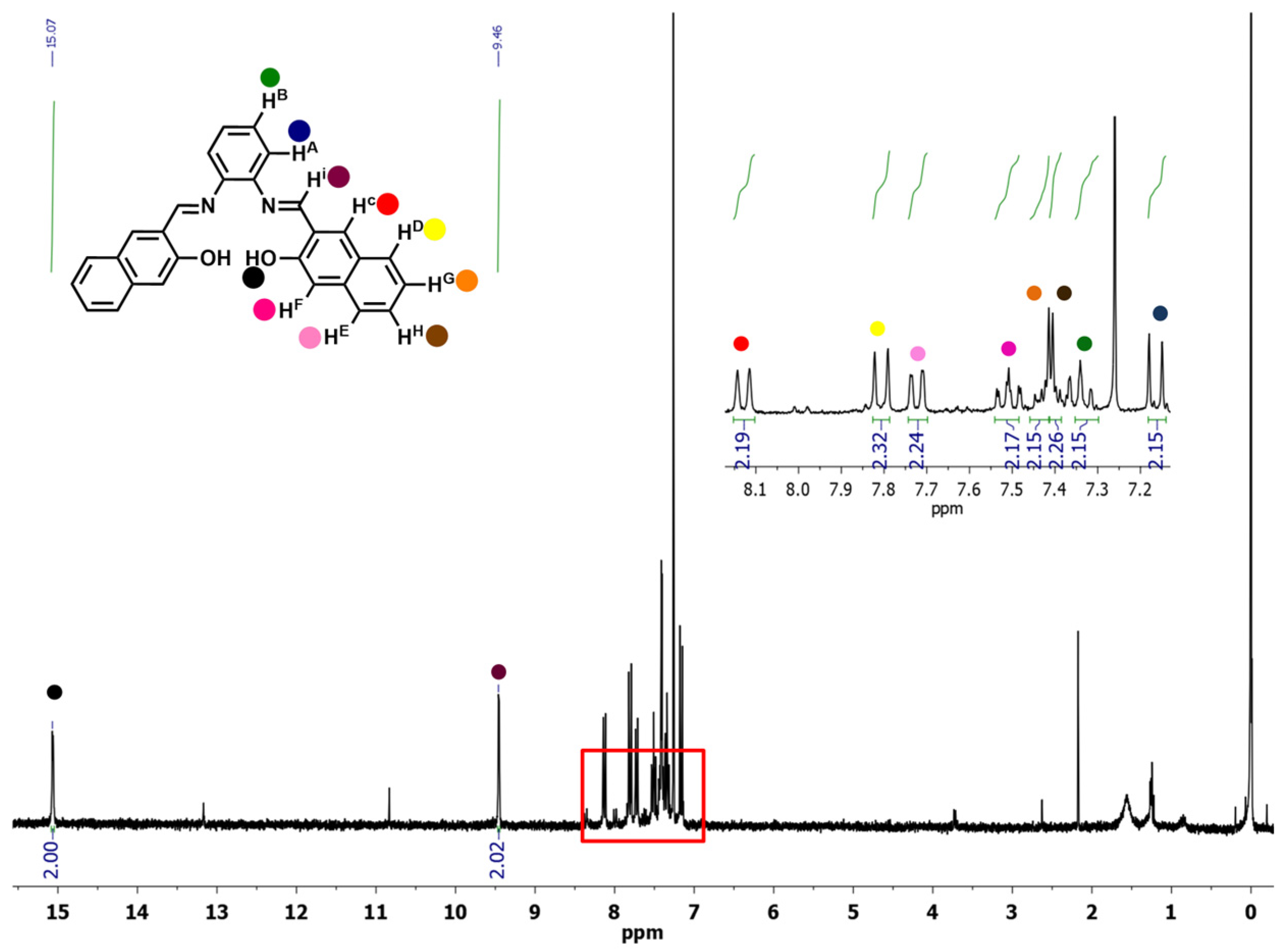
For N,N′-bis(3-hydroxy-2-naphthalydene)-1,2-phenylenediamine (L2): 0.924 mmol (100 mg) of O-Phenylenediamine; 1.849 mmol (292 mg) of 3-hydroxy-2-naphthaldehyde. Dark orange crystalline solid, yield 58.68%, m.p. 220 °C. FT-IR (cm−1) (Figure S4): 3047 (C-H aromatic), 1621 (C=N), 1324 (C=C aromatic), 737 (O-substituted ring). 1H NMR (CDCl3, 25 °C, 300.52 Hz) (Figure S5) δ (ppm): 15.07 (s, 2H, -OH), 9.46 (s, 2H, imine), 8.13 (d, 2H, naphthalene), 7.81 (d, 2H, naphthalene), 7.72 (d, 2H, naphthalene), 7.51 (m, 2H, naphthalene), 7.42 (m, 2H, naphthalene), 7.41 (m, 2H, naphthalene), 7.39 (m, 2H, O-phenylen ring), 7.16 (d, 2H, O-phenylen ring). MS (DART; m/z) (Figure S6): 417 [M + H]+. Elem. Anal. Calcd. for C28H20N2O2: C (80.75%); H (4.84%). Found: C (80.88%); H (4.91%).
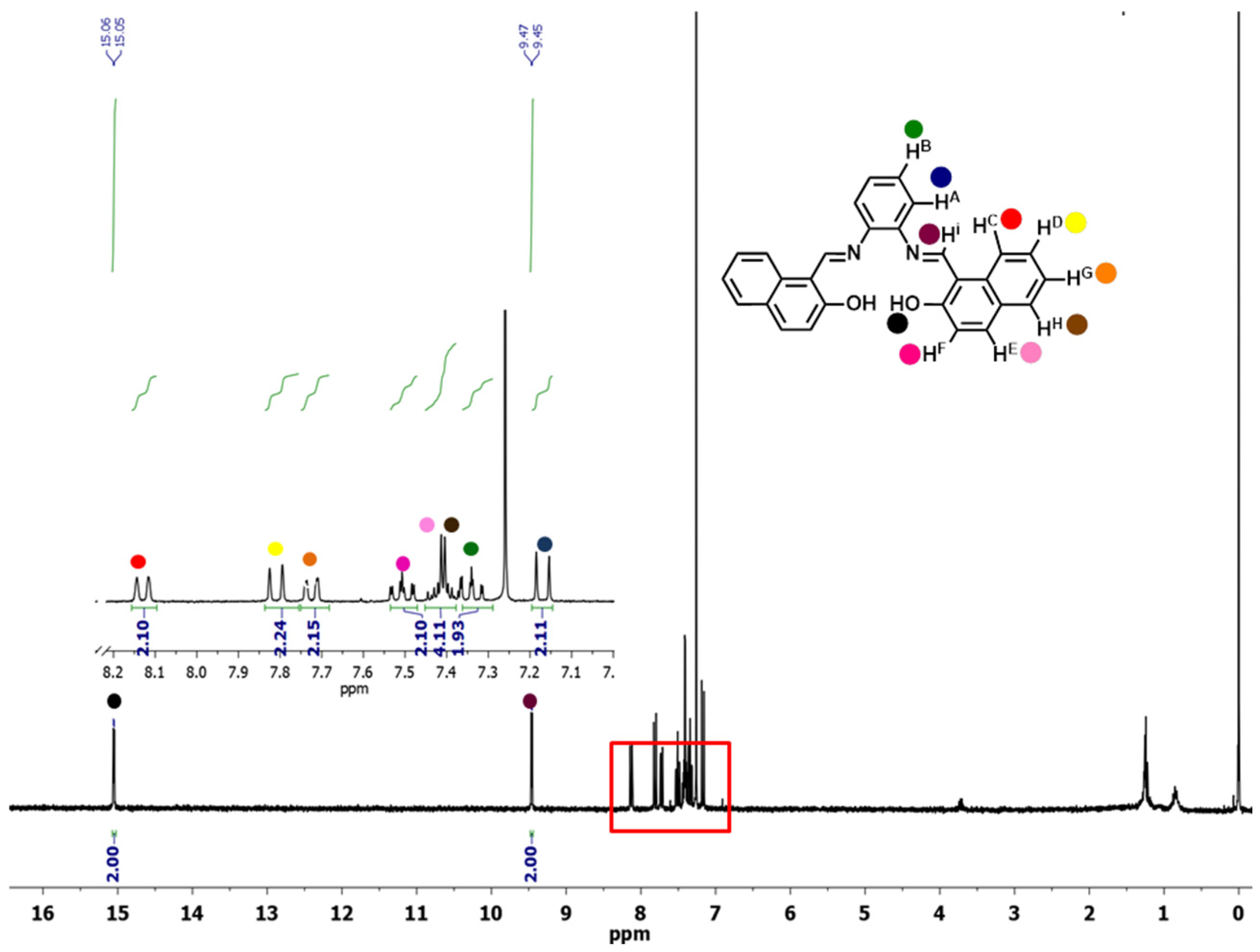
For N,N′-bis(2-hydroxy-1-naphthalydene)-1,2-phenylenediamine (L3): 0.924 mmol (100 mg) of O-Phenylenediamine; 1.849 mmol (292 mg) of 2-hydroxy-1-naphthaldehyde. Orange crystalline solid, yield 65.17% m.p. 225 °C. FT-IR (cm−1) (Figure S7): 3471 (-OH), 3045 (C-H aromatic), 1619 (C=N), 1317 (C=C aromatic), 744 (O-substituted ring). 1H NMR (CDCl3, 25 °C, 300.52 Hz) (Figure S8) δ (ppm): 15.06 (s, 2H, -OH), 9.47 (s, 2H, imine), 8.14 (d, 2H, naphthalene), 7.80 (d, 2H, naphthalene), 7.73 (d, 2H, naphthalene), 7.50 (m, 2H, naphthalene), 7.43 (m, 2H, naphthalene), 7.41 (m, 2H, naphthalene), 7.34 (m, 2H, o-phenylen ring), 7.17 (d, 2H, O-phenylen ring). MS (DART; m/z) (Figure S9): 417 [M + H]+. Elem. Anal. Calcd. for C28H20N2O2: C (80.75%); H (4.84%). Found: C (80.69%); H (4.89%).

2.2.2. Synthesis of Complexes

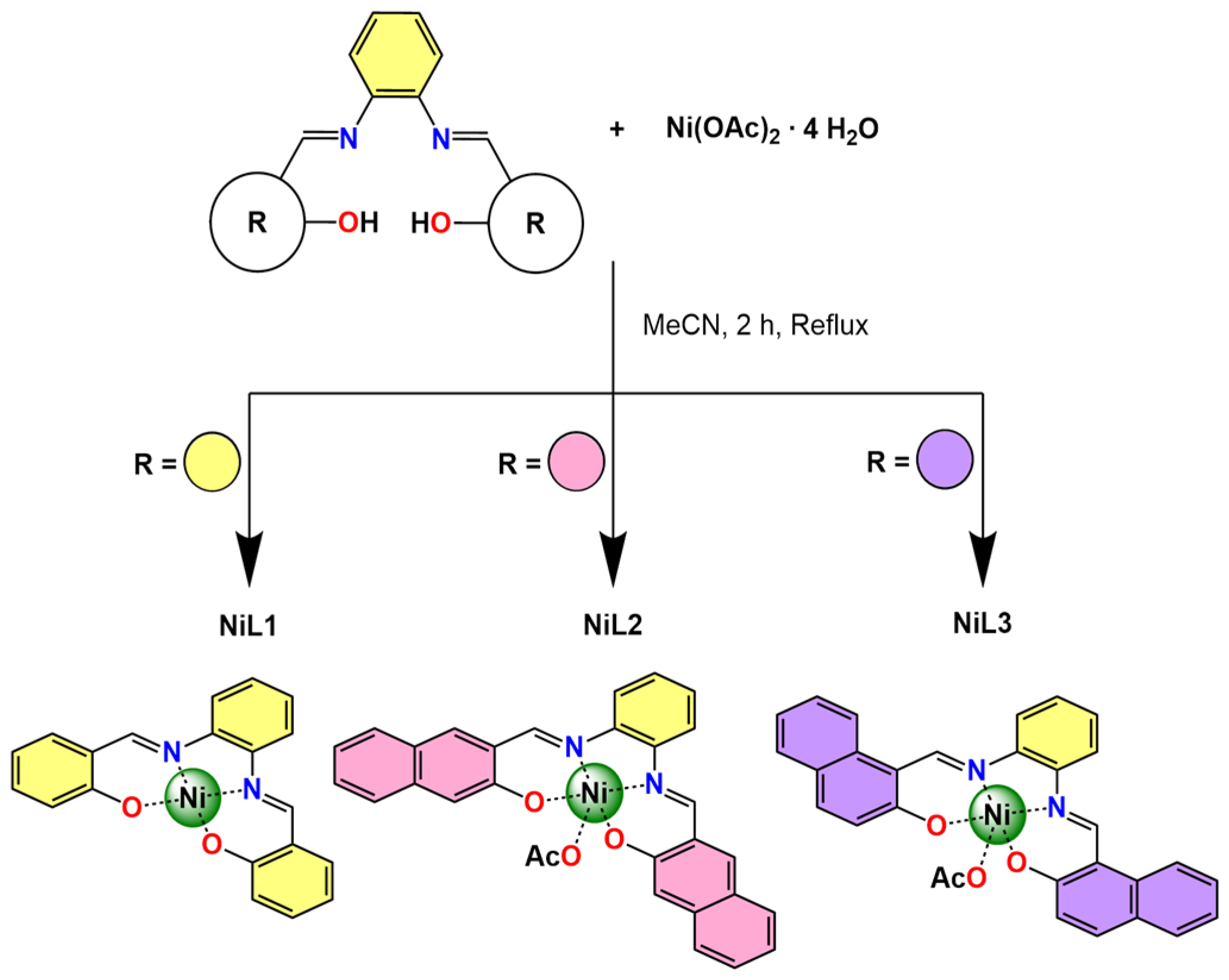
All complexes (NiL1–NiL3) were obtained through a 1:1 reaction (Scheme 2), where certain milliequivalents of nickel acetate tetrahydrate were dissolved in 50 mL of MeCN and slowly added to a solution of MeCN containing equimolar milliequivalents of the corresponding ligand. The mixture was refluxed with continuous stirring for 2 h, until a dark red precipitate formed. The precipitate was filtered and rinsed three times with diethyl ether to produce a bright-red crystalline solid. The final product was dried for 12 h at 85 °C in a vacuum oven.
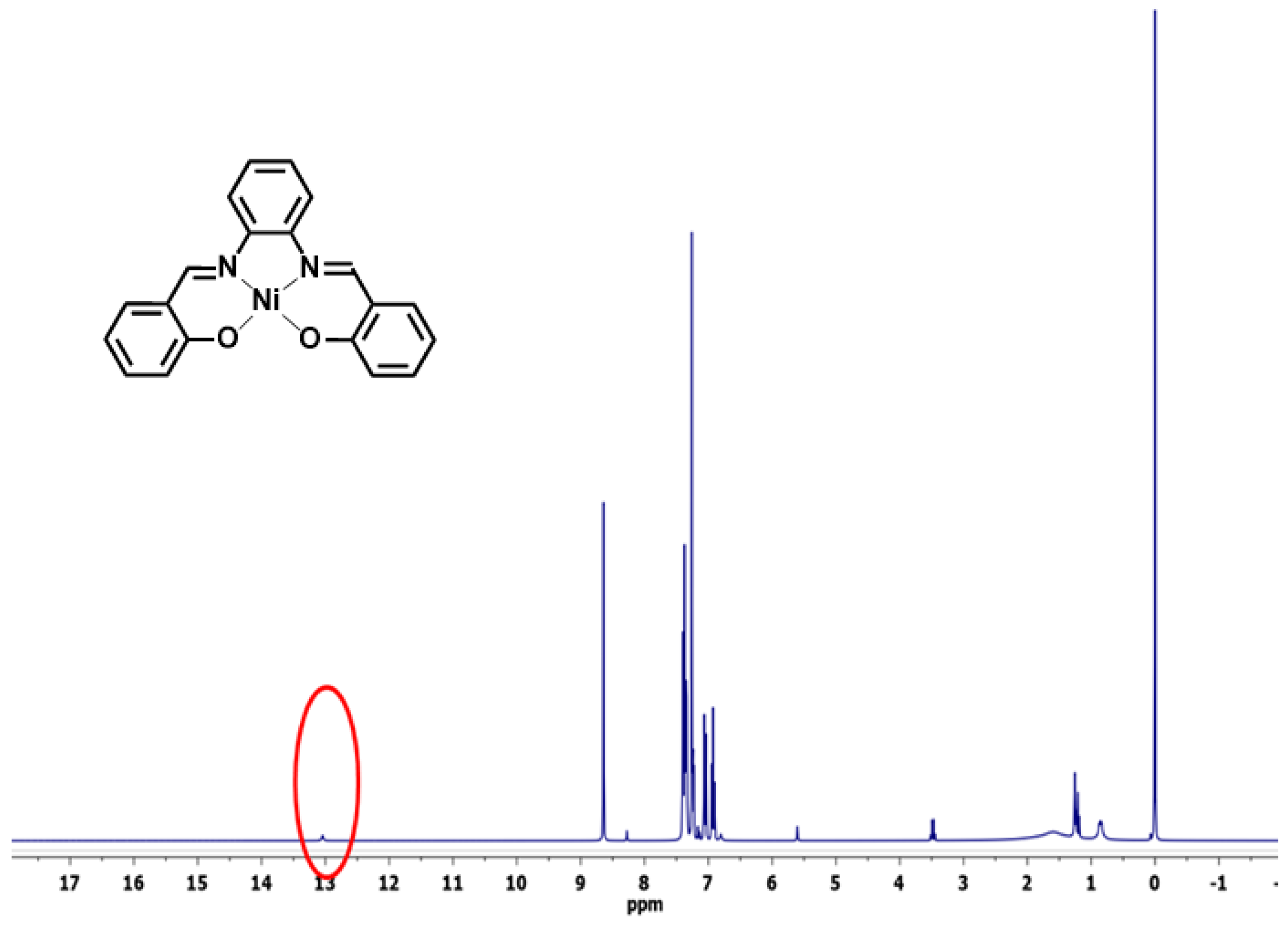
For N,N′-bis(salicylidene)-1,2-phenylenediamine nickel(II) (NiL1): 0.3160 mmol (100 mg) of Ni(AcO)2·4H2O; 0.3160 mmol (78.65 mg) of L1. Red crystalline solid, yield 94%, m.p. 210 °C. 1H NMR (CDCl3, 25 °C, 300.52 Hz) (Figure S11) δ (ppm): 8.63 (s, 2H, imine), 7.38 (s, 2H, salicyl ring), 7.36 (m, 2H, salicyl ring), 7.34 (m, 2H, O-phenylen ring), 7.24 (m, 2H, O-phenylen ring), 7.08 (d, 2H, salicyl ring), 6.91 (m, 2H, salicyl, ring). MS (DART; m/z) 371 [M]+. Elem. Anal. Calcd. for C20H14N2NiO2: C (64.40%), H (3.78%). Found: C (64.51%), H (3.88%).
For N,N′-bis(3-hydroxy-2-naphtalydene)-1,2-phenylenediamine nickel(II) (NiL2): 0.3160 mmol (100 mg) of Ni(AcO)2·4H2O; 0.3160 mmol (131.45 mg) of L2. Dark red crystalline solid, yield 76%. m.p. 246 °C. EPR (9.4 GHz, 298 K): g = 2.0055. MS (DART; m/z): 530 [M-H]. Elem. Anal. Calcd. for C30H21N2NiO4: C (67.71%), H (3.98%). Found: C (67.92%), H (4.07%).
For N,N′-bis(2-hydroxy-1-naphtalydene)-1,2-phenylenediamine nickel(II) (NiL3): 0.3160 mmol (100 mg) of Ni(AcO)2·4H2O; 0.3160 mmol (131.45 mg) of L3. Dark red crystalline solid, yield 78%. m.p. 248 °C. EPR (9.4 GHz, 298 K): g = 2.0053. MS (DART; m/z) 530 [M-H]. Elem. Anal. Calcd. for C30H21N2NiO4: C (67.71%), H (3.98%). Found: C (68.11%), H (4.18%).

2.3. Fabrication of Modified Carbon Paste Electrodes

To prepare the carbon paste electrodes (CPEs), graphite powder, mineral oil, and 15% w/w of the complex were thoroughly mixed in a mortar until a homogeneous paste was obtained. The resulting composite was then packed into a plastic tube (⌀ = 4 mm) equipped with a 2 mm banana plug connector. Prior to each measurement, the electrode surface was polished using high-whiteness paper to ensure reproducibility. The nomenclature assigned to all electrodes is summarized in Table 1. An unmodified CPE was also prepared and used as a blank.

2.4. Electrochemical Evaluation

Electrochemical measurements were performed using an Autolab PGSTAT302N potentiostat/galvanostat (Metrohm, Herisau, Switzerland) configured with a conventional three-electrode system. In this arrangement, an Ag/AgCl electrode (saturated KCl, 3 M) served as the reference electrode, a graphite rod (5 mm diameter) functioned as the counter electrode, and the modified electrodes were used as the working electrode. A 0.1 M NaOH solution was selected as the supporting electrolyte. Current intensities were obtained from the voltammogram baselines using NOVA software (version 2.1.7).

3. Results and Discussion

3.1. Synthesis of Ligands

The synthesis of the ligands L1, L2, and L3 was achieved through condensation reactions involving o-phenylenediamine and the corresponding aromatic aldehydes under reflux conditions, leading to the formation of Schiff base-type ligands with moderate yields (58–96%). These ligands, characterized by the presence of imine (–C=N–) groups, additional hydroxyl donor sites, and naphthalene-derived lateral rings (in the case of L2 and L3), were designed to bring a tetradentate motif with a high electron density around the donor atoms in order to stabilize the metal center. The presence of conjugated aromatic systems within the ligand backbone is expected to facilitate electronic delocalization, thereby improving the overall complex stability and potentially influencing its electrochemical behavior. Additionally, the presence of naphthalene moieties in the ligands decreases their solubility in polar solvents, which is crucial for heterogeneous electrocatalysis.
The FT-IR characterization of all ligands (Figures S1–S3, Supplementary Material) revealed a broad O–H stretching vibration between 3400 and 3460 cm−1, characteristic of hydroxyl groups. Additionally, bands assigned to the C–H stretching of aromatic rings were detected in the 3045–3059 cm−1 region, corresponding to overtone vibrations typical of aromatic systems. The presence of the imine group was confirmed by the appearance of a distinct C=N stretching band between 1612 and 1621 cm−1 in all ligand spectra. Moreover, aromatic C=C stretching vibrations were observed in the 1317–1486 cm−1 region, showing slight shifts in intensity and position depending on the specific structural features of each ligand. In addition, absorption bands in the 737–825 cm−1 range were attributed to out-of-plane bending vibrations associated with ortho-substitution patterns. In the case of L1, a single band was observed, whereas L2 and L3 exhibited two distinct bands. This variation is consistent with the presence of a single aromatic ring in L1, in contrast to the fused and isolated aromatic systems present in L2 and L3, each exhibiting its own ortho-substitution pattern.
The proton NMR spectra of all ligands were recorded in CDCl3 (deuterated chloroform) at 300 MHz, and the corresponding signal assignments were summarized in the experimental section and Figure 1, Figure 2 and Figure 3. Due to the structural similarity among the ligands, two common signals were observed in all spectra. In this respect, the first one corresponds to the hydroxyl groups, which appear as a broad singlet at 13.05 ppm for L1. For L2 and L3, the signal shifts to 15 ppm as a consequence of the electron density from the naphthalene rings present in their structures. The second signal was identified as the characteristic imine proton (labeled as HI), observed as a singlet in all spectra within the 8.64–8.66 ppm range. In addition, two multiplets observed between 7.15 and 7.20 and 7.32–7.40 ppm in L1 spectra were assigned to protons HA and HB from the central o-phenylen ring, as shown in the assignments in Figure 1. Moreover, for ligand L1, four additional peaks were identified around 7.40 ppm (s, HC), 6.93 ppm (m, HD), 7.34 ppm (m, HE), and 7.05 ppm (d, HF). Each signal integrates for two protons and corresponds to the lateral salicylic rings of the molecule. For L2 and L3, protons from the o-phenylen ring are displayed as a double singlet around 7.2 ppm, and a multiplet around 7.30–7.38 assigned to HA and HB, respectively (Figure 2 and Figure 3). The peaks related to the naphthalene moiety in L2 and L3 displayed three doublets at 7.70–7.75, 7.80–7.85, and 8.10–8.15 ppm assigned to HE (or HG in the case of L3), HD, and HC, whereas the rest of the protons showed multiplets between 7.35 and 7.55, as shown in Figure 2 and Figure 3. All obtained chemical shifts were consistent with those previously reported for salphen-type ligands [14,15,16,17] and naphthalene-based Schiff base ligand [18,19,20,21,22]. Moreover, the molecular ions m/z [M + H]+ (Figures S4–S6, Supplementary Material) for L1, L2, and L3 were observed at 317 and 417, respectively. All these data are consistent with the proposed molecular structures for all ligands.

3.2. Obtention of Complexes

The coordination complexes NiL1, NiL2, and NiL3 were obtained by reacting each ligand with an equimolar amount of Ni(II) acetate tetrahydrate, following a [1:1] metal-to-ligand stoichiometric ratio. The reactions were stirred, yielding red, insoluble crystalline solids. The structures of the proposed Ni(II) complexes are illustrated in Scheme 1.

Spectroscopic Characterization

The infrared spectra of the complexes (Figures S7–S9, Supplementary Material) exhibit notable variations in the intensity and position of the O–H stretching band (3400–3460 cm−1), the imine C=N stretching band (1612–1621 cm−1), and the region corresponding to the out-of-plane bending of o-substituted aromatic rings (737–825 cm−1). These spectral changes confirm the formation of coordination bonds between the hydroxyl oxygen and the nickel center (O–Ni), as well as between the imine nitrogen and nickel (N–Ni).
Nuclear magnetic resonance (1H NMR) characterization (Figure 4) was performed exclusively for the NiL1 complex due to the paramagnetic behavior of the complexes NiL2 and NiL3. The 1H NMR spectrum of NiL1 (Figure 4) revealed the disappearance of the singlet associated with the hydroxyl (O–H) proton at approximately 13.00 ppm. This absence is attributed to the deprotonation of the hydroxyl group upon coordination with the nickel center, thereby confirming the formation of the coordination complex. In contrast, the chemical shifts and intensities of the imine and aromatic proton signals remained unchanged, indicating that coordination occurs primarily through the hydroxyl and imine donor sites as expected for a tetradentate Schiff base ligand.
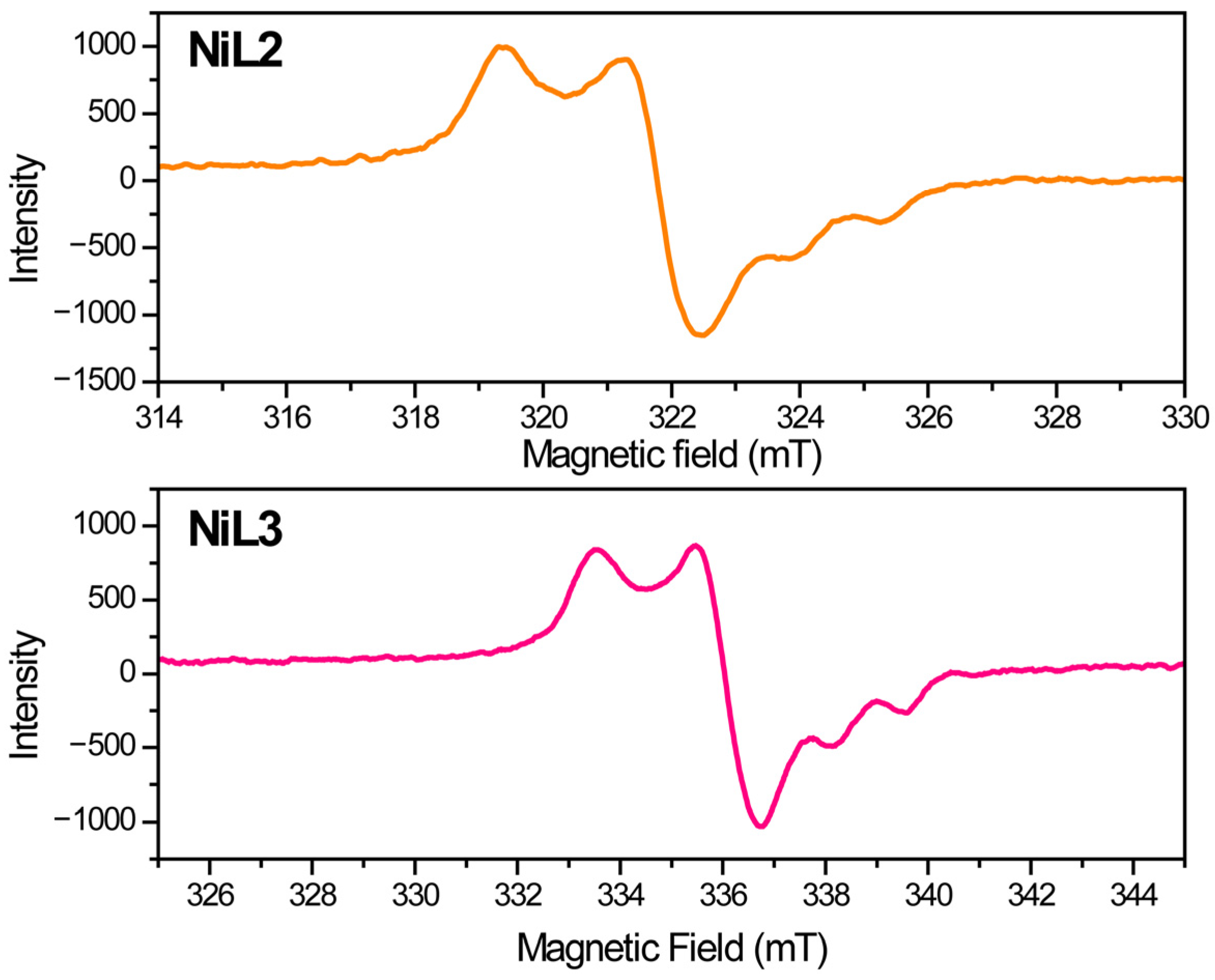
On the other hand, EPR spectra of both Ni(II) complexes were recorded in the solid state at 77 K and are shown in Figure 5. In contrast to square-planar Ni(II) species, which are typically EPR silent due to a diamagnetic (S = 0) ground state, both complexes exhibit clear EPR signals, indicating a paramagnetic electronic configuration. In this regard, the spectra of NiL2 and NiL3 display broad, anisotropic resonances centerd at ≈320–337 mT with partially resolved components appearing as doublets and satellite features. The effective g values were determined as g ≈ 2.0055 (NiL2) and g ≈ 2.0057 (NiL3). This behavior is characteristic of high-spin Ni(II) centers (d8, S = 1) [23], and arises from significant zero-field splitting (ZFS) effects, which lift the degeneracy of the Ms = −1, 0, and +1 sublevels even in the absence of an applied magnetic field [24,25,26,27]. Consequently, the observed spectra cannot be interpreted using a simple S = 1/2 spin Hamiltonian and instead reflect transitions within the lowest spin manifold of an S = 1 system. The observation of structured but broadened features near g ≈ 2.0 is typical of Ni(II) centers in distorted ligand fields and has been frequently associated with square-pyramidal coordination geometries. In such environments, axial elongation and deviations from idealized symmetry lead to anisotropic magnetic behavior that is highly sensitive to small structural perturbations. Similar EPR behavior has been widely reported for five-coordinate and pseudo-octahedral Ni(II) complexes with low symmetry, where ZFS strongly influences the line shape and effective g values [24,28,29]. On the other hand, the two structural isomers exhibit distinct EPR line shapes and slightly shifted effective g values, indicating differences in their zero-field splitting parameters. These differences reflect subtle variations in the local coordination environment around the Ni(II) centers, such as changes in axial ligand interactions or distortions within the basal plane, while preserving the same oxidation and spin state.
The molecular weight of the coordination complexes was determined by DART mass spectrometry. For the NiL1 complex (Figure S10, Supplementary Material), three fragments were identified at m/z 211, 317, and 371, corresponding to the imine fragment, the free ligand (L1), and the complete complex, respectively. The NiL2 complex (Figure S11, Supplementary Material) exhibited peaks at m/z 261, 287, 417, and 530, along with an adduct at m/z 833 attributed to the association of two ligand units. The signals at m/z 417 and 530 were assigned to the ligand and the corresponding complex, respectively. Similarly, NiL3 (Figure S12, Supplementary Material) showed fragments at m/z 261, 417, and 530, as well as the same adduct at m/z 833, indicating analogous fragmentation behavior to that of NiL2.
Based on both EPR and DART-MS results, the NiL2 and NiL3 complexes are proposed to possess a pentacoordinate square-pyramidal geometry, in which an acetate group (AcO) acts as a monodentate ligand bound to the Ni(II) center. The presence of this acetate group is likely a consequence of using Ni(II) acetate as the starting material, suggesting the retention of an acetate moiety in the final coordination sphere. This structural assignment is consistent with the EPR spectra recorded at 77 K, where both complexes exhibit g-values slightly higher than the free-electron constant (g = 2.0023). Such values are characteristic of Ni(II) centers in square-pyramidal environments, further supporting the proposed coordination geometry derived from mass spectrometric and spectroscopic data.

3.3. Morphological and Surface Analysis of Complexes

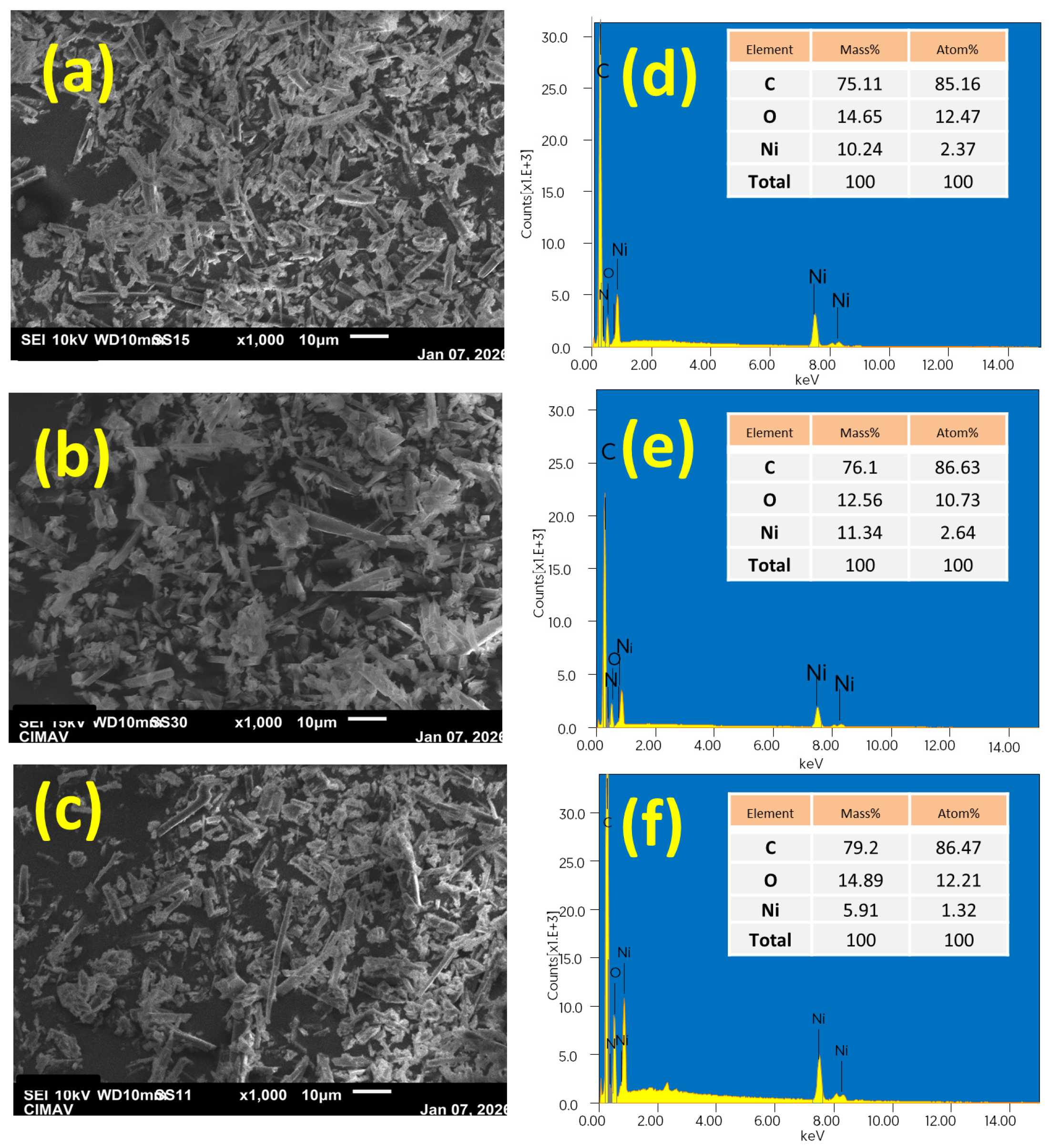
To understand the morphology of the obtained complexes and their elemental composition, SEM and EDS analyses were performed. Figure 6 summarizes the SEM micrographs and EDS results for all complexes. Clear differences in morphology were observed among the samples, indicating that variations in coordination environments and molecular packing significantly influence the solid-state structure of the materials.
As observed, complex NiL1 presents wide coalescences of spherical particles with an average size of approximately 4 µm. This morphology suggests a higher degree of particle aggregation, possibly associated with stronger intermolecular interactions or less anisotropic crystal growth. In contrast, complexes NiL2 and NiL3 display a markedly different morphology, characterized by needle-like structures with size distributions ranging from 7 to 12 µm in length. The elongated morphology observed for NiL2 and NiL3 is indicative of anisotropic growth, which is commonly associated with directional intermolecular interactions and differences in crystal packing induced by structural isomerism.
Energy-dispersive X-ray spectroscopy (EDS) analysis confirms the presence of nickel in all complexes. Quantitative analysis reveals that NiL2 and NiL3 exhibit comparable nickel contents, with mass percentages of 7.76% and 7.72%, respectively. In contrast, NiL1 shows significantly lower nickel content (1.65% by mass). This difference suggests a lower effective nickel loading in NiL1 or a higher contribution of organic components to the overall mass, which is consistent with the distinct morphology and particle aggregation observed in the SEM images.
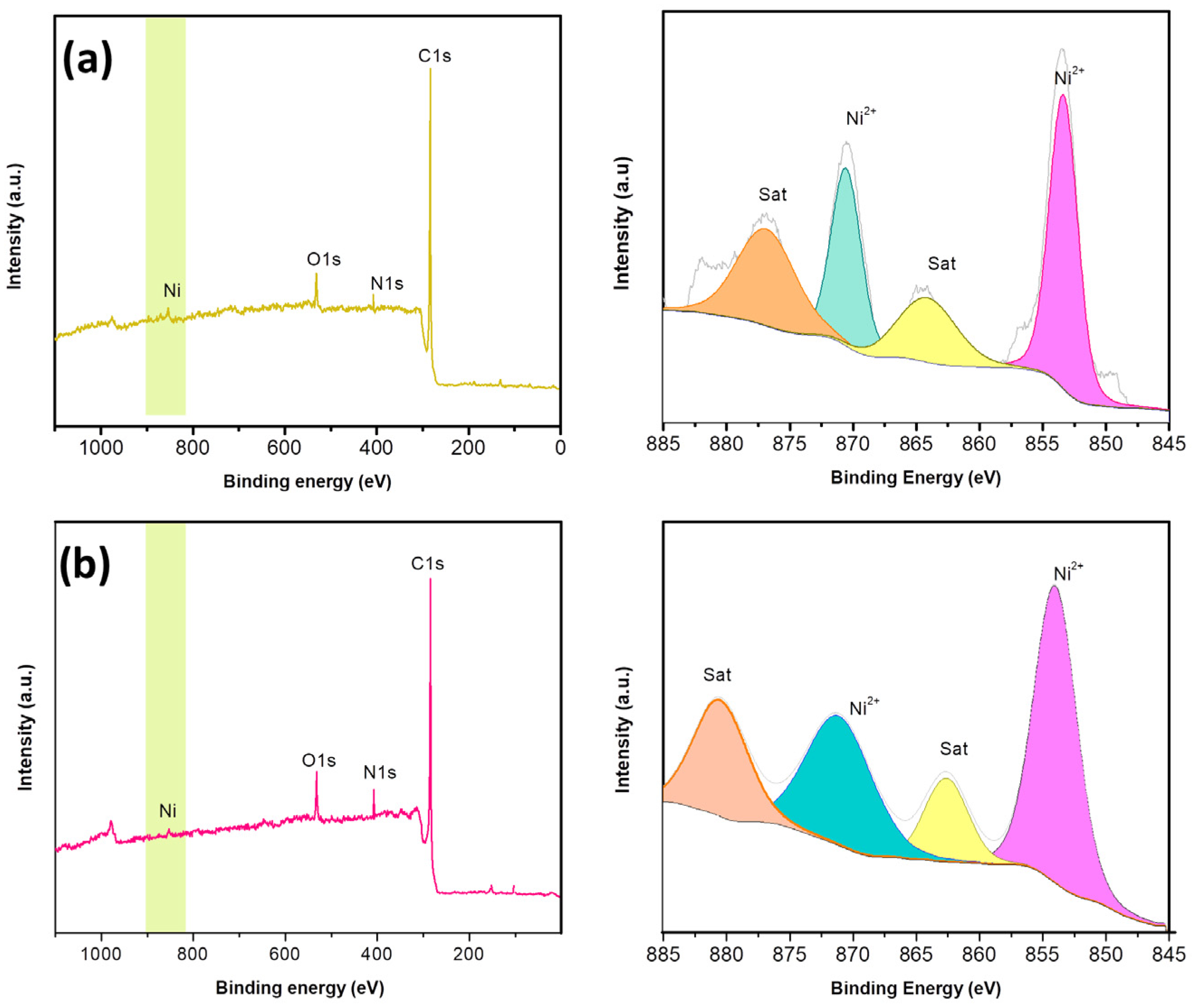
To confirm the oxidation state of nickel in complexes NiL2 and NiL3, X-ray photoelectron spectroscopy (XPS) analysis was performed. Figure 7 shows the survey and high-resolution Ni 2p spectra for NiL2 and NiL3, revealing in the first instance the presence of C, N, O, related to the composition of ligands, and Ni related to the metal center in all complexes.
High-resolution Ni 2p spectra exhibit characteristic spin–orbit doublets corresponding to the Ni 2p3/2 and Ni 2p1/2 core levels, located at binding energies of approximately 855–856 eV and 873–874 eV, respectively, with pronounced satellite peaks that were also observed at higher binding energies around 861–863 eV and 879–881 eV. The binding energy positions and satellite structures observed for both complexes are consistent with Ni2+ centers coordinated by heteroatom-containing ligands and exclude the presence of Ni0 or Ni1+ species. Therefore, the presence of Ni 2p3/2 and Ni 2p1/2, along with their respective satellites, confirms the presence of Ni(II) species [30,31,32], which reinforces the proposal of a pentacoordinated environment. Moreover, the similarity of the Ni 2p spectra for the two structural isomers indicates that nickel adopts the same oxidation state and a comparable coordination environment in both cases.

3.4. Electro-Oxidation of Methanol

Complexes NiL1, NiL2, and NiL3 (insoluble in methanol/water systems) were homogeneously incorporated in a proportion of 15% w/w in carbon paste electrodes in order to evaluate and compare the electrocatalytic activity toward methanol in alkaline media via cyclic voltammetry. The electrochemical response was optimized by considering the effects of methanol concentration and scan rate.

3.4.1. Response to Methanol

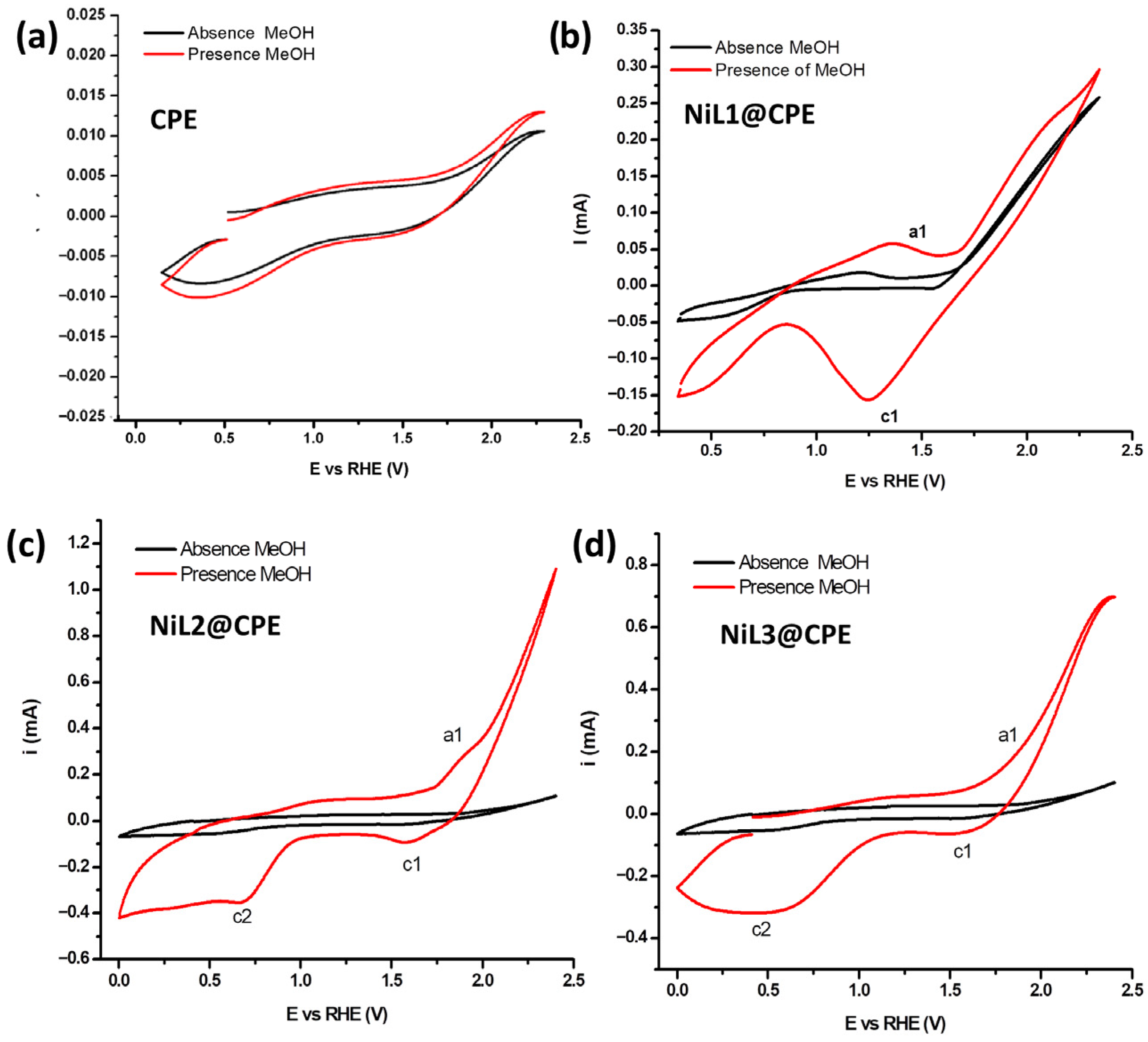
The electrochemical response in the absence and presence of methanol was compared with that obtained using an unmodified carbon paste electrode (CPE) (Figure 7). The evaluation was conducted by cyclic voltammetry (CV) at a scan rate of 0.1 V s−1 in the anodic sense. As shown in Figure 8a, the unmodified CPE exhibits no evident changes in its voltammetric profile in either the absence or presence of methanol, whereas the modified electrodes display markedly different electrochemical behaviors depending on the corresponding complex.
For NiL1@CPE (Figure 8b) in the absence of MeOH, an irreversible anodic peak was observed around 1.20 VRHE with a peak current of 0.017 mA. This signal is assigned to the oxidation of Ni(II) to a highly reactive Ni(III) species mediated under alkaline conditions. Meanwhile, electrodes modified with NiL2 and NiL3 do not exhibit well-defined redox peaks, probably due to electronic effects that shield the metal center and hinder its oxidation.
In the presence of methanol, the electrochemical response of all complexes changed significantly. For NiL1@CPE recorded in 0.20 M MeOH, a well-defined redox couple was observed. The anodic peak, attributed to the Ni(II)/Ni(III) oxidation process, appeared at 1.36 VRHE with a peak current of 0.072 mA, while the corresponding cathodic peak associated with the reduction of Ni(III) to Ni(II) was detected at 1.24 VRHE. For NiL2@CPE and NiL3@CPE (Figure 8c,d), a Ni(II)/Ni(III) oxidation peak was observed at 1.88 and 1.86 VRHE, with peak currents of 0.041 and 0.044 mA, respectively. During the cathodic sweep, the reduction of Ni(III) to Ni(II) appeared at 1.58 and 1.59 VRHE. Moreover, a second cathodic peak corresponding to the Ni(II)/Ni(I) redox process was detected at 0.70 and –0.72 VRHE for NiL2@CPE and NiL3@CPE, respectively.
The changes in the voltammetric profiles and peak current intensities in the presence of methanol are a consequence of the interaction between methanol and the electroactive Ni(III) species generated on the electrode surface [33,34,35]. This interaction, proposed by Fleishman [36] and widely adapted to coordination complexes [35,37,38] mentions that the formation of high-valence nickel oxohydroxides (NiOOH) species mediates the electro-oxidation of methanol, significantly enhancing the anodic current. In this context, methanol is adsorbed onto NiOOH, generating radical intermediates that react with other Ni(III) species to yield oxidation products. These interactions induce a significant shift in both cathodic and anodic peaks due to modification in Ni(III) production kinetics.
Considering the presence of a redox pair displayed by all complexes in alkaline media, the methanol electro-oxidation with NiL1–NiL3 via Ni(III) species can be described according to the following probable mechanism.
Ni(II)-R + OH−i → Ni(II)-R-OH
Ni(II)-R-OH + OH ⇆ Ni(III)-R-OOH + H2O + e
Ni(III)-R-OOH + MeOH → Ni(II)-R + MeO + e
Ni(III)-R-OOH + MeO → Ni(II)-R + H2CO + e
Ni(III)-R-OOH + H2CO → Ni(II)-R + HCOO−N+ e
Ni(III)-R-OOH + HCOO → Ni(II)-R + CO + e
Ni(III)-R-OOH + CO → Ni(II)-R + CO2 + e
According to Equation (4), when the Ni–R complex (where R is L1, L2 or L3) is exposed to alkaline conditions, a hydroxide ion coordinates to the Ni(II) center, generating a new active species. Subsequently, as shown in Equation (5), the application of an external potential promotes the interaction with an additional hydroxide ion, leading to the formation of oxohydroxyl species. During this step, the loss of one electron is triggered at the metal center, generating a Ni(III) species. The high-valence Ni(III) intermediate (Equation (6)) reacts with a methanol molecule to yield the first theoretical oxidation product, MeO. Finally, in Equation (7) other available Ni(III) species are involved in promoting the formation of more oxidation products that are adsorbed on the catalyst surface [39] and oxidized to CO2; therefore, the overall methanol oxidation reaction involves the exchange of 6e [40] and the constant reduction of Ni(III) to Ni(II).

3.4.2. Scan Rate Effect

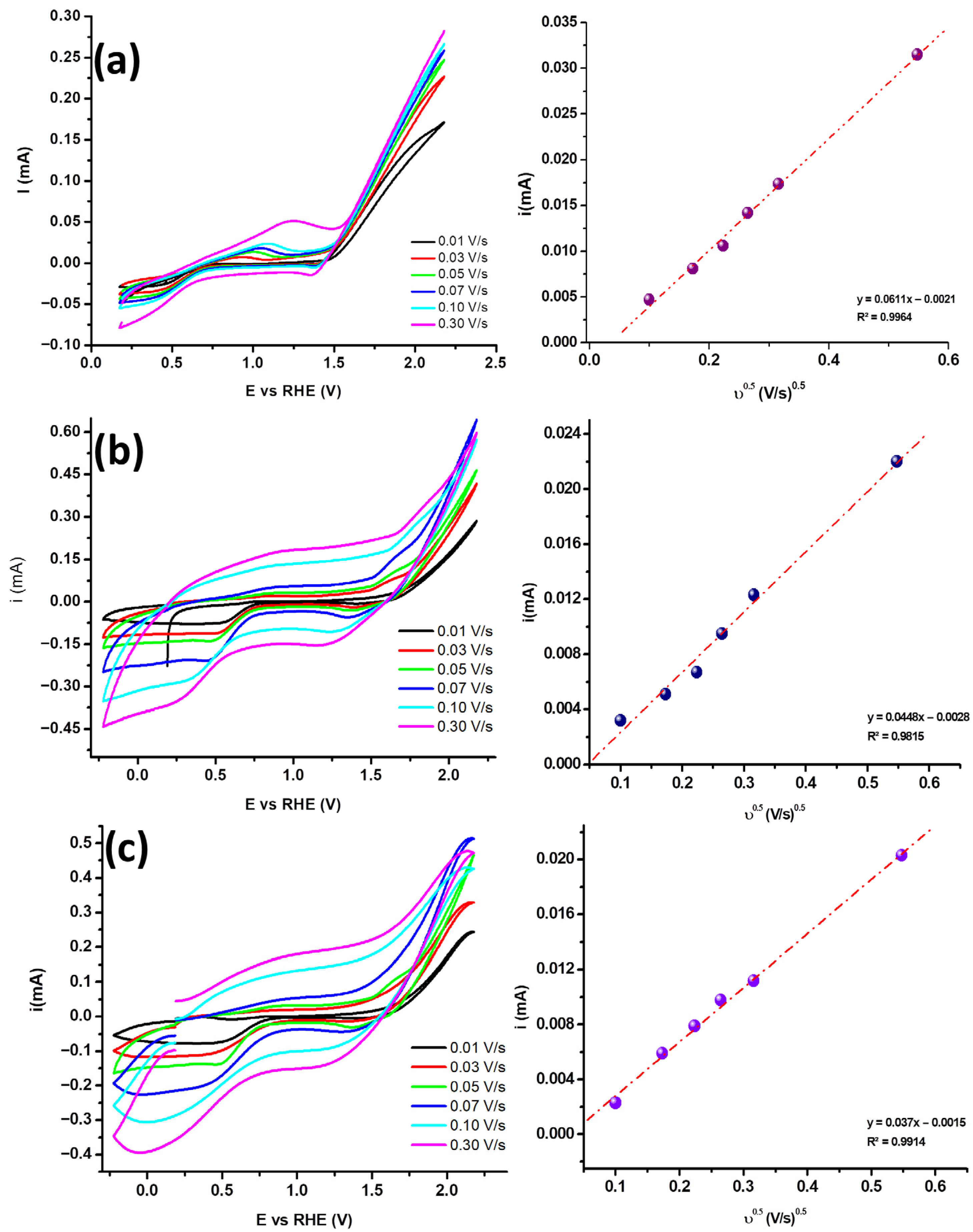
To determine whether the dominant process during the electro-oxidation of methanol on the modified electrodes is adsorption or diffusion-controlled, a cyclic voltammetry study was conducted at different scan rates using a 0.03 M methanol solution in 0.1 M NaOH as the supporting electrolyte. Figure 9 shows the voltammograms of the three modified electrodes recorded at various scan rates. A characteristic shift is observed in the anodic peak corresponding to the oxidation of Ni(II) to Ni(III), which moves toward more positive potentials as the scan rate increases from 0.01 to 0.30 V s−1, suggesting that the methanol electro-oxidation process on these electrodes is not fully reversible consistent with a complex electrochemical behavior influenced by system kinetics and the intrinsic properties of the electrode materials.
Further analysis was performed by plotting the anodic peak current as a function of the square root of the scan rate for each electrode. As illustrated in Figure 9, the observed square-root dependence confirms that the methanol electro-oxidation is diffusion-controlled under the evaluated conditions. This finding is consistent with previous reports on alcohol oxidation at nickel-based electrodes [41,42,43,44,45,46,47,48], in which the rate-limiting step is the diffusion of the reactant from the solution to the electrode–electrolyte interface.

3.4.3. Effect of MethanolConcentration

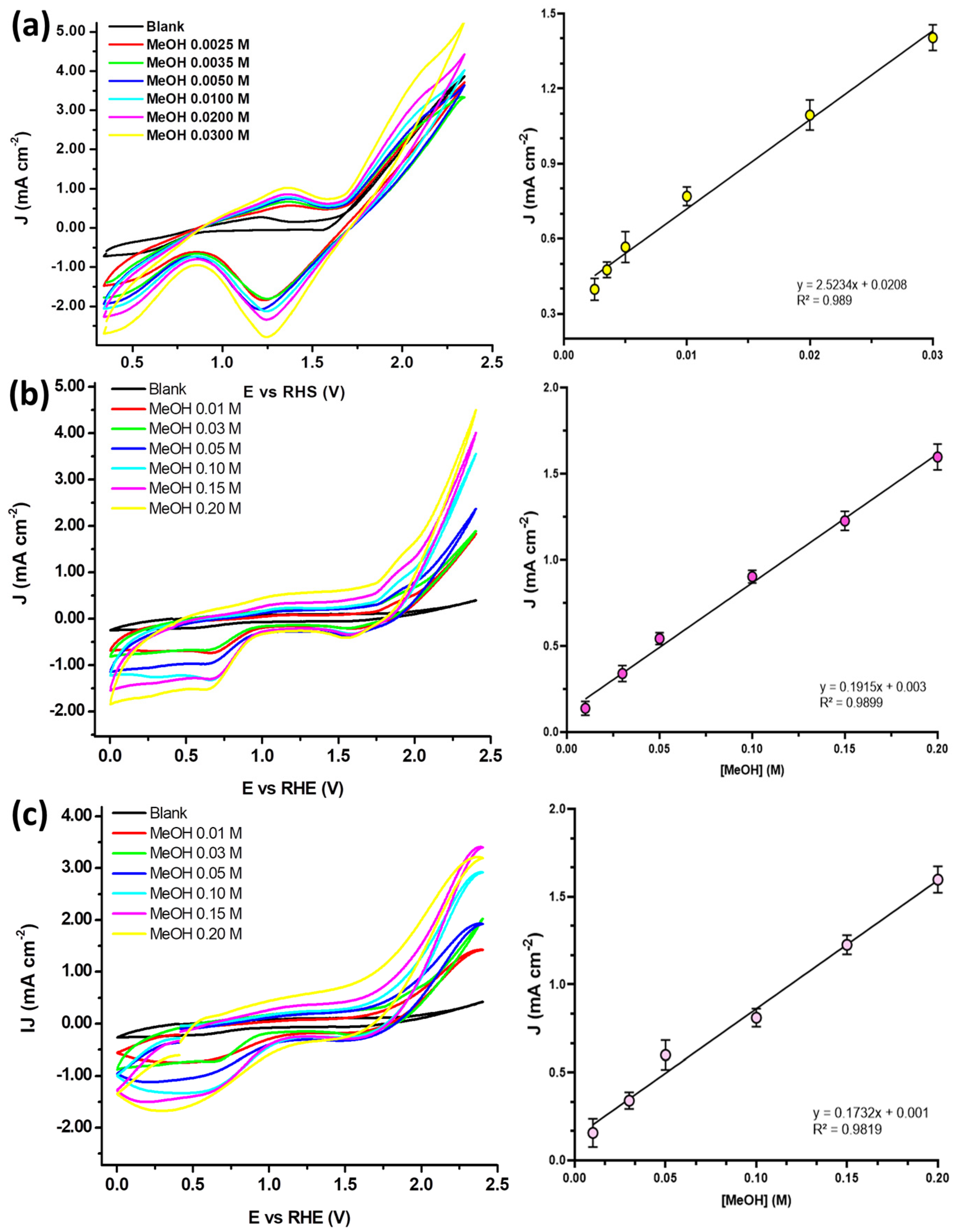
Due to the electrocatalytic activity exhibited by the nickel complexes, the effect of methanol concentration on the current density was evaluated. As shown in Figure 10, all three electrodes display a linear increase in anodic peak current as the methanol concentration increases.
For the NiL1@CPE (Figure 10a), the concentration range evaluated was from 0.002 M to 0.030 M. Within this interval, the current density increased substantially, from 0.38 mA cm−2 to 1.40 mA cm−2, demonstrating a high sensitivity of the electrode to small changes in methanol concentration. In contrast, the NiL2@CPE and Ni-L3@CPE (Figure 10b,c) exhibited a similar behavior in a broader concentration window ranging from 0.01 M to 0.20 M. For these electrodes, the current density increased from 0.31 mA cm−2 and 0.32 mA cm−2 at the lowest concentration to 1.60 mA cm−2 and 1.63 mA cm−2 at the highest concentration, respectively. The linear response observed for both systems indicates a direct dependence of electrocatalytic activity on methanol concentration, suggesting that the NiL2 and NiL3 complexes are also highly effective under conditions requiring high current output. Such linear behavior over a wide concentration range is characteristic of a homogeneous electroactive surface and reaction kinetics enhanced by the structural features of the electrode material, which facilitates electron transport.
A comparison of the operational parameters of the modified electrodes presented in this work with other modified electrodes is summarized in Table 2. Overall, although the three electrodes exhibit strong performance, NiL1@CPE operates efficiently at lower methanol concentrations, whereas NiL2@CPE and NiL3@CPE require higher concentrations to reach comparable current densities. This differential behavior suggests that the structure and chemical environment of the NiL1 complex provide greater affinity for methanol adsorption and oxidation at low concentrations. Conversely, the higher current densities achieved by NiL2@CPE and NiL3@CPE are likely associated with electronic effects of their ligands, which may enhance electron transfer to the metal center compared with L1. Additionally, coordination geometry may play a significant role in modulating the electro-oxidation process. Moreover, it was observed that current intensity decreases once the concentration range is exceeded. This effect is attributed to catalyst poisoning caused by CO2 formation on the electrode surface, which passivates the generation of Ni(III) species responsible for mediating the electro-oxidation process [49,50].

3.4.4. Electrochemical Stability

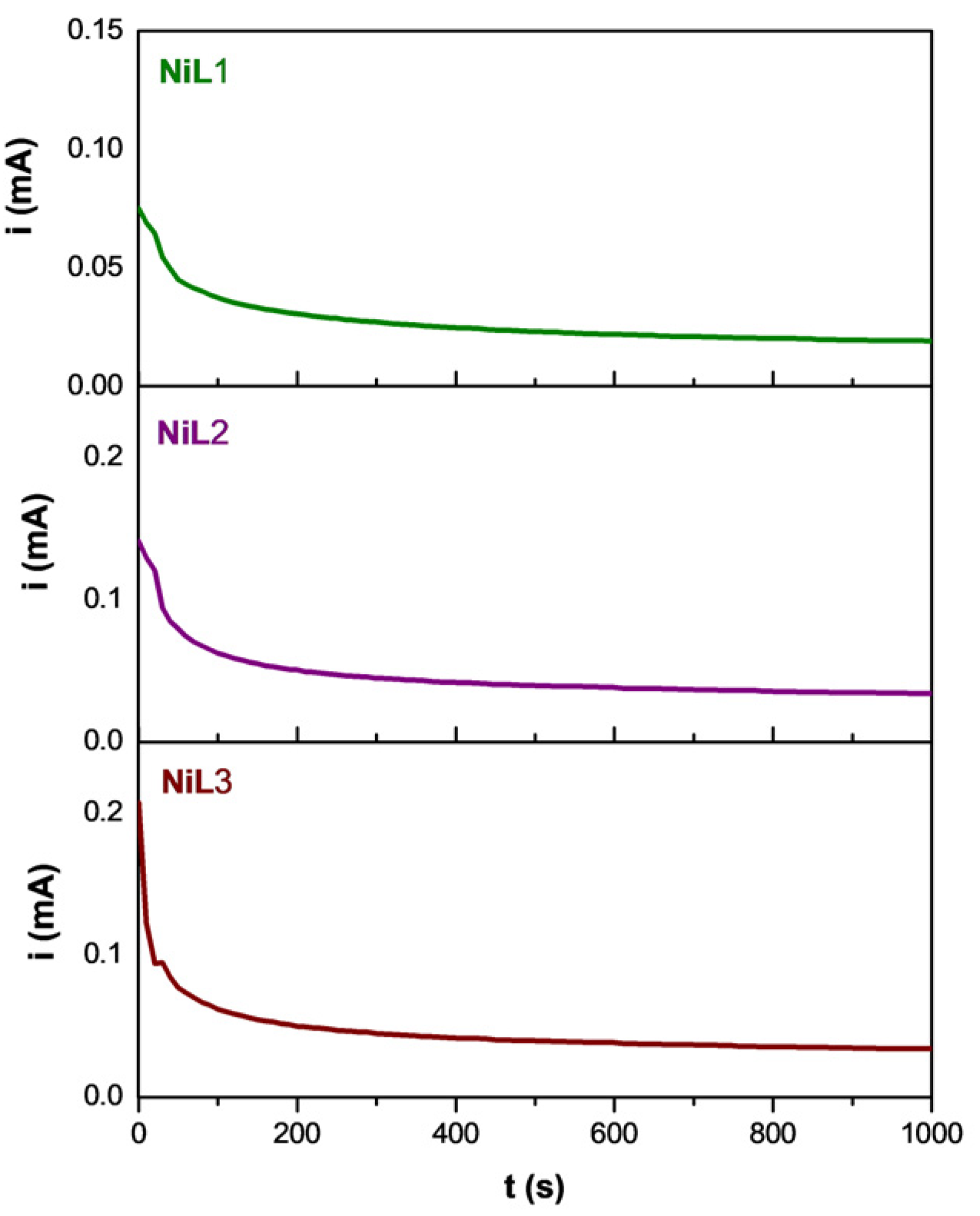
The electrochemical stability of the NiL1, NiL2, and NiL3 catalysts was evaluated by chronoamperometry at a fixed potential of 0.4 V using a conventional three-electrode electrochemical cell. The chronoamperometric experiments were performed under identical conditions for all catalysts to enable a direct comparison of their stability over time. The resulting current–time responses are summarized in Figure 11.
As observed, all catalysts exhibit an initial rapid decay in current during the first 200 s. Subsequently, the current gradually stabilizes, reaching a quasi-steady-state regime that reflects the intrinsic durability and sustained catalytic activity of the materials over the final 800 s. Among the three catalysts, NiL1 displays the lowest initial and steady-state current, indicating limited electrochemical activity and reduced stability under continuous operation.
Conversely, NiL2 and NiL3 exhibit significantly higher current responses and improved long-term stability. NiL2 shows a relatively moderate current decay and maintains a higher steady-state current compared to NiL1, suggesting enhanced accessibility of active sites and more favorable charge-transfer properties. Notably, NiL3 delivers the highest initial current and retains the largest steady-state current over the entire duration of the measurement, demonstrating superior catalytic durability under prolonged polarization. The improved performance of NiL2 and NiL3 could be attributed to their higher nickel loadings, needle-like morphologies, and comparable Ni(II) coordination environments.

4. Conclusions

A series of salophen-type Ni(II) Schiff base complexes was synthesized and fully characterized, confirming tetradentate N2O2 coordination around the nickel center. When immobilized on carbon paste electrodes, all complexes displayed stable electrochemical behavior in alkaline media without catalyst leaching and were effective for the methanol oxidation reaction (MOR). The modified electrodes exhibited current densities between 1.40 and 1.62 mA cm−2 under optimized conditions, which, although lower than those of polymeric or nanostructured nickel-based systems, are notable for discrete molecular Ni(II) Schiff base catalysts.
Differences in electrocatalytic performance reflect ligand-dependent effects: NiL1@CPE shows higher sensitivity at low methanol concentrations, while the extended π-conjugation of the naphthalene-based ligands in NiL2 and NiL3 promotes improved electron transfer and higher currents at increased methanol concentrations. The MOR was diffusion-controlled, with linear current responses across a broad concentration range; current attenuation at high methanol concentrations was attributed to partial surface poisoning by reaction intermediates.
These results demonstrate that salophen-type Ni(II) complexes provide a well-defined and stable molecular platform for probing structure–activity relationships in MOR electrocatalysis and offer clear design guidelines for future performance enhancement through ligand modification and integration with conductive supports.

Supplementary Materials

The following supporting information can be downloaded at https://www.mdpi.com/article/10.3390/org7010014/s1. Figure S1: FT-IR spectra for L1; Figure S2: FT-IR spectra for L2; Figure S3: FT-IR spectra for L3; Figure S4: DART+ spectra for L1; Figure S5: DART+ spectra for L2; Figure S6: DART+ spectra for L3; Figure S7: FT-IR spectra of NiL1; Figure S8: FT-IR spectra of NiL2; Figure S9: FT-IR spectra of NiL3; Figure S10: DART+ Spectra for NiL1; Figure S11: DART+ Spectra for NiL2; Figure S12: DART+ Spectra for NiL3.

Author Contributions

Conceptualization, J.A.C.-N., R.C.-P. and D.M.-M.; methodology, J.A.C.-N. and F.H.-G.; validation, D.M.-M. and R.C.-P.; formal analysis, J.A.C.-N.; investigation, J.A.C.-N. and E.P.-M.; resources, D.M.-M.; data curation, J.A.C.-N.; writing—original draft preparation, J.A.C.-N.; writing—review and editing, J.A.C.-N., D.M.-M. and R.C.-P.; visualization, D.M.-M.; supervision, D.M.-M.; project administration, D.M.-M.; funding acquisition, D.M.-M. All authors have read and agreed to the published version of the manuscript.

Funding

This research received no external funding.

Data Availability Statement

The original contributions presented in this study are included in the article/Supplementary Material. Further inquiries can be directed to the corresponding authors.

Acknowledgments

This work is fully supported by Secretaria de Ciencia, Humanidades y Tecnología (SECIHTI). F.H.G. acknowledges the doctoral fellowship provided by SECIHTI, and all authors thank SNI for the economic stipend granted. D.M.M acknowledges to DGAPA UNAM PAPIIT-IN218626.

Conflicts of Interest

The authors declare no conflicts of interest.

References

  1. Pashazadeh, A.; Habibi, B. A Nickel Ion-Incorporating Zinc-Mesoporous Metal Organic Framework Thin Film Nanocomposite Modified Glassy Carbon Electrode for Electrocatalytic Oxidation of Methanol in Alkaline Media. New J. Chem. 2021, 45, 2597–2608. [Google Scholar] [CrossRef]
  2. Meenu, P.C.; Datta, S.P.; Singh, S.A.; Dinda, S.; Chakraborty, C.; Roy, S. A Compendium on Metal Organic Framework Materials and Their Derivatives as Electrocatalyst for Methanol Oxidation Reaction. Mol. Catal. 2021, 510, 111710. [Google Scholar] [CrossRef]
  3. Olah, G.A.; Goeppert, A.; Prakash, G.K.S. The “Methanol Economy”: General Aspects. In Beyond Oil and Gas; Wiley-VCH: Weinheim, Germany, 2018. [Google Scholar]
  4. Goeppert, A.; Olah, G.A.; Surya Prakash, G.K. Toward a Sustainable Carbon Cycle. In Green Chemistry; Elsevier: Amsterdam, The Netherlands, 2018; pp. 919–962. [Google Scholar]
  5. Mehmood, A.; Chae, S.Y.; Park, E.D. Low-Temperature Electrochemical Oxidation of Methane into Alcohols. Catalysts 2024, 14, 58. [Google Scholar] [CrossRef]
  6. Ullah, N.; Ullah, S.; Khan, S.; Guziejewski, D.; Mirceski, V. A Review: Metal-Organic Framework Based Electrocatalysts for Methanol Electro-Oxidation Reaction. Int. J. Hydrog. Energy 2023, 48, 3340–3354. [Google Scholar] [CrossRef]
  7. Zhang, W.; Huang, B.; Cui, Y.; Shen, L.; Yan, S. Electrooxidation: A Potential-Dependent DFT. RSC Adv. 2025, 15, 11056–11064. [Google Scholar] [CrossRef] [PubMed]
  8. Zhao, L.; Jiang, Y. Sustainable Anodes for Direct Methanol Fuel Cells: Advancing Beyond Platinum Scarcity with Low-Pt Alloys and Non-Pt Systems. Sustainability 2025, 17, 5086. [Google Scholar] [CrossRef]
  9. Malav, R.; Ray, S. Recent Advances in the Synthesis and Versatile Applications of Transition Metal Complexes Featuring Schi Ff Base Ligands. RSC Adv. 2025, 15, 22889–22914. [Google Scholar] [CrossRef]
  10. Zeng, Z.; Chen, Y.; Huang, J.; Jin, Y.; Wu, X. The Key Role of the Second Material’s OER Activity on MOR Durability Enhancement of the Pt Alloys. Colloids Surf. A Physicochem. Eng. Asp. 2025, 705, 135702. [Google Scholar] [CrossRef]
  11. Wang, S.; Wang, S.; Li, Q.; Deng, L.; Wang, L. Ligand-Regulated Schiff Base Complexes for Efficient Electrocatalytic Carbon Dioxide Reduction. J. Catal. 2025, 451, 116356. [Google Scholar] [CrossRef]
  12. Juyal, V.K.; Pathak, A.; Panwar, M.; Thakuri, S.C.; Prakash, O.; Agrwal, A.; Nand, V. Schiff Base Metal Complexes as a Versatile Catalyst: A Review. J. Organomet. Chem. 2023, 999, 122825. [Google Scholar] [CrossRef]
  13. Yari, F.; Aljabour, A. A Molecular Binuclear Nickel (II) Schiff Base Complex for Efficient HER Electrocatalysis. Catalysts 2023, 13, 148. [Google Scholar] [CrossRef]
  14. Kumar, N.; Asatkar, A.K.; Panda, S.; Zade, S.S. Synthesis, Characterization and Supramolecular Building Motifs of Substituted Salphen- and Thiasalphen–Metal Complexes. Polyhedron 2016, 117, 718–728. [Google Scholar] [CrossRef]
  15. Mazlan, N.-F.; Tan, L.L.; Karim, N.H.A.; Heng, L.Y.; Reza, M.I.H. Optical Biosensing Using Newly Synthesized Metal Salphen Complexes: A Potential DNA Diagnostic Tool. Sens. Actuators B Chem. 2017, 242, 176–188. [Google Scholar] [CrossRef]
  16. Uysal, Ş.; İsmet Uçan, H. The Synthesis and Characterization of Melamine Based Schiff Bases and Its Trinuclear [Salen/SalophenFe(III)] and [Salen/SalophenCr(III)] Capped Complexes. J. Incl. Phenom. Macrocycl. Chem. 2009, 65, 299–304. [Google Scholar] [CrossRef]
  17. Ramadan, R.M.; Abu Al-Nasr, A.K.; Ali, O.A.M. Synthesis, Spectroscopic, DFT Studies and Biological Activity of Some Ruthenium Carbonyl Derivatives of Bis-(Salicylaldehyde)Phenylenediimine Schiff Base Ligand. J. Mol. Struct. 2018, 1161, 100–107. [Google Scholar] [CrossRef]
  18. Teoh, S.G.; Yeap, G.Y.; Loh, C.C.; Foong, L.W.; Teo, S.B.; Fun, H.K. Inner Coordination Sphere Tin(IV) Complexes with Some O,N,N-Terdentate {N-(2-Hydroxybenzaldehyde)-1-Amino-2-Phenyleneimine and N-(2-Hydroxy-1-Naphthaldehyde)-1-Amino-2-Phenyleneimine} and O,N,N,O-Quadridentate {N,N′-Bis(2-Hydroxybenzaldehyde)-1,2-Phenylen. Polyhedron 1997, 16, 2213–2221. [Google Scholar] [CrossRef]
  19. Naeimi, H.; Sadat Nazifi, Z.; Matin Amininezhad, S.; Amouheidari, M. Synthesis, Characterization and in Vitro Antimicrobial Activity of Some New Schiff Bases and Their Complexes. J. Antibiot. 2013, 66, 687–689. [Google Scholar] [CrossRef]
  20. Şahin, M.; Koçak, N.; Erdenay, D.; Arslan, U. Zn(II), Ni(II), Cu(II) and Pb(II) Complexes of Tridentate Asymmetrical Schiff Base Ligands: Synthesis, Characterization, Properties and Biological Activity. Spectrochim. Acta Part A Mol. Biomol. Spectrosc. 2013, 103, 400–408. [Google Scholar] [CrossRef]
  21. Maher, K.A.; Huda, A.B.; Aveen, A.I. Synthesis and Biological Activity of Copper (Ii), Nickel(Ii) and Cobalt(Ii) with Tetradentate Schiff Bases Complexes Derived from 2-Hydroxy-1- Naphthaldehyde and Aromatic Diamines. J. Univ. Zakho 2013, 1, 246–252. [Google Scholar]
  22. Luo, M.; Zhu, P.; Chen, F.; Deng, M.; Gan, Q.; Chen, L. Synthesis and Composition Determination of 2-Hydroxy-1-Naphthalene Formaldehyde o-Phenylenediamine Schiff Base and Its Copper(II) Complexes: An Introduction of a Comprehensive Chemical Experiment. Univ. Chem. 2020, 35, 152–160. [Google Scholar] [CrossRef]
  23. Ju, M.; Shin, J. EPR Spectroscopy: A Versatile Tool for Exploring Transition Metal Complexes in Organometallic and Bioinorganic Chemistry Basic Principles. Bull. Korean Chem. Soc. 2024, 45, 835–862. [Google Scholar] [CrossRef]
  24. Freire, C.; de Castro, B. Epr Characterisation of Nickel (III) Complexes with N2O2 Schiff Base Ligands Derived from Naphthaldehyde and Their Pyridine Adducts. Polyhedron 1998, 17, 4227–4235. [Google Scholar] [CrossRef]
  25. Arion, V.B.; Rapta, P.; Telser, J.; Shova, S.S.; Breza, M.; Lušpai, K.; Kožišek, J. Syntheses, Electronic Structures, and EPR/UV−Vis−NIR Spectroelectrochemistry of Nickel(II), Copper(II), and Zinc(II) Complexes with a Tetradentate Ligand Based on S-Methylisothiosemicarbazide. Inorg. Chem. 2011, 50, 2918–2931. [Google Scholar] [CrossRef] [PubMed]
  26. Azevedo, F.; Freire, C.; de Castro, B. Reductive Electrochemical Study of Ni(II) Complexes with N2O2 Schiff Base Complexes and Spectroscopic Characterisation of the Reduced Species. Reactivity towards CO. Polyhedron 2002, 21, 1695–1705. [Google Scholar] [CrossRef]
  27. Rotthaus, O.; Labet, V.; Philouze, C.; Jarjayes, O.; Thomas, F. Pseudo-Octahedral Schiff Base Nickel(II) Complexes: Does Single Oxidation Always Lead to the Nickel(III) Valence Tautomer? Eur. J. Inorg. Chem. 2008, 2008, 4215–4224. [Google Scholar] [CrossRef]
  28. van Gastel, M.; Shaw, J.L.; Blake, A.J.; Flores, M.; Schröder, M.; McMaster, J.; Lubitz, W. Electronic Structure of a Binuclear Nickel Complex of Relevance to [NiFe] Hydrogenase. Inorg. Chem. 2008, 47, 11688–11697. [Google Scholar] [CrossRef]
  29. Thangavel, K.; Bruzzese, C.; Mendt, M.; Folli, A.; Knippen, K.; Volkmer, D.; Murphy, D.M. Unveiling the Atomistic and Electronic Structure of Ni II—NO Adduct in a MOF-Based Catalyst by EPR Spectroscopy and Quantum Chemical Modelling. Phys. Chem. Chem. Phys. 2023, 25, 15702–15714. [Google Scholar] [CrossRef]
  30. Naumkin, A.; Ivanova, T.; Sidorov, A.; Maslakov, K.; Kiskin, M.; Savilov, S.; Lunin, V.; Novotortsev, V.; Eremenko, I. XPS Study of Structural Transformations in Some Ni Complexes. Surf. Interface Anal. 2018, 50, 1154–1157. [Google Scholar] [CrossRef]
  31. Survilienė, S.; Češūnienė, A.; Jasulaitienė, V.; Jurevičiūtė, I. The Use of XPS for Study of the Surface Layers of CrNi Alloys Electrodeposited from the Cr(III)+Ni(II) Bath. Appl. Surf. Sci. 2012, 258, 9902–9906. [Google Scholar] [CrossRef]
  32. Brisk, M.A.; Baker, A.D. Shake-up Satellites in X-Ray Photoelectron Spectroscopy. J. Electron. Spectros. Relat. Phenom. 1975, 7, 197–213. [Google Scholar] [CrossRef]
  33. Li, S.; Ma, R.; Hu, J.; Li, Z.; Liu, L.; Wang, X.; Lu, Y.; Sterbinsky, G.E.; Liu, S.; Zheng, L.; et al. Coordination Environment Tuning of Nickel Sites by Oxyanions to Optimize Methanol Electro-Oxidation Activity. Nat. Commun. 2022, 13, 2916. [Google Scholar] [CrossRef]
  34. Wang, W.; Li, R.; Zhang, R.; Ma, J.; Wang, B. Electrocatalytic Oxidation of Methanol on Glassy Carbon Electrode Modified with Nickel-Manganese Salen Complexes Encapsulated in Mesoporous Zeolite A. J. Electroanal. Chem. 2015, 742, 110–121. [Google Scholar] [CrossRef]
  35. Majumdar, D.; Bhattacharya, S.K. Recent Developments of Methanol Electrooxidation Using Nickel-based Nanocatalysts. ChemistrySelect 2022, 7, e202201807. [Google Scholar] [CrossRef]
  36. Fleischmann, M.; Korinek, K.; Pletcher, D. The Kinetics and Mechanism of the Oxidation of Amines and Alcohols at Oxide-Covered Nickel, Silver, Copper, and Cobalt Electrodes. J. Chem. Soc. Perkin Trans. 2 1972, 1396–1403. [Google Scholar] [CrossRef]
  37. Cruz-Navarro, J.A.; Mendoza-Huizar, L.H.; Salazar-Pereda, V.; Cobos-Murcia, J.Á.; Colorado-Peralta, R.; Álvarez-Romero, G.A. Progress in the Use of Electrodes Modified with Coordination Compounds for Methanol Electro-Oxidation. Inorg. Chim. Acta 2021, 520, 120293. [Google Scholar] [CrossRef]
  38. Hernández-García, F.; Sanchez-Mora, A.T.; Serrano-García, J.S.; Amaya-Florez, A.; Ortiz-Frade, L.A.; Alvarez-Romero, G.A.; Cruz-Navarro, J.A.; Morales-Morales, D. Para-Hydroxy Ni(II)-POCOP Pincer Complexes as Modifiers on Carbon Paste Electrodes and Their Application in Methanol Electro-Oxidation in Alkaline Media. Processes 2024, 12, 1466. [Google Scholar] [CrossRef]
  39. Wang, X.; Xiao, C.; Li, Y.; Murayama, T.; Ishida, T.; Lin, M.; Xiu, G. In-Situ Raman Unveiled Nb-O-Bond-Dependency Selectivity for Methanol Electro-Oxidation at High Current Density. Appl. Catal. A Gen. 2023, 664, 119341. [Google Scholar] [CrossRef]
  40. Škugor Rončević, I.; Buzuk, M.; Kukovec, B.M.; Sokol, V.; Buljac, M.; Vladislavić, N. Electrochemical Properties and Perspectives of Nickel(II) and Cobalt(II) Coordination Polymers-Aspects and an Application in Electrocatalytic Oxidation of Methanol. Crystals 2023, 13, 718. [Google Scholar] [CrossRef]
  41. Nozad Golikand, A.; Golabi, S.M.; Ghannadi Maragheh, M.; Irannejad, L.; Asgari, M. Electrocatalytic Oxidation of Methanol on a Glassy Carbon Modified Electrode by Bis(1,2-Phenylenediamine) Nickel(II) Complex. J. Iran. Chem. Soc. 2007, 4, 304–309. [Google Scholar] [CrossRef]
  42. Revenga-Parra, M.; García, T.; Lorenzo, E.; Pariente, F. Electrocatalytic Oxidation of Methanol and Other Short Chain Aliphatic Alcohols on Glassy Carbon Electrodes Modified with Conductive Films Derived from NiII-(N,N′-Bis(2,5-Dihydroxybenzylidene)-1,2-Diaminobenzene). Sens. Actuators B Chem. 2008, 130, 730–738. [Google Scholar] [CrossRef]
  43. Wang, W.; Li, R.; Fan, B.; Ma, J.; Zhang, R. Mesoporous Zeolite LTA-Encapsulated Ni(II)-Schiff Base Complex: An Efficient Heterogeneous Catalyst for Electrocatalytic Oxidation of Methanol in Alkaline Media. Ionics 2015, 21, 2591–2602. [Google Scholar] [CrossRef]
  44. Wang, W.; Li, R.; Hua, X.; Zhang, R. Methanol Electrooxidation on Glassy Carbon Electrode Modified with Bimetallic Ni(II)Co(II)Salen Complexes Encapsulated in Mesoporous Zeolite A. Electrochim. Acta 2015, 163, 48–56. [Google Scholar] [CrossRef]
  45. Ourari, A.; Nora, H.; Noureddine, C.; Djouhra, A. Elaboration of New Electrodes with Carbon Paste Containing Polystyrene Functionalized by Pentadentate Nickel(II)-Schiff Base Complex—Application to the Electrooxidation Reaction of Methanol and Its Aliphatic Analogs. Electrochim. Acta 2015, 170, 311–320. [Google Scholar] [CrossRef]
  46. Beigi, Z.; Kianfar, A.H.; Farrokhpour, H.; Roushani, M.; Azarian, M.H.; Mahmood, W.A.K. Synthesis, Characterization and Spectroscopic Studies of Nickel (II) Complexes with Some Tridentate ONN Donor Schiff Bases and Their Electrocatalytic Application for Oxidation of Methanol. J. Mol. Liq. 2018, 249, 117–125. [Google Scholar] [CrossRef]
  47. Kuznetsov, N.; Yang, P.; Gorislov, G.; Zhukov, Y.; Bocharov, V.; Malev, V.; Levin, O. Electrochemical Transformations of Polymers Formed from Nickel (II) Complexes with Salen-Type Ligands in Aqueous Alkaline Electrolytes. Electrochim. Acta 2018, 271, 190–202. [Google Scholar] [CrossRef]
  48. Hua, X. Electrocatalytic Oxidation of Methanol on NiMnsalpnY Modified Glassy Carbon Electrode. Int. J. Electrochem. Sci. 2019, 14, 8141–8160. [Google Scholar] [CrossRef]
  49. Hou, G.; Shen, Z.; Tang, Y.; Chen, Q.; Cao, H.; Zhang, H.; Zheng, G.; Zhang, J. Ni-WC Nanoparticles/Carbon Aerogel Electrocatalytic Electrode for Methanol and Urea Electrooxidation. Int. J. Hydrog. Energy 2023, 48, 991–1000. [Google Scholar] [CrossRef]
  50. Kwon, Y.; Lai, S.C.S.; Rodriguez, P.; Koper, M.T.M. Electrocatalytic Oxidation of Alcohols on Gold in Alkaline Media: Base or Gold Catalysis? J. Am. Chem. Soc. 2011, 133, 6914–6917. [Google Scholar] [CrossRef]
  51. Bott-Neto, J.L.; Martins, T.S.; Machado, S.A.S.; Ticianelli, E.A. Electrocatalytic Oxidation of Methanol, Ethanol, and Glycerol on Ni(OH)2 Nanoparticles Encapsulated with Poly[Ni(Salen)] Film. ACS Appl. Mater. Interfaces 2019, 11, 30810–30818. [Google Scholar] [CrossRef]
  52. Wang, Y.; Liu, C.; Xiang, J.; Xing, L.; Ou, X.; Chen, S.; Xue, X.; Yu, F.; Li, R. Electrocatalytic Oxidation of Methanol on Nickel Doped Metalorganic Frameworks MIL-110 Modified Glassy Carbon Electrode in Alkaline Medium. Int. J. Electrochem. Sci. 2016, 14, 5247–5258. [Google Scholar] [CrossRef]
  53. Golikand, A.N.; Asgari, M.; Maragheh, M.G.; Shahrokhian, S. Methanol Electrooxidation on a Nickel Electrode Modified by Nickel-Dimethylglyoxime Complex Formed by Electrochemical Synthesis. J. Electroanal. Chem. 2006, 588, 155–160. [Google Scholar] [CrossRef]
  54. Ciszewski, A. Catalytic Oxidation of Methanol on a Glassy Carbon Electrode Electrochemically Modified by a Conductive NiII-curcumin Film. Electroanalysis 1995, 7, 1132–1135. [Google Scholar] [CrossRef]
  55. Wang, N.; Liang, S.; Zhang, L.; Cao, P.; Xu, L.; Lin, M. Ionic Liquid Supported Nickel-Based Metal-Organic Framework for Electrochemical Sensing of Hydrogen Peroxide and Electrocatalytic Oxidation of Methanol. Colloids Surf. A Physicochem. Eng. Asp. 2020, 603, 125199. [Google Scholar] [CrossRef]
Scheme 1. Route of synthesis for obtaining salophen-type ligands, where letter R represents the phenyl or naphtlane moiety.
Organics 07 00014 sch001
Scheme 2. Synthesis procedure for obtaining nickel Schiff base complexes.
Organics 07 00014 sch002
Figure 1. 1HNMR for L1.
Organics 07 00014 g001
Figure 2. 1HNMR for L2.
Organics 07 00014 g002
Figure 3. 1HNMR for L3.
Organics 07 00014 g003
Figure 4. 1H NMR for NiL1.
Organics 07 00014 g004
Figure 5. EPR spectra for NiL2 and NiL3 complexes.
Organics 07 00014 g005
Figure 6. SEM micrographs for (a) NiL1, (b) NiL2, (c) NiL3 and EDS analysis for (d) NiL1, (e) NiL2, (f) NiL3.
Organics 07 00014 g006
Figure 7. Survey and high-resolution Ni2p XPS for (a) NiL2 and (b) NiL3.
Organics 07 00014 g007
Figure 8. The electrochemical profile and response of (a) CPE, (b) NiL1@CPE, (c) NiL2@CPE, (d) NiL3@CPE.
Organics 07 00014 g008
Figure 9. Scan-rate evaluation of (a) NiL1@CPE, (b) NiL2@CPE, (c) NiL3@CPE.
Organics 07 00014 g009
Figure 10. The electrochemical response to methanol concentration in (a) NiL1@CPE, (b) NiL2@CPE, (c) NiL3@CPE.
Organics 07 00014 g010
Figure 11. Stability evaluation by chronoamperometry in 0.05 mM MeOH.
Organics 07 00014 g011
Table 1. Nomenclature of modified electrodes.
CatalystElectrode Label
noneCPE
NiL1NiL1@CPE
NiL2NiL2@CPE
NiL3NiL3@CPE
Table 2. Performance comparison of proposed electrocatalysts with other Ni(II) Schiff base complexes.
CatalystMeOH
Oxidation Potential (V)
Current Density
(mA/cm2)
Optimum Measurement ConditionRef.
Poly Ni-Salen0.4214.10.1 M MeOH/0.1 M NaOH. Scan rate 0.05 V/s[51]
Ni/MIL-1100.7014.40.1 M MeOH/0.1 M NaOH. Scan rate: 0.05 V/s[52]
Ni(II)-DMG0.4215.90.40 M MeOH/0.1 M NaOH. Scan rate: 0.02 V/s[53]
Poly-Ni(II) curcumin0.5917.20.5 M MeOH/0.1 M NaOH. Scan rate: 0.01 V/s[54]
Ni-BTC0.6184.0 M MeOH/0.5 M NaOH. Scan rate: 0.05 V/s[55]
NiL1@CPE1.36 1.400.3 M MeOH/0.1 M NaOH. Scan rate 0.1 V s−1This work
NiL2@CPE1.881.600.3 M MeOH/0.1 M NaOH. Scan rate 0.1 V s−1
NiL3@CPE1.861.630.3 M MeOH/0.1 M NaOH. Scan rate 0.1 V s−1
Disclaimer/Publisher’s Note: The statements, opinions and data contained in all publications are solely those of the individual author(s) and contributor(s) and not of MDPI and/or the editor(s). MDPI and/or the editor(s) disclaim responsibility for any injury to people or property resulting from any ideas, methods, instructions or products referred to in the content.