Article

Linear Stepwise Synthesis of 2-(Naphthalen-1-yl)-2,3,5,6-tetrahydro-1H-isoquinolino[8,1,2-hij]quinazoline: A Novel Fused Heteroaromatic Framework


1
Departamento de Química, Facultad de Ciencias, Universidad Nacional de Colombia, Sede Bogotá, Carrera 30 No. 45-03, Bogotá 111321, Colombia
2
Bioorganic Chemistry Laboratory, Facultad de Ciencias Básicas y Aplicadas, Universidad Militar Nueva Granada, Cajicá 250247, Colombia
*
Author to whom correspondence should be addressed.
Organics 2026, 7(1), 12; https://doi.org/10.3390/org7010012
Submission received: 18 December 2025 / Revised: 21 January 2026 / Accepted: 27 February 2026 / Published: 3 March 2026

Abstract

In the present work, we describe the synthesis of a new heterocyclic derivative, 2-(naphthalen-1-yl)-2,3,5,6-tetrahydro-1H-isoquinolino[8,1,2-hij]quinazoline 1, using the reaction between the aminal 1,3,6,8-tetraazatricyclo[4.4.1.13,8]dodecane 2 (TATD) and 1-naphthylamine 3 as the first scaffold of a four-step linear synthetic route. In the first step, a condensation catalyzed by acetic acid in 96% ethanol was carried out, leading to the formation of the intermediate 3-(naphthalen-1-yl)-1,2,3,4-tetrahydrobenzo[h]quinazoline 4. Subsequently, this intermediate was acylated with 2-chloroacetyl chloride in the presence of triethylamine and under an inert atmosphere, obtaining the compound 2-chloro-1-(3-(naphthalen-1-yl)-3,4-dihydrobenzo[h]quinazolin-1(2H)-yl)ethan-1-one 5. In the third step, an intramolecular Friedel–Crafts cyclization was carried out using aluminum trichloride as a catalyst, yielding 2-(naphthalen-1-yl)-1,2,3,6-tetrahydro-5H-isoquinolino[8,1,2-hij]quinazolin-5-one 6. Finally, the reduction of this lactam with phosphorus pentachloride and sodium borohydride under anhydrous conditions led to the further closure of the polycyclic system, yielding the final product 1. The proposed route demonstrates the feasibility of using TATD 2 as a versatile precursor for constructing condensed heterocyclic systems of structural interest and potential relevance in advanced organic synthesis.

1. Introduction

Quinazolines and quinazolinones are an important class of fused heterocycles composed of a benzene ring fused to a pyrimidine ring [1,2]. They occur in over 200 natural alkaloids and display diverse biological activities, including anticancer, antimicrobial, antifungal, antiviral, anti-inflammatory, analgesic, antimalarial, and sedative properties [1]. Their pharmacological relevance is evidenced by marketed drugs, such as raltitrexed, used in colorectal cancer therapy, and methaqualone, a sedative and muscle relaxant [1]. Consequently, numerous synthetic methods have been developed to access quinazoline and quinazolinone frameworks with varied substitution patterns and functionalization.
Among classical approaches, the Niementowski synthesis is notable [3], involving the reaction of anthranilic acid derivatives with formamide at 125–130 °C to afford 3,4-dihydro-4-oxoquinazolines. The Grimmel-Guinther-Morgan method [4] employs o-aminobenzoic acids and amines in the presence of phosphorus trichloride to yield 2,3-disubstituted derivatives. Isatoic anhydride also reacts readily with amines to form dihydro-4-oxoquinazolinones without intermediate isolation. Additional methods include the condensation of 4H-benzo[d][1,3]oxazin-4-ones with amines [5], the Sen-Ray synthesis using urethanes and phosphorus pentoxide [1], fusion of anthranilic acid with urea, reactions of ureidobenzoic acids, and Hofmann or Lossen-type rearrangements of phthalic acid derivatives [1]. The synthesis of fused or hybrid heterocyclic systems remains challenging and highly dependent on the target structure. Recent studies have reported diverse synthetic strategies for biologically relevant quinazoline hydrids, highlighting the versatility of this scaffold. Triazino[2,3-c]quinazolines [6] were obtained from chloroalkyl triazinoquinazolinones and heterocyclic thiones, while 1,2,3-triazole/quinazolinone hybrids [7] were prepared via sequential condensation, propargylation, and Cu-catalyzed cycloaddition. Quinazoline-piperazine phosphorodiamidates [8] were synthesized through stepwise nucleophilic substitution and phosphoramidation. Other hybrids include 4-anilinoquinoline and 4-anilinoquinazoline derivatives [9], lonidamine (LND)-tacrine/quinazoline conjugates [10], quinazoline-isoxazoles [11], quinazolinone-thiazolidin-4-one hybrids [12], multifunctional quinazoline derivatives [13], tetrahydropyrimidine hybrids [14], and pyridine bis-quinazoline systems [15], generally obtained through combinations of condensations, cyclization, and nucleophilic substitution reactions. Isoquinolin-quinazoline-fused systems have also attracted attention and are commonly accessed through multistep, multicomponent, or domino strategies. A multicomponent reaction of isatoic anhydride, primary amines, and ninhydrin afforded tetracyclic quinazolinone derivatives with good generality, using HCl in 1,4-dioxane as catalyst [16]. Copper-catalyzed domino reactions of halo-benzamido benzoates with nitriles enabled the synthesis of isoquinolin[2,3-a]quinazolinones via Ullmann arylation and intramolecular cyclization, showing broad functional-group tolerance [17]. Additionally, an AgOTf-catalyzed cascade between 2-alkynylbenzaldehydes and substituted anilines produced imidazo-isoquinolino-quinazoline systems in high yields under mild conditions [18].
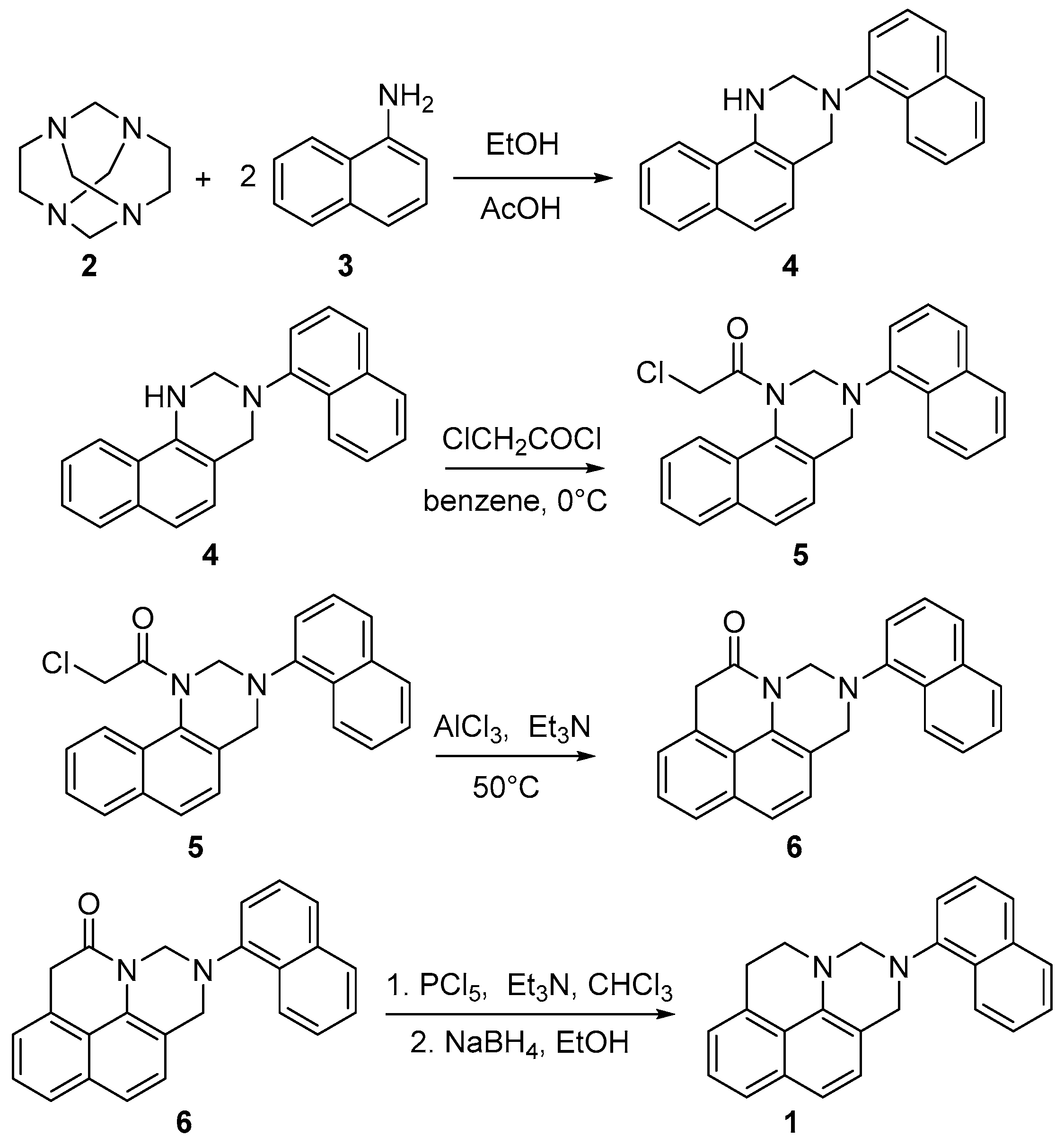
In this manuscript, the synthesis of the title compound 1 is described using the aminal 1,3,6,8-tetraazatricyclo-[4.4.1.13,8]dodecane (TATD), a versatile precursor for heterocyclic compound synthesis [19,20,21,22,23,24], and 1-naphthylamine, following a linear four-step route (Scheme 1). Initially, TATD 2 reacted with 1-naphthylamine 3 in ethanol at room temperature, catalyzed by acetic acid, to afford tetrahydrobenzo[h]quinazoline 4. Subsequent acylation with 2-chloroacetyl chloride yielded 2-chloro-1-(3-(naphthalen-1-yl)-3,4-dihydrobenzo[h]quinazolin-1(2H)-yl)ethan-1-one 5, which underwent intramolecular Friedel–Crafts cyclization promoted by aluminum trichloride to form isoquinolino[8,1,2-hij]quinazolin-5-one 6. Finally, treatment with phosphorus pentachloride and sodium borohydride induced reduction and ring closure, furnishing the target polycyclic compound 1. The results are discussed below.

2. Results and Discussion

The reaction between TATD 2 and naphthylamines was tested at a 1:4 stoichiometric ratio in ethanol, with acetic acid added. Upon TLC analysis, the formation of the dihydrophenanthroline-type subproduct was not detected, simplifying the separation process, which could now be carried out with standard amounts of silica and solvents (sample-silica ratio 1:50). A major product (yield 57%) was detected and purified by conventional column chromatography. Using spectroscopic analysis, the product was identified as 3-(naphthalen-1-yl)-1,2,3,4-tetrahydrobenzo[h]quinazoline 4.
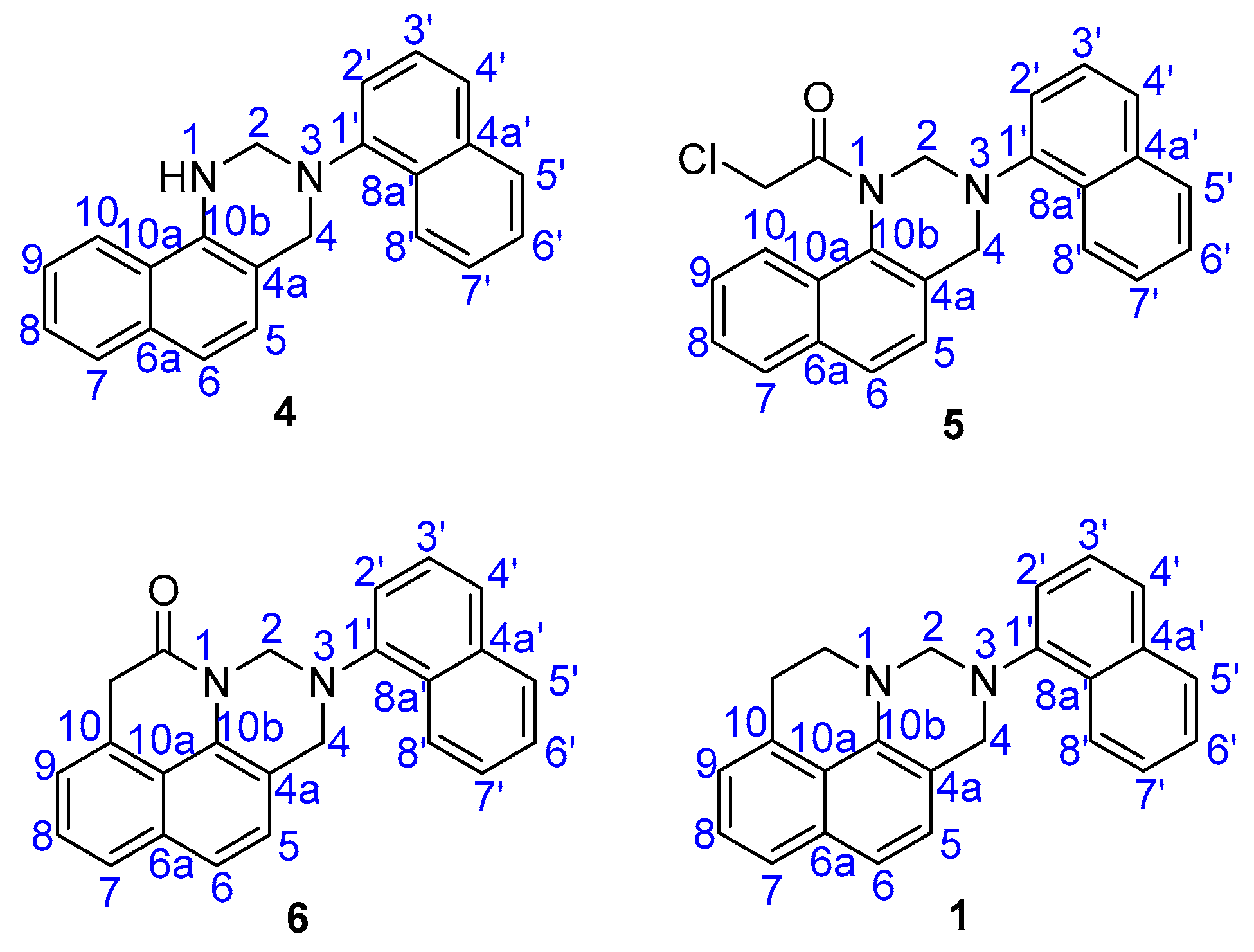
The 1H NMR spectrum of 4 (Figure S1) showed a signal pattern consistent with the expected characteristics for a tetrahydrophenanthroline-type system (Figure 1). Two well-defined singlet signals are observed at 4.93 ppm and 5.11 ppm, each integrating for two protons. The singlet signal at 4.93 ppm corresponds to the N–CH2–Ar group, where the methylene group is directly bonded to the nitrogen and to a naphthalene-type aromatic system. The signal at 5.11 ppm also appears as a singlet and is assigned to the N–CH2–N group, characteristic of aminal protons, in which two nitrogen atoms flank the methylene carbon; the electronic deshielding imparted by these electronegative substituents accounts for its slightly higher shift relative to the methylene protons adjacent to the naphtyl group (H-4). Between 7.01 and 8.15 ppm, multiple signals with complex coupling patterns are observed, indicating the presence of two fused aromatic systems: one corresponding to the phenanthroline nucleus and the other to the naphthalene-like ring. The protons of the naphthalene-like ring are assigned between 7.01 and 8.15 ppm. The 13C NMR spectrum of compound 4 (Figure S2) provides complementary and consistent confirmation of the proton assignments made for the phenanthroline-like derivative. Twenty-two carbon chemical signals were detected (53.41–146.59 ppm), a number consistent with the expected number of non-equivalent carbons in the molecule, considering the asymmetric substitution of the two fused aromatic fragments. This result already suggests the absence of high symmetry that would reduce the number of observable resonances. The two high-field signals (53.41 and 64.39 ppm) unequivocally correspond to the two methylene carbons: 53.41 ppm is assigned to N–CH2–Ar and 64.39 ppm to N–CH2–N. Most CH signals appear between 116 and 133 ppm, while more shifted signals (above 133 ppm and up to 146.6 ppm) were assigned to quaternary or ipso carbons. The latter indicates ring fusion and the presence of adjacent nitrogen atoms. In particular, C1′, which appears at 146.59 ppm, is notably more shifted, consistent with it being an ipso carbon bonded to a heterocyclic nitrogen or a fusion point between aromatic systems. Its high shift is typical of aromatic carbons directly bonded to N or of quaternary carbons in strongly conjugated systems. Carbon atoms involved in ring fusion appear at 117.86 ppm and 120.02 ppm, typical ranges for quaternary carbons.
Compound 4 was reacted with 2-chloroacetyl chloride. A significant drawback of forming amides via acylation of amines with acyl chlorides is the generation of hydrochloride salts, which can reduce reaction yields by up to 50%. In this case, however, the problem is not limited to salt formation. Because aminals are susceptible to electrophilic attack, they can also react with species such as H+ and ClCH2CO+ generated during the reaction. In the first case, acid hydrolysis of the aminal regenerates the starting amine and aldehyde. Even if this hydrolysis were to occur, it would not represent a serious issue because the reaction is reversible. The second case could be more problematic: electrophilic attack can occur at either nitrogen atom of the aminal, yielding a mixture of products that are difficult to separate. This reaction is also among the most widely used methods for producing chloroamines. The initial stage of the reaction should proceed without difficulty, since the amino group contains at least one “free” nitrogen (i.e., not all nitrogens are tertiary—an essential condition for efficient reaction with acyl halides) capable of reacting to form the desired amide. However, the resulting amide presents new challenges, as both nitrogens become tertiary and the molecule is asymmetric. If the amino group were opened directly from the amine through nucleophilic attack on the tertiary nitrogen, the product formed would be compound 5. An inert base (triethylamine) was added to neutralize HCl, preventing both hydrochloride formation and hydrolysis of the amino group. To limit polyacylation, an excess of compound 4 was used in a dilute solution to reduce the likelihood of reaction between the amide product and the acyl chloride. Dilution facilitates the desired reaction, and the excess amine ensures that no free acyl chloride remains upon completion.
The obtained compound 5 exhibited characteristic signals attributed to the formation of the desired amide. Comparative analysis of the 1H NMR spectra of the phenanthroline-type derivative 4 and its acylation product 5 clearly demonstrates amide formation. 1H NMR spectrum of 5 (Figure S3) revealed the appearance of a new singlet signal at 4.36 ppm, attributed to the Cl–CH2–(CO)N– group. Its relatively low-field position is explained by the strong combined shielding effect of the chlorine atom (inductive −I effect) and the adjacent carbonyl group. This signal constitutes the primary spectroscopic evidence of the acyl fragment’s incorporation into the nitrogen of the heterocyclic system. Furthermore, a low-field shift in the N–CH2–N signal is observed, increasing from 4.77 ppm in the precursor to 4.87 ppm in the product. This result is consistent with electronic deshielding induced by the delocalization of the carbonyl carbon to the amide nitrogen. This shift confirms that acylation occurred at N1 of compound 4, as the chemical environment of the N1 methylene group is directly affected by the –CO–CH2Cl group. The shifts in the aromatic protons also showed systematic shifts toward lower fields (0.1–0.6 ppm), reflecting an electron redistribution throughout the conjugated system upon introduction of the carbonyl group, which acted as an electron-withdrawing group (EWG) via inductive and resonance effects. The protons closest to the acylation center (H–C5, H–C6, and H–C10) exhibit the most pronounced shifts, reaching values of up to 8.40 ppm for H–C10, indicating that the delocalization of the C=O group is transmitted throughout the aromatic backbone of the phenanthroline ring. The protons of the naphthalene ring (H–C2′ to H–C8′) also undergo slight shifts (0.15–0.25 ppm), attributable to the overall polarization of the π system after the introduction of the electronegative substituent. Similarly, the 13C NMR spectrum of 5 (Figure S4) confirms the formation of the amide group. Two new and diagnostic signals appear: the amide carbonyl carbon at 165.32 ppm, within the typical range of a conjugated amide C=O, and the resonance of the methylene group bonded to the chlorine Cl–CH2–CONR2 at 44.25 ppm. The two methylene carbons bonded to the nitrogen exhibit the expected behavior upon acylation: N–CH2–Ar shifts very slightly from 53.41 to 53.92 ppm, while N–CH2–N is more significantly deshielded, increasing from 64.39 to 68.10 ppm. This difference is interpreted as the aminal carbon (N–CH2–N) being more directly affected by the decrease in electron density at the acylated nitrogen (partial delocalization towards the carbonyl group), with a more pronounced deshielding effect (+Δδ) than at the methylene group connecting to the aromatic ring. In the aromatic region, a shift towards a lower field (deshielding) is generally observed for most carbons, especially for several quaternary carbons and those ortho or peri relative to the acylated nitrogen. The signal corresponding to C10 shifts from 128.43 to 133.34 ppm, the signal attributed to C6a from 133.15 to 137.07 ppm, and the signal attributed to C4a′ from 134.74 to 138.38 ppm. These changes are consistent with the transmission of the −I carbonyl effect through the π system and ring fusion.
Once the chloroacetylated derivative 5 was obtained, the intramolecular Friedel-Crafts alkylation reaction was performed. Friedel-Crafts alkylation of aromatic compounds is very sensitive to the conditions of both the substrate and the alkylating agent. Thus, if the catalyst and the alkylating agent are very reactive and the aromatic compound is relatively inert, extensive degradation or polymerization of the alkylating agent may occur; if the aromatic substrate is very reactive toward the catalyst and the alkylating agent is relatively inert, decomposition of the aromatic compound takes precedence over alkylation. The possibility of acid hydrolysis, via HCl generated in the reaction medium, was controlled as in the previous case by adding an inert base to the reaction mixture. However, as mentioned before, it is not possible to find a completely inert base given the possibility of an acid-base reaction with AlCl3. Therefore, triethylamine was chosen because, as an aliphatic tertiary amine, it is stronger than the aromatic tertiary amine present in the molecule, which also helps prevent nucleophilic attack at the amino group by AlCl3. Because this does not guarantee that AlCl3 will not be deactivated by reaction with triethylamine, twice the amount of AlCl3 was used, and the reaction was carried out by adding compound 5 to the AlCl3- triethylamine mixture. The low reactivity of the aromatic substrate was not a concern, as the carboxyl group deactivates aromatic compounds, making Friedel-Crafts alkylation a feasible route. Finally, it is essential to note that in dilute solutions, intramolecular reactions are favored over intermolecular reactions; therefore, the experiments were conducted under these conditions.
The 1H NMR spectrum of compound 6 (Figure S5) and a comparative analysis with the 1H NMR spectrum of the precursor 5 clearly demonstrate the formation of the lactam resulting from an intramolecular Friedel-Crafts acylation at C10 of the phenanthroline system. The most significant change is the disappearance of the H–C10 signal (8.40 ppm), confirming that this carbon was the site of the aromatic electrophilic substitution by the acylating center and that it is now substituted, thereby forming the new C–C bond of the lactam ring. Simultaneously, a high-field (protection) shift in the methylene Cl–CH2–CONR2 signal is observed, decreasing from 4.36 to 3.85 ppm. This result is consistent with the loss of the chlorine atom and the formation of the intramolecular C–C bond, which reduces chlorine-induced deprotection and creates a more electron-dense environment for that carbon. This change, along with the high-field shift in the N–CH2–Ar (from 4.70 to 4.48 ppm) and N–CH2–N (from 4.87 to 4.56 ppm) signals, supported the notion that cyclization partially eliminates the carbonyl group’s inductive withdrawal effect on nitrogenous methylenes by redistributing electron density through resonance in the new conjugated lactam system. In the aromatic region, the shifts exhibited a general trend toward higher fields (Δδ between −0.2 and −0.8 ppm), attributable to electron redistribution and shielding induced by the formation of the new ring, which alters the local anisotropy of the π system. This effect is particularly noticeable in H–C9 (from 7.56 to 6.85 ppm) and H–C7 (from 7.82 to 7.09 ppm), whose surroundings are more shielded by the proximity of the new carbonyl group and by the modification of the magnetic field generated by the aromatic currents of the condensed system. Likewise, the protons of the naphthalene ring (H–C2′ to H–C8′) also undergo slight shifts toward higher fields (0.1–0.3 ppm), reflecting the overall increase in electron density after cyclization, a typical effect of the conversion of a linear amide to a conjugated lactam. The COSY experiment of compound 6 (Figure S7) revealed clear correlations between adjacent protons, enabling reliable identification of the different spin systems present in the molecule. In the aromatic region (6.8–8.3 ppm), multiple cross-correlations are observed between the signals assigned to protons H5–H9 and H2′–H8′, indicating the presence of two conjugated aromatic systems. In particular, the signals at δ 7.48–7.14–7.09–6.85 ppm and δ 7.13–7.23–7.54–7.78–7.39–7.49–8.33 ppm show sequential coupling patterns typical of substituted aromatic rings, confirming the connectivity proposed in the assignment table. In the aliphatic region, the signals at 4.56 and 4.48 ppm show correlations with each other and with nearby protons, demonstrating their participation in the saturated skeleton of the central system.
The comparison of the 13C spectrum of 6 (Figure S6) and that of the precursor 5 showed a pattern of changes entirely consistent with the formation of the lactam by a Friedel-Crafts reaction at C10. It allowed the shifts to be explained by inductive effects, anisotropy, and the new electronic distribution of the conjugated system. The signal of the methylene group previously bonded to the chlorine (Cl–CH2–CONR2) in 5 shifted from 44.25 to 33.02 ppm in compound 6, indicating a high-field (shielding) effect. This aspect eliminates the −I effect of Cl, and the change in carbon’s hybridization results in a higher local electron density and, therefore, increased shielding. Similarly, the amide carbonyl carbon shifts from 165.32 to 158.21 ppm. The two methylene carbons bonded to the nitrogen exhibit distinct behaviors: N–CH2–Ar remains virtually unchanged (from 53.92 to 53.88 ppm), while N–CH2–N experiences a marked high-field shift (from 68.10 to 57.00 ppm). This result indicates that the methylene group closest to the nitrogen that participated in the acylation experiences an increase in electron density after cyclization—probably due to a reorganization of the nitrogen’s electron donation to the lactam system and the loss of the polarizing effect exerted by the Cl–CH2 group—which explains the observed shielding. In the aromatic region, the changes are not random. However, they are preferentially localized around the cyclization site: the carbon atoms near C10 undergo significantly high-field shifts, consistent with the substitution of H–C10 by the electrophile and the consequent modification of local aromaticity and ring currents. The significant decrease at C10a and C9 indicates a change in the magnetic anisotropy and in the hybridization/electronic state of the ring adjacent to the new carbonyl bridge. Other carbons further away or in positions that receive less electronic perturbation show small or almost no changes, which is consistent with an electronic perturbation localized around the reaction site.
Finally, the lactam-type compound was reduced to the title compound. The reduction in the carbonyl group of the lactam proved problematic, warranting intensive analysis due to the presence of the amino group. Sodium borohydride was chosen for this purpose because it possesses these characteristics, though it also has some limitations. First, sodium borohydride can only reduce amides and lactams when they are in the form of the Vilsmeier complex. However, treating amides or lactams with POCl3 or PCl5 produces amine dimers unless certain conditions are met. Control of the reaction mixture showed only two compounds: one had an Rf value of 0; partitioning with ethyl acetate-water removed this compound and the color from the organic solution. After solvent removal, a solid was obtained, purified by chromatography, and identified as compound 1 in 75% yield. 1H NMR spectrum of 1 (Figure S8), is consistent with the formation of the 2,3,5,6-tetrahydro-1H-isoquinolino[8,1,2-hij]quinazoline ring system. Two new signals at 3.40–3.64 ppm, each integrating for two protons and appearing as an AA′XX′ system, indicate the presence of a CH2–CH2–N fragment adjacent to an aromatic ring and a nitrogen atom. Large geminal (14 Hz) and distinct vicinal coupling constants (9.0 and 5.6 Hz) support anti and gauche conformations, confirming a flexible –CH2–CH2–N chain formed after lactam carbonyl reduction. Concurrently, nitrogen-bound methylene protons shift upfield due to the loss of the carbonyl electron-withdrawing effect, while aromatic protons show only minor, localized shifts. The 13C NMR spectrum (Figure S9) supports these findings, with the disappearance of the lactam carbonyl signal at 158.21 ppm and the appearance of a methylene carbon at 58.57 ppm. Nitrogen-bound carbons show the expected shielding, reflecting partial recovery of nitrogen electron density. Aromatic carbons display modest high-field shifts, most pronounced near the reduced site, consistent with loss of carbonyl conjugation and a localized electronic perturbation. ESI-MS spectra of compound 1 (Figure S10) allowed us to confirm the proposed structure from the identification of the [M+Na]+ ion.

3. Materials and Methods

3.1. General

All reagents and chemicals were purchased from Merck KGaA and/or Sigma-Aldrich (Darmstadt, Germany). They were employed without additional refinement. As a result, the purity of the dry solvents was sufficiently defined at the time of purchase. The products’ reaction progress and purification were monitored by thin-layer chromatography (TLC) on silica gel 60 F254 plates (Merck KGaA) under UV light at 254 nm. 1H and 13C NMR were measured on a Brucker AC-500 spectrometer operating at 500 and 125 MHz, respectively or on a Varian XL300GS spectrometer operating at 300 MHz for 1H and 75.4 MH z for 13C. In all cases, CDC13 was used with TMS as the internal standard. Low-resolution mass spectrometry was performed on a UHPLC Shimadzu Nexera X2 chromatograph coupled to an LC-MS-9030 spectrometer. Formic acid 0.1%: methanol 40:60 was employed as the mobile phase, with a total run time of 20 min, using a Shim-pack HR-ODS column 150 mm L × 3 mm ID, 80 Å. The analysis was performed in both positive- and negative-ion modes, with the most suitable mode being ESI+.

3.2. Multistep Linear Synthesis of the Title Compound 1

3.2.1. Synthesis of 3-(Naphthalen-1-yl)-1,2,3,4-tetrahydrobenzo[h]quinazoline 4

A solution of TATD 2 (0.476 g, 2.830 mmol) in ethanol (5 mL) was added to a solution of 1-naphthylamine (1.618 g, 11.32 mmol) in ethanol (5 mL). The reaction mixture was stirred at room temperature for 1 h, after which commercial acetic acid (1 mL) was added and stirred for an additional 5 min. Distilled water (90 mL) was then slowly added, and the mixture was stirred for an additional 15 min. A solid was obtained, separated by filtration, washed with distilled water, and purified by CC using petroleum ether (40–60): benzene mixtures as the mobile phases and silica gel as the stationary phase. The compound was obtained in 57% yield. Melting point between 75.0 and 76.2 °C. Soluble in benzene, chloroform, acetone, ethyl acetate, dioxane, and insoluble in water, ethanol, methanol, and petroleum ether (40–60). IR νₘₐₓ cm−1: 3400, 3049, 2925, 2850, 1622, 1576, 1517, 1461, 1400, 1310, 1262, 1236, 1220, 1101, 1046, 1017, 923, 861, 801, 776. 1H NMR δ 8.15 (m, ABMX system, 1H, H–C8′, J = 2.03 Hz, 7.37 Hz, 0.75 Hz), 7.73 (m, ABMX system, 1H, H–C5′, J = 8.23 Hz, 1.44 Hz, 0.75 Hz), 7.73 (m, ABCD system, 1H, H–C10, J = 8.85 Hz, 2.65 Hz, 0.60 Hz), 7.73 (m, ABCD system, 1H, H–C7, J = 1.47 Hz, 8.23 Hz, 0.60 Hz), 7.51 (dd, ABX system, 1H, H–C4′, J = 1.02 Hz, 7.46 Hz), 7.50 (m, ABMX system, 1H, H–C7′, J = 6.94 Hz, 1.44 Hz, 7.37 Hz), 7.49 (m, ABMX system, 1H, H–C6′, J = 6.94 Hz, 8.23 Hz, 2.03 Hz), 7.39 (m, ABCD system, 1H, H–C8, J = 6.96 Hz, 8.23 Hz, 2.65 Hz), 7.38 (m, ABCD system, 1H, H–C9, J = 6.96 Hz, 1.47 Hz, 8.85 Hz), 7.38 (d, AB system, 1H, H–C6, J = 8.45 Hz), 7.24 (dd, ABX system, 1H, H–C3′, J = 8.02 Hz, 7.46 Hz), 7.23 (d, AB system, 1H, H–C5, J = 8.45 Hz), 7.01 (dd, system ABX, 1H, H–C2′, J = 8.02 Hz, 1.02 Hz), 5.11 (s, 2H, N–CH2–N), 4.93 (s, 2H, N–CH2–Ar). 13C NMR δ 146.59 (C1′), 137.59 (C10b), 134.74 (C4a′), 133.15 (C6a), 129.11 (C8a), 128.51 (C5′), 128.43 (C10), 125.95 (C7′), 125.81 (C6′), 125.72 (C3′), 125.55 (C8), 125.37 (C5), 125.20 (C9), 123.87 (C4′), 123.63 (C8), 120.32 (C7), 120.02 (C10a), 119.95 (C6), 117.86 (C4a), 116.9 (C2′), 64.39 (N–CH2–N), 53.41 (N–CH2–Ar).

3.2.2. Synthesis of 2-Chloro-1-(3-(naphthalen-1-yl)-3,4-dihydrobenzo[h]quinazolin-1(2H)-yl)ethan-1-one 5

A solution of 4 (0.500 g, 1.61 mmol) in benzene (15 mL) was placed in a flask and stirred vigorously at 0 °C. To this mixture, chloroacetic chloride (0.125 mL, 1.60 mmol) and triethylamine (0.223 mL, 1.60 mmol), both dissolved in 5 mL of benzene, were added. The reaction mixture was then washed with distilled water until no chloride ions remained. After phase separation, the organic layer was concentrated, and the resulting solid was purified by column chromatography on silica gel using petroleum ether (40–60 °C): benzene: acetone (20:75:5) as the eluent and a sample-to-silica ratio of 1:50. The entire procedure was carried out under an inert atmosphere and in the dark. A white solid (0.561 g, 90%) with a melting point of 143.5–144.5 °C was obtained. It was soluble in benzene, acetone, chloroform, and ethyl acetate, and insoluble in water and petroleum ether (40–60). The compound was photosensitive and unstable in the presence of oxygen. IR νmax cm−1: 3055, 2933, 2842, 1691, 1635, 1584, 1502, 1470, 1414, 1320, 1246, 1240, 1225, 1095, 1037, 1001, 863, 810, 765, 585, 456. 1H NMR δ 8.46 (ddd, ABMX system, 1H, H–C8′, J = 2.05 Hz, J = 7.40 Hz, J = 0.80 Hz), 8.40 (m, ABCD system, 1H, H–C10, J = 1.48 Hz, J = 6.97 Hz, J = 0.49 Hz), 8.05 (ddd, ABMX system, 1H, H–C5′, J = 8.19 Hz, J = 1.50 Hz, J = 0.80 Hz), 7.82 (ABCD system, 1H, H–C7, J = 8.20 Hz, J = 1.40 Hz, J = 0.49 Hz), 7.79 (d, AB system, 1H, H–C6, J = 7.78 Hz), 7.75 (dd, ABX system, 1H, H–C4′, J = 1.02 Hz, J = 7.50 Hz), 7.71 (ddd, ABMX system, 1H, H–C7′, J = 7.01 Hz, J = 1.50 Hz, J = 7.40 Hz), 7.65 (ddd, ABMX system, 1H, H–C6′, J = 7.01 Hz, J = 8.19 Hz, J = 2.05 Hz), 7.56 (m, ABCD system, 1H, H–C9, J = 7.01 Hz, J = 1.40 Hz, J = 6.97 Hz), 7.45 (m, ABCD system, 1H, H–C8, J = 7.01 Hz, J = 8.20 Hz, J = 1.48 Hz), 7.39 (d, AB system, 1H, H–C5, J = 7.78 Hz), 7.36 (dd, ABX system, 1H, H–C3′, J = 7.99 Hz, J = 7.50 Hz), 7.22 (dd, ABX system, 1H, H–C2′, J = 7.99 Hz, J = 1.07 Hz), 4.87 (s, 2H, N–CH2–N), 4.70 (s, 2H, N–CH2–Ar), 4.36 (s, 2H, Cl–CH2CONR2). 13C NMR δ 165.32 (C1″), 147.15 (C1′), 138.38 (C4a′), 137.07 (C6a), 133.34 (C10), 129.35 (C8a′), 128.65 (C5′), 128.06 (C5′), 126.31 (C9), 126.27 (C7′), 125.93 (C3′), 125.83 (C6′), 125.69 (C8), 125.21 (C10b), 124.10 (C4′), 123.84 (C8′), 121.05 (10a), 120.85 (C7), 120.04 (C6), 118.00 (C4a), 117.81 (C2′), 68.10 (N–CH2–N), 53.92 (N–CH2–Ar), 44.25 (C2″).

3.2.3. Synthesis of 2-(Naphthalen-1-yl)-1,2,3,6-tetrahydro-5H-isoquinolino[8,1,2-hij]quinazolin-5-one 6

A mixture of anhydrous aluminum trichloride (0.185 g, 1.39 mmol) and triethylamine (0.193 mL, 1.39 mmol) in dry 1,4-dioxane (10 mL) was placed in a 25 mL two-necked flask and heated to 50 °C. A reflux condenser equipped with a CaCl2 drying tube was fitted to one neck, while an addition funnel containing 5 (0.563 g, 1.39 mmol) dissolved in 5 mL of 1,4-dioxane was attached to the other. The solution was added dropwise over 30 min (6 drops/min). The reaction mixture was thoroughly washed with distilled water until the absence of chloride ions was confirmed, followed by filtration and drying. The crude product was subsequently purified by column chromatography on silica gel (sample-to-silica ratio 1:50), employing benzene as the eluent, while maintaining protection from light throughout the process. A white solid was obtained in 60% yield, with a melting point of 114.5–115.9 °C. It was soluble in benzene, acetone, chloroform, and ethyl acetate, and insoluble in water and petroleum ether. The compound was photosensitive and was identified as the lactam 6. IR νmax cm−1: 3067, 2914, 2832, 1721, 1661, 1547, 1512, 1457, 1426, 1314, 1225, 1243, 1220, 1103, 1036, 1020, 814, 736, 576, 463. 1H NMR δ 7.78 (ddd, ABMX system, 1H, H–C5′, J = 8.17 Hz, J = 1.42 Hz, J = 0.65 Hz), 8.33 (ddd, ABMX system, 1H, H–C8′, J = 1.97 Hz, J = 7.50 Hz, J = 0.65 Hz), 7.60 (d, AB system, 1H, H–C6, J = 8.45 Hz), 7.54 (dd, ABX system, 1H, H–C4′, J = 1.03 Hz, J = 7.45 Hz), 7.49 (ddd, ABMX system, 1H, H–C7′, J = 7.05 Hz, J = 1.42 Hz, J = 7.50 Hz), 7.48 (d, AB system, 1H, H–C5, J = 8.45 Hz), 7.39 (ddd, ABMX system, 1H, H–C6′, J = 7.05 Hz, J = 8.17 Hz, J = 1.97 Hz), 7.23 (dd, ABX system, 1H, H–C3′, J = 8.01 Hz, J = 7.45 Hz), 7.14 (dd, AMX system, 1H, H–C8, J = 7.80 Hz, J = 7.03Hz), 7.13 (dd, ABX system, 1H, H–C2′, J = 8.01 Hz, J = 1.03 Hz), 7.09 (dd, AMX system, 1H, H–C7, J = 1.27 Hz, J = 7.03 Hz), 6.85 (dd, AMX system, 1H, H–C9, J = 1.27 Hz, J = 7.80 Hz), 4.56 (s, 2H, N–CH2–N), 4.48 (s, 2H, N–CH2–Ar), 3.85 (s, 2H, Ar–CH2CONR2). 13C NMR δ 158.21 (C1″), 146.22 (C1′), 138.36 (C4a′), 133.40 (C6a), 129.68 (C10), 129.33 (C8a′), 128.62 (C5′), 126.72 (C5′), 126.47 (C10b), 126.24 (C7′), 125.92 (C3′), 125.82 (C6′), 124.27 (C8), 124.07 (C4′), 123.82 (C8), 121.35 (C7), 119.02 (C6), 117.79 (C2), 117.53 (C9), 115.61 (C4a), 105.05 (C10a), 57.00 (N–CH2–N), 53.88 (N–CH2–Ar), 33.02 (C2″).

3.2.4. Synthesis of 2-(Naphthalen-1-yl)-2,3,5,6-tetrahydro-1H-isoquinolino[8,1,2-hij]quinazoline 1

A mixture of the lactam 6 (0.291 g, 0.832 mmol), phosphorus pentachloride (0.173 g, 4.16 mmol), and triethylamine (0.116 mL, 8.321 mmol) dissolved in anhydrous chloroform (10 mL) was placed in a 25 mL two-necked flask. A condenser was attached to one neck, and a standard addition funnel containing sodium borohydride (0.158 g, 4.16 mmol) in absolute ethanol (5 mL) was fitted to the other. The reaction mixture contained in the flask was refluxed for 2 h, after which it was cooled to 0 °C using an ice–salt bath. The reducing agent suspension was then added slowly (20 drops/min) under vigorous stirring. Subsequently, the reaction mixture was stirred at room temperature for an additional 2 h, after which the solvent was removed. The resulting brown solid was partitioned between ethyl acetate and water until the organic layer became colorless. The organic phase was then dried over sodium sulfate and concentrated under reduced pressure. The crude product was purified by column chromatography on silica gel (sample-to-silica ratio 1:50), using benzene as the eluent, while ensuring continuous protection from light throughout the procedure. This treatment afforded 0.230 g (75%) of a white solid that decomposed at 91.0–92.3 °C. It was soluble in chloroform, ethyl acetate, acetone, and benzene, and insoluble in water. The compound was identified as compound 1. IR νmax cm−1: 3021, 2945, 2836, 1614, 1525, 1574, 1496, 1441, 1332, 1265, 1245, 1221, 1114, 1033, 1010, 802, 765. 1H NMR δ 8.37 (ddd, ABMX system, 1H, H–C8′, J = 2.01 Hz, J = 7.43 Hz, J = 0.71 Hz), 7.77 (dd, ABX system, 1H, H–C4′, J = 1.07 Hz, J = 7.43 Hz), 7.71 (ddd, ABMX system, 1H, H–C5′, J = 8.20 Hz, J = 1.40 Hz, J = 0.71 Hz), 7.52 (d, AB system, 1H, H–C6, J = 8.50 Hz), 7.43 (ddd, ABMX system, 1H, H–C7′, J = 7.08 Hz, J = 1.40 Hz, J = 7.43 Hz), 7.39 (ddd, ABMX system, 1H, H–C6′, J = 7.08 Hz, J = 8.20 Hz, J = 2.01 Hz), 7.27 (dd, ABX system, 1H, H–C3′, J = 8.05 Hz, J = 7.43 Hz), 7.24 (dd, ABX system, 1H, H–C2′, J = 8.05 Hz, J = 1.07 Hz), 7.21 (d, AB system, 1H, H–C5, J = 8.50 Hz), 7.10 (dd, AMX system, 1H, H–C8, J = 7.27 Hz, J = 6.98 Hz), 7.00 (dd, AMX system, 1H, H–C7, J = 1.25 Hz, J = 6.98 Hz), 6.80 (dd, AMX system, 1H, H–C9, J = 1.25 Hz, J = 7.77 Hz), 4.22 (s, 2H, N–CH2–N), 4.10 (s, 2H, N–CH2–Ar), 3.64 (m, system AA′XX′, 2H, Ar–CH2–CH2–NR2, J = 8.97 Hz, J = 5.58 Hz, J = −12.54 Hz, J = 5.58 Hz, J = 8.97 Hz, J = −14.38Hz), 3.40 (m, system AA′XX′, 2H, Ar–CH2–CH2–NR2, J = −14.38 Hz, J = 8.97 Hz, J = 5.58 Hz, J = −14.38 Hz, J = 5.58 Hz, J = 8.97 Hz). 13C NMR δ 146.03 (C1′), 138.36 (C4a″), 132.88 (C6a), 129.30 (C8a″), 127.92 (C5′), 126.40 (C10), 125.94 (C10b), 125.92 (C5), 125.87 (C3′), 125.82 (C6′), 125.54 (C7′), 123.90 (C8), 123.73 (C8′), 123.37 (C4′), 121.27 (C7), 118.43 (C6), 117.26 (C2′), 115.15 (C9), 112.27 (C4a), 102.54 (C10a), 58.57 (C1″), 54.90 (N–CH2–N), 3.84 (N–CH2–Ar), 29.03 (C2″). ESI-MS in its positive mode m/z (%): [M+Na]+: 359.

4. Conclusions

The proposed linear synthetic route for obtaining compound 1, based on the use of the aminal 1,3,6,8-tetraazatricyclo[4.4.1.13,8]dodecane (TATD) 2 and 1-naphthylamine 3, proved efficient and consistent with the spectroscopic analyses performed at each stage. The yields obtained for intermediates 46, as well as for the title compound 1, demonstrate the overall viability of the reaction sequence, with acylation emerging as the most efficient step. Nevertheless, the overall yield of 23.1% is relatively modest, though consistent with the inherent limitations of linear synthetic routes, which typically result in lower cumulative yields. 1H and 13C NMR analyses consistently confirmed the formation of the intermediates and the progressive structural transformation toward the final polycyclic system. The systematic variations in the chemical shifts reflected the expected electronic effects of each transformation—acylation, Friedel-Crafts cyclization, and reduction—demonstrating a good correlation between the spectroscopic evolution and the proposed synthetic design. This protocol provides access to previously unreported tetracyclic heterocyclic frameworks, including both the fully unsaturated 1H-isoquinolino[8,1,2-hij]quinazoline system and its partially hydrogenated analog. The successful construction and full spectroscopic characterization of these novel condensed systems underscore the significance of the synthetic approach and highlight its potential for developing new isoquinoline–quinazoline scaffolds of interest in heterocyclic and medicinal chemistry.

Supplementary Materials

The following supporting information can be downloaded at: https://www.mdpi.com/article/10.3390/org7010012/s1. Figure S1. 1H NMR experiment of compound 4; Figure S2. 13C NMR experiment of compound 4; Figure S3. 1H NMR experiment of compound 5; Figure S4. 13C NMR experiment of compound 5; Figure S5. 1H NMR experiment of compound 6; Figure S6. 13C NMR experiment of compound 6; Figure S7. COSY experiment of compound 6; Figure S8. 1H NMR experiment of compound 1; Figure S9. 13C NMR experiment of compound 1; Figure S10. ESI-MS spectrum of compound 1.

Author Contributions

Conceptualization, A.R., J.R.-M. and D.Q.; methodology, A.R.; software, D.Q.; chemical synthesis and structural elucidation, A.R., J.R.-M. and Á.C.; writing—original draft preparation, A.R., J.R.-M. and D.Q.; writing—review and editing, A.R., J.R.-M. and D.Q.; project administration, A.R. and D.Q.; funding acquisition, A.R. and D.Q. All authors have read and agreed to the published version of the manuscript.

Funding

Military University Nueva Granada INV-CIAS-3954.

Data Availability Statement

The original contributions presented in this study are included in the article/Supplementary Materials. Further inquiries can be directed to the corresponding author.

Acknowledgments

The present work is a product derived from the project INV-CIAS-3954 funded by Vicerrectoría de Investigaciones at UMNG—Validity 2024.

Conflicts of Interest

The authors declare no conflicts of interest.

References

  1. Asif, M. Chemical Characteristics, Synthetic Methods, and Biological Potential of Quinazoline and Quinazolinone Derivatives. Int. J. Med. Chem. 2014, 2014, 395637. [Google Scholar] [CrossRef] [PubMed]
  2. Deharkar, P.; Satpute, S.; Panhekar, D. Review on Synthesis Route of Quinazoline-Based Hybrid Derivatives. Asian J. Chem. 2021, 33, 2525–2547. [Google Scholar] [CrossRef]
  3. Meyer, J.F.; Wagner, E.C. The Niementowski Reaction. The Use of Methyl Anthranilate or Isatoic Anhydride with Substituted Amides or Amidines in the Formation of 3-substituted-4-keto-3,4-dihydroquinazolines. the course of the reaction. J. Org. Chem. 1943, 8, 239–252. [Google Scholar] [CrossRef]
  4. Grimmel, H.W.; Guenther, A.; Morgan, J.F. A New Synthesis of 4-Quinazolones. J. Am. Chem. Soc. 1946, 68, 542–543. [Google Scholar] [CrossRef] [PubMed]
  5. Zentmyer, D.T.; Wagner, E.C. The So-called Acylanthranils (3,1,4-Benzoxazones). I. Preparation; Reactions with Water, Ammonia, And Aniline; Structure 1. J. Org. Chem. 1949, 14, 967–981. [Google Scholar] [CrossRef]
  6. Grytsak, O.; Schabelnyk, K.; Kinichenko, A.; Komarovska-Porokhnyvets, O.; Lubenets, V.; Voskoboinik, O.; Kovalenko, S. [1,2,4]Triazino[2,3-c]Quinazoline Hybrids with Azole and Azine Heterocycles: Design, Synthesis, Antibacterial and Antiradical Activity. Sci. Pharm. Sci. 2024, 6, 4–14. [Google Scholar] [CrossRef]
  7. Mohamed, A.M.; Abou-Ghadir, O.M.F.; Mostafa, Y.A.; Almarhoon, Z.M.; Bräse, S.; Youssif, B.G.M. Design, Synthesis, and Antiproliferative Activity of New 1,2,3-Triazole/Quinazoline-4-One Hybrids as Dual EGFR/BRAF V600E Inhibitors. RSC Adv. 2024, 14, 38403–38415. [Google Scholar] [CrossRef]
  8. Donka, S.B.; Kethineni, S.; Valaparla, B.Y.; Bheemreddy, A.; Meti, M.D.; More, U.A.; Kotakadi, V.S.; Vatturu, M.; Doddaga, S. Design, Synthesis, and Antimicrobial Evaluation of Novel Quinazoline Piperazine Phosphorodiamidate Hybrids as Potent DNA Gyrase Inhibitors. Sci. Rep. 2025, 15, 33964. [Google Scholar] [CrossRef]
  9. Wang, R.; Yao, S.-X.; Pang, Y.-W.; Huang, Y.-J.; Lu, H.-Y.; Pan, J.; Liu, Y.; Du, T.-T.; Shi, L. Design, Synthesis and Biological Evaluation of Novel Platelet-Derived Growth Factor Receptor-α (PDGFR-α) Inhibitors Based on 4-Anilinoquinoline and 4-Anilinoquinazoline Scaffolds. Eur. J. Med. Chem. 2025, 298, 118015. [Google Scholar] [CrossRef]
  10. Bhat, R.M.; Potluri, V.; Kattula, B.; Hegde, V.; AlAjmi, M.F.; Alam, M.R.; Prasad, P.K.; Keri, R.S. Hexokinase 2 Inhibition Study of Lonidamine-Tacrine/Quinazoline Hybrids: Design, Synthesis, Molecular Docking, and Dynamics Simulations. J. Mol. Struct. 2025, 1344, 142996. [Google Scholar] [CrossRef]
  11. Narmada, G.; Marupati, S.; Srinivas, B.; Azam, M.; Al-Resayes, S.I.; Min, K.; Thirukovela, N.S. Design and Synthesis of New Quinazoline Hybrid Molecules as EGFR Targeting Anti-Breast Cancer Agents and Computational Studies. J. Mol. Struct. 2025, 1344, 142823. [Google Scholar] [CrossRef]
  12. Şenol, H.; Kılınç, N.; Çakır, F.; Albay, G.; Tokalı, F.S. Synthesis and Evaluation of Aldose Reductase Inhibition of New Thiazolidine-Quinazoline Hybrids through in Vitro and in Silico Approaches. Comput. Biol. Chem. 2025, 118, 108486. [Google Scholar] [CrossRef]
  13. Hassan, R.A.; Mahmoud, Z.; Elmaaty, A.A.; Elnagar, M.R.; Abdou, A.M.; El-Haleem, A.H.A.; Hamed, M.I.A. Design, Synthesis, and Anticancer Evaluation of New Quinazoline Hybrids: DNA Intercalation, Topoisomerase IIα Inhibition, and in Silico Studies. Bioorg. Chem. 2025, 164, 108921. [Google Scholar] [CrossRef]
  14. Saleh, N.S.; El-Sayed, N.N.E.; Saleh, O.A.; Allam, H.A.; Mohamed, N.M.; Abbas, S.E.-S.; Said, M.F. 6,7-Dimethoxy-2-Methyl-4-Substituted Quinazolines: Design, Synthesis, EGFR Inhibitory Activity, in Vitro Cytotoxicity, and in Silico Studies. Eur. J. Med. Chem. 2025, 290, 117502. [Google Scholar] [CrossRef]
  15. Nath Das, R.; Chorell, E. Design, Synthesis, and Biophysical Characterization of Pyridine Bis-Quinazoline Derivatives as Selective G-Quadruplex DNA Stabilizers. Chem.—A Eur. J. 2025, 31, e202404689. [Google Scholar] [CrossRef]
  16. Murthy, V.; Nikumbh, S.; Kumar, S.; Chiranjeevi, Y.; Rao, L.; Raghunadh, A. A Simple Approach for the Synthesis of Fused Quinazoline-Based Tetracyclic Compounds via a Multicomponent Reaction Strategy. Synlett 2016, 27, 2362–2367. [Google Scholar] [CrossRef]
  17. Liu, T.; Zhu, C.; Yang, H.; Fu, H. Copper-Catalyzed Domino Synthesis of Isoquinolino[2,3-a]Quinazolinones. Adv. Synth. Catal. 2012, 354, 1579–1584. [Google Scholar] [CrossRef]
  18. Wu, H.; Wang, Y.; Li, T.; Liu, J.; Wang, X. A Cascade Synthesis of 11 BH-Imidazo[1,2-c]Isoquinolino[2,1-a]Quinazoline Derivatives Catalyzed by AgOTf. J. Heterocycl. Chem. 2020, 57, 2203–2212. [Google Scholar] [CrossRef]
  19. Rivera, A.; Quevedo, R. Solvent-Free Mannich-Type Reaction of Tetraazatricyclododecane (TATD) with Phenols. Tetrahedron Lett. 2013, 54, 1416–1420. [Google Scholar] [CrossRef]
  20. Rivera, A.; Quiroga, D.; Ríos-Motta, J.; Dušek, M.; Fejfarová, K. 1,3-Dinitrosoimidazolidine. Acta Crystallogr. Sect. E Crystallogr. Commun. 2012, 68, o2440. [Google Scholar] [CrossRef]
  21. Rivera, A.; Quiroga, D.; Ríos-Motta, J.; Fejfarová, K.; Dušek, M. 1,1′-[Imidazolidine-1,3-Diylbis(Methylene)]Bis-(1H-Benzotriazole). Acta Crystallogr. Sect. E Struct. Rep. Online 2012, 68, o312–o313. [Google Scholar] [CrossRef]
  22. Rivera, A.; Gallo, G.I.; Gayón, M.E.; Joseph-Nathan, P. A Novel Manich Type Reaction Using Aminals in Alkaline Medium. Synth. Commun. 1993, 23, 2921–2929. [Google Scholar] [CrossRef]
  23. Rivera, A.; Nerio, L.S.; Ríos-Motta, J.; Fejfarová, K.; Dušek, M. 2,2′-[Imidazolidine-1,3-Diylbis(Methylene)]Diphenol. Acta Crystallogr. Sect. E Struct. Rep. Online 2012, 68, o170–o171. [Google Scholar] [CrossRef]
  24. Rivera, A.; Rojas, J.J.; Salazar-Barrios, J.; Maldonado, M.; Ríos-Motta, J. Synthesis of a New Series of N,N′-Dimethyltetrahydrosalen (H2 [H2Me]Salen) Ligands by the Reductive Ring-Opening of 3,3′-Ethylene-Bis(3,4-Dihydro-6-Substituted-2H-1,3-Benzoxazines). Molecules 2010, 15, 4102–4110. [Google Scholar] [CrossRef]
Scheme 1. Linear multistep synthetic route to the title compound 1.
Organics 07 00012 sch001
Figure 1. Carbon atoms labels for compounds 16.
Organics 07 00012 g001
Disclaimer/Publisher’s Note: The statements, opinions and data contained in all publications are solely those of the individual author(s) and contributor(s) and not of MDPI and/or the editor(s). MDPI and/or the editor(s) disclaim responsibility for any injury to people or property resulting from any ideas, methods, instructions or products referred to in the content.