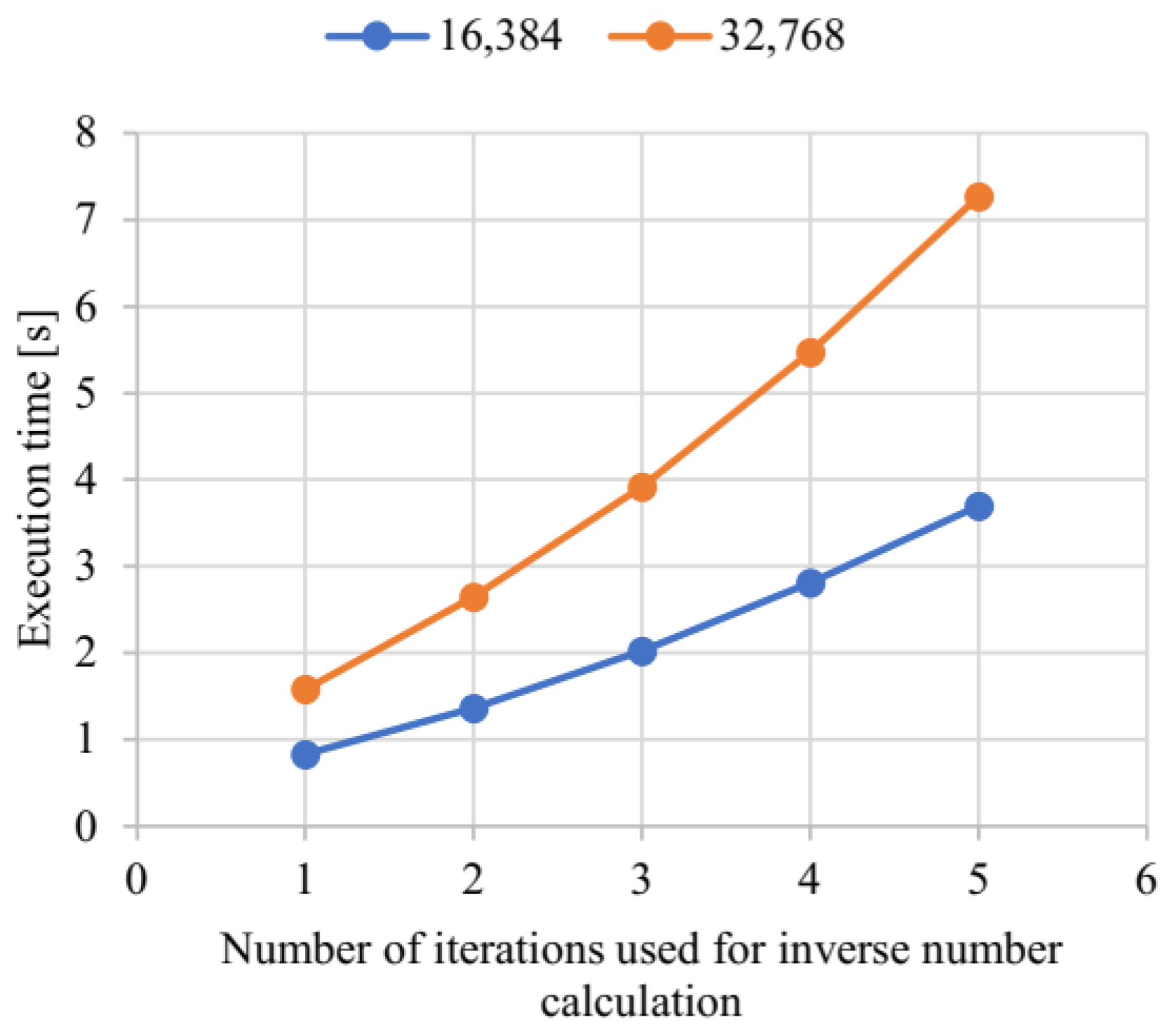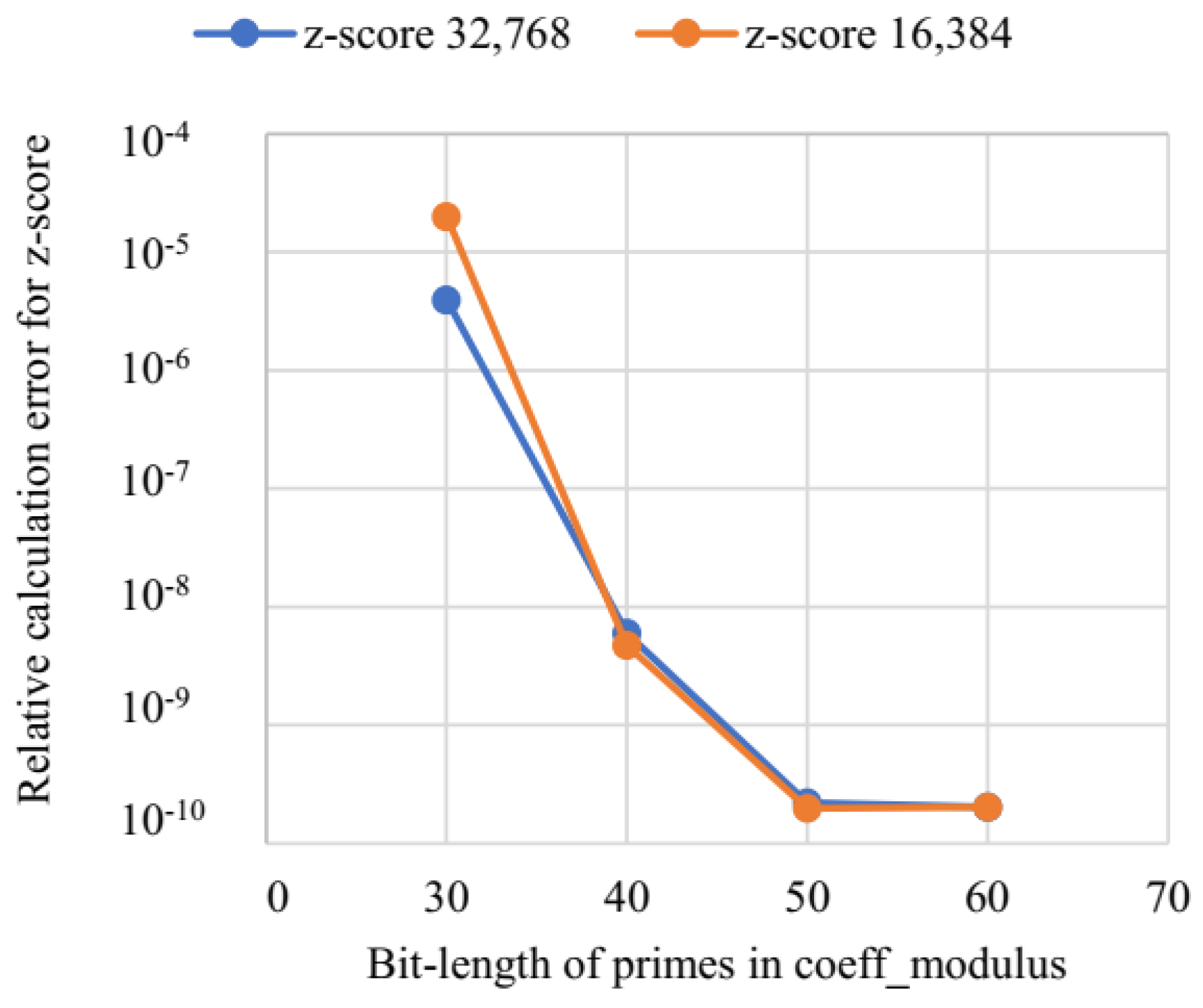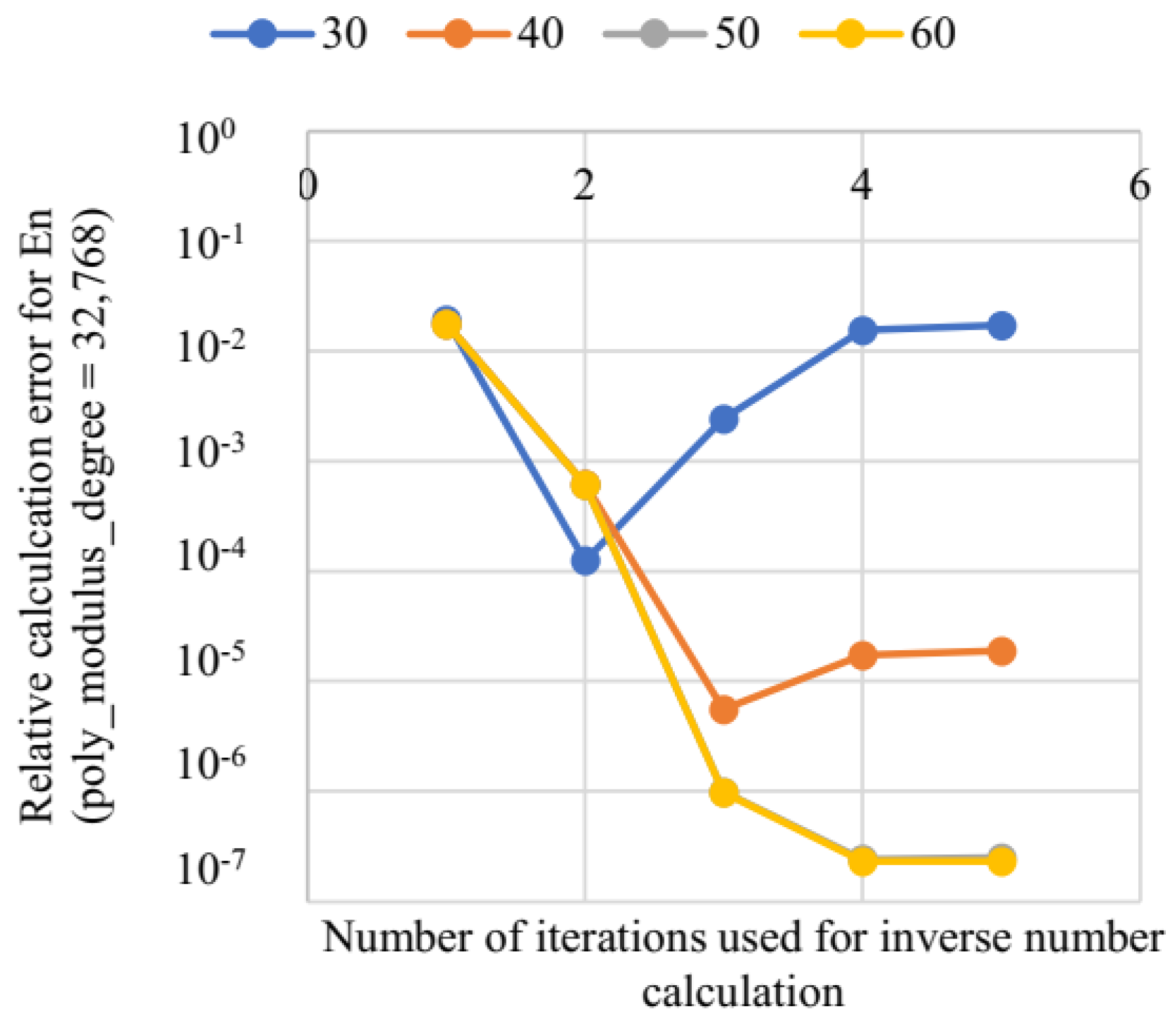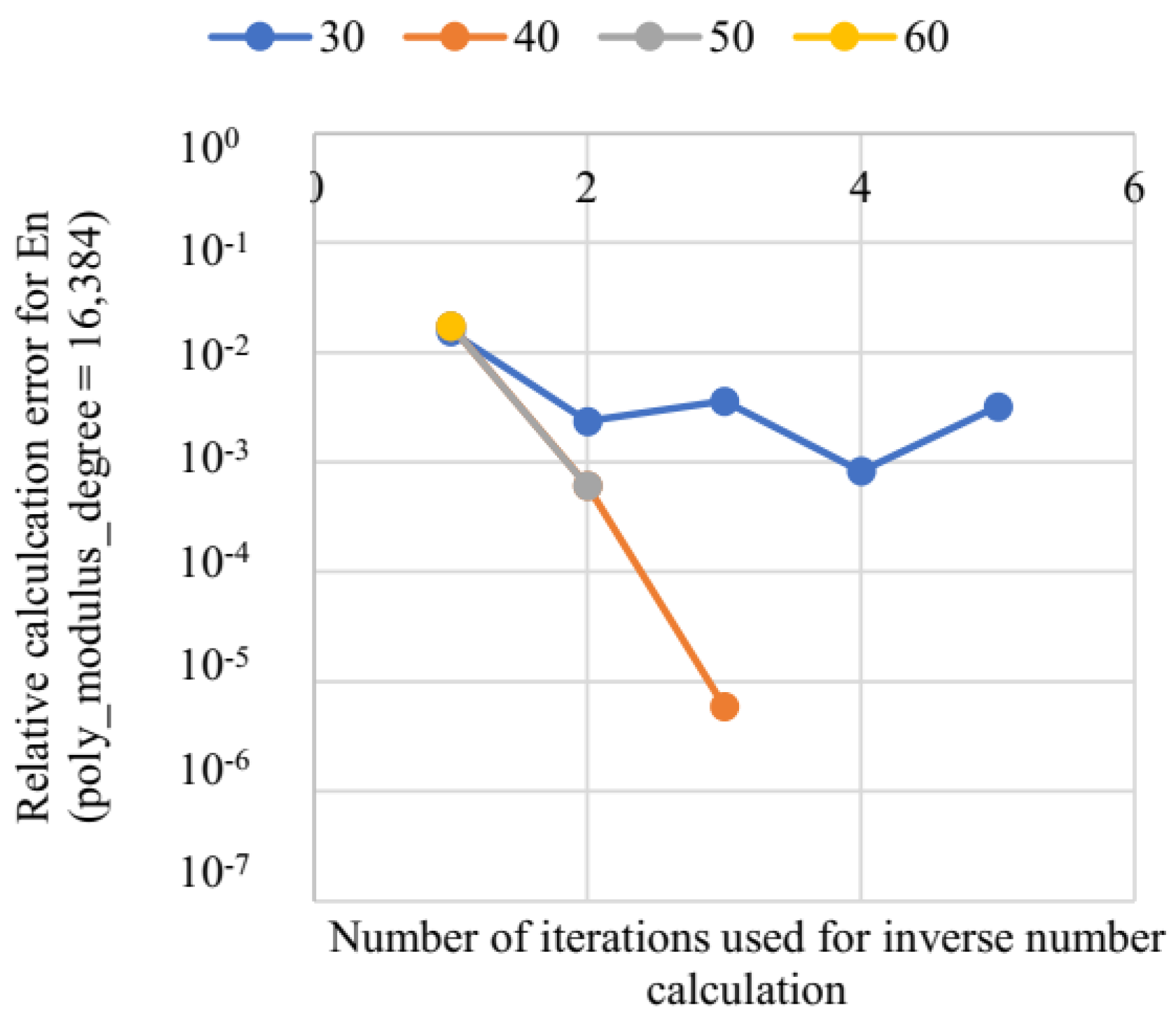
Application of Homomorphic Encryption for a Secure-by-Design Approach to Protect the Confidentiality of Data in Proficiency Testing and Interlaboratory Comparisons


Abstract
1. Introduction
- -
- Laboratories may be reluctant to share plaintext measured values that could reveal to competitors their methodological or technological advantages;
- -
- Sharing plaintext data could inadvertently expose sensitive information, in sectors governed by strict data protection regulations;
- -
- Laboratories handling client-specific samples must ensure that data shared during PT or ILCs do not compromise client confidentiality, especially when results are linked to identifiable client information;
- -
- Laboratories might be concerned that sharing plaintext data could be misused or used in ways beyond the intended scope of quality assessment, leading to biased assessments.
- (1)
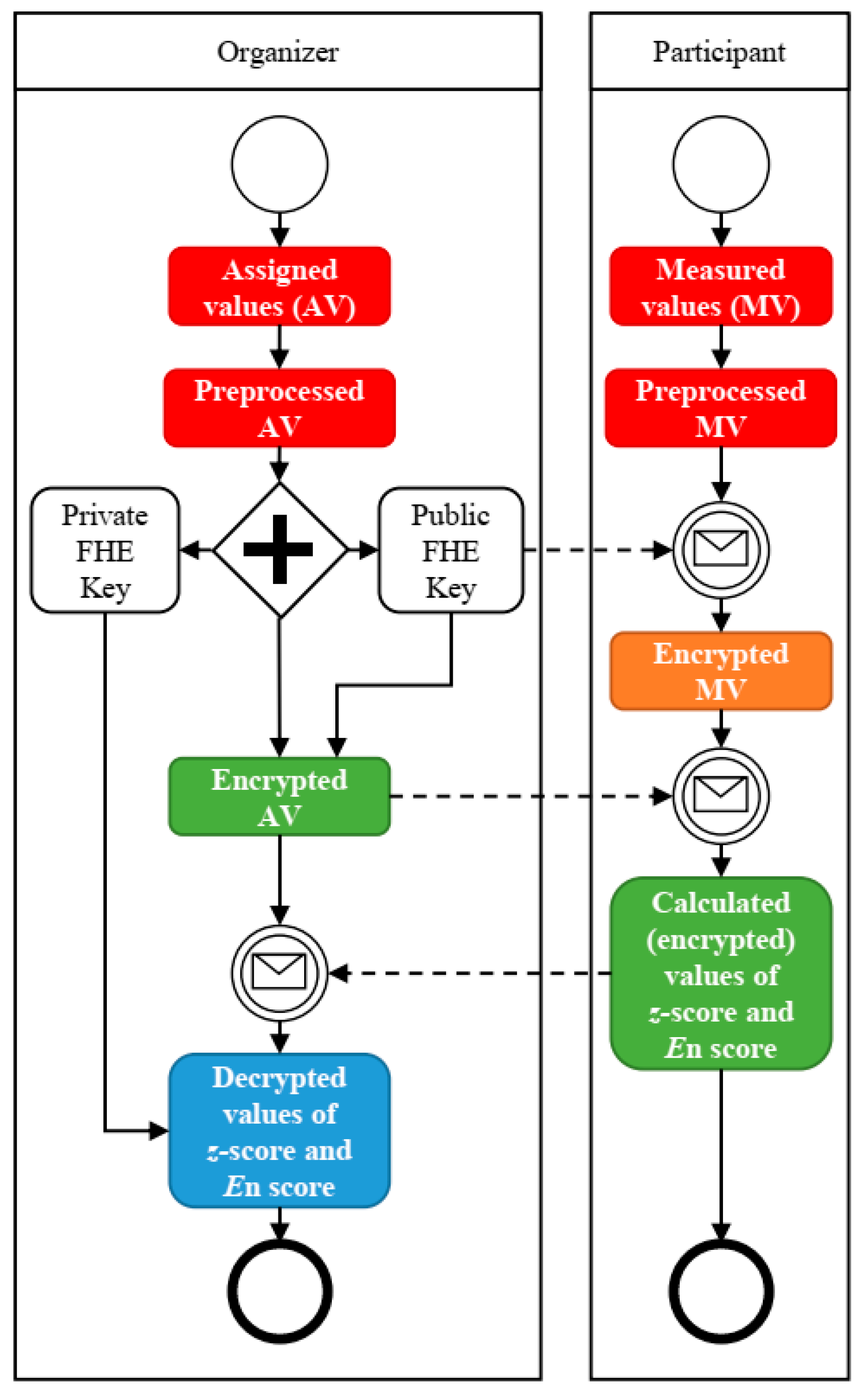
- A secure-by-design PT/ILC workflow that preserves the confidentiality of participants’ measurement data while still enabling the organizer to obtain required performance metrics.
- (2)
- A computation-efficient homomorphic formulation of z-score and En score based on plaintext pre-/post-processing plus ciphertext arithmetic, including a Newton–Raphson-based encrypted inversion to implement division without bootstrapping.
- (3)
- A reference implementation in Microsoft SEAL (CKKS) together with an evaluation of practical feasibility, reporting runtime, coefficient of variation across fresh key generations, and relative scoring error as a function of CKKS parameter choices.
2. Proposed Solution for ILC/PT Using Fully Homomorphic Encryption
2.1. Solution Overview
2.2. Key Management and Threat Model
2.3. Data Processing and Homomorphic Calculations
- -
- Measured values xMV1 … xMVm;
- -
- Measurement uncertainty of type B for measured values UB_MV;
- -
- Assigned values xAV1 … xAVn;
- -
- Measurement uncertainty of type B for assigned values UB_AV;
- -
- Expansion factor k.
2.4. Newton–Raphson Method for Homomorphic Division
3. Implementation and Verification
3.1. Implementation Specifics of SEAL Library
3.2. Testing and Verification Results
4. Conclusions
Author Contributions
Funding
Data Availability Statement
Conflicts of Interest
Abbreviations
| ILC | Interlaboratory Comparison |
| PT | Proficiency Testing |
| FHE | Fully Homomorphic Encryption |
| SEAL | Simple Encrypted Arithmetic Library |
| BGV | Brakerski–Gentry–Vaikuntanathan |
| CKKS | Cheon–Kim–Kim–Song |
| LWE | Learning With Errors |
References
- ISO/IEC 17025:2017; General Requirements for the Competence of Testing and Calibration Laboratories. ISO/CASCO: Geneva, Switzerland, 2017.
- ISO/IEC 17043:2010; Conformity Assessment—General Requirements for Proficiency Testing. ISO/CASCO: Geneva, Switzerland, 2010.
- EA-4/21 INF:2018; Guidelines for the Assessment of the Appropriateness of Small Interlaboratory Comparisons Within the Process of Laboratory Accreditation. European Accreditation: Paris, France, 2018.
- ISO 13528:2022; Statistical Methods for Use in Proficiency Testing by Interlaboratory Comparison. International Organization for Standardization: Geneva, Switzerland, 2022.
- Analytical Methods Committee. z-Scores and other scores in chemical proficiency testing—Their meanings, and some common misconceptions. Anal. Methods 2016, 8, 5553–5555. [Google Scholar] [CrossRef] [PubMed]
- Frahm, E.; Wright, J. Evaluation of Inter-Laboratory Comparison Results: Representative Examples. Measurement 2023, 223, 113723. [Google Scholar] [CrossRef]
- Frahm, E.; Wright, J. Evaluation of Inter-Laboratory Comparison Data. In Proceedings of the FLOMEKO 2022, Chongqing, China, 1–4 November 2022; Available online: https://tsapps.nist.gov/publication/get_pdf.cfm?pub_id=934985 (accessed on 8 January 2026).
- Naumovic-Vukovic, D.; Skundric, S.; Cukman, M.; Ivanovic, D.; Novko, I.; Bonic, M. Regional Interlaboratory Comparison of Measuring Systems for Current Transformers Accuracy Testing. In Proceedings of the 25th IMEKO TC4 International Symposium 23rd International Workshop on ADC and DAC Modelling and Testing IMEKO TC-4 2022, Brescia, Italy, 12–14 September 2022. [Google Scholar]
- Gentry, C. Fully Homomorphic Encryption Using Ideal Lattices. In Proceedings of the 41st Annual ACM Symposium on Theory of Computing, Bethesda, MD, USA, 31 May–2 June 2009; pp. 169–178. [Google Scholar]
- Brakerski, Z.; Gentry, C.; Vaikuntanathan, V. Fully Homomorphic Encryption Without Bootstrapping. Cryptology ePrint Archive, Paper 2011/277. Available online: https://eprint.iacr.org/2011/277 (accessed on 1 December 2025).
- Cheon, J.H.; Kim, A.; Kim, M.; Song, Y. Homomorphic Encryption for Arithmetic of Approximate Numbers. Cryptology ePrint Archive, Paper 2016/421. Available online: https://eprint.iacr.org/2016/421 (accessed on 1 December 2025).
- Lam, K.-Y.; Lu, X.; Zhang, L.; Wang, X.; Wang, H.; Goh, S.Q. Efficient FHE-Based Privacy-Enhanced Neural Network for Trustworthy AI-as-a-Service. IEEE Trans. Dependable Secur. Comput. 2024, 21, 4451–4468. [Google Scholar] [CrossRef]
- Lee, J.W.; Kang, H.; Lee, Y.; Choi, W.; Eom, J.; Deryabin, M.; Lee, E.; Lee, J.; Yoo, D.; Kim, Y.-S.; et al. Privacy-Preserving Machine Learning with Fully Homomorphic Encryption for Deep Neural Network. IEEE Access 2022, 10, 30039–30054. [Google Scholar] [CrossRef]
- Dumbere, D.M.; Ambhaikar, A. AELGA-FHE: An Augmented Ensemble Learning Based Genetic Algorithm Model for Efficient High Density Fully Homomorphic Encryption. In Proceedings of the 2022 2nd International Conference on Intelligent Technologies (CONIT), Hubli, India, 24–26 June 2022; pp. 1–8. [Google Scholar] [CrossRef]
- Sinha, S.; Saha, S.; Alam, M.; Agarwal, V.; Chatterjee, A.; Mishra, A.; Khazanchi, D.; Mukhopadhyay, D. Exploring Bitslicing Architectures for Enabling FHE-Assisted Machine Learning. IEEE Trans. Comput.-Aided Des. Integr. Circuits Syst. 2022, 41, 4004–4015. [Google Scholar] [CrossRef]
- Hosseingholizadeh, A.; Rahmati, F.; Ali, M.; Damadi, H.; Liu, X. Privacy-Preserving Joint Data and Function Homomorphic Encryption for Cloud Software Services. IEEE Internet Things J. 2024, 11, 728–741. [Google Scholar] [CrossRef]
- Jastaniah, K.; Zhang, N.; Mustafa, M.A. Efficient Privacy-Friendly and Flexible Wearable Data Processing with User-Centric Access Control. IEEE Access 2024, 12, 37012–37029. [Google Scholar] [CrossRef]
- Behera, S.; Prathuri, J.R. Design of Novel Hardware Architecture for Fully Homomorphic Encryption Algorithms in FPGA for Real-Time Data in Cloud Computing. IEEE Access 2022, 10, 131406–131418. [Google Scholar] [CrossRef]
- Chen, L.; Mu, Y.; Zeng, L.; Rezaeibagha, F.; Deng, R.H. Authenticable Data Analytics Over Encrypted Data in the Cloud. IEEE Trans. Inf. Forensics Secur. 2023, 18, 1800–1813. [Google Scholar] [CrossRef]
- Song, W.T.; Zhang, W.; Tang, D.; Hu, B. A Small-Size FHE Scheme for Better Privacy Protection of IoT. IEEE Internet Things J. 2024, 11, 12909–12917. [Google Scholar] [CrossRef]
- Jiang, L.; Chen, L.; Giannetsos, T.; Luo, B.; Liang, K.; Han, J. Toward Practical Privacy-Preserving Processing Over Encrypted Data in IoT: An Assistive Healthcare Use Case. IEEE Internet Things J. 2019, 6, 10177–10190. [Google Scholar] [CrossRef]
- Zhang, L.; Wang, X.; Wang, J.; Pung, R.; Wang, H.; Lam, K.Y. An Efficient FHE-Enabled Secure Cloud–Edge Computing Architecture for IoMT Data Protection With its Application to Pandemic Modeling. IEEE Internet Things J. 2024, 11, 15272–15284. [Google Scholar] [CrossRef]
- Chase, M.; Chen, H.; Ding, J.; Goldwasser, S.; Gorbunov, S.; Hoffstein, J.; Lauter, K.; Lokam, S.; Moody, D.; Morrison, T.; et al. Security of Homomorphic Encryption. Available online: https://www.microsoft.com/en-us/research/wp-content/uploads/2018/01/security_homomorphic_encryption_white_paper.pdf (accessed on 1 December 2025).
- Prantl, T.; Horn, L.; Engel, S.; Iffländer, L.; Beierlieb, L.; Krupitzer, C.; Bauer, A.; Sakarvadia, M.; Foster, I.; Kounev, S. De Bello Homomorphico: Investigation of the extensibility of the OpenFHE library with basic mathematical functions by means of common approaches using the example of the CKKS cryptosystem. Int. J. Inf. Secur. 2024, 23, 1149–1169. [Google Scholar] [CrossRef]
- Froelicher, D.; Troncoso-Pastoriza, J.R.; Raisaro, J.L.; Cuendet, M.A.; Sousa, J.S.; Cho, H.; Berger, B.; Fellay, J.; Hubaux, J.-P. Truly privacy-preserving federated analytics for precision medicine with multiparty homomorphic encryption. Nat. Commun. 2021, 12, 5910. [Google Scholar] [CrossRef] [PubMed]
- Kholod, A.; Polyakov, Z.; Schlottke-Lakemper, M. Secure numerical simulations using fully homomorphic encryption. Comput. Phys. Commun. 2026, 318, 109868. [Google Scholar] [CrossRef]
- Microsoft SEAL. Available online: https://github.com/microsoft/SEAL (accessed on 28 October 2025).
- Wang, Z.; Cheung, S.C.S.; Luo, Y. Information-Theoretic Secure Multi-Party Computation with Collusion Deterrence. IEEE Trans. Inf. Forensics Secur. 2017, 12, 980–995. [Google Scholar] [CrossRef]
- Tian, N.; Guo, Q.; Sun, H.; Zhou, X. Fully privacy-preserving distributed optimization in power systems based on secret sharing. iEnergy 2022, 1, 351–362. [Google Scholar] [CrossRef]
- Kunz, K. Numerical Analysis; McGraw-Hill: New York, NY, USA, 1957; pp. 14–15. [Google Scholar]

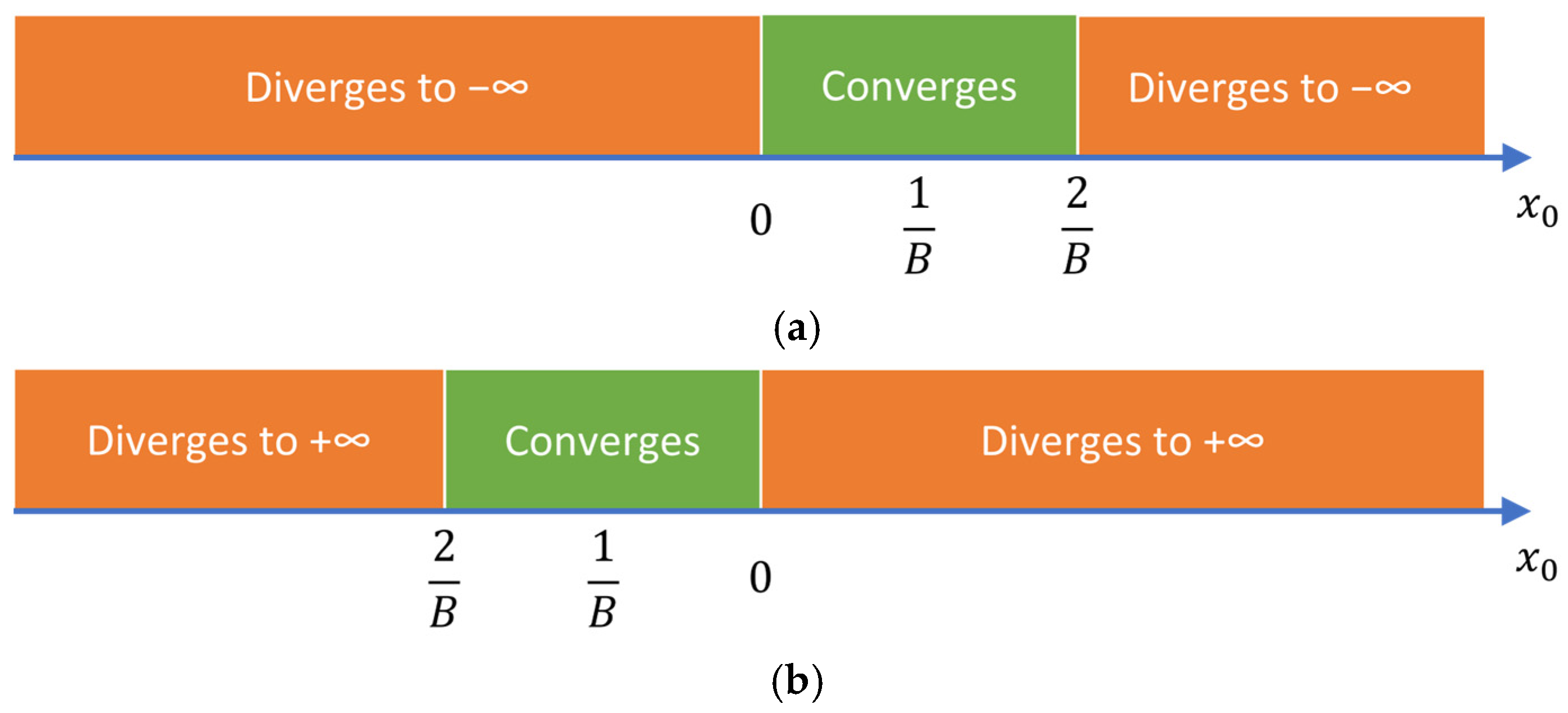
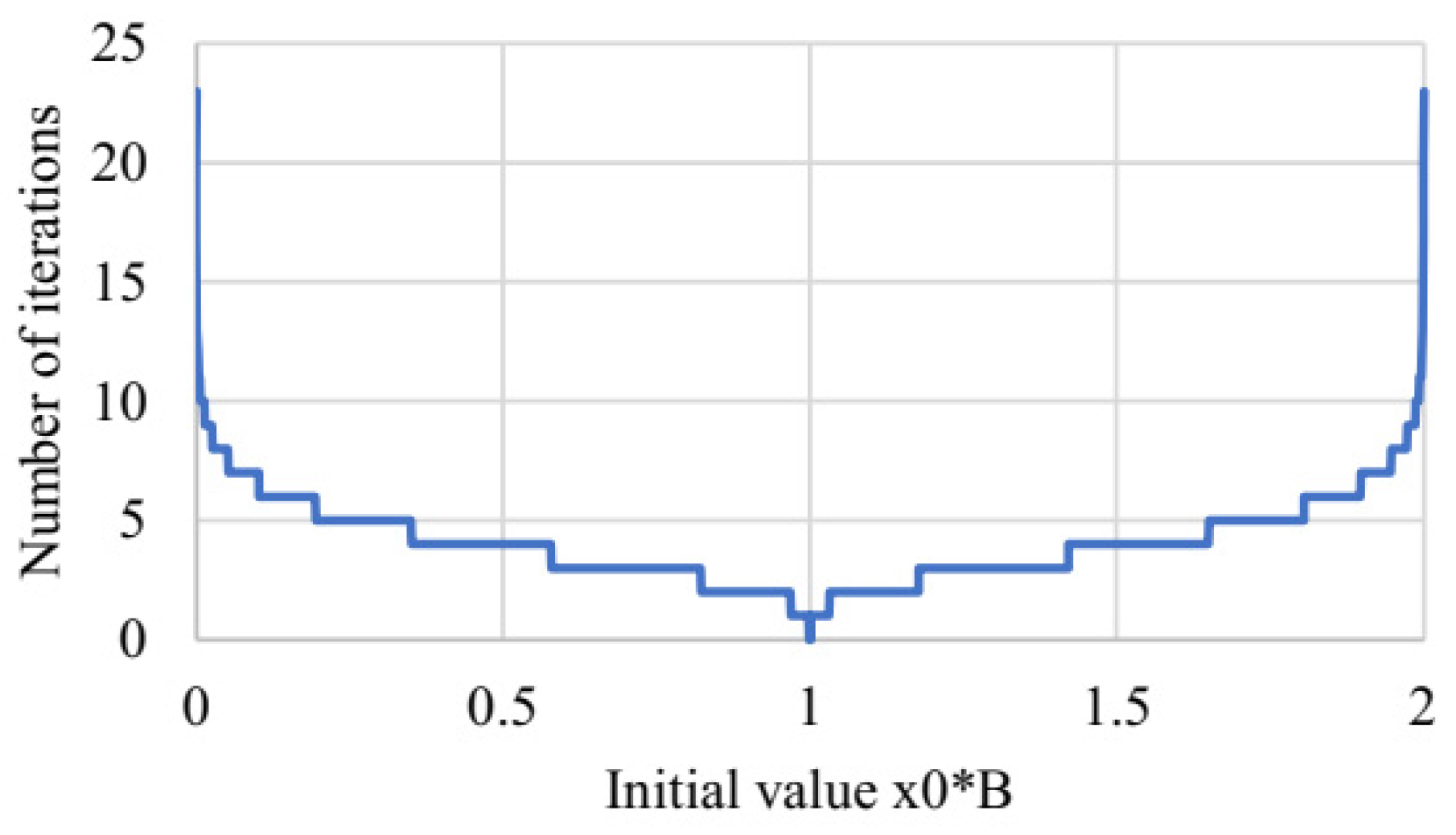


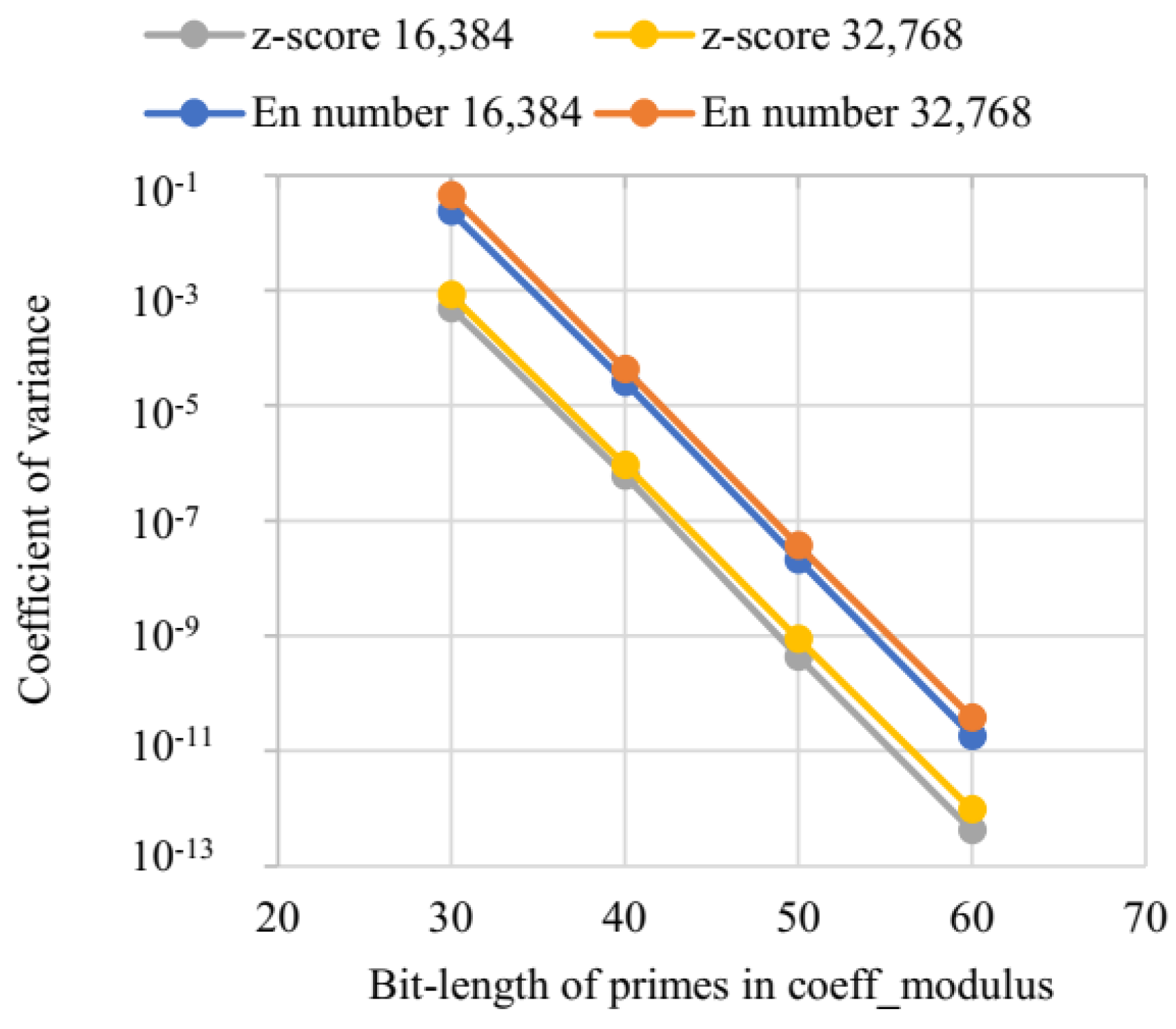



| For Positive Number B | For Negative Number B | ||
|---|---|---|---|
| Initial Value Range | Result | Initial Value Range | Result |
| (−∞ to 0) | diverges to −∞ | (−∞ to 2/B) | diverges to +∞ |
| 0 | 0 | 2/B | 0 |
| (0 to 2/B) | converges to 1/B | (2/B to 0) | converges to 1/B |
| 2/B | 0 | 0 | 0 |
| (2/B to +∞) | diverges to −∞ | (0 to +∞) | diverges to +∞ |
| Poly_ Modulus_ Degree | Max Bit-Length of Coeff_ Modulus | Chosen Coeff_Modulus | Chosen Bit-Length of Coeff_ Modulus |
|---|---|---|---|
| 2048 | 54 | 5, 5, 5, 5, 5, 5, 5, 5, 5, 5 | 50 |
| 4096 | 109 | 10, 10, 10, 10, 10, 10, 10, 10, 10, 10 | 100 |
| 8192 | 218 | 20, 20, 20, 20, 20, 20, 20, 20, 20, 20 | 200 |
| 16,384 | 438 | 40, 40, 40, 40, 40, 40, 40, 40, 40, 40 | 400 |
| 32,768 | 881 | 60, 60, 60, 60, 60, 60, 60, 60, 60, 60 | 600 |
Disclaimer/Publisher’s Note: The statements, opinions and data contained in all publications are solely those of the individual author(s) and contributor(s) and not of MDPI and/or the editor(s). MDPI and/or the editor(s) disclaim responsibility for any injury to people or property resulting from any ideas, methods, instructions or products referred to in the content. |
© 2026 by the authors. Licensee MDPI, Basel, Switzerland. This article is an open access article distributed under the terms and conditions of the Creative Commons Attribution (CC BY) license.
Share and Cite
Vinko, D.; Köhler, M.; Miličević, K.; Lukić, I. Application of Homomorphic Encryption for a Secure-by-Design Approach to Protect the Confidentiality of Data in Proficiency Testing and Interlaboratory Comparisons. Telecom 2026, 7, 14. https://doi.org/10.3390/telecom7010014
Vinko D, Köhler M, Miličević K, Lukić I. Application of Homomorphic Encryption for a Secure-by-Design Approach to Protect the Confidentiality of Data in Proficiency Testing and Interlaboratory Comparisons. Telecom. 2026; 7(1):14. https://doi.org/10.3390/telecom7010014
Chicago/Turabian StyleVinko, Davor, Mirko Köhler, Kruno Miličević, and Ivica Lukić. 2026. "Application of Homomorphic Encryption for a Secure-by-Design Approach to Protect the Confidentiality of Data in Proficiency Testing and Interlaboratory Comparisons" Telecom 7, no. 1: 14. https://doi.org/10.3390/telecom7010014
APA StyleVinko, D., Köhler, M., Miličević, K., & Lukić, I. (2026). Application of Homomorphic Encryption for a Secure-by-Design Approach to Protect the Confidentiality of Data in Proficiency Testing and Interlaboratory Comparisons. Telecom, 7(1), 14. https://doi.org/10.3390/telecom7010014