1. Introduction
Diabetes is one of the most significant public health challenges, affecting millions of people worldwide. By 2040, the number of cases is projected to exceed 642 million. In Europe, the International Diabetes Federation (IDF) projects that the number of adults with diabetes will rise to 69 million by 2045 [
1]. According to the World Health Organization’s (WHO) 2016 Diabetes Country Profile for Romania, there has been a slight increase in cases, particularly among men [
2]. The prevalence of diabetes was reported at 8.5% in males and 8.4% in females. Key risk factors for diabetes include overweight (60.8%), obesity (23.4%), and physical inactivity (26.5%) [
2].
In this context, disturbance of glucose metabolism, including newly diagnosed diabetes or dysglycemia, have been reported following hospitalization for other viral infections or acute illnesses. Numerous studies have reported cases of newly diagnosed diabetes, classified as either type 1 or type 2 diabetes, or COVID-19-associated hyperglycemia. A study from London, U.K., examined 30 children aged 23 months to 16.8 years with new-onset type 1 diabetes. Among them, 15% had a positive COVID-19 test. The study suggested a possible association between SARS-CoV-2 exposure and the increased number of cases, potentially accelerating the clinical presentation of type 1 diabetes [
3].
From a clinical perspective, a study from Wuhan, China, from October 2020, patients with new-onset diabetes had a higher admission rate to the intensive care unit. These patients required invasive mechanical ventilation and experienced acute kidney injury [
4]. Additionally, they had longer hospital stays. The study also reported that elevated blood glucose levels at hospital admission in individuals with new-onset diabetes were associated with an increased risk of all-cause mortality [
4].
It remains unclear whether newly diagnosed diabetes associated with COVID-19 is type 1, type 2, or another subtype. The angiotensin-converting enzyme 2 (ACE2) receptor, known as the binding site for SARS-CoV-2, is highly expressed in pancreatic endocrine cells [
5]. These observations have raised hypotheses regarding altered glucose metabolism, although limited research exists on islet cell antibodies in individuals with new-onset diabetes, making it difficult to determine the exact mechanism by which SARS-CoV-2 may trigger diabetes [
6].
A retrospective single-center medical-recorded review from Alabama evaluated the new-onset diabetes cases from March 2017 to March 2021. During this period, a total of 642 new cases of diabetes were identified. The study observed a significant increase in new-onset type 2 diabetes among Alabama’s young population during the COVID-19 pandemic, highlighting associations rather than causal inference [
7].
The last report from the National Center for Nontransmissible Diseases Control and Prevention (CNSCBT) in Romania on SARS-CoV-2 infections stated that 1.813.823 COVID-19 cases and 58.971 deaths (fatality rate: 3.3%) were recorded in 2020 and 2021 [
8]. In Romania, in 2021, 800.000 diabetes cases were estimated, mostly type 2, with some reports describing an overlap between SARS-CoV-2 infection and newly detected glycemic abnormalities [
9]. Some studies showed that COVID-19 can trigger acute hyperglycemic emergencies, such as diabetic ketoacidosis (DKA) and hyperosmolar hyperglycemic state (HHS), in individuals with newly diagnosed or previously unrecognized diabetes [
10].
Therefore, this study aims to describe newly detected dysglycemia and its associated clinical and therapeutic factors in hospitalized COVID-19 patients without prior diabetes.
2. Materials and Methods
2.1. Study Design and Setting
We collected retrospective COVID-19, register-based data from the Pneumophtisiology Hospital “Leon Daniello” in Cluj-Napoca, Cluj County, Romania. From March 2020 to March 2022, a total of 562 patients, hospitalized during the pandemic COVID-19 peak months, were included in the database. The study population included individuals hospitalized for COVID-19 who did not have a documented diagnosis of type 2 diabetes mellitus prior to admission. Given that HbA1c levels were not available prior to or during hospitalization, the presence of pre-existing diabetes could not be definitively excluded.
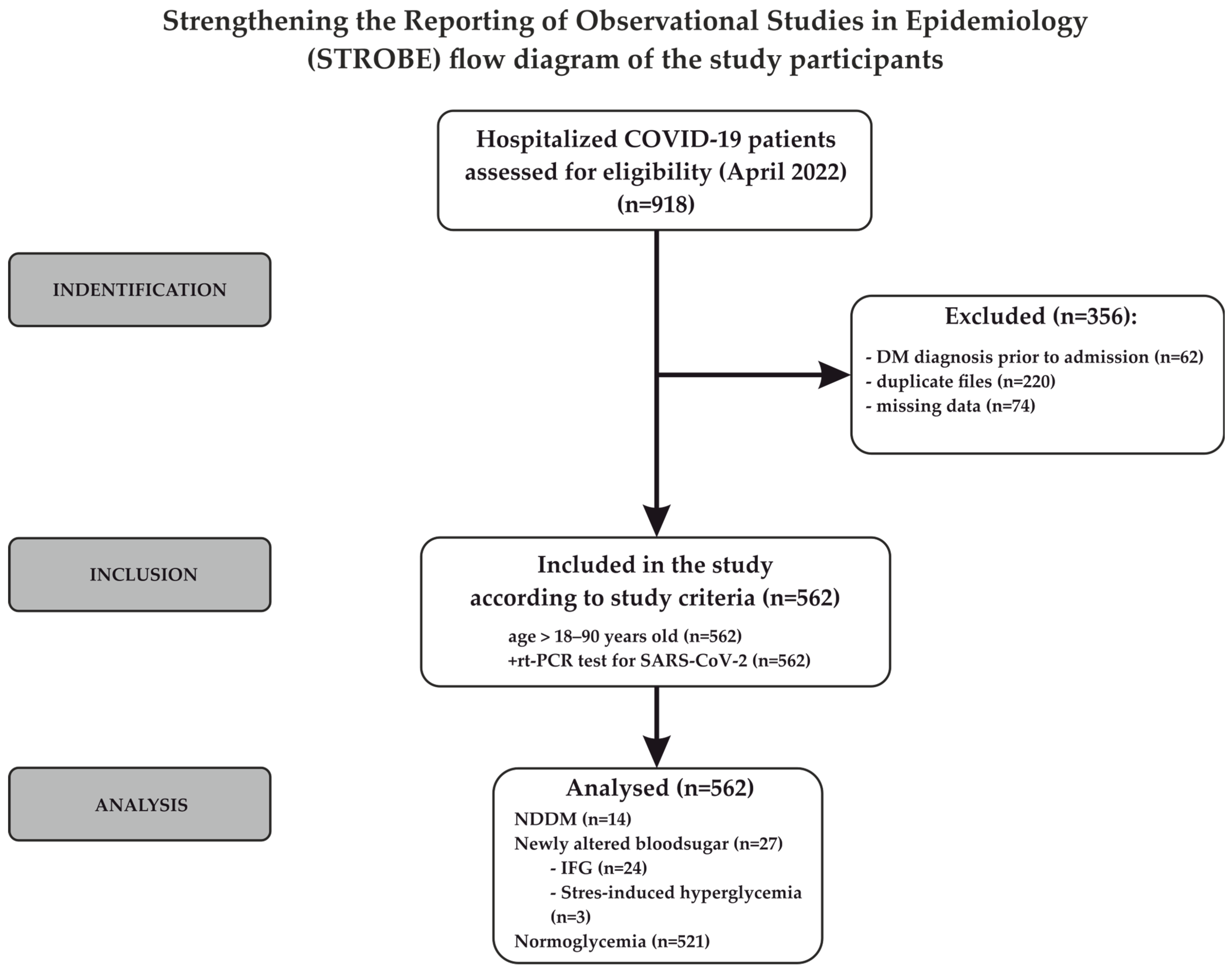
No formal sample size calculation was performed, as the study included all eligible patients identified from the hospital registry. A total of 918 patients were initially identified. After applying predefined exclusion criteria (previous diagnosis of diabetes mellitus, duplicate records, and incomplete clinical or laboratory data), 562 patients were included in the final analysis. The selection of study participants is illustrated in the STROBE flow diagram, created using CorelDRAW (Version 24.0.0.301, 2021) (
Figure 1). The reporting method used in this study adhered to the Strengthening the Reporting of Observational Studies in Epidemiology (STROBE) checklist [
11]. The completed STROBE checklist is provided as a
Supplementary Material.
2.2. Participants
The study group included both male and female participants, with a slightly higher proportion of men. Most of the participants were from urban areas. Comorbidities were frequently observed, including cardiovascular conditions, pulmonary diseases, dyslipidemia, hepatic disorders, gastrointestinal diseases, neurological conditions, endocrine disorders, renal disease, and neoplasia. COVID-19 treatment included antiviral agents, such as remdesivir and favipiravir, hydroxychloroquine, and azithromycin; systemic corticosteroids (dexamethasone); and immunomodulatory therapy with tocilizumab. Anticoagulant treatment was also part of the management approach.
The subject’s selection was based on specific eligibility criteria. The inclusion criteria were: age between 18 and 90 years and having a positive rt-PCR test for SARS-CoV-2. No minors were included in the study. The exclusion criteria were: patients who had a diagnosis of diabetes mellitus prior to hospital admission. Also, duplicate files or patients with many missing data were excluded from the research.
The patients were divided into two groups: those with newly diagnosed diabetes mellitus (NDDM) and those with newly altered blood glucose levels. Group allocation was based exclusively on in-hospital plasma glucose measurements. Accordingly, diagnoses of newly diagnosed diabetes or newly altered blood glucose were established during hospitalization based on these measurements.
2.3. Data Collection and Variables
Data were collected from electronic health records and patient files. All data were anonymized prior to analysis to ensure patient confidentiality. Patients were identified by the serial number of their medical records. The data were recorded in a secure digital database using Microsoft Excel, with access limited exclusively to the research team. Routine quality control procedures were implemented to ensure data accuracy and completeness.
For each subject, both qualitative and quantitative variables were recorded. These included individual characteristics such sociodemographic data and comorbidities. Clinical data comprised symptoms and vital signs at admission and during hospitalization. Information regarding investigations and COVID-19 treatment was also collected. Associations involving in-hospital treatments were analyzed descriptively and interpreted as observational, without causal inference, given their potential dependence on disease severity and timing during hospitalization. Laboratory data were recorded at admission and during hospitalization. Discharge data included the diagnosis (newly diagnosed diabetes, newly altered blood sugar) and discharge status (cured, improved, stationary, aggravated, deceased). Laboratory parameters were categorized as low, normal, or high based on institutional reference ranges used in routine clinical practice at the study hospital. These reference intervals were applied uniformly for all patients and were consistent with commonly accepted clinical laboratory standards. The exact reference values used to define the normal range for each laboratory parameter are provided in the corresponding table footnotes. Due to the retrospective nature of the study, detailed information on the manufacturers of reagents, kits, and instruments was not available from the recorded data.
2.4. Glycemic Classification and Diagnostic Criteria
Glycemic status was assessed using plasma glucose measurements obtained during hospitalization. Blood glucose levels were measured at admission and repeatedly during hospital stay as part of routine clinical care. Newly diagnosed diabetes mellitus was defined according to internationally accepted American Diabetes Association (ADA) criteria [
12] (
Table 1).
Within the newly altered blood sugar group, among the 27 identified patients, 3 were discharged with a diagnosis of hyperglycemia, while 24 were discharged with a diagnosis of impaired fasting glucose (IFG). IFG was defined according to ADA criteria as fasting plasma glucose levels in the range of 100–125 mg/dL (5.6–6.9 mmol/L). Hyperglycemia was used as a descriptive discharge diagnosis reflecting elevated plasma glucose values during acute illness, likely related to stress-induced hyperglycemia and the use of corticosteroid therapy during COVID-19 hospitalization.
Glycemic classification was confirmed at discharge based on the overall glycemic profile during hospitalization. HbA1c measurements were not available in this retrospective dataset; therefore, classification relied exclusively on in-hospital plasma glucose values.
Patients discharged with newly altered blood sugar levels were referred for post-hospitalization follow-up by diabetologists, where ongoing clinical evaluation and repeat, and glycemic testing were planned to assess the persistence or resolution of glycemic abnormalities. This approach acknowledges that dysglycemia identified during acute COVID-19 illness may reflect stress-related or treatment-associated hyperglycemia rather than established diabetes.
2.5. Statistical Analysis
Statistical analysis was performed using the Med Calc
® Statistical Software version 23.1.6 (Med Calc Software Ltd., Ostend, Belgium;
https://www.medcalc.org; accessed on 10 January 2026). Descriptive and inferential analyses were performed to address the study’s research questions regarding the association among hyperglycemia, newly diagnosed diabetes, and SARS-CoV-2 infection. Continuous variables were summarized using median and interquartile range (non-normal distribution in the Shapiro–Wilk test). Categorical were described using frequencies and percentages. Comparisons between groups regarding qualitative variables were performed using chi-squared test when its assumptions were met, or Fisher’s exact test when appropriate. Comparisons between groups regarding quantitative variables were performed using Mann–Whitney test. A
p-value < 0.05 was considered statistically significant for all the tests described. For categorical variables, odds ratios (ORs) with 95% confidence intervals (95%CIs) were calculated as unadjusted effect size estimates.
Given the retrospective design and limited number of events, no adjustment for disease severity was performed. Analyses were performed separately for mutually exclusive glycemic subgroups (newly diagnosed diabetes mellitus and newly altered blood sugar). As a result, the number of patients included in specific analyses varies according to the predefined subgroup considered, while the overall cohort size remains unchanged; this variation does not reflect missing data.
2.6. Ethical Consideration
The study protocol was approved by the Ethics Review Board (AVZ90, Approval Date: 13 April 2022) of UMF Iuliu Hatieganu Cluj-Napoca, and was conducted according to the guidelines of the Declaration of Helsinki. All patients or their legal representatives were informed upon admission that medical data may be used for research purposes, in accordance with institutional and national regulations. Given the retrospective, register-based data of the study, informed consent was waived where applicable. Personal data confidentiality was respected by anonymizing it within the study.
4. Discussion
This study explores the association between COVID-19, newly altered blood sugar, and newly diagnosed diabetes. Additionally, we highlight various sociodemographic and medical factors that may precipitate glycemic changes. In our cohort, remdesivir and favipiravir use was observationally associated with elevated glucose levels. However, this association may reflect confounding by indication, as remdesivir was more frequently administered to patients with more severe disease, who are themselves at increased risk of stress-related hyperglycemia. Therefore, these findings should be interpreted as associative rather than causal.
The medical literature suggests that viral infections or other acute illnesses can be temporally associated with the onset of diabetes mellitus. Studies indicate that SARS-CoV-2 infection may be linked to alteration in pancreatic function, insulin resistance, and glucose metabolism, thereby being associated with the risk of developing diabetes or experiencing glycemic changes [
13].
About newly altered blood glucose levels group, statistically significant associations were found with comorbidities such as dyslipidemia and neurological diseases. In a study that evaluated the relationship between newly diagnosed diabetes, hyperglycemia, the atherogenic index, and obesity in post-COVID-19 syndrome, researchers identified a potential interplay between metabolic dysfunction and the emergence of post-COVID-19 glycemic disturbances [
14].
In the newly diagnosed diabetes group, diarrhea had the most statistically significant difference. Additionally, dyspnea at admission was significantly associated with newly altered blood sugar. Patients from both groups had a higher need for oxygen therapy. In a retrospective study, analyzing symptoms at the time of COVID-19 first hospitalization, dry cough, fever, and dyspnea were the most commonly observed symptoms [
15]. Another cross-sectional study supports our findings, highlighting diarrhea and dyspnea as possible onset symptoms in newly diagnosed diabetes, emphasizing the importance of monitoring both respiratory and gastrointestinal symptoms [
16]. These findings align with previous research indicating that newly diagnosed diabetes and hyperglycemia at hospital admission are associated with rapid respiratory decline in patients with COVID-19 [
17].
Patients with newly diagnosed diabetes who experienced a more severe form of COVID-19 required treatment with corticosteroids and remdesivir, presented with elevated procalcitonin levels upon admission, and showed increased levels of both C-reactive protein and procalcitonin on follow-up evaluations. Several studies in the literature have described an observational association between remdesivir administration and increased glucose levels [
18,
19,
20]. However, these findings are not in agreement with a Japanese case report, which describes remdesivir-induced hypoglycemia in an elderly man without a prior diagnosis of diabetes [
21].
Our findings suggest that, across both groups, the administration of corticosteroids may be associated with increased blood sugar levels. Favipiravir and anticoagulants may influence glycemic fluctuations observed during hospitalization in newly diagnosed diabetes group. It is known that glucocorticoid therapy can be accompanied by hyperglycemia or steroid-induced diabetes mellitus [
22,
23,
24]. Regarding favipiravir treatment, these finding contrasts with the results of a retrospective study that aimed to determine the adverse effects of favipiravir administration in COVID-19 patients. In that study, the side effects of favipiravir included elevated transaminases, gastrointestinal symptoms, high blood sugar, and thrombocytopenia. The distribution of adverse effects for the high blood sugar level was only 5% [
25]. Meanwhile, other studies highlight the association between favipiravir and theophylline, which may be related to increased blood sugar levels [
26].
Furthermore, we found an association between elevated D-dimer values upon admission and newly altered blood glucose levels. Laboratory tests showed elevated levels of some inflammatory markers, such as procalcitonin, at admission and during hospitalization, and CRP during hospitalization. These findings emphasize the importance of considering the severity of the SARS-CoV-2 infection and its association with the risk of glycemic disturbances, including the onset of newly diagnosed diabetes. Inflammatory markers such as CRP appear to be more commonly encountered in COVID-19 infection in NDDM (newly diagnosed diabetes mellitus) [
5].
Moreover, we found a statistically significant difference between the groups in terms of hospitalization days. Data from our study showed that most of the patients from both, newly diagnosed group and newly altered blood sugar, are older, with a statistically significant difference between the groups in terms of hospitalization days for the newly altered blood sugar group. A review on the medical factors influencing COVID-19 severity noted that diabetes is associated with worse outcomes in COVID-19 patients, resulting in increased hospitalization and higher rates of ICU admissions. This highlights the vulnerability of diabetic patients in the face of COVID-19 [
17,
27]. Also, several studies have shown impaired pulmonary function correlates with blood glucose levels [
28].
Among the multitude of studies that have evaluated the relationship between COVID-19 and blood glucose changes, including diabetes mellitus, some have emphasized the importance of distinguishing between newly diagnosed and new-onset diabetes. A review article from 2023 stated that newly diagnosed diabetes refers to diabetes that was previously present but undetected, whereas new-onset diabetes refers to the absence of any prior diabetes [
29].
SARS-CoV-2 infection spread rapidly, becoming a major public health problem. Authorities and scientists have worked to find the best preventive measures to protect people from contracting the disease. Vaccines have been developed, safety measures implemented, and access to education has been prioritized, as it is an essential component of public health. From a clinical perspective, the observed associations underscore the need for careful glycemic assessment in hospitalized patients with COVID-19. Integrating routine glucose monitoring into inpatient management may facilitate early recognition of dysglycemia and inform appropriate post-discharge metabolic follow-up. The observed glycemic alterations during hospitalization may also reflect early manifestations of post-acute COVID-19 metabolic sequelae. Emerging evidence suggests that long COVID may contribute to sustained dysregulation of glucose metabolism, potentially precipitating new-onset diabetes or worsening pre-existing metabolic vulnerability [
30,
31]. These findings highlight the importance of longitudinal metabolic monitoring in individuals recovering from COVID-19.
Our study has some limitations. The study was conducted in a single hospital and has a retrospective design. The reliance on existing medical records may lead to incomplete or missing data. The absence of pre-admission HbA1c measurements limited the ability to differentiate between previously unrecognized diabetes and dysglycemia detected during COVID-19 hospitalization; therefore, the diagnosis of newly diagnosed diabetes and newly altered blood sugar was confirmed only at discharge. Additionally, we acknowledge that COVID-19 severity and treatment intensity may have acted as important confounding factors in the observed associations. Due to the limited number of patients diagnosed with NDDM (n = 14), multivariable logistic regression analysis was not performed for this outcome in order to avoid model overfitting and unstable estimates. Therefore, analyses related to NDDM were restricted to descriptive statistics and exploratory comparisons. The absence of a non-COVID-19 control group precludes causal inference regarding the role of SARS-CoV-2 infection in the development of diabetes. Therefore, the findings should be interpreted as descriptive and associative rather than causal. Vaccination status was not included in comparative statistical analyses, due to substantial missing data and calendar-time heterogeneity. These limitations emphasize the need for future observational studies to validate and confirm these findings.
The study’s strength is that it provides additional information regarding the possible involvement of COVID-19, sociodemographic, and medical factors in the occurrence of glycemic changes.
5. Conclusions
Among hospitalized COVD-19 patients, corticosteroid therapy, and the presence of one or more chronic conditions, such as cardiovascular disease or dyslipidemia, was observationally associated with glycemic alterations during hospitalization. Careful monitoring of admission symptoms, laboratory parameters, oxygen requirements, and sociodemographic characteristics may help identify patients at higher risk of developing dysglycemia during acute COVID-19 illness. Also, glycemic alterations were observed among patients treated with remdesivir and favipiravir; however, this association should be interpreted cautiously, as it may reflect confounding by disease severity rather than a direct effect on glucose metabolism.
Despite temporal variations in incidence, COVID-19 remains an important public health concern, with implications for quality of life, economics, and human resources. Data from future studies may help create and implement new strategies to evaluate and keep under observation patients addressed to the hospital for COVID-19, particularly those with one or more risk factors for developing diabetes.




 ,
,