Article

Predictive Modeling of Microhardness and Tensile Strength for Friction Stir Additive Manufacturing of AA8090 Alloy Using Artificial Neural Network


by
D. A. P. Prabhakar
1,2,
Arun Kumar Shettigar
2,
Mervin A. Herbert
2 and
Rashmi Laxmikant Malghan
1,*
1
Manipal Institute of Technology, Manipal Academy of Higher Education, Manipal 576104, Karnataka, India
2
Department of Mechanical Engineering, National Institute of Technology Karnataka, Surathkal, Mangaluru 575025, Karnataka, India
*
Author to whom correspondence should be addressed.
Modelling 2026, 7(2), 61; https://doi.org/10.3390/modelling7020061

Submission received: 14 January 2026 / Revised: 26 February 2026 / Accepted: 27 February 2026 / Published: 24 March 2026

Abstract

A proposed study based on an artificial neural network (ANN) model will be used to predict microhardness (VHN) and tensile strength (TS) of Friction Stir Additive Manufacturing (FSAM) of AA8090 alloy. The process parameters taken into consideration were rotational speed (1000, 1500, 2000 rpm), traverse speed (45, 65, 85 mm/min) and tilt angle (0°, 1°, 2°). We performed 90 physical experiments (74 + 7 + 6 + 3), in which 74 experiments were generated with the help of the Central Composite Design of ANN modeling, seven independent experiments were used to validate the results, six repeat experiments were taken, and three mid-level interpolation experiments were performed. Out of 74 modeling runs, 60 samples were trained, 14 were internally tested, and seven separate modeling runs were exclusively tested externally. An ANN model was created based on the Adam optimizer, where the loss was taken to be Mean Squared Error (MSE). The level of model robustness was assessed employing 5-fold cross-validation and grouped validation (LOPCO, LOFLO-RPM, and LOFLO-TA). Under 5-fold cross-validation, the ANN had mean R2 values equal to 0.940 (VHN), 0.920 (TS). In normalized training, the model achieves MAE = 0.26 and R2 = 0.97, whereas testing in physical units has developed MAE values of 1.0 and 2.0, respectively (VHN and TS). These results correspond with the high predictive ability and generalization of the ANN model, as indicated by the uniform performance of the ANN model on training, cross-validation, internal testing, and independent validation. The importance analysis of features revealed that rotational speed was the most significant factor that influenced the tensile strength and microhardness. The constructed ANN model is a credible and sound system for optimizing and replicating processes from other friction-stir processing methods on AA8090 alloy.

1. Introduction

1.1. FSAM Process

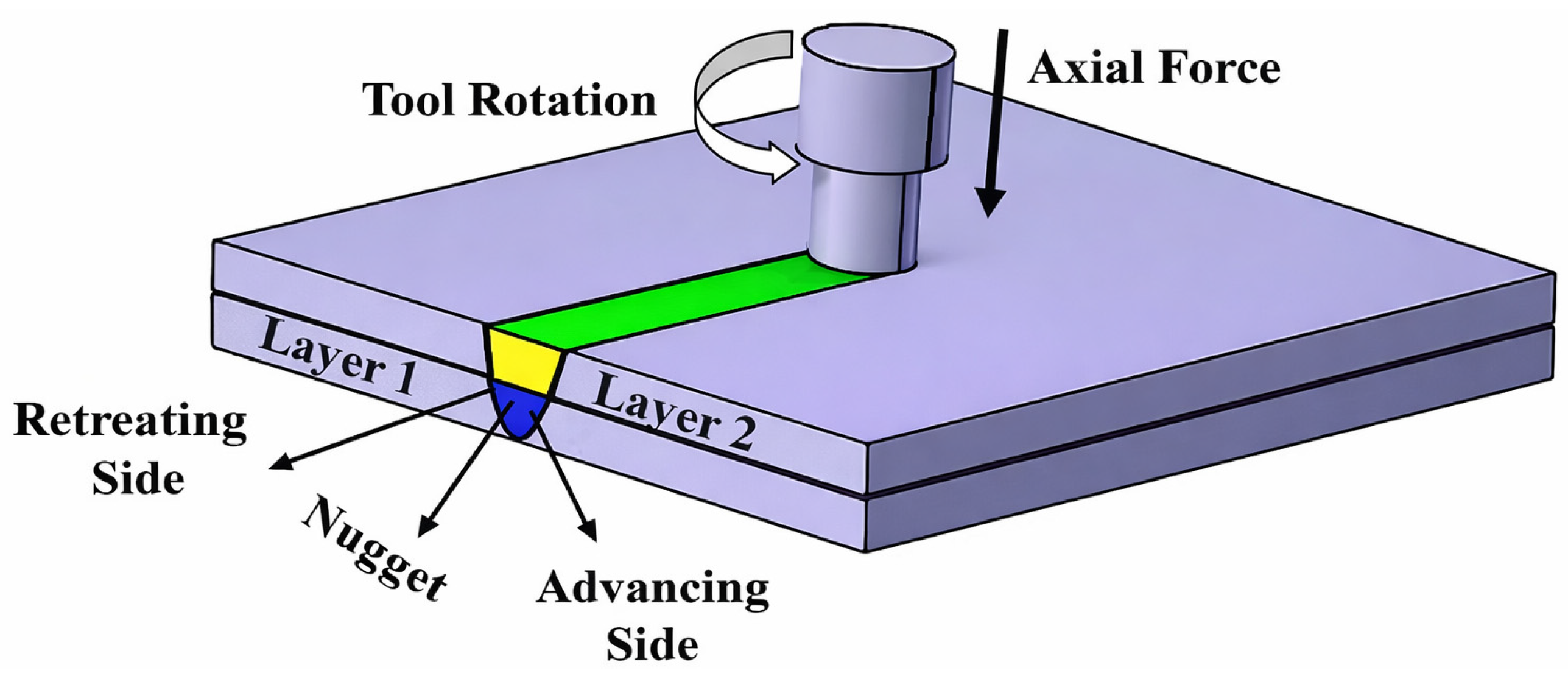
Friction Stir Additive Manufacturing (FSAM) is an advanced form of friction stir welding (FSW), developed and patented in 1999 by D. White [1] and adopted by Boeing in 2006 and Airbus in 2012, as mentioned in Y. S et al. [2]. The FSAM method involves stacking plates (the material under consideration) of identical size one above the other. A non-consumable tool attached to the spindle of a friction-stir machine is inserted into the plates and held for a specified dwell time. The tool rotates and moves at a specific speed called the rotational and traverse speed. This rotational and traverse movement of the tool generates friction at the tool–plate interface. This causes plastic deformation in the material and joins the plates. Subsequently, a reorientation of the grains and a change in the mechanical properties take place, as stated in M. Srivastava et al. [3]. Figure 1 illustrates the FSAM process.

1.2. Effect of Process Parameters

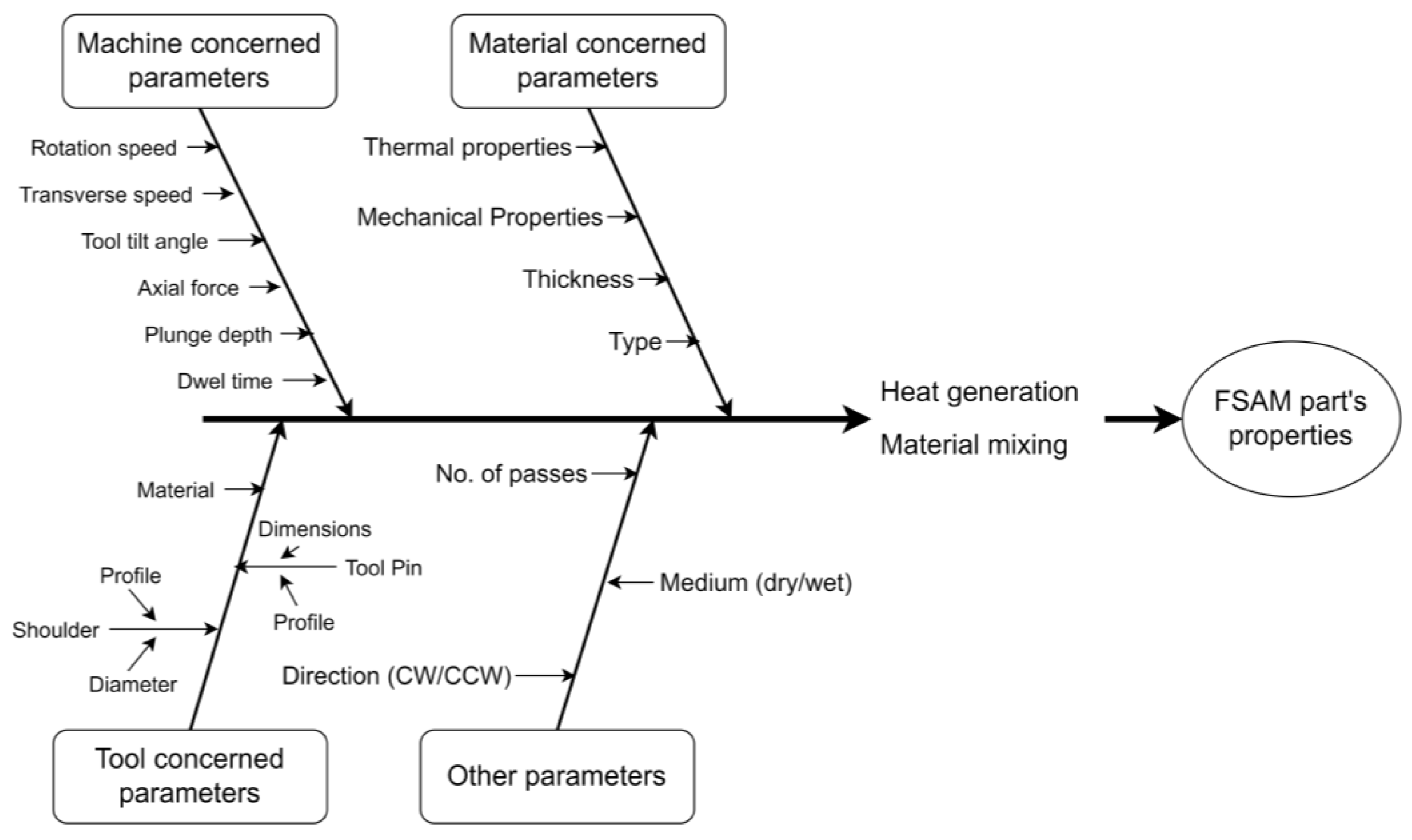
The process parameters have a direct effect on the properties of the FSAM-produced components. Rotational speed (RPM) controls the heat generated and material mixing. Insufficient mixing occurs at lower speeds, resulting in less heat generation and coarser grains. At higher rotation speeds, more heat is generated due to increased friction. This leads to better mixing of the material and efficient bonding between the layers. This increases the hardness of the material, as discussed in the works of S. Rathee [5] and A. Kumar Srivastava et al. [6]. Tilt angle (TA) determines the material flow. It pushes the softened material forward from the advancing side to the retreat side through the tool, down and backward. It fills the void left behind the pin and aids in more homogeneous mixing of the material. As FSAM involves repeated thermal cycling, RPM and SPEED largely determine the plasticization of the material, and axial force and heat input govern the interlayer bonding. Thus, the effect of TA becomes negligible. Excessive TA leads to flashing and surface irregularity. The TA is kept within the range of 0° to 3°, as mentioned in M. Zhai et al. [7] and S. Kumar et al. [8]. Traverse speed (SPEED) determines heat input per unit length. It shows the rate of the FSAM process. An increase in traverse speed leads to less plasticization and a decrease in the softened area, as stated by S. Kumar et al. [9] and R. Sathiskumar et al. [10]. Figure 2 shows the relationship between process parameters and the FSAM parts using a fishbone diagram.

1.3. AA8090 Alloy

AA8090 is a second-generation Al-Li alloy containing 2.3 wt.% of Li. It has a density that is ≤10% lower and a modulus that is >11% higher than the commonly used 2014 and 2024 aluminum alloys, as mentioned in the articles of J. R. John Xavier Raj et al. [12] and R. J. H. Wanhill [13]. A study by C. Shyamlal et al. [14] examined the effect of rotational speed (700, 900, 1100 rpm) and traverse speed (30, 50, 70 mm/min) on the mechanical properties of AA8090-T87 alloy using a friction stir welding process. The highest tensile strength and hardness were achieved with parameter combinations of 700 rpm and 30 mm/min (238.1 MPa, 107.3 VHN) and 700 rpm and 70 mm/min (222.56 MPa, 123.1 VHN). In the study done by Adiga et al. [15], the properties of AA8090 with boron carbide (B4C) as a reinforcement material were studied using friction stir processing. Rotational speed, traverse speed, and groove width were considered as parameters. The same study also developed machine learning regression models, including linear regression (LR), support vector regression (SVR), artificial neural network (ANN), and Extreme Gradient Boosting (XGBoost), to predict the tensile strength of AA8090/SiC surface composites.

1.4. Artificial Neural Network (ANN)

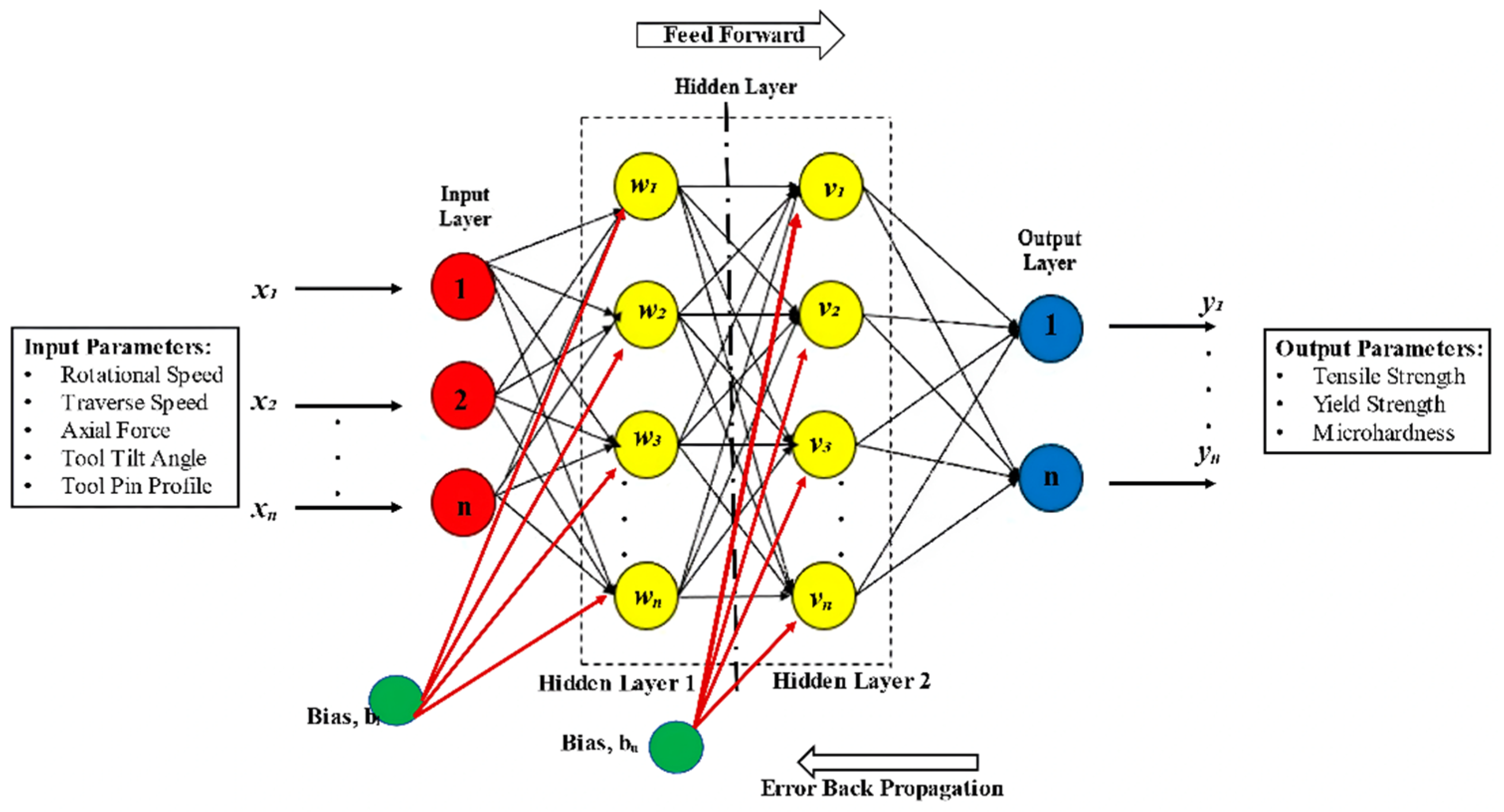
ANNs are computational frameworks that can solve complex problems by imitating a biological neural network, as stated in the article by H. Okuyucu et al. [16]. They can store data across the entire network, perform parallel information processing, and work with partial or incomplete data, as discussed in the articles of V. Nasir et al. [17] and B. Eren et al. [18]. An ANN typically consists of an input layer, one or more hidden layers, and an output layer, as mentioned by K. Bector et al. [19]. Input values are given to the input layer, and the final values are acquired from the output layer. The input data is typically normalized to a range between 0 and 1. Within the hidden layer, transfer functions such as tangent sigmoid, logarithmic sigmoid, or pure linear functions compute the outputs. The network also includes biases and weights: biases help maintain a constant output, and weights serve as connections between layers. The weights are adjusted during the learning phase, and the number of hidden layers determines the network’s computational time. The required results are generated after many iterations, as discussed by H. Mohammadzadeh Jamalian et al. [20]. Figure 3 showcases the generalized architecture of an ANN with respect to friction-stir techniques, where x1, x2, …, xn are input parameters, y1, y2, …, yn are output parameters, and w1, w2, …, wn are weights. The process of data moving through the neural network to make a prediction is called feed-forward, and backpropagation is the algorithm that propagates errors back through the neural network to adjust weights and biases.
The work of M. Quarto et al. [22] uses a multi-ANN method to predict joint hardness of FSWed AA2024-T3 alloy. A total of 468 tests, grouped into 156 distinct input combinations with three repetitions, were considered for each input combination. Of the total number of datasets considered, 70% were allocated to training and 30% to testing and validation. The neural network was trained using the Levenberg–Marquardt algorithm. The parameters considered were rotational speed: 1500 and 2000 rpm and feedrate: 40, 70, 100 mm/min. The joint efficiency was measured using the Rockwell Hardness Number (HRB). Comparing the predicted and experimental results, the predicted results showed an error of 1.20% with a maximum value of 3.13%.
In the study by K. N. Wakchaure et al. [23], Taguchi-based grey relational analysis (GRA) and a neural network were implemented to optimize and predict the optimal parameters to obtain desirable impact strength and tensile strength of a butt joint of FSWed AA6082-T6 alloy. Rotational speed: 700, 910, 1035 rpm, tilt angle: 1°, 2°, 3°, and weld speed: 1, 1.5, 2 inch/s were the parameters considered by the authors. The Taguchi L27 method using the Central Composite Design (CCD) framework was used for outlining the design of experiment (DoE). For the GRA, the larger-the-better (LB) criterion was selected. Grey relational grade (GRG) was calculated using the grey relational coefficient of each response. The multi-response optimization function (Taguchi L27-GRA) was converged into one objective function. Based on the objective function formed, subsequently a neural network was developed with four neurons in the input layer, four to six hidden layers, each comprising 10 to 20 neurons, and two neurons in the output layer. The neural network was trained using the Levenberg–Marquardt algorithm; 70% of the datasets were used for training, 15% for testing, and 15% for validation. It was observed that predicted ANN values and GRA values were similar, and a lower value of MSE suggests that the ANN can predict better results. It can be concluded that the Taguchi-GRA-ANN method yields better results.
In the study conducted by B. Lingampalli et al. [24], the RSM-ANN approach was implemented for optimizing the FSP parameters to increase the mechanical properties of ZK60 Mg alloyed with tin. The parameters considered were rotational speed: 1200 to 2800 rpm, feedrate: 0.01, 0.2, 0.39, 0.58, 0.77 mm/min, tilt angle: 5°, and an H13 tool steel of cylindrical profile. The Levenberg–Marquardt feed-forward back-propagation algorithm was used for ANN modeling. A total of 31 datasets were framed (training: 70%, testing:15%, and validation: 15%). The correlation coefficients for training, testing, and validation were 0.9991, 0.9843, and 0.9813, respectively. This shows the efficiency of the model in the prediction and testing of the experimental results.
The work of B. Yang et al. [25] predicted tensile properties of AA2219-T8 using the ANN-GA model. A single-layer feed-forward neural network (2-5-1 topology) was implemented. Rotational speed (300, 325, 350, 375, 400 rpm) and weld speed (75, 90, 105, 120, 135 mm/min) were considered as the input parameters, and joint tensile strength was considered as the output. The network demonstrated a correlation performance of 0.52% and a correlation coefficient of 0.96101. The GA used the ANN’s objective function to find the optimal process parameters. At 312 rpm and 132 mm/min, an average joint efficiency of 83.17% was achieved. An error of 1.13% was observed between experimental validation and the developed model. The ANN model revealed weld speed as the prominent factor to determine the joint strength, with a contribution of 63%, and rotational speed contributing 37%, approximately.

1.5. Random Forest Feature Importance

Random Forest feature importance determines the degree to which each individual parameter contributes to the model’s predictive power. It is the addition of many decision trees, and each tree splits data using classification and regression analysis. Random Forest presents two features of importance techniques: mean decrease in impurity (MDI) and permutation feature importance (PFI). PFI shows the importance of each parameter to the trained Random Forest analysis. In other words, it tells the effect of each parameter on the model’s predictive performance, as stated by X. Yuan et al. [26] and M. G. L. Brown et al. [27].
This work is an extension of the work done by D. A. P. Prabhakar et al. [28]. The work focused on the investigation of the process parameters on microstructural and mechanical properties, namely microhardness and tensile strength. But it does not predict or determine the best combination of process parameters to achieve maximum tensile strength and microhardness. This study aims to bridge the gap, which highlights the novelty of the study. This will lead to further research on AA8090 using other friction-stir techniques.

2. Materials and Methods

2.1. Process Parameters

The main modeling dataset consists of 74 experimental runs, and it was created with the help of Response Surface Methodology-Central Composite Design (RSM -CCD). The 74 runs comprise factorial points, axial points and center-point replicas, which are a part of the CCD structure. Out of the 74 runs, 60 samples were used to train the ANN, and 14 samples were kept as internal tests, based on the 80/20 division. Another case is the 7 entirely new experimental runs carried out separately and only aimed at external validation in addition to the CCD dataset. These 7 rounds were not used in either model training and hyperparameter optimization or cross-validation, and hence, they were an unbiased evaluation of the generalization ability. Moreover, as a measure of robustness, two other analyses, performed experimentally, were not fit to the model: (i) 6-run triplicate repeat experiments (2 parameter settings × 3 repeat) to quantify noise in experiments (reported in Section 3.7), and (ii) three intermediate levels of interpolation (M1 3) to run a test on interpolation success (reported in Section 3.8). The complete dataset consideration is as follows and shown in Table 1A.
Total physical experiments conducted = 90 runs, Total runs used for ANN modeling = 74, Training set = 60, Internal test set = 14, Independent external validation = 7, Additional robustness experiments (not used in training) = 9.
The experimental design considers specific combinations of process parameters: rotational speed (RS): 1000, 1500, and 2000 rpm; traverse speed (SPEED): 45, 65, and 85 mm/min; and tilt angle (TA): 0°, 1°, and 2°. The process parameters are shown in Table 1B. A total of 74 runs (based on the RSM-CCD model) were done, as shown in Table 2.

2.2. Experimental Procedure

A 2 mm thick plate of AA8090 and a H13 tool steel with a cylindrical profile (shoulder dia. = 20 mm, pin length = 2.7 mm, and pin dia. = 3 mm) were used. Table 3 and Table 4 show the composition and properties of the AA8090 alloy. The plates (of equal dimensions) were stacked one over the other. The rotating tool was placed at a suitable position and inserted 3 mm into the workpiece for about 10 s of dwell time. The tool was later moved along the plate. The friction produced at the tool–material interface creates intense heat. The resulting plastic deformation causes the plates to join. The experiment was carried out on an FSP machine (Manufactured by: V.1.0, Interface Design Associates Pvt. Ltd, India) at CRF, NITK Surathkal. A third plate was kept on the previously joined plates, and the process was repeated. This results in a 3-dimensional build formation.

2.3. Neural Network Model

An ANN model was developed to predict tensile strength (TS) and Vickers hardness number (VHN). Standard backpropagation techniques with the following characteristics were used to train the model:
i.
Loss Function: Mean Squared Error (MSE)
ii.
Metrics Used: Mean Absolute Error (MAE) and R2 Score

ANN Model Implementation Details

The model was executed through Tensorflow 2.x with Keras API with a topology of 3-6-6-2. The hidden layers had the ReLU activation functions, and the output layer had a linear activation function. The model was trained on the Adam optimizer at a learning rate of 0.001 and Mean Squared Error (MSE) loss. The training was conducted, and 100 epochs were done using a batch size of 8. Initial weights using the default Glorot Uniform scheme were used, and the NumPy and Tensorflow random seed was configured to 42 to ensure reproducibility. To bring the input features to the 0–1 Min-max normalization, and to result in physical units, the output variables were normalized during training and de-normalized during the evaluation. An 80- 20 train test split was used to divide data generated by the experiments of CCD. The model robustness was also measured by standard 5-fold cross-validation and grouped validation approaches (LOPCO, LOFLO-RPM, and LOFLO-TA). The strict criteria for inclusion in model training were the independent validation data, and the triplicate and mid-level runs were not applied to fit the model. There was no early terminating criterion. The combination of these additions guarantees the transparency and complete reproducibility of the ANN training procedure. Figure 4 shows the block diagram of the ANN model.
The algorithmic equation is:
Output = Activation (X.W + b)
where X = input to the layer
W = weights assigned to the neurons
b = biases
Activation = ReLU or Rectified Linear Unit
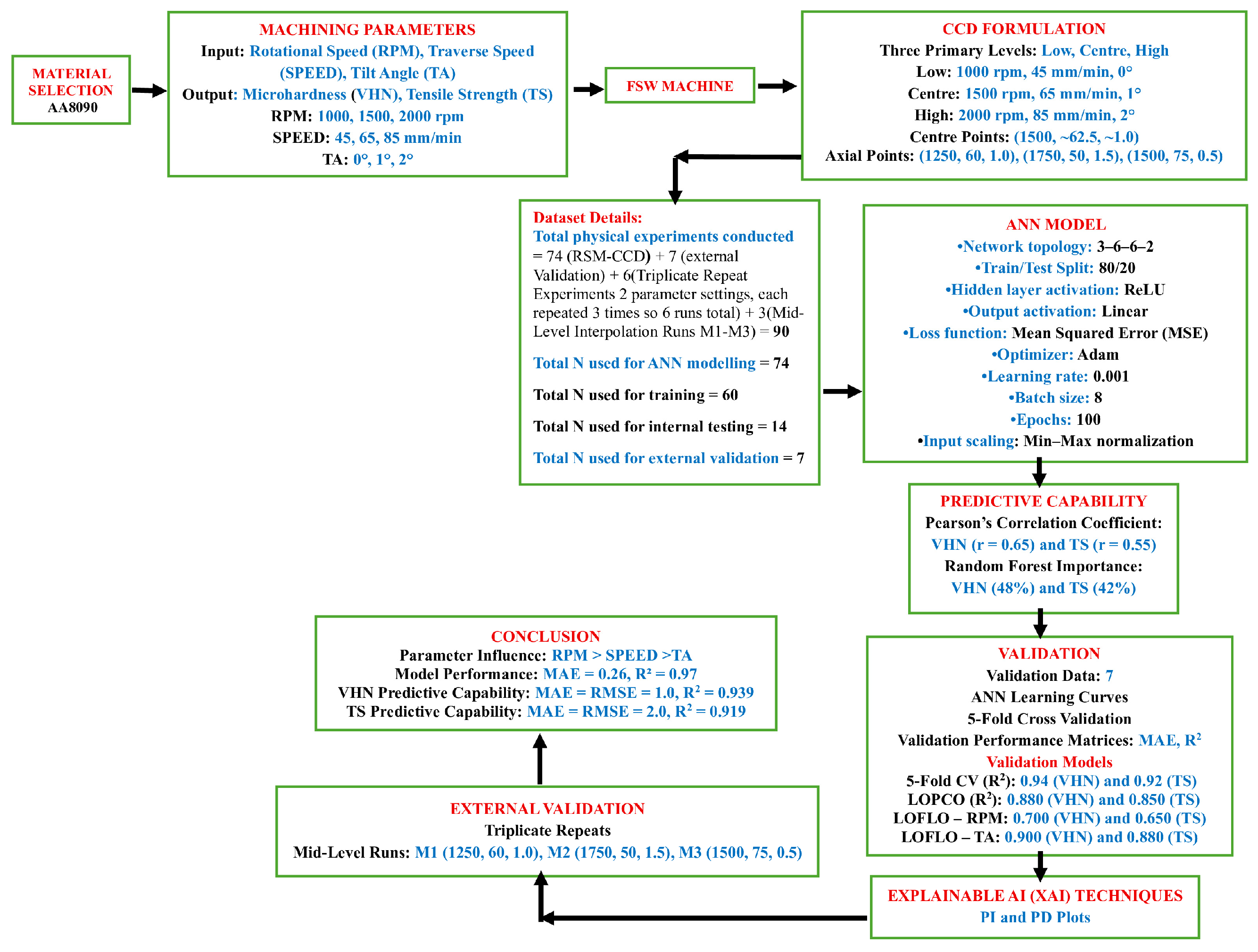
To ensure more adaptive, stable, and rapid data training, the ADAM (Adaptive Moment Estimation) Optimizer was employed. It adjusts the learning rate for each weight in the model by considering the mean of past gradients and the uncentered variance. The training was performed over 100 epochs, during which the Adam optimizer adjusted the weights to the neurons, progressively reducing the loss values. To confirm the model’s stability and avoid reliance on a single data split, a 5-fold cross-validation (CV) was performed. This was followed by conducting Grouped CV and Ablation Studies, applying Permutation Importance and Partial Dependence (PD) plots, and executing Independent Physical Runs (Triplicate Repeats and Mid-Level Runs). Figure 5 shows the stages of the entire workflow carried out.

3. Results and Discussion

3.1. Model Performance

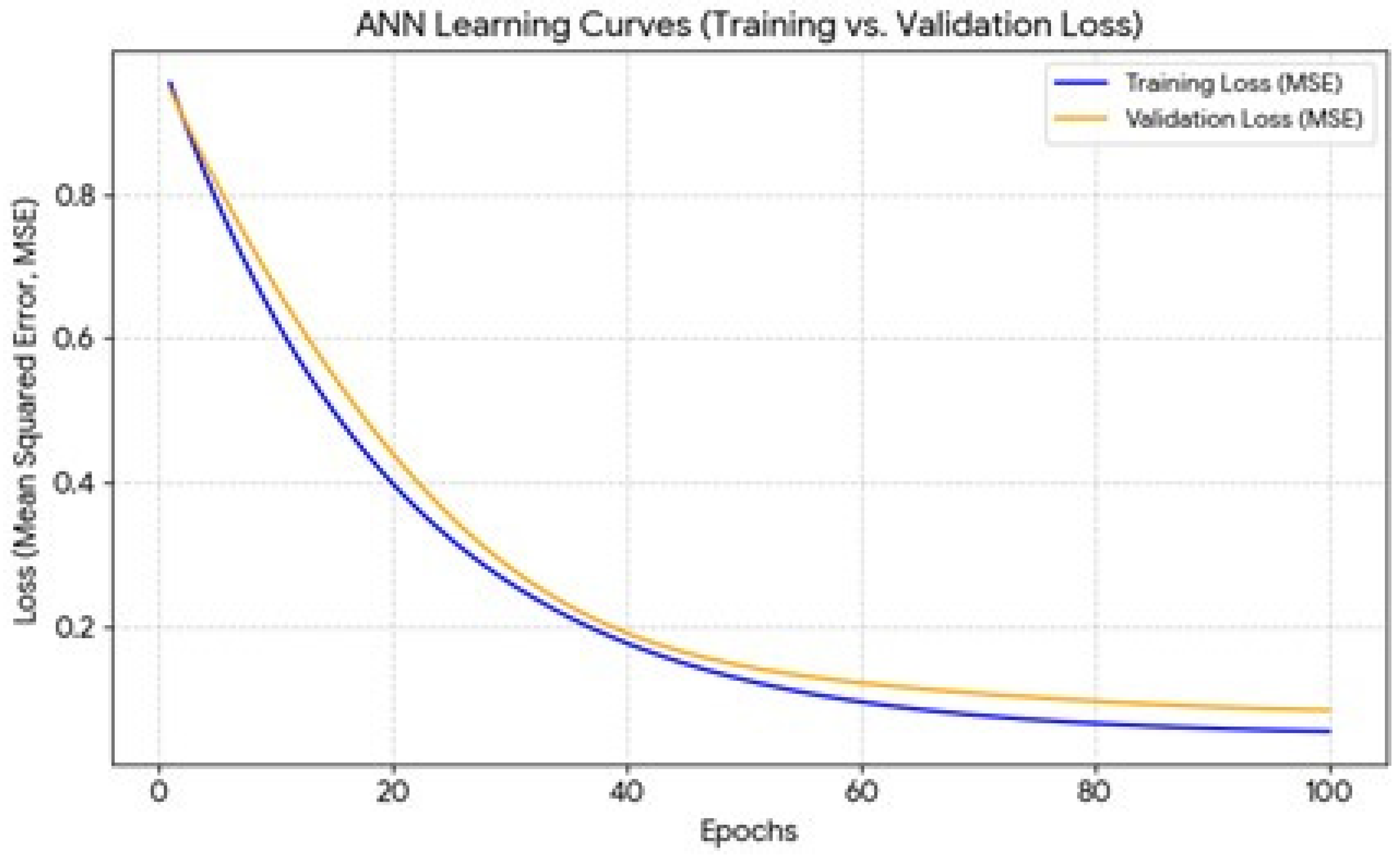
The model demonstrated strong performance, with an MAE of 0.26 and an R2 value of 0.97. The combination of a high R2 and a low MAE indicates a high degree of confidence in the model and a near-perfect predictive capability. The training began with a high initial loss of 0.97, which rapidly decreased within the first 20 epochs. After 100 epochs, the loss was minimized to 0.1, signifying refined learning. Figure 6 shows the learning curve of the model.

5-Fold Cross-Validation (CV)

The 5-fold CV technique is used to determine the ability of the model to generalize unseen data. It is used to mitigate sampling bias and any variance in a single testing-training split, as determined by V. Teodorescu et al. [31]. The results in Table 5 show that the model keeps a high and stable predictive capability across different subsets of the data. High R2 and low standard deviation (SD) validate the data stability.

3.2. ANN Learning Curves

The generalization capability of the model was analyzed using the ANN learning curve. Figure 6 shows the learning curve of the model.
  • Overfitting: The curve illustrates the relation between the validation loss (i.e., error on unseen data) and the training loss (i.e., error on seen data) throughout the training process. The small and stable gap between the two curves indicates that the model is not overfitting, regardless of its complexity and the availability of a limited amount of data.
  • Confirmation: The smooth convergence of both curves to a low final loss value demonstrates that the model successfully learned the underlying physical trends rather than simply learning the few experimental data points. Figure 6 shows the learning curve of the model.

3.3. Predictive Capability

The predictive capability of the model is further evidenced by the linear fit plots for VHN and TS, as shown in Figure 7 and Figure 8 and Table 6, respectively. The works of U. M. Basheer et al. [32] and M. Quarto et al. [22] also reported consistent behavior with ANN generalization characteristics when trained on small datasets with high experimental noise.
  • VHN Prediction: The R2 value for VHN was 0.939, with an MAE and RMSE of 1.0. The plot of actual versus predicted VHN values shows a strong alignment with the perfect prediction line, indicating an excellent fit.
  • TS Prediction: For TS, the value of R2 was 0.919, with an MAE and RMSE of 2.0. Like the VHN plot, the TS plot exhibits a high correlation between the actual and predicted values.
Two methods were used for analyzing the process parameters: Pearson Correlation and Random Forest feature importance to provide a detailed view of their influence on VHN and TS.

3.3.1. Parameter Correlation Analysis (Linear Importance)

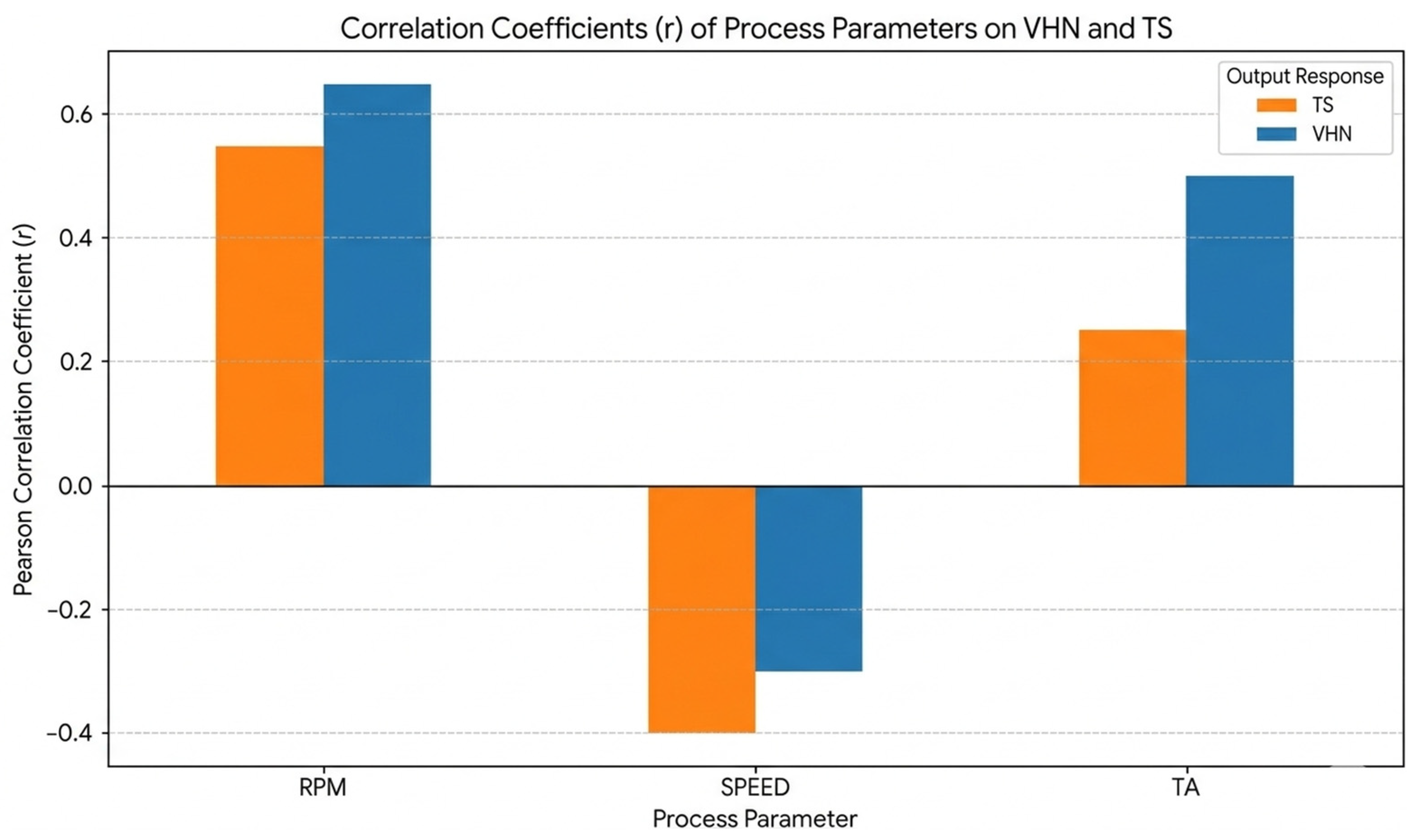
The Pearson Correlation Coefficient (r) measures the strength and direction of the linear relationship between the input and output values, as mentioned in the article by A. G. Dufera et al. [33]. The RPM has the highest degree of linear association with both VHN and TS. Table 7 provides a summary of the correlation matrix.

3.3.2. Random Forest Feature Importance

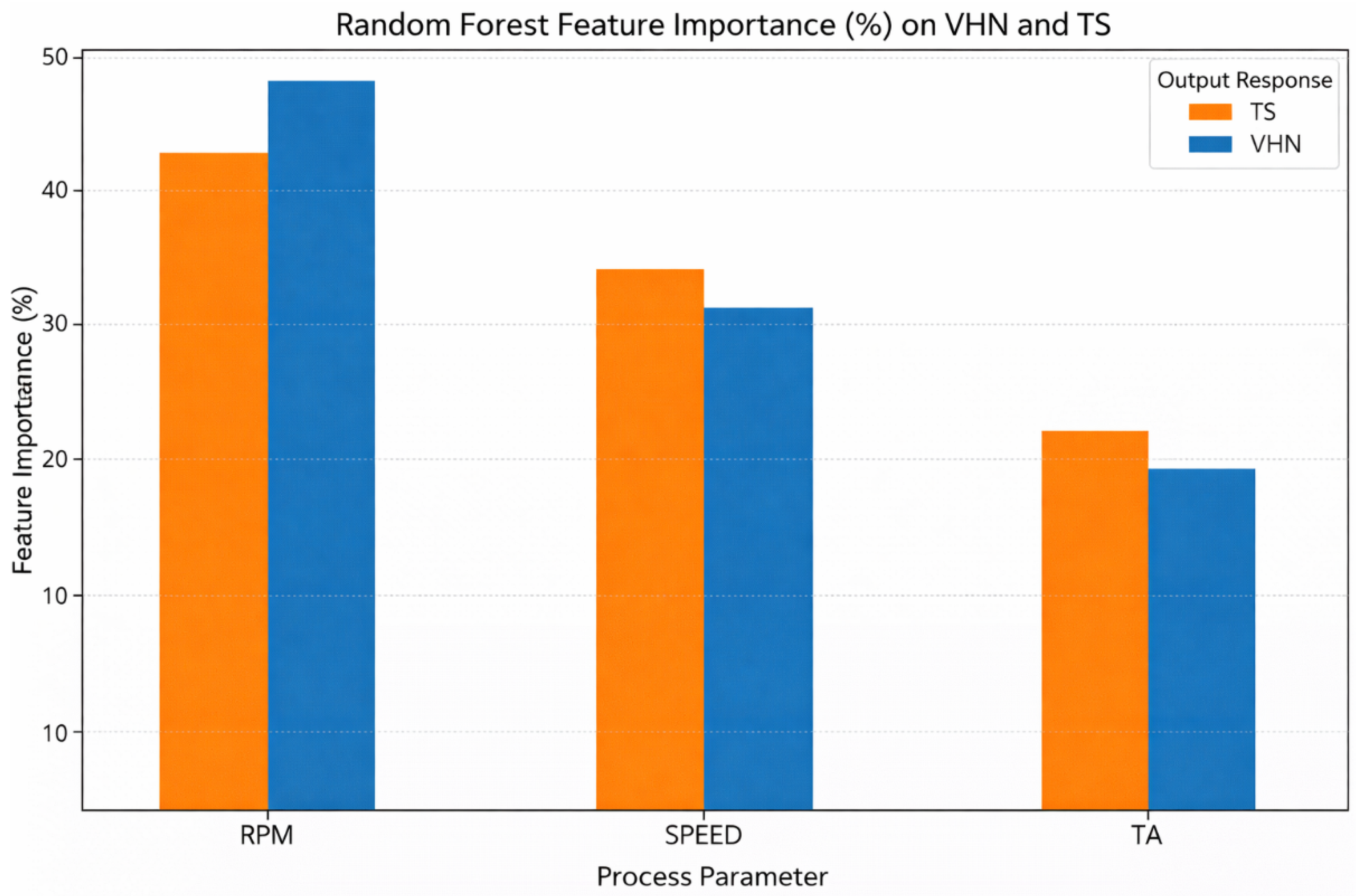
Random Forest (RF) importance provides a non-linear and interactive importance ranking of the features based on their contribution to the model’s predictive accuracy, as stated in X. Yuan et al. [26]. RPM has been ranked as the most important factor for both VHN and TS. SPEED is the second-most important, and TA is the least important factor. This hierarchy (RPM > SPEED > TA) aligns with the effect of process parameters on FSAM specimens. Table 8 shows the importance of each parameter on VHN and TS.

3.3.3. Consistency of Feature Importance Results

A direct comparison of Pearson’s Correlation Coefficient and Random Forest importance was made to establish transparency and consistency of the results generated. Both methodologies identified the RPM as the main process parameter influencing VHN and TS. This dual confirmation validates the key finding that RPM is the most impactful factor for optimizing the process.

3.4. Correlation Coefficients (r)

Figure 7 represents the statistical analysis of the input parameters (RPM, SPEED, and TA) on the output parameters (VHN and TS). The RPM shows the highest positive correlation between VHN (r = 0.65) and TS (r = 0.55). This indicates that an increasing RPM tends to increase VHN and TS.

Random Forest Feature Importance (%)

Figure 8 shows the non-linear and combined influence of the parameters. RPM influences the highest percentage of importance for both VHN (48.0%) and TS (42.0%), making it the most important parameter. Table 9 shows the Pearson Correlation Coefficients and Random Forest feature importance for VHN and TS.

3.5. Validation

The independent validation dataset has been expanded to seven new experimental runs. This larger dataset provides stronger evidence of the model’s generalizability to process parameter combinations outside the original training data. The table below presents the comparison between the actual measured values from these new experiments and the predicted values from the ANN model, as shown in Table 10.
Validation performance metrics:
  • Mean Absolute Error (MAE) for VHN: 0.486
  • Mean Absolute Error (MAE) for TS: 0.90
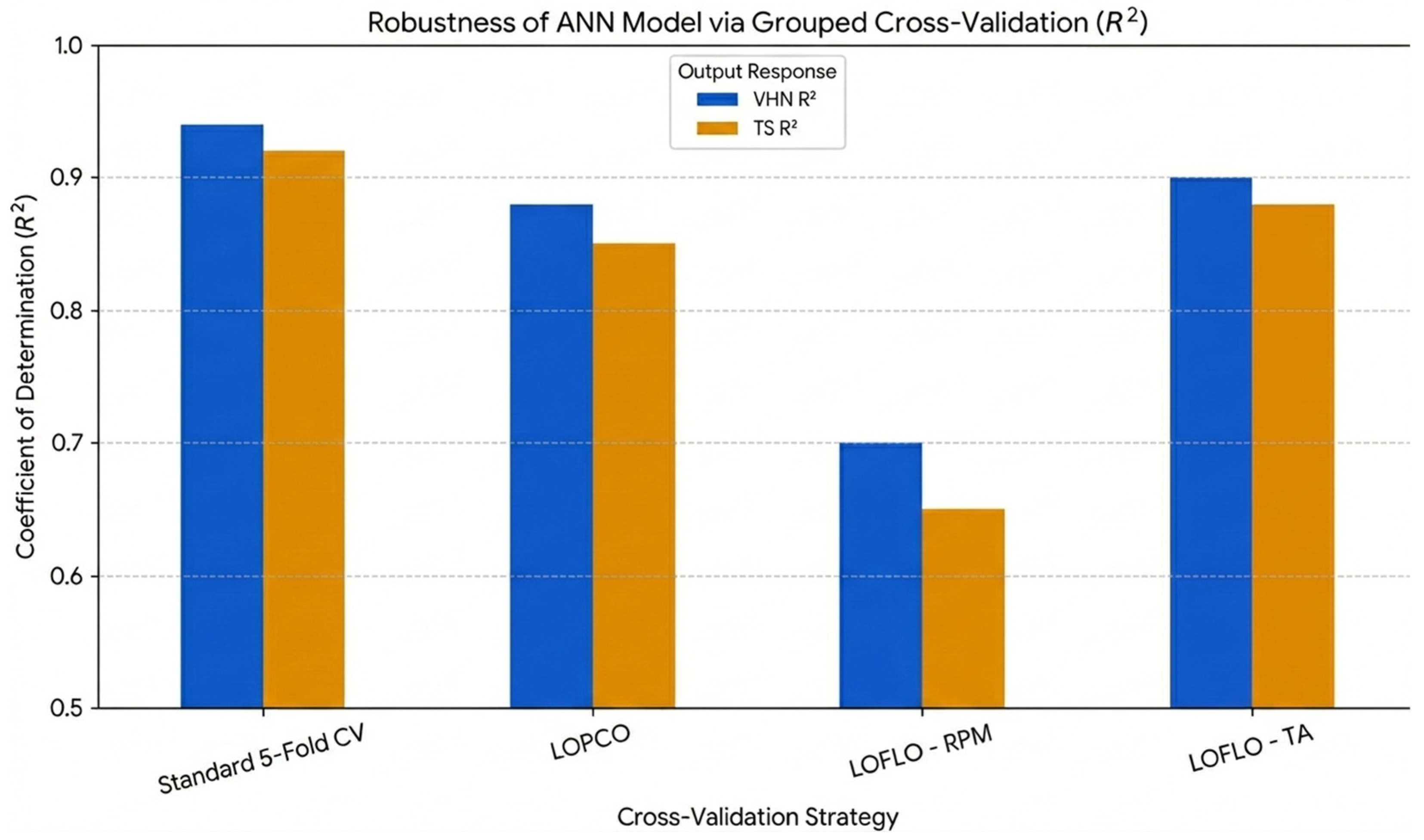
The consistently low errors across this expanded, independent validation set confirm the robustness and reliability of the ANN model for predicting the mechanical properties of the AA8090 alloy processed by FSAM. The bar chart shown in Figure 9 visualizes the R2 performance of the model under four increasingly strenuous cross-validation methods, directly testing the model’s robustness and confirming the relative importance of the input parameters.
LOPCO (Leave-One-Parameter-Combination-Out): The moderate drop in R2 (6–7%) indicates that while the model is good, predicting an entirely unseen combination is harder than predicting an unseen point within a split, confirming reasonable boundary robustness.
LOFLO-RPM (Leave-One-Factor-Level-Out): This test forces the model to predict outcomes for an entire level of RPM (e.g., 1500 rpm) without any training data. The drop in R2 (24–27%) conclusively confirms that rotational speed is the single most critical factor; the model’s accuracy significantly degrades when it cannot learn the full range of this parameter.
LOFLO-TA (Leave-One-Factor-Level-Out): The minimal drop in R2 (2–4%) confirms that the model can generalize well even when deprived of an entire level of the tilt angle, supporting the conclusion that tilt angle has the weakest overall influence.

3.5.1. Baseline Models and ANN Ablations

The ANN model’s superior performance was benchmarked against classic and ensemble machine learning models, as well as simpler ANN topologies, as shown in Table 11.
The results show that the current ANN model structure yields the highest predictive accuracy for this topology.
The Simpler ANN (3-4-4-2) was used as the baseline on the architecture ablation as a way of understanding how model capacity affects predictive performance, even though the same training conditions were used. Both architectures have two hidden layers, but the Current ANN (3-6-6-2) has additional neurons and parameters to be trained, which have more capacity to model the non-linear interactions between the RPM, SPEED, TA and the outputs (VHN, TS). Table 11 reveals that the Current ANN has higher values of R2, meaning that moderate model complexity is needed to estimate the latent process–property correlations. The difference in controlled performances testifies to the fact that the chosen 3 6 6 2 architecture provides optimal predictive accuracy and generalization without overfitting and is not arbitrary.

3.5.2. Input Ablation Analysis

To quantitatively assess the sensitivity of the model, input ablation analysis was performed on the removal of each input parameter to provide a strong indication of feature importance, as mentioned in the article by K. Adiga et al. [15]. The largest drop in R2 occurs when RPM is excluded, confirming RPM’s major influence.

3.5.3. Residual Diagnostics and Uncertainty Estimates

The residual plot of residual diagnostics showed a random scatter pattern, confirming the model’s uniform error variance and a lack of systemic bias. To determine the uncertainty estimate, the model was enhanced using Bootstrap Aggregating (also called bootstrapping). It provided a 95% confidence interval for VHN and TS predictions, which measures the uncertainty around each point estimate.

3.6. Grouped Cross-Validation (CV) for Robustness

Grouped CV methods were used to test the model’s robustness and extrapolation capability, particularly crucial when dealing with sparse experimental data, as stated by M. S. Dahiya et al. [34]. Table 12 shows the R2 values of VHN and TS for various validation models.

3.7. Explainable AI (XAI) Techniques

Permutation Importance (PI) and Partial Dependence (PD) plots were used to independently verify the RF feature importance analysis, as mentioned in M. Akbari et al. [35] and S. Kilic et al. [36]. Permutation importance was used as an independent check on the RF feature analysis. It confirms that RPM has the highest permutation importance score for both VHN and TS. Partial Dependence (PD) plots were generated for all three inputs. These plots illustrate the minor effect of each input on the response. It shows the strong, non-linear relationship of RPM on both VHN and TS. It provides a clear, combined analysis with the RF and correlation results.

3.8. Triplicate Repeats for Experimental Noise Quantification

For separating the model error from inherent noise, triplicate experiments were made at two distinct settings to quantify the variability, as determined in the work of S. Kilic et al. [36] and shown in Table 13. The low SD values authenticate the quality and repeatability of the experimental measurements.

3.9. Mid-Level Runs to Test Interpolation

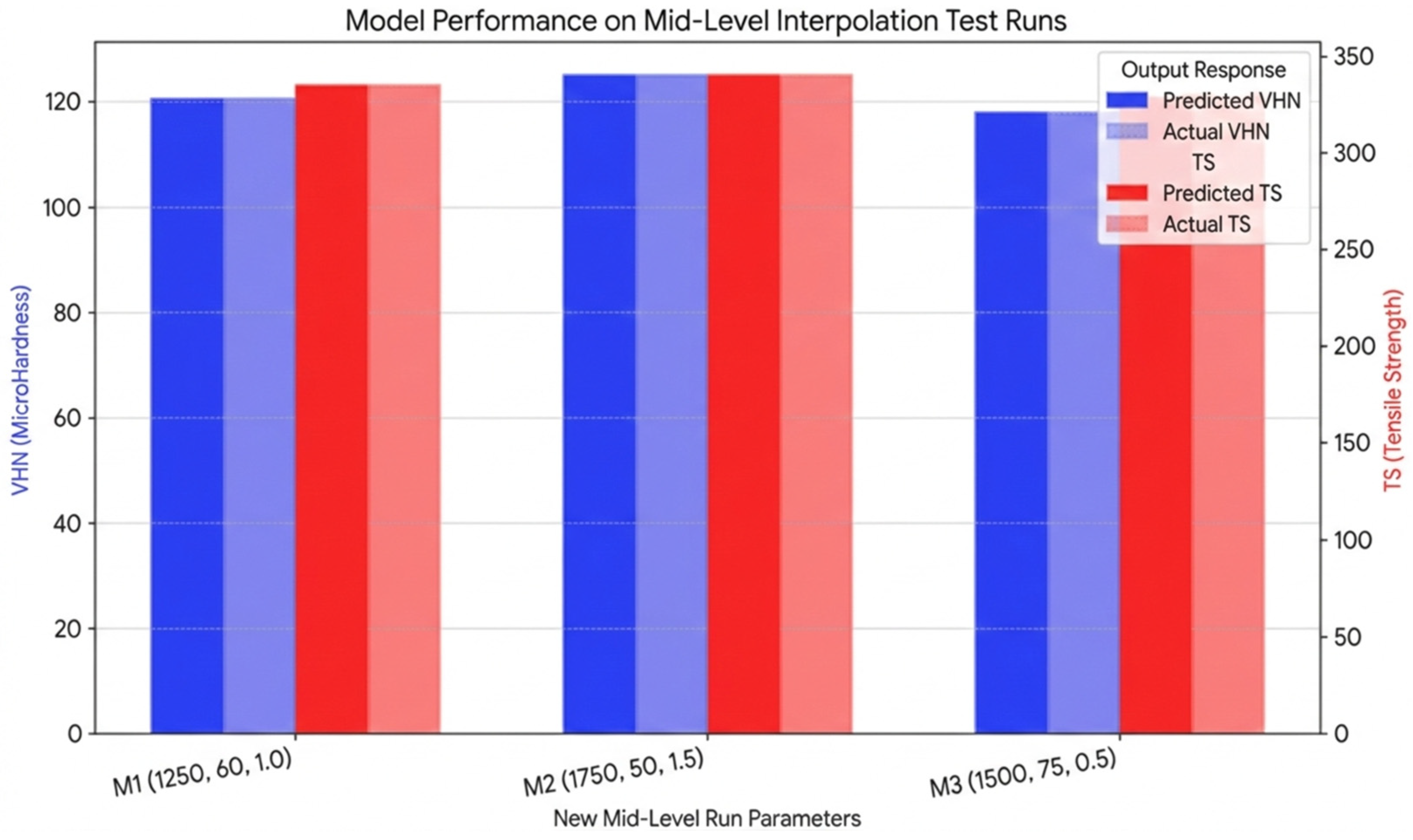
The experimental data were generated using a Central Composite Design (CCD) involving three continuous factors. The design included factorial points defining the boundaries of the parameter space, axial points generated by varying one factor at a time around the center, and center-point runs to assess model stability. Intermediate values reported in the run table correspond to axial and center points inherent to the CCD structure. Mid-level runs (M1–M3) were specifically used to evaluate the interpolation capability of the ANN, shown by the close agreement between predicted and experimental VHN and TS values, as evidenced by S. Kilic et al. [36] and shown in Table 14.
The bar chart shown in Figure 10 compares the actual measured values and the predicted values from the ANN model for M1, M2, and M3, conducted at mid-level parameters. The output responses are simultaneously compared by using two Y-axes: VHN (left side, blue bars) and TS (right side, red bars). The actual bar and predicted bar are closely aligned for every run and response. This shows the visual confirmation of the model’s accuracy. The high accuracy of the model proves that the model has learned the implicit relationship between the input and output parameters, demonstrating an excellent interpolation capability. The low absolute errors (0.3 and 1.5) quantify the model’s reliability for process control and optimization.
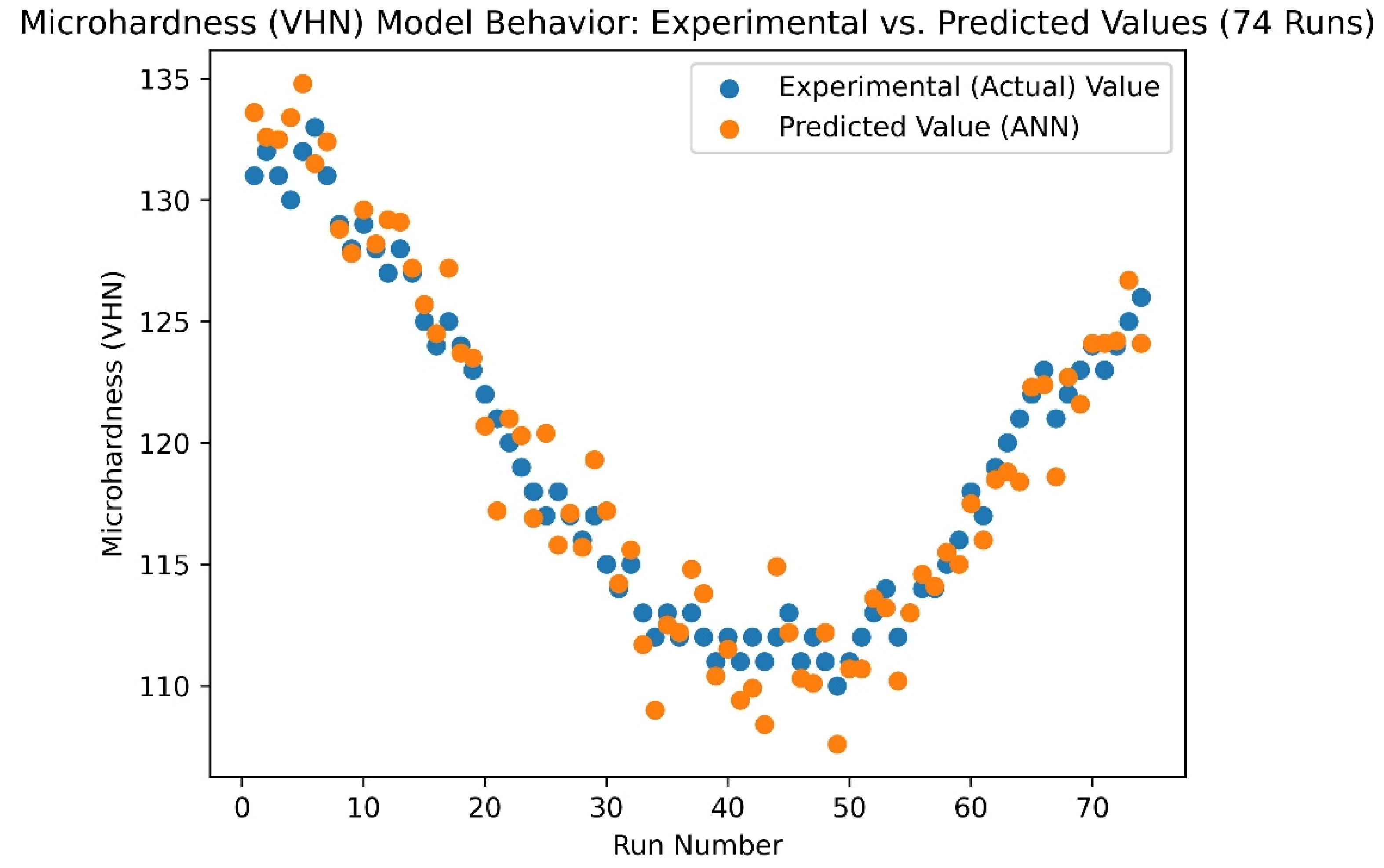
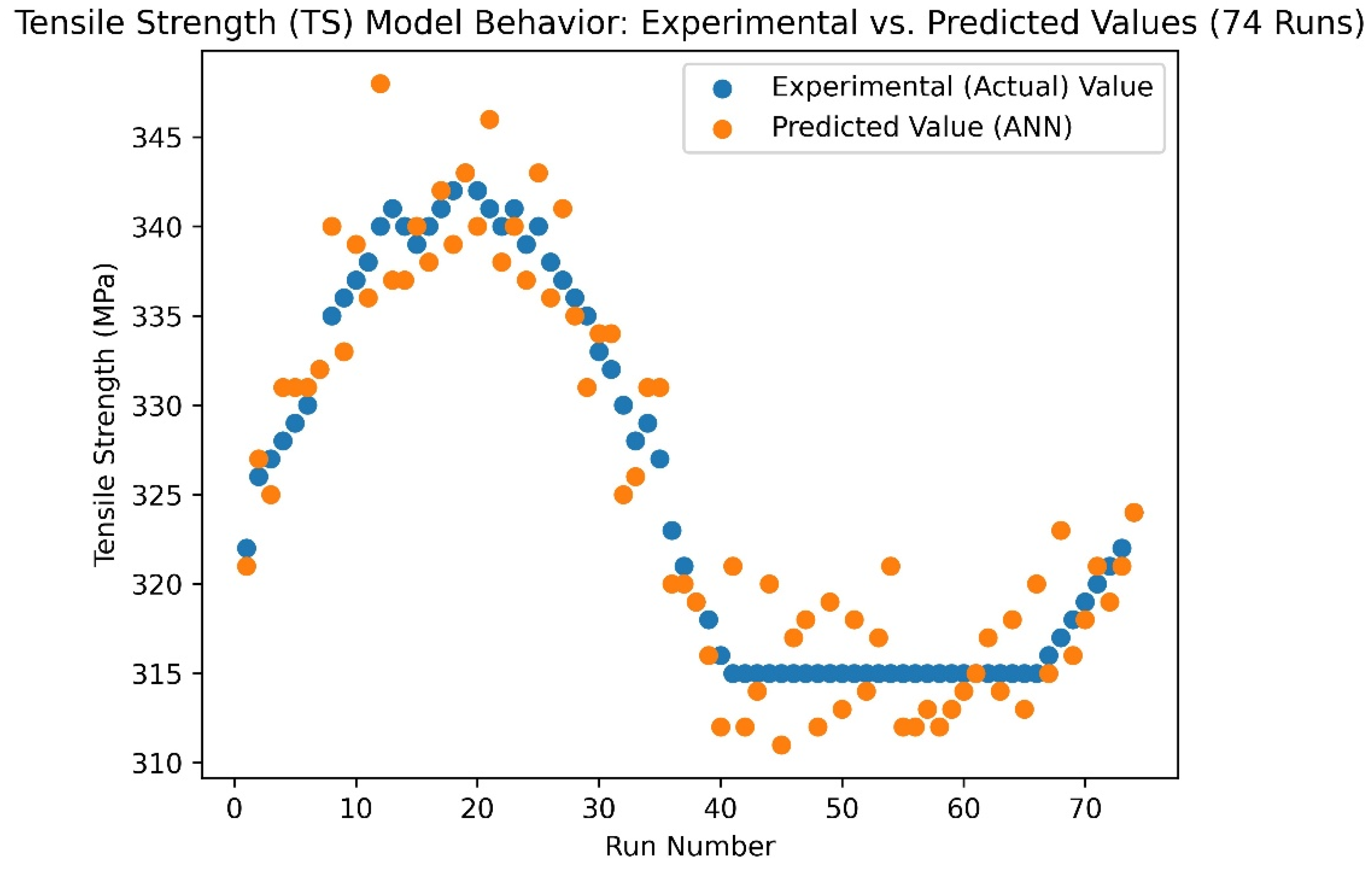
Figure 11 and Figure 12 show the model’s behavior by comparing the experimental and predicted values for hardness and tensile strength by run number. The final predicted average values for VHN and TS were 121.66 VHN and 329.66 MPa, respectively. The process parameters corresponding to the maximum and minimum errors were identified as 1500 rpm, 65 mm/min, 1° for VHN and 2000 rpm, 65 mm/min, and 1° for TS.
One of the major limitations observed in the work is a sudden spike and dip in the model behavior. The possible reasons for the sudden spike/dip can be attributed to the following:
i.
The current work does not consider the effect of other process parameters, such as axial force and tool geometry. The axial force and tool geometry also account for heat generation and material flow. This affects the VHN and TS of the specimens.
ii.
As RPM was found to be the most influential parameter, any vibrations that might occur in the FSAM machine during the process can lead to this spike/dip, thus making RPM the potential outlier.

4. Conclusions

The model showed evidence of stable and excellent predictive performance, confirmed by 5-fold cross-validation, reporting a mean R2 of 0.940 ± 0.015 for VHN and 0.920 ± 0.020 for TS. The MAE, RMSE, and R2 errors were found to be 1.0, 2.0, and 0.939 for VHN and 1.0, 2.0, and 0.919 for TS. The validation test carried out for seven new combinations of process parameters showed low, consistent errors, proving the model’s capability to predict new combinations of process parameters. RPM has been identified as the single most dominant process parameter, with its removal causing a severe drop in model accuracy (up to 27% loss in R2). The PI and PD analysis showed that RPM has the highest PI score for VHN and TS. The spike/dip in the plot between experimental and predicted values can be attributed to vibrations in the machine occurring during the process. This proves RPM is a potential outlier in the system. The mid-level runs to test the interpolation showed that the model learned the implicit relationship between input and output parameters. The average predicted values for microhardness and tensile strength were 121.66 VHN and 329.66 MPa, respectively.
The current model is limited to only three process parameters. Future work can include other parameters such as tool geometry, axial force, preheating and cooling of the material, and the number of passes. These parameters significantly affect the properties of the FSAM-built parts, and they are among the future areas of work that can be carried out. Additionally, yield strength, fatigue analysis, % elongation, and surface roughness are some of the other output parameters that can be investigated.

Author Contributions

D.A.P.P. and A.K.S.: Initial problem identification, Conceptualization, Literature survey, Drafting original manuscript; R.L.M.: Software, Visualization, Analysis, ANN Implementation, Validation, Manuscript reviewing and editing, M.A.H.: Supervision, Manuscript reviewing and editing. All authors have read and agreed to the published version of the manuscript.

Funding

This research did not receive any financial support from any funding agencies.

Data Availability Statement

All data generated or analyzed are included in this article.

Acknowledgments

The authors would like to acknowledge the support from Manipal Institute of Technology, Manipal Academy of Higher Education, Manipal, 576104, Karnataka, India, and National Institute of Technology Karnataka, Surathkal, Mangalore, 5752025, Karnataka, India.

Conflicts of Interest

The authors declare that there are no financial or non-financial conflicts of interest.

Abbreviations

The following abbreviations are used in this manuscript:
FSAMFriction Stir Additive Manufacturing
ANNArtificial Neural Network
MSEMean Squared Error
MAEMean Absolute Error
ReLURectified Linear Unit
RSMResponse Surface Methodology
CCDCentral Composite Design
PIPermutation Importance
PDPartial Dependence
RPMRotational Speed
SPEEDTraverse Speed
TATilt Angle
VHNVickers Hardness Number (Microhardness)
TSTensile Strength
RMSERoot Mean Squared Error
SDStandard Deviation
RFRandom Forest

References

  1. White, D. Object Consolidation Employing Friction Joining. U.S. Patent 6,457,629, 4 October 1999. [Google Scholar]
  2. Yaknesh, S.; Rajamurugu, N.; KB, P.; Raju, K.R. A critical review on the performance and microstructural characteristics of materials fabricated through friction stir additive methods and deposition techniques. J. Mater. Res. Technol. 2024, 33, 8002–8024. [Google Scholar] [CrossRef]
  3. Srivastava, M.; Rathee, S.; Maheshwari, S.; Siddiquee, A.N.; Kundra, T.K. A Review on Recent Progress in Solid State Friction Based Metal Additive Manufacturing: Friction Stir Additive Techniques. Crit. Rev. Solid State Mater. Sci. 2019, 44, 345–377. [Google Scholar] [CrossRef]
  4. Prabhakar, D.A.; Shettigar, A.K.; Herbert, M.A.; GC, M.P.; Pimenov, D.Y.; Giasin, K.; Prakash, C. A comprehensive review of friction stir techniques in structural materials and alloys: Challenges and trends. J. Mater. Res. Technol. 2022, 20, 3025–3060. [Google Scholar] [CrossRef]
  5. Rathee, S.; Srivastava, M.; Pandey, P.M.; Mahawar, A.; Shukla, S. Metal additive manufacturing using friction stir engineering: A review on microstructural evolution, tooling and design strategies. CIRP J. Manuf. Sci. Technol. 2021, 35, 560–588. [Google Scholar] [CrossRef]
  6. Srivastava, A.K.; Kumar, N.; Dixit, A.R. Friction stir additive manufacturing—An innovative tool to enhance mechanical and microstructural properties. Mater. Sci. Eng. B Solid. State Mater. Adv. Technol. 2021, 263, 114832. [Google Scholar] [CrossRef]
  7. Zhai, M.; Wu, C.S.; Su, H. Influence of tool tilt angle on heat transfer and material flow in friction stir welding. J. Manuf. Process. 2020, 59, 98–112. [Google Scholar] [CrossRef]
  8. Kumar, S.; Katiyar, J.K.; Roy, B.S. Influence of tool tilt angle on physical, thermal, and mechanical properties of friction stir welded Al-Cu-Li alloys. Mater. Today Commun. 2023, 34, 105348. [Google Scholar] [CrossRef]
  9. Kumar, S.; Acharya, U.; Sethi, D.; Medhi, T.; Roy, B.S.; Saha, S.C. Effect of traverse speed on microstructure and mechanical properties of friction-stir-welded third-generation Al–Li alloy. J. Braz. Soc. Mech. Sci. Eng. 2020, 42, 423. [Google Scholar] [CrossRef]
  10. Sathiskumar, R.; Murugan, N.; Dinaharan, I.; Vijay, S.J. Effect of traverse speed on microstructure and microhardness of Cu/B 4C surface composite produced by friction stir processing. Trans. Indian Inst. Met. 2013, 66, 333–337. [Google Scholar] [CrossRef]
  11. Raj, J.R.X.; Shanmugavel, B.P. Thermal stability of ultrafine grained AA8090 Al-Li alloy processed by repetitive corrugation and straightening. J. Mater. Res. Technol. 2019, 8, 3251–3260. [Google Scholar] [CrossRef]
  12. Wanhill, R.J.H. Aerospace Applications of Aluminum-Lithium Alloys. Alum.-Lithium Alloys Process. Prop. Appl. 2014, 503–535. [Google Scholar]
  13. Shyamlal, C.; Rajesh, S.; Sankar, S.S.; Jappes, J.T.W. Mechanical property and microstructural evaluation of friction stir welded AA8090 T87 aluminium alloy. Proc. Inst. Mech. Eng. Part E J. Process Mech. Eng. 2023, 237, 2449–2456. [Google Scholar] [CrossRef]
  14. Adiga, K.; Herbert, M.A.; Rao, S.S.; Shettigar, A.K.; Shrivathsa, T.V. Development of machine learning regression models for the prediction of tensile strength of friction stir processed AA8090/SiC surface composites. Mater. Res. Express 2024, 11, 076517. [Google Scholar] [CrossRef]
  15. Fsam, M.; Alloys, N.; Hassan, A.; Pedapati, S.R.; Awang, M.; Soomro, I.A. A Comprehensive Review of Friction Stir Additive. Materials 2023, 16, 2723. [Google Scholar] [CrossRef] [PubMed]
  16. Okuyucu, H.; Kurt, A.; Arcaklioglu, E. Artificial neural network application to the friction stir welding of aluminum plates. Mater. Des. 2007, 28, 78–84. [Google Scholar] [CrossRef]
  17. Nasir, V.; Sassani, F. A review on deep learning in machining and tool monitoring: Methods, opportunities, and challenges. Int. J. Adv. Manuf. Technol. 2021, 115, 2683–2709. [Google Scholar] [CrossRef]
  18. Eren, B.; Guvenc, M.A.; Mistikoglu, S. Artificial Intelligence Applications for Friction Stir Welding: A Review. Met. Mater. Int. 2021, 27, 193–219. [Google Scholar] [CrossRef]
  19. Bector, K.; Tripathi, A.; Pandey, D.; Butola, R.; Singari, R.M. A Review on the Fabrication of Surface Composites via Friction Stir Processing and Its Modeling Using ANN; Springer: Singapore, 2021. [Google Scholar] [CrossRef]
  20. Jamalian, H.M.; Eskandar, M.T.; Chamanara, A.; Karimzadeh, R.; Yousefian, R. An artificial neural network model for multi-pass tool pin varying FSW of AA5086-H34 plates reinforced with Al2O3 nanoparticles and optimization for tool design insight. CIRP J. Manuf. Sci. Technol. 2021, 35, 69–79. [Google Scholar] [CrossRef]
  21. Prabhakar, D.A.P.; Korgal, A.; Shettigar, A.K.; Herbert, M.A.; Gowdru, M.P. A Review on Optimization and Measurement Techniques of Friction Stir Welding (FSW) Process. J. Manuf. Mater. Process. 2023, 7, 181. [Google Scholar] [CrossRef]
  22. Quarto, M.; Bocchi, S.; Giardini, C. Multi-ANN approach for forecasting joint hardness and process variability in the friction stir welding process of AA2024-T3. Int. J. Adv. Manuf. Technol. 2025, 136, 2667–2679. [Google Scholar] [CrossRef]
  23. Wakchaure, K.N.; Thakur, A.G.; Gadakh, V.; Kumar, A. Multi-Objective Optimization of Friction Stir Welding of Aluminium Alloy 6082-T6 Using hybrid Taguchi-Grey Relation Analysis-ANN Method. Mater. Today Proc. 2018, 5, 7150–7159. [Google Scholar] [CrossRef]
  24. Lingampalli, B.; Dondapati, S. Optimization of friction stir process parameters for enhanced mechanical properties in surface-alloyed ZK60 magnesium with Tin (Sn): An RSM-ANN hybrid approach. Prod. Manuf. Res. 2024, 12, 2366870. [Google Scholar] [CrossRef]
  25. Yang, B.; Lu, X.; Sun, S.; Liang, S.Y. Tensile strength prediction and process parameters optimization of FSW thick AA2219-T8 based on ANN-GA. J. Braz. Soc. Mech. Sci. Eng. 2024, 46, 388. [Google Scholar] [CrossRef]
  26. Yuan, X.; Liu, S.; Feng, W.; Dauphin, G. Feature Importance Ranking of Random Forest-Based End-to-End Learning Algorithm. Remote Sens. 2023, 15, 5203. [Google Scholar] [CrossRef]
  27. Brown, M.G.L.; Peterson, M.G.; Tezaur, I.K.; Peterson, K.J. Journal of Computational and Applied Mathematics Random forest regression feature importance for climate impact pathway detection. J. Comput. Appl. Math. 2025, 464, 116479. [Google Scholar] [CrossRef]
  28. Prabhakar, D.A.P.; Kumar, A.; Herbert, M.A.; Korgal, A. Results in Engineering Investigation of the effect of process parameters on the mechanical properties of friction stir additive manufactured (FSAM) AA8090 alloy. Results Eng. 2025, 28, 107680. [Google Scholar] [CrossRef]
  29. Adiga, K.; Herbert, M.A.; Rao, S.S.; Shettigar, A.K. Optimization of process parameters for friction stir processing (FSP) of AA8090/boron carbide surface composites. Weld. World 2024, 68, 2683–2700. [Google Scholar] [CrossRef]
  30. Dahiya, M.S.; Gupta, M. Sequential procedure to investigate the optimal ranges of process parameters for the FSW of AA8090. Eng. Res. Express 2024, 6, 015013. [Google Scholar] [CrossRef]
  31. Teodorescu, V.; Bras, L.O. Assessing the Validity of k-Fold Cross-Validation for Model Selection: Evidence from Bankruptcy Prediction Using Random Forest and XGBoost. Computation 2025, 13, 127. [Google Scholar] [CrossRef]
  32. Basheer, U.M.; Naib, A. Artificial intelligence in friction stir welding of ceramic—Reinforced metal composites: A review on process optimization and property prediction. Int. J. Adv. Manuf. Technol. 2025, 141, 1095–1112. [Google Scholar] [CrossRef]
  33. Dufera, A.G.; Liu, T.; Xu, J. Regression models of Pearson correlation coefficient. Stat. Theory Relat. Fields 2023, 7, 97–106. [Google Scholar] [CrossRef]
  34. Dahiya, M.S.; Gupta, M. Optimization of process parameter of FS-welding of aluminum-lithium alloy (AA8090) by using desirability analysis. Res. Eng. Struct. Mater. 2024, 11, 607–630. [Google Scholar] [CrossRef]
  35. Akbari, M.; Hassanzadeh, E.; Dadgar, Y.; Moghanian, A. A comprehensive review on the integration of artificial intelligence in friction stir welding for monitoring, modelling, and process optimization. J. Adv. Join. Process. 2025, 11, 100316. [Google Scholar] [CrossRef]
  36. Kilic, S.; Ozturk, F.; Fatih, M. A comprehensive literature review on friction stir welding: Process parameters, joint integrity, and mechanical properties. J. Eng. Res. 2025, 13, 122–130. [Google Scholar] [CrossRef]
Figure 1. FSAM process. A rotating non-consumable tool is inserted into the stacked plates. The tool moves forward along the length of the plate. The generated friction at the interface creates intense heat. The resulting plastic deformation causes the plates to join. D. A. P. Prabhakar et al. [4].
Modelling 07 00061 g001
Figure 2. Fishbone diagram showing the relationship between process parameters and FSAM parts. The parameters are classified based on the machine, material, and tool. A. Hassan et al. [11].
Modelling 07 00061 g002
Figure 3. Generalized ANN Architecture with respect to Friction Stir Techniques. D. A. P. Prabhakar et al. [21]. Here, x1, x2, …, xn are input parameters (rotational speed, traverse speed, axial force, tool tilt angle, tool pin profile), y1, y2, …, yn are output parameters (tensile strength, hardness, yield strength, etc.), and w1, w2, …, wn and v1, v2, …, vn are the weights assigned to neurons in the hidden layers.
Modelling 07 00061 g003
Figure 4. Block diagram of the ANN model developed. (RS: rotational speed, SPEED: traverse speed, TA: tilt angle, VHN: Vickers hardness number, TS: tensile strength).
Modelling 07 00061 g004
Figure 5. Stages of the entire workflow carried out.
Modelling 07 00061 g005
Figure 6. Learning curve of the ANN model.
Modelling 07 00061 g006
Figure 7. Correlation coefficients of process parameters on VHN and TS.
Modelling 07 00061 g007
Figure 8. Random Forest feature importance on VHN and TS.
Modelling 07 00061 g008
Figure 9. Robustness of ANN model vs. grouped cross-validation.
Modelling 07 00061 g009
Figure 10. Model performance on mid-level interpolation.
Modelling 07 00061 g010
Figure 11. Model behavior comparing experimental and predicted values for Vickers hardness by run number.
Modelling 07 00061 g011
Figure 12. Model behavior comparing experimental and predicted values for tensile strength by run number.
Modelling 07 00061 g012
Table 1. (A) Experimental dataset details. (B) Process parameters.
(A)
CategoryNumber of RunsUsed for ANN Training?Purpose
CCD Dataset74Yes (60 train + 14 test)Model development
Independent Validation7NoExternal validation
Triplicate Repeats6 (2 × 3)NoNoise quantification
Mid-Level Runs3NoInterpolation testing
(B)
Rotational Speed (rpm)100015002000
Traverse Speed (mm/min)456585
Tilt Angle (°)012
Table 2. Total number of runs.
INPUTOUTPUT
RUNRPMSPEEDTAVHNTS
11000450111319
22000450115330
31000850113316
42000850112326
51000452116327
62000452117343
71000852119319
82000852121335
91500651123330
101500651121330
111500651122330
121500651124329
131000651126318
142000651125329
151500451123343
161500851121337
171500650122319
181500652120328
191500651119329
201500651121330
211100500.5114322
221100501121324
231100501.5122324
241100600.5116318
251100601123321
261100601.5123322
271100700.5117317
281100701124319
291100701.5124319
301100800.5114316
311100801121317
321100801.5122318
331300500.5117324
341300501124326
351300501.5125327
361300600.5119321
371300601126323
381300601.5126324
391300700.5120320
401300701127321
411300701.5128322
421300800.5118318
431300801125319
441300801.5126320
451500500.5120331
461500501127333
471500501.5128334
481500600.5122328
491500601129330
501500601.5130331
511500700.5123327
521500701130329
531500701.5131330
541500800.5121325
551500801128327
561500801.5129328
571700500.5120331
581700501127333
591700501.5128334
601700600.5122328
611700601129330
621700601.5130331
631700700.5123327
641700701130329
651700701.5131330
661700800.5121325
671700801128327
681700801.5129328
691900500.5120331
701900501127333
711900501.5128334
721900600.5122328
731900601129330
741900601.5130331
Table 3. Composition of AA8090 alloy, mentioned in K. Adiga et al. [29].
ElementsLiCuMgSiZrFeAl
Wt.%2.21.20.810.1010.1060.056Balance
Table 4. Mechanical properties of AA8090, shown in M. S. Dahiya et al. [30].
Mechanical PropertyValues
Density (g/cm3)2.54
Young’s Modulus (GPa)77
Poisson’s Ratio0.3
Tensile Strength (MPa)450 MPa
% Elongation7
Hardness (HV)158
Shear Strength (MPa)270 MPa
Table 5. Predictive capability of the model for 5-fold CV.
MetricVHN (Mean ± SD)TS (Mean ± SD)
MAE1.00 ± 0.052.00 ± 0.15
RMSE1.20 ± 0.072.50 ± 0.20
R20.940 ± 0.0150.920 ± 0.020
Table 6. Predictive capability of the model.
MetricVHN TS
MAE1.02.0
RMSE1.02.0
R20.9390.919
Table 7. Correlation matrix summary.
Input ParameterVHNTSInterpretation
Rotational Speed (RPM)+0.65+0.55Positive Influence: Higher RPM increases VHN and TS.
Traverse Speed (SPEED)−0.30−0.40Moderately Negative Influence: Increase in traverse speed tends to slightly decrease both VHN and TS.
Tilt Angle (TA)+0.50+0.25Moderate Positive Linear Influence: Increasing tilt angle shows a moderate link to higher VHN but a weaker link to TS.
Table 8. Random Forest parameter importance.
Input
Parameter
VHN
Importance (%)
TS Importance (%)Rank
RPM48.042.01
SPEED32.035.02
TA20.023.03
Table 9. Pearson Correlation Coefficient and Random Forest feature importance on VHN and TS.
Input ParameterVHN (r)VHN Importance (%)TS (r)TS Importance (%)
RPM+0.6548.0%+0.5542.0%
SPEED−0.3032.0%−0.4035.0%
TA+0.5020.0%+0.2523.0%
Table 10. Independent validation results: expanded experimental dataset.
RunRPMSPEEDTAActual VHNPredicted VHNAbs Error VHNActual TSPredicted TSAbs Error TS
V11250750.5118.0118.50.5322.5321.01.5
V21800551.5125.1124.01.1336.8338.01.2
V31500450.8122.5122.20.3341.0340.50.5
V41050501.8115.5115.80.3324.5325.20.7
V51950800.2119.9119.50.4331.0332.01.0
V61500701.0123.0122.80.2335.8335.50.3
V71700600.5119.5120.10.6329.1328.01.1
Table 11. Baseline model and ANN ablations.
Model/AblationVHN R2TS R2
Current ANN (2 Hidden Layers)0.9400.920
Linear Regression (LR)0.6000.550
Random Forest (RF)0.9000.870
XGBoost0.9100.880
Simpler ANN (2 Hidden Layers)0.8500.800
Table 12. R2 values of VHN and TS for various validation models.
MethodVHN R2TS R2
Standard 5-Fold CV0.9400.920
Leave-One-Parameter-Combination-Out (LOPCO)0.8800.850
Leave-One-Factor-Level-Out (LOFLO-RPM)0.7000.650
Leave-One-Factor-Level-Out (LOFLO-TA)0.9000.880
Table 13. Triplicate repeats.
SettingVHN (Mean ± SD)TS (Mean ± SD)
Optimal TS (R = 2000, S = 45, T = 2)117.1 ± 0.35343.2 ± 0.76
Edge VHN (R = 1000, S = 85, T = 0)113.0 ± 0.50316.0 ± 0.50
Table 14. Interpolation accuracy of the model at mid-level parameters.
RunActual VHNPredicted VHNActual TSPredicted TS
M1 (1250, 60, 1.0)120.8120.5334.5335.0
M2 (1750, 50, 1.5)124.5125.0340.0339.5
M3 (1500, 75, 0.5)117.6118.0328.5329.0
Disclaimer/Publisher’s Note: The statements, opinions and data contained in all publications are solely those of the individual author(s) and contributor(s) and not of MDPI and/or the editor(s). MDPI and/or the editor(s) disclaim responsibility for any injury to people or property resulting from any ideas, methods, instructions or products referred to in the content.