
Predictive Modeling of Microhardness and Tensile Strength for Friction Stir Additive Manufacturing of AA8090 Alloy Using Artificial Neural Network

 , ,
, ,
Abstract
1. Introduction
1.1. FSAM Process
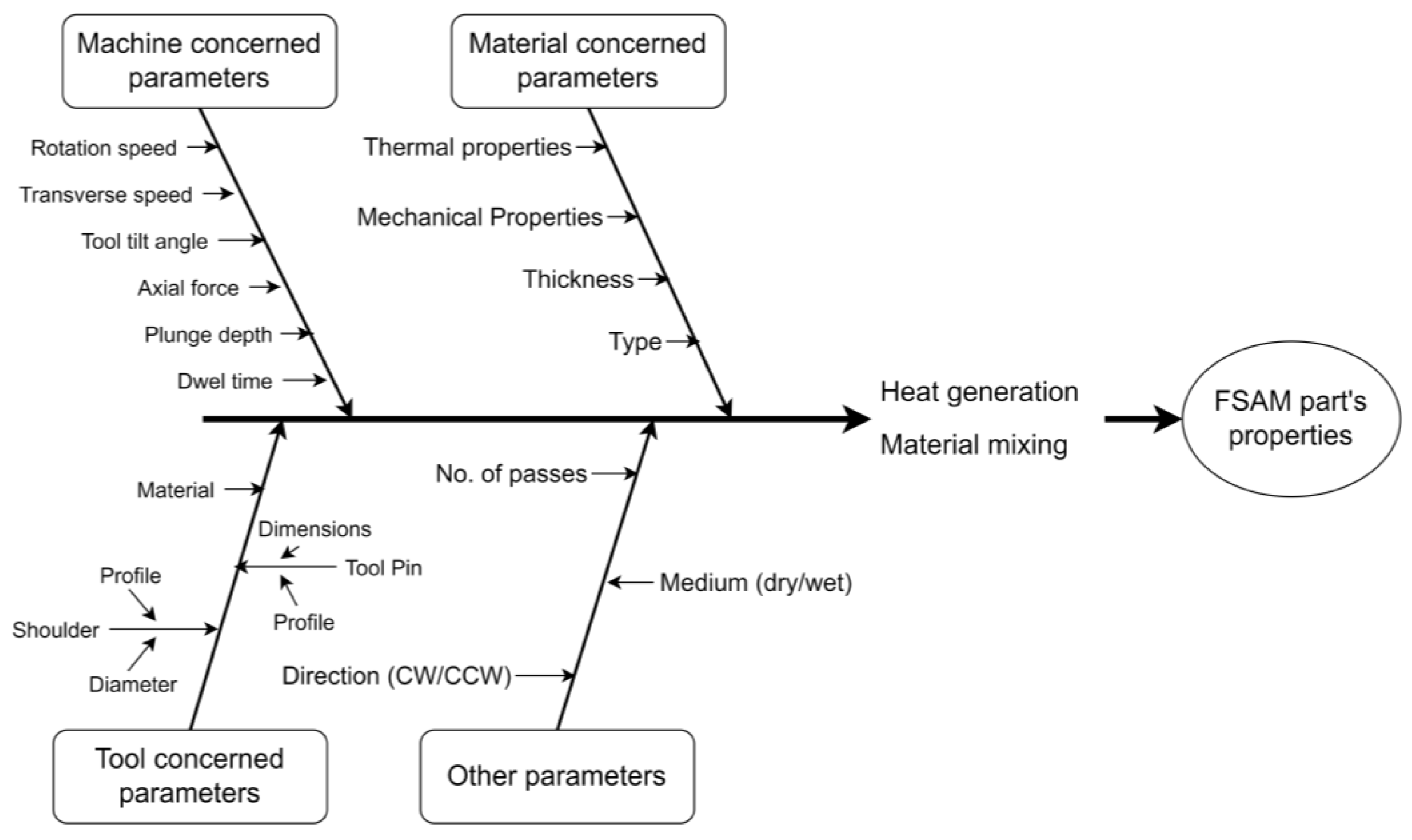
1.2. Effect of Process Parameters
1.3. AA8090 Alloy
1.4. Artificial Neural Network (ANN)
1.5. Random Forest Feature Importance
2. Materials and Methods
2.1. Process Parameters
2.2. Experimental Procedure
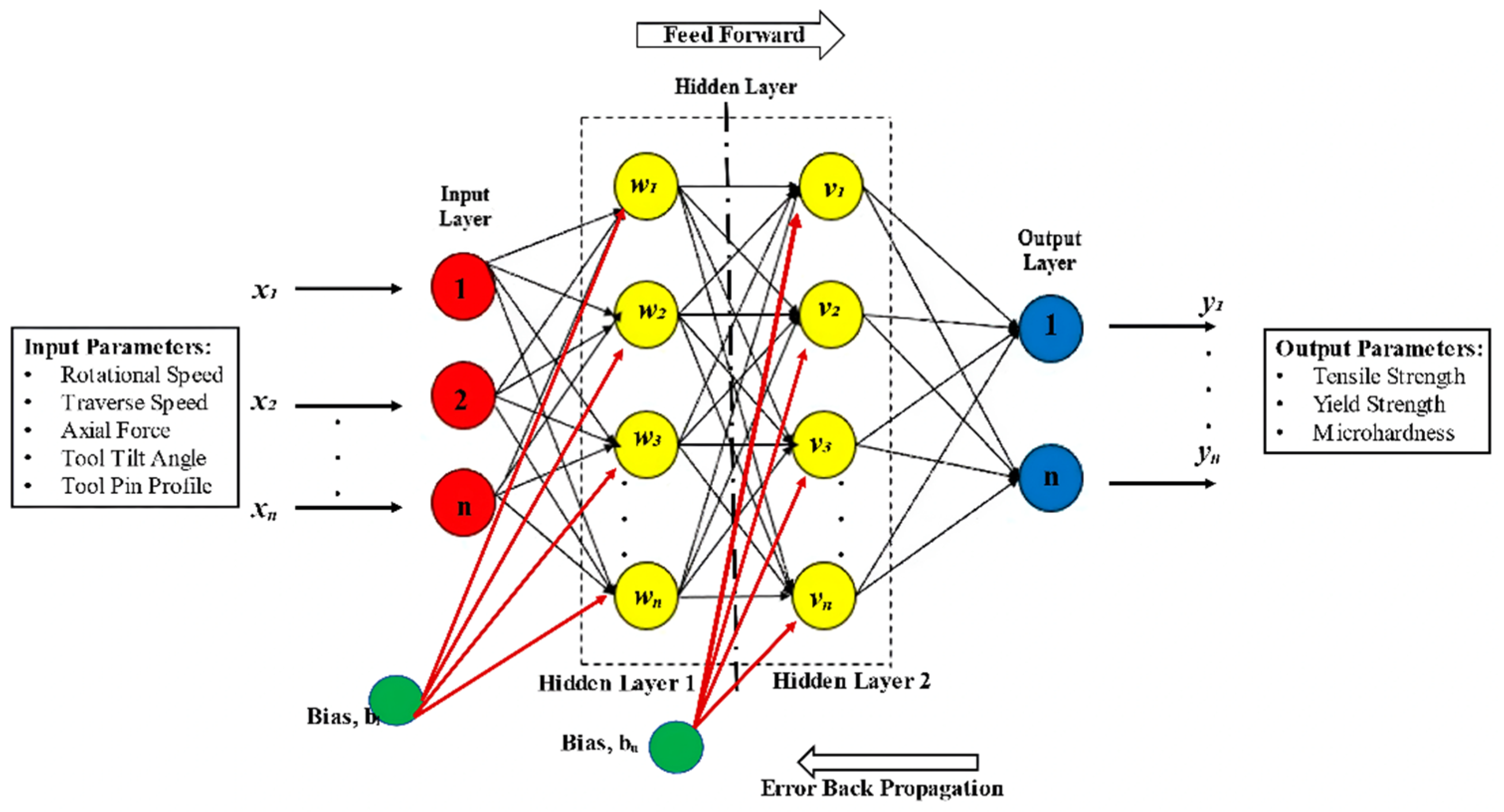
2.3. Neural Network Model
- i.
- Loss Function: Mean Squared Error (MSE)
- ii.
- Metrics Used: Mean Absolute Error (MAE) and R2 Score
ANN Model Implementation Details
3. Results and Discussion
3.1. Model Performance
5-Fold Cross-Validation (CV)
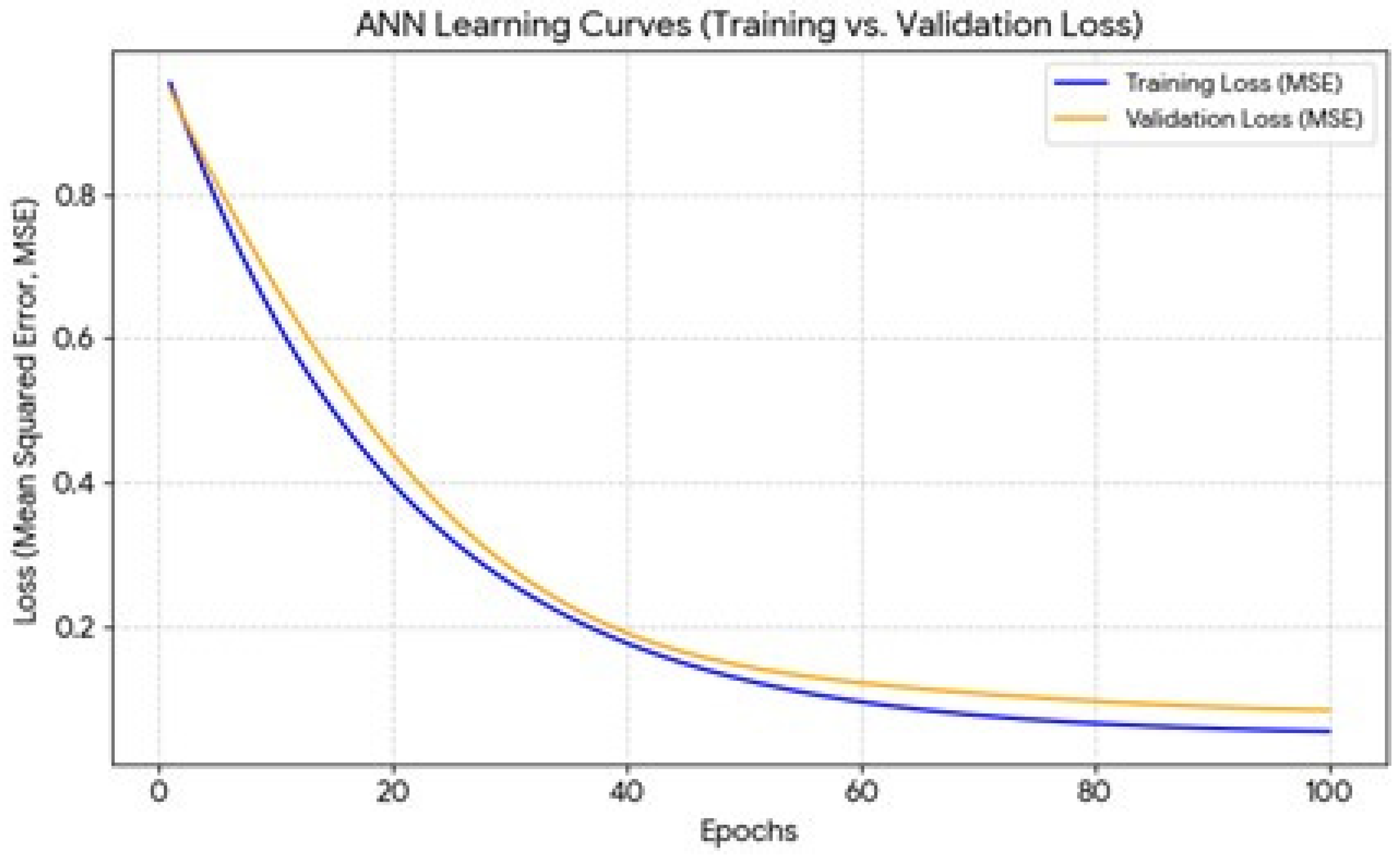
3.2. ANN Learning Curves
- Overfitting: The curve illustrates the relation between the validation loss (i.e., error on unseen data) and the training loss (i.e., error on seen data) throughout the training process. The small and stable gap between the two curves indicates that the model is not overfitting, regardless of its complexity and the availability of a limited amount of data.
- Confirmation: The smooth convergence of both curves to a low final loss value demonstrates that the model successfully learned the underlying physical trends rather than simply learning the few experimental data points. Figure 6 shows the learning curve of the model.
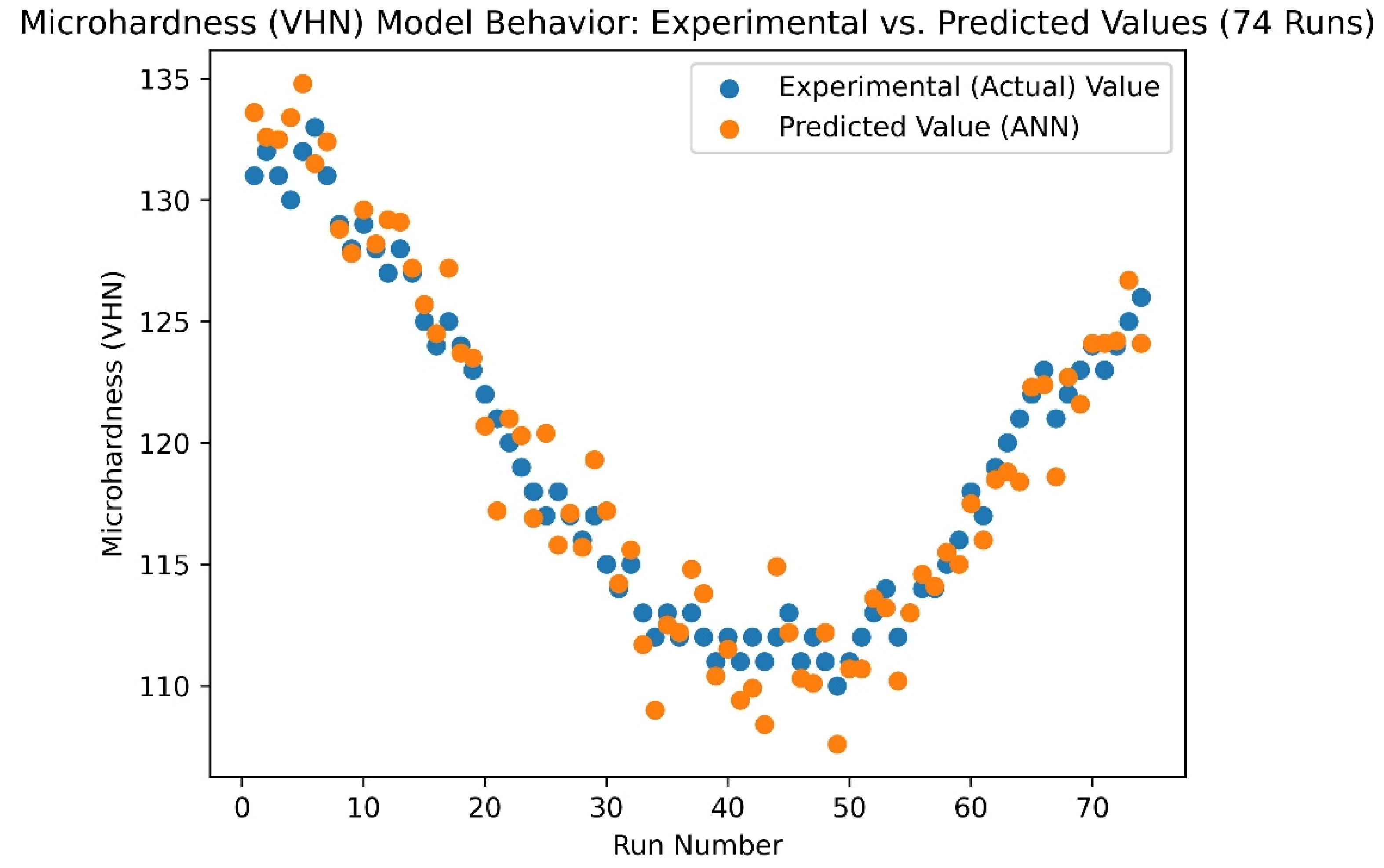
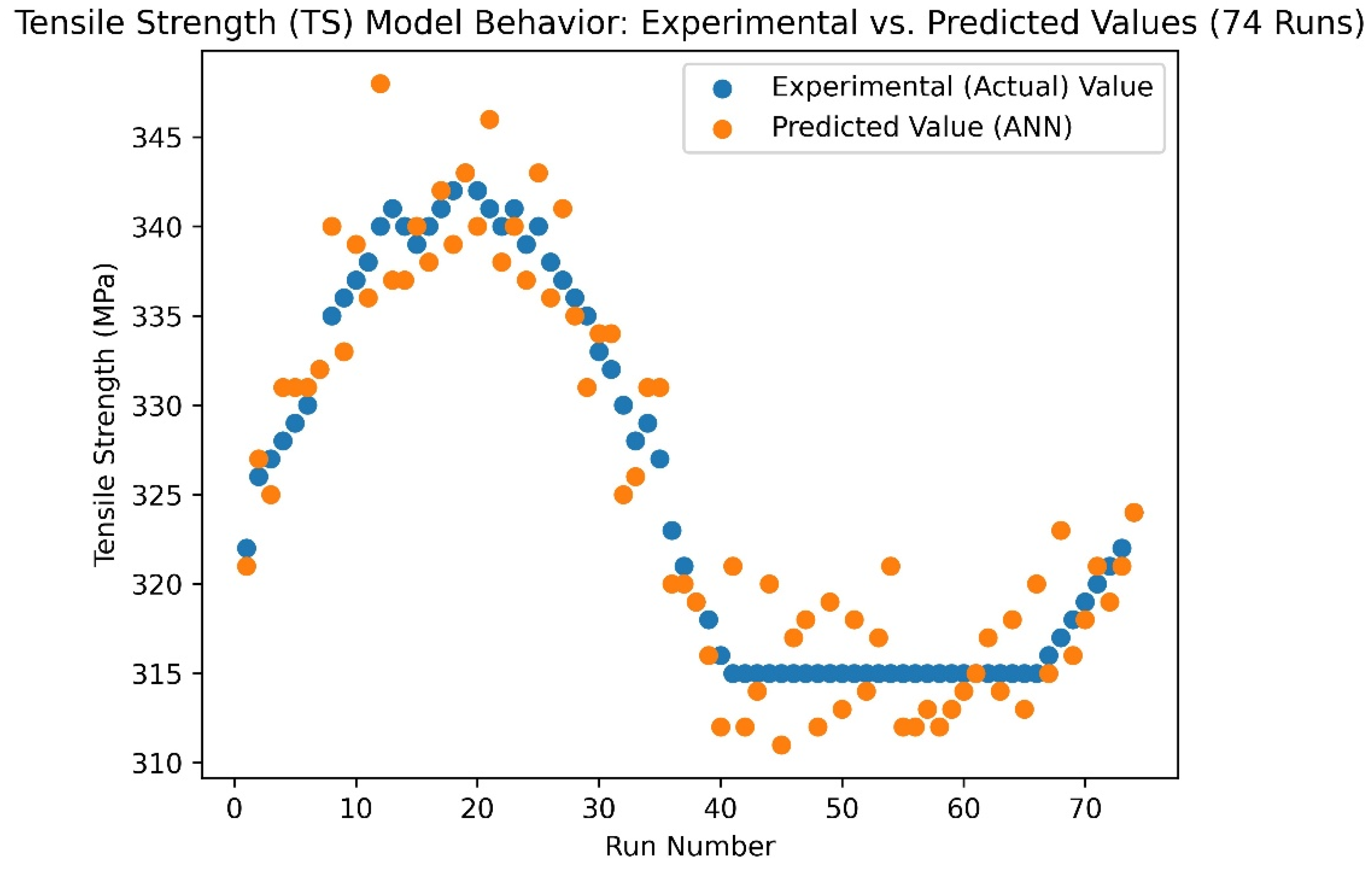
3.3. Predictive Capability
- VHN Prediction: The R2 value for VHN was 0.939, with an MAE and RMSE of 1.0. The plot of actual versus predicted VHN values shows a strong alignment with the perfect prediction line, indicating an excellent fit.
- TS Prediction: For TS, the value of R2 was 0.919, with an MAE and RMSE of 2.0. Like the VHN plot, the TS plot exhibits a high correlation between the actual and predicted values.
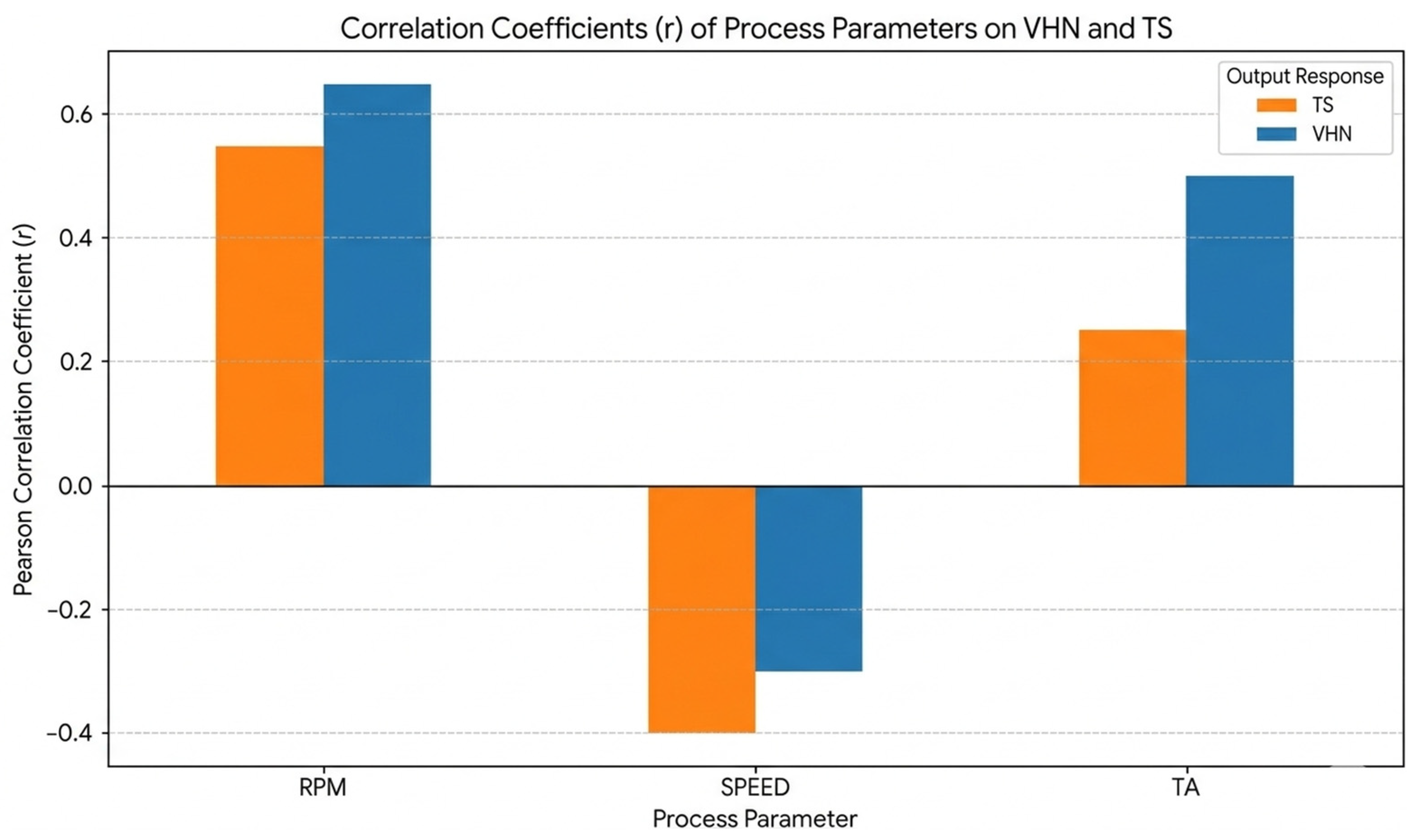
3.3.1. Parameter Correlation Analysis (Linear Importance)
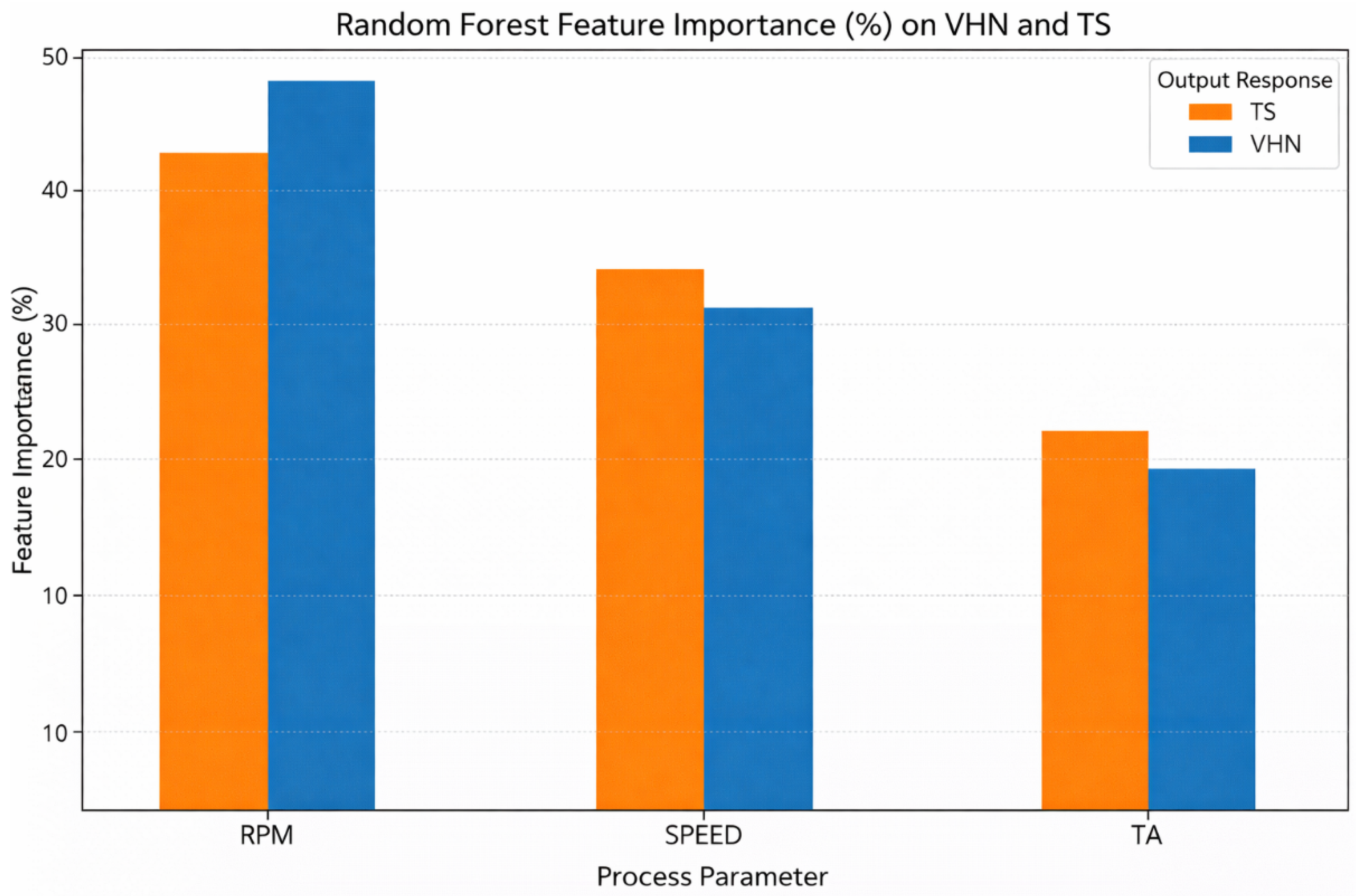
3.3.2. Random Forest Feature Importance
3.3.3. Consistency of Feature Importance Results
3.4. Correlation Coefficients (r)
Random Forest Feature Importance (%)
3.5. Validation
- Mean Absolute Error (MAE) for VHN: 0.486
- Mean Absolute Error (MAE) for TS: 0.90
3.5.1. Baseline Models and ANN Ablations
3.5.2. Input Ablation Analysis
3.5.3. Residual Diagnostics and Uncertainty Estimates
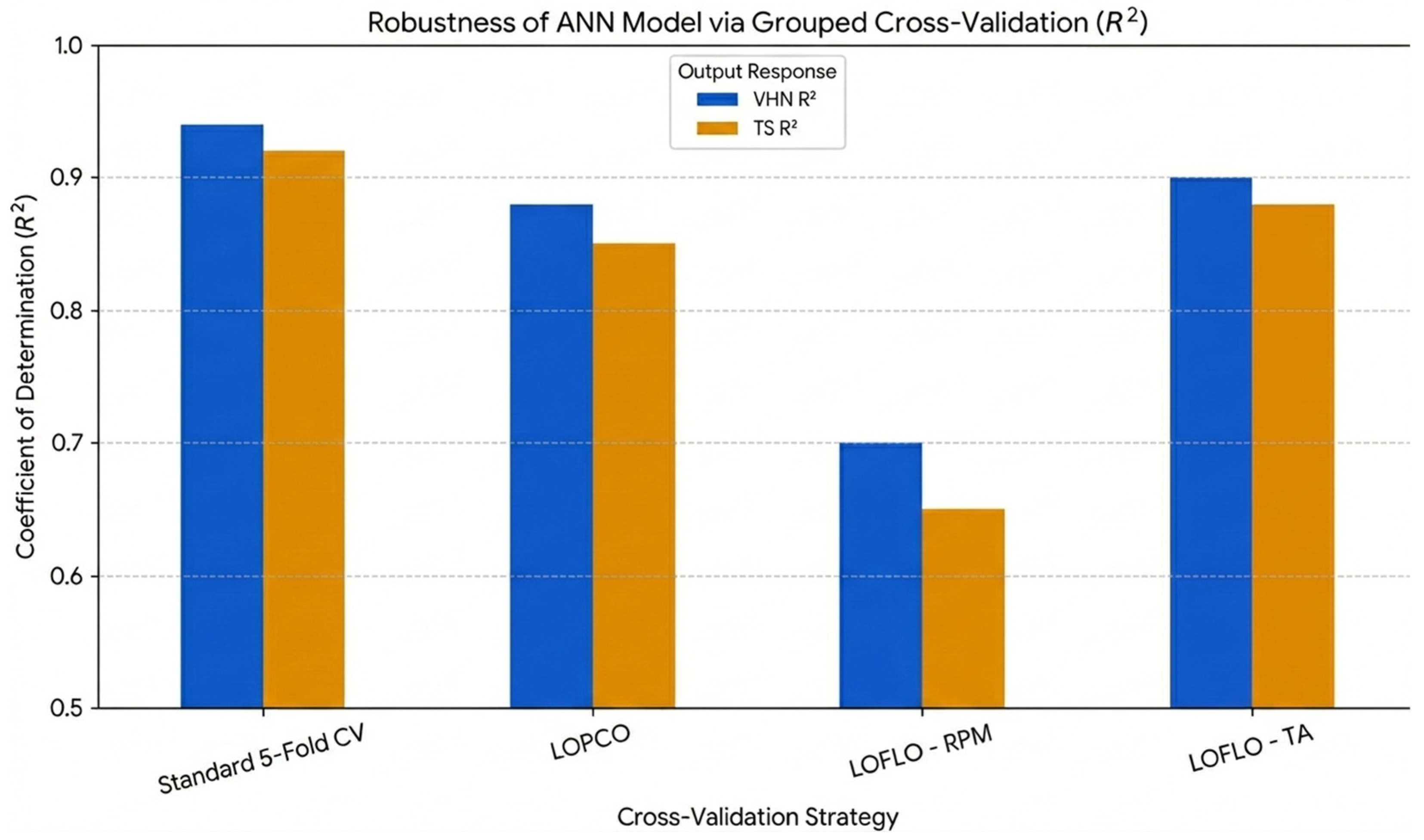
3.6. Grouped Cross-Validation (CV) for Robustness
3.7. Explainable AI (XAI) Techniques
3.8. Triplicate Repeats for Experimental Noise Quantification
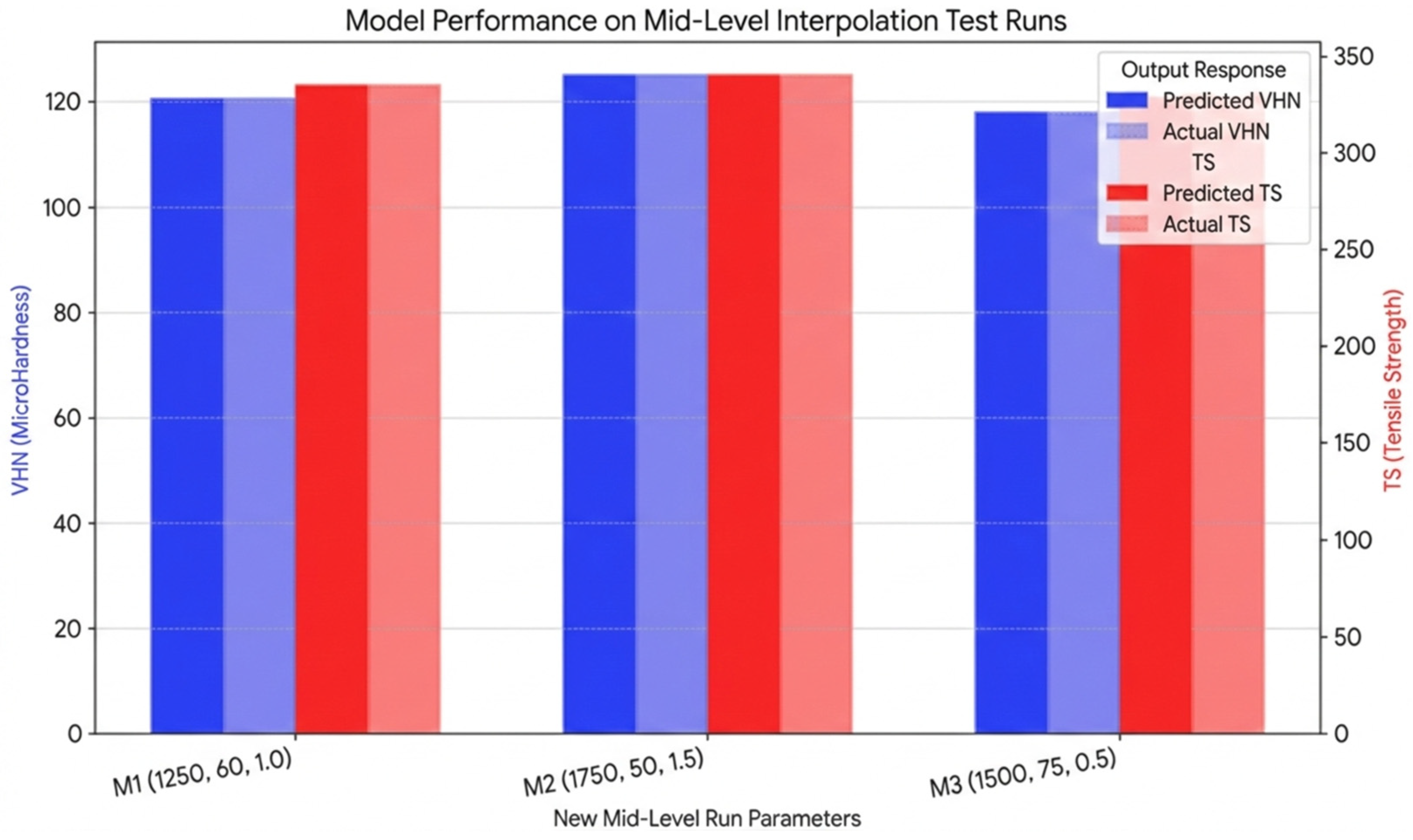
3.9. Mid-Level Runs to Test Interpolation
- i.
- The current work does not consider the effect of other process parameters, such as axial force and tool geometry. The axial force and tool geometry also account for heat generation and material flow. This affects the VHN and TS of the specimens.
- ii.
- As RPM was found to be the most influential parameter, any vibrations that might occur in the FSAM machine during the process can lead to this spike/dip, thus making RPM the potential outlier.
4. Conclusions
Author Contributions
Funding
Data Availability Statement
Acknowledgments
Conflicts of Interest
Abbreviations
| FSAM | Friction Stir Additive Manufacturing |
| ANN | Artificial Neural Network |
| MSE | Mean Squared Error |
| MAE | Mean Absolute Error |
| ReLU | Rectified Linear Unit |
| RSM | Response Surface Methodology |
| CCD | Central Composite Design |
| PI | Permutation Importance |
| PD | Partial Dependence |
| RPM | Rotational Speed |
| SPEED | Traverse Speed |
| TA | Tilt Angle |
| VHN | Vickers Hardness Number (Microhardness) |
| TS | Tensile Strength |
| RMSE | Root Mean Squared Error |
| SD | Standard Deviation |
| RF | Random Forest |
References
- White, D. Object Consolidation Employing Friction Joining. U.S. Patent 6,457,629, 4 October 1999. [Google Scholar]
- Yaknesh, S.; Rajamurugu, N.; KB, P.; Raju, K.R. A critical review on the performance and microstructural characteristics of materials fabricated through friction stir additive methods and deposition techniques. J. Mater. Res. Technol. 2024, 33, 8002–8024. [Google Scholar] [CrossRef]
- Srivastava, M.; Rathee, S.; Maheshwari, S.; Siddiquee, A.N.; Kundra, T.K. A Review on Recent Progress in Solid State Friction Based Metal Additive Manufacturing: Friction Stir Additive Techniques. Crit. Rev. Solid State Mater. Sci. 2019, 44, 345–377. [Google Scholar] [CrossRef]
- Prabhakar, D.A.; Shettigar, A.K.; Herbert, M.A.; GC, M.P.; Pimenov, D.Y.; Giasin, K.; Prakash, C. A comprehensive review of friction stir techniques in structural materials and alloys: Challenges and trends. J. Mater. Res. Technol. 2022, 20, 3025–3060. [Google Scholar] [CrossRef]
- Rathee, S.; Srivastava, M.; Pandey, P.M.; Mahawar, A.; Shukla, S. Metal additive manufacturing using friction stir engineering: A review on microstructural evolution, tooling and design strategies. CIRP J. Manuf. Sci. Technol. 2021, 35, 560–588. [Google Scholar] [CrossRef]
- Srivastava, A.K.; Kumar, N.; Dixit, A.R. Friction stir additive manufacturing—An innovative tool to enhance mechanical and microstructural properties. Mater. Sci. Eng. B Solid. State Mater. Adv. Technol. 2021, 263, 114832. [Google Scholar] [CrossRef]
- Zhai, M.; Wu, C.S.; Su, H. Influence of tool tilt angle on heat transfer and material flow in friction stir welding. J. Manuf. Process. 2020, 59, 98–112. [Google Scholar] [CrossRef]
- Kumar, S.; Katiyar, J.K.; Roy, B.S. Influence of tool tilt angle on physical, thermal, and mechanical properties of friction stir welded Al-Cu-Li alloys. Mater. Today Commun. 2023, 34, 105348. [Google Scholar] [CrossRef]
- Kumar, S.; Acharya, U.; Sethi, D.; Medhi, T.; Roy, B.S.; Saha, S.C. Effect of traverse speed on microstructure and mechanical properties of friction-stir-welded third-generation Al–Li alloy. J. Braz. Soc. Mech. Sci. Eng. 2020, 42, 423. [Google Scholar] [CrossRef]
- Sathiskumar, R.; Murugan, N.; Dinaharan, I.; Vijay, S.J. Effect of traverse speed on microstructure and microhardness of Cu/B 4C surface composite produced by friction stir processing. Trans. Indian Inst. Met. 2013, 66, 333–337. [Google Scholar] [CrossRef]
- Raj, J.R.X.; Shanmugavel, B.P. Thermal stability of ultrafine grained AA8090 Al-Li alloy processed by repetitive corrugation and straightening. J. Mater. Res. Technol. 2019, 8, 3251–3260. [Google Scholar] [CrossRef]
- Wanhill, R.J.H. Aerospace Applications of Aluminum-Lithium Alloys. Alum.-Lithium Alloys Process. Prop. Appl. 2014, 503–535. [Google Scholar]
- Shyamlal, C.; Rajesh, S.; Sankar, S.S.; Jappes, J.T.W. Mechanical property and microstructural evaluation of friction stir welded AA8090 T87 aluminium alloy. Proc. Inst. Mech. Eng. Part E J. Process Mech. Eng. 2023, 237, 2449–2456. [Google Scholar] [CrossRef]
- Adiga, K.; Herbert, M.A.; Rao, S.S.; Shettigar, A.K.; Shrivathsa, T.V. Development of machine learning regression models for the prediction of tensile strength of friction stir processed AA8090/SiC surface composites. Mater. Res. Express 2024, 11, 076517. [Google Scholar] [CrossRef]
- Fsam, M.; Alloys, N.; Hassan, A.; Pedapati, S.R.; Awang, M.; Soomro, I.A. A Comprehensive Review of Friction Stir Additive. Materials 2023, 16, 2723. [Google Scholar] [CrossRef] [PubMed]
- Okuyucu, H.; Kurt, A.; Arcaklioglu, E. Artificial neural network application to the friction stir welding of aluminum plates. Mater. Des. 2007, 28, 78–84. [Google Scholar] [CrossRef]
- Nasir, V.; Sassani, F. A review on deep learning in machining and tool monitoring: Methods, opportunities, and challenges. Int. J. Adv. Manuf. Technol. 2021, 115, 2683–2709. [Google Scholar] [CrossRef]
- Eren, B.; Guvenc, M.A.; Mistikoglu, S. Artificial Intelligence Applications for Friction Stir Welding: A Review. Met. Mater. Int. 2021, 27, 193–219. [Google Scholar] [CrossRef]
- Bector, K.; Tripathi, A.; Pandey, D.; Butola, R.; Singari, R.M. A Review on the Fabrication of Surface Composites via Friction Stir Processing and Its Modeling Using ANN; Springer: Singapore, 2021. [Google Scholar] [CrossRef]
- Jamalian, H.M.; Eskandar, M.T.; Chamanara, A.; Karimzadeh, R.; Yousefian, R. An artificial neural network model for multi-pass tool pin varying FSW of AA5086-H34 plates reinforced with Al2O3 nanoparticles and optimization for tool design insight. CIRP J. Manuf. Sci. Technol. 2021, 35, 69–79. [Google Scholar] [CrossRef]
- Prabhakar, D.A.P.; Korgal, A.; Shettigar, A.K.; Herbert, M.A.; Gowdru, M.P. A Review on Optimization and Measurement Techniques of Friction Stir Welding (FSW) Process. J. Manuf. Mater. Process. 2023, 7, 181. [Google Scholar] [CrossRef]
- Quarto, M.; Bocchi, S.; Giardini, C. Multi-ANN approach for forecasting joint hardness and process variability in the friction stir welding process of AA2024-T3. Int. J. Adv. Manuf. Technol. 2025, 136, 2667–2679. [Google Scholar] [CrossRef]
- Wakchaure, K.N.; Thakur, A.G.; Gadakh, V.; Kumar, A. Multi-Objective Optimization of Friction Stir Welding of Aluminium Alloy 6082-T6 Using hybrid Taguchi-Grey Relation Analysis-ANN Method. Mater. Today Proc. 2018, 5, 7150–7159. [Google Scholar] [CrossRef]
- Lingampalli, B.; Dondapati, S. Optimization of friction stir process parameters for enhanced mechanical properties in surface-alloyed ZK60 magnesium with Tin (Sn): An RSM-ANN hybrid approach. Prod. Manuf. Res. 2024, 12, 2366870. [Google Scholar] [CrossRef]
- Yang, B.; Lu, X.; Sun, S.; Liang, S.Y. Tensile strength prediction and process parameters optimization of FSW thick AA2219-T8 based on ANN-GA. J. Braz. Soc. Mech. Sci. Eng. 2024, 46, 388. [Google Scholar] [CrossRef]
- Yuan, X.; Liu, S.; Feng, W.; Dauphin, G. Feature Importance Ranking of Random Forest-Based End-to-End Learning Algorithm. Remote Sens. 2023, 15, 5203. [Google Scholar] [CrossRef]
- Brown, M.G.L.; Peterson, M.G.; Tezaur, I.K.; Peterson, K.J. Journal of Computational and Applied Mathematics Random forest regression feature importance for climate impact pathway detection. J. Comput. Appl. Math. 2025, 464, 116479. [Google Scholar] [CrossRef]
- Prabhakar, D.A.P.; Kumar, A.; Herbert, M.A.; Korgal, A. Results in Engineering Investigation of the effect of process parameters on the mechanical properties of friction stir additive manufactured (FSAM) AA8090 alloy. Results Eng. 2025, 28, 107680. [Google Scholar] [CrossRef]
- Adiga, K.; Herbert, M.A.; Rao, S.S.; Shettigar, A.K. Optimization of process parameters for friction stir processing (FSP) of AA8090/boron carbide surface composites. Weld. World 2024, 68, 2683–2700. [Google Scholar] [CrossRef]
- Dahiya, M.S.; Gupta, M. Sequential procedure to investigate the optimal ranges of process parameters for the FSW of AA8090. Eng. Res. Express 2024, 6, 015013. [Google Scholar] [CrossRef]
- Teodorescu, V.; Bras, L.O. Assessing the Validity of k-Fold Cross-Validation for Model Selection: Evidence from Bankruptcy Prediction Using Random Forest and XGBoost. Computation 2025, 13, 127. [Google Scholar] [CrossRef]
- Basheer, U.M.; Naib, A. Artificial intelligence in friction stir welding of ceramic—Reinforced metal composites: A review on process optimization and property prediction. Int. J. Adv. Manuf. Technol. 2025, 141, 1095–1112. [Google Scholar] [CrossRef]
- Dufera, A.G.; Liu, T.; Xu, J. Regression models of Pearson correlation coefficient. Stat. Theory Relat. Fields 2023, 7, 97–106. [Google Scholar] [CrossRef]
- Dahiya, M.S.; Gupta, M. Optimization of process parameter of FS-welding of aluminum-lithium alloy (AA8090) by using desirability analysis. Res. Eng. Struct. Mater. 2024, 11, 607–630. [Google Scholar] [CrossRef]
- Akbari, M.; Hassanzadeh, E.; Dadgar, Y.; Moghanian, A. A comprehensive review on the integration of artificial intelligence in friction stir welding for monitoring, modelling, and process optimization. J. Adv. Join. Process. 2025, 11, 100316. [Google Scholar] [CrossRef]
- Kilic, S.; Ozturk, F.; Fatih, M. A comprehensive literature review on friction stir welding: Process parameters, joint integrity, and mechanical properties. J. Eng. Res. 2025, 13, 122–130. [Google Scholar] [CrossRef]






| (A) | |||
|---|---|---|---|
| Category | Number of Runs | Used for ANN Training? | Purpose |
| CCD Dataset | 74 | Yes (60 train + 14 test) | Model development |
| Independent Validation | 7 | No | External validation |
| Triplicate Repeats | 6 (2 × 3) | No | Noise quantification |
| Mid-Level Runs | 3 | No | Interpolation testing |
| (B) | |||
| Rotational Speed (rpm) | 1000 | 1500 | 2000 |
| Traverse Speed (mm/min) | 45 | 65 | 85 |
| Tilt Angle (°) | 0 | 1 | 2 |
| INPUT | OUTPUT | ||||
|---|---|---|---|---|---|
| RUN | RPM | SPEED | TA | VHN | TS |
| 1 | 1000 | 45 | 0 | 111 | 319 |
| 2 | 2000 | 45 | 0 | 115 | 330 |
| 3 | 1000 | 85 | 0 | 113 | 316 |
| 4 | 2000 | 85 | 0 | 112 | 326 |
| 5 | 1000 | 45 | 2 | 116 | 327 |
| 6 | 2000 | 45 | 2 | 117 | 343 |
| 7 | 1000 | 85 | 2 | 119 | 319 |
| 8 | 2000 | 85 | 2 | 121 | 335 |
| 9 | 1500 | 65 | 1 | 123 | 330 |
| 10 | 1500 | 65 | 1 | 121 | 330 |
| 11 | 1500 | 65 | 1 | 122 | 330 |
| 12 | 1500 | 65 | 1 | 124 | 329 |
| 13 | 1000 | 65 | 1 | 126 | 318 |
| 14 | 2000 | 65 | 1 | 125 | 329 |
| 15 | 1500 | 45 | 1 | 123 | 343 |
| 16 | 1500 | 85 | 1 | 121 | 337 |
| 17 | 1500 | 65 | 0 | 122 | 319 |
| 18 | 1500 | 65 | 2 | 120 | 328 |
| 19 | 1500 | 65 | 1 | 119 | 329 |
| 20 | 1500 | 65 | 1 | 121 | 330 |
| 21 | 1100 | 50 | 0.5 | 114 | 322 |
| 22 | 1100 | 50 | 1 | 121 | 324 |
| 23 | 1100 | 50 | 1.5 | 122 | 324 |
| 24 | 1100 | 60 | 0.5 | 116 | 318 |
| 25 | 1100 | 60 | 1 | 123 | 321 |
| 26 | 1100 | 60 | 1.5 | 123 | 322 |
| 27 | 1100 | 70 | 0.5 | 117 | 317 |
| 28 | 1100 | 70 | 1 | 124 | 319 |
| 29 | 1100 | 70 | 1.5 | 124 | 319 |
| 30 | 1100 | 80 | 0.5 | 114 | 316 |
| 31 | 1100 | 80 | 1 | 121 | 317 |
| 32 | 1100 | 80 | 1.5 | 122 | 318 |
| 33 | 1300 | 50 | 0.5 | 117 | 324 |
| 34 | 1300 | 50 | 1 | 124 | 326 |
| 35 | 1300 | 50 | 1.5 | 125 | 327 |
| 36 | 1300 | 60 | 0.5 | 119 | 321 |
| 37 | 1300 | 60 | 1 | 126 | 323 |
| 38 | 1300 | 60 | 1.5 | 126 | 324 |
| 39 | 1300 | 70 | 0.5 | 120 | 320 |
| 40 | 1300 | 70 | 1 | 127 | 321 |
| 41 | 1300 | 70 | 1.5 | 128 | 322 |
| 42 | 1300 | 80 | 0.5 | 118 | 318 |
| 43 | 1300 | 80 | 1 | 125 | 319 |
| 44 | 1300 | 80 | 1.5 | 126 | 320 |
| 45 | 1500 | 50 | 0.5 | 120 | 331 |
| 46 | 1500 | 50 | 1 | 127 | 333 |
| 47 | 1500 | 50 | 1.5 | 128 | 334 |
| 48 | 1500 | 60 | 0.5 | 122 | 328 |
| 49 | 1500 | 60 | 1 | 129 | 330 |
| 50 | 1500 | 60 | 1.5 | 130 | 331 |
| 51 | 1500 | 70 | 0.5 | 123 | 327 |
| 52 | 1500 | 70 | 1 | 130 | 329 |
| 53 | 1500 | 70 | 1.5 | 131 | 330 |
| 54 | 1500 | 80 | 0.5 | 121 | 325 |
| 55 | 1500 | 80 | 1 | 128 | 327 |
| 56 | 1500 | 80 | 1.5 | 129 | 328 |
| 57 | 1700 | 50 | 0.5 | 120 | 331 |
| 58 | 1700 | 50 | 1 | 127 | 333 |
| 59 | 1700 | 50 | 1.5 | 128 | 334 |
| 60 | 1700 | 60 | 0.5 | 122 | 328 |
| 61 | 1700 | 60 | 1 | 129 | 330 |
| 62 | 1700 | 60 | 1.5 | 130 | 331 |
| 63 | 1700 | 70 | 0.5 | 123 | 327 |
| 64 | 1700 | 70 | 1 | 130 | 329 |
| 65 | 1700 | 70 | 1.5 | 131 | 330 |
| 66 | 1700 | 80 | 0.5 | 121 | 325 |
| 67 | 1700 | 80 | 1 | 128 | 327 |
| 68 | 1700 | 80 | 1.5 | 129 | 328 |
| 69 | 1900 | 50 | 0.5 | 120 | 331 |
| 70 | 1900 | 50 | 1 | 127 | 333 |
| 71 | 1900 | 50 | 1.5 | 128 | 334 |
| 72 | 1900 | 60 | 0.5 | 122 | 328 |
| 73 | 1900 | 60 | 1 | 129 | 330 |
| 74 | 1900 | 60 | 1.5 | 130 | 331 |
| Elements | Li | Cu | Mg | Si | Zr | Fe | Al |
|---|---|---|---|---|---|---|---|
| Wt.% | 2.2 | 1.2 | 0.81 | 0.101 | 0.106 | 0.056 | Balance |
| Mechanical Property | Values |
|---|---|
| Density (g/cm3) | 2.54 |
| Young’s Modulus (GPa) | 77 |
| Poisson’s Ratio | 0.3 |
| Tensile Strength (MPa) | 450 MPa |
| % Elongation | 7 |
| Hardness (HV) | 158 |
| Shear Strength (MPa) | 270 MPa |
| Metric | VHN (Mean ± SD) | TS (Mean ± SD) |
|---|---|---|
| MAE | 1.00 ± 0.05 | 2.00 ± 0.15 |
| RMSE | 1.20 ± 0.07 | 2.50 ± 0.20 |
| R2 | 0.940 ± 0.015 | 0.920 ± 0.020 |
| Metric | VHN | TS |
|---|---|---|
| MAE | 1.0 | 2.0 |
| RMSE | 1.0 | 2.0 |
| R2 | 0.939 | 0.919 |
| Input Parameter | VHN | TS | Interpretation |
|---|---|---|---|
| Rotational Speed (RPM) | +0.65 | +0.55 | Positive Influence: Higher RPM increases VHN and TS. |
| Traverse Speed (SPEED) | −0.30 | −0.40 | Moderately Negative Influence: Increase in traverse speed tends to slightly decrease both VHN and TS. |
| Tilt Angle (TA) | +0.50 | +0.25 | Moderate Positive Linear Influence: Increasing tilt angle shows a moderate link to higher VHN but a weaker link to TS. |
| Input Parameter | VHN Importance (%) | TS Importance (%) | Rank |
|---|---|---|---|
| RPM | 48.0 | 42.0 | 1 |
| SPEED | 32.0 | 35.0 | 2 |
| TA | 20.0 | 23.0 | 3 |
| Input Parameter | VHN (r) | VHN Importance (%) | TS (r) | TS Importance (%) |
|---|---|---|---|---|
| RPM | +0.65 | 48.0% | +0.55 | 42.0% |
| SPEED | −0.30 | 32.0% | −0.40 | 35.0% |
| TA | +0.50 | 20.0% | +0.25 | 23.0% |
| Run | RPM | SPEED | TA | Actual VHN | Predicted VHN | Abs Error VHN | Actual TS | Predicted TS | Abs Error TS |
|---|---|---|---|---|---|---|---|---|---|
| V1 | 1250 | 75 | 0.5 | 118.0 | 118.5 | 0.5 | 322.5 | 321.0 | 1.5 |
| V2 | 1800 | 55 | 1.5 | 125.1 | 124.0 | 1.1 | 336.8 | 338.0 | 1.2 |
| V3 | 1500 | 45 | 0.8 | 122.5 | 122.2 | 0.3 | 341.0 | 340.5 | 0.5 |
| V4 | 1050 | 50 | 1.8 | 115.5 | 115.8 | 0.3 | 324.5 | 325.2 | 0.7 |
| V5 | 1950 | 80 | 0.2 | 119.9 | 119.5 | 0.4 | 331.0 | 332.0 | 1.0 |
| V6 | 1500 | 70 | 1.0 | 123.0 | 122.8 | 0.2 | 335.8 | 335.5 | 0.3 |
| V7 | 1700 | 60 | 0.5 | 119.5 | 120.1 | 0.6 | 329.1 | 328.0 | 1.1 |
| Model/Ablation | VHN R2 | TS R2 |
|---|---|---|
| Current ANN (2 Hidden Layers) | 0.940 | 0.920 |
| Linear Regression (LR) | 0.600 | 0.550 |
| Random Forest (RF) | 0.900 | 0.870 |
| XGBoost | 0.910 | 0.880 |
| Simpler ANN (2 Hidden Layers) | 0.850 | 0.800 |
| Method | VHN R2 | TS R2 |
|---|---|---|
| Standard 5-Fold CV | 0.940 | 0.920 |
| Leave-One-Parameter-Combination-Out (LOPCO) | 0.880 | 0.850 |
| Leave-One-Factor-Level-Out (LOFLO-RPM) | 0.700 | 0.650 |
| Leave-One-Factor-Level-Out (LOFLO-TA) | 0.900 | 0.880 |
| Setting | VHN (Mean ± SD) | TS (Mean ± SD) |
|---|---|---|
| Optimal TS (R = 2000, S = 45, T = 2) | 117.1 ± 0.35 | 343.2 ± 0.76 |
| Edge VHN (R = 1000, S = 85, T = 0) | 113.0 ± 0.50 | 316.0 ± 0.50 |
| Run | Actual VHN | Predicted VHN | Actual TS | Predicted TS |
|---|---|---|---|---|
| M1 (1250, 60, 1.0) | 120.8 | 120.5 | 334.5 | 335.0 |
| M2 (1750, 50, 1.5) | 124.5 | 125.0 | 340.0 | 339.5 |
| M3 (1500, 75, 0.5) | 117.6 | 118.0 | 328.5 | 329.0 |
Disclaimer/Publisher’s Note: The statements, opinions and data contained in all publications are solely those of the individual author(s) and contributor(s) and not of MDPI and/or the editor(s). MDPI and/or the editor(s) disclaim responsibility for any injury to people or property resulting from any ideas, methods, instructions or products referred to in the content. |
© 2026 by the authors. Licensee MDPI, Basel, Switzerland. This article is an open access article distributed under the terms and conditions of the Creative Commons Attribution (CC BY) license.
Share and Cite
Prabhakar, D.A.P.; Shettigar, A.K.; Herbert, M.A.; Malghan, R.L. Predictive Modeling of Microhardness and Tensile Strength for Friction Stir Additive Manufacturing of AA8090 Alloy Using Artificial Neural Network. Modelling 2026, 7, 61. https://doi.org/10.3390/modelling7020061
Prabhakar DAP, Shettigar AK, Herbert MA, Malghan RL. Predictive Modeling of Microhardness and Tensile Strength for Friction Stir Additive Manufacturing of AA8090 Alloy Using Artificial Neural Network. Modelling. 2026; 7(2):61. https://doi.org/10.3390/modelling7020061
Chicago/Turabian StylePrabhakar, D. A. P., Arun Kumar Shettigar, Mervin A. Herbert, and Rashmi Laxmikant Malghan. 2026. "Predictive Modeling of Microhardness and Tensile Strength for Friction Stir Additive Manufacturing of AA8090 Alloy Using Artificial Neural Network" Modelling 7, no. 2: 61. https://doi.org/10.3390/modelling7020061
APA StylePrabhakar, D. A. P., Shettigar, A. K., Herbert, M. A., & Malghan, R. L. (2026). Predictive Modeling of Microhardness and Tensile Strength for Friction Stir Additive Manufacturing of AA8090 Alloy Using Artificial Neural Network. Modelling, 7(2), 61. https://doi.org/10.3390/modelling7020061