1. Introduction
Digital elevation models (DEMs) are a fundamental tool in geoscience, civil engineering, hydrology, and geomatics among other sciences. They provide a continuous representation of the terrain surface and serve as the basis for slope analysis and the planning of engineering works. The accuracy and smoothness of the DEM strongly depend on the interpolation technique used to transform the discrete set of elevation measurements into a continuous surface. The choice of interpolation method is therefore crucial for ensuring the reliability of any subsequent spatial or numerical analysis.
Traditional interpolation methods such as inverse distance weighting [
1], kriging [
2,
3], or spline-based techniques [
4,
5,
6] can provide acceptable results for well-distributed datasets, but they often face limitations when the data are irregularly spaced or when the terrain exhibits complex gradients [
7,
8]. Radial basis functions (RBFs) [
9] have also been widely used for smooth surface reconstruction due to their mathematical flexibility and mesh-free nature, but their performance is strongly influenced by the choice of kernel and support radius, which limits their stability for large datasets.
More recently, data-driven approaches, particularly those based on machine learning, have also been explored for DEM interpolation and surface reconstruction. In particular, convolutional neural networks and multi-scale learning architectures have been employed to infer elevation fields from sparse or irregularly sampled data [
10,
11]. These methods often achieve high predictive accuracy when large training datasets are available, but they typically require extensive training, lack an explicit variational or physical interpretation, and offer limited control over smoothness or boundary behaviour, which can be critical in engineering-oriented applications.
In such cases, physically inspired or variational approaches offer a powerful alternative, as they guarantee smoothness by minimizing an energy functional rather than relying purely on geometric fitting. The Finite Element Method (FEM) provides a convenient computational framework for this type of approach [
12].
In a previous study [
13], the terrain surface was reconstructed using the FEM formulation of the thin-plate bending problem. That methodology was based on the Kirchhoff–Love theory and led to a biharmonic partial differential equation, which was solved using standard FEM shell elements. The resulting surfaces exhibited a high degree of smoothness and continuity, particularly in terms of curvature, but the computational cost was relatively high due to the large number of degrees of freedom required to represent bending effects. Moreover, the biharmonic formulation involves fourth-order derivatives, which impose stricter requirements on the continuity of the interpolation functions.
From the above review, it can be observed that existing approaches to DEM generation can be broadly classified into interpolation-based methods, such as kriging, splines, and RBFs, and variational or physically inspired formulations, including thin-plate models and Poisson-based surface reconstruction techniques. While several studies have employed the Poisson equation for three-dimensional surface reconstruction from oriented point clouds, these approaches are fundamentally volumetric and differ in both formulation and objective from planar DEM interpolation. Indirectly related works, including data-driven and machine-learning-based methods, further highlight the diversity of available strategies, but typically lack an explicit variational interpretation or direct integration within FEM frameworks. In this context, the present work addresses a gap in the literature by formulating DEM reconstruction as a constrained harmonic problem solved directly by the finite element method on scattered planar data.
In the present work, a different FEM-based methodology is proposed for the same purpose, using the Poisson equation as the governing model. This formulation reduces the order of the governing equation from fourth to second, significantly decreasing the number of degrees of freedom and improving computational efficiency without compromising the smoothness of the reconstructed surface. The use of standard triangular elements with first-order interpolation functions is sufficient to achieve accurate results.
Unlike previous Poisson-based methods for 3D surface reconstruction from point clouds [
14,
15], which use the Poisson equation to recover a closed surface from oriented points in three-dimensional space, the present formulation is strictly two-dimensional and designed for planar terrain interpolation. The unknown field represents the elevation, and the governing equation is interpreted as a harmonic interpolation model rather than a volumetric reconstruction. This distinction makes the proposed method computationally lighter, conceptually simpler, and directly applicable to DEM generation.
In addition to presenting the new Poisson-based FEM formulation, this work includes a comparison with two alternative surface reconstruction strategies: the previously published FEM model based on a variational formulation unrelated to the present Poisson approach, and a non-physical geometric method combining Radial Basis Function (RBF) interpolation with Non-Uniform Rational B-Splines (NURBS). The RBF–NURBS procedure generates a smooth surrogate surface from scattered data by first constructing a global RBF interpolant and then sampling it on a tensor-product grid suitable for NURBS interpolation. Although this approach can yield highly accurate surfaces under favourable sampling conditions, it lacks any underlying physical or variational principle, is sensitive to clustered or irregular point distributions, and requires solving dense linear systems together with an additional fitting step.
In addition to presenting the new Poisson-based FEM formulation, this work includes a comparison with two alternative surface reconstruction strategies: the previously published FEM model based on a variational formulation unrelated to the present Poisson approach, and a non-physical geometric method combining Radial Basis Function (RBF) interpolation with Non-Uniform Rational B-Splines (NURBS). The RBF–NURBS procedure generates a smooth surrogate surface from scattered data by first constructing a global RBF interpolant and subsequently fitting a NURBS surface to a sampled grid. It is important to emphasize that the introduction of the NURBS stage is not intended to improve the interpolation accuracy with respect to the original data points, as the RBF interpolation already provides an exact and smooth reconstruction. The role of the NURBS surface is instead to provide a compact and explicit parametric representation of the terrain, which is advantageous for geometry handling and integration within CAD and FEM workflows. While this two-stage approach can be effective under favourable sampling conditions, it lacks an underlying physical or variational principle, is sensitive to clustered or irregular point distributions, and requires solving dense linear systems together with an additional fitting step.
The three approaches differ fundamentally in their mathematical formulation, computational complexity, and type of smoothness achieved.
Table 1 summarises the main characteristics of each method considered in this study. The results demonstrate that the proposed Poisson-based FEM approach combines the simplicity of low-order interpolation with the global smoothness characteristic of variational formulations, offering a fast and physically consistent alternative for digital terrain modelling.
Since DEM resolution has a direct influence on hydrological and geomorphological simulations [
16], the ability to efficiently generate smooth and accurate elevation fields becomes essential. The proposed approach provides a robust and computationally efficient interpolation framework that integrates naturally within existing FEM environments.
The objective of this paper is therefore twofold: first, to present the theoretical formulation and implementation of the Poisson-based FEM method for terrain surface reconstruction; and second, to evaluate its performance against the previously developed thin-plate FEM model and a RBF-NURBS interpolation. The comparison is performed using both synthetic and real terrain datasets, allowing quantitative assessment in terms of accuracy, smoothness, and computational efficiency. The results demonstrate that the Poisson formulation provides a significant reduction in computational effort while maintaining the accuracy required for digital terrain modelling.
2. Methodology
2.1. Methodology Overview
The methodology proposed in this work aims to reconstruct a continuous terrain surface from a discrete set of elevation data by using the Finite Element Method as an interpolation framework. The approach treats the elevation field as a scalar variable defined over a two-dimensional computational domain representing the horizontal projection of the study area. The governing equation is derived from the Poisson problem, which enforces smoothness through a variational principle without assuming any specific physical behaviour of the terrain.
The process begins by defining the computational domain that encloses all available measurement points. This domain is discretized into a finite element mesh composed of triangular elements, which provides flexibility to represent irregular boundaries and to locally refine the resolution where the data density is higher. Each node of the mesh is associated with an unknown scalar variable representing the elevation to be estimated.
Known elevation points are introduced as boundary or internal constraints by prescribing their measured heights directly as nodal values. The remaining nodes are determined by solving the Poisson equation in steady state, ensuring that the resulting surface satisfies harmonic equilibrium and exhibits continuous slopes across the entire domain. The formulation naturally filters high-frequency noise and produces smooth interpolations even in areas with sparse or unevenly distributed data.
The overall procedure can be summarised as follows:
Definition of the domain. The boundary of the area of interest is established from the available topographic data or cartographic limits, defining the domain where the interpolation will be performed.
Mesh generation. The domain is discretised using triangular or quadrangular finite elements. Mesh density may be adapted according to terrain variability or point density to achieve an adequate balance between accuracy and computational efficiency.
Assignment of elevation data. The measured heights are imposed as Dirichlet boundary conditions at the corresponding nodal positions. Optional interior constraints can be added if additional elevation points are available within the domain.
Finite element analysis. The Poisson equation is solved under steady-state conditions using the FEM formulation presented in the next subsection. The solution provides the scalar field , which represents the interpolated elevations.
Surface reconstruction and export. The resulting field is interpreted as the continuous terrain surface and can be exported to GIS or CAD environments for visualisation or further analysis.
2.2. Poisson Formulation
In this work, the generation of a smooth continuous surface from a set of discrete elevation data is addressed by means of the Finite Element Method using a formulation based on the Poisson equation, as an alternative to the thin plate model previously described. The governing equation is mathematically equivalent to the steady-state heat conduction problem and therefore allows the use of thermal analysis capabilities already available in standard finite element method (FEM) software.
The physical analogy considers the surface to be a homogeneous isotropic medium where the variable of interest, denoted by
, represents a scalar potential analogous to temperature. The equilibrium of heat fluxes under steady-state conditions leads to the classical Poisson equation:
where
k is the isotropic conductivity coefficient (assumed constant and equal to 1 in this study), and
is a source term representing a distributed generation or absorption of heat. In the present study, the reconstruction is restricted to the homogeneous case
, for which Equation (
1) reduces to the Laplace equation. The resulting elevation field is therefore a harmonic function with continuous first derivatives. In the geometric context of surface generation, this property guarantees smooth transitions between known elevation points.
For clarity, the term “Poisson formulation” is used throughout the paper to denote the general methodological framework, while “Laplace equation” refers specifically to the homogeneous case considered in this study.
The strong form of the governing equation in the computational domain
with boundary
can thus be written as:
subject to appropriate boundary conditions:
where
and
denote the Dirichlet and Neumann portions of the boundary, respectively,
is the outward unit normal,
are prescribed temperatures, and
are imposed normal fluxes.
In the present application, the known elevation points are enforced as Dirichlet conditions by assigning the measured height
as temperature values
at the corresponding nodes of the finite element mesh. The remaining nodes are unconstrained, and their values are determined by solving Equations (
2)–(
4). The resulting scalar field
can therefore be interpreted as an interpolated surface satisfying the harmonic equilibrium. This configuration ensures that the interpolated field
passes exactly through the known elevations while maintaining continuous first derivatives across the domain.
It is important to emphasize that, since Dirichlet constraints are imposed at interior points of the domain and not only along its boundary, the resulting problem does not correspond to a classical boundary value problem for the Poisson equation. Instead, it can be interpreted as a constrained harmonic reconstruction, in which the solution is required to satisfy prescribed values at a discrete set of internal locations. In this setting, the finite element mesh serves as a numerical support for enforcing these internal constraints, while the external boundary remains subject to natural (homogeneous Neumann) conditions unless explicitly constrained by measurement points.
The weak (variational) form of Equation (
1) is obtained by multiplying by a weighting function
v and integrating over
:
This expression leads directly to the standard finite element formulation:
where
is the conductivity (stiffness) matrix assembled from the elemental contributions:
is the vector of nodal temperatures, and
is the load vector collecting the effects of the internal source term
Q and the boundary fluxes
.
The system (
6) is symmetric and positive definite, which allows the use of efficient linear solvers.
It should be noted that modelling the elevation field as a harmonic function implies an intrinsic regularization of the reconstructed surface. From a topographic perspective, this assumption is well suited to terrains characterized by smoothly varying slopes and the absence of sharp discontinuities, as the harmonic solution minimizes the integral of the squared gradient over the domain. In this sense, the resulting surface represents a smoothed approximation of the underlying topography rather than a strict pointwise interpolant of local relief variations.
As a direct consequence of this harmonic formulation, the Poisson-based reconstruction acts as a low-pass filter on the elevation field. High-frequency components of the surface are progressively attenuated, strong local slopes tend to be underfitted, and sharp transitions or discontinuities are smoothed out. This behaviour is inherent to the minimisation of gradient variations and should therefore be regarded as a defining characteristic of the method rather than a numerical shortcoming. The impact of this regularisation becomes increasingly apparent in the numerical examples presented below, particularly in cases involving abrupt elevation changes or highly irregular sampling.
2.3. Domain Definition and Meshing
The computational domain represents the horizontal projection of the study area in which the elevation field is to be interpolated. Its boundary is defined so that all available elevation measurements are contained within the domain. Each measured point, or each location for which the elevation is known, must correspond to a node of the finite element mesh with coordinates and an assigned elevation . These nodes act as Dirichlet conditions in the numerical model.
Additional nodes are distributed within the domain at arbitrary positions to complete the discretisation. Their elevations are unknown and will be computed from the numerical solution of the Poisson equation. The resulting mesh provides the spatial framework for the interpolation of the scalar field representing the terrain surface.
The quality of the resulting interpolation depends on the distribution of nodes and the size of the elements. A denser mesh is generally employed in regions where the terrain exhibits higher gradients or where data points are concentrated. Conversely, coarser elements are sufficient in relatively flat areas.
The procedure used to define the computational boundary, locate the measurement points as mesh nodes, and generate the remaining nodes ensuring adequate coverage of the domain, follows the methodology previously described in [
13]. That earlier work contains a detailed explanation of the steps suggested to build the mesh.
The generation of a suitable mesh is a critical step in any finite element formulation, as it determines the spatial resolution and numerical accuracy of the model [
17,
18]. Classical grid generation techniques have progressively evolved towards automatic and adaptive mesh algorithms [
19,
20], with more recent developments incorporating optimization criteria and quality control for unstructured triangulations [
21,
22].
2.4. Use of RBF Interpolation as a Preprocessing Step for NURBS Surfaces
Although NURBS surfaces provide a flexible and compact representation of smooth geometries, they cannot interpolate a scattered point cloud directly. A tensor-product NURBS surface requires its control points to be arranged on a rectangular grid in the parameter space, which presupposes an ordered data structure incompatible with the irregular point distributions commonly found in terrain reconstruction (a lidar raster could be handled, but not a general unstructured cloud). When the available data consist of arbitrarily located samples, a NURBS surface fitted directly to the triples can only approximate them in a least-squares sense and will generally not pass through the selected points.
To overcome this limitation, we introduce an auxiliary preprocessing step based on radial basis function (RBF) interpolation. This step is not part of the Poisson-based reconstruction method proposed in this work; it is included solely to provide a consistent and controlled procedure for constructing a NURBS representation in the numerical comparisons. We employ a second-order polyharmonic spline RBF, also known as the logarithmic biharmonic kernel, , which yields a smooth interpolant over the entire domain and remains stable under irregular point distributions. Since the RBF is an exact interpolant, it passes through all available data points and therefore provides a reference surface that reproduces the known elevations with zero interpolation error.
The resulting RBF interpolant is then sampled on a uniform tensor-product grid, producing a structured dataset suitable for exact NURBS interpolation. It is important to note that the regularity of this grid refers exclusively to the parametric domain: the sampled points possess a rectangular indexing structure in the parameter space, even though their physical coordinates are not uniformly spaced. In this way, the NURBS surface does not interpolate the original scattered data, but rather a regular sampling—in the parametric sense—of the smooth RBF interpolant. Since the RBF surface passes exactly through the scattered samples, increasing the sampling resolution makes the resulting NURBS surface converge towards the underlying RBF interpolant and therefore remain very close to the original data points, with small and controlled errors. This provides a robust and reproducible bridge between unstructured point clouds and the tensor-product NURBS representation used in the examples.
Although the RBF interpolant alone would be sufficient to obtain an exact surface matching the scattered data, we additionally construct a NURBS representation so that the comparison with the Poisson-based reconstruction is carried out between two smooth surfaces defined over structured tensor-product domains. The NURBS surface does not enhance the interpolation quality provided by the RBF, but it offers a parametric and computationally efficient representation that facilitates uniform sampling, visualization, and a consistent comparison framework. In this way, both the Poisson reconstruction and the RBF–NURBS approximation can be evaluated on identical grids, ensuring a fair and homogeneous assessment of their respective behaviors.
5. Results
5.1. Evaluation Methodology
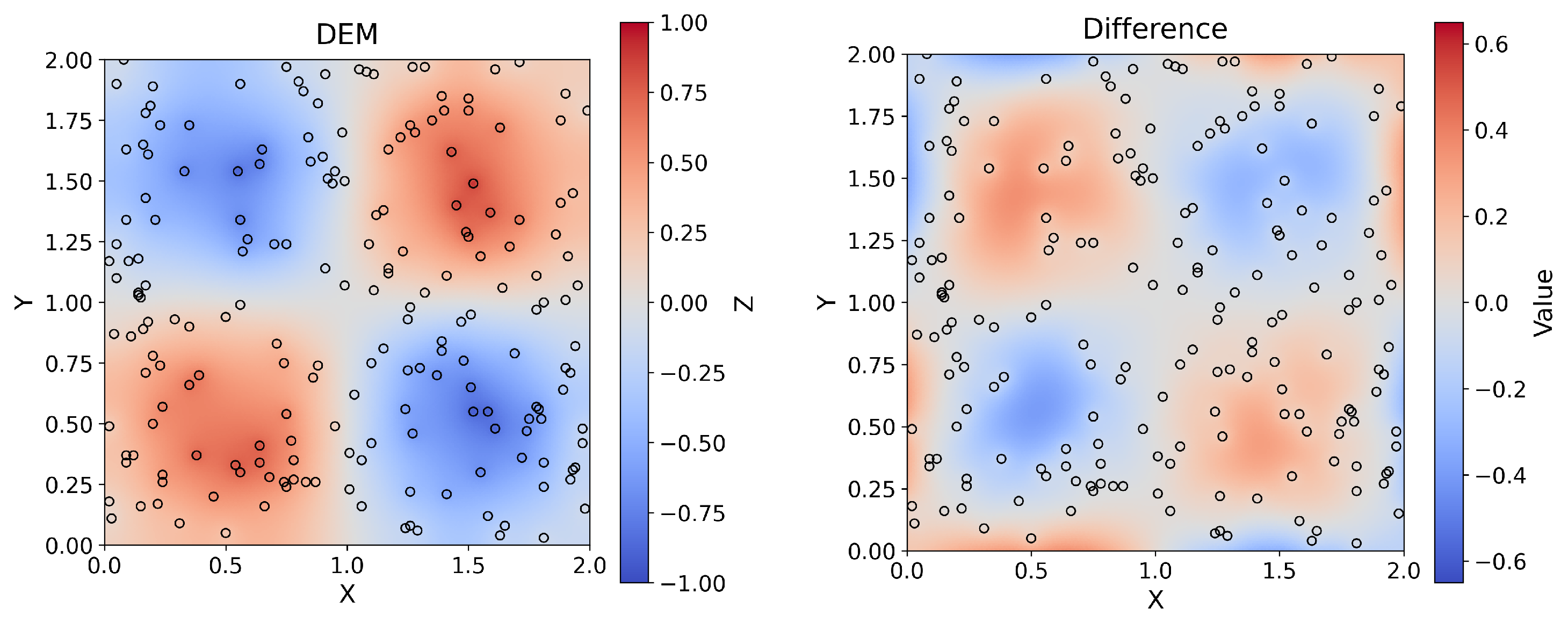
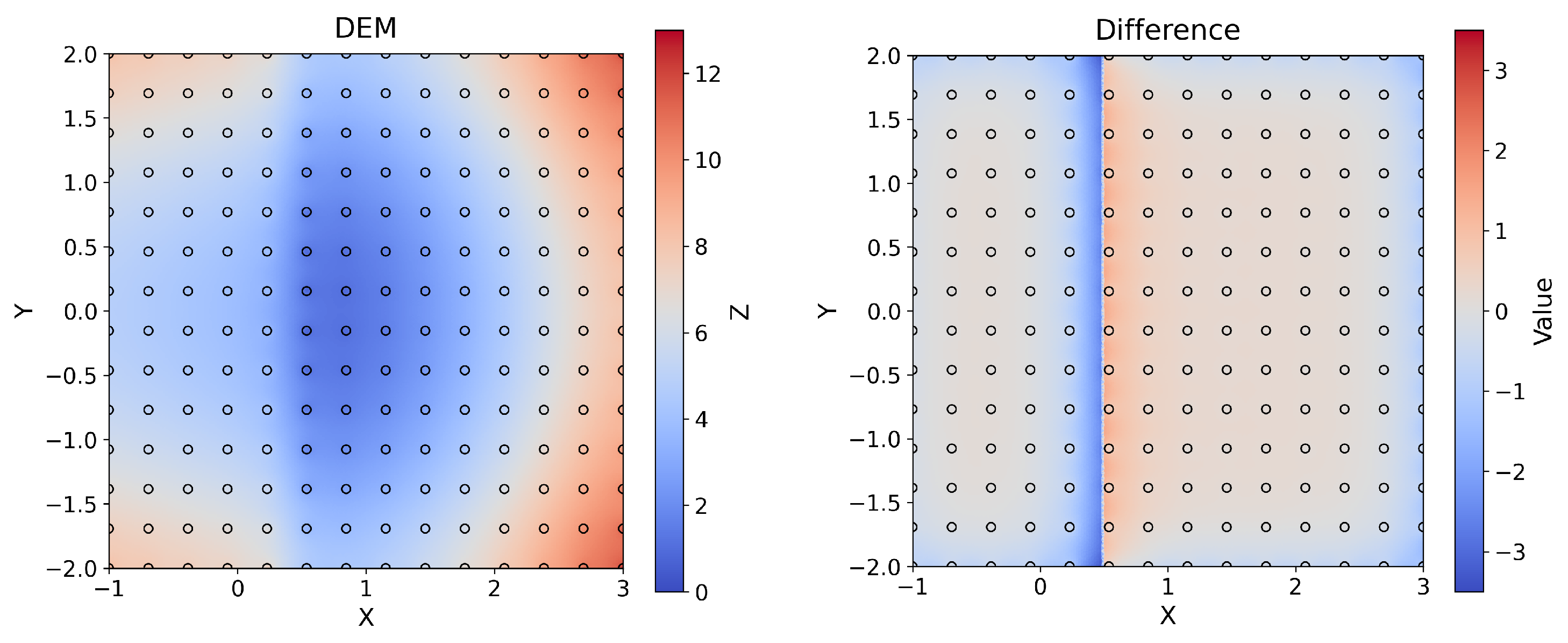
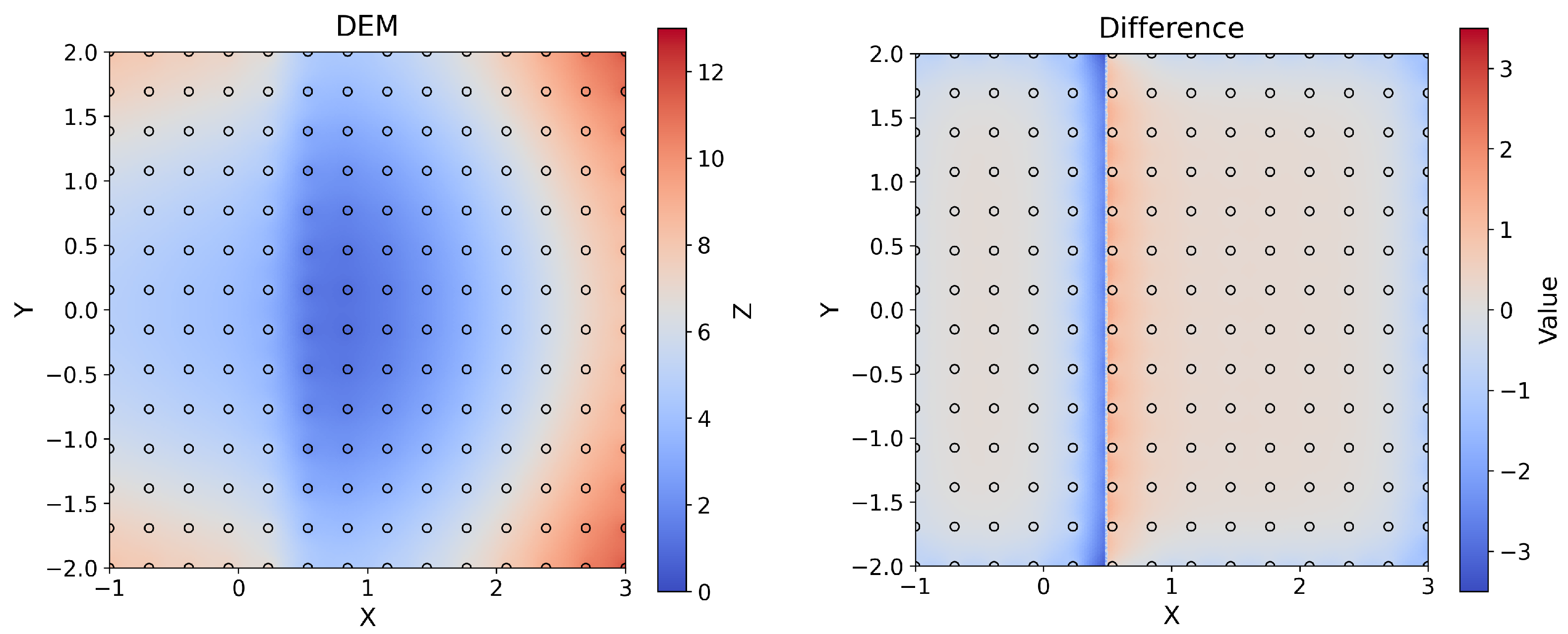
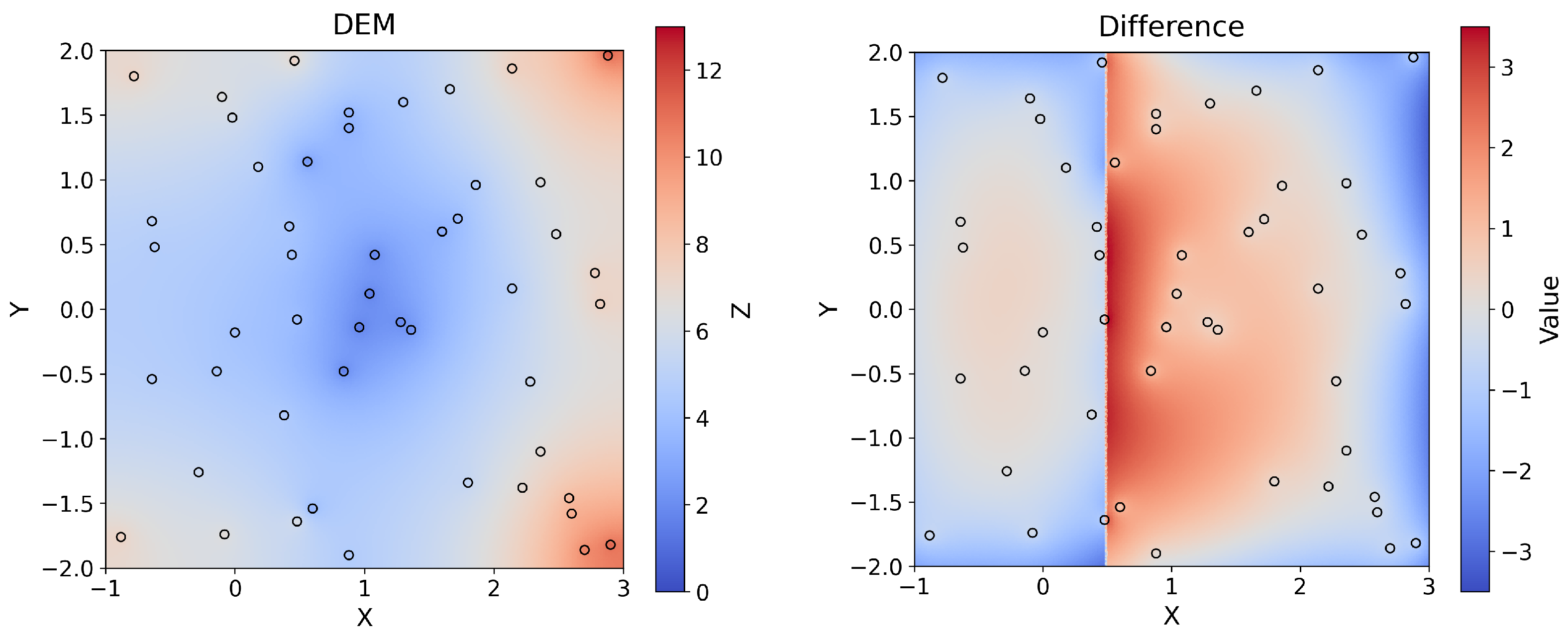
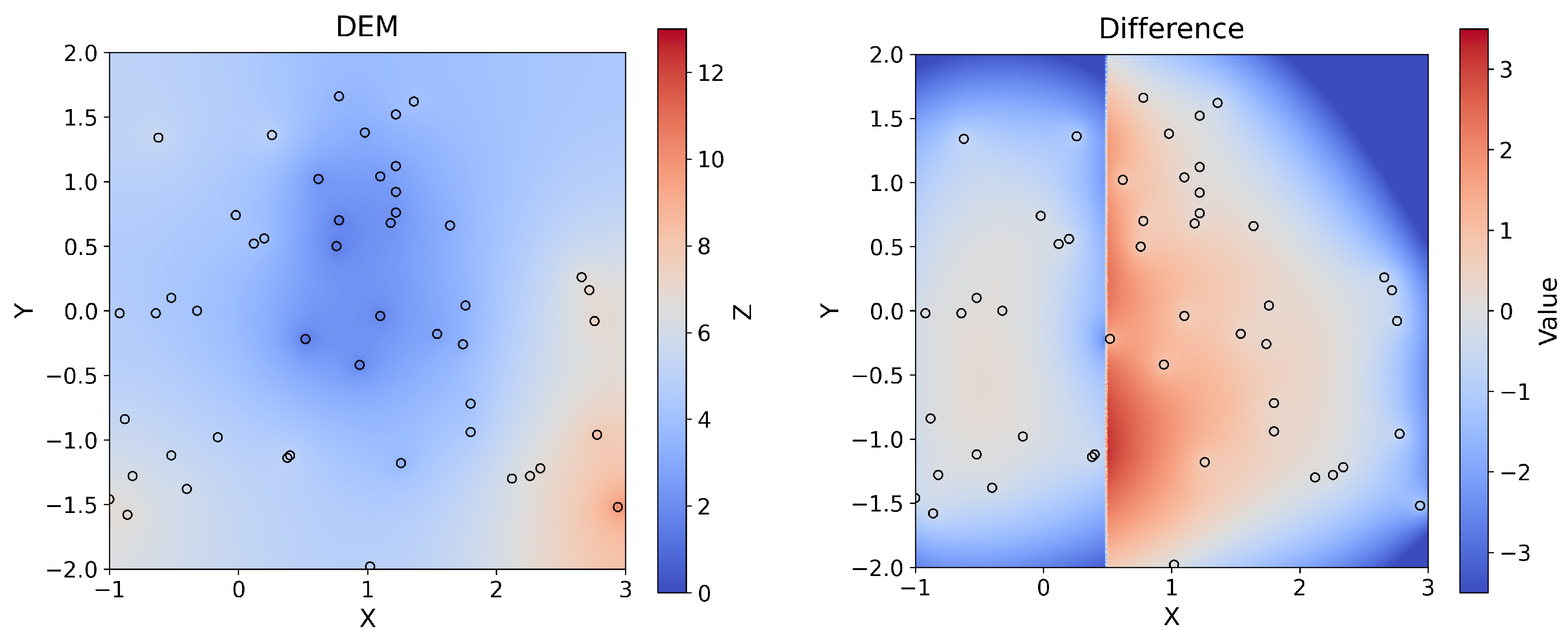
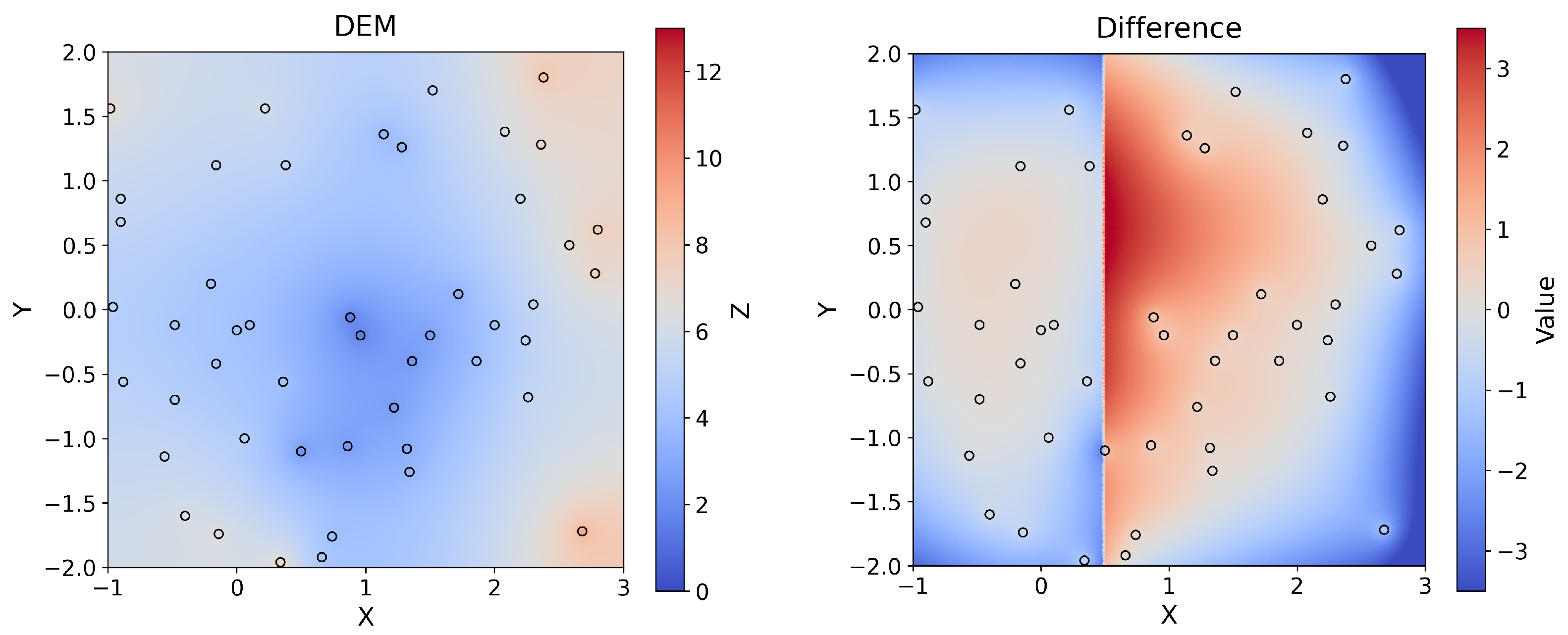
For each example, the results are presented in terms of the interpolated surface geometry, smoothness, and deviation from the analytical or measured data. The comparison between the three methods focuses on their capability to reproduce continuous and realistic terrain morphologies rather than on computational performance, since the implementations are based on different environments (compiled FEM software and Python for the RBF-NURBS model).
The quality of the reconstructed surfaces is assessed both visually and quantitatively. The visual inspection allows identifying the continuity of slopes and the presence of artificial oscillations, while the quantitative evaluation is based on the elevation differences between the interpolated surface and the reference data. In the synthetic examples, these differences are computed with respect to the analytical function, whereas in the real terrain case they are calculated with respect to the measured elevations. The maximum difference reported in the tables corresponds to the largest absolute deviation, while the global error is defined as the mean of the absolute elevation differences at all evaluated points.
All comparisons presented in this study are performed using identical variables and under strictly equivalent conditions for the three reconstruction methods. In all cases, the reconstructed elevation field is compared against the same reference surface, either given by the analytical function in the synthetic examples or by the measured elevations in the real terrain case. The deviations are always computed as pointwise differences in elevation at the same spatial locations, using identical sampling points and evaluation grids. No method-specific variables, weighting factors, or post-processing steps are introduced in the comparison. This ensures that the observed differences are solely attributable to the intrinsic behaviour of each reconstruction approach.
For each example, identical colour bar ranges are used across all reconstruction methods in both the DEM visualisations and the corresponding difference maps, in order to enable a direct visual comparison. The colour scales may differ between examples to account for the different ranges of elevation and deviation values.
For clarity, only a limited number of representative and limiting cases are reproduced and discussed in the main text. The complete set of results, including intermediate sampling densities and alternative random seeds for irregular point distributions, is provided in
Appendix A.
This analysis provides a consistent framework to evaluate the ability of each method to reconstruct both simple and complex topographies while preserving the physical and geometric continuity of the terrain surface.
5.2. Example 1: Synthetic Function 1
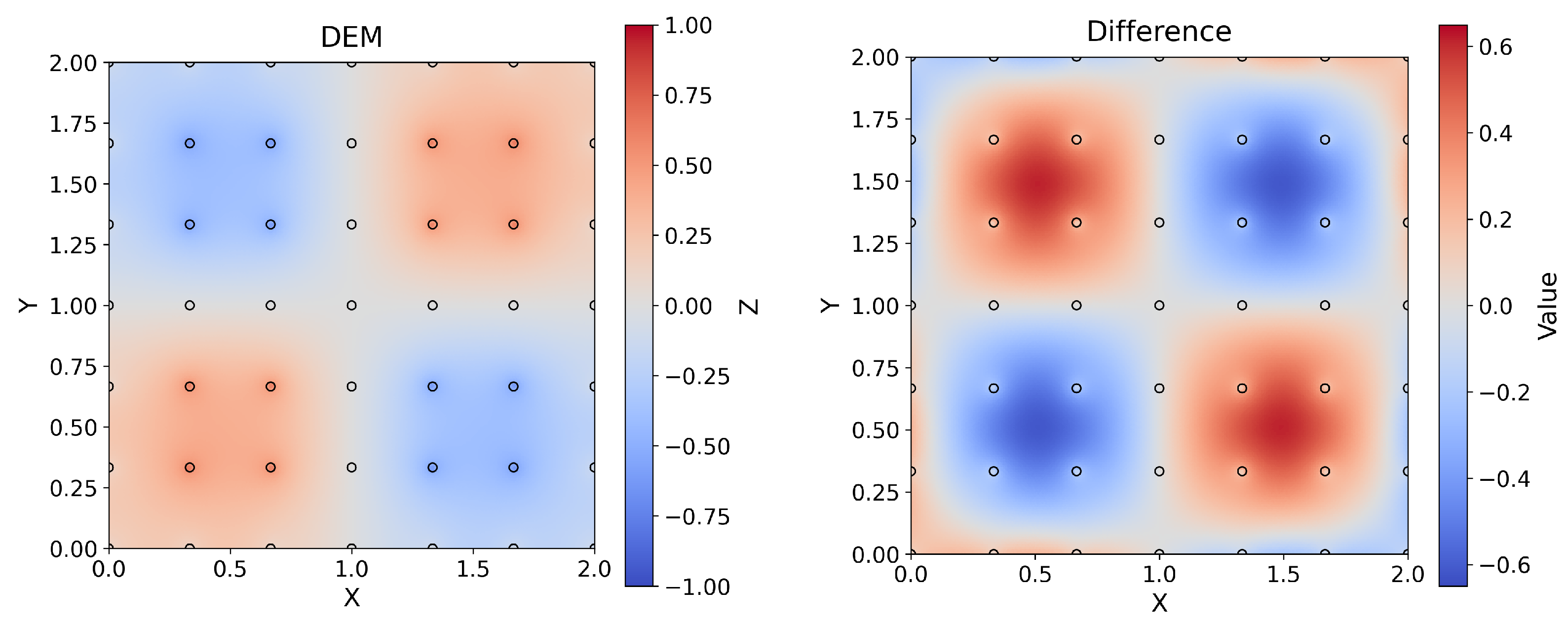
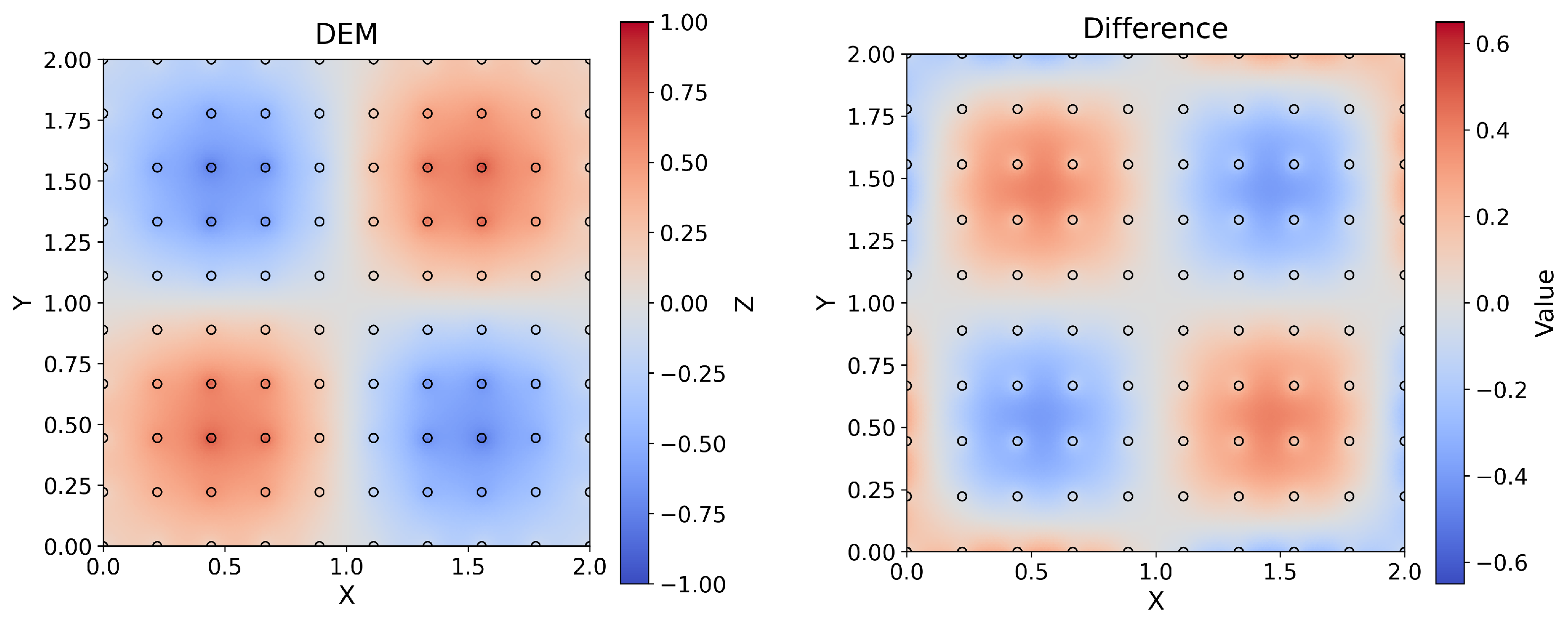
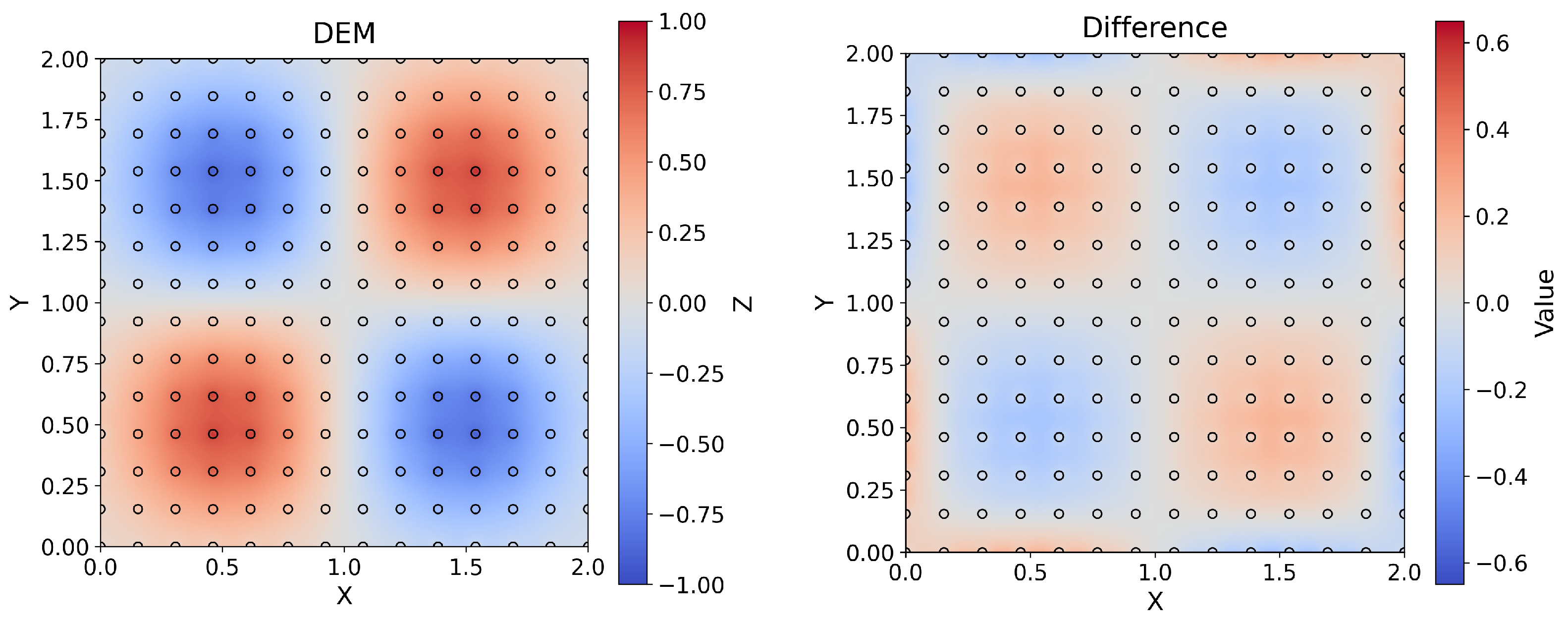
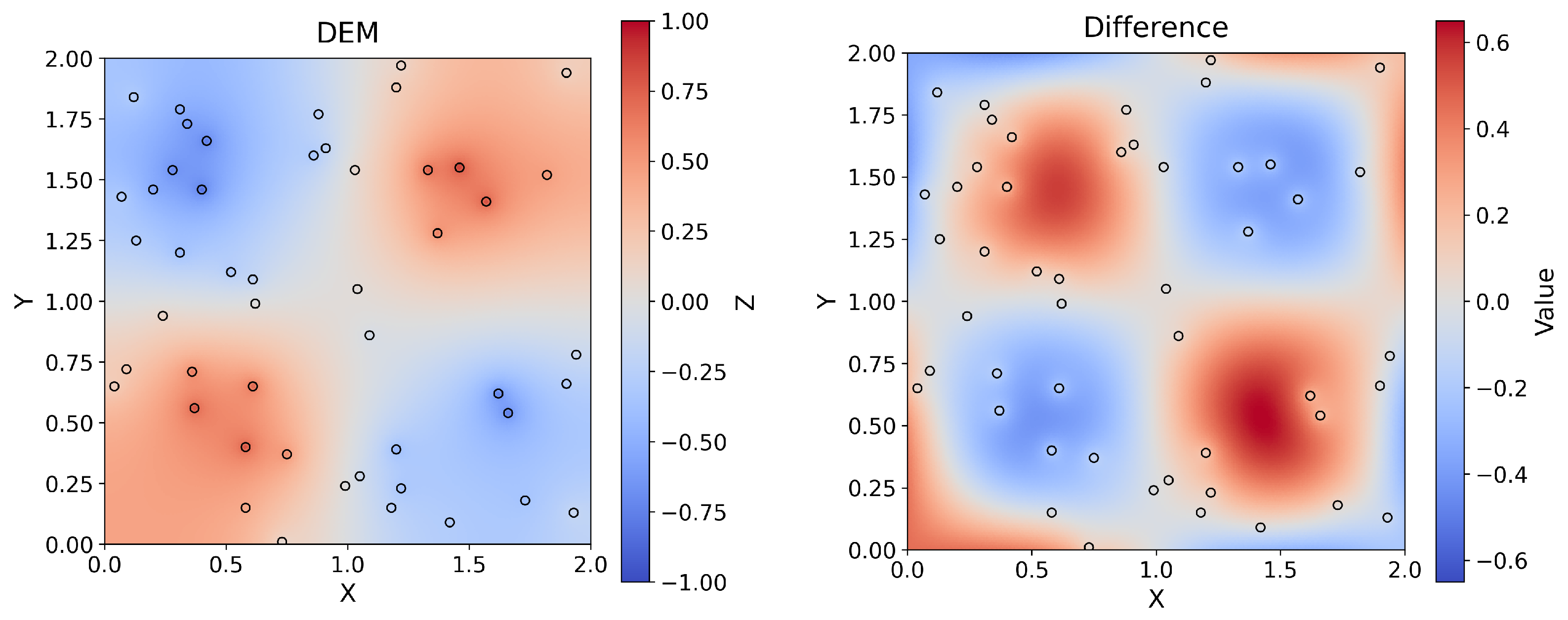
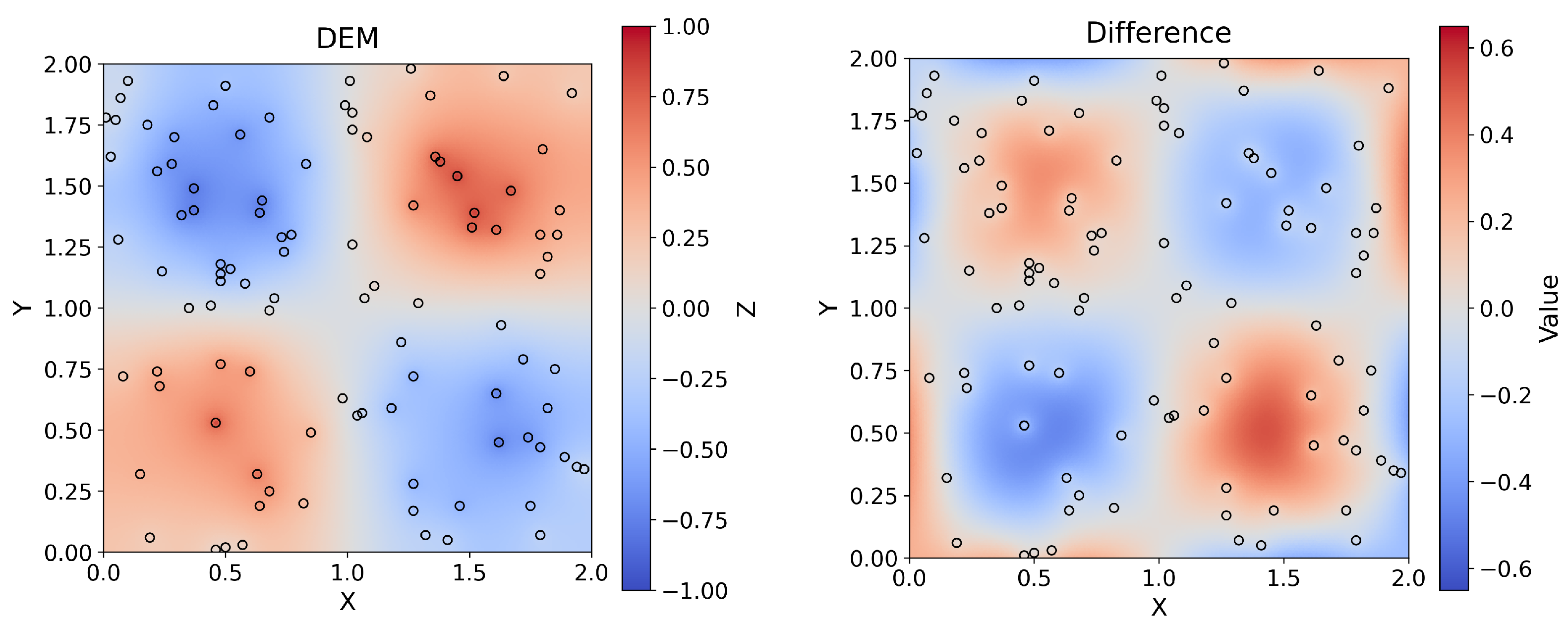
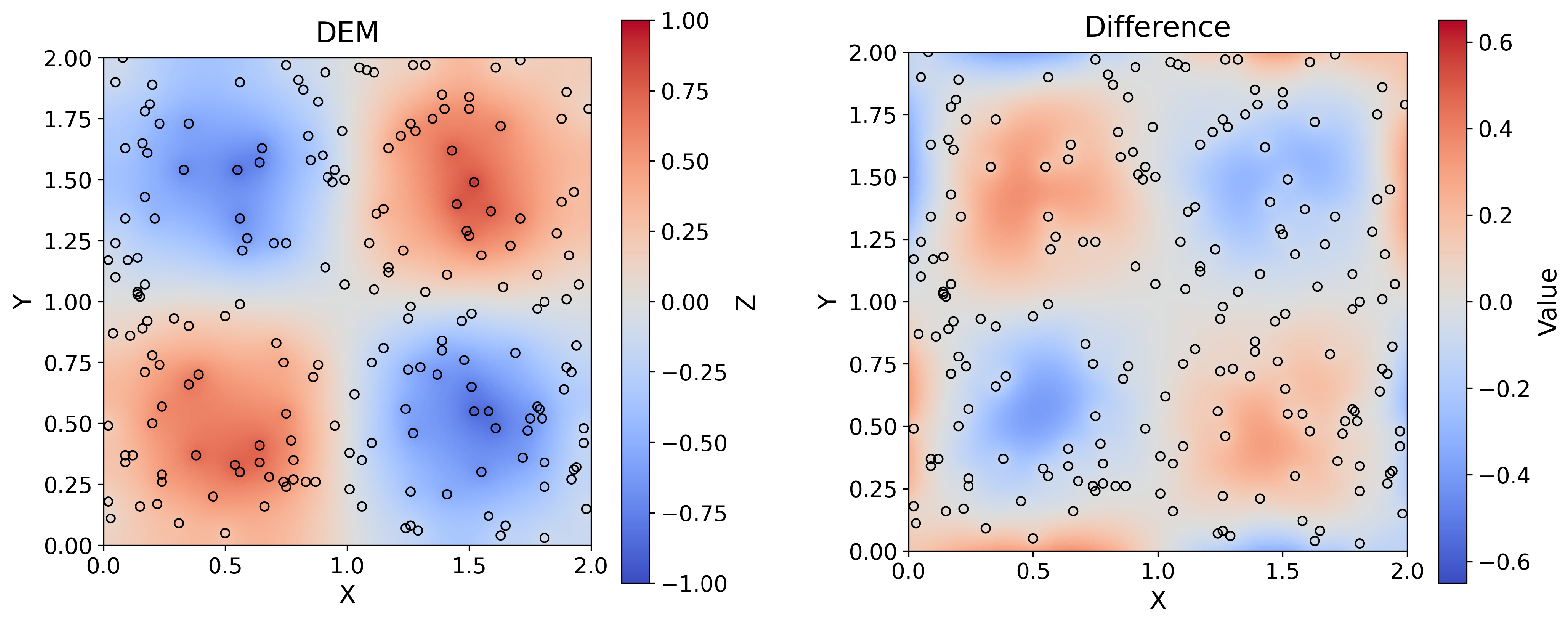
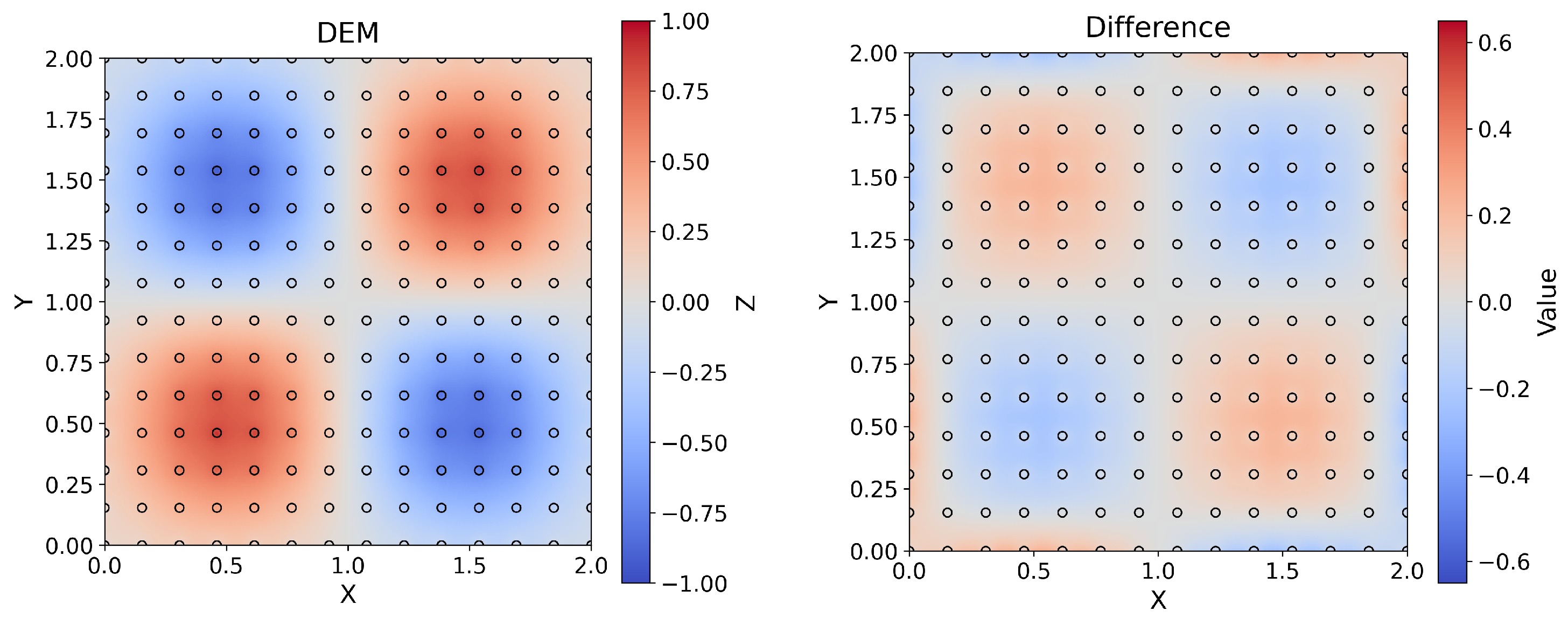
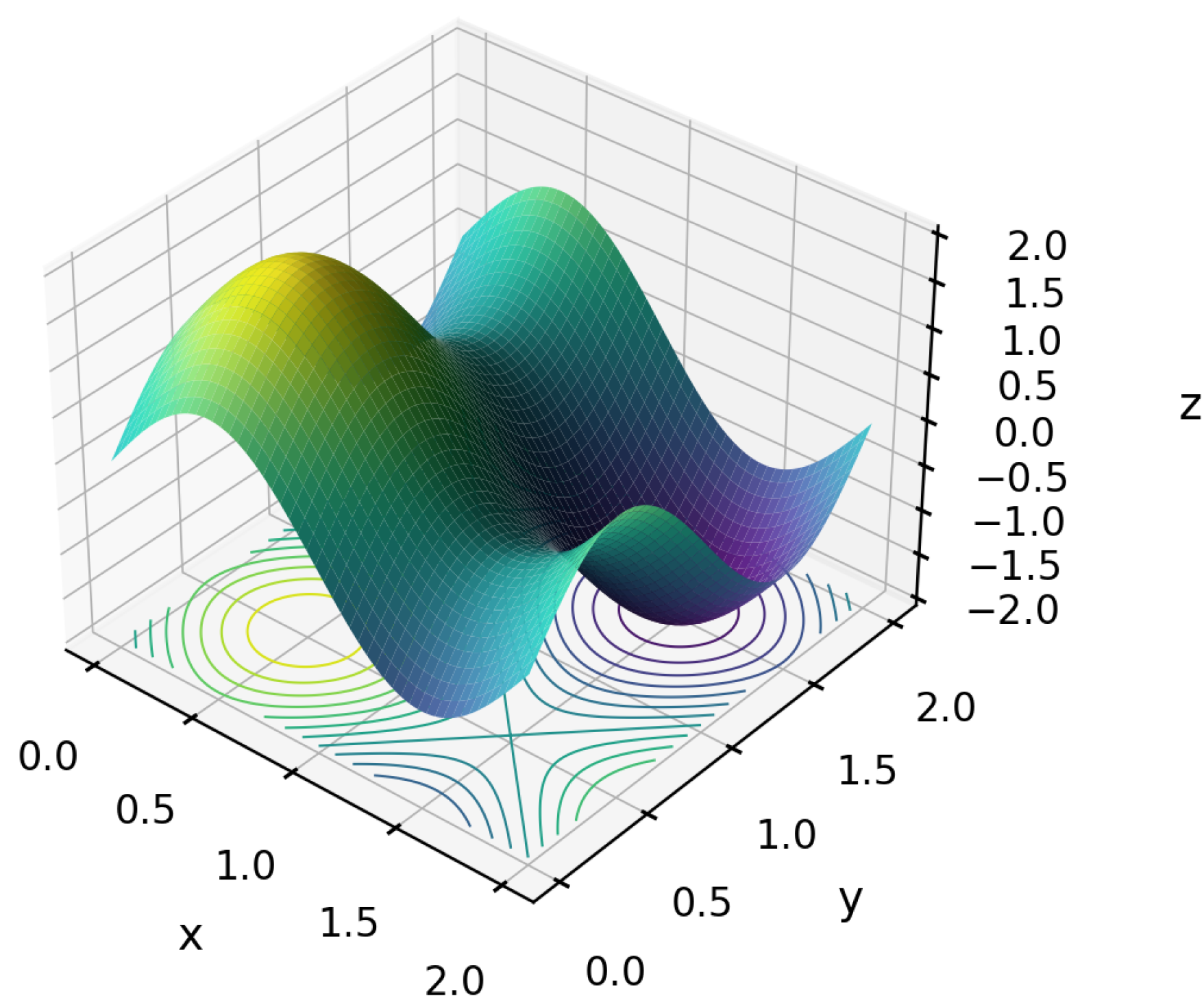
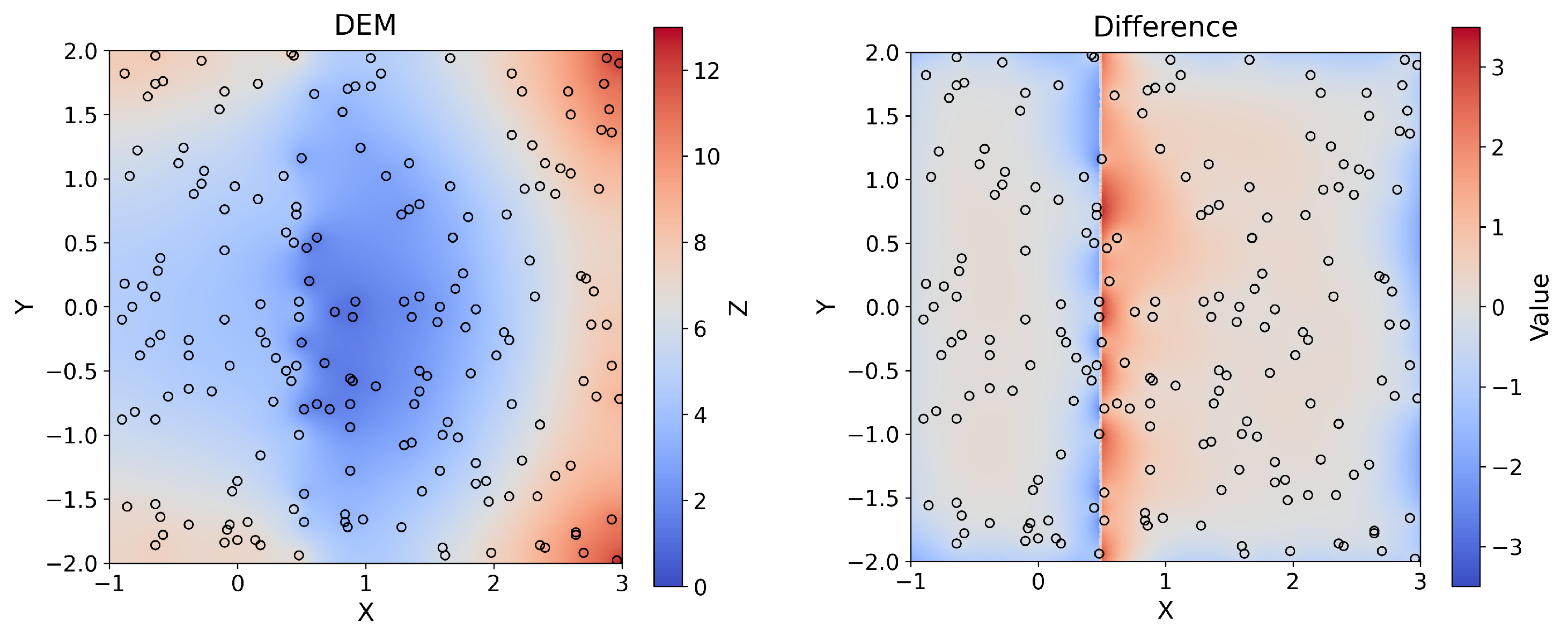
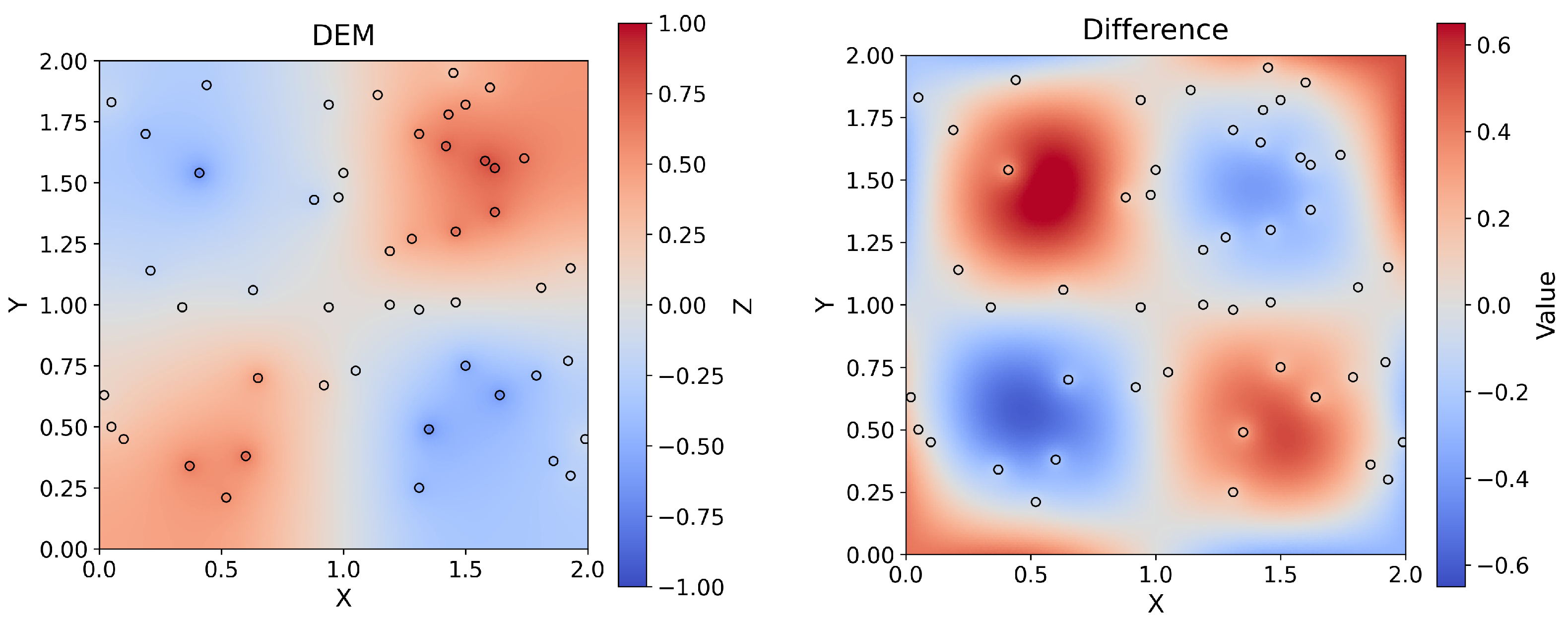
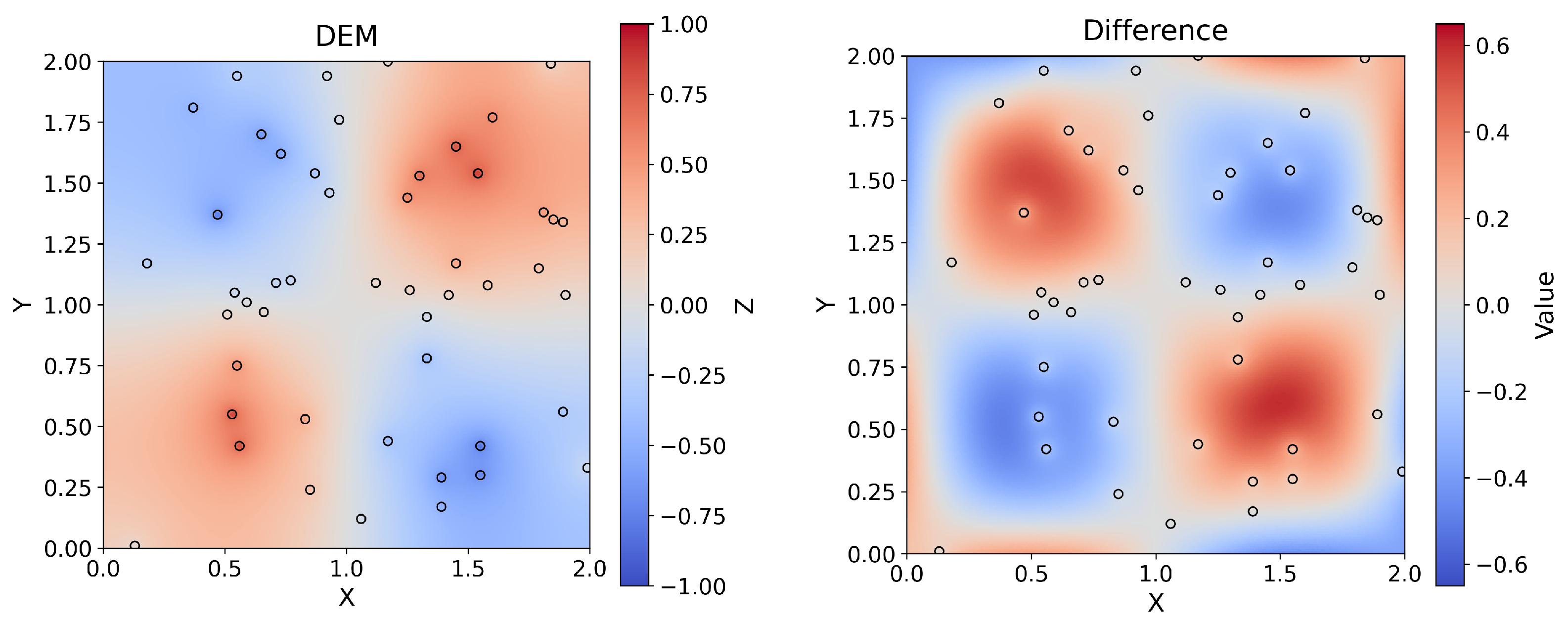
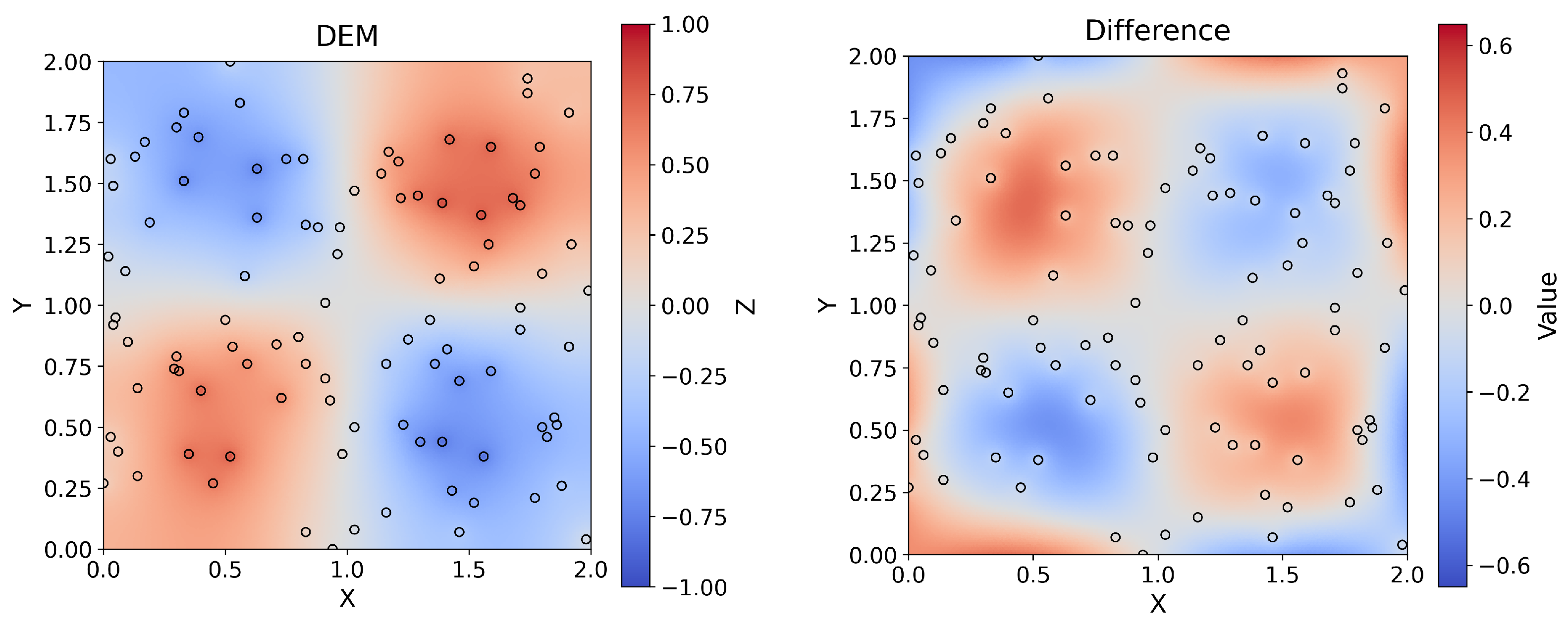
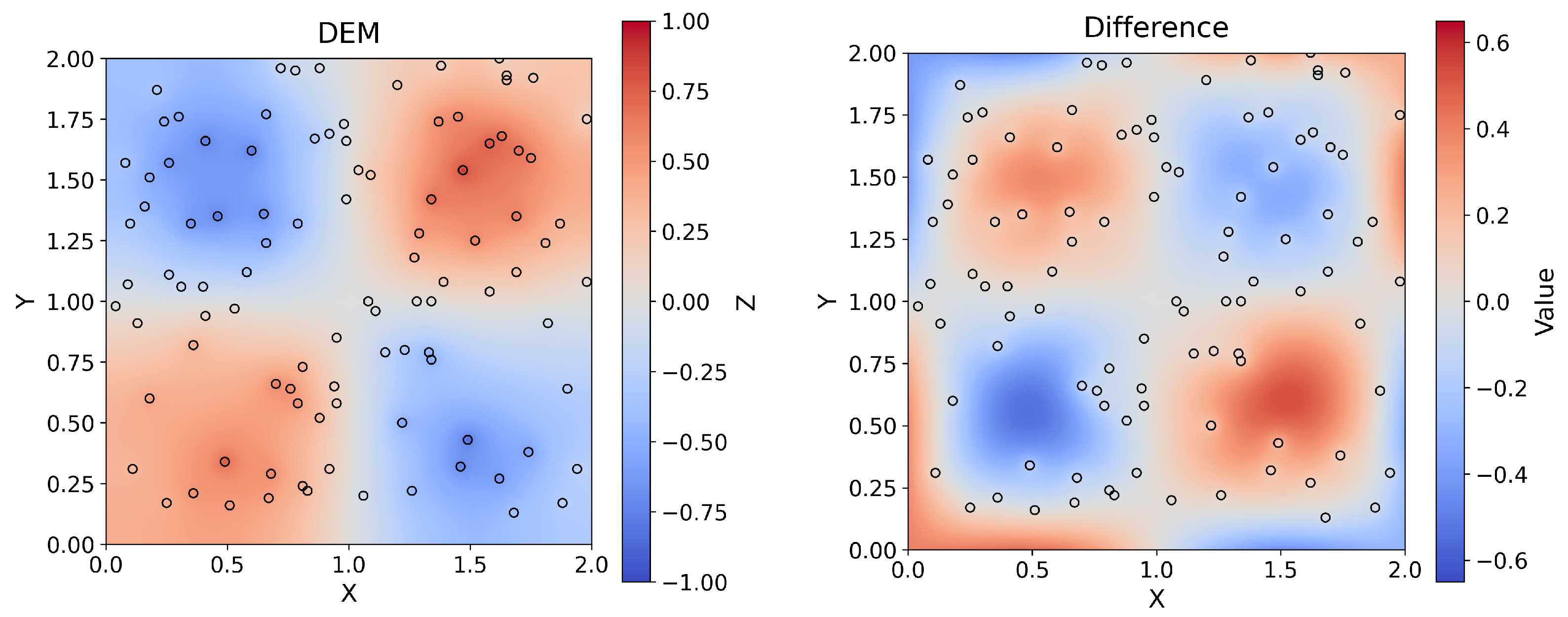
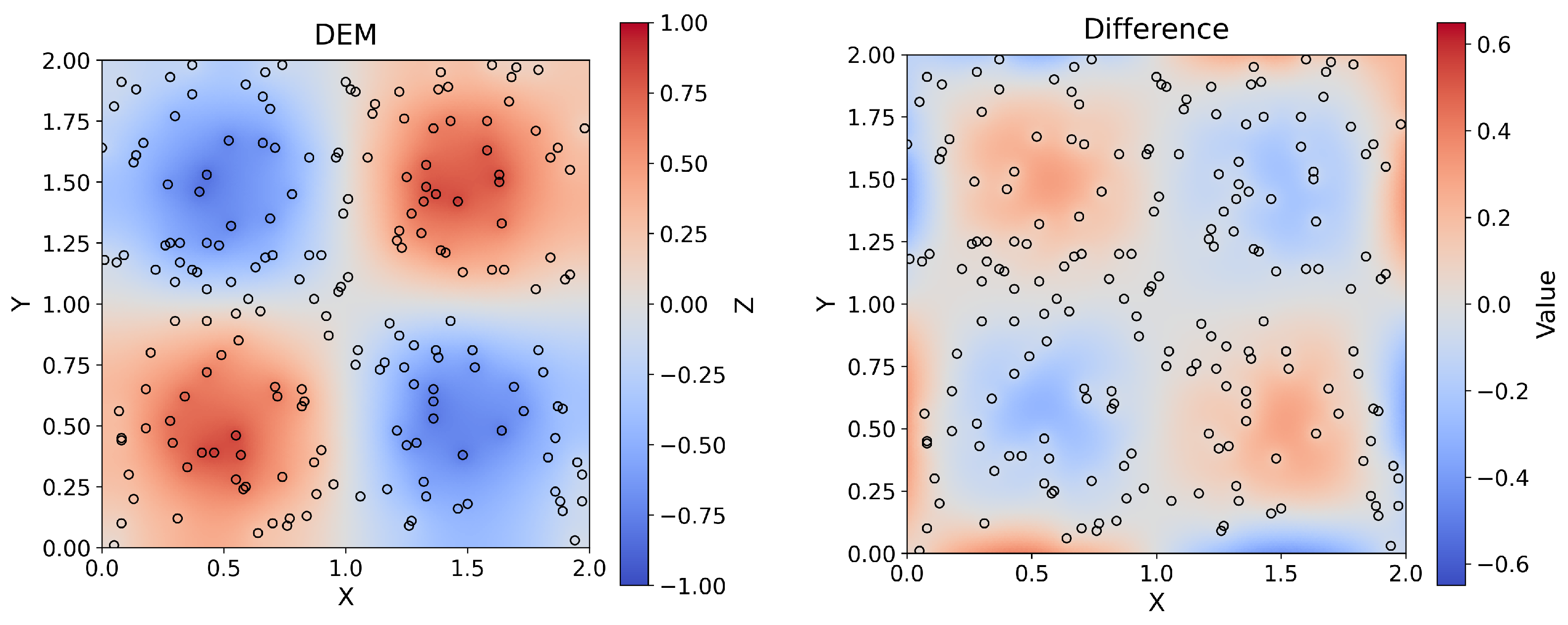
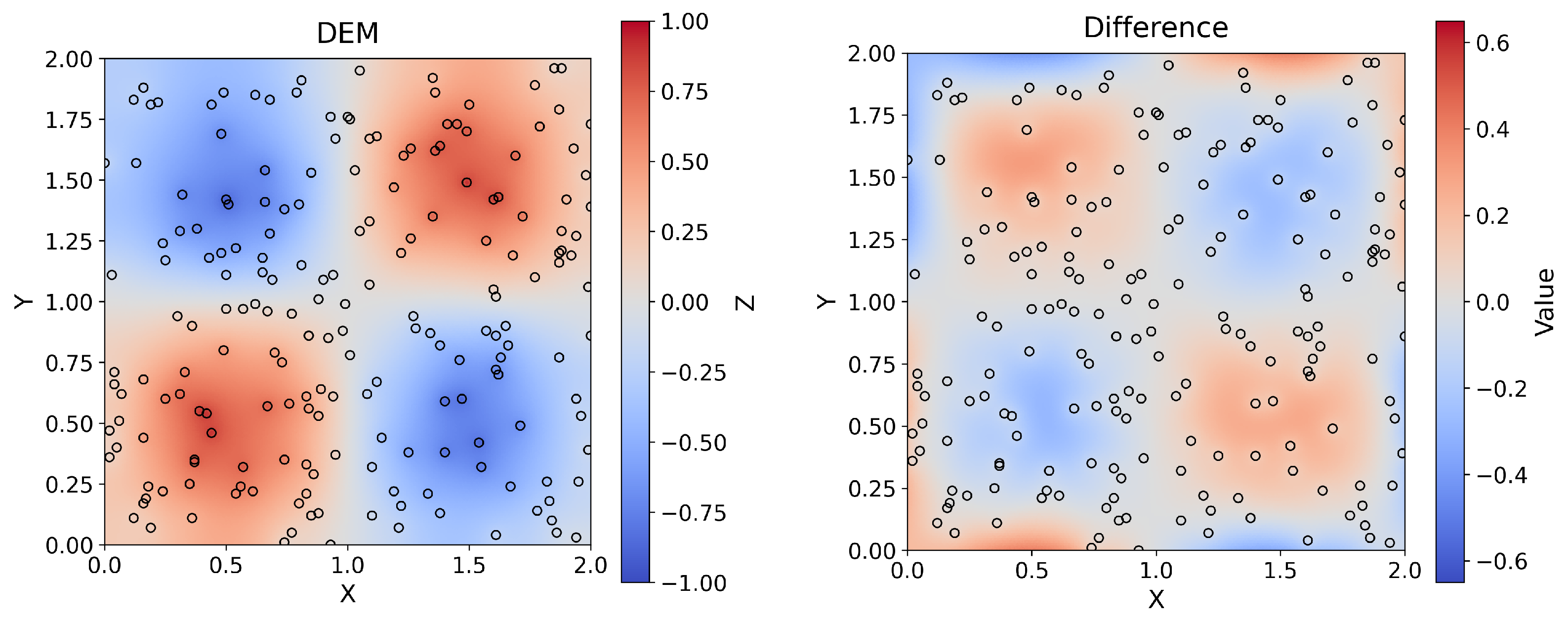
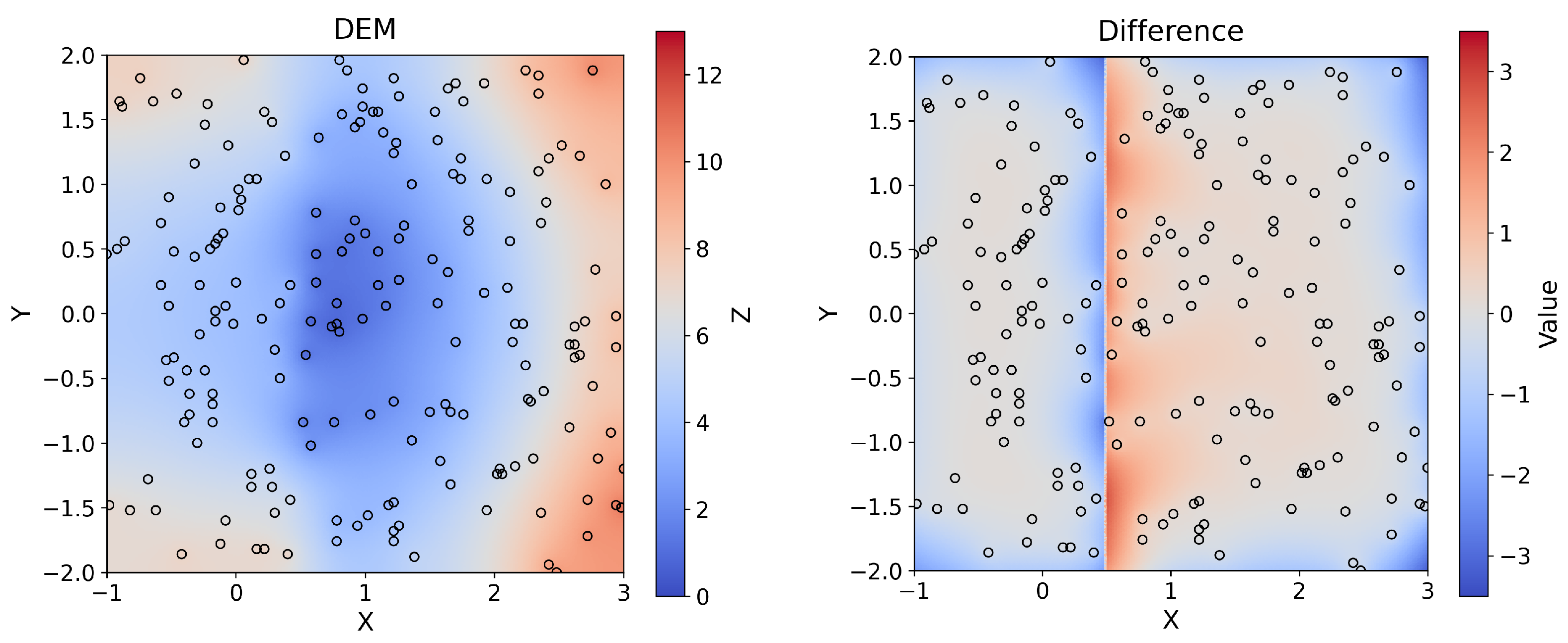
In the first example, a representative selection of the results obtained by applying the Poisson FEM methodology is presented in the main text (
Figure 4 and
Figure 5), while the complete set of figures (
Figure A1,
Figure A2,
Figure A3,
Figure A4,
Figure A5,
Figure A6,
Figure A7,
Figure A8,
Figure A9,
Figure A10,
Figure A11,
Figure A12) is provided in
Appendix A. The image on the left illustrates the reconstructed surface obtained with each interpolation method, while the image on the right displays the contour map of the differences with respect to the analytical reference function. These differences constitute interpolation errors with respect to the analytical surface; however, they reflect the intrinsic regularization imposed by the harmonic formulation rather than a numerical deficiency of the method. The objective is not to reproduce the exact pointwise values of the analytical function, but to capture its essential geometric features in terms of elevation and slope continuity.
Table 3 and
Table 4 present the maximum and mean deviations obtained for each configuration, providing a quantitative assessment of how each method reproduces the overall shape and smoothness of the analytical surface.
5.3. Example 2: Synthetic Function 2
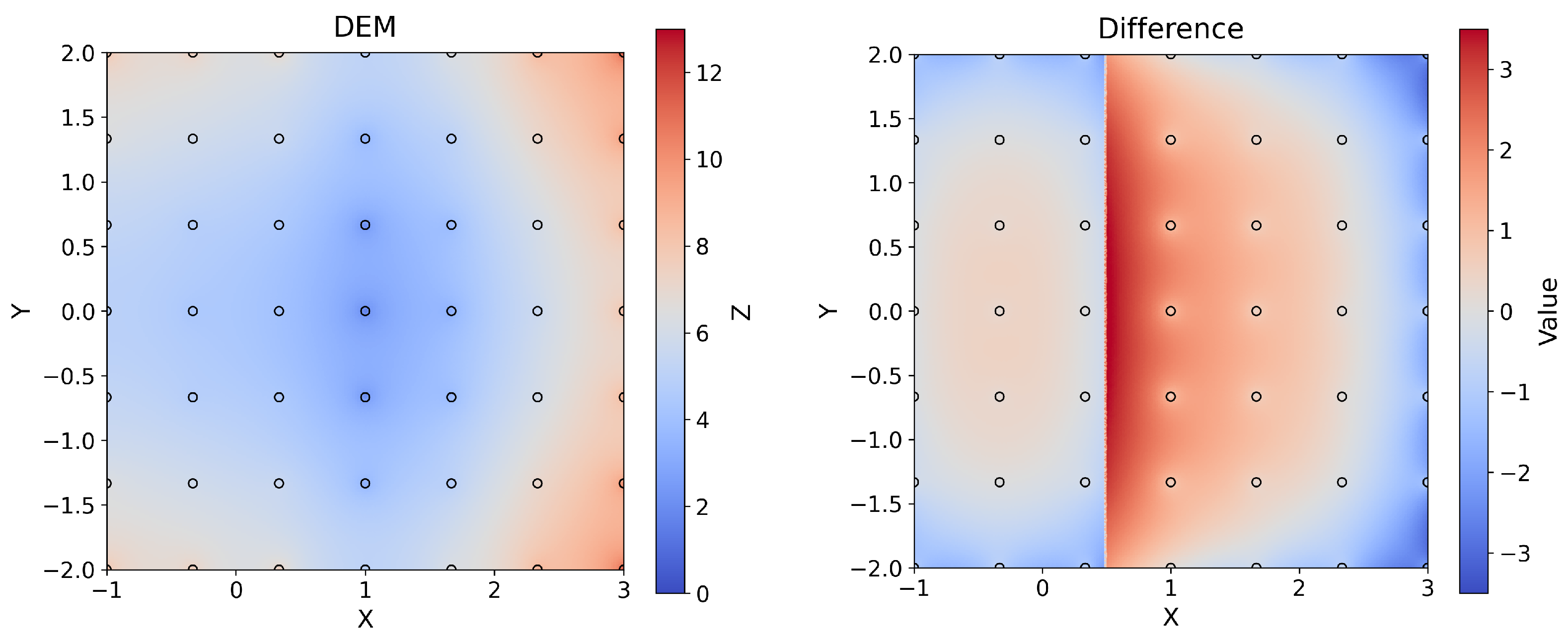
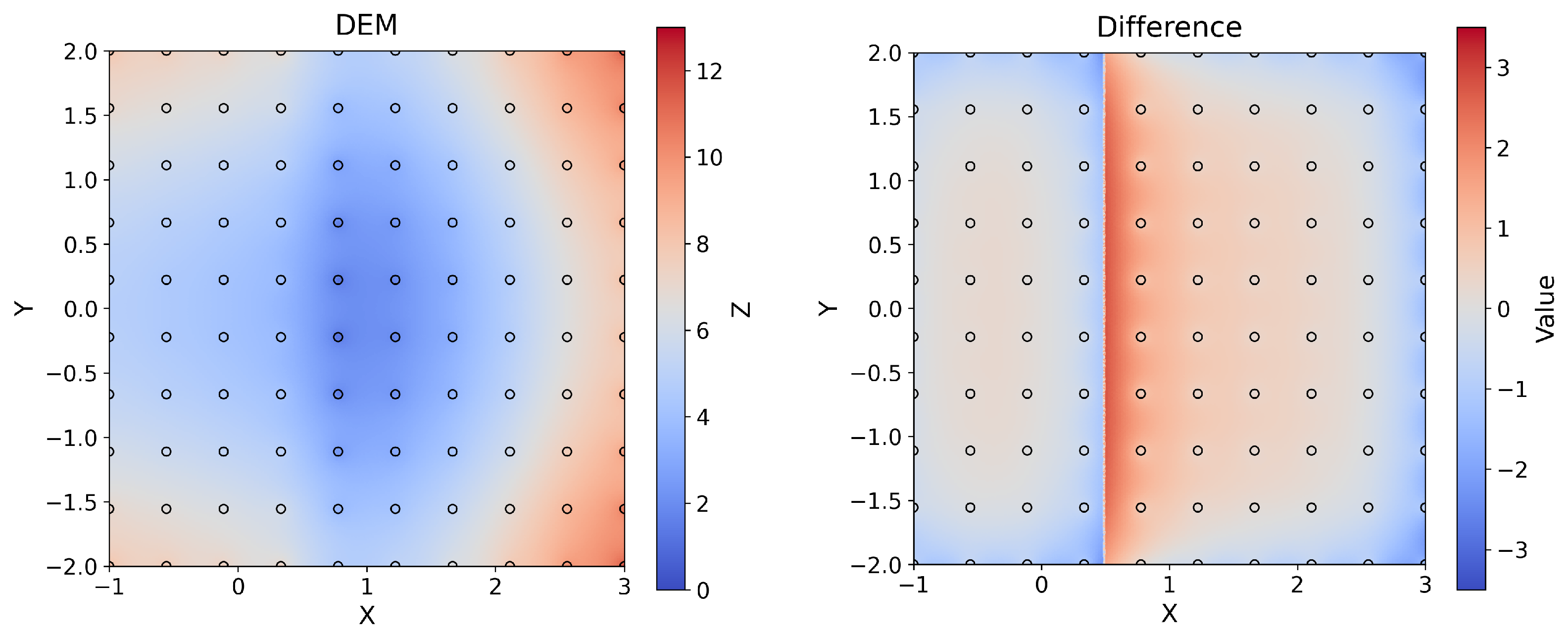
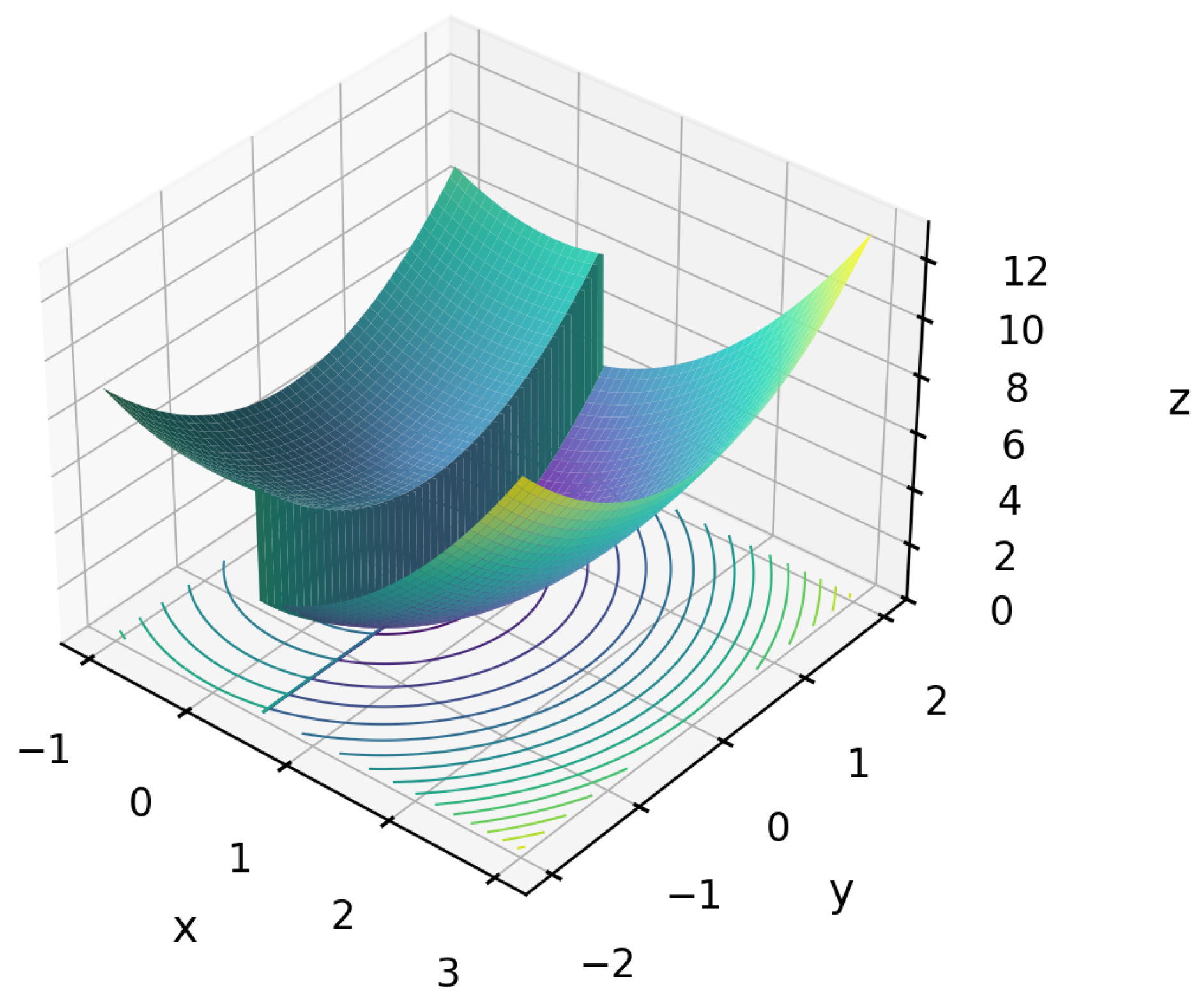
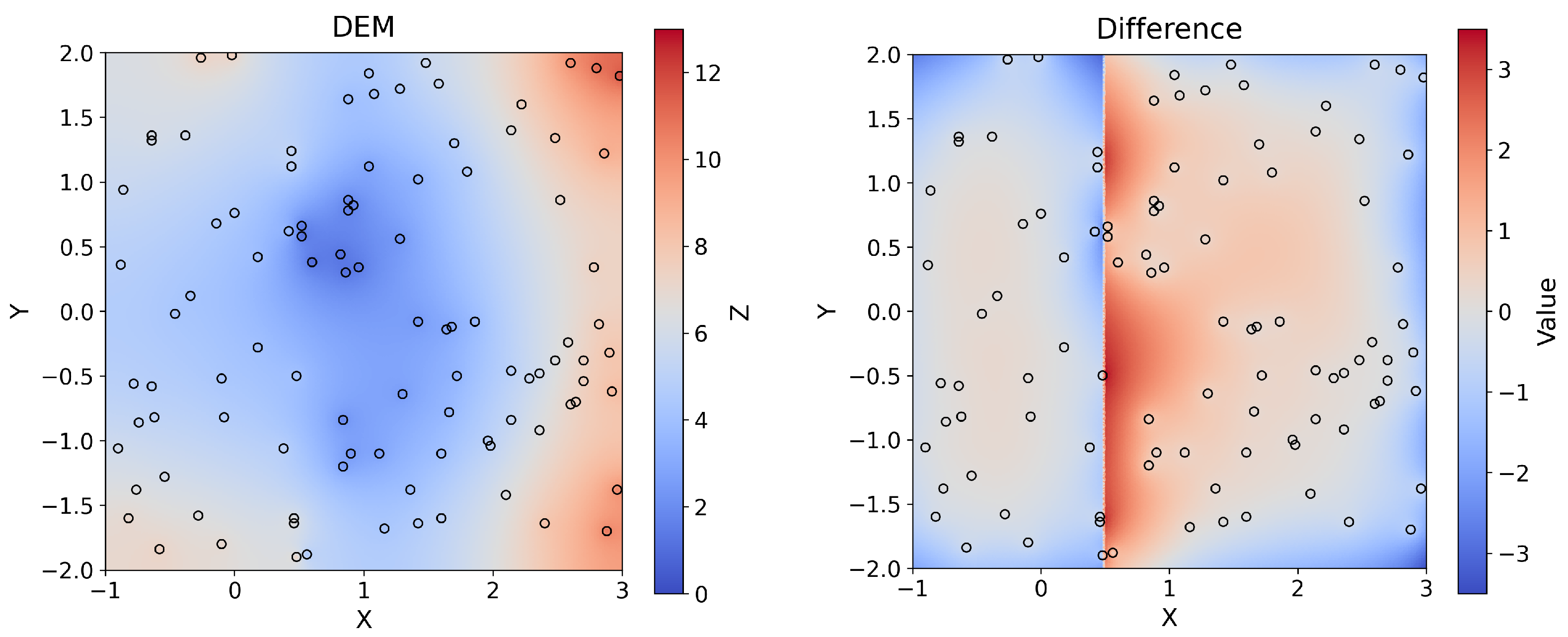
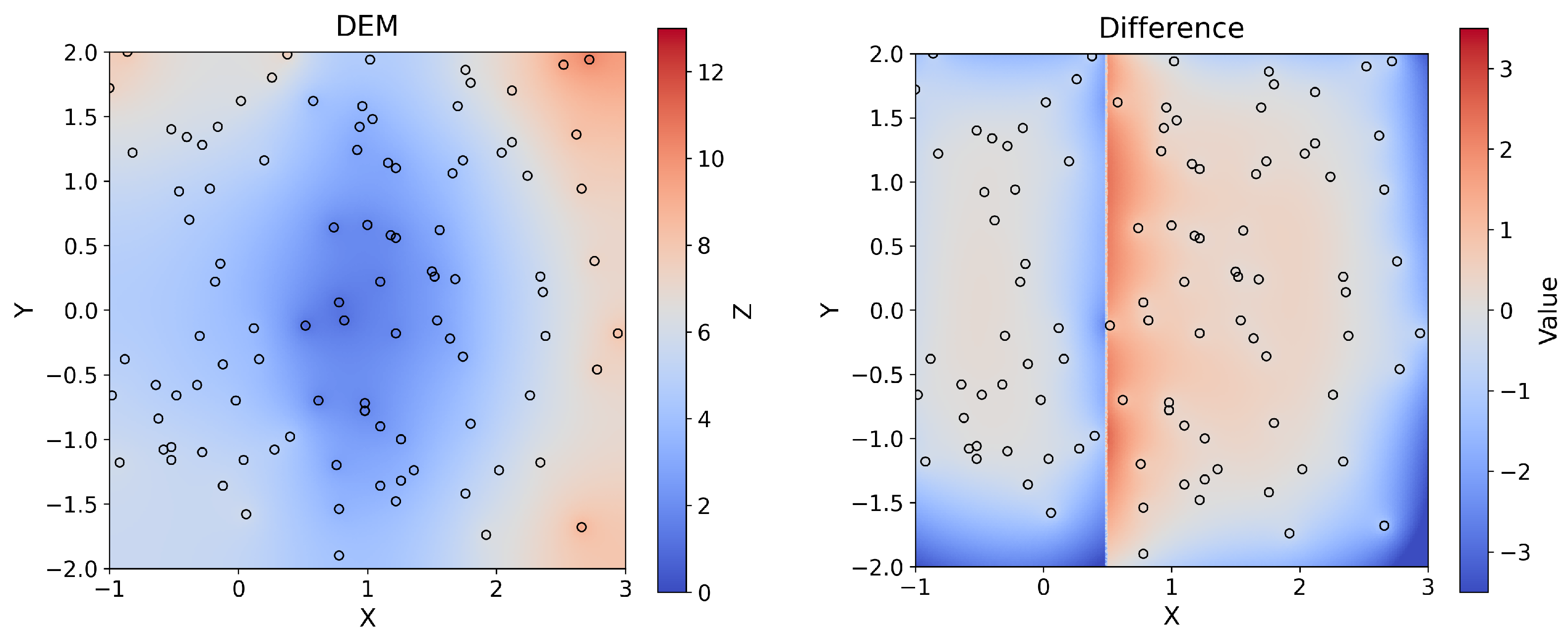
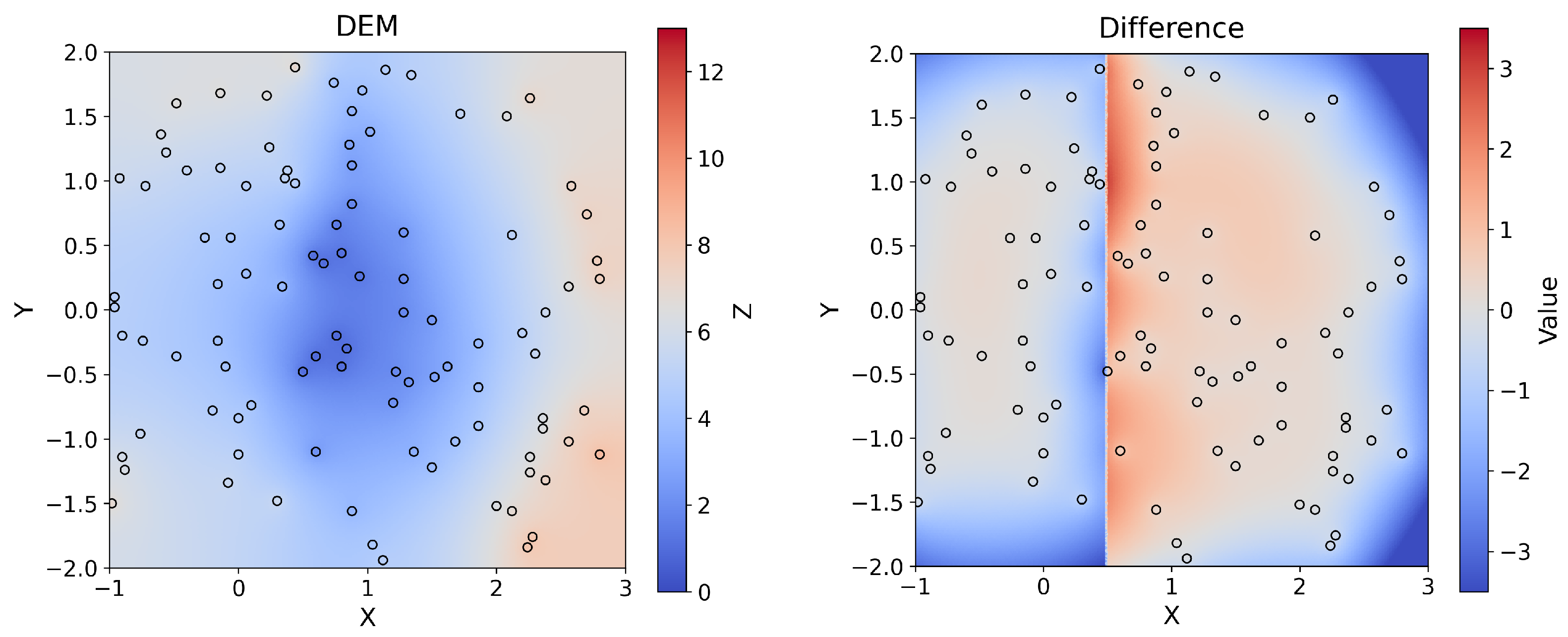
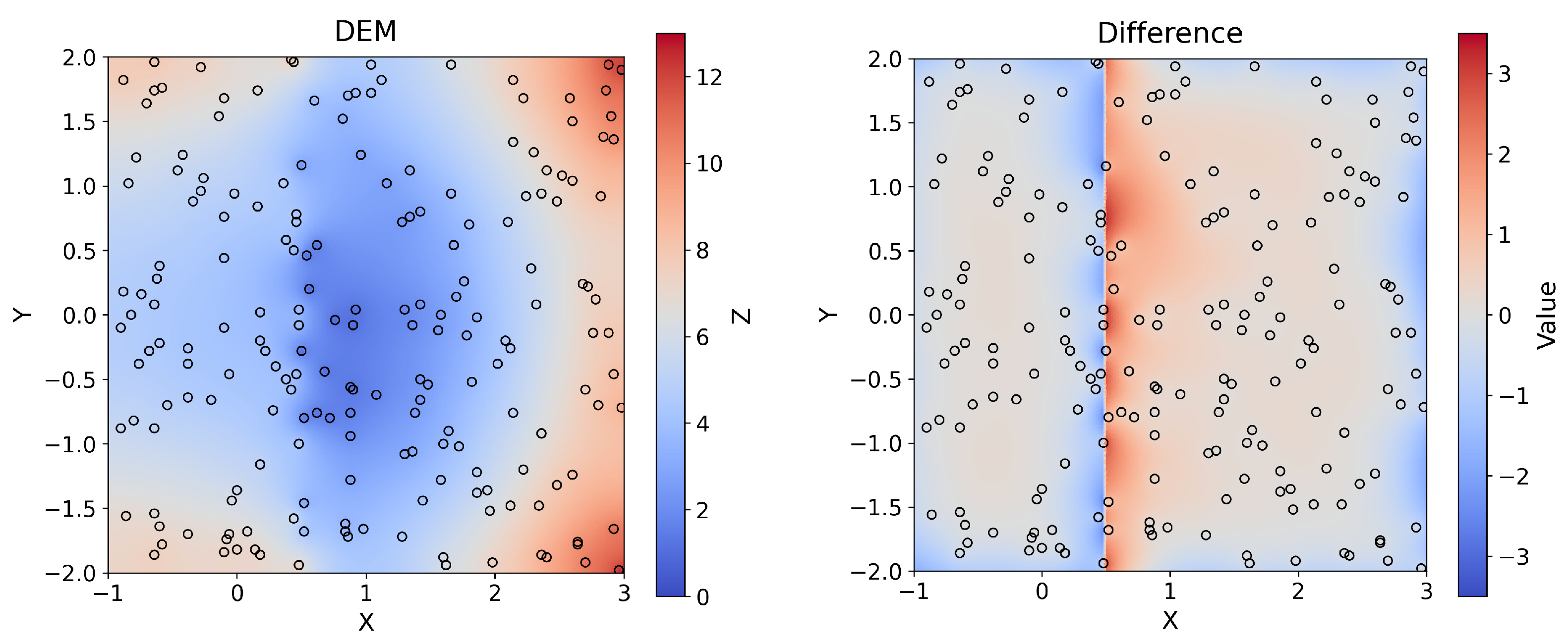
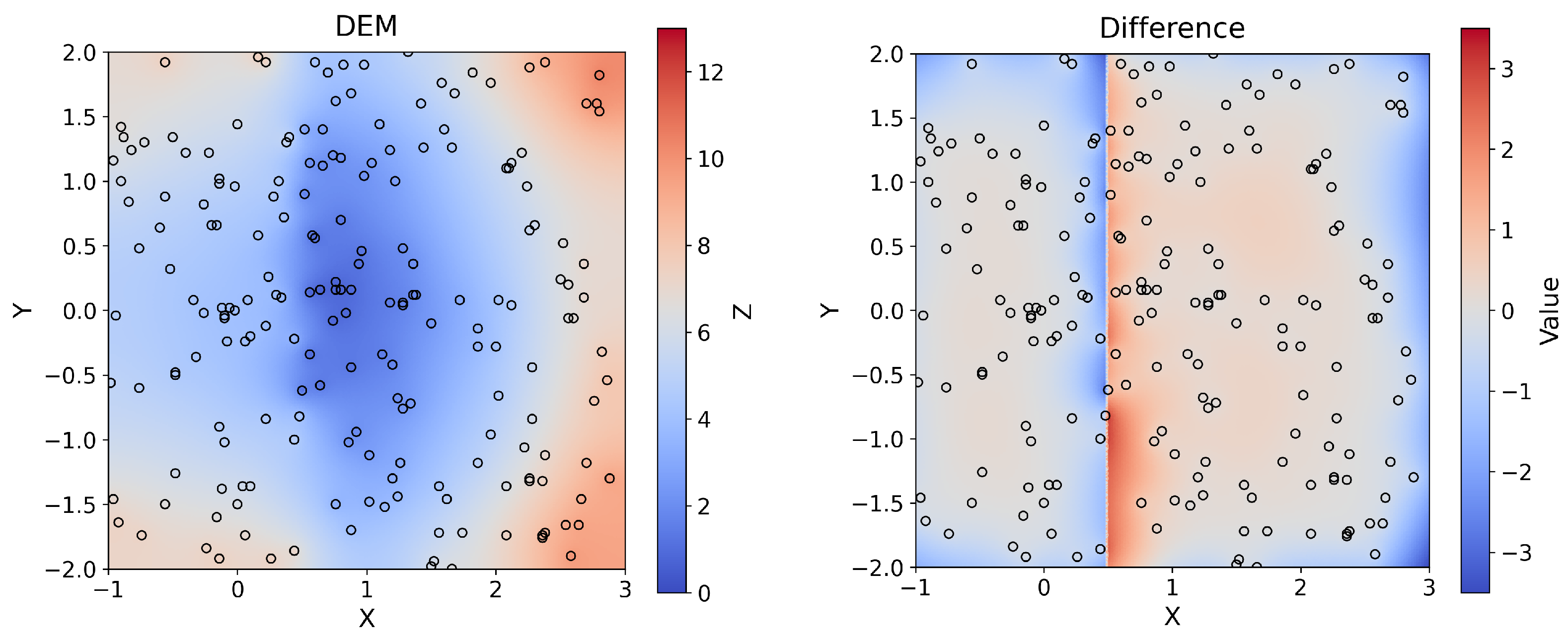
In the second example, the same analysis was performed using a different analytical function, characterized by a discontinuity that generates a sharp elevation jump. A representative selection of the corresponding results is presented in the main text (
Figure 6 and
Figure 7), while the complete set of figures (
Figure A13,
Figure A14,
Figure A15,
Figure A16,
Figure A17,
Figure A18,
Figure A19,
Figure A20,
Figure A21,
Figure A22,
Figure A23,
Figure A24) is provided in
Appendix A, illustrating how each interpolation method reproduces this transition for the Poisson equation (FEM). As in the previous case, the differences represent interpolation errors relative to the analytical reference surface, arising from the smoothing inherent to the Poisson formulation. These errors therefore provide an indication of how effectively each approach captures the main geometric features of the surface and handles discontinuities in elevation and slope. The quantitative results, summarized in
Table 5 and
Table 6, present the maximum and mean absolute deviations (in parentheses) obtained for each configuration.
5.4. Example 3: Real Terrain
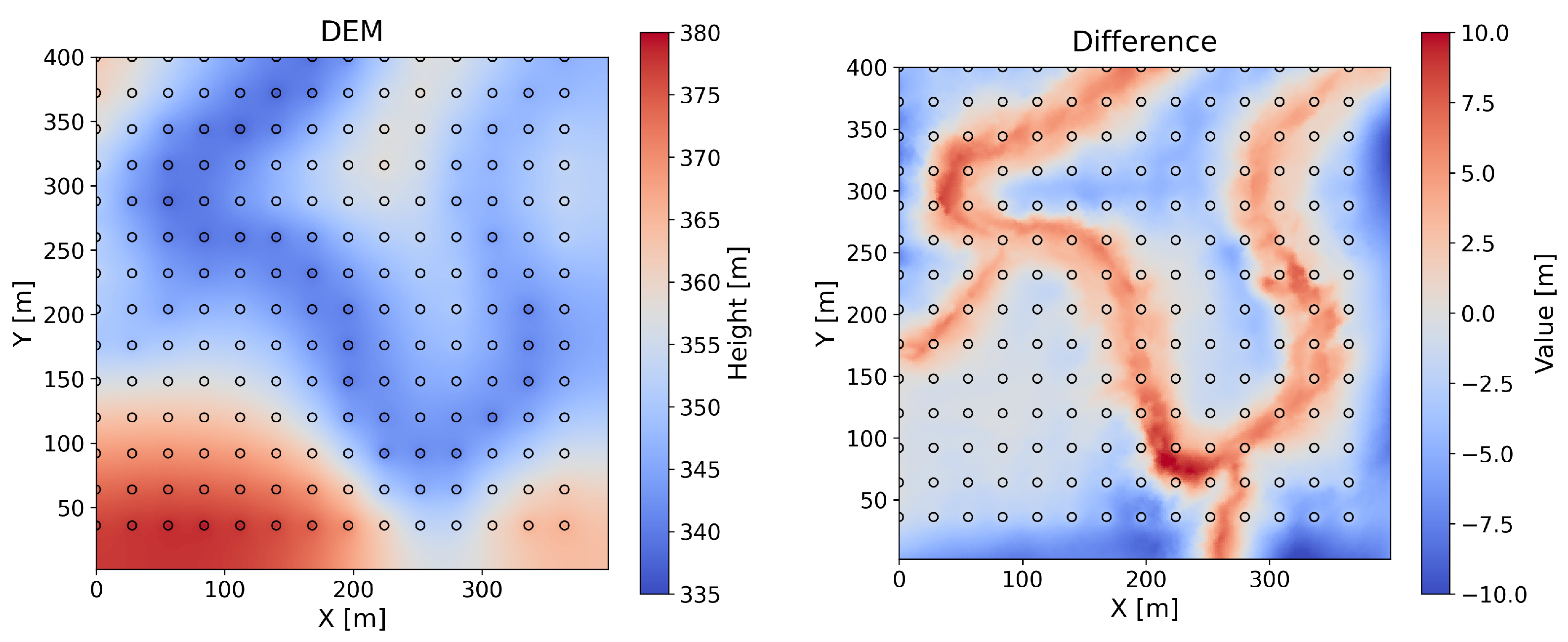
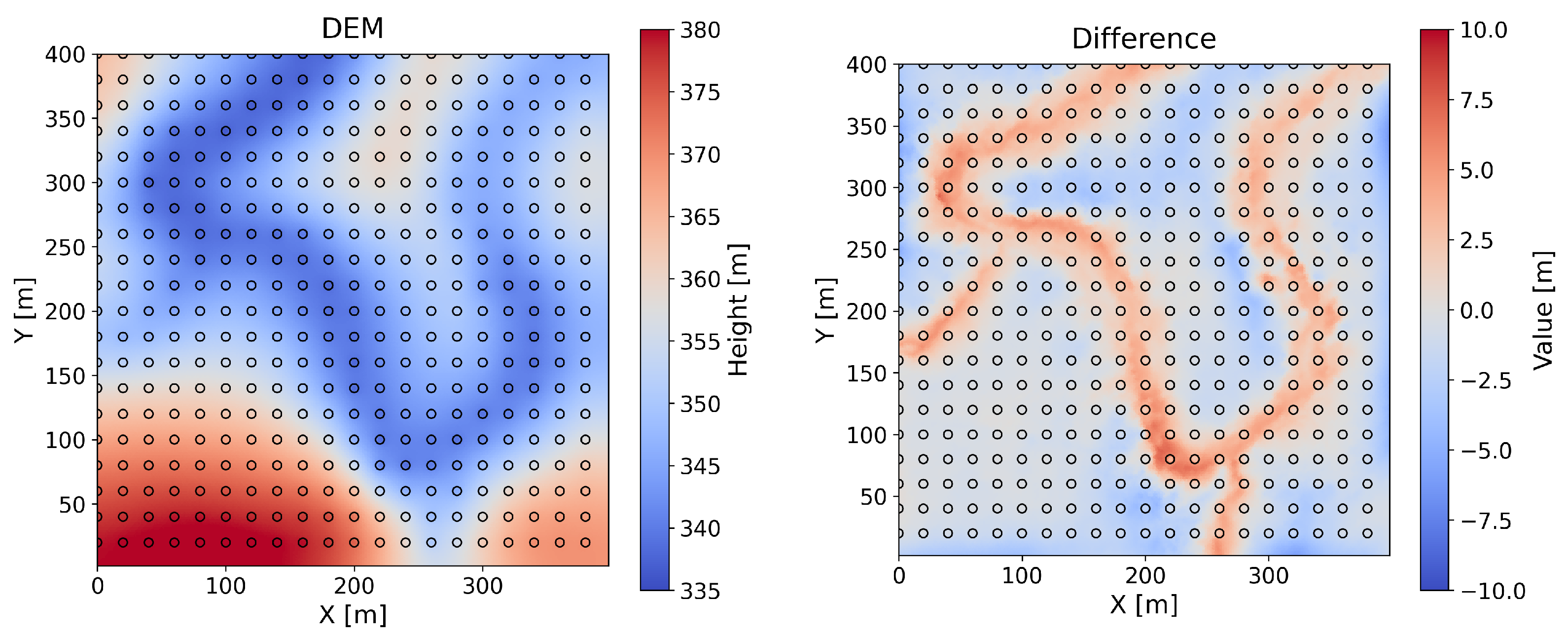
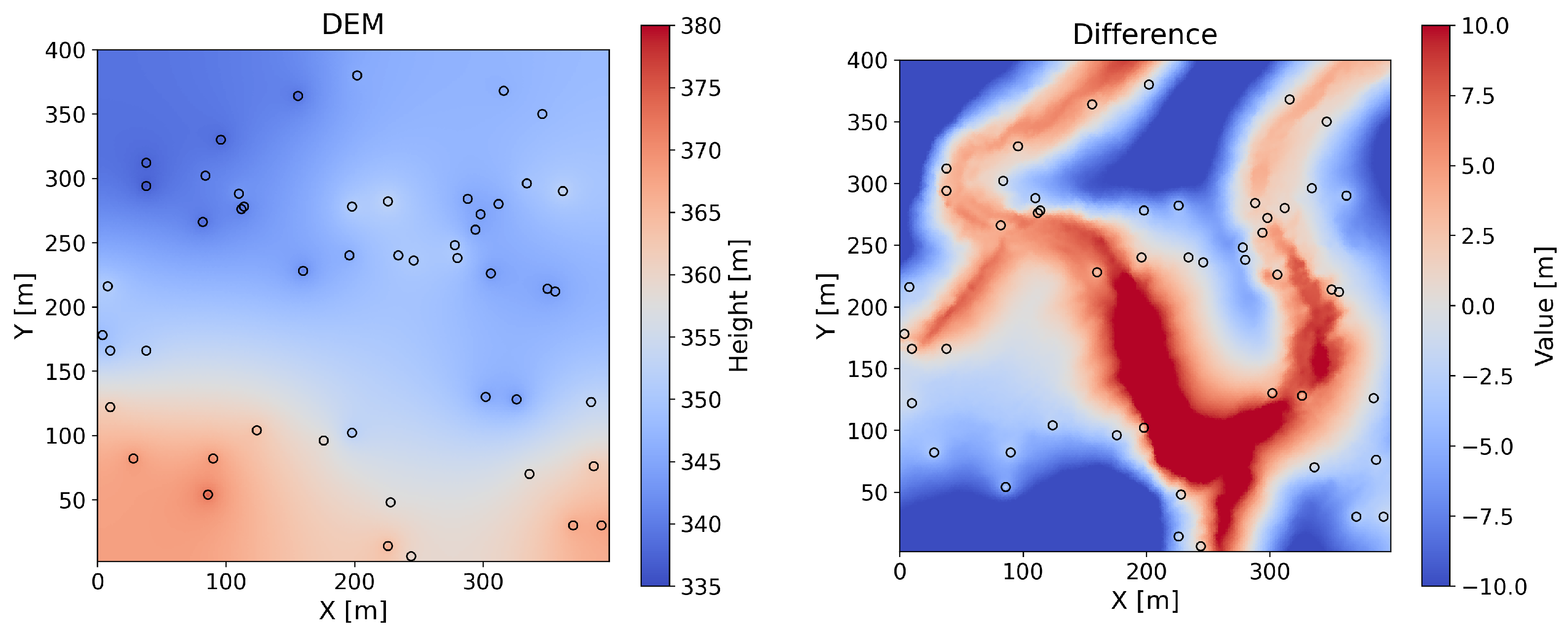
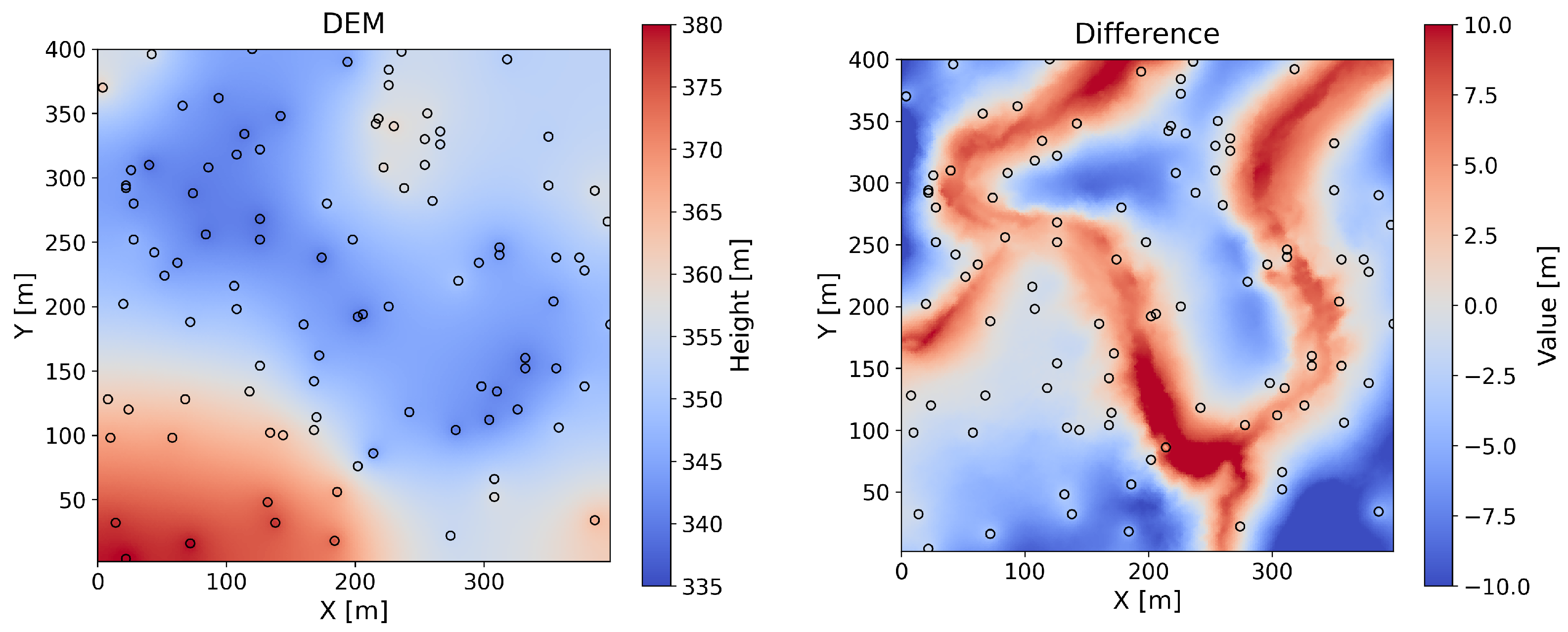
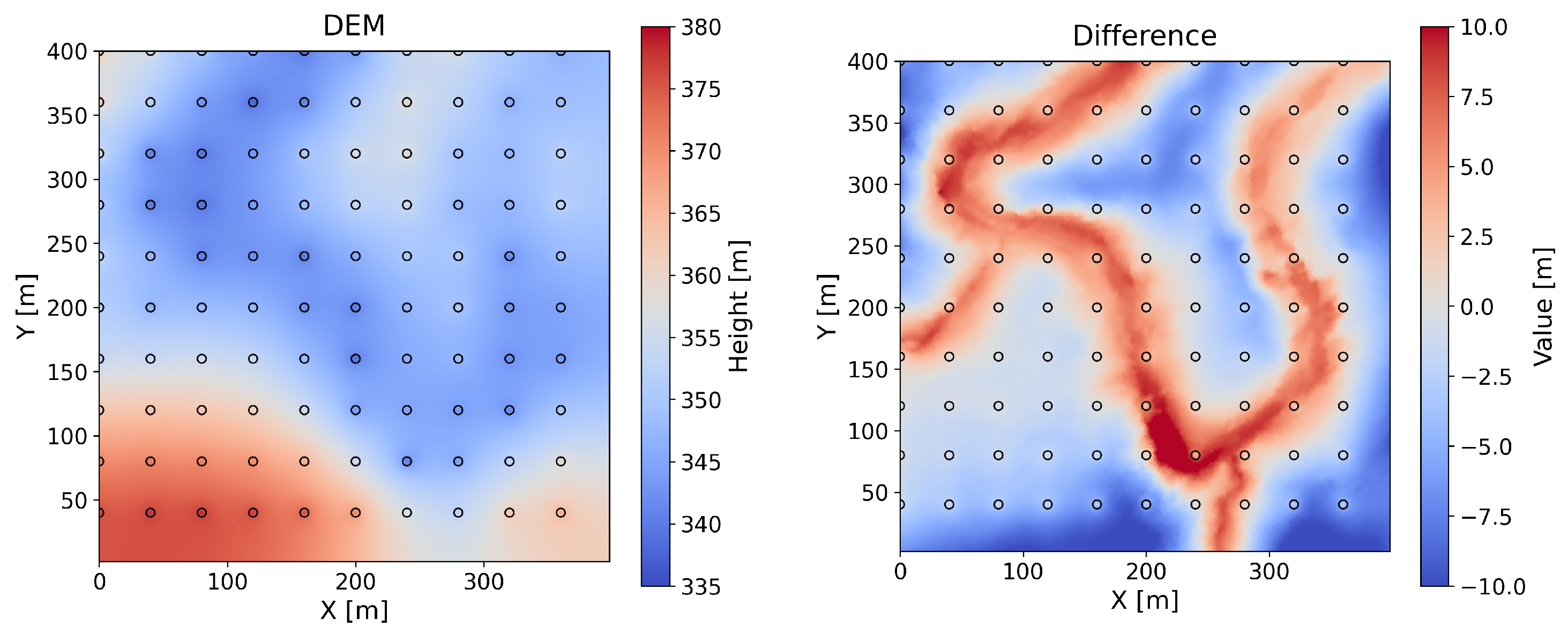
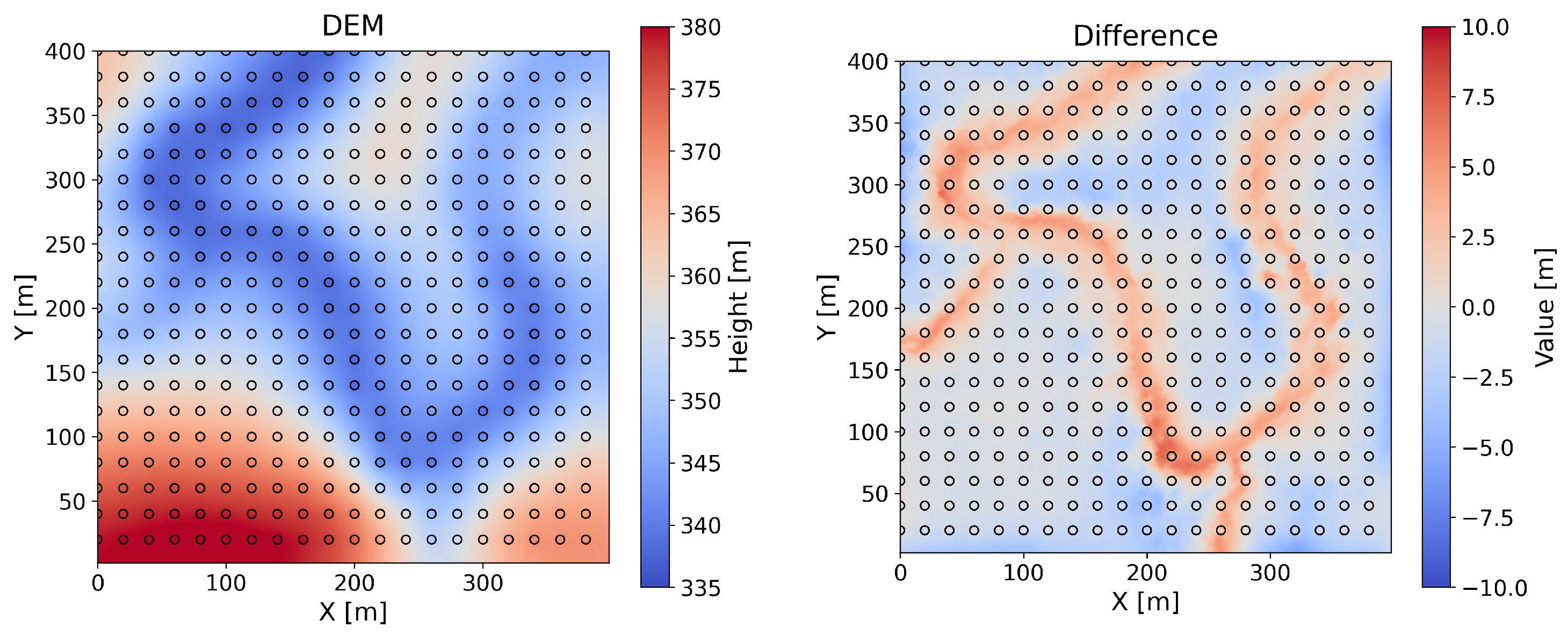
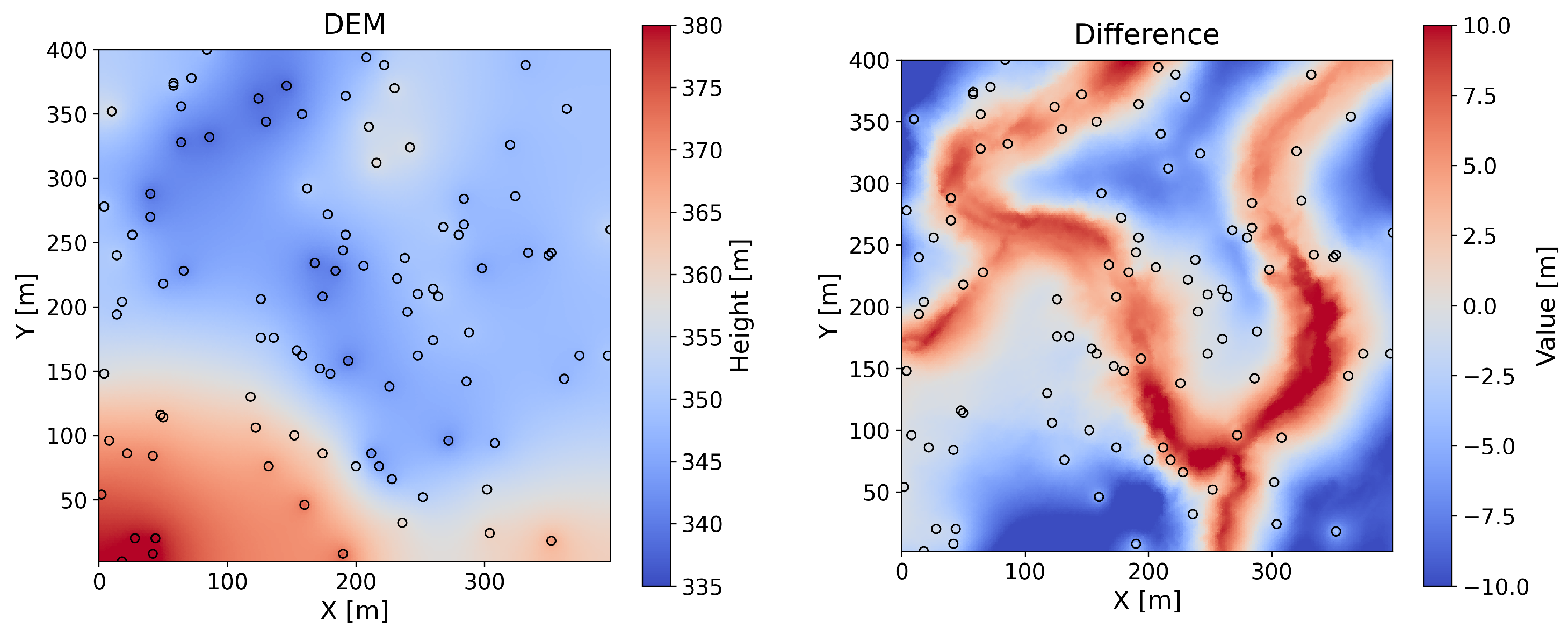
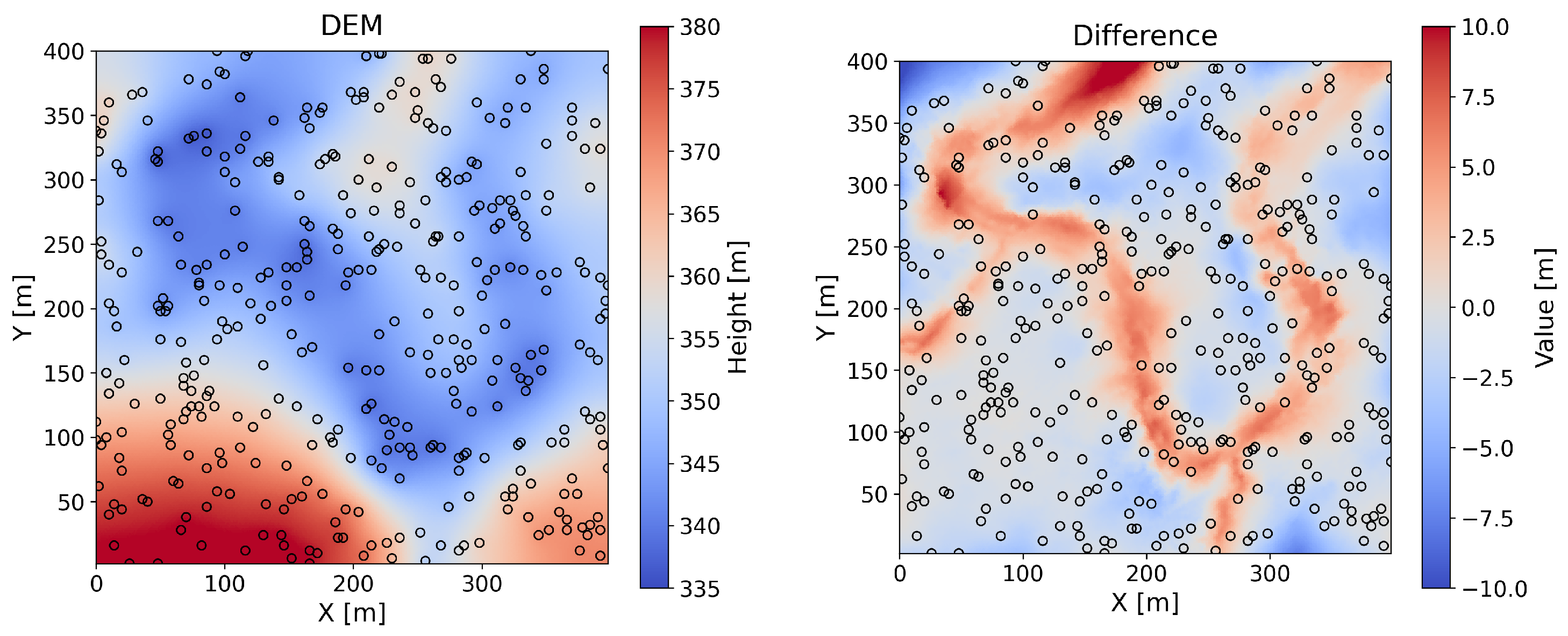
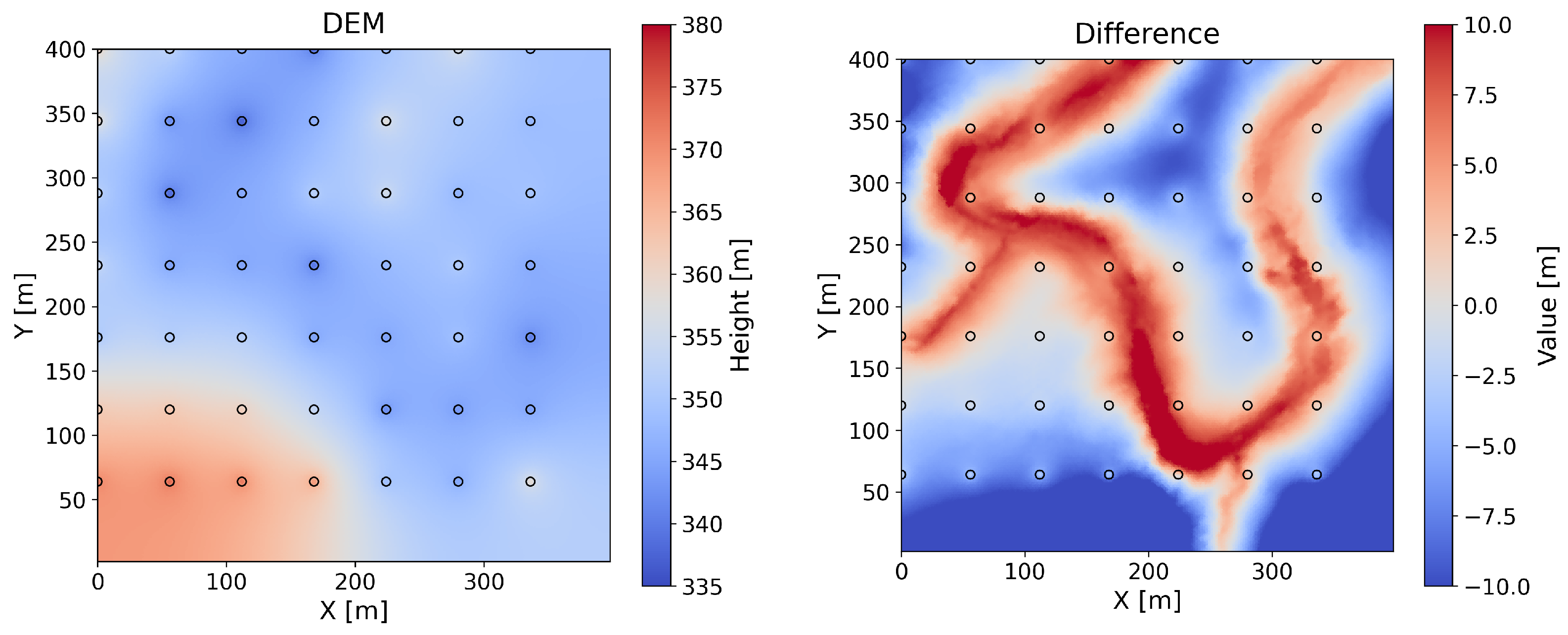
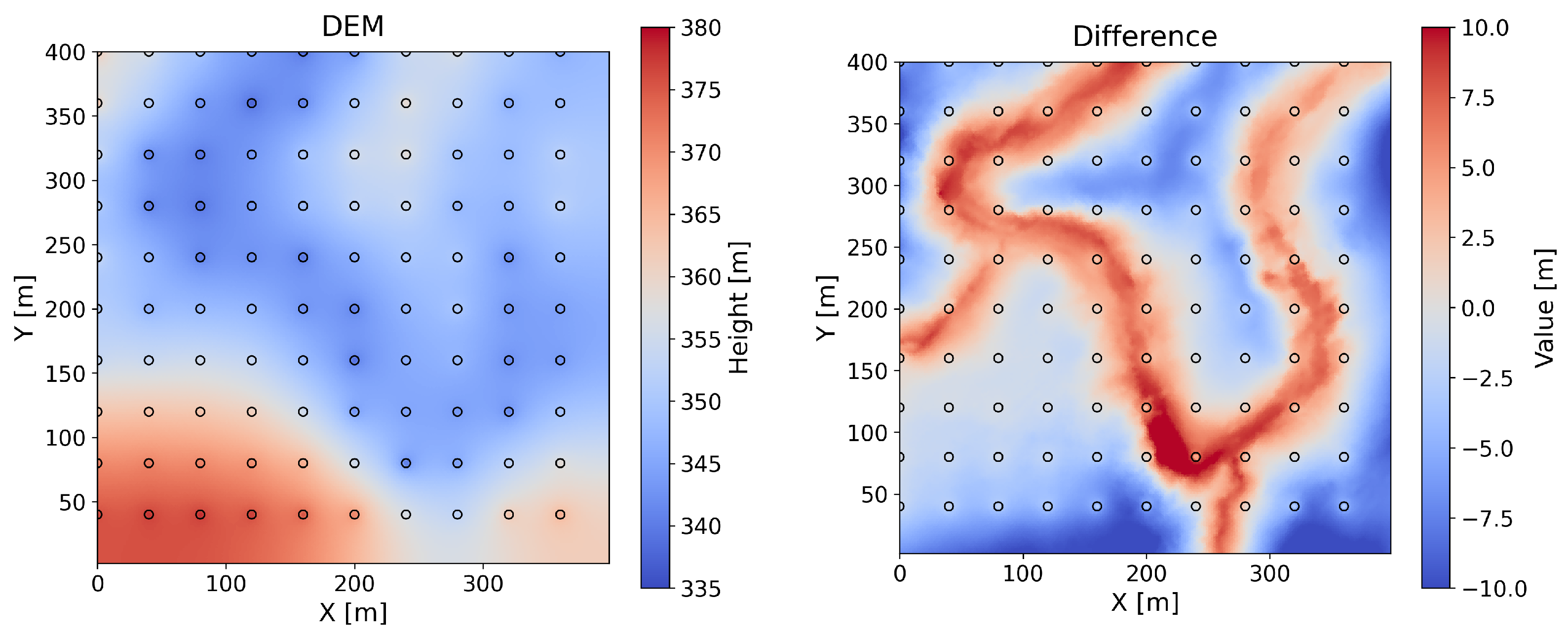
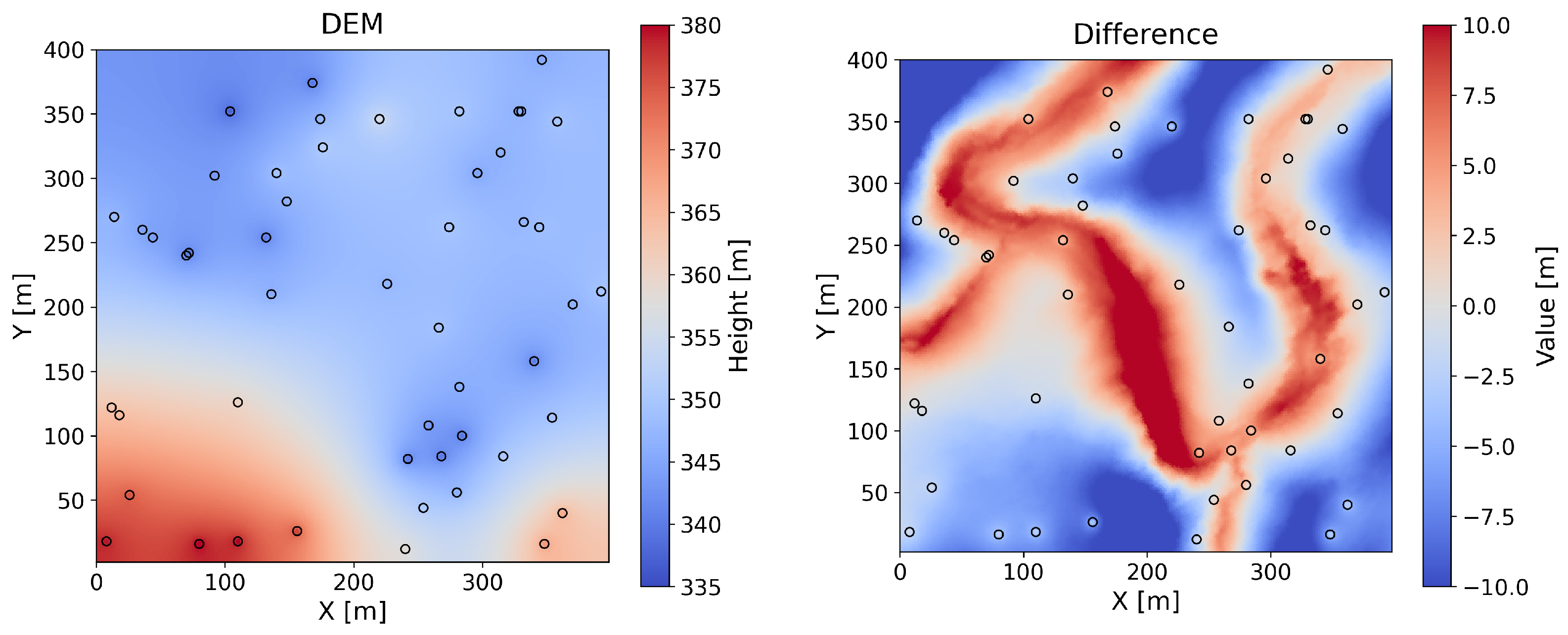
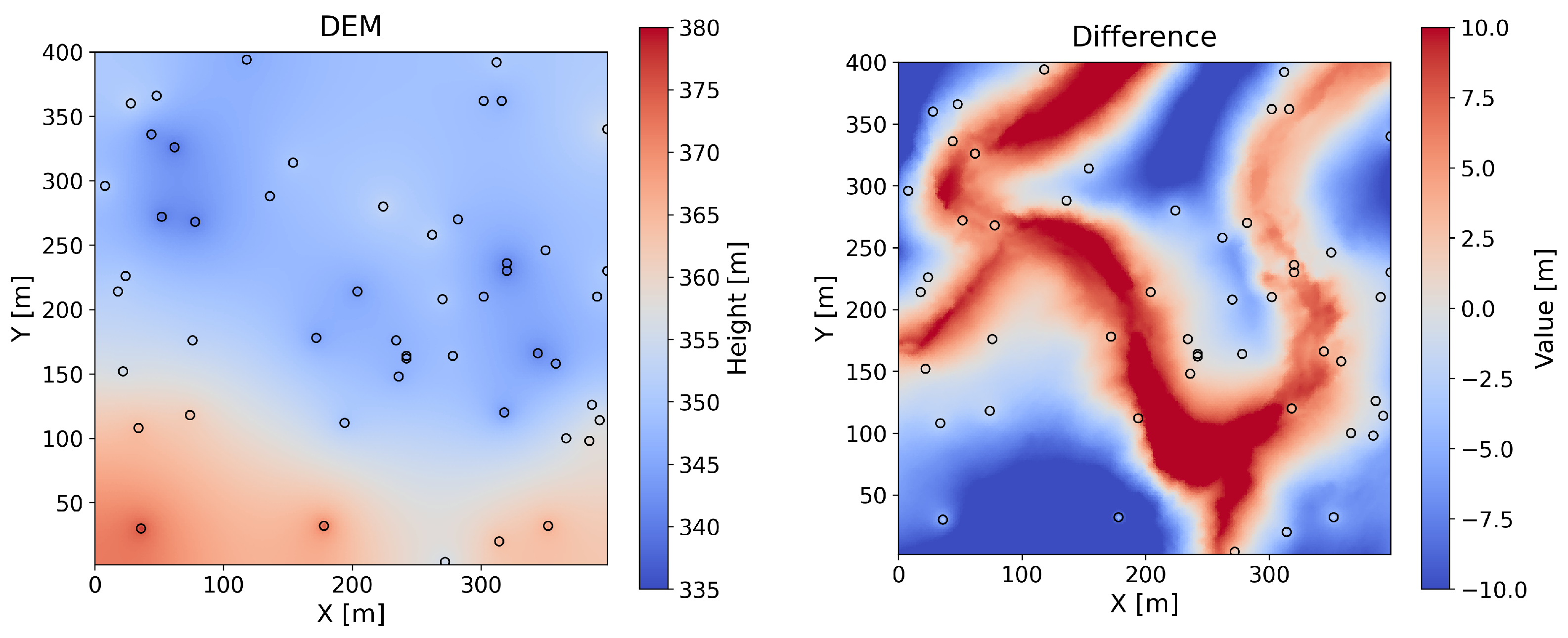
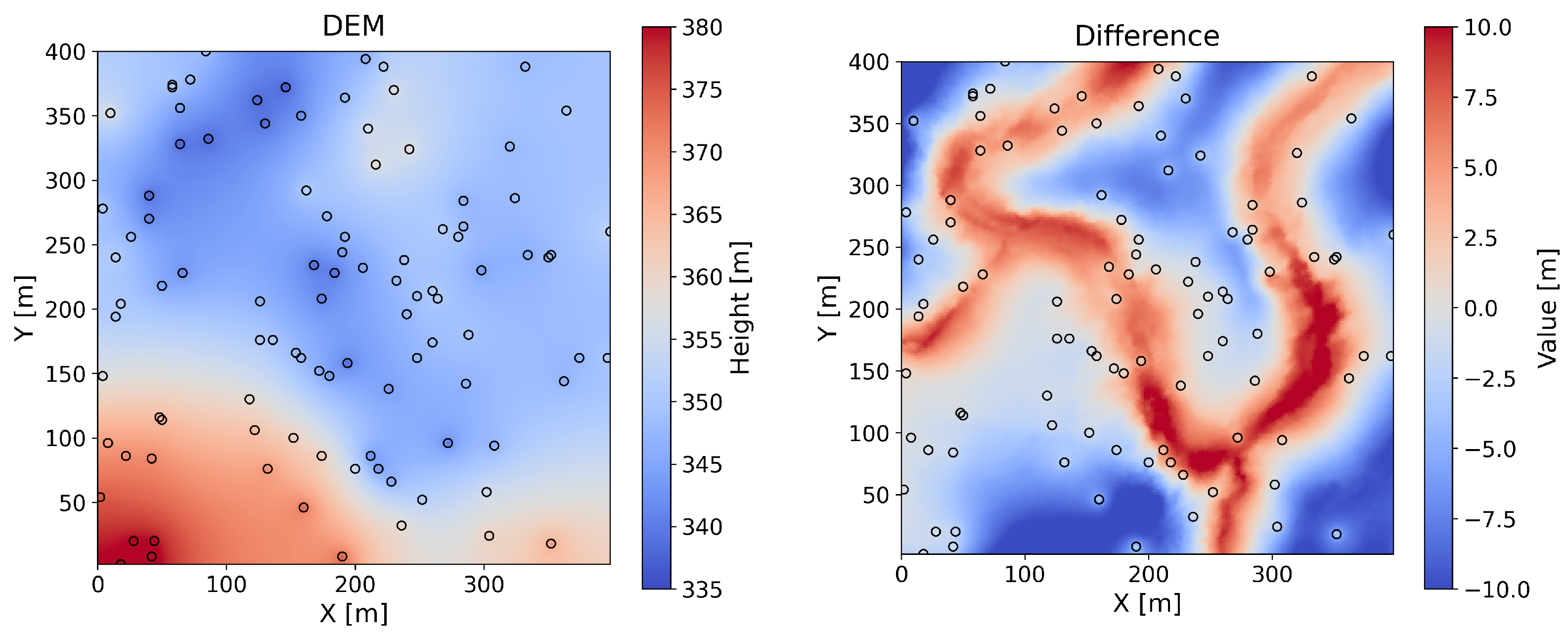
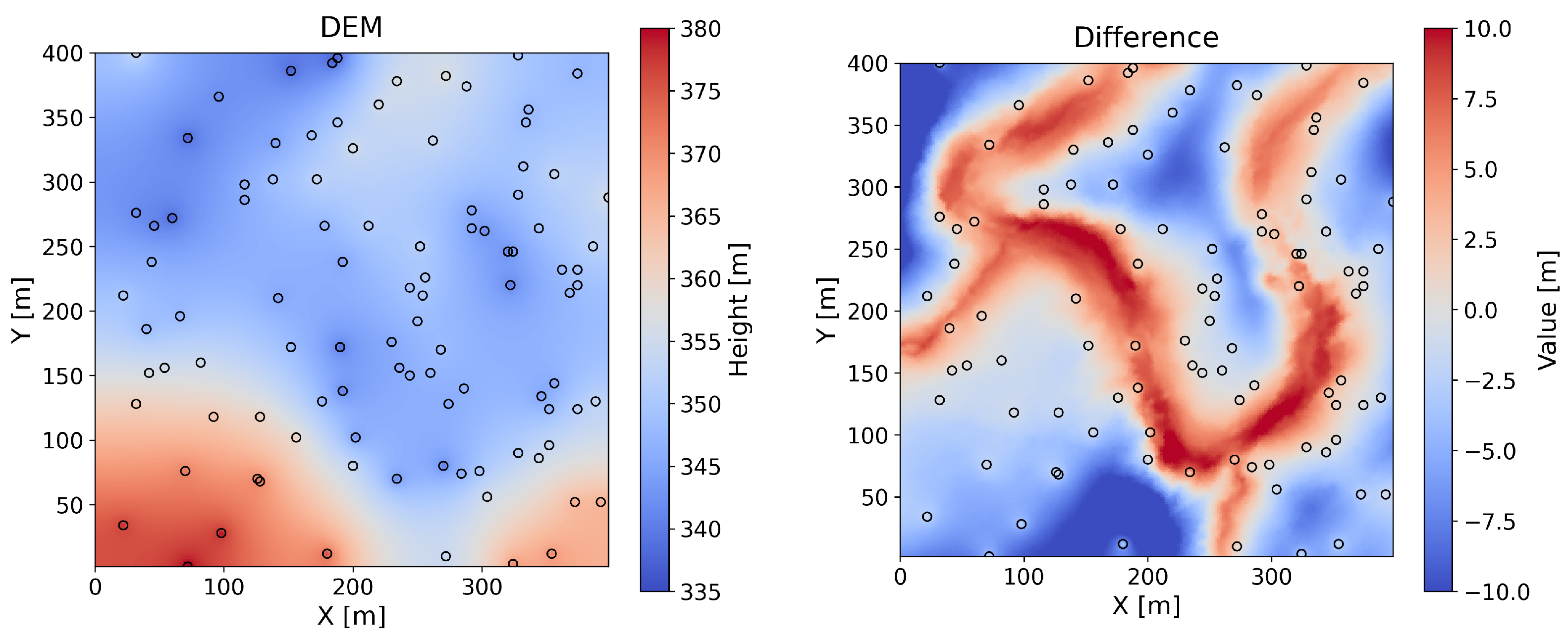
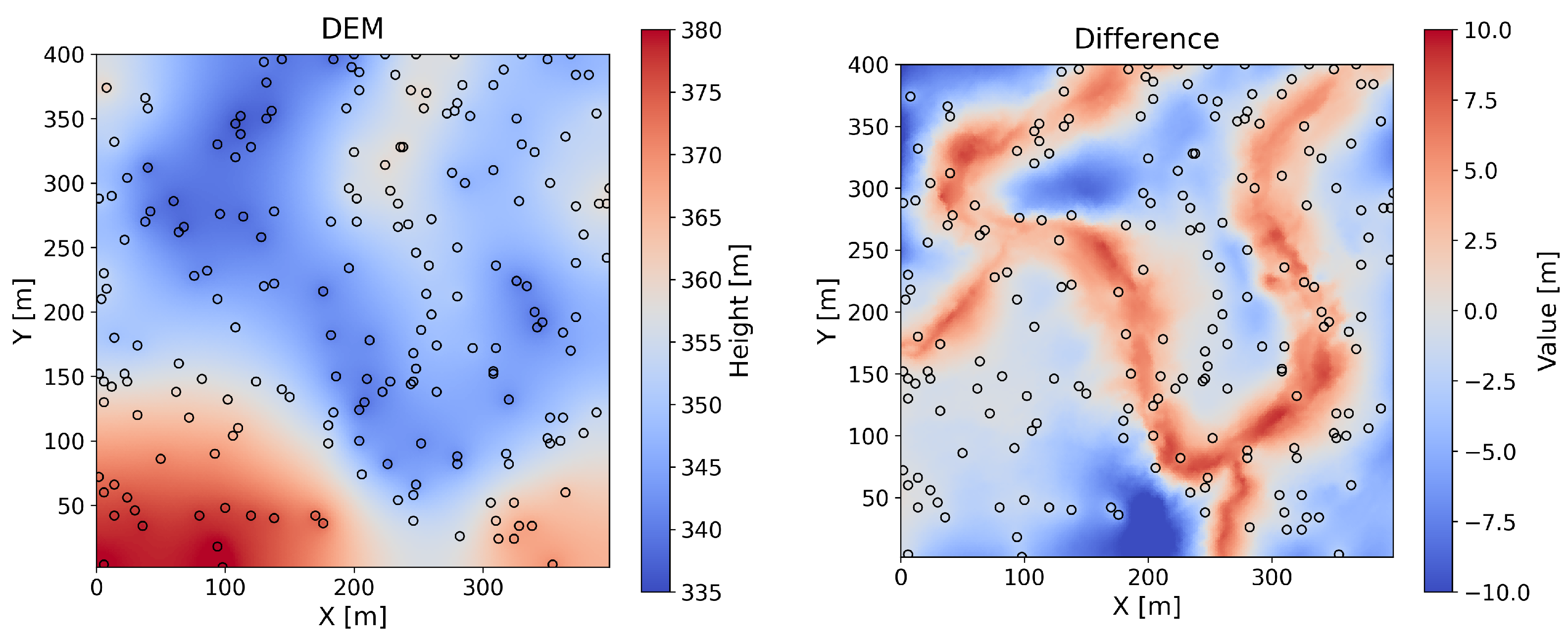
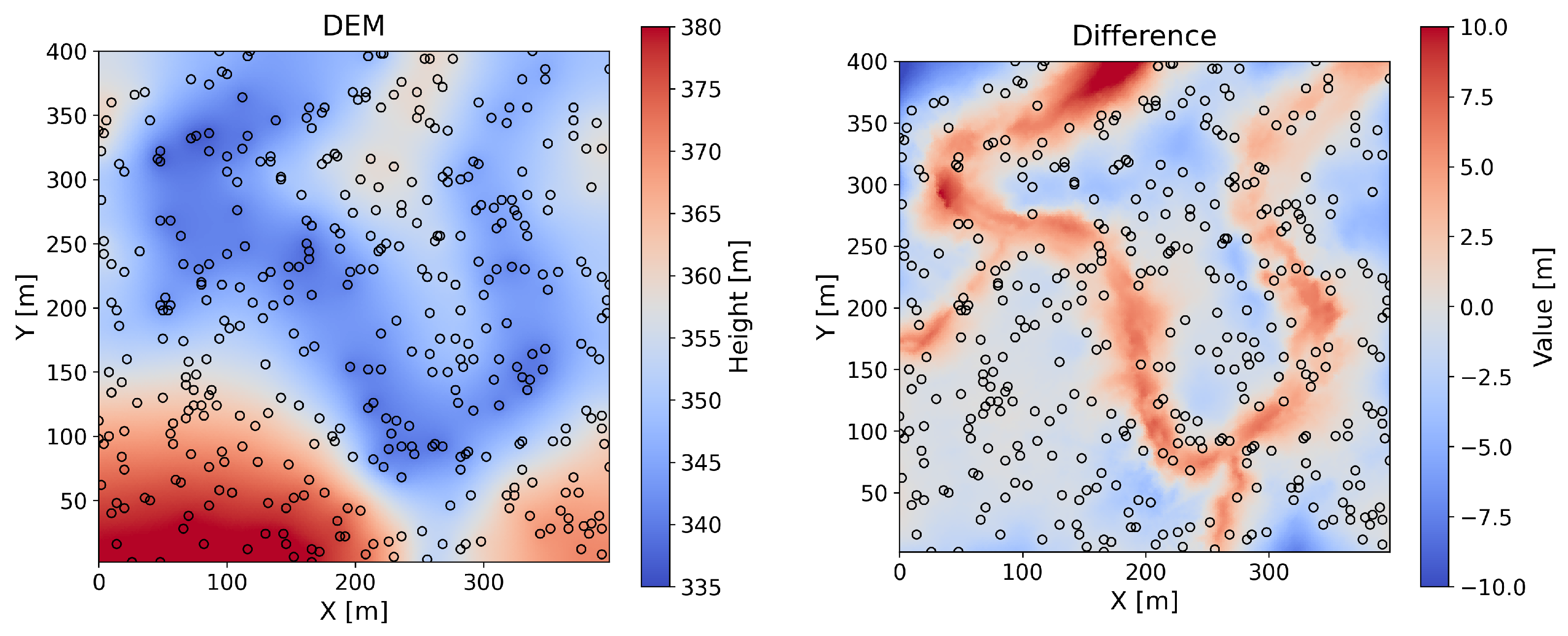
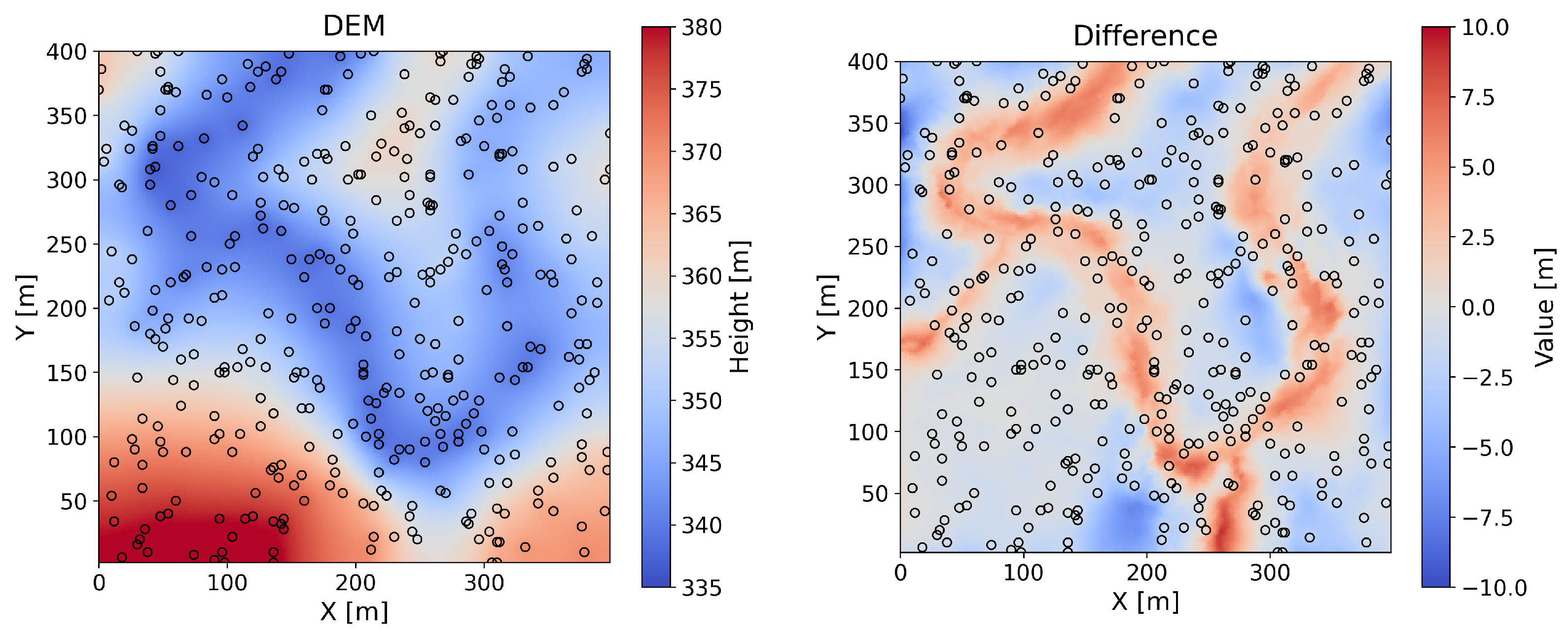
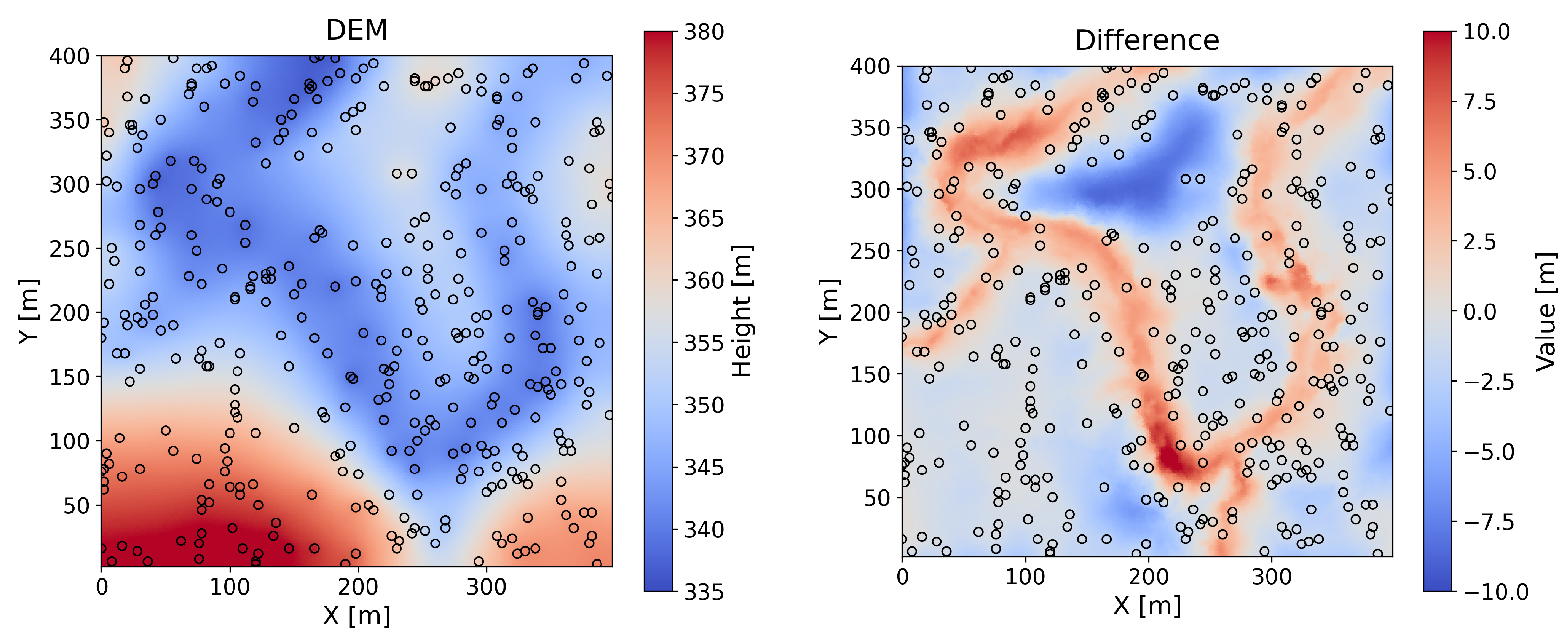
In the last example, corresponding to the real terrain case, a representative selection of the results is presented in the main text (
Figure 8,
Figure 9,
Figure 10 and
Figure 11), while the complete set of figures (
Figure A25,
Figure A26,
Figure A27,
Figure A28,
Figure A29,
Figure A30,
Figure A31,
Figure A32,
Figure A33,
Figure A34,
Figure A35,
Figure A36,
Figure A37,
Figure A38,
Figure A39,
Figure A40) is provided in
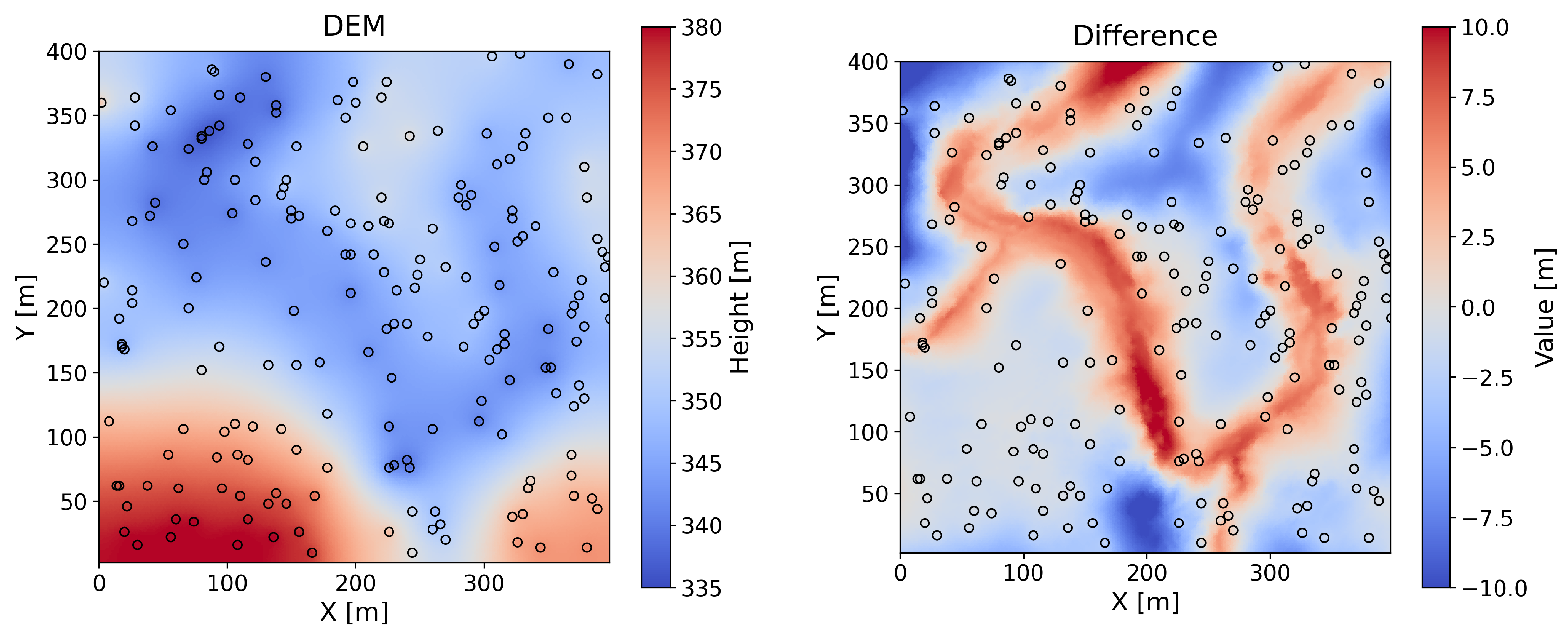
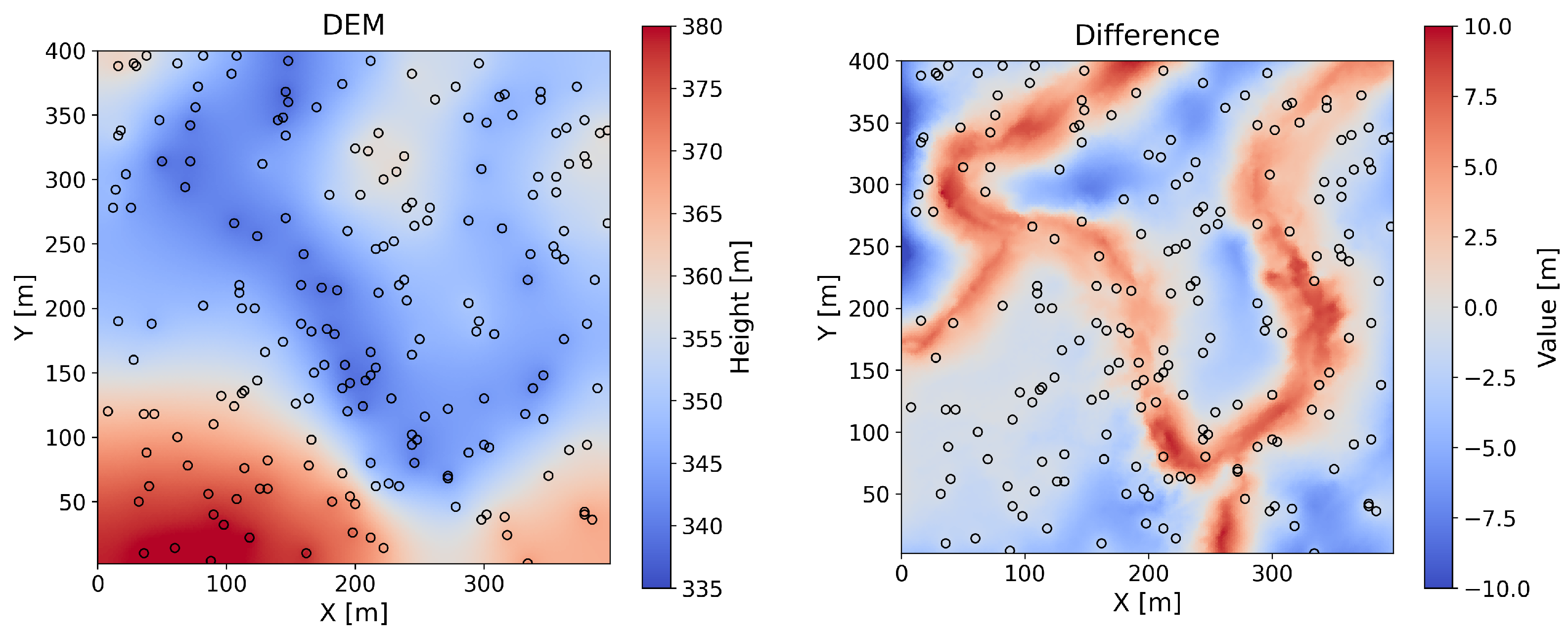
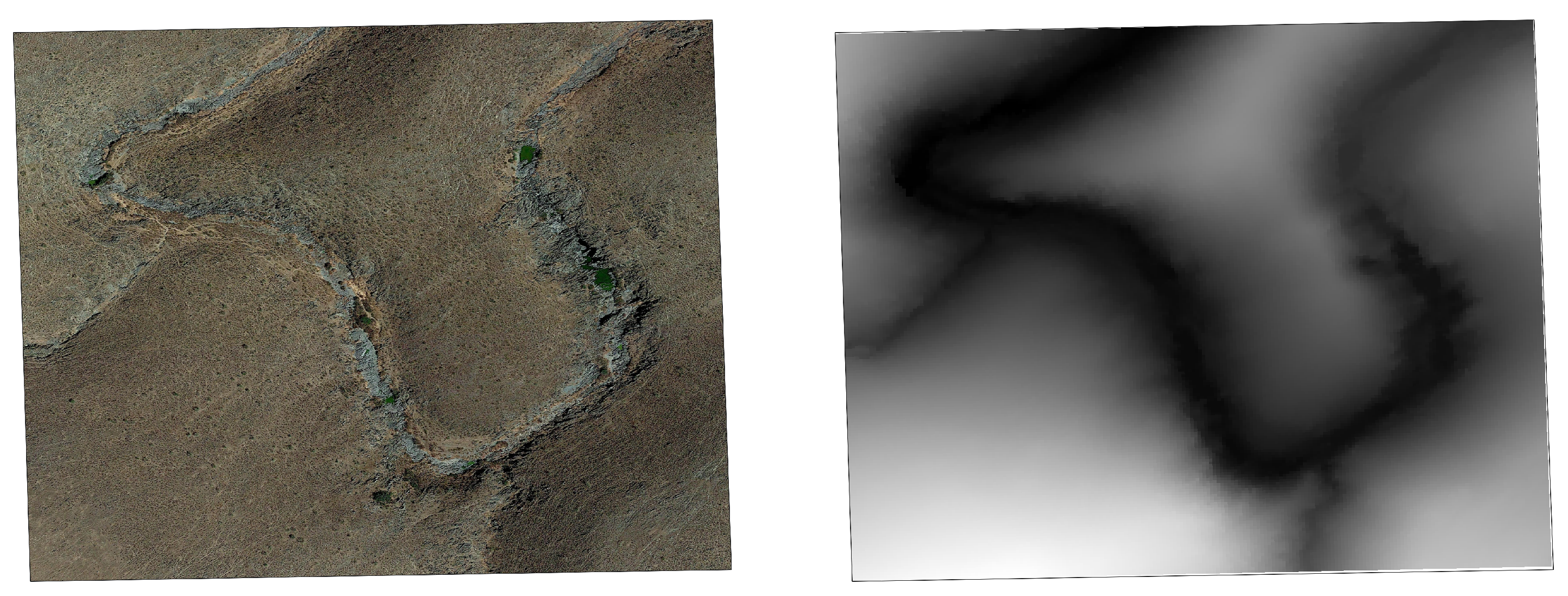
Appendix A. For each configuration, the image on the left displays the reconstructed digital elevation model, whereas the image on the right shows the contour map of elevation differences, computed as the interpolated height minus the reference high-resolution DEM (
Figure 3, right). These differences should be interpreted as deviations with respect to the reference dataset rather than absolute errors, reflecting how each interpolation approach adapts a smooth surface to the actual topography while preserving slope continuity and overall terrain morphology.
In the regular sampling configuration, the control points were intentionally arranged so that no points were placed along the lower and right boundaries of the domain. This design choice was made to explicitly assess the impact of missing boundary information on the reconstruction quality. As shown in the results, the absence of boundary constraints forces the Poisson and thin-plate models to extrapolate the surface near the edges, producing a noticeable increase in the deviations. Therefore, the behaviour observed in these regions is not a numerical artefact but an intended feature of the test configuration.
In the regular sampling configuration, the control points were arranged so that no points were placed along the lower and right boundaries of the domain, as discussed above. As a consequence, the Poisson and thin-plate models rely on extrapolation near these edges, which results in a noticeable increase in the deviations in these regions. This behaviour is therefore consistent with the expected influence of missing boundary constraints and does not indicate a numerical artefact of the formulation.
Table 7 and
Table 8 report the maximum elevation differences for each method, while the values in parentheses denote the mean absolute deviations (in meters), providing a quantitative assessment of the surface fitting accuracy in the real terrain case.
6. Discussion
6.1. Example 1: Synthetic Function 1
For the regular distribution, the results follow the expected trend: increasing the number of points leads to a uniform reduction in the errors for both methods, with the RBF–NURBS model yielding the smallest deviations. Although both methods enforce the same elevation values at the sampled points, their behavior between these points differs fundamentally. The RBF interpolant reproduces the prescribed values exactly, and the subsequent NURBS approximation remains very close to this interpolating surface. In contrast, the Poisson-based model, while also improving with denser sampling, retains a slightly larger error. In this formulation the elevations at the control points are imposed through Dirichlet conditions, but the surface in between is obtained as the solution of an elliptic PDE that minimizes a global smoothness energy. Consequently, even for a smooth analytical function and a dense sampling, the Poisson reconstruction produces a surface that is intrinsically smoother than the target function, leading to small but systematic deviations.
For the random distributions, the overall behaviour is similar. In most configurations the errors decrease as the number of points increases, and both models remain reasonably robust to the stochastic nature of the sampling. However, the variability introduced by random point placement has a stronger impact on the RBF–NURBS reconstruction, which is more sensitive to local clustering and irregular spacing. This is evident in the differences among the three seeds for each point count: while many random configurations yield errors comparable to or only slightly above those obtained with the regular grids, others exhibit noticeably larger deviations, particularly for RBF–NURBS. In contrast, the Poisson-based method shows a more consistent performance across seeds, with smaller fluctuations in both maximum and mean errors.
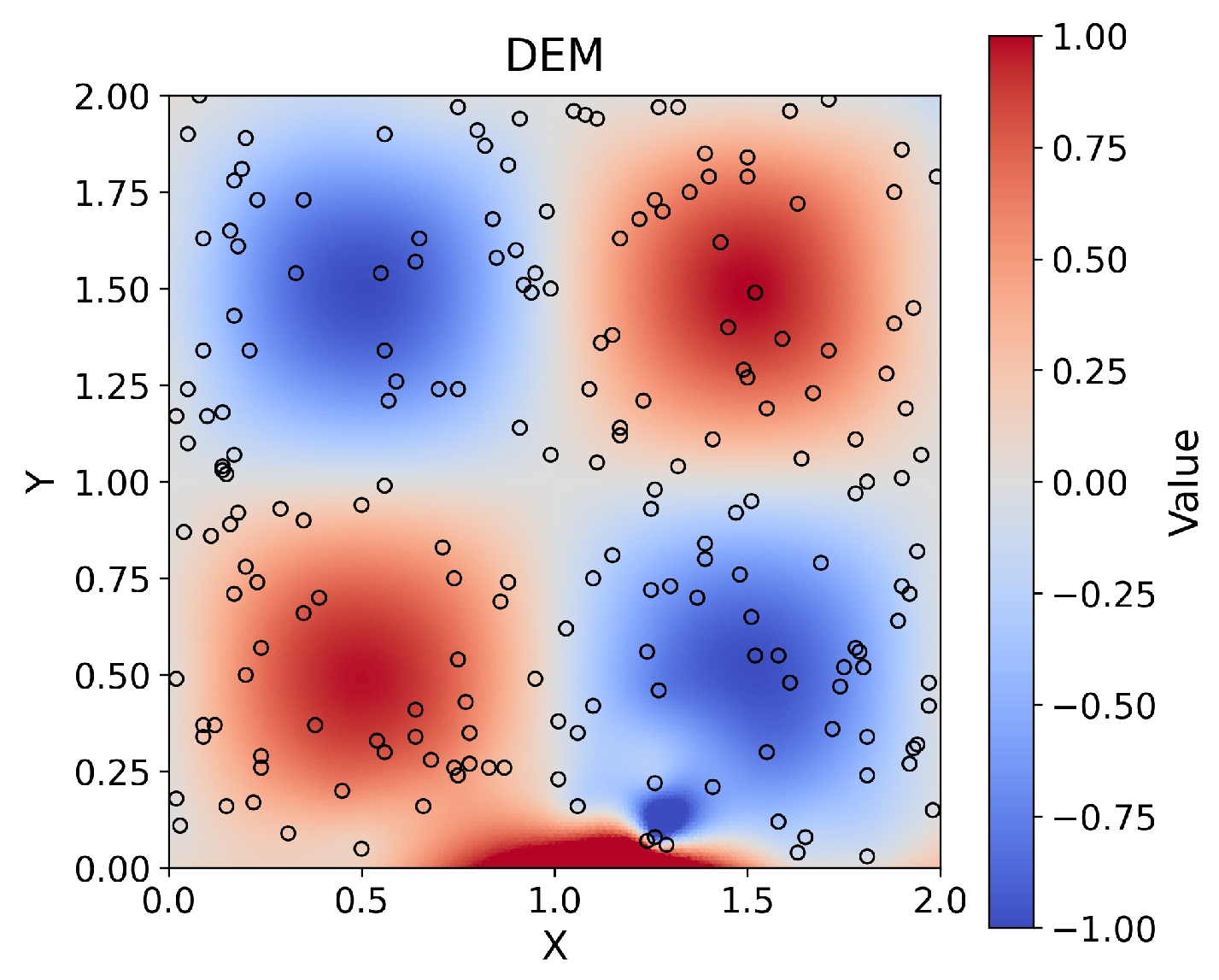
The most prominent outlier corresponds to the 196-point random distribution for Seed 1, where the RBF-NURBS error increases sharply despite the high point density. This behaviour does not originate in the NURBS surface itself, but in the RBF interpolation step on which it is based. In this particular seed, several sample points are located very close to one another near the lower boundary of the domain (
Figure 12), while no points exist immediately outside the domain to counterbalance their influence. The radial basis function employed here is a global interpolant, meaning that every data point contributes to the reconstructed surface throughout the entire domain. When multiple points are clustered near a boundary, their combined effect acts effectively as a strong local source term, forcing the interpolant to adopt an exaggerated curvature in order to pass through all the closely spaced samples. Inside the domain, similar clusters do not produce such distortions because they are surrounded by other points in all directions, which stabilises the interpolation. At the boundary, however, the lack of neighbouring data on one side prevents this balancing effect. As a result, the RBF interpolant develops an artificial deformation in that region, which is subsequently inherited by the NURBS surface fitted to the RBF-generated grid. This explains the marked increase in error observed for the 196-point irregular configuration with Seed 1, and highlights the sensitivity of global RBF methods to clustered samples located near domain boundaries.
Beyond the accuracy considerations discussed above, the behaviour observed in this example also illustrates several practical strengths of the Poisson-based reconstruction. Because the Poisson formulation relies on the solution of a sparse elliptic problem, it is naturally robust to uneven point distributions and does not require constructing an artificial tensor-product structure. In contrast, the RBF–NURBS pipeline depends critically on the intermediate RBF interpolation, whose global character can amplify local irregularities in the sampling. Moreover, building and evaluating an RBF interpolant requires solving a dense linear system whose size grows with the number of points, followed by a NURBS fitting step on a structured mesh. This makes the full RBF–NURBS procedure substantially more demanding in both computational time and memory. The Poisson model therefore combines a more stable response to irregular sampling with significantly better computational scalability, which becomes particularly relevant for large datasets or repeated reconstructions.
6.2. Example 2: Synthetic Function 2
In Example 2, the reconstruction problem becomes more challenging due to the presence of a sharp change in slope at . This discontinuity in the derivative introduces a non-smooth feature that neither method is able to reproduce exactly, yet the two models handle this difficulty in different ways. For the regular point distributions, the errors remain of comparable magnitude for both approaches and do not decay as steadily as in Example 1. This behaviour is expected: the discontinuity dominates the reconstruction error, and increasing the number of points does not eliminate the intrinsic smoothing that both models apply across the jump. The RBF-NURBS-based reconstruction shows systematically smaller mean deviations, reflecting its ability to interpolate a smooth surrogate surface away from the discontinuity, whereas the Poisson solution exhibits more uniform errors across the domain but is influenced more strongly by the abrupt change in gradients.
For the random point sets, the behaviour departs more noticeably from that observed in Example 1. In all seeds and point counts, the discontinuity imposes a lower bound on the attainable accuracy, and the statistical variability between seeds becomes more pronounced. This effect is particularly visible in the Poisson reconstructions, where the maximum deviation increases significantly for seeds in which few points sample the region around , thus providing insufficient information to reproduce the steep gradient transition. Conversely, when the random sampling happens to place more points near the discontinuity, the Poisson model yields errors similar to those from the regular grid. The RBF–NURBS model shows a more stable response across seeds, as the RBF interpolation distributes the influence of the jump more globally; however, this also results in a systematic smoothing of the discontinuity, leading to larger maximum errors in many cases.
Overall, the results reveal a complementary behaviour between the two reconstructions. The RBF–NURBS approach provides smoother approximations and is less sensitive to how the random samples are distributed around the discontinuity, but its global smoothing prevents an accurate reproduction of the sharp gradient change. The Poisson model, on the other hand, is able to preserve the structure of the discontinuity more faithfully when the sampling sufficiently resolves it, but becomes more sensitive to seeds that undersample the region where the slope changes. These trends are consistent with the observations made in Example 1: the RBF–NURBS method is strongly influenced by the smoothing inherent to the RBF interpolation, whereas the Poisson formulation responds more directly to the local distribution of pointwise gradient information. In the presence of non-smooth features, these differences become more pronounced and highlight the contrasting reconstruction mechanisms of the two approaches.
6.3. Example 3: Real Terrain
The real terrain example highlights the different balance that the three approaches strike between smoothness and pointwise accuracy. The Poisson-based model exhibits a robust behaviour in terms of maximum deviation, reaching values comparable to those of the thin-plate interpolator and the RBF-NURBS surface when the number of points increases. However, in all configurations—both regular and random—the mean absolute deviations provided by the Poisson formulation are noticeably higher than those obtained with the other two methods. This indicates that the Poisson solution produces a smoother surface with reduced roughness, which tends to underfit the small-scale variations present in the measured elevations.
In contrast, the thin-plate interpolator and the RBF-NURBS reconstruction achieve a closer pointwise agreement with the reference data, as reflected by their consistently lower mean deviations, although at the cost of reproducing more local variability of the terrain. As the point density increases, the three methods show a coherent convergence trend, with diminishing maximum and mean deviations, but the relative behaviour between them remains consistent.
In contrast, the thin-plate interpolator and the RBF-NURBS reconstruction achieve a closer pointwise agreement with the reference data, as reflected by their consistently lower mean deviations, although at the cost of reproducing more local variability of the terrain. As the point density increases, the three methods show a coherent convergence trend, with diminishing maximum and mean deviations, but the relative behaviour between them remains consistent. It is worth noting that, for the random sampling configurations, the maximum deviation does not necessarily decrease monotonically with increasing number of points. This behaviour is expected, as the maximum deviation is a highly local metric that is strongly influenced by the specific spatial distribution of the sampling points. While increasing point density improves the overall coverage of the domain on average—leading to a systematic reduction of the mean deviation—isolated gaps or local clustering may still occur and dominate the maximum deviation. As a result, non-monotonic variations of the maximum deviation with point density are a natural consequence of random sampling and do not contradict the general convergence trend observed in the mean error.
Overall, Example 3 shows that the Poisson approach prioritizes smoothness and slope continuity over pointwise accuracy, whereas thin-plate and RBF-NURBS favour a tighter local fit. The choice between these methods therefore depends on whether the application requires a smoother global representation or a more detailed reproduction of the small-scale terrain features.
The results also show that the absence of sampling points on the domain boundary strongly amplifies the errors in the Poisson and thin-plate models (
Figure A25,
Figure A26,
Figure A27,
Figure A28), particularly near the edges where the surface must be extrapolated. This effect highlights the importance of an adequate boundary sampling strategy when applying these methods to real terrain data.
7. Conclusions
7.1. Main Contributions
This work has introduced a Poisson-based strategy for reconstructing smooth surfaces from scattered elevation data and has compared it with an RBF–NURBS reconstruction across several synthetic and real examples. In addition to the quantitative differences observed in the numerical tests, the study reveals a number of conceptual and practical advantages of the Poisson formulation that are particularly relevant for applications involving irregular or large datasets.
Overall, the results demonstrate that the Poisson-based reconstruction provides a robust, scalable, and methodologically clean alternative to interpolation-driven methods. While RBF–NURBS may reach higher pointwise accuracy under favourable sampling conditions, the Poisson formulation offers a more stable and practically applicable framework for surface reconstruction, especially in irregular sampling scenarios and large-scale computational settings.
7.2. Accuracy, Smoothness, and Limitations
An important strength of the Poisson approach is its inherent robustness to noise and local fluctuations in the data. Since the reconstructed surface is obtained by solving an elliptic PDE that integrates a smoothly regularised representation of the terrain derivatives, the method naturally suppresses local inconsistencies and avoids the sharp oscillations that interpolation-based schemes may reproduce.
The real terrain experiment confirms these smoothing effects in a demanding geomatic setting. As the point density increases, the Poisson-based reconstruction attains maximum deviations that are comparable to those of the thin-plate and RBF–NURBS methods, but it consistently shows larger mean deviations. This behaviour reflects the stronger smoothing imposed by the Poisson formulation, which produces a surface with reduced roughness and therefore underrepresents small-scale terrain variations. This smoothing behaviour also defines the main limitation of the proposed approach, which stems from the use of a harmonic formulation. Since the solution minimizes gradient variations in a global, variational sense, the method is not designed to accurately reproduce abrupt topographic features such as cliffs, sharp ridges, terraces, or anthropogenic structures. In such cases, the intrinsic smoothing of the Poisson model may lead to an underestimation of local slopes and elevations. Consequently, the method should not be regarded as a replacement for exact interpolation techniques when the preservation of fine-scale or highly localized features is required, but rather as a regularized reconstruction strategy appropriate for smoothly varying terrains or large-scale modelling applications.
In contrast, thin-plate and RBF–NURBS reconstructions provide a closer pointwise fit at the expense of reproducing more of the local variability present in the data.
The results also highlight the importance of adequate boundary sampling. In regions where no control points are available—particularly along the domain edges—the Poisson and thin-plate models must extrapolate the surface, which leads to a substantial increase in error. This effect is clearly visible in the real terrain test and underscores the need to include boundary information when working with scattered elevation data.
7.3. Computational Aspects
A further and notable advantage lies in the computational cost. The linear system arising from the Poisson formulation is sparse, allowing the use of efficient iterative solvers or multigrid methods whose complexity scales approximately as or , depending on the solver and preconditioning strategy. The RBF–NURBS pipeline, on the other hand, requires solving a dense interpolation system for the RBF coefficients, with a computational cost that scales as in the general case, followed by the construction of a NURBS surface on a structured grid. This makes the Poisson formulation substantially more scalable and better suited for large or high-resolution datasets.
A direct comparison of execution times or memory usage is not reported in this work, as the two approaches have been implemented in fundamentally different computational environments. The Poisson-based formulation is solved using a commercial FEM solver with highly optimized compiled routines and solver strategies that are not directly accessible or configurable, whereas the RBF interpolation relies on a third-party Python implementation. As a result, any direct timing or memory comparison would be dominated by implementation-specific factors rather than by the intrinsic numerical characteristics of the methods.
Nevertheless, the difference in memory requirements follows directly from the structure of the linear systems involved: sparse matrices in the Poisson formulation versus dense matrices in the RBF interpolation, leading to markedly different memory scaling for large problem sizes.
7.4. Practical Implications
The Poisson formulation also has the advantage of working directly on the scattered point set, without requiring any imposed structure on the data. In contrast, the NURBS reconstruction depends critically on a preliminary RBF interpolation and the generation of a regular tensor-product grid, making it more sensitive to variations in point density and distribution and more susceptible to local artefacts, particularly near domain boundaries.
In addition, the Poisson model produces globally coherent surfaces even in the presence of uneven or clustered sampling. The underlying variational principle ensures smooth transitions between regions of different point density and prevents the formation of local distortions that may arise in global interpolation schemes such as RBFs. Finally, the PDE-based nature of the method makes it naturally compatible with finite element workflows, facilitating its integration into broader modelling pipelines involving gradient-based or physics-driven processes.
The Poisson-based reconstruction also generates surfaces with smoother slopes than those produced by the other methods considered. This characteristic can be advantageous in various engineering and modelling contexts. For instance, when generating boundary geometries for finite element models of structures (such as dams or bridges), the terrain does not need to be represented with high local detail, and an overly rugged surface would unnecessarily refine the mesh. Likewise, in large-scale CFD or river-channel simulations, incorporating fine-scale topographic irregularities may lead to impractically large meshes, whereas a smoother DEM is often preferable. Similar considerations apply to two-dimensional hydraulic or shallow-water models, where small-scale roughness and vegetation effects are introduced through empirical roughness parameters rather than explicitly through micro-topography.
It is also worth noting that the intrinsic smoothing introduced by the Poisson formulation can be beneficial in situations where the underlying surface is extremely smooth, nearly harmonic, or when the available data contain noise. In these cases, enforcing exact pointwise interpolation—as done by RBF-based approaches—may reproduce small oscillations or fluctuations that are not representative of the large-scale behaviour of the surface. By contrast, the elliptic regularization inherent to the Poisson model acts as a natural stabilizing mechanism, yielding reconstructions that remain faithful to the global geometry while filtering out spurious variations.
7.5. Perspectives and Future Work
Although modern finite element workflows often incorporate adaptive meshing or gradient-based mesh refinement strategies, these aspects have not been explicitly addressed in the present study. The primary focus here is on the reconstruction of a smooth elevation field from scattered data, rather than on the optimisation of the computational mesh itself. In this context, the finite element mesh acts merely as a numerical support for solving the Poisson problem and does not represent a physical discretisation requiring error-driven refinement. Nevertheless, the proposed formulation is fully compatible with adaptive meshing techniques, which could be applied in a subsequent stage if local resolution enhancement were required for specific applications.
The examples analysed in this study were constructed from either regular grids or random point clouds generated without human intervention. This strategy was deliberately adopted to avoid selection bias and to enable objective comparisons across methods. In practical applications, however, sampling is typically performed by engineers or specialists who can select points at key locations—such as peaks, valleys, or slope breaks—capturing the essential structure of the terrain. For this reason, real-world errors are expected to be significantly lower than those obtained with the artificially neutral sampling used in the synthetic and real examples of this study.
A final remark concerns the role of the source term Q in the Poisson formulation. In this study, the reconstruction has been restricted to the homogeneous case , which naturally promotes smooth solutions and highlights the intrinsic regularizing effect of the method. In more general settings, prescribing a non-zero or spatially varying would allow one to locally adjust the curvature of the reconstructed surface, effectively giving different weights to selected regions or features. Exploring these possibilities, however, would require a dedicated analysis and falls outside the scope of the present work. Nevertheless, the potential flexibility offered by non-homogeneous Poisson models suggests an interesting direction for future research, particularly in applications where varying degrees of smoothness are desirable across the domain.