Article

Propagation of Correlation Singularities of a Partially Coherent Field

1
College of General Education, Kookmin University, Seoul 02707, Republic of Korea
2
Department of Physics, University of Massachusetts, Amherst, MA 01003, USA
3
Department of Physics and Engineering Physics, Yonsei University, Wonju 26493, Republic of Korea
*
Author to whom correspondence should be addressed.
Optics 2026, 7(1), 9; https://doi.org/10.3390/opt7010009 (registering DOI)
Submission received: 22 November 2025 / Revised: 30 December 2025 / Accepted: 15 January 2026 / Published: 22 January 2026

Abstract

We investigate the structure of correlation singularities for the Laguerre–Gauss beam of order n = 0 and m = 2 in the transverse plane during the propagation of the beam in the beam-wander model. We explicitly derive analytical expressions for the cross-spectral density of the corresponding beam order and the analytic expressions representing the singular behavior. We also verify that the singular points disappear at certain z values and reappear at other z values as shown in the previous numerical study. We investigate the dependence of the absolute value of the complex degree of coherence μ on the parameter δ of the beam-wander model during the propagation of the Laguerre–Gauss beam in the corresponding order. The complex degree of coherence depends not only on δ but also on the relative positions of two transverse observation points ρ 1 and ρ 2 , as well as on the propagation variable z for the fixed values of the beam waist and the wavelength of the Laguerre–Gauss beam. Experiments on μ can demonstrate the range of the applicability of the beam-wander model in the turbulent atmosphere. Finally, we examine the orbital angular momentum flux density of the beam and confirm that the general behaviors of the previous studies also hold for m = 2 .

1. Introduction

The ill-defined phase arising from the vanishing amplitude of an optical wave has led to the development of a new field in optics called singular optics [1,2]. A typical study on the singular property of optical fields is to find the zero intensity regions of collective light waves. These regions can be point(s), line(s), or plane(s).
Although seemingly simple when the singular region is a point, such a structure has numerous potential applications. For example, because the phase of a wave is well-defined except for a point, a wave can have a circulating structure around that point, thus forming a vortex-like shape [1]. In other words, a circulating light beam carrying an angular momentum typically has a vortex at its center. This angular momentum can be classically quantified in terms of (discrete) topological charges.
A similar singular behavior has also been studied in partially coherent waves [3,4,5,6,7,8,9]. One interesting model for air turbulence is the beam-wander model, where the beam axis fluctuates slowly and randomly, generating a partially coherent wave field. The associated topological charges of the beam were found to be quite stable during propagation until it was absorbed by air molecules [10]. This stability leads to the conservation of the charge (angular momentum), which can be exploited in optical communications [9]. This beam-wander model was applied to the Laguerre–Gauss beam with n = 0 and m = 1 , providing insight into vorticity [11]. The same beam with n = 0 and m = 2 was numerically discussed in [10]. They found that the conservation of angular momentum led to the interesting result of transforming high-order optical singularities into low-order coherence singularities by preserving the total order of singularities [10]. Subsequently, analytical solutions for all azimuthal orders of the partially coherent Laguerre–Gauss beam of radial order zero were obtained [12].
Recently, several interesting studies have been published on beam vortices and their applications. These include a study of manipulating the symmetry of spin splitting upon reflection using a pair of vortices of beam [13] and its related work [14], as well as the study of partially coherent sources with coherent modes using spatiotemporal optical vortex beams [15]. There are also studies on the propagation of partially coherent beams in atmospheric turbulence. These include studies on scintillation properties of the beam-wander model [16], applications of the beam-wander model to angular momentum [17,18], the modified Huygens–Fresnel method [19], the vortex evolution [20], and the beam-wander of partially coherent Gaussian Shell-model beams [21]. In addition, there is a numerical study on the propagation of partially coherent Laguerre–Gauss beams [22,23] as well as a study on the propagation of partially coherent twisted Laguerre–Gaussian pulsed beam [24].
In this work, as an explicit extension of [11], we reexamine the model by explicitly deriving the expression in the higher order of n = 0 , m = 2 and investigate the behavior of vortices during the propagation. In Section 2, we present an explicit representation of the Laguerre–Gauss beam for n = 0 and m = 2 . In Section 3, we investigate the role of vortices in propagation in the order. The details of the calculation can be found in Appendix A and we present a contour plot to verify the consistency of our calculations with the previous results in Appendix B. In Section 4, we examine the relation between the complex degree of coherence μ and the beam-wander model parameter δ , the orbital angular momentum flux density in Section 5, and conclude in Section 6.

2. Correlation Singularities in the Beam-Wander Model

A monochromatic scalar wave field, U ( r , t ) with the frequency ω , can be represented as
U ( r , t ) U ( r , ω ) e i ω t ,
where the phase factor of the spatial dependence of the amplitude can be separated out as
U ( r , ω ) A ( r , ω ) e i ϕ ( r , ω ) .
However, when the amplitude A ( r , ω ) vanishes, the phase ϕ ( r , ω ) cannot be well defined and the wave field becomes singular.
This singular behavior can also affect the cross-spectral density of partially coherent waves. The cross-spectral density of the scalar fields can be written as
W ( r 1 , r 2 , ω ) = U * ( r 1 , ω ) U ( r 2 , ω ) ω ,
where U ( r , ω ) is assumed to be the monochromatic realization of a partially coherent field [5,10].
Let us examine the cross-spectral density in the model of ‘beam wander’ in atmospheric turbulence [25,26] as
W ( r 1 , r 2 , ω ) = f ( r 0 ) U * ( r 1 r 0 , ω ) U ( r 2 r 0 , ω ) d 2 r 0 ,
where the integral represents the ensemble average over the source plane on a transverse position r 0 . f ( r 0 ) is the probability density which governs the coherence of the wave, and thus enables us to create a partially coherent field. f ( r 0 ) is the Gaussian function in terms of the position of the central vortex core, r 0 .
f ( r 0 ) = 1 π δ 2 e r 0 2 / δ 2 ,
where δ is a diffusion scale representing the average wander of the vortex core and is related to the spatial coherence [26]. δ satisfies δ 0 for the fully coherent field and δ for the completely incoherent field. We refer to δ as the correlation parameter.
We choose the Laguerre–Gauss beam as a scalar field, U ( r ) , as performed explicitly for the low-order ( n = 0 and m = 1 ) in the work [11] and implicitly for all orders in the work [12]. The general expression of the Laguerre–Gauss beam can be written as [25]
U n m ( ρ , ϕ , z , ω ) = 2 n ! π ( n + | m | ) ! w 0 w ( z ) 2 ρ w ( z ) m L n | m | 2 ρ 2 w 2 ( z ) e ρ 2 / w 2 ( z ) e i ( 2 n + m + 1 ) Φ ( z ) e i m ϕ i k ρ 2 / 2 R ( z ) + i k z ,
where L n m is the associated-Laguerre polynomials of orders of n and m, and Φ ( z ) is the longitudinal phase delay on the transverse plane called Gouy phase. Also, w ( z ) and R ( z ) are the beam width and the radius of curvature of the wavefront, respectively, given as
R z 1 + z 0 z 2 ,
w 2 w 0 2 1 + z z 0 2 ,
where z 0 is called Rayleigh length and w 0 is the beam waist at z = 0 . They are related by
z 0 = π w 0 2 λ = k w 0 2 2 .
So, k can be expressed as
k 2 z 0 w 0 2 .
In this work, we use the Laguerre–Gauss beam with n = 0 and m = 2 as the scalar field to obtain the explicit expression of the cross-spectral density,
U 02 ( ρ , ϕ , z ) = 2 w 0 ρ 2 π w 3 ( z ) e 3 i Φ ( z ) e i k z + 2 i ϕ ρ 2 / w 2 ( z ) i k ρ 2 / 2 R ( z ) .
In this section, we consider the field at the zero point ( z = 0 ) of the beam,
U 02 ( ρ , ϕ , z = 0 ) = 2 π e 2 i ϕ ρ 2 w 0 2 e ρ 2 / w 0 2 ,
where w ( z ) w 0 , R ( z ) , and Φ ( z ) 0 as z 0 . We express this field in rectangular coordinates
W ( r 1 , r 2 ) = 4 π 2 w 0 4 δ 2 d x 0 d y 0 e ( x 0 2 + y 0 2 ) / δ 2 e [ ( x 1 x 0 ) 2 + ( y 1 y 0 ) 2 + ( x 2 x 0 ) 2 + ( y 2 y 0 ) 2 ] / w 0 2 × { [ ( x 1 x 0 ) + i ( y 1 y 0 ) ] 2 } * { [ ( x 2 x 0 ) + i ( y 2 y 0 ) ] 2 } .
Note that the exponential part is the same as the first-order case. Performing the integration is quite lengthy but straightforward. To perform the integration, it is more convenient to change the integration variables from x 0 and y 0 to x 0 x 0 a 0 and y 0 y 0 b 0 , respectively. a 0 and b 0 are defined as follows:
a 0 x 1 + x 2 w 0 2 A 0 , b 0 y 1 + y 2 w 0 2 A 0 , A 0 2 w 0 2 + 1 δ 2 .
For later convenience, we separate the real and imaginary parts in the spectral density. We keep in mind that both the real part and the imaginary part of the cross-spectral density must vanish separately to have the vanishing cross-spectral density, i.e., to have a singular behavior. The real and the imaginary parts of the non-exponential factor (denoted by []) in Equation (13) can be written, respectively, as
R e [ ] = x 0 4 + y 0 4 + 2 x 0 2 y 0 2 + x 0 2 ( a 0 x 1 ) 2 + ( a 0 x 2 ) 2 + 4 ( a 0 x 1 ) ( a 0 x 2 ) ( b 0 y 1 ) 2 ( b 0 y 2 ) 2 + 4 ( b 0 y 1 ) ( b 0 y 2 ) + y 0 2 ( a 0 x 1 ) 2 ( a 0 x 2 ) 2 + 4 ( a 0 x 1 ) ( a 0 x 2 ) + ( b 0 y 1 ) 2 + ( b 0 y 2 ) 2 + 4 ( b 0 y 1 ) ( b 0 y 2 ) + ( a 0 x 1 ) 2 ( a 0 x 2 ) 2 ( a 0 x 1 ) 2 ( b 0 y 2 ) 2 ( a 0 x 2 ) 2 ( b 0 y 1 ) 2 + ( b 0 y 1 ) 2 ( b 0 y 2 ) 2 + 4 ( a 0 x 1 ) ( a 0 x 2 ) ( b 0 y 1 ) ( b 0 y 2 ) ,
I m [ ] = 4 ( a 0 x 1 ) ( b 0 y 2 ) ( a 0 x 2 ) ( b 0 y 1 ) ( x 0 2 + y 0 2 ) + 2 [ ( a 0 x 1 ) ( b 0 y 1 ) ( b 0 y 2 ) 2 ( a 0 x 2 ) ( b 0 y 1 ) 2 ( b 0 y 2 ) ( a 0 x 1 ) ( a 0 x 2 ) 2 ( b 0 y 1 ) + ( a 0 x 1 ) ( a 0 x 2 ) 2 ( b 0 y 2 ) ] .
After the r 0 -integration (in practice, d x 0 d y 0 ), the cross-spectral density becomes
W ( ρ 1 , ρ 2 , z = 0 ) = 4 π w 0 4 δ 2 A 0 3 e ( x 1 2 + y 1 2 + x 2 2 + y 2 2 ) / w 0 2 e A 0 ( a 0 2 + b 0 2 ) [ { 2 + 4 A 0 [ ( a 0 x 1 ) ( a 0 x 2 ) + ( b 0 y 1 ) ( b 0 y 2 ) ] + A 0 2 [ ( a 0 x 1 ) 2 ( a 0 x 2 ) 2 ( a 0 x 1 ) 2 ( b 0 y 2 ) 2 ( a 0 x 2 ) 2 ( b 0 y 1 ) 2 + ( b 0 y 1 ) 2 ( b 0 y 2 ) 2 + 4 ( a 0 x 1 ) ( a 0 x 2 ) ( b 0 y 1 ) ( b 0 y 2 ) ] } + i { 4 A 0 [ ( a 0 x 1 ) ( b 0 y 2 ) ( a 0 x 2 ) ( b 0 y 1 ) ] + 2 A 0 2 [ ( a 0 x 1 ) ( b 0 y 1 ) ( b 0 y 2 ) 2 ( a 0 x 2 ) ( b 0 y 1 ) 2 ( b 0 y 2 ) ( a 0 x 1 ) ( a 0 x 2 ) 2 ( b 0 y 1 ) + ( a 0 x 1 ) 2 ( a 0 x 2 ) ( b 0 y 2 ) ] } ] .
Here, we use the following values of definite integrals:
x 2 n e x 2 d x = Γ ( n + 1 2 ) = ( 2 n ) ! n ! 2 2 n π .
As we can see in Equation (17), the real part is symmetric under the exchange of the subindices ‘1’ and ‘2’ while the imaginary part is antisymmetric. Note that both a 0 and b 0 are symmetric under the exchange. This fact verifies the Hermitian property of the cross-spectral density, W ( r 1 , r 2 ) = W * ( r 2 , r 1 ) .
The non-exponent imaginary part of the cross-spectral density in Equation (17) can be written in a more simplified form of
I m [ ] = A 0 [ ( a 0 x 1 ) ( b 0 y 2 ) ( a 0 x 2 ) ( b 0 y 1 ) ] [ 4 + 2 A 0 ( a 0 x 1 ) ( a 0 x 2 ) + 2 A 0 ( b 0 y 1 ) ( b 0 y 2 ) ] .
The imaginary part of the cross-spectral density vanishes when the first factor in Equation (19) is zero,
( a 0 x 1 ) ( b 0 y 2 ) ( a 0 x 2 ) ( b 0 y 1 ) = 0 .
This condition is met when
x 1 y 1 = x 2 y 2 .
This relation implies tan ϕ 1 = tan ϕ 2 and thus ϕ 1 = ϕ 2 or ϕ 1 + π = ϕ 2 . Therefore, a singularity in the cross-spectral density occurs when the real part also vanishes. (Note that the real part of the cross-spectral density in Equation (17) does not vanish when the second factor in I m [ ] of Equation (19) vanishes, i.e., 4 + 2 A 0 ( a 0 x 1 ) ( a 0 x 2 ) + 2 A 0 ( b 0 y 1 ) ( b 0 y 2 ) = 0 ).
To search for the vanishing real part, we rewrite the relevant factors in the real part of the cross-spectral density in terms of polar coordinates,
( a 0 x 1 ) = 1 C [ ( 1 C ) ρ 1 cos ϕ 1 + ρ 2 cos ϕ 2 ] = 1 C [ ( 1 C ) ρ 1 + ρ 2 ] cos ϕ , ( a 0 x 2 ) = 1 C [ ρ 1 cos ϕ 1 + ( 1 C ) ρ 2 cos ϕ 2 ] = 1 C [ ρ 1 + ( 1 C ) ρ 2 ] cos ϕ , ( b 0 y 1 ) = 1 C [ ( 1 C ) ρ 1 sin ϕ 1 + ρ 2 sin ϕ 2 ] = 1 C [ ( 1 C ) ρ 1 + ρ 2 ] sin ϕ , ( b 0 y 2 ) = 1 C [ ρ 1 sin ϕ 1 + ( 1 C ) ρ 2 sin ϕ 2 ] = 1 C [ ρ 1 + ( 1 C ) ρ 2 ] sin ϕ ,
where C = w 0 2 A 0 and ϕ 1 = ϕ 2 ϕ for the vanishing amplitude. By using the above relations, the real part of the cross-spectral density in Equation (17) becomes
R e [ ] = 2 + 4 A 0 C 2 [ ρ 1 + ( 1 C ) ρ 2 ] [ ( 1 C ) ρ 1 + ρ 2 ] + A 0 2 C 4 [ ρ 1 + ( 1 C ) ρ 2 ] 2 [ ( 1 C ) ρ 1 + ρ 2 ] 2 .
To obtain the relations between ρ 1 and ρ 2 satisfying Re { W } = 0 , we define the following replacement,
ζ [ ρ 1 + ( 1 C ) ρ 2 ] [ ( 1 C ) ρ 1 + ρ 2 ] .
Then, we obtain the quadratic equation for ζ ,
2 + 4 A 0 C 2 ζ + A 0 2 C 4 ζ 2 = 0 .
The solution to the quadratic equation is
ζ = α ± = 2 C 2 A 0 ( 1 ± 1 2 ) .
Now, we can find the relations for ρ 1 and ρ 2 from the solutions and find a similar behavior that was found in the first-order case in Ref. [11]. From the following coordinate transformation (rotation), we have
χ 1 1 2 ( ρ 1 ρ 2 ) , χ 2 1 2 ( ρ 1 + ρ 2 ) .
This condition yields a pair of hyperbolas for ϕ 1 = ϕ 2
χ 1 2 2 α ± C 2 χ 2 2 α ± 2 ( 1 C 2 ) 2 = 1 .
Similar relations hold for another pair of hyperbolas with two variables of ϕ 1 and ϕ 2 = ϕ 1 + π ,
Υ 1 1 2 ( ρ 1 + ρ 2 ) , Υ 2 1 2 ( ρ 1 + ρ 2 ) .
Thus, the resulting equations for this pair of hyperbolas are
Υ 1 2 2 α ± C 2 Υ 2 2 α ± 2 ( 1 C 2 ) 2 = 1 .
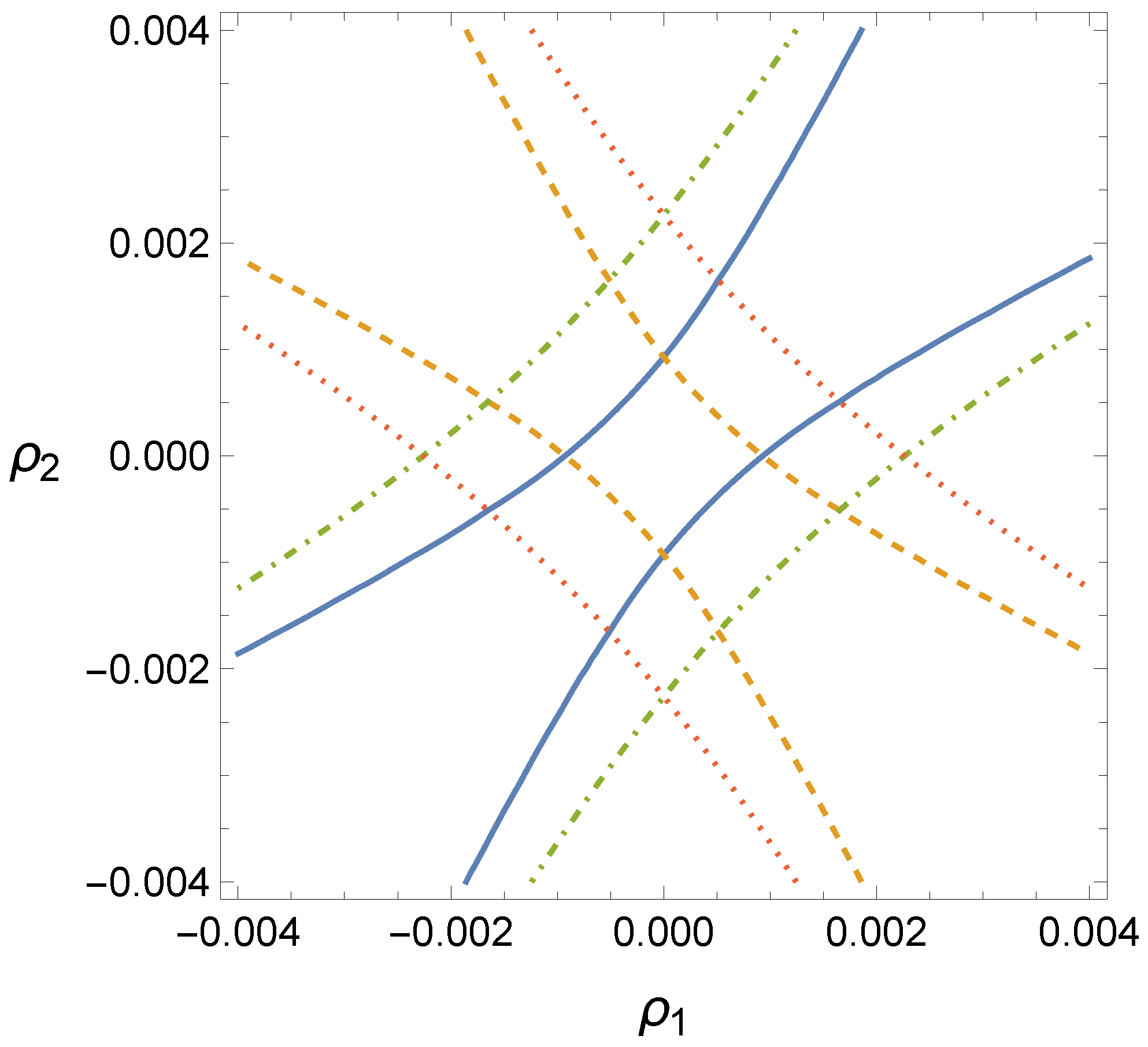
To obtain the correlation singularities of W ( r 1 , r 2 ) , we need both the real and imaginary parts of W ( r 1 , r 2 ) to vanish. The vanishing real part gives two pairs of hyperbolas depending on the condition in Equation (21). They are shown in Figure 1. We use w 0 = 1 mm for the beam waist and λ = 500 nm for the wavelength of the beam. The solid (blue in color) and dot-dashed (green in color) curves represent the hyperbolas of Equation (28) with α + and α , respectively. The dashed (orange in color) and dotted (red in color) curves represent the hyperbolas of Equation (30) with α + and α , respectively. The second pair of hyperbolas can also be obtained from the first hyperbolas by rotating π / 2 . When we use modified polar coordinates ( ρ , ϕ ) with < ρ < and 0 ϕ < π , we will have only one pair of hyperbolas of Equation (28).
The denominator of the first term on the left-hand side of the equations in Equation (28) or in Equation (30) corresponds to the square of the intercept of the hyperbola. (Note that α ± < 0 ). It is the half the distance L between two curves in the hyperbola. Therefore, the distance becomes
L = 4 1 1 2 2 w 0 2 + 1 δ 2 1 / 2 .
For the fully coherent field, δ 0 , and for the completely incoherent field, δ , the corresponding distances become
δ 0 , L 4 1 1 2 δ ,
δ , L 4 1 1 2 w 0 2 .
L approaches to zero when the fields are fully coherent. On the other hand, L approaches a constant proportional to the beam waist when the fields are completely incoherent. This behavior is also found in the first-order singularity of the Laguerre–Gauss beam.

3. Propagation of Correlation Singularities

The correlation of the wave changes as the beam propagates. Since the relevant cross-spectral density changes in z, the singular structure of the cross-spectral density also depends on z. The z-dependence follows as a straightforward generalization of the z = 0 case.
We use the scalar field in Equation (11) with n = 0 and m = 2 . In the calculation of the cross-spectral density, the Gouy phase does not contribute to the integration since the Gouy phase is only a function of z while the integration in W is over x 0 and y 0 . The resulting spectral density is the form of
W ( r 1 , r 2 ) = 4 w 0 2 π 2 w 6 δ 2 e ( x 1 2 + y 1 2 ) ξ * ( x 2 2 + y 2 2 ) ξ × d x 0 d y 0 e ( x 0 2 + y 0 2 ) / δ 2 e 2 ( x 1 x 0 + y 1 y 0 ) ξ * + 2 ( x 2 x 0 + y 2 y 0 ) ξ 2 ( x 0 2 + y 0 2 ) / w 2 ( z ) × [ ( x 1 x 0 ) + i ( y 1 y 0 ) 2 } * { ( x 2 x 0 ) + i ( y 2 y 0 ) ] 2 } ,
where ξ is defined as
ξ 1 w 2 ( z ) + i k 2 R ( z ) .
R ( z ) and w ( z ) are defined in Equation (7) and in Equation (8), respectively. Since the integration variables are x 0 and y 0 , we arrange the exponential part in terms of manageable forms of x 0 and y 0 . To perform the integration, we first consider the exponential part of the integrand in Equation (34). This exponential factor can be simplified as
e A [ ( x 0 + a ) 2 + ( y 0 + b ) 2 ] + A ( a 2 + b 2 ) ,
where a, b, and A are defined as
a x 1 ξ * + x 2 ξ A , b y 1 ξ * + y 2 ξ A , A 2 w 2 ( z ) + 1 δ 2 ,
Therefore, a, b, and A are all dependent on z. In the limit of z 0 , the variables above become w w 0 , R , a a 0 , b b 0 , and A A 0 , and thus we recover the definitions of the previous section.
As in the previous section, we can perform the similar calculations on the cross-spectral density W ( r 1 , r 2 ) , as well as the hyperbolas representing correlation singularities. Detailed calculations can be found in Appendix A. The results are presented below.
W ( r 1 , r 2 ) = 4 w 0 2 π 2 w 6 δ 2 A 3 e ( x 1 2 + y 1 2 ) ξ * ( x 2 2 + y 2 2 ) ξ e A ( a 2 + b 2 ) [ { 2 + 4 A [ ( a x 1 ) ( a x 2 ) + ( b y 1 ) ( b y 2 ) ] + A 2 [ ( a x 1 ) 2 ( a x 2 ) 2 ( a x 1 ) 2 ( b y 2 ) 2 ( a x 2 ) 2 ( b y 1 ) 2 + ( b y 1 ) 2 ( b y 2 ) 2 + 4 ( a x 1 ) ( a x 2 ) ( b y 1 ) ( b y 2 ) ] } + i { 4 A [ ( a x 1 ) ( b y 2 ) ( a x 2 ) ( b y 1 ) ] + 2 A 2 [ ( a x 1 ) ( b y 1 ) ( b y 2 ) 2 ( a x 2 ) ( b y 1 ) 2 ( b y 2 ) ( a x 1 ) ( a x 2 ) 2 ( b y 1 ) + ( a x 1 ) 2 ( a x 2 ) ( b y 2 ) ] } ] .
Two pairs of the hyperbolas are
ϵ 1 2 P 2 ϵ 2 2 Q 2 = 1 ,
where P 2 and Q 2 are
P 2 4 γ 2 ( 4 β 2 1 ) 2 , Q 2 4 γ 2 ( 4 β 2 1 ) ( 4 α 2 + 1 ) .
The structure of these singularities of the order ( n = 0 , m = 2 ) of the Laguerre–Gauss beam has two pairs of hyperbolas with two values of γ , while the structure of the first-order ( n = 0 , m = 1 ) singularity of the beam has only one pair of hyperbolas [11].
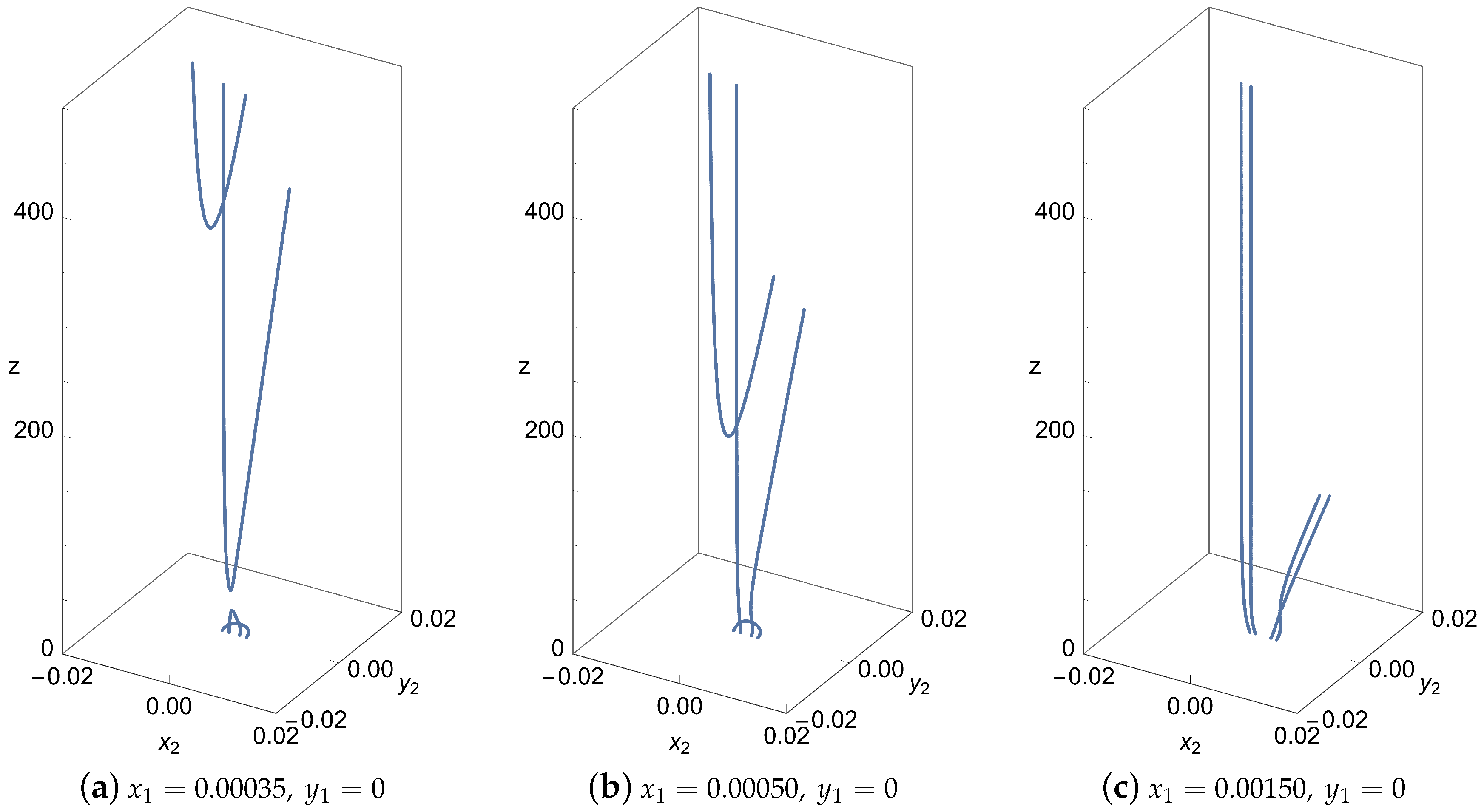
In Figure 2, we use the same values of w 0 = 1 mm, δ = 1 mm, and the beam wavelength λ = 500 nm as in Ref. [11] for comparison. We fix three different values of x 1 for each graph and ρ 1 can be obtained from ρ 1 = | ρ 1 | = | ( x 1 , 0 ) | = | x 1 | . We use the values of x 1 = 0.35 mm, x 1 = 0.5 mm, and x 1 = 1.5 mm for three graphs. The first graph in Figure 2 shows that the singularities disappear around z = 3 m and z = 17 m, and then reappear around z = 34 m and z = 337 m. For some short range of z, there is no singular behavior. In the second graph, only one of the singularities disappears near z = 5 m, and then reappears around z = 157 m. No disappearance or reappearance occurs in the third graph. Similar behaviors can also be found in Refs. [10,11].
The topological charges (angular momenta) associated with vortices cannot disappear or reappear. The disappearance or the reappearance of vortices only emerges due to the nature of spectral density of the two relative positions ρ 1 and ρ 2 . After the beam interacts with air molecules, the associated topological charges will eventually disappear and will not reappear. Their angular momentum is transferred to surrounding medium. Until then, the singularity representing angular momentum has propagated over considerable distances, conserving angular momentum throughout the propagation.

4. Relation Between Complex Degree of Coherence μ and the δ Parameter

In the beam-wander model, the parameter δ reflects the magnitude of beam wander. It is also an important parameter relating to partial coherence of the wave. When δ 0 , the beam is fully coherent, and when δ , the beam is completely incoherent as mentioned earlier. Therefore, the parameter is related to the complex degree of coherence μ . We investigate how the degree of coherence μ depends on the parameter δ during the propagation of the Laguerre–Gauss beam in the cross-spectral density.
The normalized complex degree of coherence is defined as
μ μ 12 W ( r 1 , r 2 ) W ( r 1 , r 1 ) W ( r 2 , r 2 ) ,
where W ( r i , r j ) W ( ρ i , ρ j , z ) with a fixed z and i , j = 1 , 2 . The Hermiticity of cross-spectral density makes the expression of μ simpler. From W ( r 1 , r 2 ) * = W ( r 2 , r 1 ) , we know that W ( r 1 , r 1 ) and W ( r 2 , r 2 ) are real and nonnegative. These properties can be checked in Equation (38). The imaginary part of the cross-spectral density in Equation (38) vanishes when x 1 = x 2 and y 1 = y 2 . This is what we expected since W ( r i , r i ) is a spectrum. In Equation (38), we can find
W ( r i , r i ) = 4 w 0 2 π 2 w 6 δ 2 A 3 e 2 ρ i 2 / w 2 e A ( a i 2 + b i 2 ) 2 + 4 A [ ( a i x i ) 2 + ( b i y i ) 2 ] + A 2 [ ( a i x i ) 2 + ( b i y i ) 2 ] 2 ,
where a i and b i for i = 1 , 2 are defined as
a i ( ξ * + ξ ) x i A , b i ( ξ * + ξ ) y i A .
As we see in the previous section, the separation of the exponential and the non-exponential parts of W ( r 1 , r 1 ) , W ( r 2 , r 2 ) , and W ( r 1 , r 2 ) makes the calculation of μ simpler. The separated exponential factors are independently treated for the calculation of μ . We will consider the absolute value of μ or μ = | μ | . The relation between the complex degree of coherence, μ , and the δ parameter can be obtained from Equation (41).
For the exponential part, a i and b i in Equations (42) and (38) contain the position variables x i and y i . It is more convenient to factor out the position variables from other variables in the numerical calculation of μ . We also extract the exponential factors from Equations (A9), (A10), and (A11), and relabel R in terms of the position variables r 1 and r 2 as R ( r 1 , r 2 ) . Similarly, we relabel N E and R e a l in Equation (A7) as N E ( 1 , 2 ) and R e a l ( 1 , 2 ) , respectively. Therefore, the overall exponential factor can be expressed in the form of
| e R ( 1 , 2 ) + i I ( 1 , 2 ) | e R ( 1 , 1 ) e R ( 2 , 2 ) = e R ( 1 , 2 ) 1 2 ( R ( 1 , 1 ) + R ( 2 , 2 ) ) .
The imaginary part of the exponential in the numerator disappears in the absolute value of the exponential. The final result for a given z becomes
e R ( 1 , 2 ) ( R ( 1 , 1 ) + R ( 2 , 2 ) ) / 2 = e 1 A w 0 2 w 2 [ ( x 1 x 2 ) 2 + ( y 1 y 2 ) 2 ] .
The non-exponential factor can be found in Equation (A8). The real and the imaginary parts can be clearly separated and easily identified in the equation. The form of the non-exponential factor can be written as
| N E ( 1 , 2 ) | R e a l ( 1 , 1 ) R e a l ( 2 , 2 ) ,
where R e a l ( 1 , 1 ) and R e a l ( 2 , 2 ) are
R e a l ( 1 , 1 ) = ( ) [ 2 A 2 + 4 A ( | ξ | 2 + | η | 2 ξ * η ξ η * ) ( x 1 2 + y 1 2 ) + | ξ | 4 + | η | 4 + 4 | ξ | 2 | η | 2 + ξ * 2 η 2 + ξ 2 η * 2 2 ( | ξ | 2 + | η | 2 ) ( ξ * η + ξ η * ) ( x 1 2 + y 1 2 ) 2 ,
R e a l ( 2 , 2 ) = ( ) [ 2 A 2 + 4 A ( | ξ | 2 + | η | 2 ξ * η ξ η * ) ( x 2 2 + y 2 2 ) + | ξ | 4 + | η | 4 + 4 | ξ | 2 | η | 2 + ξ * 2 η 2 + ξ 2 η * 2 2 ( | ξ | 2 + | η | 2 ) ( ξ * η + ξ η * ) ( x 2 2 + y 2 2 ) 2 ,
where the parenthesis, ( ) = 4 w 0 2 / ( π w 6 δ 2 A 5 ) , is canceled out by the same factor in N E ( 1 , 2 ) of Equation (A8).
Therefore, the absolute value of the complex degree of coherence becomes
μ = | μ | = e 1 A w 0 2 w 2 [ ( x 1 x 2 ) 2 + ( y 1 y 2 ) 2 ] | N E ( 1 , 2 ) | R e a l ( 1 , 1 ) R e a l ( 2 , 2 ) .
μ depends on δ in a very complicated way in Equation (49).
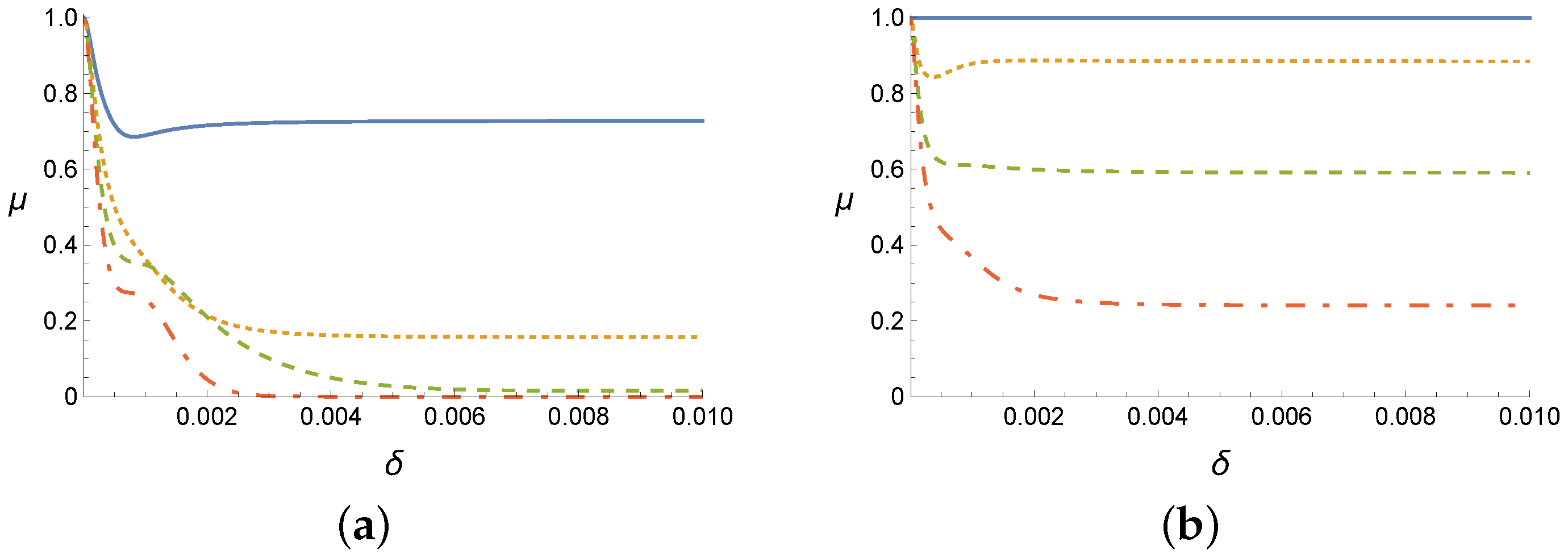
Figure 3 shows the absolute of the complex degree of coherence μ in terms of the correlation parameter δ for w 0 = 1 mm and λ = 500 nm. The first graph of Figure 3 shows the relation between μ and δ for the fixed value of ρ 1 = ( 0.0002 , 0.0003 ) with the δ range of 0.0001 < δ < 0.01 . We change ρ 2 for four different values of z as ρ 2 = ( 0.0004 , 0.0007 ) for z = 0 , ρ 2 = ( 0.0008 , 0.001 ) for z = 5 , ρ 2 = ( 0.002 , 0.0025 ) for z = 20 , and ρ 2 = ( 0.005 , 0.008 ) for z = 50 , and each represented as solid (blue in color), dashed (orange in color), large-dashed (green in color), and dot-dashed (red in color) curves, respectively. The reason why we choose increasing coordinates of ρ 2 is that the beam expands as it propagates. (The beam width becomes 8.4 mm at z = 50 m.) When we choose the same coordinates of ρ 2 for all four plots (only four different coordinates of z in this case), the degree of coherence becomes only slightly better in propagation (for bigger z), although we do not include this result here.
The second graph of Figure 3 shows the relations for four different values of ρ 2 with the fixed value of z = 5 and ρ 1 = ( 0.0001 , 0.0002 ) . When we change the coordinates of ρ 2 as ( 0.0001 , 0.0002 ) , ( 0.0003 , 0.0004 ) , ( 0.0005 , 0.0006 ) , and ( 0.0007 , 0.0008 ) , μ = 1 starts a flat line to gradually lowering curves as seen in the figure, and each represented as solid (blue in color), dashed (orange in color), large-dashed (green in color), and dot-dashed (red in color) curves, respectively. As ρ 2 gets farther from ρ 1 , the degree of coherence decreases as δ increases as expected. However, the curves converge to certain values not to zero as δ increases for ρ 2 closer to ρ 1 .
This behavior follows directly from the definition of μ in Equation (41). When r 2 r 1 , the δ -dependence cancels between the numerator and the denominator. This is due to the nature of the probability density function f ( r 0 ) , which contains δ 2 in the denominator and in the exponential function in Equation (5). The δ 2 in the denominator of the density function cancels out because it is common to all three W’s in the definition of μ . On the other hand, the δ in the exponential function of the density function does not cancel. After performing x 0 and y 0 integration, it is spread over all the expressions of the positions r 1 and r 2 as in Equation (38). The δ -dependence is implied in the expression of A in Equation (37). (Note that a and b also depend on δ through A). The effect of δ is relatively smaller in A for large δ than for small δ . Therefore, μ stays almost constant for large δ to the case of ρ 2 ρ 1 since W’s are canceled out in the numerator and in the denominator in the definition of μ . Graphs in Figure 3 are only for the case when ρ 2 close to ρ 1 . On the other hand, μ approaches zero (very) fast when δ increases for ρ 2 far from ρ 1 as expected, although we do not show it here. This coherence is related most to the relative distance between two observation points. When z 0 , we can understand this more clearly from Equation (17). The exponential factors in Equation (17) can be changed to
e ( ρ 1 2 + ρ 2 2 ) / w 0 2 δ 2 A e | ρ 1 ρ 2 | 2 / w 0 4 A .
The distance between two positions ρ 1 and ρ 2 is defined as Δ ρ | ρ 1 ρ 2 | . The coherence is maximized when Δ ρ 0 , and completely disappeared when Δ ρ . However, when z 0 , the coherence is not easily understood from the exponential part of Equation (38) because the exponential function does not have a simple dependence on the relative distance. Nevertheless, the degree of coherence μ exhibits this behavior. We emphasize that the general behavior of μ versus δ is still valid.
Figure 3 tells us two important points.
(1) Checking the range of coherence
As shown in Figure 3, the convergent value of μ depends on the relative positions of two points ρ 1 and ρ 2 . When the two points are close, the coherence persists for a larger value of δ in the turbulent atmosphere. When two positions are further apart, the degree of coherence μ converges to zero very fast, although graphs are not shown here. Therefore, for a fixed point, ρ 1 , we can determine the range of coherence by setting a convergent value of μ .
(2) Checking the validity range of beam-wander model in turbulent air
Once an experiment is performed on the coherence, we can determine the parameter δ since it is the only free parameter in the expression of μ . A series of measurements (at different positions of ρ 2 at a fixed point ρ 1 ) of the coherence can give a series of values of δ . The experiments will determine whether the parameter is a constant or it has a functional dependence on positions. We may find out the validity range of the beam-wander model from the experimental results. For these reasons, we encourage experimental physicists to do relevant experiments.

5. Orbital Angular Momentum Flux Density

The correlation-singular behavior is related to the vortex structure of the beam. The vortex carries angular momentum [17,18,27,28,29]. The conservation of angular momentum in electromagnetic waves leads to the definition of the angular momentum flux density, as described in [29,30]. Now, we examine the angular momentum flux density of the beam in the beam-wander model.
Consider uniformly unpolarized, partially coherent waves with vortex structures in the paraxial limit. For unpolarized waves, the spin component of the total angular momentum is considered to be zero, leaving only the orbital angular momentum. As defined in [29], the dyadic form of the electric cross-spectral density tensor for such waves is
W E ( r 1 , r 2 , ω ) = x ^ x ^ W ( r 1 , r 2 , ω ) + y ^ y ^ W ( r 1 , r 2 , ω ) ,
where W ( r 1 , r 2 , ω ) is a scalar cross-spectral density. The corresponding orbital angular momentum (OAM) flux density is [12,29]
L o r b ( r , ω ) ϵ 0 k x y W ( r , r , ω ) y x W ( r , r , ω ) r = r .
Furthermore, to eliminate the effect of intensity dependence, we introduce a normalized flux density of the beam. The corresponding normalized OAM flux density is defined as [12]
l o r b ( r , ω ) ω L o r b ( r , ω ) S ( r , ω ) ,
where S ( r , ω ) is the z-component of the Poynting vector which can be expressed as
S ( r , ω ) k μ 0 ω W ( r , ω ) .
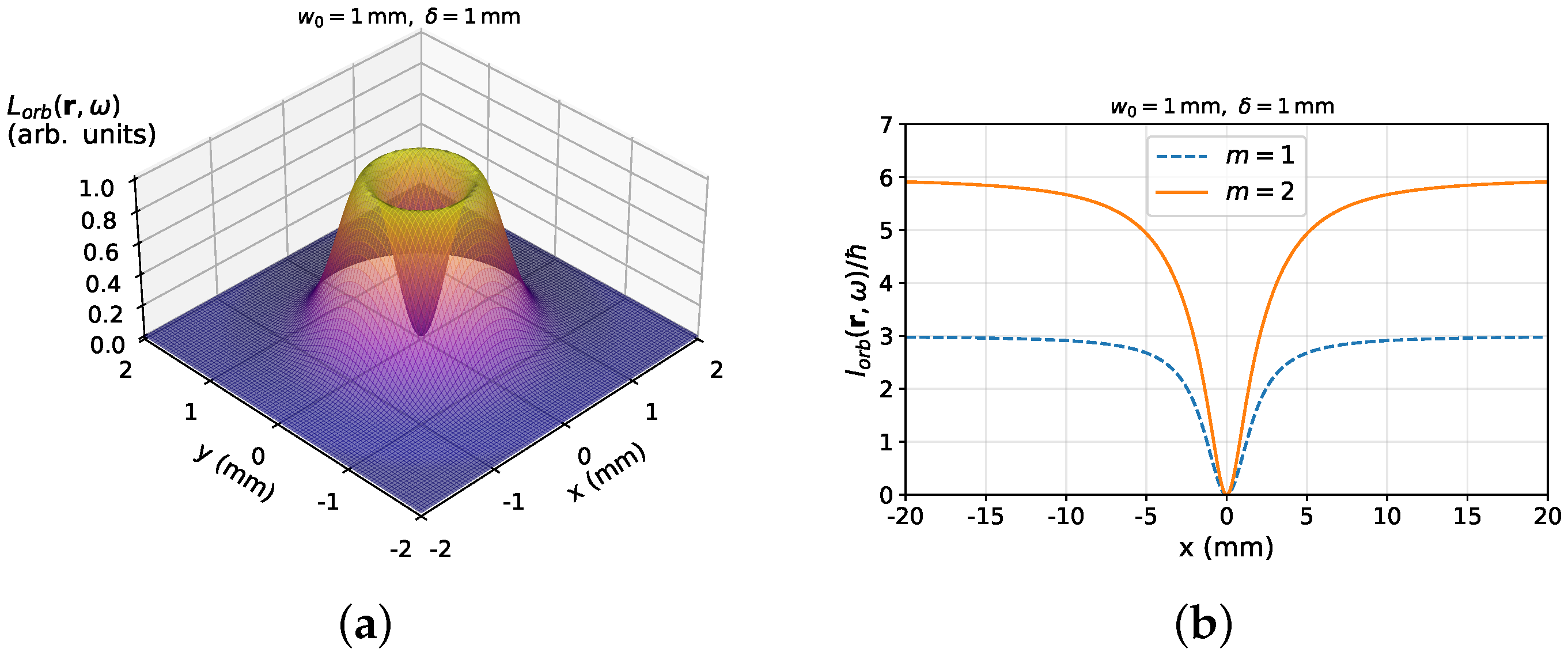
For the calculation of the OAM flux density of the Laguerre–Gauss beam in the beam-wander model, we use the cross-spectral density given in Equation (17). The OAM flux density and its normalized density are shown in Figure 4. As shown in Figure 4a, the OAM flux density L o r b ( r , ω ) increases rapidly from the origin to a maximum on a circle, then decreases rapidly thereafter, similar to the previous study [29]. The difference is that the slope of the circular peak is steeper in this study with m = 2 than in the previous study with m = 1 .
The normalized OAM flux density l o r b ( r , ω ) is shown in Figure 4b. The density l o r b for the cross section of the field increases quadratically near the center of the beam, and it converges to a constant as the distance from the center increases. This behavior has also been observed in the previous study, and there is no qualitative difference. When we compare, this constant is twice the corresponding constant in [29]. This is what we expected because this constant reflects the topological charge of m = 2 , whereas the constant in [29] corresponds to the topological charge of m = 1 . We confirm that the normalized OAM density is proportional to the value of m, as discussed in [12]. The normalized OAM flux density in [12] is expressed as l o r b , and its convergent formula becomes
l o r b m 1 + 2 δ 2 w z 2 .
Figure 4b verifies this formula. The normalized OAM density is a useful tool for investigating the topological charge, i.e., the orbital angular momentum of the beam. The general behaviors of L o r b and l o r b for the field in [12,29] are verified here.

6. Conclusions

In this study, we derive the explicit expression for the correlation singularities of the partially coherent field of the Laguerre–Gauss beam of order n = 0 and m = 2 in the beam-wander model in propagation. These singularities form two pairs of hyperbolas in the ρ 1 - ρ 2 plot. These singularities can disappear and reappear during propagation. This behavior depends on several variables including the positions r 1 = ( ρ 1 , z ) and r 2 = ( ρ 2 , z ) , the beam-wander model parameter δ , and wave properties such as the beam waist w 0 and the wavelength λ . Although the detailed singular behavior is difficult to predict, the conservation of topological charge remain robust.
We also derive and investigate the complex degree of coherence in propagation, especially in terms of the parameter δ . We find that the complex degree of coherence in propagation is sensitive to all the parameters we used in this model, namely, w 0 , λ , δ , as well as the two observation positions, r 1 = ( ρ 1 , z ) and r 2 = ( ρ 2 , z ) . We can also determine the range of coherence for a fixed point r 1 = ( ρ 1 , z ) by excluding such sensitive regions of r 2 = ( ρ 2 , z ) . A series of experiments on measuring the degree of coherence will allow us to check the validity range of the beam-wander model in the turbulent atmosphere.
Lastly, we study the orbital angular momentum using the Laguerre–Gauss beam in this model. As in previous studies [12,29], we observed general behaviors of the orbital angular momentum density and the normalized density.


Author Contributions

Formal analysis, J.L., G.J., B.Y., D.K., H.K., S.-M.K.; writing—original draft, S.-M.K. All authors have read and agreed to the published version of the manuscript.

Funding

This research received no external funding.

Data Availability Statement

The original contributions presented in this study are included in the article. Further inquiries can be directed to the corresponding author.

Conflicts of Interest

The authors declare no conflict of interest.

Appendix A

We present the detailed process of calculating the cross-spectral density when z 0 in this appendix.
In the process of calculation, it is convenient to introduce another variable, η ,
η A ξ * = ξ + 1 δ 2 .
The corresponding expression of Equation (17) should be recovered from the final result after replacing A, a, b, w, and R to A 0 , a 0 , b 0 , w 0 , and R , respectively, and all these variables in this section depend on z. This makes the calculation much more complicated. We now have the following expressions which vary with z:
a x 1 = 1 A ( η x 1 + ξ x 2 ) ,
a x 2 = 1 A ( ξ * x 1 η * x 2 ) ,
b y 1 = 1 A ( η y 1 + ξ y 2 ) ,
b y 2 = 1 A ( ξ * y 1 η * y 2 ) .
After lengthy calculations, we obtain the cross-spectral density Equation (38) when z 0 . Note that Equation (17) can be recovered from Equation (38) by taking z = 0 .
To investigate the singular behavior of the cross-spectral density, we separately consider the exponential part and non-exponential part of the integrand in Equation (38). We can summarize the exponential part in Equation (36) and the non-exponential part in Equation (A8) as follows:
E e R + i I = e R ( cos I + i sin I ) ,
N E R e a l + i I m a g .
After factoring out the variables x i and y i ( i = 1 , 2 ) from a and b, the non-exponential part becomes
NE = 4 w 0 2 π w 6 ( z ) δ 2 A 5 [ 2 A 2 + 4 A ( | ξ | 2 + | η | 2 ) ( x 1 x 2 + y 1 y 2 ) + ( | ξ | 4 + | η | 4 ) [ ( x 1 x 2 + y 1 y 2 ) 2 ( x 1 y 2 x 2 y 1 ) 2 ] + 4 | ξ | 2 | η | 2 ( x 1 2 + y 1 2 ) ( x 2 2 + y 2 2 ) 2 A ( ξ * η + ξ η * ) ( x 1 2 + y 1 2 + x 2 2 + y 2 2 ) + 1 2 ( ξ * 2 η 2 + ξ 2 η * 2 ) [ ( x 1 2 + y 1 2 ) 2 + ( x 2 2 + y 2 2 ) 2 ] ( | ξ | 2 + | η | 2 ) ( ξ * η + ξ η * ) ( x 1 x 2 + y 1 y 2 ) ( x 1 2 + y 1 2 + x 2 2 + y 2 2 ) + i ( | ξ | 2 | η | 2 ) ( ξ * η ξ η * ) ( x 1 y 2 x 2 y 1 ) ( x 1 2 + y 1 2 x 2 2 y 2 2 ) + i 2 { ( | ξ | 4 | η | 4 ) ( x 2 y 1 x 1 y 2 ) ( x 1 x 2 + y 1 y 2 ) + 2 A ( | ξ | 2 | η | 2 ) ( x 2 y 1 x 1 y 2 ) + i A ( ξ * η ξ η * ) ( x 1 2 + y 1 2 x 2 2 y 2 2 ) i 1 4 ( ξ * η ξ η * ) ( ξ * η + ξ η * ) [ ( x 1 2 + y 1 2 ) 2 ( x 2 2 + y 2 2 ) 2 ] + i 1 2 ( | ξ | 2 + | η | 2 ) ( ξ * η ξ η * ) ( x 1 x 2 + y 1 y 2 ) ( x 1 2 + y 1 2 x 2 2 y 2 2 ) + 1 2 ( | ξ | 2 | η | 2 ) ( ξ * η + ξ η * ) ( x 1 y 2 x 2 y 1 ) ( x 1 2 + y 1 2 + x 2 2 + y 2 2 ) } ] .
The overall complex ( NE × E ) of the cross-spectral density up to a constant becomes
e R ( cos I + i sin I ) ( R e a l + i I m a g ) = e R [ ( R e a l × cos I I m a g × sin I ) + i ( R e a l × sin I + I m a g × cos I ) ] .
After factoring out x i and y i variables, R and I become
R = 1 w 2 ( z ) + 1 A 1 w 4 ( z ) k 2 4 R 2 ( z ) ( x 1 2 + y 1 2 + x 2 2 + y 2 2 ) + 2 A 1 w 4 ( z ) + k 2 4 R 2 ( z ) ( x 1 x 2 + y 1 y 2 ) ,
I = k 2 R ( z ) 1 2 A w 2 ( z ) ( x 1 2 + y 1 2 x 2 2 y 2 2 ) .
Note that ‘ R e a l ’ and R are symmetric while ‘ I m a g ’ and I are antisymmetric under the exchange of subindices 1 and 2. Therefore, we can find that the real part, e R [ ( R e a l × cos I I m a g × sin I ) ] , is symmetric while the imaginary part, e R [ ( R e a l × sin I + I m a g × cos I ) ] , is antisymmetric under the exchange. Again, this reflects the Hermiticity of the cross-spectral density, W ( 1 , 2 ) = W ( 2 , 1 ) * . Since ξ and η depend on z, they vary during propagation. We can restore the expression of the previous case of z = 0 when we put z = 0 in the expression. For example, in Equation (A8), ξ and η become real and ξ ξ 0 = 1 / w 0 2 , and η η 0 = 1 / w 0 2 + 1 / δ 2 = A 0 ξ 0 .
To investigate the cross-sectional view of the singular behavior for the given value of z during the propagation of the wave, we introduce the cylindrical coordinates as
x 1 ρ 1 cos ϕ 1 , y 1 ρ 1 sin ϕ 1 , x 2 ρ 2 cos ϕ 2 , y 2 ρ 2 sin ϕ 2 .
Then, Equation (A8) becomes
N E = 4 w 0 2 π w 6 ( z ) δ 2 A 5 { 2 A 2 + 4 A ( | ξ | 2 + | η | 2 ) ρ 1 ρ 2 cos ( ϕ 2 ϕ 1 ) 1 2 ( ξ * η + ξ η * ) ( ρ 1 2 + ρ 2 2 ) + ( | ξ | 2 + | η | 2 ) ρ 1 ρ 2 cos ( ϕ 2 ϕ 1 ) 1 2 ( ξ * η + ξ η * ) ( ρ 1 2 + ρ 2 2 ) 2 ( | ξ | 2 | η | 2 ) ρ 1 ρ 2 sin ( ϕ 2 ϕ 1 ) i 1 2 ( ξ * η ξ η * ) ( ρ 1 2 ρ 2 2 ) 2 + i 2 ( | ξ | 2 | η | 2 ) ρ 1 ρ 2 sin ( ϕ 2 ϕ 1 ) i 1 2 ( ξ * η ξ η * ) ( ρ 1 2 ρ 2 2 ) × ( | ξ | 2 + | η | 2 ) ρ 1 ρ 2 cos ( ϕ 2 ϕ 1 ) 1 2 ( ξ * η + ξ η * ) ( ρ 1 2 + ρ 2 2 ) + 2 A } ,
where ξ and η depend on w ( z ) and thus on z. Equation (A13) shows the analytic expression of the propagation of the Laguerre–Gauss beam explicitly. Now, we trace the propagation of the singular behavior of the spectral density analytically.
To obtain the singular points in propagation, both the real and imaginary parts of Equation (A13) must vanish. The following relations can be obtained considering that both the real and imaginary parts are zero:
ρ 1 ρ 2 sin ( ϕ 2 ϕ 1 ) = i 1 2 ξ * η ξ η * | ξ | 2 | η | 2 ( ρ 1 2 ρ 2 2 ) ,
ρ 1 ρ 2 cos ( ϕ 2 ϕ 1 ) = 1 2 ξ * η + ξ η * | ξ | 2 + | η | 2 ( ρ 1 2 + ρ 2 2 ) + ( 2 ± 2 ) A | ξ | 2 + | η | 2 .
Therefore, we obtain
ρ 1 2 ρ 2 2 = i 1 2 ξ * η ξ η * | ξ | 2 | η | 2 ( ρ 1 2 ρ 2 2 ) 2 + 1 2 ξ * η + ξ η * | ξ | 2 + | η | 2 ( ρ 1 2 + ρ 2 2 ) + ( 2 ± 2 ) A | ξ | 2 + | η | 2 2 .
To simplify the calculations, we introduce two dimensionless variables, ν 1 and ν 2 , and three variables, α , β , and γ ,
ν 1 ρ 1 w 0 , ν 2 ρ 2 w 0 ,
α i 1 2 ξ * η ξ η * | ξ | 2 | η | 2 , β 1 2 ξ * η + ξ η * | ξ | 2 + | η | 2 , γ ( 2 ± 2 ) A / w 0 2 | ξ | 2 + | η | 2 .
Then, Equation (A16) becomes
ν 1 2 ν 2 2 = [ α ( ν 1 2 ν 2 2 ) ] 2 + [ β ( ν 1 2 + ν 2 2 ) + γ ] 2 .
Again, the solutions to this equation are two pairs of hyperbolas depending on the values of γ . This can be seen after replacing ϵ 1 ν 1 2 + ν 2 2 , ϵ 2 ν 1 2 ν 2 2 , and ϵ 1 ϵ 1 + 4 β γ / ( 4 β 2 1 ) . The variables ϵ 1 and ϵ 2 satisfy a hyperbolic equation,
( 4 β 2 1 ) ϵ 1 2 + ( 4 α 2 + 1 ) ϵ 2 2 = 16 β 2 γ 2 4 β 2 1 4 γ 2 .
We find that 4 β 2 1 < 0 and thus 16 β 2 γ 2 / ( 4 β 2 1 ) 4 γ 2 = γ 2 / ( 4 β 2 1 ) < 0 . Therefore, we have two pairs of the following hyperbolas:
ϵ 1 2 P 2 ϵ 2 2 Q 2 = 1 ,
where P 2 and Q 2 are as follows:
P 2 4 γ 2 ( 4 β 2 1 ) 2 , Q 2 4 γ 2 ( 4 β 2 1 ) ( 4 α 2 + 1 ) .
Remember that γ has two values.

Appendix B

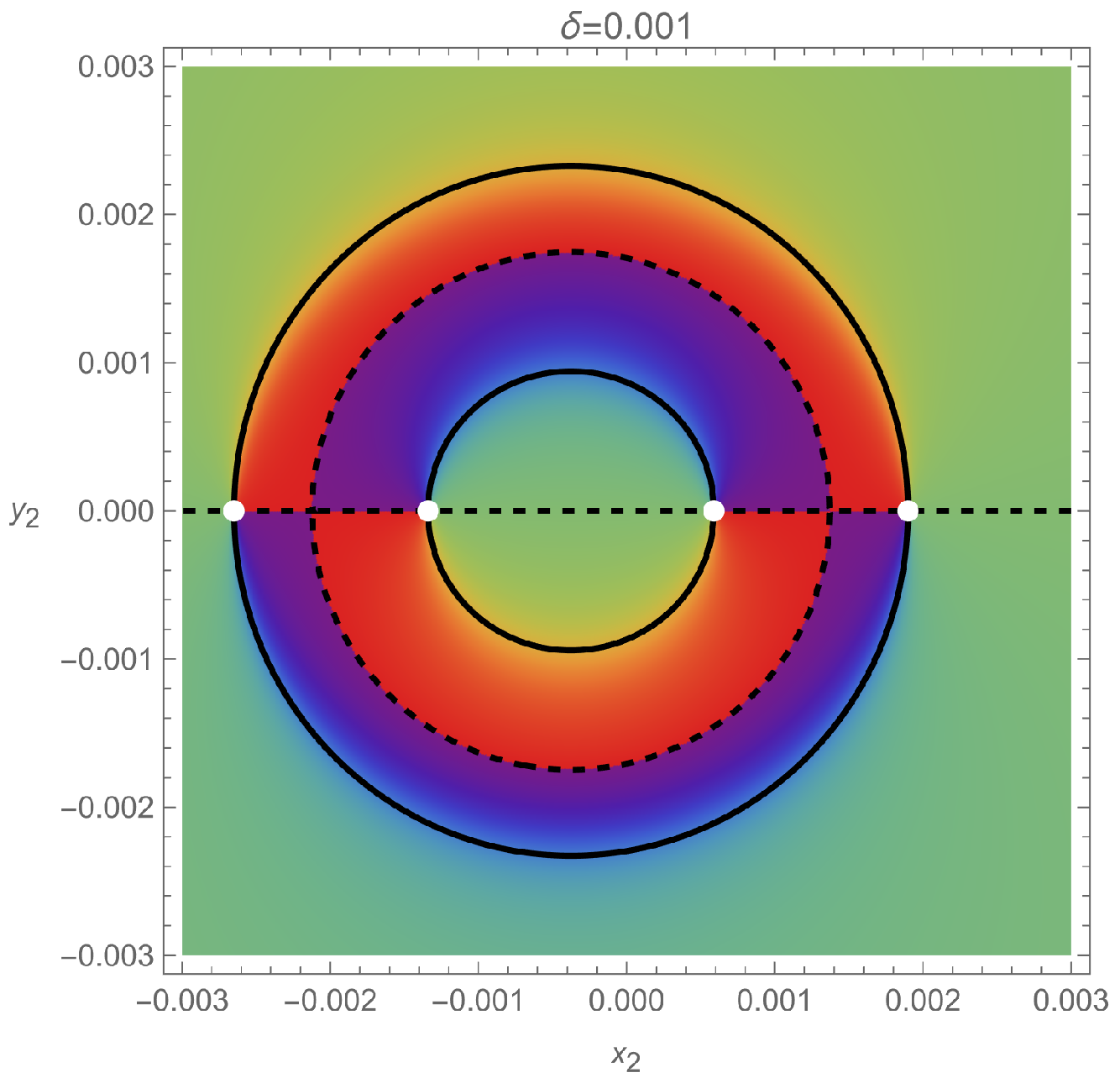
We show the equal phase contours in Figure A1 to examine whether our results are consistent with the previous numerical study in [10] on the cross-spectral density for n = 0 and m = 2 at z = 0 , with the reference point at (−0.3 mm, 0) and the values of w 0 = 1 mm and δ = 1 mm. This contour plot is consistent with the results in Figure 2b of [10].
Figure A1. Equal phase contours of the cross-spectral density of the Laguerre–Gauss beam of n = 0 , m = 2 , with w 0 = 1 mm and δ = 1 mm at z = 0 . The four singular points on the x 2 axis are indicated by white dots.
Optics 07 00009 g0a1

References

  1. Nye, J.F.; Berry, M.V. Dislocations in wave trains. Proc. R. Soc. Lond. Ser. A 1974, 336, 165–190. [Google Scholar] [CrossRef]
  2. Soskin, M.S.; Vasnetsov, M.V. Singular Optics. Prog. Opt. 2001, 42, 219–276. [Google Scholar]
  3. Freund, I. Bichromatic optical Lissajous fields. Opt. Commun. 2003, 226, 351–376. [Google Scholar] [CrossRef]
  4. Gbur, G.; Visser, T.D. Coherence vortices in partially coherent beams. Opt. Commun. 2003, 222, 117–125. [Google Scholar] [CrossRef]
  5. Gbur, G.; Visser, T.D. Phase singularities and coherence vortices in linear optical systems. Opt. Commun. 2006, 259, 428–435. [Google Scholar] [CrossRef]
  6. Palacios, D.M.; Maleev, I.D.; Marathay, A.S.; Swartzlander, G.A. Spatial Correlation Singularity of a Vortex Field. Phys. Rev. Lett. 2004, 92, 143905. [Google Scholar] [CrossRef] [PubMed]
  7. Maleev, I.D.; Palacios, D.M.; Marathay, A.S.; Swartzlander, G.A. Spatial correlation vortices in partially coherent light: Theory. J. Opt. Soc. Am. B 2004, 21, 1895–1900. [Google Scholar] [CrossRef]
  8. Wang, W.; Duan, Z.; Hanson, S.G.; Myamoto, Y.; Takeda, M. Experimental Study of Coherence Vortices: Local Properties of Phase Singularities in a Spatial Coherence Function. Phys. Rev. Lett. 2006, 96, 073902. [Google Scholar] [CrossRef] [PubMed]
  9. Gbur, G.; Tyson, R.K. Vortex beam propagation through atmospheric turbulence and topological charge conservation. J. Opt. Soc. Am. A 2008, 25, 225–230. [Google Scholar] [CrossRef]
  10. Gbur, G.; Gu, Y. Topological reactions of optical correlation vortices. Opt. Commun. 2009, 282, 709–716. [Google Scholar] [CrossRef]
  11. Gbur, G.; Swartzlander, G.A. Complete transverse representation of a correlation singularity of a partially coherent field. J. Opt. Soc. Am. B 2008, 25, 1422–1429. [Google Scholar] [CrossRef]
  12. Stahl, C.S.D.; Gbur, G. Partially coherent vortex beams of arbitrary order. J. Opt. Soc. Am. A 2017, 34, 1793–1799. [Google Scholar] [CrossRef] [PubMed]
  13. Zhen, W.; Wang, X.; Ding, J.; Wang, H. Controlling the symmetry of the photonic spin Hall effect by an optical vortex pair. Phys. Rev. A 2023, 108, 023514. [Google Scholar] [CrossRef]
  14. Zhen, W.; Ren, Z.; Wang, X.; Ding, J.; Wang, H. Polarization structure transition of C-point singularities upon reflection. Sci. China-Phys. Mech. Astron. 2025, 68, 244211. [Google Scholar] [CrossRef]
  15. Hyde, M.W., IV; Korotkova, O.; Spencer, M.F. Partially coherent sources whose coherent modes are spatiotemporal optical vortex beams. J. Opt. 2023, 25, 035606. [Google Scholar] [CrossRef]
  16. Yu, J.; Huang, Y.; Wang, F.; Liu, X.; Gbur, G.; Cai, Y. Scintillation properties of a partially coherent vector beam with vortex phase in turbulent atmosphere. Opt. Express 2019, 19, 26676–26688. [Google Scholar] [CrossRef]
  17. Zhang, Y.; Korotkova, O.; Cai, Y.; Gbur, G. Correlation-induced orbital angular momentum changes. Phys. Rev. A 2020, 102, 063513. [Google Scholar] [CrossRef]
  18. Zhang, Y.; Cai, Y.; Gbur, G. Switch of orbital angular momentum flux density of partially coherent vortex beams. Opt. Express 2023, 31, 38004–38012. [Google Scholar] [CrossRef]
  19. Shiri, A.; Schmidt, J.; Tellez, J.; Gbur, G. Modified Huygens-Fresnel method for the propagation of partially coherent beams through turbulence. J. Opt. Soc. Am. A 2023, 40, 470–478. [Google Scholar] [CrossRef]
  20. Miao, W.; Zhang, Y.; Gbur, G. Deterministic vortices evolving from partially coherent fields. Optica 2023, 10, 1173–1176. [Google Scholar] [CrossRef]
  21. Stahl, C.S.D.; Gbur, G. Twisted vortex Gaussian Schell-model beams. J. Opt. Soc. Am. A 2018, 35, 1899–1906. [Google Scholar] [CrossRef] [PubMed]
  22. Zhao, Y.; Zhang, H.; Yao, L.; Cai, Y.; Yuan, Y.; Gao, Y. Beam wander of partially coherent array beams propagating bidirectionally through atmospheric turbulence and Plasma. Opt. Express 2025, 33, 34434. [Google Scholar] [CrossRef] [PubMed]
  23. Zhang, Y.; Yao, L.; Zhao, Y.; Zhang, H.; Cai, Y.; Yuan, Y.; Gao, Y. Bidirectional Propagation Properties of Partially Coherent Laguerre-Gauss Beams in Atmospheric Turbulence and Plasma. Photonics 2024, 11, 1111. [Google Scholar] [CrossRef]
  24. Xu, Y.; Xu, Y.; Wang, T. Evolution Properties of a Partially Coherent Twisted Laguerre-Gaussian Pulsed Beam Propagating through Anisotropic Atmospheric Turbulence. Photonics 2022, 9, 707. [Google Scholar] [CrossRef]
  25. Andrews, L.C.; Phillips, R.L. Laser Beam Propagation Through Random Media, 2nd ed.; SPIE: Belingham, WA, USA, 2005. [Google Scholar]
  26. Gbur, G.; Visser, T.D.; Wolf, E. Hidden singularities in partially coherent wavefields. J. Opt. A Pure Appl. Opt. 2004, 6, S239–S242. [Google Scholar] [CrossRef]
  27. Allen, L.; Beijersbergen, M.W.; Spreeuw, R.; Woerdman, J. Orbital angular momentum of light and the transformation of Laguerre-Gaussian laser modes. Phys. Rev. A 1992, 45, 8185. [Google Scholar] [CrossRef] [PubMed]
  28. Berry, M. Paraxial beams of spinning light. Proc. SPIE 1998, 3487, 6–11. [Google Scholar]
  29. Kim, S.M.; Gbur, G. Angular momentum conservation in partially coherent wave fields. Phys. Rev. A 2012, 86, 043814. [Google Scholar] [CrossRef]
  30. Barnett, S.M. Optical angular-momentum flux. J. Opt. B 2002, 4, S7. [Google Scholar] [CrossRef]
Figure 1. Two pairs of hyperbolas representing the correlation singularities of the Laguerre–Gauss beam of n = 0 , m = 2 with w 0 = 1 mm and λ = 500 nm.
Optics 07 00009 g001
Figure 2. Propagation of singularities of the cross-spectral density for the Laguerre–Gauss beam with n = 0 and m = 2 for various values of ρ 2 for a fixed value of ρ 1 . From three positions of ρ 1 , (ac) show three different types of appearance and disappearance of singularities during propagation.
Optics 07 00009 g002
Figure 3. Complex degree of coherence: μ vs. δ for w 0 = 1 mm, λ = 500 nm: (a) μ approaches zero for large z; (b) μ decreases as the distance between ρ 1 and ρ 2 increases.
Optics 07 00009 g003
Figure 4. Unpolarized orbital angular momentum of Laguerre–Gauss beam in the beam-wander model with δ = 1 mm, ω 0 = 1 mm, and λ = 500 nm: (a) OAM flux density, L o r b ( r , ω ) with m = 2 , (b) Normalized OAM flux density, l o r b ( r , ω ) / with m = 1 and m = 2 .
Optics 07 00009 g004
Disclaimer/Publisher’s Note: The statements, opinions and data contained in all publications are solely those of the individual author(s) and contributor(s) and not of MDPI and/or the editor(s). MDPI and/or the editor(s) disclaim responsibility for any injury to people or property resulting from any ideas, methods, instructions or products referred to in the content.