AI techniques such as FL and ANN are extensively applied for tuning control system parameters owing to their capability of learning the mapping between input and output variables even when the dynamics of the system under consideration are partially known [
17]. In addition, they can effectively compensate for the performance of the system in the event of a disturbance which is more important from the MG point of view, as it is regularly subjected to various disturbances. Therefore, researchers are now focusing on utilising them to effectively control MG. This paper mainly focuses on the application of these AI techniques for CHC at each level.
4.1. Basics of Primary Control
As mentioned in
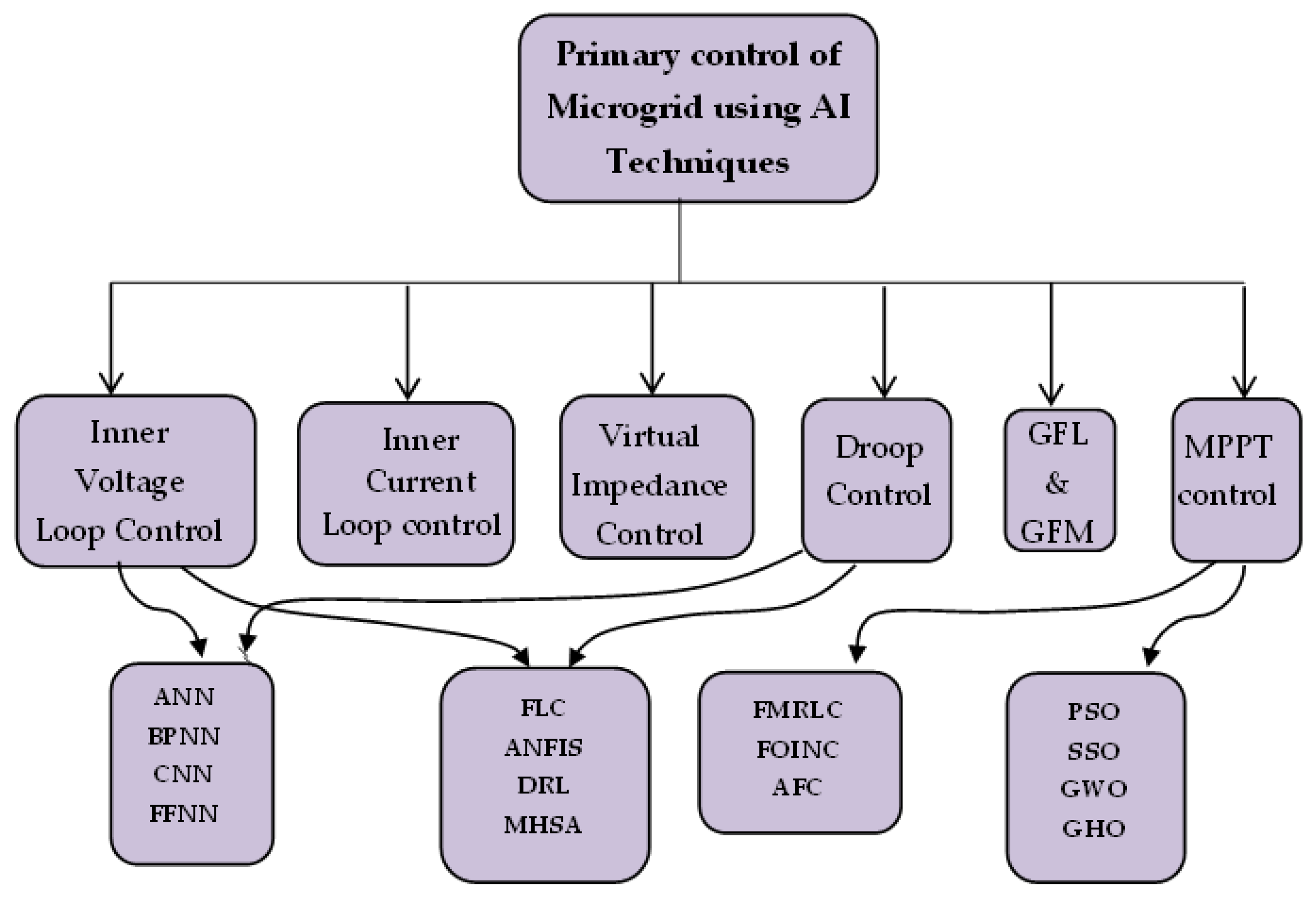
Section 2, this control action is initiated by the LCs at the terminals of the interfacing converter (either grid or load). Primary control is applied to supply the required load with existing power generation and storage while maintaining voltage and frequency deviations within prescribed limits by controlling local variables, such as voltage, frequency and current injection. This is achieved using appropriate controllers. During islanded operation, microgrids operate in autonomous mode to increase the reliability of the system. Hence, their time level is the fastest compared to other levels and includes islanding detection, active and reactive power sharing and successive changes in control modes. Although there are several ways to implement this primary control as mentioned in
Figure 4, conventional droop methods and improved droop methods have been extensively explored and used for MG control in the literature, owing to their simplicity and efficiency. The output of these droop controllers is sent to the inner voltage control and current control loop, whose output generates the PWM pulse for the power electronic interfaces after applying the necessary transformation [
18].
Droop controller implements the relationship between f-P and V-Q that can be represented as
where ω and
are the frequency and magnitude of the voltage of the DG source,
and
are the active and reactive power measured at the DG source,
and
are the droop coefficients selected according to the rating of the DG sources, and
and
are the references for the primary control set by the secondary control.
where
and
are the maximum allowed deviations for the frequency and magnitude of the voltage, and
and
are the maximum real and reactive powers of the DG sources (optimal design of the islanded MG). Thus, the frequency and voltage magnitude are influenced by the P/Q sharing from each of the DG sources as well as the droop coefficients.
Conventionally, proportional integral (PI) controllers are used for DC MGs because of their zero steady-state error in tracking the reference, and Proportional Resonant (PR) controllers are used for AC MGs, as they are more appropriate for following AC command signals. With the advent of ML techniques, these conventional controllers can either be replaced or cooperated with an intelligent controller for improving the performance of MGs.
4.1.1. Application of Fuzzy Logic for Primary Control of MG
Various studies have utilised various fuzzy rules and controllers to tune either the droop coefficients or the PI control parameters. With the advent of fuzzy self-tuning and self-organising gains of the PID controller in real-time to improve the response of the system [
19], FL-based PI controllers have started gaining attention. Then, Li (2008) [
20] proposed a self-organised/self-tuned fuzzy controller for frequency control of MG in grid-connected and autonomous modes by controlling the power of the electrolyser. The proposed control system comprises an API controller and an FL self-tuning mechanism for adjusting the KP and KI parameters. Although they proved that the proposed controller minimised the tie-line power fluctuation despite frequency control, there was no mention of the voltage profile of the system which cannot be bypassed. C.N. Papadimitriou (2010) [
21] proposed fuzzy logic-based local controllers for the primary control of frequency and local bus voltage following a disturbance in either islanded or grid-connected mode, as fuzzy controllers are flexible and adaptive in nature to nonlinear systems. They used three fuzzy controllers for the combined Fuel Cell and Battery bank system and two fuzzy controllers for the DFIG system, which were designed with the heuristic knowledge of the complete system and thoroughly iterated for fine-tuning of the control parameters. Hiroaki Kakigano (2013) [
22] proposed a fuzzy control with gain scheduling control techniques for voltage control of a primary controller under islanded operation of MG with a storage system and also accomplishes energy management as well. They proposed an implemented fuzzy control that is applicable for energy balance control, which reduces losses compared to conventional droop control. He considered electric vehicles and double-layer capacitors as storage systems and experimentally validated his results.
A similar work for controlling the DC grid voltage using an FL based PID controller was done by R.K. Chauhan (2015) [
23]. The authors used real-time data from a project in the USA with only PV systems and proved that the steady-state error of voltage was reduced to less than 0.3%, and the peak time, peak overshoot and settling time decreased. This justifies the fact that the FL-PID reduces the voltage fluctuations in the MG, making it more stable. In contrast, Eldessouky (2016) [
24] implemented fuzzy model reference learning control (FMRLC) with PID into the control of a static VAR compensator for voltage regulation of an MG in islanded mode. The learning mechanism of the FLC compensates for load variations by updating the controller parameter and hence maintains the system parameters as is required for longer operating conditions. The author also tested the same logic and MHSA technique for the adaptive tuning of the parameters of the PI controller based on the load—frequency deviation in an islanded MG with load—generation mismatch.
A two-stage strategic control was proposed by Fattahi (2016) [
25], where the first stage incorporates a fuzzy controller to find the adaptive droop co-efficient, while the second stage incorporates another fuzzy controller to fix the Q sharing errors by controlling the small real power injections. The results were validated using both time and frequency domain analyses. Chin Hsing. Cheng (2016) [
26] proposed a simple FLC for each of the DGs connected to the MG, each having one input as the deviation of that specific converter power and the other input in common, which is the deviation in the load power. The output is the control signal for the duty cycle of the converter to regulate the voltage in the MG, whereas optimal power dispatch is performed using dynamic programming to maintain the power flow balance. The entire system was experimentally validated for different load conditions.
Jayapriya M (2016) [
27] proposes a FLC that stabilises the frequency during islanded operation by managing the charging and discharging of batteries as per the target power and the battery’s state of charge (SOC). The rules are implemented using Python with the help of the FL library in Raspberry Pi, thereby providing a cost-effective solution, fast fuzzification and quicker logical decisions. Shivam (2017) [
28] designed a fuzzy interface system to reduce DC bus voltage degradation by adjusting the droop resistance using fuzzy logic for source converters in a DC MG. Mohammed Hassan Khaboon (2017) [
29] tuned the PI parameters automatically by a general type—II fuzzy-based PI with online measurements, where the parameters of controllers are calculated using a heuristic algorithm named Modified Harmony Search Algorithm (MHSA). These three components are considered in the optimisation process: usage of harmony memory, pitch adjustment and randomization and proved that through this rolling optimisation process and adaptive technique, the proposed controller could be able to coordinate the Electric Vehicle’s and DGs output. Hamed Moaziami (2017) [
30] combines optimal location and sizing of DG units, considering fuel cost, voltage stability index and variation in voltage as objective functions to minimise/optimise the droop parameters using Fuzzy approach.
Ainur Rofiq Nansur (2018) [
31] proposes an FLC for maintaining a constant Voltage at the DC bus when PV coupled with MPPT is used as a DG. With the FLC, the voltage error is maintained at less than 3%. Yang Mi (2019) [
32] proposed droop control with optimised droop coefficients by the Takaji-Sujeno Fuzzy method so that the load changes on the DC MG are regulated in a better way. Feng N (2019) [
33] proposed an FLC for the virtual capacitor droop control of HESS in a DC microgrid, where the droop coefficients are varied in accordance with the line impedance and load variation. Here, the system realises the full advantage of HESS by using a decentralised controller rather than a centralised controller. Concurrent-learning-based DRL can also replace the conventional droop control with a droop-free control algorithm, which can vary the droop resistance while maintaining the trade-off between the variation in current and voltage [
34]. Adapting nonlinear control for real-time modification of droop coefficients is one of the best solutions for overcoming the uneven distribution of reactive power from micro-sources. Therefore, Ding (2020) [
35] proposed an ANFIS-based neuro-fuzzy controller to compensate for these droop coefficients by considering various inputs, such as load disturbances, active power and reactive power. The results prove that this adaptive method balances the distribution of reactive power, even when there is a mismatch in the line impedance. The same problems were solved by a vector-controlled feed-forward droop controller by Yadav (2021) [
36], where a fuzzy logic control system tunes the loop coefficients aiming at a power balance between parallel inverter operations based on the loads.
In contrast, Guo (2022) [
37] designed a fuzzy controller to correct the droop coefficients for a bipolar (multimode) DC microgrid to improve the unbalanced voltage. Javeria Noor (2024) [
38] also implemented a fuzzy logic-based control strategy using Takagi-Sugeno’s approach for real-time power distribution in a bipolar DC microgrid. He incorporated a SEPIC-Cuk converter for voltage balancing of bipolar transmission lines. The application of Fuzzy logic in primary control of microgrid is summarized in
Table 2.
4.1.2. Application of Artificial Neural Network for Primary Control of MG
While some researchers have dealt with FLC, many have also worked on ANN-based controllers for MG control and stability enhancement. They are mainly used to improve the performance of the maximum power point tracker in the case of PV and WES and can also be used to predict and analyse the SOC of various types of batteries that are used as storage elements in the MG. Eddahech 2011 [
39] developed an FFNN-based model for the voltage control of Li-Po batteries. Refs. [
40,
41,
42,
43,
44] discuss the application of NN models for designing and improving the performance characteristics of various types of batteries that form part of an MG.
In addition, AI is used to improve stability and control to ensure an efficient and reliable supply to consumers. MDNN was designed by Sabahi in 2007 [
45] to minimise frequency derivation in the tie-line power, while Baek in 2008 [
46] designed NN for non-linear parameter optimisation of first-order derivatives in the power system. An Inverter Control based on ANN was proposed by Singh in 2014 [
47] for an MG based on PV and Fuel cells. The authors claimed to have achieved a better THD with ANN control compared to conventional control methods. An ANN-based controller trained by app dynamic programming was introduced by Weizen Dong (2018) [
48] for a DC microgrid. Droop control was implemented for each DG for power sharing, and its reference voltage output was used to train the ANN to maintain the voltage within the limit from the primary control point of view. Although he claimed that there was a rapid change in the converter current to meet the new load with less dip in voltage, the system under study only had a DC source, and the condition of the system when connected to the grid was not specified. T.Vignesh (2016) [
49] proposes a feed forward Neural Network for proper sharing of real and reactive power as a part of primary droop control for a two DG system. The study shows that despite proper sharing of power; the proposed controller also controls the voltage and frequency of the MG under all operating conditions. For the same system, he also compared the settling time, peak overshoot and rise time with respect to the PID controller and proved that the FLC was successful in improving these parameters, in addition to controlling V and F. Habibi (2019) [
50] employed ANN to tune the coefficients of a generalised droop control-based DR, which regulates the voltage profile and maintains a stable frequency using flexible loads.
Liu [
51] proposed a DRL algorithm that regulates the voltage and supports current sharing as well as load sharing. Refs. [
52,
53,
54,
55] prove that the inability of the PI controller to regulate the inverter output has been overcome by dynamic programming based on NN. FFNN can also be used to improve droop control performance by replacing virtual impedance control [
56]. The effectiveness of ANN ANN-based adaptive PI controller was investigated in ref. [
57] by reducing the THD, improving power sharing and maintaining IEEE-519 standards. Ref [
58] replaced the conventional fixed-gain PID controller with a sliding mode droop control scheme supported by ANN to deal with the high rate of change in frequency owing to the integration of PVs and batteries, which considerably reduced the inertia of the system.
Instead of optimising the internal parameters of ANN using various heuristic approaches, Ref. [
59] trains the ANN with optimised dq-axis voltage references obtained by offline training using PSO to compensate for the effects of load variations and transmission line variations. One step further, Akpolat [
60] introduced a model predictive control trained by ANN to replace the conventional PI controller trained by ANN for attaining quicker damping. Zaman [
61] proposed a primary controller to adjust the gains for disturbance compensation using a PI controller trained by the generalised Hebb’s learning law. An ANN-based PR regulator was proposed by Derban et al. in 2024 [
62] for regulating the output voltage with minimum deviations to improve the performance of the VSI. In addition, they incorporated an additional droop control for power sharing among the DGs. The application of AI techniques in primary control of MG is summarised in the
Table 3.
4.2. Basics of Secondary Control
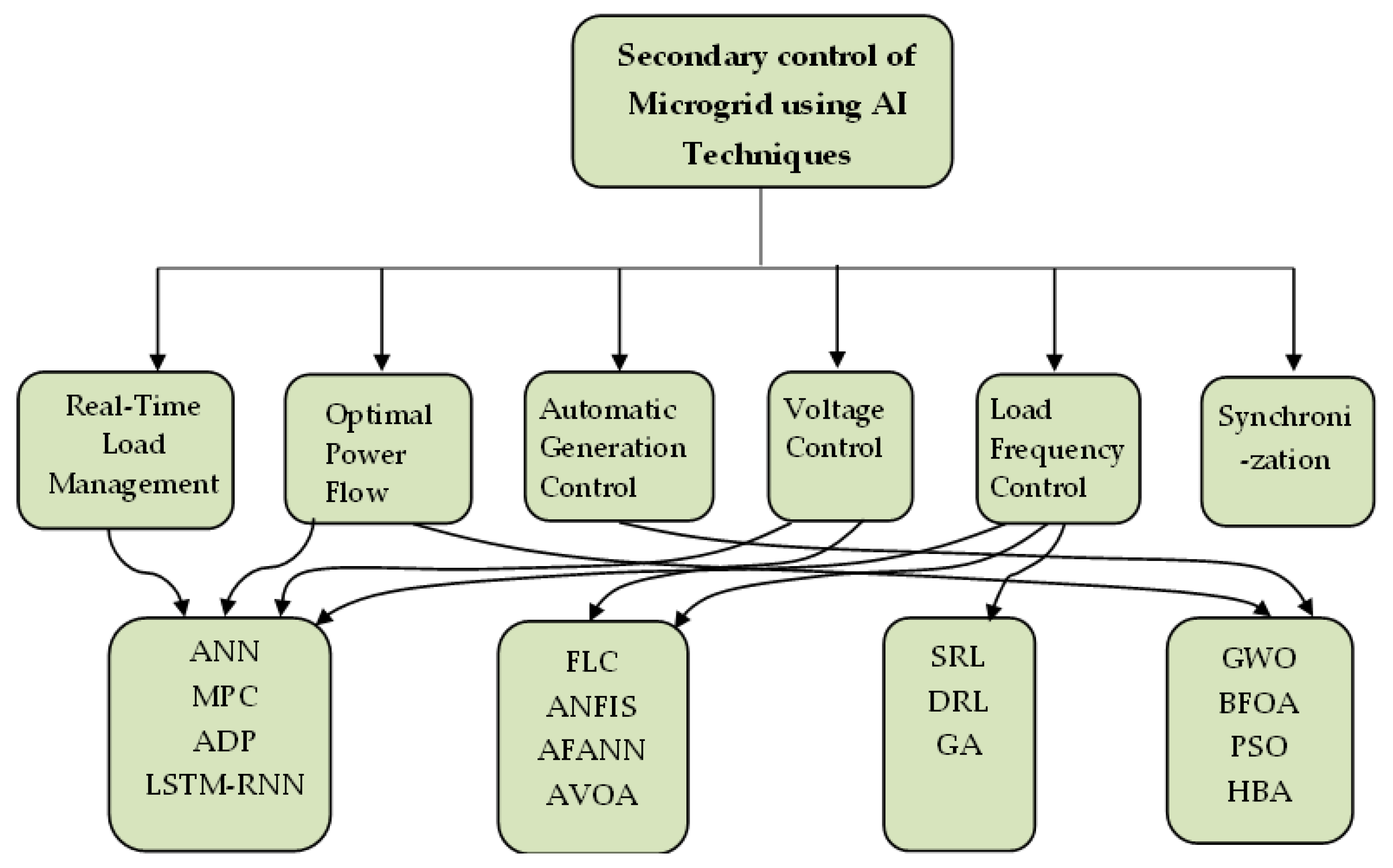
Primary control is implemented to achieve a balance between the required voltage regulation and power sharing at the expense of each other. The primary control leaves a steady-state error, which is fixed by the secondary control. Various secondary control methods are shown in
Figure 5. This control level is used to fix the problem of voltage deviation by sending the error signal to all DG sources to restore their output voltage.
So, for the DC grid, the voltage equation now becomes
: Desired or reference output voltage after compensation.
: Base reference voltage.
: Droop resistance or a virtual resistance used for load sharing or stability.
: Output current.
: A small-signal voltage term or disturbance compensation term.
For AC MG, now the equation becomes
: Magnitude of the regulated voltage in the system.
: The nominal or reference voltage.
: Coefficient related to the sensitivity of voltage magnitude to changes in reactive power.
: Reactive power responsible for regulating the voltage in AC power systems.
: Changes in voltage due to dynamic conditions or measurement errors.
: Angular frequency of the grid.
: The nominal frequency or desired frequency.
: Coefficient relating the sensitivity of frequency to changes in the active power.
: The active Power.
: Dynamic deviations or errors from the nominal value.
The voltage and frequency in each MG are measured, and the difference between them and the reference voltage and frequency is calculated as errors that are to be processed by the compensators and sent to all the MGs for restoration.
The output frequency, as well as the voltage, is regulated using these error signals, which are given by
Here
,
,
and
are the PI control parameters for secondary control to be set to limit the δω and δE to be within deviation limits [
63].
In summary, droop control strategies are often used in primary control to maintain the generation-level balance that makes the MG stable. However, it introduces a voltage and frequency deviation that is dependent on the load. This problem can be solved using PI controllers. However, conventional PI or droop-based secondary controls often respond slowly to the voltage and frequency deviations introduced by the primary control. In addition, inaccurate control can lead to poor power sharing or unstable voltage/frequency profiles. In addition, secondary control typically requires centralised or distributed communication among DERs.
Therefore, communication delays, losses or cybersecurity issues can desynchronise DERs and compromise system reliability. Improper communication or coordination among control units can result in the desynchronisation of inverter-based sources, frequency/voltage instabilities and poor power quality. They also struggle to handle fault-induced dynamics without advanced fault detection and control schemes [
12]. To tackle these issues, intelligent control techniques such as fuzzy logic, artificial neural networks, reinforcement learning and model predictive control (MPC) have been proposed. These can offer:
Faster, adaptive and decentralised control.
Reduced communication needs.
Fault tolerance and resilience.
Better real-time decision-making.
The following section deals with the literature review of intelligent secondary control of microgrids in detail.
4.2.1. Application of Fuzzy Logic for Secondary Control of MG
FLCs are very effective for controlling systems that are usually complex, nonlinear or poorly defined; hence, they are suitable for applications where conventional control methods, such as PID controllers, are not effective. They enhance the PID’s performance by compensating for the areas in which the gains do not perform well. The combination of PI control and a fuzzy control strategy combine the advantages of both and makes them suitable for complex applications, such as the control of power system networks.
Hettiarachchi [
64] reviewed the application of FL for the control of an AC-DC MG system in a multi-agent-based approach. He presented a summary of papers that used FL for DC bus bar control, frequency control and AC voltage control. This was helpful for many researchers in consolidating the application of FLC for MG control. Bevrani H [
65] proposed an intelligent PSO-based Fuzzy PI control for mitigating the variations in frequency and demonstrated its effectiveness by comparing it with the pure fuzzy PI method. However, the frequency deviations are still high from the standard value. Therefore, Annamraju [
66] introduced a two-stage adaptive FL-based PI controller and optimised the membership function by adding GWO along with PSO with a reduced number of variables. The controller was robust and efficient. A dynamic secondary LFC based on a sliding mode approach was proposed in ref. [
67], where an artificial gorilla troop optimisation technique was used for tuning the coefficient, and its effectiveness was validated on the IEEE 14-bus system by comparing it with PSO and GWO. African Vulture optimisation (AVOA) was used in ref. [
68] to optimise the control variables and obtain fixed gains in the cased PI-FL controller in a simulation, as well as tested in HIL Opal RT and a rapid prototype for its effectiveness. Prusty [
69] also justified the result of the Opal RT for a fractional-order type 2 Fuzzy PID controller for frequency control with the impact of storage devices.
While Alizera [
70] proposed the ANFIS technique to adaptively optimise the PI controller coefficients to compensate for the deviations in voltage and frequency for different study cases, Elian [
71] introduced a fuzzy secondary controller with reduced communication links with local measurements to maintain the deviation in voltage and frequency within an acceptable tolerance. Even when subjected to an unintentional landing, the controller maintained the voltage and frequency without using an islanding detection system. Furqan [
72] developed a new mechanism for frequency and voltage stabilisation with battery storage instead of diesel. The proposed controller maintained the deviations and controlled the charging of the battery storage. Refs. [
73,
74] also used the battery of electric vehicles as an alternative to BESS from an economic perspective. In contrast, Ref. [
75] proposed an FLC with separately defined frequency and voltage references necessary to guarantee minimum deviation at each instant of time.
Refs. [
76,
77] also proposed an FLC with a self-tuning fractional order for load frequency control of a microgrid to minimise the violation in the amplitude of the frequency. On the other hand, Ref. [
78] proved that the FL controller is better than the PID and ANN-based controllers in terms of efficiency and precision to control them under different loads and solar irradiation conditions. While all these studies focused on Standalone systems, Neves [
79] proposed a multitask fuzzy secondary controller that changes from grid-tied to Standalone control in the event of isolation.
Table 4 consolidates the FL application for the secondary control of MG.
4.2.2. Application of ANN for Secondary Control of MG
ANN-based tuning for regulating the voltage and frequency of microgrids has been practiced for a long time [
80]. Rohit Trivedi et al. [
12] recently reviewed how these AI techniques have been implemented in microgrid control. They discussed the use of ANN for deviation control, as well as its application to mitigate communication delay, fault restoration and protection. However, Ref. [
81] implemented secondary layer voltage control without a communication channel for an islanded MG using a distributed ML technique. The authors in refs. [
82,
83,
84] used ANN for the control of V and f deviations, with differences in how the parameters are tuned; ref. [
82] used a multilayer perceptron for the selection of parameters based on various aspects of the controller, while ref. [
83] used GA for parameter initialisation and ANN for online tuning. Adaptive dynamic programming (DP) is used to manage current sharing and regulate DC voltage in refs. [
85,
86]. Refs. [
87,
88,
89,
90,
91,
92] used DRL to regulate voltage and current sharing and improve the efficiency of the MG.
Various DRL algorithms have been used for secondary voltage and frequency control of MG by adjusting battery power, offline and online training, gain scheduling, etc. [
93,
94,
95,
96,
97,
98,
99]. Ali M. Jasim [
100] proposed ANN-based online tuning of PI controllers for intelligent V and f variation mitigation as well as ANN-based reactive power controllers for secondary control. They proposed PR-based primary control for accurately sharing power among the DGs. He also proposed GA-optimised ANN-based controllers to minimise V and f fluctuations and share the active and reactive power under primary control [
101]. Recently, ref. [
102] employed a GA-based Pi controller with fine-grained online tuning to mitigate the V and f deviations and validated their results on the ThingSpeak platform with real-time data. Similar work was performed by Alshalawi [
103], who proposed an adaptive controller with a GA optimiser and ANN for real and reactive power control in a microgrid. The combination of GA with ANN for tuning PI controller parameters can improve the stability of the system by mitigating the fluctuations in frequency, as justified by Dashtdar [
104]. The PSO-based ANN technique is also used to tune the PID controller in an islanded MG with an EV incorporated [
105]. Their results showed that the system dynamic characteristics and stability improved with the use of an ANN controller. Ref. [
106] used HBA (Honey badger algorithm) to train the gain values of a PID controller at the first stage, and ANN is trained in the second state to match them with the tie-line power. The trained controller exhibited a better dynamic response and stability with a minimum deviation in frequency. In contrast, Ref. [
107] used a BFOA tuned-PID controller for reducing the frequency deviations in the MG system powered by various DGs.
Adaptive fuzzy-based NN inherited with total sliding mode control (TSMC) for secondary control of MG not only improves the stability of the system, as each DG requires self-information, and of its neighbours only, but is also robust to unpredictable disturbances [
108]. IoT-based secondary control of MG is proposed in ref. [
109] which maintains the voltage and frequency profile in a stable range with less than 50 ms time delay. With the help of IoT, cloud-based ML provides efficient islanding detection methods without many power quality issues. The duty cycle of the DC-DC converter connected to PV sources is fine-tuned for regulating the power flow outputs in accordance with other sources as well as solar irradiance by an ANN controller [
110], which not only improves the transient performance but also ensures satisfactory power delivery to the grid in case of excess generation and power reversal in the event of a deficit.
Kumar et al. [
111] forecasted solar and wind power using a Long Short-term Memory Recurrent Neural Network (LSTM-RNN) and injected it into the developed MG small-signal model with auxiliary and secondary sources. When the frequency deviates owing to load disturbance, the controller responds by initiating secondary sources to vary the power shared with the MG. OME-DRL was incorporated for data-driven secondary frequency control in ref. [
112] to obtain multi-objective optimality and reduce generation cost. Ref. [
113] proposed a nonlinear mode for secondary voltage control under normal operation and a linear mode under large disturbance to maintain stability, and the switching between the modes was performed by proper estimation of the hyperparameters of ANN. While Ho Pham [
114] proposed a MIMO-based ANN model for supervisory control of an MG system, Umashankar [
115] proposed a MIMO-based ANFIS controller for charging an EV in an MG system powered by a PV and FC. As witnessed from the above, researchers are still exploring the application of AI techniques to improve the control of MG at the secondary level.
Table 5 provides an overview of the application of ANN for the secondary control of MG.
4.3. Basics of Tertiary Control
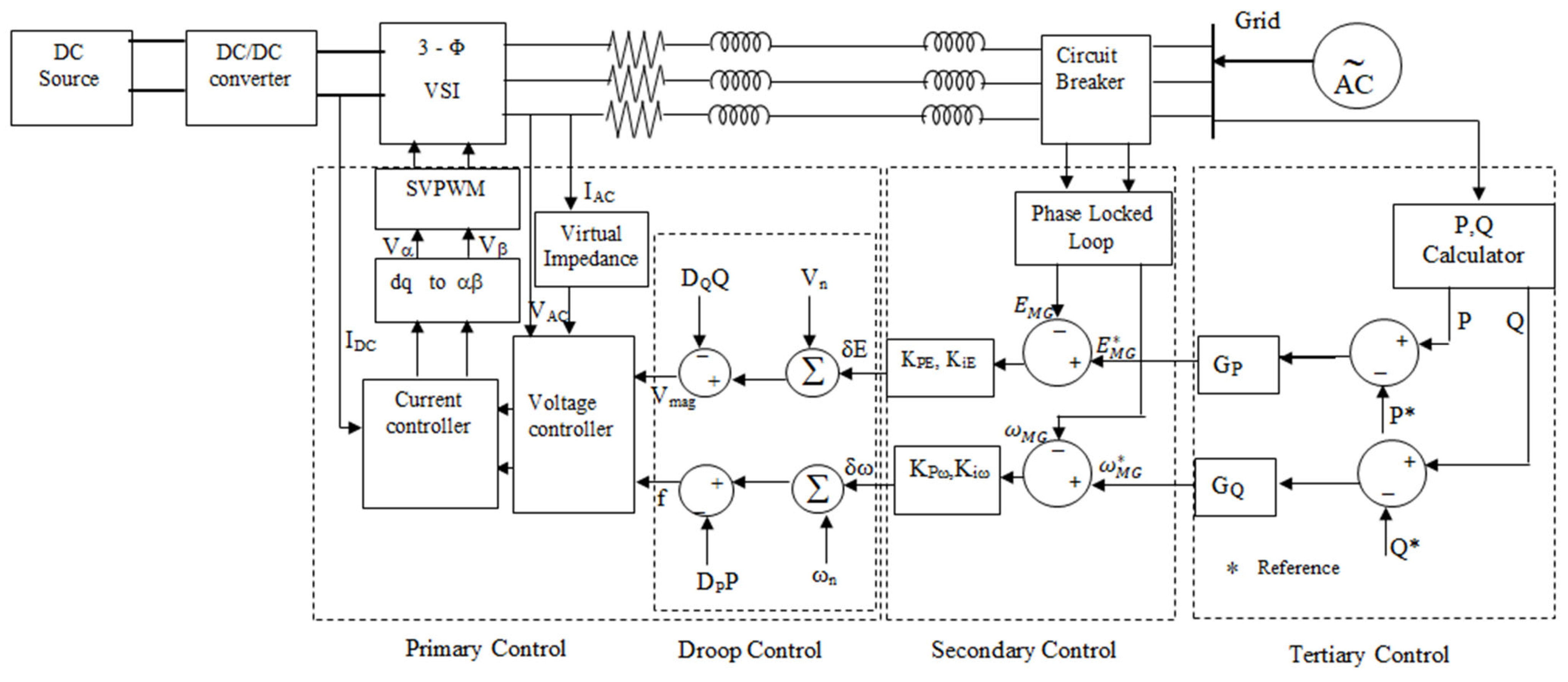
This is the last and slowest control level that manages the power flow between the main grid and microgrid, considering optimal and economic concerns. This real and reactive power flow can be managed by adjusting the voltage amplitude and frequency after obtaining their reference values from the below equations
Tertiary control also coordinates to enhance system quality by optimal operation and energy management by considering economic aspects as well as the power flow between the MG and grid or among the MGs [
116]. They deal with issues such as (i) the economic dispatch aspect of the trade-off between the MG and energy market at the event of excess generation, (ii) setting the optimal operating point of MG as per the requirements of the main grid, (iii) needs of MG with respect to regulation of voltage and frequency in grid-connected or islanded mode and (iv) active/reactive power management within MG cluster/with grid [
117].
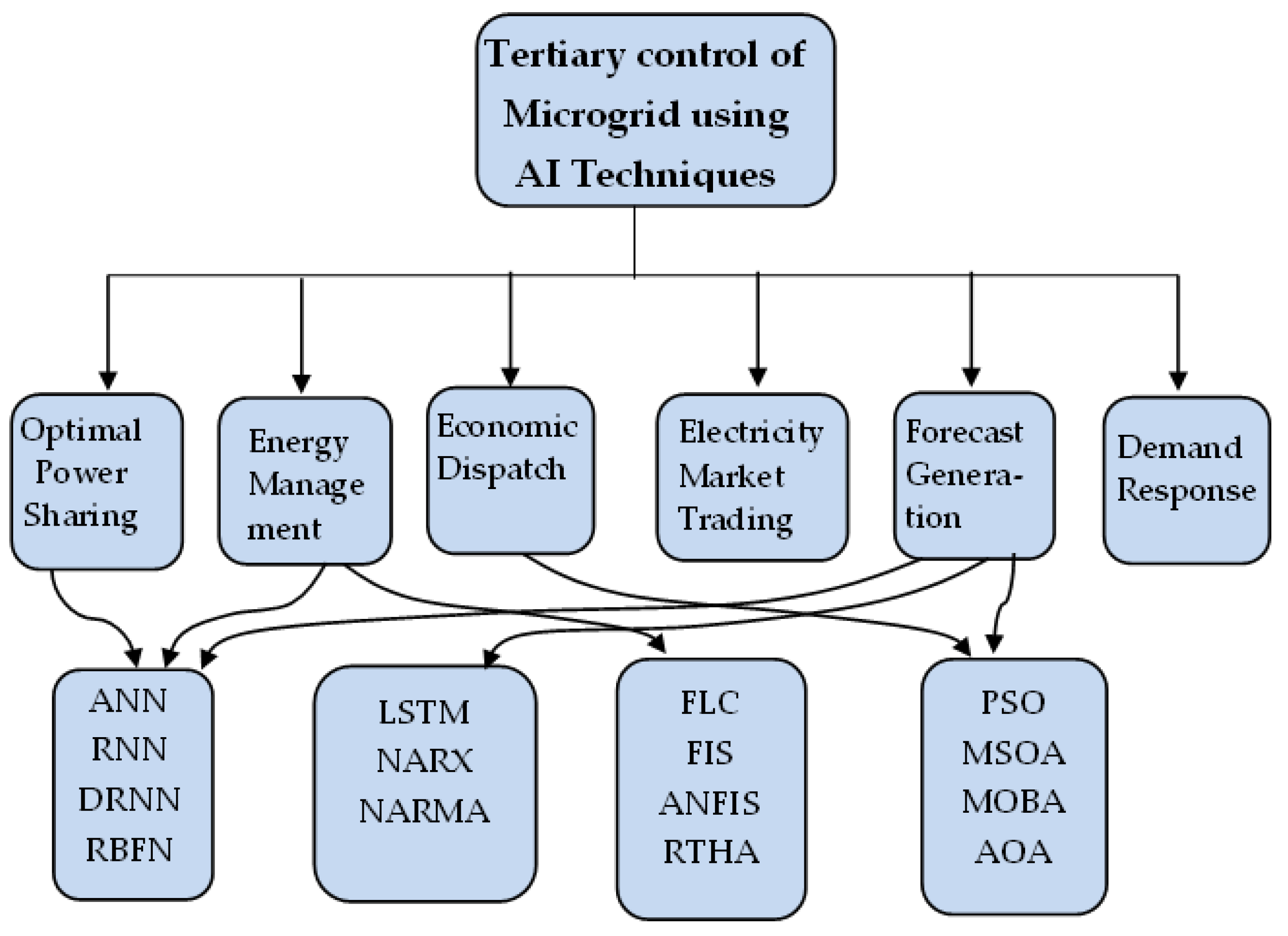
The equations governing various operations in tertiary control as given in
Figure 6 include
- (i)
Economic dispatch
Subject to constraints
where
: cost function of generator i.
: active power output of generator i.
N: number of distributed generators (DGs).
- (ii)
Power Flow Equations (for interconnected microgrids or grid-tied systems)
To ensure optimal power exchange between nodes, i and j, power exchange between the nodes i and j should be
- (iii)
Optimal power flow
When the aim of the tertiary control is to optimise power dispatch, the objective function could be
Subject to
- (iv)
Voltage and Frequency Reference setting
Tertiary control also sets the references for voltage and frequency that primary and secondary controls track as represented by Equations (10) and (11).
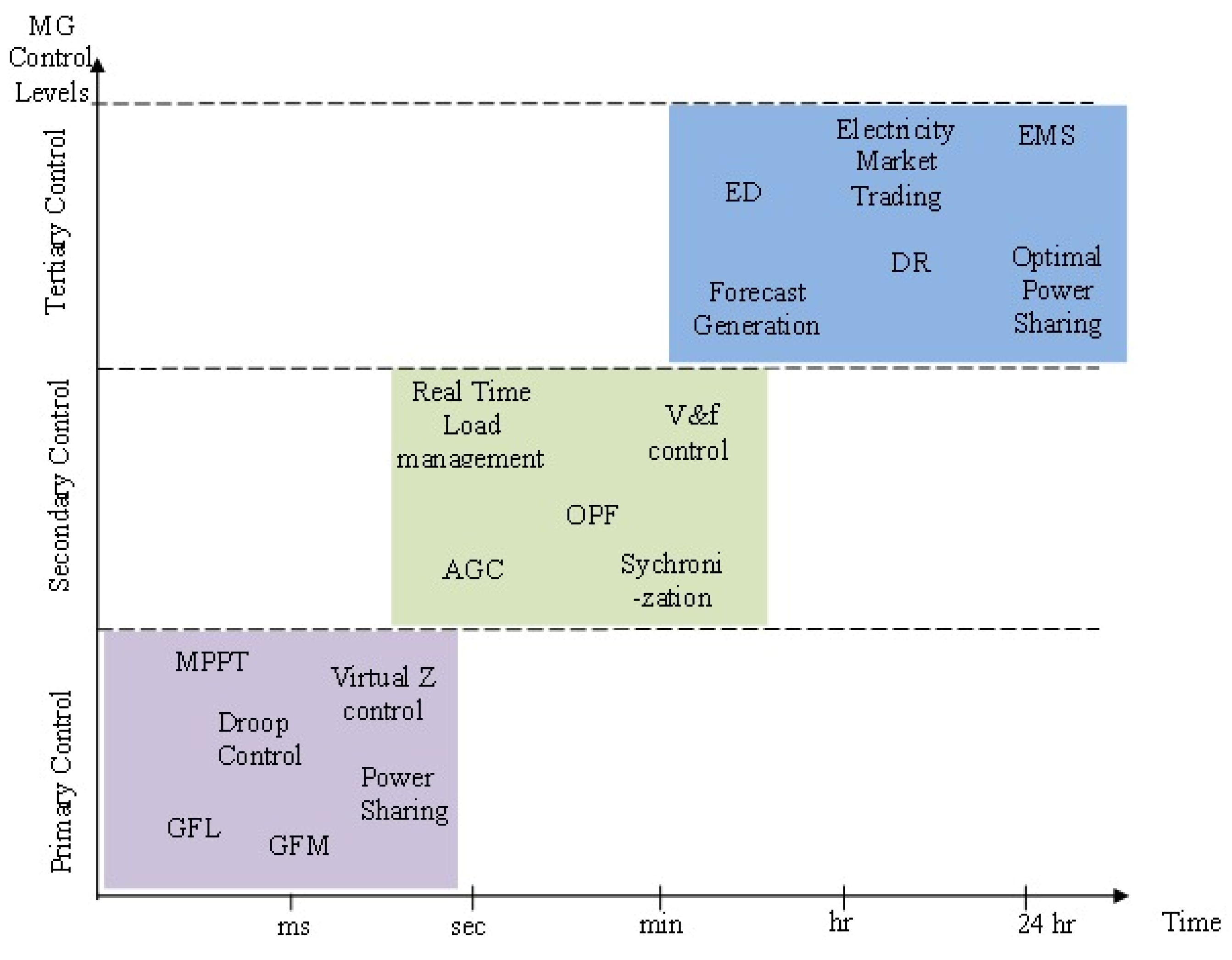
As the last control level, the time frame for the action is relatively large; hence, it is a slow control level when compared to the primary and secondary levels discussed earlier, as indicated in
Figure 7. Various optimisation algorithms can be implemented to ensure economic operation, and when all the DGs operate at the same marginal cost, optimal economic operation is achieved [
118]. Tertiary control may be centralised or decentralised, based on requirements. In the centralised control, the microgrid central controller (MGCC) manages the aforementioned activities, that is, optimises microgrid operation, manages power exchange with the main grid, and provides set points for secondary control. The implementation of these intelligent techniques for the MGCC is the need of the hour, as the time frame available is on the higher side, and hence, more possibilities can be explored to reduce the time.
4.3.1. Application of Fuzzy Logic for Tertiary Control of MG
The fuzzy logic optimisation approach was used to solve the ED in MG as early as 2004 by Pathom [
119] for an uncertain deregulated power system by representing these uncertain parameters with fuzzy numbers. They determined the optimal amount of power and reserve. Mahmoud [
120] proposed a fuzzy tuning system for a prediction model by FSCM (Fuzzy subtractive clustering method based ANFIS with reduced error for performing the ED in MG. Hui Hou [
121] proposed the MSOA multi-objective seeker optimisation algorithm based fuzzy membership function for ED in MG with EVs considering its charging—discharging characteristics. A multi-input single-output (MISO) fuzzy neural network controller for frequency control and to reduce generation cost by managing power distribution for ED is presented in ref. [
122]. Lopez [
123] developed Fuzzy interface system (FIS) incorporated ED to maintain operational limits of power generation in a MG involving wind and hydropower. In contrast to single-objective optimisation, multi-objective optimisation is proposed for ED in ref. [
124], which can result in a set of solutions called Pareto-optimal solutions that are normalised using the fuzzy method. Mukesh Gautam [
125] also proposed multi-objective Economic Emission Scheduling (EES) for minimising emission along with minimum generation cost. To obtain the best solution, they used the fuzzified Pareto concavity elimination transformation (PaCcET) and the results indicated that it has a shorter computational time. The multi-objective Bat Algorithm (MOBA) with Fuzzy Set Theory was proposed in ref. [
126] for solving the optimal dispatch for optimal energy dispatch and reducing pollutant emissions to obtain a set of solutions at the Pareto optimal front (POF) and FST for identifying the best solution. Ref. [
127] also proposed an approach to multi-objective ED considering four objectives, namely environmental impact, COE, distance of supply, load balancing and used fuzzy analytic hierarchy process (Fuzzy AHP) to prioritise them and LP for generating the alternative solution. Ref. [
128] introduced a new approach by incorporating ED within the fuzzy logic energy management system (FLEMS) to reduce the cost of generation and increase system efficiency. PSO, GA and ABC optimisation techniques were used on real data, and the results were compared to find the suitable technique for solving the ED problem.
Divya [
129] also implemented an FLC-based controller to manage the active power share among the MG and mitigate power quality problems when a nonlinear unbalanced load was applied to the MG. A fuzzy-based coordinate control strategy was proposed by [
130] considering the SCO of BESS for the MGMS and proved that this controller is much sensitive to system structure parameter variations compared to the conventional controllers. An FLC-based centralised MG control system for EMS design was implemented in ref. [
131] by maintaining the SOC of the BESS, thereby improving the overall grid power profile stability. The authors in ref. [
132] proposed two decoupled FLCs for a hierarchical EMS among two energy storage units with hydrogen and electric storage systems in a residential MG. They claimed that this structure provides excellent stability and adaptability compared with PSO and rule-based EMS. A reliable power, irrespective of generation disruption, is guaranteed by [
133] using a fuzzy—sparrow search algorithm for MG operation with RES and BESS for EVs. An adaptive fuzzy integrated FOPID controller was proposed in ref. [
134] for power sharing among RES and storage that enhances DC bus management and regulates DC bus voltage at reduced battery stress. Nur E Alam [
135] designed a FLC for EMS in MG, considering the intermittent nature of RES and varying loads in Malaysia and verified that it offers superior control of SOC thereby preventing the over- and under-charging of batteries. In addition to the above, many researchers have developed fuzzy logic-based EMS for better utilisation of renewables and reduction in costs, as well as for managing power balance either by using BESS [
136,
137,
138,
139,
140,
141,
142,
143,
144] or by controlling the charging of EVs [
145,
146,
147,
148,
149,
150,
151], to mention a few. In all these studies, the major differences were between the types of renewables used (PV, Wind, FC, etc.) and the types of FLC they incorporated (conventional, optimal, adaptive, or combined) [
152]. The summary of Fuzzy Logic application to tertiary control of microgrid is given in
Table 6.
4.3.2. Application of ANN for Tertiary Control of MG
Although many conventional methods are available for tertiary control of MG, ANN plays a major role in streamlining the operation of future grids, as economic scheduling and energy management should be given utmost care for minimising the losses and meeting the loads at the minimum cost. ANN techniques are used mainly to forecast wind velocity, solar irradiation or load, enabling optimal scheduling to be performed accordingly. F. Pilo et al. [
153] developed an ANN-based MGCC to predict the optimal set points for the associated DERs operation and hence reduce the overall cost and increase profit. This is accomplished by performing feasibility studies based on various economic evaluation criteria to calculate the operating power capacity of the MG that is most convenient in various market scenarios. This ANN-based MGCC is also used for economic scheduling and optimal participation of MG in a linearised energy market [
154,
155]. A DRNN-based bidirectional LSTM was proposed [
156] for forecasting the hourly PV output and load for optimal scheduling under various scenarios, and it was proven that, in addition to reducing the losses, this approach also improves the system economics. While ref. [
157] proposed PSO to predict the optimal number of hidden layer neurons of ANN for optimal scheduling of MG, Ref. [
158] employed a nonlinear autoregressive exogenous (NARX) model to train ANN to forecast solar irradiation and wind power for economic dispatch studies. A receding horizon control-based short-term forecasting model with ANN was used for forecasting the primary sources of RES and second-order cone programming for maintaining the optimal operation of a DC MG by Walter Gil-González [
159].
A Radial Basis Functional network (RBFN)-based forecast model for estimating wind generation was proposed in ref. [
160] along with receding horizon control for an economic dispatch scheme to maximise wind generation and reduce BESS sizing. DNN-based two-stage training was implemented by [
161] to overcome the intermittent nature of RES through separate training and proved that this framework needs less data for training. Ref. [
162] also proposed a DNN for learning the number of neurons required to solve the ED algorithm, specifically, the λ - iteration algorithm paved the way for real-time control beyond ED.
The performance of the MG can be improved by deploying an intelligent energy management system because the conventional EMS fixes the power references only with the available power generation and load and does not consider the accumulated power at the AC grid and SOC. Joshi [
163] conducted a complete literature review on the application of AI techniques for EMS in MG. Ref. [
164] proposed a two-step ANN to determine the operation mode and charge/discharge status of an ESS and experimentally proved its effectiveness. However, ref. [
78] proposed an EMS based on meeting the load using renewables while monitoring the SOC of BESS using three strategies (PID, ANN and FL) and concluded that FL is more effective in the considered scenario. Ref. [
165] also implemented and proved the same, stating that FL is better at keeping the frequency stable, in addition to managing the EMS of the system. Ref. [
166] also considered the same data to develop a simple and efficient ANN-based EMS that can simultaneously predict the operating modes of various power converters in an MG. Nonlinear Autoregressive Moving Average Level 2 (NARMA-L2) artificial neural network (ANN)-based EMS was incorporated into an MG consisting of PV/WIND/BESS in ref. [
167], and it was claimed that, in addition to EM, the proposed strategy was efficient in DC bus and frequency stabilisation. For demand response control, several DRL techniques were implemented in different realistic scenarios for EMS in ref. [
168], while in ref. [
169], an EMS aggregator with two-level MPC was employed for decision-making. Metaheuristic algorithms have been used for optimisation in MGs for EMS, as reviewed by [
170,
171,
172,
173,
174,
175,
176,
177,
178], to mention a few others.
Conversely, the current trend towards green transport has paved the way for the use of EVs for EMS in MG. To address the plug-and-play functionality of EV, a PSO-based ANN was used to develop a hierarchical EMS for effective power sharing among multiple ESS, including batteries in ref. [
179]. A supervised FF-ANN trained with the Bayesian Regularisation algorithm was used for EMS in an MG with both EV and battery for energy management in ref. [
180] and justified a 28% reduction in grid power usage. PSO-tuned ANFIS was proposed by [
181] for a similar system under varying power profiles and demonstrated its effectiveness with high revenue, thereby enhancing cost-effectiveness. Ref. [
182] developed a modified dragonfly approach for EMS in MG to mitigate the charging effect of HEVs and obtained a 2.5% reduction in the overall operational cost. A combined ANN-AOA (Aquila optimiser algorithm) was proposed by [
183] for controlling the dynamics of battery charging/discharging and implementing EMS in a PV/battery/UC system under various load and road conditions. The red-tailed hawk algorithm (RTHA)-optimised ANN was proposed by Richard [
184] for optimal energy distribution in an MG consisting of PV, Battery and SC to manage the varying energy demand of EV. He also developed a prototype to confirm the effectiveness of the proposed algorithm, in addition to extending the lifespan of the batteries. Ref. [
185] proposed a PSO-based ANN for appropriate energy extraction from MG and an FL-based controller for managing EV charging/discharging and claimed that the system operated at 97% efficiency under various operating conditions. A detailed review of the role of AI techniques for EMS in MG with the advent of EVs was also conducted by Khan [
186]. The application of ANN in Tertiary control of microgrids is listed in the
Table 7 below.