Next Article in Journal
Artificial Intelligence and Machine Learning for Smart and Sustainable Agriculture
Previous Article in Journal
Applications of Artificial Intelligence in Dental Malocclusion: A Scoping Review of Recent Advances (2020–2025)
Previous Article in Special Issue
A Comparative Analysis of Federated Learning for Multi-Class Breast Cancer Classification in Ultrasound Imaging
error_outline You can access the new MDPI.com website here. Explore and share your feedback with us.
 
 
Review

AI-Driven Advances in Precision Oncology: Toward Optimizing Cancer Diagnostics and Personalized Treatment


1
St. Catherine Specialty Hospital, 10000 Zagreb, Croatia
2
International Center for Applied Biological Research, 10000 Zagreb, Croatia
3
School of Medicine, Josip Juraj Strossmayer University of Osijek, 31000 Osijek, Croatia
4
Department of Molecular Biology, Faculty of Science, University of Zagreb, 10000 Zagreb, Croatia
5
Department of Pediatrics, Clinical Hospital Center Rijeka, 51000 Rijeka, Croatia
6
UPMC Hillman Cancer Center Croatia, 49210 Bračak, Croatia
7
Dartmouth Health, Lebanon, NH 03766, USA
8
Faculty of Dental Medicine and Health, Josip Juraj Strossmayer University of Osijek, 31000 Osijek, Croatia
9
Eberly College of Science, The Pennsylvania State University, State College, PA 16802, USA
10
School of Medicine, University of Split, 21000 Split, Croatia
11
The Henry C. Lee College of Criminal Justice and Forensic Sciences, University of New Haven, New Haven, CT 06516, USA
12
Sana Kliniken Oberfranken, 96450 Coburg, Germany
13
School of Medicine, University of Rijeka, 51000 Rijeka, Croatia
14
School of Medicine, University of Mostar, 88000 Mostar, Bosnia and Herzegovina
15
National Forensic Sciences University, Gandhinagar 382007, India
16
School of Medicine, University of Pittsburgh, Pittsburgh, PA 15213, USA
*
Author to whom correspondence should be addressed.
These authors contributed equally to this work and have co-first authorship.
These authors contributed equally to this work and have co-senior authorship.
Submission received: 1 December 2025 / Revised: 22 December 2025 / Accepted: 29 December 2025 / Published: 4 January 2026

Abstract

Cancer remains one of the main global public health challenges, with rising incidence and mortality rates demanding more effective diagnostic and therapeutic approaches. Recent advances in artificial intelligence (AI) have positioned it as a transformative force in oncology, offering the ability to process vast and complex datasets that extend beyond human analytic capabilities. By integrating radiological, histopathological, genomic, and clinical data, AI enables more precise tumor characterization, including refined molecular classification, thereby improving risk stratification and facilitating individualized therapeutic decisions. In diagnostics, AI-driven image analysis platforms have demonstrated excellent performance, particularly in radiology and pathology. Prognostic algorithms are increasingly applied to predict survival, recurrence, and treatment response, while reinforcement learning models are being explored for dynamic radiotherapy and optimization of complex treatment regimens. Beyond direct patient care, AI is accelerating drug discovery and clinical trial design, reducing costs and timelines associated with translating novel therapies into clinical practice. Clinical decision support systems are gradually being integrated into practice, assisting physicians in managing the growing complexity of cancer care. Despite this progress, challenges such as data quality, interoperability, algorithmic bias, and the opacity of complex models limit widespread integration. Additionally, ethical and regulatory hurdles must be addressed to ensure that AI applications are safe, equitable, and clinically effective. Nevertheless, the trajectory of current research suggests that AI will play an increasingly important role in the evolution of precision oncology, complementing human expertise and improving patient outcomes.

1. Introduction

Cancer is one of the leading causes of morbidity and mortality worldwide and represents a major burden for public health systems. According to data from the World Health Organization (WHO), there were 20 million new cases of cancer and 9.7 million deaths from cancer in the year 2022, with the three major types being lung, breast, and colorectal cancer [1]. Projections suggest that these numbers will continue to rise due to population aging, urbanization, and lifestyle changes, creating an urgent need for more effective diagnostic and therapeutic strategies. Despite advances in surgical techniques, radiotherapy, systemic treatments, and immunotherapy, traditional approaches often fail to achieve optimal outcomes, especially in advanced stages of disease or in rare tumors.
Over the past decade, the concept of precision medicine, which aims to tailor treatment to the biomolecular and clinical characteristics of each patient, has become a central goal in oncology [2]. However, the implementation of precision medicine faces significant challenges due to the complexity and exponential growth of biomedical data. High-throughput omics technologies, digital pathology, and medical imaging technologies generate vast amounts of information that exceed the capacity of conventional statistical methods and human perception [3,4]. In this context, artificial intelligence (AI) and machine learning (ML) have emerged as indispensable tools.
Artificial intelligence is broadly defined as the ability of computer systems to perform tasks that typically require human intelligence, particularly pattern recognition, data-based prediction, and decision-making. Within the field of biomedical research, machine learning and deep learning, a subset of machine learning based on artificial neural networks, have gained momentum due to their effectiveness in analyzing complex numerical datasets with tens and hundreds of thousands of samples, as well as medical images, histopathological samples, genetic data, and more [5]. Where oncology is concerned, the potential for the application of AI is truly wide: from early tumor detection and histological and molecular subtype classification to prediction of therapeutic response, automated radiotherapy planning, and the discovery of novel molecules in drug development [6].
One of the most promising aspects of AI in oncology lies in its ability to integrate diverse data types through a multi-modal approach. By combining radiological imaging, digital pathology slides, whole-genome sequencing, and clinical records, AI can generate predictive models that more accurately capture tumor heterogeneity. Such models enable personalized patient stratification and real-time treatment optimization [4]. Furthermore, AI systems are already demonstrating superior performance in certain areas. For example, algorithms for breast cancer detection in mammography have achieved accuracy comparable to, or even exceeding, that of experienced radiologists in specific studies [7].
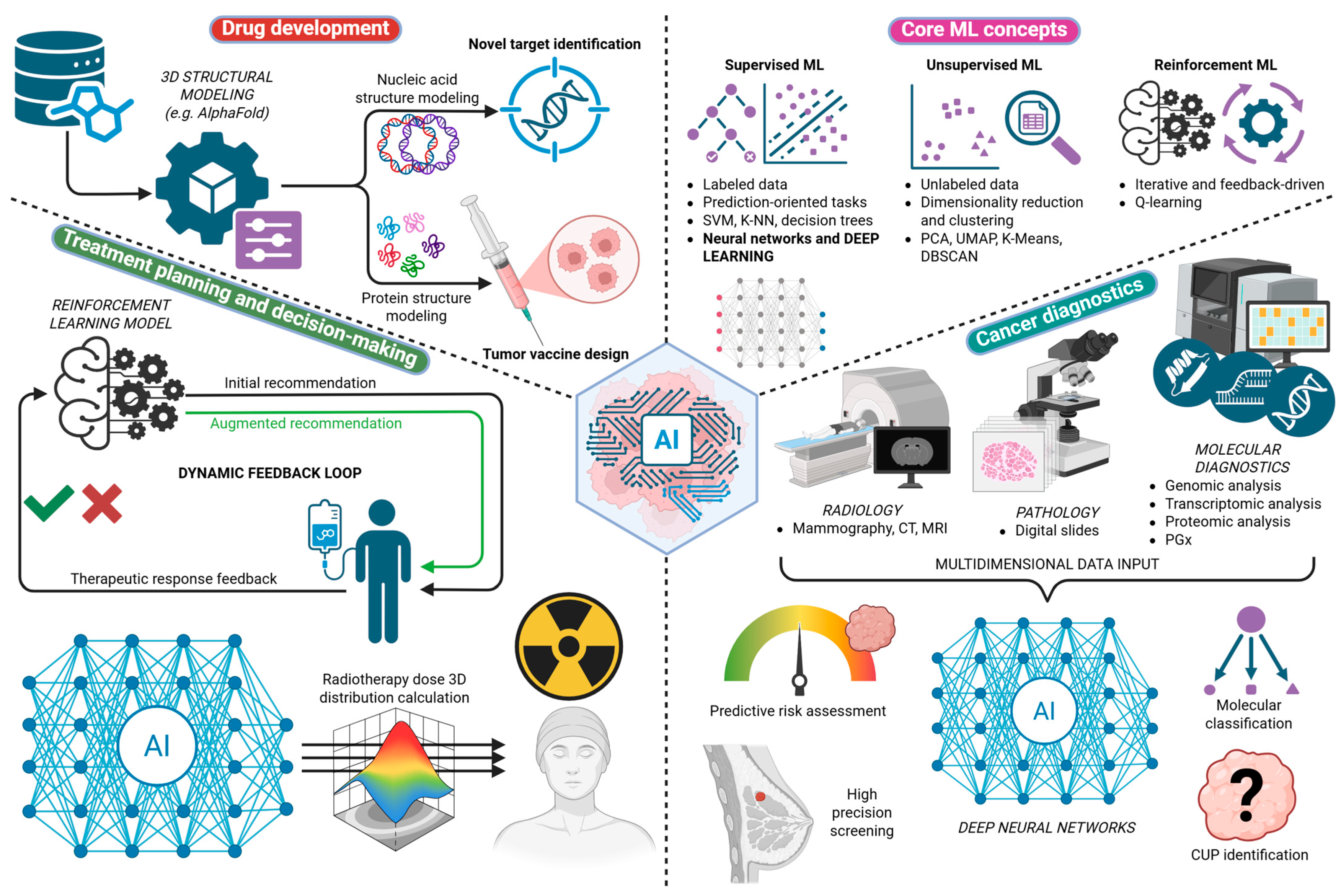
The aim of this paper is to provide an in-depth overview of the latest research and clinical applications of artificial intelligence algorithms in oncology (Figure 1). The focus will be on diagnostic applications (radiology, pathology, genomics), prognostic models and risk stratification, treatment planning (radiotherapy, surgery, systemic therapies), drug discovery, and clinical decision support systems. Ethical, regulatory, and practical challenges will also be discussed, along with future perspectives. By synthesizing current knowledge, this paper seeks to highlight how AI is moving from research to real-world clinical practice, with the potential to significantly improve cancer patient outcomes.

2. Foundations of AI in Oncology

Artificial intelligence entails a broad spectrum of computational techniques and algorithms, which can be divided into several key groups based on their core concepts and approaches. When discussing AI in oncology, the vast majority of the advancements can be attributed to the field of machine learning and its subset of deep learning, mainly due to their significant ability to learn patterns and derive conclusions from raw and highly complex datasets [6].

2.1. Core Concepts in Machine Learning

Based on the core paradigm, the field of machine learning can be broadly divided into three categories: supervised machine learning, unsupervised machine learning, and reinforcement learning.
Supervised machine learning entails algorithms which are trained on labeled datasets, most often with the purpose of making data-based predictions. In supervised learning, algorithms are trained using datasets where both input variables (e.g., CT images, gene expression profiles) and outputs (e.g., tumor subtype, survival time) are known. Once the model learns by mapping inputs to outputs, it can then predict new outputs in unseen cases [8]. The strength of this approach lies in its accuracy when sufficient labeled data are available, but its limitation is the need for large, high-quality annotated datasets, which are often scarce in medical contexts. Within the category of supervised machine learning, it is important to make a distinction between classification algorithms, tasked with predicting a categorical value, and regression algorithms, tasked with predicting a continuous value. Where specific algorithms are concerned, both classification and regression problems have plenty at their disposal, such as decision trees, linear and logistic regression, support vector machines, and neural networks [9]. In the context of clinical oncology, supervised learning underpins tasks such as predicting whether a radiological image contains malignant lesions, estimating recurrence risk, forecasting patient survival, or predicting therapeutic response [10,11].
Unlike supervised approaches, unsupervised machine learning algorithms operate on unlabeled data, discovering inherent structures, clusters, or associations without predefined outcomes. Similarly to supervised learning, a distinction must be made between grouping data into categories, which falls under the domain of clustering, and combining it into a new continuous value, which falls under dimensionality reduction [12]. Well-known clustering algorithms include K-means, density-based and hierarchical density-based spatial clustering of applications with noise (DBSCAN and HDBSCAN), while dimensionality reduction is often performed using principal component analysis (PCA), t-distributed stochastic neighbor embedding (t-SNE), and uniform manifold approximation and projection (UMAP). Unsupervised learning is particularly valuable in clinical oncology, where it can be used to reveal previously unrecognized tumor subtypes, stratify patients into novel risk groups, or identify molecular signatures across multi-omics data. Such clustering methods can contribute to precision oncology by suggesting biologically meaningful patient subgroups that may respond differently to therapies, which can serve as a foundation for optimal diagnostic and treatment protocols [13].
Reinforcement machine learning involves training algorithms and systems to make decisions by iteratively providing them with feedback in the form of rewards or penalties. Examples of reinforcement learning algorithms include Q-learning and proximal policy optimization (PPO) [14]. This iterative, feedback-driven framework is especially well-suited to complex clinical environments where decisions unfold over time. In clinical oncology, reinforcement learning has been explored for adaptive radiotherapy, where treatment parameters can be continuously adjusted in response to tumor dynamics, or for optimizing multi-drug treatment regimens in silico [15].
Deep learning represents a specific subset of machine learning, relying on artificial neural networks with many interconnected layers. Its capacity for feature extraction makes it highly effective for analyzing unstructured data such as medical images and pathology slides [16]. Convolutional neural networks (CNNs) excel in image-based tasks, including tumor detection, segmentation, and classification in radiology and histopathology. Recurrent neural networks (RNNs) and their variants are applied to sequential data like clinical notes or time-series patient monitoring. Transformers and attention-based models, originally developed for natural language processing, are increasingly applied in oncology to integrate multi-modal data within unified predictive models. These architectures capture long-range dependencies and contextual information, enabling more nuanced decision support.

2.2. Multimodal Data in Clinical Oncology

The performance and reliability of AI models in oncology are intrinsically tied to the quality, diversity, and scope of the data on which they are trained. Cancer care generates vast and heterogeneous datasets spanning radiology, pathology, genomics, clinical records, and real-world observations. Harnessing these sources allows AI models to capture the biological complexity of tumors and the multifactorial nature of patient outcomes.
Radiological imaging remains one of the most established and abundant data sources for oncology AI. Modalities such as computed tomography (CT), magnetic resonance imaging (MRI), positron emission tomography (PET), and mammography are routinely used for screening, diagnosis, staging, and follow-up. These images are high-dimensional and often contain latent features not perceptible to the human eye. Where tumor detection and segmentation are concerned, CNNs can automatically delineate tumor boundaries, quantify tumor volumes, and track changes over time, reducing inter-observer variability [17]. Furthermore, the advanced image processing capabilities of CNNs have led to the development of an entirely new field—radiomics. By extracting hundreds of quantitative imaging features (e.g., texture, shape, intensity), radiomics combined with AI can reveal biomarkers predictive of prognosis or therapeutic response [18]. Finally, the integration of PET with CT or MRI enables AI systems to simultaneously capture anatomical and functional tumor information, enhancing diagnostic accuracy [19]. These applications are already entering clinical practice, with AI-assisted mammography and lung cancer screening showing particular promise in reducing false negatives and improving efficiency.
Histopathology is the gold standard for cancer diagnosis, but manual slide review is time-consuming and subject to inter-observer variability. Whole-slide imaging (WSI) has transformed pathology into a digital domain suitable for AI analysis. For automated tumor grading, deep learning models can identify morphological features, mitotic figures, and nuclear atypia, providing consistent grading of cancers [20]. Furthermore, AI can assess immunohistochemistry (IHC) or fluorescence in situ hybridization (FISH) slides to quantify biomarker expression, supporting targeted therapy decisions [21]. Thirdly, AI algorithms can quantify immune infiltration, angiogenesis, and stromal composition, offering insights into prognosis and response to immunotherapy. Digital pathology datasets also enable the creation of large, annotated repositories, which serve as invaluable training material for AI models that can scale diagnostic capacity in regions with limited pathology expertise [22].
Next-generation sequencing (NGS) technologies have allowed scientists to obtain vast amounts of genomic and molecular data, forming a cornerstone of precision oncology [23]. AI plays a critical role in interpreting and integrating these datasets, primarily due to their complexity and volume. Where genomic variant interpretation is concerned, machine learning models predict the pathogenicity of mutations, prioritize variants of uncertain significance, and match patients with targeted therapies. Furthermore, genomic variants can significantly aid in tumor classification, as different tumors usually possess different mutational patterns [24]. Aside from genetic variants, AI can identify subtle expression signatures and epigenetic patterns, which complement other omics layers and further enhance the accuracy of molecular subtyping [25]. Moreover, by analyzing protein abundance and metabolic profiles together with genomic and epigenomic features, algorithms can identify functional pathways linked to disease progression or drug resistance. Emerging omics fields such as glycomics provide additional dimensions of tumor biology, where AI excels in detecting subtle associations with disease phenotypes [26]. The integration of multi-omics data represents one of the most ambitious applications of AI in oncology, as it allows holistic modeling of cancer biology, linking genetic mutations with phenotypic outcomes and therapeutic vulnerabilities.
Beyond traditional clinical and laboratory data, new data streams are increasingly being recognized as valuable for oncology AI. Liquid biopsies, which yield information on circulating tumor DNA (ctDNA), tumor-derived exosomes, and circulating tumor cells, represent a minimally invasive markers for tumor monitoring [23]. AI algorithms can interpret complex sequencing and proteomic outputs to detect early relapse or emerging resistance. Wearable devices and sensors, as well as patient-reported outcomes and mobile health apps, offer continuous monitoring of physical activity, vital signs, and physiological parameters, and generate high-frequency datasets [27]. These can be used to assess treatment tolerance, predict adverse events, and personalize supportive care. Finally, population-level cancer registries and insurance claims databases provide large-scale data for validating AI algorithms across diverse cohorts. The integration of these emerging sources with traditional clinical datasets is expected to further enhance the predictive and adaptive capacity of AI in oncology, bringing patient-centered, real-time monitoring into mainstream care [28,29].

3. AI in Cancer Diagnostics, Prognostics and Risk Stratification

Through advances in research and clinics, AI is rapidly reshaping how cancer is detected, characterized, and clinically assessed. Although they are well-established and reliable, traditional diagnostic and prognostic methods can struggle to keep pace with the growing volume and complexity of imaging, pathology, genomic, and clinical data. In diagnostics, AI enhances accuracy and efficiency across radiology, digital pathology, and molecular testing by integrating complex and multidimensional datasets [30]. In parallel, machine learning models are increasingly used to predict survival, treatment response, and recurrence risk, enabling more personalized patient management. As these capabilities converge, AI is becoming central to risk stratification frameworks that guide therapy selection and clinical decision-making.

3.1. Radiology and Image-Based Diagnostics

Radiological imaging remains one of the most promising areas for AI innovation in oncology. Modalities such as the CT, MRI, PET, and mammography produce detailed and high-dimensional data that are well-suited for pattern recognition. AI models, particularly deep learning models, can detect, localize, and characterize tumors with high accuracy, often identifying subtle features that may be missed by human observers. By automating tasks such as lesion detection, segmentation, and quantitative feature extraction, AI enhances diagnostic precision, improves workflow efficiency, and supports earlier and more reliable cancer detection across a wide range of tumor types.
Breast cancer is a prime example of this, as shown across many scientific articles. In 2024, Salim et al. published the ScreenTrustMRI randomized controlled trial, in which the utility of AI in mammography-based breast cancer screening was evaluated [31]. In the trial, participants with negative screening mammograms, but selected as high-risk by the model, were referred for supplemental MRI-based screening. Based on the results, the authors concluded that this selective AI-based approach for supplemental MRI-based screening ordinance could lead to the avoidance of a significant number of missed breast cancer diagnoses. Another study, published by Oviedo et al., used explainable AI to detect breast cancer in MRI screening [32]. Using their own FCDD anomaly detection model, the authors were able to accurately detect tumor lesions, achieving high AUC scores on both cross-validation and external validation.
Another example of cancer screening where AI has shown promise is lung cancer, as covered by Quanyang et al. in their review article [33]. In terms of lesion detection and classification, there is no doubt about the fact that AI holds the potential for a significant boost in accuracy and false-negative/false-positive rate reduction. However, its potential capabilities expand well beyond simple binary classifications, including far more complex tasks, such as tumor growth prediction, as well as predictive pathological and genetic typing. In 2022, Jiang et al. demonstrated the utility of a deep-learning system in the reconstruction of ultra-low-dose CT images [34]. The results demonstrated that the employment of deep learning led to a significant reduction in noise and an overall improvement in nodule detection accuracy. Similarly, Shah et al. utilized convolutional neural networks to detect cancerous lesions in lung CT scan images and were able to achieve accuracy scores as high as 95% [35].
The utility of AI in imaging result analysis has also been shown in identifying metastases. Zhang et al. developed a deep-learning model in order to detect cancer metastases in the brain [36]. Using post-contrast MRI and convolutional neural networks, the RUSBoost algorithm was created. When evaluated on a held-out test set, the model achieved a ROC-AUC score of 0.79, proving its effectiveness. A similar approach was demonstrated by Huang et al. using the DeepMedic network with certain upgrades [37]. A meta-analysis investigating various deep-learning models for brain metastasis detection identified over forty relevant studies [38]. Out of all the evaluated models and deep-learning algorithms, U-net proved superior in segmentation. Additionally, the pooled results showed sensitivity scores around 85%, which further demonstrates the potential of AI in the detection of brain metastases.
Apart from the ones covered in this section, there are many other cancer sites which have become a target for the application of AI in imaging-based diagnostics. Examples include the detection of prostate cancer, liver metastases, bone cancer, renal cancer, and others [39,40,41,42]. Once again, considering the task at hand was imaging-based classification, the majority of the algorithms used were from the domain of deep learning, as is the gold standard in AI for any sort of visual processing. All of the aforementioned articles make up only a small piece of the vast and ever-expanding area of AI-based imaging analysis and diagnostics. The high accuracy scores that have been achieved truly demonstrate how AI is transforming modern radiology, especially where cancer diagnostics are concerned.
Artificial intelligence has transformed oncological PET imaging by improving quality and facilitating a more consistent extraction of quantitative metrics. Fully automatic segmentation may be achieved using deep learning with convolutional neural network models and radiomics, showing that AI-based PET analysis will be successfully clinically implemented [43,44]. Deep Learning (especially CNN) can delineate tumors and organs without manual input, saving time and reducing variability. On the other hand, radiomics as an advanced field in medical imaging that focuses on extracting large amounts of quantitative data from standard medical images (such as CT, MRI, or PET scans) by using AI-based computational algorithms can predict disease progression or treatment response, assist in precision medicine by correlating imaging features with genomic, proteomic and clinical data. This is especially helpful because many PET/CT studies are performed in the context of assessing response to therapy, so AI models may enable quick segmentation and automatic feature extraction of the total tumor burden or the bulky lesion. Several studies emphasize the value of AI in improving diagnostic accuracy and prognostic modeling [45,46]. Recently published paper of Constantino et al. showed that an AI-based fully automatic 3D segmentation of lesions in whole-body PET/CT scans may benefit from the addition of the maximum intensity projections (MIP)-DL-based segmentation compared with the standard DL-based method, reduces the lesion false positive rate detection and improves the patients’ tumor burden quantification in patients with melanoma, lymphoma and lung cancer [47]. Some studies in a cohort of lymphoma and lung carcinoma patients used coronal MIPs with DL to classify foci as malignant or nonmalignant lesions, achieving an accuracy of 98%. At present, in clinical practice, relative changes in SUV during therapy represent the most robust parameter and published DL-based models showed further improvement of diagnostic still need human supervision and corrections.

3.2. Digital Pathology and Histopathology-Based Diagnostics

Apart from radiological imaging, another great source of visual data in oncology is histopathology. Histopathology is a diagnostic gold standard in oncology, and the transition from glass slides to whole-slide imaging has opened the door to powerful AI applications. Deep learning models can analyze tissue architecture, cellular morphology, and biomarker expression with remarkable precision, assisting pathologists in tasks such as tumor grading, mitosis detection, and subtype classification. By reducing inter-observer variability and enabling rapid, scalable analysis of large slide volumes, AI-driven digital pathology enhances diagnostic consistency and supports more informed treatment decisions.
AI-driven digital pathology has proven crucial in the area of lung cancer, where histopathological classifications rarely lack complexity, but significantly impact prognosis and treatment planning. A comprehensive analysis of almost 200 publications has identified the United States and China as the main drivers in this field [48]. Through technological innovation, deep-learning models have opened the door toward enhancing classification accuracy. However, the multicentric study published by Zhao et al. demonstrated the potential to tackle even more complex tasks [49]. Their DeepGEM model, trained on multicentric data, was designed to predict gene mutations in lung cancer cells using histological images. Results showed high accuracy and ROC-AUC scores for mutation prediction in the EGFR and KRAS genes. If implemented clinically, this model could tie directly into treatment planning, providing actionable predictions with regard to targeted therapies [50].
Apart from lung cancer, the combination of digital pathology and AI is transforming diagnostics with several other cancer types. One example is renal cell carcinoma, where convolutional neural networks are being used to extract clinically relevant morphological features in selected areas of interest [51]. This not only optimizes histopathological classification but also offers the potential for survival prediction and clinical decision-making support. Another prominent example is breast cancer with its complex histology-based classification system [52]. Integrating AI into the pathology workflow allows for more efficient characterization of the cancer, including features such as local invasion and histological grade. Furthermore, complex models for immunophenotype prediction (estrogen and progesterone receptor positivity, HER2 positivity, Ki-67) have also shown promise. Lastly, studies investigating colorectal cancer have shown that the combination of digital pathology and AI may be used for predicting therapeutically relevant biomarkers, such as microsatellite instability [53].
A lesser-known, but increasingly interesting area of AI-assisted digital pathology application is the diagnostic conundrum of cancers of unknown primary origin (CUP). With the unknown primary site presenting the primary diagnostic hurdle in these rare but complex cases, several studies have attempted to overcome it by predicting the primary site through AI models trained on histology slides. In 2021, Lu et al. published their TOAD algorithm, a deep-learning model trained on over 22,000 samples [54]. When evaluated on over 6000 samples, the model was able to discriminate between 18 primary cancer sites with an accuracy of over 80%. Another solution based on a similar approach was presented by Tian et al. in 2024 [55]. Their TORCH model, based on deep neural networks and trained on tens of thousands of histological images, achieved an accuracy of over 80% and ROC-AUC score of over 0.95. Additionally, patients with TORCH-guided treatment had a significantly better survival than the control, which demonstrated the clinical utility of the model. With well-performing models, such as those presented in these two studies, it is clear that the combination of digital pathology and AI may significantly improve the diagnosis of CUPs.
To sum up, AI has certainly found its place in the histopathology diagnostic pipeline, with a capacity for precise and efficient morphological classification, as well as a potential for clinically actionable prediction-based insights.

3.3. Molecular and Genomics-Based Diagnostics

Advances in next-generation sequencing and other molecular profiling technologies have produced vast datasets that are essential for precision oncology but challenging to interpret manually. AI enables rapid, scalable analysis of genomic alterations, expression patterns, and multi-omics signatures, helping identify driver mutations, classify tumor subtypes, and detect actionable biomarkers. By integrating complex molecular data with clinical and imaging information, AI enhances diagnostic accuracy and supports personalized treatment selection based on the unique biological characteristics of each patient.
Where AI-based analysis of multi-omic data for cancer is concerned, the relevant literature has expanded dramatically in recent years. One of the key articles in this area was published by the Clinical Proteomic Tumor Analysis Consortium in 2023 [56]. The presented models go beyond any single source of data, integrating histopathological slides with transcriptomic and proteomic signatures to achieve higher accuracy. When evaluated, the models performed very well in distinguishing between tumor and normal tissue, as well as identifying the tissue of origin, with ROC-AUC scores of over 0.97. Another study, published by Darmofal et al., utilized tumor genomic data to enhance cancer classification [57]. Using their GGD-ENS hyperparameter ensemble based on deep neural networks, an accuracy score of 93% was achieved for high-confidence predictions across 38 different types of cancer. The clinical relevance of such a model lies in its capacity to provide dynamic, real-time support in decision-making and treatment planning.
Apart from the approach using digital pathology, which has been discussed in the previous section, some researchers have attempted to tackle the issue of CUPs using tumor genomic data. The first of these is the CUP-AI-Dx deep-learning model, published in 2020 by Zhao et al. [58]. In their study, the authors collected transcriptomic profiles of over 18,000 tumor samples. When evaluated on a test dataset, the model achieved an accuracy score of over 0.95, while international multi-centric data evaluation yielded accuracy scores of 0.87 and 0.72. Three years later, Moon et al. published their predictive model for CUP resolution: OncoNPC [59]. The study included next-generation sequencing data from over 35,000 tumor samples, which were used to train a machine-learning model based on the XGBoost (extreme gradient boosting) algorithm. The model achieved a weighted F1 score of 0.78 on a test set consisting of 22 cancer types, and a weighted F1 score of 0.81 on a test set consisting of 13 cancer types. Moreover, the authors demonstrated significantly superior outcomes using OncoNPC-concordant treatment compared to the control group. Finally, in 2025, Brlek et al. published their CUP identification software titled OncoOrigin [24]. The XGBoost-based model utilized information on patient sex, age, and genetic variant presence in 345 genes across 20,700 metastatic tumor samples. On the test set, the model differentiated between 10 primary cancer types with a weighted ROC-AUC value of 0.97. The aforementioned AI solutions position genomic data as another valuable option for tackling CUPs.
The integration of complex genomic and multi-omic data into AI models is still a relatively new approach, but one that holds great promise for improving cancer diagnostics. These models have demonstrated their capacity to provide clinically actionable insights, particularly when combining multi-omic and visual data (such as imaging or digital pathology slides).

3.4. Risk Assessment and AI-Guided Prevention

Artificial intelligence is increasingly being applied not only in diagnosing cancer, but also in identifying individuals at elevated risk before the disease develops. By analyzing complex datasets, including genetic profiles, family histories, lifestyle factors, imaging screenings, and electronic health records, AI can detect subtle, multifactorial patterns associated with cancer susceptibility. These models enable more accurate risk stratification than traditional scoring systems and may help target screening, surveillance, and preventive interventions to those most likely to benefit.
Predictive models for cancer risk assessment have been developed in several areas, including gynecological cancers, pancreatic cancer, breast cancer, esophageal cancer, and many others [60,61,62,63]. Where esophageal cancer is concerned, the model published by Nfor et al. combines genetic polymorphism data with alcohol consumption data for risk prediction [63]. The results of the study showed a ROC-AUC score of 0.96 and a sensitivity of 92%, which shows high predictive capability. Additionally, a keener insight into genetic predisposition for esophageal cancer was gained through identifying specific risk-increasing polymorphisms. Another study, published by Novielli et al., trained a model for colorectal cancer risk prediction based on gut microbiome profiling [64]. Specifically, machine-learning models were trained on 16S RNA sequencing data. Internal and external validation results showed a ROC-AUC score of around 0.7. Feature importance analysis associated Fusobacterium and Peptostreptococcus strains with a higher risk of colorectal cancer, while Eubacterium strains were identified as lower risk. Regarding lung cancer, it has been shown that AI analysis of low-dose CT imaging is not only useful for enhanced detection, but also for risk prediction [65]. Lee et al. conducted external validation of Sybil, a deep-learning model designed for low-dose chest CT analysis and achieved high and moderately high ROC-AUC scores (varying with regard to smoking status) for 1-year and 6-year lung cancer prediction, respectively.
The aforementioned studies demonstrate how different sources of data can be used to train accurate AI models for cancer risk prediction. Furthermore, these models can also provide novel insights through feature importance analysis, identifying new risk factors that traditional statistical analyses may overlook.

4. AI in Cancer Treatment Planning and Clinical Decision Making

Artificial intelligence is rapidly reshaping cancer treatment planning and decision making, offering new opportunities to enhance personalization, efficiency, and consistency across chemotherapy and radiotherapy workflows. AI-based approaches enable data-driven support for complex therapeutic decisions, multi-step treatment optimization, and automated generation of high-quality radiotherapy plans [66,67,68].

4.1. Clinical Decision-Support Systems and EBRT Planning

Machine learning (including reinforcement learning and deep learning) has provided the groundwork for several clinical decision-support systems, offering models for treatment response prediction, as well as dynamic treatment planning. For example, a clinical decision support system based on data-driven machine learning was used in early-stage lung and postoperative oropharyngeal cancers radiotherapy treatment planning [69]. Using machine-learning classifiers, Valdes et al. were able to train models for accurate radiotherapy planning, thereby successfully connecting patients and specific treatment protocols. In a study published by Brenner et al., a machine-learning model based on the random forest algorithm was developed to predict neoadjuvant therapy outcomes in breast cancer, identifying key patient and tumor features that significantly influence complete pathological response [10]. With an accuracy of 80% and a ROC-AUC score of 0.83, the model demonstrated how AI can support clinical decision-making in breast cancer treatment by enabling more personalized, prediction-based treatment planning. In another study, machine learning-guided treatment planning for 54 Gy fractionated radiotherapy was performed and compared with traditional planning approaches [70]. For the 61 patients included in the study, 93% of the plans were judged to be of acceptable clinical quality, with significantly reduced planning time and improved consistency across cases. Beyond technical applications, AI-driven tools also support clinical decision-making by enabling risk stratification, tumor progression prediction, and individualized treatment planning through integration into multidisciplinary workflows.
Techniques such as reinforcement learning are particularly noteworthy as they enable the modeling of sequential therapeutic decisions. The algorithms learn optimal actions based on the patient’s condition and treatment outcomes, thereby enabling AI-guided real-time therapy augmentation [66,67]. Recent studies highlight that reinforcement learning can optimize multi-step treatment strategies, adapting dynamically to patient responses and minimizing adverse events, particularly in complex oncology cases [67]. However, challenges include limited datasets, heterogeneity of clinical cases, and the lack of standardized criteria for evaluating plan quality [68]. Conroy et al. emphasize that bridging the gap between retrospective promise and clinical reality in AI-driven radiotherapy planning requires overcoming barriers related to trust, data quality, and workflow integration, alongside ensuring transparency and clinical education [71].
Where large language models (LLM) AI agents are concerned, Ferber et al. introduced an autonomous oncology decision-support agent built upon the foundation of “GPT-4” and enhanced with specialized medical tools, including histopathology vision models, radiology segmentation models, guideline search, and precision oncology knowledge bases [72]. When tested on 20 challenging multimodal patient cases, the agent performed well, correctly using tools in 87.5% of cases and making accurate clinical conclusions in 91% of instances. It significantly outperformed “GPT-4” alone, showing that combining a LLM foundation model with domain-specific tools can significantly boost decision-making accuracy. The authors mention that, although promising, the system still requires broader validation and careful clinical integration before real-world use.
The global rise in cancer incidence is expected to drive demand for radiation therapy beyond the capacity of the current workforce [73]. Deep learning shows considerable promise in automating external beam radiotherapy (EBRT) planning by streamlining complex processes such as tumor segmentation, treatment planning, quality assurance, and patient monitoring. These advancements enable faster and more consistent workflows while reducing inter-clinician variability and improving overall treatment precision. Advanced architectures, including CNNs, U-Nets, ResNets, and GANs, have been applied in predicting 3-dimensional radiotherapy dose distributions and combined with deep learning models used for clinical decision support [68]. Sande et al. described an AI-based treatment planning method for locally advanced left-sided breast cancer using a CNN model. The training database consisted of patients diagnosed with stage III breast cancer, and 10 out of the 12 mimicked plans were clinically acceptable, meeting all relevant clinical goals [74]. In another study, a U-Net model was trained using a database that consisted of 300 samples and evaluated on cervical cancer patients diagnosed with FIGO stage IA2-IVB [75]. In evaluation, the model was reported to have generally high geometric and dosimetric accuracy (compared to clinician) for most organs at risk in cervical cancer EBRT, with the exception of spinal cord and pelvic bone, where significant dosimetric differences were found.
Beyond treatment planning, AI is also advancing the field of radiomics by enabling the extraction and analysis of quantitative imaging biomarkers from medical images, supporting predictive tumor progression modeling and radiosensitivity, aiding in precision oncology approaches [76].

4.2. Balancing Automation and Clinical Oversight in AI Systems

Despite technological advances, surveys among medical physicists indicate that machine learning methods still require clinician oversight in most cases, particularly in complex therapeutic scenarios, and that their implementation in routine practice is still greatly limited by infrastructural, educational, and regulatory requirements [77]. Compliance with the EU AI Act and adherence to regulatory frameworks aim to ensure the safe and lawful implementation of AI systems in oncology [78]. Furthermore, AI tools for treatment recommendations in oncology face key challenges such as data security, data representativeness, model transparency and explainability, and integration into multidisciplinary tumor boards. These challenges further slow the transition from experimental stages to routine clinical use.
Although many steps, such as automatic contouring and dose calculation, are already widely applied, full automation of patient management, from imaging to a finalized treatment plan, has not yet been fully achieved. System autonomy must be balanced with human oversight, in which clinicians still remain essential for complex cases, model interpretation, and final decision-making [79]. Key risks include overreliance on the system, reduced attention due to trust in automation, and insufficient algorithm transparency. Additionally, studies have emphasized the need for continuous model retraining and validation to maintain accuracy as patient populations and treatment protocols evolve [62]. Without maintenance of AI tools, AI technologies designed to improve patient health may introduce new forms of harm, ultimately eroding trust in AI and machine learning for healthcare [80].

5. AI in Cancer Drug Discovery and Development

5.1. Molecular Design, Target Identification and Tumor Vaccines

The integration of artificial intelligence into oncology research has revolutionized the way scientists tackle drug discovery and development. Traditional discovery pipelines are slow and expensive, with high attrition rates, especially in oncology, as tumor heterogeneity and adaptive resistance often complicate therapeutic targeting [81,82]. By contrast, AI-driven computational frameworks can delineate complex nonlinear relationships among molecular structures, biological pathways, and pharmacological responses that are unattainable using conventional methods.
At the early discovery stage, deep learning architectures and graph neural networks are increasingly applied in the in silico screening of large chemical libraries. Therefore, these systems estimate binding affinity with remarkable precision, predict toxicity, and model pharmacokinetic properties with efficiency that sometimes outcompete standard laboratory screening [83]. Recently, generative models such as transformer-based and diffusion frameworks have been used in designing completely new molecules. They enhance potency and selectivity while reducing off-target interactions. According to studies, AI-driven pipelines are capable of improving the development of small-molecule candidates. The time from identification of the target to preclinical validation may be reduced from three to five years to approximately eighteen months [84]. As may be easily realized, this improvement has big implications for the pace and cost of pharmaceutical innovation.
Beyond molecular design, AI contributes to target identification and biomarker discovery through integrating multi-omics data. Integration of genomic, transcriptomic, proteomic, and metabolomic data allows researchers to pinpoint molecular vulnerabilities that can be targeted within specific tumor types. Modern high-throughput profiling approaches, including whole-genome sequencing, whole-exome sequencing, and RNA sequencing, now represent the basis for comprehensive tumor characterization and classification [23,50]. Analyzing such data with AI-driven bioinformatic tools generates very accurate predictive models that can discriminate between tumor subtypes and identify the tissue or organ of origin. This approach is particularly valuable for cancers of unknown primary [24].
Comparative genomic analyses that evaluate somatic mutations in tumor samples against a patient’s germline DNA also represent a fundamental component in the development of personalized tumor vaccines. In these contexts, machine learning algorithms have been applied to predict peptide-MHC binding affinities and antibody–antigen interactions specific to tumor-associated neoantigens. Such in silico approaches expedite target discovery and allow vaccine design to proceed considerably faster than with traditional laboratory-based methods alone [85,86]. Concurrently, these approaches can enable the rapid generation of personalized therapeutic vaccines that may elicit specific immune responses capable of improving treatment outcomes in patients with advanced or drug-resistant cancers.

5.2. AI in Trial Design and Patient Stratification

Artificial intelligence is being used increasingly in daily clinical practice to support not only the planning of studies based on real-world data but also the patient stratification with enhanced precision. Tools such as Trial Pathfinder use electronic health records to simulate and assess clinical study eligibility criteria. This method enables researchers to assess in advance the potential impact of different inclusion and exclusion parameters before the trial has started. It helps ensure greater diversity among participants while maintaining statistical reliability and often lowers the number of participants needed. AI also shifts how patients are allocated within clinical trials. By integrating genetic, imaging, and clinical data, machine learning models can identify subgroups of patients who are more likely to respond to a particular therapy. This approach increases both precision and efficiency in patient recruitment, especially in oncology, where AI has shown an enhancement in biomarker-driven trial design and the inclusion of usually underrepresented populations, such as those with rare molecular subtypes or comorbidities that often exclude them from standard studies [87,88,89].
Additionally, AI plays an important role in adaptive trial designs and digital twin models, such as TwinRCTs™, which show strong potential to accelerate patient recruitment, improve interim analyses, and increase the overall success rates of clinical trials [87]. Digital twins are virtual patient models generated from multidimensional clinical and molecular data that enable investigators to test different therapeutic strategies or dosing regimens in silico before actual implementation in real-world patient cohorts. Such simulations can significantly reduce costs, shorten development timelines, and enhance the statistical power of even small-scale studies.
Recent evidence suggests that AI has increasingly become an integral part of precision oncology, rather than just a supportive analytical tool. In conjunction with modern computational modeling, next-generation sequencing techniques such as WGS, WES, and RNA-Seq enable researchers to investigate tumor biology in far greater detail. These approaches support the identification of oncogenic drivers, the understanding of mechanisms of drug resistance, and guide the design of treatment strategies more closely adapted to the individual patient [50,85]. In parallel, genomic and transcriptomic data support the development of tumor vaccines, which are particularly important for patients with rare cancers, where standard treatment protocols are often lacking or ineffective. Here, a personalized vaccine can be designed to tackle an individual tumor’s molecular profile, offering a targeted approach when conventional options are limited. The same principle applies to aggressive malignancies that continue to have a poor prognosis despite established treatment regimens, such as glioblastoma [86]. In these situations, AI-assisted vaccine design has the potential to accelerate neoantigen target identification and support the creation of tailored immunotherapies, which could prolong survival and enhance quality of life.

6. Ethical Concerns and Translational Challenges

Despite the significant promise of artificial intelligence in medicine, and by extension oncology, the translation of these technologies into routine clinical practice is accompanied by a range of ethical and practical challenges [90]. Addressing these issues is essential to ensure that AI tools are safe, equitable, and clinically effective across diverse patient populations. The discussion around ethical and translational issues regarding the integration of AI into clinical practice can be boiled down to several key points.

6.1. Algorithmic Bias and Data Underrepresentation

One of the key issues when training AI models is algorithmic bias, which can arise when AI systems are trained on datasets that do not adequately reflect the diversity of real-world patients. Models developed on homogeneous or unbalanced data may perform well in some demographic or clinical groups while failing in others, leading to potential inequality in cancer diagnosis and treatment. Ensuring high-quality performance across different patient groups requires careful attention to dataset composition, transparent reporting of model performance across subgroups, and ongoing post-deployment surveillance [91,92,93,94]. However, this issue is directly related to the question of data availability, particularly where the representation of certain ethnic groups is concerned. This imbalance is discussed in the study by Pean et al., in which the authors identify ethnic and racial variability of ML model accuracy [95]. One of the prime examples in cancer diagnostics of how skewed datasets may lead to discriminatory model performance can be found in dermatology, more precisely, pigmented skin lesion classification. In the literature, it has been shown that ML models trained on pigmented skin lesion datasets containing racially underrepresented samples can perform poorly when diagnosing these patients [96]. In order to ensure model robustness, training and evaluation on multi-centric data is key, whilst ensuring balanced representation across all sample subgroups (e.g., race, ethnicity).

6.2. Lack of Model Interpretability and Explainability

Another point brought up frequently in discussions is that of transparency and interpretability. Many of the more powerful AI systems, particularly deep learning models, function as “black boxes,” offering limited insight into how predictions are generated. This opacity can undermine clinician trust, hinder adoption, and complicate the process of clinical decision-making. The development and implementation of explainable AI techniques are therefore crucial for enabling clinicians to understand, contextualize, and appropriately act on algorithmic outputs [97,98,99]. Cui et al. define certain “simpler” machine-learning models as inherently explainable, such as linear regression or decision trees [100]. What makes these models interpretable is their foundation, which is either a straight-forward mathematical formula, or a visually comprehensive structure such as a decision tree. However, in cancer radiology, for example, the models used for analysis and processing of radiological images are most commonly ensemble machine-learning models or deep-learning models, offering no such options. For this reason, other methods for model explanation must be explored.
Where cancer radiology and radiotherapy are concerned, Cui et al. offer several methods for shedding light on the “black box” of the model after training is complete [100]. One of these methods that has increasingly gained popularity in ML research is SHAP (Shapley Additive exPlanations). For predictive models, SHAP offers an explanation as to how the model arrived at its prediction by determining how and to what extent each feature contributed to the output. Another example of the need for AI explainability in cancer research can be found in the prediction of cancer drug values. To address this, Kothari et al. developed an explainable AI-assisted web application, utilizing the SHAP method, but also LIME (Local Interpretable Model Agnostic Explanation) and Anchor [101].

6.3. Data Security and Integrity

The third core ethical issue involves patient privacy and data security. AI systems typically rely on large volumes of sensitive data, including imaging archives, pathological specimens, genomic profiles, and electronic health records. Safeguarding these data requires strong de-identification protocols, secure storage systems, and responsible data-sharing frameworks that comply with relevant privacy regulations and maintain public trust in the use of AI-driven healthcare technologies [102,103,104].
The effective use of artificial intelligence in oncology relies on access to large and sensitive patient datasets, making responsible data handling a fundamental ethical and regulatory requirement. Oncology data, including imaging, pathology, genomic profiles, and electronic health records, carry heightened privacy risks and demand robust safeguards throughout the data lifecycle. Genomic data require special consideration, as they may enable indirect identification and have implications beyond the individual patient [105]. From a clinical and methodological perspective, responsible data handling also entails ensuring data quality, representativeness, and fairness. Incomplete, biased, or poorly annotated datasets can lead to unreliable or inequitable AI models. Standardized data collection, quality control procedures, and inclusion of diverse patient populations are therefore essential for clinically robust and ethically acceptable AI systems [106].

6.4. Regulatory Implementation Barriers

The clinical implementation of artificial intelligence models in oncology is subject to complex regulatory requirements designed to ensure patient safety, clinical validity, and responsible use. However, existing regulatory frameworks were largely developed for conventional medical devices and static software systems, creating challenges when applied to adaptive, data-driven AI technologies. Consequently, regulatory considerations remain a key barrier to the widespread deployment of AI models in cancer care. In both the United States and the European Union, most AI-based clinical tools are regulated as software as a medical device (SaMD) [107]. In the United States, the Food and Drug Administration (FDA) evaluates such systems under a risk-based framework that considers intended use, clinical impact, and level of automation [108]. In oncology, where AI outputs may directly influence diagnostic or therapeutic decisions, regulators typically require strong evidence of analytical validity, clinical validity, and clinical utility. Similarly, the European Medicines Agency (EMA), together with notified bodies operating under the Medical Device Regulation (MDR), applies stringent conformity assessment procedures for high-risk medical software [109]. These processes demand robust documentation, performance evaluation, and post-market surveillance plans.
A central regulatory challenge involves demonstrating generalizability and reproducibility. Regulatory authorities increasingly require external, multi-center validation studies to ensure that AI models perform consistently across different patient populations, institutions, and technical environments [110]. Variability in imaging protocols, laboratory assays, and data annotation practices can significantly affect model performance, making regulatory approval more complex and resource-intensive. The adaptive nature of AI systems presents an additional challenge for regulators. Unlike traditional software, AI models may evolve through retraining or continuous learning, raising questions about how updates should be validated and approved. The FDA has proposed a lifecycle-based regulatory approach that includes predefined change control plans and continuous performance monitoring, while European regulators are similarly exploring mechanisms to oversee model updates under the MDR framework [111]. Nonetheless, clear and harmonized guidance on managing adaptive algorithms remains under development. Transparency and explainability are also increasingly emphasized in regulatory evaluations. Both FDA and EU regulators expect that clinicians can understand and appropriately interpret AI outputs, particularly in high-risk clinical contexts such as oncology. The limited interpretability of some deep learning models complicates this requirement and continues to pose challenges for regulatory acceptance [112]. Finally, post-market surveillance is a critical component of regulatory oversight. Once deployed, AI models must be continuously monitored for performance degradation, unintended bias, and safety issues. Establishing reliable mechanisms for real-world monitoring and reporting remains technically and organizationally demanding, particularly in oncology, where clinical outcomes may emerge over extended time periods [113].

7. Conclusions

Artificial intelligence is rapidly transforming the landscape of modern oncology, offering powerful tools for improving cancer diagnostics, prognostication, treatment planning, and drug development. By leveraging large, heterogeneous datasets drawn from radiology, digital pathology, multi-OMICs, and electronic health records, AI systems can uncover complex patterns that exceed human analytic capabilities and support more precise, data-driven clinical decision-making. Across the cancer care continuum, these technologies have demonstrated the potential to enhance diagnostic accuracy, identify high-risk patients earlier, predict therapeutic responses more reliably, and guide personalized treatment strategies that align with the principles of precision medicine. As the field advances, AI is poised to become an integral component of oncology by augmenting the expertise of clinicians, streamlining complex workflows, and enabling more personalized and efficient care.

Author Contributions

Conceptualization, L.B., M.B., P.B., P.S. and D.P.; methodology, N.H., V.Š., E.B., P.P. and S.A.R.; formal analysis, N.H., E.B., M.B. and D.P.; investigation, L.B., P.B., S.A.R., V.Š. and P.P.; writing—original draft preparation, L.B., P.B., N.H., M.B. and E.B.; writing—review and editing, V.Š., P.P., P.S., S.A.R. and D.P.; visualization, L.B., P.B. and E.B.; supervision, V.Š., P.S. and D.P.; project administration, P.P., P.S. and D.P. All authors have read and agreed to the published version of the manuscript.

Funding

This research received no external funding.

Institutional Review Board Statement

Not applicable.

Informed Consent Statement

Not applicable.

Data Availability Statement

No new data were created or analyzed in this study.

Acknowledgments

We would like to thank the International Society for Applied Biological Sciences and the International Center for Applied Biological Research for their ongoing support.

Conflicts of Interest

The authors declare no conflicts of interest.

References

  1. World Health Organization. Global Cancer Burden Growing, Amidst Mounting Need for Services. 2024. Available online: https://www.who.int/news/item/01-02-2024-global-cancer-burden-growing--amidst-mounting-need-for-services (accessed on 15 October 2025).
  2. Horgan, D.; Tanner, M.; Aggarwal, C.; Thomas, D.; Grover, S.; Basel-Salmon, L.; Dienstmann, R.; Jing Ying Tan, T.; Park, W.Y.; Mohmad Abu Rasheed, H.; et al. Precision Oncology: A Global Perspective on Implementation and Policy Development. JCO Glob. Oncol. 2025, 11, e2400416. [Google Scholar] [CrossRef]
  3. Nakagawa, H.; Fujita, M. Whole genome sequencing analysis for cancer genomics and precision medicine. Cancer Sci. 2018, 109, 513–522. [Google Scholar] [CrossRef]
  4. Barker, A.D.; Lee, J.S.H. Translating “Big Data” in Oncology for Clinical Benefit: Progress or Paralysis. Cancer Res. 2022, 82, 2072–2075. [Google Scholar] [CrossRef]
  5. Rahmani, A.M.; Yousefpoor, E.; Yousefpoor, M.S.; Mehmood, Z.; Haider, A.; Hosseinzadeh, M.; Ali Naqvi, R. Machine Learning (ML) in Medicine: Review, Applications, and Challenges. Mathematics 2021, 9, 2970. [Google Scholar] [CrossRef]
  6. Huhulea, E.N.; Huang, L.; Eng, S.; Sumawi, B.; Huang, A.; Aifuwa, E.; Hirani, R.; Tiwari, R.K.; Etienne, M. Artificial Intelligence Advancements in Oncology: A Review of Current Trends and Future Directions. Biomedicines 2025, 13, 951. [Google Scholar] [CrossRef] [PubMed]
  7. Tan, H.; Wu, Q.; Wu, Y.; Zheng, B.; Wang, B.; Chen, Y.; Du, L.; Zhou, J.; Fu, F.; Guo, H.; et al. Mammography-based artificial intelligence for breast cancer detection, diagnosis, and BI-RADS categorization using multi-view and multi-level convolutional neural networks. Insights Imaging 2025, 16, 109. [Google Scholar] [CrossRef]
  8. Ono, S.; Goto, T. Introduction to supervised machine learning in clinical epidemiology. Ann. Clin. Epidemiol. 2022, 4, 63–71. [Google Scholar] [CrossRef] [PubMed]
  9. Jiang, T.; Gradus, J.L.; Rosellini, A.J. Supervised Machine Learning: A Brief Primer. Behav. Ther. 2020, 51, 675–687. [Google Scholar] [CrossRef]
  10. Brenner, E.; Bulić, L.; Milković-Periša, M. Breast cancer neoadjuvant therapy outcome prediction based on clinical patient and tumor features: A cross-sectional study. Curr. Probl. Cancer 2025, 57, 101220. [Google Scholar] [CrossRef]
  11. Bera, K.; Braman, N.; Gupta, A.; Velcheti, V.; Madabhushi, A. Predicting cancer outcomes with radiomics and artificial intelligence in radiology. Nat. Rev. Clin. Oncol. 2022, 19, 132–146. [Google Scholar] [CrossRef]
  12. Brlek, P.; Bulić, L.; Mršić, L.; Sokač, M.; Brenner, E.; Matišić, V.; Skelin, A.; Bach-Rojecky, L.; Primorac, D. Exploring the Pharmacogenomic Map of Croatia: PGx Clustering of 522-Patient Cohort Based on UMAP + HDBSCAN Algorithm. Int. J. Mol. Sci. 2025, 26, 589. [Google Scholar] [CrossRef]
  13. Xu, H.; Mohamed, M.; Flannery, M.; Peppone, L.; Ramsdale, E.; Poh Loh, K.; Wells, M.; Jamieson, L.; Vogel, V.G.; Hall, B.A.; et al. An Unsupervised Machine Learning Approach to Evaluating the Association of Symptom Clusters with Adverse Outcomes Among Older Adults with Advanced Cancer: A Secondary Analysis of a Randomized Clinical Trial. JAMA Netw. Open 2023, 6, e234198. [Google Scholar] [CrossRef]
  14. Al Mahamid, F.; Grolinger, K. Reinforcement Learning Algorithms: An Overview and Classification. In Proceedings of the 2021 IEEE Canadian Conference on Electrical and Computer Engineering (CCECE), Ontario, ON, Canada, 12–17 September 2021; IEEE: New York, NY, USA, 2021; pp. 1–7. [Google Scholar]
  15. Lopez, R.G. Reinforcement Learning in Oncology: A Comprehensive Review. Utrecht University. 2024. Available online: https://studenttheses.uu.nl/handle/20.500.12932/47144 (accessed on 15 October 2025).
  16. Tran, K.A.; Kondrashova, O.; Bradley, A.; Williams, E.D.; Pearson, J.V.; Waddell, N. Deep learning in cancer diagnosis, prognosis and treatment selection. Genome Med. 2021, 13, 152. [Google Scholar] [CrossRef] [PubMed]
  17. Ganesh, S.; Gomathi, R.; Kannadhasan, S. Brain tumor segmentation and detection in MRI using convolutional neural networks and VGG16. Cancer Biomark. 2025, 42, 18758592241311184. [Google Scholar] [CrossRef] [PubMed]
  18. Mayerhoefer, M.E.; Materka, A.; Langs, G.; Häggström, I.; Szczypiński, P.; Gibbs, P.; Cook, G. Introduction to Radiomics. J. Nucl. Med. 2020, 61, 488–495. [Google Scholar] [CrossRef] [PubMed]
  19. Sadaghiani, M.S.; Rowe, S.P.; Sheikhbahaei, S. Applications of artificial intelligence in oncologic 18F-FDG PET/CT imaging: A systematic review. Ann. Transl. Med. 2021, 9, 823. [Google Scholar] [CrossRef]
  20. Greeley, C.; Holder, L.; Nilsson, E.E.; Skinner, M.K. Scalable deep learning artificial intelligence histopathology slide analysis and validation. Sci. Rep. 2024, 14, 26748. [Google Scholar] [CrossRef]
  21. Brattoli, B.; Mostafavi, M.; Lee, T.; Jung, W.; Ryu, J.; Park, S.; Park, J.; Pereira, S.; Shin, S.; Choi, S.; et al. A universal immunohistochemistry analyzer for generalizing AI-driven assessment of immunohistochemistry across immunostains and cancer types. npj Precis. Onc. 2024, 8, 277. [Google Scholar] [CrossRef]
  22. Lianas, L.; Del Rio, M.; Pireddu, L.; Aspegren, O.; Giunchi, F.; Fiorentino, M.; Leo, S.; Zelic, R.; Vincent, P.H.; Destefanis, N.; et al. An open-source platform for structured annotation and computational workflows in digital pathology research. Sci. Rep. 2025, 15, 28910. [Google Scholar] [CrossRef]
  23. Brlek, P.; Bulić, L.; Bračić, M.; Projić, P.; Škaro, V.; Shah, N.; Shah, P.; Primorac, D. Implementing Whole Genome Sequencing (WGS) in Clinical Practice: Advantages, Challenges, and Future Perspectives. Cells 2024, 13, 504. [Google Scholar] [CrossRef]
  24. Brlek, P.; Bulić, L.; Shah, N.; Shah, P.; Primorac, D. In Silico Validation of OncoOrigin: An Integrative AI Tool for Primary Cancer Site Prediction with Graphical User Interface to Facilitate Clinical Application. Int. J. Mol. Sci. 2025, 26, 2568. [Google Scholar] [CrossRef]
  25. Bulić, L. Leukemia and Brain Tumor Classification Using Gene Expression Profiles. Bachelor’s Thesis, University of Zagreb, Faculty of Electrical Engineering and Computing, Zagreb, Croatia, 2025. Available online: https://urn.nsk.hr/urn:nbn:hr:168:256064 (accessed on 10 October 2025).
  26. Guo, Y.; Jia, W.; Yang, J.; Zhan, X. Cancer glycomics offers potential biomarkers and therapeutic targets in the framework of 3P medicine. Front. Endocrinol. 2022, 13, 970489. [Google Scholar] [CrossRef] [PubMed]
  27. Birla, M.; Rajan Roy, P.G.; Gupta, I.; Malik, P.S. Integrating Artificial Intelligence-Driven Wearable Technology in Oncology Decision-Making: A Narrative Review. Oncology 2025, 103, 69–82. [Google Scholar] [CrossRef] [PubMed]
  28. Khoury, M.J.; Iademarco, M.F.; Riley, W.T. Precision Public Health for the Era of Precision Medicine. Am. J. Prev. Med. 2016, 50, 398–401. [Google Scholar] [CrossRef]
  29. Puco, K.; Fagereng, G.L.; Brabrand, S.; Niehusmann, P.; Støre Blix, E.; Samdal Steinskog, E.S.; Haug, Å.; Fredvik Torkildsen, C.; Oppedal, I.A.; Meltzer, S.; et al. IMPRESS-Norway: Improving public cancer care by implementing precision medicine in Norway; inclusion rates and preliminary results. Acta Oncol. 2024, 63, 379–384. [Google Scholar] [CrossRef]
  30. Khosravi, P.; Fuchs, T.J.; Ho, D.J. Artificial Intelligence-Driven Cancer Diagnostics: Enhancing Radiology and Pathology through Reproducibility, Explainability, and Multimodality. Cancer Res. 2025, 85, 2356–2367. [Google Scholar] [CrossRef]
  31. Salim, M.; Liu, Y.; Sorkhei, M.; Ntoula, D.; Foukakis, T.; Fredriksson, I.; Wang, Y.; Eklund, M.; Azizpour, H.; Smith, K.; et al. AI-based selection of individuals for supplemental MRI in population-based breast cancer screening: The randomized ScreenTrustMRI trial. Nat. Med. 2024, 30, 2623–2630. [Google Scholar] [CrossRef]
  32. Oviedo, F.; Kazerouni, A.S.; Liznerski, P.; Xu, Y.; Hirano, M.; Vandermeulen, R.A.; Kloft, M.; Blum, E.; Alessio, A.M.; Li, C.I.; et al. Cancer Detection in Breast MRI Screening via Explainable AI Anomaly Detection. Radiology 2025, 316, e241629. [Google Scholar] [CrossRef] [PubMed]
  33. Quanyang, W.; Yao, H.; Sicong, W.; Linlin, Q.; Zewei, Z.; Donghui, H.; Hongjia, L.; Shijun, Z. Artificial intelligence in lung cancer screening: Detection, classification, prediction, and prognosis. Cancer Med. 2024, 13, e7140. [Google Scholar] [CrossRef]
  34. Jiang, B.; Li, N.; Shi, X.; Zhang, S.; Li, J.; de Bock, G.H.; Vliegenthart, R.; Xie, X. Deep Learning Reconstruction Shows Better Lung Nodule Detection for Ultra-Low-Dose Chest CT. Radiology 2022, 303, 202–212. [Google Scholar] [CrossRef]
  35. Shah, A.A.; Malik, H.A.M.; Muhammad, A.; Alourani, A.; Butt, Z.A. Deep learning ensemble 2D CNN approach towards the detection of lung cancer. Sci. Rep. 2023, 13, 2987. [Google Scholar] [CrossRef] [PubMed]
  36. Zhang, M.; Young, G.S.; Chen, H.; Li, J.; Qin, L.; McFaline-Figueroa, J.R.; Reardon, D.A.; Cao, X.; Wu, X.; Xu, X. Deep-Learning Detection of Cancer Metastases to the Brain on MRI. J. Magn. Reson. Imaging 2020, 52, 1227–1236. [Google Scholar] [CrossRef]
  37. Huang, Y.; Bert, C.; Sommer, P.; Frey, B.; Gaipl, U.; Distel, L.V.; Weissmann, T.; Uder, M.; Schmidt, M.A.; Dörfler, A.; et al. Deep learning for brain metastasis detection and segmentation in longitudinal MRI data. Med Phys. 2022, 49, 5773–5786. [Google Scholar] [CrossRef]
  38. Wang, T.W.; Hsu, M.S.; Lee, W.K.; Pan, H.C.; Yang, H.C.; Lee, C.C.; Wu, Y.T. Brain metastasis tumor segmentation and detection using deep learning algorithms: A systematic review and meta-analysis. Radiother. Oncol. 2024, 190, 110007. [Google Scholar] [CrossRef]
  39. Turkbey, B.; Huisman, H.; Fedorov, A.; Macura, K.J.; Margolis, D.J.; Panebianco, V.; Oto, A.; Schoots, I.G.; Siddiqui, M.M.; Moore, C.M.; et al. Requirements for AI Development and Reporting for MRI Prostate Cancer Detection in Biopsy-Naive Men: PI-RADS Steering Committee, Version 1.0. Radiology 2025, 315, e240140. [Google Scholar] [CrossRef] [PubMed]
  40. Rompianesi, G.; Pegoraro, F.; Ceresa, C.D.; Montalti, R.; Troisi, R.I. Artificial intelligence in the diagnosis and management of colorectal cancer liver metastases. World J. Gastroenterol. 2022, 28, 108–122. [Google Scholar] [CrossRef] [PubMed]
  41. Rao, B.D.; Madhavi, K. Enhancing bone cancer detection through optimized pre trained deep learning models and explainable AI using the osteosarcoma tumor assessment dataset. Sci. Rep. 2025, 15, 39104. [Google Scholar] [CrossRef] [PubMed]
  42. Feretzakis, G.; Juliebø-Jones, P.; Tsaturyan, A.; Sener, T.E.; Verykios, V.S.; Karapiperis, D.; Bellos, T.; Katsimperis, S.; Angelopoulos, P.; Varkarakis, I.; et al. Emerging Trends in AI and Radiomics for Bladder, Kidney, and Prostate Cancer: A Critical Review. Cancers 2024, 16, 810. [Google Scholar] [CrossRef]
  43. Tarai, S.; Lundström, E.; Sjöholm, T.; Jönsson, H.; Korenyushkin, A.; Ahmad, N.; Pedersen, M.A.; Molin, D.; Enblad, G.; Strand, R.; et al. Improved automated tumor segmentation in whole-body 3D scans using multi-directional 2D projection-based priors. Heliyon 2024, 10, e26414. [Google Scholar] [CrossRef]
  44. Jafari, E.; Zarei, A.; Dadgar, H.; Keshavarz, A.; Manafi-Farid, R.; Rostami, H.; Assadi, M. A convolutional neural network–based system for fully automatic segmentation of whole-body [68Ga]Ga-PSMA PET images in prostate cancer. Eur. J. Nucl. Med. Mol. Imaging 2024, 51, 1476–1487. [Google Scholar] [CrossRef]
  45. Girum, K.B.; Rebaud, L.; Cottereau, A.S.; Meignan, M.; Clerc, J.; Vercellino, L.; Casasnovas, O.; Morschhauser, F.; Thieblemont, C.; Buvat, I. 18F-FDG PET maximum-intensity projections and artificial intelligence: A win-win combination to easily measure prognostic biomarkers in DLBCL patients. J. Nucl. Med. 2022, 63, 1925–1932. [Google Scholar] [CrossRef]
  46. Cottereau, A.S.; Nioche, C.; Dirand, A.S.; Clerc, J.; Morschhauser, F.; Casasnovas, O.; Meignan, M.; Buvat, I. 18F-FDG PET dissemination features in diffuse large B-cell lymphoma are predictive of outcome. J. Nucl. Med. 2020, 61, 40–45. [Google Scholar] [CrossRef]
  47. Constantino, C.D.; Oliveira, F.P.M.; Machado, M.; Vinga, S.; Costa, D.C. The Use of Maximum-Intensity Projections and Deep Learning Adds Value to the Fully Automatic Segmentation of Lesions Avid for [18F]FDG and [68Ga]Ga-PSMA in PET/CT. J. Nucl. Med. 2025, 66, 795–801. [Google Scholar] [CrossRef] [PubMed]
  48. Xiong, D.D.; He, R.Q.; Huang, Z.G.; Wu, K.J.; Mo, Y.Y.; Liang, Y.; Yang, D.P.; Wu, Y.H.; Tang, Z.Q.; Liao, Z.T.; et al. Global bibliometric mapping of the research trends in artificial intelligence-based digital pathology for lung cancer over the past two decades. Digit. Health 2024, 10, 20552076241277735. [Google Scholar] [CrossRef] [PubMed]
  49. Zhao, Y.; Xiong, S.; Ren, Q.; Wang, J.; Li, M.; Yang, L.; Wu, D.; Tang, K.; Pan, X.; Chen, F.; et al. Deep learning using histological images for gene mutation prediction in lung cancer: A multicentre retrospective study. Lancet Oncol. 2025, 26, 136–146. [Google Scholar] [CrossRef]
  50. Brlek, P.; Škaro, V.; Hrvatin, N.; Bulić, L.; Petrović, A.; Projić, P.; Smolić, M.; Shah, P.; Primorac, D. Advances in Precision Oncology: From Molecular Profiling to Regulatory-Approved Targeted Therapies. Cancers 2025, 17, 3500. [Google Scholar] [CrossRef] [PubMed]
  51. Ivanova, E.; Fayzullin, A.; Grinin, V.; Ermilov, D.; Arutyunyan, A.; Timashev, P.; Shekhter, A. Empowering Renal Cancer Management with AI and Digital Pathology: Pathology, Diagnostics and Prognosis. Biomedicines 2023, 11, 2875. [Google Scholar] [CrossRef]
  52. Soliman, A.; Li, Z.; Parwani, A.V. Artificial intelligence’s impact on breast cancer pathology: A literature review. Diagn. Pathol. 2024, 19, 38. [Google Scholar] [CrossRef]
  53. Bilal, M.; Nimir, M.; Snead, D.; Taylor, G.S.; Rajpoot, N. Role of AI and digital pathology for colorectal immuno-oncology. Br. J. Cancer 2023, 128, 3–11. [Google Scholar] [CrossRef]
  54. Lu, M.Y.; Chen, T.Y.; Williamson, D.F.K.; Zhao, M.; Shady, M.; Lipkova, J.; Mahmood, F. AI-based pathology predicts origins for cancers of unknown primary. Nature 2021, 594, 106–110. [Google Scholar] [CrossRef]
  55. Tian, F.; Liu, D.; Wei, N.; Fu, Q.; Sun, L.; Liu, W.; Sui, X.; Tian, K.; Nemeth, G.; Feng, J.; et al. Prediction of tumor origin in cancers of unknown primary origin with cytology-based deep learning. Nat. Med. 2024, 30, 1309–1319. [Google Scholar] [CrossRef]
  56. Wang, J.M.; Hong, R.; Demicco, E.G.; Tan, J.; Lazcano, R.; Moreira, A.L.; Li, Y.; Calinawan, A.; Razavian, N.; Schraink, T.; et al. Deep learning integrates histopathology and proteogenomics at a pan-cancer level. Cell Rep. Med. 2023, 4, 101173. [Google Scholar] [CrossRef] [PubMed]
  57. Darmofal, M.; Suman, S.; Atwal, G.; Toomey, M.; Chen, J.F.; Chang, J.C.; Vakiani, E.; Varghese, A.M.; Balakrishnan Rema, A.; Syed, A.; et al. Deep-Learning Model for Tumor-Type Prediction Using Targeted Clinical Genomic Sequencing Data. Cancer Discov. 2024, 14, 1064–1081. [Google Scholar] [CrossRef]
  58. Zhao, Y.; Pan, Z.; Namburi, S.; Pattison, A.; Posner, A.; Balachander, S.; Paisie, C.A.; Reddi, H.V.; Rueter, J.; Gill, A.J.; et al. CUP-AI-Dx: A tool for inferring cancer tissue of origin and molecular subtype using RNA gene-expression data and artificial intelligence. EBioMedicine 2020, 61, 103030. [Google Scholar] [CrossRef]
  59. Moon, I.; LoPiccolo, J.; Baca, S.C.; Sholl, L.M.; Kehl, K.L.; Hassett, M.J.; Liu, D.; Schrag, D.; Gusev, A. Machine learning for genetics-based classification and treatment response prediction in cancer of unknown primary. Nat. Med. 2023, 29, 2057–2067. [Google Scholar] [CrossRef]
  60. Jiang, Y.; Wang, C.; Zhou, S. Artificial intelligence-based risk stratification, accurate diagnosis and treatment prediction in gynecologic oncology. Semin. Cancer Biol. 2023, 96, 82–99. [Google Scholar] [CrossRef]
  61. Mishra, A.K.; Chong, B.; Arunachalam, S.P.; Oberg, A.L.; Majumder, S. Machine Learning Models for Pancreatic Cancer Risk Prediction Using Electronic Health Record Data-A Systematic Review and Assessment. Am. J. Gastroenterol. 2024, 119, 1466–1482. [Google Scholar] [CrossRef] [PubMed]
  62. Ingman, W.V.; Britt, K.L.; Stone, J.; Nguyen, T.L.; Hopper, J.L.; Thompson, E.W. Artificial intelligence improves mammography-based breast cancer risk prediction. Trends Cancer 2025, 11, 188–191. [Google Scholar] [CrossRef]
  63. Nfor, O.N.; Huang, P.M.; Wu, M.F.; Chen, K.C.; Chou, Y.H.; Lin, M.W.; Zhong, J.H.; Kuo, S.W.; Lee, Y.K.; Hsu, C.H.; et al. Personalized prediction of esophageal cancer risk based on virtually generated alcohol data. J. Transl. Med. 2025, 23, 379. [Google Scholar] [CrossRef] [PubMed]
  64. Novielli, P.; Baldi, S.; Romano, D.; Magarelli, M.; Diacono, D.; Di Bitonto, P.; Nannini, G.; Di Gloria, L.; Bellotti, R.; Amedei, A.; et al. Personalized colorectal cancer risk assessment through explainable AI and Gut microbiome profiling. Gut Microbes 2025, 17, 2543124. [Google Scholar] [CrossRef]
  65. Lee, J.H.; Chae, K.J.; Lu, M.T.; Chang, Y.C.; Lee, S.; Goo, J.M.; Choi, S.H.; Kim, H. External Testing of a Deep Learning Model for Lung Cancer Risk from Low-Dose Chest CT. Radiology 2025, 316, e243393. [Google Scholar] [CrossRef] [PubMed]
  66. Eckardt, J.N.; Wendt, K.; Bornhäuser, M.; Middeke, J.M. Reinforcement Learning for Precision Oncology. Cancers 2021, 13, 4624. [Google Scholar] [CrossRef]
  67. Bongurala, A.R.; Save, D.; Virmani, A. Progressive role of artificial intelligence in treatment decision-making in the field of medical oncology. Front. Med. 2025, 12, 1533910. [Google Scholar] [CrossRef]
  68. Wang, M.; Zhang, Q.; Lam, S.; Cai, J.; Yang, R. A Review on Application of Deep Learning Algorithms in External Beam Radiotherapy Automated Treatment Planning. Front. Oncol. 2020, 10, 580919. [Google Scholar] [CrossRef]
  69. Valdes, G.; Simone, C.B., II; Chen, J.; Lin, A.; Yom, S.S.; Pattison, A.J.; Carpenter, C.M.; Solberg, T.D. Clinical decision support of radiotherapy treatment planning: A data-driven machine learning strategy for patient-specific dosimetric decision making. Radiother. Oncol. 2017, 125, 392–397. [Google Scholar] [CrossRef]
  70. Tsang, D.S.; Tsui, G.; Santiago, A.T.; Keller, H.; Purdie, T.; Mcintosh, C.; Bauman, G.; La Macchia, N.; Parent, A.; Dama, H.; et al. A Prospective Study of Machine Learning-Assisted Radiation Therapy Planning for Patients Receiving 54 Gy to the Brain. Int. J. Radiat. Oncol. Biol. Phys. 2024, 119, 1429–1436. [Google Scholar] [CrossRef]
  71. Conroy, L.; Winter, J.; Kalifa, A.; Tsui, G.; Berlin, A.; Purdie, T.G. Artificial Intelligence for Radiation Treatment Planning: Bridging Gaps From Retrospective Promise to Clinical Reality. Clin. Oncol. 2025, 37, 103630. [Google Scholar] [CrossRef] [PubMed]
  72. Ferber, D.; El Nahhas, O.S.M.; Wölflein, G.; Wiest, I.C.; Clusmann, J.; Leßmann, M.E.; Foersch, S.; Lammert, J.; Tschochohei, M.; Jäger, D.; et al. Development and validation of an autonomous artificial intelligence agent for clinical decision-making in oncology. Nat. Cancer 2025, 6, 1337–1349. [Google Scholar] [CrossRef]
  73. Zhu, H.; Chua, M.L.K.; Chitapanarux, I.; Kaidar-Person, O.; Mwaba, C.; Alghamdi, M.; Rodríguez Mignola, A.; Amrogowicz, N.; Yazici, G.; Bourhaleb, Z.; et al. Global Radiotherapy Demands and Corresponding Radiotherapy-Professional Workforce Requirements in 2022 and predicted to 2050: A Population-Based Study. Lancet Glob. Health 2024, 12, e1945–e1953. [Google Scholar] [CrossRef]
  74. van de Sande, D.; Sharabiani, M.; Bluemink, H.; Kneepkens, E.; Bakx, N.; Hagelaar, E.; van der Sangen, M.; Theuws, J.; Hurkmans, C. Artificial intelligence based treatment planning of radiotherapy for locally advanced breast cancer. Phys. Imaging Radiat. Oncol. 2021, 20, 111–116. [Google Scholar] [CrossRef] [PubMed]
  75. Wang, J.; Chen, Y.; Xie, H.; Luo, L.; Tang, Q. Evaluation of auto-segmentation for EBRT planning structures using deep learning-based workflow on cervical cancer. Sci. Rep. 2022, 12, 13650. [Google Scholar] [CrossRef]
  76. Majumder, S.; Katz, S.; Kontos, D.; Roshkovan, L. State of the art: Radiomics and Radiomics-Related Artificial Intelligence on the Road to Clinical Translation. BJR Open 2024, 6, tzad004. [Google Scholar] [CrossRef]
  77. Brouwer, C.L.; Dinkla, A.M.; Vandewinckele, L.; Crijns, W.; Claessens, M.; Verellen, D.; van Elmpt, W. Machine learning applications in radiation oncology: Current use and needs to support clinical implementation. Phys. Imaging Radiat. Oncol. 2020, 16, 144–148. [Google Scholar] [CrossRef] [PubMed]
  78. Bignami, E.G.; Russo, M.; Semeraro, F.; Bellini, V. Balancing Innovation and Control: The European Union Act in an Era of Global Uncertainty. JMIR AI 2025, 4, e75527. [Google Scholar] [CrossRef]
  79. Callens, D.; Malone, C.; Carver, A.; Fiandra, C.; Gooding, M.J.; Korreman, S.S.; Matos Dias, J.; Popple, R.A.; Rocha, H.; Crijns, W.; et al. Is full-automation in radiotherapy treatment planning ready for take off? Radiother. Oncol. 2024, 201, 110546. [Google Scholar] [CrossRef] [PubMed]
  80. Owens, K.; Griffen, Z.; Damaraju, L. Managing a “responsibility vacuum” in AI monitoring and governance in healthcare: A qualitative study. BMC Health Serv. Res. 2025, 25, 1217. [Google Scholar] [CrossRef]
  81. Joshi, R.P.; Kumar, N. Artificial Intelligence for Autonomous Molecular Design: A Perspective. Molecules 2021, 26, 6761. [Google Scholar] [CrossRef]
  82. Dewaker, V.; Morya, V.K.; Kim, Y.H.; Park, S.T.; Kim, H.S.; Koh, Y.H. Revolutionizing oncology: The role of Artificial Intelligence (AI) as an antibody design, and optimization tools. Biomark. Res. 2025, 13, 52. [Google Scholar] [CrossRef] [PubMed]
  83. Rajaei, F.; Minoccheri, C.; Wittrup, E.; Wilson, R.C.; Athey, B.D.; Omenn, G.S.; Najarian, K. AI-Based Computational Methods in Early Drug Discovery and Post Market Drug Assessment: A Survey. IEEE Trans. Comput. Biol. Bioinform. 2025, 22, 97–115. [Google Scholar] [CrossRef]
  84. Abdul Raheem, A.K.; Dhannoon, B.N. Automating Drug Discovery using Machine Learning. Curr. Drug Discov. Technol. 2023, 20, 79–86. [Google Scholar] [CrossRef]
  85. Fan, T.; Zhang, M.; Yang, J.; Zhu, Z.; Cao, W.; Dong, C. Therapeutic cancer vaccines: Advancements, challenges, and prospects. Signal Transduct. Target. Ther. 2023, 8, 450. [Google Scholar] [CrossRef]
  86. Latzer, P.; Zelba, H.; Battke, F.; Reinhardt, A.; Shao, B.; Bartsch, O.; Rabsteyn, A.; Harter, J.; Schulze, M.; Okech, T.; et al. A real-world observation of patients with glioblastoma treated with a personalized peptide vaccine. Nat. Commun. 2024, 15, 6870. [Google Scholar] [CrossRef]
  87. Zhang, B.; Zhang, L.; Chen, Q.; Jin, Z.; Liu, S.; Zhang, S. Harnessing artificial intelligence to improve clinical trial design. Commun. Med. 2023, 3, 191. [Google Scholar] [CrossRef]
  88. Chow, R.; Midroni, J.; Kaur, J.; Boldt, G.; Liu, G.; Eng, L.; Liu, F.F.; Haibe-Kains, B.; Lock, M.; Raman, S. Use of artificial intelligence for cancer clinical trial enrollment: A systematic review and meta-analysis. J. Natl. Cancer Inst. 2023, 115, 365–374. [Google Scholar] [CrossRef]
  89. Azenkot, T.; Rivera, D.R.; Stewart, M.D.; Patel, S.P. Artificial Intelligence and Machine Learning Innovations to Improve Design and Representativeness in Oncology Clinical Trials. Am. Soc. Clin. Oncol. Educ. Book 2025, 45, e473590. [Google Scholar] [CrossRef]
  90. Farhud, D.D.; Zokaei, S. Ethical Issues of Artificial Intelligence in Medicine and Healthcare. Iran. J. Public. Health 2021, 50, i–v. [Google Scholar] [CrossRef]
  91. Norori, N.; Hu, Q.; Aellen, F.M.; Faraci, F.D.; Tzovara, A. Addressing bias in big data and AI for health care: A call for open science. Patterns 2021, 2, 100347. [Google Scholar] [CrossRef] [PubMed]
  92. Mittermaier, M.; Raza, M.M.; Kvedar, J.C. Bias in AI-based models for medical applications: Challenges and mitigation strategies. NPJ Digit. Med. 2023, 6, 113. [Google Scholar] [CrossRef] [PubMed]
  93. Cross, J.L.; Choma, M.A.; Onofrey, J.A. Bias in medical AI: Implications for clinical decision-making. PLoS Digit. Health 2024, 3, e0000651. [Google Scholar] [CrossRef] [PubMed]
  94. Ratwani, R.M.; Sutton, K.; Galarraga, J.E. Addressing AI Algorithmic Bias in Health Care. JAMA 2024, 332, 1051–1052. [Google Scholar] [CrossRef]
  95. Pean, C.A.; Buddhiraju, A.; Chen, T.L.W.; Seo, H.H.; Shimizu, M.R.; Esposito, J.G.; Kwon, Y.M. Racial and Ethnic Disparities in Predictive Accuracy of Machine Learning Algorithms Developed Using a National Database for 30-Day Complications Following Total Joint Arthroplasty. J. Arthroplast. 2025, 40, 1139–1147. [Google Scholar] [CrossRef]
  96. Alipour, N.; Burke, T.; Courtney, J. Skin Type Diversity in Skin Lesion Datasets: A Review. Curr. Dermatol. Rep. 2024, 13, 198–210. [Google Scholar] [CrossRef]
  97. Hildt, E. What Is the Role of Explainability in Medical Artificial Intelligence? A Case-Based Approach. Bioengineering 2025, 12, 375. [Google Scholar] [CrossRef]
  98. Frasca, M.; La Torre, D.; Pravettoni, G.; Cutica, I. Explainable and interpretable artificial intelligence in medicine: A systematic bibliometric review. Discov. Artif. Intell. 2024, 4, 15. [Google Scholar] [CrossRef]
  99. Ennab, M.; Mcheick, H. Enhancing interpretability and accuracy of AI models in healthcare: A comprehensive review on challenges and future directions. Front. Robot. AI 2024, 11, 1444763. [Google Scholar] [CrossRef]
  100. Cui, S.; Traverso, A.; Niraula, D.; Zou, J.; Luo, Y.; Owen, D.; El Naqa, I.; Wei, L. Interpretable artificial intelligence in radiology and radiation oncology. Br. J. Radiol. 2023, 96, 20230142. [Google Scholar] [CrossRef] [PubMed]
  101. Kothari, S.; Sharma, S.; Shejwal, S.; Kazi, A.; D’Silva, M.; Karthikeyan, M. An explainable AI-assisted web application in cancer drug value prediction. MethodsX 2024, 12, 102696. [Google Scholar] [CrossRef]
  102. Jeelani, O.F.; Njie, M.; Korzhuk, V. Methods and Algorithms of Ensuring Data Privacy in AI-Based Healthcare Systems and Technologies. Stud. Health Technol. Inform. 2024, 316, 1260–1261. [Google Scholar] [CrossRef]
  103. Li, N.; Lewin, A.; Ning, S.; Waito, M.; Zeller, M.P.; Tinmouth, A.; Shih, A.W.; Canadian Transfusion Trials Group. Privacy-preserving federated data access and federated learning: Improved data sharing and AI model development in transfusion medicine. Transfusion 2025, 65, 22–28. [Google Scholar] [CrossRef] [PubMed]
  104. Mehrtabar, S.; Marey, A.; Desai, A.; Saad, A.M.; Desai, V.; Goñi, J.; Pal, B.; Umair, M. Ethical Considerations in Patient Privacy and Data Handling for AI in Cardiovascular Imaging and Radiology. J. Imaging Inform. Med. 2025. [Google Scholar] [CrossRef] [PubMed]
  105. Gerido, L.H.; Ayday, E. An Ethical Approach to Genomic Privacy Preserving Technology Development. In Proceedings of the 2024 IEEE 12th International Conference on Healthcare Informatics (ICHI), Orlando, FL, USA, 3–6 June 2024; Volume 2024, pp. 638–641. [Google Scholar] [CrossRef]
  106. García-Lezana, T.; Bobowicz, M.; Frid, S.; Rutherford, M.; Recuero, M.; Riklund, K.; Cabrelles, A.; Rygusik, M.; Fromont, L.; Francischello, R.; et al. New implementation of data standards for AI in oncology: Experience from the EuCanImage project. Gigascience 2025, 14, giae101. [Google Scholar] [CrossRef]
  107. Palaniappan, K.; Lin, E.Y.T.; Vogel, S. Global Regulatory Frameworks for the Use of Artificial Intelligence (AI) in the Healthcare Services Sector. Healthcare 2024, 12, 562. [Google Scholar] [CrossRef] [PubMed]
  108. Singh, R.; Bapna, M.; Diab, A.R.; Ruiz, E.S.; Lotter, W. How AI is used in FDA-authorized medical devices: A taxonomy across 1,016 authorizations. NPJ Digit. Med. 2025, 8, 388. [Google Scholar] [CrossRef] [PubMed]
  109. Lenarczyk, G.; Minssen, T.; Price, N.; Rai, A. The future of AI regulation in drug development: A comparative analysis. J. Law. Biosci. 2025, 12, lsaf028. [Google Scholar] [CrossRef] [PubMed]
  110. Windecker, D.; Baj, G.; Shiri, I.; Kazaj, P.M.; Kaesmacher, J.; Gräni, C.; Siontis, G.C.M. Generalizability of FDA-Approved AI-Enabled Medical Devices for Clinical Use. JAMA Netw. Open 2025, 8, e258052. [Google Scholar] [CrossRef]
  111. Sivakumar, R.; Lue, B.; Kundu, S. FDA Approval of Artificial Intelligence and Machine Learning Devices in Radiology: A Systematic Review. JAMA Netw. Open 2025, 8, e2542338. [Google Scholar] [CrossRef]
  112. U.S. Food & Drug Administration. Transparency for Machine Learning-Enabled Medical Devices: Guiding Principles. 2024. Available online: https://www.fda.gov/medical-devices/software-medical-device-samd/transparency-machine-learning-enabled-medical-devices-guiding-principles (accessed on 12 December 2025).
  113. U.S. Food & Drug Administration. Methods and Tools for Effective Postmarket Monitoring of Artificial Intelligence (AI)-Enabled Medical Devices. 2024. Available online: https://www.fda.gov/medical-devices/medical-device-regulatory-science-research-programs-conducted-osel/methods-and-tools-effective-postmarket-monitoring-artificial-intelligence-ai-enabled-medical-devices (accessed on 12 December 2025).
Figure 1. A comprehensive overview of the roles of artificial intelligence in advanced oncology, including diagnostics, treatment planning and drug development (created with Biorender.com).
Ai 07 00011 g001
Disclaimer/Publisher’s Note: The statements, opinions and data contained in all publications are solely those of the individual author(s) and contributor(s) and not of MDPI and/or the editor(s). MDPI and/or the editor(s) disclaim responsibility for any injury to people or property resulting from any ideas, methods, instructions or products referred to in the content.