
Modelling and Parametrisation Approach for an Electric Powertrain in a Hardware-in-the-Loop Environment

Abstract
1. Introduction
1.1. Background
1.2. Problem Definition and Challenges/Practical Constraints
- -
- Due to the adaptation of the device under test in the hardware-in-the-loop, additional adapters are required. Furthermore, the load machines replace the vehicle’s wheels. The vehicle’s mass is not taken into account. The addition of these adapters and the lack of body mass significantly changes the oscillation behaviour of the torsional system [13].
- -
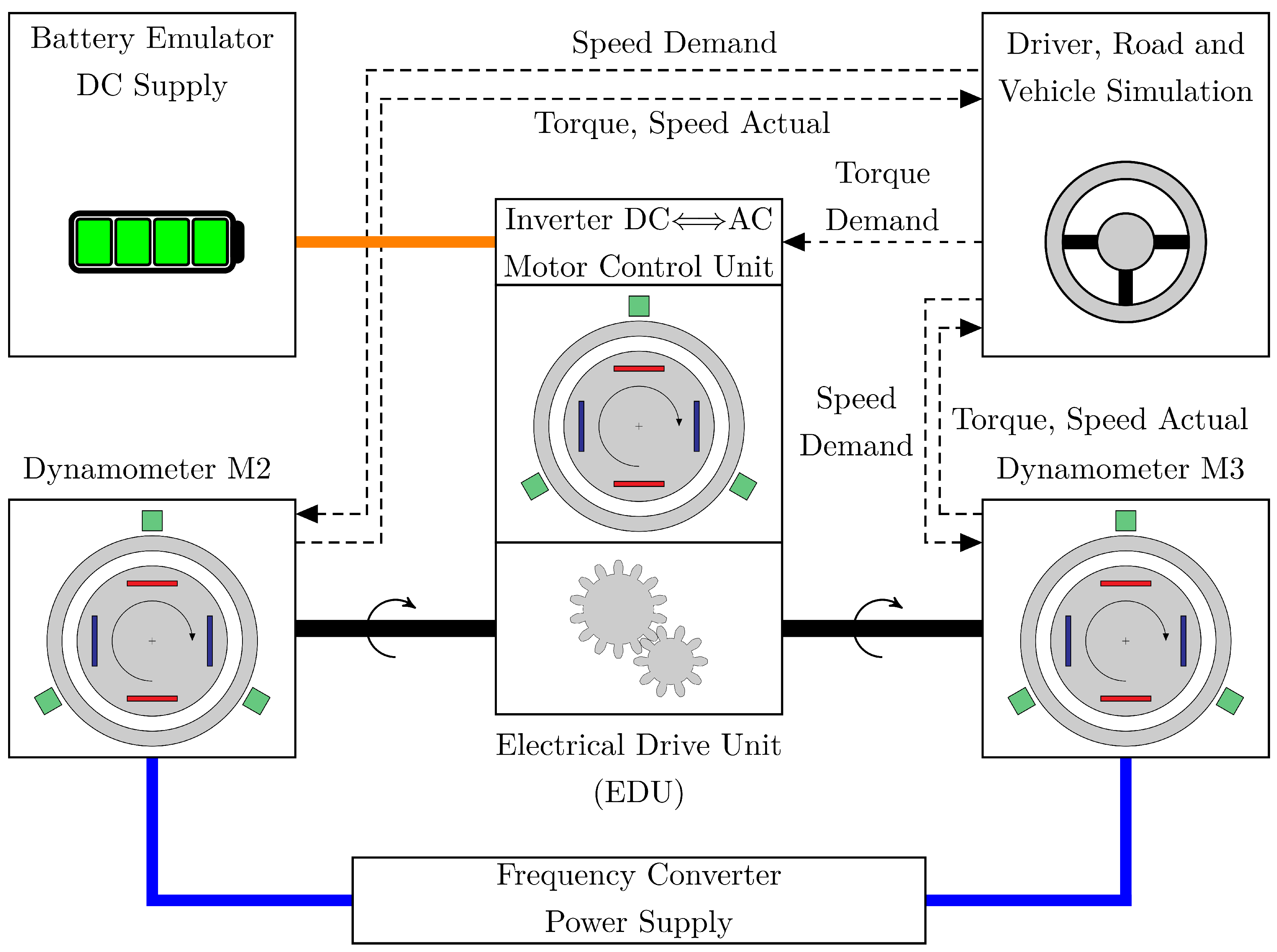
- The excitation of the system by step functions is suitable for evaluating the natural frequency. An evaluation of these tests with coupled vehicle simulation, cf. Figure 1, shows that dead times and the existing control architecture (PID) in particular strongly influence and falsify the results [12,14].
1.2.1. Electronical Domain
- -
- number of pole pairs p
- -
- stator resistance
- -
- inductances and
- -
- permanent magnet flux
1.2.2. Mechanical Domain
- -
- rotor shaft,
- -
- gear stage 1,
- -
- countershaft,
- -
- gear stage 2 to the cage of the differential,
- -
- differential with cage, planets, bevel gears,
- -
- …
- -
- bell and shaft with multi-tooth profile of the tripod on the gearbox side,
- -
- tripod with star and rollers,
- -
- profile shaft,
- -
- wide angle joint,
- -
- bell and shaft with multi-tooth profile on wheel side,
- -
- depending on the side shaft, the wheel bearing and a pressed-on and bolted flange are also part of the rotating masses.
1.2.3. Challenges and Practical Constraints
- -
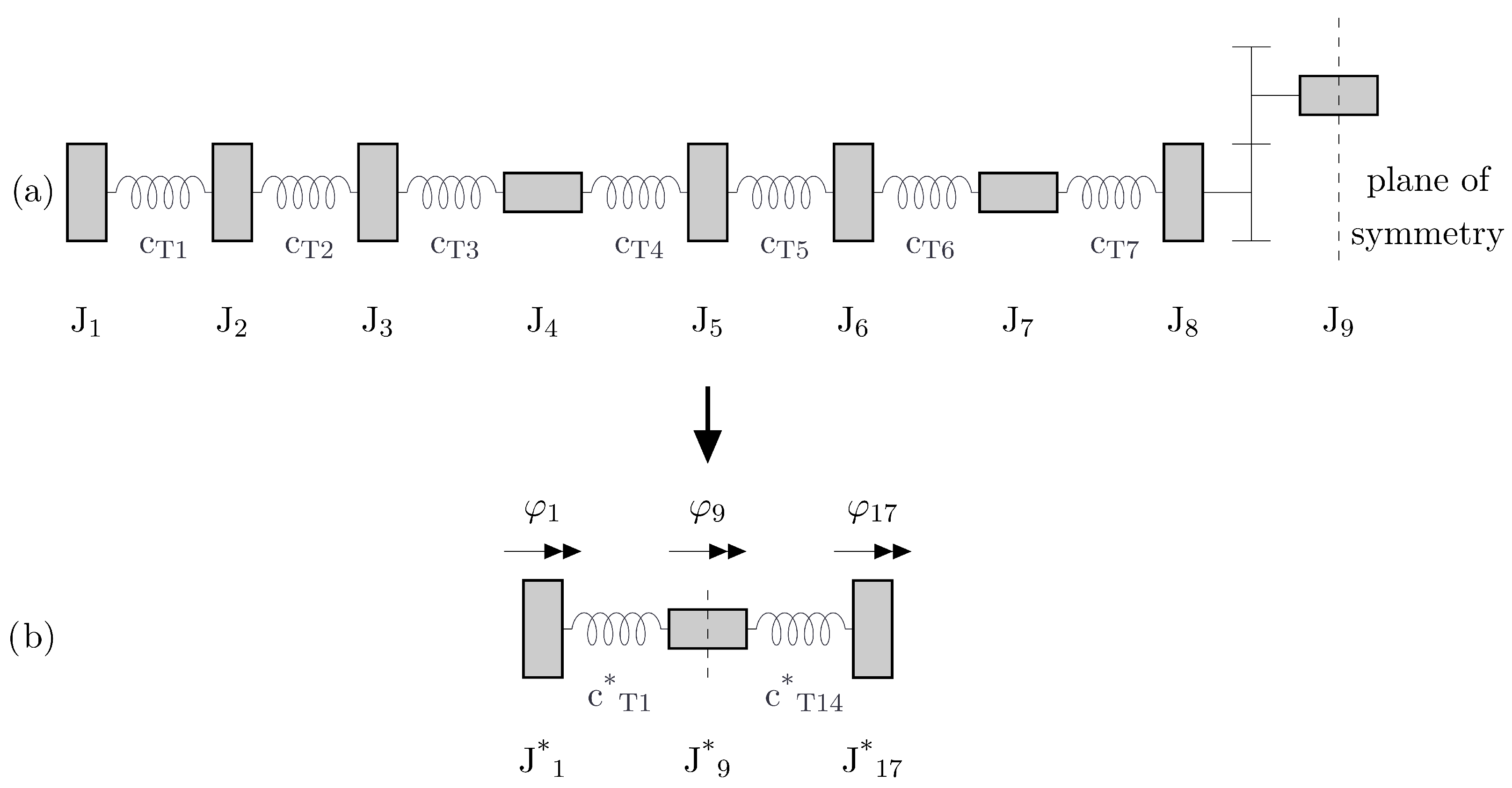
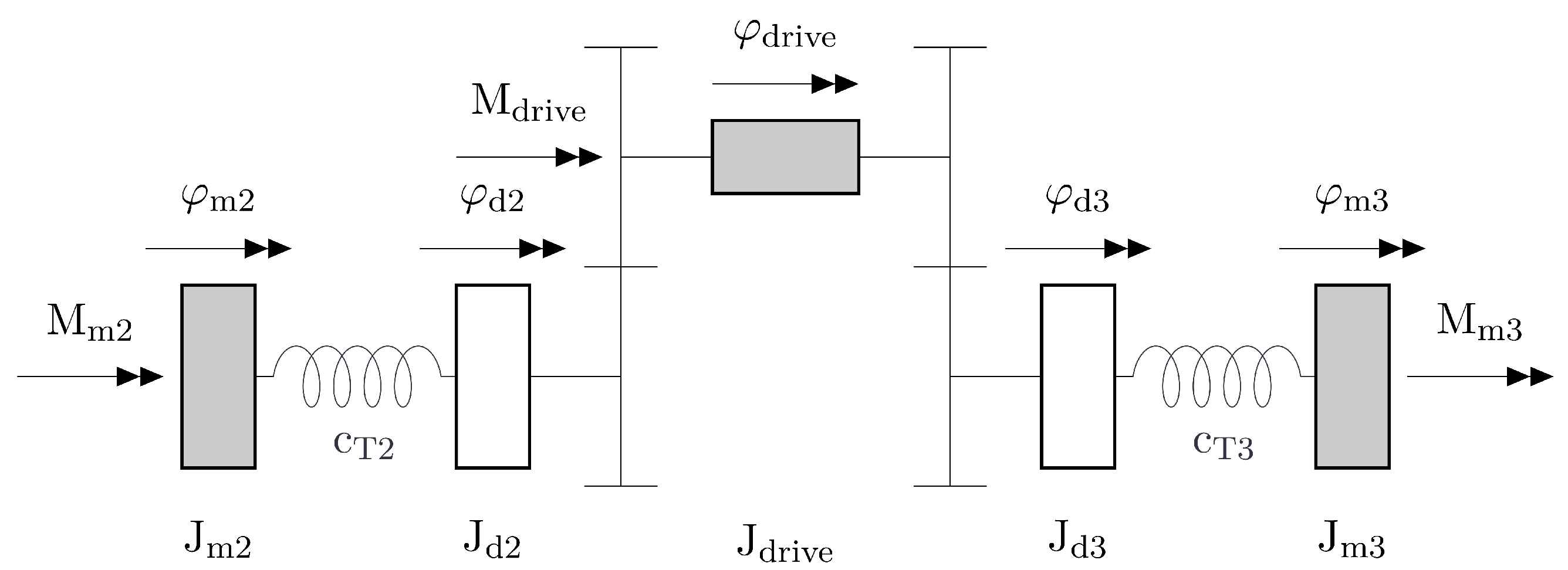
- It is necessary to identify the significant properties of the test rig when creating a model of the plant with a focus on driveability. Regarding the described characteristics of real vehicles, the findings have to be transferred to the test rig, as the load machines replace the wheels on it. The rotors replace the moment of inertia of the rim, but there is no physical influence of the tire belt inertia and the coupling stiffness. The influence of tire properties is calculated virtually and accounted for in the specified torque of the load machines.For modelling the powertrain as a device under test, the model could include the following components: the drive and output moments of inertia, and the stiffness of the side shafts. This paper has to prove this claim. The test rig considers cornering; therefore, the model must map the separate consideration of left and right outputs.
- -
- Because the electrical drive unit and the side shafts of the device under test are a black-box for the user, the determination of the necessary parameters from data sheets or CAD models is not possible. The model’s parametrisation has to be experimental.
- -
- As there is no suitable component test rig at the chair of automobile engineering, the side shafts cannot be measured individually. Parameterising the assembled subsystem has the additional advantage that the measurements describe the installed position. Therefore, for example, the influence of tooth stiffness between the side shaft and bevel gears on the resulting shaft stiffness remains in this approach.
- -
- The electrical drive units under test usually do not have sufficiently accurate measurement technology that is suitable for parameterisation. For example, the device under test used here does not have its own internal torque sensor. The device under test has a speed sensor installed. The communication frequency to the motor itself is only 100 Hz, which means that the resolution of the speed signal is unsuitable for frequency observations. The method must be adapted so that the high-precision sensors of the load machines serve as the basis for measurements.
- →
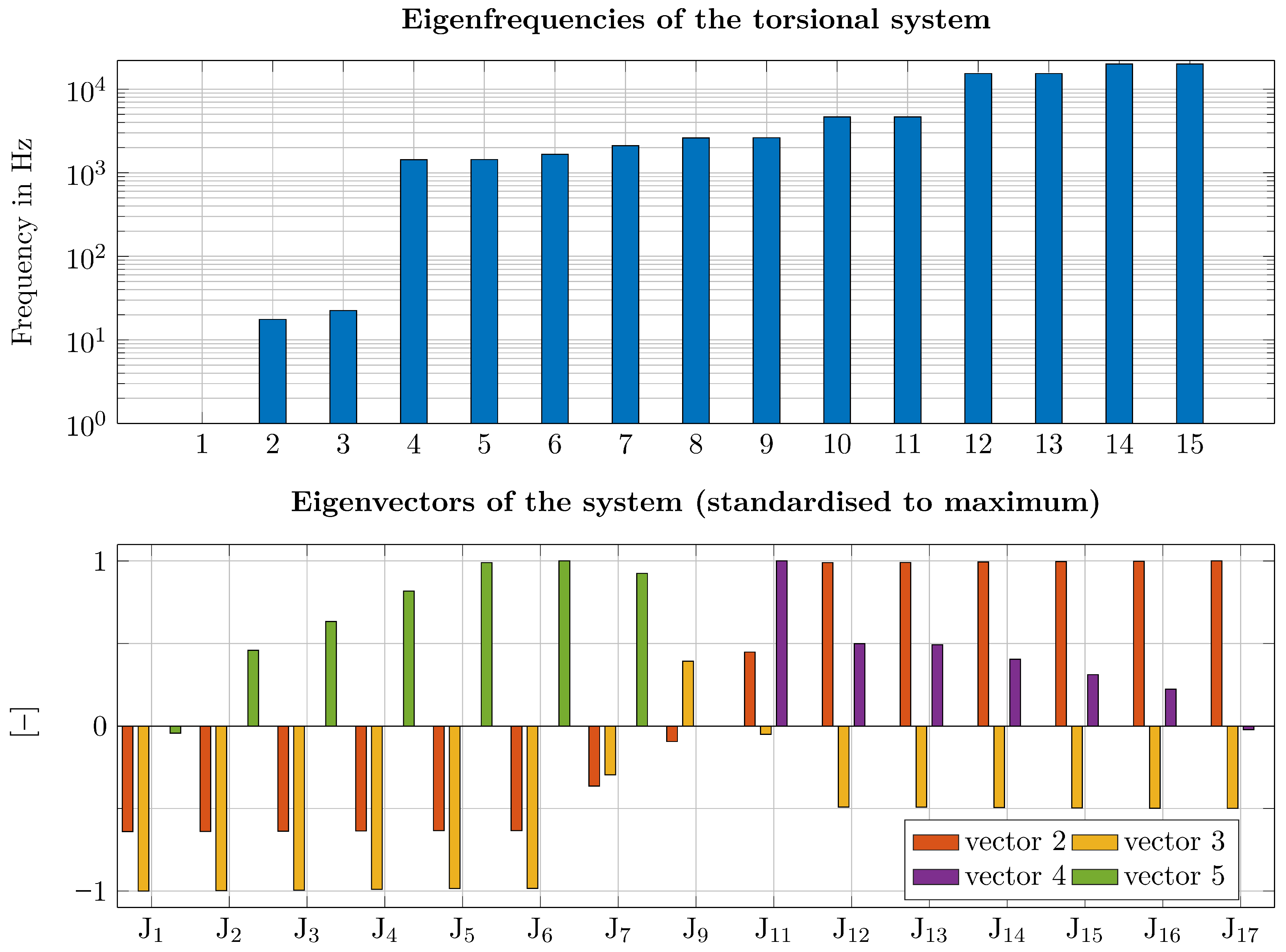
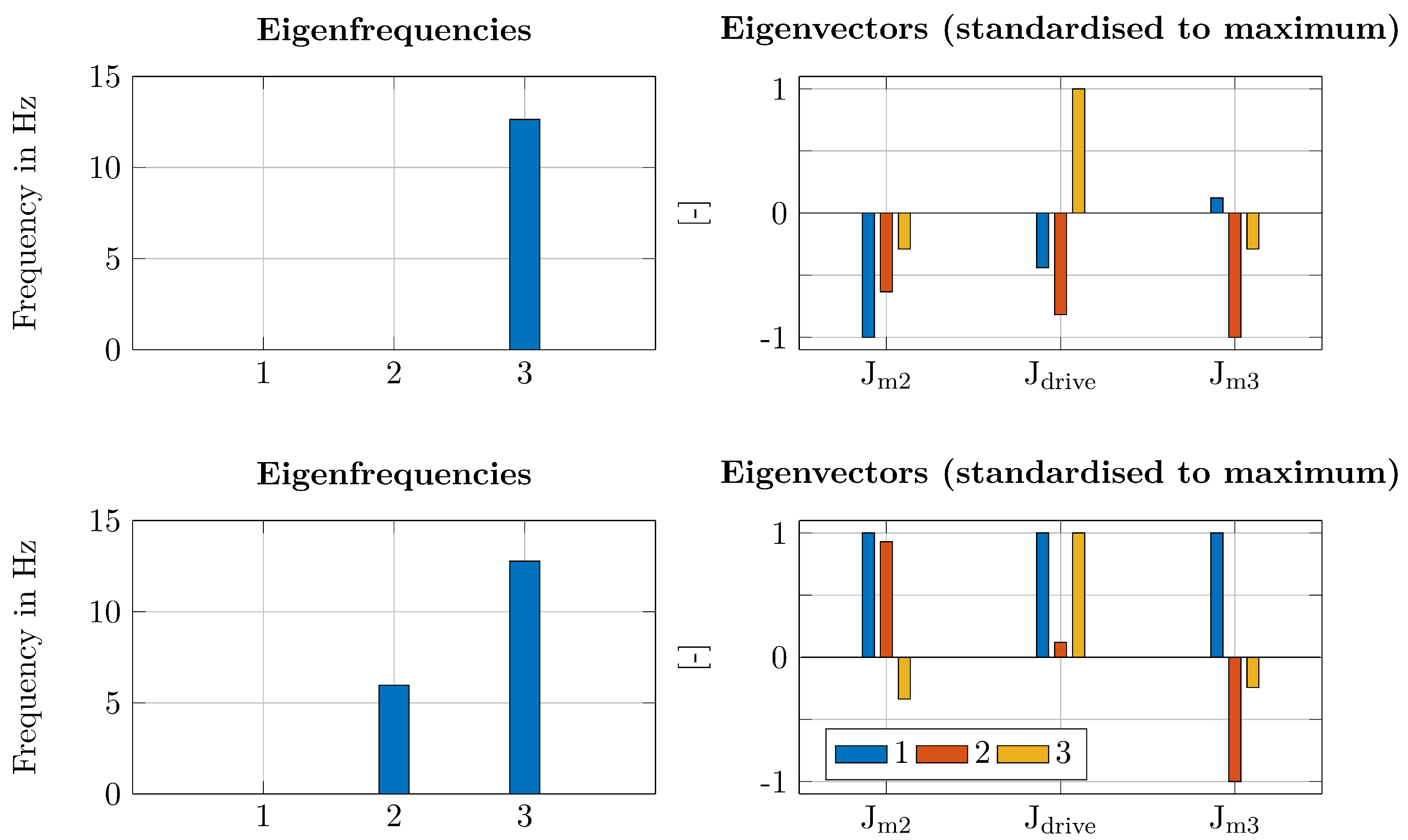
- What must the underlying mechanical model of the plant of the powertrain test rig look like for use in that rig? The model should cover the essential eigenmodes and the necessary frequency range ( 30 Hz), and be parameterisable by the test rig itself.
1.3. Research Gap and Existing Methods
2. Materials and Methods
2.1. Modelling of a Torsional System
- -
- All considered parts are ideally rotationally symmetrical.
- -
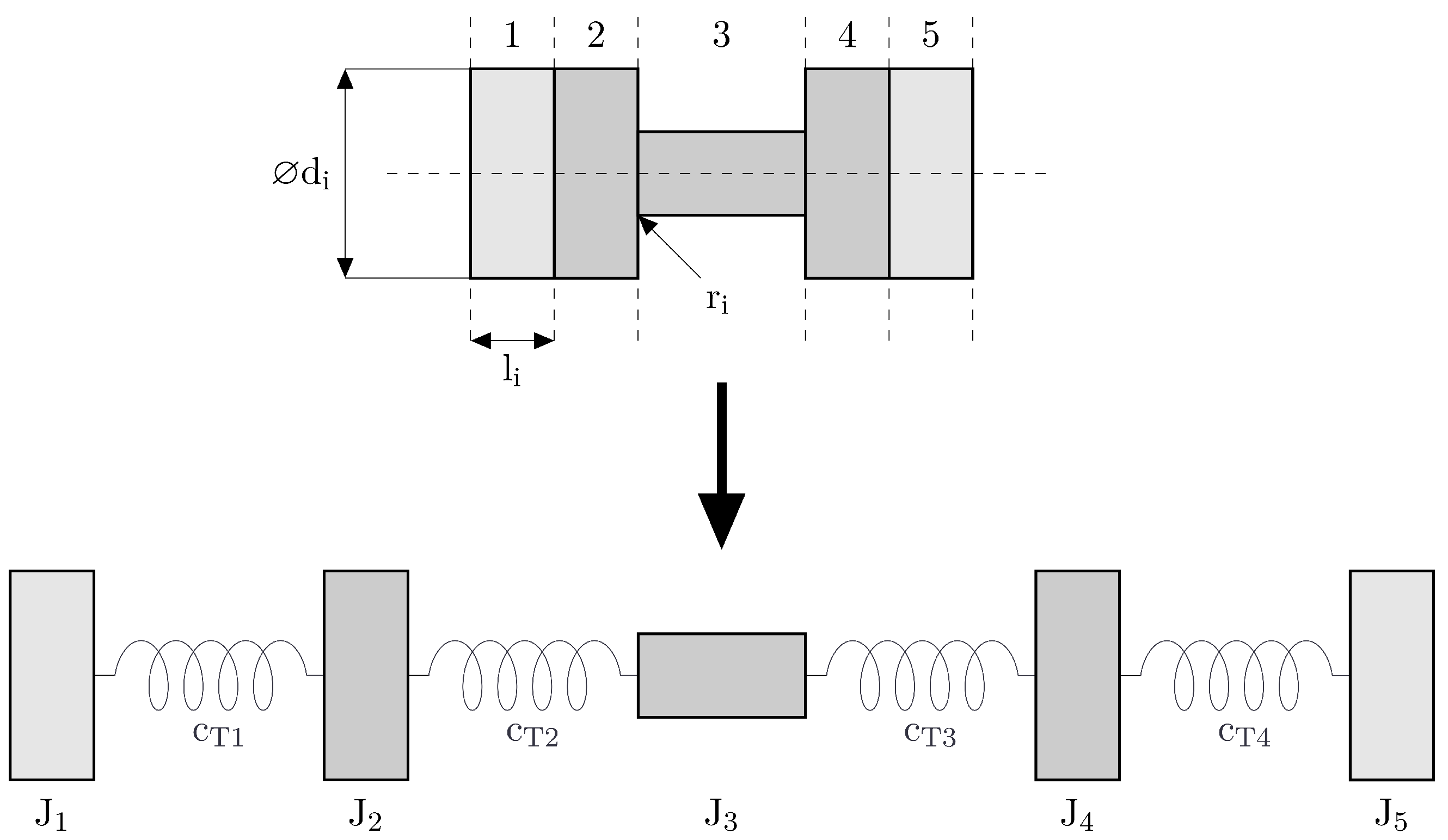
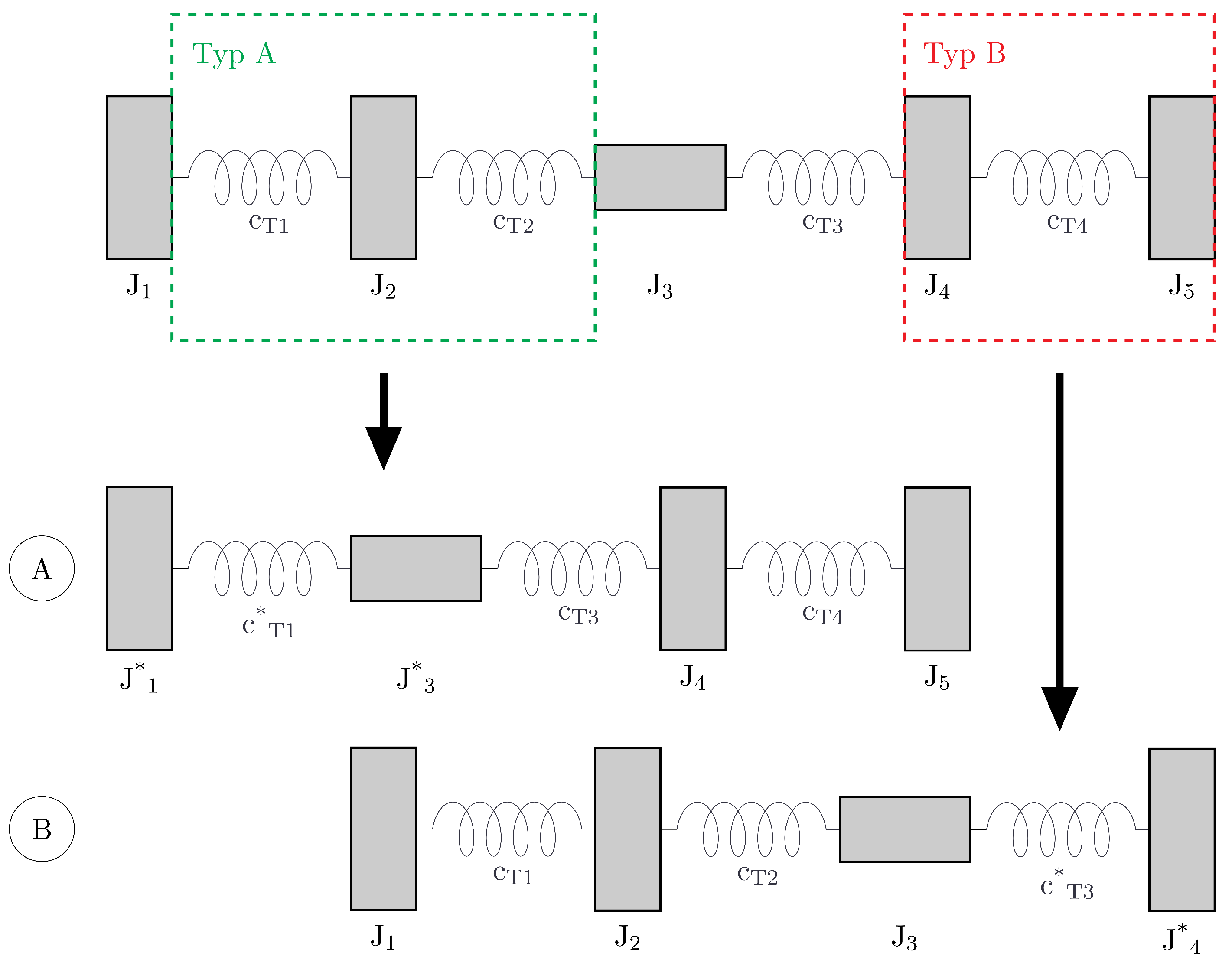
- This approach considers only rigid (partial) bodies, and interprets all rotational masses of a stepped shaft as discrete bodies.
- -
- Only the pre-tensioned state of the system is considered for the description of the parameterisation. There are no load changes around M = 0 Nm, so that the assumption of a series oscillator is permissible. This assumption neglects gear backlash in the first step.
- -
- The mechanical parameters of the motor (moment of inertia and stiffness) and the drive shafts are unknown, as explained in Section 1. Estimating these parameters is necessary for the initial description of the methodology. For the motor, the total moment of inertia, reduced to the output, is taken from comparable applications. The stiffness of the drive components is much higher than the output stiffnesses of the left and right branches due to the reduction. Therefore, the approach will neglect it. The moment of inertia and the stiffness of the side shafts are estimated from Equations (1) and (2).
2.2. Reduction in Degrees of Freedom of the Torsional System
2.3. Parametrisation of the Torsional System
2.4. Modelling of a Simplified Torsional System for Use on the Test Rig
2.5. Influence of Static Bending
3. Results
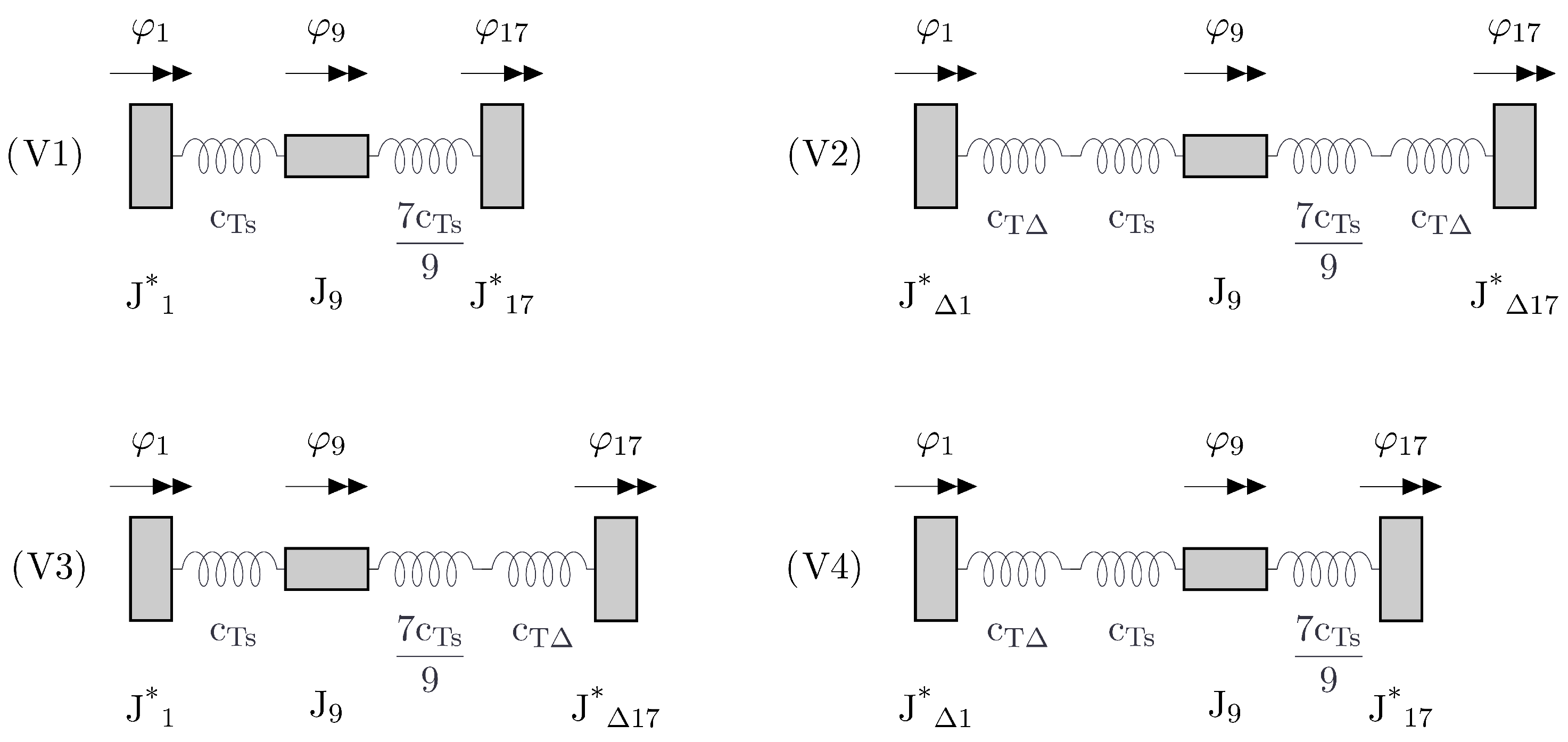
- V1
- This variant considers the original test rig set-up.
- V2
- This variant considers the original test rig set-up, including the additional spring on both sides.
- V3
- This variant considers the original test rig set-up, including the additional spring on the right side.
- V4
- This variant considers the original test rig set-up, including the additional spring on the left side.
- -
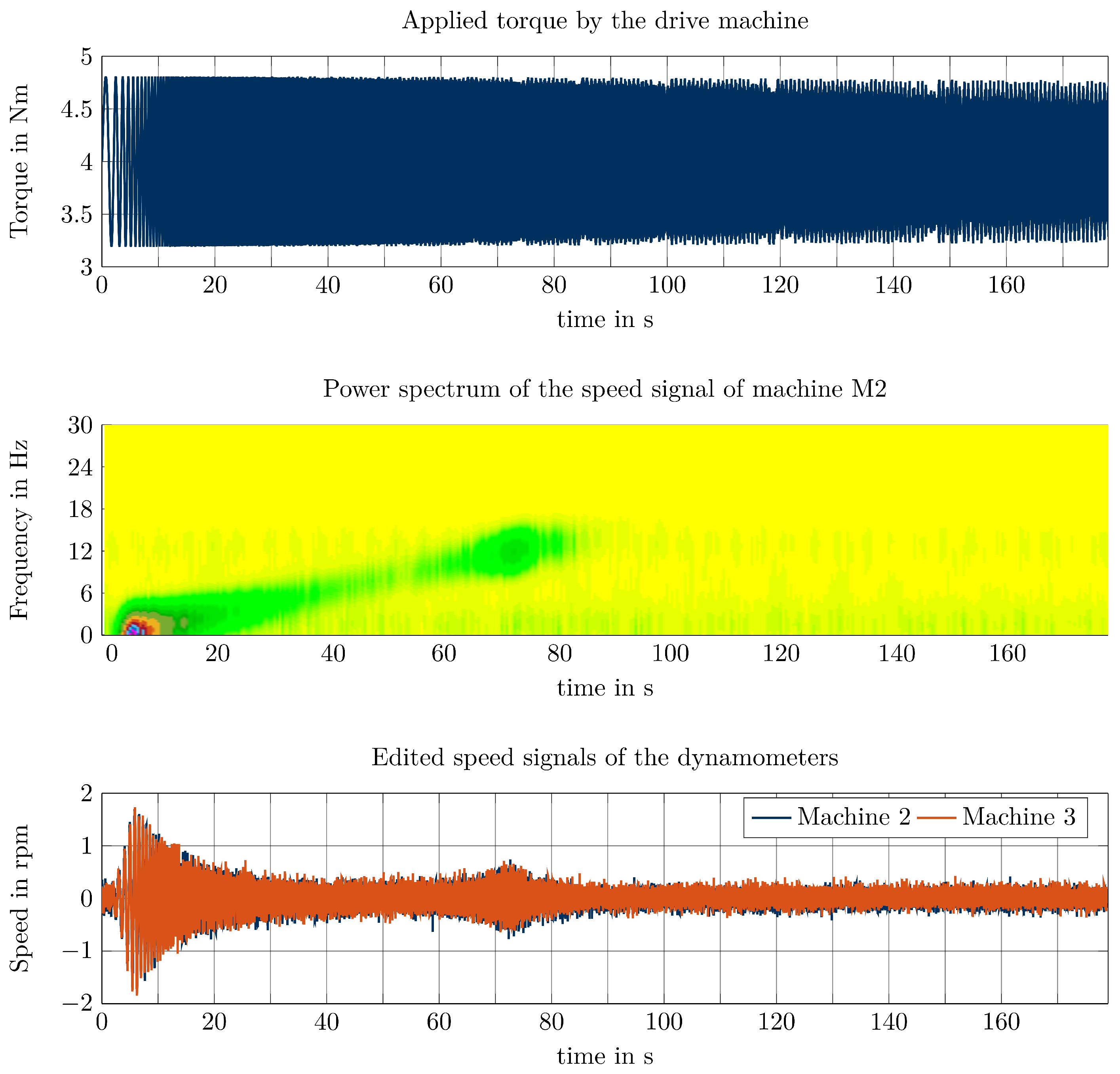
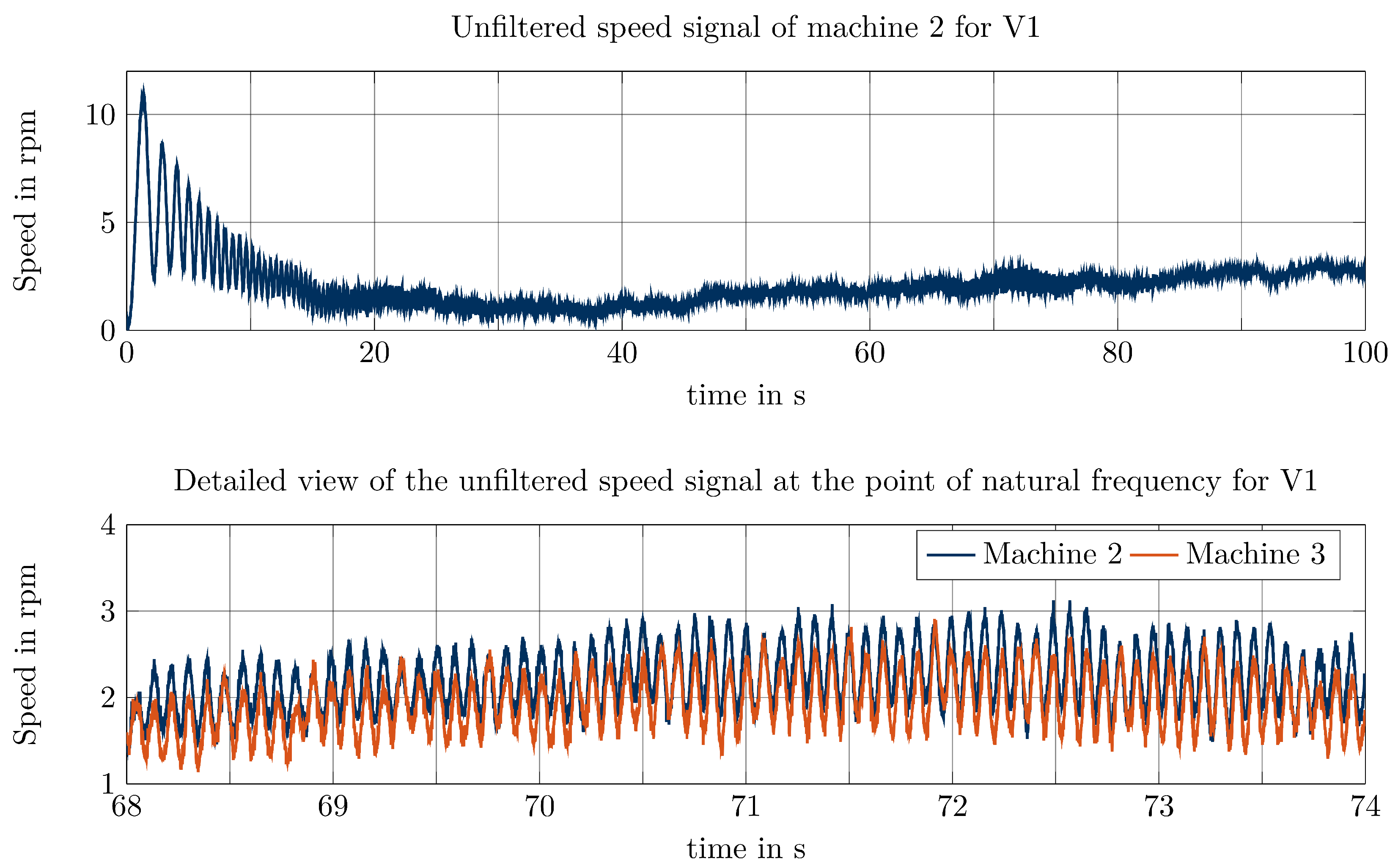
- A high-pass filter (cut-off frequency = 1 Hz) corrects the raw speed signal for any fundamental oscillations and offset. Figure 9 includes this correction.
- -
- The power spectrum of the speed signal is determined. The frequency range is limited to frequencies between 1 Hz and 30 Hz.
- -
- The matrix of the power spectrum is used to determine the maximum value in the range of the overshoot.
- -
- To be more robust against fluctuations, the algorithm determines the range in which the power spectrum corresponds to at least 80% of the maximum value. The outer limits of the range serve as interval limits for the position of the natural frequency.
- -
- The centre of the interval is determined, which indicates the position of the natural frequency. This position determines the frequency driven from the time axis.
4. Discussion
4.1. Significance of the Results
4.2. Assumptions in the Derivation of the Methodology
- -
- , respectively, ;
- -
- , respectively, (short);
- -
- .
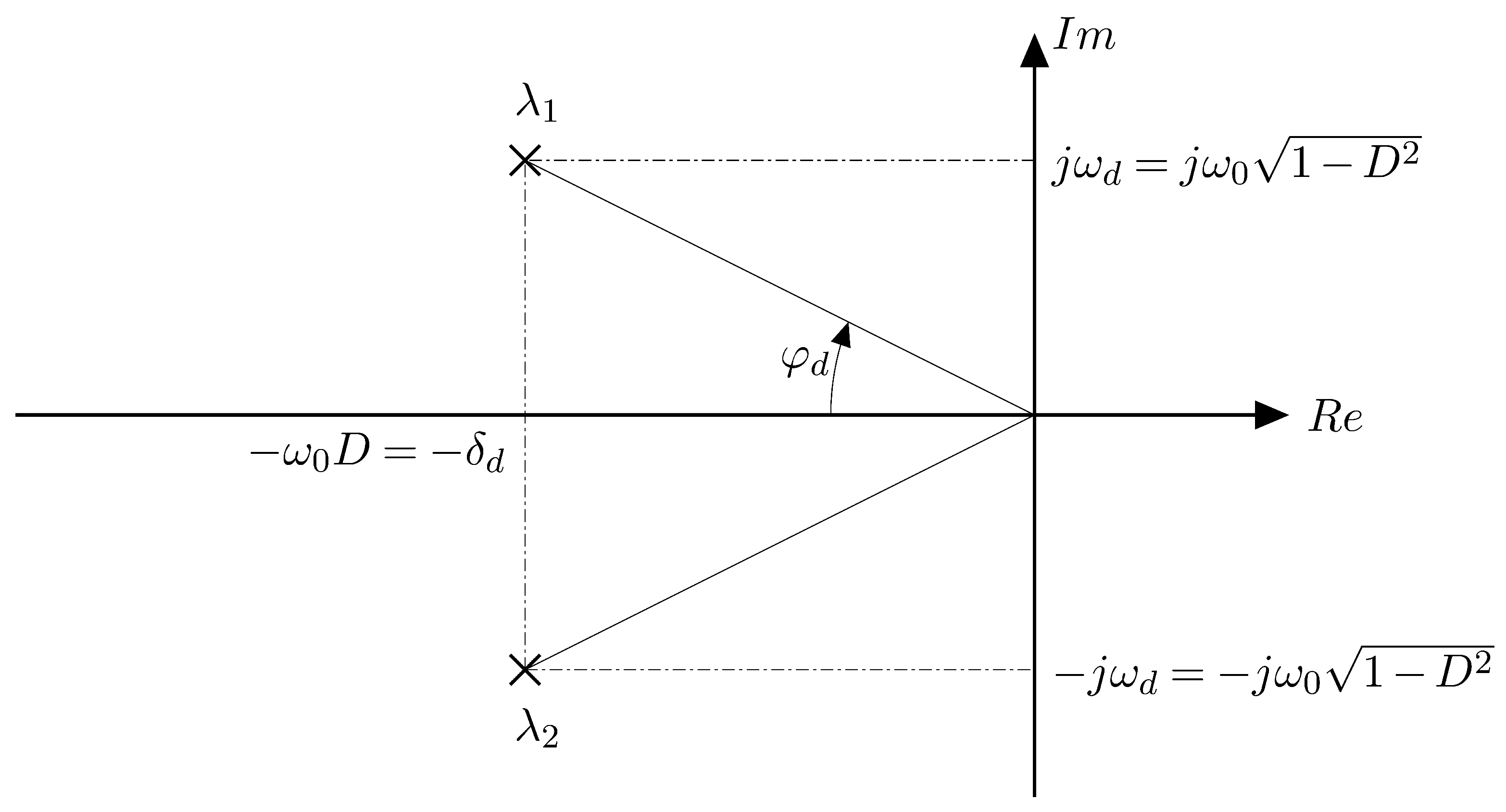
4.3. Impact of Damping
4.4. Consideration of the Relevant Modes
4.5. Modes of the Torsional System for Use on the Test Rig
4.6. Influence of the Load Machines on the Free Oscillation
5. Conclusions
Author Contributions
Funding
Data Availability Statement
Acknowledgments
Conflicts of Interest
Appendix A

| Moment of Inertia | Stiffness | Remarks |
|---|---|---|
| in 10−3 kgm2 | in 108 Nm/rad | - |
| = 850 | = 0.0872 | rotor shaft dynamometer M2 |
| = 38 | = 0.0460 | torque sensor |
| = 18.8 | = 7.2907 | adapter segment 1 |
| = 0.7 | = 0.0169 | adapter segment 2 |
| = 3.7 | = 2.7171 | adapter segment 3 |
| The additional stiffness (Table A2) is applied here | ||
| = 3.4 | = 0.1408 | flange of side shaft |
| = 0.3 | = 0.0001 | side shaft (short) |
| = - | = - | integrated in i = 9 |
| = 3500 | = 0.7266 | reduced inertias and stiffnesses to load axle, including rotor shaft, gear stages, lay shaft, differential |
| = - | = - | integrated in i = 9 |
| = 0.4 | = 0.0001 | side shaft (long) |
| = 3.4 | = 0.1408 | flange of side shaft |
| The additional stiffness (Table A2) is applied here | ||
| = 3.7 | = 2.7171 | adapter segment 3 |
| = 0.7 | = 0.0169 | adapter segment 2 |
| = 18.8 | = 7.2907 | adapter segment 1 |
| = 38 | = 0.0460 | torque sensor |
| = 850 | = 0.0872 | rotor shaft dynamometer M3 |
| Moment of Inertia | Stiffness | Remarks |
|---|---|---|
| in 10−3 kgm2 | in 108 Nm/rad | - |
| = 3.9 | = 3.0530 | adapter segment 1 |
| = 0.1 | = 0.0035 | adapter segment 2 |
| = 0.4 | = 0.0010 | adapter segment 3 |
| = 0.1 | = 0.0036 | adapter segment 4 |
| = 0.4 | = 0.4165 | adapter segment 5 |
| = 0.3 | = 0.0880 | adapter segment 6 |
| = 3.7 | = 2.7187 | adapter segment 7 |
References
- Fan, J. Theoretische und Experimentelle Untersuchungen zu Längsschwingungen von Pkw (Ruckeln); Berichte aus der Fahrzeugtechnik; Shaker: Aachen, Germany, 1994. [Google Scholar]
- Maier, P. Entwicklung einer Methode zur Objektivierung der subjektiven Wahrnehmung von antriebsstrangerregten Fahrzeugschwingungen. In Forschungsberichte; Albers, A., Ed.; IPEK. Bd. 51; IPEK—Institut für Produktentwicklung am Karlsruher Institut für Technologie (KIT): Karlsruhe, Germany, 2011. [Google Scholar]
- Cai, R. Methode zur objektivierten Komfortbeurteilung antriebsstranginduzierter Fahrzeugschwingungen am Fahrzeug-Rollenprüfstand. In Forschungsberichte; Albers, A., Ed.; IPEK. Bd. 131; IPEK—Institut für Produktentwicklung am Karlsruher Institut für Technologie (KIT): Karlsruhe, Germany, 2020. [Google Scholar]
- Schmidt, H.; Büttner, K.; Prokop, G. Methods for Virtual Validation of Automotive Powertrain Systems in Terms of Vehicle Drivability—A Systematic Literature Review. IEEE Access 2023, 11, 27043–27065. [Google Scholar] [CrossRef]
- Verein Deutscher Ingenieure. Einwirkung mechanischer Schwingungen auf den Menschen: Ganzkörper-Schwingungen; Beuth Verlag GmbH: Berlin, Germany, 2017. [Google Scholar]
- Hao, D.; Zhao, C.; Huang, Y. A Reduced–Order Model for Active Suppression Control of Vehicle Longitudinal Low–Frequency Vibration. Shock Vib. 2018. [Google Scholar] [CrossRef]
- Figel, K.J.; Schultalbers, M.; Svaricek, F. Review and experimental evaluation of models for drivability simulation with focus on tire modeling. Forsch. Ingenieurwesen 2019, 83, 105–118. [Google Scholar] [CrossRef]
- Hülsmann, A. Methodenentwicklung zur virtuellen Auslegung von Lastwechselphänomenen in Pkw. Ph.D. Thesis, Technische Universität München, München, Germany, 2007. [Google Scholar]
- Lukac, M.; Brumercik, F.; Krzywonos, L. Driveability Simulation of Vehicle with Variant Tire Properties. Commun. Sci. Lett. Univ. Zilina 2016, 18, 34–37. [Google Scholar] [CrossRef]
- Pillas, J. Modellbasierte Optimierung dynamischer Fahrmanöver mittels Prüfständen. Ph.D. thesis, Technische Universität Darmstadt, Darmstadt, Germany, 2017. [Google Scholar]
- Sorniotti, A. Driveline Modeling, Experimental Validation and Evaluation of the Influence of the Different Parameters on the Overall System Dynamics; SAE Technical Paper; SAE International: Warrendale, PA, USA, 2008; pp. 1–19. [Google Scholar] [CrossRef]
- Hübner, C.; Prokop, G. A preview for vehicle driveability characterization on subsystem level powertrain. Adv. Mech. Eng. 2025, 17, 1–33. [Google Scholar] [CrossRef]
- Schmidt, H.; Prokop, G. Characterization of a Powertrain Test Bed in the Context of Virtual Validation of Driveability. J. Tongji Univ. (Natural Sci.) 2024, 52, 9–19. [Google Scholar] [CrossRef]
- Hübner, C.; Prokop, G. The impact of tire simulation approaches on the longitudinal vehicle shuffle in a cyberphysical environment. J. Vib. Control 2025, accepted. [Google Scholar] [CrossRef]
- Kellner, L. Parameteridentifkation bei permanenterregten Synchronmaschinen. Ph.D. Thesis, Universität Erlangen-Nürnberg, Erlangen, Germany, 2012. [Google Scholar]
- Rafaq, M.S.; Jung, J.W. A Comprehensive Review of State-of-the-Art Parameter Estimation Techniques for Permanent Magnet Synchronous Motors in Wide Speed Range. IEEE Trans. Ind. Inform. 2020, 16, 4747–4758. [Google Scholar] [CrossRef]
- Dresig, H.; Holzweißig, F. Maschinendynamik, 12th ed.; Springer Vieweg: Wiesbaden, Germany, 2016. [Google Scholar]
- Schmidt, H. Charakterisierung eines Antriebsstrangprüfstands zur virtuellen Absicherung des Fahrzeuglängsruckelns. Ph.D. Thesis, Technische Universität Dresden, Dresden, Germany, 2025. [Google Scholar]
- Dresig, H.; Fidlin, A. Schwingungen mechanischer Antriebssysteme: Modellierung, Berechnung, Analyse, Synthese, 4th ed.; Springer Vieweg: Berlin/Heidelberg, Germany, 2020. [Google Scholar]
- Rosenlöcher, T. Systematisierung des Modellierungsprozesses zur Erstellung elastischer Mehrkörpersystem-Modelle und dynamischen Untersuchung von Großantrieben. Ph.D. Thesis, Technische Universität Dresden, Dresden, Germany, 2012. [Google Scholar]
- Sähn, S. Torsionsfederzahlen abgesetzter Wellen mit Kreisquerschnitt und Folgerungen für die Gestaltung von Schrumpfverbindungen. Konstruktion 1967, 19, 12–19. [Google Scholar]
- Rivin, E.I. Metod umenŝenija stepenej svobody v raŝcetnych schemach zepnych i rasvetvlennych sistem. Vestnik Mašinostroenija 1966, 46, 38–41. [Google Scholar]
- Di, P.N. Beitrag zur Reduktion diskreter Schwingungsketten auf ein Minimalmodell. Ph.D. Thesis, Technische Universität Dresden, Dresden, Germany, 1973. [Google Scholar]
- Deur, J.; Asgari, J.; Hrovat, D.; Kovač, P. Modeling and Analysis of Automatic Transmission Engagement Dynamics-Linear Case. ASME J. Dyn. Syst., Meas., Control 2006, 128, 263–277. [Google Scholar] [CrossRef]
- Deur, J.; Ivanović, V.; Hancock, M.; Assadian, F. Modeling and Analysis of Active Differential Dynamics. J. Dyn. Sys., Meas., Control. 2010, 132, 061501. [Google Scholar] [CrossRef]
- Figel, K. Backlash Models for Drivability Simulation; Technical Report; Universität der Bundeswehr München: München, Germany, 2019. [Google Scholar] [CrossRef]
- Lunze, J. Regelungstechnik 1: Systemtheoretische Grundlagen, Analyse und Entwurf einschleifiger Regelungen, 12th ed.; Springer Vieweg: Wiesbaden, Germany, 2020. [Google Scholar]


| Parameter | Value | Remarks |
|---|---|---|
| 0.9148 kgm2 | Sum of to → 0.9146 kgm2 | |
| 3.5003 kgm2 | - | |
| 0.9148 kgm2 | Sum of to → 0.9146 kgm2 | |
| 13,093 Nm/rad | Stiffness of the shaft = 13,254 Nm/rad | |
| 10,211 Nm/rad | Stiffness of the shaft = 10,308 Nm/rad |
| Parameter | Value | Remarks |
|---|---|---|
| 0.9222 kgm2 | Sum of before shaft → 0.9201 kgm2 | |
| 3.5030 kgm2 | - | |
| 0.9225 kgm2 | Sum of before shaft → 0.9201 kgm2 | |
| 10,861 Nm/rad | Stiffness of series connection of the shaft and → 10,990 Nm/rad | |
| 8801 Nm/rad | Stiffness of series connection of the shaft and → 8884 Nm/rad |
| Parameter | Value | Parameter | Value |
|---|---|---|---|
| initial set point | 4 Nm | Amplitude | 0.8 Nm |
| Frequency | 1 Hz → 30 Hz | Number of repetitions | 5 |
| nominal Power of DuT | 184 kW | Speed sensor dynamometer | ECN 1313 |
| Variant 1 | Variant 2 | Variant 3 | Variant 4 | |
| Variant 1 | X | - | - | - |
| Variant 2 | = 0.529 kgm2 = 1479 Nm/rad | X | - | - |
| Variant 3 | = = [] | = = [] | X | - |
| Variant 4 | = 0.736; 7.570 kgm2 = 1888; 7073 Nm/rad | = = [] | = = [] | X |
| The combination of Variant 1 and Variant 4 results in two solutions for the moment of inertia and the stiffness. A semicolon separates them. These two solutions are labelled by V1/V4-1 and V1/V4-2 in the following. | ||||
| Property | Variant 1 | Variant 2 | Variant 3 | Variant 4 |
|---|---|---|---|---|
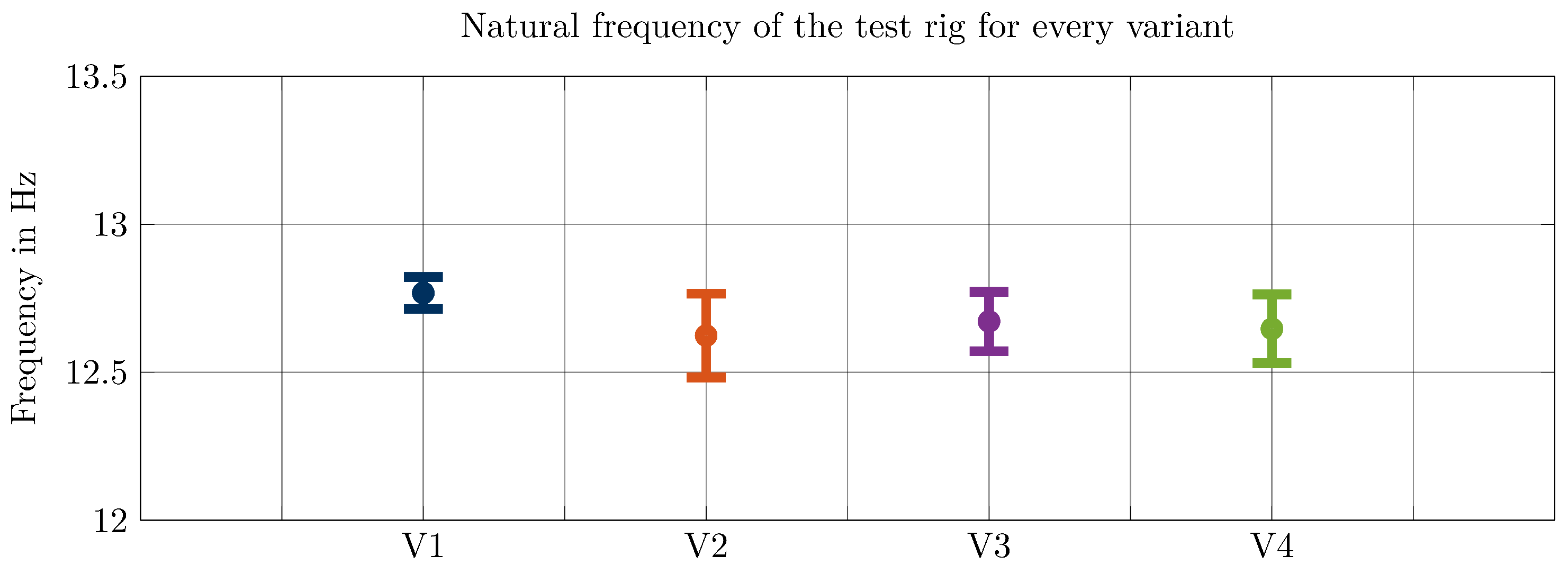
| Measured System | f = 12.77 Hz | f = 12.62 Hz | f = 12.67 Hz | f = 12.65 Hz |
| Parameter set V1/V2 | = 5.97 Hz = 12.77 Hz | = 5.89 Hz = 12.62 Hz | = 5.93 Hz = 12.72 Hz | = 5.93 Hz = 12.67 Hz |
| Parameter set V1/V4-1 | = 6.74 Hz = 12.77 Hz | = 6.63 Hz = 12.59 Hz | = 6.68 Hz = 12.71 Hz | = 6.69 Hz = 12.65 Hz |
| Parameter set V1/V4-2 | = 12.77 Hz = 15.07 Hz | = 12.19 Hz = 14.28 Hz | = 12.26 Hz = 15.01 Hz | = 12.65 Hz = 14.39 Hz |
| Parameter | Value | Remarks |
|---|---|---|
| variation of stiffness, | ||
| 0.9154 kgm2 | Sum of to → 0.9146 kgm2 | |
| 3.5048 kgm2 | - | |
| 0.9159 kgm2 | Sum of to → 0.9146 kgm2 | |
| 117,940 Nm/rad | Stiffness of the shaft = 132,540 Nm/rad | |
| 94,030 Nm/rad | Stiffness of the shaft = 103,080 Nm/rad | |
| variation of stiffness, | ||
| 0.9147 kgm2 | Sum of to → 0.9146 kgm2 | |
| 3.5 kgm2 | - | |
| 0.9147 kgm2 | Sum of to → 0.9146 kgm2 | |
| 1324 Nm/rad | Stiffness of the shaft = 1325 Nm/rad | |
| 1030 Nm/rad | Stiffness of the shaft = 1031 Nm/rad | |
| variation of moment of inertia, | ||
| 0.9148 kgm2 | Sum of to → 0.9146 kgm2 | |
| 35.0003 kgm2 | - | |
| 0.9148 kgm2 | Sum of to → 0.9146 kgm2 | |
| 13,093 Nm/rad | Stiffness of the shaft = 13,254 Nm/rad | |
| 10,211 Nm/rad | Stiffness of the shaft = 10,308 Nm/rad | |
| variation of moment of inertia, | ||
| 0.9148 kgm2 | Sum of to → 0.9146 kgm2 | |
| 0.3503 kgm2 | - | |
| 0.9148 kgm2 | Sum of to → 0.9146 kgm2 | |
| 13,093 Nm/rad | Stiffness of the shaft = 13,254 Nm/rad | |
| 10,211 Nm/rad | Stiffness of the shaft = 10,308 Nm/rad | |
Disclaimer/Publisher’s Note: The statements, opinions and data contained in all publications are solely those of the individual author(s) and contributor(s) and not of MDPI and/or the editor(s). MDPI and/or the editor(s) disclaim responsibility for any injury to people or property resulting from any ideas, methods, instructions or products referred to in the content. |
© 2026 by the authors. Licensee MDPI, Basel, Switzerland. This article is an open access article distributed under the terms and conditions of the Creative Commons Attribution (CC BY) license.
Share and Cite
Hübner, C.; Prokop, G. Modelling and Parametrisation Approach for an Electric Powertrain in a Hardware-in-the-Loop Environment. Vehicles 2026, 8, 12. https://doi.org/10.3390/vehicles8010012
Hübner C, Prokop G. Modelling and Parametrisation Approach for an Electric Powertrain in a Hardware-in-the-Loop Environment. Vehicles. 2026; 8(1):12. https://doi.org/10.3390/vehicles8010012
Chicago/Turabian StyleHübner, Carl, and Günther Prokop. 2026. "Modelling and Parametrisation Approach for an Electric Powertrain in a Hardware-in-the-Loop Environment" Vehicles 8, no. 1: 12. https://doi.org/10.3390/vehicles8010012
APA StyleHübner, C., & Prokop, G. (2026). Modelling and Parametrisation Approach for an Electric Powertrain in a Hardware-in-the-Loop Environment. Vehicles, 8(1), 12. https://doi.org/10.3390/vehicles8010012