


Abstract
The recycling of spent lithium-ion batteries (LIBs) requires efficient and sustainable methods for recovering critical metals. In this study, the leaching behavior of LiCoO2 cathode material obtained from spent LIBs was investigated in phosphoric acid, using copper powder recovered from waste LIBs as a reducing agent. Leaching experiments were conducted under various conditions (temperature, solid-to-liquid ratio, agitation rate) and compared with systems without copper. In the absence of copper, lithium and cobalt, recoveries after 30 min were approximately 77% and 23%, respectively. The addition of copper significantly enhanced leaching, achieving >96% recovery for both metals at 80 °C, with most extraction occurring within the first 30 min. Kinetic analysis using the shrinking core model indicated a mixed-control mechanism involving both surface chemical reaction and product layer diffusion. The calculated activation energies were 20.2 kJ·mol−1 for lithium and 16.1 kJ·mol−1 for cobalt. Solid residues were characterized by X-ray diffraction (XRD) and scanning electron microscopy with energy-dispersive spectroscopy (SEM-EDS). XRD results revealed that the composition of the residues varied with leaching temperature: Co3O4 was consistently detected, whereas Cu8(PO3OH)2(PO4)4·7H2O appeared only when leaching was performed above 50 °C. Thermodynamic calculations supported the reductive role of copper and provided insight into possible reaction pathways. These findings confirm the effectiveness of copper-mediated leaching in phosphoric acid and demonstrate that temperature strongly influences residue phase evolution, thereby offering valuable guidance for the design of sustainable LIB recycling processes.
1. Introduction
The rapid rise of electric vehicles (EVs), portable electronics, and renewable energy systems has led to a sharp increase in LIB production [1,2]. Battery demand is projected to grow more than fourteenfold by 2030 relative to 2018, driven largely by transport electrification [3]. In parallel, the consumption of critical raw materials such as cobalt and lithium is rising significantly; for instance, their use in EV batteries alone is expected to nearly triple between 2020 and 2030. This growing reliance is particularly concerning given that these metals are predominantly sourced from a limited number of countries, increasing the vulnerability of global supply chains and potentially constraining the growth of the battery industry due to geopolitical and economic factors [4]. Moreover, natural deposits of cobalt and lithium often contain lower concentrations than those found in spent lithium-ion batteries, particularly in LiCoO2 cathodes, which typically contain 5–15 wt% Co and 2–7 wt% Li, making battery waste a particularly rich and strategic secondary resource [5].
In this context, the development of effective recycling strategies is essential not only for economic reasons but also due to the environmental and health risks posed by LIB components. Spent batteries contain toxic and potentially hazardous substances, including heavy metals and organic electrolytes, which can leach into the environment if not properly managed [6,7]. Among various cathode chemistries, lithium cobalt oxide (LiCoO2) remains one of the most widely used materials, particularly in early-generation commercial batteries [8]. Its layered structure allows reversible Li+ intercalation [9], but it also poses challenges for efficient metal recovery when the battery reaches the end of its life [10]. Traditional recycling methods include pyrometallurgy, biometallurgy, and hydrometallurgy [11,12]. Among these, hydrometallurgical techniques are especially appealing because they can recover high-purity metals under relatively mild conditions, while reducing energy use and gas emissions [4]. Recently, direct recycling has also emerged as a promising laboratory-scale method, offering notable environmental and economic advantages over traditional recycling technologies. However, its large-scale commercialization remains limited due to economic and technical challenges [13].
Leaching of LiCoO2 in acidic media generally requires a reductive environment to solubilize Co3+ by reducing it to Co2+. In the absence of a strong reducing agent, water acts as the electron donor, resulting in a slow leaching process where Li+ and Co2+ are gradually released from LiCoO2. This process often leads to the formation of a Co3O4 crust around the unreacted core, limiting further leaching by hindering diffusion. This highlights the importance of introducing an effective reducing agent to enhance reaction efficiency [4]. Most commonly, hydrogen peroxide (H2O2) has been employed as a reductant in combination with mineral acids such as H2SO4 or HCl [3,14,15,16]. However, the use of H2O2 presents several drawbacks, including instability, non-selective reactivity, and potential safety hazards [17]. Consequently, there has been growing interest in alternative, environmentally benign reductants such as glucose (C6H12O6) and ascorbic acid (C6H8O6), which have demonstrated effectiveness in various leaching processes [18,19].
Previous studies have demonstrated the effectiveness of metallic copper as a reducing agent for LiCoO2 leaching in sulfuric acid media [17,20,21,22,23,24]. For example, Peng et al. [24] reported that copper and aluminum foils recovered from spent LIBs significantly enhanced the leaching efficiencies of cobalt and lithium by acting as reductants in sulfuric acid solutions. Their approach exploited the naturally present Cu and Al in the waste material itself, eliminating the need for expensive additives such as hydrogen peroxide or ascorbic acid, and achieving over 99% extraction of the target metals. Similarly, Porvali et al. [17] investigated the kinetics of LiCoO2 dissolution in sulfuric acid media enhanced with metallic copper and catalytic amounts of ferrous ions, concluding that copper effectively donates electrons to ferric ions, which then mediate the reductive dissolution of LiCoO2. Although these studies strongly suggest the potential of copper in sulfuric systems, to the best of our knowledge, no investigations have yet explored the use of copper powder as a reductant in phosphoric acid systems.
Unlike stronger mineral acids, it generates fewer toxic fumes and enables potential recovery of valuable phosphate-based by-products. However, its interactions with metallic reducing agents such as copper have not been extensively studied, particularly in the context of lithium cobalt oxide leaching.
Given the limited application of phosphoric acid in combination with metallic copper, this study focuses on investigating the leaching kinetics of Li and Co from LiCoO2 in the presence of copper powder. Special emphasis is placed on temperature effects, solid residue characterization, and thermodynamic interpretation. This approach contributes to the development of efficient and environmentally sustainable recycling methods for spent LIBs.
2. Materials and Methods
2.1. Materials and Reagents
The cathode material used in this study was obtained from lithium-ion batteries recovered from discarded laptops of various models and manufacturers. Copper powder, serving as the reducing agent, was prepared by manually grinding copper foil separated from the current collectors of spent LIBs.
Phosphoric acid (H3PO4, Zorka Pharma, Šabac, Serbia) was used as the leaching agent. To determine the lithium and cobalt content in the cathode material, samples were digested using an aqua regia mixture of nitric acid and hydrochloric acid in a 1:3 volume ratio (HNO3:HCl, Merck, Darmstadt, Germany).
All reagents were of analytical grade, and all solutions were prepared with deionized water.
2.2. Analytical Methods
The chemical composition of the initial cathode material and leachates was determined using inductively coupled plasma optical emission spectrometry (ICP-OES, Optima 8300, PerkinElmer, Waltham, MA, USA).
The phase composition of both the pristine material and the leaching residues was examined using X-ray diffraction (Rigaku MiniFlex 600, Tokyo, Japan), equipped with a Cu Kα radiation source (λ = 0.154 nm) and operated at 40 kV and 15 mA.
Surface morphology and microstructural features were analyzed using scanning electron microscopy (JSM-IT300LV, JEOL, Tokyo, Japan) operated at an accelerating voltage of 20 keV. Elemental composition was further assessed by energy-dispersive X-ray spectroscopy (EDS), integrated with the SEM system. Data acquisition and analysis were performed using Aztec software (Aztec 3.1 SP1).
Thermodynamic analyses were performed using HSC Chemistry 9.9.2.3 to complement the experimental findings and to verify that the presence of copper powder thermodynamically favors cobalt reduction and leaching. The Gibbs free energy change (ΔG) for the relevant reactions was calculated to evaluate the spontaneity and feasibility.
2.3. Preparation of the Cathode Material
For this study, 40 LIBs from laptop computers of various manufacturers were collected. On average, each battery contained six cylindrical LIB cells. Battery identification was performed according to the procedure described by Medić et al. [25]. Only batteries with LiCoO2 cathodes were selected for further processing.
The dismantling of LIBs into individual cells was manually carried out using standard handheld tools. After full discharge, the cell terminals were removed with a hacksaw, followed by a longitudinal cut along the casing. Once the metal casing was removed, each cell was disassembled into its components: plastic casing, metal casing, cathode, anode, and separator.
To remove the organic binder, the cathode materials (still attached to aluminum foil) were thermally treated at 580 °C for 10 min in a muffle furnace under atmospheric air conditions. After cooling to room temperature, the cathode materials were carefully collected. A representative image of the aluminum foil and resulting thermally treated cathode powder is shown in Supplementary Materials Figure S1.
In some cases, portions of the cathode material remained adhered to the separator. To minimize material loss, the separators were annealed at 300 °C. Figure S2 shows a separator with residual cathode material. The recovered material was combined with the cathode powder previously obtained from aluminum foil and subjected to an additional calcination step at 630 °C for 6 h in air to ensure complete removal of residual carbon.
The prepared cathode materials were then ground using an agate mortar and pestle. To avoid contamination, the mortar was cleaned with quartz sand before each use.
In addition, copper foil from the anode material was mechanically separated from the separator, rinsed with distilled water, dried at room temperature, and milled using a laboratory grinder to obtain the copper powder used in this study. A representative image of the manually separated copper foil is shown in Figure S3.
2.4. Leaching Procedure
Leaching experiments were carried out in a 250 mL double-walled glass reactor equipped with a condenser to prevent evaporation of the leaching solution and a thermometer to ensure precise temperature control (Figure S4). A volume of 50 mL of leaching solution at the desired concentration was thermostated to the target temperature. Once the set temperature was achieved, a pre-weighed amount of cathode material was added to the reactor, depending on the experimental conditions. In all experiments, 0.2 g of copper powder was used as a reducing agent, except in the tests investigating the effect of the reducing agent, where no copper powder was introduced. Magnetic stirring was maintained at 600 revolutions per minute (rpm) in all experiments, except in those designed to study the influence of stirring speed on the leaching efficiency of Li and Co.
Aliquots (1.0 mL) of the leaching solution were collected at predetermined time intervals (5, 15, 30, 45, and 60 min), filtered, diluted to 50 mL in volumetric flasks, and subsequently analyzed for metal content using ICP-OES.
All solid residues were collected by filtration, thoroughly rinsed with distilled water, and dried. Selected leach residues were further characterized by SEM and XRD analysis.
3. Results and Discussion
3.1. Characterization of the Cathode Material
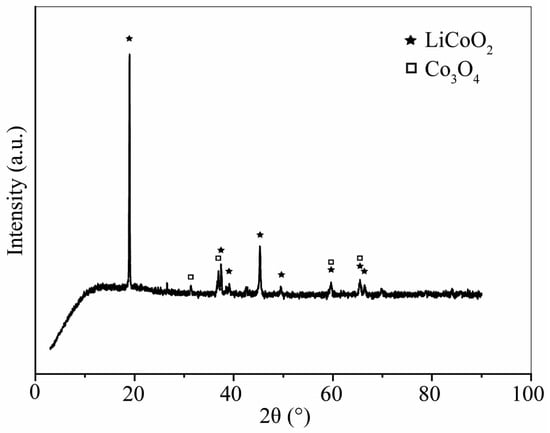
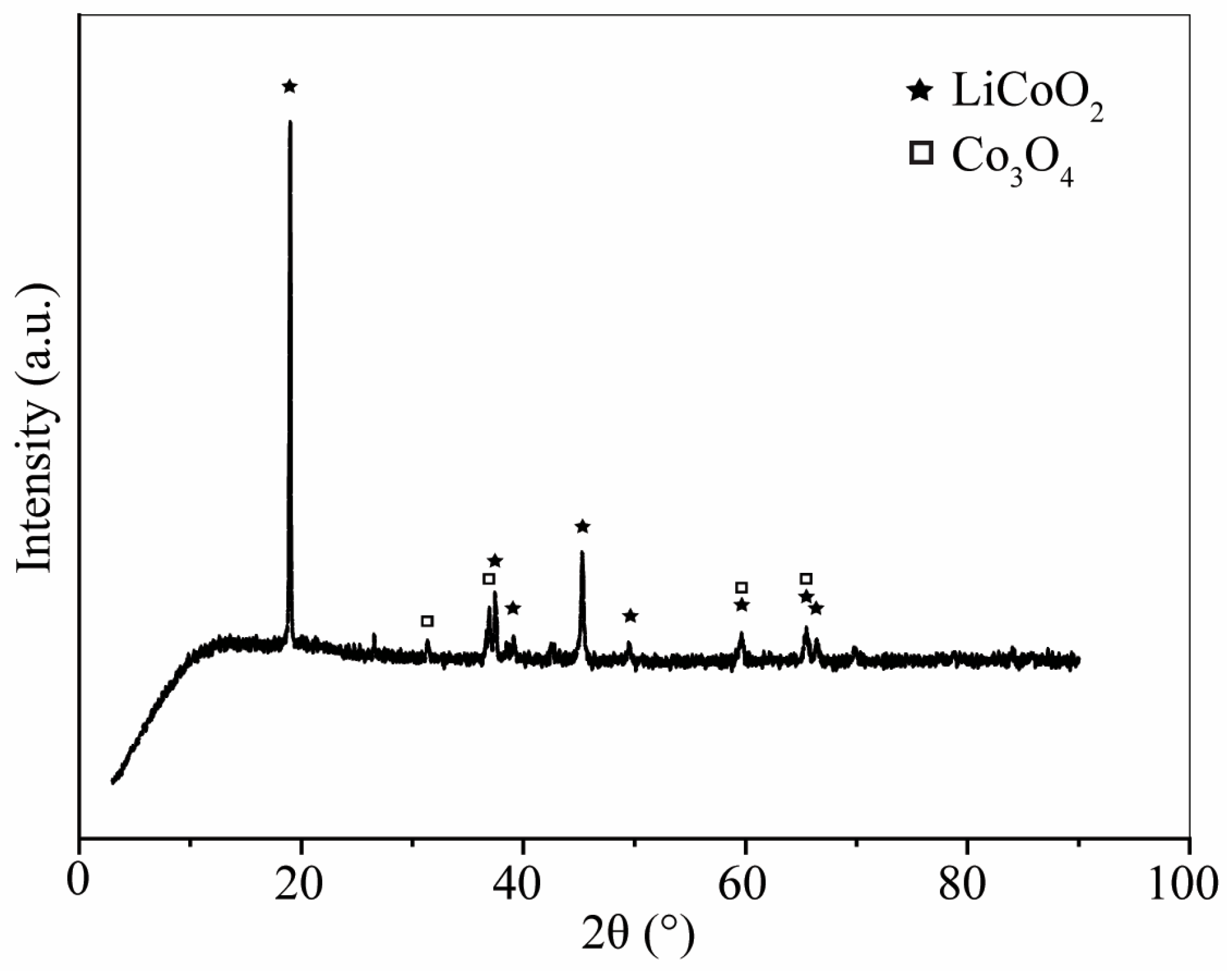
ICP-OES analysis of the post-calcined cathode material revealed cobalt and lithium contents of 59.89 wt.% and 6.97 wt.%, respectively. The XRD presented on Figure 1 identified LiCoO2 as the predominant crystalline phase, along with a minor amount of Co3O4. XRD characterization was performed on the calcined material because the as-received sample contains non-active electrode constituents such as binder and carbonaceous matter, which significantly elevate the background signal and obscure the characteristic diffraction peaks of LiCoO2. Calcination at 630 °C significantly reduces these residues, lowering the background signal and enabling clearer phase identification. The presence of Co3O4 is attributed to the partial degradation of LiCoO2 during battery operation, as well as to phase transformations induced by thermal treatment of the spent material. According to Li et al. [26], Co3O4 is frequently observed as a degradation product formed under extended electrochemical cycling. This is further supported by Medić et al. [27], who reported that thermal decomposition of LiCoO2 contributes to the formation of Co3O4 in heat-treated cathode residues.
Figure 1.
XRD pattern of LiCoO2 cathode material after calcination at 630 °C.
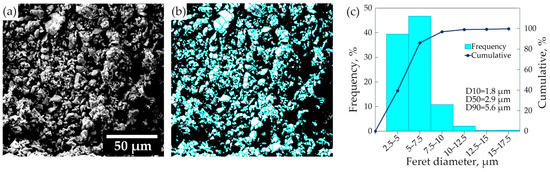
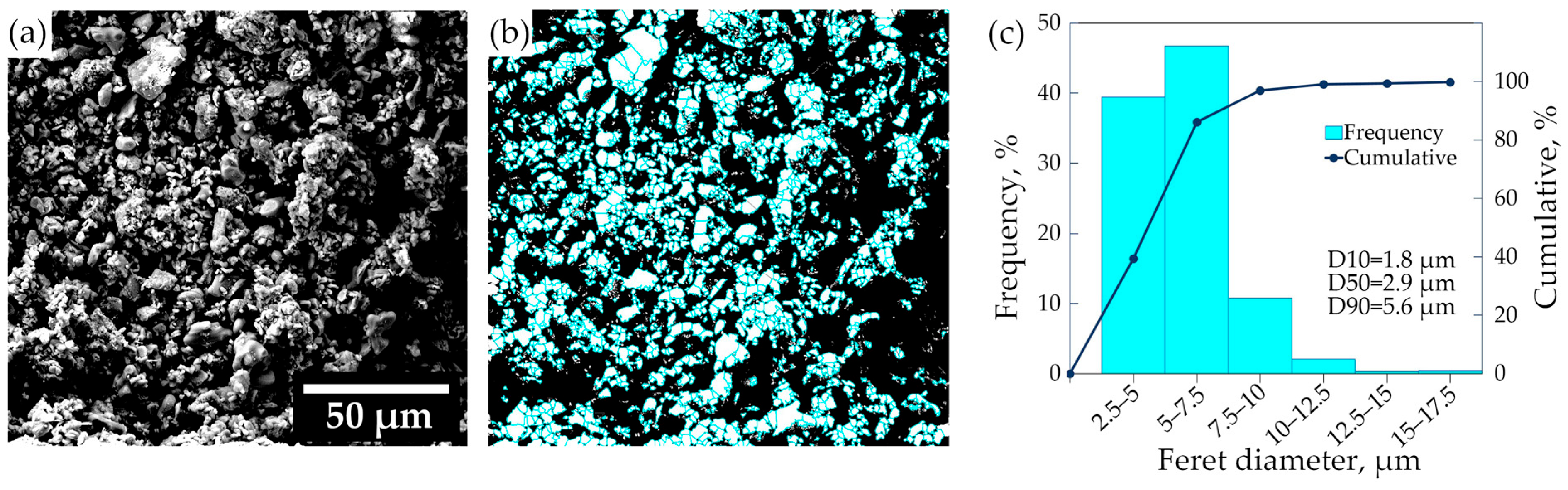
Figure 2 shows the SEM image of the prepared cathode powder for leaching, with particle contours overlaid using ImageJ 1.54p, and the resulting particle-size distribution histogram with cumulative curve and characteristic diameters (D10, D50, D90).
Figure 2.
(a) SEM photomicrograph of the cathode powder for leaching, (b) same image with particle contours overlaid (ImageJ 1.54p analysis), (c) and corresponding particle size distribution histogram with cumulative curve.
Image analysis of the SEM micrograph in Figure 2b using ImageJ 1.54p showed that the cathode powder consists predominantly of fine particles with a relatively narrow size distribution. The mean Feret diameter was 3.37 µm with a standard deviation of 1.76 µm, while the minimum and maximum measured values were 1.4 and 18.2 µm, respectively. The powder is strongly dominated by small particles—the D10, D50 and D90 values were 1.8, 2.9, and 5.6 µm, meaning that half of the particles are smaller than about 3 µm, and nearly all (90%) remain under 5.6 µm. The histogram in Figure 2c shows that the largest fraction of particles falls within the 2.5–5 µm interval, whereas only a very small fraction (<1%) exceeds 10 µm, confirming the presence of a fine powder with a minimal share of particles above 10 µm. Such a particle-size distribution is expected to provide a high specific surface area and thus favorable conditions for subsequent leaching of the cathode material.
3.2. Optimal Leaching of Waste Cathode Material
3.2.1. Effect of Copper Powder on the Leaching Efficiency of Li and Co
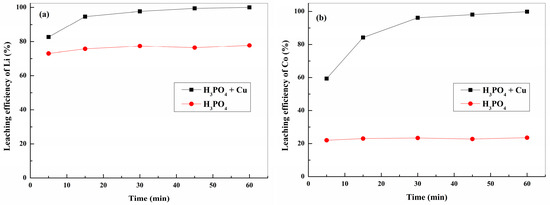
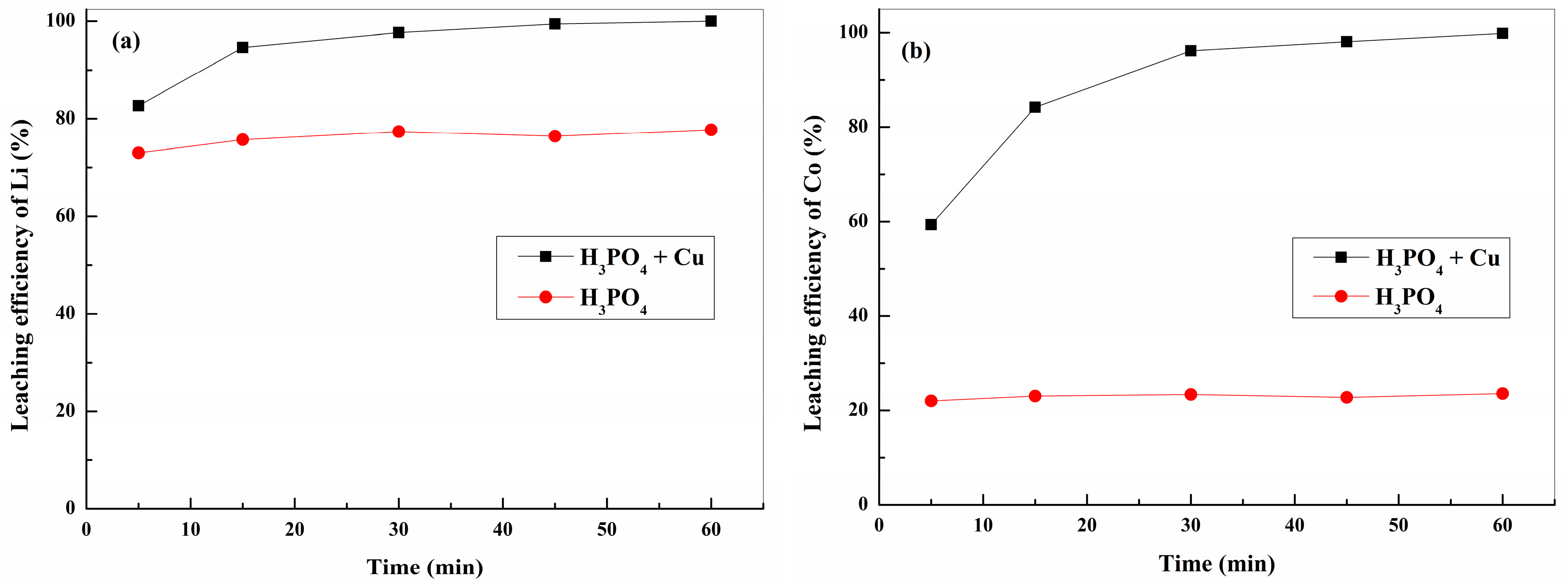
To investigate the role of the reducing agent, the leaching efficiencies of lithium and cobalt were compared in systems with and without copper powder. All experiments were conducted using 50 mL 0.4 mol·L−1 H3PO4 as the leaching agent at 80 °C, with a stirring speed of 600 rpm. The mass of cathode material was 0.4 g. In the test with the reducing agent, 0.2 g of copper powder was added to the reaction system. As shown in Figure 3, the presence of copper significantly enhanced the leaching efficiency of both metals, in agreement with previous findings that metallic Cu increases the dissolution efficiency of both Li and Co in acidic leaching systems [17,24]. In the absence of copper (H3PO4 only), lithium extraction remained stable at around 75%, while cobalt extraction stayed below 25% throughout the 60 min leaching period. The addition of copper powder significantly enhanced the extraction of both metals. Lithium recovery rapidly exceeded 94% within the first 15 min and remained high thereafter. Although the final extraction percentage was lower for cobalt, the effect of copper addition was more pronounced in its case-cobalt extraction increased to over 84% within just 15 min.
Figure 3.
Effect of copper powder on the leaching efficiency of Li (a) and (b) Co during the leaching of LiCoO2 in 50 mL 0.4 mol·L−1 H3PO4 solution at 80 °C.
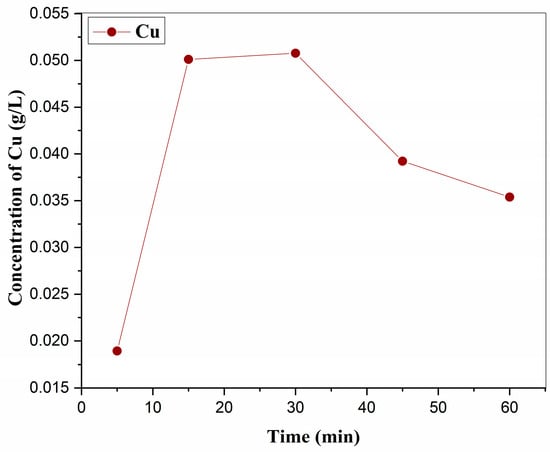
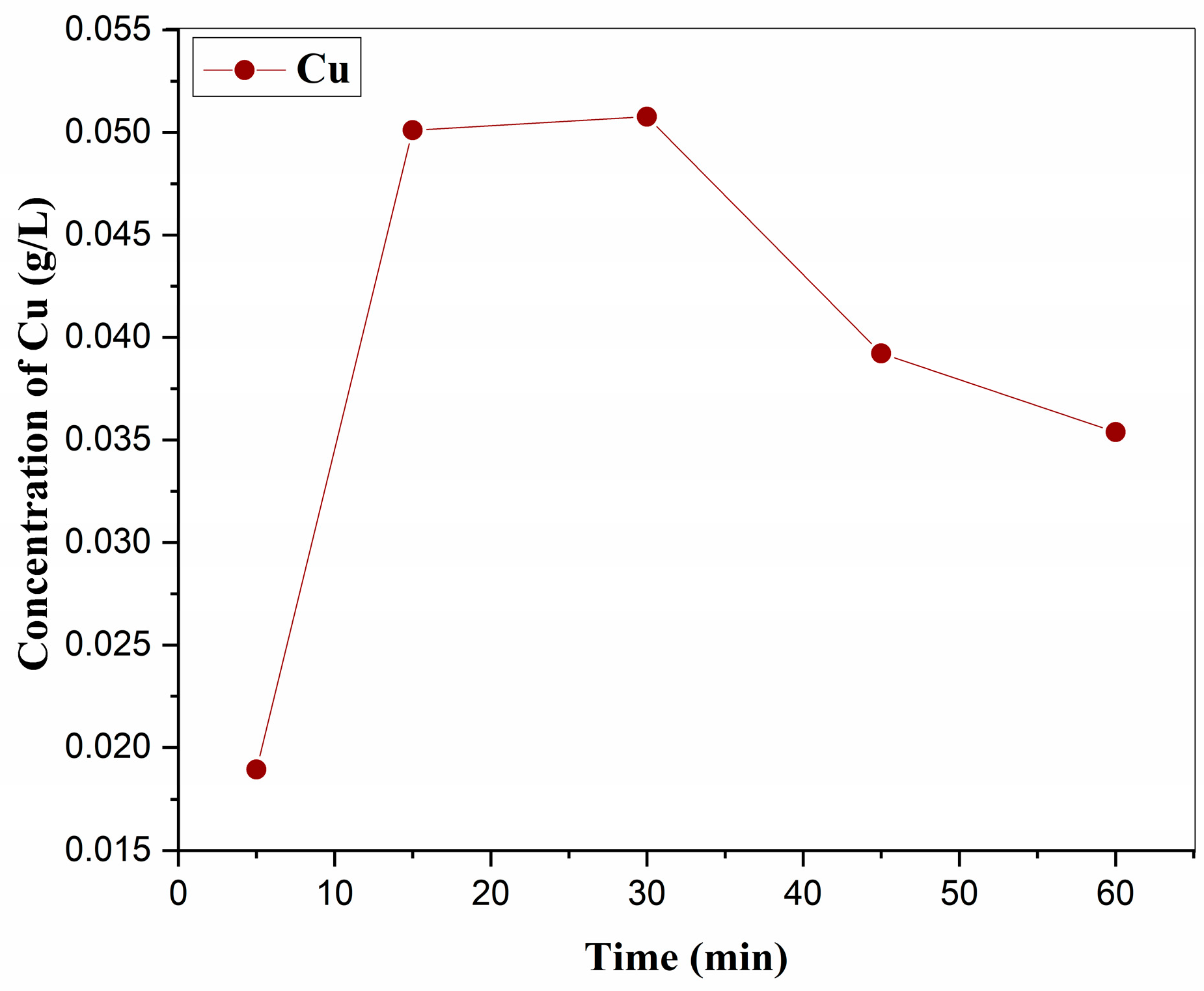
This remarkable improvement in leaching efficiency is consistent with the presence of metallic copper in the system, which promotes substantially faster cobalt dissolution compared to leaching without Cu. While the exact electron-transfer pathway cannot be confirmed within the scope of this study, the early increase and subsequent decrease in dissolved Cu2+ indicate that copper actively participates in processes that enhance cobalt release. As shown in Figure 4, the concentration of dissolved Cu2+ in the solution increased sharply within the first 15 min, indicating active oxidation of copper powder and its participation in redox reactions. This coincided with the steep rise in lithium and cobalt extraction, confirming the critical role of copper in promoting metal dissolution. After reaching peak values at around 30 min, the Cu2+ concentration gradually decreased, suggesting that copper was either consumed within the solution via precipitation or complexation. Despite this decline, the leaching efficiencies of both lithium and cobalt remained high (as presented in Figure 3), indicating that the majority of the leaching process occurred during the initial phase when copper activity was at its peak. These findings confirm that the presence of copper not only accelerates the dissolution kinetics but is also essential for achieving high extraction yields under the applied experimental conditions.
Figure 4.
Concentration of Cu2+ during the leaching of LiCoO2 in 50 mL 0.4 mol·L−1 H3PO4 with 0.2 g Cu powder at 80 °C.
Previous studies have demonstrated that in acidic leaching systems, especially sulfate-based, metallic copper facilitates cobalt reduction often through indirect mechanisms involving ionic mediators such as Fe2+/Fe3+ or Cu+ species stabilized by chloride. For instance, Joulie et al. [21] reported that galvanic interactions between transition metal oxides and conductive components such as copper and aluminum can significantly enhance the leaching efficiency of lithium nickel manganese cobalt oxide (NMC) cathodes, even in the absence of externally added reducing agents or thermal activation. Similarly, Chernyaev et al. [22] and Porvali et al. [17] showed that copper can indirectly enable the reduction of Co3+ through redox mediation by Fe3+/Fe2+ cycling, where Cu regenerates Fe2+ from Fe3+, and Fe2+ subsequently reduces the active material. Partinen et al. [23] further highlighted the importance of chloride ions in stabilizing Cu+ species, which then catalyze electron transfer to LiCoO2.
In contrast, our results demonstrate that in a phosphoric acid medium, and in the absence of both iron species and chloride ligands, copper powder alone is sufficient to induce rapid and complete leaching of both cobalt and lithium. The mechanism underlying this efficiency remains unclear, as the exact electron transfer pathway between Cu and LiCoO2 is not yet identified. Nevertheless, the sharp increase in extraction rates, combined with the concurrent decrease in soluble copper concentration, strongly indicates that copper is directly involved in redox reactions and is progressively consumed during the process.
3.2.2. Effect of Cathode Material Mass on the Leaching Efficiency of Li and Co
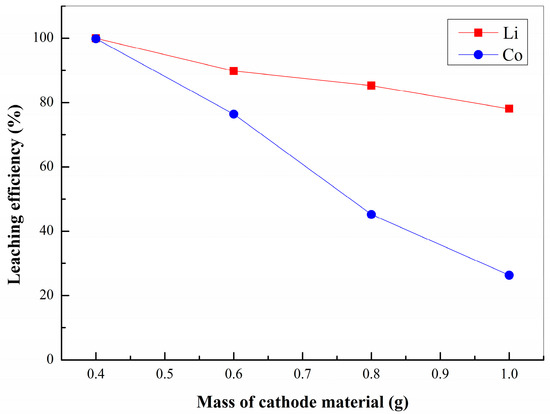
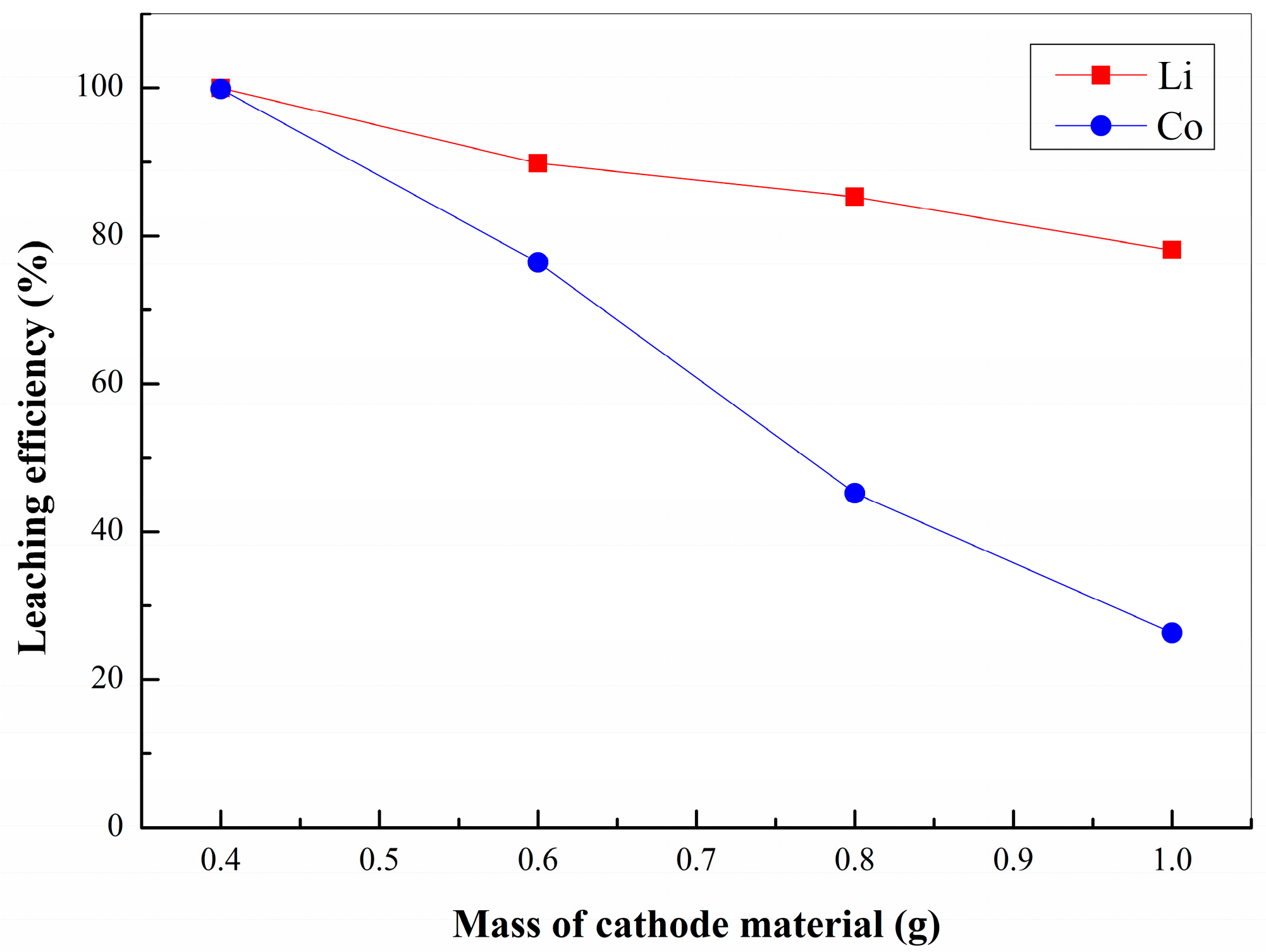
The influence of cathode material mass on the leaching efficiency of lithium and cobalt was investigated in a 50 mL solution of 0.4 mol·L−1 H3PO4 with the addition of 0.2 g of copper powder as a reducing agent. The experiments were conducted at a temperature of 80 °C and a stirring speed of 600 rpm. The obtained results are presented in Figure 5.
Figure 5.
Effect of cathode material mass on the leaching efficiency of Li and Co in 50 mL 0.4 mol·L−1 H3PO4 at 80 °C and 600 rpm after 60 min.
A clear decreasing trend in leaching efficiency was observed with increasing mass of the cathode material. When 0.4 g of LiCoO2 was used, the leaching efficiencies of lithium and cobalt were 99.98% and 99.86%, respectively. As the mass increased to 0.6 g, lithium leaching dropped to 89.81% and cobalt to 76.42%. Further increasing the mass to 0.8 g resulted in lithium and cobalt extraction efficiencies of 85.28% and 45.23%, respectively. At the highest tested mass of 1.0 g, the leaching efficiency of lithium fell to 78.07%, while cobalt dropped drastically to only 26.34%.
The influence of the solids increase refers only to the cathode material mass, while the copper powder addition (0.2 g) was kept constant in all experiments. As the cathode mass increases, copper rapidly oxidizes and precipitates as insoluble copper-phosphate, reducing the available electrons for Co3+ reduction and intensifying diffusion resistance at the particle surface. Thus, the decline in cobalt leaching efficiency is primarily attributable to early copper precipitation and restricted electron availability, rather than to the modest increase in the total solids content of the suspension.
Considering these findings, the cathode material mass of 0.4 g was identified as the optimal value and was therefore used in all subsequent experiments.
3.2.3. Effect of Stirring Speed on the Leaching Efficiency of Li and Co
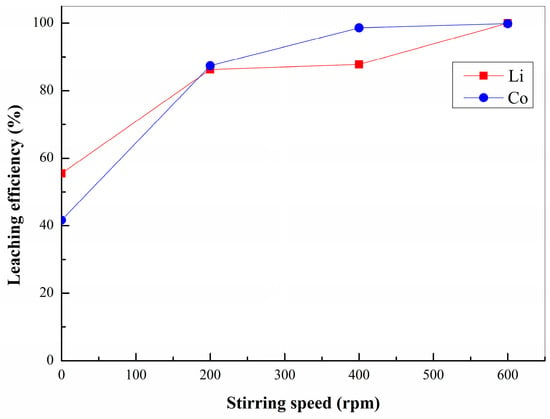
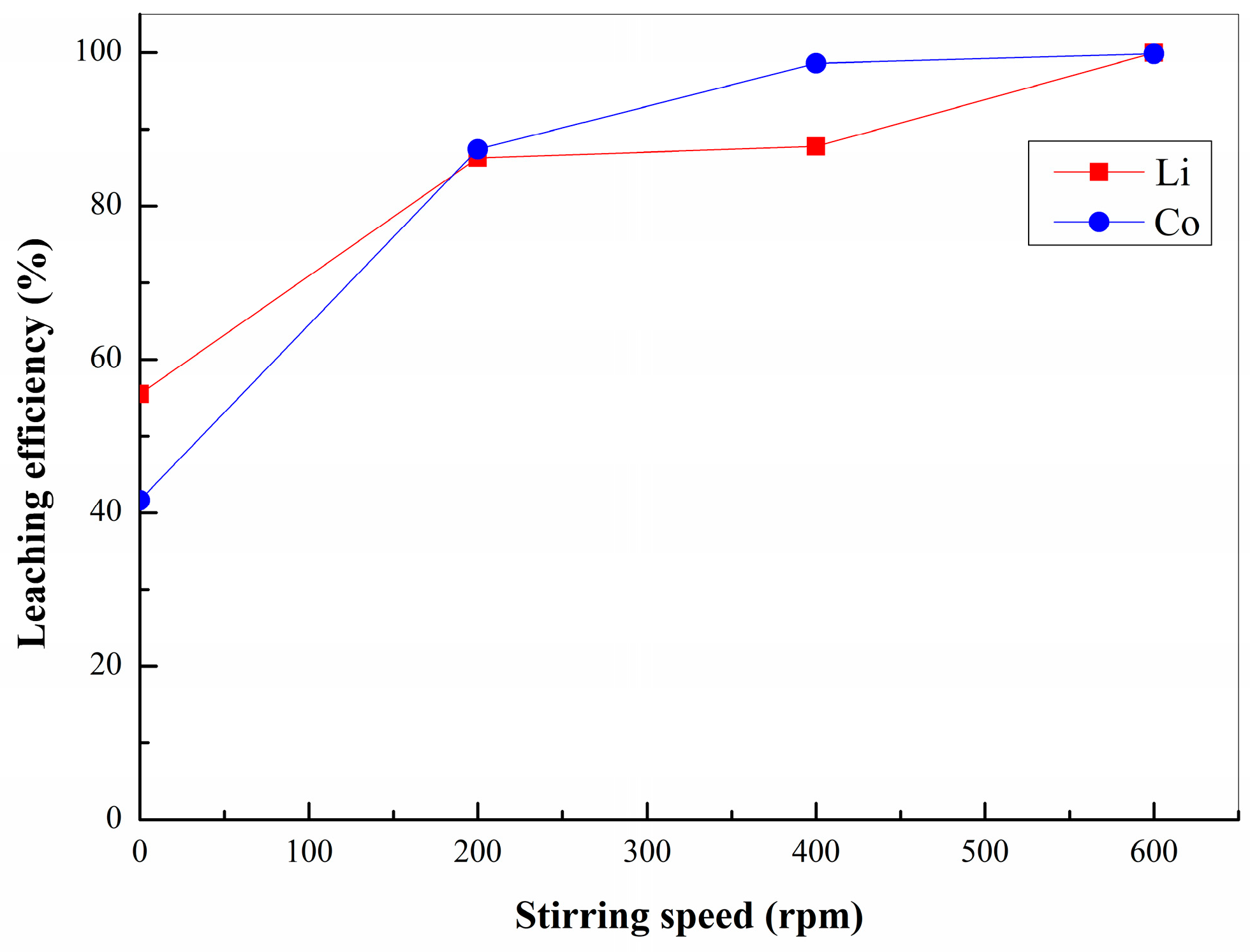
The effect of stirring speed (0, 200, 400, and 600 rpm) on the dissolution of cathode material was examined in a 50 mL solution of 0.4 mol·L−1 H3PO4 with the addition of 0.2 g of copper powder. The experiments were conducted at a temperature of 80 °C using 0.4 g of LiCoO2. The results are shown in Figure 6.
Figure 6.
Effect of stirring speed on the leaching efficiency of Li and Co from waste LiCoO2 in 50 mL 0.4 mol·L−1 H3PO4 at 80 °C after 60 min.
The obtained data indicate a positive correlation between stirring speed and leaching efficiency. In the absence of stirring (0 rpm), the leaching efficiencies of lithium and cobalt were significantly lower, with lithium extraction at 55.50% and cobalt at 41.64%. As the stirring speed increased to 200 rpm, Li and Co leaching efficiencies improved to 86.29% and 87.41%, respectively. With further increases to 400 rpm, the efficiencies continued to rise, reaching 87.79% for Li and 98.61% for Co. The highest leaching efficiencies were achieved at a stirring speed of 600 rpm, with Li extraction reaching 99.98% and Co reaching 99.86%.
This can be attributed to improved mass transfer, better particle suspension, and enhanced contact between the solid phase and the leaching solution at higher stirring rates [28,29]. Efficient mixing ensures uniform distribution of both the leaching agent (H3PO4) and the reducing agent (Cu), which collectively promote more effective dissolution of the active material.
Based on these results, a stirring speed of 600 rpm was selected as the optimal condition and was therefore used in all subsequent experiments.
3.2.4. Effect of Temperature and Time on the Leaching Efficiency of Li and Co
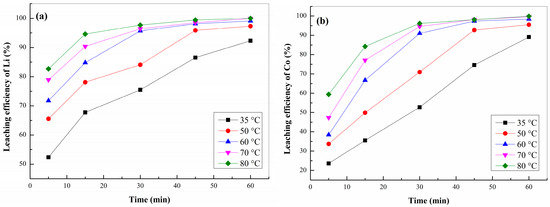
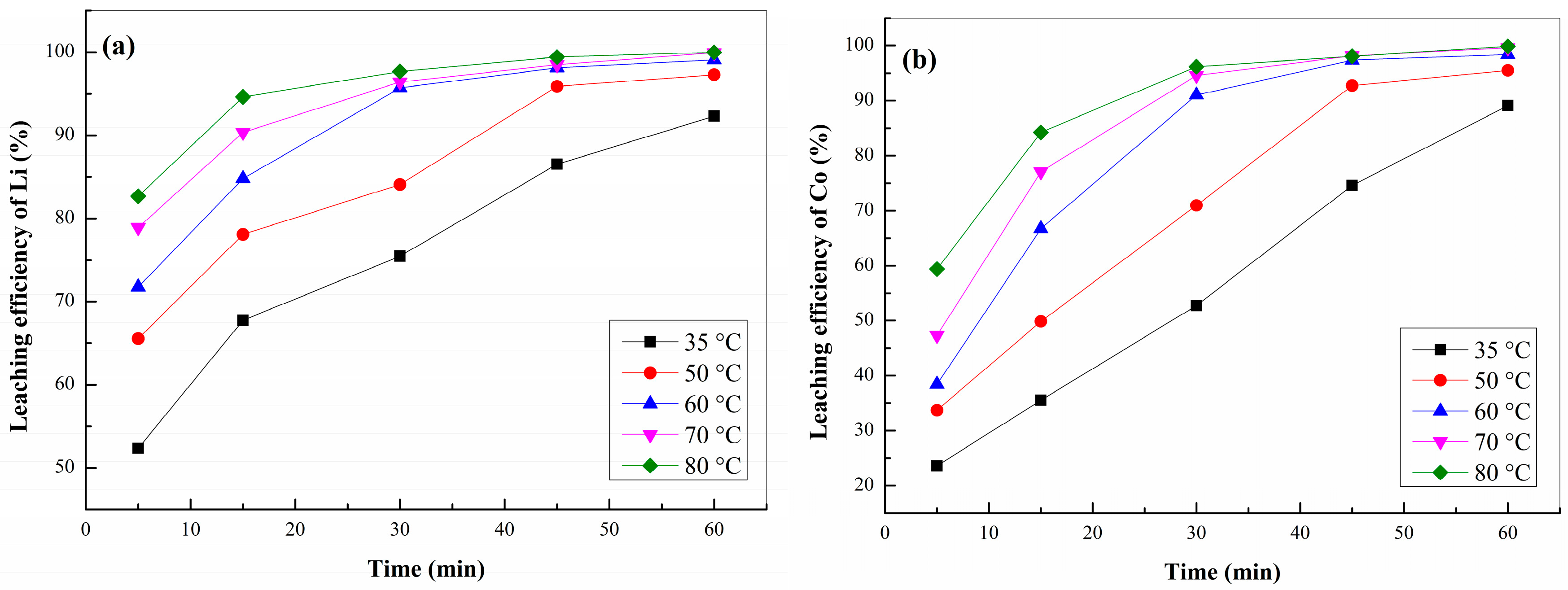
The effects of temperature and leaching time on the extraction efficiencies of lithium and cobalt were systematically investigated in a 50 mL 0.4 mol·L−1 H3PO4 solution with the addition of Cu powder, under constant stirring conditions. The results are presented in Figure 7.
Figure 7.
Effect of temperature and time on the leaching efficiency of (a) Li and (b) Co in 50 mL 0.4 mol·L−1 H3PO4 containing 0.2 g Cu powder under constant stirring.
The data reveal a positive correlation between temperature and leaching efficiency. At 35 °C, after 60 min, lithium and cobalt achieved extraction efficiencies of 92.29% and 89.09%, respectively. As the temperature increased to 50 °C, the leaching efficiencies slightly improved to 97.29% for lithium and 95.53% for cobalt. Further enhancement was observed at 60 °C, with lithium extraction reaching 99.07% and cobalt 98.40%. At 70 °C, the efficiencies rose to 99.92% for lithium and 99.59% for cobalt, while the highest values were recorded at 80 °C—99.98% and 99.86%, respectively.
These findings are consistent with the well-established influence of temperature on leaching kinetics. According to the Arrhenius equation, the reaction rate increases exponentially with temperature as a result of the higher kinetic energy of the reacting species, leading to a greater frequency of effective collisions. Elevated temperatures also enhance ion mobility, improve diffusion processes, and accelerate surface reactions between the solid phase and the leaching agent. Furthermore, the increased reductive activity of copper at higher temperatures may facilitate the more efficient reduction of Co(III) to Co(II), thereby promoting cobalt dissolution. Similar effects were reported by Sahu et al. [30], who demonstrated that elevated temperatures significantly enhance the leaching efficiencies of lithium and cobalt from spent lithium-ion battery cathode materials.
In addition to temperature, leaching time had a significant impact on the extraction efficiencies of lithium and cobalt. At 80 °C, over 82% of Li and 59% of Co were extracted within 5 min, increasing to ~95% (Li) and ~84% (Co) after 15 min, and exceeding 97% (Li) and 96% (Co) after 30 min. At lower temperatures, extraction was slower but also improved with time, reaching ~92% (Li) and ~89% (Co) after 60 min at 35 °C. Although most extraction occurred within the first 30 min, a leaching time of 60 min was selected as optimal to ensure maximum and consistent metal recovery across varying conditions. This observation is further supported by the kinetic analysis presented in Section 3.3. The mass balance of Co, Li and Cu under the optimized leaching conditions is provided in Table S1.
3.3. Kinetics of Li and Co Leaching
The leaching kinetics of lithium and cobalt from LiCoO2 in phosphoric acid in the presence of copper powder was investigated to determine the rate-controlling mechanism and assess the influence of temperature. A series of experiments was carried out at temperatures ranging from 35 to 80 °C under constant operating conditions: 50 mL 0.4 mol·L−1 H3PO4 as the leaching agent, 0.4 g of cathode material, 0.2 g of copper powder, and a stirring speed of 600 rpm. The leaching process was monitored over a period of up to 60 min.
Given the fluid–solid, non-catalytic nature of the system, where solid LiCoO2 reacts with a liquid leaching medium across a phase boundary, the process falls into the category of heterogeneous chemical reactions. Such systems are typically described using the shrinking core model (SCM), which accounts for possible control by surface chemical reactions, diffusion through a liquid film, or diffusion through a product (ash) layer [31,32,33]. Kinetic data were analyzed using SCM expressions for all three classical mechanisms, as well as a hybrid (mixed-control) model, which considers simultaneous chemical reaction and product layer diffusion:
where x is the fraction of metal extracted at time t, and k is the apparent rate constant.
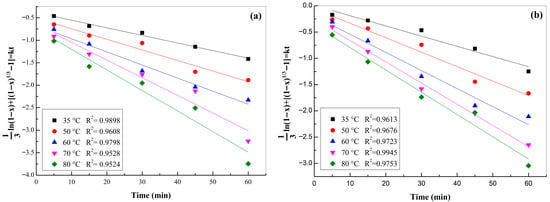
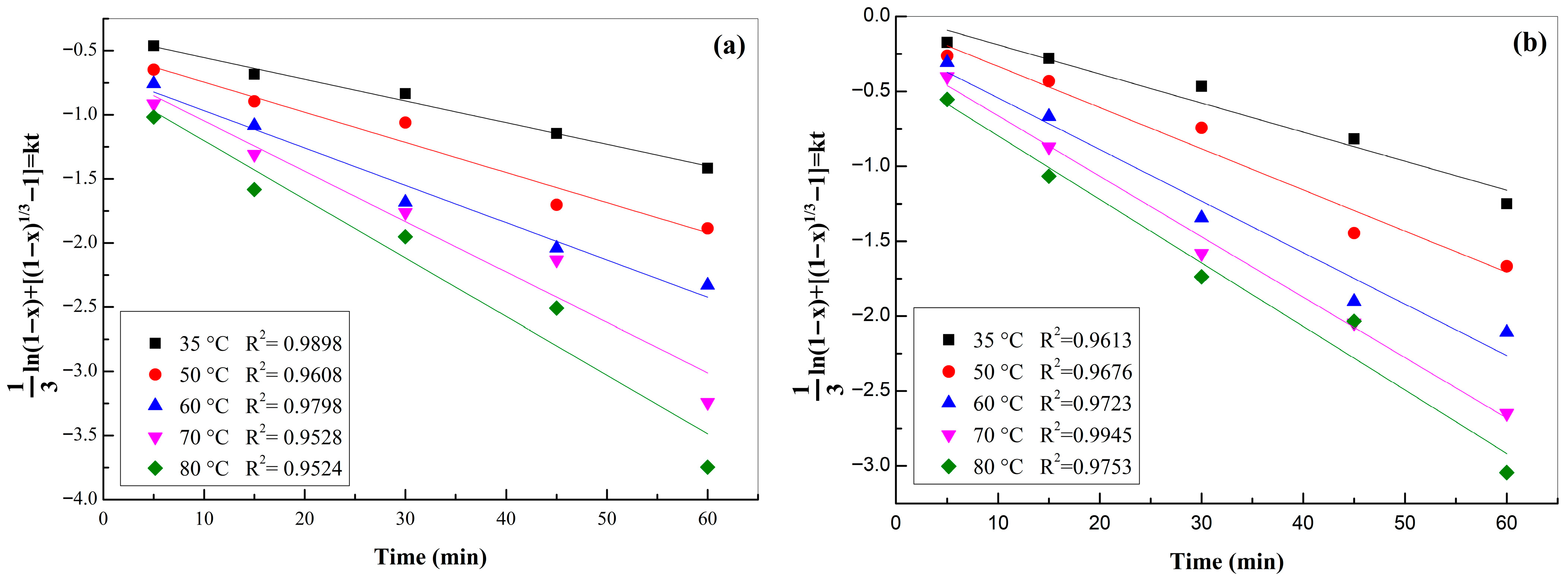
Among the tested models, the hybrid model provided the best fit for both lithium and cobalt, with correlation coefficients (R2) above 0.95 across the tested temperature range (Figure 8). Correlation coefficients for the other kinetic models are provided in Table S2, confirming that mixed control best describes the leaching mechanism under the given conditions. Although the surface chemical reaction model also provided relatively high R2 values, the hybrid model more accurately reflects the evolving nature of the process. The fitting suggests that, initially, chemical reaction at the particle surface dominates, but as the reaction progresses, the progressive formation of a solid product layer increases the role of diffusion resistance. Consequently, the leaching process transitions from reaction-controlled to mixed-controlled, making the hybrid shrinking core model the most representative description of the mechanism under the tested conditions. A similar kinetic behavior was reported by Fan et al. [34], who investigated the leaching of LiNixMnyCo1-x-yO2 cathode material in malonic acid medium. They demonstrated that leaching initially proceeds under surface-reaction control, but as the product layer grows, diffusion resistance becomes dominant; consequently, the system is best represented by a hybrid shrinking-core model. These findings suggest that the interplay between interfacial reaction and diffusion is a general characteristic of leaching processes involving complex multicomponent oxides such as LiCoO2 and LiNixMnyCo1-x-yO2, regardless of the acid medium or reducing agent used.
Figure 8.
Kinetic analysis of Li and Co leaching from the cathode material: (a) Li and (b) Co.
To further quantify the temperature dependence, the activation energy (Ea) was calculated using the Arrhenius equation:
where k is the apparent rate constant (1/min), A is the frequency factor, Ea is the activation energy (J·mol−1), R is the gas constant (8.314 J·mol−1·K−1), and T is the temperature (K). The activation energy represents the minimum energy barrier required for the leaching reaction to proceed.
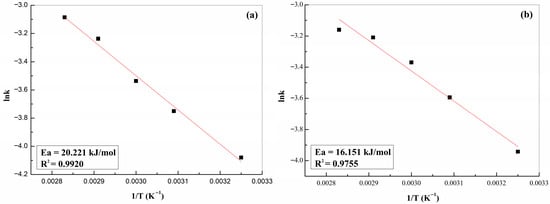
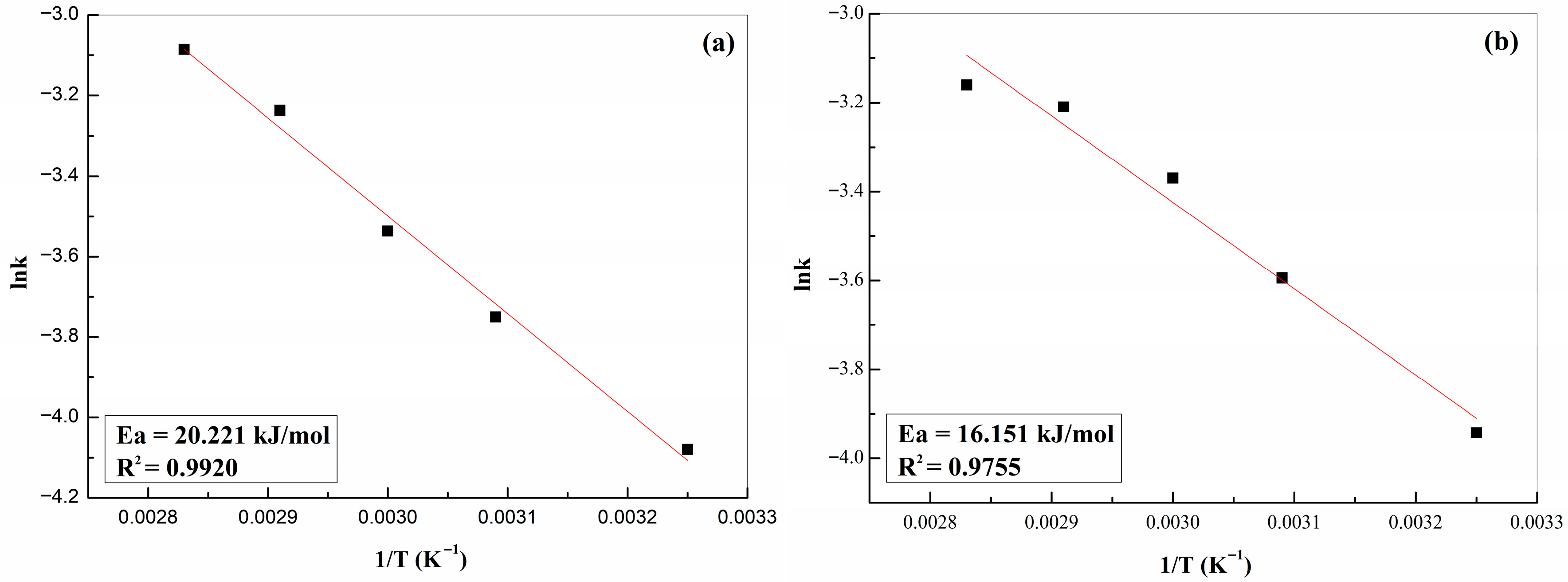
The Arrhenius plots of ln k versus 1/T were constructed for both Li and Co based on rate constants obtained from the mixed-control model. As shown in Figure 9, linear regression of these plots yielded straight lines with high correlation, confirming the validity of the Arrhenius approach for this system. The calculated activation energies were 20.2 kJ·mol−1 for lithium and 16.1 kJ·mol−1 for Co, which, according to the classification by Jafari et al. [31], indicates a mixed-control reaction mechanism. In their study, activation energies between 13 and 42 kJ·mol−1 were characteristic of systems governed simultaneously by chemical reaction and diffusion through a product layer (shrinking core model), without a single dominant mechanism. Therefore, the obtained values confirm that a mixed mechanism is operative.
Figure 9.
Arrhenius plots of Li and Co leaching from the cathode material: (a) Li and (b) Co.
The lower Ea for cobalt compared to lithium is attributed to the role of copper as a reducing agent, which accelerates the Co3+ → Co2+ reduction and facilitates its dissolution. In contrast, lithium, although not requiring reduction, may become partially trapped within solid residues (e.g., Co3O4, Cu8(PO3OH)2(PO4)4·7H2O), thereby facing diffusion barriers that increase its apparent activation energy.
3.4. Phase Evolution in Solid Residues During Cathode Material Leaching in the H3PO4–Cu System at Different Temperatures
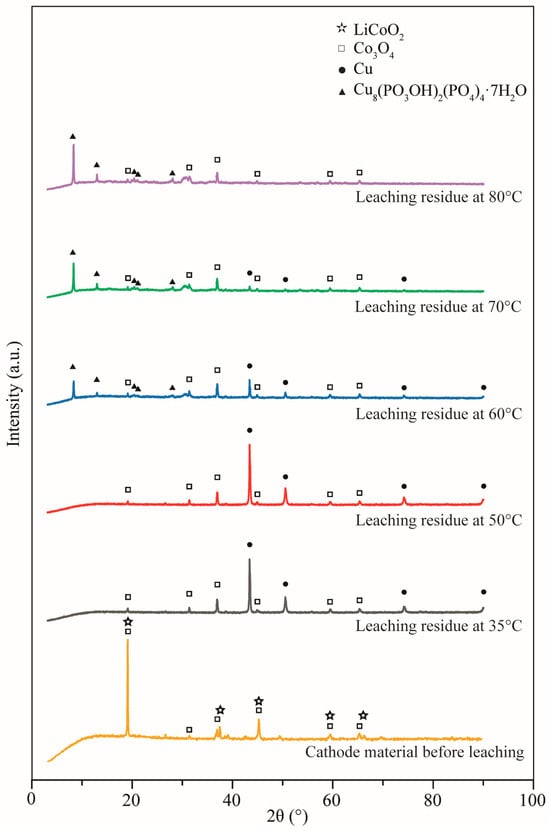
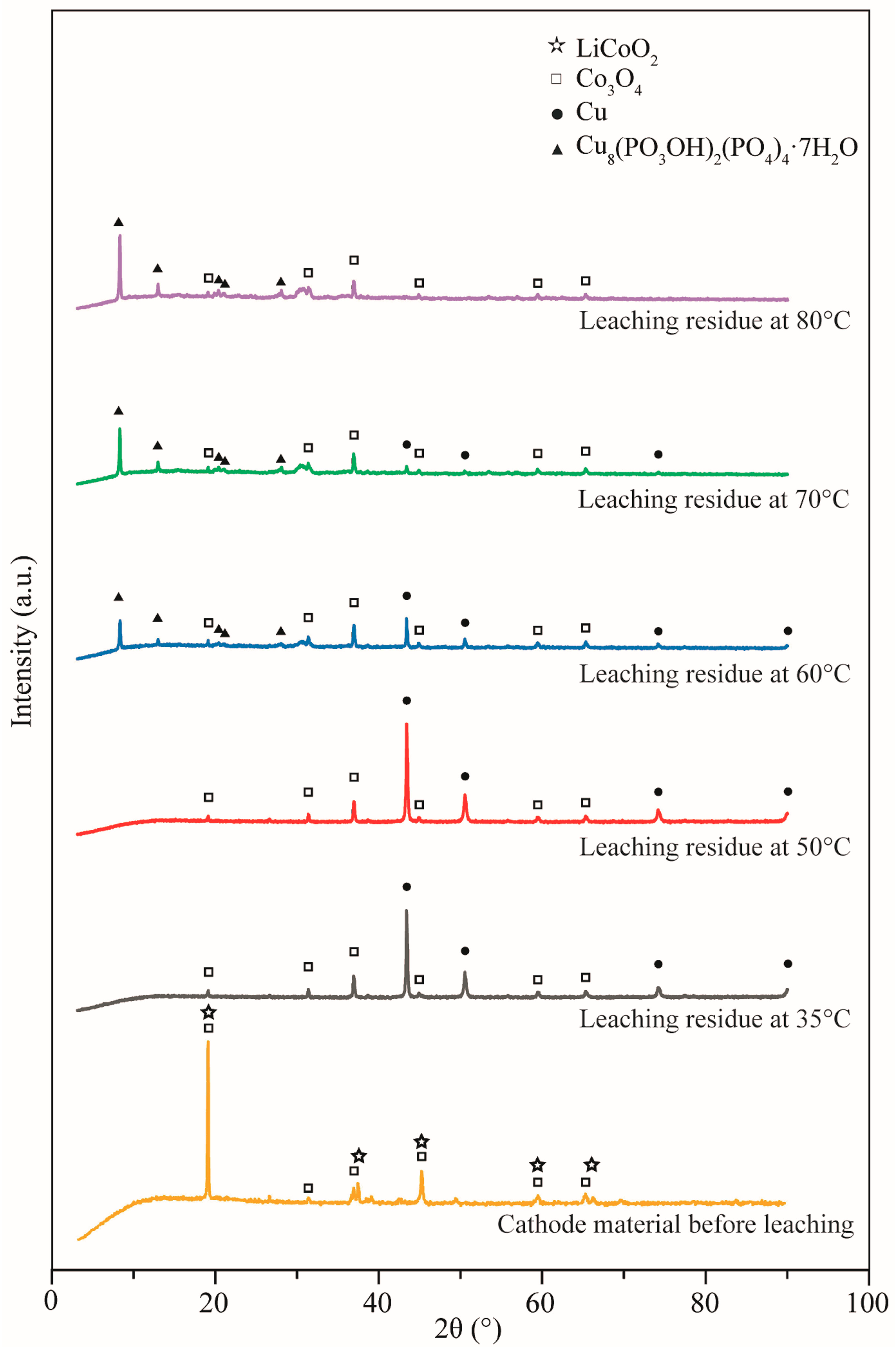
XRD analysis of solid residues obtained after leaching the cathode material at different temperatures (35–80 °C) revealed changes in the crystalline phase composition, which were further examined to understand the influence of temperature (Figure 10).
Figure 10.
XRD patterns of solid residues obtained after leaching at various temperatures (35–80 °C).
XRD analysis of the residue obtained at 35 °C revealed the presence of Co3O4 and metallic copper. Since Co3O4 was already present in the original cathode material, its detection at this temperature does not necessarily indicate new formation but rather incomplete transformation or dissolution under mildly reducing conditions. The coexistence of Cu0 and Co3O4 suggests that redox reactions between metallic copper and cobalt species were initiated but remained incomplete. Similar observations were reported by Golmohammadzadeh et al. [35], who demonstrated that Co3O4 can remain stable during the degradation of LiCoO2 under limited reducing conditions. Cerrillo-Gonzalez et al. [36] further showed that Co3O4 may persist as a decomposition product or precipitate from Co2+ under mild reducing conditions.
At 50 °C, both Co3O4 and metallic copper were still clearly detectable, with no substantial change in peak intensity compared to 35 °C. This indicates that the overall solid-phase composition remained largely unaffected by the moderate temperature increase, and that a portion of cobalt remained stabilized as Co3O4, either as an unreacted residual phase or a product of LiCoO2 transformation.
At 60 °C, the XRD pattern revealed the emergence of peaks corresponding to Cu8(PO3OH)2(PO4)4·7H2O, a hydrated copper phosphate. The formation of this phase is attributed to the oxidation of Cu0 and its subsequent reaction with phosphate ions from the leaching medium. Chen et al. [37,38] reported that this compound can form on copper surfaces immersed in phosphoric acid even at room temperature, due to gradual oxidation and precipitation of Cu2+ with phosphate species. Although Co3O4 remained present in the residue, the appearance of the copper phosphate phase indicates additional transformation of copper at this temperature, independent of the extent of redox interaction with cobalt.
At 70 °C and 80 °C, the copper phosphate phase became dominant in the solid residues. However, Co3O4 remained consistently present, with no significant reduction in its diffraction peak intensity. This persistence suggests that a fraction of cobalt remains immobilized in oxide form even under more favorable conditions for redox transformation. Metallic copper was not observed in the XRD pattern, indicating that any remaining Cu was likely present below the detection limit or had been largely converted into the identified phosphate phase Cu8(PO3OH)2(PO4)4·7H2O.
It is important to note that LiCoO2 was not detected in any of the residues, confirming its complete decomposition under all investigated conditions. This highlights the effectiveness of the H3PO4-Cu system in breaking down the layered cathode structure and releasing lithium and cobalt into solution.
The evolution of crystalline phases with increasing temperature highlights two key mechanistic aspects of the leaching process:
- The persistence of Co3O4 in the leaching residues at all investigated temperatures strongly suggests that this phase behaves as an essentially inert component inherited from the original cathode material.
- The progressive formation of Cu8(PO3OH)2(PO4)4·7H2O, reflecting the oxidation of Cu0 and serving as an indicator of redox activity within the system—an effect also observable visually: the residue was black at 35 °C and 50 °C, developed a grayish tone at 60 °C, and turned green at 70 °C and 80 °C due to the dominance of copper phosphate phases.
Notably, both Cu8(PO3OH)2(PO4)4·7H2O and Co3O4 are known for their photocatalytic properties, suggesting that the leaching residues may exhibit photocatalytic potential and therefore hold additional value beyond process waste.
3.5. SEM/EDS Characterization of the Leaching Residue at 80 °C
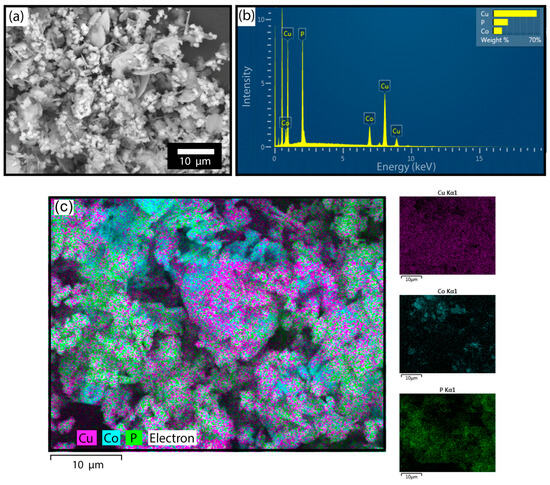
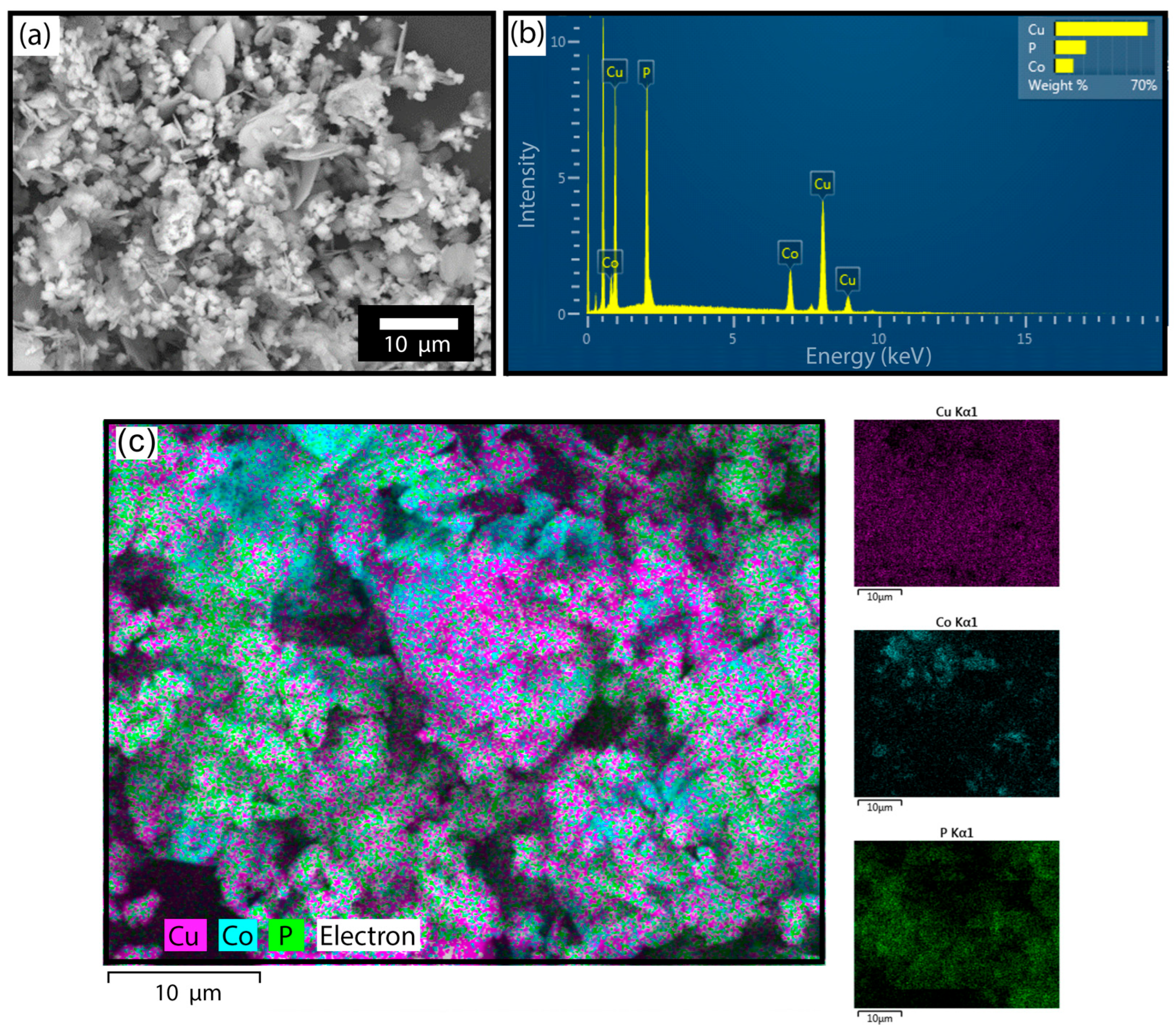
SEM imaging and EDS elemental analysis (Figure 11) provided further insight into the composition and morphology of the leaching residue obtained at 80 °C. The SEM micrograph revealed a heterogeneous mixture of morphologically distinct particles, including aggregates of fine-grained crystalline material and well-developed plate-like structures. The observed morphological heterogeneity reflects the simultaneous formation of multiple secondary phases, generated through the interaction of copper powder with phosphoric acid and dissolved metal ions.
Figure 11.
SEM and EDS characterization of the leaching residue obtained at 80 °C: (a) SEM photomicrographs showing morphological diversity of the residue; (b) Representative EDS spectra and (c) Elemental mapping of Cu, P, and Co distribution.
Quantitative EDS spectra acquired from selected points confirmed that copper is the dominant element (~70 wt%), while phosphorus and cobalt were also detected in lower amounts. These results are in good agreement with the phase identification obtained from XRD analysis. Elemental mapping reveals overlapping distributions of Cu, P, and Co within the solid residue, which is consistent with the formation of copper phosphate phases. The presence of cobalt in these regions may indicate its partial incorporation into secondary phases or its retention in trace amounts on surface-associated domains.
These Co-containing areas are likely associated with residual Co3O4, as suggested by the presence of weak Co3O4 reflections in the XRD patterns. No distinct Co-phosphate phases were identified, implying that if cobalt is incorporated into secondary products, it is either in minor amounts or within poorly crystalline or amorphous structures.
Combined SEM/EDS and XRD results indicate that, under optimal leaching conditions (80 °C, 0.4 mol·L−1 H3PO4, 0.2 g Cu), lithium and cobalt are almost completely extracted into solution, whereas copper predominantly precipitates as low-solubility phosphate phases. These precipitates are most likely dominated by Cu8(PO3OH)2(PO4)4·7H2O, as confirmed by XRD, and the spatial overlap of Cu and P in the elemental maps further supports this assignment. Trace amounts of cobalt may be physically trapped or co-precipitated within these secondary phases, but the majority of cobalt is removed via dissolution.
3.6. Interpretation of Solid-Phase Changes and Redox Behavior: Insights from XRD, SEM/EDS, and Thermodynamic Analysis
Based on the experimentally determined optimal conditions, thermodynamic calculations were performed to confirm the observed phase transformations and clarify the role of copper as a reductant. The XRD results (Figure 10) enabled the identification of crystalline phases in the leaching residues, while SEM images and EDS elemental analysis (Figure 11) provided information on surface morphology and local elemental distribution. Combining these methods confirmed the formation of phases such as Cu8(PO3OH)2(PO4)4·7H2O and provided insights into the behavior of cobalt and copper under the applied leaching conditions.
Thermodynamic calculations were carried out for the solution composition corresponding to the optimal conditions at 80 °C, focusing on two representative reactions. Reaction 1 describes the dissolution of LiCoO2 in phosphoric acid without a reductant and shows limited thermodynamic favorability:
LiCoO2 + 4H3PO4 → Li+ + 2H2O + Co3+ + 4H2PO4− ΔG (80 °C) = −67.2 kJ·mol−1
In the presence of copper powder (Reaction 2), Co3+ is reduced to the more stable Co2+, and copper precipitates as Cu3(PO4)2·3H2O, which significantly increases the thermodynamic driving force of the process.
LiCoO2 + 1.833H3PO4 + 0.500Cu → 1Li+ + 1.500H2O + Co2+ + 1.500HPO42− + 0.167Cu3(PO4)2·3H2O ΔG (80 °C) = −117.9 kJ·mol−1
Since the HSC Chemistry 9.9.2.3 database [39] does not contain the phase Cu8(PO3OH)2(PO4)4·7H2O, which was identified experimentally by XRD, the thermodynamically similar compound Cu3(PO4)2·3H2O was used in the modeling. Although these two phases are not fully identical—Cu8(PO3OH)2(PO4)4·7H2O contains both phosphate and phosphite groups—their comparable Cu:P ratio, hydration degree, and low solubility justify this substitution. Although this approximation adds some uncertainty into the absolute ΔG values, it is sufficient to determine the qualitative thermodynamic trend. Neverth`eless, the exact hydrated copper phosphate phase formed, the calculations consistently show that the reaction pathway involving copper yields a substantially more negative ΔG than the copper-free route. Therefore, the presence of copper thermodynamically favors cobalt leaching under the analyzed conditions, which in correspondence with the experimentally observed enhancement in cobalt dissolution.
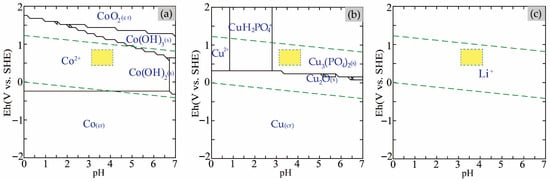
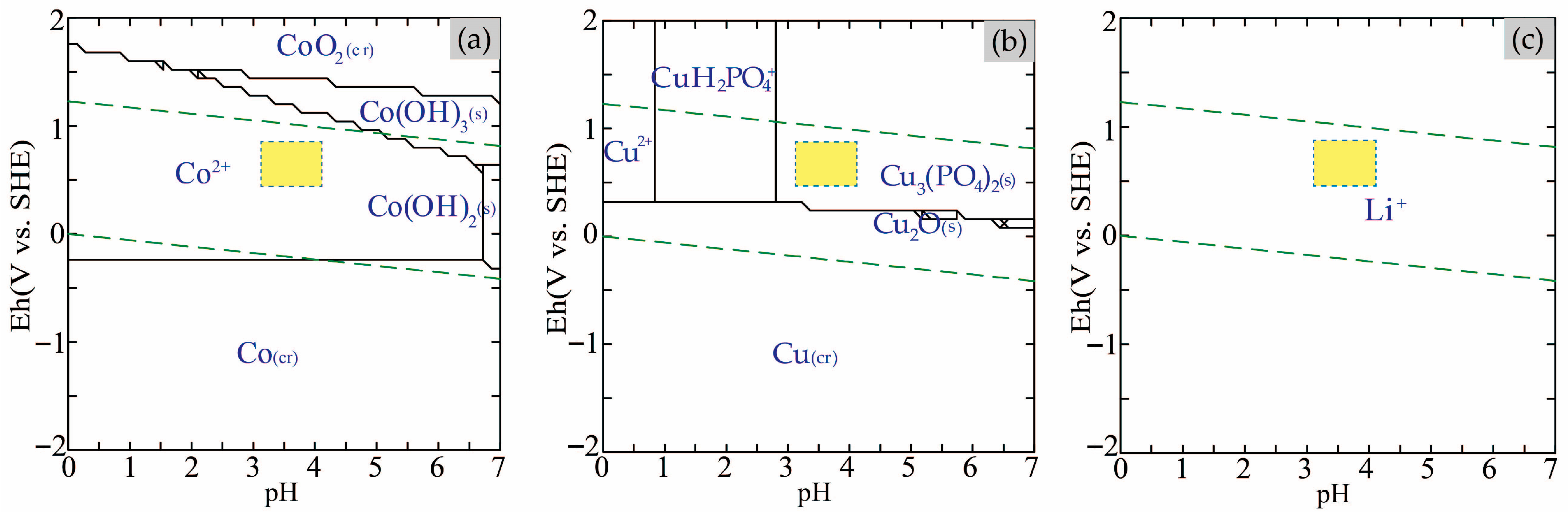
To investigate the existing species in the leaching solution under the defined conditions, Pourbaix’s diagrams (potential vs. pH) calculated by Hydra/Medusa software (version 2010) [40] are illustrated in Figure 12.
Figure 12.
Pourbaix’s diagram of Co (a), Cu (b), and Li (c) in the leaching system. Conditions: [Co2+]tot = 81 mM, [Cu2+]tot = 63 mM, [PO43−]tot = 400 mM, [Li+]tot = 80 mM, 1 atm, T = 80 °C.
The initial diagram inputs were taken from the optimized leaching experiment in order to indicate the region in which Li+ and Co2+ remain stable in the leaching solution, while Cu powder remains outside the dissolved-ion fields and is directed toward the low-solubility solid phase. The Eh–pH diagrams for cobalt and lithium show that the marked yellow pH–Eh operating range (pH ≈ 3–4, Eh ≈ 0.4–0.8 V) lies fully within the aqueous stability fields of dissolved ions, where cobalt is thermodynamically stabilized as soluble Co2+ and lithium as Li+ throughout this region, confirming that these conditions thermodynamically allow their transfer into solution. The copper diagram indicates that the added metallic copper powder (Cu0) originates from the lower Eh domain, where the metal is stable but becomes unstable when introduced into the oxidative leaching environment, initiating its surface-localized oxidation, commonly represented by the electron-releasing step Cu0 → Cu2+ + 2e−. The diagram further shows that upon increasing pH within a similar Eh range, the formed oxidized copper species shift toward general low-solubility solid stability domains of copper–phosphate phase. Copper leaves the aqueous phase through fast redox-driven precipitation, rather than remaining dissolved. This process mainly shifts with increasing pH, with no need for large changes in Eh, while Co2+ and Li+ stay stable in solution during leaching. These diagrams indicate thermodynamic feasibility only and do not constitute direct mechanistic evidence for electron-transfer steps.
4. Conclusions
This study demonstrated that copper powder is an effective reductant for the leaching of Li and Co from LiCoO2- and Co3O4-containing cathode material in a phosphoric acid medium. Under mild conditions, more than 84% of both metals leached within 15 min, with kinetics following a mixed-control mechanism.
The results of this work also provide a new understanding of the role of metallic copper in phosphate-based leaching systems. According to the study, copper not only accelerates the reductive dissolution of LiCoO2 but also transforms into the phosphate-rich phase Cu8(PO3OH)2(PO4)4·7H2O. This makes the Cu–H3PO4 system’s limitations and reaction path more understandable. These findings expand the process-level understanding of the recovery of Li and Co with Cu addition and underline the novelty of using metallic copper as both a reductant and a recyclable resource within a single process.
Compared to common reductants such as H2O2, glucose, and ascorbic acid, copper in the H3PO4 system proved particularly favorable. While H2O2 enables rapid kinetics and nearly complete extraction, it is unstable, costly, and requires careful handling due to safety risks. Glucose and ascorbic acid are inexpensive and safe, but their weaker reducing power and degradation during the process limit kinetics and increase reagent consumption. In contrast, metallic copper allows efficient dissolution under mild conditions and can be directly sourced from waste streams. This dual role of copper—as a reductant and a recyclable raw material—enhances the sustainability of the process and distinguishes the H3PO4–Cu system from peroxide- and organic-based reductants.
Thermodynamic analysis also confirmed that the leaching process is spontaneous, with negative Gibbs free energy values supporting the copper-assisted reduction of Co3+ to Co2+ in the H3PO4 medium.
Although the process was investigated at the laboratory scale, the results indicate its potential for industrial application. The identification of Co3O4 and Cu8(PO3OH)2(PO4)4·7H2O, both reported as photocatalytic phases, suggests additional opportunities for value-added utilization of leaching residues in environmental or functional applications. However, if there is no practical interest in obtaining Cu8(PO3OH)2(PO4)4·7H2O, further optimization of process conditions by adjusting excess phosphoric acid and copper powder is recommended to ensure more efficient reagent utilization and minimize unnecessary consumption.
Supplementary Materials
The following supporting information can be downloaded at: https://www.mdpi.com/article/10.3390/chemistry7060203/s1. Figure S1: Cathode material after thermal treatment at 580 °C: aluminum foil and recovered powder; Figure S2: Separator with residual cathode material before thermal treatment; Figure S3: Manually separated copper foil from the anode material used for copper powder preparation; Figure S4: Schematic diagram of the leaching apparatus: 1—condenser, 2—thermometer, 3—sampling port, 4—dou-ble-wall glass reactor, 5—hot plate with magnetic stirrer; Table S1: Mass balance of Co, Li, and Cu under the optimized leaching conditions; Table S2: Applied kinetic models for evaluating the leaching kinetics of lithium-ion battery materials.
Author Contributions
Conceptualization, D.M. and I.Đ.; methodology, D.M. and I.Đ.; software, N.G.; validation, M.N., V.N. and A.P.; formal analysis, I.Đ. and S.Đ.; investigation, I.Đ., S.Đ. and V.N.; resources, M.N.; data curation, D.M. and I.Đ.; writing—original draft preparation, D.M.; writing—review and editing, N.G., M.N. and V.N.; visualization, A.P. and V.N.; supervision, N.G. All authors have read and agreed to the published version of the manuscript.
Funding
This work was supported by the Ministry of Science, Technological Development and Innovation of the Republic of Serbia (Contract No. 451-03-137/2025-03/200131, Contract No. 451-03-136/2025-03/200052, and Contract No. 451-03-136/2025-03/200287).
Data Availability Statement
The original contributions presented in the study are included in the article. Further inquiries can be directed to the corresponding author.
Conflicts of Interest
Author Ivan Đorđević are employed by the Company Elixir Prahovo Co., Ltd. The remaining author declare that the research was conducted in the absence of any commercial or financial relationships that could be construed as a potential conflict of interest.
References
- Qi, Y.; Wang, M.; Yuan, L.; Chen, X. Closed-loop recycling of valuable metals from spent LiCoO2 batteries through phosphate-chemistry-based process. Chem. Eng. J. 2023, 466, 143030. [Google Scholar] [CrossRef] [Scilit]
- Pinna, E.G.; Ruiz, M.C.; Ojeda, M.W.; Rodriguez, M.H. Cathodes of spent Li-ion batteries: Dissolution with phosphoric acid and recovery of lithium and cobalt from leach liquors. Hydrometallurgy 2017, 167, 66–71. [Google Scholar] [CrossRef] [Scilit]
- Cerrillo-Gonzalez, M.M.; Villen-Guzman, M.; Vereda-Alonso, C.; Rodriguez-Maroto, J.M.; Paz-Garcia, J.M. Acid leaching of LiCoO2 enhanced by reducing agent. Model formulation and validation. Chemosphere 2022, 287, 132020. [Google Scholar] [CrossRef] [Scilit] [PubMed]
- Cerrillo-Gonzalez, M.M.; Paz-Garcia, J.M.; Muñoz-Espinosa, M.; Rodriguez-Maroto, J.M.; Villen-Guzman, M. Extraction and selective precipitation of metal ions from LiCoO2 cathodes using citric acid. J. Power Sources 2024, 592, 233870. [Google Scholar] [CrossRef] [Scilit]
- Sun, J.; Wang, Z.; He, Z. Indirect electrochemical leaching and separation of cobalt and lithium from spent LiCoO2 through recovery and reuse of sulfuric acid. Sep. Purif. Technol. 2025, 364, 132587. [Google Scholar] [CrossRef] [Scilit]
- Meshram, P.; Pandey, B.D.; Mankhand, T.R. Recovery of valuable metals from cathodic active material of spent lithium ion batteries: Leaching and kinetic aspects. Waste Manag. 2015, 45, 306–313. [Google Scholar] [CrossRef] [Scilit]
- Qu, L.; He, Y.; Fu, Y.; Xie, W.; Ye, C.; Lu, Q.; Li, J.; Li, J.; Pang, Z. Enhancement of leaching of cobalt and lithium from spent lithium-ion batteries by mechanochemical process. Trans. Nonferrous Met. Soc. China 2022, 32, 1325–1335. [Google Scholar] [CrossRef] [Scilit]
- Verma, A.; Corbin, D.R.; Shiflett, M.B. Lithium and cobalt recovery for lithium-ion battery recycle using an improved oxalate process with hydrogen peroxide. Hydrometallurgy 2021, 203, 105694. [Google Scholar] [CrossRef] [Scilit]
- Piątek, J.; Afyon, S.; Budnyak, T.M.; Budnyk, S.; Sipponen, M.H.; Slabon, A. Sustainable Li-Ion Batteries: Chemistry and Recycling. Adv. Energy Mater. 2021, 11, 2003456. [Google Scholar] [CrossRef] [Scilit]
- Pinna, E.G.; Drajlin, D.S.; Toro, N.; Rodriguez, M.H. Kinetic modeling of the leaching of LiCoO2 with phosphoric acid. J. Mater. Res. Technol. 2020, 9, 14017–14028. [Google Scholar] [CrossRef] [Scilit]
- Zhou, S.; Zhang, Y.; Meng, Q.; Dong, P.; Fei, Z.; Li, Q. Recycling of LiCoO2 cathode material from spent lithium ion batteries by ultrasonic enhanced leaching and one-step regeneration. J. Environ. Manag. 2021, 277, 111426. [Google Scholar] [CrossRef] [Scilit] [PubMed]
- Cerrillo-Gonzalez, M.M.; Villen-Guzman, M.; Acedo-Bueno, L.F.; Rodriguez-Maroto, J.M.; Paz-Garcia, J.M. Hydrometallurgical extraction of Li and Co from LiCoO2 particles—Experimental and modeling. Appl. Sci. 2020, 10, 6375. [Google Scholar] [CrossRef] [Scilit]
- Wei, G.; Liu, Y.; Jiao, B.; Chang, N.; Wu, M.; Liu, G.; Lin, X.; Weng, X.; Chen, J.; Zhang, L.; et al. Direct recycling of spent Li-ion batteries: Challenges and opportunities toward practical applications. iScience 2023, 26, 107676. [Google Scholar] [CrossRef] [Scilit] [PubMed]
- Li, J.; Li, X.; Zhang, Y.; Hu, Q.; Wang, Z.; Zhou, Y.; Fu, F. Study of spent battery material leaching process. Trans. Nonferrous Met. Soc. China 2009, 19, 751–755. [Google Scholar] [CrossRef] [Scilit]
- Swain, B.; Jeong, J.; Lee, J.-C.; Lee, G.-H.; Sohn, J.-S. Hydrometallurgical process for recovery of cobalt from waste cathodic active material generated during manufacturing of lithium ion batteries. J. Power Sources 2007, 167, 536–544. [Google Scholar] [CrossRef] [Scilit]
- Kang, J.; Senanayake, G.; Sohn, J.; Shin, S.M. Recovery of cobalt sulfate from spent lithium ion batteries by reductive leaching and solvent extraction with Cyanex 272. Hydrometallurgy 2010, 100, 168–171. [Google Scholar] [CrossRef] [Scilit]
- Porvali, A.; Chernyaev, A.; Shukla, S.; Lundström, M. Lithium ion battery active material dissolution kinetics in Fe(II)/Fe(III) catalyzed Cu–H2SO4 leaching system. Sep. Purif. Technol. 2020, 236, 116305. [Google Scholar] [CrossRef] [Scilit]
- Aaltonen, M.; Peng, C.; Wilson, B.P.; Lundström, M. Leaching of metals from spent lithium-ion batteries. Recycling 2017, 2, 20. [Google Scholar] [CrossRef] [Scilit]
- Meng, Q.; Zhang, Y.; Dong, P. Use of glucose as reductant to recover Co from spent lithium ion batteries. Waste Manag. 2017, 64, 214–218. [Google Scholar] [CrossRef] [Scilit]
- Chernyaev, A.; Zou, Y.; Wilson, B.P.; Lundström, M. The interference of copper, iron and aluminum with hydrogen peroxide and its effects on reductive leaching of LiNi1/3Mn1/3Co1/3O2. Sep. Purif. Technol. 2022, 281, 119903. [Google Scholar] [CrossRef] [Scilit]
- Joulie, M.; Billy, E.; Laucournet, R.; Meyer, D. Current collectors as reducing agent to dissolve active materials of positive electrodes from Li-ion battery wastes. Hydrometallurgy 2017, 169, 426–432. [Google Scholar] [CrossRef] [Scilit]
- Chernyaev, A.; Partinen, J.; Klemettinen, L.; Wilson, B.P.; Jokilaakso, A.; Lundström, M. The efficiency of scrap Cu and Al current collector materials as reductants in LIB waste leaching. Hydrometallurgy 2021, 203, 105608. [Google Scholar] [CrossRef] [Scilit]
- Partinen, J.; Halli, P.; Helin, S.; Wilson, B.P.; Lundström, M. Utilizing Cu+ as catalyst in reductive leaching of lithium-ion battery cathode materials in H2SO4–NaCl solutions. Hydrometallurgy 2022, 208, 105808. [Google Scholar] [CrossRef] [Scilit]
- Peng, C.; Liu, F.; Aji, A.T.; Wilson, B.P.; Lundström, M. Extraction of Li and Co from industrially produced Li-ion battery waste—Using the reductive power of waste itself. Waste Manag. 2019, 95, 604–611. [Google Scholar] [CrossRef] [Scilit]
- Medić, D.; Milić, S.; Alagić, S.; Đorđević, I.; Dimitrijević, S. Classification of spent Li-ion batteries based on ICP-OES/X-ray characterization of the cathode materials. Chem. Ind. 2020, 74, 221–230. [Google Scholar] [CrossRef] [Scilit]
- Li, L.; Dunn, J.B.; Zhang, X.X.; Gaines, L.; Chen, R.J.; Wu, F.; Amine, K. Recovery of metals from spent lithium-ion batteries with organic acids as leaching reagents and environmental assessment. J. Power Sources 2013, 233, 180–189. [Google Scholar] [CrossRef] [Scilit]
- Medić, D.; Sokić, M.; Nujkić, M.; Antonijević, M. Cobalt extraction from spent lithium-ion battery cathode material using a sulfuric acid solution containing SO2. J. Mater. Cycles Waste Manag. 2023, 25, 1008–1018. [Google Scholar] [CrossRef] [Scilit]
- Hao, J.; Wang, X.; Wang, Y.; Guo, F.; Wu, Y. Optimization and kinetic studies of tin leaching from waste printed circuit boards and selective tin recovery from its pregnant solution. Metals 2022, 12, 954. [Google Scholar] [CrossRef] [Scilit]
- Sahu, S.; Agrawala, M.; Patra, S.R.; Devi, N. Synergistic approach for selective leaching and separation of strategic metals from spent lithium-ion batteries. ACS Omega 2024, 9, 10556–10565. [Google Scholar] [CrossRef] [Scilit]
- Sahu, S.; Pati, S.; Devi, N. A detailed kinetic analysis of the environmentally friendly leaching of spent lithium-ion batteries using monocarboxylic acid. Metals 2023, 13, 947. [Google Scholar] [CrossRef] [Scilit]
- Jafari, M.; Shafaie, S.Z.; Abdollahi, H.; Entezari-Zarandi, A. Green recycling of spent Li-ion batteries by deep eutectic solvents (DESs): Leaching mechanism and effect of ternary DES. J. Environ. Chem. Eng. 2022, 10, 109014. [Google Scholar] [CrossRef] [Scilit]
- Ghassa, S.; Farzanegan, A.; Gharabaghi, M.; Abdollahi, H. The reductive leaching of waste lithium ion batteries in presence of iron ions: Process optimization and kinetics modelling. J. Clean. Prod. 2020, 262, 121312. [Google Scholar] [CrossRef] [Scilit]
- Li, P.; Luo, S.; Su, F.; Zhang, L.; Yan, S.; Lei, X.; Mu, W.; Wang, Q.; Zhang, Y.; Liu, X.; et al. Optimization of synergistic leaching of valuable metals from spent lithium-ion batteries by the sulfuric acid–malonic acid system using response surface methodology. ACS Appl. Mater. Interfaces 2022, 14, 11359–11374. [Google Scholar] [CrossRef] [Scilit]
- Fan, E.; Yang, J.; Huang, Y.; Lin, J.; Arshad, F.; Wu, F.; Li, L.; Chen, R. Leaching mechanisms of recycling valuable metals from spent lithium-ion batteries by a malonic acid-based leaching system. ACS Appl. Energy Mater. 2020, 3, 8532–8542. [Google Scholar] [CrossRef] [Scilit]
- Golmohammadzadeh, R.; Rashchi, F.; Vahidi, E. Recovery of lithium and cobalt from spent lithium-ion batteries using organic acids: Process optimization and kinetics studies. Waste Manag. 2017, 60, 666–676. [Google Scholar] [CrossRef] [Scilit]
- Cerrillo-Gonzalez, M.M.; Villen-Guzman, M.; Vereda-Alonso, C.; Gomez-Lahoz, C.; Rodriguez-Maroto, J.M.; Paz-Garcia, J.M. Recovery of Li and Co from LiCoO2 via hydrometallurgical–electrodialytic treatment. Appl. Sci. 2020, 10, 2367. [Google Scholar] [CrossRef] [Scilit]
- Chen, X.; Ma, H.; Luo, C.; Zhou, T. Recovery of valuable metals from waste cathode materials of spent lithium-ion batteries using mild phosphoric acid. J. Hazard. Mater. 2017, 326, 77–86. [Google Scholar] [CrossRef] [Scilit]
- Chen, X.H.; Yang, G.B.; Kong, L.H.; Dong, D.; Yu, L.G.; Chen, J.M.; Zhang, P.Y. Direct growth of hydroxy cupric phosphate heptahydrate monocrystal with honeycomb-like porous structures on copper surface mimicking lotus leaf. Cryst. Growth Des. 2009, 9, 2656–2661. [Google Scholar] [CrossRef] [Scilit]
- Roine, A. HSC Chemistry®, version 9; Outotec Research Oy Center: Pori, Finland, 2016.
- Puigdomenech, I. HYDRA (Hydrochemical Equilibrium-Constant Database) and MEDUSA (Make Equilibrium Diagrams Using Sophisticated Algorithms) Programs (Version 2010); Royal Institute of Technology: Stockholm, Sweden, 2006. [Google Scholar]
Disclaimer/Publisher’s Note: The statements, opinions and data contained in all publications are solely those of the individual author(s) and contributor(s) and not of MDPI and/or the editor(s). MDPI and/or the editor(s) disclaim responsibility for any injury to people or property resulting from any ideas, methods, instructions or products referred to in the content. |
© 2025 by the authors. Licensee MDPI, Basel, Switzerland. This article is an open access article distributed under the terms and conditions of the Creative Commons Attribution (CC BY) license (https://creativecommons.org/licenses/by/4.0/).