

Correction: Kurniawan et al. Vapor-Phase Oxidant-Free Dehydrogenation of 2,3- and 1,4-Butanediol over Cu/SiO2 Catalyst Prepared by Crown-Ether-Assisted Impregnation. Chemistry 2023, 5, 406–421


1. Text Correction
2. Error in Table

| Entry | Organic Additive | D | SACu /m2 g−1 | Conversion a /mol% | Selectivity a/mol% | |
|---|---|---|---|---|---|---|
| AC | DA | |||||
| 1 | none | 0.248 | 2.76 | 19.0 | 99.3 | 0.0 |
| 2 | 12C4 | 0.632 | 7.06 | 56.4 | 98.8 | 1.0 |
| 3 | 15C5 | 0.613 | 6.84 | 43.0 | 99.2 | 0.5 |
| 4 | 18C6 | 0.521 | 5.81 | 38.9 | 99.3 | 0.4 |
| 5 | CA | 0.549 | 7.12 | 50.2 | 99.0 | 1.0 |
| Catalyst | SACu /m2 g–1 | Temp. /°C | W/F /h | TOS a /h | Conv. /mol% | Select. /mol% | GBL Prod. /g gcat−1 h−1 | Ref. |
|---|---|---|---|---|---|---|---|---|
| Cu/ZnO/ZrO2/Al2O3 b | 40.3 | 240 | 0.08 | 5 | 84 | 98 | 9.63 | [41] |
| 12Cu/SiO2 | 3.90 | 250 | 0.50 | 10 | 100 | 98 | 1.92 | [17] |
| 10Cu/La2O3/ZrO2 | 8.40 | 250 | 1.00 | 13 | 97 | 96 | 0.91 | [43] |
| 10Cu/SBA-15 | 8.68 | 250 | 1.00 | 17 | 100 | 98 | 0.95 | [44] |
| 10Cu/CeO2 | 5.60 | 240 | 0.50 | 1 | 93 | 98 | 1.78 | [18] |
| 10Cu/CeO2-Al2O3 | - | 240 | 0.50 | 1 | 100 | 99 | 1.94 | [45] |
| 12C4-10Cu/SiO2 | 26.1 | 260 | 0.27 | 5 | 98.8 | 98.5 | 3.44 | This work |
| 0.054 | 5 | 81.4 | 95.7 | 13.8 |
3. Error in Figure
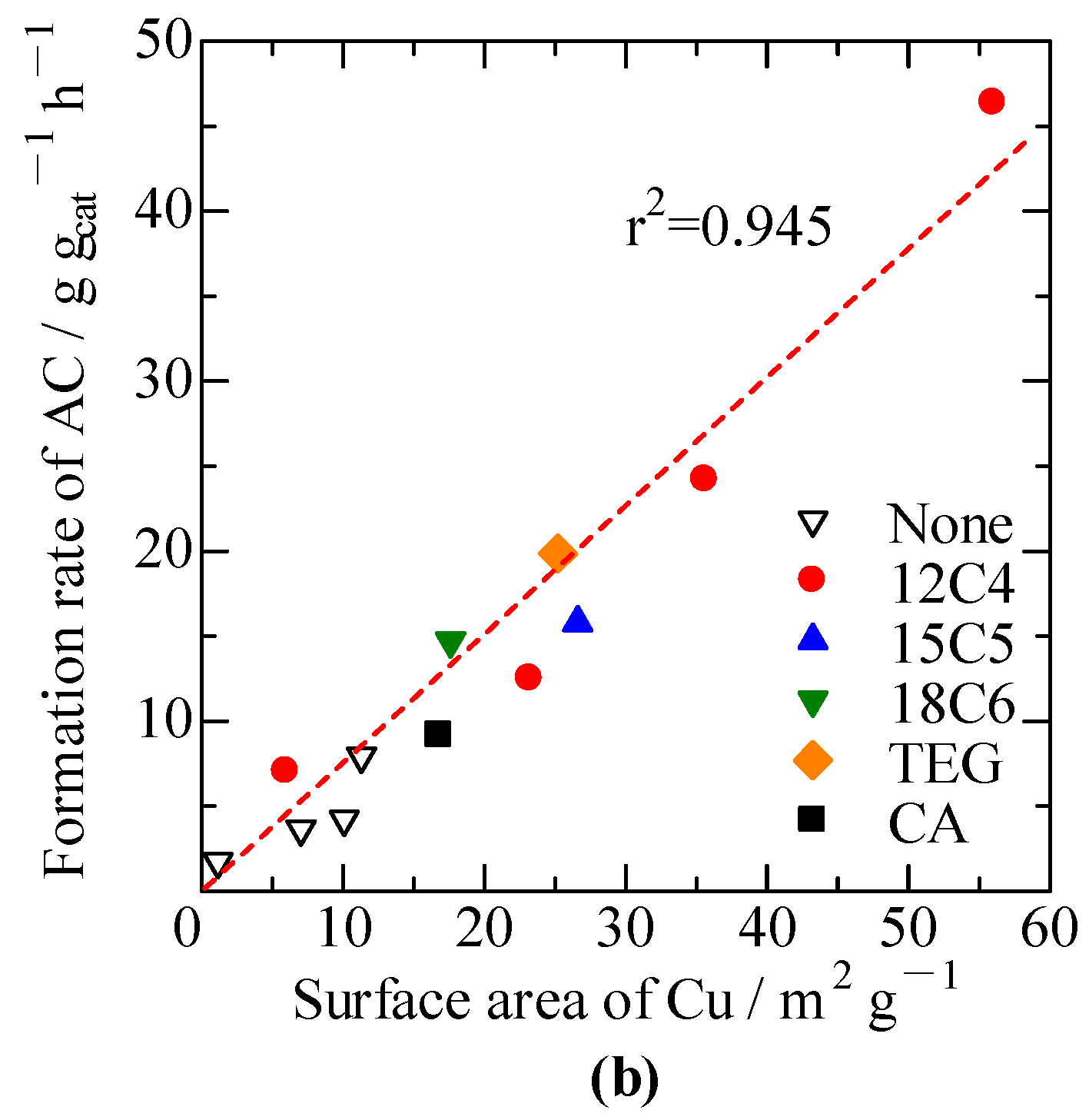
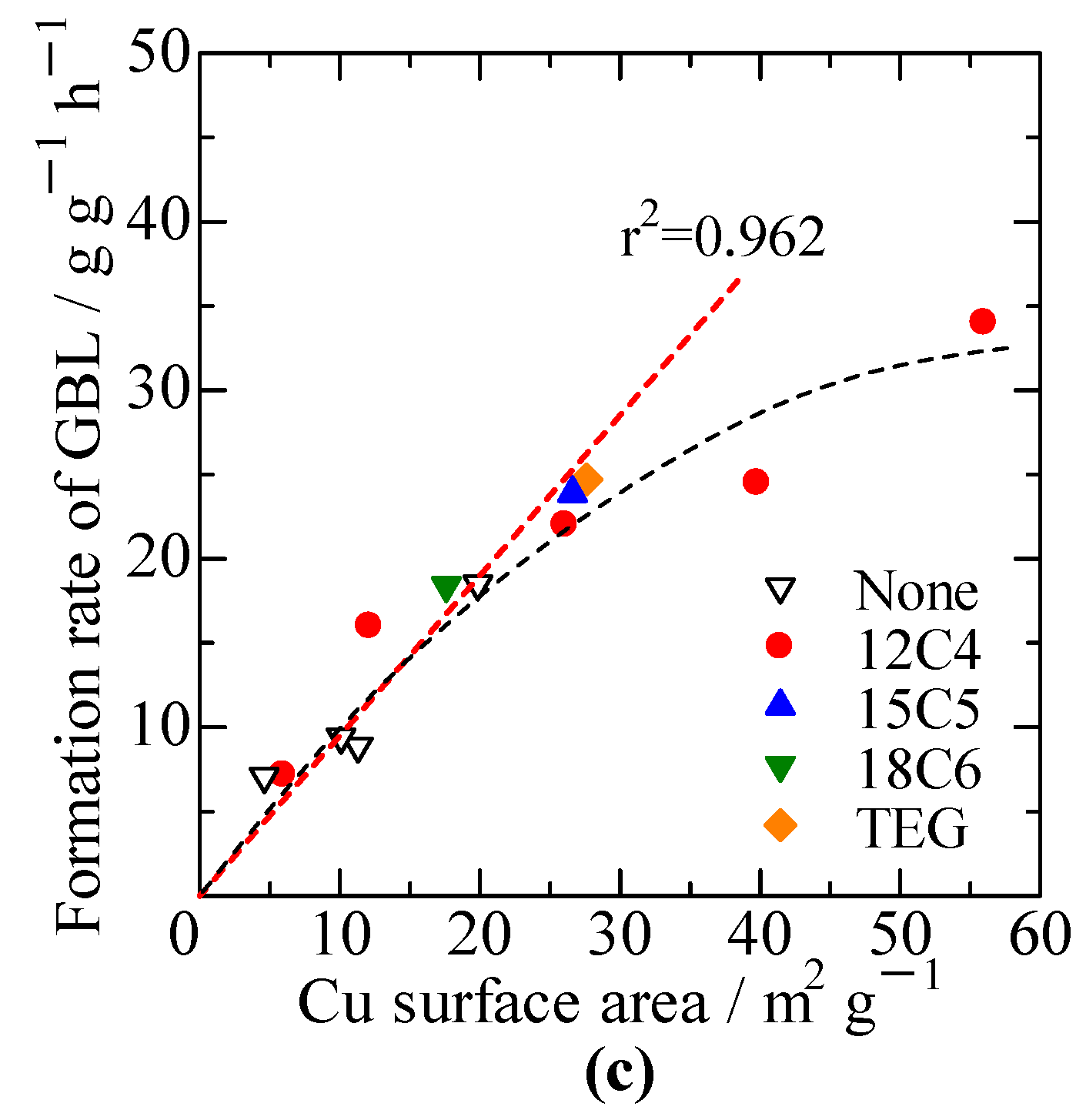
Reference
- Kurniawan, E.; Hosaka, S.; Kobata, M.; Yamada, Y.; Sato, S. Vapor-Phase Oxidant-Free Dehydrogenation of 2,3- and 1,4-Butanediol over Cu/SiO2 Catalyst Prepared by Crown-Ether-Assisted Impregnation. Chemistry 2023, 5, 406–421. [Google Scholar] [CrossRef]
Disclaimer/Publisher’s Note: The statements, opinions and data contained in all publications are solely those of the individual author(s) and contributor(s) and not of MDPI and/or the editor(s). MDPI and/or the editor(s) disclaim responsibility for any injury to people or property resulting from any ideas, methods, instructions or products referred to in the content. |
© 2023 by the authors. Licensee MDPI, Basel, Switzerland. This article is an open access article distributed under the terms and conditions of the Creative Commons Attribution (CC BY) license (https://creativecommons.org/licenses/by/4.0/).
Share and Cite
Kurniawan, E.; Hosaka, S.; Kobata, M.; Yamada, Y.; Sato, S. Correction: Kurniawan et al. Vapor-Phase Oxidant-Free Dehydrogenation of 2,3- and 1,4-Butanediol over Cu/SiO2 Catalyst Prepared by Crown-Ether-Assisted Impregnation. Chemistry 2023, 5, 406–421. Chemistry 2023, 5, 1719-1721. https://doi.org/10.3390/chemistry5030117
Kurniawan E, Hosaka S, Kobata M, Yamada Y, Sato S. Correction: Kurniawan et al. Vapor-Phase Oxidant-Free Dehydrogenation of 2,3- and 1,4-Butanediol over Cu/SiO2 Catalyst Prepared by Crown-Ether-Assisted Impregnation. Chemistry 2023, 5, 406–421. Chemistry. 2023; 5(3):1719-1721. https://doi.org/10.3390/chemistry5030117
Chicago/Turabian StyleKurniawan, Enggah, Shuya Hosaka, Masayuki Kobata, Yasuhiro Yamada, and Satoshi Sato. 2023. "Correction: Kurniawan et al. Vapor-Phase Oxidant-Free Dehydrogenation of 2,3- and 1,4-Butanediol over Cu/SiO2 Catalyst Prepared by Crown-Ether-Assisted Impregnation. Chemistry 2023, 5, 406–421" Chemistry 5, no. 3: 1719-1721. https://doi.org/10.3390/chemistry5030117
APA StyleKurniawan, E., Hosaka, S., Kobata, M., Yamada, Y., & Sato, S. (2023). Correction: Kurniawan et al. Vapor-Phase Oxidant-Free Dehydrogenation of 2,3- and 1,4-Butanediol over Cu/SiO2 Catalyst Prepared by Crown-Ether-Assisted Impregnation. Chemistry 2023, 5, 406–421. Chemistry, 5(3), 1719-1721. https://doi.org/10.3390/chemistry5030117

