
Systematic Review

Internet of Things for Industry 4.0: A Systematic Literature Review of Technologies, Architectures, Applications, and Challenges


1
Laboratory of Systems Analysis, Information Processing and Industrial Management (LASTIMI), High School of Technology of Salé, Mohammed V University, Rabat 10000, Morocco
2
LyRICA Lab, ITQAN Team, School of Information Sciences, Rabat 10100, Morocco
3
Laboratory of Innovative Technologies and Informatics (LT2I), High School of Technology of Fez, Sidi Mohamed Ben Abdellah University, Fez 30000, Morocco
*
Author to whom correspondence should be addressed.
Submission received: 26 April 2026 / Revised: 29 May 2026 / Accepted: 3 June 2026 / Published: 11 June 2026
(This article belongs to the Topic Smart Production in Terms of Industry 4.0 and 5.0)

Abstract

Industry 4.0 is speeding up the move to connected, data-driven, and automated production, where the Internet of Things (IoT) enables sensing, communication, and real-time support for decisions. At the same time, rapid growth in industrial IoT studies has led to scattered technologies, architectures, and results. This paper fills this gap through a systematic literature review on IoT for Industry 4.0. It also helps readers compare methods and choose suitable building blocks for real deployments today. We focus on key technologies, integration architectures, application areas, challenges, trends, and reported benefits. Using PRISMA 2020, we searched five major databases (Scopus, MDPI, IEEE Xplore, ScienceDirect, and Web of Science) for 2020–2025 and found 584 records. After removing duplicates and screening, we kept 96 peer-reviewed studies for detailed analysis. Results show that most studies use a layered stack that combines sensing/actuation, industrial networking, data collection pipelines, and analytics across edge, fog, and cloud resources. MQTT, OPC UA, CoAP, LPWAN, and 5G connectivity are often used for communication, while RAMI 4.0, IIRA, and similar layered models guide system design. Many architectures follow an edge–cloud pattern, with growing focus on digital twin/CPS links and security-by-design. Applications are mainly smart manufacturing, predictive maintenance, and logistics, with added work in energy management, Construction 4.0, and agri-food monitoring. The key barriers remain interoperability, data quality and evaluation gaps, cybersecurity risks, legacy integration, and deployment limits. The review points to future work on edge AI/TinyML, deterministic connectivity, scalable digital twins, trusted data sharing, and sustainable industrial IoT.

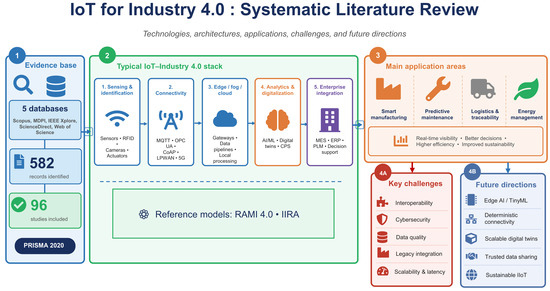
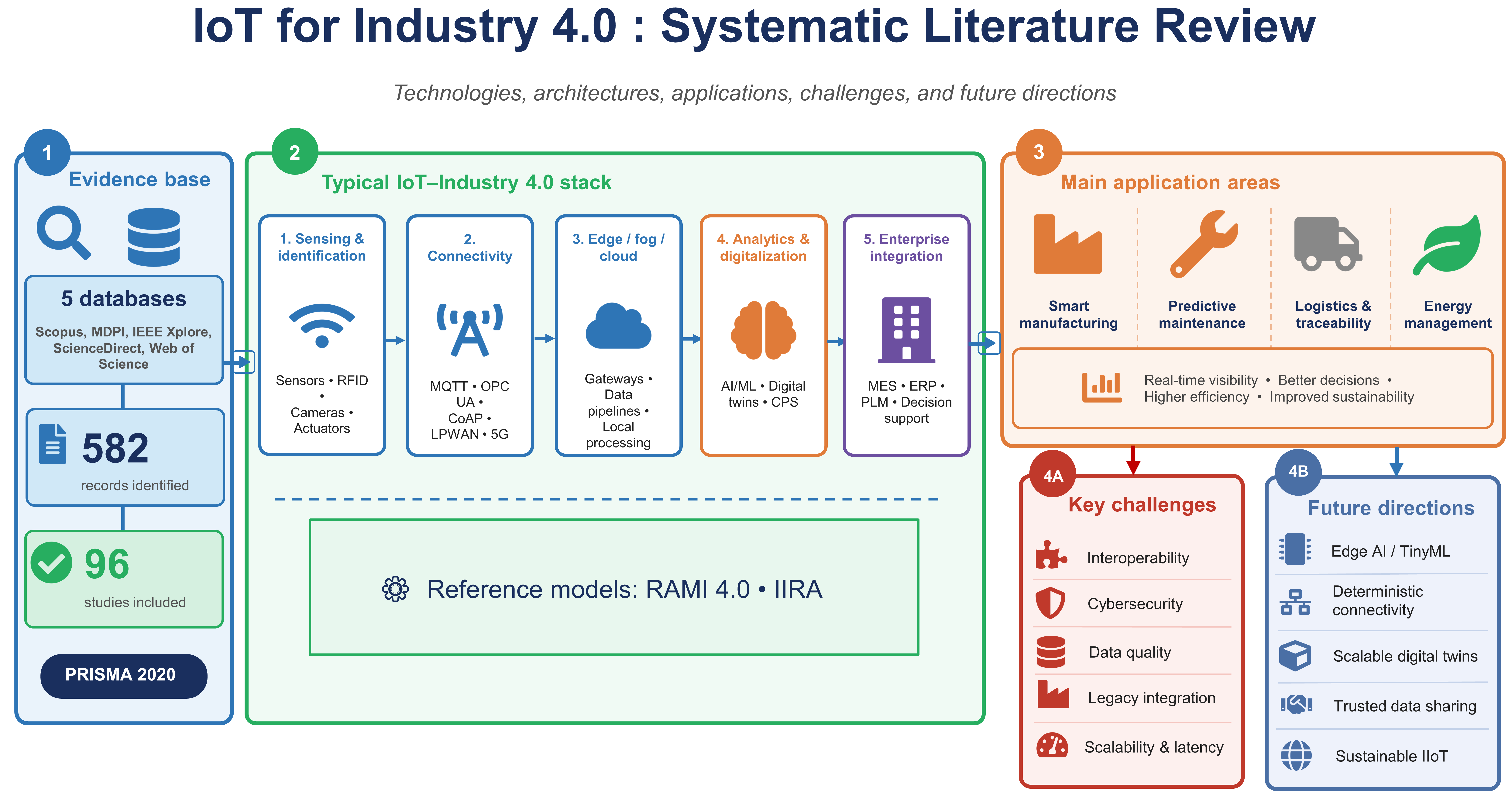
Graphical Abstract

1. Introduction

Industrial systems are moving from stand-alone equipment to connected production networks that learn from data [1]. In this setting, the Internet of Things (IoT), often called the Industrial IoT (IIoT), links sensors and actuators with communications, edge and cloud computing, and analytics [2]. This link helps plants observe their processes, react faster, and improve safety, quality, productivity, and sustainability. Between 2020 and 2025, several enabling technologies became mature enough for regular use [3], not only for pilot projects. These advances include low-power sensors, 5G and TSN networking, container-based edge platforms, lightweight machine learning, and secure device management. As a result, deployments have spread from process industries and discrete manufacturing to energy, mining, logistics, and smart facilities. However, decision-makers still face a fragmented landscape of platforms, protocols, and reference architectures [4]. Studies often report results using different datasets, testbeds, and metrics, which makes fair comparison difficult [5]. Persistent issues include interoperability, cybersecurity, system reliability, clear interpretation of analytics, and proving return on investment. For this reason, a rigorous synthesis is timely. A clear map of tools and architectures can guide researchers and help practitioners plan upgrades with less risk today. Early industrial efforts focused on RFID for supply-chain visibility, but the scope expanded with better wireless links, cloud computing, and embedded systems. At the same time, Industry 4.0 framed this shift as a new industrial revolution, where IoT connects physical assets to digital platforms and supports smart, adaptive production ecosystems [6].

1.1. Internet of Things (IoT)

In the Industry 4.0 literature, the Internet of Things (IoT) is not presented only as a set of connected devices. It is mainly used as a data link between physical industrial assets and digital decision systems. Early IoT work was linked to RFID and supply-chain visibility, but recent studies extend this role to sensors, actuators, cameras, gateways, communication protocols, edge nodes, cloud platforms, and analytics tools [7,8,9,10]. In this view, IoT creates the data chain that allows machines, products, and production lines to be observed, connected, and controlled in a more structured way. The reviewed studies also show a clear difference between general IoT and Industrial IoT (IIoT). General IoT covers many domains, such as healthcare, agriculture, transport, and smart cities. IIoT is more specific because it works under industrial constraints, including safety, reliability, low latency, data quality, and legacy equipment [11]. In this context, IoT connects operational technology (OT), such as PLCs and SCADA, with information technology (IT), such as cloud platforms, analytics tools, MES, ERP, and PLM systems [12,13]. This OT–IT connection is central to Industry 4.0, but it also creates integration, interoperability, and security challenges.
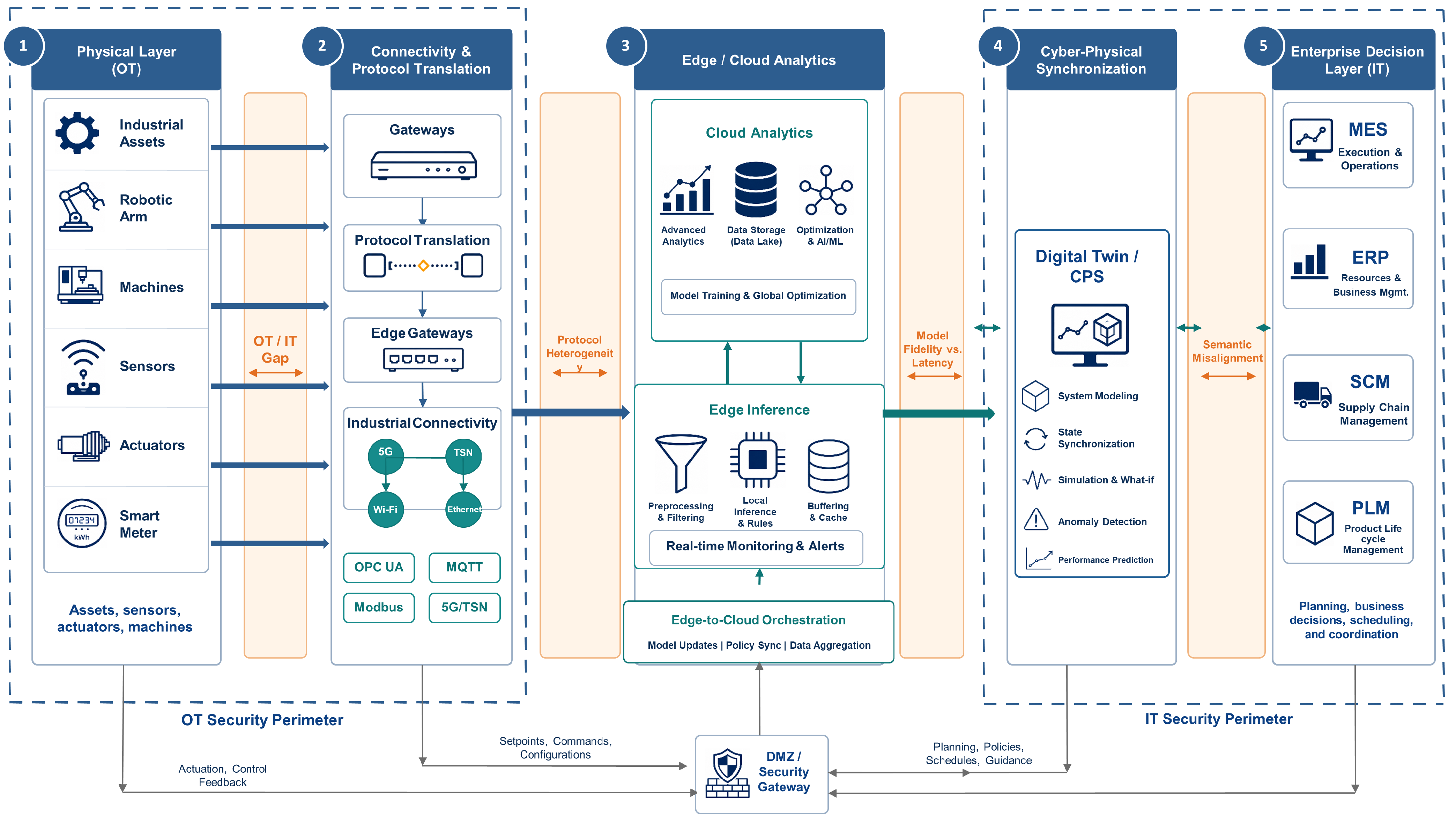
Across the literature, IoT architectures for Industry 4.0 are often described through five connected layers [14]. The perception layer collects physical data and supports actuation through sensors, RFID, cameras, meters, and embedded devices. The network layer transfers these data through industrial and wireless communication technologies, including MQTT, OPC UA, Wi-Fi, 5G, Zigbee, and LoRaWAN [15]. The edge/processing layer filters, aggregates, and prepares data close to the production source, which reduces delay and network load [16]. The application layer uses the processed data for services such as monitoring, predictive maintenance, energy management, scheduling, and digital twins. The business layer links IoT outputs with enterprise systems, KPIs, compliance, and decision support. The main value of this layered view is not only the separation of functions. It also shows how problems can move from one layer to another. Poor sensing reduces data quality, weak communication increases delay and data loss, limited edge processing affects real-time response, and weak business integration prevents analytics from creating operational value. For this reason, the main issue in IIoT is not only to define the layers but also to manage their interaction in real industrial deployments. Figure 1 presents the five-layer architecture used in this review as a basis for analysing IoT technologies, architectures, and challenges in Industry 4.0.
From the reviewed studies, the most repeated IIoT requirements are interoperability, cybersecurity, scalability, low latency, reliability, and cost-effective deployment [17,18]. These requirements explain why the literature does not converge on one single architecture or protocol. Some studies focus on semantic interoperability, others on edge processing, predictive maintenance, digital twins, or security-by-design. Therefore, this review treats IoT as an integration framework for Industry 4.0, not as a simple list of devices or communication tools.

1.2. Industry 4.0

Industry 4.0 is described in the literature as a move from isolated automation to connected, data-driven, and adaptive production. The concept emerged from the German industrial strategy, but recent studies treat it less as a historical stage and more as an integration framework for modern factories [19]. In this framework, cyber–physical systems, digital connectivity, and data analytics link physical operations with digital models and decision tools [20,21,22]. Industry 4.0 depends on the coordination of several technologies, not on one single tool. IoT provides sensing and connectivity. Artificial intelligence and machine learning support prediction, fault detection, optimisation, and decision support. Edge, fog, and cloud computing define where data are processed and stored. Digital twins and CPSs link physical assets with virtual models, while MESs, ERP, and PLM connect shop-floor data with planning and business decisions [23]. The value of Industry 4.0 therefore comes from the combined use of these technologies across production, maintenance, logistics, energy management, and quality control.
The literature also shows that this coordination remains difficult in practice. Many industrial projects start with connectivity, data collection, and monitoring, before moving toward analytics, automation, or digital twins. However, partial adoption can create fragmented systems when machines, sensors, software platforms, and enterprise tools do not share data in a consistent way. This explains why interoperability, data governance, cybersecurity, worker skills, investment cost, and return on investment are repeated barriers in Industry 4.0 studies. Within this context, IoT acts as the connectivity backbone of Industry 4.0. Smart factories, autonomous logistics, predictive maintenance, digital twins, and integrated supply chains all depend on continuous data exchange between physical operations and digital systems [24,25]. Figure 2 presents this smart-factory view, where physical systems, IoT connectivity, edge/cloud analytics, digital twins, and enterprise control form a closed industrial feedback loop [26]. In this review, Industry 4.0 is therefore treated as the industrial setting in which IoT technologies are selected, combined, and evaluated.

1.3. Why IoT Matters for Industry 4.0

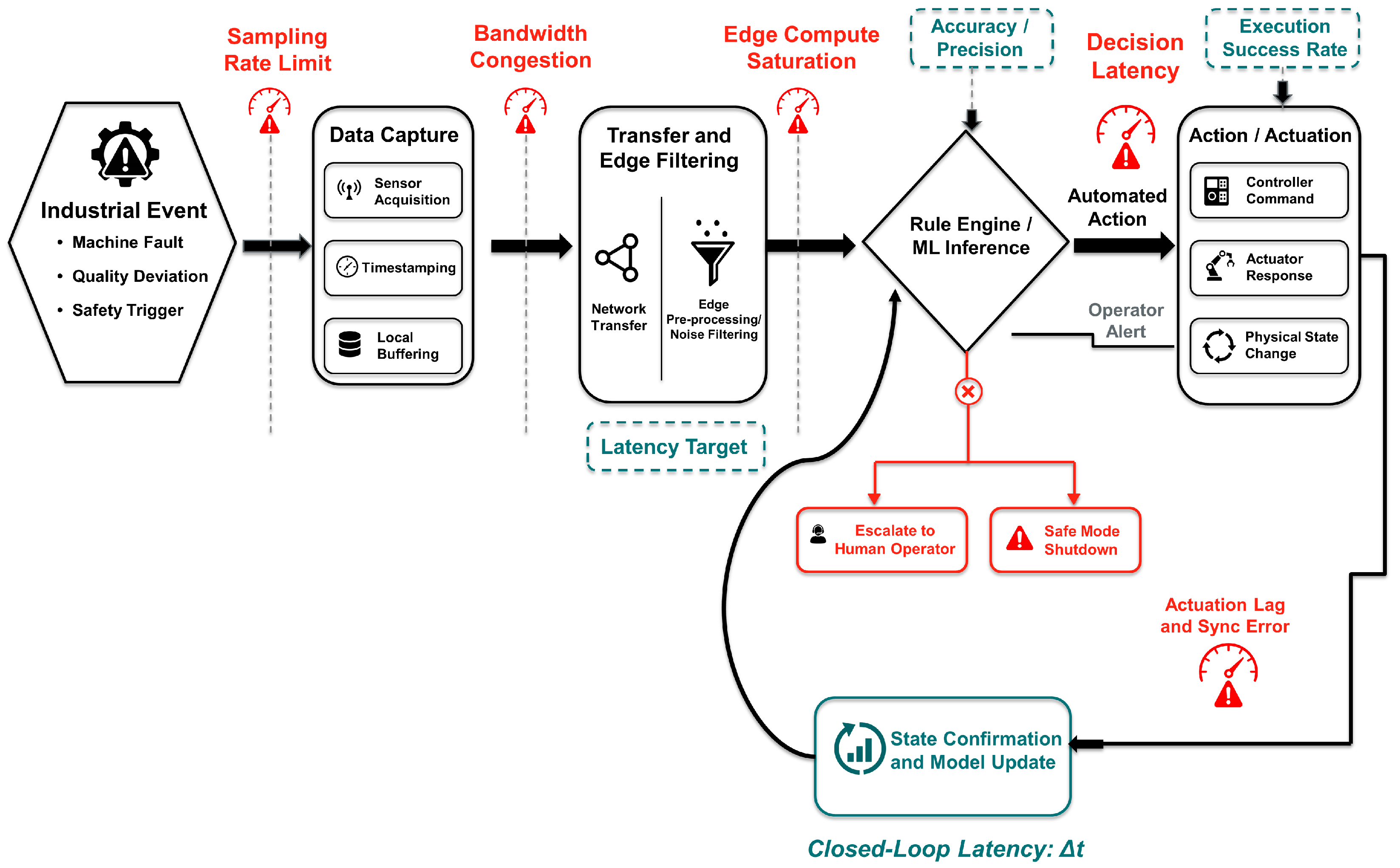
In Industry 4.0, IoT matters because it changes industrial events into usable operational evidence. A machine stoppage, an abnormal vibration signal, a temperature drift, an energy peak, or a quality deviation becomes more valuable when it can be captured, time-stamped, transferred, analysed, and linked to an action. Without this connection, factories often keep data inside separate machines, spreadsheets, control rooms, or maintenance logs, which slows diagnosis and weakens coordination between production teams. IoT reduces this separation by creating a continuous information path between equipment, products, operators, and digital platforms [27,28]. The added value is therefore not limited to connecting assets. It lies in converting operational signals into decisions that can improve maintenance planning, process control, energy use, quality monitoring, and resource allocation. This point is important for the present review because many included studies do not treat IoT as a standalone technology. They examine it as the mechanism that makes industrial data usable across technical and managerial levels. The IoT workflow in Industry 4.0 can be read as an event-to-action pathway. Data are first produced by sensors, RFID tags, cameras, meters, controllers, and machine interfaces. They then move through industrial networks, gateways, and edge nodes, where early filtering or local checks can reduce delay and limit unnecessary data transfer. Storage and integration tools connect these processed data with databases, data lakes, MESs, ERP, PLM, and other enterprise resources. Analytics, AI, and machine learning then transform the data into maintenance alerts, fault detection results, production plans, energy recommendations, or quality decisions [29,30]. The final value appears only when these results return to the industrial process through control commands, operator guidance, dashboard updates, digital twin states, or human–machine interaction. In this way, IoT links monitoring with execution and makes Industry 4.0 less dependent on delayed manual reporting.
The same workflow also explains why IoT deployment is difficult. Each transition in the pathway can reduce the value of the final decision. Sensor signals may be incomplete, communication gateways may translate protocols differently, edge devices may have limited computing capacity, and enterprise platforms may store data in incompatible formats. Analytics may also lose value when models are trained on weak or delayed data, while dashboards and digital twins become less useful when their information is not aligned with the real production state. These limits show that IoT performance depends on coordination across the whole pathway, not on a single device, protocol, or platform. Figure 3 presents this operational loop from data capture to action and visualization. In this review, this figure is used as a guide for analysing how the selected studies address data collection, communication, processing, analytics, actuation, and human decision support in Industry 4.0 systems.
Recent review articles confirm that IoT and Industry 4.0 have already attracted strong academic attention, but they approach the field from different angles. Kumar et al. [31] mainly mapped publication growth, citations, authors, countries, and keyword patterns through a Scopus-based bibliometric analysis. Kalsoom et al. [32] focused on the impact of IoT in manufacturing Industry 4.0 and identified drivers, enablers, challenges, and future research domains. The review by Soori et al. [33] centred on smart-factory applications, such as predictive maintenance, asset tracking, quality control, energy efficiency, and supply-chain optimisation. Afrin et al. [34] expanded the scope toward IIoT implementations across several sectors, including agriculture, construction, healthcare, robotics, smart grids, and predictive maintenance. Qiu et al. [20] placed more emphasis on the integration of IoT, IIoT, and Industry 4.0 from a technical and security-oriented perspective, covering CPS, AI/ML, 5G, MQTT, and industrial security issues. These contributions are valuable, but they do not address the same gap. Table 1 therefore compares their scope and shows how the present review positions itself through a recent PRISMA 2020 multi-database synthesis, a five-layer IoT–Industry 4.0 taxonomy, and a combined analysis of technologies, architectures, applications, challenges, and future trends.

1.4. Objectives and Contributions of the Review

Major industrial programs have pushed factories toward smart, connected, and more independent operations. Well-known examples include Industry 4.0 in Germany, the Advanced Manufacturing Partnership (AMP) in the United States, Made in China 2025, and the Factories of the Future (FoF) program in Europe. Over the last decade, IoT, cyber–physical systems (CPSs), artificial intelligence (AI), and big data methods have changed how many industrial systems are built and run [33]. Yet the research on IoT within Industry 4.0 is still scattered. Many papers study specific tools or use cases, but fewer works bring the evidence together in a clear and systematic way. This makes it harder for readers to see what works well, what is still missing, and how different choices fit together.
This review addresses this need through a systematic literature review (SLR). We select and study peer-reviewed papers from 2020 to 2025 that focus on IoT in Industry 4.0 [35]. Our aim is to give readers a clear view of the research landscape, the main technical directions, and the industrial areas where these ideas are applied.
The objectives of this review are as follows [36]:
  • O1. To describe how IoT research for Industry 4.0 has evolved and what trends are most visible today.
  • O2. To identify the main technologies, architectures, and standards used in industrial IoT systems, from sensing and networking to edge/cloud computing and analytics.
  • O3. To examine the key application areas (such as manufacturing, logistics, energy, and maintenance) where IoT has shown strong impact.
  • O4. To discuss research gaps, open challenges, and future opportunities, with attention to scale, system-to-system communication, cybersecurity, and long-term deployment.
Based on these objectives, the contributions of this review are as follows:
  • A structured map of IoT-based Industry 4.0 research from 2020 to 2025, grouped by application area, technology choices, and study purpose.
  • A clear taxonomy of IoT architectures and workflows in Industry 4.0 that links sensing, connectivity, edge computing, data handling, and analytics in one framework.
  • A synthesis of common design patterns and key technologies that appear in successful studies, helping readers learn good practices and spot areas of agreement.
  • A discussion of unresolved gaps and a future research agenda that can guide researchers, engineers, and policymakers working on IoT-driven industrial change.
The rest of this paper is organized as follows. Section 2 explains the SLR method, including the research protocol, search process, inclusion and exclusion rules, and the use of the PRISMA framework. Section 3 presents and discusses the results, including publication trends, application areas, key technologies, and IoT architectures in the selected studies. It also links these findings to the research questions and points out the main drivers, challenges, and emerging themes. Section 4 outlines research implications and future directions for IoT in Industry 4.0. Finally, Section 5 concludes the paper by summarizing the main contributions and the value of this review for both research and industrial practice.

2. Methodology

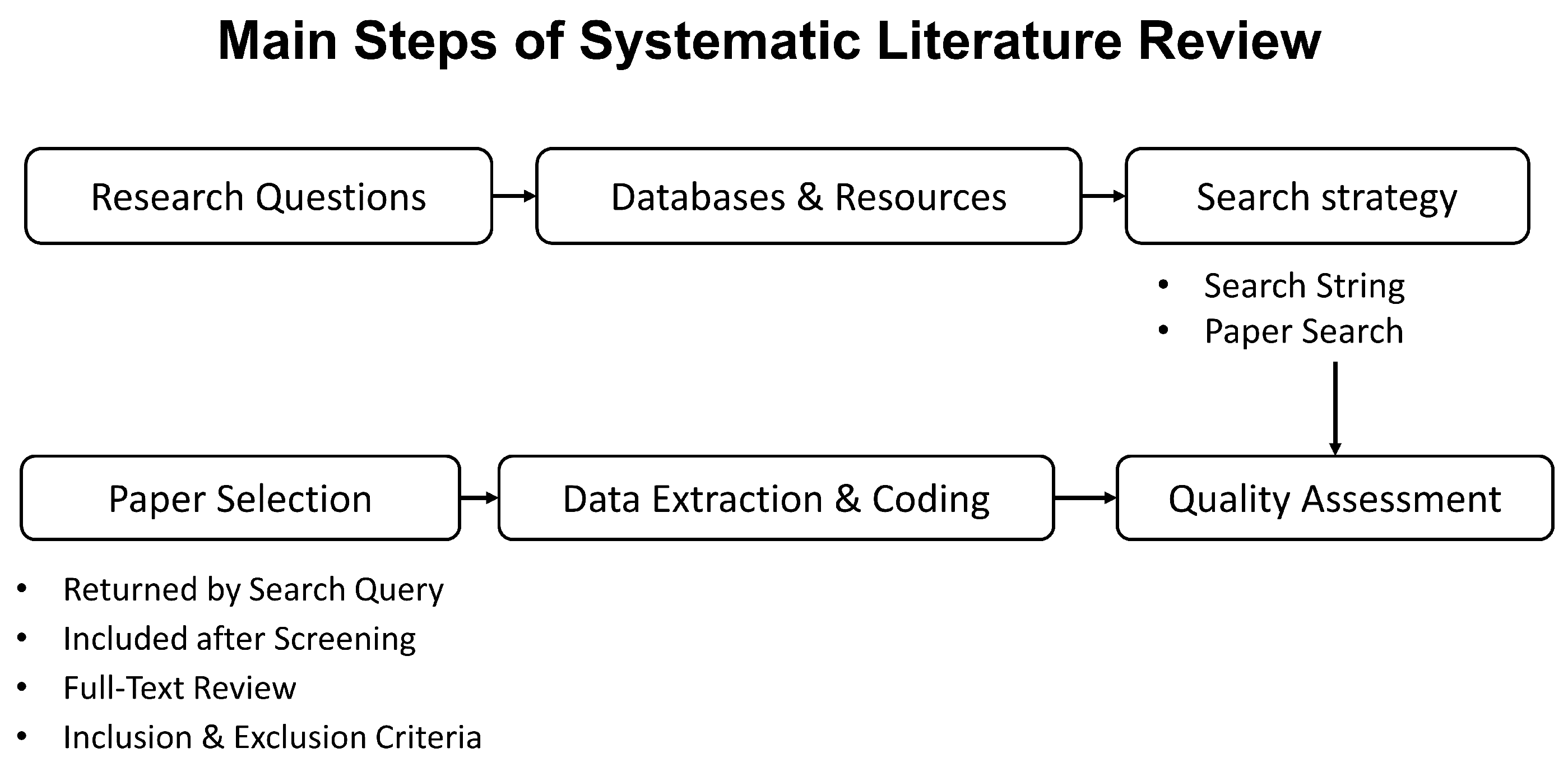
This section explains how we carried out the systematic literature review (SLR) on the use of the Internet of Things (IoT) in Industry 4.0. We follow the general SLR guidance by Kitchenham and Charters (2007) and we use the PRISMA protocol for reporting [37]. The goal is to keep the review process clear, repeatable, and well structured. This helps readers trust how the papers were found, selected, and discussed.

2.1. Systematic Review Protocol

In recent years, many papers have studied Industry 4.0 and IoT from different angles. Some papers focus on specific technologies, while others discuss system design, real use cases, or management issues. Because the field moves fast, results are often spread across many sources and are not easy to compare [38,39]. For this reason, a neutral and structured summary is important. This helps readers understand what IoT really brings to Industry 4.0 and where the main limits remain.
To meet this need, we use an SLR method that supports an objective and repeatable review of earlier work. We rely on clear rules for searching, selecting, and studying the papers. We also combine two types of analysis. The qualitative part looks at key concepts, frameworks, and links between themes. The quantitative part examines publication counts, the spread of technologies, and visible research trends. Together, these two views give a clearer picture than either one alone.
We follow the PRISMA framework, which organizes the review into four stages: identification, screening, eligibility, and inclusion [40]. These stages make it easy to track how papers move from the first search to the final set of studies. This review was not registered in a systematic review registry. No separate public protocol was prepared; however, the review protocol, including the research questions, search strategy, eligibility criteria, selection process, data extraction, and quality assessment, is described in Section 2. Figure 4 summarizes the PRISMA workflow used in this review, from database search to the final list of included papers. The complete PRISMA checklist is available in Supplementary Table S1. This protocol helps ensure that the collected evidence on IoT in Industry 4.0 is broad, fair, and consistent with the objectives set in Section 1.4.

2.2. Research Questions

To understand how Internet of Things (IoT) technologies are used in Industry 4.0, this review is guided by five research questions (RQs). They help us collect papers in a consistent way and compare their findings over the 2020–2025 period. Together, these questions also help non-specialist readers follow the main technical choices and the reasons behind them.
  • RQ1. What IoT technologies, frameworks, and communication standards are used in Industry 4.0 systems, and what strengths and limits do studies report? This question covers sensing tools, communication options, and edge or cloud platforms, with attention to both benefits and practical limits.
  • RQ2. How is IoT used inside Industry 4.0 system design, and which design models or reference architectures appear most often? This question looks at how sensing, communication, data processing, and applications are arranged, and how IoT works with CPS, data analytics, and AI.
  • RQ3. In which industrial areas is IoT most often used under the Industry 4.0 vision? This question groups use cases such as manufacturing, logistics, maintenance, energy, and smart factories, and it reports the main outcomes in each area.
  • RQ4. What key issues and open problems are linked to IoT adoption in Industry 4.0 settings? This question covers barriers such as system-to-system communication, cybersecurity, latency, scale, standards, data handling, and long-term deployment.
  • RQ5. What trends and future research directions do studies suggest for IoT-based Industry 4.0 systems? This question highlights gaps in current work and points to future steps that may improve reliability and real industrial use.

2.3. Identification and Search Strings

For the identification stage, we searched five major sources that cover engineering, computer science, industrial systems, and applied research: Scopus, IEEE Xplore, Web of Science Core Collection, ScienceDirect, and MDPI. The aim was to retrieve peer-reviewed studies on IoT in the context of Industry 4.0, while also covering related work on smart manufacturing, industrial automation, cyber–physical systems, digital twins, edge computing, and predictive maintenance. MDPI Open Access journals, including Sensors, Applied Sciences, and Sustainability, were also searched because they contain many recent studies on IoT and industrial digital transformation.
The search strings were aligned with the research questions in Section 2.2. An initial broad query returned more than 18,000 records in Scopus, which showed that the search was too general: TITLE-ABS-KEY ((“Internet of Things” OR IoT OR “Industrial Internet of Things” OR IIoT OR “cyber-physical systems”) AND (“Industry 4.0” OR “Fourth Industrial Revolution” OR “smart manufacturing” OR “digital factory” OR “industrial automation”)). The final strategy therefore required the two core terms, “Internet of Things” or IoT and “Industry 4.0”, to appear in the title. Related terms were searched in the title, abstract, and keywords when the database interface allowed it.
Because each database uses different field tags and query limits, the same search logic was adapted to each platform. In Scopus, the final query was: TITLE ((“Internet of Things” OR IoT) AND (“Industry 4.0”)) AND TITLE-ABS-KEY (“digital twin” OR “smart factory” OR “cyber-physical system” OR “predictive maintenance” OR “industrial automation” OR “manufacturing process” OR “edge computing” OR “data-driven production”). In IEEE Xplore, the query was adapted to the available metadata fields: (“Document Title”: “Internet of Things” OR “Document Title”: IoT) AND (“Document Title”: “Industry 4.0”). In Web of Science Core Collection, the core terms were searched in the title field and the contextual terms in the Topic field: TI = ((“Internet of Things” OR IoT) AND (“Industry 4.0”)) AND TS = (“digital twin” OR “smart factory” OR “cyber-physical system” OR “predictive maintenance” OR “industrial automation” OR “manufacturing process” OR “edge computing” OR “data-driven production”). For ScienceDirect, the query was split across fields because of the platform limit on Boolean connectors: the main field contained “Internet of Things” AND “Industry 4.0”, while the two additional fields contained “digital twin” OR “smart factory” OR “cyber-physical system” OR “predictive maintenance” and “industrial automation” OR “manufacturing process” OR “edge computing” OR “data-driven production”. On the MDPI Open Access platform, the query (“Internet of Things” AND “Industry 4.0”) was applied in the Title/Abstract/Keywords field.
To address the possible effect of the title-based restriction, a sensitivity check was conducted in Scopus and Web of Science. This check was not used to rebuild the PRISMA corpus, but to verify whether a broader title/abstract/keyword strategy would introduce new major themes outside the final review structure. In Scopus, the broader query was: TITLE-ABS-KEY ((“Internet of Things” OR IoT OR IIoT OR “Industrial Internet of Things” OR “industrial AIoT” OR “cyber-physical system” OR “cyber-physical systems” OR CPS) AND (“Industry 4.0” OR “Fourth Industrial Revolution” OR “smart manufacturing” OR “digital manufacturing” OR “digital factory” OR “industrial automation”) AND (“digital twin” OR “predictive maintenance” OR “edge computing” OR “smart factory” OR “manufacturing process” OR “data-driven production”)). This broad search returned 6327 records before filters. After applying the 2020–2025, article/review, and final-publication filters, 1890 records remained. The detailed Scopus search syntax and sensitivity results are provided in Supplementary Table S2. In Web of Science, the equivalent Topic Search was: TS = ((“Internet of Things” OR IoT OR IIoT OR “Industrial Internet of Things” OR “industrial AIoT” OR “cyber-physical system” OR “cyber-physical systems” OR CPS) AND (“Industry 4.0” OR “Fourth Industrial Revolution” OR “smart manufacturing” OR “digital manufacturing” OR “digital factory” OR “industrial automation”) AND (“digital twin” OR “predictive maintenance” OR “edge computing” OR “smart factory” OR “manufacturing process” OR “data-driven production”)). This search produced 2839 records before filters. After applying the available filters for 2020–2025, article/review document type, and English language, 1470 records remained. The detailed Web of Science search syntax and sensitivity results are provided in Supplementary Table S3.
The filtered sensitivity records were inspected at the level of titles, abstracts, and keywords. The broader searches increased the number of records, but they mainly expanded themes already represented in the final corpus, including IIoT, cyber–physical systems, smart manufacturing, digital twins, edge/cloud computing, AI/ML, predictive maintenance, cybersecurity, blockchain, energy systems, logistics, robotics, agriculture, healthcare, and construction. They did not reveal a new major technology group, application domain, architecture type, or challenge category outside the scope already covered by the final synthesis. Therefore, the title-based restriction was retained for the main PRISMA corpus because it improved thematic precision while preserving the conceptual coverage needed to answer the research questions. The first record export and screening file were prepared from 18 February 2026, and the last search across all databases was conducted on 13 April 2026. After retrieval, all records were exported for duplicate removal and screening. Table 2 reports the number of records found in each database at the identification stage, before duplicate removal and screening.
A total of 584 documents were first found across the five databases. We then imported these records into a reference manager to remove duplicates and prepare them for screening. The next step applied the inclusion and exclusion rules described in the following section.

2.4. Selection of Papers

After the identification step, we combined all records from the databases into one list. We removed duplicates and then screened the remaining papers using clear inclusion and exclusion rules. This step helped us keep only strong studies that match the scope of this review. We followed PRISMA guidance to keep the selection process clear and easy to repeat. As a result, readers can see how the final set of papers was chosen and why some papers were left out.

2.4.1. Inclusion and Exclusion Criteria

We set inclusion rules to keep only studies that directly match the goals of this review. In particular, we focused on work that links the Internet of Things (IoT) with Industry 4.0 in industrial and manufacturing settings. We also checked that the selected papers provide enough detail to support a reliable review. Table 3 lists the full set of inclusion criteria used in this study. Only peer-reviewed journal articles and review articles were eligible for inclusion; conference papers and proceedings were excluded during source-level filtering.
In parallel, we applied exclusion rules to remove papers that may mention IoT or Industry 4.0 but do not match the aims of this review. This step helps keep the focus on industrial settings and avoids adding papers that could confuse the overall picture. It also improves the quality of the final dataset by keeping only studies with clear value for our research questions. Table 4 lists the exclusion criteria used during screening.
All papers that met the inclusion rules and passed the exclusion screening were then read in full. At this step, we collected key details such as study aims, used technologies, data sources, system design, and reported outcomes. We then placed this information in a structured form so we could compare studies in a consistent way.

2.4.2. PRISMA Flow of Study Selection

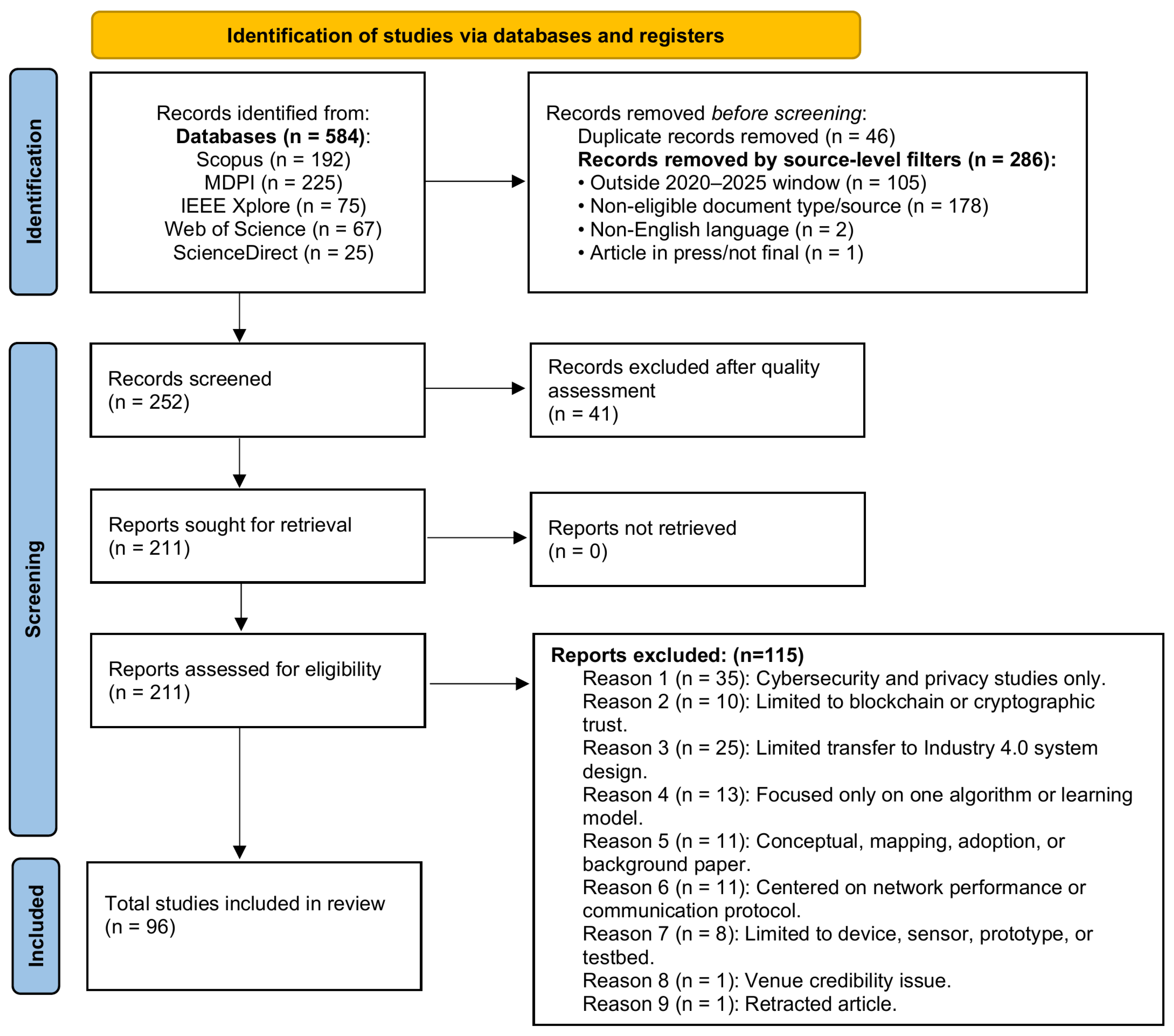
The study selection process followed PRISMA 2020 and tracked the reduction in records at each filtering stage. The database search retrieved 584 documents: MDPI (225), Scopus (192), IEEE Xplore (75), Web of Science Core Collection (67), and ScienceDirect (25).
Source-level filters were then applied for publication year, document type, language, and final publication status. In Scopus, the 2020–2025 filter reduced 192 records to 155. Restricting the set to journal articles and reviews left 54 records, after excluding 58 conference papers, 36 book chapters, 3 books, 2 data papers, 1 editorial, and 1 conference review. One article in press was then removed, giving 53 final Scopus records. In MDPI, 225 records were reduced to 195 by the year filter and to 185 after limiting the set to research and review articles. The excluded MDPI records were four systematic reviews, three proceeding papers, one correction, one editorial, and one communication.
For ScienceDirect, 25 records were retrieved for 2020–2025. Removing 3 book chapters and 2 data articles left 20 final journal and review papers. In Web of Science, the date filter reduced 67 records to 49, and article/review, language, and final-publication filters left 34 records. The removed records included proceedings papers, a data paper, an early-access record, and two non-English studies. In IEEE Xplore, the 2020–2025 filter reduced 75 records to 55. Limiting the set to journal articles left 6 records, after excluding 42 conference papers, 6 books, and 1 magazine item.
After these database-specific filters, 298 records remained as potentially relevant studies. Duplicate checking across databases removed 46 repeated records, leaving 252 unique papers for the next stages of screening and eligibility assessment. The full workflow, from database retrieval to the final set of included studies, is presented in the PRISMA flow diagram (Figure 5).

2.4.3. Data Extraction and Quality Assessment

After the identification step, 252 studies remained for data extraction and quality checks. This step helps ensure that the final set of papers is both reliable and relevant to our review topic. In particular, we focus on how the Internet of Things (IoT) is used in Industry 4.0 studies published between 2020 and 2025.
For data extraction, we manually collected key information from each paper based on the research questions defined earlier. For each study, we recorded basic details such as the publication year, database source, title, and authors. We also collected content details that matter for analysis. These include the study aim, the target domain (for example, manufacturing, logistics, energy, or healthcare), the IoT system design or framework, and the main technologies used (such as cloud, edge, AI, or digital twins). We also noted the study type (experimental, conceptual, review, or mixed) and the main results and limits reported by the authors. This dataset supports the descriptive results and the theme-based discussion in the next sections.
To improve reliability, we defined quality criteria before we started the synthesis. The criteria check five aspects: (1) clear research aims, (2) a clear and well explained method, (3) a clear added value for IoT or Industry 4.0, (4) fit with the review scope and the 2020–2025 period, and (5) a trustworthy publication venue (for example, peer-reviewed journals or well-known publishers). We scored each paper using a simple binary rule (✓ for met, ✗ for not met). Only papers that met the minimum quality level were kept for the final synthesis. We completed both extraction and quality checks by hand to keep strong attention to context and meaning, which is a common practice in SLR studies [41] The results of this step guide the study grouping and the main analysis in Section 3.
To keep the process clear, Table 5 lists the quality criteria used to assess each paper before inclusion. These criteria help us judge whether a study is reliable, relevant, and useful for the goals of this review. Each paper was checked using the same five criteria to support fair comparison across the full set of reviewed studies. The binary scoring approach helps keep the assessment simple and consistent across documents.
After defining the quality checklist (Table 5), we screened each record using the title, abstract, and author keywords. For every study, we checked the five criteria (Q1–Q5) using a simple two-choice score (✓/✗). In practice, we judged Q1–Q3 by reading the abstract and looking for three clear points. First, we checked whether the study stated its aim and scope (Q1). Next, we checked whether it described a clear method, design, or test setup (Q2). Then, we checked whether it reported a clear contribution, such as a framework, architecture, model, system, taxonomy, or a useful review insight (Q3). We used Q4 to confirm that the paper fits our topic (IoT in an Industry 4.0 industrial setting) and that it falls within 2020–2025. Finally, Q5 checked that the paper came from a trusted peer-reviewed venue. When we detected non-journal outlets at the source level (for example, proceedings-style venues), we removed them.
Using this process on the dataset (n = 252 records after duplicate removal), 211 studies met the abstract-level quality threshold and moved to the full-text eligibility step. These 211 studies were not yet the final review set. They were papers that appeared relevant from the title, abstract, keywords, and publication source. We then read the full text and checked whether each paper could answer at least one of the five research questions. A study was kept only when it gave clear evidence on IoT technologies, architectures, standards, application domains, challenges, or future directions in an Industry 4.0 industrial context. During this step, 115 studies were removed. Among them, 113 were removed because of scope mismatch, and the detailed exclusion reasons are reported in the PRISMA flow diagram. This means that the full paper did not give enough evidence for the aims of this review, even if the title or keywords included terms such as IoT, IIoT, Industry 4.0, edge computing, blockchain, security, or digital twin. The main reasons were that some papers focused on a single technical mechanism without linking it to Industry 4.0 system design, some were limited to one device, component, or local case, and others treated a domain or application without enough connection to industrial IoT architectures, standards, or deployment lessons. Security-related studies were not excluded when they discussed cybersecurity as a system-level Industry 4.0 challenge, such as device identity, secure data sharing, intrusion detection, or governance. They were excluded only when the security contribution was too narrow to support the review questions. One further paper was removed because of a venue credibility issue, and one paper was removed because it had been retracted. Therefore, the final set included 96 studies that were both methodologically acceptable and directly useful for the synthesis.
Before we applied the quality checklist, we also set a clear scoring rule to keep the process fair and comparable. Each paper was checked with five questions (QA1–QA5) and scored in a binary way: 1 if the criterion was clearly met based on the title, abstract, and keywords, and 0 if it was not met or not supported by enough evidence. We computed a total score by adding the five items (maximum score = 5). To keep only strong and relevant studies for synthesis, we applied a threshold: papers with a score of ≥4/5 were included, while papers below this level were removed at the quality check stage. The full 0/1 scoring rules used for each criterion are listed in Table 6.

3. Results

3.1. Overview of the Included Studies (Descriptive Statistics)

This section gives a clear overview of the final set of studies kept for synthesis after the PRISMA steps: identification, filtering, duplicate removal, and abstract-based screening. In total, 96 studies published between 2020 and 2025 were included. These papers form the evidence base for answering the five research questions on IoT-based Industry 4.0 systems. We first show how the number of papers changes by year (Figure 6). We then describe where the papers are published, what kind of work they report (for example, frameworks, experiments, or case studies), and which topics appear most often in author keywords. This overview helps readers see the field structure and growth before we move to the research-question analysis.
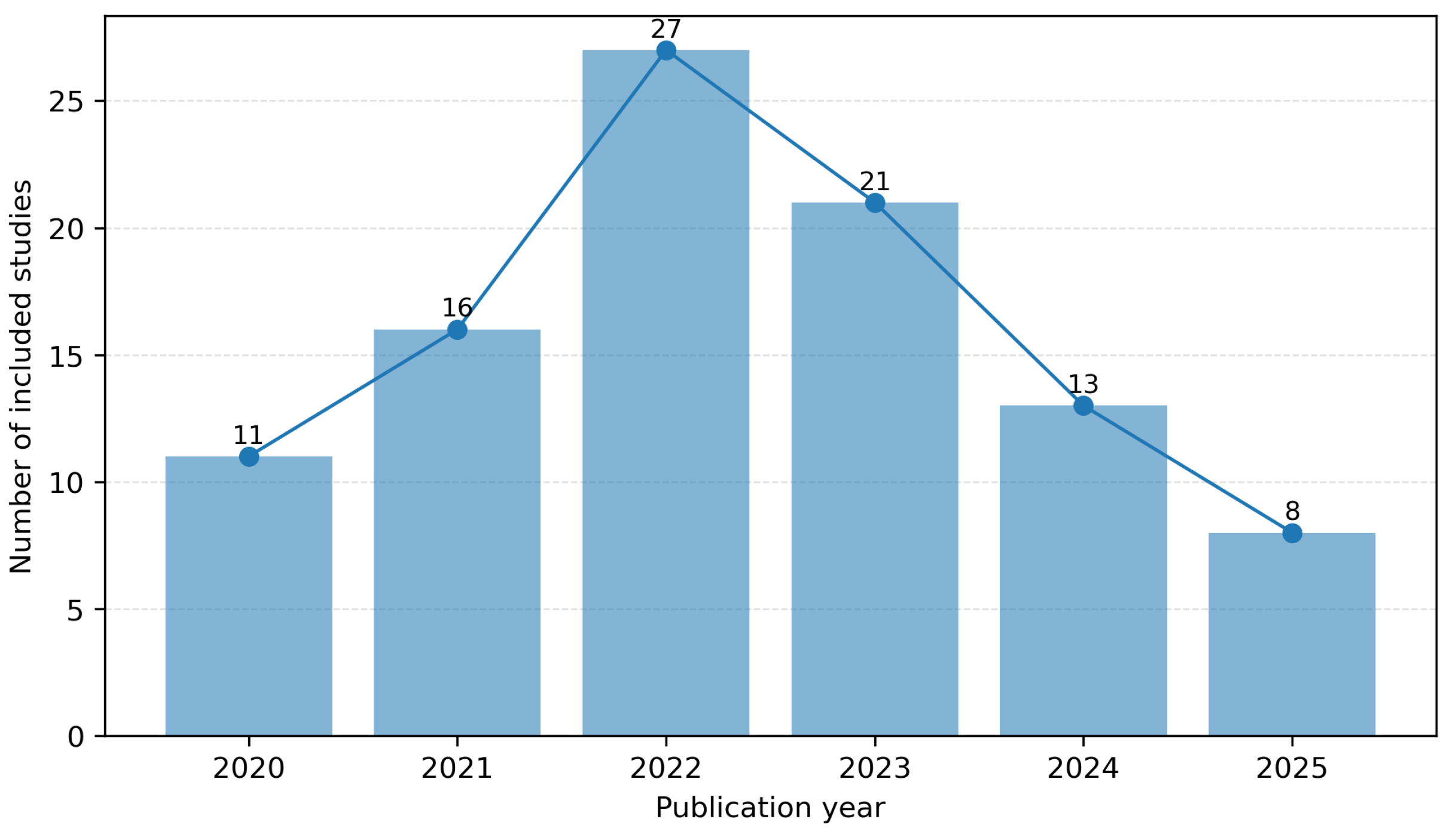
From 2020 to 2025, the number of publications rises toward the early and middle years, then becomes more stable. In our final set, the year counts are: 2020 (11), 2021 (16), 2022 (27), 2023 (21), 2024 (13), and 2025 (8). The peak in 2022 points to strong interest in how IoT fits into Industry 4.0 system design. The lower count in 2025 is expected because it is often only partly indexed, depending on the search date and database updates. Figure 6 shows this trend.
The included studies appear in many journals and publishers, which shows that IoT-based Industry 4.0 research crosses several fields. The final set covers outlets in industrial engineering, automation, smart manufacturing, computing, and cyber–physical systems. Table 7 lists the main publication channels by showing the journal names, their publishers, and how many studies appear in each venue. This view helps readers see where IoT–Industry 4.0 work is most often published. It also shows two important points. First, a small group of journals appears many times, which suggests a set of core outlets for this topic. Second, many other journals publish smaller numbers of papers, which reflects the wide range of interests across engineering and computing. This spread confirms that IoT–Industry 4.0 integration is studied from both industrial needs and technical viewpoints.
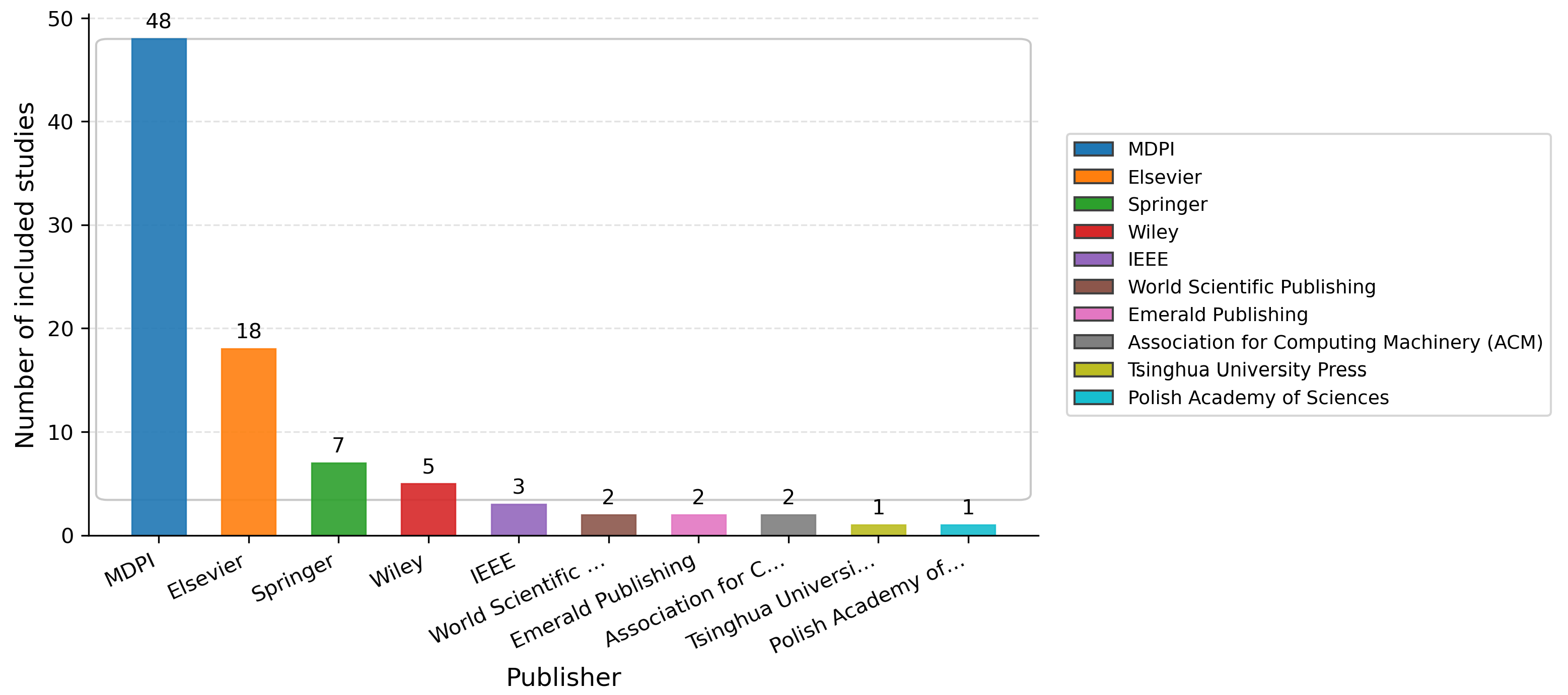
To add to the venue-level view, we also looked at how the included studies are spread across publishers. This helps show which publishing groups appear most often in the IoT–Industry 4.0 literature. Because many publishers contribute only a small number of papers, the full list can be long and hard to read. For this reason, we report only the Top 10 publishers, ranked by the number of included studies. This keeps the summary clear and easy to compare. Figure 7 shows how many of the final eligible studies ( n = 96 ) are linked to each of these publishers. It also shows whether publications are concentrated in a few major outlets or spread across many sources, and which publishing groups most often host recent work on IoT-based Industry 4.0 systems.
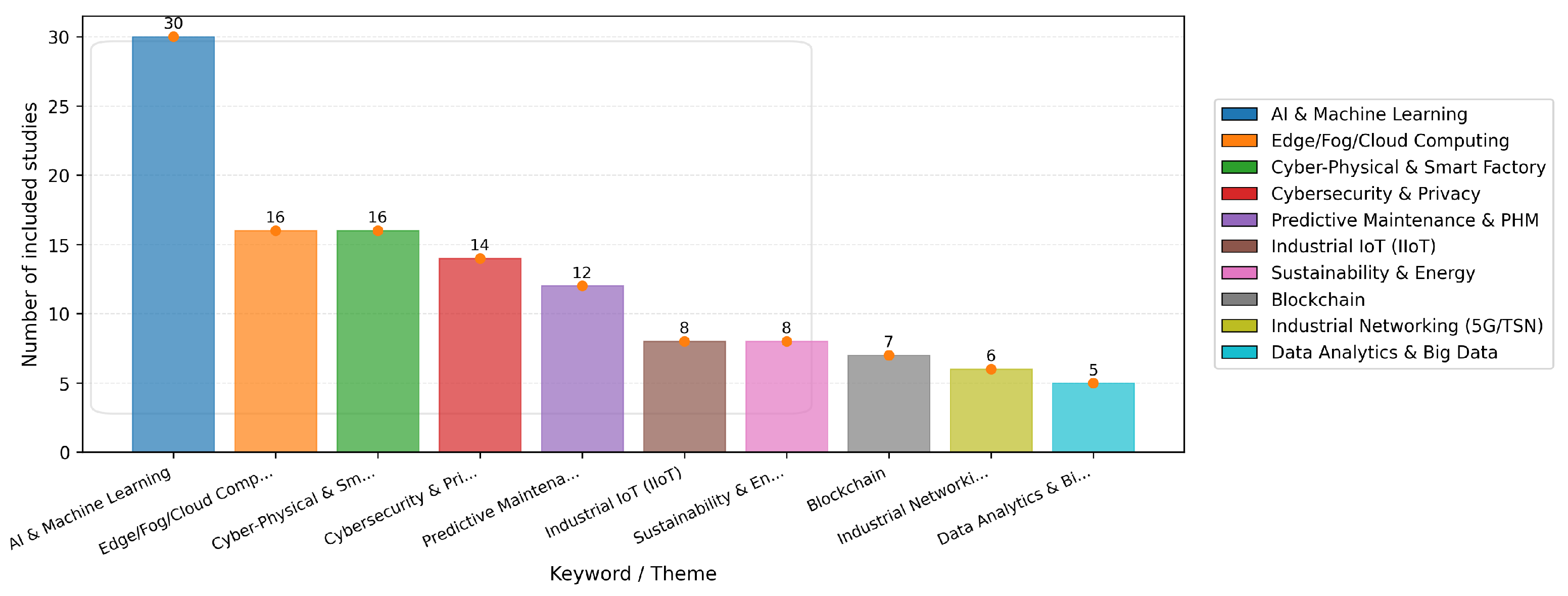
To obtain a clear view of the main themes in the included studies, we reviewed the author keywords from the 96 final papers. We cleaned the keyword list by merging common variants (for example, “IoT” and “Internet of Things”), using consistent spelling and capitalization, and removing repeated terms. Because our search strategy required “Internet of Things” and “Industry 4.0” as core terms, these keywords appear in most papers and do not help much to separate topics. For this reason, we removed these mandatory terms and focused on the most frequent secondary keywords. The results show that many studies focus on data-driven methods and decision support (for example, AI and machine learning), cyber–physical links and smart factory ideas, practical goals such as predictive maintenance, distributed computing (edge, fog, and cloud), and trust topics such as cybersecurity and blockchain. Figure 8 shows the most common secondary keywords and how often they appear.

3.2. IoT Technologies, Frameworks, and Standards in Industry 4.0 (RQ1)

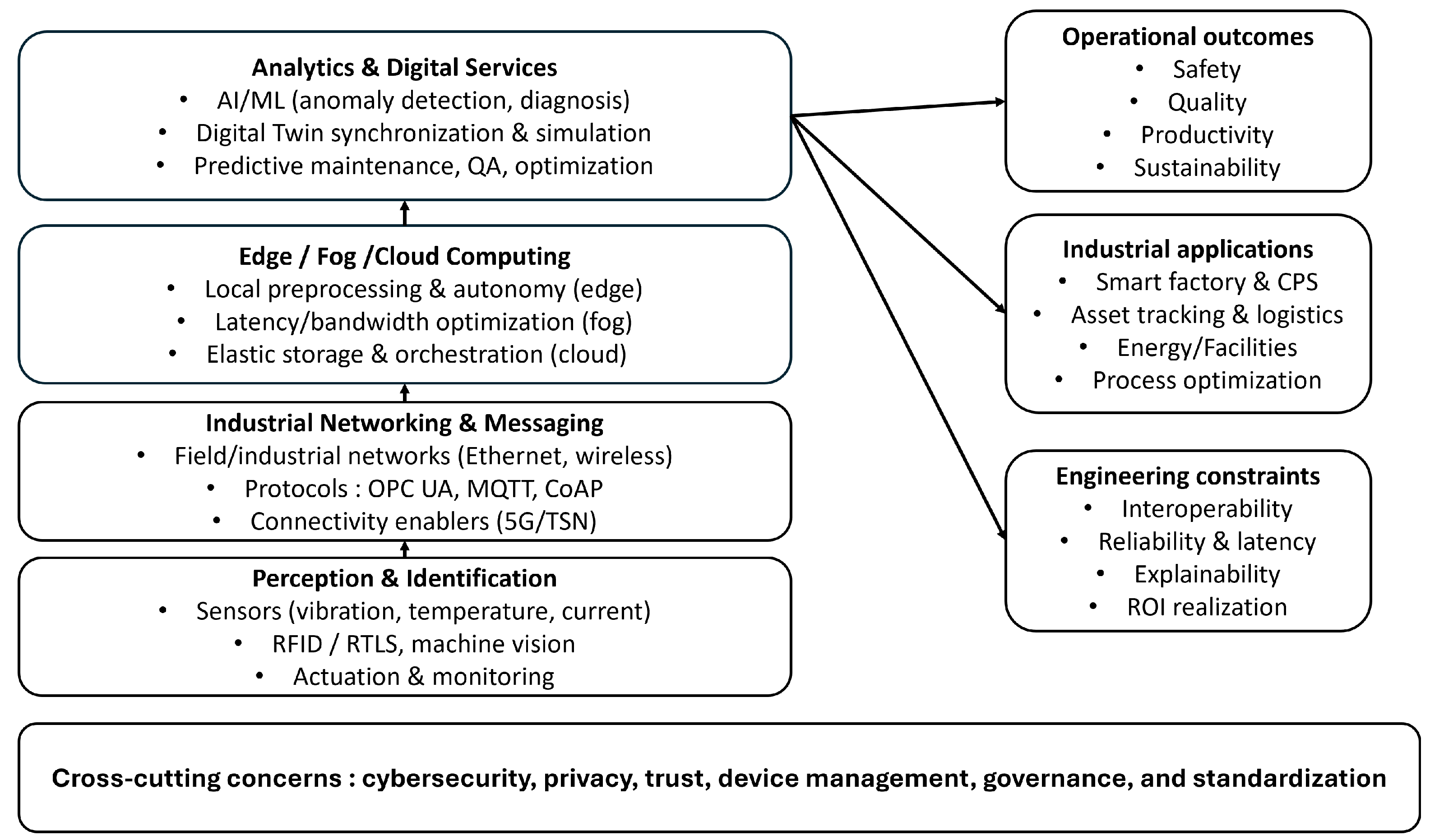
Across the studies, IoT is often described as a set of layers that helps Industry 4.0 work in practice. It turns physical machines and production assets into connected cyber–physical systems (CPS). The literature does not treat IoT as “connectivity only”. Instead, it usually breaks it into four parts: (i) sensing and identification, (ii) industrial networking and messaging, (iii) computing platforms across edge/fog/cloud, and (iv) data-based services. This view explains why many papers call IoT the “data backbone” of smart factories. It builds the full data path needed for monitoring, automation, and steady improvement. At the same time, it brings hard tasks, such as system connection, security, and device life-cycle management.
At the perception layer, studies use a wide range of sensing and identification tools. These tools track machine health, product state, and the surrounding environment. Common examples include vibration, temperature, and current sensors for condition tracking and maintenance planning [42]. Many papers also use RFID/RTLS for asset and material traceability. Vision-based sensing is also used for inspection and quality checks [43,44]. The main benefit is better visibility during operation. This can help detect faults earlier, improve quality checks, and support real-time awareness. However, papers also report repeated limits in real factories. These include sensor noise, drift over time, and extra effort for setup and calibration. They also mention missing data and the difficulty of keeping data quality consistent across sites and supply partners.
In the communication and system-connection layer, two needs appear again and again. The first is the ability to connect with industrial automation systems [45]. The second is data exchange that can grow with larger deployments. Many papers link system connection to industrial protocols and information models. For example, OPC UA is often described as a practical way to link operational technology (OT) with higher-level information systems in CPS-focused designs [46]. For lightweight machine-to-service communication, studies also discuss messaging approaches that fit IoT limits. MQTT often appears as a common choice for publish/subscribe communication in IIoT systems [47]. Beyond protocols, the literature is clear on one point: standards alone are not enough. Differences in data meaning, legacy constraints, and weak interface governance still block smooth connection in real deployments. The reviewed studies use different testbeds, data volumes, latency needs, and evaluation methods. Therefore, a single performance ranking would not be reliable. Instead, the technologies are compared by their industrial role, strengths, limits, and deployment trade-offs. MQTT fits lightweight telemetry and cloud-based monitoring, while OPC UA is stronger for semantic interoperability and OT–IT integration. CoAP and LPWAN support constrained or low-power sensing, but they are less appropriate for high-rate data exchange or time-critical control [48]. In contrast, 5G and TSN are better aligned with low-latency, mobile, or deterministic communication, but they require stronger infrastructure planning [49]. Table 8 presents a scenario-based comparison of these approaches.
A recurring architectural pattern in the included studies is to distribute computing and data services across edge, fog, and cloud layers. This pattern is not only a technical stack, but a deployment trade-off. Edge and fog nodes are most useful when response time, bandwidth limits, or unstable connectivity make centralized processing risky. They filter data near machines and send only relevant events or features to higher layers [50]. Cloud platforms remain stronger for large storage, cross-site learning, and long-term optimization. However, the reviewed designs do not show one universally superior placement. Edge-heavy systems reduce delay but increase orchestration, software maintenance, and model-version control across plants. Cloud-heavy systems simplify aggregation but increase data movement, connectivity dependence, and latency exposure. Above the connectivity layer, analytics provide operational value, but their effectiveness depends on the industrial task [51]. Machine learning and deep learning are suitable for anomaly detection, fault diagnosis, quality prediction, and decision support when data streams are reliable and representative [52]. Their main limitation is deployment stability: models trained on one machine, product line, or operating regime may not transfer well to another. Adaptive methods, including deep reinforcement learning and multi-agent optimization, are more relevant for scheduling, control, and resource sharing, but they remain harder to validate in real production because exploration, safety, and changing constraints must be controlled [53]. Digital twins add another layer of value by connecting IoT data with virtual models for monitoring, simulation, and what-if testing [54]. Their advantage is system-level visibility, while their weakness is the need for accurate synchronization, model fidelity, and clear links with reference architectures such as RAMI-inspired structures [55]. Security, trust, and advanced networking also show mixed deployment effects. Cyber-risk management becomes essential because more connected devices and distributed services expand the attack surface across OT and IT layers [56,57]. Blockchain can improve traceability and trusted data sharing, but it also adds cost, governance complexity, and integration overhead [58,59]. Similarly, 5G and other high-capacity networks support mobility, data exchange, and real-time services, but their benefits depend on coverage planning, edge infrastructure, and industrial integration [20].
The evidence suggests that IoT technologies, system frameworks, and communication standards must be designed together to reach Industry 4.0 goals. Protocols such as OPC UA and messaging such as MQTT support system connection. Edge–fog–cloud designs balance fast response with large-scale analytics. AI and digital twins turn data into actions. At the same time, device variety, cyber risk, and data-quality issues remain key limits. This is why many studies stress not only tools, but also careful engineering for reliable, secure, and maintainable industrial IoT deployments. Figure 9 shows how these layers are organized in the reviewed studies.

3.3. IoT Integration Architectures for Industry 4.0

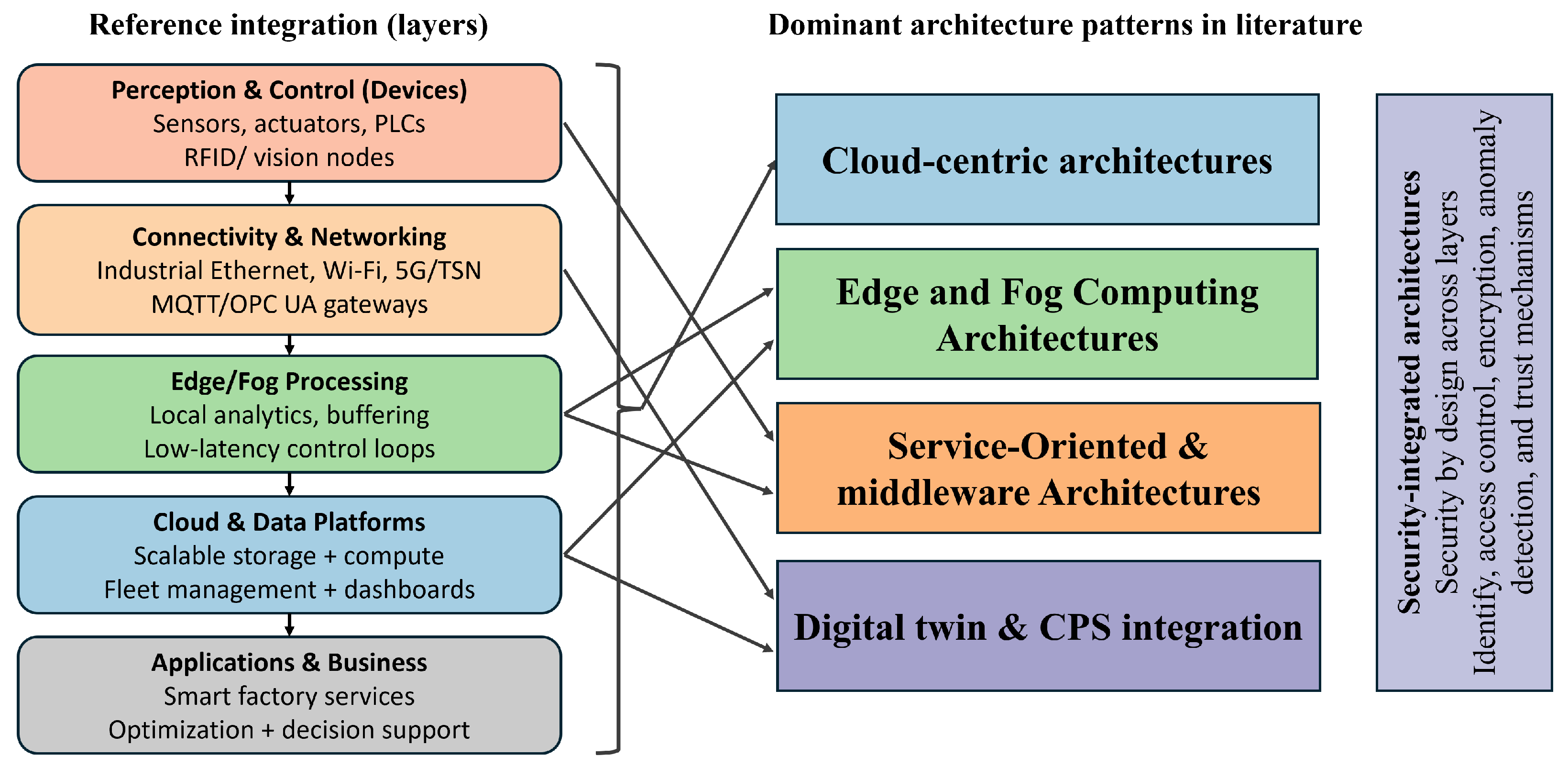
This section describes the main IoT system designs reported for Industry 4.0. Across the reviewed studies, five patterns appear often. They shape how sensing, connectivity, computing, and control are arranged in modern industrial settings: (1) cloud-centric designs, (2) edge and fog designs, (3) service-based and middleware designs, (4) digital twin and CPS integration, and (5) security-integrated designs. Figure 10 summarizes these patterns and shows how data and decisions are shared across the shop floor, edge/fog, and cloud layers to meet needs for fast response, scale, and trust.
  • Cloud-centric designs: Cloud computing offers a central place to handle large and continuous data streams from industrial IoT devices. It supports large storage, flexible computing power, and shared data handling. This helps with data analysis, long-term improvement, and a wider view across sites. In Industry 4.0, cloud-centric designs are often used to bring data from machines, sensors, and MES/ERP systems into one place, which supports cross-site monitoring and coordination. The authors of [60] support this direction by proposing a cloud-based predictive maintenance model for asset management. Their work collects process and condition data from several assets and uses automated fault detection to reduce unexpected downtime. They also use feature selection with deep prediction to improve forecasting. In the same spirit, the authors of [61] study cloud-based integration to improve data consolidation and analytics for industrial planning, which supports the role of the cloud as a central point for large-scale decision support.
  • Edge and fog designs: While the cloud is powerful, many industrial tasks need very fast response, stable operation during network problems, and lower data transfer. Central cloud designs do not always meet these needs. Edge and fog designs address this by moving part of the computing closer to the data source, such as gateways, local servers, controllers, and fog nodes. This supports near-real-time filtering, anomaly detection, local inference, and quick response actions. These functions matter for safety, closed-loop control, and time-critical monitoring. One study [62] uses fog computing to reduce energy use in drinking-water facilities. The study argues that Industry 4.0 benefits often need distributed processing to support system uptime and productivity. Another work [63] proposes an IoT–fog predictive maintenance model for asset management. Their system processes identification and status data (for example, RFID/QR streams) in the fog layer and combines optimization with machine learning to improve task assignment and maintenance decisions. They report lower execution time and energy use compared to central approaches. A recent study [64] also points to a wider move from cloud-heavy designs to edge intelligence, especially when AI services and trust tools (such as blockchain) must work under strict delay limits.
  • Service-based and middleware designs: Industry 4.0 integration is often difficult because devices differ, protocols differ, and old equipment must work with new IoT parts. For this reason, many studies use service-based designs and middleware to hide low-level differences and make systems easier to connect. In this pattern, physical devices are wrapped as services, and middleware helps manage how components talk to each other. This supports better system connection, better modular design, and easier upgrades over time, since applications are less tied to specific hardware. The work in [65] proposes a conceptual IIoT software design based on service principles. It stresses modular service composition to support smooth communication between industrial subsystems. The review in [2] examines CPS-related designs and highlights the role of middleware in handling many distributed computing units and linking physical processes with digital services. By separating services from device limits, this pattern supports gradual upgrades, integration of older assets, and flexible addition of new functions in smart factories.
  • Digital twin and CPS integration: Digital twins and CPS integration link physical assets with digital models that are updated over time. Designs in this group focus on real-time links between the shop floor and virtual models. This supports monitoring, simulation, prediction, and improvement. In Industry 4.0, this approach can support early maintenance actions, adaptive control, and better performance, because the digital model becomes part of the decision loop rather than a static display. The framework proposed in [66] presents a digital-twin design in a healthcare-oriented Industry 4.0 setting. The study shows how detailed virtual models can support physical–digital operations, but it also points to new security risks that system design must address. The system in [67] develops an IoT solution that uses fuzzy logic for early maintenance, where a digital twin tracks machine state and supports early failure prediction and better scheduling. The studies [68,69] also discuss IoT-based predictive maintenance for CPSs and stress that good CPS integration needs strong machine-to-machine and human-to-machine coordination to support correct sensing and useful decisions.
  • Security-integrated designs: As Industry 4.0 connects more devices and services, more entry points appear for attacks. These risks can affect sensors, gateways, networks, and analytics platforms. Because of this, many studies treat security as part of the core design, not as an extra add-on. Security-integrated designs place trust tools inside the data and control flow, such as strong access control, encrypted communication, anomaly detection, and tamper-resistant logs. The approach in [70] proposes an IoT design that uses machine learning to detect attacks and validate signals in CPS monitoring. The goal is to improve online supervision by separating real measurements from injected or altered data. The review [71] examines IIoT and Industry 4.0 integration and stresses that secure system design is essential for smart manufacturing, especially to protect data integrity and prevent unwanted changes. In this design pattern, blockchain often appears as a trust layer for integrity and traceability, while AI-based intrusion detection helps respond to changing threats.

3.4. Application Domains and Industrial Use Cases (RQ3)

This section reviews the main application areas reported in the 96 final studies on IoT-based Industry 4.0. It also highlights the most common use cases supported by these systems. Across the literature, IoT is often described as the key link between physical work and data-based services. In this view, sensing, connectivity, and real-time analytics work together to support monitoring, improvement, and decision-making. The studies also show that application areas are not fully separate. Many of them overlap because they share similar goals, such as asset visibility, quality checks, energy savings, and stable production. In this review, we derived the application domains from paper titles, abstracts, and author keywords. We present them as clear industrial settings where IoT is put into practice and assessed.
Smart manufacturing and production systems: Smart manufacturing is the most common domain in the reviewed studies. Here, IoT is used to bring shop-floor activities into digital form through continuous sensing, machine-to-machine communication, and production analytics. Several studies discuss step-by-step adoption, especially for factories with limited budgets, where small sensor additions and low-cost IoT stacks support gradual upgrades instead of full redesign [72,73,74]. Other studies focus on integration problems, such as aligning data flows and production information across tools and platforms, and propose coordination layers that support planning and execution across manufacturing tasks [75,76,77]. Common use cases include real-time machine status tracking, production traceability, anomaly detection during operation, and feedback control supported by edge analytics [78]. Typical sensing includes vibration and temperature sensors on rotating machines, current and power measurements for machine condition, RFID/QR for part tracking, and camera-based monitoring for inspection or safety.
Predictive maintenance and asset management: Predictive maintenance is another frequent domain because industrial assets produce rich operational data that can support early warnings. In this setting, IoT provides continuous data collection, while analytics models turn sensor signals into fault indicators, remaining-life estimates, or risk scores. Many studies describe designs that combine condition tracking with local or edge processing to support fast response, then use cloud services for wider learning and longer-term improvement. Examples include maintenance pipelines that combine sensor signals with learning models for early fault detection and lower downtime [79]. Other works combine several industrial signals to support maintenance scheduling and resource planning [80]. Typical use cases include vibration-based fault checks for motors and bearings, thermal monitoring for overheating, pressure and flow tracking for pneumatic or hydraulic parts, and anomaly detection for process drift that may lead to damage [81]. Many studies also describe predictive maintenance as both a technical task and an operational strategy to improve reliability, safety, and cost control.
Logistics and supply chain operations: A notable group of studies looks beyond the factory and studies IoT in logistics and supply chains, where visibility and traceability are vital. IoT connects distributed assets such as containers, pallets, vehicles, and warehouse systems to digital platforms for tracking and coordination. Many papers stress the need for shared data and clear rules across partners, because supply chains involve several actors and systems [82]. Other studies link IoT visibility with sustainability goals and argue that real-time data helps improve response and resource use in distributed networks [83]. Common use cases include live shipment tracking, inventory visibility, cold-chain monitoring (temperature and humidity), and dynamic routing based on current constraints. Typical technologies include RFID, GPS/telematics, environmental sensors, and platform layers that combine data from multiple partners.
Energy efficiency and sustainability management: Energy-focused Industry 4.0 use cases appear often because factories aim to reduce costs and meet sustainability targets. In this domain, IoT supports continuous measurement of energy use at the machine, line, or facility level, which helps reveal waste patterns and supports better workload planning. Several studies describe IoT-based energy monitoring as a key input for energy-aware decisions, where energy data is linked with optimization and scheduling rules [84]. Other works discuss integrated management, where energy analytics is part of production planning and helps balance output needs with energy limits [85]. Typical use cases include smart metering, peak-load control, detection of inefficient operating modes, and energy-aware scheduling [86]. Common sensing includes smart meters, current transformers, power-quality sensors, and environmental sensors that help explain energy patterns.
Construction 4.0 and the built environment: Construction 4.0 appears as a clear domain, although it is less frequent than manufacturing. Here, IoT helps improve visibility, safety, and coordination on construction sites. Some studies describe IoT as a practical tool for tracking equipment and monitoring site conditions, which supports safety control and schedule follow-up [87]. Other works discuss Construction 4.0 more broadly and present IoT as a base layer for real-time sensing and links with management workflows [88]. Typical use cases include asset tracking, worker safety monitoring, sensing of dust/noise/temperature, and progress tracking. Compared to factories, construction sites often face harsher conditions, unstable connectivity, and changing layouts. This makes robust, low-maintenance sensing and scalable data handling even more important.
Healthcare-related Industry 4.0 applications: A smaller but distinct set of studies applies Industry 4.0 ideas to healthcare, where IoT supports remote monitoring, smart hospital services, and connected workflows. For example, some studies review how IoT and Industry 4.0 come together to improve healthcare services and strengthen operational resilience [89]. Others describe healthcare-focused designs that combine sensing, connectivity, and analytics to support service delivery and monitoring [90]. Common use cases include patient monitoring, device tracking, and data-based coordination of clinical operations, while the goals differ from manufacturing, the role of IoT is similar: continuous data collection, secure communication, and analytics that support decisions.
Cross-cutting security and governance use cases: Several studies treat security, privacy, and trust as shared concerns that affect all domains. These works stress that secure data exchange, device authentication, and data integrity are needed to scale IoT-based industrial systems across organizations [91,92]. Blockchain is also discussed as a way to improve traceability and tamper resistance in industrial data flows, especially when several actors must trust the same records [93,94]. In practice, this leads to use cases such as secure device onboarding, intrusion detection, access control, privacy-aware telemetry, and audit trails for industrial events [95]. Beyond these main domains, a smaller group of studies examines the use of IoT in other industrial and commercial contexts. These include IoT-based management of connected infrastructure in smart environments [96], as well as IoT adoption in service-sector industries within developing economies. In these contexts, implementation is shaped by specific challenges such as adoption barriers, regulatory limitations, and connectivity constraints, which differ from those commonly observed in manufacturing settings [97].
To summarize the synthesis for Section 3.4 (RQ3), Table 9 lists the main application domains and links each one to key use cases, common IoT technologies and sensors, and where analytics is most often placed. We report the “analytics layer” for each domain (edge/fog, cloud, or hybrid edge–cloud) because it is a central design choice in Industry 4.0. Real-time control and short feedback loops often push analytics closer to the edge. In contrast, long-term learning, global improvement, and cross-site coordination often rely on cloud services, which is why many systems use a hybrid edge–cloud setup.

3.5. Challenges, Limitations, and Open Issues (RQ4)

Interoperability and standard alignment remain the most common barriers when IoT-based Industry 4.0 moves from small pilots to large-scale use. Many studies report that industrial sites must connect older machines, vendor-specific field networks, and different data formats. As a result, connectivity alone does not create reusable data services or stable decision support. For this reason, several papers stress the need for reference architectures, shared meaning for data, and middleware that turns device differences into stable APIs and common information models, so applications can move across plants and vendors more easily [13]. A repeated issue is the mismatch between OT and IT lifecycles: OT systems may stay in service for decades, while software changes fast. This creates version and compatibility problems for interfaces, data schemas, and device firmware. Studies that discuss requirements work and model-based methods argue that interoperability must be planned early with clear interface rules, data-quality checks, and lifecycle notes instead of being left to the final integration step [105]. Uneven use of standards is also common, so many deployments still need protocol mapping and conformance checks to avoid fragile links and vendor lock-in [106].
Cybersecurity, privacy, and trust are described as system-wide limits that affect every design choice in IoT–Industry 4.0. The reviewed studies often point to a larger attack surface caused by wide connectivity, remote support, and edge–cloud links. At the same time, many field devices have limited resources and are difficult to update, making strong security controls harder to apply [107]. Beyond network attacks, several papers highlight integrity risks for sensor data and control commands, where changed data can trigger unsafe actions, cause production loss, or lead to wrong analytics. In response, the authors propose layered protection that mixes lightweight authentication, anomaly detection, and secure logging to support later investigation [108]. At the ecosystem level, studies also raise governance questions in multi-stakeholder settings who owns the data, who can use it, and how rules are checked, which increases interest in auditable access control and traceability tools such as permissioned ledgers and policy-based identity management [104]. Several works also stress secure update chains and network segmentation of critical control zones to reduce the spread of attacks.
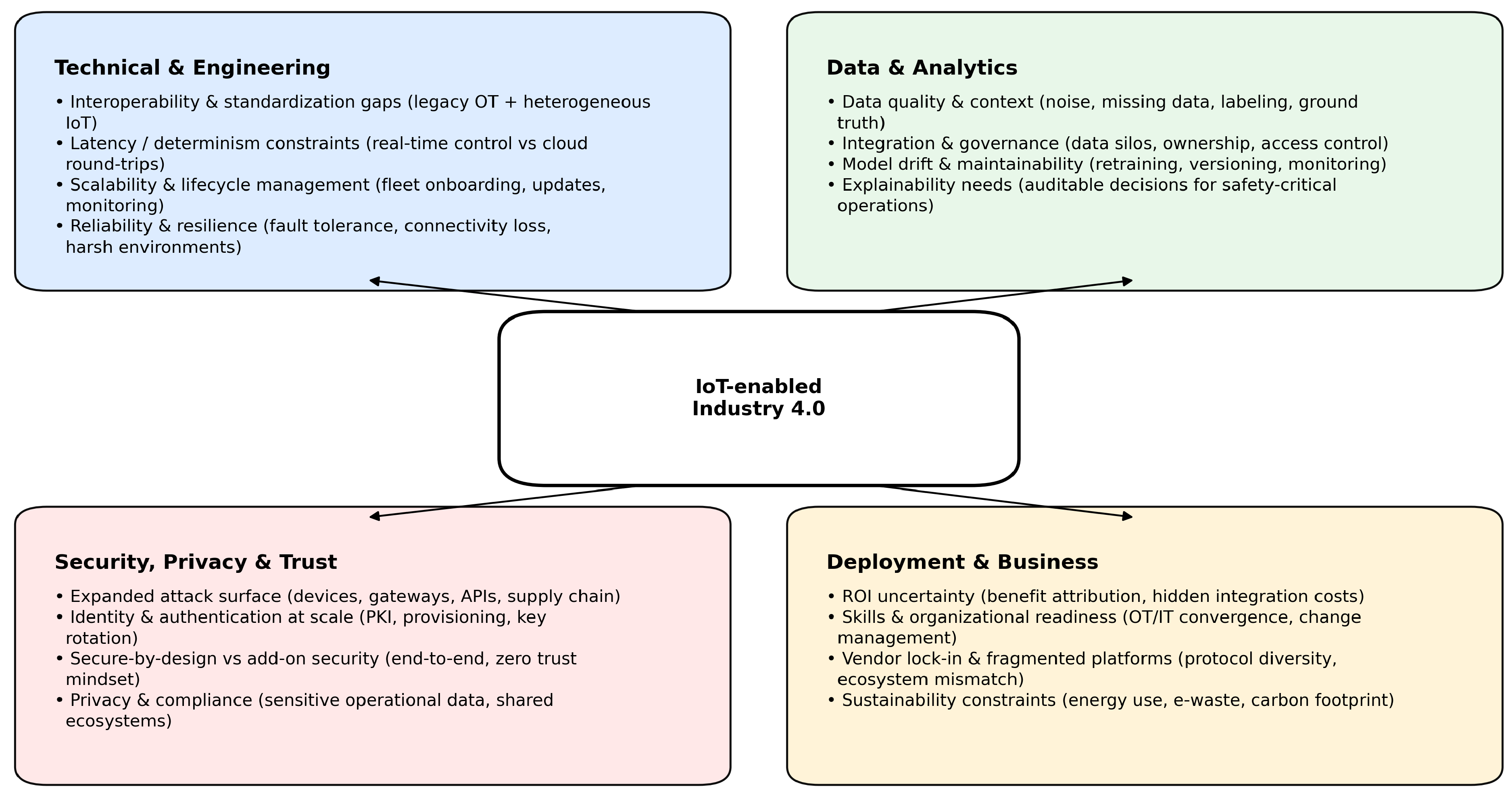
A third group of open issues relates to data quality, reliable analytics, and how to run “intelligence” at scale. While AI and machine learning are often presented as key tools for prediction and decision support, many studies warn that results depend strongly on sensor drift, missing data, changing operating conditions, and the lack of labeled failure events especially for rare faults and safety-critical assets [109]. This drives many papers toward mixed strategies that combine engineering knowledge with data-driven learning, and toward edge-aware pipelines that filter, merge, and validate streams before sending them to cloud services. Another limit is explainability: operators often need clear alerts and practical root-cause hints, while black-box models can be hard to justify in regulated or high-risk settings. Running analytics across edge, fog, and cloud also raises open questions about where to place workloads, how often to update models, and how to keep services stable when connectivity drops. Several papers also note that it is hard to compare studies because benchmarks differ and reports often miss details about datasets, deployment limits, and delay/energy trade-offs. This makes it difficult to generalize ROI claims and to repeat results in new industrial settings [110]. As a result, recent work points to stronger IIoT MLOps practices (dataset and version tracking, continuous checks, drift tracking) and to evaluation methods that report accuracy together with delay, energy, and behavior under real operating conditions. Figure 11 groups these challenges and open issues into four domains.
Beyond the individual barriers discussed above, the synthesis shows that IoT–Industry 4.0 challenges depend strongly on the application domain. Smart manufacturing is mainly limited by brownfield integration, multi-vendor equipment, and the need to connect legacy OT systems with new IoT platforms. Predictive maintenance faces a different problem: sensors and analytics are widely used, but model transfer, data quality, label scarcity, and long-term stability remain difficult across machines and operating conditions. In logistics and supply chains, the main concern shifts toward trust, traceability, data ownership, and coordination between organizations. Energy, construction, agri-food, and remote monitoring add further constraints because communication reliability, harsh environments, calibration, power use, and local maintenance affect whether prototypes can become stable deployments. These patterns show that the same technology may solve one part of the problem while creating another trade-off. Cloud platforms support large-scale storage and cross-site learning, but they increase data movement and dependency on connectivity. Edge and fog computing reduce delay and support local control, but they add orchestration and lifecycle-management complexity. Blockchain improves auditability and trusted data sharing, but it can introduce latency, cost, and governance overhead. AI-based models improve detection and prediction, but they remain sensitive to data quality, transferability, and explainability. Table 10 maps these domain-specific patterns by linking each application area to its dominant challenge, the partial technological response, and the remaining gap or conflict.

3.6. Emerging Trends and Future Research Directions (RQ5)

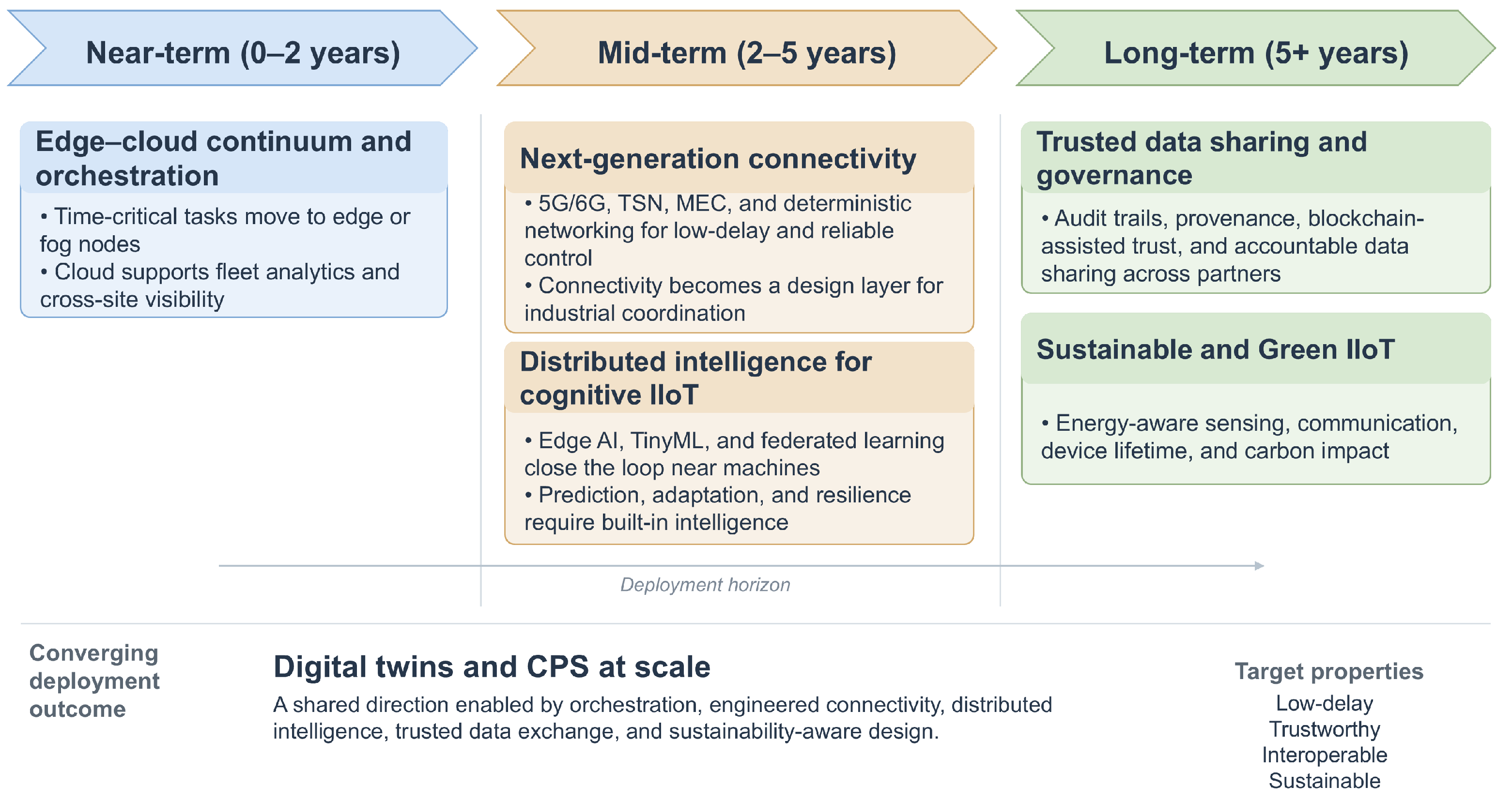
This section presents the main trends and future research directions for IoT-based Industry 4.0 systems. Across the 96 eligible studies, the literature points to five clear directions: (i) the edge–cloud continuum and orchestration, (ii) next-generation connectivity (5G/6G and deterministic networking), (iii) distributed intelligence for cognitive IIoT, (iv) trusted data sharing and governance (including blockchain-based approaches), and (v) sustainability-focused “Green IIoT”. Figure 12 summarizes these directions and shows how they move toward industrial IoT systems that can scale, react fast, and support trust.
Edge–cloud continuum and distributed computing. A strong trend is the shift away from cloud-first designs toward a continuum, where time-critical tasks run close to machines (edge/fog), while the cloud supports long-term analytics, fleet-level insight, and cross-site visibility. Authors in [111] support this view through an edge-focused IIoT platform for predictive maintenance. They show that placing intelligence near the shop floor can cut response time and improve robustness under tough industrial conditions. In addition, authors in [112] stress the role of decentralized designs and discuss how edge computing, AI, and other tools work together when low-delay services are needed in cyber–physical settings.
Next-generation connectivity (5G and beyond). The included studies increasingly treat connectivity as more than a transport layer. Instead, it becomes a key element for dependable industrial control and large-scale device onboarding. Authors in [113] discuss 5G–IoT links for smart factories and highlight that low delay and high device density are central for real-time monitoring and large-scale sensing. In a related direction, authors in [114] study a digital-twin approach for NB-IoT communication and point to the need to engineer connectivity settings end-to-end to keep reliability in indoor industrial sites. Together, these studies suggest a move toward more engineered networking (e.g., 5G/TSN/MEC ideas) to tighten the loop between sensing, analytics, and control.
Distributed intelligence and cognitive IIoT. Another major direction is that AI/ML moves from a supporting analytics tool to a core design need for autonomy, resilience, and continuous improvement. This supports “cognitive IIoT” systems that can sense, predict, and act with less human input. Authors in [115] present an IoT- and machine-learning-based predictive maintenance architecture, showing how built-in intelligence can support early maintenance actions and continuous improvement. Similarly, authors in [116] discuss how AI, digital twins, and IoT are coming together, and argue that future systems should use intelligence not only for prediction, but also to strengthen cyber–physical resilience in changing operating conditions.
Trusted data sharing and blockchain-based governance. As Industry 4.0 grows into multi-partner ecosystems, trust, audit trails, and governance become design requirements, not optional add-ons. Authors in [103] propose blockchain-based access control with Hyperledger Fabric to address data governance and accountability in decentralized industrial settings. This reflects a wider move toward security- and governance-aware designs that support safe cooperation and clear data provenance across partners.
Sustainable and Green IIoT. A growing set of studies links sustainability to real deployment limits, such as energy use, device lifetime, and carbon impact. Authors in [100] highlight Green IIoT as a key priority and argue for energy-aware sensing and communication choices (including wake-up radio ideas) to reduce energy demand. This suggests that future IoT–Industry 4.0 systems will be judged not only by delay and accuracy, but also by energy use and long-term sustainability at scale.
Figure 12 gives a short roadmap of the most common trends and future directions across the 96 eligible studies on IoT-based Industry 4.0. It groups these directions across a near-/mid-/long-term horizon and shows how they move toward future industrial systems that react fast, support trust, work across vendors, and remain sustainable. The roadmap also highlights how the edge–cloud continuum, next-generation connectivity, and edge AI/TinyML evolve together, along with the growing role of digital twins/CPS at scale and security/data sovereignty as deployment-critical needs.
The future agenda that emerges from the reviewed studies is more precise than a general call for more IoT adoption. The next step is to make IoT–Industry 4.0 technologies testable, transferable, secure, and maintainable under real industrial conditions. The main research axes concern AI lifecycle and model transfer, brownfield OT–IT interoperability, edge–cloud workload placement, deterministic connectivity, digital twin synchronization, trusted data governance, Green IIoT, human and organizational adoption [117], and long-term industrial pilots. Across these axes, the same limitation appears repeatedly: many studies demonstrate a working prototype, algorithm, architecture, or platform, but fewer evaluate drift, retraining needs, latency under load, cybersecurity overhead, energy cost, semantic integration, operator acceptance, or maintenance over time. Table 11 therefore converts the future directions into a structured research agenda by linking each axis to its open problem, current technological or validation limit, and a concrete future research question with deployment-oriented recommendations.

3.7. Benefits of IoT in Industry 4.0

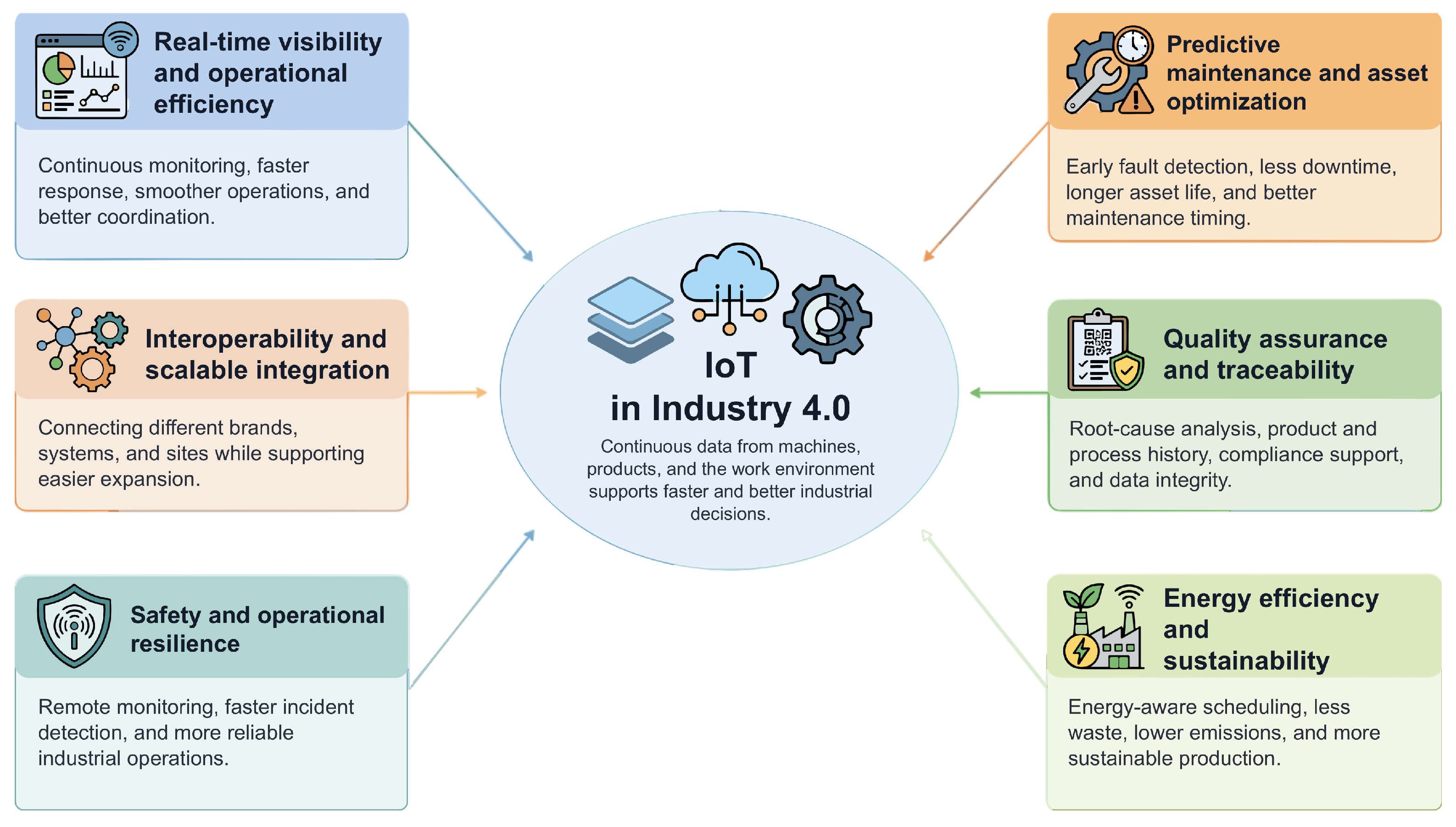
This section summarizes the main benefits of using IoT in Industry 4.0, as reported in the selected studies. The literature often describes IoT as the base technology that turns physical industrial work into systems that people can watch, measure, and improve. By collecting data from machines, products, and the work environment, IoT helps teams make faster and better decisions. Figure 13 summarizes the main benefits of IoT in Industry 4.0.
A key benefit in the reviewed studies is real-time visibility. It helps people understand what is happening on the shop floor and across sites. Continuous data streams help teams spot anomalies early, notice slow changes in processes, and react faster to disruptions. This improves day-to-day response and supports smoother operations. It can also lead to clear efficiency gains, such as fewer small stops, better coordination between production steps, and more stable output. As noted in [120], timely operational data supports better process supervision and improves productivity through quicker fixes and better use of resources. A second major benefit is the shift from reactive maintenance to predictive and condition-based maintenance. IoT sensors (for example, vibration, temperature, electric current, and pressure) help detect faults early and track asset health over time. This can reduce unplanned downtime and extend the useful life of critical machines. Many studies report that maintenance pipelines based on IoT data can raise equipment availability, reduce maintenance cost, and help avoid major failures. This is shown in [98], where IoT-based monitoring and analytics support maintenance timing based on asset condition rather than fixed schedules.IoT supports interoperability and scalable integration by helping industrial systems connect across devices, vendors, and sites, which makes expansion easier as production environments grow. IoT also improves quality checks and traceability by linking product history with process data and operating conditions. This link helps teams find root causes when defects appear. It also supports clearer compliance reports and more reliable recall steps in regulated settings. Studies such as [121] note that combining IoT with trusted data tools (for example, blockchain-based logs) can further strengthen traceability and data integrity, which matters more when several partners share industrial data.
The reviewed studies also point to strong benefits for energy efficiency and sustainability. IoT-based metering and control support energy-aware scheduling, load control, and waste reduction. They do this by showing how and where energy is used and by guiding focused actions. These steps can lower operating costs and support environmental targets, which fits the wider Green IIoT direction. For example, the authors of [118] highlight how resource-aware sensing and energy-aware operation can support sustainability goals while keeping strong industrial performance.
Finally, IoT can improve safety and operational resilience through remote monitoring, hazard detection, and faster incident response [119]. In highly automated settings, IoT connectivity can also support safer work in robotic cells and cyber–physical workflows through continuous monitoring and alerts. This appears in studies such as [122], where IoT-based supervision links to safer industrial operation. Overall, these benefits help explain why the reviewed studies often describe IoT as a key driver of Industry 4.0 change. To give readers a compact cross-section view of the reviewed literature, Table 12 compares the main Industry 4.0 application domains and cross-cutting themes in terms of representative references, core IoT technologies, common architecture patterns, compute placement, reported benefits, and open issues. Unlike the earlier domain-focused table, this synthesis highlights recurring design choices and trade-offs across the full results section. It also links the detailed findings of Section 3 with the broader discussion in Section 4 by showing where the literature converges and where important gaps remain.

4. Discussion

The evidence from the 96 eligible studies shows a clear picture: IoT-based Industry 4.0 research is moving toward a shared technical core, while it still spreads into new sectors and new goals. For enabling technologies (RQ1), most papers describe a layered stack that combines sensing and actuation, industrial communication, data collection pipelines, and analytics. This stack often relies on common messaging and integration standards that support monitoring and control. This technical base links directly to the main integration architectures (RQ2). Here, layered reference models and the edge–cloud continuum appear most often. More recently, many works also add digital twin/CPS links and assume security-by-design as part of the core system. In terms of applications (RQ3), the strongest focus remains on smart manufacturing and production improvement, predictive maintenance and asset management, and logistics and supply-chain visibility. There is also steady interest in energy and sustainability management, Construction 4.0, and agri-food monitoring, but these appear less often. Across these domains, the benefits stay very consistent: real-time visibility, higher operational efficiency, better use of assets through predictive maintenance, stronger quality checks and traceability, improved energy use, and safer and more resilient operations. For adoption barriers (RQ4), the reviewed studies point to five recurring issues: interoperability gaps, cybersecurity and privacy risks, data-quality limits, scale and latency constraints, and hard integration with legacy OT systems. Together, these issues help explain why many promising pilot projects still struggle to move into stable use across plants and vendors. The cross-domain synthesis in Table 10 adds a second level of interpretation to these barriers. It shows that deployment challenges change according to the industrial context. In smart manufacturing, interoperability is mainly a brownfield integration issue, where legacy PLCs, SCADA systems, proprietary machines, and new IoT platforms must operate together. In logistics and supply chains, the critical barrier shifts toward trust, traceability, and data ownership between organizations. In predictive maintenance, the limitation is not only data collection but also data quality, label scarcity, model drift, and transfer across assets. This indicates that IoT deployment cannot be improved through one generic solution. Technologies such as OPC UA, MQTT, blockchain, edge/fog/cloud computing, AI models, and digital twins reduce specific barriers, but they also introduce trade-offs in latency, governance, scalability, explainability, or lifecycle management. Therefore, future IoT–Industry 4.0 research should move from isolated technical demonstrations toward comparative studies that test these trade-offs under real operating conditions.
From a practical view, this review offers clear guidance for both industry and research. For industry teams, many studies suggest starting with real operating limits. Time-critical monitoring and control should run close to machines (edge/fog), while cloud resources remain useful for long-term analytics, fleet-wide insight, and learning across sites. A second message is that interoperability and governance should be part of the first design steps, not something left for later. Early work on data models, stable interfaces, and platform governance can reduce long-term integration problems and help avoid vendor lock-in as systems grow. Security and privacy also appear as core design needs. Identity and access control, secure device onboarding, and continuous monitoring are often linked to successful scale-up, especially when several partners share the same system. For researchers, the most useful next steps are those that turn high-level ideas into systems that others can repeat and deploy. This includes tests in realistic conditions and clear reporting of where compute runs (edge vs. cloud), what delay limits exist, and how lifecycle tasks are handled (monitoring, updates, and model drift). The evidence also shows that AI combined with CPS and digital twins is now widely expected. Still, it becomes reliable in practice only when systems provide clear explanations and support audit trails, especially in safety-critical settings.
Two limits matter when readers compare results across studies. First, author keywords are often inconsistent and not well defined. This makes thematic analysis sensitive to how terms are grouped. For example, similar work may appear under “IIoT,” “Industrial IoT,” “Industrial Internet,” or “smart manufacturing IoT.” In the same way, compute placement terms may switch between “edge computing,” “fog computing,” and “MEC,” even when the meaning is close. This variation can hide true topic frequency unless the terms are merged carefully. Second, performance claims are often hard to compare directly. Studies use different test settings, datasets, metrics, and levels of detail. Some papers focus on accuracy, while others focus on delay, availability, energy use, or proof of concept. This makes strict numerical comparison difficult.
Looking ahead (RQ5), the overall direction points to industrial IoT systems that can run in real sites, support trust, and remain sustainable. Key themes include edge AI/TinyML for on-device intelligence, engineered networking (5G/TSN/MEC) for real-time control, digital twins at scale for prediction and improvement, security and privacy built into the system design, and stronger focus on interoperability and sustainability as drivers of adoption, not afterthoughts.

5. Conclusions

This systematic literature review examines how Internet of Things (IoT) technologies support Industry 4.0 by studying research published between 2020 and 2025. Using a PRISMA-based selection process, we kept 96 eligible studies and studied them through five research questions. These questions cover key technologies and standards, integration architectures, application domains, adoption barriers, and future directions. The reviewed studies show that IoT serves as the working backbone of Industry 4.0 because it supports continuous sensing, connectivity, and data-driven control across industrial assets, processes, and environments. The evidence points to a layered technology stack that includes sensing, communication, data processing, and application services. This stack relies on industrial communication protocols and integration tools that support real-time monitoring and practical intelligence at scale.
From an architecture view, most studies follow layered reference models and an edge–cloud spectrum that balances fast response with large-scale analytics. Across the reviewed papers, edge and fog layers appear more often for time-critical monitoring and control, while cloud platforms remain important for long-term storage, fleet-level improvement, and learning across sites. At the same time, digital twin and cyber–physical system (CPS) integration is becoming a key design direction. It supports predictive maintenance and operational improvement through closer links between physical assets and their digital counterparts. In terms of application areas, the literature is most mature in smart manufacturing, predictive maintenance, and industrial logistics. It also shows rising use in energy and sustainability management, Construction 4.0, and agri-food monitoring. Across these domains, studies report stable benefits, such as better operational visibility, less downtime, stronger traceability and quality checks, energy savings, and safer industrial work.
Despite this progress, the review also highlights barriers that still slow large-scale adoption. The most reported limits include interoperability gaps, cybersecurity and privacy risks, governance and data-management complexity, scaling limits, and practical deployment issues in brownfield sites. Cross-study comparison also remains difficult because keyword metadata is often inconsistent and evaluation practices vary. For example, studies use different metrics, datasets, and test settings, which makes direct comparison harder.
Looking ahead, the evidence suggests that the next stage of maturity for IoT-based Industry 4.0 systems will rely on deployable edge intelligence (edge AI/TinyML), engineered networking for real-time control (5G/TSN/MEC), digital twins that can scale, and security built into system design. Future research should focus on reference implementations that others can repeat, realistic benchmarks under industrial limits, and standard-aligned interoperability approaches that reduce integration effort while improving trust, sustainability, and long-term maintainability of industrial IoT ecosystems.

Supplementary Materials

The following supporting information can be downloaded at: https://www.mdpi.com/article/10.3390/iot7020046/s1. Table S1: PRISMA_2020_Checklist, Table S2: Scopus sensivity analysis, and Table S3: WOS sensivity analysis.

Author Contributions

Conceptualization, N.H. and M.Z.; methodology, N.H. and M.Z.; validation, M.Z., A.H., M.S. and A.E.O.; formal analysis, N.H.; investigation, N.H.; data curation, N.H.; writing—original draft preparation, N.H.; writing—review and editing, M.Z., A.H., M.S. and A.E.O.; supervision, M.Z., A.H., M.S. and A.E.O.; project administration, M.Z. All authors have read and agreed to the published version of the manuscript.

Funding

This research received no external funding.

Data Availability Statement

The extracted review data, screening matrix, and supporting analysis materials used for the descriptive and thematic synthesis are available from the corresponding author upon reasonable request.

Acknowledgments

During the preparation of this manuscript, the authors used ChatGPT by OpenAI (GPT-5.4 Thinking) for language editing, grammar checking, structural refinement, punctuation, and formatting support. The authors reviewed and edited the output and take full responsibility for the content of this publication.

Conflicts of Interest

The authors declare no conflicts of interest.

Abbreviations

The following abbreviations are used in this manuscript:
AIArtificial Intelligence
CoAPConstrained Application Protocol
CPSCyber–Physical Systems
ERPEnterprise Resource Planning
IIoTIndustrial Internet of Things
IIRAIndustrial Internet Reference Architecture
IoTInternet of Things
ITInformation Technology
LPWANLow-Power Wide-Area Network
MECMulti-access Edge Computing
MESManufacturing Execution System
MLMachine Learning
MLOpsMachine Learning Operations
MQTTMessage Queuing Telemetry Transport
NB-IoTNarrowband Internet of Things
OPC UAOpen Platform Communications Unified Architecture
OTOperational Technology
PLCProgrammable Logic Controller
PLMProduct Lifecycle Management
PRISMAPreferred Reporting Items for Systematic Reviews and Meta-Analyses
RAMI 4.0Reference Architectural Model Industrie 4.0
RFIDRadio-Frequency Identification
RTLSReal-Time Locating System
RULRemaining Useful Life
SCADASupervisory Control and Data Acquisition
SLRSystematic Literature Review
TSNTime-Sensitive Networking

References

  1. Tao, F.; Qi, Q.; Liu, A.; Kusiak, A. Data-driven smart manufacturing. J. Manuf. Syst. 2018, 48, 157–169. [Google Scholar] [CrossRef]
  2. Pivoto, D.G.; de Almeida, L.F.; da Rosa Righi, R.; Rodrigues, J.J.; Lugli, A.B.; Alberti, A.M. Cyber-physical systems architectures for industrial internet of things applications in Industry 4.0: A literature review. J. Manuf. Syst. 2021, 58, 176–192. [Google Scholar] [CrossRef]
  3. Mekala, S.H.; Baig, Z.; Anwar, A.; Zeadally, S. Cybersecurity for Industrial IoT (IIoT): Threats, countermeasures, challenges and future directions. Comput. Commun. 2023, 208, 294–320. [Google Scholar] [CrossRef]
  4. Ungurean, I.; Gaitan, N.C. A Software Architecture for the Industrial Internet of Things—A Conceptual Model. Sensors 2020, 20, 5603. [Google Scholar] [CrossRef]
  5. Oks, S.J.; Jalowski, M.; Lechner, M.; Mirschberger, S.; Merklein, M.; Vogel-Heuser, B.; Möslein, K.M. Cyber-Physical Systems in the Context of Industry 4.0: A Review, Categorization and Outlook. Inf. Syst. Front. 2022, 26, 1731–1772. [Google Scholar] [CrossRef]
  6. Singh, A.; Madaan, G.; Hr, S.; Kumar, A. Smart manufacturing systems: A futuristics roadmap towards application of industry 4.0 technologies. Int. J. Comput. Integr. Manuf. 2023, 36, 411–428. [Google Scholar] [CrossRef]
  7. Atzori, L.; Iera, A.; Morabito, G. The Internet of Things: A survey. Comput. Netw. 2010, 54, 2787–2805. [Google Scholar] [CrossRef]
  8. Awaisi, K.S.; Ye, Q.; Sampalli, S. A Survey of Industrial AIoT: Opportunities, Challenges, and Directions. IEEE Access 2024, 12, 96946–96996. [Google Scholar] [CrossRef]
  9. Wójcicki, K.; Biegańska, M.; Paliwoda, B.; Górna, J. Internet of Things in Industry: Research Profiling, Application, Challenges and Opportunities—A Review. Energies 2022, 15, 1806. [Google Scholar] [CrossRef]
  10. Salih, K.O.M.; Rashid, T.A.; Radovanovic, D.; Bacanin, N. A Comprehensive Survey on the Internet of Things with the Industrial Marketplace. Sensors 2022, 22, 730. [Google Scholar] [CrossRef] [PubMed]
  11. Malik, P.K.; Sharma, R.; Singh, R.; Gehlot, A.; Satapathy, S.C.; Alnumay, W.S.; Pelusi, D.; Ghosh, U.; Nayak, J. Industrial Internet of Things and its Applications in Industry 4.0: State of the Art. Comput. Commun. 2021, 166, 125–139. [Google Scholar] [CrossRef]
  12. Vadruccio, R.; Scarpino, C.; Tumino, A. Unveiling Industrial Internet of Things potential for sustainable manufacturing: A Triple Bottom Line approach. Procedia Comput. Sci. 2025, 253, 1083–1092. [Google Scholar] [CrossRef]
  13. Rosati, R.; Romeo, L.; Cecchini, G.; Tonetto, F.; Viti, P.; Mancini, A.; Frontoni, E. From knowledge-based to big data analytic model: A novel IoT and machine learning based decision support system for predictive maintenance in Industry 4.0. J. Intell. Manuf. 2022, 34, 107–121. [Google Scholar] [CrossRef]
  14. Awouda, A.; Traini, E.; Asranov, M.; Chiabert, P. Bloom’s IoT Taxonomy towards an effective Industry 4.0 education: Case study on Open-source IoT laboratory. Educ. Inf. Technol. 2024, 29, 15043–15065. [Google Scholar] [CrossRef]
  15. Saleem, A.; Shah, S.; Iftikhar, H.; Zywiołek, J.; Albalawi, O. A Comprehensive Systematic Survey of IoT Protocols: Implications for Data Quality and Performance. IEEE Access 2025, 13, 196206–196235. [Google Scholar] [CrossRef]
  16. Zhukabayeva, T.; Zholshiyeva, L.; Karabayev, N.; Khan, S.; Alnazzawi, N. Cybersecurity Solutions for Industrial Internet of Things–Edge Computing Integration: Challenges, Threats, and Future Directions. Sensors 2025, 25, 213. [Google Scholar] [CrossRef]
  17. Klaina, H.; Picallo, I.; Lopez-Iturri, P.; Biurrun, A.; Alejos, A.V.; Azpilicueta, L.; Socorro-Leránoz, A.B.; Falcone, F. IIoT Low-Cost ZigBee-Based WSN Implementation for Enhanced Production Efficiency in a Solar Protection Curtains Manufacturing Workshop. Sensors 2024, 24, 712. [Google Scholar] [CrossRef]
  18. Majid, M.; Habib, S.; Javed, A.R.; Rizwan, M.; Srivastava, G.; Gadekallu, T.R.; Lin, J.C.W. Applications of Wireless Sensor Networks and Internet of Things Frameworks in the Industry Revolution 4.0: A Systematic Literature Review. Sensors 2022, 22, 2087. [Google Scholar] [CrossRef]
  19. Kagermann, H.; Wahlster, W. Ten Years of Industrie 4.0. Sci 2022, 4, 26. [Google Scholar] [CrossRef]
  20. Qiu, F.; Kumar, A.; Hu, J.; Sharma, P.; Tang, Y.B.; Xu Xiang, Y.; Hong, J. A Review on Integrating IoT, IIoT, and Industry 4.0: A Pathway to Smart Manufacturing and Digital Transformation. IET Inf. Secur. 2025, 2025, 9275962. [Google Scholar] [CrossRef]
  21. Tazzioli, D.; Venanzi, R.; Capponi, A.; Dost, S.; Foschini, L.; Bellavista, P. AWS IoT Service Integration for Real Industry 4.0 Deployments. In GLOBECOM 2023—2023 IEEE Global Communications Conference; IEEE: New York, NY, USA, 2023; pp. 2620–2625. [Google Scholar] [CrossRef]
  22. Ryalat, M.; ElMoaqet, H.; AlFaouri, M. Design of a Smart Factory Based on Cyber-Physical Systems and Internet of Things towards Industry 4.0. Appl. Sci. 2023, 13, 2156. [Google Scholar] [CrossRef]
  23. Bigliardi, B.; Dolci, V.; Monferdini, L.; Pini, B.; Bottani, E. Exploring the evolution of Industry 4.0 research: A bibliometric perspective. Procedia Comput. Sci. 2025, 253, 2879–2888. [Google Scholar] [CrossRef]
  24. Židek, K.; Pitel’, J.; Adámek, M.; Lazorík, P.; Hošovský, A. Digital Twin of Experimental Smart Manufacturing Assembly System for Industry 4.0 Concept. Sustainability 2020, 12, 3658. [Google Scholar] [CrossRef]
  25. Shonubi, O.A. The role of digital B2B platforms with industry 4.0 technological ecosystems(integration of cloud computing, artificial intelligence and internet of things) as a growth lever. Sustain. Futures 2025, 10, 101041. [Google Scholar] [CrossRef]
  26. Attaran, S.; Attaran, M.; Celik, B.G. Digital Twins and Industrial Internet of Things: Uncovering operational intelligence in industry 4.0. Decis. Anal. J. 2024, 10, 100398. [Google Scholar] [CrossRef]
  27. Rakholia, R.; Suárez-Cetrulo, A.L.; Singh, M.; Carbajo, R.S. Integrating AI and IoT for Predictive Maintenance in Industry 4.0 Manufacturing Environments: A Practical Approach. Information 2025, 16, 737. [Google Scholar] [CrossRef]
  28. Garcia, A.; Oregui, X.; Ojer, M. Edge architecture for the automation and control of flexible manufacturing lines. Procedia Comput. Sci. 2024, 237, 305–312. [Google Scholar] [CrossRef]
  29. Bitam, T.; Yahiaoui, A.; Boubiche, D.E.; Martínez-Peláez, R.; Toral-Cruz, H.; Velarde-Alvarado, P. Artificial Intelligence of Things for Next-Generation Predictive Maintenance. Sensors 2025, 25, 7636. [Google Scholar] [CrossRef]
  30. Dobson-Lohman, E. Artificial Intelligence-Based Decision-Making Algorithms, Internet of Things Smart Devices, and Real-Time Process Monitoring in Sustainable Industry 4.0. Econ. Manag. Financ. Mark. 2020, 15, 30–36. [Google Scholar] [CrossRef]
  31. Kumar, R.; Rani, S.; Awadh, M.A. Exploring the Application Sphere of the Internet of Things in Industry 4.0: A Review, Bibliometric and Content Analysis. Sensors 2022, 22, 4276. [Google Scholar] [CrossRef]
  32. Kalsoom, T.; Ahmed, S.; Rafi-ul Shan, P.M.; Azmat, M.; Akhtar, P.; Pervez, Z.; Imran, M.A.; Ur-Rehman, M. Impact of IoT on Manufacturing Industry 4.0: A New Triangular Systematic Review. Sustainability 2021, 13, 12506. [Google Scholar] [CrossRef]
  33. Soori, M.; Arezoo, B.; Dastres, R. Internet of things for smart factories in industry 4.0, a review. Internet Things Cyber-Phys. Syst. 2023, 3, 192–204. [Google Scholar] [CrossRef]
  34. Afrin, S.; Rafa, S.J.; Kabir, M.; Farah, T.; Alam, M.S.B.; Lameesa, A.; Ahmed, S.F.; Gandomi, A.H. Industrial Internet of Things: Implementations, challenges, and potential solutions across various industries. Comput. Ind. 2025, 170, 104317. [Google Scholar] [CrossRef]
  35. Shah, S.; Hussain Madni, S.H.; Hashim, S.Z.B.M.; Ali, J.; Faheem, M. Factors influencing the adoption of industrial internet of things for the manufacturing and production small and medium enterprises in developing countries. IET Collab. Intell. Manuf. 2024, 6, e12093. [Google Scholar] [CrossRef]
  36. Ahmed, S.F.; Alam, M.S.B.; Hoque, M.; Lameesa, A.; Afrin, S.; Farah, T.; Kabir, M.; Shafiullah, G.; Muyeen, S. Industrial Internet of Things enabled technologies, challenges, and future directions. Comput. Electr. Eng. 2023, 110, 108847. [Google Scholar] [CrossRef]
  37. Page, M.J.; McKenzie, J.E.; Bossuyt, P.M.; Boutron, I.; Hoffmann, T.C.; Mulrow, C.D.; Shamseer, L.; Tetzlaff, J.M.; Akl, E.A.; Brennan, S.E.; et al. The PRISMA 2020 statement: An updated guideline for reporting systematic reviews. BMJ 2021, 372, n71. [Google Scholar] [CrossRef]
  38. Salawu, G.; Glen, B. Exploring the Integration of IoT and Robotics in Manufacturing: A Scoping Review of Disruptive Technologies. Technologies 2025, 13, 566. [Google Scholar] [CrossRef]
  39. Hornos, M.J.; Quinde, M. Development methodologies for IoT-based systems: Challenges and research directions. J. Reliab. Intell. Environ. 2024, 10, 215–244. [Google Scholar] [CrossRef]
  40. Khan, N.; Solvang, W.D.; Yu, H. Industrial Internet of Things (IIoT) and Other Industry 4.0 Technologies in Spare Parts Warehousing in the Oil and Gas Industry: A Systematic Literature Review. Logistics 2024, 8, 16. [Google Scholar] [CrossRef]
  41. Marzi, G.; Balzano, M.; Caputo, A.; Pellegrini, M.M. Guidelines for Bibliometric-Systematic Literature Reviews: 10 steps to combine analysis, synthesis and theory development. Int. J. Manag. Rev. 2025, 27, 81–103. [Google Scholar] [CrossRef]
  42. Souza, L.C.; Neto, E.R.; Lima, E.S.; Junior, A.C.S. Optically-Powered Wireless Sensor Nodes towards Industrial Internet of Things. Sensors 2022, 22, 57. [Google Scholar] [CrossRef] [PubMed]
  43. Murugiah, P.; Muthuramalingam, A.; Anandamurugan, S. A design of predictive manufacturing system in IoT-assisted Industry 4.0 using heuristic-derived deep learning. Int. J. Commun. Syst. 2023, 36, e5432. [Google Scholar] [CrossRef]
  44. Saif, Y.; Rus, A.Z.M.; Yusof, Y.; Ahmed, M.L.; Al-Alimi, S.; Didane, D.H.; Adam, A.; Gu, Y.H.; Al-masni, M.A.; Abdulrab, H.Q.A. Advancements in Roundness Measurement Parts for Industrial Automation Using Internet of Things Architecture-Based Computer Vision and Image Processing Techniques. Appl. Sci. 2023, 13, 11419. [Google Scholar] [CrossRef]
  45. Peserico, G.; Morato, A.; Tramarin, F.; Vitturi, S. Functional Safety Networks and Protocols in the Industrial Internet of Things Era. Sensors 2021, 21, 6073. [Google Scholar] [CrossRef] [PubMed]
  46. Korodi, A.; Crisan, R.; Nicolae, A.; Silea, I. Industrial Internet of Things and Fog Computing to Reduce Energy Consumption in Drinking Water Facilities. Processes 2020, 8, 282. [Google Scholar] [CrossRef]
  47. Peinado-Asensi, I.; Montés, N.; Ibañez, D.; García, E. Industrializable industrial internet of things (I3oT) for a massive implementation of industry 4.0 applications: A press shop case example. Int. J. Prod. Res. 2025, 63, 4523–4539. [Google Scholar] [CrossRef]
  48. Todoli-Ferrandis, D.; Silvestre-Blanes, J.; Sempere-Payá, V. Robust Downlink Mechanism for Industrial Internet of Things Using LoRaWAN Networks. Electronics 2021, 10, 2122. [Google Scholar] [CrossRef]
  49. Urke, A.R.; Kure, Ø.; Øvsthus, K. A Survey of 802.15.4 TSCH Schedulers for a Standardized Industrial Internet of Things. Sensors 2022, 22, 15. [Google Scholar] [CrossRef]
  50. Teoh, Y.K.; Gill, S.S.; Parlikad, A.K. IoT and Fog-Computing-Based Predictive Maintenance Model for Effective Asset Management in Industry 4.0 Using Machine Learning. IEEE Internet Things J. 2023, 10, 2087–2094. [Google Scholar] [CrossRef]
  51. Faheem, M.; Butt, R.A. Big datasets of optical-wireless cyber-physical systems for optimizing manufacturing services in the internet of things-enabled industry 4.0. Data Brief 2022, 42, 108026. [Google Scholar] [CrossRef]
  52. Sujatha, M.; Priya, N.; Beno, A.; Blesslin Sheeba, T.; Manikandan, M.; Tresa, I.M.; Jose, P.S.H.; Peroumal, V.; Thimothy, S.P. IoT and Machine Learning-Based Smart Automation System for Industry 4.0 Using Robotics and Sensors. J. Nanomater. 2022, 2022, 6807585. [Google Scholar] [CrossRef]
  53. Rosenberger, J.; Urlaub, M.; Rauterberg, F.; Lutz, T.; Selig, A.; Bühren, M.; Schramm, D. Deep Reinforcement Learning Multi-Agent System for Resource Allocation in Industrial Internet of Things. Sensors 2022, 22, 4099. [Google Scholar] [CrossRef]
  54. Dangana, M.; Ansari, S.; Asad, S.M.; Hussain, S.; Imran, M.A. Towards the Digital Twin (DT) of Narrow-Band Internet of Things (NBIoT) Wireless Communication in Industrial Indoor Environment. Sensors 2022, 22, 9039. [Google Scholar] [CrossRef]
  55. Binder, C.; Neureiter, C.; Lüder, A. Towards a Domain-Specific Approach Enabling Tool-Supported Model-Based Systems Engineering of Complex Industrial Internet-of-Things Applications. Systems 2021, 9, 21. [Google Scholar] [CrossRef]
  56. Radanliev, P.; De Roure, D.; Nicolescu, R.; Huth, M.; Santos, O. Artificial Intelligence and the Internet of Things in Industry 4.0. CCF Trans. Pervasive Comput. Interact. 2021, 3, 329–338. [Google Scholar] [CrossRef]
  57. Radanliev, P.; De Roure, D.; Page, K.; Nurse, J.R.C.; Mantilla Montalvo, R.; Santos, O.; Maddox, L.; Burnap, P. Cyber risk at the edge: Current and future trends on cyber risk analytics and artificial intelligence in the industrial internet of things and industry 4.0 supply chains. Cybersecurity 2020, 3, 13. [Google Scholar] [CrossRef]
  58. Tran, M.Q.; Elsisi, M.; Mahmoud, K.; Liu, M.K.; Lehtonen, M.; Darwish, M.M.F. Experimental Setup for Online Fault Diagnosis of Induction Machines via Promising IoT and Machine Learning: Towards Industry 4.0 Empowerment. IEEE Access 2021, 9, 115429–115441. [Google Scholar] [CrossRef]
  59. Pal, S.; Jadidi, Z. Analysis of Security Issues and Countermeasures for the Industrial Internet of Things. Appl. Sci. 2021, 11, 9393. [Google Scholar] [CrossRef]
  60. Shanmugam, K.; Satyam, K.; Reddy, T.R.S. Developing an Integrated IoT Cloud Based Predictive Conservation Model for Asset Management in Industry 4.0. J. Soc. Comput. 2023, 4, 139–149. [Google Scholar] [CrossRef]
  61. Wu, C.H.; Ng, S.C.H.; Kwok, K.C.M.; Yung, K.L. Applying Industrial Internet of Things Analytics to Manufacturing. Machines 2023, 11, 448. [Google Scholar] [CrossRef]
  62. Kondo, R.E.; Andrade, W.J.; de Mello Henequim, C.; Lazzaretti, A.E.; de Souza Britto, A.; de Freitas Rocha Loures, E.; Santos, E.A.P.; Reynoso-Meza, G. An industrial edge computing architecture for Local Digital Twin. Comput. Ind. Eng. 2024, 193, 110257. [Google Scholar] [CrossRef]
  63. D’Agostino, P.; Violante, M.; Macario, G. A Scalable Fog Computing Solution for Industrial Predictive Maintenance and Customization. Electronics 2025, 14, 24. [Google Scholar] [CrossRef]
  64. Gao, Z.; Yan, W. The real-time data processing framework for blockchain and edge computing. Alex. Eng. J. 2025, 120, 50–61. [Google Scholar] [CrossRef]
  65. Mellado, J.; Núñez, F. Design of an IoT-PLC: A containerized programmable logical controller for the industry 4.0. J. Ind. Inf. Integr. 2022, 25, 100250. [Google Scholar] [CrossRef]
  66. Wakili, A.; Bakkali, S.; Ibrahim, I.A. A digital twin-enhanced cybersecurity framework for IoT in healthcare: Applications in industry 4.0. Telemat. Inform. Rep. 2025, 20, 100254. [Google Scholar] [CrossRef]
  67. Qazi, A.M.; Mahmood, S.H.; Haleem, A.; Bahl, S.; Javaid, M.; Gopal, K. The impact of smart materials, digital twins (DTs) and Internet of things (IoT) in an industry 4.0 integrated automation industry. Mater. Today Proc. 2022, 62, 18–25. [Google Scholar] [CrossRef]
  68. Compare, M.; Baraldi, P.; Zio, E. Challenges to IoT-Enabled Predictive Maintenance for Industry 4.0. IEEE Internet Things J. 2020, 7, 4585–4597. [Google Scholar] [CrossRef]
  69. Radanliev, P.; De Roure, D.; Nicolescu, R.; Huth, M.; Santos, O. Digital twins: Artificial intelligence and the IoT cyber-physical systems in Industry 4.0. Int. J. Intell. Robot. Appl. 2021, 6, 171–185. [Google Scholar] [CrossRef]
  70. Maghrabi, L.A.; Alzahrani, I.R.; Alsalman, D.; AlKubaisy, Z.M.; Hamed, D.; Ragab, M. Golden Jackal Optimization with a Deep Learning-Based Cybersecurity Solution in Industrial Internet of Things Systems. Electronics 2023, 12, 4091. [Google Scholar] [CrossRef]
  71. Alnajim, A.M.; Habib, S.; Islam, M.; Thwin, S.M.; Alotaibi, F. A Comprehensive Survey of Cybersecurity Threats, Attacks, and Effective Countermeasures in Industrial Internet of Things. Technologies 2023, 11, 161. [Google Scholar] [CrossRef]
  72. Barton, M.; Budjac, R.; Tanuska, P.; Sladek, I.; Nemeth, M. Advancing Small and Medium-Sized Enterprise Manufacturing: Framework for IoT-Based Data Collection in Industry 4.0 Concept. Electronics 2024, 13, 2485. [Google Scholar] [CrossRef]
  73. Pasi, B.N.; Mahajan, S.K.; Rane, S.B. Redesigning of Smart Manufacturing System Based on IoT: Perspective of Disruptive Innovations of Industry 4.0 Paradigm. Int. J. Mech. Prod. Eng. Res. Dev. 2020, 10, 727–746. [Google Scholar] [CrossRef]
  74. Aheleroff, S.; Xu, X.; Lu, Y.; Aristizabal, M.; Pablo Velásquez, J.; Joa, B.; Valencia, Y. IoT-enabled smart appliances under industry 4.0: A case study. Adv. Eng. Inform. 2020, 43, 101043. [Google Scholar] [CrossRef]
  75. Mikołajewski, D.; Czerniak, J.M.; Piechowiak, M.; Węgrzyn-Wolska, K.; Kacprzyk, J. The Internet of Things and AI-based optimization within the Industry 4.0 paradigm. Bull. Pol. Acad. Sci. Tech. Sci. 2023, 72, 147346. [Google Scholar] [CrossRef]
  76. Adnan, Q.; Kaidi, H.; Masrom, M.; Hamzah, H. IoT Implementation Framework to Support Industry 4.0 in the Malaysian Manufacturing Industries: A Systematic Review. Int. J. Comput. Digit. Syst. 2023, 14, 875–888. [Google Scholar] [CrossRef]
  77. Vlachos, I.P.; Pascazzi, R.M.; Zobolas, G.; Repoussis, P.; Giannakis, M. Lean manufacturing systems in the area of Industry 4.0: A lean automation plan of AGVs/IoT integration. Prod. Plan. Control 2023, 34, 345–358. [Google Scholar] [CrossRef]
  78. Chen, T.A.; Chen, S.C.; Tang, W.; Chen, B.T. Internet of Things: Development Intelligent Programmable IoT Controller for Emerging Industry Applications. Sensors 2022, 22, 5138. [Google Scholar] [CrossRef]
  79. Alijoyo, F.A. AI-powered deep learning for sustainable industry 4.0 and internet of things: Enhancing energy management in smart buildings. Alex. Eng. J. 2024, 104, 409–422. [Google Scholar] [CrossRef]
  80. Dinesh, M.; Arvind, C.; Sreeja Mole, S.; Subash Kumar, C.; Chandra Sekar, P.; Somasundaram, K.; Srihari, K.; Chandragandhi, S.; Sundramurthy, V.P. An Energy Efficient Architecture for Furnace Monitor and Control in Foundry Based on Industry 4.0 Using IoT. Sci. Program. 2022, 2022, 1128717. [Google Scholar] [CrossRef]
  81. Mohapatra, A.G.; Mohanty, A.; Tripathy, P.K. IoT-Enabled Predictive Maintenance and Analytic Hierarchy Process Based Prioritization of Real-Time Parameters in a Diesel Generator: An Industry 4.0 Case Study. SN Comput. Sci. 2024, 5, 145. [Google Scholar] [CrossRef]
  82. Abualsauod, E.H. ISO-Based Framework Optimizing Industrial Internet of Things for Sustainable Supply Chain Management. Sustainability 2025, 17, 6421. [Google Scholar] [CrossRef]
  83. Khan, I.H.; Javaid, M. Role of Internet of Things (IoT) in Adoption of Industry 4.0. J. Ind. Integr. Manag. 2022, 7, 515–533. [Google Scholar] [CrossRef]
  84. Elsisi, M.; Mahmoud, K.; Lehtonen, M.; Darwish, M.M.F. Reliable Industry 4.0 Based on Machine Learning and IoT for Analyzing, Monitoring, and Securing Smart Meters. Sensors 2021, 21, 487. [Google Scholar] [CrossRef]
  85. Ahmed, U.; Lin, J.C.W.; Srivastava, G. Heterogeneous Energy-aware Load Balancing for Industry 4.0 and IoT Environments. ACM Trans. Manag. Inf. Syst. 2022, 13, 46. [Google Scholar] [CrossRef]
  86. Hasan, M.Z.; Ahammed, R. Application of Industry 4.0 in LPG condition monitoring and emergency systems using IoT approach. World J. Eng. 2021, 18, 971–984. [Google Scholar] [CrossRef]
  87. Gamil, Y.; A. Abdullah, M.; Abd Rahman, I.; Asad, M.M. Internet of things in construction industry revolution 4.0. J. Eng. Des. Technol. 2020, 18, 1091–1102. [Google Scholar] [CrossRef]
  88. Lekan, A.; Clinton, A.; Stella, E.; Moses, E.; Biodun, O. Construction 4.0 Application: Industry 4.0, Internet of Things and Lean Construction Tools’ Application in Quality Management System of Residential Building Projects. Buildings 2022, 12, 1557. [Google Scholar] [CrossRef]
  89. Aceto, G.; Persico, V.; Pescapé, A. Industry 4.0 and Health: Internet of Things, Big Data, and Cloud Computing for Healthcare 4.0. J. Ind. Inf. Integr. 2020, 18, 100129. [Google Scholar] [CrossRef]
  90. Phani Praveen, S.; Hasan Ali, M.; Musa Jaber, M.; Buddhi, D.; Prakash, C.; Rani, D.R.; Thirugnanam, T. IoT-Enabled Healthcare Data Analysis in Virtual Hospital Systems Using Industry 4.0 Smart Manufacturing. Int. J. Pattern Recognit. Artif. Intell. 2023, 37, 2356002. [Google Scholar] [CrossRef]
  91. Zhai, Z.; Liu, J.; Liu, X.; Mao, Y.; Zhang, X.; Ma, J.; Jin, C. A Lightweight Authentication Method for Industrial Internet of Things Based on Blockchain and Chebyshev Chaotic Maps. Future Internet 2025, 17, 338. [Google Scholar] [CrossRef]
  92. Raimundo, R.J.; Rosário, A.T. Cybersecurity in the Internet of Things in Industrial Management. Appl. Sci. 2022, 12, 1598. [Google Scholar] [CrossRef]
  93. Soori, M.; Jough, F.K.G.; Dastres, R.; Arezoo, B. Blockchains for industrial Internet of Things in sustainable supply chain management of industry 4.0, a review. Sustain. Manuf. Serv. Econ. 2024, 3, 100026. [Google Scholar] [CrossRef]
  94. Li, N.; Ma, M.; Wang, H. ASAP-IIOT: An Anonymous Secure Authentication Protocol for Industrial Internet of Things. Sensors 2024, 24, 1243. [Google Scholar] [CrossRef]
  95. Czeczot, G.; Rojek, I.; Mikołajewski, D. Autonomous Threat Response at the Edge Processing Level in the Industrial Internet of Things. Electronics 2024, 13, 1161. [Google Scholar] [CrossRef]
  96. Kamala, H. Intelligent Management of a Network of Smart Billboards on the IoT Platform in Industry 4.0. Int. J. Inf. Technol. Comput. Sci. 2022, 14, 39–46. [Google Scholar] [CrossRef]
  97. Saeed, M.; Arshed, N.; Zhang, H. The Adaptation of Internet of Things in the Indian Insurance Industry—Reviewing the Challenges and Potential Solutions. Electronics 2022, 11, 419. [Google Scholar] [CrossRef]
  98. Mohapatra, A.G.; Mohanty, A.; Pradhan, N.R.; Mohanty, S.N.; Gupta, D.; Alharbi, M.; Alkhayyat, A.; Khanna, A. An Industry 4.0 implementation of a condition monitoring system and IoT-enabled predictive maintenance scheme for diesel generators. Alex. Eng. J. 2023, 76, 525–541. [Google Scholar] [CrossRef]
  99. Beliatis, M.J.; Jensen, K.; Ellegaard, L.; Aagaard, A.; Presser, M. Next Generation Industrial IoT Digitalization for Traceability in Metal Manufacturing Industry: A Case Study of Industry 4.0. Electronics 2021, 10, 628. [Google Scholar] [CrossRef]
  100. Rup, C.; Bajic, E. Green and Sustainable Industrial Internet of Things Systems Leveraging Wake-Up Radio to Enable On-Demand IoT Communication. Sustainability 2024, 16, 1160. [Google Scholar] [CrossRef]
  101. Gaspar, P.D.; Fernandez, C.M.; Soares, V.N.G.J.; Caldeira, J.M.L.P.; Silva, H. Development of Technological Capabilities through the Internet of Things (IoT): Survey of Opportunities and Barriers for IoT Implementation in Portugal’s Agro-Industry. Appl. Sci. 2021, 11, 3454. [Google Scholar] [CrossRef]
  102. Bersani, C.; Ruggiero, C.; Sacile, R.; Soussi, A.; Zero, E. Internet of Things Approaches for Monitoring and Control of Smart Greenhouses in Industry 4.0. Energies 2022, 15, 3834. [Google Scholar] [CrossRef]
  103. Shih, D.H.; Wu, T.W.; Shih, M.H.; Chen, G.W.; Yen, D.C. Hyperledger Fabric Access Control for Industrial Internet of Things. Appl. Sci. 2022, 12, 3125. [Google Scholar] [CrossRef]
  104. Alotaibi, B. A Survey on Industrial Internet of Things Security: Requirements, Attacks, AI-Based Solutions, and Edge Computing Opportunities. Sensors 2023, 23, 7470. [Google Scholar] [CrossRef]
  105. Goknil, A.; Nguyen, P.; Sen, S.; Politaki, D.; Niavis, H.; Pedersen, K.J.; Suyuthi, A.; Anand, A.; Ziegenbein, A. A Systematic Review of Data Quality in CPS and IoT for Industry 4.0. ACM Comput. Surv. 2023, 55, 327. [Google Scholar] [CrossRef]
  106. Li, Y.; Su, D.A.; Mardani, A. Digital twins and blockchain technology in the industrial Internet of Things (IIoT) using an extended decision support system model: Industry 4.0 barriers perspective. Technol. Forecast. Soc. Change 2023, 195, 122794. [Google Scholar] [CrossRef]
  107. Rudenko, R.; Pires, I.M.; Oliveira, P.; Barroso, J.; Reis, A. A Brief Review on Internet of Things, Industry 4.0 and Cybersecurity. Electronics 2022, 11, 1742. [Google Scholar] [CrossRef]
  108. Kebande, V.R. Industrial internet of things (IIoT) forensics: The forgotten concept in the race towards industry 4.0. Forensic Sci. Int. Rep. 2022, 5, 100257. [Google Scholar] [CrossRef]
  109. Umran, S.M.; Lu, S.; Abduljabbar, Z.A.; Zhu, J.; Wu, J. Secure Data of Industrial Internet of Things in a Cement Factory Based on a Blockchain Technology. Appl. Sci. 2021, 11, 6376. [Google Scholar] [CrossRef]
  110. Rahman, M.S.; Ghosh, T.; Aurna, N.F.; Kaiser, M.S.; Anannya, M.; Hosen, A.S. Machine learning and internet of things in industry 4.0: A review. Meas. Sens. 2023, 28, 100822. [Google Scholar] [CrossRef]
  111. Resende, C.; Folgado, D.; Oliveira, J.; Franco, B.; Moreira, W.; Oliveira-Jr, A.; Cavaleiro, A.; Carvalho, R. TIP4.0: Industrial Internet of Things Platform for Predictive Maintenance. Sensors 2021, 21, 4676. [Google Scholar] [CrossRef]
  112. Santo, Y.; Immich, R.; Dalmazo, B.L.; Riker, A. Fault Detection on the Edge and Adaptive Communication for State of Alert in Industrial Internet of Things. Sensors 2023, 23, 3544. [Google Scholar] [CrossRef]
  113. Diao, Z.; Sun, F. Application of Internet of Things in Smart Factories under the Background of Industry 4.0 and 5G Communication Technology. Math. Probl. Eng. 2022, 2022, 4417620. [Google Scholar] [CrossRef]
  114. Seferagić, A.; Famaey, J.; De Poorter, E.; Hoebeke, J. Survey on Wireless Technology Trade-Offs for the Industrial Internet of Things. Sensors 2020, 20, 488. [Google Scholar] [CrossRef]
  115. Calabrese, M.; Cimmino, M.; Fiume, F.; Manfrin, M.; Romeo, L.; Ceccacci, S.; Paolanti, M.; Toscano, G.; Ciandrini, G.; Carrotta, A.; et al. SOPHIA: An Event-Based IoT and Machine Learning Architecture for Predictive Maintenance in Industry 4.0. Information 2020, 11, 202. [Google Scholar] [CrossRef]
  116. Jamil, S.; Rahman, M.; Fawad. A Comprehensive Survey of Digital Twins and Federated Learning for Industrial Internet of Things (IIoT), Internet of Vehicles (IoV) and Internet of Drones (IoD). Appl. Syst. Innov. 2022, 5, 56. [Google Scholar] [CrossRef]
  117. Stadnicka, D.; Sęp, J.; Amadio, R.; Mazzei, D.; Tyrovolas, M.; Stylios, C.; Carreras-Coch, A.; Merino, J.A.; Żabiński, T.; Navarro, J. Industrial Needs in the Fields of Artificial Intelligence, Internet of Things and Edge Computing. Sensors 2022, 22, 4501. [Google Scholar] [CrossRef]
  118. Yang, Z.; Wang, Q.; Jia, M. Integrating Industry 4.0 and the Internet of Things (IoT) for eco-friendly manufacturing. Int. J. Adv. Manuf. Technol. 2023. [Google Scholar] [CrossRef]
  119. Bavaresco, R.; Arruda, H.; Rocha, E.; Barbosa, J.; Li, G.P. Internet of Things and occupational well-being in industry 4.0: A systematic mapping study and taxonomy. Comput. Ind. Eng. 2021, 161, 107670. [Google Scholar] [CrossRef]
  120. Sundar, P.S.; Chowdhury, C.; Kamarthi, S. Industrial Internet of Things Enabled Kata Methodology of Assembly Line Productivity Improvement: Insights from a Case Study. Processes 2024, 12, 2611. [Google Scholar] [CrossRef]
  121. Umer, M.A.; Belay, E.G.; Gouveia, L.B. Fortifying Industry 4.0: Internet of Things Security in Cloud Manufacturing through Artificial Intelligence and Provenance Blockchain—A Thematic Literature Review. Sci 2024, 6, 51. [Google Scholar] [CrossRef]
  122. Ionescu, D.; Filipescu, A.; Simion, G.; Filipescu, A. Internet of Things-Cloud Control of a Robotic Cell Based on Inverse Kinematics, Hardware-in-the-Loop, Digital Twin, and Industry 4.0/5.0. Sensors 2025, 25, 1821. [Google Scholar] [CrossRef]
  123. Elsisi, M.; Tran, M.Q.; Mahmoud, K.; Lehtonen, M.; Darwish, M.M.F. Deep Learning-Based Industry 4.0 and Internet of Things towards Effective Energy Management for Smart Buildings. Sensors 2021, 21, 1038. [Google Scholar] [CrossRef]
  124. Dadhaneeya, H.; Nema, P.K.; Arora, V.K. Internet of Things in food processing and its potential in Industry 4.0 era: A review. Trends Food Sci. Technol. 2023, 139, 104109. [Google Scholar] [CrossRef]
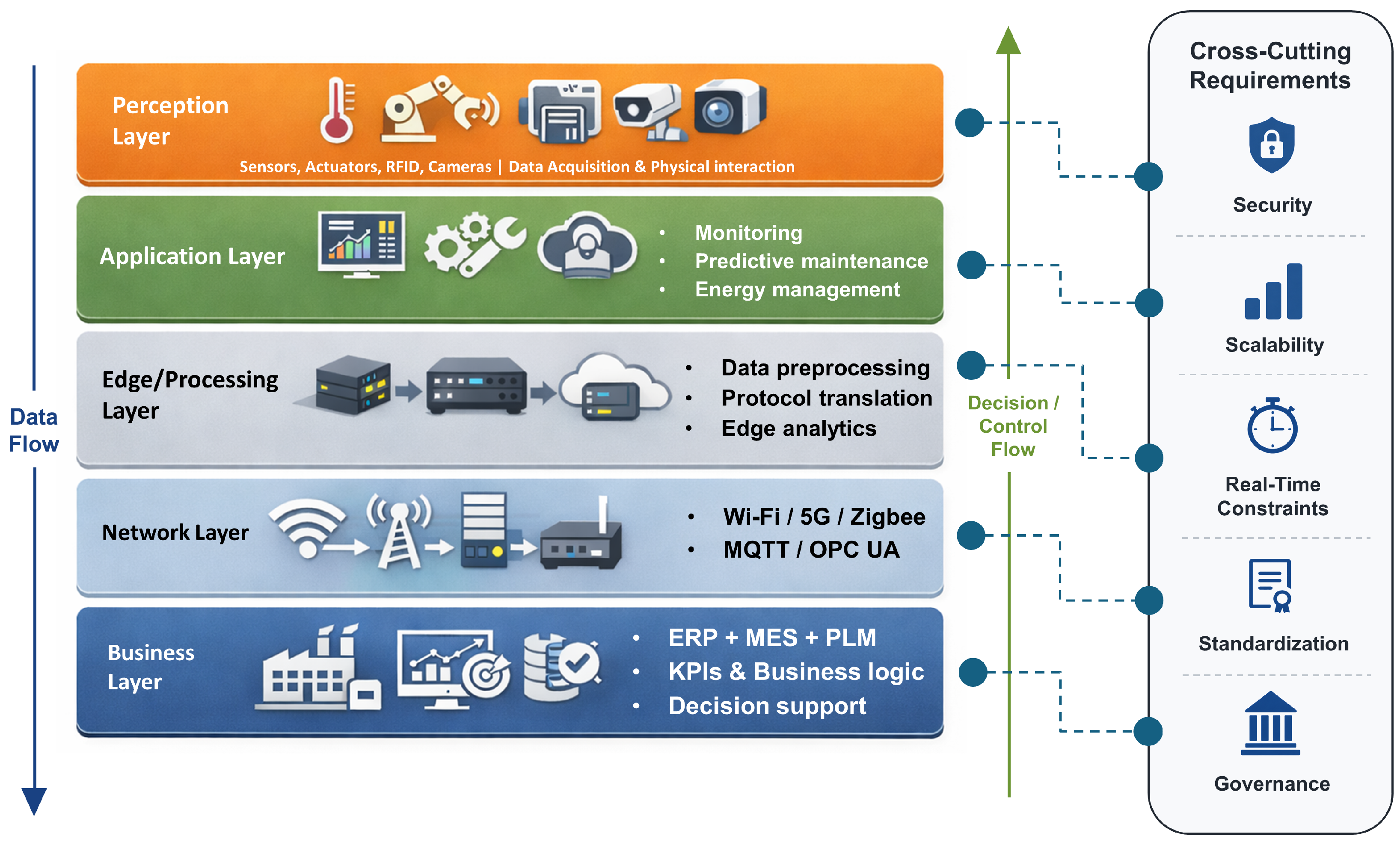
Figure 1. Five-layer IoT architecture for Industry 4.0, highlighting the movement of operational data, the return of decision/control signals, and the cross-cutting requirements that affect the perception, network, edge/processing, application, and business layers.
Iot 07 00046 g001
Figure 2. IoT–Industry 4.0 integration map linking physical assets, protocol translation, edge/cloud analytics, cyber–physical synchronization, and enterprise decision systems, with emphasis on architectural friction points and security boundaries.
Iot 07 00046 g002
Figure 3. Event-to-action pathway in Industrial IoT systems, illustrating how industrial events are captured, filtered, analysed, converted into actions, and updated through bottleneck-aware closed-loop feedback.
Iot 07 00046 g003
Figure 4. PRISMA workflow used in this review, showing the stages of identification, screening, eligibility, and inclusion from the initial database search to the final set of selected studies.
Iot 07 00046 g004
Figure 5. PRISMA 2020 flow diagram showing database identification, source-level filtering, duplicate removal, quality assessment, full-text eligibility, detailed exclusion reasons, and final inclusion of studies.
Iot 07 00046 g005
Figure 6. Number of included studies per year (2020–2025) in the final set of 96 papers.
Iot 07 00046 g006
Figure 7. Top 10 publishers by number of included studies in the final set ( n = 96 ).
Iot 07 00046 g007
Figure 8. Most frequent secondary author keywords in the included studies ( n = 96 ).
Iot 07 00046 g008
Figure 9. Main IoT technology layers in Industry 4.0 systems across the included studies: sensing and identification, networking and messaging, edge/fog/cloud platforms, and data-based services.
Iot 07 00046 g009
Figure 10. Dominant Industry 4.0 integration patterns mapped to the reference layers. The arrows show the main focus of each pattern: (1) Cloud-centric moves data from connectivity to cloud platforms; (2) Edge/Fog keeps processing close to sensors and edge nodes; (3) SOA/Middleware links edge systems with the cloud; and (4) Digital Twin links the full stack (L1–L5), from physical sensing to business use. Security applies across all layers.
Iot 07 00046 g010
Figure 11. Challenges and open issues in IoT-based Industry 4.0 systems, highlighting the main barriers across interoperability/standards, security/trust, and data and analytics at scale.
Iot 07 00046 g011
Figure 12. Roadmap of emerging trends and future research directions for IoT-based Industry 4.0, grouped into near-, mid-, and long-term horizons, and showing the move toward low-delay, trustworthy, interoperable, and sustainable industrial systems.
Iot 07 00046 g012
Figure 13. Main benefits of IoT in Industry 4.0 reported in the reviewed studies, including real-time visibility, predictive maintenance, better quality and traceability, energy efficiency, and improved safety and resilience.
Iot 07 00046 g013
Table 1. Comparison of recent review studies on IoT, IIoT, and Industry 4.0.
StudyMethod and SourcesCoverageMain FocusDifference from This Review
Kumar et al. [31]Bibliometric and content analysis using Scopus, VOSviewer, and Biblioshiny.2014–2020Publication trends, citations, leading authors, sources, countries, and keyword evolution for IoT in Industry 4.0.Useful for mapping scientific production, but less focused on qualitative synthesis of technologies, architectures, application sectors, and deployment barriers.
Kalsoom et al. [32]Systematic review based on Denyer and Tranfield, using five academic databases.2009–2020IoT impact in manufacturing Industry 4.0, with drivers, enablers, challenges, and future research domains.Strong manufacturing focus; the present review extends the scope to recent 2020–2025 studies, communication standards, edge/cloud architectures, and wider application sectors.
Soori et al. [33]Narrative review of IoT for smart factories.Up to 2023Smart-factory applications, including predictive maintenance, asset tracking, inventory management, quality control, energy efficiency, and supply-chain optimisation.Application-centred synthesis; the present review adds a reproducible PRISMA workflow and a structured comparison of protocols, architectures, and cross-layer challenges.
Afrin et al. [34]Thematic review of IIoT implementations and challenges across industries.Up to 2025IIoT applications in environmental monitoring, agriculture, construction, healthcare, robotics, smart grids, and predictive maintenance.Broad cross-sector IIoT review; the present work is more directly organised around IoT in Industry 4.0 system design and layered architectural integration.
Qiu et al. [20]Technical review on IoT, IIoT, and Industry 4.0 integration.Up to 2025Smart manufacturing, CPS, AI/ML, 5G, MQTT, IACS, safety measures, and IIoT security.Technical and security-oriented review; the present study combines standards, architectures, domains, challenges, and trends in one PRISMA 2020-based review corpus.
Table 2. Number of documents retrieved from each database based on the final search queries.
Database/Digital RepositorySearch ScopeDocuments Retrieved
ScopusTitle + Abstract + Keywords192
MDPI Open AccessTitle/Abstract/Keywords225
IEEE XploreDocument Title + All Metadata75
ScienceDirectTitle + Abstract + Keywords25
Web of Science (Core Collection)Topic (Title + Abstract + Keywords)67
Table 3. Inclusion criteria applied during the screening process.
No.Inclusion CriterionRationale
1The study explicitly mentions both Internet of Things (IoT) and Industry 4.0 in the title, abstract, or keywords.Ensures direct relevance to the review topic.
2The study focuses on industrial or manufacturing applications such as smart factories, digital twins, predictive maintenance, or industrial automation.Keeps the focus on the Industry 4.0 industrial setting.
3The paper presents theoretical, methodological, or empirical findings on IoT architectures, frameworks, or key technologies for Industry 4.0.Ensures the paper adds useful evidence on IoT and Industry 4.0 system design.
4The document is a peer-reviewed journal article or review article.Supports scientific quality and reliability.
5The publication is written in English.Supports consistent reading and data extraction.
6The paper was published between 2020 and 2025.Captures recent work in a fast-changing field.
7The paper is in the final publication stage (assigned to an issue and volume).Excludes preprints and keeps only final, citable studies.
Table 4. Exclusion criteria applied during the screening process.
No.Exclusion CriterionRationale
1Studies that discuss IoT in non-industrial areas such as healthcare, agriculture, or smart homes.Keeps the review focused on industrial IoT use.
2Studies that discuss Industry 4.0 without an IoT part.Removes papers outside the overlap of the two topics.
3Conference papers, proceedings papers, conference abstracts, editorials, corrections, theses, technical reports, and other non-journal outputs.Keeps only validated scientific work.
4Duplicate papers found in more than one database.Avoids repetition and inflated counts.
5Papers that do not provide clear methods or strong analysis of IoT–Industry 4.0 links.Keeps a steady level of study quality.
6Papers written in a language other than English.Keeps terminology and interpretation consistent.
7Papers not in a final publication stage (in press, early access, or preprint).Excludes work that is not final and fully verified.
Table 5. Quality assessment criteria.
CriterionDescriptionEvaluation Method
Q1. Clarity of research objectivesThe study clearly states the research problem, objectives, and scope related to IoT and Industry 4.0.Check whether the objectives are clearly stated and match the topic.
Q2. Method qualityThe study explains its method in a clear way, including data sources, tools, or the experimental setup. The steps should allow others to repeat the work.Check whether the method is described clearly and can be repeated.
Q3. Contribution to knowledgeThe paper adds useful new ideas, a clear framework, or a practical use case that supports IoT or Industry 4.0 progress.Check whether the contribution is clear and adds new value.
Q4. Relevance and recencyThe study matches the goals of this review and was published between 2020 and 2025, which keeps the evidence up to date.Check whether it fits the review scope and falls within the time window.
Q5. Source credibilityThe paper is published in a peer-reviewed journal or venue that is well known and indexed in major databases (Scopus, Web of Science, IEEE, etc.).Check whether the venue is peer-reviewed and indexed in trusted databases.
Table 6. Quality assessment scoring scheme (QA).
Item #QA QuestionScoreDescription
QA1Are the research objectives clearly stated?0The title, abstract, and keywords do not state a clear aim, objective, or scope.
1The aim and scope are stated clearly and match IoT in Industry 4.0.
QA2Is the research method clearly described?0The abstract does not explain the method or study design (for example, a framework, architecture, experiment, dataset, evaluation, or procedure).
1The method is described clearly (for example, a proposed architecture or framework with implementation and evaluation, a case study, experiments, or a structured review method).
QA3Does the study state a clear contribution?0The abstract does not show a clear added value (only general discussion or unclear novelty).
1The abstract states a clear added value (for example, a new architecture, framework, model, taxonomy, comparative study, tested system, or clear lessons).
QA4Is the study within the scope and time
window of this review?
0The paper is not about IoT-based Industry 4.0 industrial use and/or it is outside 2020–2025.
1The paper clearly covers IoT in an Industry 4.0 industrial setting and is published within 2020–2025.
QA5Is the publication source credible and
peer-reviewed?
0The source is not eligible (for example, proceedings or conference outlets, non-peer-reviewed sources, or unclear venue quality).
1The source is peer-reviewed and indexed in major databases (for example, Scopus, Web of Science, IEEE journals, ScienceDirect, or MDPI journals).
Table 7. Publication channels of the included IoT–Industry 4.0 studies.
PublisherPublication TitleStudies
Addleton Academic PublishersEconomics, Management, and Financial Markets1
ACMACM Computing Surveys1
ACM Transactions on Management Information Systems1
ElsevierAlexandria Engineering Journal2
Journal of Industrial Information Integration2
Advanced Engineering Informatics1
Computer Communications1
Computers & Industrial Engineering1
Data in Brief1
Decision Analytics Journal1
Forensic Science International: Reports1
Journal of Manufacturing Systems1
Measurement: Sensors1
Procedia Manufacturing1
Sustainable Futures1
Sustainable Manufacturing and Service Economics1
Technological Forecasting and Social Change1
Telematics and Informatics Reports1
Trends in Food Science and Technology1
Emerald PublishingJournal of Engineering, Design and Technology1
World Journal of Engineering1
IEEEIEEE Internet of Things Journal2
IEEE Access1
KeAi CommunicationsInternet of Things and Cyber-Physical Systems1
MDPISensors18
Electronics7
Applied Sciences6
Energies2
Information (Switzerland)2
Processes2
Sustainability2
Buildings1
Future Internet1
Logistics1
Machines1
Sci1
Sustainability (Switzerland)1
Syst. Innov.1
Systems1
Technologies1
Modern Education and CS PressInternational Journal of IT and Computer Science1
Polish Academy of SciencesBulletin of the Polish Academy of Sciences: Technical Sciences1
SpringerCCF Transactions on Pervasive Computing and Interaction1
Cybersecurity1
Education and Information Technologies1
Int. Journal of Advanced Manufacturing Technology1
Int. Journal of Intelligent Robotics and Applications1
Journal of Intelligent Manufacturing1
SN Computer Science1
TJPRCInt. Journal of Mech. and Production Engineering R&D1
Taylor & FrancisInternational Journal of Production Research1
Production Planning and Control1
Tsinghua University PressJournal of Social Computing1
University of BahrainInternational Journal of Computing and Digital Systems1
WileyIET Information Security1
International Journal of Communication Systems1
Journal of Nanomaterials1
Mathematical Problems in Engineering1
Scientific Programming1
World Scientific PublishingInt. Journal of Pattern Recognition and Artificial Intelligence1
Journal of Industrial Integration and Management1
Table 8. Scenario-based suitability matrix for IoT communication technologies and computing placement in Industry 4.0.
Approach and IIoT RoleTelemetryOT–IT SemanticsConstrained SensingMobile/Remote AssetsTime-Critical ControlMain Trade-Off
MQTT
Telemetry broker
+++++Light and simple for monitoring, but it needs topic governance, broker security, and external semantic modelling.
OPC UA
Industrial semantics
+++++Strong for structured OT–IT data exchange, but configuration effort and gateway needs increase in mixed environments.
CoAP
Constrained web link
++++Efficient for small devices, but weak for high-rate streams, enterprise integration, and time-critical control.
LPWAN/LoRaWAN/NB-IoT
Wide-area sensing
+++++Wide coverage and low energy use, but limited throughput and higher latency restrict closed-loop uses.
5G/MEC
Mobile low-latency link
++++++Supports mobile and low-latency services, but cost, coverage planning, spectrum access, and integration remain demanding.
TSN
Deterministic Ethernet
+++Provides bounded latency, but requires TSN-ready devices, time synchronization, and engineered network design.
Edge/fog/cloud
Computing placement
++++++Edge reduces delay, while cloud supports cross-site analytics; orchestration, synchronization, security, and lifecycle control remain difficult.
Legend: ++ = strong fit; + = usable with conditions; − = weak fit for the scenario.
Table 9. Application domains and representative industrial use cases of IoT-based Industry 4.0 systems, with typical IoT technologies/sensors and the main analytics layer.
Application DomainRepresentative Industrial Use CasesTypical IoT Technologies/SensorsDominant Analytics Layer
Smart manufacturing and production [72,73,75]Shop-floor monitoring; adaptive process control and production scheduling; robot/AGV coordination; in-line quality checks; and traceabilityMachine/PLC telemetry; vibration/temperature/current sensors; vision cameras; RFID/QR; OPC UA/MQTT; gateways; and industrial edge nodesEdge/Fog (real-time control, low delay) + Cloud (history, planning).
Predictive maintenance and asset management [50,68,98]Condition monitoring; anomaly and fault diagnosis; remaining useful life (RUL) estimate; maintenance scheduling; and spare-parts planningVibration/acoustic/thermal sensors; motor current signals; SCADA/PLC signals; edge feature extraction with ML models; and CMMS linksEdge (feature extraction, inference) + Cloud (model training, updates).
Logistics and supply chain [40,82,99]Tracking and tracing; inventory visibility; warehouse monitoring; fleet telematics; cold-chain monitoring; and compliance reportsRFID/QR; GPS/telematics; temperature/humidity sensors; barcode/vision capture; IoT gateways; and links with enterprise platformsCloud (platform for visibility) + Blockchain (traceability, data integrity).
Energy and sustainability management [84,85,100]Energy metering and saving; load monitoring; energy-aware scheduling; efficiency checks; utility control; and anomaly detectionSmart meters; power-quality sensors; connected drives/actuators; edge monitoring nodes; and forecasting and scheduling toolsCloud (forecasting, reporting) + Edge (local load balancing/shedding).
Construction 4.0 and built environment [87,88]Site safety and progress monitoring; equipment tracking; environmental risk sensing; and smart building/facility monitoringWearables and location tags; environmental sensors (dust/noise/temp); equipment telemetry; BIM-linked data flows; and site gatewaysCloud (BIM data links, display) + Edge (fast safety alerts).
Agri-food monitoring and processing [101,102]Quality/condition tracking in processing and storage; traceability; cold-chain quality; and waste reductionTemperature/humidity/gas sensors; RFID/QR; smart packaging/monitoring nodes; gateways; and analytics dashboardsCloud (compliance data, analytics) + Edge (gateway aggregation).
Cross-cutting security and governance [91,103,104]Secure device onboarding; identity and access control; anomaly/attack detection; trusted data sharing; and audit trailsLightweight security protocols; PKI/identity; secure gateways; ML-based intrusion detection; blockchain/ledger options; and policy toolsBlockchain/ledger (integrity) + Edge (intrusion detection).
Other/miscellaneous industrial applications [96,97]Domain-specific monitoring and improvement across process industries, utilities, and connected facilities; and pilot-to-deployment patternsMixed sensing and connectivity stacks; links with legacy systems; and application-driven choice of sensors, gateways, and analytics toolsContext-dependent (depends on scale and low-delay needs).
Table 10. Domain-specific challenges, partial technological responses, and unresolved gaps and conflicts in IoT–Industry 4.0 studies. Note: Counts are non-exclusive because one study may address several domains, technologies, or challenge categories.
Application Domain
Studies
Dominant Challenge
Signal Count
Technologies
in Reviewed Studies
Partial Resolution
Shown in Studies
Persisting GapConflicting Evidence/
Unresolved Tension
Smart manufacturing and production
n = 63
Brownfield interoperability across legacy PLCs, SCADA, proprietary machines, and new IoT stacks.
interoperability: 57 papers
legacy OT: 14 papers
OPC
UA, MQTT, edge gateways, CPS wrappers, digital twins, 5G.
Protocol bridges expose machine data and reduce manual reporting. OPC
UA supports OT–IT semantic alignment in vendor-supported environments.
Protocol translation alone cannot resolve semantic mismatch, vendor lock-in, OT lifecycle misalignment, or hard real-time guarantees under mixed traffic.Tension. OPC UA is effective in vendor-homogeneous settings, but per-site middleware is still needed when legacy PLCs lack standard interfaces. No universally replicable integration path is demonstrated.
Predictive maintenance and asset management
n = 23
Data scarcity, label imbalance, model drift, and cross-asset transfer.
data quality: 37 papers
Vibration, thermal and acoustic sensors, edge ML, cloud analytics, digital twins, SCADA/PLC signals.Fault detection and RUL models show strong performance on single machines or controlled testbeds. Edge processing reduces inference latency.Generalization across machines, sites, or operating regimes is weakly demonstrated. Explainability and model lifecycle management are rarely treated.Conflict. Data-driven ML often reports high single-testbed accuracy but degrades on transfer. Physics-informed hybrids improve generalization but add modelling cost. Comparable benchmarks remain limited.
Logistics, traceability, and supply chains
n = 34
Cross-company data ownership, trust, and interoperability across supply-chain actors.
trust and sharing: 21 papers
RFID, IoT tracking, blockchain, smart contracts, cloud platforms, governance frameworks.RFID and IoT tracking improve asset visibility. Blockchain and smart contracts strengthen audit trails and data provenance across partners.Blockchain improves auditability but introduces latency, governance complexity, and unclear liability when several partners share ledger control.Conflict. Blockchain is proposed as a trust solution, while other studies show ledger overhead can conflict with frequent IoT updates. Real-time performance and multi-party governance are rarely validated together.
Energy management, smart buildings, and utilities
n = 62
Reliable sensing, low-latency control, energy efficiency, and safe local decisions under intermittent connectivity.
connectivity: 53 papers
latency: 37 papers
Smart meters, LPWAN/NB-IoT, edge control, cloud analytics, AI optimization.Smart metering and AI scheduling reduce energy waste and support load balancing. LPWAN and NB-IoT extend sensing to distributed utility assets.Cloud supports global optimization, while edge supports faster local response. The best placement remains context-dependent.Tension. Cloud-centric studies report better global optimization, while edge-centric studies report better resilience under connectivity loss. Hybrid proposals exist but are rarely validated on the same testbed.
Construction 4.0, agri-food, and field monitoring
n = 31
Connectivity continuity, harsh environments, sensor calibration drift, and power limits.
connectivity: 53 papers
scalability: 59 papers
LoRaWAN, NB-IoT, wireless sensors, mobile gateways, BIM-linked flows.LPWAN protocols extend IoT monitoring to distributed and remote assets. Gateway aggregation reduces backhaul load and improves local resilience.Most deployments remain prototypes or single-site studies. Long-term maintenance, calibration continuity, and cost transfer are weakly shown.Evidence gap. Connectivity results vary between open-field conditions and dense built environments. Few studies compare LPWAN options under real construction-site constraints or multi-season agricultural use.
Cybersecurity, privacy, and governance
n = 52
Expanded attack surface across OT assets, edge nodes, cloud platforms, enterprise APIs, and legacy systems.
cybersecurity: 53 papers
governance: 61 papers
Authentication/PKI, access control, AI-based IDS, blockchain provenance, secure gateways.Layer-specific controls reduce targeted threats. AI-based intrusion detection can identify anomalies beyond static rule sets.Most approaches protect one layer or threat vector. Few integrate security with latency, usability, legacy OT governance, and multi-stakeholder access.Conflict. AI-based IDS improves detection but may create false positives. Blockchain adds tamper resistance but can conflict with low-latency OT needs. Integrated validation remains limited.
Digital twins, CPS, and edge–cloud orchestration
n = 37
Synchronization fidelity, model accuracy, latency, and compute placement for real-time physical processes.
latency: 37 papers
data quality: 37 papers
CPS/digital twins, edge/fog/cloud, 5G/MEC, virtual commissioning, distributed ML.Digital twins support monitoring, simulation, and what-if analysis. Edge placement reduces synchronization delay for local control loops.Cloud-hosted twins increase data movement and synchronization latency. Edge-hosted twins face compute and storage limits.Tension. Cloud-side twins emphasize fleet-level learning and scalability; edge-side twins emphasize real-time fidelity and resilience. Hybrid architectures are proposed, but full synchronization loops remain weakly validated.
Iot 07 00046 i001 Conflicting evidence/unresolved tension Iot 07 00046 i002 Study count Iot 07 00046 i003 High-signal challenge Iot 07 00046 i004 Medium-signal challenge.
Table 11. Specific future research agenda for IoT–Industry 4.0 deployment (RQ5). one study may support more than one future research axis.
Future Research AxisCurrent Research Gaps/Open Research ProblemFuture Research Questions/Directions
AI lifecycle, model transfer, and explainability [13,50,115]
n = 23 studies
AI models are widely used for anomaly detection, fault diagnosis, quality prediction, and decision support. However, most studies validate models on one dataset, machine, or process. Transfer across assets, model drift, explainability, retraining needs, and maintenance effort remain weakly tested.How can industrial AI models remain accurate, explainable, and maintainable when machines, sensors, products, and operating conditions change over time? Future studies should report drift, retraining frequency, data quality, explainability, and maintenance effort together with accuracy.
Edge–cloud orchestration and workload placement [62,63,112]
n = 29 studies
Edge, fog, and cloud architectures are used to balance latency, storage, and analytics. Yet most studies test one architecture, while few compare edge-only, cloud-only, and hybrid designs under the same workload, network load, reliability, and maintenance conditions.How should computation and data services be placed across edge, fog, and cloud layers under real shop-floor constraints? Future experiments should compare latency, network load, availability, update cost, failure recovery, and lifecycle maintenance.
Interoperability, standards, and legacy OT integration [55,65,105]
n = 9 studies
Standards and protocols improve connectivity, but brownfield factories still depend on legacy PLCs, SCADA systems, proprietary machines, gateways, and enterprise platforms. Semantic mismatch, vendor lock-in, old equipment lifecycles, and configuration cost remain unresolved.How can mixed-vendor industrial systems be integrated through reusable architectures instead of site-specific middleware? Future pilots should report semantic mapping effort, gateway requirements, configuration cost, and reuse across sites.
Cybersecurity, privacy, trust, and governance [57,104,107]
n = 33 studies
Distributed IIoT increases the attack surface across sensors, gateways, edge nodes, cloud platforms, enterprise APIs, and inter-organizational data flows. Security tools, blockchain, and provenance methods often protect one layer or one threat type rather than the full deployment chain.How can IIoT systems be secured while preserving latency, usability, data ownership, and multi-stakeholder governance? Future studies should test realistic attacks, access rules, detection quality, latency overhead, governance models, and failure handling.
Digital twins and CPS synchronization [26,54,66]
n = 12 studies
Digital twins and CPS support monitoring, simulation, and what-if analysis, but synchronization with physical assets remains difficult. Few studies validate real-time updates, model error, synchronization delay, and plant-scale CPS integration under changing operating conditions.How can digital twins remain synchronized with physical assets while preserving model fidelity, low latency, and scalable computation? Future work should report synchronization delay, model error, update frequency, and integration with OT/CPS systems.
Data quality, benchmarks, and reproducible validation [51,105,110]
n = 13 studies
Industrial IoT studies use different sensors, datasets, labels, workloads, and evaluation metrics. This makes performance claims difficult to compare and limits reproducibility, especially for predictive maintenance, quality control, anomaly detection, and energy optimization.How can IoT and AI methods be compared fairly across industrial contexts? Future research should publish reusable datasets or benchmark protocols with sensor metadata, data-quality metrics, failure modes, workloads, and common evaluation criteria.
Deterministic connectivity and next-generation networks [49,114]
n = 11 studies
5G, TSN, LPWAN, MQTT, and OPC UA are often evaluated separately. Real industrial deployments require combined radio planning, deterministic traffic control, coverage analysis, packet-loss control, and integration with existing OT systems.How can next-generation networks support massive sensing, mobile assets, and time-critical control without increasing integration complexity? Future testbeds should evaluate end-to-end chains including sensors, gateways, controllers, edge nodes, and enterprise platforms.
Green IIoT and lifecycle sustainability [79,100,118]
n = 34 studies
Low-power sensing, energy-aware analytics, and sustainable IoT design are increasingly important. However, battery lifetime, device replacement, maintenance frequency, carbon footprint, lifecycle cost, and long-term reliability are rarely measured together.How can IIoT deployments reduce energy use and lifecycle impact while maintaining sensing quality, connectivity, and service reliability? Future evaluations should include energy consumption, battery lifetime, device replacement, carbon footprint, maintenance frequency, and lifecycle cost.
Scalable industrial pilots and socio-technical adoption [76,77,119]
deployment n = 21 ; adoption n = 26
Many IoT solutions remain prototypes, simulations, or single-site pilots. Long-term uptime, upgrade effort, integration cost, operator acceptance, skills needs, governance changes, and return on investment are still rarely reported.How can IoT systems move from proof-of-concept to stable industrial deployment across plants, vendors, operators, and organizational routines? Future pilots should report uptime, maintenance effort, user adoption, skills requirements, governance changes, scalability, and lessons from deployment failures.
Table 12. Comparative synthesis of IoT-based Industry 4.0 literature across main application domains and cross-cutting themes.
Domain/
Use Case
Representative ReferencesMain IoT TechnologiesArchitecture PatternCompute PlacementMain Reported BenefitsOpen Issues
Smart manufacturing and production[72,75,122]PLC/SCADA, RFID/QR, machine vision, OPC UA/MQTT, robots, AGVsLayered smart-factory/CPSEdge/Fog + CloudVisibility, adaptive control, traceability, productivityLegacy integration, interoperability, latency, skill gaps
Predictive maintenance and asset management[47,98,115]Vibration, acoustic, thermal, and current sensors; SCADA/PLC; IoT gateways; ML monitoringCondition-monitoring/PdM pipelineEdge + CloudEarly fault detection, less downtime, better maintenance planningData quality, model drift, weak benchmark comparability, deployment cost
Logistics and supply chain[40,82,99]RFID/QR, tracking sensors, gateways, cloud dashboards, blockchain toolsIIoT traceability platformCloud + EdgeAsset visibility, traceability, coordination, better planningTrust issues, standards mismatch, data-sharing barriers, platform dependence
Energy and sustainability management[85,118,123]Smart meters, power-quality sensors, connected drives, edge nodes, forecasting toolsCyber–physical energy managementCloud + EdgeEnergy-aware scheduling, load balancing, less waste, lower costScalability, data reliability, legacy integration, limited real-site validation
Construction 4.0 and built environment[87,88]Wearables, location tags, environmental sensors, equipment telemetry, BIM-linked flowsIoT-BIM/site monitoringCloud + EdgeSite safety, progress tracking, equipment monitoring, coordinationHarsh field conditions, weak connectivity, fragmented tools, low maturity
Agri-food monitoring and processing[101,102,124]Temperature, humidity, and gas sensors; RFID/QR; smart packaging; gateways; dashboardsCold-chain/quality monitoringCloud + EdgeQuality tracking, traceability, waste reduction, condition monitoringSensor calibration, monitoring continuity, interoperability, scaling cost
Security, privacy, and governance[91,103,121]Secure gateways, PKI, intrusion detection, privacy-aware telemetry, blockchain logsSecurity-by-design/trustEdge + Cloud/LedgerSecure onboarding, access control, integrity, audit trailsSecurity complexity, privacy risk, added overhead, governance alignment
Disclaimer/Publisher’s Note: The statements, opinions and data contained in all publications are solely those of the individual author(s) and contributor(s) and not of MDPI and/or the editor(s). MDPI and/or the editor(s) disclaim responsibility for any injury to people or property resulting from any ideas, methods, instructions or products referred to in the content.