This is an early access version, the complete PDF, HTML, and XML versions will be available soon.
Article

Randomness-Driven Evaluation of SPN-Based Lightweight Ciphers for IoT Applications


by
Raad S. Al-Qassas
1,* and
Malik Qasaimeh
2
1
Department of Computer Science, Princess Sumaya University for Technology, Amman 11941, Jordan
2
Department of Software Engineering, Jordan University of Science and Technology, Irbid 22110, Jordan
*
Author to whom correspondence should be addressed.
Submission received: 3 March 2026 / Revised: 20 May 2026 / Accepted: 29 May 2026 / Published: 1 June 2026

Abstract

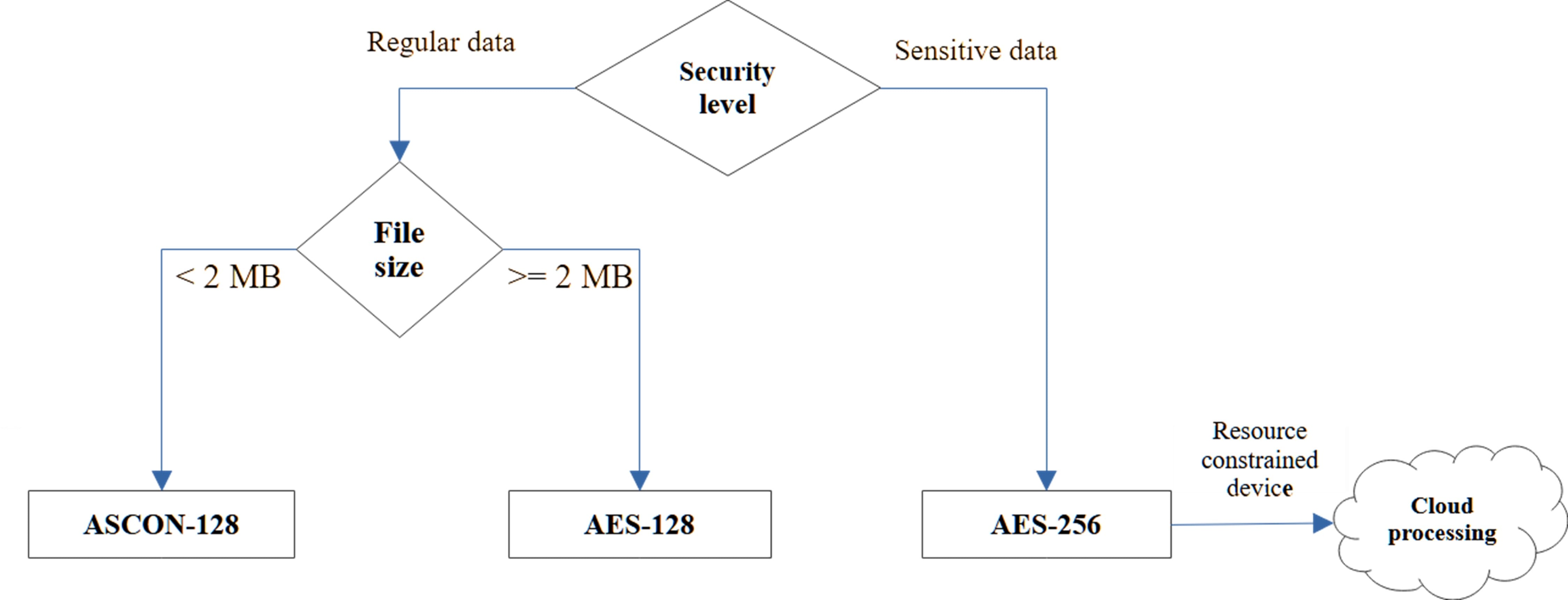
Lightweight devices are becoming a crucial part of networked systems, including Internet of Things environments. These devices usually have constraints, such as limited computational power, which have directed researchers to develop lightweight crypto algorithms to secure the data generated by these devices. Therefore, an efficient but secure crypto algorithm for these devices is required. In this paper, we thoroughly evaluate well-known SPN-based algorithms, namely AES, LED, PRESENT, ASCON-128, and ASCON-128a, based on the success rates of statistical randomness tests, including the Frequency, Runs, Discrete Fourier Transform, and Cumulative Sum tests. With these tests, the assessment measures the algorithms’ ability to produce unpredictable text. To ensure thorough evaluation, the experiments included approximately 19,000 image files of varying sizes up to 2560 KB. The extensive experimental results show that the ASCON family achieved high success rates above 98% in all tests, particularly for small file sizes, while AES achieved higher success rates for larger file sizes, and LED showed limited performance for the varied file sizes. The results confirm that ASCON-128 and ASCON-128a offer the needed trade-off between computation and randomness validation. Based on this evaluation, we propose an adaptive encryption framework based on file size, data classification, and device computational power.
Keywords: IoT; randomness evaluation; lightweight cryptography; NIST randomness tests IoT; randomness evaluation; lightweight cryptography; NIST randomness tests
Graphical Abstract