
A Lightweight Post-Quantum Anonymous Attestation Framework for Traceable and Comprehensive Privacy Preservation in VANETs

 ,
,  ,
,  ,
,  , , and
Abstract
1. Introduction
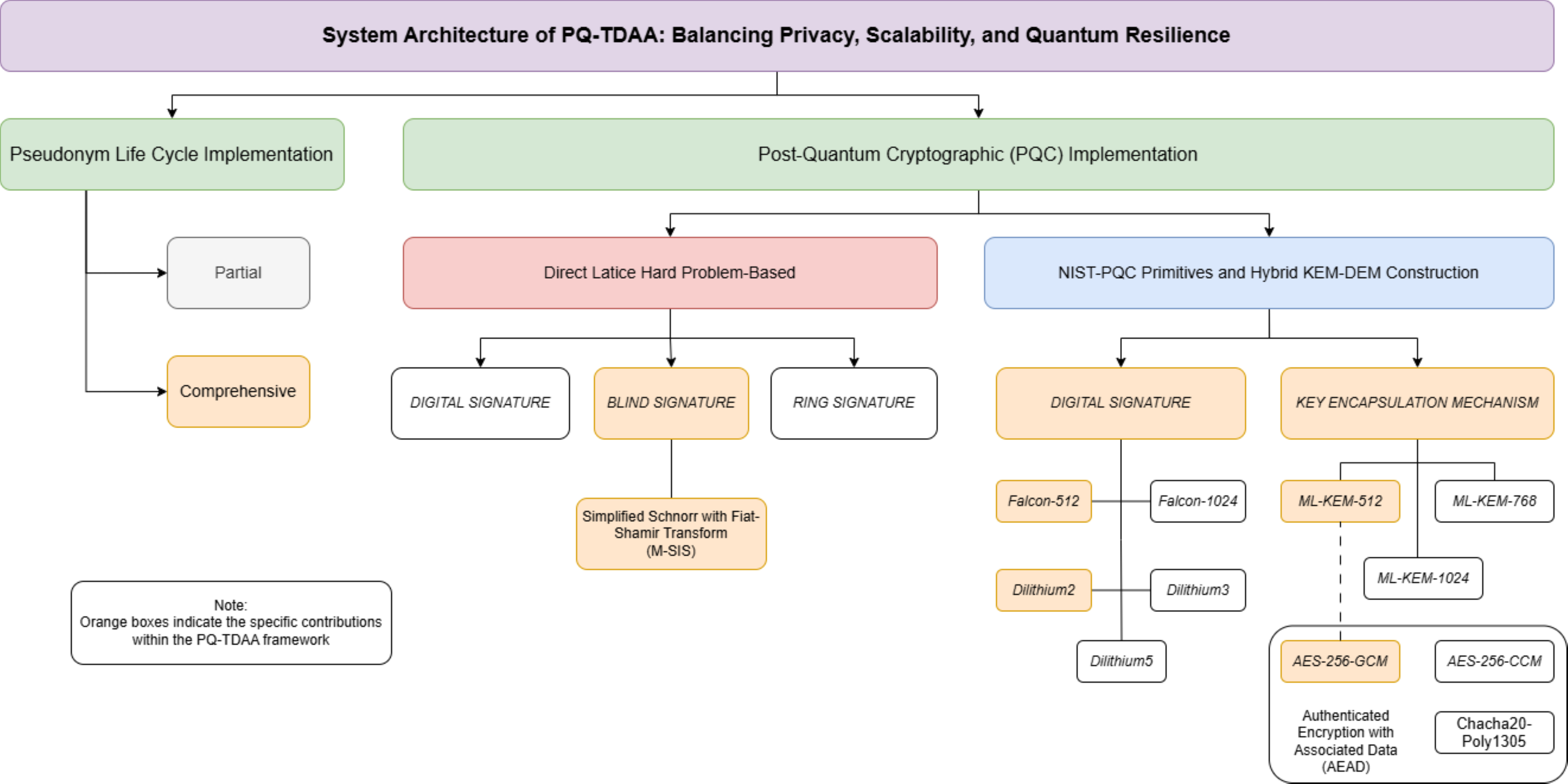
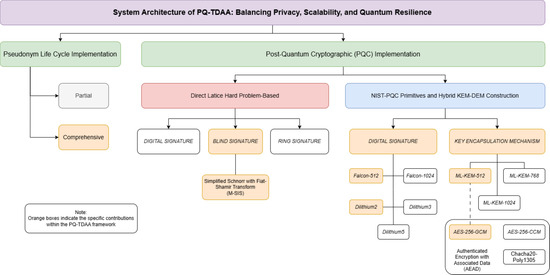
- A systematic integration framework for post-quantum traceable DAA in VANETs (PQ-TDAA) that integrates NIST-standard ML-KEM-512, Dilithium2, and Falcon-512 with Beullens et al.’s two-round blind signature transformed through a Fiat–Shamir-based simplified Schnorr proof is established. PQ-TDAA achieves practical efficiency by optimizing parameters for vehicular conditions, enabling complete pseudonym lifecycle management, reducing communication overhead, and controlling traceability.
- A lightweight blind signature for VANETs is obtained. We adapt Beullens et al.’s [13] lattice-based blind signature by replacing the original Lyubashevsky, Nguyen, and Plancon (LNP) zero-knowledge protocol (ZKP) with a Fiat–Shamir-transformed simplified Schnorr proof. This systematic adaptation reduces the proof size to 8 kB, which is a 63.6% reduction from Beullens et al.’s [13] original scheme and 69.2% smaller than the state-of-the-art V-LDAA [8], making credential issuance practical for bandwidth-constrained control channels.
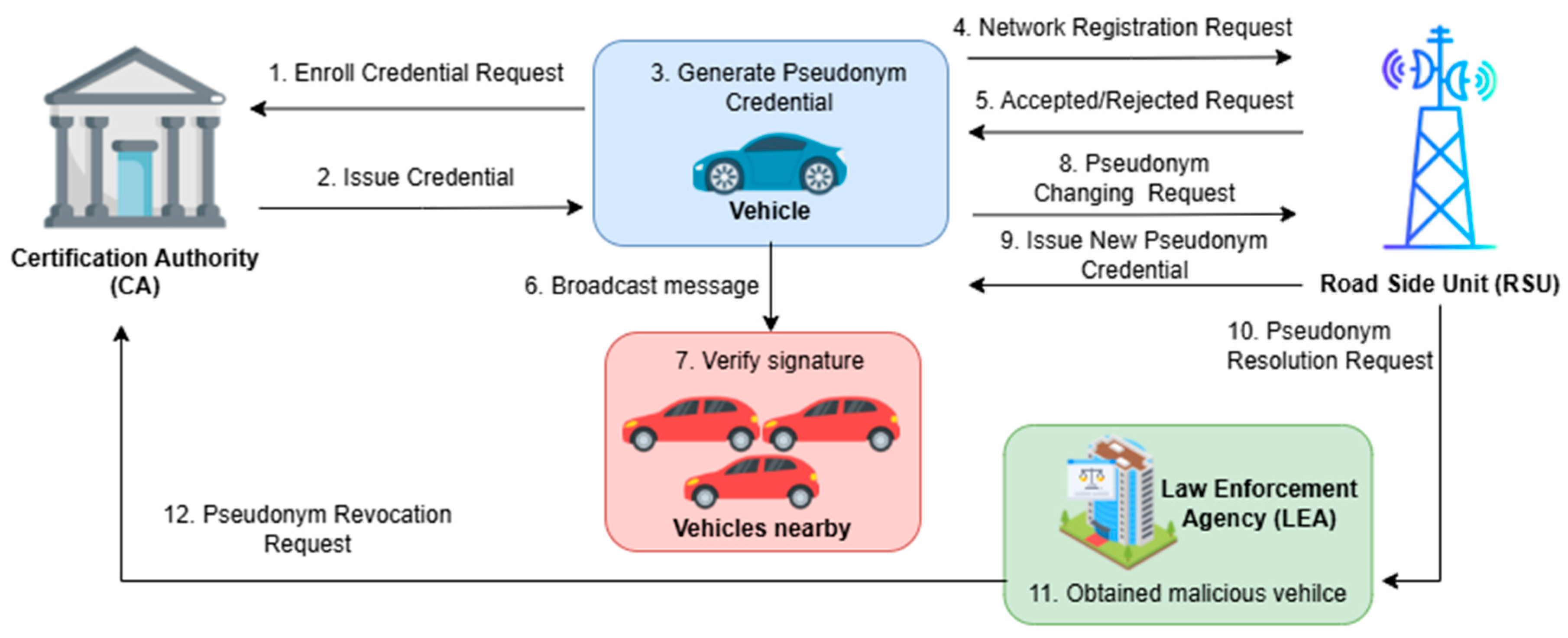
- A complete pseudonym lifecycle with ETSI TS 102 941 compliance is obtained [14]. We introduce the first post-quantum framework covering all five operational phases (Issuance, Usage, Changing, Resolution, and Revocation) that aligns with ETSI TS 102 941 standards [14]. By integrating RSU-assisted hierarchical verification, PQ-TDAA shifts the computational burden from OBUs to the infrastructure.
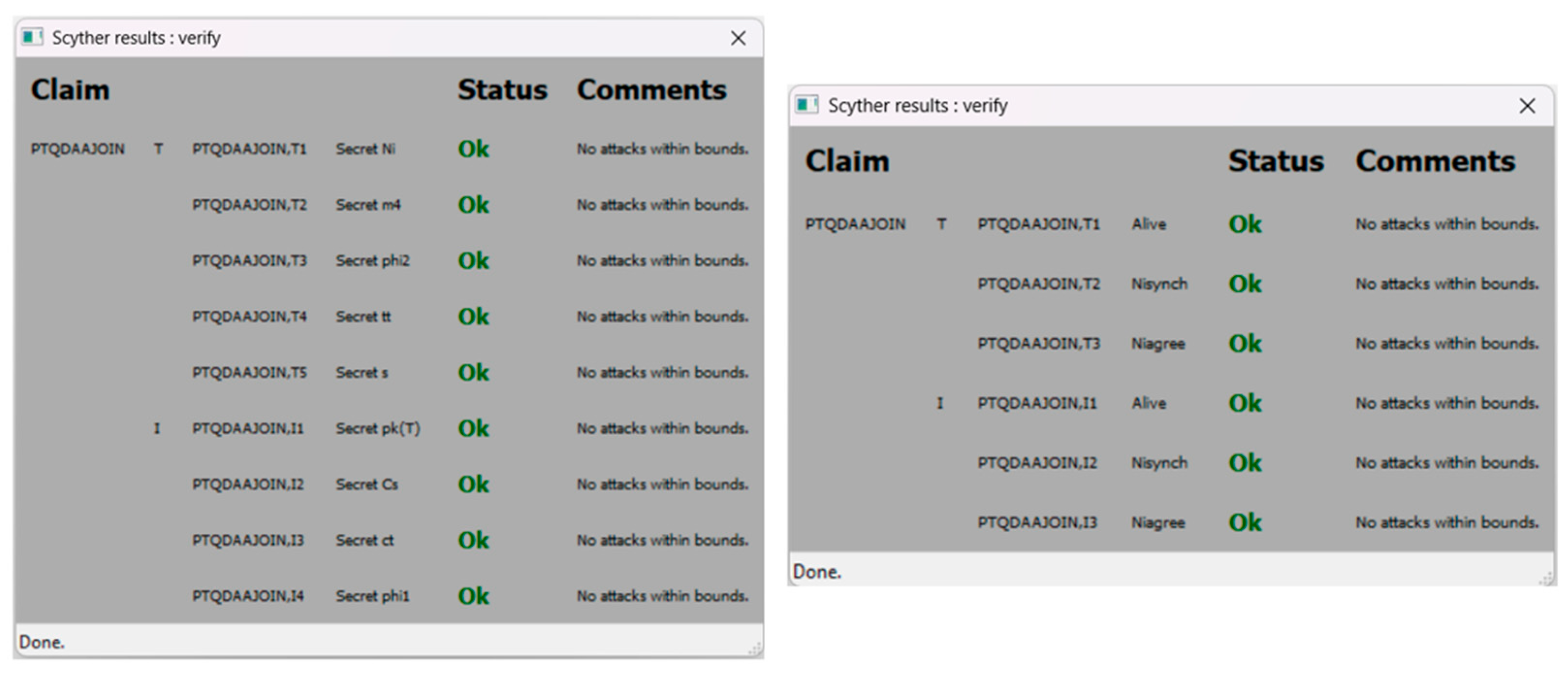
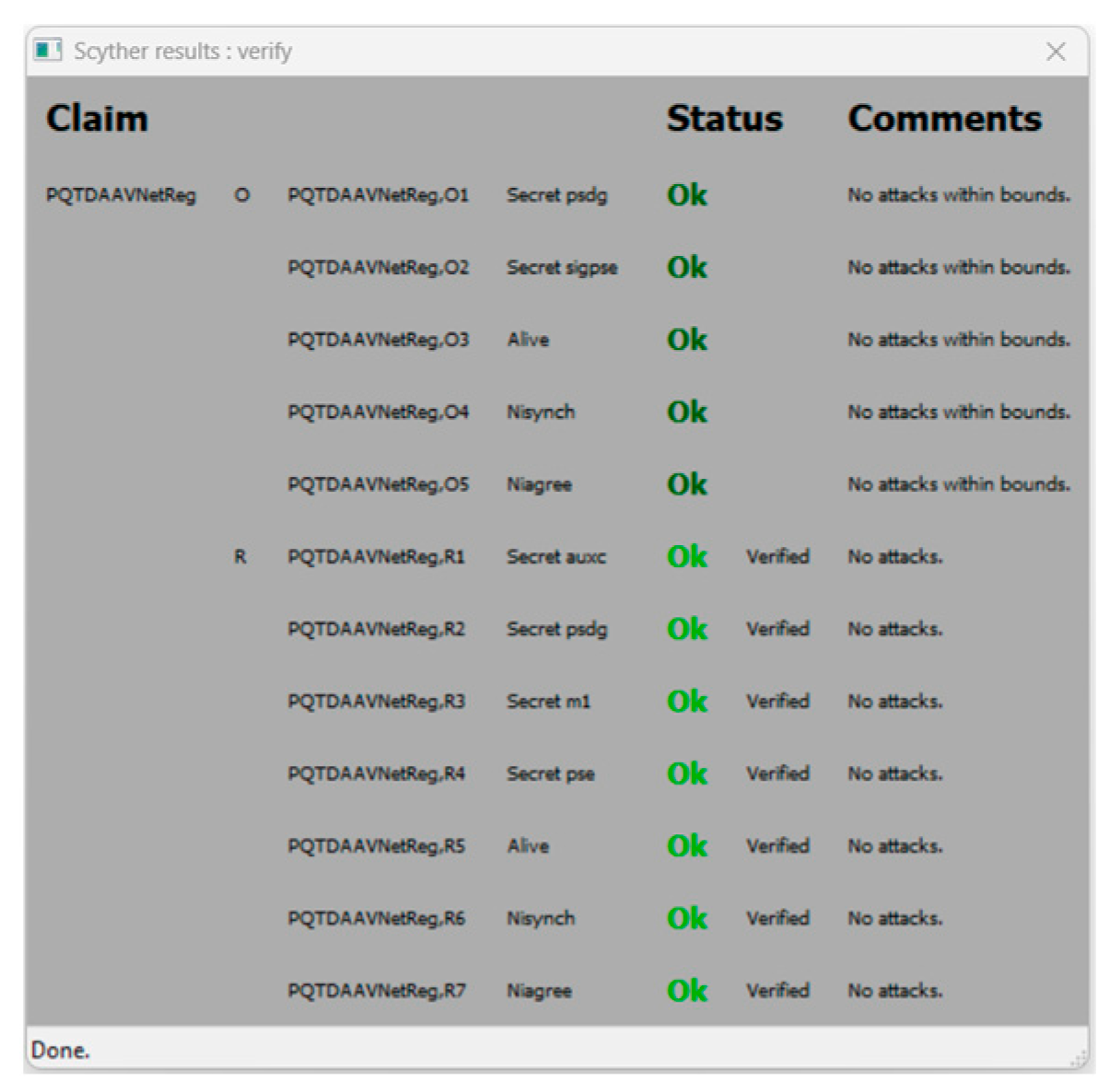
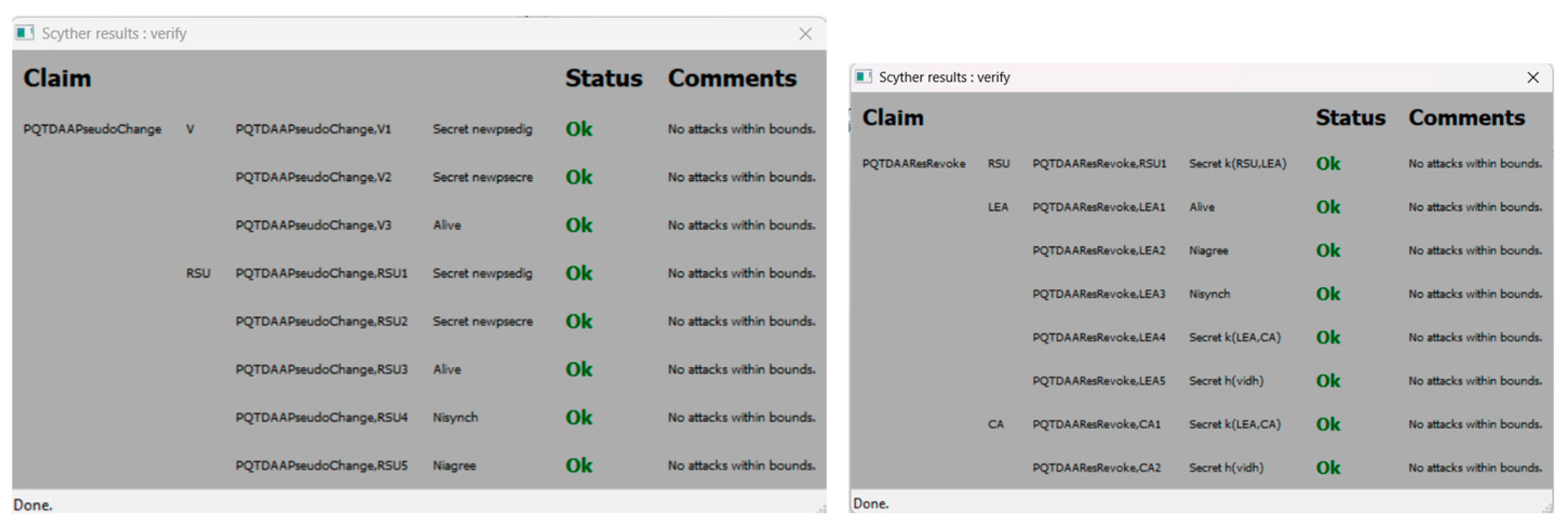
- Rigorous hybrid security verification is achieved. We conducted a comprehensive three-layer validation that combines Scyther-based formal verification, informal security justification, and lattice-level cryptographic analysis. The Scyther verification under the Dolev–Yao model confirms secrecy, authentication, and synchronization with no attacks detected, while the informal analysis validates eight security and privacy properties across protocol phases. Complementarily, the lattice-based proof establishes soundness, zero-knowledge, and unforgeability for Module-Short Integer Solution (M-SIS)/Module-Learning with Errors (M-LWE), supported by a BKZ-728 parameterization providing approximately 125-bit quantum security, substantially exceeding NIST Level-1 requirements.
- Real-world deployment validation on automotive-grade ARM hardware is performed. We present direct measurements on an ARM Cortex-A76 (Raspberry Pi 5) platform, representing realistic automotive OBU platforms. Both Dilithium2 and Falcon-512 variants achieve sub-0.5 ms complete V2V cycles (beacon generation and verification), well within the 100 ms beacon interval, confirming real-time suitability for vehicular deployment. These measurements bridge the gap between theoretical design and practical embedded implementation.
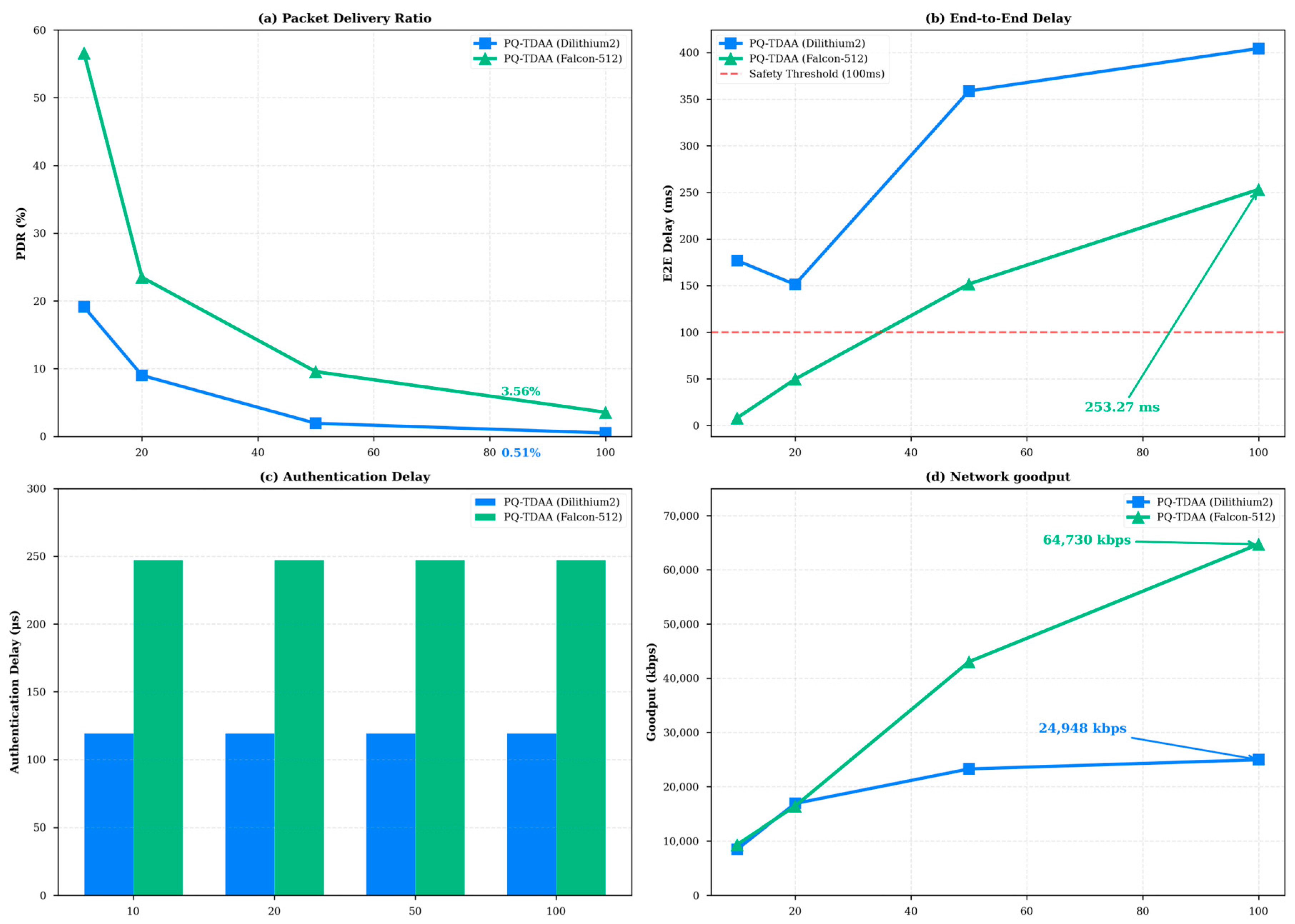
- Holistic performance validation is completed. Analytical profiling and NS-3 simulations demonstrate significant gains in computational efficiency, communication compactness, and network goodput. The results reveal that signature compactness, rather than cryptographic speed, is the dominant performance factor in post-quantum vehicular networks, effectively bridging the gap between theoretical security and practical implementation.
2. Related Work
2.1. National Institute of Standards and Technology (NIST) Post-Quantum Cryptography (PQC) Algorithms Standard [15,16]
2.1.1. Module Lattice Key Encapsulation Mechanism (ML-KEM)-512
2.1.2. CRYSTAL-Dilithium2 (Dilithium2)
2.1.3. Falcon-512
2.1.4. Hardware Scaling Projection
2.2. Selected Existing Blind Signature and Zero-Knowledge Proof (ZKP) Mechanisms
2.3. Hybrid Post-Quantum Encapsulation and Authenticated Data Protection
2.4. Post-Quantum Privacy-Preserving Authentication in VANETs
3. Proposed Framework Development
3.1. Setup Phase
3.2. Join Phase
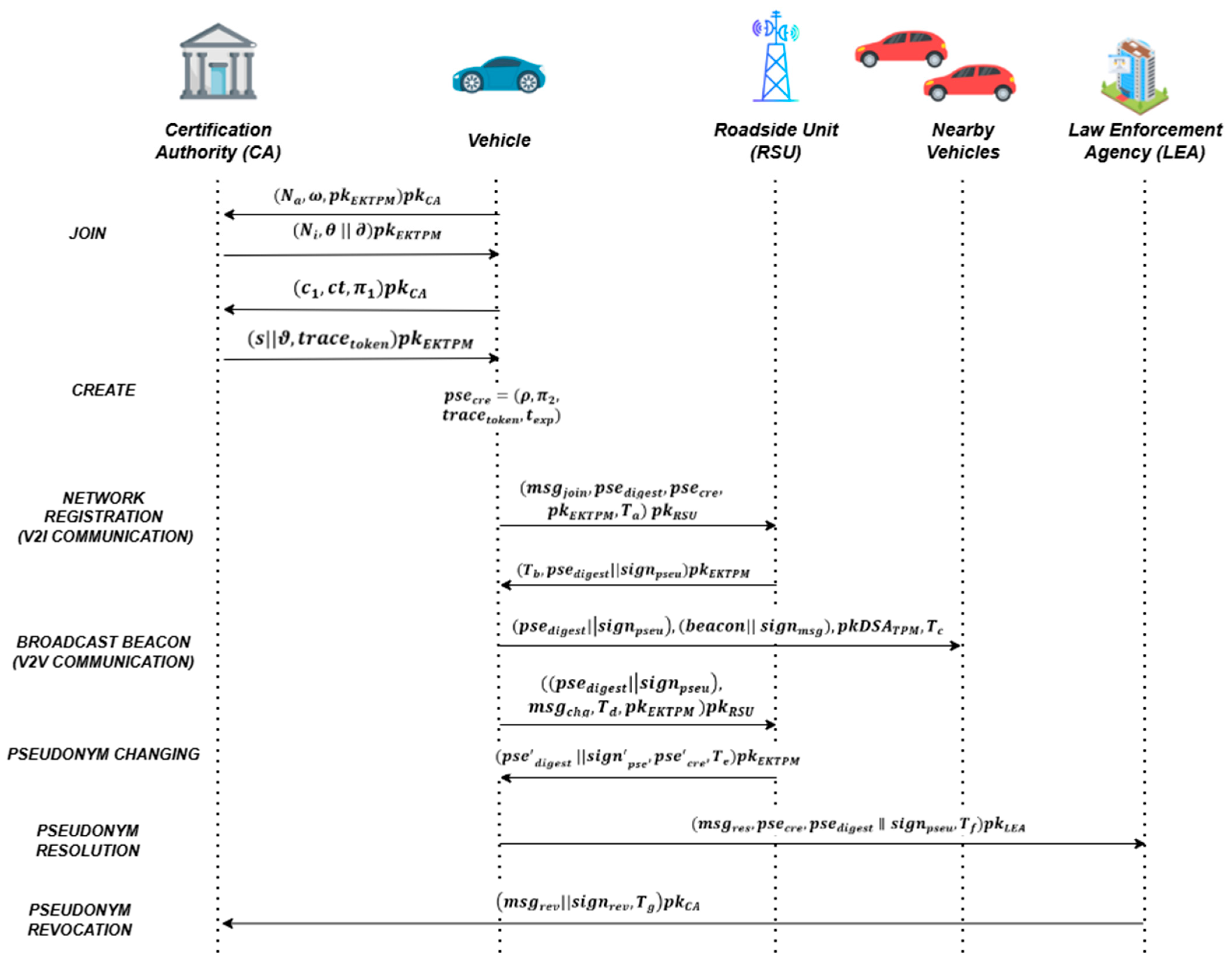
- OBU generates a random nonce and a hash value ω = H(). Then, it encrypts , ω, and using the CA’s public key, and transmits to the CA.
- CA decrypts the message and verifies that the included hash ω matches its own computation of H(). Once validated, the CA generates its own random nonce , derives its hash = H(), and signs the pair (, ) with its private signature key. This response is then encrypted with the OBU’s public key and sent back to the OBU.
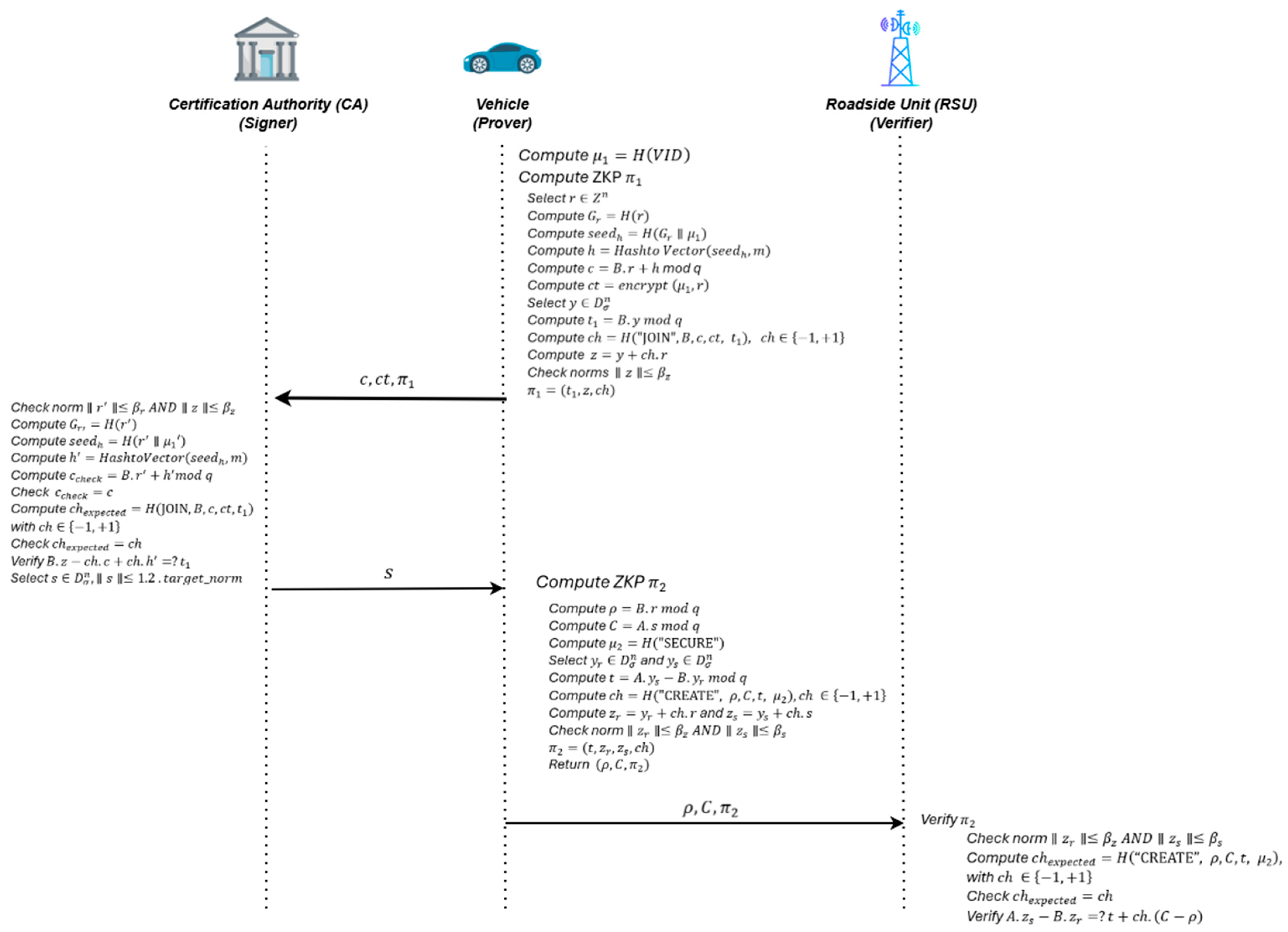
- After decrypting the message using , the OBU verifies the signature on (, ), confirming that the message originated from the legitimate CA and establishing a mutually authenticated channel. OBU then initiates the simplified Schnorr blind signature using the Fiat–Shamir transform. These initiation results are the random value (), commitment (), the encryption tuple (), and the ZKP (). The OBU encrypts using CA’s public key and the encrypted message to CA.
- The CA decrypts the encrypted message using the CA’s secret key and verifies that follows the simplified Schnorr with Fiat–Shamir transform blind signature. Upon successful verification, the CA computes a short preimage then generates a digital signature = signCA() using its signing key . Concurrently, the CA generates a by encrypting a hash of a newly generated internal vehicle ID, with the LEA’s public key: = Enc (). The final tuple (, , ) is encrypted using the OBU’s public key and sent to the OBU.
- Upon reception, the vehicle decrypts the message to retrieve and . It verifies the signature on using the CA’s public key . If successful, the vehicle securely stores and for subsequent protocol operations, completing the Join phase.
3.3. Create (Pseudonym) Phase
3.4. Network Registration (V2I Communication) Phase
- 1.
- The OBU produces a timestamp , generates the message , and creates the pseudonym credential as = (, , , ). The OBU subsequently calculates a digest = H() and encrypts and together with and by the public key of the RSU.
- 2.
- On obtaining the ciphertext, the RSU decrypts it using the secret key and verifies the freshness of . It recalculates = H() and verifies that = . The RSU also verifies a credential’s expiry by checking the and the validity of the proof under the FSwA mechanism. If all the checks are successful, RSU signs by using its digital signature key to produce = Sign (). is a new timestamp, and RSU sends the encrypted response (, ) to the OBU.
- 3.
- The OBU retrieves and the credential signature after decryption by using . It authenticates the RSU’s signature with by determining whether Ver (, ) = true and ensuring that is fresh. Upon successful verification of both verifications, the OBU accepts as a valid signature and stores it for later use in beacon broadcasting.
3.5. Broadcast Beacon (V2V Communication) Phase
3.6. Pseudonym Changing Phase
- 1.
- The OBU creates the message and produces a timestamp . It then constructs the transmission packet ((), , , ), encrypted with the RSU’s public key .
- 2.
- The RSU receives the packet, decrypts it with and checks the validity of . The RSU maintains a mapping between each vehicle’s pseudonym credential and its digest value (). From the stored credential , RSU extracts the embedded tracing token to maintain conditional traceability. RSU then uses a new credential token, = RAND(128), and calculates another tracing token as = . A new pseudonym credential is then built as = (, , , ), with being the new expiration time. RSU calculates = H(), then uses its digital signature key to sign the new pseudonym credential digest, the result of which is = Sign (), and creates a timestamp . It then forwards encrypted data (, , ) to the OBU.
- 3.
- The OBU receives the new pseudonym credential and its signature after the decryption using . It confirms that the signature of the RSU is also correct, Ver (, ) = true, and that is fresh. Upon satisfying both checks, the OBU stores the signed pseudonym as its active pseudonym signature for future V2V communication.
3.7. Pseudonym Resolution Phase
- 1.
- The RSU creates a timestamp to eliminate replay and form a resolution request message, denoted as . The whole package (, ()) is then encrypted using the public key of LEA and sent to LEA.
- 2.
- LEA decrypts the message using its private key and the freshness of is checked. Then, it verifies the authentication of the pseudonym data by verifying with the public verification key of the RSU to ensure that is signed correctly. After verification, LEA derives the that contains the commitment , the proof , the traceable token , and the expiration time . The LEA authenticates the validity of by ensuring that the credential was valid at the time of the request. It then uses its private key to decrypt the trace token, thereby retrieving the hashed vehicle internal identity
3.8. Pseudonym Revocation Phase
3.9. PQ-TDAA Design Rationale
3.9.1. Choice of Post-Quantum Cryptography Standard Algorithms
3.9.2. Simplified Schnorr with Fiat–Shamir Transform in PQ-TDAA
3.9.3. Separation of Control and Data Plane
3.9.4. ETSI TS 102 941 Trust and Privacy Compliance Mapping
4. Security Evaluation
4.1. Formal Analysis
4.2. Informal Analysis
- Mutual and Anonymous Authentication: The PQ-TDAA framework guarantees a high level of mutual authentication in the Join phase, where the OBU and CA should authenticate themselves with credentials by using encrypted messages and ZKP authentication. More importantly, the real vehicle identity (VID) remains hidden; later authentication in the Network Registration phase is performed via pseudonyms, with support from a simplified Schnorr with Fiat–Shamir transform ZKP (π2). The process enables the vehicle to demonstrate legitimacy without disclosing its secrets, thus ensuring authenticated communication and maintaining complete sender anonymity and unlinkability.
- Data Integrity: Data integrity is maintained based on a dual-tier PQC approach to unauthorized modification. The first layer provides non-repudiation and integrity for public messages using CRYSTALS-Dilithium2 signatures, ensuring that V2V beacons and pseudonym certificates can be verified and guaranteed. The second layer provides integrity for confidential communications (e.g., join, registration, and revocation) using the AES-256-GCM AEAD primitive. The primitive produces a cryptographically secure authentication tag that enables the receiver to detect any modification and to quickly fail-stop reject an attacked message.
- Confidentiality: The PQ-TDAA protocol achieves a high level of confidentiality at all sensitive stages, which is a quantum-resistant hybrid encryption architecture (KEM-DEM). The first step in this system uses the NIST standard ML-KEM-512 to securely encapsulate a symmetric secret key (K) with the recipient’s public key, providing strong protection against quantum attacks. The high-speed AES-256-GCM AEAD then encrypts the actual data payload using the key K. Confidentiality is crucial in ensuring that initial registration secrets are kept, along with secrecy of the trace token (only known to LEA) and pseudonym credentials throughout the network stages, which eventually ensures that only the party with the appropriate private key can decrypt and verify the integrity of the data plus the secrets of initial registration.
- Non-repudiation: Non-repudiation is satisfied using a systematic use of post-quantum secure digital signatures, namely Dilithium2 and Falcon-512. Because each critical transmission (e.g., pseudonym certificates and vital protocol messages) is digitally signed, the message’s origin is uniquely bound to the sender’s private key. This mechanism provides unquestionable cryptographic evidence of participation; that is, the signing party cannot rightfully deny having sent the message after the recipient has authenticated it.
- Resistance Against Attacks: PQ-TDAA is resistant to attack: (i) Replay attack is addressed by adding timestamps and nonces to each critical message exchange, the Join and Network Registration, Broadcast Beacon, and Pseudonym Changing phases; (ii) combining mutual authentication (both OBU and RSU are verified) prevents man-in-the-middle attack; (iii) modification attacks are decisively avoided, as every pseudonym certificate and broadcast message is protected by a post-quantum secure digital signature (Dilithium2 and Falcon-512), allowing any recipient to verify the integrity and reject unauthorized alterations upon receipt; and (iv) quantum attacks are inherently resisted because all underlying cryptographic primitives, including commitments, ZKPs, and signatures, are lattice-based and align with the NIST PQC standards.
- Complete Pseudonym Lifetime: This is a critical structural component of the PQ-TDAA protocol, which guarantees the privacy of users and conditional accountability over time. It is a lifecycle with five phases. Pseudonyms are created (issued) and then used for anonymous V2V and V2I communication. As a precautionary measure against user unlinkability, credentials are periodically changed (updated). The issue of accountability is addressed by enabling the LEA (trusted authorities) to resolve the pseudonym to the hash of the vehicle’s internal identity (VIDin) when required. Finally, the lifecycle ends with the revocation phase, typically when the CA blacklists the vehicles after detecting malicious behavior.
- Unlinkability: Unlinkability is one of the privacy objectives, ensuring that no third party can connect several pseudonyms or messages to the same vehicle across time. The PQ-TDAA protocol can secure this using a mixture of operational guidelines and cryptographic robustness. At the operational level, the system will occasionally replace old pseudonyms with new ones, and tracking old identities over time is not possible. PQ-TDAA uses the hiding property of lattice-based ZKP. During authentication, the OBU demonstrates the correctness of a pseudonym without necessarily revealing the secret value that identifies the relationships among identities.
- Conditional Traceability: PQ-TDAA provides conditional traceability to strike a balance between the privacy of the users and the need to have accountability. Such responsibility is attained through the establishment of the LEA. This is determined cryptographically in the first stage of the Join phase. Each pseudonym certificate is assigned a trace token that is securely encrypted under LEA’s public key. As a result, upon identifying malicious behavior and obtaining legal permission, the LEA can use its private key to decrypt the token and retrieve the hashed vehicle identifier H(VIDin). The scenario also ensures that, although general privacy is maintained, accountability is maintained by performing a resolution that is controlled and secure.
4.3. Comparative Security and Privacy Requirements
4.4. Lattice-Based Security Analysis
4.4.1. Soundness via Module-SIS Reduction
4.4.2. Hiding via Module-LWE
4.4.3. Parameter Selection and Security Level
4.4.4. Rejection Sampling and Zero-Knowledge
4.4.5. Trapdoor Construction and Credential Issuance
4.4.6. Side-Channel Resistance
5. Performance Evaluation
5.1. Experimental Setup
5.2. Theoretical Computation Cost
5.3. Asymptotic Complexity Analysis and Feasibility Analysis
- 1.
- Privacy-centric initialization (Setup to V2I): To guarantee robust anonymity, these phases employ lattice-based blind signatures and ZKPs over unstructured lattices. The dominant matrix operations result in complexity, justifying the higher computational cost observed during the registration phase.
- 2.
- Latency-critical operation (V2V to Revocation): Once registered, the framework transitions to optimized module lattice primitives (e.g., Dilithium/Falcon). By leveraging the algebraic structure of polynomial rings and the number theoretic transform, the complexity is reduced to , ensuring the low latency required for high-frequency beaconing.
5.4. Experimental Computation Cost
5.5. Blind Signature Comparison with V-LDAA
5.6. Real ARM Cortex-A76 V2V Measurements
5.7. Consistency Analysis: Theoretical vs. Experimental Computation
5.8. Communication Cost Analysis
5.9. Network Performance Evaluation
5.9.1. Network Simulation Parameter
5.9.2. Packet Delivery Ratio (PDR) Analysis
5.9.3. End-to-End (E2E) Delay Analysis
5.9.4. Authentication (Auth) Delay Analysis
5.9.5. Goodput Analysis
5.10. Discussion
6. Conclusions
Author Contributions
Funding
Institutional Review Board Statement
Informed Consent Statement
Data Availability Statement
Conflicts of Interest
Appendix A
| Algorithm A1: System Setup |
| Input: Security parameter λ = 128 |
| Output: Public parameters PP, matrices (A, B), trapdoor T |
| 1: Set parameters: - Ring dimension d ← 512 - Lattice dimensions (n, m) ← (1024, 1024) - Modulus q ← 7933 - Gaussian width σ ← 232.0 - Norm bounds: β_r ← 2√n, β_z ← 1.2σ√n, β_s ← 1.2σ√n 2: //Build CDT for Efficient Gaussian Sampling 3: T ←⌈tail .σ⌉ //T = 2320 4: for k = 0 to T do 5: pmf[k] //Discrete Gaussian PDF 6: end for 7: Z ←2.sum(pmf)-pmf(0) //Normalization constant 8: for k = 0 to T do 9: cdf[k] ← sum(pmf [0:k]) //Cumulative distribution 10: end for 11://Generate Public Matrices 12: Generate a random matrix A ← Z_q^(m × n) 13: Generate a random matrix B ← Z_q^(m × n) 14://Store Parameters 15: PP ← {λ, d, n, m, q, σ, β_r, β_z, β_s, cdf, T} 16: return (PP, A, B) |
| Algorithm A2: Join Phase—Vehicle Side |
| Input: Matrix B, public parameters PP |
| Output: Commitment c, ciphertext ct, proof π1 |
| //Step 1: Choose Vehicle ID 1: VID ← {0,1}^128 //Random vehicle identifier 2: μ1 ← H256(VID) //SHA3-256 hash //Step 2: Sample Secret 3: repeat 4: r ← Uniform({−2,−1,0,1,2}^n) 5: until ||r|| ≤ β_r //Step 3: Compute Commitment 6: G_r ← SHAKE256(r, 32) 7: seed_h ← SHAKE256(G_r || μ1, 32) 8: h ← HashToVector(seed_h, m) //Expand to Z_q^m 9: c ← B · r + h mod q //Step 4: Encrypt (μ1, r) 10: payload ← μ1 || Encode(r) 11: seed_k ← SHAKE256(“EK” || c, 64) 12: nonce ← {0,1}^96 13: keystream ← SHAKE256(seed_k || nonce, |payload|) 14: ct_data ← payload ⊕ keystream 15: tag ← H256(“AAD” || nonce || ct_data) [0:128] 16: ct ← (nonce, ct_data, tag) //Step 5: Generate Zero-Knowledge Proof (ZKP) π1 17: attempt ← 0 18: repeat 19: y ← D_σ^n //Sample Gaussian masking 20: t1 ← B · y mod q //Commitment 21: //Fiat–Shamir challenge 22: msg ← “JOIN” || B || c || ct || t1 23: ch ← {−1, +1} //H(msg) mod 2 24: z ← y + ch · r //Response 25: attempt ← attempt + 1 26: until ||z|| ≤ β_z OR attempt > 200 27: if attempt > 200 then 28: return ⊥ //Proof generation failed 29: end if 30: π1 ← (t1, z, ch) 31: return (c, ct, π1) |
| Algorithm A3: Join Phase—CA Side |
| Input: Matrices (A, B), commitment c, ciphertext ct, proof π1 |
| Output: Credential s or ⊥ |
| //Parse proof 1: (t1, z, ch) ← π1 2: (nonce, ct_data, tag) ← ct //Step 1: Decrypt Ciphertext 3: seed_k ← SHAKE256(“EK” || c, 64) 4: keystream ← SHAKE256(seed_k || nonce, |ct_data|) 5: payload ← ct_data ⊕ keystream 6: μ1’ ← payload [0:256] 7: r_bytes ← payload [256:] 8: r’ ← Decode(payload [256:]) //Step 2: Norm Checks 9: if ||r’|| > β_r then return ⊥ 10: if ||z|| > β_z then return ⊥ //Step 3: Verify Commitment 11: G_r’ ← SHAKE256(r’, 32) 12: seed_h ← SHAKE256(G_r’ || μ1’, 32) 13: h’ ← HashToVector(seed_h, m) 14: c_check ← B · r’ + h’ mod q 15: if c_check ≠ c then return ⊥ //Step 4: Verify Challenge 16: c_bytes ← Encode_Modq(c) 17: t1_bytes ← Encode_Modq(t1) 18: ct_bytes ← nonce || ct_data || tag 19: msg ← “JOIN” || c_bytes || ct_bytes || t1_bytes 20: ch_bytes ← H256(msg) 21: ch_expected ← +1 if ch_bytes [0] mod 2 = 0 else −1 22: if ch ≠ ch_expected then return ⊥ //Step 5: Verify Zero-Knowledge Proof Equation 23: left ← B · z − ch · c + ch · h’ mod q 24: if left ≠ t1 then return ⊥ //Step 6: Issue Credential Using Simplified Gaussian Sampling 25: target norm ← 0.4 .β_s 26: repeat 27: s_base ← D_σ^n //Sample Gaussian vector 28: if ||s_base ||>0 then 29: scale ← target_norm/||s_base ||> 30: s ← Round(s_base · scale)//Scale to target norm 31: else 32: s ← D_σ^n//Retry if zero vector 33: end if 34: until ||s|| ≤ 1.2 · target_norm 35: return s //Credential successfully issued |
| Algorithm A4: Create Phase—OBU Side |
| Input: Matrices (A, B), secrets (r, s), message μ2 |
| Output: Pseudonym , proof π2 |
| //Step 1: Compute Pseudonym 1: ← B · r mod q //Step 2: Compute Auxiliary Data C 2: C ← A. s mod q //Step 3: Compute Message Hash 3: seed_h ← SHAKE256( || μ2, 32) 4: h ← HashToVector(seed_h, m) //Step 4: Generate Zero-Knowledge Proof (ZKP) π2 5: attempt ← 0 6: repeat 7: y_r ← D_σ^n //Sample Gaussian maskings 8: y_s ← D_σ^n 9: t ← A · y_s − B · y_r mod q //Commitment 11: //Fiat–Shamir challenge 12: _bytes ← Encode_Modq() 13: C_bytes ← Encode_Modq(C) 14: t_bytes ← Encode_Modq(t) 15: msg ← “CREATE|” || _bytes || C_bytes || t_bytes || μ2 16: ch_bytes ← H256(msg) 17: ch ← +1 if ch_bytes [0] mod 2 = 0 else −1//Binary challenge 18: z_r ← y_r + ch · r //Response for r 19: z_s ← y_s + ch · s //Response for r 20: attempt ← attempt + 1 21: until (||z_r|| ≤ β_z AND ||z_s|| ≤ β_s) OR attempt > 500 22: if attempt > 500 then 23: return ⊥ 24: end if 25: π2 ← (t, z_r, z_s, ch) 26: auxiliary ← C 27: return (, π2, C) |
| Algorithm A5: Network Registration Phase—RSU Verification |
| Input: Matrices (A, B), pseudonym , proof π2, message μ2, timestamp t_now |
| Output: Accept (1) or Reject (0) |
| //Parse proof 1: (, π2) ← signature 2: (t, z_r, z_s, ch) ← π2 3: C ← auxiliary 4: //Step 2: Norm Checks 5: if ||z_r|| > β_z then return 0 6: if ||z_s|| > β_s then return 0 //Step 3: Verify Challenge 7: _bytes ← Encode_Modq() 8: C_bytes ← Encode_Modq(C) 9: t_bytes ← Encode_Modq(t) 10: msg ← “CREATE|” || _bytes || C_bytes || t_bytes || μ2 11: ch_bytes ← H256(msg) 12: ch_expected ← +1 if ch_bytes [0] mod 2 = 0 else −1 13: if ch ≠ ch_expected then return 0 //Step 4: Verify Modified Proof Equation //Verification check: A·z_s − B·z_r =? t +ch.(C-) 14: LHS ← A.z_s -B.z_r mod q//Compute left hand side 15: RHS ← t +ch.(C-) //Compute right hand side 16: if LHS ≠ RHS then 17: return 0 //Verification failed 18: end if 19: return 1 //Verification successful |
References
- Manasrah, A.; Yaseen, Q.; Al-Aqrabi, H.; Liu, L. Identity-Based Authentication in VANETs: A Review. IEEE Trans. Intell. Transp. Syst. 2025, 26, 4260–4282. [Google Scholar] [CrossRef]
- Jan, S.A.; Amin, N.U.; Othman, M.; Ali, M.; Umar, A.I.; Basir, A. A Survey on Privacy-Preserving Authentication Schemes in VANETs: Attacks, Challenges and Open Issues. IEEE Access 2021, 9, 153701–153726. [Google Scholar] [CrossRef]
- Agustina, E.R.; Ramli, K.; Hakim, A.R.; Harwahyu, R. A Systematic Literature Review on Privacy Preservation in VANETs: Trends, Challenges, and Future Directions. IEEE Access 2025, 13, 88421–88444. [Google Scholar] [CrossRef]
- Azam, F.; Yadav, S.K.; Priyadarshi, N.; Padmanaban, S.; Bansal, R.C. A Comprehensive Review of Authentication Schemes in Vehicular Ad-Hoc Network. IEEE Access 2021, 9, 31309–31321. [Google Scholar] [CrossRef]
- Raya, M.; Papadimitratos, P.; Hubaux, J.P. Securing Vehicular Communications. IEEE Wirel. Commun. 2006, 13, 8–15. [Google Scholar] [CrossRef]
- Brickell, E.; Camenisch, J.; Chen, L. Direct anonymous attestation. In Proceedings of the 11th ACM Conference on Computer and Communications Security, Washington, DC, USA, 25–29 October 2004; pp. 132–145. [Google Scholar]
- Shim, K.A. A Survey on Post-Quantum Public-Key Signature Schemes for Secure Vehicular Communications. IEEE Trans. Intell. Transp. Syst. 2022, 23, 14025–14042. [Google Scholar] [CrossRef]
- Chen, L.; Tu, T.; Yu, K.; Zhao, M.; Wang, Y. V-LDAA: A New Lattice-Based Direct Anonymous Attestation Scheme for VANETs System. Secur. Commun. Netw. 2021, 4660875. [Google Scholar] [CrossRef]
- Fiat, A.; Shamir, A. How to prove yourself: Practical solutions to identification and signature problems. In Proceedings of the Conference on the Theory and Application of Cryptographic Techniques, Linköping, Sweden, 20–22 May 1986; Springer: Berlin/Heidelberg, Germany, 1986; pp. 186–194. [Google Scholar]
- Schnorr, C.P. Efficient signature generation by smart cards. J. Cryptol. 1991, 4, 161–174. [Google Scholar] [CrossRef]
- Lyubashevsky, V. Fiat-Shamir with Aborts: Applications to Lattice and Factoring-Based Signatures. In Proceedings of the Advances in Cryptology—ASIACRYPT 2009, Tokyo, Japan, 6–10 December 2009; Springer: Berlin/Heidelberg, Germany, 2009; pp. 598–616. [Google Scholar]
- Lyubashevsky, V. Lattice Signatures without Trapdoors. In Proceedings of the Advances in Cryptology—EUROCRYPT 2012, Cambridge, UK, 15–19 April 2012; Springer: Berlin/Heidelberg, Germany, 2012; pp. 738–755. [Google Scholar]
- Beullens, W.; Lyubashevsky, V.; Nguyen, N.K.; Seiler, G. Lattice-Based Blind Signatures: Short, Efficient, and Round-Optimal; Association for Computing Machinery: New York, NY, USA, 2023; pp. 16–29. [Google Scholar]
- ETSI TS 102 941; Intelligent Transport Systems (ITS); Security; Trust and Privacy Management; Release 2. ETSI: Sophia Antipolis, France, 2022.
- National Institute of Standards and Technology. FIPS 203: Module-Lattice-Based Key-Encapsulation Mechanism; National Institute of Standards and Technology: Gaithersburg, MD, USA, 2024. [Google Scholar]
- National Institute of Standards and Technology. FIPS 204 Module-Lattice-Based Digital Signature Standard; National Institute of Standards and Technology: Gaithersburg, MD, USA, 2024. [Google Scholar]
- Fouque, P.-A.; Gajland, P.; de Groote, H.; Janneck, J.; Kiltz, E. A Closer Look at Falcon. Cryptology ePrint Archive, Paper 2024/1769. 2024. Available online: https://eprint.iacr.org/2024/1769 (accessed on 16 February 2026).
- Open Quantum Safe Project. Falcon. Available online: https://openquantumsafe.org/liboqs/algorithms/sig/falcon.html (accessed on 3 November 2025).
- Prajapat, S.; Gautam, D.; Kumar, P.; Jangirala, S.; Das, A.K.; Park, Y.; Lorenz, P. Secure Lattice-Based Aggregate Signature Scheme for Vehicular Ad Hoc Networks. IEEE Trans. Veh. Technol. 2024, 73, 12370–12384. [Google Scholar] [CrossRef]
- Han, L.; Cao, S.; Yang, X.; Zhang, Z. Privacy Protection of VANET Based on Traceable Ring Signature on Ideal Lattice. IEEE Access 2020, 8, 206581–206591. [Google Scholar] [CrossRef]
- Wani, N.M.; Verma, G.K.; Chamola, V. Dynamic Anonymous Quantum-Secure Batch-Verifiable Authentication Scheme for VANET. IEEE Trans. Consum. Electron. 2024, 70, 7112–7120. [Google Scholar] [CrossRef]
- Li, L.; Hsu, C.; Au, M.H.; Cui, J.; Harn, L.; Zhao, Z. Lattice-Based Conditional Privacy-Preserving Batch Authentication Protocol for Fog-Assisted Vehicular Ad Hoc Networks. IEEE Trans. Inf. Forensics Secur. 2024, 19, 9629–9642. [Google Scholar] [CrossRef]
- Li, Q.; He, D.; Yang, Z.; Xie, Q.; Choo, K.K.R. Lattice-Based Conditional Privacy-Preserving Authentication Protocol for the Vehicular Ad Hoc Network. IEEE Trans. Veh. Technol. 2022, 71, 4336–4347. [Google Scholar] [CrossRef]
- Liu, G.; Li, H.; Le, J.; Wang, N.; Liu, Y.; Xiang, T. LRCPA: Lattice-Based Robust and Conditional Privacy-Preserving Authentication for VANETs. IEEE Trans. Veh. Technol. 2024, 74, 4698–4712. [Google Scholar] [CrossRef]
- Xu, S.W.; Yu, S.H.; Bai, Y.J.; Yue, Z.Y.; Liu, Y.L. LB-CLAS: Lattice-based conditional privacy-preserving certificateless aggregate signature scheme for VANET. Veh. Commun. 2024, 50, 100843. [Google Scholar] [CrossRef]
- Arm Limited. Cortex-A76AE Automotive Enhanced: Datasheet; Arm Limited: Cambridge, UK, 2024. [Google Scholar]
- Raspberry Pi Ltd. Raspberry Pi 5 Product Brief; Raspberry Pi Ltd.: Cambridge, UK, 2025. [Google Scholar]
- Kannwischer, M.J.; Rijneveld, J.; Schwabe, P.; Stoffelen, K. pqm4: Testing and Benchmarking NIST PQC on ARM Cortex-M4; IACR Cryptology ePrint Archive, Paper 2019/844. 2019. Available online: https://repository.ubn.ru.nl/bitstream/handle/2066/210214/210214.pdf (accessed on 16 February 2026).
- John, L.K. Performance Evaluation Techniques, Tools and Benchmarks; University of Texas at Austin: Austin, TX, USA, 2002. [Google Scholar]
- Fog, A. The Microarchitecture of Intel, AMD and VIA CPUs: An Optimization Guide for Assembly Programmers and Compiler Makers; Technical University of Denmark: Kongens Lyngby, Denmark, 2021. [Google Scholar]
- La Manna, M.; Treccozzi, L.; Perazzo, P.; Saponara, S.; Dini, G. Performance Evaluation of Attribute-Based Encryption in Automotive Embedded Platform for Secure Software Over-The-Air Update. Sensors 2021, 21, 515. [Google Scholar] [CrossRef]
- Lyubashevsky, V.; Nguyen, N.K.; Plançon, M. Lattice-Based Zero-Knowledge Proofs and Applications: Shorter, Simpler, and More General; Springer Nature Switzerland: Cham, Switzerland, 2022. [Google Scholar]
- National Institute of Standards and Technology. Advanced Encryption Standard (AES); 197 (FIPS 197); National Institute of Standards and Technology: Gaithersburg, MD, USA, 2023. [Google Scholar]
- Dworkin, M. Recommendation for Block Cipher Modes of Operation: Galois/Counter Mode (GCM) and GMAC; 800-38D; National Institute of Standards and Technology: Gaithersburg, MD, USA, 2007. [Google Scholar]
- Whitefield, J.; Chen, L.; Giannetsos, T.; Schneider, S.; Treharne, H. Privacy-enhanced capabilities for VANETs using direct anonymous attestation. In Proceedings of the 2017 IEEE Vehicular Networking Conference (VNC), Torino, Turin, Italy, 27–29 November 2017; pp. 123–130. [Google Scholar]
- Chen, L.; Ng, S.L.; Wang, G. Threshold Anonymous Announcement in VANETs. IEEE J. Sel. Areas Commun. 2011, 29, 605–615. [Google Scholar] [CrossRef]
- Desmoulins, N.; Diop, A.; Rafflé, Y.; Traoré, J.; Gratesac, J. Practical Anonymous Attestation-based Pseudonym Schemes for Vehicular Networks. In Proceedings of the 2019 IEEE Vehicular Networking Conference (VNC), Los Angeles, CA, USA, 4–6 December 2019; pp. 1–8. [Google Scholar]
- Dharminder, D.; Mishra, D. LCPPA: Lattice-based conditional privacy preserving authentication in vehicular communication. Trans. Emerg. Telecommun. Technol. 2020, 31, e3810. [Google Scholar] [CrossRef]
- Wen, J.; Bai, L.; Yang, Z.; Zhang, H.; Wang, H.; He, D. LaRRS: Lattice-Based Revocable Ring Signature and Its Application for VANETs. IEEE Trans. Veh. Technol. 2024, 73, 739–753. [Google Scholar] [CrossRef]
- Mundhe, P.; Yadav, V.K.; Verma, S.; Venkatesan, S. Efficient Lattice-Based Ring Signature for Message Authentication in VANETs. IEEE Syst. J. 2020, 14, 5463–5474. [Google Scholar] [CrossRef]
- Wang, F.; Gu, M.; Xiao, H.; Wang, Y.; Cao, C. Secure and Efficient Attribute-based Batch Authentication Scheme for VANETs. IEEE Netw. 2025. [Google Scholar] [CrossRef]
- Agustina, E.R.; Hakim, A.R.; Ramli, K. Modeling Data Security and Privacy Threats for VANET using STRIDE and LINDDUN. In Proceedings of the 2024 2nd International Conference on Software Engineering and Information Technology (ICoSEIT), Bandung, Indonesia, 28–29 February 2024; pp. 114–119. [Google Scholar]
- Cremers, C.J.F. The Scyther Tool: Verification, Falsification, and Analysis of Security Protocols. In Proceedings of the Computer Aided Verification, Princeton, NJ, USA, 7–14 July 2008; Springer: Berlin/Heidelberg, Germany, 2008; pp. 414–418. [Google Scholar]
- Chen, Y.; Nguyen, P.Q. BKZ 2.0: Better Lattice Security Estimates. Lect. Notes Comput. Sci. 2011, 7073, 1–20. [Google Scholar] [CrossRef]
- Alagic, G.; Apon, D.; Cooper, D.; Dang, Q.; Kelsey, J.; Liu, Y.-K.; Miller, C.; Moody, D.; Peralta, R.; Perlner, R.; et al. Status Report on the Third Round of the NIST Post-Quantum Cryptography Standardization Process; National Institute of Standards and Technology: Gaithersburg, MD, USA, 2022. [Google Scholar]
- J2945_1_201603; On-Board System Requirements for V2V Safety Communications. SAE International: Warrendale, PA, USA, 2016.
- Kim, Y.; Song, J.; Youn, T.-Y.; Seo, S.C. Crystals-Dilithium on ARMv8. Secur. Commun. Netw. 2022, 2022, 5226390. [Google Scholar] [CrossRef]
- Kim, Y.; Song, J.; Seo, S.C. Accelerating Falcon on ARMv8. IEEE Access 2022, 10, 44446–44460. [Google Scholar] [CrossRef]
- Kementerian Perhubungan Republik Indonesia. Peraturan Menteri Perhubungan Nomor 96 Tahun 2015 Tentang Pedoman Pelaksanaan Kegiatan Manajemen dan Rekayasa Lalu Lintas; Kementerian Perhubungan Republik Indonesia: Jakarta, Indonesia, 2015. [Google Scholar]
- Karnadi, F.K.; Mo, Z.H.; Lan, K.-C. Rapid Generation of Realistic Mobility Models for VANET. In Proceedings of the IEEE Wireless Communications and Networking Conference, Hong Kong, China, 11–15 March 2007; pp. 2508–2513. [Google Scholar]
- Sommer, C.; German, R.; Dressler, F. Bidirectionally Coupled Network and Road Traffic Simulation for Improved IVC Analysis. IEEE Trans. Mob. Comput. 2011, 10, 3–15. [Google Scholar] [CrossRef]
- Ma, X.; Chen, X. Performance Analysis of IEEE 802.11 Broadcast Scheme in Ad Hoc Wireless LANs. IEEE Trans. Veh. Technol. 2008, 57, 3757–3768. [Google Scholar] [CrossRef]
- Qiu, H.J.F.; Ho, I.W.-H.; Tse, C.K.; Xie, Y. A Methodology for Studying 802.11p VANET Broadcasting Performance with Practical Vehicle Distribution. IEEE Trans. Veh. Technol. 2016, 65, 8756–8769. [Google Scholar] [CrossRef]
- Hota, L.; Nayak, B.P.; Kumar, A.; Sahoo, B.; Ali, G.G.M.N. A Performance Analysis of VANETs Propagation Models and Routing Protocols. Sustainability 2022, 14, 1379. [Google Scholar] [CrossRef]
- Bilstrup, K.; Uhlemann, E.; Ström, E.G.; Bilstrup, U. Evaluation of the IEEE 802.11p MAC Method for Vehicle-to-Vehicle Communication. In Proceedings of the IEEE 68th Vehicular Technology Conference (VTC Fall), Calgary, AB, Canada, 21–24 September 2008; pp. 1–5. [Google Scholar]
- Studer, A.; Bai, F.; Bellur, B.; Perrig, A. Flexible, Extensible, and Efficient VANET Authentication. In Proceedings of the 6th Embedded Security in Cars Conference; KICS: Hamburg, Germany, 2008. [Google Scholar]
- Postel, J. Internet Protocol; RFC 791; IETF. 1981. Available online: https://www.rfc-editor.org/rfc/rfc791 (accessed on 20 December 2025).
- Van Eenennaam, M.; Remke, A.; Heijenk, G. An Analytical Model for Beaconing in VANETs. In Proceedings of the IEEE Vehicular Networking Conference, Seoul, Republic of Korea, 14–16 November 2012; pp. 9–16. [Google Scholar]
- Gonzalez, S.; Ramos, V. A Simulation-Based Analysis of the Loss Process of Broadcast Packets in WAVE Vehicular Networks. Wirel. Commun. Mob. Comput. 2018, 2018, 7430728. [Google Scholar] [CrossRef]
- IEEE. IEEE Standard for Information Technology—Telecommunications and Information Exchange Between Systems Local and Metropolitan Area Networks—Specific Requirements Part 11: Wireless LAN Medium Access Control (MAC) and Physical Layer (PHY) Specifications Amendment 6: Wireless Access in Vehicular Environments; IEEE: Piscataway, NJ, USA, 2010; pp. 1–51. [Google Scholar] [CrossRef]



| Parameter | ML-KEM-512 | Dilithium2 | Falcon-512 |
|---|---|---|---|
| NIST security level | 1 | 2 | 1 |
| Quantum security (bits) | 143 | 140 | 141 |
| Classical security (bits) | 153 | 151 | 154 |
| Lattice dimension (n) | 256 | 256 | 512 |
| Modulus (q) | 3329 | 8,380,417 | 12,289 |
| Public key size (bytes) | 800 | 1312 | 897 |
| Private key sizes (bytes) | 1632 | 2528 | 1281 |
| Ciphertext size (bytes) | 768 | - | - |
| Signature size (bytes) | - | 2420 | 666 |
| Scaling Factor | Simulation Workstation (Baseline) | Automotive OBU (Target) | Scaling Ratio |
|---|---|---|---|
| Processor model | AMD Ryzen 9 5900HX (Zen 3) | ARM Cortex-A76 (R-Pi 5) | - |
| Clock frequency | 3.3 GHz (base clock) | 2.4 GHz | 1.38× |
| Microarchitecture (IPC) | ~2.0 (Zen 3 high-performance) | ~1.7 (A76 4-way superscalar) | 1.18× |
| Active core count | 8 cores | 4 cores | 2× |
| Total scaling factor | Reference (1.0) | Projected gap | 3.26× |
| Scheme | Cryptographic Time (Mean) (ms) | Standard Deviation (ms) | Overhead (Bytes) | Assessment |
|---|---|---|---|---|
| ML-KEM + AES-256-GCM | 0.861 | 0.049 | 796 | Optimal (fastest and most stable) |
| ML-KEM + Chacha20-Poly1305 | 1.093 | 0.056 | 796 | Strong alternative (software consistent) |
| ML-KEM + AES-256-CCM | 2.821 | 0.121 | 796 | Slowest hybrid (higher variability) |
| DAA Variants | Key Features | Strengths | Limitations |
|---|---|---|---|
| Classical DAA [6] | ZKP, trusted platform module-based (TPM-based) | Strong privacy and accountability | Heavy computation, less suitable for practical real-time VANET |
| TAA [36] | Threshold authentication with TAA | Ensures message reliability, supports auditability | Complex coordination, additional communication overhead |
| Privacy-enhanced DAA for VANETs [35] | Integrates DAA into VANET PKI | Strong privacy with conditional traceability | High computation overhead, scalability issues |
| Pre-DAA-based pseudonym [37] | Secure elements handle the entire pseudonym lifecycle | Real-time, feasible, efficient, and flexible driver vehicle mapping | Weak Join phase; weak against impersonation, replay, and quantum attacks; incomplete pseudonym lifecycle |
| V-LDAA [8] | Optimized lattice signatures, smaller proof size | Long-term security is more efficient than early lattice schemes | High communication overhead, challenging for VANET bandwidth/latency, incomplete pseudonym lifecycle, and lack of infrastructure integration |
| Phase | Entities | Interaction | Entities’ Role |
|---|---|---|---|
| Setup | CA | Securely generate and transmit the security parameter and cryptographic keys to other entities | All entities securely store the security parameter and cryptographic keys. |
| Join | CA and vehicle |
| CA authenticates the OBU anonymously, generates a trace token and a vehicle internal identity, and issues a credential for a blind signature. |
| Create | Vehicle |
| OBU and TPM are embedded in the vehicle. TPM is responsible for all cryptographic and security operations, and OBU is responsible for V2I and V2V communication. |
| Network Registration (V2I communication) | Vehicle and roadside unit (RSU) |
| Vehicle requests to enter the vehicular network. RSU authenticates the vehicle anonymously and signs the pseudonym credential. |
| Broadcast Beacon (V2V communication) | Vehicles |
| The vehicle creates and signs the message beacon, then broadcasts it to nearby vehicles. The receiving vehicles verify the signatures of the beacon and the pseudonym credential. |
| Pseudonym Changing | Vehicles and RSU |
| Vehicle initiates pseudonym changing. RSU generates and signs a new pseudonym credential. |
| Pseudonym Resolution | RSU and LEA |
| RSU initiates pseudonym resolution upon detecting a malicious vehicle. LEA opens the trace token of a malicious vehicle. |
| Pseudonym Revocation | LEA and CA |
| CA adds the vehicle-related identity to the blacklist server. |
| Cryptographic Key | Description |
|---|---|
| Public and private endorsement keys of the vehicle | |
| Public and private key pair of the CA | |
| Public and private key pair of the RSU | |
| Public and private key pair of the LEA | |
| Public and private key pair of the TPM for the digital signature mechanism | |
| Public and private key pair of the CA for the digital signature mechanism | |
| Public and private key pair of the RSU for the digital signature mechanism | |
| Public and private key pair of the LEA for the digital signature mechanism |
| Parameter | Beullens et al. [13] | Our PQ-TDAA |
|---|---|---|
| 7933 | 7933 | |
| 232.0 | 232.0 | |
| (uniform) | ||
| (Gaussian) | ||
| Trapdoor mechanism | NTRU + GPV sampling | None (random A, B) (Lyubashevsky style) |
| Credential issuance | via trapdoor | |
| ZKP mechanism | LNP | Simplified Schnorr with Fiat–Shamir transform |
| Signing paradigm | GPV hash-and-sign | Fiat–Shamir (commitment-challenge-response) |
| Signature | ||
| Auxiliary data | - | (2 kB) |
| ETSI Requirement | Clause | PQ-TDAA Mechanism |
|---|---|---|
| Pseudonymity for ITS-Station (ITS-S) with privacy; AA must not re-identify vehicles (ItssWithPrivacy). | 3.4 Notation: ItssWithPrivacy (“pseudonymity has to be assured and re-identification by the AA is not allowed”). | PQ-TDAA issues lattice-based pseudonym certificates via blind signatures, ensuring the CA never learns or reconstructs the privacy-enabled vehicle’s canonical identifier. |
| Privacy based on pseudonymity and unlinkability; the canonical identifier is never transmitted over the air. | 5 Privacy in ITS: pseudonymity “but can still be accountable for that use”; unlinkability; “never transmitting the station’s canonical identifier in communications between ITS stations.” | In the Join phase, the CA issues a secret for local pseudonym derivation to keep the vehicle’s real identity private. The RSU then registers this pseudonym without identifying the vehicle, allowing it to sign safety messages using NIST post-quantum signatures (Falcon/Dilithium). Finally, neighboring vehicles use the RSU’s public key to verify these messages, ensuring secure authentication while maintaining total anonymity. |
| Separation of duties between EA (identity) and AA (authorization) to protect privacy. | 5 Privacy in ITS: privacy of registration ensured by limiting canonical identifier knowledge to EAs and by separating EA and AA roles. | PQ-TDAA strictly separates the CA, which performs anonymous authentication of vehicles and maintains only pseudonymous registration records without storing any long-term real-world identifiers, from the LEA, which merely processes blinded authorization requests and never gains access to either canonical identifiers or the CA’s internal identity records. |
| Conditional accountability and traceability via a canonical identifier and a canonical key stored at EA. | 5 Privacy in ITS (accountability); 6.1.2 Manufacture: EA stores canonical identifier, profile, and canonical public key as an associated set. | ETSI TS 102 941 requires EAs to store canonical identifiers, profile data, and public keys for accountability. PQ-TDAA implements this using pseudonymous registration records instead of real-world identifiers. During resolution, LEAs use trace tokens to link misbehaving pseudonyms to CA registration data, ensuring ETSI-compliant conditional traceability without long-term real-world identifier storage. |
| Revocation and end-of-life handling through CTL/CRL management and refusal of further credentials. | 6.1.5 Maintenance; 6.1.6 End of life; 6.3 Generation, distribution, and use of CTL and CRL. | For revocation, the CA inserts the temporary identity of a misbehaving vehicle into a blacklist service and announces the corresponding pseudonym credentials to the RSUs, which then disseminate this revocation information across the network so that other vehicles can reject any subsequent beacons or protocol messages originating from the revoked pseudonym. |
| Security and Privacy Requirements | V-LDAA [8] | PQ-TDAA |
|---|---|---|
| Mutual authentication | No | Yes |
| Anonymous authentication | Yes | Yes |
| Data integrity | Yes | Yes |
| Confidentiality | No | Yes |
| Resistance against attack: | ||
| a. Replay attack | No | Yes |
| b. Man-in-the-middle attack | No | Yes |
| c. Modification attack | No | Yes |
| d. Quantum attack | Yes | Yes |
| Complete pseudonym lifecycle | No | Yes |
| Unlinkability | Yes | Yes |
| Conditional traceability | No | Yes |
| Components | Specification |
|---|---|
| Hardware Environment: | |
| Device | ASUS ROG Strix G513QM laptop |
| Processor | AMD Ryzen 9 5900HX with Radeon graphics (8 cores, 16 threads, 3.30 GHz) |
| Installed RAM | 32 GB DDR4, 3200 MT/s |
| Graphics card | NVIDIA GeForce RTX 3060 |
| Storage | 954 GB SSD |
| Operating system | Windows 11 Pro (64-bit) via WSL2 (Ubuntu 24.04.3 LTS, Linux kernel 6.6.87.2) |
| Software Environment: | |
| Mathematical framework | SageMath 10.6 kernel (Python 3.11.13) for lattice-based operations |
| Execution platform | Jupyter notebook (single-threaded configuration) |
| PQC runtime environment | Python 3.11 with liboqs 0.14.1-dev and liboqspython 0.14.1 bindings |
| Supported PQC algorithms | ML-KEM (Kyber512), CRYSTALS-Dilithium2, Falcon-512 |
| Building Block Cryptography | Description | Computation Time | Notation |
|---|---|---|---|
| Matrix-vector multiplication | Performs matrix-vector multiplication in (e.g., computing ). | 929.66 | |
| Gaussian sampling | Samples a length-n discrete Gaussian vector () to generate secrets/perturbations (f, g, y, s) for trapdoor/ZKP algorithms. | 7360.31 | |
| Uniform sampling | Uniformly samples small-element vectors (e.g., ), used to generate secret r in the Join phase. | 607.85 | |
| L2 norm | Computes Euclidean norm for lattice vectors; used in rejection sampling and validating bounds. | 82.21 | |
| Fast SHA-256 | Optimized SHA3-256 execution for short, fixed inputs (ID, commitment, nonce || ciphertext) without string processing overhead. | 0.66 | |
| AEAD-like (XOR + hash) | Lightweight primitive: Generates SHAKE keystream for XOR encryption and computes SHA3 tag over nonce/ciphertext for integrity. | 99.26 |
| Building Block Cryptography | Description | Computation Time | Notation |
|---|---|---|---|
| ML-KEM key generation | Generates an ML-KEM-512 key pair (public and secret keys). | 18.1 | |
| ML-KEM encapsulation | Uses ML-KEM public key to generate KEM ciphertext and the shared secret (AES-GCM session key). | 13.9 | |
| ML-KEM decapsulation | Uses ML-KEM secret key to recover the shared secret from the KEM ciphertext on the receiver’s side. | 14.6 | |
| Dilithium2 key generation | Generates a public and secret key pair for digital signatures using Dilithium2. | 30.3 | |
| Dilithium2 signing | Signs a message using the Dilithium2 secret key. | 50.8 | |
| Falcon-512 key generation | Generates a public and secret key pair for digital signatures using Falcon-512. | 4703.2 | |
| Falcon-512 signing | Signs a message using the Falcon-512 secret key. | 182.9 | |
| Falcon-512 verify | Verifies a Falcon-512 signature using the associated public key. | 47.1 | |
| AEAD encrypt | AES-256-GCM encryption using the ML-KEM symmetric key; generates nonce, ciphertext, and authentication tag. | 2.3 | |
| AEAD decrypt | AES-256-GCM decryption; verifies the auth tag and returns plaintext upon successful authentication. | 1.6 | |
| SHA3-256 | Generates protocol digests (psedigest, omega/theta, h(VID)) using SHA3-256 hashing. | 2.1 |
| Phase | Theoretical Computation Expression | PQ-TDAA-Dilithium2 | PQ-TDAA-Falcon-512 |
|---|---|---|---|
| Setup | or | 0.0149 | 0.0336 |
| Join | or or | 0.0273 | 0.0276 |
| Create | 0.0178 | 0.0180 | |
| Network Registration (V2I) | or atau | 0.0020 | 0.0020 |
| Broadcast Beacon (V2V) | or or | 0.0001 | 0.0003 |
| Pseudonym Changing | or or | 0.0001 | 0.0003 |
| Pseudonym Resolution | or | 0.0001 | 0.0001 |
| Pseudonym Revocation | or | 0.0001 | 0.0003 |
| TOTAL | 0.0625 | 0.0822 | |
| Phase | Dominant Operation | Dominant Complexity |
|---|---|---|
| Setup | Matrix generation | |
| Join | Blind signature issuance (matrix-vector multiplication) | |
| Create | Commitment computation and ZKP generation | |
| Network Registration (V2I) | ZKP verification | |
| Broadcast Beacon (V2V) | Sign and verify using Dilithium2 or Falcon-512 | |
| Pseudonym Changing | Sign and verify using Dilithium2 or Falcon-512 | |
| Pseudonym Resolution | Verify using Dilithium2 or Falcon-512 and KEM with AEAD | |
| Pseudonym Revocation | Sign and verify using Dilithium2 or Falcon-512 and KEM with AEAD |
| Phase | PQ-TDAA | |
|---|---|---|
| Dilithium2 | Falcon-512 | |
| Setup | 0.0082 | 0.0304 |
| Join | 0.0427 | 0.0430 |
| Create | 0.0269 | 0.0269 |
| Network Registration (V2I) | 0.0117 | 0.0120 |
| Broadcast Beacon (V2V) | 0.0012 | 0.0014 |
| Pseudonym Changing | 0.0012 | 0.0009 |
| Pseudonym Resolution | 0.0003 | 0.0006 |
| Pseudonym Revocation | 0.0001 | 0.0003 |
| TOTAL | 0.0926 | 0.1156 |
| Scheme | BlindSign Time (ms) | BlindVerify Time (ms) | Blind Proof Size (KB) | Size Reduction |
|---|---|---|---|---|
| V-LDAA [8] | 7.26 | 0.14 | 26 | - |
| PQ-TDAA | 22.45 | 8.21 | 8 | 69.2% |
| V2V Sub-Process | Operation | Our Workstation (Ryzen 9) | R-Pi 5 Cortex A-76 | Scaling |
|---|---|---|---|---|
| ((Measured (ms)) | (Measured (ms)) | |||
| Dilithium2 | ||||
| Beacon generation | Beacon pack | 0.0078 | 0.0134 | 3.08 times (95% of 3.26 times) |
| Beacon signing | 0.0670 | 0.2085 | ||
| Total | 0.0748 | 0.2219 | ||
| Beacon verification | Verification | 0.0524 | 0.1699 | |
| Total V2V Cycle | 0.1272 | 0.3918 | ||
| Falcon-512 | ||||
| Beacon generation | Beacon pack | 0.0062 | 0.0089 | 1.59 times (49% of 3.26 times) |
| Beacon signing | 0.1910 | 0.3080 | ||
| Total | 0.1972 | 0.3169 | ||
| Beacon verification | Verification | 0.0787 | 0.1199 | |
| Total V2V Cycle | 0.2759 | 0.4368 | ||
| Component | Description | PQ-TDAA | |
|---|---|---|---|
| Dilithium2 | Falcon-512 | ||
| Hash result of the pseudonym credential | 32 | 32 | |
| Signature of pseudonym psedigest | 2420 | 666 | |
| Signature of beacon | 2420 | 666 | |
| beacon | (posspeednotif) | 64 | 64 |
| Public key DSA of the vehicle | 1312 | 897 | |
| Timestamp | 6 | 6 | |
| TOTAL | 6254 | 2331 | |
| Scheme | Sign () | Verify () |
|---|---|---|
| PQ-TDAA-Dilithium2 | 66.9184 | 52.4420 |
| PQ-TDAA-Falcon-512 | 190.9926 | 78.7414 |
| Parameter | Description/Value |
|---|---|
| Simulation time | 200 s |
| Number of vehicles | 10, 20, 50, and 100 |
| Road length | 300 m |
| Mobility model | Constant velocity mobility model |
| Beacon interval | 100 ms |
| Transmission range | 300 m |
| Vehicle speed range | 15–25 m/s |
| MAC standard | IEEE 802.11 p |
| Transmit power | 33 dBm |
| Propagation | Nakagami-m fading (m0 = 4.0, m1 = 4.0, m2 = 3.0) |
| CCA threshold | −82 dBm (802.11 p standard) |
| Rx sensitivity | −85 dBm (6 Mbps OFDM) |
| Data rate | 6 Mbps OFDM (10 MHz channel) |
| Shadowing | None (future: 3GPP TR 36.885) |
| Mobility | Constant velocity (no lane changes) |
| Scenario | Vehicle = 10 | Vehicle = 20 | Vehicle = 50 | Vehicle = 100 |
|---|---|---|---|---|
| PQ-TDAA (Dilithium2) | ||||
| Beacon sent | 19,700 | 39,400 | 98,500 | 197,000 |
| Total receptions | 33,905 | 67,446 | 92,950 | 99,729 |
| PDR (%) | 19.12 | 9.01 | 1.93 | 0.51 |
| Avg E2E delay (ms) | 176.987 | 151.296 | 358.781 | 404.464 |
| Avg auth delay () | 119.360 | 119.360 | 119.360 | 119.360 |
| Goodput (kbps) | 8481.67 | 16,872.29 | 23,252.37 | 24,948.21 |
| PQ-TDAA (Falcon-512) | ||||
| Beacon sent | 19,700 | 39,400 | 98,500 | 197,000 |
| Total receptions | 100,342 | 175,818 | 461,472 | 694,235 |
| PDR (%) | 56.59 | 23.49 | 9.56 | 3.56 |
| Avg E2E delay (ms) | 8.127 | 49.699 | 151.782 | 253.273 |
| Avg auth delay () | 269.734 | 269.734 | 269.734 | 269.734 |
| Goodput (kbps) | 9355.89 | 16,393.27 | 43,027.65 | 64,730.47 |
Disclaimer/Publisher’s Note: The statements, opinions and data contained in all publications are solely those of the individual author(s) and contributor(s) and not of MDPI and/or the editor(s). MDPI and/or the editor(s) disclaim responsibility for any injury to people or property resulting from any ideas, methods, instructions or products referred to in the content. |
© 2026 by the authors. Licensee MDPI, Basel, Switzerland. This article is an open access article distributed under the terms and conditions of the Creative Commons Attribution (CC BY) license.
Share and Cite
Agustina, E.R.; Ramli, K.; Harwahyu, R.; Gunawan, T.S.; Salman, M.; Lestari, A.A.; Hakim, A.R. A Lightweight Post-Quantum Anonymous Attestation Framework for Traceable and Comprehensive Privacy Preservation in VANETs. J. Cybersecur. Priv. 2026, 6, 44. https://doi.org/10.3390/jcp6020044
Agustina ER, Ramli K, Harwahyu R, Gunawan TS, Salman M, Lestari AA, Hakim AR. A Lightweight Post-Quantum Anonymous Attestation Framework for Traceable and Comprehensive Privacy Preservation in VANETs. Journal of Cybersecurity and Privacy. 2026; 6(2):44. https://doi.org/10.3390/jcp6020044
Chicago/Turabian StyleAgustina, Esti Rahmawati, Kalamullah Ramli, Ruki Harwahyu, Teddy Surya Gunawan, Muhammad Salman, Andriani Adi Lestari, and Arif Rahman Hakim. 2026. "A Lightweight Post-Quantum Anonymous Attestation Framework for Traceable and Comprehensive Privacy Preservation in VANETs" Journal of Cybersecurity and Privacy 6, no. 2: 44. https://doi.org/10.3390/jcp6020044
APA StyleAgustina, E. R., Ramli, K., Harwahyu, R., Gunawan, T. S., Salman, M., Lestari, A. A., & Hakim, A. R. (2026). A Lightweight Post-Quantum Anonymous Attestation Framework for Traceable and Comprehensive Privacy Preservation in VANETs. Journal of Cybersecurity and Privacy, 6(2), 44. https://doi.org/10.3390/jcp6020044