


Abstract
Unmanned aerial vehicles (UAVs) have become essential tools for monitoring crop condition, detecting early signs of plant stress, and supporting timely interventions in modern precision agriculture. However, real-time onboard image analysis remains challenging due to the limited computational and energy resources of small embedded UAV platforms. This work presents a deployment-aware neural architecture search (NAS) framework for discovering lightweight object detection networks explicitly optimized for edge hardware constraints. Building on the YOLOv8n baseline, the proposed NAS procedure yields detector architectures that substantially reduce computational load while preserving high detection accuracy for agricultural field monitoring tasks. The best-discovered model reduces GFLOPs by 37.0% and parameters by 61.3% compared to YOLOv8n, with only a 1.96% decrease in mAP@50. When deployed on an NVIDIA Jetson Nano, it achieves a 28.1% increase in inference speed and an 18.5% improvement in energy efficiency under ONNX Runtime, with additional gains using TensorRT FP16. Evaluation on wheat head and cotton seedling datasets demonstrates strong generalization across crop types and varying imaging conditions. By enabling highly efficient onboard inference, the proposed NAS framework supports practical UAV-based crop monitoring workflows and contributes to the development of responsive, field-ready remote sensing systems in resource-limited environments.
1. Introduction
Artificial intelligence (AI), combined with unmanned aerial vehicles (UAVs), has become an increasingly important enabler of precision agriculture by providing high-resolution, timely observations of large agricultural areas. UAV-mounted imaging sensors allow crop monitoring at scales and frequencies that are difficult to achieve with ground-based systems, enabling data-driven decision-making for yield estimation, crop development analysis, and stress detection [1]
Among agricultural applications, UAV-based computer vision has been widely adopted for tasks such as weed segmentation for targeted spraying, crop detection and counting, and early identification of pests or diseases. These tasks require accurate object detection under challenging field conditions, including varying illumination, complex backgrounds, and strong scale variation. As a result, detection models must achieve a careful balance between accuracy and computational efficiency to be practically deployable on UAV platforms.
Recent deep learning models, particularly one-stage object detectors such as the YOLO family, have demonstrated strong accuracy and real-time performance for UAV imagery analysis. However, deploying such models directly on UAVs remains challenging. Small aerial platforms typically operate under strict constraints on onboard computation, memory, and energy, and are often required to perform inference without reliable connectivity to ground stations. Most existing detectors are generally optimized for desktop-class GPUs rather than embedded hardware.
Lightweight object detection models address these constraints by reducing network depth, width, or operator complexity, but often suffer from degraded accuracy or limited generalization across datasets and environmental conditions. Moreover, manually designing efficient architectures requires substantial domain expertise and extensive trial-and-error, making it difficult to adapt models to diverse UAV platforms and agricultural scenarios. These challenges highlight key technical bottlenecks in UAV-based agricultural deployment, including hardware adaptability, energy–accuracy trade-offs, and robustness across crops and acquisition conditions.
Neural architecture search (NAS) has emerged as a promising approach for automating the design of efficient deep learning models by exploring a predefined search space. Despite its success in general computer vision, relatively few studies have investigated NAS in the context of UAV remote sensing, where deployment constraints and power efficiency are critical. To the best of our knowledge, no prior work jointly addresses three essential components: UAV-based wheat head detection, deployment-aware lightweight architectures, and automated architecture discovery through NAS.
This study bridges these gaps by proposing a systematic framework for producing efficient object detection models tailored for UAV-based agricultural remote sensing. While NAS has been applied to object detection in prior work, existing approaches largely focus on improving accuracy–efficiency trade-offs on server-class GPUs or mobile devices, without explicitly addressing the stringent constraints of UAV edge deployment. In particular, most NAS-for-detection methods do not account for device-specific latency, energy consumption, or operator-level efficiency on embedded platforms, and are typically evaluated using proxy metrics such as FLOPs rather than real hardware measurements. In parallel, lightweight YOLO variants and compression techniques (e.g., pruning or quantization) are commonly applied as post hoc optimizations to fixed architectures, limiting their ability to explore fundamentally different architectural configurations. In contrast, our work integrates deployment-aware NAS directly into the detector design process, constraining the search space to UAV-compatible operators and explicitly evaluating candidate architectures on edge hardware. This enables the discovery of architectures that are not merely compressed versions of YOLO, but are structurally optimized for real-time, energy-efficient UAV-based wheat head detection. The key contributions of this work are as follows:
- Deployment-aware NAS search space: We design a search space specifically targeted at discovering energy-efficient architectures suitable for real-time inference on embedded UAV hardware.
- Optimized YOLOv8-based detectors: We derive lightweight object detection models that substantially reduce computational complexity and parameter count while maintaining competitive accuracy relative to baseline detectors.
- Comprehensive edge-device evaluation: We benchmark the NAS-generated architectures across multiple deployment formats (ONNX Runtime, TensorRT FP32/FP16) on widely used embedded platforms, including the NVIDIA Jetson Nano and the Raspberry Pi with OAK-D.
- Assessment of generalizability: We validate our framework both on the Global Wheat Head Detection dataset and a seedling detection dataset, illustrating its applicability to a broader range of agricultural remote sensing tasks.
Overall, this work provides a flexible and scalable approach for producing deep learning models optimized for onboard UAV inference. By automating the search for efficient architectures, it advances the development of resource-aware remote sensing solutions that support reliable crop monitoring, even in regions with constrained connectivity or limited access to high-performance computing infrastructure.
2. Related Work
Existing research related to this study can be grouped into three main areas: lightweight object detectors, neural architecture search (NAS), and UAV-based crop monitoring with a focus on wheat head detection. Although significant progress has been made in each of these areas individually, to the best of our knowledge, no prior work has simultaneously addressed all three aspects, namely the automated discovery of lightweight architectures suitable for real-time wheat head detection on resource-constrained UAV platforms.
Lightweight object detectors. Object detection models are typically categorized as two-stage or single-stage detectors. Two-stage detectors such as Faster R-CNN and Mask R-CNN achieve strong accuracy but rely on region proposals, resulting in high computational cost and slower inference. Single-stage detectors predict object classes and bounding boxes in a single forward pass, enabling real-time performance even on embedded devices. Prominent single-stage detectors include the YOLO family [2,3], SSD [4], RetinaNet [5], and EfficientDet [6]. YOLOv8, for example, incorporates anchor-free detection, improved feature aggregation, and optimized training strategies to balance speed and accuracy. SSD introduced multi-scale feature maps for improved detection of objects of varying sizes, RetinaNet proposed focal loss to mitigate class imbalance, and EfficientDet combined compound scaling with a BiFPN for effective multi-level fusion. These developments reflect a broader trend toward compact yet accurate detectors that can operate under the strict latency and power limitations encountered in UAV remote sensing.
Neural architecture search. NAS has emerged as a powerful approach for automating neural network design by exploring large search spaces of possible architectures. While early NAS research primarily targeted image classification [7,8,9], more recent work has extended NAS to object detection [10,11,12]. Existing methods generally focus on backbone search (e.g., DetNAS [10], SP-NAS [13]), feature pyramid network (FPN) search (e.g., OPANAS [14], Auto-FPN [15]), or joint backbone–FPN search (e.g., E-AutoDet [12]). DetNAS demonstrated that NAS-discovered backbones can outperform hand-designed ones through a three-stage pipeline of pre-training, fine-tuning, and evolutionary search. OPANAS explored FPN optimization using one-shot weight-sharing, while E-AutoDet introduced differentiable search with kernel reuse and dynamic channel refinement to reduce GPU memory usage. Despite these advances, most NAS techniques remain computationally demanding. To address this, approaches such as ZiCo [16] employ zero-shot accuracy predictors to estimate model performance without full training, substantially reducing search time while preserving competitive performance. However, NAS applications tailored to UAV remote sensing scenarios are still limited, particularly in the context of strict embedded-device constraints.
UAV object detection in precision agriculture. UAVs play an increasingly important role in precision agriculture, supporting tasks such as weed detection, disease monitoring, pest assessment, and crop yield estimation. Deep learning models including YOLO variants, U-Net, and transformer-based architectures have significantly improved agricultural object detection accuracy.
For instance, YOLOv7 has been employed for weed detection in cotton fields using UAV RGB imagery, achieving 88% mAP@0.5 and an F1-score of 0.82 [17]. WeedMap demonstrated the benefit of multispectral sensing by combining a nine-channel neural network with UAV data for sugar beet weed mapping, outperforming RGB-only baselines with an AUC of 0.782 [18]. UAV-based plant disease detection has also advanced; for example, a Vision Transformer-based model achieved up to 97.0% accuracy for early downy mildew symptoms in cabbage [19]. Other studies have used multispectral UAV imagery with FCN and U-Net models to identify insect pest hotspots with precision and recall above 90% [20]. For fruit yield estimation, UAV-derived 3D RGB point clouds have been used to estimate apple counts with [21]. Likewise, YOLOv5- and YOLOX-based models have achieved for early-season maize stand counts [22].
Most of these methods rely on high-end GPU servers for offline inference. Consequently, they do not fully address the computational and energy constraints associated with real-time detection on UAV edge hardware. This limitation remains a key barrier for in-flight decision support and autonomous agricultural monitoring.
Wheat head detection. Wheat head detection is particularly challenging due to dense spike arrangements, occlusion, cluttered backgrounds, and small object sizes [23]. Early CNN-based approaches struggled with global context and multi-scale representation, prompting the development of enhanced one-stage detectors and transformer-based architectures. Gong et al. [24] improved YOLOv4 using dual spatial pyramid pooling modules and a multi-path feature pyramid, achieving real-time accuracy on high-end GPUs. YOLOv7-MA [25] introduced micro-scale detection layers and attention modules, achieving 93.9% mAP@50 at 36 FPS on the GWHD dataset. Fang and Yang [26] simplified the YOLOv8 neck and detection heads while incorporating large-kernel attention, improving both speed and accuracy. Transformer-based models have also been explored: FLTrans-Net [23] applied multi-scale fusion and spatial attention to improve robustness, and WH-DETR [27] proposed a lightweight DETR variant with Ghost convolutions and GS-BiFPN, reaching 95.7% AP on GWHD 2021 [28]. While these methods achieve strong detection accuracy, their computational footprint limits deployment on embedded UAV hardware. Conversely, lightweight YOLOv8-based models offer a promising balance of efficiency and accuracy but still rely primarily on hand-crafted design decisions.
In summary, real-time UAV-based object detection remains limited by the computational cost of state-of-the-art models and the difficulty of manually designing architectures that meet embedded hardware constraints. Although NAS offers a principled way to automate the discovery of efficient architectures, its application in UAV-based agricultural remote sensing is still relatively unexplored. This gap motivates the present work, which unifies lightweight detection, NAS, and UAV-based wheat monitoring into a single deployment-aware framework. The following section describes the proposed methodology in detail.
3. Materials and Methods
3.1. Datasets
We evaluate on two public datasets representative of UAV-based agricultural monitoring. The primary benchmark is the Global Wheat Head Dataset (GWHD) 2021 [28,29], which extends the 2020 release with 1722 additional images from 5 countries and 81,553 wheat heads, totaling 6422 images and 275,187 annotated spikes collected by 16 institutions across 12 countries. Images are pixels, captured from heights of 1.8–3 m with focal lengths of 10–50 mm, spanning diverse genotypes, planting densities (row spacing 12.5–30.5 cm), soils, climates, and growth stages (late flowering through maturity). We use the full dataset with a 70/20/10 train/validation/test split and stratify by region to mitigate domain leakage.
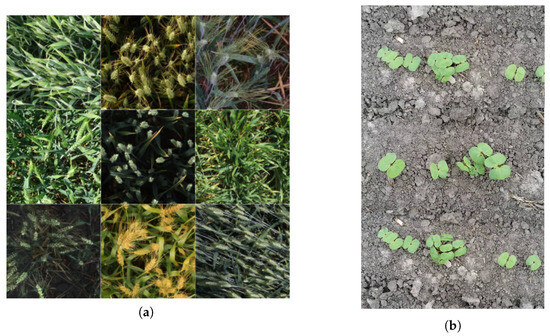
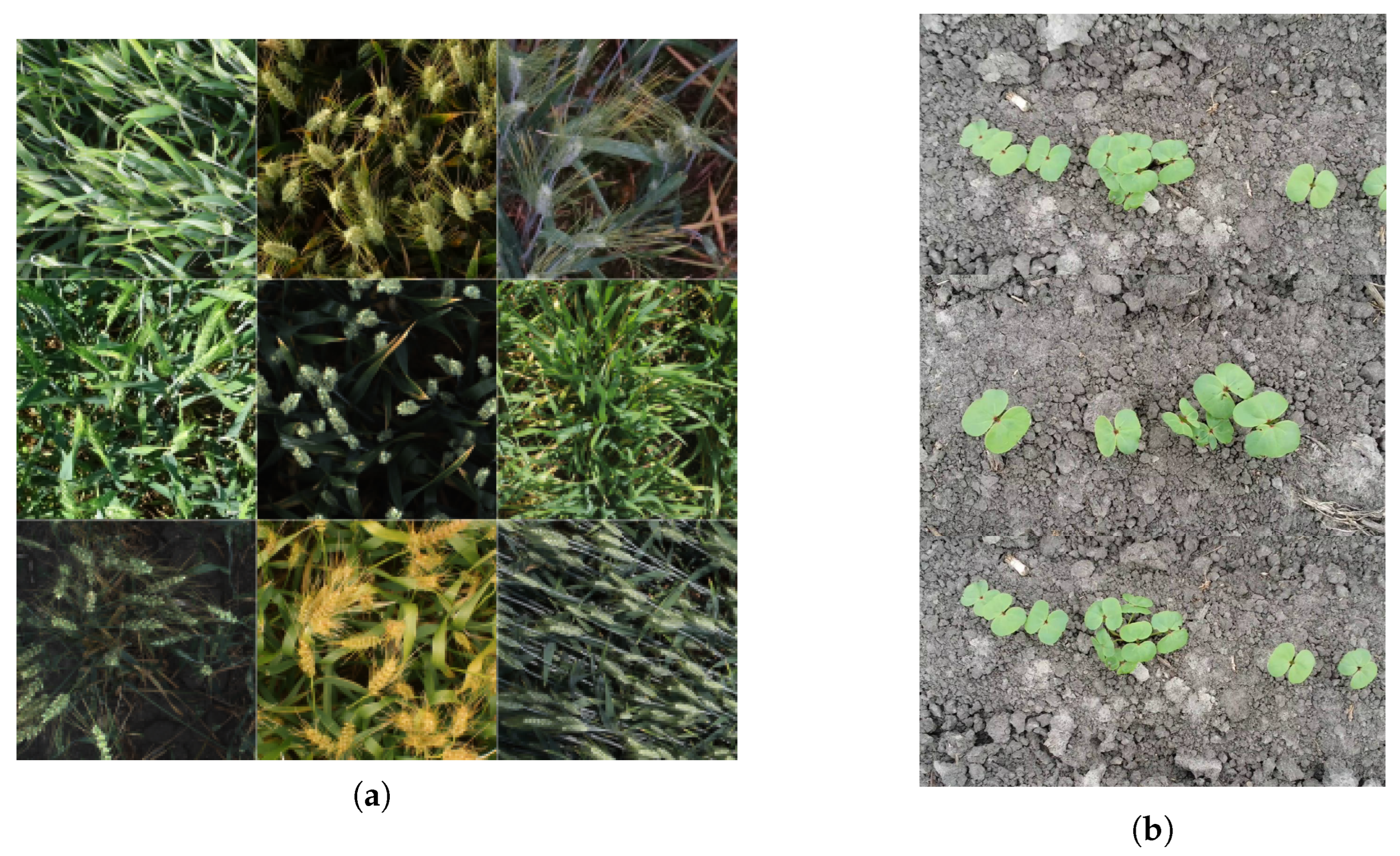
To assess transferability beyond wheat, we also use the DeepSeedling dataset [30], which contains cotton field seedling imagery, acquired during germination across multiple fields and seasons using heterogeneous platforms (handheld, cart-mounted, and tractor-mounted cameras) with the camera placed at approximately 0.5 m above ground to reduce scale variation. In total, the dataset provides 5292 images with annotated plant seedlings. Following the GWHD 2021 protocol [28], we use a 70%/20%/10% train/validation/test split. Figure 1 illustrates representative samples from both datasets.
Figure 1.
Representative UAV imagery from the datasets used in this study. (a) GWHD 2021 samples; (b) DeepSeedling samples.
To increase robustness to field variability (illumination, pose, and scale), we apply random rotations (0°–45°), horizontal and vertical flips, random crops, random rescaling, and HSV perturbations. We also use Mosaic augmentation to promote multi-context learning and improve small-object recall, following [26,27]. Based on prior studies in object detection and UAV imagery, Mosaic augmentation typically has the strongest influence on mAP@50 by increasing object-scale diversity and effective contextual sampling, which is particularly important for dense small-object scenarios such as wheat head detection. Geometric augmentations (e.g., scaling, rotation, and cropping) primarily affect localization accuracy and therefore contribute more strongly to mAP@50–95, while color-based augmentations mainly improve robustness to illumination and appearance variations. Augmented images are mixed with original samples to compose the final training set.
3.2. Neural Network Architectures
Our baseline detector is YOLOv8n, the nano variant of the YOLOv8 family [2,3], chosen for its favorable speed–accuracy trade-off on UAV edge devices. YOLO detectors follow the single-stage paradigm, directly predicting bounding boxes and class scores from full images without an explicit proposal stage. Compared to two-stage approaches, this design achieves real-time performance while maintaining high accuracy.
The YOLOv8 architecture adheres to the backbone–neck–head decomposition:
- Backbone: An improved CSPDarknet with lightweight C2f modules, designed to enhance gradient flow and feature reuse. Each C2f module splits the input feature map into multiple sub-channels, processes them sequentially through a series of convolutional layers, and then concatenates the outputs before a residual connection merges them with the original input. This design preserves representational capacity while reducing both the number of parameters and computational overhead compared to standard residual blocks. In YOLOv8n, the channel width of the backbone is progressively increased from 16 to 64 across stages, with C2f modules repeated 1–3 times per stage, resulting in a lightweight yet expressive feature extractor suitable for real-time UAV deployment. Early downsampling reduces resolution while expanding channel depth, followed by a sequence of convolutional blocks. A fast variant of spatial pyramid pooling (SPPF) aggregates multi-scale context features with low overhead.
- Neck: A bidirectional fusion network combining a Feature Pyramid Network (FPN) [31] and a Path Aggregation Network (PANet) [32]. This structure merges semantically rich low-resolution features with spatially precise high-resolution features, ensuring robust detection of small-to-medium objects.
- Head: an anchor-free, decoupled detection head that predicts object class probabilities and bounding box regression separately. This design eliminates the need for anchor tuning, improves generalization to different object scales, and reduces the number of candidate boxes, thereby accelerating post-processing.
YOLOv8 is released in five scales (n, s, m, l, x), differing in depth and width multipliers. We employ YOLOv8n, the lightest model, which is well suited for real-time UAV deployment under memory and power constraints. For UAV scenarios dominated by small-to-medium objects, we also consider a two-head variant that removes the largest-scale (P5) detection head. This reduces parameters, FLOPs, and latency, while preserving accuracy on the object scales of interest. The two-head variant is a post hoc modification applied after NAS. It removes the largest detection head because the dataset contains only small-to-medium objects. This adjustment further reduces complexity and parameters without noticeably affecting accuracy.
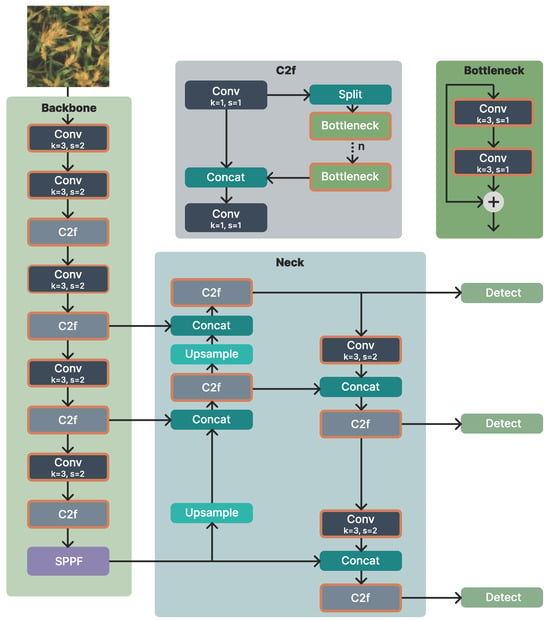
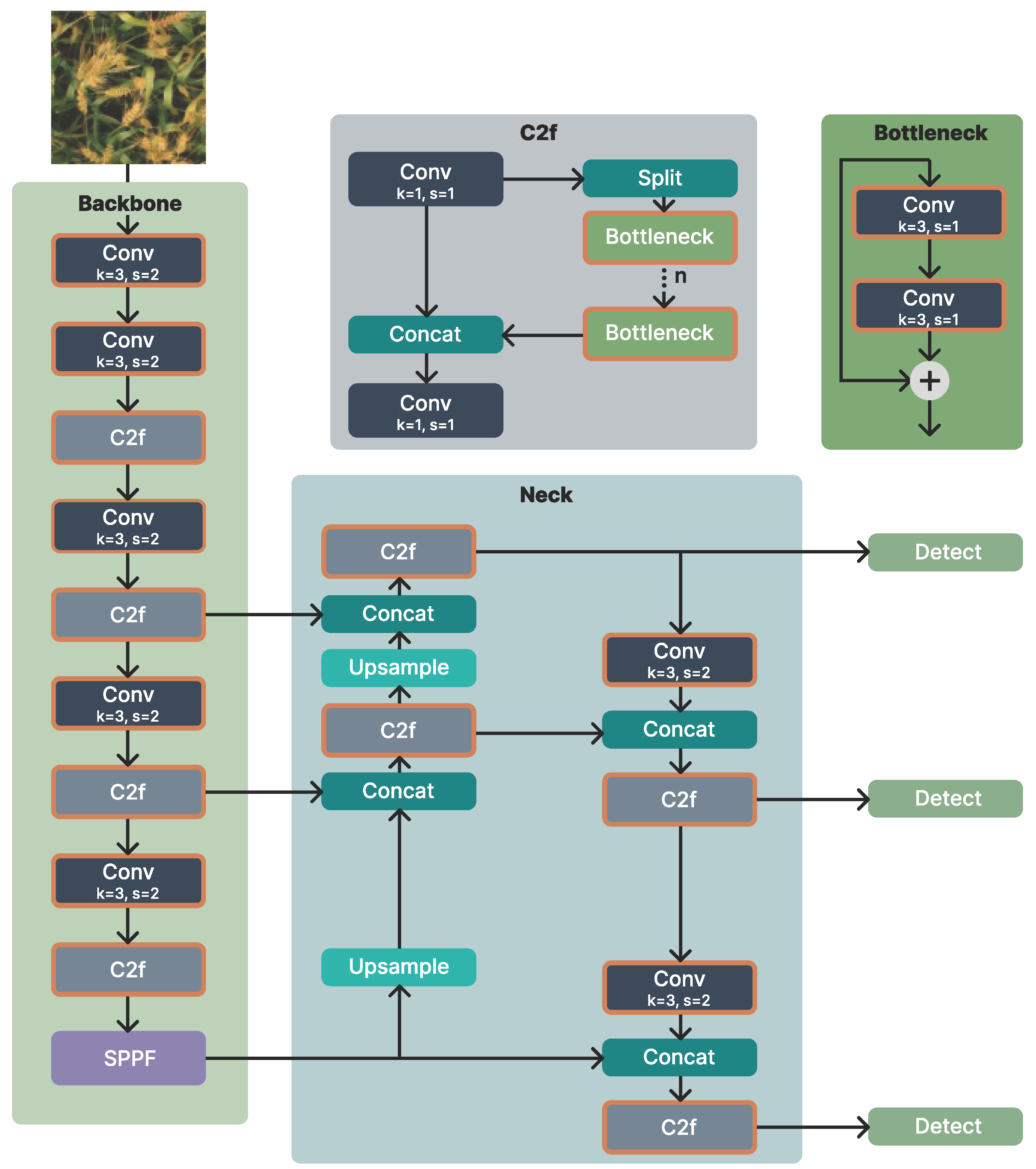
Figure 2 highlights the backbone and neck components subject to neural architecture search (NAS). Importantly, we keep the detection heads and non-maximum suppression post-processing fixed across all variants to ensure deployment compatibility.
Figure 2.
YOLOv8 diagram with searchable components highlighted (orange border).
3.3. Neural Architecture Search (NAS)
Designing efficient detectors for UAV deployment typically involves expert-driven trial-and-error, balancing accuracy against inference cost. Neural architecture search (NAS) offers a systematic alternative by automating this trade-off. Early detection NAS methods such as DetNAS [10] and Auto-FPN [15] restricted search to a single component (either the backbone or the feature pyramid), while relying on costly supernet pretraining and evolutionary algorithms. These approaches, although effective, are prohibitively slow and memory-intensive for rapid iteration.
In this work, we adopt a deployment-aware perspective on NAS, where architectural decisions are explicitly optimized for the constraints of UAV edge deployment. Deployment awareness here refers to jointly optimizing detection accuracy with (i) real-time inference latency on embedded hardware, (ii) energy efficiency per inference, (iii) compatibility with edge inference runtimes, and (iv) fixed memory and power budgets typical of UAV platforms. These deployment constraints are not treated as post hoc considerations, but are directly encoded into the NAS search space and evaluation protocol.
We therefore adopt E-AutoDet [12], a differentiable NAS framework specifically designed for object detection. E-AutoDet jointly searches the backbone and FPN, capturing their interaction, and introduces two efficiency mechanisms that make it tractable on commodity GPUs:
- Kernel reusing, which compacts multiple candidate convolutions on an edge into a single forward operator, reducing GPU memory footprint without altering expressivity.
- Dynamic channel refinement, which searches layer expansion ratios using Gumbel–Softmax, while dynamically adjusting adjacent weights to maintain consistency.
Compared to DetNAS and related methods, this design achieves competitive detection performance at a fraction of the search cost.
In our adaptation, we constrain the search to downsampling blocks and C2f modules in the YOLOv8 backbone and neck, while preserving deployment-friendly operators and the detection head. This ensures compatibility with UAV edge devices and keeps the search focused on the most impactful components for accuracy–efficiency trade-offs.
NAS objective and architecture derivation. We formulate the architecture search as a differentiable bi-level optimization problem, following DARTS and E-AutoDet. Network weights are optimized to minimize the standard YOLO detection loss on the training set, while architecture parameters are updated using the validation loss during designated architecture phases. After search convergence, the final discrete architecture is obtained by selecting, for each searchable block, the candidate operation with the highest architecture weight and removing all others.
Search spaces. To explicitly trade accuracy for efficiency on edge hardware, we define four nested, deployment-aware search spaces (Table 1): full, no-5 (removing kernels), small (restricting to / and pruning depthwise/dilated ops in the neck), and only-ex (expansion-ratio search only). For each space, we additionally consider the optional two-head variant. This design keeps post-processing identical across candidates, isolating architectural effects. These four search spaces were carefully chosen to balance hardware constraints, search efficiency, and architectural diversity. By constraining the search to deployment-friendly operators and focusing on downsampling blocks and C2f modules, we ensure that all candidate architectures are compatible with UAV edge devices and efficiently searchable. The nested spaces cover a spectrum of accuracy–efficiency trade-offs: small aggressively reduces computational cost for real-time inference, only-ex optimizes expansion ratios while preserving standard kernels, no-5 removes larger kernels to moderate complexity, and full allows full flexibility for maximum accuracy. This design enables NAS to identify architectures tailored to different deployment scenarios, from highly efficient lightweight models to more accurate, fully-featured ones, while keeping search time and computational requirements manageable.
Table 1.
Deployment-aware search spaces used in NAS. Down: downsampling blocks; C2f: feature-extraction blocks. DW Conv. indicates depthwise convolutions in the FPN. ✓ included; ✕ excluded.
Search schedule. Supernet optimization alternates between weight and architecture parameter updates (Figure 3). We first warm up network weights for 50 epochs with architecture parameters frozen, then alternate 25-epoch phases for weights and architecture until 200 epochs. For NAS, the training split is divided into equal parts: 50% for weight updates and 50% for architecture updates. After each search epoch, we checkpoint the most probable operation and expansion ratio per layer, yielding compact candidate architectures for downstream training. Compared with evolutionary detection NAS (e.g., DetNAS [10]), this joint procedure greatly reduces wall-clock search time while preserving accuracy.
Figure 3.
Training/search alternation for the supernet. Initial weight warm-up lasts 50 epochs; subsequent weight/architecture phases alternate every 25 epochs.
The large differences in search space size are primarily driven by the combinatorial effect of kernel and operator choices in the C2f and downsampling blocks, which are repeated across multiple network stages. Allowing multiple kernel sizes and operator types at each block leads to exponential growth in the number of possible architectures, while expansion ratio search contributes a smaller, multiplicative factor. Progressively constraining kernel options and feature fusion operators therefore significantly reduces search variance and stabilizes the NAS process, whereas larger spaces trade higher variance and search complexity for increased architectural diversity and potential accuracy gains.
3.4. Training Protocol
Supernet (NAS) training. We follow the alternating schedule in Figure 3 for 200 epochs, using SGD/AdamW optimizers with cosine learning-rate schedules on 768 px inputs and standard YOLO-style augmentations. Architecture parameters are optimized only during the designated architecture phases.
Final model training. Searched architectures are discretized and retrained from scratch for 200 epochs using the standard YOLOv8 recipe. Inputs are resized to (a favorable accuracy–latency compromise) with rectangular training to respect the native aspect. While lower resolutions such as offer higher inference speed, they reduce spatial detail and can negatively affect small-object detection performance, which is critical for wheat head imagery. Conversely, using the native image resolution of leads to a quadratic increase in computational cost, resulting in substantially lower FPS and higher energy consumption on resource-constrained edge devices, with only marginal accuracy improvements. Empirically, provides a balanced trade-off, preserving fine-grained visual information while maintaining real-time inference speed and acceptable energy efficiency during on-device deployment. We use batch size 16, SGD with initial LR 0.1 and momentum 0.9, weight decay , and automatic mixed precision (AMP). Loss weights follow YOLOv8 defaults: 7.5 (box), 0.5 (cls), and 1.5 (DFL). Best checkpoints are selected by validation mAP.
3.5. Edge Deployment and Inference Measurement
We evaluate real-time feasibility on two edge platforms: (i) NVIDIA Jetson Nano 4GB (Max-N power mode) and (ii) Raspberry Pi 3B+ with OAK-D Pro W (Myriad X VPU). Trained models are exported to ONNX and compiled to TensorRT engines (FP32/FP16) on Jetson. For OAK-D, ONNX models are compiled to Myriad X blob via OpenVINO, respecting operator support constraints.
Throughput (FPS) is measured on-device over repeated runs with warm-up; for Jetson, we additionally log instantaneous power to estimate energy per inference. Pre- and post-processing (input size, normalization, confidence threshold, NMS) are fixed across all deployments to ensure comparability of latencies and accuracy.
We explicitly define the scope of latency and FPS measurements for each platform. On the NVIDIA Jetson Nano, latency and FPS correspond to model inference time only, including data transfer from CPU to GPU, but excluding image decoding, resizing, normalization, and non-maximum suppression (NMS). On the Raspberry Pi with OAK-D, latency and FPS include full image preprocessing and data transfer from the host to the device over USB, in addition to model inference. NMS is excluded from the measurements on both platforms.
For all latency, FPS, and energy measurements, we use a fixed evaluation protocol on both platforms. Each experiment includes a warm-up phase of 10 inference iterations to mitigate cold-start effects, followed by 1000 measured iterations. On the Jetson Nano, power consumption is recorded using tegrastats, the standard NVIDIA system monitoring utility, and reflects on-device power usage during inference. On the Raspberry Pi with OAK-D, power consumption is measured using a Monsoon Power Monitor, capturing total system power draw of the Raspberry Pi while the OAK-D camera is connected via USB. Dynamic voltage and frequency scaling (DVFS) is left to the default system configuration on both platforms.
3.6. Evaluation Metrics
We report COCO-style detection metrics. The intersection-over-union (IoU) between predicted and ground-truth boxes is
The primary metrics used are mAP@50 and mAP@50:95:
with class in our setting (wheat head). Precision and recall define the PR curve; AP is its area:
For efficiency, we additionally report parameter count, GFLOPs (theoretical), device-level FPS, and energy per inference (Jetson).
3.7. Compute Environment and Reproducibility
All searches and trainings were executed on the HPC Slurm cluster FRIDA (Faculty of Computer and Information Science, University of Ljubljana), comprising 1456 vCPUs, 8576 GB RAM, and 40 GPUs totaling 3392 GB of GPU memory (FRIDA website: https://docs.rdc.si/FRIDA/slurm/ (accessed on 30 July 2025)). Unless otherwise stated, we used a single NVIDIA L4 (24 GB) per run, Python 3.10, PyTorch 2.5.0, NumPy 2.2.0 and standard vision libraries. All models are trained from scratch (no pretraining). We fix random seeds per run (seed = 0 for Python, NumPy, and PyTorch) and enable deterministic CuDNN behavior to improve reproducibility. Due to the computational cost of NAS and embedded deployment evaluation, results are reported from a single deterministic run per configuration, and no averaging across multiple random seeds is performed.
4. Results
4.1. Baseline Model Selection
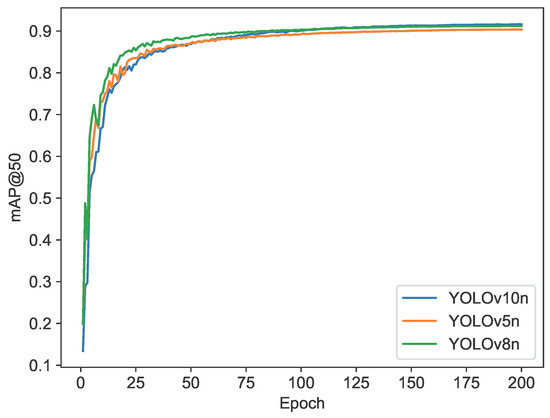
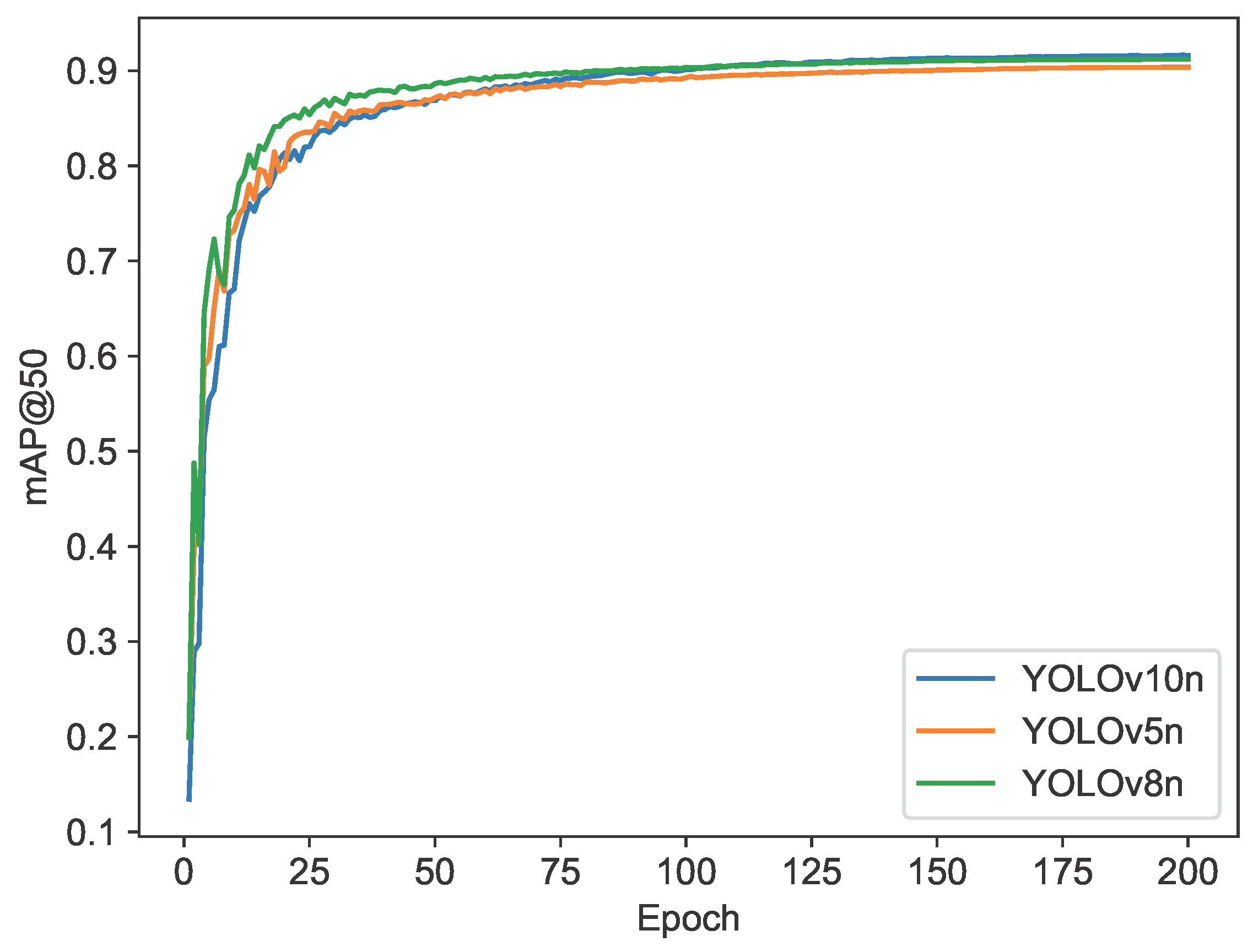
We first compared lightweight YOLO baselines on GWHD 2021 to select a starting point for NAS. Table 2 reports accuracy (mAP) and efficiency (GFLOPs, FPS) on the Jetson Nano. denotes the relative percentage change of each metric with respect to the immediately preceding model in the table (i.e., YOLOv8n compared to YOLOv5n, and YOLOv10n compared to YOLOv8n). All three candidates achieve high mAP@50 (0.904–0.916) with modest differences in mAP@50–95. From YOLOv5n to YOLOv8n, accuracy improves by +0.88% in mAP@50 and +2.73% in mAP@50–95, while computational cost rises moderately by +14.1% GFLOPs. Despite a minor speed drop of 5.2%, YOLOv8n offers the best accuracy–efficiency trade-off. In contrast, YOLOv10n yields only marginal accuracy gains (+0.44% mAP@50, +0.38% mAP@50–95) over YOLOv8n, while incurring additional complexity (+1.2% GFLOPs) and a further 3.4% speed reduction. Considering these trends, YOLOv8n provides the most balanced compromise between detection performance and runtime efficiency, making it a suitable baseline for subsequent NAS experiments. Figure 4 shows training curves (mAP@50 vs. epochs), confirming stable convergence across baselines.
Table 2.
Performance comparison of YOLO baselines on NVIDIA Jetson Nano (ONNX runtime) with denoting the relative percentage change of each metric between consecutive models.
Figure 4.
Validation mAP@50 during training for different YOLO baselines.
4.2. NAS Results
We apply NAS over four deployment-aware search spaces and compare the resulting architectures to the original E-AutoDet model and YOLO baselines. Table 3 summarizes complexity (GFLOPs), parameters, search time, and Jetson Nano throughput. The original E-AutoDet architecture is accurate but slow (12.3 GFLOPs; 4.11 FPS). Constrained search spaces yield markedly faster models with reduced compute: the small search space achieves 5.9 GFLOPs and 8.40 FPS, while the only-ex variant preserves accuracy at 7.91 FPS. Our fastest model (small search space + 2 heads) reaches 9.13 FPS at 5.1 GFLOPs and 1.16 M parameters.
Table 3.
Compute and speed comparison of NAS-discovered models and baselines on Jetson Nano (ONNX).
4.3. Training Performance on GWHD 2021
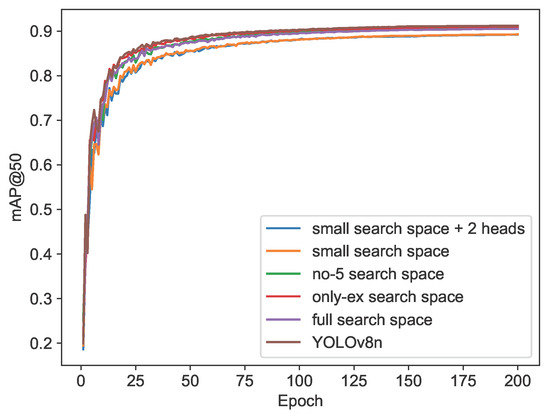
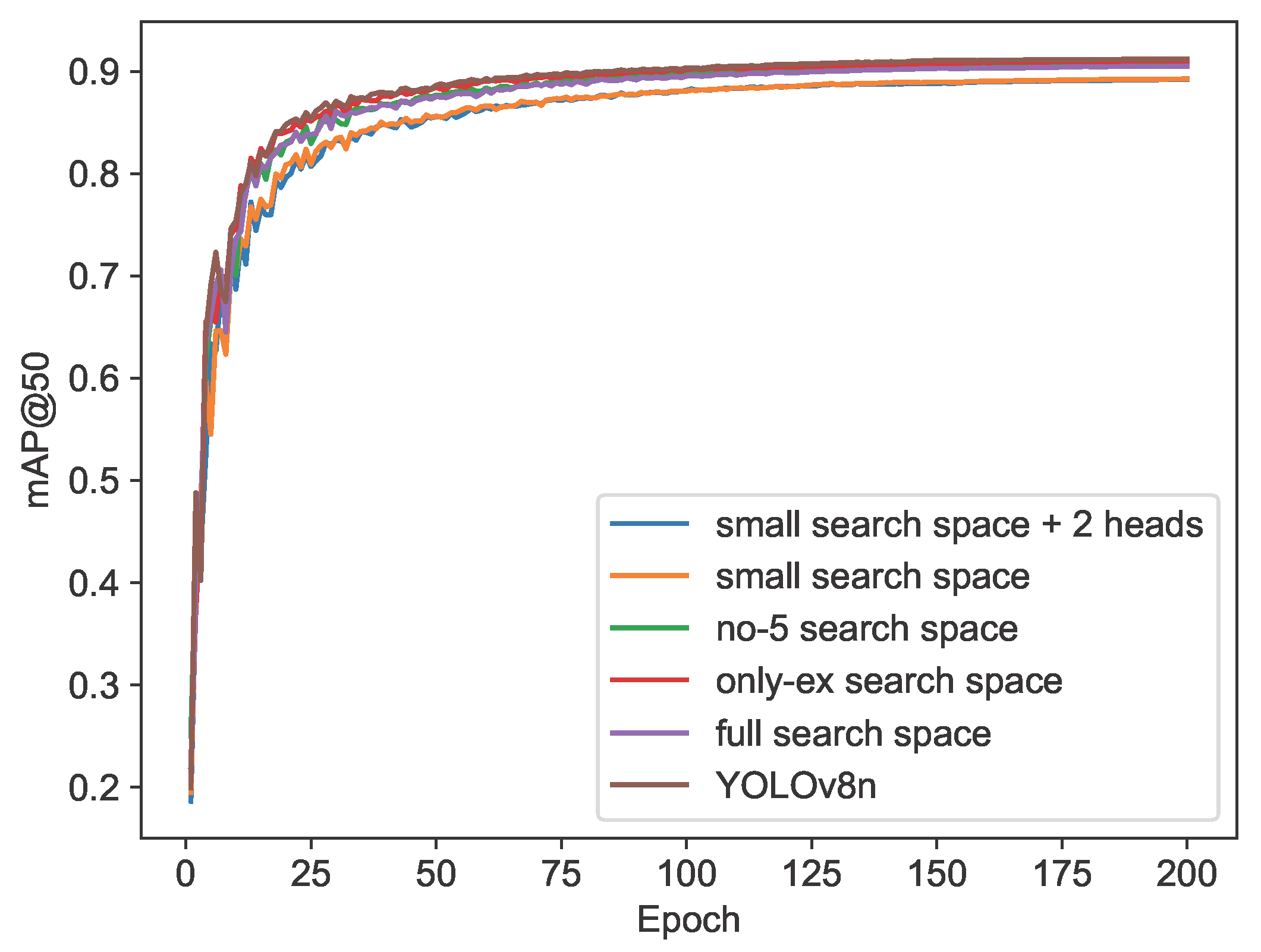
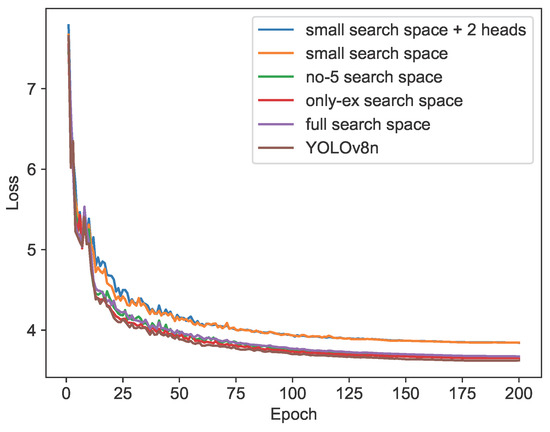
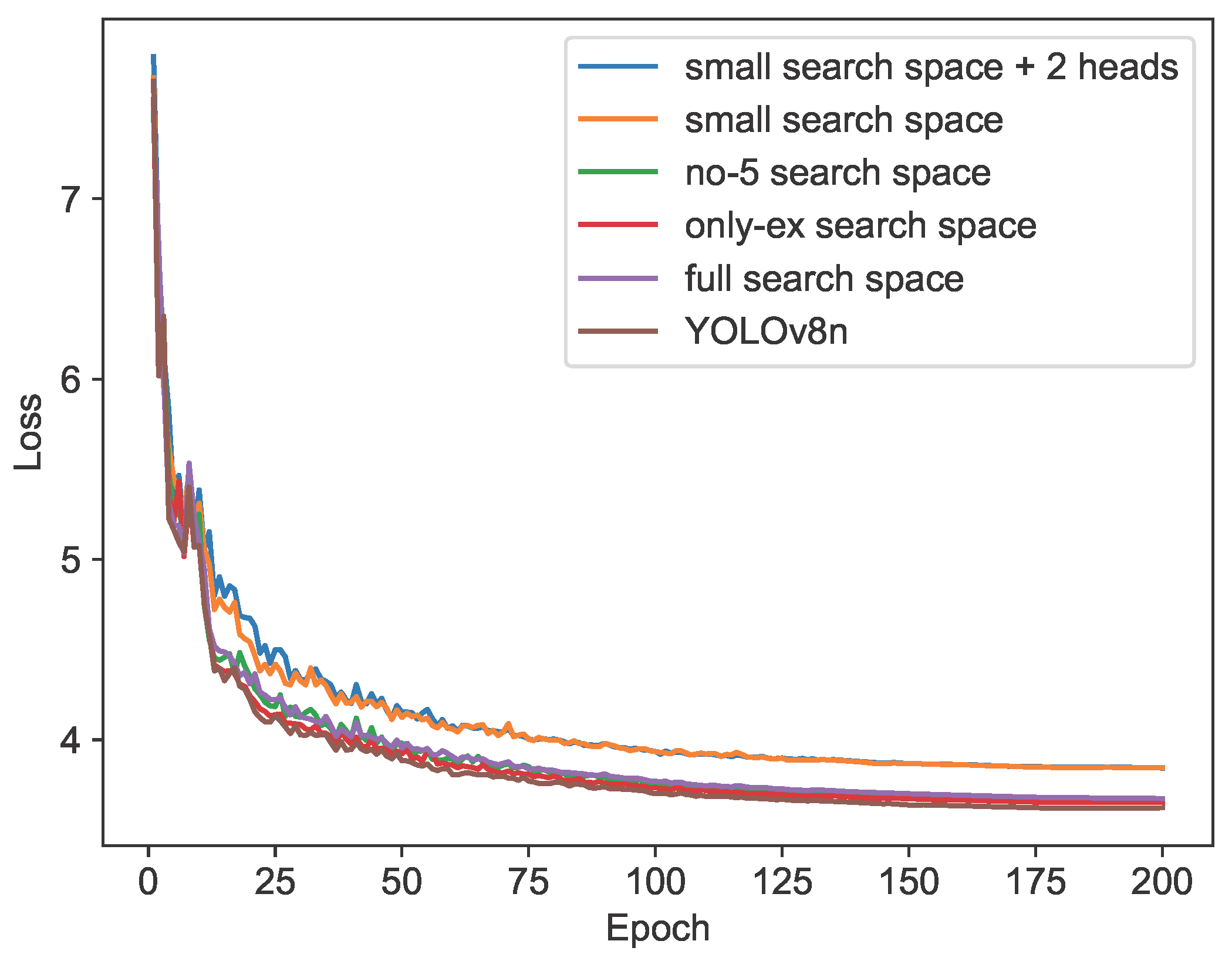
We retrained all selected architectures from scratch with the same protocol (Section 3.4). Table 4 reports test set accuracy and model complexity. YOLOv8n attains the highest mAP but at higher compute (8.1 GFLOPs; 3.01M params). Constrained spaces reduce FLOPs and parameters while preserving most accuracy; the small search space is the lightest three-head model (5.9 GFLOPs) with a modest mAP drop. Removing the largest head (small + 2 heads) yields the smallest, fastest model with limited accuracy loss. Figure 5 and Figure 6 show validation curves (mAP@50 and total loss).
Table 4.
Accuracy and complexity on GWHD 2021 test set for baselines and NAS-discovered models.
Figure 5.
Validation mAP@50 during training for all evaluated architectures.
Figure 6.
Validation loss (sum of components) during training for all architectures.
4.4. Qualitative Results
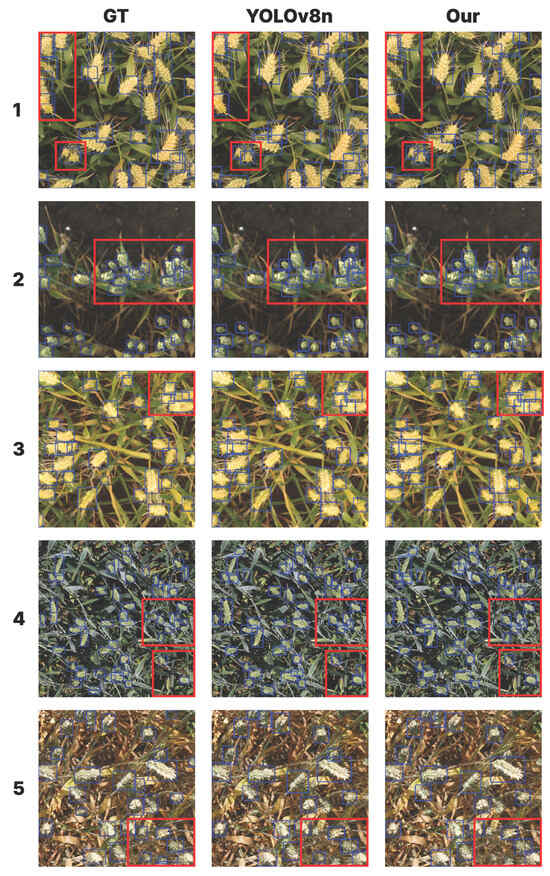
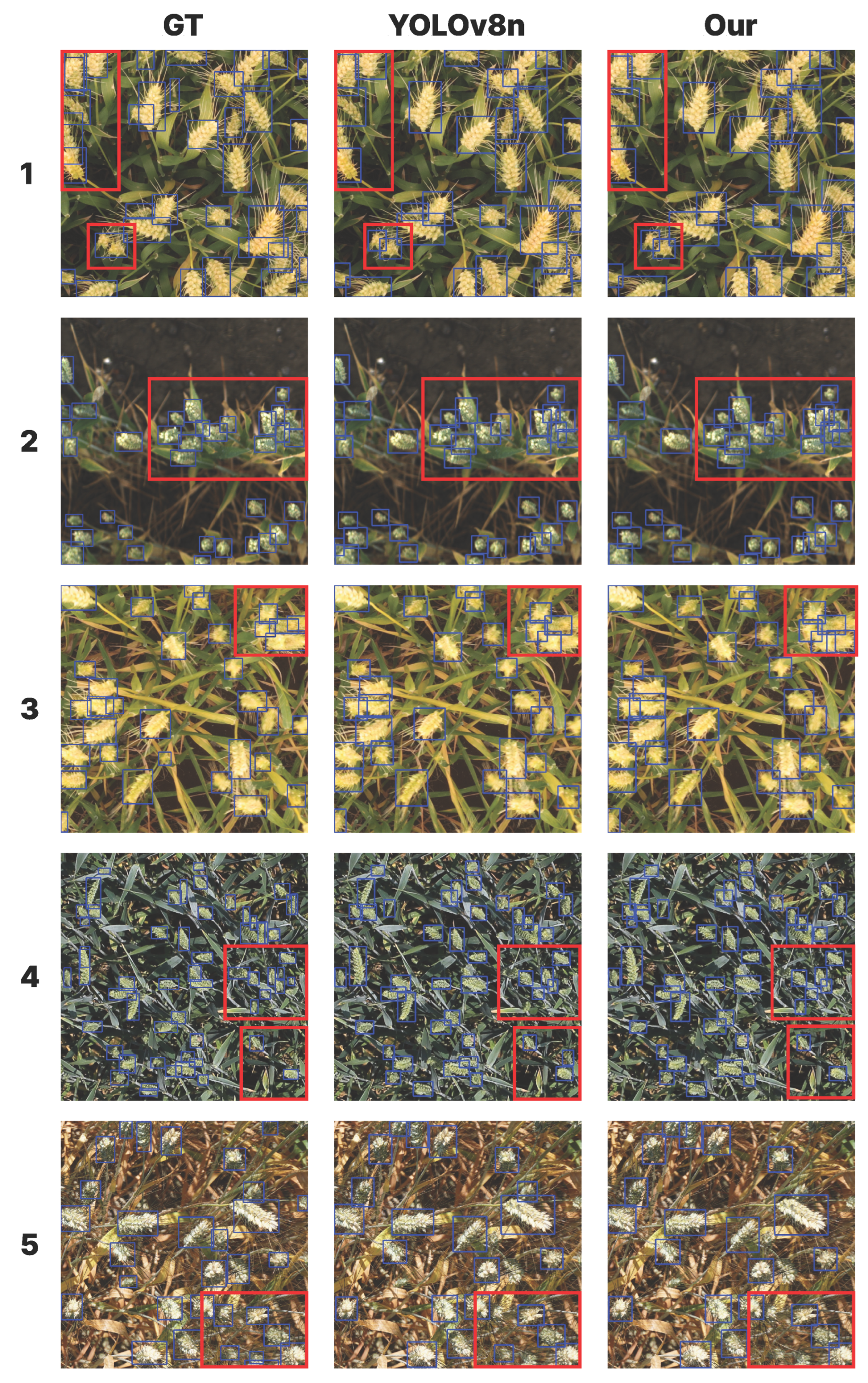
Figure 7 compares ground truth, YOLOv8n, and the fastest NAS model (small + 2 heads) on test held-out GWHD 2021 images. Predictions are visually similar; minor differences occur near borders and in dense regions. In particular, differences are most noticeable at image boundaries and in areas with overlapping wheat heads, where partial occlusions and truncated objects make detection more challenging. In several such cases, the NAS-derived model detects wheat heads near the image edges that are missed by YOLOv8n, while in dense regions both models exhibit comparable performance, indicating that the reduced architecture does not compromise detection robustness.
Figure 7.
GWHD 2021 test samples with ground truth, YOLOv8n, and small + 2 heads predictions.
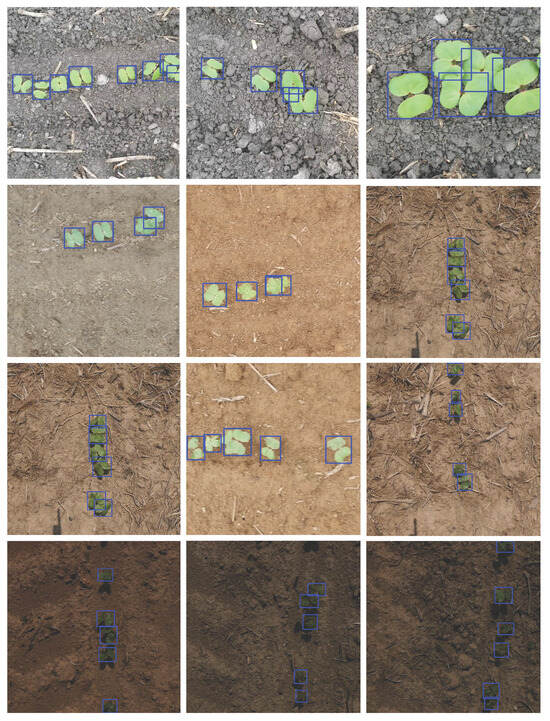
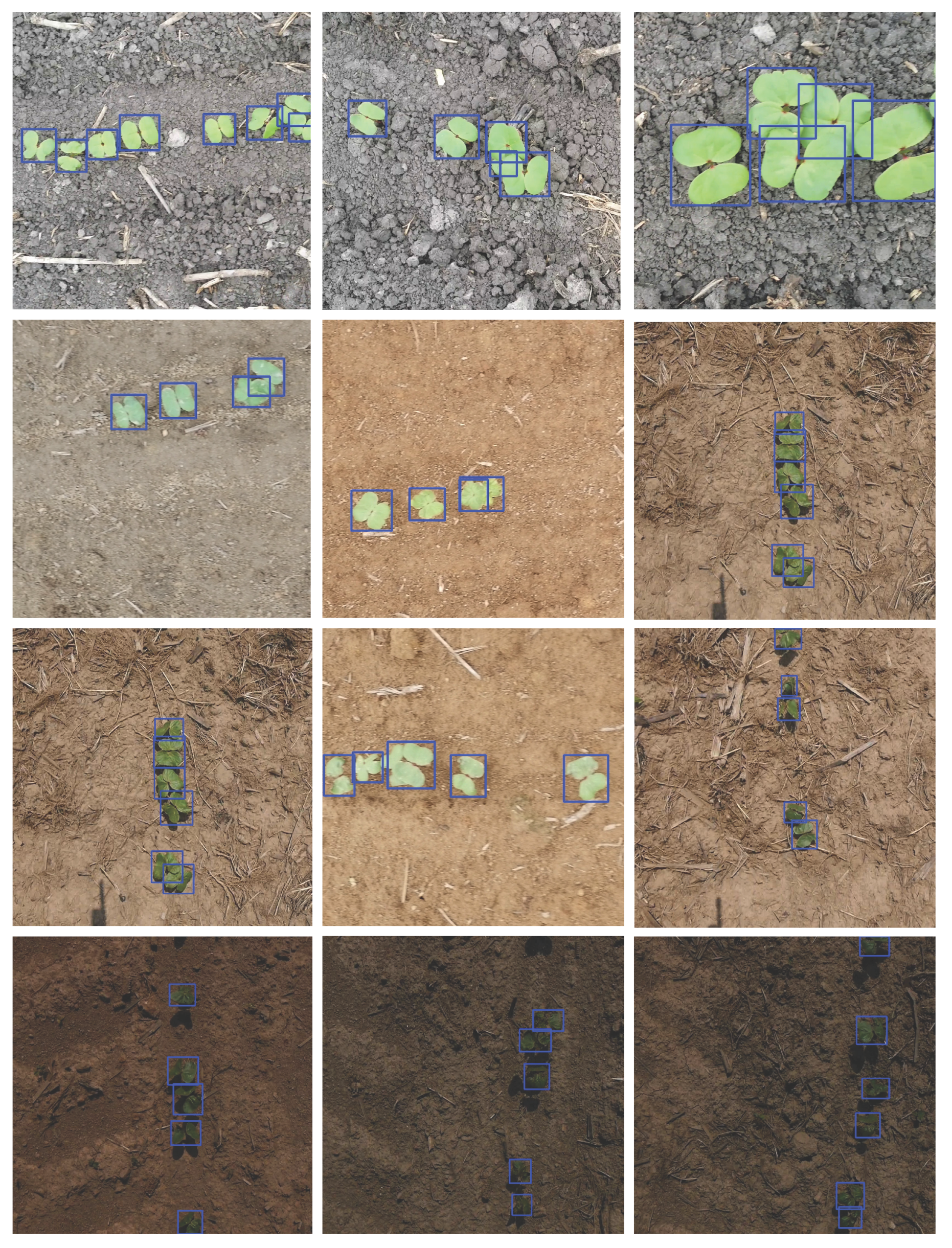
Similarly, Figure 8 shows the fastest NAS model (small + 2 heads) predictions on DeepSeedling test set samples. Despite differences in crop type and imaging conditions, the model maintains consistent detection behavior, suggesting good transferability of the searched architecture.
Figure 8.
Predictions of the NAS-discovered model (small search space) on the DeepSeedling test set [30].
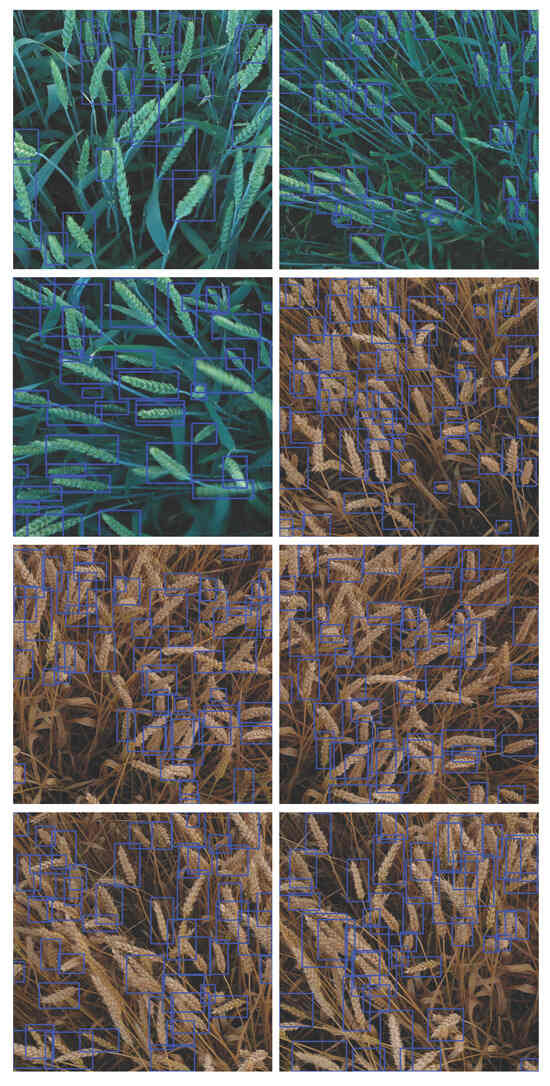
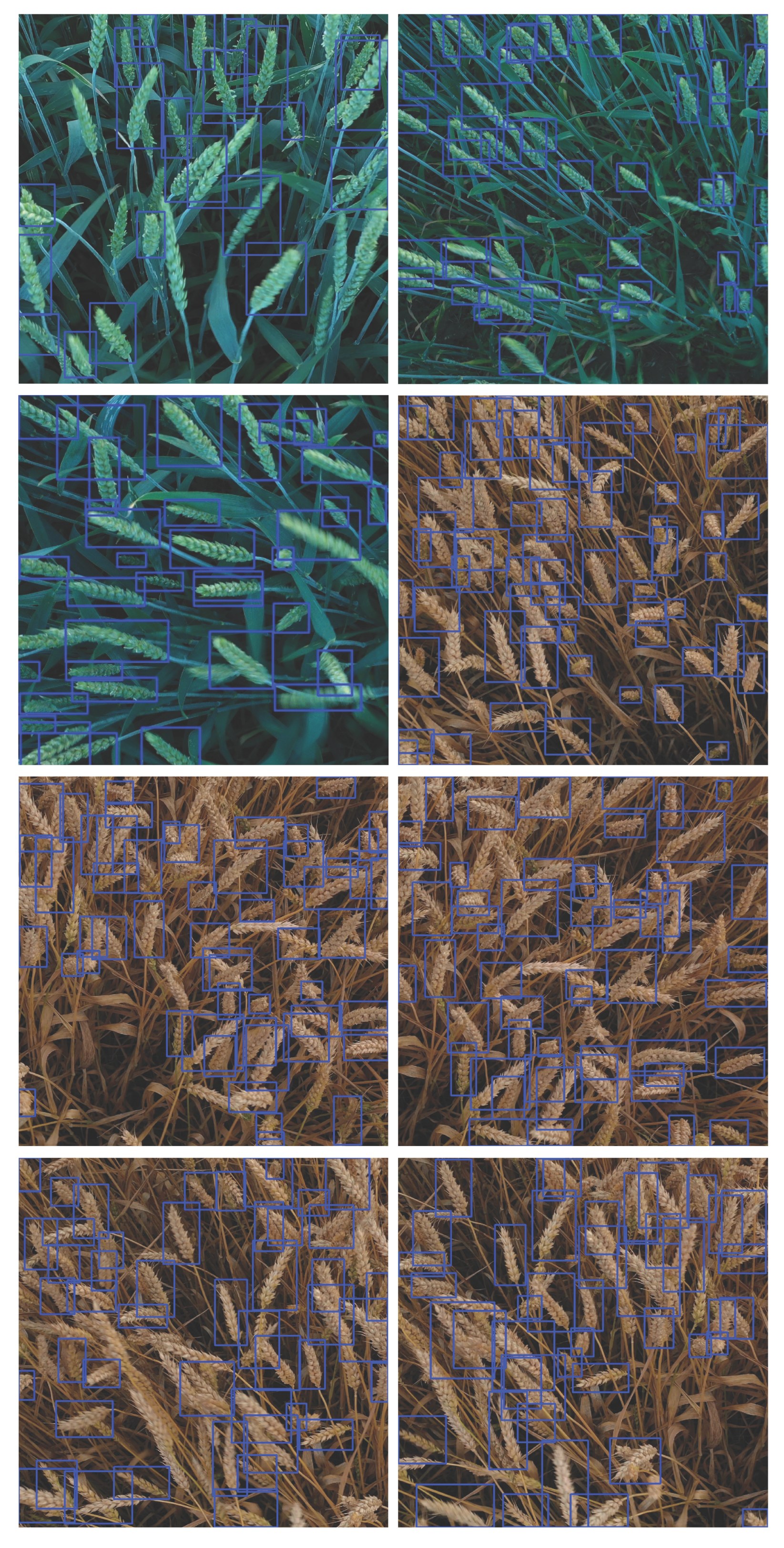
Figure 9 shows in-the-wild detections from UAV imagery collected in Slovenia across two growth stages and multiple fields. These examples illustrate stable detections under real field conditions, including varying plant density and illumination, supporting the practical applicability of the proposed models.
Figure 9.
In-the-wild UAV imagery: predictions of the small + 2 heads model across different fields and growth stages.
4.5. Energy and Throughput on Edge Devices
4.5.1. Energy and Throughput on Edge Devices on the GWHD 2021 Dataset
We benchmark energy per inference and FPS on two edge platforms.
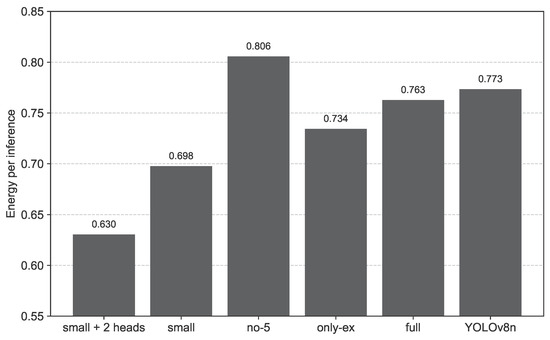
Jetson Nano (ONNX runtime). Table 5 and Figure 10 report FPS, average power, and energy per inference. The small + 2 heads model achieves both the highest FPS (9.13) and the lowest energy per inference (0.6304 J). Notably, lower runtime can outweigh slightly higher instantaneous power, leading to better energy efficiency.
Table 5.
Frames per second, average power consumption and energy per inference on NVIDIA Jetson Nano using ONNX runtime.
Figure 10.
Energy per inference on NVIDIA Jetson Nano using ONNX runtime.
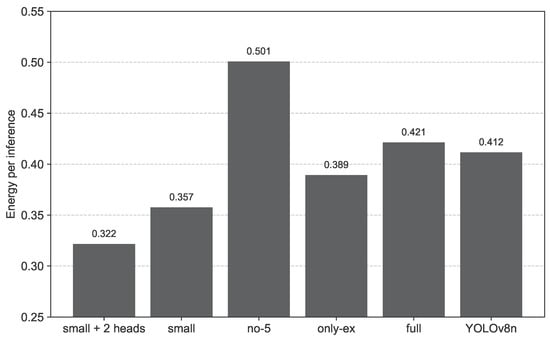
Raspberry Pi 3B+ with OAK-D. On the Myriad X VPU, the small + 2 heads model is again the most energy-efficient (0.3216 J/inference) and fastest (12.04 FPS), as shown in Table 6 and Figure 11.
Table 6.
Frames per second, average power consumption and energy per inference on Raspberry Pi 3B+ with OAK-D.
Figure 11.
Energy per inference on Raspberry Pi 3B+ with OAK-D.
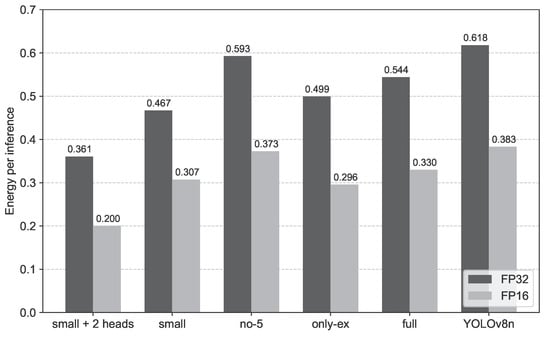
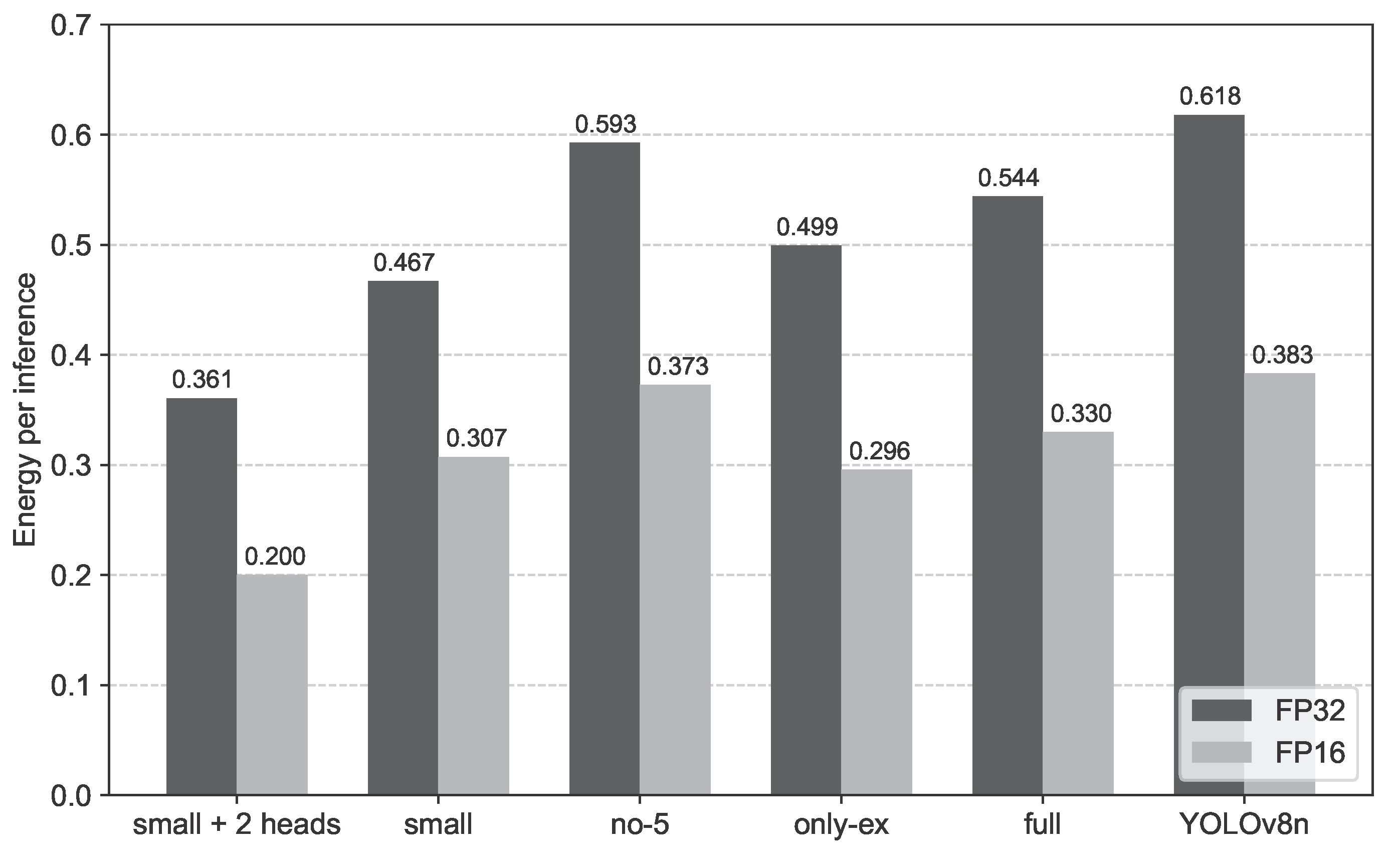
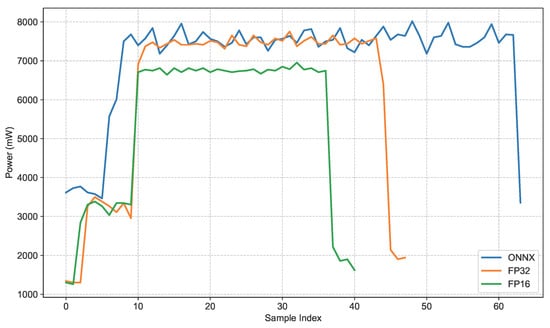
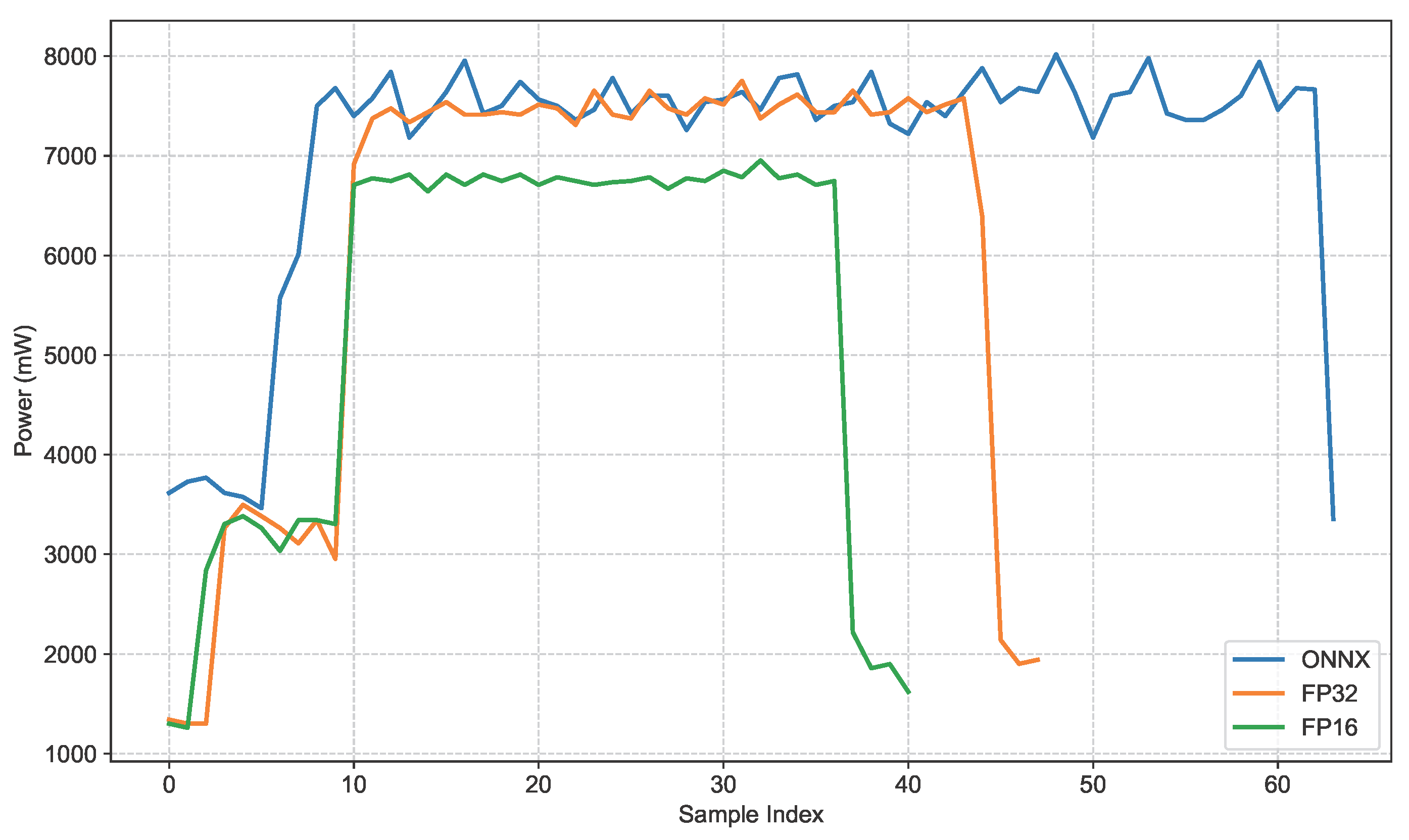
Jetson Nano (TensorRT). Converting to TensorRT further improves throughput. The small + 2 heads model reaches 14.45 FPS (FP32) and 18.47 FPS (FP16), substantially faster than ONNX (9.13 FPS). Figure 12 reports energy per inference across precisions; trends mirror ONNX, with FP16 yielding the best efficiency. It is important to note that we did not observe any accuracy drop of the FP16 model. Figure 13 plots power traces over time for ONNX, TensorRT FP32, and FP16.
Figure 12.
Energy per inference on Jetson Nano with TensorRT (FP32/FP16).
Figure 13.
Jetson Nano power consumption over time: ONNX vs. TensorRT (FP32/FP16) for the small + 2 heads model.
An interesting cross-platform observation is that the full search space variant is more energy-efficient than the baseline on Jetson Nano (Figure 10 and Figure 12) but slightly less efficient on the Raspberry Pi 3B+ with OAK (Figure 11). This reinforces the importance of search space definition in neural architecture search. Kernel choices and block designs that are optimal for one device may not translate directly to another.
4.5.2. Energy and Throughput on Edge Devices on the DeepSeedling Dataset
To probe generalization, we repeated the energy and throughput measurements on edge devices on the DeepSeedling [30] models. Table 7 shows that on this dataset too, the discovered model (searched on the small space) reduces the number of computations (6.3 vs. 8.1 GFLOPs) and also the number of parameters (1.98M vs. 3.01M) while maintaining mAP@50 (0.994) and achieving a competitive mAP@50–95. Furthermore, the execution speed on Jetson Nano improves from 7.24 to 8.34 FPS.
Table 7.
DeepSeedling results: baseline vs. NAS-discovered architecture (Jetson Nano, ONNX).
5. Discussion
The results demonstrate that deployment-aware neural architecture search, when coupled with targeted and task-aligned architectural modifications, can substantially improve the computational efficiency of object detection models for UAV-based crop monitoring. Across all evaluated configurations, the NAS-discovered architectures reduced FLOPs and parameter counts relative to the YOLOv8n baseline (Table 3 and Table 4) while maintaining competitive detection accuracy. These reductions translated directly into higher throughput and lower energy per inference on the Jetson Nano and Raspberry Pi with OAK-D (Table 5 and Table 6). The best-performing model, derived from the small search space with two detection heads, achieved the highest frame rates and the lowest energy consumption across platforms, exhibiting only a modest decline in mAP@50. Visual evaluation on GWHD 2021 and UAV imagery (Figure 7, Figure 8 and Figure 9) confirmed that detection robustness is preserved across phenological stages and varying field conditions.
A central factor enabling these gains is the suitability of E-AutoDet’s differentiable search strategy for the constraints of embedded aerial platforms. By jointly optimizing the backbone and feature pyramid network, the method directly targets the primary components influencing the accuracy–efficiency trade-off in single-stage detectors. Its kernel-reuse and dynamic channel-refinement mechanisms further prevent excessive memory growth during search, enabling systematic exploration of multiple deployment-aware search spaces (Table 1). Notably, search spaces constrained to operators with low cost on embedded hardware (such as the small or only-ex variants) provided disproportionately strong improvements in efficiency relative to the minor accuracy reductions observed.
The removal of the large-object detection head contributed additional speed and energy benefits, reflecting the predominantly small-object nature of the GWHD 2021 dataset. However, this modification is intrinsically data-specific: tasks involving larger or more heterogeneous targets, such as the DeepSeedling dataset, required retention of all detection heads to avoid reductions in recall. These findings highlight the importance of aligning head configurations with the scale distribution of target objects rather than relying on generic pruning rules.
The energy analyses further show that energy efficiency is governed not only by instantaneous device power consumption but also by inference latency. Models with similar power draw can still vary significantly in total energy per inference due to differences in completion time. The Jetson Nano results with TensorRT underscore this point: hardware-native runtimes simultaneously improved both frame rates and Joules per inference (Figure 12), consistent with earlier observations that optimized inference engines can amplify gains from architectural compression.
The relative performance of the search spaces differed between the Jetson and OAK-D platforms, indicating that the cost of operators such as dilated and convolutions is backend-dependent. This suggests that a single universal search space is unlikely to be optimal for all hardware. A practical implication is that operator-level profiling should be performed on the target platform prior to NAS, enabling the construction of hardware-calibrated search spaces. This aligns with the finding that the small and only-ex spaces produced strong Pareto-efficient solutions across devices. Concretely, operator-level profiling would involve benchmarking each candidate convolution and feature-fusion operator (e.g., standard, depthwise, dilated, and large-kernel convolutions) on the target hardware to measure latency and energy cost. These measurements could then be used to prune consistently inefficient operators or to bias the NAS search space toward hardware-efficient choices, thereby reducing search variance and improving deployment fidelity before architecture optimization begins.
Evaluation on the DeepSeedling dataset confirmed that the proposed NAS framework generalizes beyond wheat head detection. The discovered architecture reduced computational demand while preserving mAP@50 (Table 7), illustrating the transferability of the approach to other agricultural detection tasks. The moderate decrease in mAP@50–95 suggests that extreme architectural constraints may under-represent certain object shapes or contextual cues, motivating future refinements in expansion-ratio selection or augmentation strategies to capture broader variation.
Several limitations should be noted. All experiments in this study were conducted using a single fixed random seed (seed = 0), and results are reported from one deterministic run per configuration. As a result, we do not report standard deviations for mAP or FPS, nor do we explicitly assess the stability of the selected architecture across different random initializations. While fixing the seed improves reproducibility, evaluating variance across multiple seeds and analyzing the robustness of NAS-selected architectures remain important directions for future work. All models were trained from scratch to ensure comparability across architectures; stronger initialization, such as self-supervised pretraining on aerial imagery, may further enhance the accuracy of lightweight models. In addition, evaluations used fixed input resolutions and NMS configurations; device-specific tuning of resolution, tiling, or thresholding may offer further gains. Although energy measurements were collected under controlled conditions, system-level factors such as dynamic voltage and frequency scaling introduce variability, meaning the reported values should be interpreted as conservative estimates of relative performance rather than absolute measurements. Finally, while GWHD 2021 is diverse, it reflects specific geographical and annotation characteristics; validating the framework across additional environments and sensor types would strengthen its generalizability.
Taken together, the findings indicate that deployment-aware NAS offers a viable pathway for achieving real-time UAV-based crop monitoring on low-power edge devices. By reducing energy per inference and increasing frame rates, the resulting models support longer flight duration and denser spatial sampling, both of which are essential for operational in-field phenotyping and remote sensing applications.
Future research could pursue several technically grounded directions to further improve the efficiency, robustness, and generalization of UAV-based crop monitoring systems.
First, hardware-calibrated search spaces should be investigated by deriving operator sets from microbenchmarks specific to the target accelerator, such as CUDA cores, Tensor cores, or VPU kernels. By aligning the neural architecture search (NAS) with device-level performance characteristics, resulting architectures can maximize throughput and energy efficiency while remaining compatible with real-time deployment constraints. Such calibration ensures that NAS prioritizes operations that are not only theoretically efficient but also practically optimized for the target hardware.
Second, scale-aware detection heads could be developed by estimating the statistical distribution of object scales in the dataset and conditioning head pruning or dynamic head selection on these statistics. This approach would enhance the network’s ability to detect objects across a wide range of scales, improving robustness against small or variably sized seedlings or crop features, which is critical for UAV imagery where objects occupy only a small portion of the frame.
Third, mixed-precision computation and structured sparsity represent promising avenues for additional efficiency gains. By combining FP16/INT8 quantization with channel pruning informed by the NAS-discovered topology, and by evaluating hardware support for structured sparsity, inference latency and energy consumption can be significantly reduced without compromising detection accuracy. Exploiting these techniques is particularly beneficial for edge devices with limited memory bandwidth and computational throughput.
Fourth, temporal context integration can be leveraged by incorporating short sequences of UAV frames into the detection pipeline. Exploiting temporal cues allows the model to stabilize predictions under wind-induced motion, camera jitter, or fluctuating illumination, without incurring additional per-frame computational cost. This temporal modeling can be particularly valuable for time-series crop monitoring or scenarios where transient occlusions occur.
Finally, self-supervised pretraining and domain adaptation should be explored using large collections of unlabeled UAV imagery. Pretraining the backbone in a self-supervised manner, followed by adaptation to different crop types, field conditions, or seasonal variations, can improve generalization while reducing the reliance on labeled data. This approach enables more efficient utilization of large-scale unannotated datasets and facilitates rapid deployment across diverse agricultural contexts.
Collectively, these research directions provide concrete, implementable strategies to enhance both the computational efficiency and detection robustness of UAV-based crop monitoring systems while maintaining real-world applicability on resource-constrained hardware.
6. Conclusions
This study introduced a deployment-aware framework for real-time UAV-based crop monitoring that integrates a YOLOv8n detector with a neural architecture search procedure tailored specifically for object detection under edge hardware constraints. By restricting the search to backbone and feature-fusion components and by selecting operators known to be efficient on embedded devices, the framework produced models that preserve competitive accuracy while substantially reducing computational cost and improving throughput and energy efficiency.
Across the GWHD 2021 dataset, the constrained search spaces yielded architectures with markedly fewer FLOPs and parameters than the YOLOv8n baseline, with only minor reductions in mAP. The most efficient model, derived from the small search space and using two detection heads, consistently achieved the highest frame rates and the lowest energy per inference on both the Jetson Nano and Raspberry Pi with OAK-D. Additional compilation with TensorRT further increased performance on the Jetson platform, underscoring the importance of hardware-native inference engines for embedded deployment.
Evaluation on the DeepSeedling dataset demonstrated that the proposed design principles generalize to other agricultural object-detection tasks. The NAS-discovered architecture maintained mAP@50 while reducing computational complexity and improving inference speed, indicating that the deployment-aware constraints are transferable beyond wheat head detection.
Several limitations remain. All models were trained from scratch for comparability; future work incorporating self-supervised or domain-specific pretraining may further enhance the accuracy of lightweight architectures. The evaluation relied on fixed input resolutions and post-processing settings, and additional device-specific tuning may yield further speed or energy improvements. Although energy measurements were performed under controlled conditions, system-level factors such as dynamic voltage and frequency scaling introduce variability; the reported numbers should therefore be interpreted as conservative relative estimates.
Overall, this work demonstrates that device-aware neural architecture search, combined with targeted architectural simplification, provides a practical strategy for enabling real-time, on-board crop monitoring on resource-constrained UAV platforms. The resulting models offer reduced computational load, higher throughput, and lower energy consumption with minimal loss in detection accuracy, supporting the development of efficient and scalable remote sensing systems for precision agriculture.
Author Contributions
Conceptualization, O.M.M. and A.L.M.; methodology, O.M.M., A.L.M. and J.K.; software, J.K.; validation, J.K., O.M.M. and A.L.M.; formal analysis, J.K.; investigation, J.K.; resources, O.M.M., A.L.M. and J.K.; data curation, J.K.; writing—original draft preparation, J.K., O.M.M. and A.L.M.; writing—review and editing, J.K., O.M.M. and A.L.M.; visualization, J.K.; supervision, O.M.M. and A.L.M.; project administration, O.M.M. and A.L.M.; funding acquisition, O.M.M. and A.L.M. All authors have read and agreed to the published version of the manuscript.
Funding
The research presented in this paper was funded by the Slovenian Research Agency through research core funding No. P2-0426 and grants N2-0393 and J2-3047.
Institutional Review Board Statement
Not applicable.
Informed Consent Statement
Not applicable.
Data Availability Statement
The original data presented in the study is openly available at https://github.com/kkeroo/yolo-nas/ (accessed on 15 December 2025).
Acknowledgments
During the preparation of this manuscript, the authors used ChatGPT (OpenAI, GPT-5.1) to assist with improving clarity, grammar, and phrasing of selected text passages. The tool was not used to generate scientific content, experimental results, data, figures, or interpretations. All outputs were carefully reviewed and edited by the authors, who take full responsibility for the content of this publication.
Conflicts of Interest
The authors declare no conflicts of interest.
References
- Vikram Puri, A.N.; Raja, L. Agriculture drones: A modern breakthrough in precision agriculture. J. Stat. Manag. Syst. 2017, 20, 507–518. [Google Scholar] [CrossRef] [Scilit]
- Redmon, J.; Divvala, S.; Girshick, R.; Farhadi, A. You only look once: Unified, real-time object detection. In Proceedings of the IEEE Conference on Computer Vision and Pattern Recognition, Las Vegas, NV, USA, 27–30 June 2016; IEEE: Piscataway, NJ, USA, 2016; pp. 779–788. [Google Scholar] [CrossRef] [Scilit]
- Varghese, R.; Sambath, M. YOLOv8: A Novel Object Detection Algorithm with Enhanced Performance and Robustness. In Proceedings of the 2024 International Conference on Advances in Data Engineering and Intelligent Computing Systems (ADICS), Chennai, India, 18–19 April 2024; IEEE: Piscataway, NJ, USA, 2024; pp. 1–6. [Google Scholar] [CrossRef] [Scilit]
- Liu, W.; Anguelov, D.; Erhan, D.; Szegedy, C.; Reed, S.; Fu, C.Y.; Berg, A.C. SSD: Single Shot MultiBox Detector. In Proceedings of the Computer Vision—ECCV 2016, Amsterdam, The Netherlands, 11–14 October 2016; Leibe, B., Matas, J., Sebe, N., Welling, M., Eds.; Springer: Cham, Switzerland, 2016; pp. 21–37. [Google Scholar] [CrossRef] [Scilit]
- Lin, T.Y.; Goyal, P.; Girshick, R.; He, K.; Dollár, P. Focal Loss for Dense Object Detection. IEEE Trans. Pattern Anal. Mach. Intell. 2020, 42, 318–327. [Google Scholar] [CrossRef] [Scilit] [PubMed]
- Tan, M.; Pang, R.; Le, Q.V. EfficientDet: Scalable and Efficient Object Detection. In Proceedings of the 2020 IEEE/CVF Conference on Computer Vision and Pattern Recognition (CVPR), Seattle, WA, USA, 13–19 June 2020; IEEE: Piscataway, NJ, USA, 2020; pp. 10778–10787. [Google Scholar] [CrossRef] [Scilit]
- Cai, H.; Gan, C.; Wang, T.; Zhang, Z.; Han, S. Once for All: Train One Network and Specialize it for Efficient Deployment. In Proceedings of the International Conference on Learning Representations, Addis Ababa, Ethiopia, 26–30 April 2020. [Google Scholar] [CrossRef] [Scilit]
- Hu, L.; Wang, Z.; Li, H.; Wu, P.; Mao, J.; Zeng, N. l-DARTS: Light-weight differentiable architecture search with robustness enhancement strategy. Knowl.-Based Syst. 2024, 288, 111466. [Google Scholar] [CrossRef] [Scilit]
- Tan, M.; Chen, B.; Pang, R.; Vasudevan, V.; Sandler, M.; Howard, A.; Le, Q.V. MnasNet: Platform-Aware Neural Architecture Search for Mobile. In Proceedings of the IEEE/CVF Conference on Computer Vision and Pattern Recognition (CVPR), Long Beach, CA, USA, 16–20 June 2019; IEEE: Piscataway, NJ, USA, 2019. [Google Scholar] [CrossRef] [Scilit]
- Chen, Y.; Yang, T.; Zhang, X.; Meng, G.; Xiao, X.; Sun, J. DetNAS: Backbone Search for Object Detection. In Proceedings of the Advances in Neural Information Processing Systems, Vancouver, BC, Canada, 8–14 December 2019; Wallach, H., Larochelle, H., Beygelzimer, A., d’Alché-Buc, F., Fox, E., Garnett, R., Eds.; Curran Associates, Inc.: Red Hook, NY, USA, 2019; Volume 32. [Google Scholar]
- Sakuma, Y.; Ishii, M.; Narihira, T. DetOFA: Efficient Training of Once-for-All Networks for Object Detection using Path Filter. In Proceedings of the IEEE/CVF International Conference on Computer Vision, Paris, France, 2–6 October 2023; IEEE: Piscataway, NJ, USA, 2023; pp. 1333–1342. [Google Scholar] [CrossRef] [Scilit]
- Wang, X.; Lin, J.; Zhao, J.; Yang, X.; Yan, J. Eautodet: Efficient architecture search for object detection. In Proceedings of the European Conference on Computer Vision, Tel Aviv, Israel, 23–27 October 2022; Springer: Berlin/Heidelberg, Germany, 2022; pp. 668–684. [Google Scholar] [CrossRef] [Scilit]
- Jiang, C.; Xu, H.; Zhang, W.; Liang, X.; Li, Z. SP-NAS: Serial-to-parallel backbone search for object detection. In Proceedings of the IEEE/CVF Conference on Computer Vision and Pattern Recognition, Seattle, WA, USA, 13–19 June 2020; IEEE: Piscataway, NJ, USA, 2020; pp. 11863–11872. [Google Scholar] [CrossRef] [Scilit]
- Liang, T.; Wang, Y.; Tang, Z.; Hu, G.; Ling, H. Opanas: One-shot path aggregation network architecture search for object detection. In Proceedings of the IEEE/CVF Conference on Computer Vision and Pattern Recognition, Nashville, TN, USA, 20–25 June 2021; IEEE: Piscataway, NJ, USA, 2021; pp. 10195–10203. [Google Scholar] [CrossRef] [Scilit]
- Xu, H.; Yao, L.; Zhang, W.; Liang, X.; Li, Z. Auto-fpn: Automatic network architecture adaptation for object detection beyond classification. In Proceedings of the IEEE/CVF International Conference on Computer Vision, Seoul, Republic of Korea, 27 October–2 November 2019; IEEE: Piscataway, NJ, USA, 2019; pp. 6649–6658. [Google Scholar] [CrossRef] [Scilit]
- Li, G.; Yang, Y.; Bhardwaj, K.; Marculescu, R. ZiCo: Zero-shot NAS via inverse Coefficient of Variation on Gradients. In Proceedings of the Eleventh International Conference on Learning Representations, Kigali, Rwanda, 1–5 May 2023. [Google Scholar]
- Das, A.; Yang, Y.; Subburaj, V.H. YOLOv7 for Weed Detection in Cotton Fields Using UAV Imagery. AgriEngineering 2025, 7, 313. [Google Scholar] [CrossRef] [Scilit]
- Sa, I.; Popović, M.; Khanna, R.; Chen, Z.; Lottes, P.; Liebisch, F.; Nieto, J.; Stachniss, C.; Walter, A.; Siegwart, R. WeedMap: A Large-Scale Semantic Weed Mapping Framework Using Aerial Multispectral Imaging and Deep Neural Network for Precision Farming. Remote Sens. 2018, 10, 1423. [Google Scholar] [CrossRef] [Scilit]
- Lyu, Y.; Han, X.; Wang, P.; Shin, J.Y.; Ju, M.W. Unmanned Aerial Vehicle-Based RGB Imaging and Lightweight Deep Learning for Downy Mildew Detection in Kimchi Cabbage. Remote Sens. 2025, 17, 2388. [Google Scholar] [CrossRef] [Scilit]
- Amarasingam, N.; Powell, K.; Sandino, J.; Bratanov, D.; Ashan Salgadoe, A.S.; Gonzalez, F. Mapping of insect pest infestation for precision agriculture: A UAV-based multispectral imaging and deep learning techniques. Int. J. Appl. Earth Obs. Geoinf. 2025, 137, 104413. [Google Scholar] [CrossRef] [Scilit]
- Hobart, M.; Pflanz, M.; Tsoulias, N.; Weltzien, C.; Kopetzky, M.; Schirrmann, M. Fruit Detection and Yield Mass Estimation from a UAV Based RGB Dense Cloud for an Apple Orchard. Drones 2025, 9, 60. [Google Scholar] [CrossRef] [Scilit]
- Wang, B.; Zhou, J.; Costa, M.; Kaeppler, S.M.; Zhang, Z. Plot-Level Maize Early Stage Stand Counting and Spacing Detection Using Advanced Deep Learning Algorithms Based on UAV Imagery. Agronomy 2023, 13, 1728. [Google Scholar] [CrossRef] [Scilit]
- Yousafzai, S.N.; Nasir, I.M.; Tehsin, S.; Fitriyani, N.L.; Syafrudin, M. FLTrans-Net: Transformer-based feature learning network for wheat head detection. Comput. Electron. Agric. 2025, 229, 109706. [Google Scholar] [CrossRef] [Scilit]
- Gong, B.; Ergu, D.; Cai, Y.; Ma, B. Real-Time Detection for Wheat Head Applying Deep Neural Network. Sensors 2021, 21, 191. [Google Scholar] [CrossRef] [Scilit]
- Meng, X.; Li, C.; Li, J.; Li, X.; Guo, F.; Xiao, Z. YOLOv7-MA: Improved YOLOv7-Based Wheat Head Detection and Counting. Remote Sens. 2023, 15, 3770. [Google Scholar] [CrossRef] [Scilit]
- Fang, C.; Yang, X. Lightweight YOLOv8 for Wheat Head Detection. IEEE Access 2024, 12, 66214–66222. [Google Scholar] [CrossRef] [Scilit]
- Yang, Z.; Yang, W.; Yi, J.; Liu, R. WH-DETR: An Efficient Network Architecture for Wheat Spike Detection in Complex Backgrounds. Agriculture 2024, 14, 961. [Google Scholar] [CrossRef] [Scilit]
- David, E.; Serouart, M.; Smith, D.; Madec, S.; Velumani, K.; Liu, S.; Wang, X.; Pinto, F.; Shafiee, S.; Tahir, I.S.; et al. Global Wheat Head Detection 2021: An Improved Dataset for Benchmarking Wheat Head Detection Methods. Plant Phenomics 2021, 2021, 9846158. [Google Scholar] [CrossRef] [Scilit] [PubMed]
- David, E.; Madec, S.; Sadeghi-Tehran, P.; Aasen, H.; Zheng, B.; Liu, S.; Kirchgessner, N.; Ishikawa, G.; Nagasawa, K.; Badhon, M.A.; et al. Global Wheat Head Detection (GWHD) Dataset: A Large and Diverse Dataset of High-Resolution RGB-Labelled Images to Develop and Benchmark Wheat Head Detection Methods. Plant Phenomics 2020, 2020, 3521852. [Google Scholar] [CrossRef] [Scilit] [PubMed]
- Jiang, Y.; Li, C.; Paterson, A.H.; Robertson, J.S. DeepSeedling: Deep convolutional network and Kalman filter for plant seedling detection. Plant Methods 2019, 15, 141. [Google Scholar] [CrossRef] [Scilit] [PubMed]
- Lin, T.Y.; Dollár, P.; Girshick, R.; He, K.; Hariharan, B.; Belongie, S. Feature pyramid networks for object detection. In Proceedings of the IEEE Conference on Computer Vision and Pattern Recognition, Honolulu, HI, USA, 21–26 July 2017; IEEE: Piscataway, NJ, USA, 2017; pp. 2117–2125. [Google Scholar] [CrossRef] [Scilit]
- Liu, S.; Qi, L.; Qin, H.; Shi, J.; Jia, J. Path aggregation network for instance segmentation. In Proceedings of the IEEE Conference on Computer Vision and Pattern Recognition, Salt Lake City, UT, USA, 18–23 June 2018; IEEE: Piscataway, NJ, USA, 2018; pp. 8759–8768. [Google Scholar] [CrossRef] [Scilit]



Disclaimer/Publisher’s Note: The statements, opinions and data contained in all publications are solely those of the individual author(s) and contributor(s) and not of MDPI and/or the editor(s). MDPI and/or the editor(s) disclaim responsibility for any injury to people or property resulting from any ideas, methods, instructions or products referred to in the content. |
© 2026 by the authors. Licensee MDPI, Basel, Switzerland. This article is an open access article distributed under the terms and conditions of the Creative Commons Attribution (CC BY) license.