Article

Research on Axial Load Transfer Law of Machine-Picked Seed Cotton and Discrete Element Simulation

1
College of Mechanical and Electrical Engineering, Shihezi University, Shihezi 832003, China
2
Key Laboratory of Northwest Agricultural Equipment, Ministry of Agriculture and Rural Affairs, Shihezi 832003, China
3
School of Agricultural Engineering, Jiangsu University, Zhenjiang 212013, China
4
Key Laboratory for Theory and Technology of Intelligent Agricultural Machinery and Equipment, Jiangsu University, Zhenjiang 212013, China
5
School of Engineering, Northeast Agricultural University, Harbin 150030, China
*
Author to whom correspondence should be addressed.
AgriEngineering 2026, 8(1), 7; https://doi.org/10.3390/agriengineering8010007 (registering DOI)
Submission received: 23 October 2025 / Revised: 10 December 2025 / Accepted: 16 December 2025 / Published: 1 January 2026

Abstract

The compression deformation of seed cotton has been identified as a key factor affecting the working reliability of the baling device and the quality of bale molding. However, due to the complex working conditions of seed cotton in the continuous compression process in a confined space, it has proven to be difficult to study the compression molding mechanism of machine-harvested seed cotton in the baling process. The present study employs a universal testing machine to compress the seed cotton. In addition, pressure sensors are utilised to ascertain the internal axial load transfer law of the seed cotton. Furthermore, the internal density distribution equation of the seed cotton is established. Moreover, the Fiber model is employed to establish a spatial helix structure model of the cotton fibre. Finally, the compression simulation test is conducted to calibrate its material parameters. The results of the study indicate that seed cotton exhibits hysteresis in its internal stress–strain transfer. Through the polynomial fitting of the compression–displacement curve, it has been demonstrated that as the seed cotton approaches the compressed side, the rate of change in compression increases. The internal density distribution of the seed cotton must be calculated when it is compressed to a density of 220 kg·m−3. It is found that the density of the upper layer of the seed cotton is slightly greater than that of the lower layer of the seed cotton. The density distribution equation must then be obtained through regression fitting. The parameters of the compression model must be calibrated by means of uniaxial compression tests. Finally, the density distribution equation of the cotton fibre must be obtained through the compression test. The parameters of the simulation model, as determined by the uniaxial compression test calibration, are of significant importance. This is particularly evident in the context of the Poisson’s ratio of cotton fibre and the cotton fibre elastic modulus under pressure. The regression equation was obtained through analysis of variance, and the simulation of contact parameter optimisation. The optimal parameter combination was determined to be 0.466, and the pressure at this time. The relative error was found to be 2.96%, and the compression of specific performance was determined to be 10.14%. These findings serve to validate the simulation model. The findings of this study have the potential to provide a theoretical foundation and simulation assistance for the design and optimisation of cotton picker baling devices.

1. Introduction

Xinjiang is the most significant cotton-producing region in China, with a cotton cultivation area accounting for 81.6% of the nation’s total area in 2024 [1,2,3]. In the context of the ongoing mechanization of agricultural practices, the autonomous region of Xinjiang has witnessed a substantial increase in the utilisation of mechanized cotton harvesting equipment. Indeed, the utilisation of domestically produced cotton pickers has attained an estimated 80% market share within the region [4]. The seed cotton baling device constitutes the core component of baler-type cotton pickers, with the function of enabling the packaging, storage, and transportation of machine-harvested seed cotton. It plays a crucial role in reducing costs, improving efficiency, and minimizing impurity contamination. Its performance has been shown to have a significant impact on the operational efficiency of cotton pickers [5]. During the process of baling, the compression of cotton fibres and the deformation of seeds under stress are pivotal factors in determining the reliability of the baling device and the quality of cotton bale formation. However, given the numerous influencing factors and complex operating conditions during the continuous compression of seed cotton in a confined space, measuring the stress on cotton fibres during deformation is challenging. This inherent challenge, therefore, serves to compound the complexity inherent to the study of the compression and forming mechanism of machine-harvested seed cotton during the baling process [6]. The employment of numerical simulation techniques to establish precise simulation models, founded upon research into the mechanical compression properties of machine-harvested seed cotton, provides a foundation for in-depth investigation of the baling process. This finding is of considerable significance for the optimisation and enhancement of the baling mechanisms of cotton harvesters produced domestically.
In the context of the compression of seeds, the mechanical properties of the harvesting machine’s packaging apparatus and operational parameters require optimisation and design [7]. This subject has been extensively researched by scholars both domestically and internationally. Hardin et al. [8] conducted research on the compression and deformation of seeds, with a focus on the mechanical properties of seeds during the compression process. However, the compression density range is minimal, which limits its ability to provide theoretical guidance for the development of the harvesting machine’s packaging apparatus. In their study, Gong et al. [9] utilised two models to describe the compression and relaxation of seeds’ mechanical properties. The experimental results indicated that the coefficient of the seed compression and relaxation process is greater than 0.9. The relationship between the compression of the seeds, the compression stress, the compression relaxation, the water content, and the amount fed is all presented in a correlative manner. In their study, Wei et al. [10] investigated the compression characteristics and compressibility of the seeds in more detail. By establishing a mathematical model through regression analysis of the data obtained from a single-axis sealed compression test, the study revealed that the compression speed, initial density, water content, and foreign matter content have a significant impact on the compression of the seeds during the process of machine harvesting. Despite the significant research conducted by domestic and international scholars on the compression of seeds, there is a paucity of literature on the modelling and theoretical analysis of the distribution of internal pressure, transmission, and density variations during the compression of seeds.
The discrete element method, a significant analytical technique for the study of compression characteristics of agricultural materials, has gained widespread application in a range of research areas, including the analysis of fertilisers [11], rice straw [12], and corn stover [13,14]. Du Haijun et al. [15] analysed the force chain evolution during alfalfa compression moulding from a fine scale using a multisphere polymerisation model. The results demonstrated that the distribution of the force chain decreased from top to bottom during vibration-free compression of alfalfa. Li Zhen et al. [16] conducted a study on the uniaxial compression process of salix, analysing the axial particle pressure distribution of salix particles during compression. Machine-picked seed cotton is constituted primarily of cotton seeds and fibres that are distributed in a haphazard manner in space. Consequently, employing conventional modelling methods results in a computationally inefficient process, due to the challenges in demonstrating the characteristics of cotton fibres that are bent and entangled in space. The development of the fibre model represents a significant advancement in this field, as it facilitates the construction of a simulation model with a reduced number of particles, thereby enhancing the efficiency of the simulation process when compared with the bonded model [17]. Consequently, the Fiber model is more appropriate for simulating the compression process of seed cotton, and it can be employed to analyse the compression process and mechanical properties of agricultural fibre materials.
This paper adopts a scientific approach by selecting machine-picked seed cotton as the primary subject of investigation. Utilising uniaxial compression testing, the axial load of cotton is meticulously measured through the employment of pressure sensors. The study delves into the intricate process of axial load transfer during compression, aiming to elucidate the underlying mechanisms governing cotton density distribution upon completion of the compression cycle. To this end, the research establishes a discrete element simulation model of machine-picked cotton, meticulously calibrating the eigenparameters through the utilisation of compression simulation tests. This endeavour provides a comprehensive theoretical and practical foundation for the design and optimisation of the baling device of cotton picking machines. The theoretical and simulation-based framework underpinning the design and optimisation of the cotton picker baling device is hereby presented.

2. Materials and Methods

2.1. Seed Cotton Layered Compression Test

2.1.1. Test Materials and Instruments

The test material was selected from machine-picked seed cotton Xinluzao 84 in Xinjiang Shihezi City, Xinjiang, and the moisture content of seed cotton was determined to be 6.7% at the time of the test. The equipment employed for this study comprises a universal material testing machine, an FA1104 electronic balance, an RP-C10-ST flexible film pressure transducer, a sensor control test board, a constant temperature and humidity box, and a plexiglass cylinder with the following external dimensions: 125 mm diameter, 350 mm height, and 10 mm wall thickness.

2.1.2. Test Method

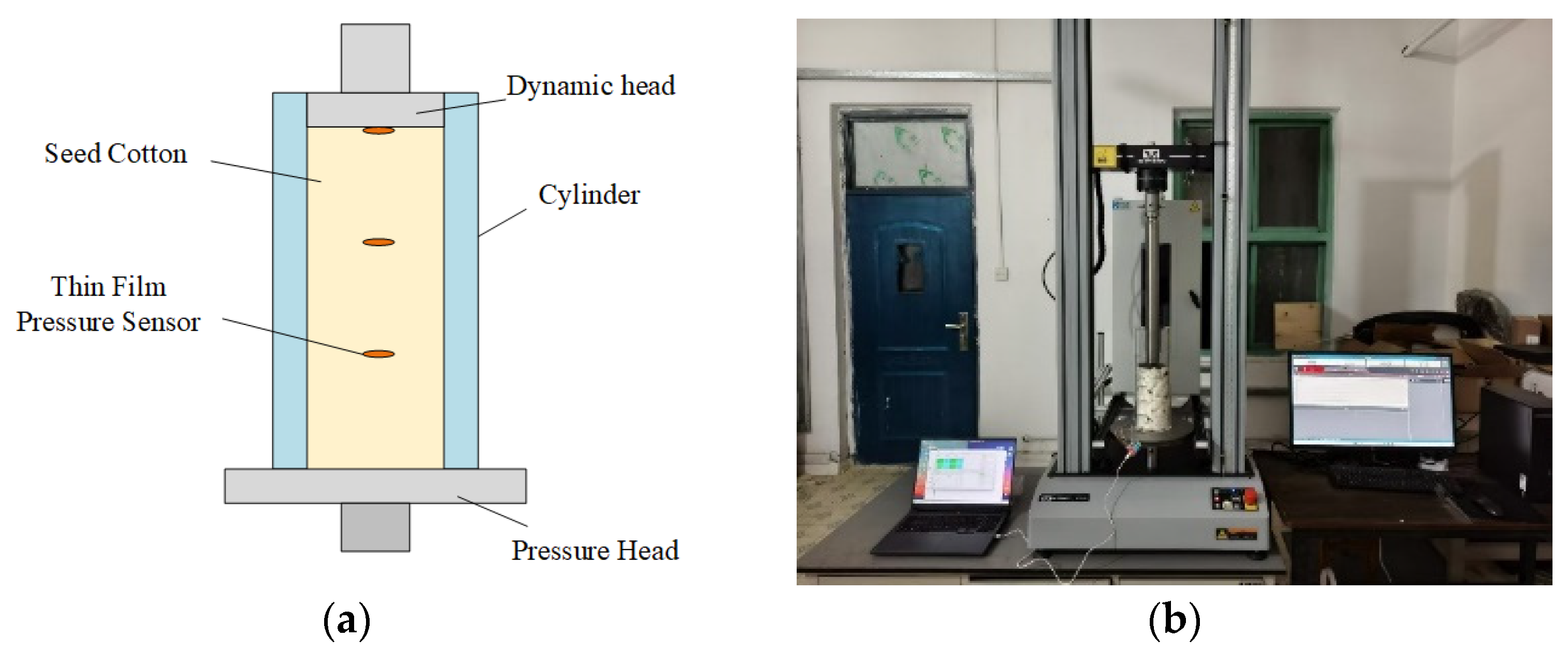
In this paper, uniaxial compression of seed cotton was conducted, and the axial load of seed cotton was collected by pressure sensors. The pressure difference between adjacent sensors was then used as an evaluation index to analyse the relationship between the compression and density of seed cotton between layers in the compression process. Given that the moisture content of seed cotton harvested by cotton pickers is generally between 9% and 16%, an excess of moisture will result in mould, while an insufficient moisture content is susceptible to the development of static electricity, which can impede subsequent processing [18]. The seed cotton, weighing 200 g, was humidified using a constant temperature and humidity oven, and the seed cotton was humidified to 10% moisture content with reference to GB 1103.1-2023, “Cotton Part 1: Serrated Processed Fine Staple Cotton” [19]. The humidified seed cotton was loaded into an acrylic cylinder on the platform of the universal testing machine, and the compression test was conducted at a loading speed of 30 mm·min−1 [9]. The test was repeated three times, and the average value was taken as the test value to reduce the error. As the bale density formed by the self-propelled baling cotton picker was measured at 220 kg·m−3, the test was halted once the average compression density of the seed cotton reached this value. As illustrated in Figure 1a, three flexible film pressure sensors (P1, P2, and P3) were meticulously positioned within the seed cotton, thereby dividing the seed cotton into three sections from the top to the bottom. A silicone gasket measuring 3.5 mm in diameter and 1 mm in thickness is mounted on the sensor surface. Thereafter, the pressure data at varying locations were acquired by the sensor-controlled test board and imported into the computer via data lines. The compression test was then conducted, as illustrated in Figure 1b.

2.2. Discrete Element Simulation of Seed Cotton Compression Test

2.2.1. Discrete Metamodel for Seed Cotton

Machine-harvested seed cotton comprises two materials with significant differences in compression characteristics, namely cotton seeds and cotton fibres [18]. Consequently, seed cotton is regarded as a mixture of these two materials, with each material modelled separately during discrete element simulation. Additionally, based on existing research, the parameters of the cotton fibres are calibrated through compression tests [20].
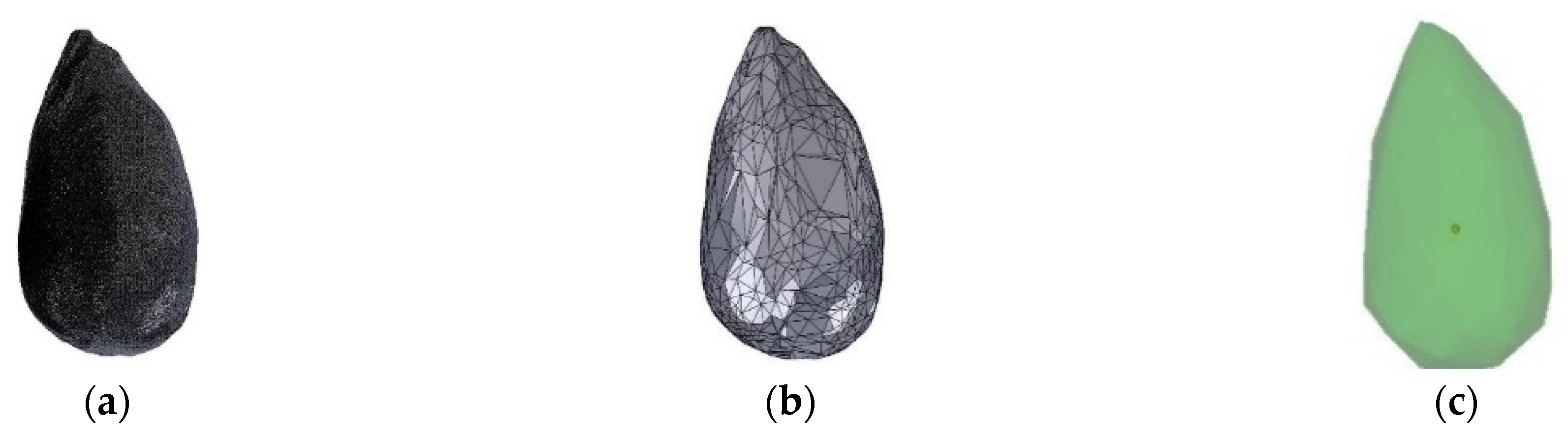
As outlined in reference [21], the utilisation of a discrete element model of cotton seeds entails the employment of 3D point cloud scanning to procure point cloud data. This process employs the MeshLab software (version 2021) to streamline the representation of cotton seeds as an amalgamation of triangular planes, constituted by convex polyhedral particles. Subsequently, the data is imported into the Ansys Rocky software (version 2022 R2) to finalise the modelling process, as depicted in Figure 2. Given the efficiency and accuracy of the simulation, this paper proposes that the number of facets of the polyhedral cottonseed model should be set at 200 for the subsequent simulation study. The relevant contact parameter settings of the cottonseed model are shown in Table 1.
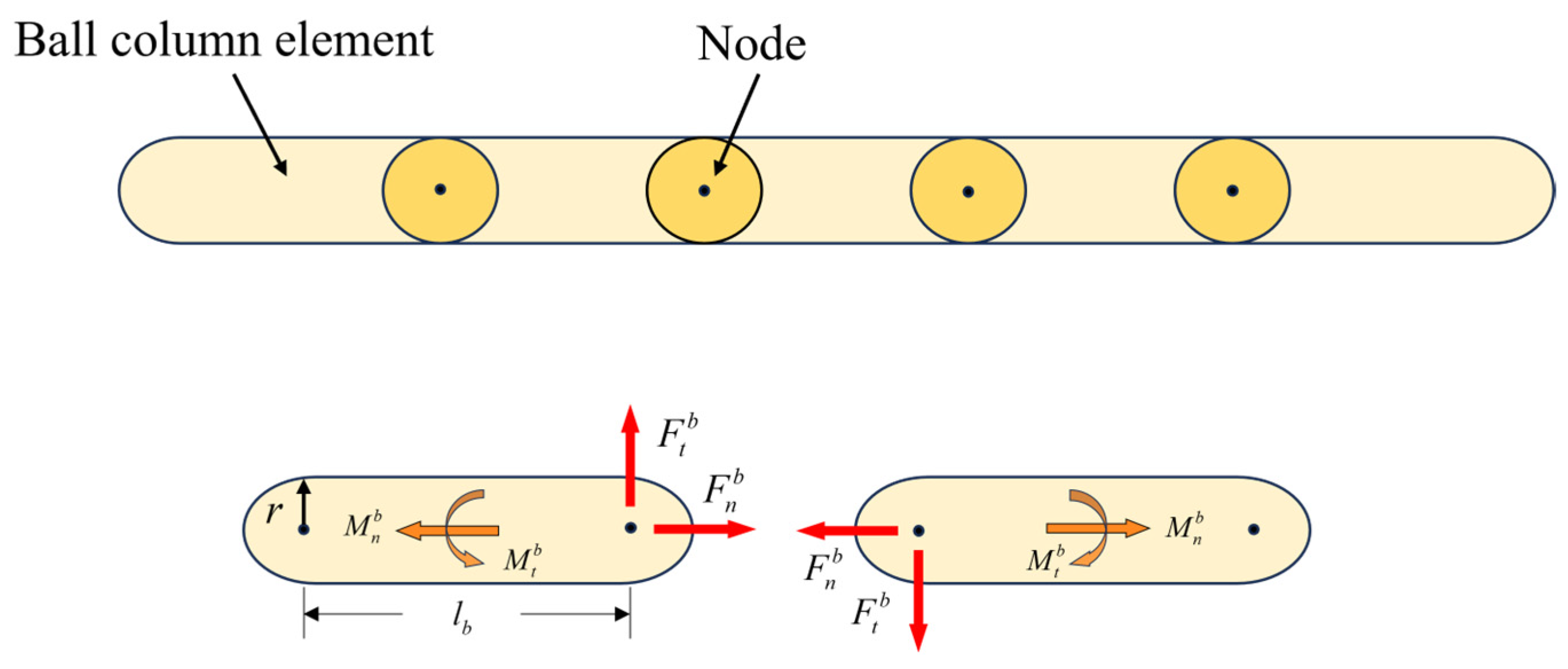
In the current literature, the multisphere aggregation model and the bonding model are frequently employed to model alfalfa and other fibre materials [22,23]. However, these models often result in an excessive number of particles in the discrete metamodel. This, in turn, increases the simulation time and decreases the simulation efficiency. In this paper, we propose the utilisation of the fibre model in Ansys Rocky to establish a discrete metamodel for cotton fibre. The Fiber model posits that the fibre is a one-dimensional particle shape, which can be described by a line segment or a group of lines in three-dimensional space. This approach has the potential to significantly reduce the number of particles and enhance the simulation efficiency, particularly in the case of the same model. As demonstrated in Figure 3, the fibre model comprises a multitude of rigid spherical column elements, each of which is interconnected with adjacent elements via a node at the centre of the hemisphere. Through this network of connections, forces and moments are transmitted, thereby facilitating the translation and rotation of the fibre [24].
In order to model the Flexible Fiber, it is necessary to take into account the manner in which forces and moments are transferred at the nodes of two adjacent ball-and-column elements. As demonstrated in Figure 3, the forces and moments acting on the nodes of adjacent ball-and-column elements in the Fiber model are of equal magnitude but opposite direction. The translational and rotational motions of the spherical column elements are governed by Newton’s second law:
m i d v i d t = F n i c + F t i c + F n i b + F t i b + F n i c d + F t i c d + F n i b d + F t i b d + m i g
J i d ω τ d t = M i c + M i b + M i c d + M i b d
where mi is the mass of the spherical column element; vi is the velocity of the spherical column element; Fnic is the normal contact force of the spherical column element; Ftic is the tangential contact force of the spherical column element; Fnib is the normal contact force of the node; Ftib is the tangential contact force of the node; Fnicd is the normal contact damping of the spherical column element; Fticd is the tangential contact damping of the spherical column element; Fnibd is the nodal normal contact damping of the node; Ftibd is the tangential contact damping of the node; g is the gravity coefficient; Ji is the moment of inertia of the ball-column element; ωi is the angular velocity of the ball-column element; Mic is the moment of the ball-column element; Mib is the nodal moment; Micd is the ball-column element damping moment; and Mibd is the nodal damping moment.
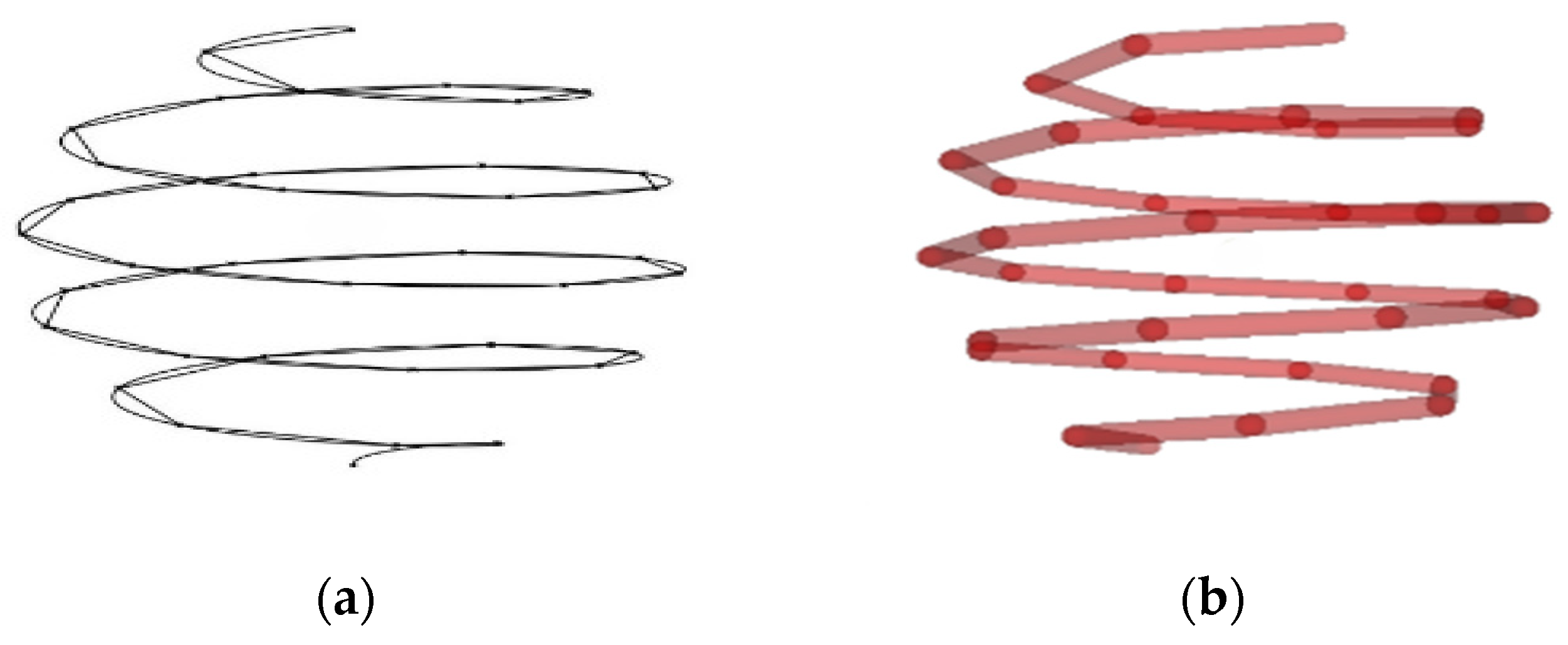
The distribution of cotton fibres in space is such that direct modelling is challenging. It is important to consider the shape characteristics of seed cotton in order to comprehend its simplified form, which can be described as a spherical spatial helix. Initially, the spatial helix is sketched in Solidworks and divided into line segments of equal length. Subsequently, the coordinates of the nodes connecting the segments are obtained. Finally, the node coordinates are imported into the Assemble fiber module of Ansys Rocky to establish the fibre model, as illustrated in Figure 4. In order to ascertain the most efficacious and accurate simulation, this paper elects to utilise 34 line segments of 10 mm to simulate the cotton fibre.
The material parameters of cotton fibres have been documented in references [25,26,27], as illustrated in Table 2. The parameters were subsequently calibrated by means of uniaxial compression tests, which took into account the variation in simulation results due to the effect of different modelling approaches.

2.2.2. Simulation Test Process

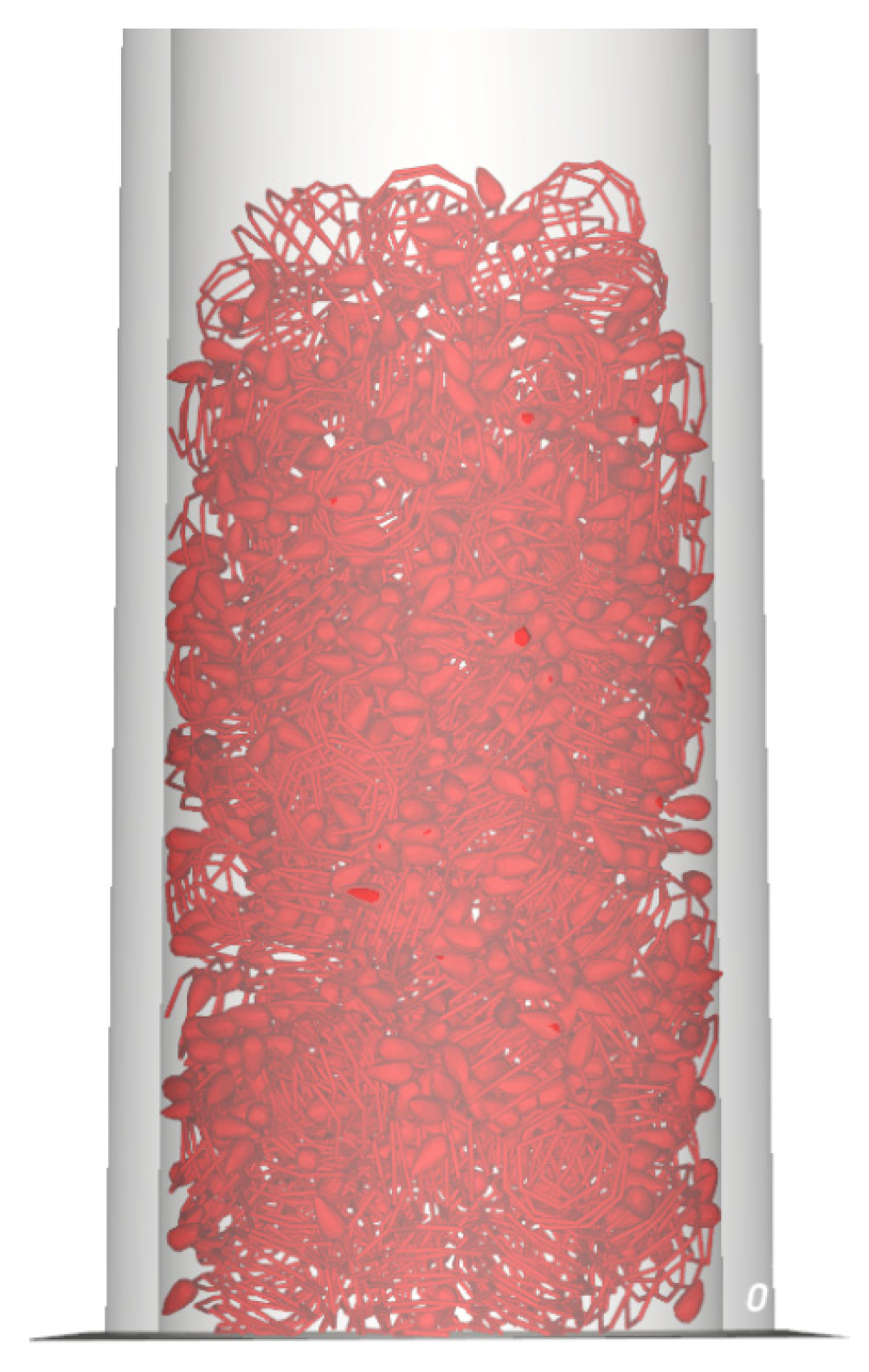
The Hertzian Spring Dashpot and Linear Spring Coulomb Limit contact models were selected for simulated compression tests in Ansys Rocky. In a manner analogous to the actual test, the pressure–displacement of the seed cotton model was examined during the simulation in order to verify the compression performance of the model. In order to conduct the simulation test, the cylinder, fixed-indenter and dynamic-indenter models were imported into the Ansys Rocky software. The cylinder was then employed as a container in order to construct a particle factory, with the objective of generating cottonseed and cotton fibre particles in a ratio of 6:4, in accordance with the mass ratio of the seed cotton that had been measured in the preliminary tests. The total mass of the particles that were generated was 200 g. Once the particles had been stabilised, they were loaded using a dynamic-indenter at a speed of 30 mm·min−1 until the density of the seed cotton had reached 220 kg·m−1. The post-processing interface was utilised for the compression tests, and the compression test was conducted within the post-processing interface, as illustrated in Figure 5. The pressure–displacement curves were subsequently plotted in the post-processing interface by exporting the pressure–displacement curves of the dynamic head over time to Origin.

3. Results and Discussion

3.1. Analysis of Axial Load Transfer in Machine-Picked Seed Cotton

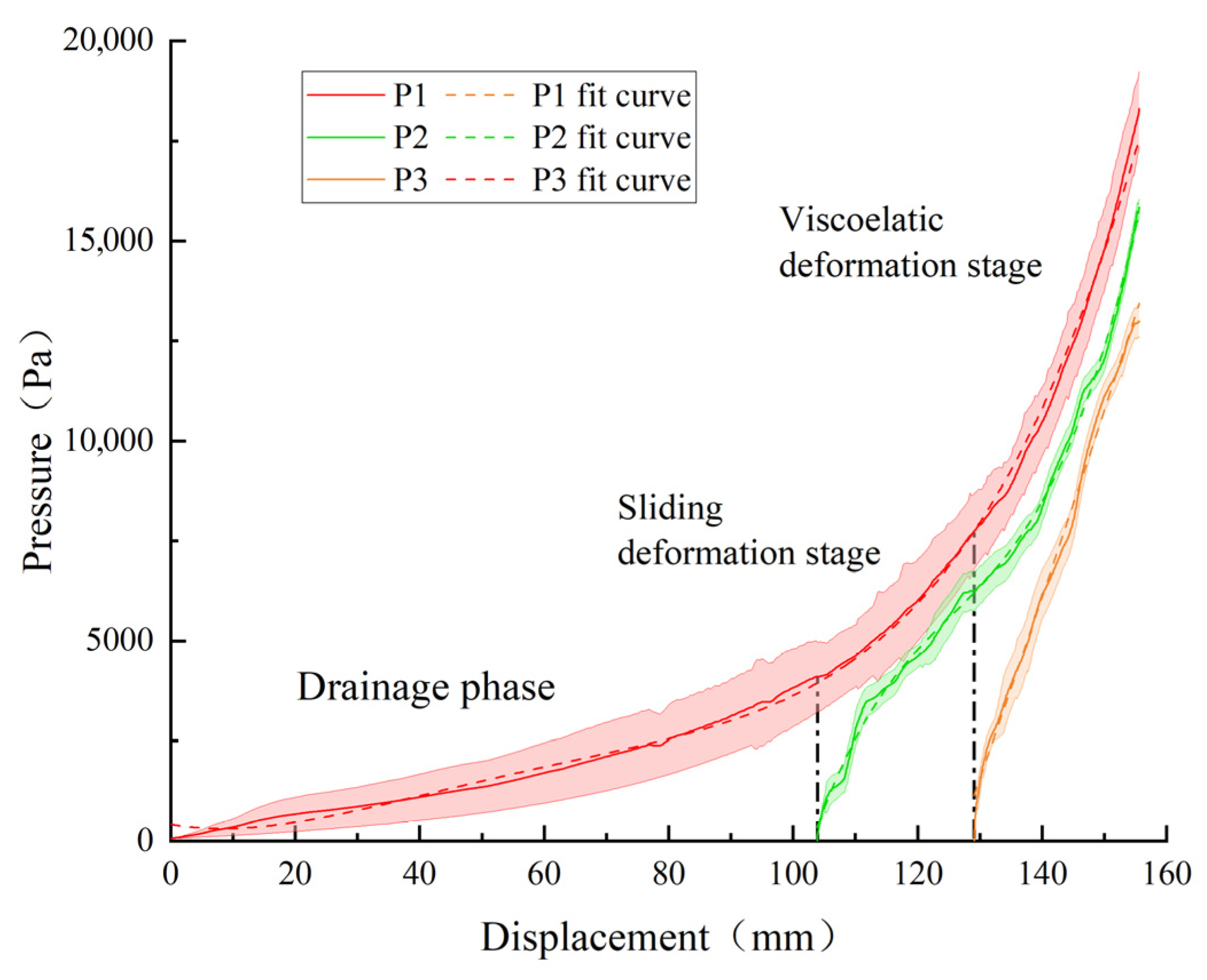
The collection of machine picking seed cotton axial load data for processing is achieved by means of a compression fixture. The utilisation of Origin to draw the load transfer curve is demonstrated in Figure 5. As is apparent from the figure, with the increase in strain during the compression process of seed cotton, the pressure measured by the sensors exhibited an upward trend. Concurrently, the pressure data collected from various locations by the sensors exhibited a downward trend, with a gradual decrease from the top to the bottom.
In previous research, the compression process of seed cotton was often divided into three stages [28]: the emptying stage, the slip deformation stage, and the viscoelastic plastic deformation stage. In this paper, the compression process is further investigated by placing sensors at different locations inside the seed cotton. As demonstrated in Figure 6, when the compression displacement is less than 104 mm, only the P1 sensor generates data, and the slope of the curve is relatively flat and stable, which corresponds to the emptying stage. The compression force is derived from the elastic deformation of the cotton fibre bending and viscosity of the internal friction. Upon reaching a displacement of 104 mm, the P2 sensor commences data generation, concurrently with a substantial rise in the slope of the P1 sensor curve, indicative of the slip deformation stage. The compression force is thereby transferred to the seed, a process facilitated by the elastic deformation of the cotton fibre. It is evident that upon the attainment of a displacement measuring 124 mm, the P2 sensor initiates the process of data generation. Concurrently, the slope of the P1 sensor curve experiences a substantial rise, which is indicative of the slip deformation stage. This stage corresponds to the pressure exerted by the cotton fibre on the cotton seed. The randomness inherent in the arrangement of the cotton seed results in the cotton fibre being interspersed with the pressure and the slip. It is evident that as the displacement attains a magnitude of 129 mm, the P3 sensor commences the generation of data. Concurrently, the slope of the P1 sensor curve exhibits an augmentation and attains a relatively stable state. This phenomenon corresponds to the visco-elastic deformation stage. The fibre arrangement of seed cotton is observed to be in close proximity, and the cotton fibre undergoes a process of pressurisation accompanied by a degree of plastic deformation. Concurrently, the seed undergoes an elastic deformation.
The fitting of the pressure–displacement curves for each sensor was performed in Origin, with the fitting results shown in Table 3. The fitted curves are all fitted with polynomial functions, and R2 > 0.99, which indicates that the polynomial functions can more accurately describe the change of pressure with displacement at different positions during the compression process of seed cotton. In the fitting equations, it is demonstrated that the proximity of the sensor to the dynamic head is directly proportional to the magnitude of the corresponding polynomial number. This indicates that with the compression of seed cotton, the rate of change in pressure is greater in closer proximity to the compression side of the sensor. Consequently, the position of the seed cotton compression is also accelerated. It is therefore evident that seed cotton is a strain-sensitive material, and that the deformation of cotton fibre in compression is the cause of its strain sensitivity [29].
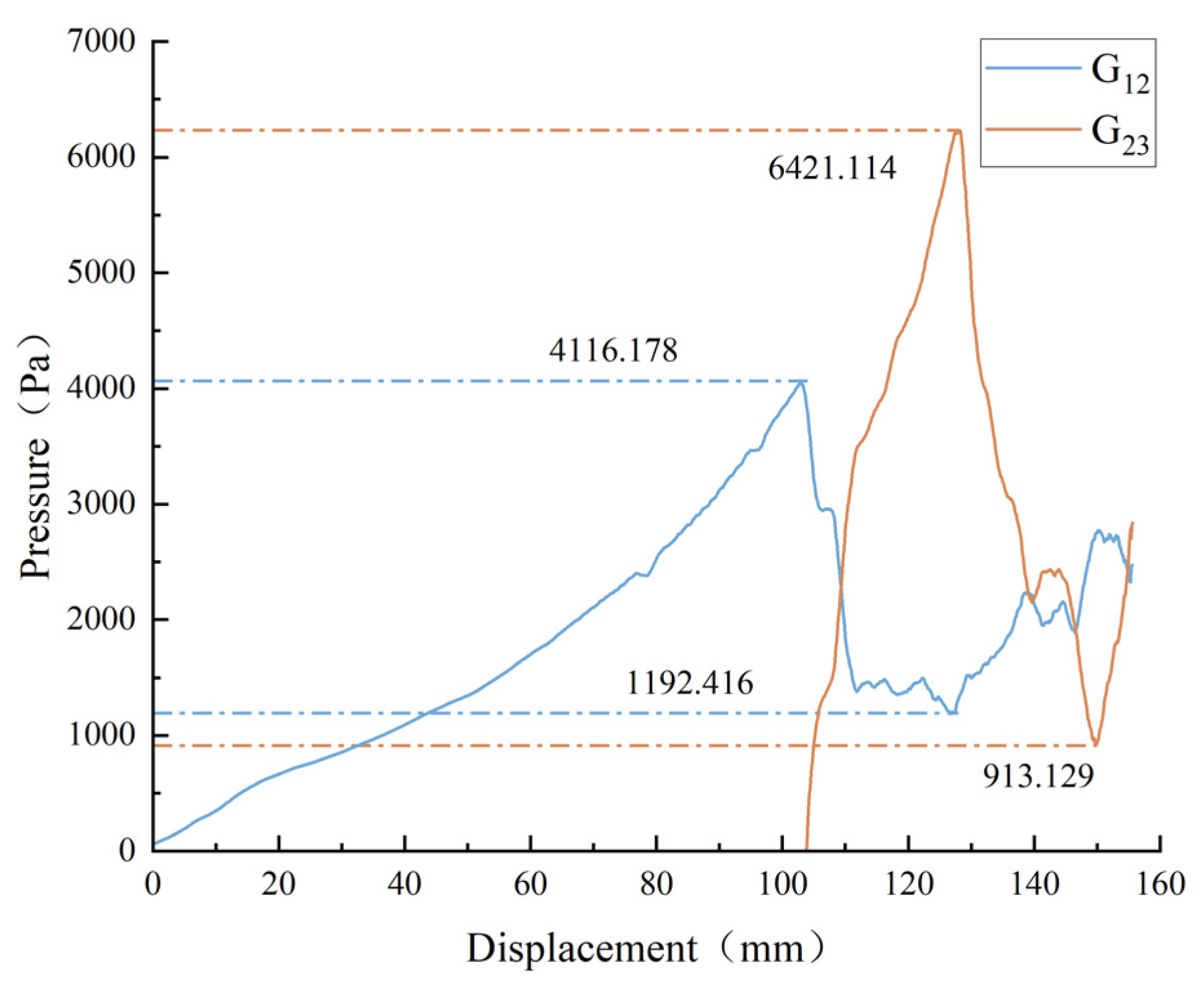
The differential pressure–displacement curves of the neighbouring sensors of seed cotton are illustrated in Figure 6, in which G12 and G23 denote the differential pressure between neighbouring sensors P1 and P2 and P2 and P3, respectively. As illustrated in Figure 7, the sensor differential pressure curves demonstrate a trend of firstly increasing and then decreasing, ultimately reaching a state of smoothness. This observation indicates the presence of hysteresis in the axial load transfer process during the compression of seed cotton. The maximum values of the seed cotton differential pressure–displacement curves demonstrate significant variation, while the minimum values approximate 1000 Pa. When the seed cotton is compressed to 220 kg·m−3, similar differential pressures are observed in G12 and G23, suggesting that the density formed between the layers of the seed cotton may be different due to the dissipation of compression energy during the compression process.
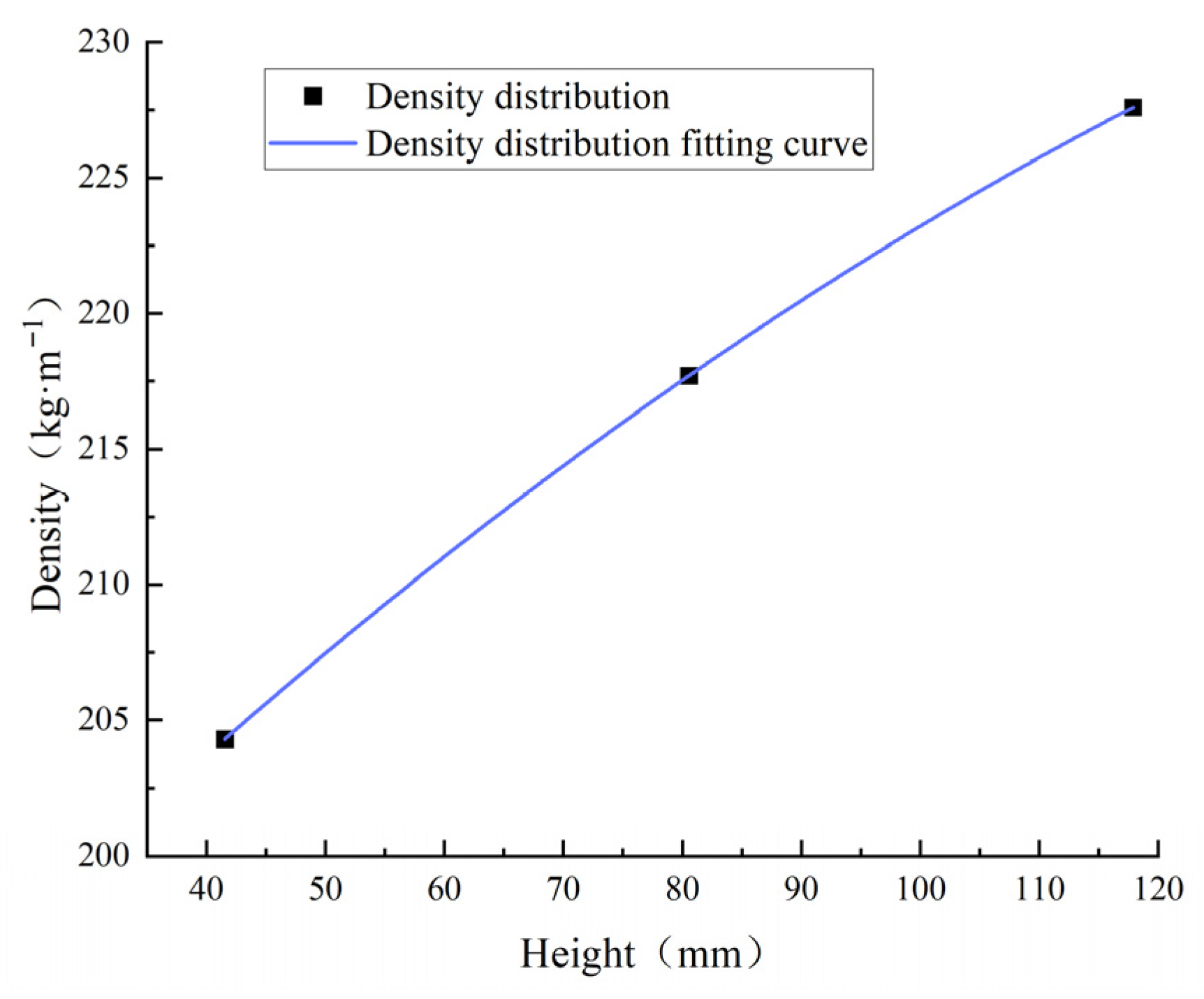
It is evident that the pressure transfer within the seed cotton is subject to a certain degree of latency, which consequently gives rise to variations in displacement and density of the seed cotton in each layer. As demonstrated by Fang Liang et al. [30], the relationship between axial pressure and the density of the seed cotton is established. Utilising this relationship, the density of the seed cotton corresponding to the pressure of each sensor can be calculated by Equation (3) when the seed cotton is compressed to 220 kg·m−3. It is important to note that the internal density distribution of seed cotton is not uniform when the compression is completed. Therefore, the density of seed cotton in each layer is calculated by the following Equations (4) and (5). At this time, the density of seed cotton in the upper layer is 227.6 kg·m−3, corresponding to the height of sensor P1, which is 117.88 mm; the density of seed cotton in the middle layer is 217.7 kg·m−3, corresponding to the height of sensor P2, which is 80 mm. The dimensions of the specimen are as follows: the diameter of the bottom layer of seed cotton is 57 mm; the density of the bottom layer of seed cotton is 204.3 kg·m−3; the diameter of the middle layer of seed cotton is 217.7 kg·m−3; the height of sensor P2 is 80.57 mm; the diameter of the bottom layer of seed cotton is 204.3 kg·m−3, which corresponds to the height of sensor P3 being 41.56 mm. The calculation results demonstrate that the compression density of seed cotton in the bale is not uniformly distributed, but is significantly correlated with its own compression position. As demonstrated in Figure 8, the correlation between the density of seed cotton and the height of the change curve and fit is evident. The seed cotton density data obtained, together with the height change curve, can be described more accurately by employing a polynomial function regression fitting. However, it is essential to first ascertain the compression of the seed cotton internal density with height change rule.
y j = a x j 7.508 × 10 8 3.909
ρ j = 0.2 3 ( v j v j + 1 )
v j = 0.2 ( 1 j 3 ) y j
where xj is the pressure of each sensor, kg; yj is the density corresponding to the pressure of each sensor, kg·m−3; a is the density correction coefficient, 0.93; ρj is the density of each layer of seed cotton, kg·m−3; vj is the volume of seed cotton compressed by each sensor, m3.

3.2. Analysis of Discrete Element Simulation Results for Seed Cotton Compression

3.2.1. Plackett–Burman Test and Significance Analysis

Given the complex nature of factors influencing seed cotton compression characteristics, a Plackett–Burman experiment was designed using the DOE module in Design-Expert software (version 13) to reduce experimental workload and identify significant influencing factors. The response value was the pressure exerted when seed cotton was compressed to 220 kg·m−3. Results are presented in Table 4. Analysis of variance (Table 5) revealed that the parameters exerting extremely significant effects on seed cotton compression pressure were cotton fiber Poisson’s ratio A and cotton fiber modulus of elasticity B, which together accounted for 89.68% of the variation. Therefore, subsequent experiments will focus on investigating these two parameters.

3.2.2. Center Combination Test and Result Analysis

The results of the Plackett–Burman test indicated that the remaining parameters were set at level values for the test. The central combination experimental design was conducted utilising Design-Expert software (version 13), with five groups of replicated tests set at the centre level. A total of 13 groups of seed cotton compression simulation tests were performed. The experimental design and the results thereof are displayed in Table 6, while the analysis of variance (ANOVA) is presented in Table 7.
As illustrated in Table 7, within the framework of the seed cotton compression test, when the other parameters are constant, the Poisson’s ratio of cotton fibre A and the modulus of elasticity of cotton fibre B exert a highly significant influence on the pressure, while their interaction term AB does not demonstrate a significant effect on the pressure. Consequently, the interaction effects were disregarded, and the optimised ANOVA results were obtained, as illustrated in Table 8.
The results of the analysis of variance indicate that seed cotton pressure is linearly correlated with the Poisson’s ratio A of cotton fibers and the elastic modulus B of cotton fibers. In order to accurately determine the optimal parameters for each factor, it is necessary to establish a linear regression equation for seed cotton pressure in Design Expert using the results from the analysis of variance.
N = 27.45 + 120.46 A + 1.42 × 10 7 B
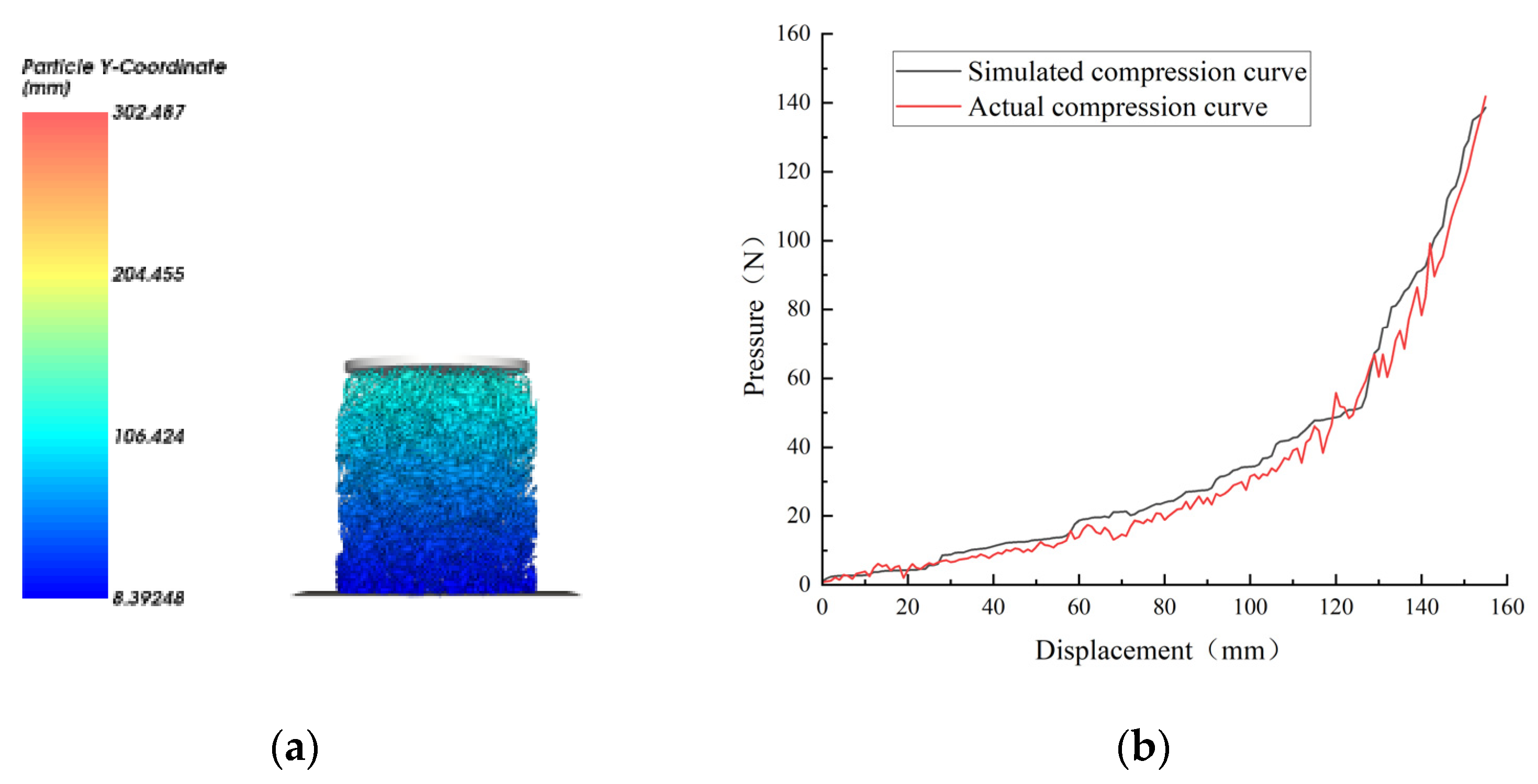
Linear regression analysis indicates that the target pressure value is 220 kg·m−3, which is equivalent to 143.75 N, when the seed cotton density is compressed to this level. This calculation is performed using Design-Expert software (version 13). The seed cotton pressure is 143.75 N when A and B are 0.466 and 8.07 × 10⁸ Pa, respectively. The parameter combinations obtained by the optimisation solution are verified by simulation. The relative error with the real value is 2.96% when the seed cotton density is compressed to 220 kg·m−3. The pressure of seed cotton is 139.5 N, and the relative error with the real value is 2.96%.
In order to provide further validation of the seed cotton discrete element model established in the paper and to ascertain its accuracy, a comparison was made between the simulation model and the actual seed cotton compression process energy consumption. This was done in order to verify whether the seed cotton discrete element model could accurately describe the energy consumption in the seed cotton compression process. The image was plotted in Origin, as demonstrated in Figure 9. The area enclosed by the compression curve and the X-axis was defined as the seed cotton compression specific energy. The actual compression specific energy of machine-picked seed cotton was determined to be 4947.75 N·mm, and the simulated compression specific energy was calculated to be 5449.89 N·mm. The discrepancy between the two values was found to be 10.14%, thereby validating the hypothesis that the simulation model is capable of providing a more accurate representation of the energy consumption of machine-picked seed cotton during compression.

4. Conclusion

(1) In this study, the harvesting of seed cotton is undertaken using a compressor in conjunction with a universal testing machine. The axial load transfer law within the seed cotton is determined by means of a pressure sensor. The experimental findings demonstrate the existence of a clear hysteresis within the stress–strain transfer of seed cotton. Through the utilisation of polynomial fittings for the pressure–displacement curve, it has been substantiated that as one moves closer to the compressed side of the seed cotton, the rate of pressure change increases.
(2) An analysis of the pressure–displacement curve during uniaxial compression of machine-harvested seed cotton revealed that density variations may occur between different layers. This is due to the lag in axial load transfer. Density distribution calculations within the seed cotton sample, subjected to a compression of 220 kg·m−3, indicate that the upper layer exhibits a marginally higher density compared to the lower layer. A density distribution equation was derived through the process of fitting the density data across a range of heights of the seed cotton.
(3) The establishment of a discrete elemental model of machine-picked seed cotton was achieved, and a spatial helix structure modelling method based on the Fiber model was proposed. The calibration of the simulation model parameters was achieved through the implementation of uniaxial compression tests. The analysis yielded findings that indicated the Poisson’s ratio A of cotton fibre and the elastic modulus B of cotton fibre exerted a significantly substantial influence on the pressure. The optimal parameters that were determined for these variables were 0.466 and 8.07 × 10⁸ Pa, respectively. The relative errors observed in the pressure and compression specific energy were 2.96% and 10.14%, respectively.
It is important to note that the compression tests and simulations in this paper primarily focus on cylindrical compression tests of seed cotton under laboratory conditions, providing preliminary research on the axial load transfer patterns of seed cotton. In comparison with preceding studies, a spatially curved ellipsoidal spherical–cylindrical discrete element model was utilised to simulate cotton fibres, as opposed to simple spherical or linear models. This approach has been shown to approximate the characteristics of cotton fibres more closely, thereby facilitating a more accurate characterisation of their properties. It is recommended that future research should utilise the methodology outlined in this study to investigate the load transfer patterns of seed cotton under actual operational conditions. This would enable adjustments to parameters such as feed rate, feed frequency, and feed duration in existing cotton picker baling mechanisms, thereby reducing operational energy consumption. The present study is not without its limitations. The simplification of the model resulted in an oversight of the complex operational conditions that prevail within the actual baling chamber. It is recommended that future research efforts focus on the development of more sophisticated simulation models that incorporate multiphysics simulations. This approach is expected to enhance the accuracy of predictions in real-world harvesting scenarios.

Author Contributions

Conceptualization, Y.L.; methodology, Y.L., M.Z. and Y.Z.; software, Y.L. and X.T.; validation, W.W. and H.Q.; writing—original draft preparation, Y.L.; writing—review and editing, Y.L. and Y.Z.; supervision, Y.Z. and D.Y.; funding acquisition, Y.Z. and M.Z. All authors have read and agreed to the published version of the manuscript.

Funding

This research was funded by Science and Technology Department of Xinjiang Uygur Autonomous Region (grant number 2022A02010-2) and Jiangsu University (grant number NGXB20240102).

Institutional Review Board Statement

Not applicable.

Informed Consent Statement

Not applicable.

Data Availability Statement

The data presented in this study are available on request from the corresponding author.

Conflicts of Interest

The authors declare no conflicts of interest.

References

  1. Barnes, E.; Morgan, G.; Hake, K.; Devine, J.; Kurtz, R.; Ibendahl, G.; Sharda, A.; Rains, G.; Snider, J.; Maja, J.M.; et al. Opportunities for Robotic Systems and Automation in Cotton Production. AgriEngineering 2021, 3, 339–362. [Google Scholar] [CrossRef]
  2. Wei, X.; Wang, M.; Zhang, H.; Wang, L.; Du, X.; Chen, L.; Zhi, S. Effect of Cyclic Loading Treatment on the Compression Energy and Creep Properties of Machine-Harvested Seed Cotton. Agriculture 2024, 14, 239. [Google Scholar] [CrossRef]
  3. Zhang, Q.; Sun, Y.; Luo, D.; Li, P.; Liu, T.; Xiang, D.; Zhang, Y.; Yang, M.; Gou, L.; Tian, J.; et al. Harvest Aids Applied at Appropriate Time Could Reduce the Damage to Cotton Yield and Fiber Quality. Agronomy 2023, 13, 664. [Google Scholar] [CrossRef]
  4. Tian, Z.; Wang, L.; Wang, Z.; Zhang, L.; Guo, X.; Elsiding, R.; Cao, J. Research status and development strategies of Xinjiang Machine-picked Cotton. Cotton Text. Technol. 2025, 53, 1–6, (In Chinese with English abstract). [Google Scholar]
  5. Lu, X.; Jia, X.; Niu, J. The present situation and prospects of cotton industry development in China. Sci. Agric. Sin. 2018, 51, 26–36, (In Chinese with English abstract). [Google Scholar] [CrossRef]
  6. Du, X. Design and Research on Packing Device of Seed Cotton Baler. Master’s Thesis, Shihezi University, Xinjiang, China, May 2023. (In Chinese with English abstract). [Google Scholar]
  7. Wei, X.; Zhang, H.; Wang, J.; Li, S.; Wang, L.; Du, X. Experimental study and simulation on the creep characteristics of machine-harvested seed cotton. Int. J. Agric. Biol. Eng. 2024, 17, 241–250. [Google Scholar] [CrossRef]
  8. Hardin, R. Viscoelastic Properties of Seed Cotton and Their Effect on Module Shape and Density. Master’s Thesis, Texas A&M University, College Station, TX, USA, August 2004. [Google Scholar]
  9. Kong, F.; Wu, T.; Chen, C.; Sun, Y.; Xie, Q.; Shi, L. Mechanical properties and construction of constitutive model for compression and stress relaxation of seed cotton. Trans. Chin. Soc. Agric. Eng. 2021, 37, 53–60, (In Chinese with English abstract). [Google Scholar] [CrossRef]
  10. Wei, X.; Deng, Z.; Fu, X.; Zhang, H.; Wang, M.; Wang, L.; Zheng, Y.; Zhi, S. Compressed springback deformation characteristics of Xinjiang machine-harvested seed cotton. Ind. Crops Prod. 2025, 225, 120498. [Google Scholar] [CrossRef]
  11. Zhu, Q.; Zhang, H.; Zhu, Z.; Gao, Y.; Chen, L. Structural Design and Simulation of Pneumatic Conveying Line for a Paddy Side-Deep Fertilisation System. Agriculture 2022, 12, 867. [Google Scholar] [CrossRef]
  12. Xu, F.; Xu, W.; Xu, C.; Wang, J.; Tang, H. Optimising Rice Straw Bale Quality Through Vibration-Assisted Compression. Agriculture 2025, 15, 2094. [Google Scholar] [CrossRef]
  13. Wang, H.; Ma, Z.; Wulantuya; Fan, Z.; Wang, C. Calibration method of mesoscopic parameters using BP neural network and Burgers model. Trans. Chin. Soc. Agric. Eng. 2022, 38, 152–161, (In Chinese with English abstract). [Google Scholar] [CrossRef]
  14. Huan, X.; Li, S.; Wang, L.; Wang, D.; You, Y. Study on silage mixing device of King Grass stalk particles based on DEM simulation and bench test. Powder Technol. 2024, 437, 119581. [Google Scholar] [CrossRef]
  15. Du, H.; Ma, Y.; Li, R.; Lei, T.; Wu, P. Effect of vibrational frequency on alfalfa opening compression process. BioResources 2022, 17, 6706–6717. [Google Scholar] [CrossRef]
  16. Li, Z.; Li, Z.; Zhang, D.; Yue, Q. Characterization of dense forming force chain of salix granules under uniaxial compression. J. For. Eng. 2023, 8, 124–130, (In Chinese with English abstract). [Google Scholar] [CrossRef]
  17. Gong, L.; Nie, L.; Liu, C.; Xu, Y. Modelling Triaxial Tests on Fibre-Reinforced Sands with Different Fibre Orientations Using the Discrete Element Method. KSCE J. Civ. Eng. 2020, 24, 2268–2280. [Google Scholar] [CrossRef]
  18. Xia, Y. The key points of cleaning and processing technology for machine-picked cotton quality. China Fiber Insp. 2019, 4, 38–39, (In Chinese with English abstract). [Google Scholar] [CrossRef]
  19. GB 1103.1-2023; Cotton-Part 1: Saw Ginned Upland Cotton. National Standardization Administration: Beijing, China, 2023.
  20. Li, Y.; Li, J.; Wu, B.; Hu, S.; Chen, X. Analysis and research on the principle of compressive force transmission of cotton fiber assembly. Shanghai Text. Sci. Technol. 2019, 47, 8–11+14, (In Chinese with English abstract). [Google Scholar] [CrossRef]
  21. Li, Y.; Tian, X.; Zhao, Y.; Liu, X.; Zhou, M.; Dai, F.; Wang, W. Parameter calibration and experiment of polyhedral cottonseed discrete element based on Tavares model. Trans. Chin. Soc. Agric. Mach. 2024, 55, 124–131+220, (In Chinese with English abstract). [Google Scholar] [CrossRef]
  22. Zeng, F.; Diao, H.; Liu, Y.; Ji, D.; Dou, M.; Cui, J.; Zhao, Z. Calibration and Validation of Simulation Parameters for Maize Straw Based on Discrete Element Method and Genetic Algorithm–Backpropagation. Sensors 2024, 24, 5217. [Google Scholar] [CrossRef]
  23. Yuan, Z.; Dai, F.; Zhao, W.; Shi, R.; Zhao, Y.; Xin, S. Simulated analysis and test of air-screen cleaning device for flax based on CFD-DEM coupling. Agric. Res. Arid. Areas. 2023, 41, 281–290, (In Chinese with English abstract). [Google Scholar]
  24. Xu, D.; Ma, H.; Guo, Y. Effects of Fiber Shape on Mechanical Properties of Fiber Assemblies. Materials 2023, 16, 2712. [Google Scholar] [CrossRef] [PubMed]
  25. Wang, P.; Wang, H.; Zhang, R.; Hu, R.; Hao, B.; Huang, J. Numerical Simulation of an Online Cotton Lint Sampling Device Using Coupled CFD–DEM Analysis. Agriculture 2024, 14, 127. [Google Scholar] [CrossRef]
  26. Hu, W.; Wang, D.; Chen, X.; Wang, J.; Li, Y. Finite element simulation of cotton serrated ginning state based on cottonseed modeling. J. Text. Res. 2020, 41, 27–32, (In Chinese with English abstract). [Google Scholar] [CrossRef]
  27. Zhao, H.; Zhou, Z. Research on determination method of mercerized cotton density. Shanghai Text. Sci. Technol. 2014, 42, 43–45+60, (In Chinese with English abstract). [Google Scholar] [CrossRef]
  28. Wang, J.; Zhang, H.; Wang, L.; Wei, X.; Wang, M.; Gu, Y.; Cai, Y. Experimental Study and Simulation of the Stress Relaxation Characteristics of Machine-Harvested Seed Cotton. Appl. Sci. 2021, 11, 9959. [Google Scholar] [CrossRef]
  29. Li, Y.; Zhang, H.; Zhang, Y.; Chen, X.; Liu, W. Research on compressive force transmission properties and densities-mechanical properties model of cotton fiber assembly. J. Text. Res. 2016, 37, 19–25, (In Chinese with English abstract). [Google Scholar] [CrossRef]
  30. Fang, L.; Zhang, R.; Duan, H.; Chang, J.; Zeng, Z.; Qian, Y.; Hong, M. Resistive Sensing of Seed Cotton Moisture Regain Based on Pressure Compensation. Sensors 2023, 23, 8421. [Google Scholar] [CrossRef] [PubMed]
Figure 1. Seed cotton axial load transfer test device: (a) Schematic diagram of compression fixture, (b) Compression test chart.
Agriengineering 08 00007 g001
Figure 2. Modeling cottonseed: (a) Cottonseed point cloud map, (b) MeshLab simplified modeling, (c) Ansys Rocky import model.
Agriengineering 08 00007 g002
Figure 3. Fiber model schematic.
Agriengineering 08 00007 g003
Figure 4. Cotton fiber modeling: (a) Solidworks drawing space spirals, (b) Ansys Rocky fiber model.
Agriengineering 08 00007 g004
Figure 5. Compression simulation of seed cotton.
Agriengineering 08 00007 g005
Figure 6. Axial load transfer curve of seed cotton during compression.
Agriengineering 08 00007 g006
Figure 7. Seed cotton adjacent sensor differential pressure curve.
Agriengineering 08 00007 g007
Figure 8. Variation curve of seed cotton compression density with height.
Agriengineering 08 00007 g008
Figure 9. Seed cotton simulation model validation: (a) Compression simulation, (b) Simulated and actual compression curves for seed cotton.
Agriengineering 08 00007 g009
Table 1. Cottonseed model parameters.
ParametersValue
Cottonseed Poisson’s ratio0.19
Modulus of elasticity of cottonseed/Pa3.37 × 109
Cottonseed–Plexiglas collision recovery coefficient0.46
Cottonseed–Plexiglass static friction coefficient0.51
Cottonseed–Plexiglass rolling friction coefficient0.21
Cottonseed–Cottonseed collision recovery coefficient0.106
Cottonseed–Cottonseed static friction coefficient0.248
Cottonseed–Cottonseed rolling friction coefficient0.105
Table 2. Seed cotton model material parameters.
ParametersValue
Cotton fiber Poisson’s ratio A0.2–0.6
Modulus of elasticity of cotton fiber B/Pa5 × 108–1 × 10⁹
Cotton fiber density/(kg·m−3)1500
Cotton fiber–Plexiglas collision recovery coefficient C0.05–0.15
Cotton fiber–Plexiglas static friction coefficient D0.35–0.55
Cotton fiber–Plexiglas rolling friction coefficient E0.1–0.3
Cotton fiber–cotton fiber collision recovery factor F0.05–0.15
Cotton fiber–Cotton fiber static friction coefficient G0.45–0.65
Cotton fiber–Cotton fiber rolling friction coefficient H0.1–0.2
Table 3. Pressure–displacement curve fitting equation.
NumberFitted EquationR2
P1 y = 413.5533 27.8763 x + 1.9925 x 2 0.0262 x 3 + 0.0001 x 4 0.9984
P2 y = 404549.866 + 9505.119 x 74.5654 x 2 + 0.1982 x 3 0.9974
P3 y = 45687.753 + 279.3388 x + 0.6466 x 2 0.9955
Table 4. Plackett–Burman experimental design and results.
NumberElementPressure/N
ABCDEFGHIJK
10.21 × 1090.150.350.30.150.650.1−1−11132.8
20.25 × 1080.150.350.30.150.450.211−156.1
30.25 × 1080.050.550.10.150.650.111174.3
40.61 × 1090.050.350.10.150.450.21−11237
50.21 × 1090.050.550.30.050.650.21−1−1128.3
60.25 × 1080.050.350.10.050.450.1−1−1−162.1
70.21 × 1090.150.550.10.050.450.2−111120.1
80.65 × 1080.150.550.30.050.450.11−1184.6
90.65 × 1080.050.350.30.050.650.2−111118
100.65 × 1080.150.550.10.150.650.2−1−1−1125.2
110.61 × 1090.050.550.30.150.450.1−11−1184.6
120.61 × 1090.150.350.10.050.650.111−1219.5
Table 5. Analysis of variance for the Plackett–Burman test.
ElementEffectF-Valuep-ValueContribution/%Order of Significance
A65.867140.420.001334.3172
B83.667226.570.000655.3721
C−113.920.14220.9576
D−18.06710.560.04752.5824
E−22.316.100.02783.9333
F12.95.390.10301.3165
G8.9332.580.20640.6317
H4.4670.640.48040.1588
Table 6. Center combination test design and results.
NumberElementPressure/N
AB
10.21 × 109133.3
20.65 × 108110.1
30.6828437.5 × 108178.2
40.47.5 × 108125.7
50.43.96447 × 10871.5
60.47.5 × 108123
70.1171577.5 × 10897
80.41.10355 × 109185
90.25 × 10885.2
100.47.5 × 108109.6
110.47.5 × 108132.4
120.47.5 × 108120.7
130.61 × 109186.3
Table 7. Analysis of variance for the center combination test.
SourceSum of SquaresdfMean SquareF-Valuep-Value
Model14,980.5334993.5146.83<0.0001
A4643.3114643.3143.54<0.0001
B10,139.82110,139.8295.09<0.0001
AB197.401197.401.850.2067
Residual959.729106.64
Lack of Fit681.815136.361.960.2666
Pure Error277.91469.48
Cor Total15,940.2512
Note: R2 = 0.9398, R2adj = 0.9197, R2pre = 0.8574, C.V.% = 8.10.
Table 8. Optimization of analysis of variance for central combination test.
SourceSum of SquaresdfMean SquareF-Valuep-Value
Model14,783.1327391.5663.88<0.0001
A4643.3114643.3140.13<0.0001
B10,139.82110,139.8287.63<0.0001
Residual1157.1210115.71
Lack of Fit879.216146.542.110.2452
Pure Error277.91469.48
Cor Total15,940.2512
Note: R2 = 0.9274, R2adj = 0.9129, R2pre = 0.8668, C.V.% = 8.43.
Disclaimer/Publisher’s Note: The statements, opinions and data contained in all publications are solely those of the individual author(s) and contributor(s) and not of MDPI and/or the editor(s). MDPI and/or the editor(s) disclaim responsibility for any injury to people or property resulting from any ideas, methods, instructions or products referred to in the content.