
Bridging the Information Gap in Smart Construction: An LLM-Based Assistant for Autonomous TBM Tunneling


Highlights
- New Intelligent Assistant for TBM Tunneling: This study created and tested an intelligent assistant that uses a large language model to help human operators communicate better with the Tunnel Boring Machines.
- Effective Technology: The assistant’s method for recognizing intentions showed strong accuracy in tests, which is essential for understanding operator commands.
- Real-World Benefits: Case studies in engineering showed that the assistant provides valuable advantages by making systems more transparent, building user trust, and enhancing safety in tunneling operations.
- A Practical Model for Urban Automation: This work provides a viable “human-in-the-loop” operational model for safely deploying autonomous systems during the construction of critical smart-city underground infrastructure.
- A Trust-Centric Path to Adoption: It demonstrates that building user trust through AI-powered transparency is as crucial as technological advancement for the successful integration of autonomous technologies in complex urban environments.
Abstract
1. Introduction
- (1)
- Cognitive and experience differences among drivers: TBM tunneling involves complex geological conditions and control logic. Drivers with varying levels of experience may exhibit significantly different levels of dependency and trust in the automation system. For example, experienced drivers may be more inclined to intervene manually, whereas novice drivers tend to rely too much on the automated system [8].
- (2)
- Subjective preferences of drivers: Drivers may question the system’s control actions due to personal habits or preferences for specific control strategies, leading to frequent manual intervention, which can reduce collaboration efficiency [9].
- (3)
- System transparency and explainability: Current automated tunneling systems often lack transparency in their decision-making logic [10] and do not provide sufficient human–machine interaction pathways to explain control strategies. This lack of transparency can lead to doubts about the system’s reliability and, in some cases, result in human–machine conflict due to excessive manual intervention [11].
- (4)
- System fault tolerance and safety mechanisms: If an automated tunneling system lacks a collaborative fault-tolerant mechanism with drivers for handling unforeseen situations (such as cutterhead jamming or sudden ground surges), it may lead to decision delays or misjudgments, posing a safety risk [12]. This potential risk introduced by the automation system creates barriers to drivers’ acceptance, making them hesitant or overly cautious in its use. It is evident that improving the collaboration between the TBM autonomous tunneling system and the operator requires efforts in multiple areas, including optimizing human–machine interaction models, enhancing decision transparency, reducing cognitive load, establishing trust pathways, and strengthening safety redundancies.
2. Related Work
2.1. Human–Machine Collaboration in Autonomous Driving
2.2. LLM-Based Intelligent Agents
3. Design of Human–Machine Collaboration-Oriented Intelligent Assistant Service Model
3.1. Analysis of Issues and Responses in Autonomous Tunneling
3.1.1. Common Issues in Autonomous Driving
3.1.2. Handling Requirements for Autonomous Tunneling Issues
3.2. Agent Design
3.3. Human–Machine Collaboration Model with Intelligent Assistant Involvement
4. Intention Recognition Model
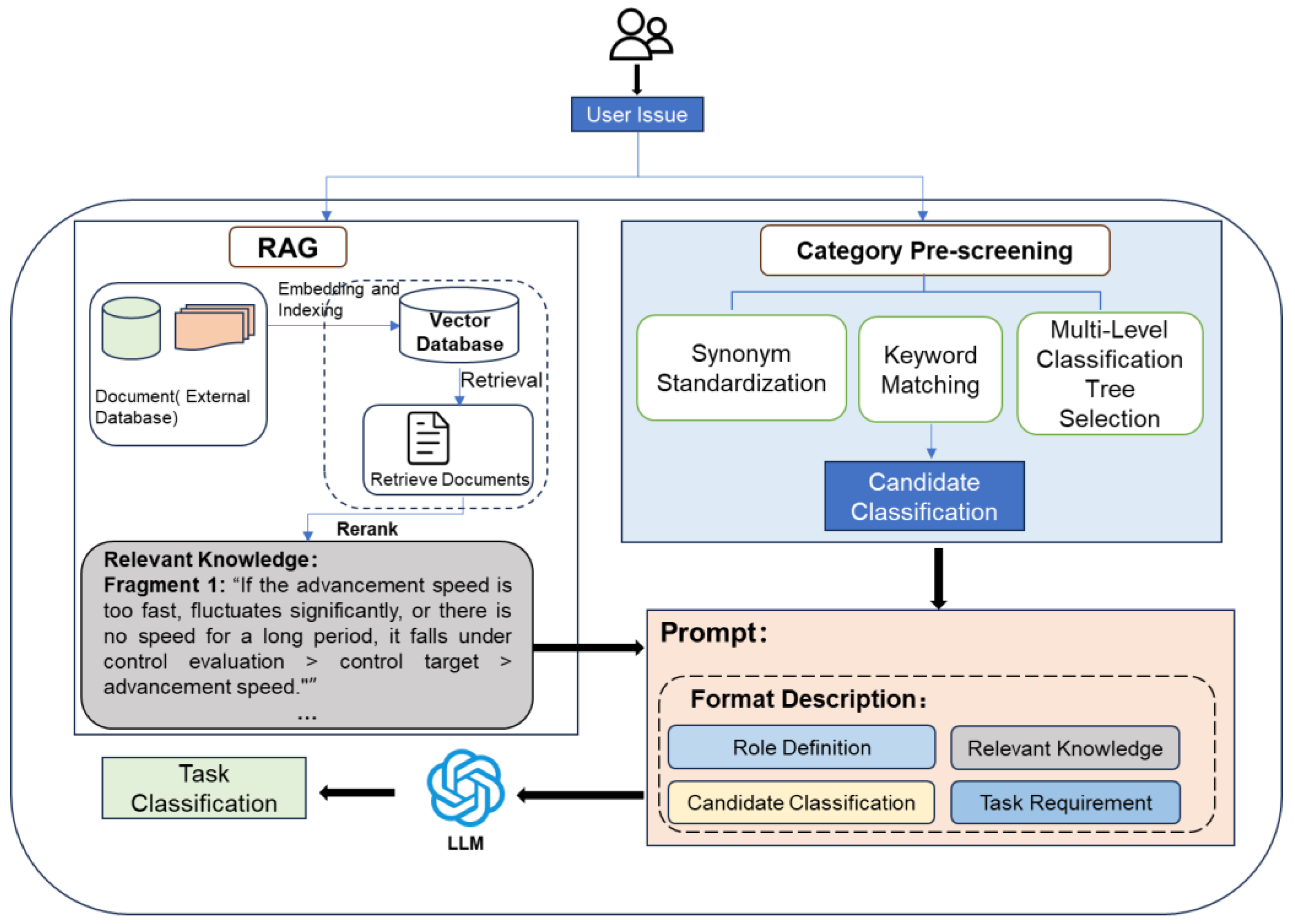
4.1. Intention Recognition Framework
4.2. Key Technical Implementation
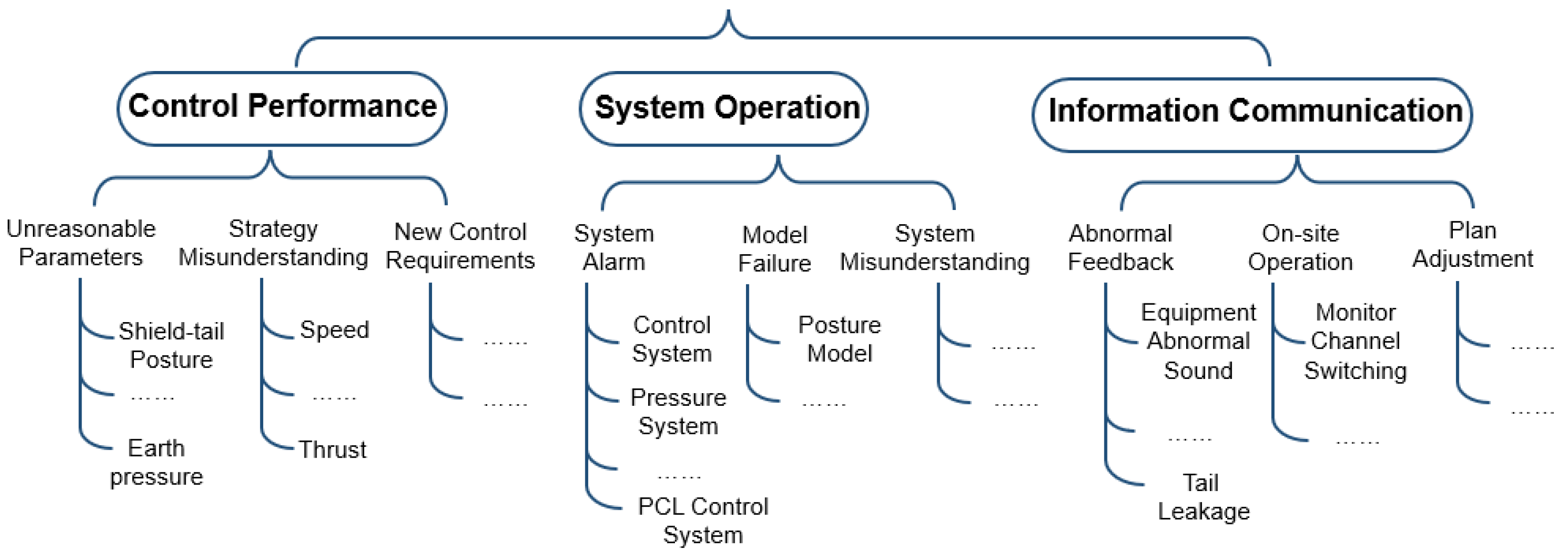
4.2.1. Category Pre-Screening
- (1)
- If the input text intersects with R3 (i.e., M3 ≠ ∅), output the corresponding third-level category and verify that its second- and first-level paths are consistent.
- (2)
- If M3 = ∅ and M2 ≠ ∅, output the second-level category and label all third-level categories as “All.”
- (3)
- If only M1 ≠ ∅, output the first-level category and label both the second- and third-level categories as “All.”
- (4)
- If all intersections are empty, return “Unclassified.”
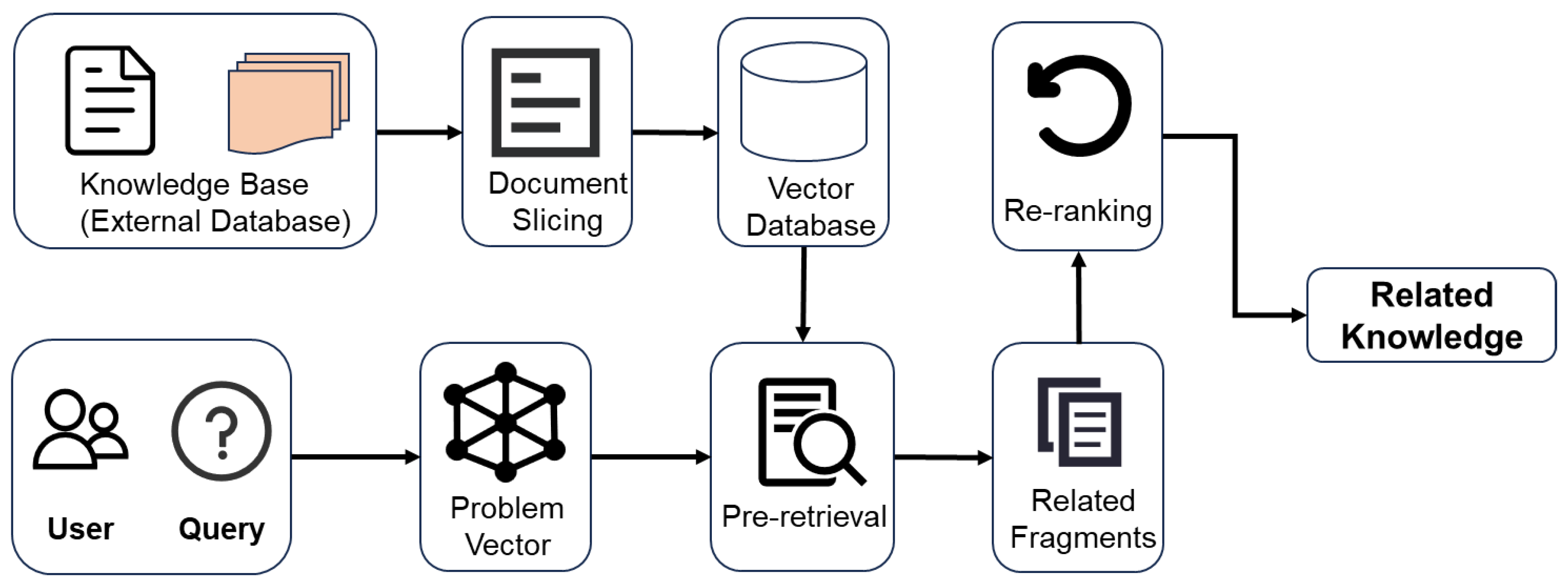
4.2.2. RAG Module
- (1)
- Knowledge Base Vectorization: The content of the knowledge base is sliced into documents, and then each text slice is converted into a vector using the bge-large-zh-v1.5 pre-trained text vectorization model developed by the Beijing Academy of Artificial Intelligence. These vectors are then stored in a vector database. The model performs excellently in retrieval and semantic matching tasks [45].
- (2)
- Question Vectorization: Similarly, the user’s input question is vectorized using the bge-large-zh-v1.5 model.
- (3)
- Pre-retrieval: Cosine similarity is used to search for the most similar texts in the vector database. Cosine similarity measures the similarity between two vectors by calculating the cosine of the angle between them, as shown in Equation (1). Based on the similarity, the top-ranked text segments are selected as candidate documents.where represents the vector representation of the query text, and B represents the vector representation of the candidate text in the knowledge base. A ⋅ B denotes the dot product of the two vectors, while and represent the magnitudes of vectors A and B, respectively.
- (4)
- Re-ranking: To accurately identify and improve the ranking of truly relevant answers, the BGE-Reranker-Large model [45] is introduced after the initial retrieval results are obtained. This model performs fine-grained scoring of candidate documents based on features such as contextual relevance, task relevance, and knowledge richness. It then completes a secondary ranking of candidate segments, which are used in the LLM prompt to enhance the accuracy of the final retrieval.
4.2.3. LLM Prompt Design
4.3. Recognition Effect Evaluation
4.3.1. Experimental Design and Evaluation Method
- (1)
- Test Dataset: To ensure the generalizability and reliability of the experimental results, the dataset is expanded from the original 435 service events by adding 70 variations, including instructions with reversed word order, semantically ambiguous expressions, and inputs irrelevant to the task. These additions test the robustness of the classification method and evaluate whether the intelligent assistant can still accurately identify tasks under noisy or anomalous inputs.
- (2)
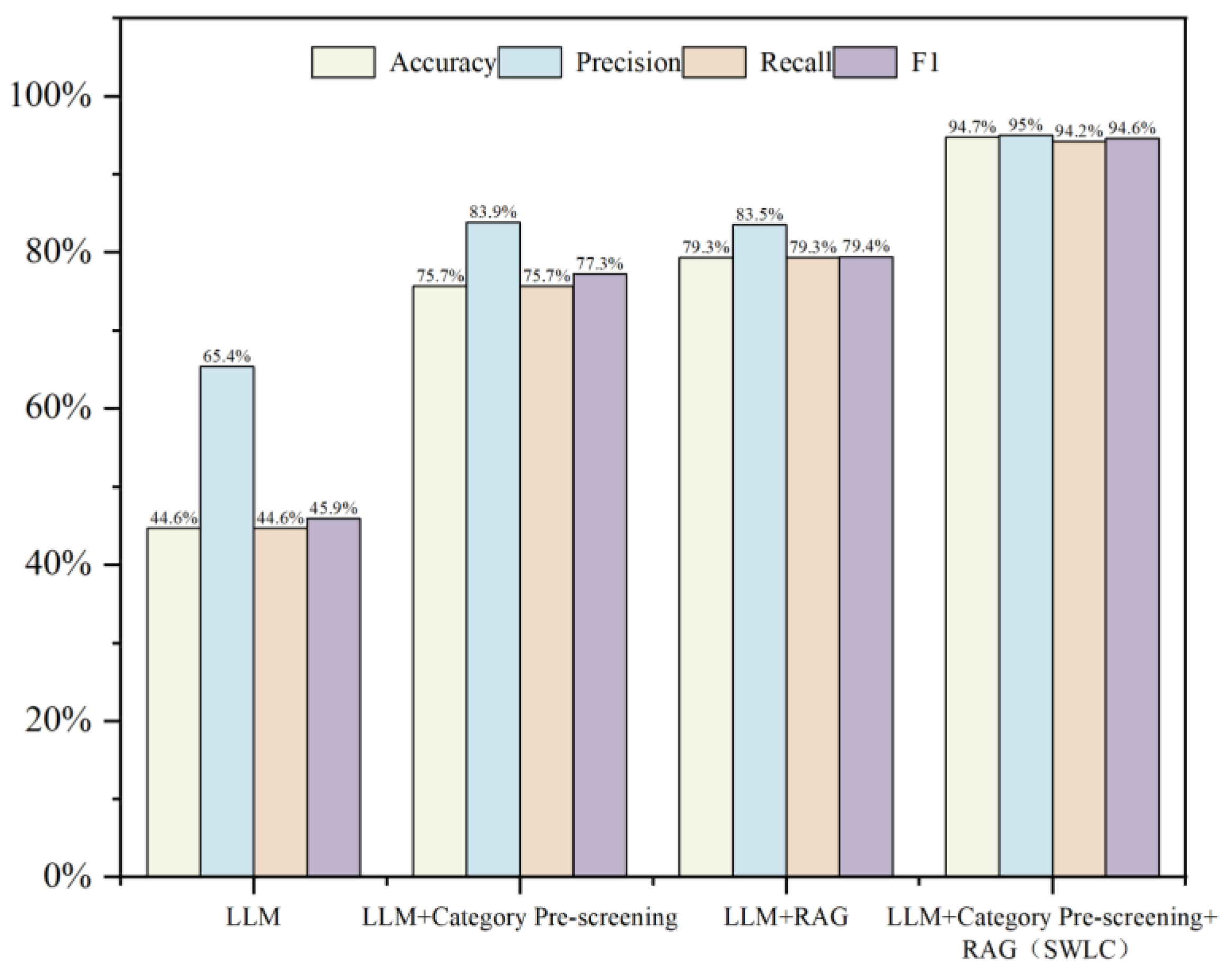
- Experimental Arrangement: To comprehensively verify the effectiveness of the SWLC method, multiple experiments were conducted. The first set of experiments compares the performance of different base LLMs, while the second set evaluates the impact of the category pre-screening and RAG methods on classification accuracy.
- (3)
- Evaluation Metrics: The evaluation metrics used in this study include Accuracy, Precision, Recall, and F1 Score, which are employed to assess the classification performance [46] comprehensively.
4.3.2. Comparison Experiment with Base Large Models
4.3.3. Classification Module Combination Experiment
4.3.4. Robustness Verification
5. Engineering Application
5.1. Implementation of the Intelligent Assistant
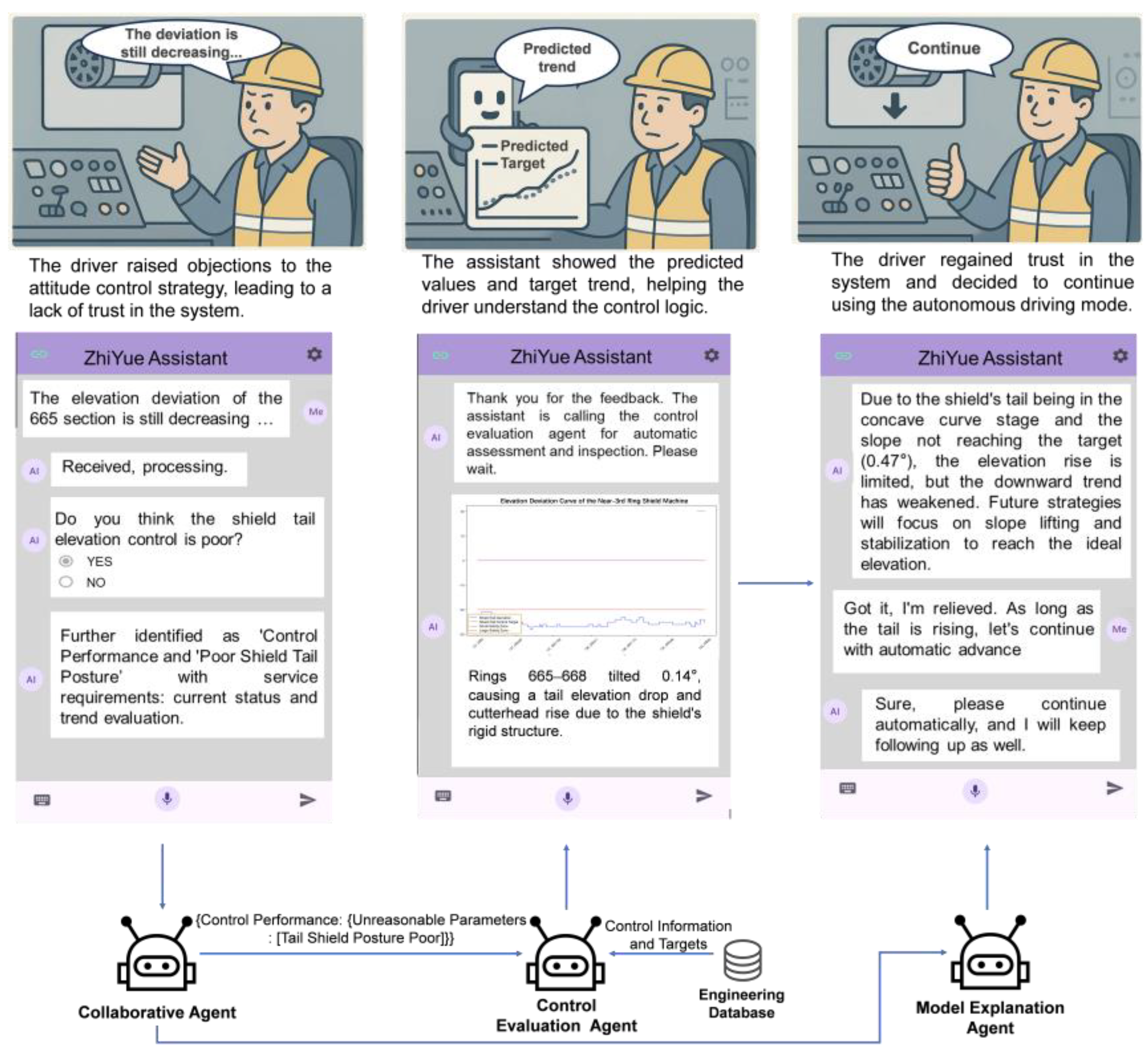
5.2. Case Analysis 1: Enhancing System Transparency and Increasing User Trust
5.3. Case Analysis 2: Bridging the Human–Machine Information Gap to Enhance System Safety
6. Conclusions
Author Contributions
Funding
Data Availability Statement
Acknowledgments
Conflicts of Interest
References
- Chen, X.; Fu, Y.; Chen, X.; Xiao, H.; Bao, X.; Pang, X.; Wang, X. Advances in Underground Space Construction Technology and the Current Status of Digital and Intelligent Technologies. China J. Highw. Transp. 2022, 35, 1–12. [Google Scholar] [CrossRef]
- Xiong, J.L.J.; Shen, S.L.K.; Batty, R.J.; Ho, J.C.J. The pursuit of an autonomous tunnel boring machine. In Proceedings of the ITAAITES World Tunnel Digital Congress and Exhibition (WTC) 2020 and the 46th General Assembly, Kuala Lumpur, Malaysia, 9 November 2020; pp. 139–146. [Google Scholar]
- Hu, M.; Wu, B.; Zhou, W.; Wu, H.; Li, G.; Lu, J.; Yu, G.; Qin, Y. Self-driving shield: Intelligent systems, methodologies, and practice. Autom. Constr. 2022, 139, 104326. [Google Scholar] [CrossRef]
- Guo, W.; Hong, K.; Gao, P.; Li, F.; Li, S.; Zhao, X. Status quo and prospects of tunnel intelligent construction in China. Tunn. Constr. 2023, 43, 549. [Google Scholar]
- Zhang, H.; Lu, M.; Li, G.; Hu, M. Design and application of performance evaluation system for self-driving shields. Tunn. Constr. 2023, 43, 1872–1886. [Google Scholar]
- Du, J.; Zhang, J.; Hu, M.; Gan, L. Literature Review on Human Factors involved in Intelligent Shield Construction. Tunn. Constr. 2023, 8, 1269–1281. [Google Scholar]
- Bach, T.A.; Khan, A.; Hallock, H.; Beltrão, G.; Sousa, S. A systematic literature review of user trust in AI-enabled systems: An HCI perspective. Int. J. Hum.—Comput. Interact. 2024, 40, 1251–1266. [Google Scholar] [CrossRef]
- Islam, M.T.; Sepanloo, K.; Woo, S.; Woo, S.H.; Son, Y.J. A review of the industry 4.0 to 5.0 transition: Exploring the intersection, challenges, and opportunities of technology and human–machine collaboration. Machines 2025, 13, 267. [Google Scholar] [CrossRef]
- Krupas, M.; Kajati, E.; Liu, C.; Zolotova, I. Towards a human-centric digital twin for human–machine collaboration: A review on enabling technologies and methods. Sensors 2024, 24, 2232. [Google Scholar] [CrossRef] [PubMed]
- Boyacı, T.; Canyakmaz, C.; De Véricourt, F. Human and machine: The impact of machine input on decision making under cognitive limitations. Manag. Sci. 2024, 70, 1258–1275. [Google Scholar] [CrossRef]
- Verhagen, R.S.; Marcu, A.; Neerincx, M.A.; Tielman, M.L. The influence of interdependence on trust calibration in human-machine teams. In Proceedings of the HHAI 2024: Hybrid Human AI Systems for the Social Good, Malmö, Sweden, 10–14 June 2024; pp. 300–314. [Google Scholar]
- Yang, H.; Han, Q.L.; Ge, X.; Ding, L.; Xu, Y.; Jiang, B.; Zhou, D. Fault-tolerant cooperative control of multiagent systems: A survey of trends and methodologies. IEEE Trans. Ind. Inform. 2019, 16, 4–17. [Google Scholar] [CrossRef]
- Hou, X.; Zhao, Y.; Liu, Y.; Yang, Z.; Wang, K.; Li, L.; Luo, X.; Lo, D.; Grundy, J.; Wang, H. Large language models for software engineering: A systematic literature review. ACM Trans. Softw. Eng. Methodol. 2024, 33, 79. [Google Scholar] [CrossRef]
- Yang, C.; Zhu, Y.; Chen, Y. A review of human–machine cooperation in the robotics domain. IEEE Trans. Hum. Mach. Syst. 2021, 52, 12–25. [Google Scholar] [CrossRef]
- Schleiger, E.; Mason, C.; Naughtin, C.; Reeson, A.; Paris, C. Collaborative Intelligence: A Scoping Review of Current Applications. Appl. Artif. Intell. 2024, 38, 2327890. [Google Scholar] [CrossRef]
- Vaccaro, M.; Almaatouq, A.; Malone, T. When combinations of humans and AI are useful: A systematic review and meta-analysis. Nat. Hum. Behav. 2024, 8, 2293–2303. [Google Scholar] [CrossRef] [PubMed]
- Zhang, Y.; Hu, Z.; Hang, P.; Lou, S.; Lv, C. Human–machine cooperative decision-making and planning for automated vehicles using spatial projection of hand gestures. Adv. Eng. Inform. 2024, 62, 102864. [Google Scholar] [CrossRef]
- Lu, J.; Sun, B.; Zhang, B.; Pang, Z.; Peng, Z.; Yang, S.; Cao, Y. CO-Mode with AV-CRM: A novel paradigm towards human–machine collaboration in intelligent vehicle safety. J. Saf. Sci. Resil. 2025, 7, 100209. [Google Scholar] [CrossRef]
- Xing, Y.; Huang, C.; Lv, C. Driver-Automation Collaboration for Automated Vehicles: A Review of Human-Centered Shared Control. In Proceedings of the 2020 IEEE Intelligent Vehicles Symposium (IV), Las Vegas, NV, USA, 19 October–13 November 2020; pp. 1964–1971. [Google Scholar] [CrossRef]
- Cominelli, L.; Feri, F.; Garofalo, R.; Giannetti, C.; Meléndez-Jiménez, M.A.; Greco, A.; Nardelli, M.; Scilingo, E.P.; Kirchkamp, O. Promises and trust in human–robot interaction. Sci. Rep. 2021, 11, 9687. [Google Scholar] [CrossRef]
- Lippi, M.; Martinelli, M.; Picone, M.; Zambonelli, F. Enabling causality learning in smart factories with hierarchical digital twins. Comput. Ind. 2023, 148, 103892. [Google Scholar] [CrossRef]
- Ha, T.; Kim, S. Improving trust in AI with mitigating confirmation bias: Effects of explanation type and debiasing strategy for decision-making with explainable AI. Int. J. Hum. Comput. Interact. 2024, 40, 8562–8573. [Google Scholar] [CrossRef]
- Adami, P.; Rodrigues, P.B.; Woods, P.J.; Becerik-Gerber, B.; Soibelman, L.; Copur-Gencturk, Y.; Lucas, G. Impact of VR-based training on human–robot interaction for remote operating construction robots. J. Comput. Civ. Eng. 2022, 36, 04022006. [Google Scholar]
- Wang, Z.; Abdel-Aty, M.; Yue, L.; Zhu, J.; Zheng, O.; Zaki, M.H. Investigating the Effects of Human–Machine Interface on Cooperative Driving Using a Multi-Driver Co-Simulation Platform. IEEE Trans. Intell. Veh. 2023, 9, 2808–2821. [Google Scholar] [CrossRef]
- You, F.; Liang, Y.; Fu, Q.; Zhang, J. Exploring the Role of AR Cognitive Interface in Enhancing Human-Vehicle Collaborative Driving Safety: A Design Perspective. Int. J. Hum.—Comput. Interact. 2025, 41, 115–135. [Google Scholar] [CrossRef]
- Sun, X.; Li, J.; Tang, P.; Zhou, S.; Peng, X.; Li, H.N.; Wang, Q. Exploring Personalized Autonomous Vehicles to Influence User Trust. Cogn. Comput. 2020, 12, 1170–1186. [Google Scholar] [CrossRef]
- Xu, Z.; Chen, T.; Huang, Z.; Xing, Y.; Chen, S. Personalizing Driver Agent Using Large Language Models for Driving Safety and Smarter Human–Machine Interactions. IEEE Intell. Transp. Syst. Mag. 2025, 17, 96–111. [Google Scholar] [CrossRef]
- Fang, S.; Liu, J.; Ding, M.; Cui, Y.; Lv, C.; Hang, P.; Sun, J. Towards interactive and learnable cooperative driving automation: A large language model-driven decision-making framework. IEEE Trans. Veh. Technol. 2025, 74, 11894–11905. [Google Scholar] [CrossRef]
- Ali, A.; Jianjun, H.; Jabbar, A. Recent Advances in Federated Learning for Connected Autonomous Vehicles: Addressing Privacy, Performance, and Scalability Challenges. EEE Access 2025, 13, 80637–80665. [Google Scholar] [CrossRef]
- Sun, J.; Huang, Y.; Huang, X.; Zhang, J.; Zhang, H. Effect of Proactive Interaction on Trust in Autonomous Vehicles. Sustainability 2024, 16, 3404. [Google Scholar] [CrossRef]
- Liu, B.; Zhang, J.; Luximon, Y. Interface design for visual blind spots in cooperative driving. Behav. Inf. Technol. 2025, 44, 4906–4924. [Google Scholar] [CrossRef]
- Woide, M.; Stiegemeier, D.; Pfattheicher, S.; Baumann, M. Measuring driver-vehicle cooperation: Development and validation of the Human-Machine-Interaction-Interdependence Questionnaire (HMII). Transp. Res. Part F Traffic Psychol. Behav. 2021, 83, 424–439. [Google Scholar] [CrossRef]
- Rony, M.R.A.H.; Suess, C.; Bhat, S.R.; Sudhi, V.; Schneider, J.; Vogel, M.; Teucher, R.; Friedl, K.E.; Sahoo, S. CarExpert: Leveraging Large Language Models for In-Car Conversational Question Answering. arXiv 2023, arXiv:2310.09536. [Google Scholar]
- Li, X. Design of Intelligent Question-Answering System Based on Large Language Model. Procedia Comput. Sci. 2025, 261, 734–743. [Google Scholar] [CrossRef]
- Garello, L.; Belgiovine, G.; Russo, G.; Rea, F.; Sciutti, A. Building Knowledge from Interactions: An LLM-Based Architecture for Adaptive Tutoring and Social Reasoning. arXiv 2025, arXiv:2504.01588. [Google Scholar] [CrossRef]
- Xu, L.; Yu, J.; Peng, X.; Chen, Y.; Li, W.; Yoo, J.; Chunag, S.; Lee, D.; Ji, D.; Zhang, C. MoSE: Skill-by-Skill Mixture-of-Expert Learning for Autonomous Driving. arXiv 2025, arXiv:2507.07818. [Google Scholar]
- Chen, J.; Liu, Z.; Huang, X.; Wu, C.; Liu, Q.; Jiang, G.; Pu, Y.; Lei, Y.; Chen, X.; Wang, X.; et al. When large language models meet personalization: Perspectives of challenges and opportunities. World Wide Web 2024, 27, 1–45. [Google Scholar] [CrossRef]
- Li, Z.; Xu, X.; Xu, Z.; Lim, S.; Zhao, H. LARM: Large Auto-Regressive Model for Long-Horizon Embodied Intelligence. arXiv 2024, arXiv:2405.17424. [Google Scholar]
- Du, H.; Feng, X.; Ma, J.; Wang, M.; Tao, S.; Zhong, Y.; Li, Y.-F.; Wang, H. Towards proactive interactions for in-vehicle conversational assistants utilizing large language models. arXiv 2024, arXiv:2403.09135. [Google Scholar] [CrossRef]
- Huang, X.; Lian, J.; Lei, Y.; Yao, J.; Lian, D.; Xie, X. Recommender AI Agent: Integrating Large Language Models for Interactive Recommendations. ACM Trans. Inf. Syst. 2025, 43, 1–33. [Google Scholar] [CrossRef]
- Yang, F.; Liu, X.C.; Lu, L.; Wang, B.; Liu, C. A Self-Supervised Multi-Agent Large Language Model Framework for Customized Traffic Mobility Analysis Using Machine Learning Models. Transp. Res. Rec. 2025, 2679, 1–16. [Google Scholar]
- Zhu, Q.; Wang, M.; Zhang, T.; Huang, H. Current trends and future prospects of large-scale foundation model in K-12 education. Front. Digit. Educ. 2025, 2, 22. [Google Scholar] [CrossRef]
- Lu, J.; Zhou, W.; Hu, M.; Chew, C.M. A meta-learning enhanced framework for prediction and control of shield-tunneling-induced ground deformation under data scarcity. Transp. Geotech. 2025, 56, 101779. [Google Scholar]
- Huang, H.; Chang, J.; Zhang, D.; Zhang, J.; Wu, H.; Li, G. Machine learning-based automatic control of tunneling posture of shield machine. J. Rock Mech. Geotech. Eng. 2022, 14, 1153–1164. [Google Scholar] [CrossRef]
- Xiao, S.; Liu, Z.; Zhang, P.; Muennighoff, N.; Lian, D.; Nie, J.Y. C-pack: Packed resources for general Chinese embeddings. In Proceedings of the 47th International ACM SIGIR Conference on Research and Development in Information Retrieval 2024, Washington, DC, USA, 14–18 July 2024; pp. 641–649. [Google Scholar]
- Sokolova, M.; Lapalme, G. A systematic analysis of performance measures for classification tasks. Inf. Process. Manag. 2009, 45, 427–437. [Google Scholar] [CrossRef]
- Touvron, H.; Martin, L.; Stone, K.; Albert, P.; Almahairi, A.; Babaei, Y.; Bashlykov, N.; Batra, S.; Bhargava, P.; Bhosale, S.; et al. Llama 2: Open foundation and fine-tuned chat models. arXiv 2023, arXiv:2307.09288. [Google Scholar] [CrossRef]
- Yang, A.; Xiao, B.; Wang, B.; Zhang, B.; Bian, C.; Yin, C.; Lv, C.; Pan, D.; Wang, D.; Yan, D.; et al. Baichuan 2: Open large-scale language models. arXiv 2023, arXiv:2309.10305. [Google Scholar] [CrossRef]
- Bai, J.; Bai, S.; Chu, Y.; Cui, Z.; Dang, K.; Deng, X.; Fan, Y.; Ge, W.; Han, Y.; Huang, F.; et al. Qwen technical report. arXiv 2023, arXiv:2309.16609. [Google Scholar] [CrossRef]




| Service Event Categories | Service Demands | |||
|---|---|---|---|---|
| Service Event Category | Subcategory | Category Explanation | Communication and Collaboration | Manual Intervention |
| Control Performance | Unreasonable Parameters | Perceived tunneling parameters are unreasonable | √ | √ |
| Control Performance | Strategy Misunderstanding | The system operates normally, but field technicians cannot understand its strategy or operational logic. | √ | |
| Control Performance | New Control Requirements | The driver wants to adjust key parameters during tunneling | √ | |
| System Operation | System Misunderstanding | The driver cannot correctly operate or understand the system’s output | √ | |
| System Operation | Model Failure | The automatic propulsion model has a fault alarm | √ | |
| System Operation | System Alert | The system detects anomalies or risks and sends an alert | √ | √ |
| Information Communication | Abnormal Feedback | Emergent situations or exceptional events, such as sensor failure, require recording. | √ | √ |
| Information Communication | Plan Adjustment | The construction plan or task changes, but the system continues to operate normally. | √ | |
| Information Communication | On-site Operation | On-site special operations, such as inspection, calibration, or maintenance | √ | |
| Cause of Switching | Reason Analysis | Service Demand | Service Format |
|---|---|---|---|
| Lack of system familiarity | Drivers are unfamiliar with the automatic control system, especially during the initial stage of adopting a new system or mode, and may switch to manual operation prematurely due to limited experience. | System presentation | Answering user inquiries |
| Insufficient trust | On-site personnel show limited confidence in the autonomous tunneling system. When encountering difficult geological sections or short-term performance fluctuations, they tend to switch to manual operation. | Status and trend assessment | Quantitative and objective evaluation; Visualized charts and curves; Clarification of short-term and long-term trends |
| Lack of transparency | Drivers are unable to understand the model’s control strategies and parameter adjustment mechanisms. | Status assessment and strategy interpretation | Explanation of strategy generation rationale; Quantitative and objective evaluation; Visualized charts and curves |
| Preference for manual operation | The automatic control mode differs from drivers’ habitual manual practices, leading them to rely more on personal experience. | Control execution | Interactive interface for receiving user input; Execution of control requests verified through safety checks |
| Poor information communication | The system model lacks sufficient perception of real-time on-site conditions, making it challenging to handle unexpected changes. | Information acquisition | On-site data collection and real-time interaction; Model adjustment based on external information |
| Operational safety concerns | Drivers worry that they may be unable to intervene promptly in the event of system performance degradation, prompting an early switch to manual mode. | Monitoring and alerting | Continuous monitoring, anomaly detection, and risk warning provision |
| Agent | Task Description | Design Considerations | |||
|---|---|---|---|---|---|
| Input | Operating Conditions | Output Timing | Output | ||
| Control Evaluation | Obtains real-time data and control targets from the system, invokes a performance evaluation model, and provides assessments of current and future control trends. | Real-time system data; Control targets | Periodically triggered in the background or when users are dissatisfied with the control performance. | When risks are identified or users request an evaluation | Data results; Graphical analyses; Risk levels; Trend evaluations |
| Model Explanation | Provides causal interpretation of model outputs or control logic, explaining reasons for parameter variations. | User inquiries; Model output data | When users express doubts about control logic | Upon the user’s request for an explanation | Causal-chain interpretation; Parameter descriptions; Visualization charts |
| Control Execution | Actively performs parameter adjustments according to driver commands or system judgments and provides execution feedback. | Driver control commands; Current system state | When the driver inputs control commands | Upon command execution | Comparison of pre- and post-adjustment results; Execution feedback |
| Anomaly Monitoring | Continuously monitors key parameters during tunneling, detects anomalies, and generates trend analyses and operational recommendations. | Real-time tunneling data; Historical data; Control targets | Continuous background monitoring or detection of abnormal trends | When anomalies or trend changes are detected | Anomaly alerts, Trend analysis charts, Operational recommendations |
| Information Acquisition | Collects and analyzes on-site updates such as schedule changes or unexpected events. | Schedule adjustments; Emergency event information | Real-time recording and feedback | When schedule changes or unexpected events occur | Information summaries; Analytical reports |
| System Introduction | Provides explanations of system functions and updates in response to user queries or automated system notifications. | User inquiries or system-triggered notifications | When users inquire about system status or functions | Upon user request for system information | Function descriptions; Status updates; Hierarchical display content |
| Category | Relevant Knowledge |
|---|---|
| Problem Summary | Issues such as jack oil leakage and cylinder failure are related to the posture system and are classified under ‘Failure > System > Posture System’. |
| Category Explanation | “Failure” commonly occurs in cases of cruise model alarms, communication failures (including data collection failures due to network congestion), and hardware damage to tunneling equipment and supporting computer resources. |
| Category Explanation | “Propulsion oil pressure” refers to the hydraulic pressure of the propulsion cylinder, which varies across propulsion modes and is commonly found in “4-zone” and “6-zone” systems, directly affecting propulsion speed and TBM posture. |
| Content | Template Description | Prompt Example |
|---|---|---|
| Role Definition | Define the LLM role to ensure domain-specific expertise in tunneling construction. | You are an expert in tunnel boring machine (TBM) tunneling. You are tasked with completing the classification based on the pre-screened categories and selecting the most appropriate one. |
| Candidate Classification | Limit the model’s category range to avoid out-of-bounds output. | ## Pre-screened categories: {candidate_classification} |
| Relevant Knowledge | Provide relevant knowledge to enhance the model’s semantic understanding and its basis for judgment. | ## Relevant knowledge: {relevant_knowledge} |
| Task Requirement | Standardize the task execution process and output format to ensure classification results are accurate and interpretable. | ## Task Requirements: 1. Combine the relevant knowledge to identify the classification from the “hard classification” list, ensuring the most appropriate key-value path. 2. The classification result must strictly be chosen from the pre-screened categories. If no match is found, explicitly request the user to provide more information or recheck the classification. 3. If the user reports a misclassification, ask for more information or clarification, and reclassify based on the above rules. 4. Before returning the classification result, verify the result to ensure it aligns with the question and that it either exists in the “pre-screened classification” or is explained in the “relevant knowledge.” Output format: Provide the result in JSON format, including keys: “First Level”, “Second Level”, “Third Level.” Input question: {question} Classification result output: ## Example: Input question: Propulsion speed fluctuation Classification result output: {“First Level”: “Control Performance”, “Second Level”: “Control Requirements”, “Third Level”: “Propulsion Speed”} |
| Model | Accuracy | Average Response Time (s) |
|---|---|---|
| llama2-7b-chat | 21.40% | 3.25 |
| llama2-13b-chat | 24.80% | 4.05 |
| baichuan2-7b-chat | 30.50% | 3.78 |
| Qwen1.5-14b | 36.80% | 4.35 |
| Qwen1.5-32b | 44.60% | 4.8 |
| Qwen1.5-72b | 45.70% | 20.35 |
| Example | Types | Result |
|---|---|---|
| I wasn’t driving very fast on the road today | Irrelevant | Irrelevant issue |
| You are a technician responsible for on-site scheduling. How should today’s work be arranged? | Irrelevant | Irrelevant issue |
| … | … | … |
| To the −50 to −40 range, can the elevation parameter be adjusted? | Inverted Command Syntax | {Control Performance: {New Control Requirements : [Elevation Attitude]}} |
| Check why the speed suddenly increased | Ambiguous Expressions | {Control Performance: {Unreasonable Parameters : [Speed]}} |
Disclaimer/Publisher’s Note: The statements, opinions and data contained in all publications are solely those of the individual author(s) and contributor(s) and not of MDPI and/or the editor(s). MDPI and/or the editor(s) disclaim responsibility for any injury to people or property resulting from any ideas, methods, instructions or products referred to in the content. |
© 2025 by the authors. Licensee MDPI, Basel, Switzerland. This article is an open access article distributed under the terms and conditions of the Creative Commons Attribution (CC BY) license (https://creativecommons.org/licenses/by/4.0/).
Share and Cite
Hu, M.; Gao, H.; Mi, Q.; Wu, B.; Lu, J.; Liu, Y. Bridging the Information Gap in Smart Construction: An LLM-Based Assistant for Autonomous TBM Tunneling. Smart Cities 2025, 8, 212. https://doi.org/10.3390/smartcities8060212
Hu M, Gao H, Mi Q, Wu B, Lu J, Liu Y. Bridging the Information Gap in Smart Construction: An LLM-Based Assistant for Autonomous TBM Tunneling. Smart Cities. 2025; 8(6):212. https://doi.org/10.3390/smartcities8060212
Chicago/Turabian StyleHu, Min, Hongzheng Gao, Qing Mi, Bingjian Wu, Jing Lu, and Yongchang Liu. 2025. "Bridging the Information Gap in Smart Construction: An LLM-Based Assistant for Autonomous TBM Tunneling" Smart Cities 8, no. 6: 212. https://doi.org/10.3390/smartcities8060212
APA StyleHu, M., Gao, H., Mi, Q., Wu, B., Lu, J., & Liu, Y. (2025). Bridging the Information Gap in Smart Construction: An LLM-Based Assistant for Autonomous TBM Tunneling. Smart Cities, 8(6), 212. https://doi.org/10.3390/smartcities8060212