Article

Exploring the Electronic Landscape of Two-Dimensional Tin Monoxide: Layer Thickness and Crystallographic Symmetry Effects


1
Key Laboratory of Extraordinary Bond Engineering and Advanced Materials Technology of Chongqing, Yangtze Normal University, Chongqing 408100, China
2
School of Materials Science and Engineering, National Institute for Advanced Materials, Renewable Energy Conversion and Storage Center (RECAST), Nankai University, Tianjin 300350, China
*
Authors to whom correspondence should be addressed.
Surfaces 2026, 9(1), 8; https://doi.org/10.3390/surfaces9010008 (registering DOI)
Submission received: 30 October 2025 / Revised: 6 December 2025 / Accepted: 24 December 2025 / Published: 1 January 2026
(This article belongs to the Special Issue Surface and Interface Science in Energy Materials)

Abstract

The ability to precisely control the electronic bandgap is crucial for tailoring two-dimensional (2D) materials for optoelectronic applications. In this work, we systematically investigate the electronic structure of 2D tin monoxide (SnO) across various layer thicknesses (monolayer to tetralayer) and crystallographic symmetries using first-principles calculations. Our results reveal a strong dependence of the bandgap on the number of layers, which decreases dramatically from 3.94 eV in the monolayer to nearly metallic in the tetralayer. Furthermore, different space group symmetries are found to significantly influence the bandgap, providing an additional degree of freedom for property tuning. This bandgap engineering is quantitatively linked to enhanced interlayer electronic coupling, as evidenced by a progressive increase in interlayer charge transfer with layer count. Our findings establish a clear structure–property relationship and offer practical guidance for designing SnO-based devices in flexible electronics and tunable optoelectronics.

1. Introduction

Over the past decade, research on two-dimensional (2D) materials, sparked by the exceptional properties of graphene, has surged due to their potential in next-generation electronics [1,2,3]. This exploration has expanded the family of 2D materials to include silicene [4], germanene [5], boron nitride [6], pentagraphene [7], transition metal dichalcogenides [8], and metal oxides [9,10]. The synthesis of these materials often relies on top-down exfoliation or bottom-up growth on substrates. Concurrently, computational methods have played a pivotal role in accelerating the discovery of novel 2D materials, such as borophene and specific metal oxides, by predicting structures that were later verified experimentally [11,12,13,14,15,16,17,18]. This synergy between theoretical and experimental approaches forms the cornerstone of identifying 2D materials with tailored properties for electronics, optics, and quantum devices.
Among the diverse 2D materials, tin monoxide (SnO) stands out due to its unique electronic structure, which is influenced by its layered architecture and the presence of lone-pair electrons [19,20,21,22,23,24,25,26,27,28,29,30]. The exploration of SnO has been facilitated by the successful experimental synthesis of several stable phases. Most notably, the common blue-black α -SnO (tetragonal, P4/nmm) has been produced via wafer-scale growth [31]. Additionally, a red SnO phase with distinct symmetry has also been reported [32]. These experimentally accessible structures, along with theoretically predicted stable monolayers (e.g., with Pmmn symmetry [22,26]), provide a rich foundation for investigating the property space of layered SnO. Pioneering studies by Li et al. [33], Mubeen et al. [19] and Hu et al. [20] revealed the tunability of SnO’s bandgap with layer thickness, highlighting its promise for applications in optoelectronics and thin-film transistors. These works, along with the seminal study by Ogo et al. [21], have established SnO as a viable channel material, though challenges in optimizing device performance remain.
The understanding of SnO’s crystallographic behavior has evolved significantly through rigorous investigations. Watson’s study [25] challenged conventional wisdom by highlighting the role of lone pairs in its bonding mechanism and electronic properties. This perspective was further refined by Hunanyan et al. [26], who explored various SnO polymorphs and assessed their stability, revealing the potential for novel structures with intriguing properties.
Recent advances in synthesis have enabled detailed studies of 2D SnO. The mechanical exfoliation technique demonstrated by Kun et al. [29] has facilitated the creation of 2D SnO layers, allowing the investigation of their properties free from bulk effects. Meanwhile, Kripalani et al. [30] highlighted the remarkable mechanical properties of ultrathin SnO, such as superplasticity, which has profound implications for flexible electronics.
While previous research has laid a solid foundation, a comprehensive understanding of how different crystallographic symmetries (space groups) influence the electronic properties of layered SnO remains elusive. This gap motivates our in-depth investigation.
In this work, we employ density functional theory (DFT) to systematically explore the electronic properties of 2D SnO, focusing on the effects of layer thickness (from monolayer to tetralayer) and crystallographic symmetry. Our study expands beyond traditional SnO structures by examining a wide range of layered configurations, aiming to establish a unified design principle for bandgap engineering. We demonstrate that each incremental change in layer count or symmetry significantly modulates SnO’s electronic behavior. The computational methodology is detailed in Section 3, our results and discussion are presented in Section 2, and the conclusions are summarized in Section 4.

2. Results and Discussions

2.1. Structural Survey of SnO Polymorphs

To identify candidate structures for our study, we initiated a comprehensive survey of tin–oxygen compounds using the Materials Project database [34] and its PhaseDiagram module [35]. The thermodynamic stability of various SnOx phases was assessed through the construction of a binary phase diagram based on DFT-calculated formation energies, as shown in Figure 1a. Phases located below the convex hull are thermodynamically stable, while those above it are metastable or unstable. Focusing on the Sn:O = 1:1 composition (Figure 1b), we identified several SnO polymorphs with distinct formation energies, which serve as the starting point for our investigation into their two-dimensional derivatives.
SnO crystallizes in three primary structure types: tetragonal, orthorhombic, and triclinic. The tetragonal phase includes three variants (mp-2097, mp-1065811, mp-999142), with mp-2097 representing the common blue-black SnO. The orthorhombic family encompasses mp-545820, mp-545552, and mp-1078644; the latter is recognized as the red SnO phase [32], while mp-545552 corresponds to a high-pressure form. Notably, prior theoretical studies [22,26] have identified a stable 2D structure in the orthorhombic family with space group Pmmn (No. 59). In contrast, the triclinic SnO structures (e.g., mp-1245076, mp-1245329) are non-layered and thus unsuitable for exfoliation.
While the exploration of SnO under pressure has revealed other polymorphs [28,36], experimental reports of 2D SnO are currently limited to structures related to mp-2097, synthesized via wafer-scale growth [31] or mechanical exfoliation [29]. Theoretically, high-throughput computational screening [37] has predicted two stable 2D SnO phases with Pmmn and P4/nmm symmetries, with phonon calculations confirming the thermodynamic stability of Pmmn over P4/nmm [22,26]. Building on this foundation, we systematically examine seven potential quasi van der Waals SnO configurations, including six derived from the phase diagram and the theoretically favored SnO-1L-Pmmn structure.

2.2. Crystal Structures of SnO Polymorphs and Their Layered Derivatives

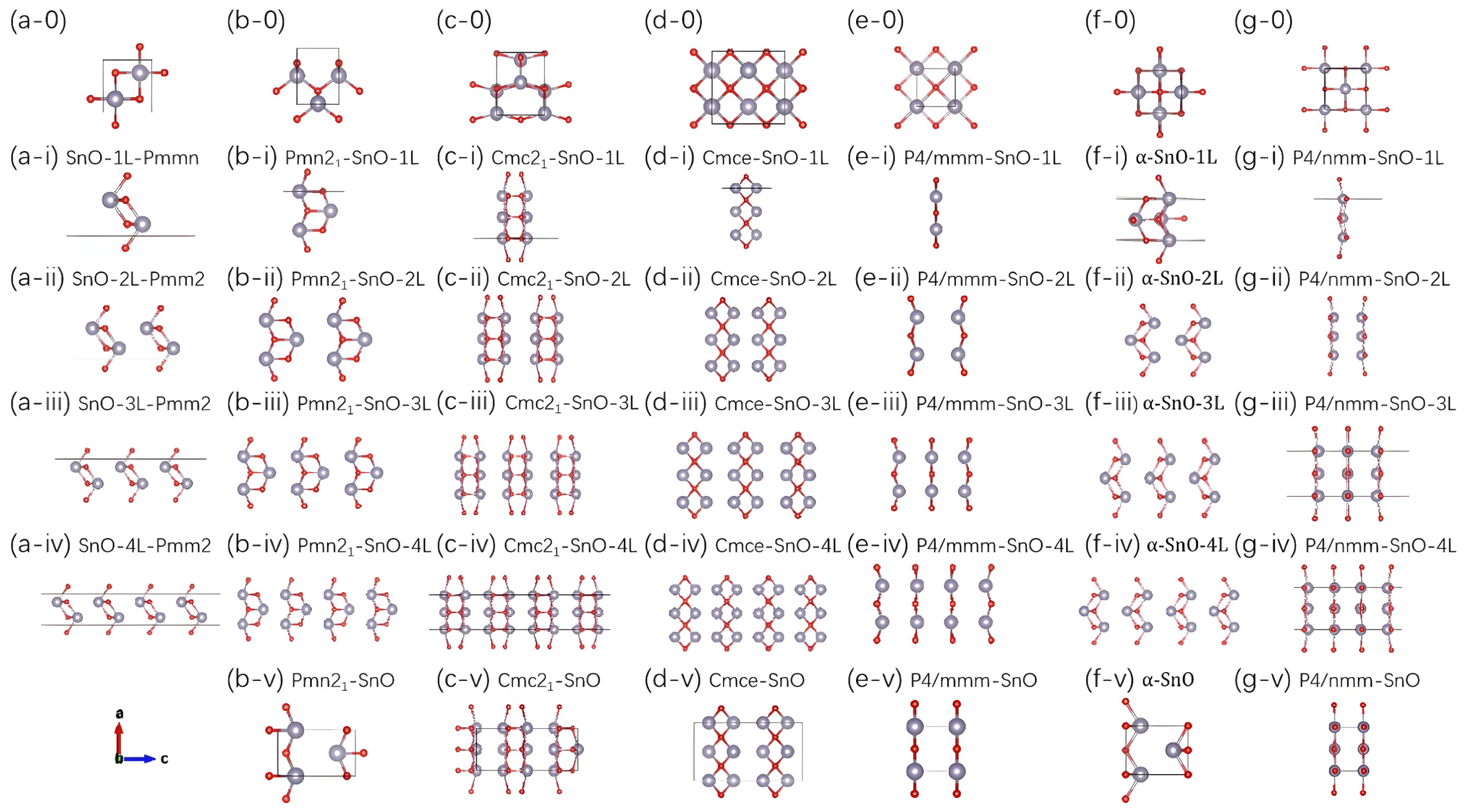
The structural diversity of the investigated SnO systems is summarized in Table 1 and visually represented in Figure 2. Table 1 systematically categorizes both three-dimensional crystalline structures and their corresponding two-dimensional layered derivatives, organized by crystal system (orthorhombic and tetragonal) and layer thickness (monolayer to tetralayer).
In this table, the “Experimental realization” status is explicitly noted for the parent bulk crystals: an entry of “Yes” indicates that the phase has been reported in experimental literature, while “No” denotes a theoretically predicted structure not yet synthesized in bulk form. The inclusion of the latter group is essential for a systematic and comprehensive exploration of how crystallographic symmetry governs the electronic properties across the full spectrum of possible SnO polymorphs.
A key observation from Table 1 is the structural continuity between bulk crystals and their layered counterparts. Most layered architectures retain the crystallographic symmetry of their parent bulk structures, with the notable exception of monoclinic structures (marked with asterisks in columns 3–5), which exhibit symmetry reduction in their layered forms. The table also highlights subtle structural distinctions: for instance, α -SnO and P4/nmm-SnO share the same space group (P4/nmm, No. 129) but differ in their Wyckoff positions, leading to distinct atomic arrangements and material properties despite their apparent symmetry similarity.
Figure 2 provides complementary visual evidence of this structural evolution, showing both top and side views of all configurations. The systematic progression from monolayer to tetralayer structures demonstrates how layer stacking modifies the overall architecture while largely preserving the characteristic features of each polymorph.
All structures presented in Figure 2 have been fully relaxed. The detailed structural parameters and electronic properties for α -SnO across different layer thicknesses are quantified in Table 2. A clear trend emerges: lattice parameters expand gradually with increasing layer count, while bandgaps decrease substantially. The HSE06 functional, which incorporates exact Fock exchange, yields larger bandgaps than PBE, as expected. Our calculated HSE06 bandgaps for α -SnO-1L (3.94 eV) and bulk α -SnO (0.48 eV) show excellent agreement with previous theoretical (3.92 eV and 0.45 eV) [30] and experimental (3.95 eV and 0.64 eV) [29] values, validating our computational approach.
Notably, the P4/mmm and P4/nmm structures (columns 5 and 7 in Figure 2) exhibit minimal layer corrugation and the smallest bandgaps among all configurations, indicating metallic character. Complete structural and electronic data for all configurations are provided in Section SI of the Supporting Information.

2.3. Electronic Structure and Stability

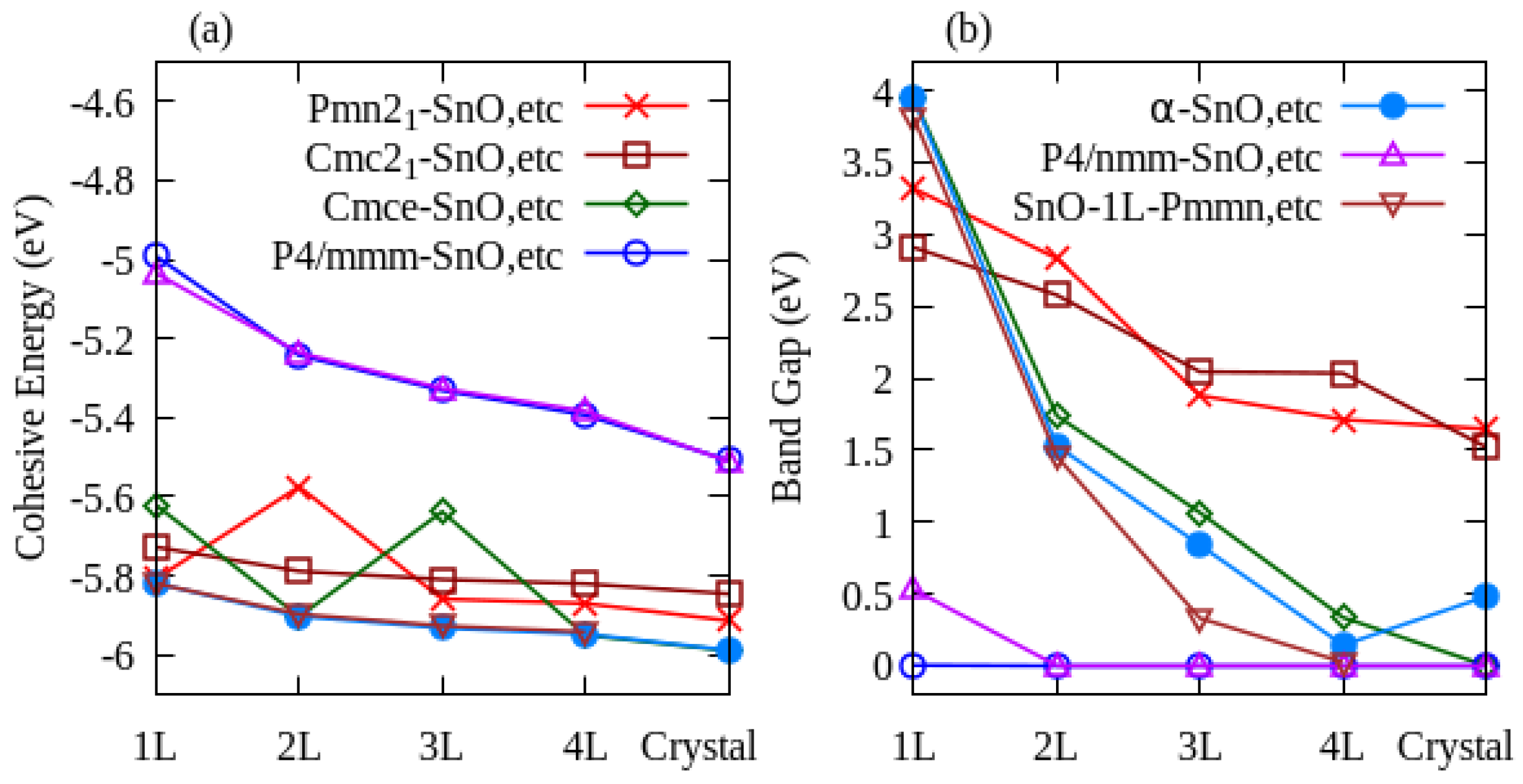
The thermodynamic stability and electronic properties of the investigated SnO structures are summarized in Figure 3. The cohesive energy, calculated as E coh = ( E Sn n O m n E Sn m E O ) / ( n + m ) where E Sn n O m is the total energy of each configuration and E Sn / E O are atomic energies, provides a crucial metric for assessing structural stability (Figure 3a). More negative values indicate higher stability, suggesting greater likelihood of experimental realization. Our calculations reveal that metallic phases (P4/mmm-SnO and P4/nmm-SnO) and their layered derivatives exhibit relatively higher cohesive energies, rendering them less stable compared to other configurations. In contrast, α -SnO and SnO-nL-Pmmn (n = 1–4) structures demonstrate notably lower cohesive energies, identifying them as the most promising candidates for stable 2D configurations. The relative thermodynamic stability indicated by the cohesive energy is further supported by prior reports on the dynamical stability of key structures. For instance, the Pmmn monolayer [22,26] and the α -SnO polymorph family [33] have been confirmed to be dynamically stable.
Figure 3b displays the HSE06-calculated bandgaps, revealing two dominant trends in SnO’s electronic structure. First, a pronounced layer-dependent behavior: bandgaps systematically decrease with increasing layer count across all structural families. This reduction can be attributed to enhanced interlayer electronic coupling, which modifies the band edge positions through increased wavefunction overlap between adjacent layers. Second, a strong symmetry dependence: different space groups significantly modulate the electronic properties. While α -SnO-1L and SnO-1L-Pmmn exhibit wide bandgaps (>3.5 eV) characteristic of semiconductors, the Cmce-SnO family shows substantial bandgap narrowing towards narrow-gap semiconducting behavior. The Pmn21-SnO and Cmc21-SnO families maintain moderate semiconducting character, whereas the P4/mmm-SnO and P4/nmm-SnO families approach metallic conductivity with negligible bandgaps. The corresponding PBE bandgaps, which are systematically smaller due to the well-known bandgap underestimation of standard DFT, are provided in the Supporting Information for completeness.
The strong reduction of bandgap with increasing layer number, as reported for the specific case of α -SnO (P4/nmm) [33], is confirmed here to be a general trend across all quasi-2D SnO polymorphs studied (Figure 3b). A comparative analysis of our comprehensive dataset, however, reveals that crystallographic symmetry imposes an even greater modulation on the electronic structure. Two distinct regimes are evident. Within a given structural family, the bandgap reduction is predominantly and monotonically driven by increasing layer number. However, when comparing across different polymorphs at the same layer count, crystallographic symmetry emerges as the decisive factor, setting the absolute electronic baseline. This is clearly demonstrated by the monolayer data (Figure 3b), where the bandgap spans a range of nearly 4 eV—a variation larger than that induced by layering in any single family. Consequently, these two parameters define a two-dimensional design space for 2D SnO: symmetry selection provides a “coarse-tuning” mechanism for the fundamental electronic character, while subsequent control of layer thickness enables continuous “fine-tuning” within the selected material system.
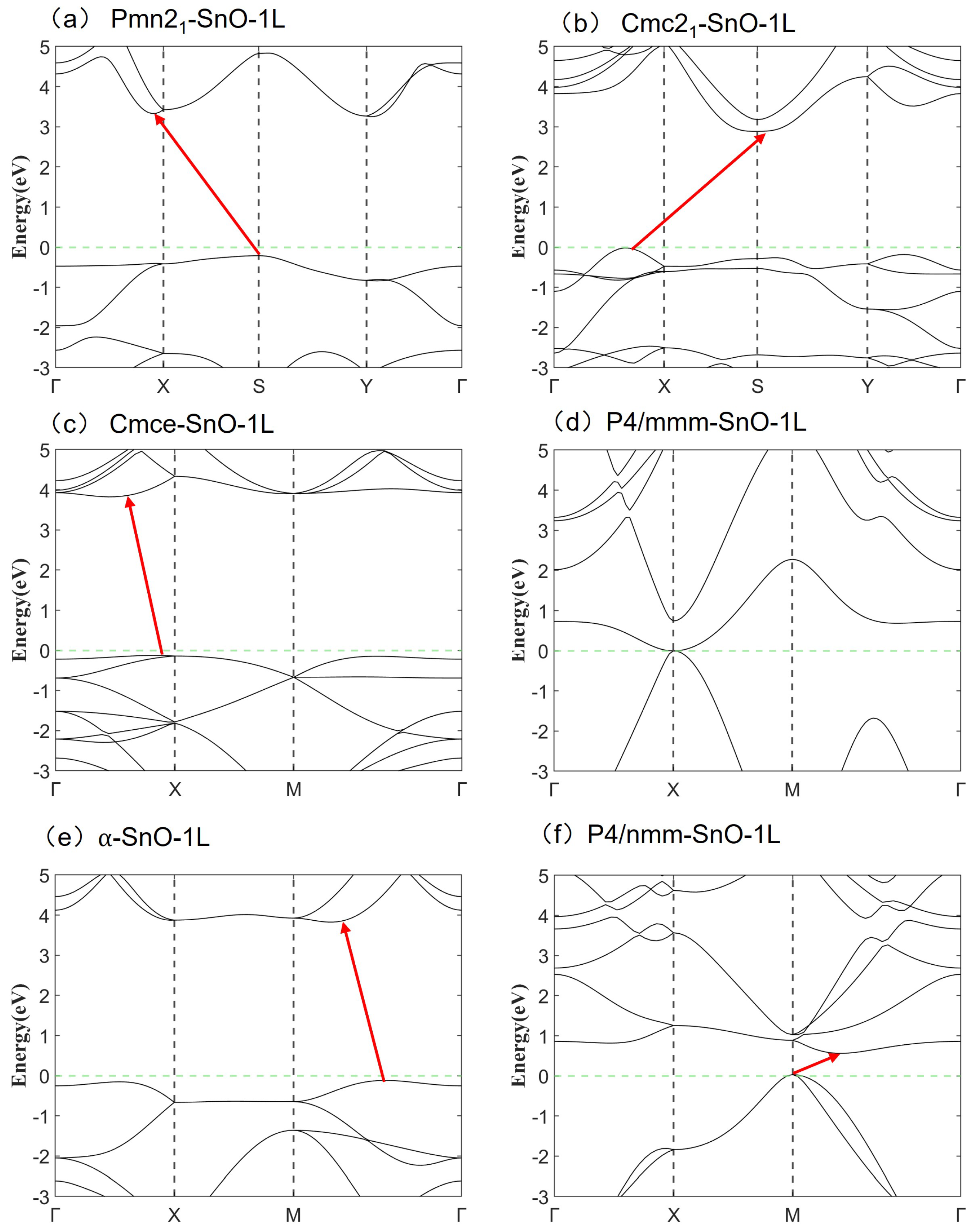
To gain deeper insight into the electronic structure evolution, we examine the band dispersions of monolayer SnO configurations derived from different crystalline prototypes (Figure 4). A detailed comparative analysis reveals that all monolayers except P4/mmm-SnO-1L exhibit indirect bandgap character, with the valence band maximum (VBM) and conduction band minimum (CBM) occurring at different k-points in the Brillouin zone. This indirect nature has important implications for carrier dynamics and optoelectronic performance, as it typically leads to longer carrier lifetimes due to the requirement of phonon-assisted optical transitions. The significant variation in both bandgap magnitude and band dispersion characteristics across different structural families underscores the critical role of crystallographic symmetry in determining the electronic properties of 2D SnO. The wide range of bandgaps accessible through layer and symmetry control—spanning from deep UV (3.94 eV) to near-infrared (0.03 eV)—suggests SnO’s potential for broadband optoelectronic applications. Specifically, the wide-gap monolayers ( α -SnO-1L and SnO-1L-Pmmn) could serve as deep-UV photodetectors or transparent conductive layers, while the narrow-gap multilayers approach the ideal bandgap range for thin-film photovoltaics and infrared optoelectronics.

2.4. Layer-Dependent Electronic Evolution in SnO-nL-Pmmn

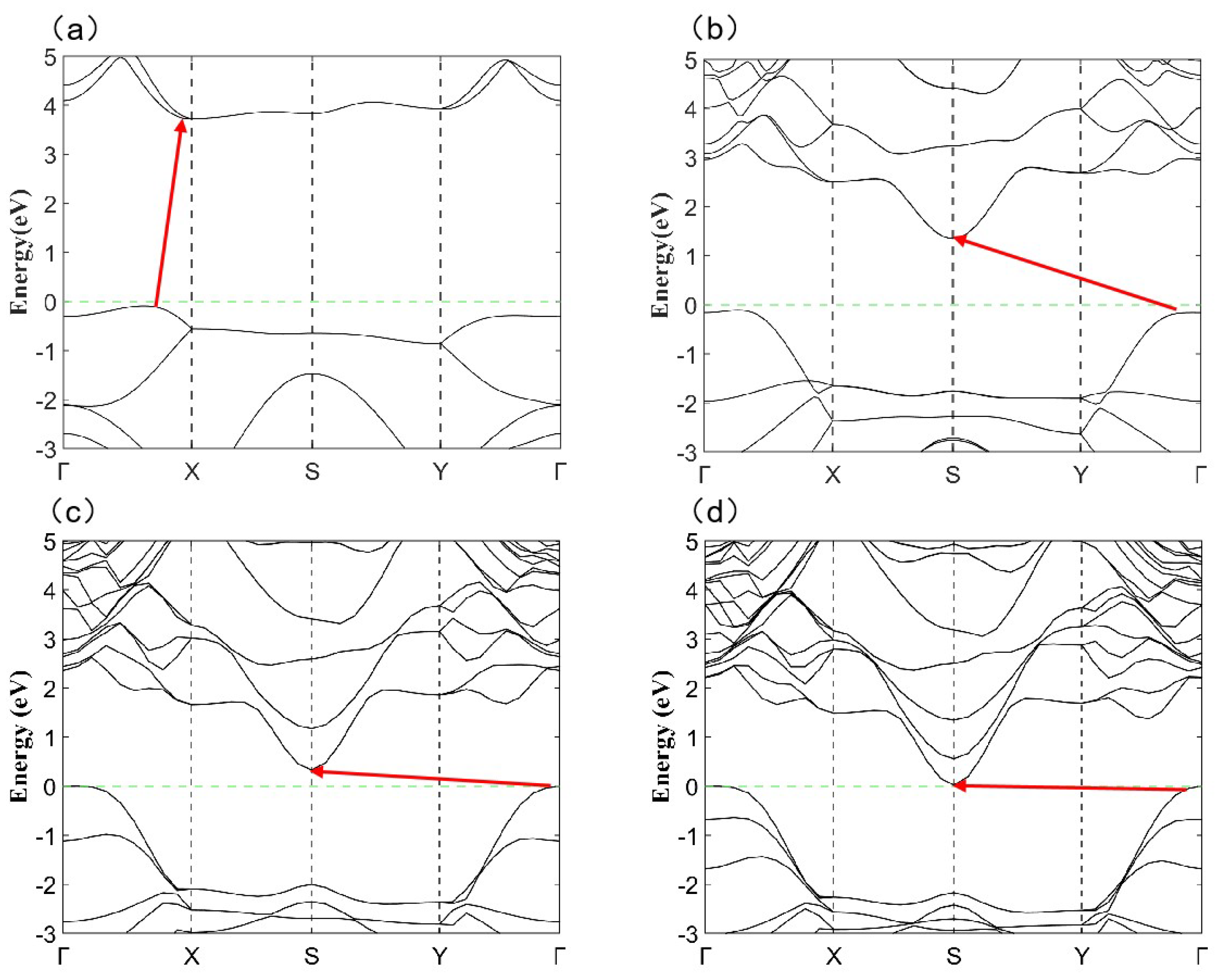
To elucidate the mechanism behind the layer-dependent bandgap reduction observed in Figure 3, we focus on the SnO-nL-Pmmn family as a representative system. Figure 5 depicts the electronic band structures for SnO-1L-Pmmn (structure (a-i) in Figure 2) and its layered counterparts. Figure 5 depicts the HSE06-calculated band structures from monolayer to tetralayer, clearly demonstrating the progressive closure of the bandgap with increasing layer count. The monolayer exhibits a substantial indirect bandgap of 3.81 eV, which rapidly decreases to 1.46 eV (bilayer), 0.33 eV (trilayer), and ultimately to a near-metallic 0.03 eV in the tetralayer. This systematic reduction arises from the evolution of both valence and conduction band edges: interlayer interactions cause a pronounced upward shift in the valence band maximum and a concurrent downward shift in the conduction band minimum, effectively narrowing the bandgap through enhanced interlayer electronic coupling. For a detailed description of the electronic band structures of other configurations obtained from PBE calculations, please refer to Section SII of the Supporting Information. Band structures from HSE06 calculations can be found in Section SIII of the Supporting Information. This focused analysis on the SnO-nL-Pmmn family complements the broader survey of monolayer band structures in Figure 4, providing a detailed view of layer-dependent effects in one of the most stable configurations identified in our study.
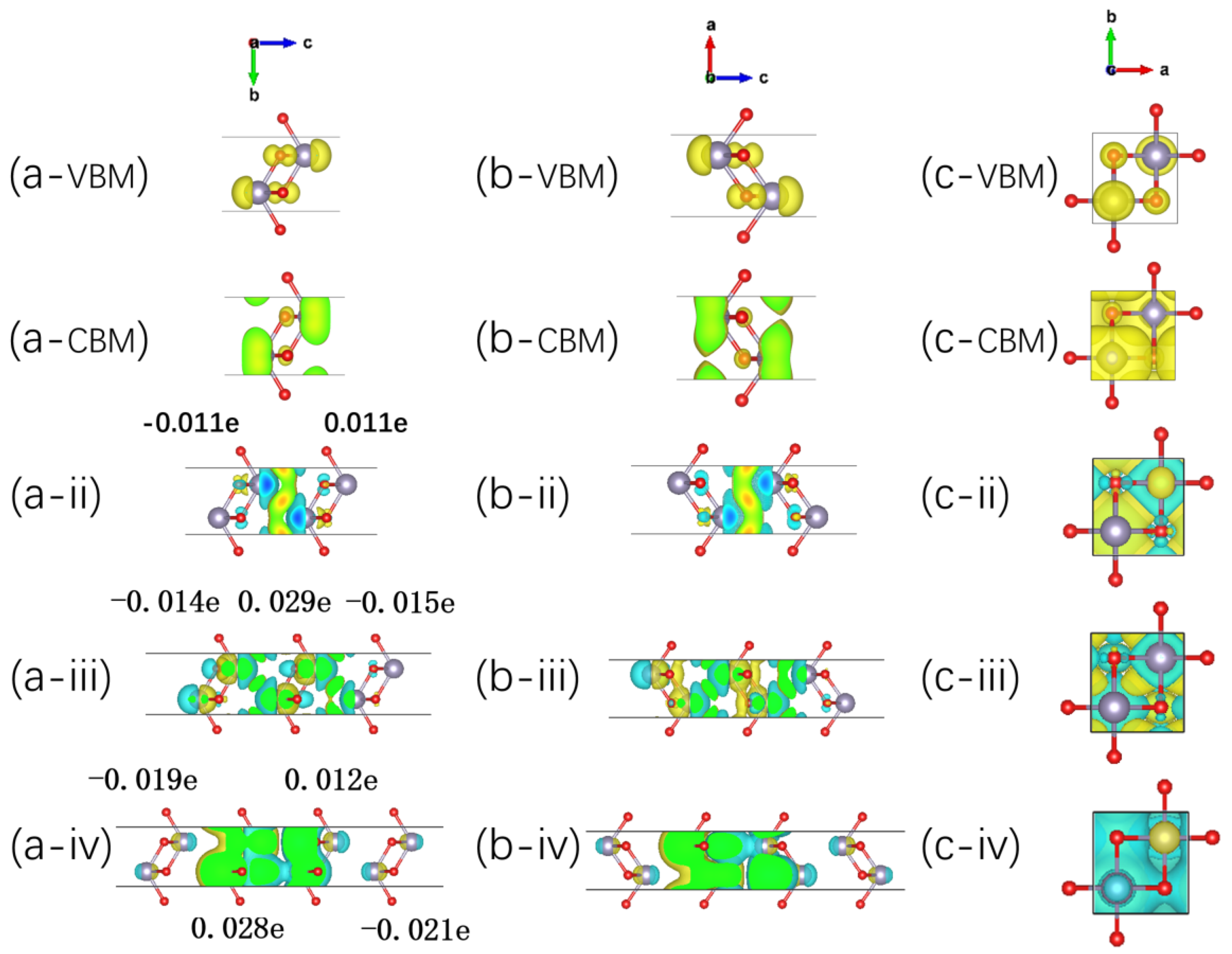
The fundamental driving force behind this electronic structure evolution is directly visualized through charge density analysis. Figure 6 provides a comprehensive picture of the layer-dependent charge redistribution. The first two rows display the charge distributions at the VBM and CBM for the monolayer, showing the characteristic orbital contributions that define the band edges. More importantly, the charge density difference (CDD) plots, defined as Δ ρ = ρ total i ρ i (where ρ i represents the charge density of isolated individual layers), reveal the net charge redistribution due to interlayer interactions.
The CDD analysis demonstrates a progressive enhancement of interlayer charge transfer with increasing layer count. Bader charge analysis quantifies this trend: the interlayer charge transfer increases from 0.011 e in the bilayer to 0.014 e in the trilayer and 0.019 e in the tetralayer. This systematic increase in charge transfer, coupled with the expanding regions of charge accumulation (yellow isosurfaces) in the interlayer regions, provides direct evidence of strengthened interlayer electronic coupling. The growing charge cloud in the central regions of multilayer configurations indicates enhanced wavefunction overlap between layers, which facilitates the bandgap narrowing observed in both PBE and HSE06 calculations.
This combined analysis of band structures and charge distributions establishes a coherent physical picture: the enhanced interlayer coupling, quantified by increasing charge transfer, modifies the electronic structure through wavefunction hybridization across layers. This leads to band renormalization where the valence band maximum rises and conduction band minimum descends, systematically reducing the bandgap as layer count increases. The excellent agreement between our HSE06 bandgaps and experimental values, coupled with this mechanistic understanding of the layer-dependent behavior, provides a solid foundation for designing SnO-based devices with tailored electronic properties. For complete band structures and charge density analyses of all SnO families, see Sections SII–SIV of the Supporting Information.

3. Methodology

First-principles calculations based on density functional theory (DFT) were performed using the Vienna ab initio simulation package (VASP) [38,39]. The electron–ion interactions were described by the projector-augmented wave (PAW) method [40], and the exchange-correlation functional was treated within both the generalized gradient approximation (GGA) using the Perdew–Burke–Ernzerhof (PBE) formulation [41] and the hybrid HSE06 functional [42]. To accurately describe the interlayer interactions in the layered SnO structures, the van der Waals (vdW) corrections were incorporated using the DFT-D3 method with Becke–Johnson damping as proposed by Grimme [43,44].
A plane-wave kinetic energy cutoff of 520 eV was employed for the basis set. The Brillouin zone integration was sampled using Γ -centered k-point meshes with a grid spacing of less than 0.03 Å−1, specifically 6 × 6 × 5 for bulk phases (corresponding to a spacing of ∼0.02 Å−1) and 9 × 9 × 1 for all layered structures (corresponding to a spacing of ∼0.015 Å−1), ensuring energy convergence. For the HSE06 calculations, single-point energy calculations were performed on the PBE-optimized structures. The electronic self-consistent field iteration was considered converged when the total energy change between successive steps was below 10 6 eV. All atomic positions and lattice parameters were fully relaxed until the Hellmann–Feynman forces on each atom were less than 0.01 eV/Å.
To model the two-dimensional systems, periodic boundary conditions were applied in the in-plane directions (x and y), while a vacuum layer of 15 Åwas introduced along the z-direction to eliminate spurious interactions between periodic images. This vacuum size was confirmed to be sufficient by testing that the total energy variation was less than 1 meV/atom when increased further.
Additionally, to gain deeper insight into the orbital contributions to the electronic structure, projected density of states (PDOS) analyses were performed for all configurations. and can be found in Section SV of the Supporting Information. These PDOS calculations were carried out using the QuantumATK software (W-2024.09) package [45], which employs localized basis sets and is highly efficient for such post-processing analysis.

4. Conclusions

In summary, this systematic first-principles study demonstrates that the electronic structure of two-dimensional SnO can be effectively engineered through both layer thickness and crystallographic symmetry. We have quantified a pronounced bandgap reduction from 3.94 eV in the monolayer to nearly 0 eV in the tetralayer, a trend validated by HSE06 calculations. Furthermore, distinct space groups are shown to significantly modulate the electronic properties, offering an alternative strategy for bandgap tuning. The underlying mechanism for the layer-dependent behavior is attributed to progressively enhanced interlayer electronic coupling, directly evidenced by the increasing interlayer charge transfer revealed through Bader analysis. These findings establish clear design principles for manipulating the electronic landscape of 2D SnO, providing valuable guidance for its application in future optoelectronic and quantum devices.

Supplementary Materials

The following supporting information can be downloaded at https://www.mdpi.com/article/10.3390/surfaces9010008/s1, Section SI. Structural properties for crystal and layered SnO. Table S1: Structural properties for SnO-1L-Pmmn and its corresponding multilayered relatives; Table S2: Structural properties for crystal and layered Pmn21-SnO up to 4 layers; Table S3: Structural properties for crystal and layered Cmc21-SnO up to 4 layers; Table S4: Structural properties for crystal and layered Cmce-SnO up to 4 layers; Table S5: Structural properties for crystal and layered P4/mmm-SnO up to 4 layers; Table S6: Structural properties for crystal and layered P4/nmm-SnO up to 4 layers; Section SII. Band structures obtained from PBE calculations. Figure S1: Band structure of (a) SnO-1L-Pmmn, (b) SnO-2L-Pmm2, (c) SnO-3L-Pmm2, and (d) SnO-4L-Pmm2 obtained from PBE calculations; Figure S2: Band structures of (a) Pmn21-SnO-1L, (b) Pmn21-SnO-2L, (c) Pmn21-SnO-3L, (d) Pmn21-SnO-4L, and (e) Pmn21-SnO obtained from PBE calculations; Figure S3: Band structures of (a) Cmc21-SnO-1L, (b) Cmc21-SnO-2L, (c) Cmc21-SnO-3L, and (d) Cmc21-SnO-4L, and (e)Cmc21-SnO obtained from PBE calculations; Figure S4: Band structures of (a) Cmce-SnO-1L, (b) Cmce-SnO-2L, (c) Cmce-SnO-3L, (d) Cmce-SnO-4L, and (e) Cmce-SnO obtained from PBE calculations; Figure S5: Band structures of (a) P4/mmm-SnO-1L, (b) P4/mmm-SnO-2L, (c) P4/mmm-SnO-3L, (d) P4/mmm-SnO-4L, and (e) P4/mmm-SnO obtained from PBE calculations; Figure S6: Band structures of (a) α -SnO-1L, (b) α -SnO-2L, (c) α -SnO-3L, (d) α -SnO-4L, and (e) α -SnO obtained from PBE calculations; Figure S7: Band structures of (a) P4/nmm-SnO-1L, (b) P4/nmm-SnO-2L, (c) P4/nmm-SnO-3L, (d) P4/nmm-SnO-4L, and (e) P4/nmm-SnO obtained from PBE calculations; Section SIII. Band structures obtained from HSE06 calculations. Figure S8: Band structures of (a) Pmn21-SnO-1L, (b) Pmn21-SnO-2L, (c) Pmn21-SnO-3L, (d) Pmn21-SnO-4L, and (e) Pmn21- SnO obtained from HSE06 calculations; Figure S9: Band structures of (a) Cmc21-SnO-1L, (b) Cmc21-SnO-2L, (c) Cmc21-SnO-3L, and (d) Cmc21-SnO-4L obtained from HSE06 calculations; Figure S10: Band structures of (a) Cmce-SnO-1L, (b) Cmce-SnO-2L, (c) Cmce-SnO-3L, and (d) Cmce-SnO-4L obtained from HSE06 calculations; Figure S11: Band structures of (a) P4/mmm-SnO-1L, (b) P4/mmm-SnO-2L, (c) P4/mmm-SnO-3L, and (d) P4/mmm-SnO-4L obtained from HSE06 calculations; Figure S12: Band structures of (a) α -SnO-1L, (b) α -SnO-2L, (c) α -SnO-3L, and (d) α -SnO-4L obtained from HSE06 calculations; Figure S13: Band structures of (a) P4/nmm-SnO-1L, (b) P4/nmm-SnO-2L, (c) P4/nmm-SnO-3L, and (d) P4/nmm-SnO-4L obtained from HSE06 calculations; Section SIV. Charge density difference for multi-layered SnO. Figure S14: Charge density difference for (-ii) Pmn21-SnO-2L, (-iii) Pmn21-SnO-3L, and (-iv) Pmn21-SnO-4L in first, second, third rows, respectively. The (a) first, (b) second, (c) third columns denote the view from vector a, vector b, and vector c, respectively. Net charge of each layers is shown in (a-ii), (a-iii), and (a-iv); Figure S15: Charge density difference for (-ii) Cmc21-SnO-2L, (-iii) Cmc21-SnO-3L, and (-iv) Cmc21-SnO-4L in first, second, third rows, respectively. The (a) first, (b) second, (c) third columns denote the view from vector a, vector b, and vector c, respectively. Net charge of each layers is shown in (a-ii), (a-iii), and (a-iv); Figure S16: Charge density difference for (-ii) Cmce-SnO-2L, (-iii) Cmce-SnO-3L, and (-iv) Cmce-SnO-4L in first, second, third rows, respectively. The (a) first, (b) second, (c) third columns denote the view from vector a, vector b, and vector c, respectively. Net charge of each layers is shown in (a-ii), (a-iii), and (a-iv); Figure S17: Charge density difference for (-ii) P4/mmm-SnO-2L, (-iii) P4/mmm-SnO-3L, and (-iv) P4/mmm-SnO-4L in first, second, third rows, respectively. The (a) first, (b) second, (c) third columns denote the view from vector a, vector b, and vector c, respectively. Net charge of each layers is shown in (a-ii), (a-iii), and (a-iv); Figure S18: Charge density difference for (-ii) α -SnO-2L, (-iii) α -SnO-3L, and (-iv) α -SnO-4L in first, second, third rows, respectively. The (a) first, (b) second, (c) third columns denote the view from vector a, vector b, and vector c, respectively. Net charge of each layers is shown in (a-ii), (a-iii), and (a-iv); Figure S19: Charge density difference for (-ii) P4/nmm-SnO-2L, (-iii) P4/nmm-SnO-3L, and (-iv) P4/nmm-SnO-4L in first, second, third rows, respectively. The (a) first, (b) second, (c) third columns denote the view from vector a, vector b, and vector c, respectively. Net charge of each layers is shown in (a-ii), (a-iii), and (a-iv); Section SV. Projected Partial Density of States (PDOS) Plot of Tin(II) Oxide. Figure S20: Projected density of states (PDOS) for (a) SnO-1L-Pmmn, (b) SnO-2L-Pmm2, (c) SnO-3L-Pmm2,and (d) SnO-4L-Pmm2; Figure S21: Projected density of states (PDOS) for (a) Pmn21-SnO-1L, (b) Pmn21-SnO-2L, (c) Pmn21-SnO-3L, (d) Pmn21-SnO-4L, and (e) Pmn21-SnO; Figure S22: Projected density of states (PDOS) for (a) Cmc21-SnO-1L, (b) Cmc21-SnO-2L, (c) Cmc21-SnO-3L, and (d) Cmc21-SnO-4L; Figure S23: Projected density of states (PDOS) for (a) Cmce-SnO-1L, (b) Cmce-SnO-2L, (c) Cmce-SnO-3L, and (d) Cmce-SnO-4L; Figure S24: Projected density of states (PDOS) for (a) P4/mmm-SnO-1L, (b) P4/mmm-SnO-2L, (c) P4/mmm-SnO-3L, and (d) P4/mmm-SnO-4L; Figure S25: Projected density of states (PDOS) for (a) α -SnO-1L, (b) α -SnO-2L, (c) α -SnO-3L, and (d) α -SnO-4L; Figure S26: Projected density of states (PDOS) for (a) P4/nmm-SnO-1L, (b) P4/nmm-SnO-2L, (c) P4/nmm-SnO-3L, and (d) P4/nmm-SnO-4L.

Author Contributions

Conceptualization, Z.H. and G.L.; methodology, Z.H. and X.D.; software, M.B. and C.Y.; validation, X.W., X.D. and L.D.; formal analysis, Z.H., X.W. and X.D.; investigation, Z.H., X.W., X.D., L.D. and H.L.; resources, G.L.; data curation, Z.H., X.W. and X.D.; writing—original draft preparation, X.D.; writing—review and editing, Z.H.; visualization, Z.H., X.D. and X.W.; supervision, G.L.; project administration, Z.H. and G.L.; funding acquisition, Z.H. All authors have read and agreed to the published version of the manuscript.

Funding

This research was funded by by Science and Technology Research project of Chongqing Education Commission under Nos. KJQN202201421 and KJQN202401422, and Fuling District guiding scientific research project under No. FLKJ.2024BAG5130.

Data Availability Statement

Data are contained within the article. Further inquiries can be directed to the corresponding author.

Acknowledgments

We would like to express our sincere gratitude to Yangtze Normal University and Nankai University for providing the equipment for this research.

Conflicts of Interest

The authors declare no conflicts of interest.

References

  1. Grigorieva, V.; Firsov, A. Electric field in atomically thin carbon films. Science 2004, 205, 666–669. [Google Scholar] [CrossRef] [PubMed]
  2. Castro Neto, A.H.; Guinea, F.; Peres, N.M.; Novoselov, K.S.; Geim, A.K. The electronic properties of graphene. Rev. Mod. Phys. 2009, 81, 109–162. [Google Scholar] [CrossRef]
  3. Rodgers, P. Nanoscience and Technology: A Collection of Reviews from Nature Journals; World Scientific: Singapore, 2009. [Google Scholar]
  4. Kara, A.; Enriquez, H.; Seitsonen, A.P.; Voon, L.L.Y.; Vizzini, S.; Aufray, B.; Oughaddou, H. A review on silicene—new candidate for electronics. Surf. Sci. Rep. 2012, 67, 1–18. [Google Scholar] [CrossRef]
  5. Cahangirov, S.; Topsakal, M.; Aktürk, E.; Şahin, H.; Ciraci, S. Two-and one-dimensional honeycomb structures of silicon and germanium. Phys. Rev. Lett. 2009, 102, 236804. [Google Scholar] [CrossRef]
  6. Zhang, K.; Feng, Y.; Wang, F.; Yang, Z.; Wang, J. Two dimensional hexagonal boron nitride (2D-hBN): Synthesis, properties and applications. J. Mater. Chem. C 2017, 5, 11992–12022. [Google Scholar] [CrossRef]
  7. Zhang, S.; Zhou, J.; Wang, Q.; Chen, X.; Kawazoe, Y.; Jena, P. Penta-graphene: A new carbon allotrope. Proc. Natl. Acad. Sci. USA 2015, 112, 2372–2377. [Google Scholar] [CrossRef]
  8. Manzeli, S.; Ovchinnikov, D.; Pasquier, D.; Yazyev, O.V.; Kis, A. 2D transition metal dichalcogenides. Nat. Rev. Mater. 2017, 2, 17033. [Google Scholar] [CrossRef]
  9. Ataca, C.; Sahin, H.; Ciraci, S. Stable, single-layer MX2 transition-metal oxides and dichalcogenides in a honeycomb-like structure. J. Phys. Chem. C 2012, 116, 8983–8999. [Google Scholar] [CrossRef]
  10. Yang, T.; Song, T.T.; Callsen, M.; Zhou, J.; Chai, J.W.; Feng, Y.P.; Wang, S.J.; Yang, M. Atomically thin 2D transition metal oxides: Structural reconstruction, interaction with substrates, and potential applications. Adv. Mater. Interfaces 2019, 6, 1801160. [Google Scholar] [CrossRef]
  11. Le, T.H.; Oh, Y.; Kim, H.; Yoon, H. Exfoliation of 2D materials for energy and environmental applications. Chem.- Eur. J. 2020, 26, 6360–6401. [Google Scholar] [CrossRef]
  12. Vilá, R.; Momeni, K.; Wang, Q.; Bersch, B.; Lu, N.; Kim, M.; Chen, L.; Robinson, J. Bottom-up synthesis of vertically oriented two-dimensional materials. 2D Mater. 2016, 3, 041003. [Google Scholar] [CrossRef]
  13. Mounet, N.; Gibertini, M.; Schwaller, P.; Campi, D.; Merkys, A.; Marrazzo, A.; Sohier, T.; Castelli, I.E.; Cepellotti, A.; Pizzi, G.; et al. Two-dimensional materials from high-throughput computational exfoliation of experimentally known compounds. Nat. Nanotechnol. 2018, 13, 246–252. [Google Scholar] [CrossRef]
  14. Dong, B.; Wang, Z.; Hung, N.T.; Oganov, A.R.; Yang, T.; Saito, R.; Zhang, Z. New two-dimensional phase of tin chalcogenides: Candidates for high-performance thermoelectric materials. Phys. Rev. Mater. 2019, 3, 013405. [Google Scholar] [CrossRef]
  15. Mannix, A.J.; Zhou, X.F.; Kiraly, B.; Wood, J.D.; Alducin, D.; Myers, B.D.; Liu, X.; Fisher, B.L.; Santiago, U.; Guest, J.R.; et al. Synthesis of borophenes: Anisotropic, two-dimensional boron polymorphs. Science 2015, 350, 1513–1516. [Google Scholar] [CrossRef]
  16. Joseph, T.; Ghorbani-Asl, M.; Kvashnin, A.; Larionov, K.; Popov, Z.; Sorokin, P.; Krasheninnikov, A.V. Nonstoichiometric phases of two-dimensional transition-metal dichalcogenides: From chalcogen vacancies to pure metal membranes. J. Phys. Chem. Lett. 2019, 10, 6492–6498. [Google Scholar] [CrossRef]
  17. Puthirath Balan, A.; Radhakrishnan, S.; Woellner, C.F.; Sinha, S.K.; Deng, L.; Reyes, C.d.l.; Rao, B.M.; Paulose, M.; Neupane, R.; Apte, A.; et al. Exfoliation of a non-van der Waals material from iron ore hematite. Nat. Nanotechnol. 2018, 13, 602–609. [Google Scholar] [CrossRef] [PubMed]
  18. Wang, J.; Umezawa, N.; Hosono, H. Mixed valence tin oxides as novel van der Waals materials: Theoretical predictions and potential applications. Adv. Energy Mater. 2016, 6, 1501190. [Google Scholar] [CrossRef]
  19. Mubeen, A.; Majid, A.; Alkhedher, M.; Tag-ElDin, E.M.; Bulut, N. Structural and electronic properties of SnO downscaled to monolayer. Materials 2022, 15, 5578. [Google Scholar] [CrossRef]
  20. Hu, Y.; Schlom, D.; Datta, S.; Cho, K. Interlayer engineering of band gap and hole mobility in p-type oxide SnO. ACS Appl. Mater. Interfaces 2022, 14, 25670–25679. [Google Scholar] [CrossRef]
  21. Ogo, Y.; Hiramatsu, H.; Nomura, K.; Yanagi, H.; Kamiya, T.; Hirano, M.; Hosono, H. p-channel thin-film transistor using p-type oxide semiconductor, SnO. Appl. Phys. Lett. 2008, 93, 032113. [Google Scholar]
  22. Wan, W.; Ge, Y.; Liu, Y. Strong phonon anharmonicity and low thermal conductivity of monolayer tin oxides driven by lone-pair electrons. Appl. Phys. Lett. 2019, 114, 031901. [Google Scholar] [CrossRef]
  23. Rahamana, M.M.; Momin, M.A.; Majumdar, A.; Rahman, M.J. DFT Based LDA Study on Tailoring the Optical and Electrical Properties of SnO and In-Doped SnO. arXiv 2023, arXiv:2307.03843. [Google Scholar]
  24. Reuter, H. Red and blue-black tin monoxide, sno: Pitfalls, challenges, and helpful tools in crystal structure determination of low-intensity datasets from microcrystals. Crystals 2023, 13, 1281. [Google Scholar] [CrossRef]
  25. Watson, G.W. The origin of the electron distribution in SnO. J. Chem. Phys. 2001, 114, 758–763. [Google Scholar] [CrossRef]
  26. Hunanyan, A.A.; Aroutiounian, V.M.; Zakaryan, H.A. Computational Search and Stability Analysis of Two-Dimensional Tin Oxides. J. Phys. Chem. C 2022, 126, 4647–4654. [Google Scholar] [CrossRef]
  27. Shang, Z.W.; Hsu, H.H.; Zheng, Z.W.; Cheng, C.H. Progress and challenges in p-type oxide-based thin film transistors. Nanotechnol. Rev. 2019, 8, 422–443. [Google Scholar] [CrossRef]
  28. Nguyen, L.T.; Makov, G. High-pressure phases of SNO and PBO: A density functional theory combined with an evolutionary algorithm approach. Materials 2021, 14, 6552. [Google Scholar] [CrossRef]
  29. Jiang, K.; Ji, J.; Gong, W.; Ding, L.; Li, J.; Li, P.; Li, B.; Geng, F. Mechanical cleavage of non-van der Waals structures towards two-dimensional crystals. Nat. Synth. 2023, 2, 58–66. [Google Scholar] [CrossRef]
  30. Kripalani, D.R.; Sun, P.P.; Lin, P.; Xue, M.; Zhou, K. Strain-driven superplasticity of ultrathin tin (II) oxide films and the modulation of their electronic properties: A first-principles study. Phys. Rev. B 2019, 100, 214112. [Google Scholar] [CrossRef]
  31. Daeneke, T.; Atkin, P.; Orrell-Trigg, R.; Zavabeti, A.; Ahmed, T.; Walia, S.; Liu, M.; Tachibana, Y.; Javaid, M.; Greentree, A.D.; et al. Wafer-scale synthesis of semiconducting SnO monolayers from interfacial oxide layers of metallic liquid tin. ACS Nano 2017, 11, 10974–10983. [Google Scholar] [CrossRef]
  32. Köhler, J.; Tong, J.; Dinnebier, R.; Simon, A. Crystal structure and electronic structure of red SnO. Z. Für Anorg. Und Allg. Chem. 2012, 638, 1970–1975. [Google Scholar] [CrossRef]
  33. Wanzhong, L.; Jian, S.; Chong, D. Layer-dependent electronic and optical properties of tin monoxide: A potential candidate in photovoltaic applications. Phys. Chem. Chem. Phys. 2022, 24, 7611–7616. [Google Scholar] [CrossRef]
  34. Jain, A.; Ong, S.P.; Hautier, G.; Chen, W.; Richards, W.D.; Dacek, S.; Cholia, S.; Gunter, D.; Skinner, D.; Ceder, G.; et al. Commentary: The Materials Project: A materials genome approach to accelerating materials innovation. APL Mater. 2013, 1, 011002. [Google Scholar] [CrossRef]
  35. Bartel, C.J. Review of computational approaches to predict the thermodynamic stability of inorganic solids. J. Mater. Sci. 2022, 57, 10475–10498. [Google Scholar] [CrossRef]
  36. Li, K.; Wang, J.; Blatov, V.A.; Gong, Y.; Umezawa, N.; Tada, T.; Hosono, H.; Oganov, A.R. Crystal and electronic structure engineering of tin monoxide by external pressure. J. Adv. Ceram. 2021, 10, 565–577. [Google Scholar] [CrossRef]
  37. Wang, V.; Tang, G.; Liu, Y.C.; Wang, R.T.; Mizuseki, H.; Kawazoe, Y.; Nara, J.; Geng, W.T. High-throughput computational screening of two-dimensional semiconductors. J. Phys. Chem. Lett. 2022, 13, 11581–11594. [Google Scholar] [CrossRef]
  38. Kohn, W.; Sham, L.J. Self-consistent equations including exchange and correlation effects. Phys. Rev. 1965, 140, A1133. [Google Scholar] [CrossRef]
  39. Kresse, G.; Furthmüller, J. Efficient iterative schemes for ab initio total-energy calculations using a plane-wave basis set. Phys. Rev. B 1996, 54, 11169. [Google Scholar] [CrossRef] [PubMed]
  40. Blöchl, P.E. Projector augmented-wave method. Phys. Rev. B 1994, 50, 17953–17979. [Google Scholar] [CrossRef]
  41. Perdew, J.P.; Burke, K.; Ernzerhof, M. Generalized gradient approximation made simple. Phys. Rev. Lett. 1996, 77, 3865. [Google Scholar] [CrossRef] [PubMed]
  42. Heyd, J.; Scuseria, G.E.; Ernzerhof, M. Hybrid functionals based on a screened Coulomb potential. J. Chem. Phys. 2003, 118, 8207–8215. [Google Scholar] [CrossRef]
  43. Grimme, S. Semiempirical GGA-type density functional constructed with a long-range dispersion correction. J. Comput. Chem. 2006, 27, 1787–1799. [Google Scholar] [CrossRef] [PubMed]
  44. Grimme, S.; Ehrlich, S.; Goerigk, L. Effect of the damping function in dispersion corrected density functional theory. J. Comput. Chem. 2011, 32, 1456–1465. [Google Scholar] [CrossRef] [PubMed]
  45. Smidstrup, S.; Markussen, T.; Vancraeyveld, P.; Wellendorff, J.; Schneider, J.; Gunst, T.; Verstichel, B.; Stradi, D.; Khomyakov, P.A.; Vej-Hansen, U.G.; et al. QuantumATK: An integrated platform of electronic and atomic-scale modelling tools. J. Physics Condens. Matter 2019, 32, 15901. [Google Scholar] [CrossRef] [PubMed]
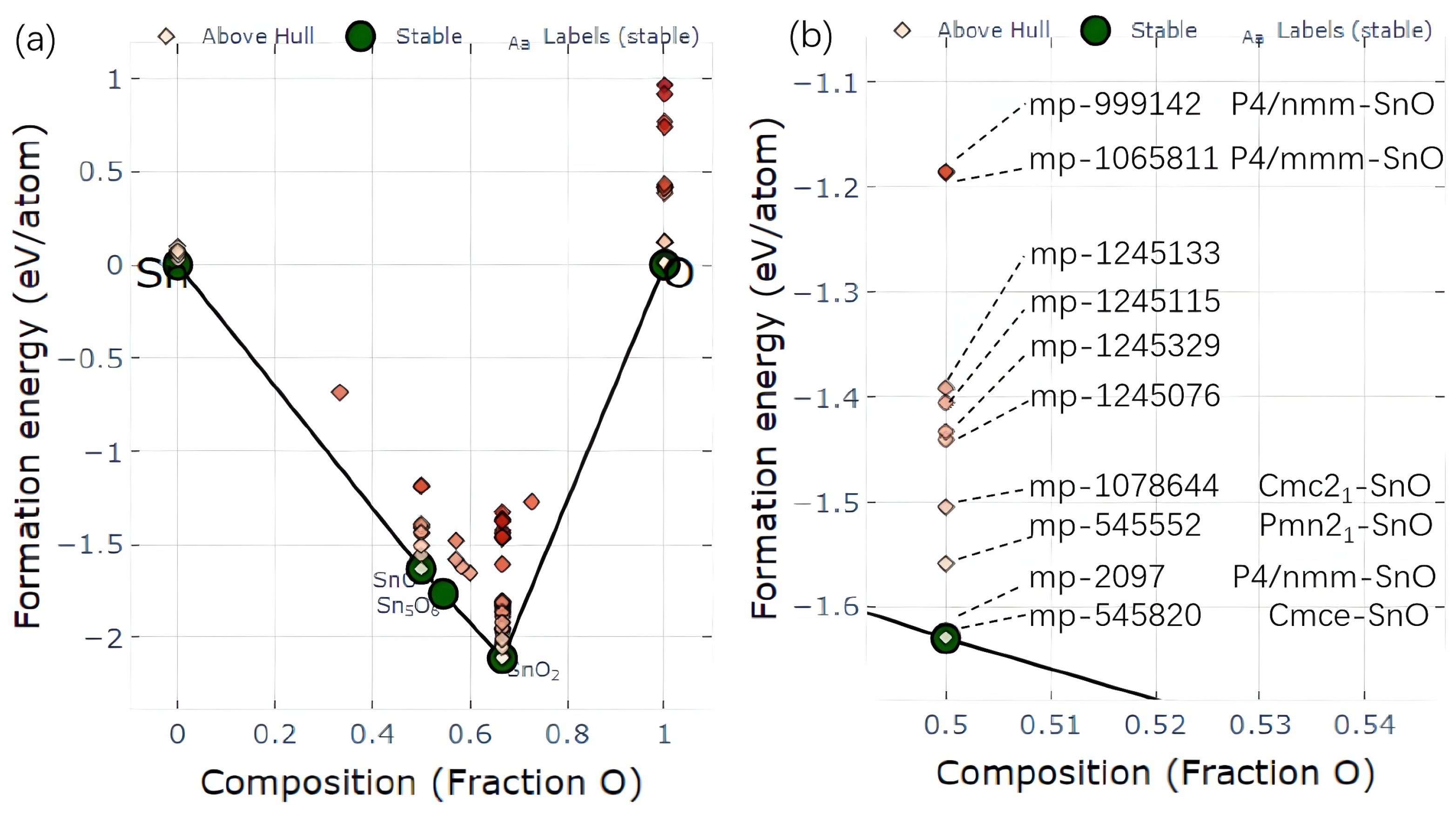
Figure 1. (a) Binary phase diagram of SnO compounds, highlighting stable phases (below the convex hull) and (b) detailing crystal structures with various formation energies for the Sn:O 1:1 ratio. “mp-*” denote the Material ID from Materials Project. “*-SnO” represent the corresponding crystals with quasi van der Waals structures.
Surfaces 09 00008 g001
Figure 2. Visual representation of the structural progression of optimized SnO is provided, with the beginning row presenting the top views (*-0) of seven columns of distinct configurations labeled (ag). The sequences of columns of depicted SnO structures here are harmoniously aligned with those detailed in Table 1. Subsequent rows depict the side views of SnO structures as they increase in layer count, including monolayer (*-i), bilayer (*-ii), trilayer (*-iii), and tetralayer (*-iv). The final row illustrates the side views of six crystalline structures (*-v) derived from phase diagram calculations. Gray and red balls denote Sn and O atoms, respectively.
Surfaces 09 00008 g002
Figure 3. (a) Cohesive energy and (b) HSE06 bandgap of investigated structures.
Surfaces 09 00008 g003
Figure 4. Energy band structures of various monolayer SnO configurations from HSE06 calculations: band structure of (a) Pmn21-SnO-1L, (b) Cmc21-SnO-1L, (c) Cmce-SnO-1L, (d) P4/mmm-SnO-1L, (e) α -SnO-1L and (f) P4/nmm-SnO-1L.
Surfaces 09 00008 g004
Figure 5. Band structure of (a) SnO-1L-Pmmn, (b) SnO-2L-Pmm2, (c) SnO-3L-Pmm2 and (d) SnO-4L-Pmm2 obtained from HSE06 calculations. Red arrows indicate the indirect bandgaps.
Surfaces 09 00008 g005
Figure 6. (Top rows) Charge distribution at the valence band maximum (VBM) and conduction band minimum (CBM) for monolayer SnO-1L-Pmmn. (Bottom rows) Charge density differences for (a-ii) SnO-2L-Pmm2, (a-iii) SnO-3L-Pmm2, and (a-iv) SnO-4L-Pmm2 structures, viewed along the (ac) crystallographic directions. Net Bader charges for each layer are indicated. Yellow and blue isosurfaces represent charge accumulation and depletion, respectively.
Surfaces 09 00008 g006
Table 1. Structural properties of studied crystal and layered SnO. Labels * in columns 3, 4, and 5 mark the monoclinic structures.
OrthorhombicTetragonal
CrystalNotationPmn21-SnOCmc21-SnOCmce-SnOP4/mmm-SnO α -SnOP4/nmm-SnO
International
symbol
Pmn21Cmc21CmceP4/mmmP4/nmmP4/nmm
Space group
number
313664123129129
Material IDmp-545552mp-1078644mp-545820mp-1065811mp-2097mp-999142
Wyckoff position
for Sn2+
2a2a4f1a2c2a
Experimental
realization
Yes; SnO at
high pressure
Yes
Red SnO
NoNoYes; Black-blue
SnO
No
MonolayerSnO-1L-Pmmn
(Pmmn;
No. 59)
Pmn21-SnO-1L
(Pmn21;
No. 31)
Cmc21-SnO-1L *
(Cm;
No. 8)
Cmce-SnO-1L
(Aem2;
No. 39)
P4/mmm-SnO-1L
(P4/mmm;
No. 123)
α -SnO-1L
(P4/nmm;
No. 129)
P4/nmm-SnO-1L
(P4/nmm;
No. 129)
BilayerSnO-2L-Pmm2
(Pmm2;
No. 25)
Pmn21-SnO-2L
(Pmn21;
No. 31)
Cmc21-SnO-2L *
(Cm;
No. 8)
Cmce-SnO-2L
(Aem2;
No. 39)
P4/mmm-SnO-2L
(P4/mmm;
No. 123)
α -SnO-2L
(P4/nmm;
No. 129)
P4/nmm-SnO-2L
(P4/nmm;
No. 129)
TrilayerSnO-3L-Pmm2
(Pmm2;
No. 25)
Pmn21-SnO-3L *
(Pm;
No. 6)
Cmc21-SnO-3L *
(Cm;
No. 8)
Cmce-SnO-3L *
(Cm;
No. 8)
P4/mmm-SnO-3L
(P4/mmm;
No. 123)
α -SnO-3L
(P4mm;
No. 99)
P4/nmm-SnO-3L
(P4mm;
No. 99)
TetralayerSnO-4L-Pmm2
(Pmm2;
No. 25)
Pmn21-SnO-4L *
(Pm;
No. 6)
Cmc21-SnO-4L *
(Cm;
No. 8)
Cmce-SnO-4L *
(Cm;
No. 8)
P4/mmm-SnO-4L
(P4/mmm;
No. 123)
α -SnO-4L
(P4mm;
No. 99)
P4/nmm-SnO-4L
(P4mm;
No. 99)
Table 2. Structural properties for crystal and layered α -SnO up to 4 layers.
LayersCrystal
Notation α -SnO-1L α -SnO-2L α -SnO-3L α -SnO-4L α -SnO
Latticea(Å) = b(Å)3.765113.775933.780013.780603.84082
c(Å)152535454.91413
Intra-layerSn-O(Å)2.241142.240572.242112.241922.25009
Sn-Sn(Å)3.605943.595853.595023.594953.84082
O-O(Å)2.662342.669992.672872.673292.71587
InterlayerO-O(Å)-4.966044.910534.909004.91413
Sn-Sn(Å)-4.970514.924454.922803.73840
Electronic
properties
Band characterIndirectIndirectIndirectIndirectIndirect
PBE bandgap (eV)3.01440.95720.36860.14320.04
HSE06 bandgap (eV)3.94301.52900.93910.14400.4818
Disclaimer/Publisher’s Note: The statements, opinions and data contained in all publications are solely those of the individual author(s) and contributor(s) and not of MDPI and/or the editor(s). MDPI and/or the editor(s) disclaim responsibility for any injury to people or property resulting from any ideas, methods, instructions or products referred to in the content.