
A New Partially Linear Regression with an Application to the Price of Coffee Before and After the Pandemic

 ,
,  ,
, 
Abstract
1. Introduction
2. Materials and Methods
2.1. Materials: Coffee Price Data Before and After the Pandemic
- : Arabica coffee price in Brazilian currency (Coffee is a key pillar of the Brazilian economy. Therefore, studying price trends is vital, given their profound influence on export revenue, the national trade balance, and consumer-level inflation.);
- : Robusta coffee price in Brazilian currency (Record-breaking prices for Brazilian robusta (conilon) are reshaping the economy, profoundly affecting the cost of living, trade balance, and earnings for producers.);
- : Global consumption (As the world’s top coffee producer and exporter, Brazil holds a dominant position in both global supply and local consumption.);
- : Presence of the pandemic (0 = beforehand, 1 = afterward) (The COVID-19 pandemic has profoundly influenced the coffee market overall, altering production, consumption patterns, and global supply chains.);
- : Broad National Consumer Price Index (IPCA) (The IPCA directly influences the price of coffee, serving as the primary measure of the increased costs consumers face when purchasing the product in supermarkets).
2.2. Methods: New Partial Regression Model
2.3. The GOLLN Partially Linear Regression
Computational Implementation
2.4. Residual Analysis
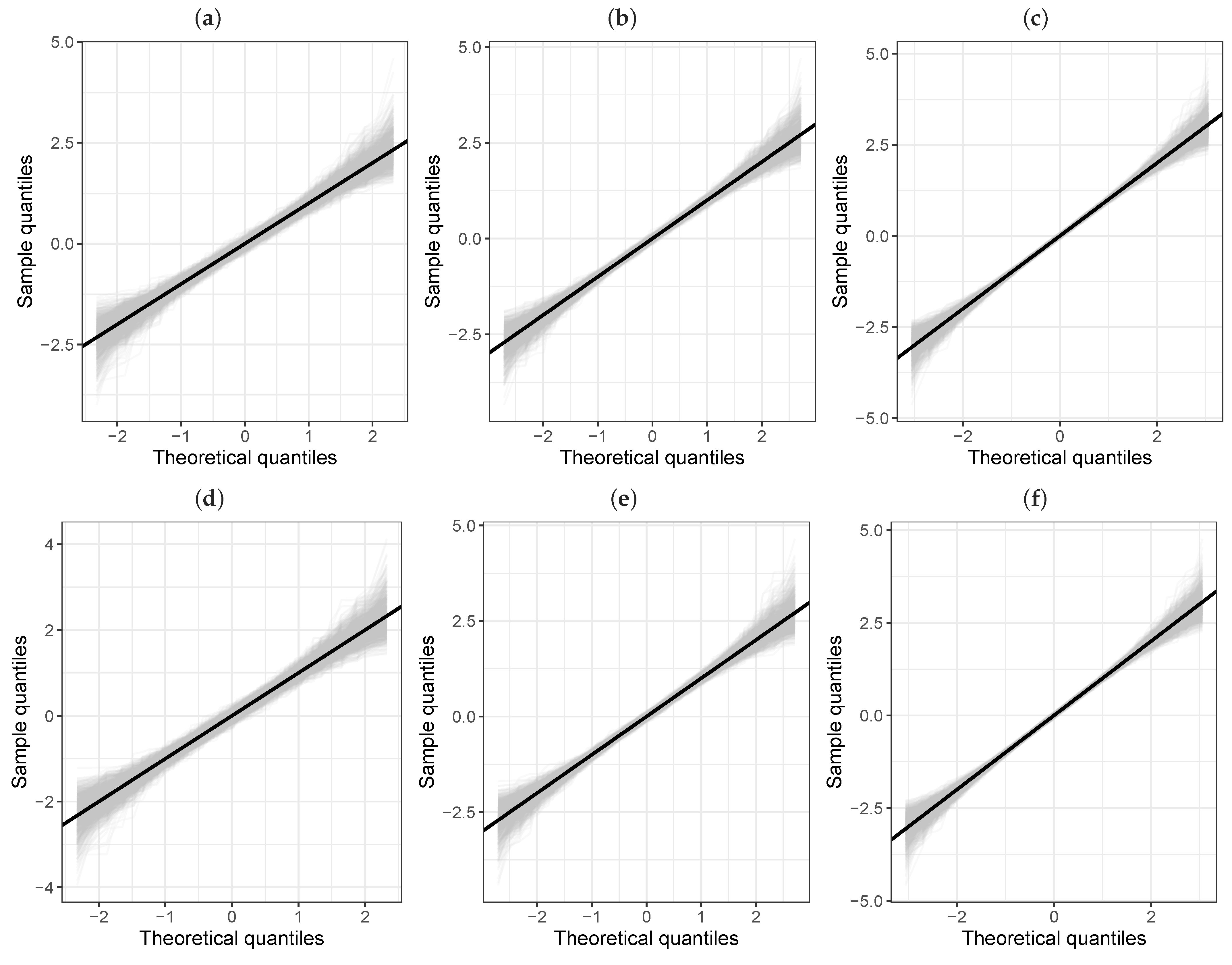
2.5. Simulation Study
- Scenario 1 (cubic structure for the nonlinear part): , where gives a cubic structure for the nonlinear part of the regression model.The true parameters are: , , and .
- Scenario 2 (quadratic structure for the nonlinear part): , where , , , and .
3. Results
3.1. Discussion of the GOLLNPLR
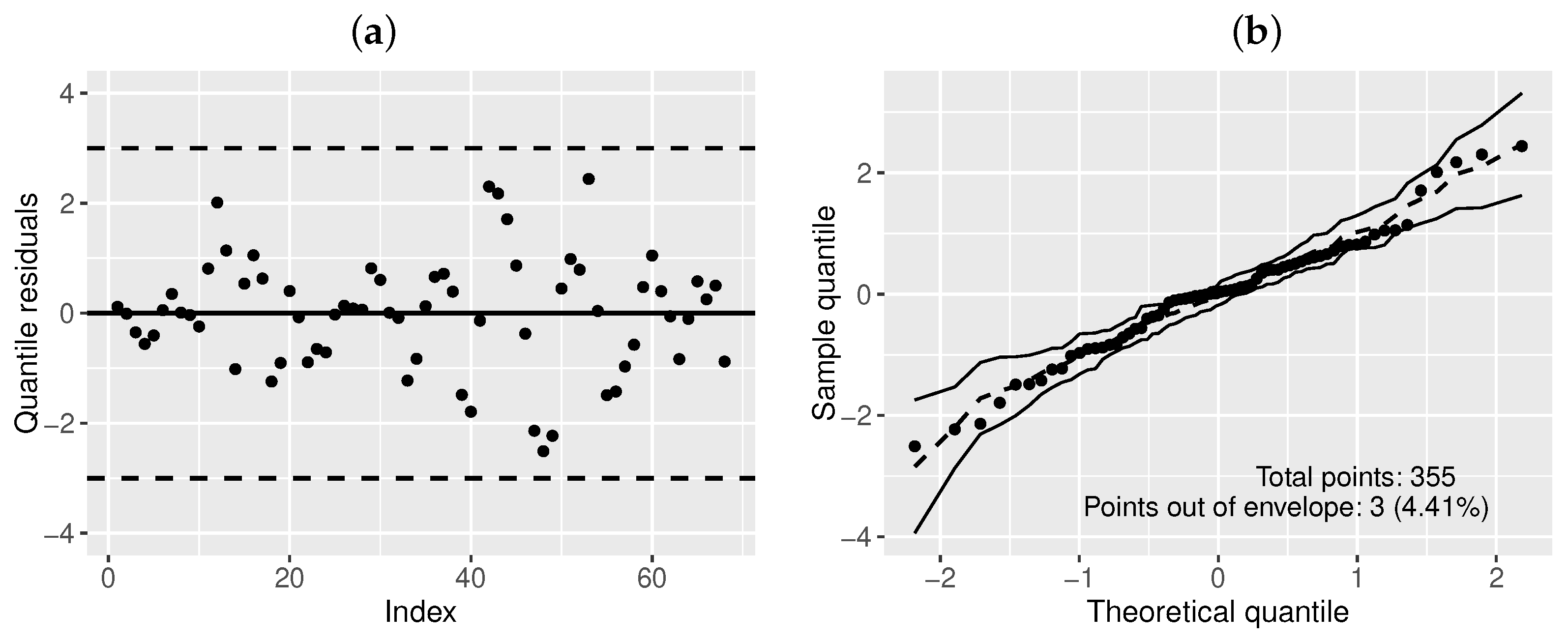
3.2. Residual Analysis
4. Discussion
4.1. Linear Effects
- Table 4 shows that as the price of Robusta coffee increases, the price of Arabica coffee also increases significantly.
- There is a small but significant drop in global consumption (as expected) when the price of coffee increases.
4.2. Pandemic Effect
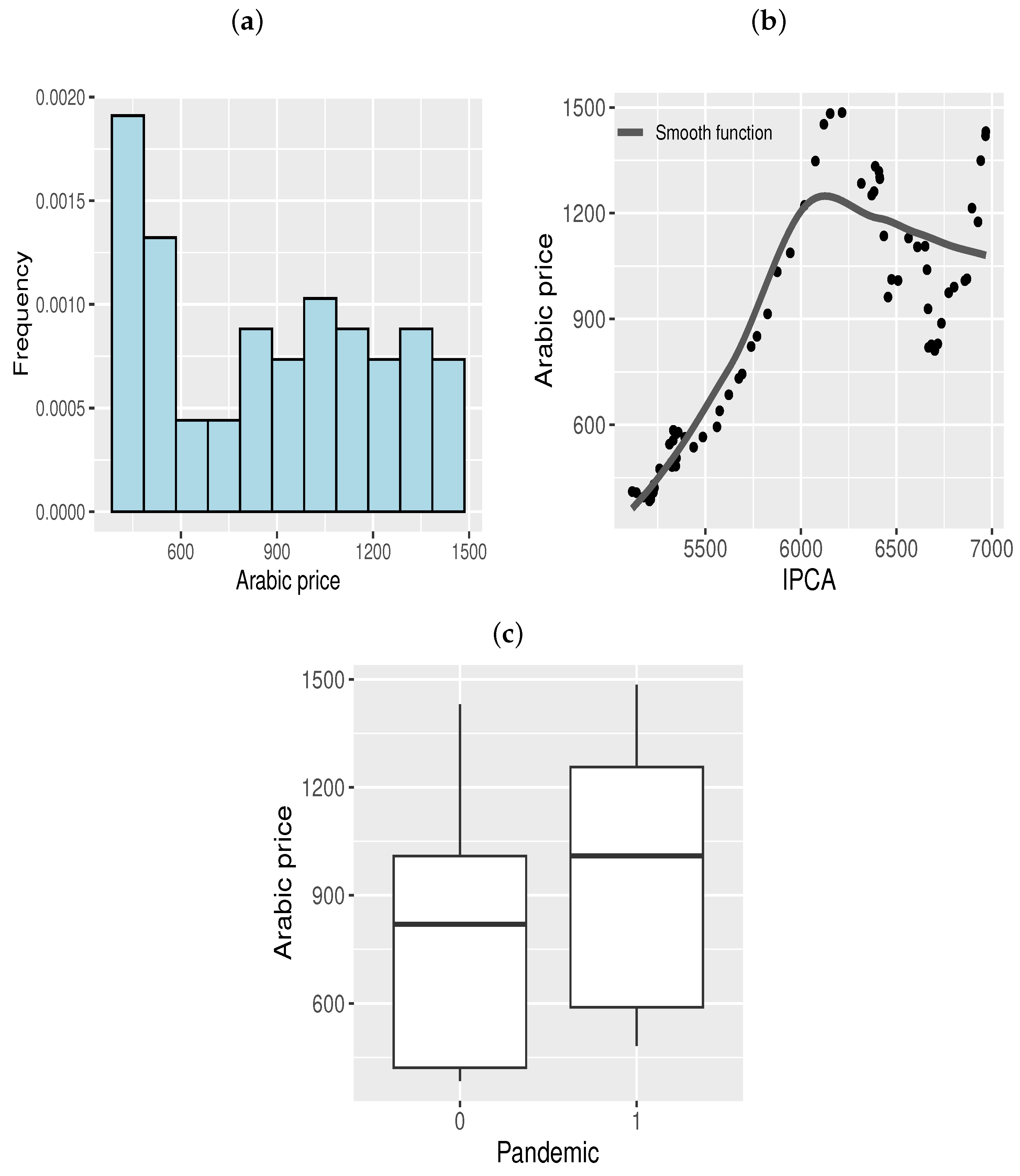
- The price of Arabica coffee is significantly different from the levels before and after the pandemic.
4.3. Nonlinear Effects
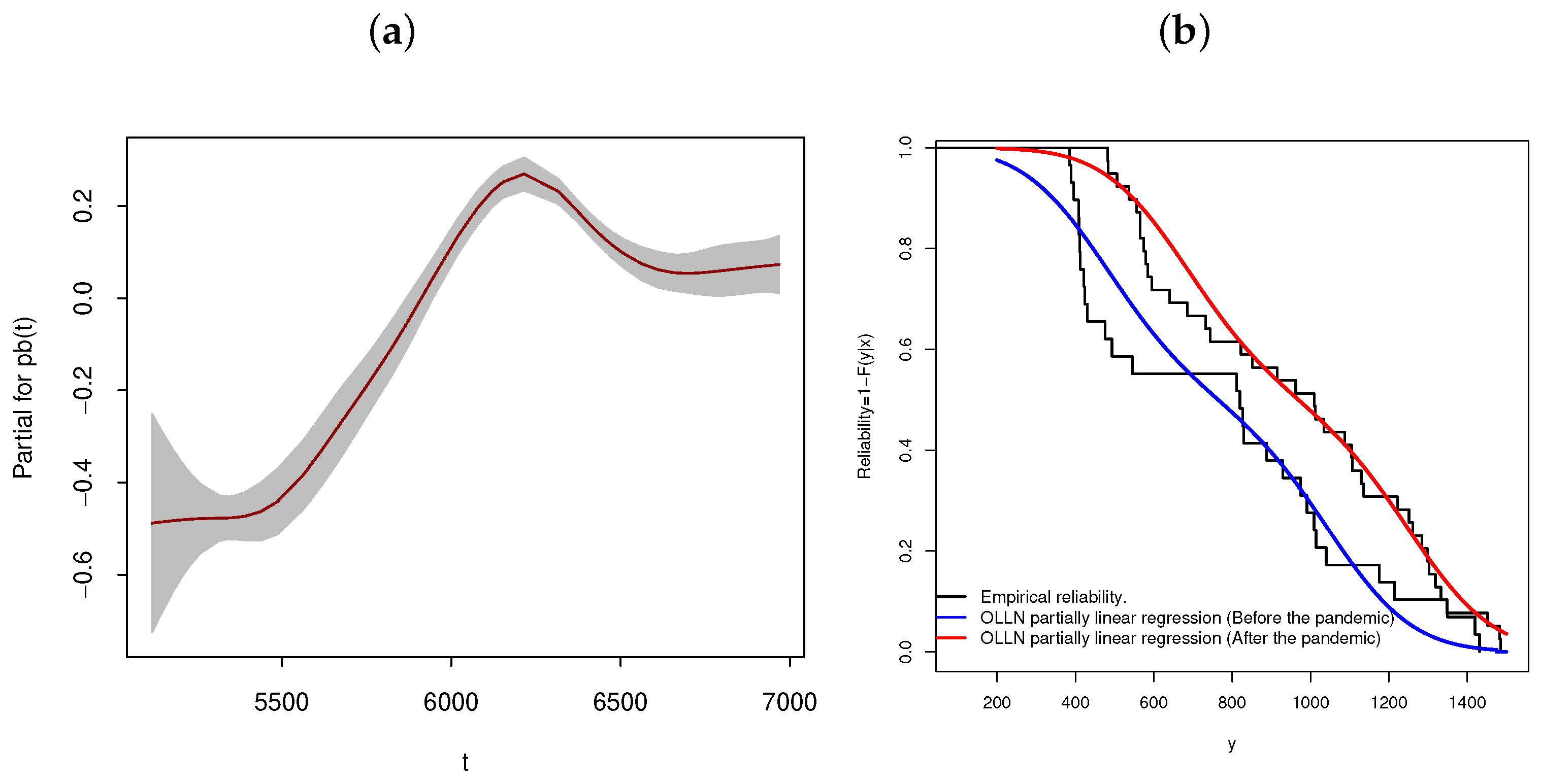
- The IPCA values are explicit in the horizontal axis of Figure 6a. The vertical axis indicates the penalized smoothers to the fitted prices, which shows that the nonlinear effect of the IPCA. Thus, the use of penalized smoothers is relevant. Moreover, the penalized smoothers for the covariate present an increasing period of the value of the price of coffee and from the value of IPCA 6250 (approximately) the decrease in the price of Arabica coffee is evident and then apparently the price of coffee tends to increase slightly from IPCA 6700.
4.4. Practical Implications
- As the world’s leading producer and exporter, Brazil holds a central position in the global coffee industry, with the commodity serving as a cornerstone of its national economy since the 19th century. The sector generates billions in export revenue and creates millions of jobs, acting as a fundamental economic pillar. Beyond commerce, coffee is deeply ingrained in Brazilian culture, culture, and daily life, serving as a vital component of social gatherings and gastronomy. However, the coffee market is highly volatile and sensitive to various economic, climatic, and market variables. Global supply and demand, weather conditions, production costs, and exchange rates are just some of the variables that affect coffee prices. The COVID-19 pandemic brought significant challenges, altering consumption patterns, impacting the climate, and addressing logistical issues that affected both global coffee production and trade. Using a GOLLN-based partial regression model, this study analyzes pre- and post-pandemic coffee prices. The objective is to identify and measure the impact of influential variables, including production costs, supply and demand, weather conditions, and exchange rates. An analysis of pre- and post-pandemic data is conducted to evaluate the structural impacts of recent external shocks on the coffee sector. Based on this, the study identifies key insights aimed at enhancing the strategic planning and operational resilience of producers, exporters, and policymakers in navigating future crises.
5. Conclusions
Author Contributions
Funding
Institutional Review Board Statement
Informed Consent Statement
Data Availability Statement
Acknowledgments
Conflicts of Interest
Abbreviations
| IPCA | National consumer price index |
| GOLL-G | Generalized odd log-logistic-G |
| GOLLN | Generalized odd log-logistic normal |
| OLLN | Odd log-logistic normal |
| ExpN | Exponentiated Normal |
| qf | Quantile function |
| GOLLNPLR | GOLLN partially linear regression |
| OLLNPLR | OLLN partially linear regression |
| ExpNPLR | Exponentiated normal partially linear regression |
| NPLR | Normal partially linear regression |
| MPLEs | Maximum penalized quasi-likelihood estimates |
| qrs | Quantile residuals |
| MSEs | Mean squared erros |
| SEs | mean standard errors Mean |
| ACIs | Average confidence intervals |
| CPs | Coverage probabilities |
| CEPEA | Center for Advanced Studies in Applied Economics |
| GD | Global Deviance |
| AIC | Akaike Information Criterion |
| BIC | Bayesian Information Criterion |
Appendix A

References
- Box, G.E.P.; Cox, D.R. An analysis of transformations. R. Stat. Soc. Ser. B 1964, 26, 211–243. [Google Scholar] [CrossRef]
- Breiman, L.; Friedman, J.H. Estimating optimal transformations for multiple regression and correlation. J. Am. Stat. Assoc. 1985, 80, 580–598. [Google Scholar] [CrossRef]
- Tibshirani, R. Estimating transformations for regression via additivity and variance stabilization. J. Am. Stat. Assoc. 1988, 83, 394–405. [Google Scholar] [CrossRef]
- Riani, M.; Atkinson, A.C.; Corbellini, A. Robust transformations for multiple regression via additivity and variance stabilization. J. Comput. Graph. Stat. 2024, 33, 85–100. [Google Scholar] [CrossRef]
- Engle, R.F.; Granger, C.W.J.; Rice, J.; Weiss, A. Semiparametric estimates of the relation between weather and electricity sales. J. Am. Stat. Assoc. 1986, 81, 310–320. [Google Scholar] [CrossRef]
- Speckman, P. Kernel smoothing in partial linear models. R. Stat. Soc. Ser. B 1988, 50, 413–436. [Google Scholar] [CrossRef]
- Ruppert, D.; Wand, M.P.; Carroll, R.J. Semiparametric Regression; Cambridge University Press: Cambridge, UK, 2003. [Google Scholar]
- Gleaton, J.U.; Lynch, J.D. Properties of generalized log-logistic families of lifetime distributions. J. Probab. Stat. Sci. 2006, 4, 51–64. [Google Scholar]
- Vigas, V.P.; Ortega, E.M.M.; Cordeiro, G.M.; Silva, G.L.; Santos, J.P.C. A new regression model under informative censoring mechanism with applications. Commun. Stat-Theor. M. 2025, 54, 2578–2598. [Google Scholar] [CrossRef]
- Rodrigues, G.M.; Cordeiro, G.M.; Ortega, E.M.M.; Vila, R. New regression model and machine learning for fitting proportional data with application. Statistics 2025, 59, 498–516. [Google Scholar] [CrossRef]
- Cardozo, C.A.; Paula, G.A.; Vanegas, L.H. Generalized log-gamma additive partial linear models with P-spline smoothing. Stat. Pap. 2022, 63, 1953–1978. [Google Scholar] [CrossRef]
- Rodríguez, D.; Valdora, M.; Vena, P. Robust estimation in partially linear regression models with monotonicity constraints. Commun. Stat. Simul. Comput. 2022, 51, 2039–2052. [Google Scholar] [CrossRef]
- Vasconcelos, J.C.S.; Ortega, E.M.M.; Cordeiro, G.M.; Vasconcelos, J.; Biaggioni, M.A.M. Estimation and diagnostic for a partially linear regression based on an extension of the Rice distribution. Revstat Stat. J. 2024, 22, 433–454. [Google Scholar]
- Fidelis, C.R.; Ortega, E.M.M.; Prataviera, F.; Vila, R.; Cordeiro, G.M. Reparametrized Generalized Gamma Partially Linear Regression with Application to Breast Cancer data. J. Appl. Stat. 2024, 51, 3248–3265. [Google Scholar] [CrossRef] [PubMed]
- Chou-Chen, S.W.; Oliveira, R.A.; Raicher, I.; Paula, G.A. Additive partial linear models with autoregressive symmetric errors and its application to the hospitalizations for respiratory diseases. Stat. Pap. 2024, 65, 5145–5166. [Google Scholar] [CrossRef]
- Cho, S.; Jeon, J.M.; Kim, D.; Yu, K.; Park, B.U. Partially Linear Additive Regression with a General Hilbertian Response. J. Am. Stat. Assoc. 2024, 119, 942–956. [Google Scholar] [CrossRef]
- Liu, Y.; Lu, J.; Paula, G.A.; Liu, S. Bayesian diagnostics in a partially linear model with first-order autoregressive skew-normal errors. Comput. Stat. 2025, 40, 1021–1051. [Google Scholar] [CrossRef]
- Cordeiro, G.M.; Alizadeh, M.; Ozel, G.; Hosseini, B.; Ortega, E.M.M.; Altun, E. The generalized odd log-logistic family of distributions: Properties, regression models and applications. J. Stat. Comput. Simul. 2017, 87, 908–932. [Google Scholar] [CrossRef]
- O’Sullivan, F. A Statistical Perspective on Ill-Posed Inverse Problems. Stat. Sci. 1986, 1, 502–527. [Google Scholar]
- Green, P.; Silverman, B. Nonparametric Regression and Generalized Linear Models: A Roughness Penalty Approach; Chapman and Hall/CRC: New York, NY, USA, 1993. [Google Scholar]
- R Core Team. R: A Language and Environment for Statistical Computing; R Foundation for Statistical Computing: Vienna, Austria, 2023; Available online: https://www.R-project.org/ (accessed on 18 March 2026).
- Lee, Y.; Nelder, J.A.; Pawitan, Y. Generalized Linear Models with Random Effects: Unified Analysis via H-Likelihood; Chapman & Hall/CRC: New York, NY, USA, 2006. [Google Scholar]
- Rigby, R.A.; Stasinopoulos, D.M. Automatic smoothing parameter selection in GAMLSS with an application to centile estimation. Stat. Methods Med. Res. 2014, 23, 318–332. [Google Scholar] [CrossRef] [PubMed]
- Dunn, P.K.; Smyth, G.K. Randomized quantile residuals. J. Comput. Graph. Stat. 1996, 5, 236–244. [Google Scholar] [CrossRef]



| Scenario 1 | ||||||||||||||||
|---|---|---|---|---|---|---|---|---|---|---|---|---|---|---|---|---|
| Value 1 | Bias | MSE | Mean SE | ACI | CP | Bias | MSE | Mean SE | ACI | CP | Bias | MSE | Mean SE | ACI | CP | |
| 0.40 | 0.00 | 0.00 | 0.03 | 0.10 | 0.883 | −0.00 | 0.00 | 0.02 | 0.06 | 0.927 | −0.00 | 0.00 | 0.00 | 0.04 | 0.933 | |
| −1.60 | −0.09 | 0.02 | 0.09 | 0.36 | 0.819 | −0.04 | 0.00 | 0.05 | 0.21 | 0.914 | −0.01 | 0.00 | 0.03 | 0.12 | 0.963 | |
| 0.50 | 0.06 | 0.01 | 0.09 | 0.35 | 0.970 | 0.02 | 0.00 | 0.05 | 0.20 | 0.996 | 0.01 | 0.00 | 0.03 | 0.12 | 0.999 | |
| 0.60 | 0.03 | 0.00 | 0.12 | 0.47 | 0.986 | 0.01 | 0.00 | 0.07 | 0.27 | 0.991 | 0.00 | 0.00 | 0.04 | 0.15 | 0.993 | |
| Scenario 2 | ||||||||||||||||
| Value 1 | Bias | MSE | Mean SE | CI Length | CP | Bias | MSE | Mean SE | CI Length | CP | Bias | MSE | Mean SE | CI Length | CP | |
| 0.60 | 0.00 | 0.00 | 0.04 | 0.17 | 0.905 | −0.00 | 0.00 | 0.04 | 0.10 | 0.952 | −0.00 | 0.00 | 0.01 | 0.06 | 0.936 | |
| −1.30 | −0.08 | 0.02 | 0.10 | 0.40 | 0.864 | −0.03 | 0.01 | 0.06 | 0.23 | 0.928 | −0.01 | 0.00 | 0.03 | 0.13 | 0.952 | |
| 0.40 | 0.04 | 0.00 | 0.09 | 0.39 | 0.994 | 0.01 | 0.00 | 0.06 | 0.22 | 0.997 | 0.00 | 0.00 | 0.03 | 0.13 | 0.996 | |
| 0.50 | 0.01 | 0.00 | 0.12 | 0.47 | 0.988 | 0.00 | 0.00 | 0.07 | 0.27 | 0.988 | 0.00 | 0.00 | 0.04 | 0.15 | 0.986 | |
| Model | GD | AIC | BIC | ||||
|---|---|---|---|---|---|---|---|
| GOLLN | 0.1080 | 1.9367 | 787.09 | 87.7908 | 970.0 | 978.0 | 986.9 |
| (0.0157) | (0.6688) | (47.6979) | (6.4167) | ||||
| OLLN | 0.1324 | 1 | 870.52 | 84.1513 | 972.7 | 978.7 | 985.4 |
| (0.0159) | (14.8631) | (3.2403) | |||||
| ExpN | 1 | 1.0254 | 866.18 | 348.51 | 987.4 | 993.4 | 1000.1 |
| (13.0130) | (405.35) | (1311.95) | |||||
| Normal | 1 | 1 | 872.87 | 344.36 | 987.5 | 991.4 | 995.9 |
| (41.7476) | (29.5205) |
| Model | Parametric Regression | Partial Linear Regression | |||||
|---|---|---|---|---|---|---|---|
| GD | AIC | BIC | GD | AIC | BIC | ||
| Normal | 814.87 | 826.87 | 840.19 | 733.05 | 757.33 | 784.28 | |
| ExpN | 809.07 | 823.07 | 838.61 | 729.90 | 755.40 | 783.69 | |
| OLLN | 801.87 | 815.87 | 831.41 | 721.97 | 747.56 | 775.96 | |
| GOLLN | 792.21 | 808.21 | 825.97 | 729.08 | 756.94 | 787.86 | |
| MPLE | SE | p-Value | CI | |
|---|---|---|---|---|
| 6.817 | 0.770 | <0.001 | (5.308, 8.326) | |
| 0.001 | 0.000 | <0.001 | (0.001, 0.001) | |
| −0.014 | 0.005 | 0.011 | (−0.024, −0.004) | |
| 0.175 | 0.016 | <0.001 | (0.144, 0.205) | |
| 5.675 | 0.091 | <0.001 | (5.497, 5.854) | |
| 1.913 | 0.092 | <0.001 | (1.733, 2.092) |
Disclaimer/Publisher’s Note: The statements, opinions and data contained in all publications are solely those of the individual author(s) and contributor(s) and not of MDPI and/or the editor(s). MDPI and/or the editor(s) disclaim responsibility for any injury to people or property resulting from any ideas, methods, instructions or products referred to in the content. |
© 2026 by the authors. Licensee MDPI, Basel, Switzerland. This article is an open access article distributed under the terms and conditions of the Creative Commons Attribution (CC BY) license.
Share and Cite
Ortega, E.M.M.; Rodrigues, G.M.; Jang, K.S.; Cordeiro, G.M. A New Partially Linear Regression with an Application to the Price of Coffee Before and After the Pandemic. Stats 2026, 9, 40. https://doi.org/10.3390/stats9020040
Ortega EMM, Rodrigues GM, Jang KS, Cordeiro GM. A New Partially Linear Regression with an Application to the Price of Coffee Before and After the Pandemic. Stats. 2026; 9(2):40. https://doi.org/10.3390/stats9020040
Chicago/Turabian StyleOrtega, Edwin M. M., Gabriela M. Rodrigues, Kwan Sung Jang, and Gauss M. Cordeiro. 2026. "A New Partially Linear Regression with an Application to the Price of Coffee Before and After the Pandemic" Stats 9, no. 2: 40. https://doi.org/10.3390/stats9020040
APA StyleOrtega, E. M. M., Rodrigues, G. M., Jang, K. S., & Cordeiro, G. M. (2026). A New Partially Linear Regression with an Application to the Price of Coffee Before and After the Pandemic. Stats, 9(2), 40. https://doi.org/10.3390/stats9020040