The Basic Soil Structure Parameters and Their Spatial Prediction Using Machine Learning and Remote Sensing Data in Semi-Arid Trans-Ural Steppe Zone, Russia




Abstract
1. Introduction
2. Materials and Methods
2.1. Study Area and Sampling
2.2. Soil Analyses
2.3. Environmental Predictors
2.4. Predictive Algorithms
2.5. Model Validation and Uncertainty Assessment
3. Results
3.1. Summary Statistics of Soil Properties
3.2. Model Performance and Key Variables
3.3. Spatial Distribution of Soil Properties
4. Discussion
4.1. Physical Soil Properties of the Study Area
4.2. Importance of Environmental Variables
4.3. Model Performance
5. Conclusions
- (1)
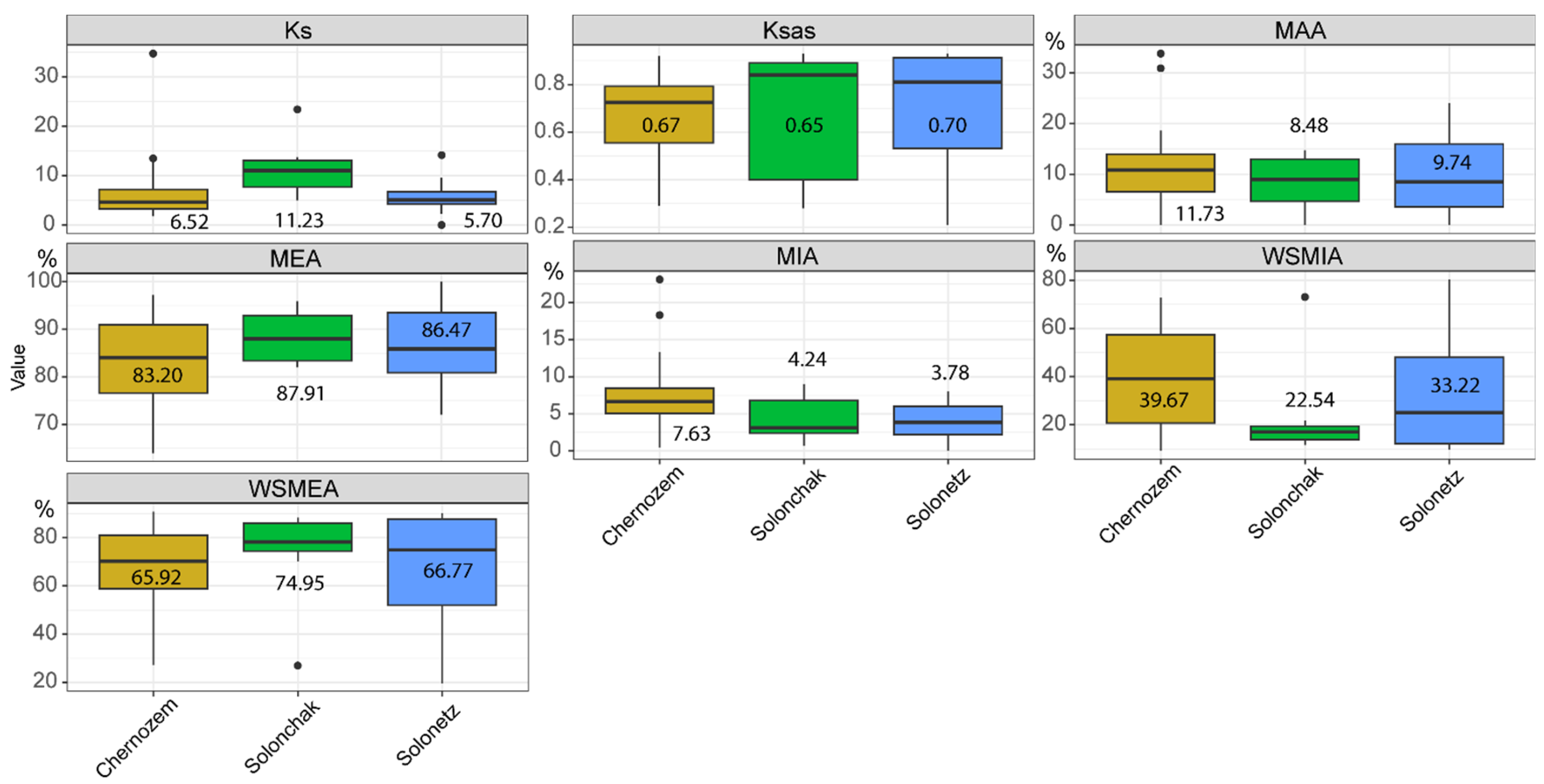
- All studied soil types (Chernozems, Solonchaks, and Solonetzes) were characterized by “excellent” aggregate state with the average structural coefficient (Ks) 6.52, 11.23, and 5.70, respectively. The soils demonstrated a “good” resistance of aggregates to destruction by water, with aggregate stability coefficients (Ksas) of 0.67, 0.65, and 0.70, respectively. The average share of MIA, MEA, and MAA in Chernozem was 7.63, 83.20, and 11.73%, in Solonchak—4.24, 87.91, and 8.48%, and in Solonetz—3.78, 86.47, and 9.74%, respectively. The proportion of water-stable mesoaggregates (WSMEA) in Chernozems was 65.92, and microaggregates (WSMIA)—39.67; Solonchaks—74.95 and 22.54; Solonetz soil—66.77 and 33.22%; respectively.
- (2)
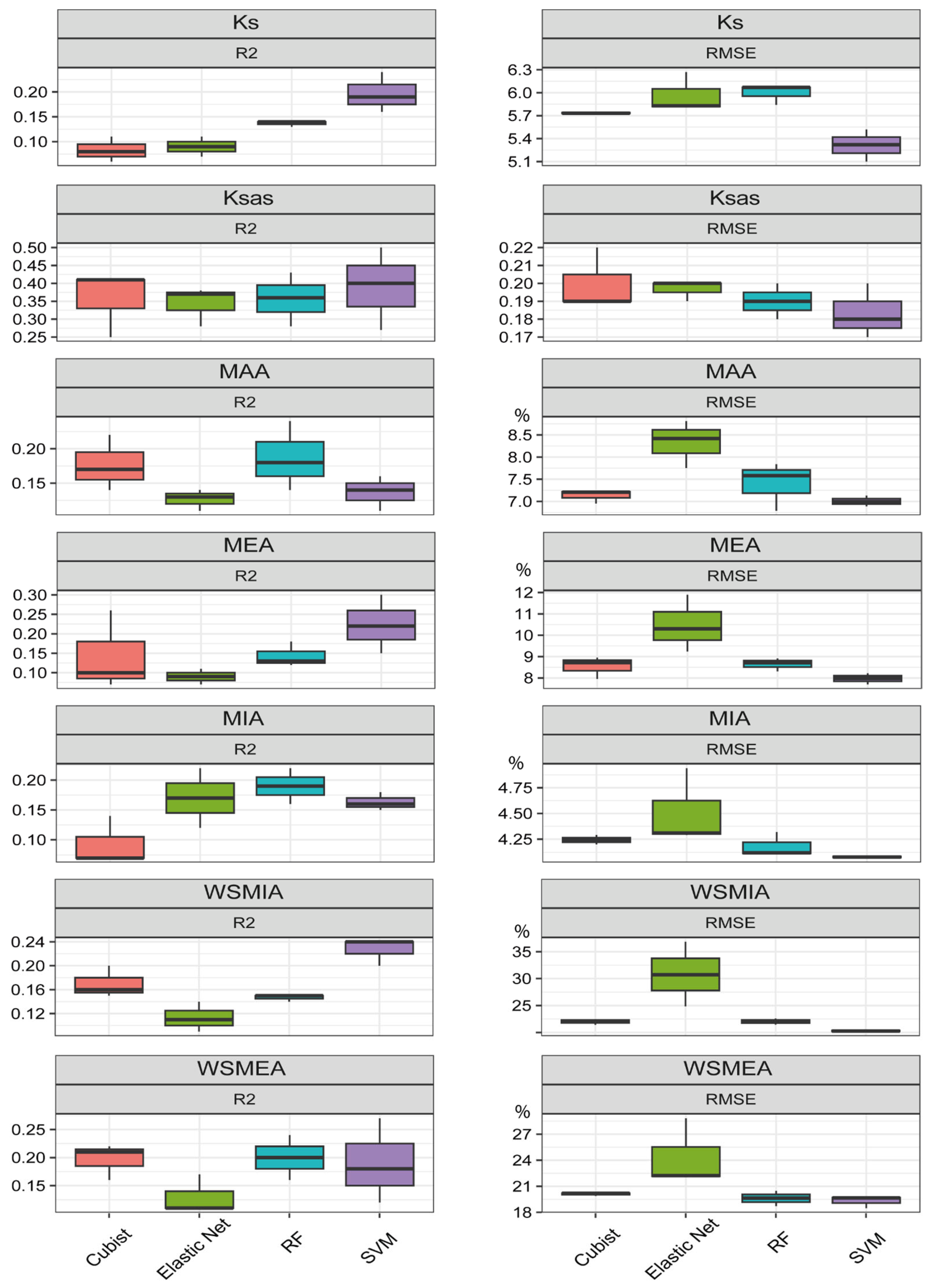
- Among the ML approaches tested, SVM achieved the best accuracy for predictions of most properties (Ks, Ksas, MEA, WSMIA, and WSMEA), according to the cross-validation strategy. RF and Elastic Net were the best algorithms for MAA and MIA predictions, respectively. The best prediction model was achieved for Ksas under the SVM algorithm and resulted in R2 = 0.50 and RMSE = 0.17. The second most accurate model (R2 = 0.30 and RMSE = 7.70%) was obtained for MEA modeling.
- (3)
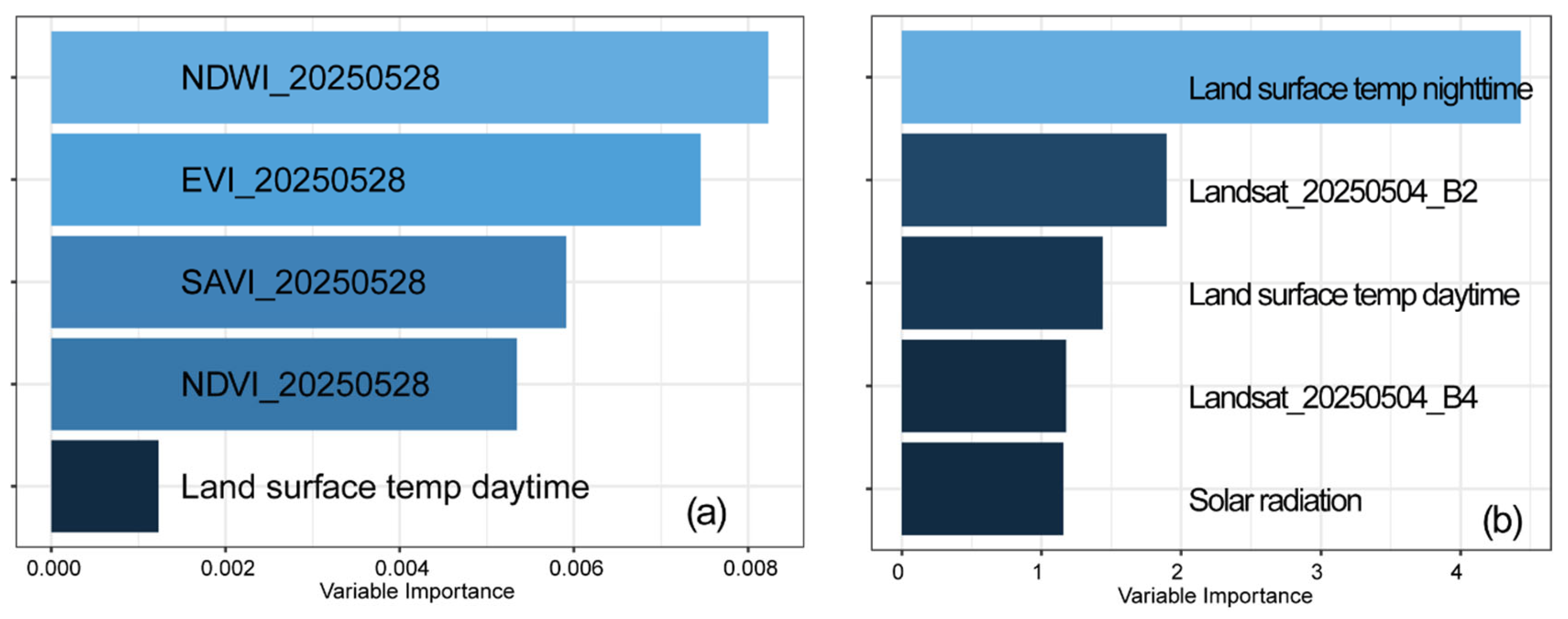
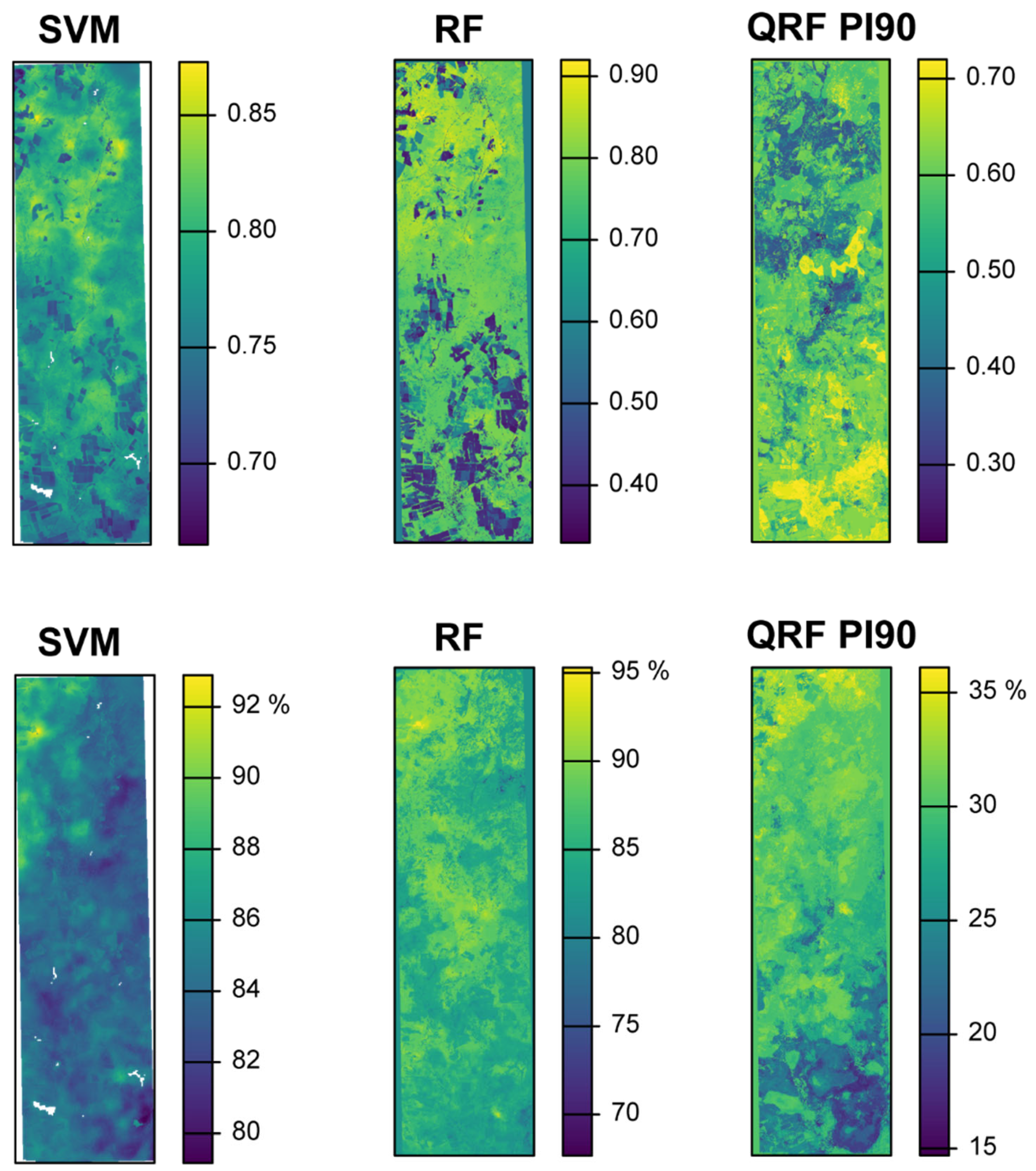
- The best modeled soil properties (Ksas and MEA) were controlled by different variables. The spatial distribution of Ksas was controlled by spectral indices, mainly due to the distinctive spectral response of Solonchak soils. Climate variables (land surface temperature and solar radiation) and Landsat bands (green and NIR) were crucial for the MEA model, highlighting correlations between different soil types and their surface spectral signal.
- (4)
- Despite the results obtained, subsequent studies should focus on including a more extensive data set and testing additional independent variables reflecting the variability of soil properties.
Author Contributions
Funding
Data Availability Statement
Conflicts of Interest
Abbreviations
References
- Deng, Z.; Lan, H.; Li, L.; Sun, W. Vegetation-Induced Modifications in Hydrological Processes and the Consequential Dynamic Effects of Slope Stability. CATENA 2025, 251, 108793. [Google Scholar] [CrossRef]
- Lu, M.; Yang, M.; Yang, Y.; Wang, D.; Sheng, L. Soil Carbon and Nutrient Sequestration Linking to Soil Aggregate in a Temperate Fen in Northeast China. Ecol. Indic. 2019, 98, 869–878. [Google Scholar] [CrossRef]
- Sainju, U.M.; Liptzin, D.; Jabro, J.D. Relating Soil Physical Properties to Other Soil Properties and Crop Yields. Sci. Rep. 2022, 12, 22025. [Google Scholar] [CrossRef] [PubMed]
- Bronick, C.J.; Lal, R. Soil Structure and Management: A Review. Geoderma 2005, 124, 3–22. [Google Scholar] [CrossRef]
- Khaledian, Y.; Miller, B.A. Selecting Appropriate Machine Learning Methods for Digital Soil Mapping. Appl. Math. Model. 2020, 81, 401–418. [Google Scholar] [CrossRef]
- Khosravani, P.; Baghernejad, M.; Moosavi, A.A.; Rezaei, M. Digital Mapping and Spatial Modeling of Some Soil Physical and Mechanical Properties in a Semi-Arid Region of Iran. Environ. Monit. Assess. 2023, 195, 1367. [Google Scholar] [CrossRef]
- Alonso-Sarria, F.; Blanco-Bernardeau, A.; Gomariz-Castillo, F.; Jiménez-Bastida, H.; Romero-Diaz, A. Estimation of Soil Properties Using Machine Learning Techniques to Improve Hydrological Modeling in a Semiarid Environment: Campo de Cartagena (Spain). Earth Sci. Inform. 2025, 18, 323. [Google Scholar] [CrossRef]
- Ließ, M.; Glaser, B.; Huwe, B. Uncertainty in the Spatial Prediction of Soil Texture: Comparison of Regression Tree and Random Forest Models. Geoderma 2012, 170, 70–79. [Google Scholar] [CrossRef]
- Bouslihim, Y.; Rochdi, A.; Aboutayeb, R.; El Amrani-Paaza, N.; Miftah, A.; Hssaini, L. Soil Aggregate Stability Mapping Using Remote Sensing and GIS-Based Machine Learning Technique. Front. Earth Sci. 2021, 9, 748859. [Google Scholar] [CrossRef]
- Zeraatpisheh, M.; Ayoubi, S.; Mirbagheri, Z.; Mosaddeghi, M.R.; Xu, M. Spatial Prediction of Soil Aggregate Stability and Soil Organic Carbon in Aggregate Fractions Using Machine Learning Algorithms and Environmental Variables. Geoderma Reg. 2021, 27, e00440. [Google Scholar] [CrossRef]
- Beck, H.E.; Zimmermann, N.E.; McVicar, T.R.; Vergopolan, N.; Berg, A.; Wood, E.F. Present and Future Köppen-Geiger Climate Classification Maps at 1-Km Resolution. Sci. Data 2018, 5, 180214. [Google Scholar] [CrossRef]
- IUSS Working Group WRB. World Reference Base for Soil Resources 2014, Update 2015. In International Soil Classification System for Naming Soils and Creating Legends for Soil Maps; World Soil Resources Reports No. 106; FAO: Rome, Italy, 2015. [Google Scholar]
- Suleymanov, A.; Asylbaev, I.; Suleymanov, R.; Mirsayapov, R.; Gabbasova, I.; Tuktarova, I.; Belan, L. Assessing and Mapping of Soil Organic Carbon at Multiple Depths in the Semi-Arid Trans-Ural Steppe Zone. Geoderma Reg. 2024, 38, e00855. [Google Scholar] [CrossRef]
- Vadyunina, A.F.; Korchagina, Z.A. Methods of Studying the Physical Properties of Soils; Agropromizdat: Moscow, Russia, 1986; p. 416. (In Russian) [Google Scholar]
- Langley, S.K.; Cheshire, H.M.; Humes, K.S. A Comparison of Single Date and Multitemporal Satellite Image Classifications in a Semi-Arid Grassland. J. Arid Environ. 2001, 49, 401–411. [Google Scholar] [CrossRef]
- Rouse, J.W.; Haas, R.H.; Schell, J.A.; Deering, D.W. Monitoring vegetation systems in the Great Plains with ERTS. NASA Spec. Publ. 1974, 351, 309. [Google Scholar]
- Huete, A.R. A Soil-Adjusted Vegetation Index (SAVI). Remote Sens. Environ. 1988, 25, 295–309. [Google Scholar] [CrossRef]
- Huete, A.; Didan, K.; Miura, T.; Rodriguez, E.P.; Gao, X.; Ferreira, L.G. Overview of the Radiometric and Biophysical Performance of the MODIS Vegetation Indices. Remote Sens. Environ. 2002, 83, 195–213. [Google Scholar] [CrossRef]
- Gao, B. NDWI—A Normalized Difference Water Index for Remote Sensing of Vegetation Liquid Water from Space. Remote Sens. Environ. 1996, 58, 257–266. [Google Scholar] [CrossRef]
- Khan, N.M.; Rastoskuev, V.V.; Sato, Y.; Shiozawa, S. Assessment of hydrosaline land degradation by using a simple approach of remote sensing indicators. Agric. Water Manag. 2005, 77, 96–109. [Google Scholar] [CrossRef]
- Fick, S.E.; Hijmans, R.J. WorldClim 2: New 1-Km Spatial Resolution Climate Surfaces for Global Land Areas. Int. J. Climatol. 2017, 37, 4302–4315. [Google Scholar] [CrossRef]
- Karger, D.N.; Conrad, O.; Böhner, J.; Kawohl, T.; Kreft, H.; Soria-Auza, R.W.; Zimmermann, N.E.; Linder, H.P.; Kessler, M. Climatologies at High Resolution for the Earth’s Land Surface Areas. Sci. Data 2017, 4, 170122. [Google Scholar] [CrossRef]
- Suleymanov, A.; Kuzyakov, Y.; Asylbaev, I.; Rusakov, I.; Suleymanov, R.; Tuktarova, I.; Belan, L. Mechanisms and Drivers of Soil pH Assessed by Shapley Additive Explanation. CATENA 2025, 259, 109301. [Google Scholar] [CrossRef]
- Breiman, L. Random Forests. Mach. Learn. 2001, 45, 5–32. [Google Scholar] [CrossRef]
- Zou, H.; Hastie, T.; Zou, H.; Hastie, T. Regularization and Variable Selection via the Elastic Net. J. R. Stat. Soc. Ser. B Stat. Methodol. 2005, 67, 301–320. [Google Scholar] [CrossRef]
- Meinshausen, N. Quantile Regression Forests. J. Mach. Learn. Res. 2006, 7, 983–999. [Google Scholar]
- Kuhn, M.; Johnson, K. Applied Predictive Modeling; Springer: New York, NY, USA, 2013; ISBN 978-1-4614-6848-6. [Google Scholar]
- Dubovik, E.V.; Dubovik, D.V. Relationships between the Organic Carbon Content and Structural State of Typical Chernozem. Eurasian Soil Sci. 2019, 52, 150–161. [Google Scholar] [CrossRef]
- Komissarov, M.A.; Gabbasova, I.M. Erosion of Agrochernozems under Sprinkler Irrigation and Rainfall Simulation in the Southern Forest-Steppe of Bashkir Cis-Ural Region. Eurasian Soil Sci. 2017, 50, 253–261. [Google Scholar] [CrossRef]
- Zolotareva, B.N.; Bukhonov, A.V.; Demkin, V.A. The Structural State of Buried and Surface Soils of Solonetzic Complexes in the Dry Steppe Zone of the Lower Volga Basin. Eurasian Soil Sci. 2012, 45, 690–699. [Google Scholar] [CrossRef]
- Gaevaya, E.A.; Bezuglova, O.S. Use of Analysis of the Principal Components to Identify the Relationships between Soil Aggregates and Parameters of Soil Fertility of Migration–Segregation Chernozems. Moscow Univ. Soil Sci. Bull. 2025, 80, 228–238. [Google Scholar] [CrossRef]
- Lal, R. Tillage Effects on Soil Degradation, Soil Resilience, Soil Quality, and Sustainability. Soil Till. Res. 1993, 27, 1–8. [Google Scholar] [CrossRef]
- Komissarov, M.A.; Klik, A. The Impact of No-Till, Conservation, and Conventional Tillage Systems on Erosion and Soil Properties in Lower Austria. Eurasian Soil Sci. 2020, 53, 503–511. [Google Scholar] [CrossRef]
- Alaoui, A.; Diserens, E. Changes in Soil Structure Following Passage of a Tracked Heavy Machine. Geoderma 2011, 163, 283–290. [Google Scholar] [CrossRef]
- Murray, R.S.; Grant, C.D. The impact of irrigation on soil structure. In Land and Water Australia; The National Program for Sustainable Irrigation (Land & Water Australia): Canberra, Australia, 2007; pp. 1–31. [Google Scholar]
- Ball, B.; Bingham, I.; Rees, B.; Watson, C.; Litterick, A. The Role of Crop Rotations in Determining Soil Structure and Crop Growth Conditions. Can. J. Soil Sci. 2005, 85, 557–577. [Google Scholar] [CrossRef]
- Gholoubi, A.; Emami, H.; Caldwell, T. Deforestation Effects on Soil Aggregate Stability Quantified by the High Energy Moisture Characteristic Method. Geoderma 2019, 355, 113919. [Google Scholar] [CrossRef]
- Villamil, M.B.; Amiotti, N.M.; Peinemann, N. Soil degradation related to overgrazing in the semi-arid southern Caldenal area of Argentina. Soil Sci. 2001, 166, 441. [Google Scholar] [CrossRef]
- Chalise, D.; Kumar, L.; Kristiansen, P. Land Degradation by Soil Erosion in Nepal: A Review. Soil Syst. 2019, 3, 12. [Google Scholar] [CrossRef]
- Sterk, G.; Riksen, M.; Goossens, D. Dryland Degradation by Wind Erosion and Its Control. Ann. Arid Zone 2001, 41, 351–367. [Google Scholar]
- Suleymanov, A.; Polyakov, V.; Komissarov, M.; Suleymanov, R.; Gabbasova, I.; Garipov, T.; Saifullin, I.; Abakumov, E. Biophysicochemical Properties of the Eroded Southern Chernozem (Trans-Ural Steppe, Russia) with Emphasis on the 13C NMR Spectroscopy of Humic Acids. Soil Water Res. 2022, 17, 222–232. [Google Scholar] [CrossRef]
- Fedorov, N.; Shirokikh, P.; Zhigunova, S.; Baisheva, E.; Komissarov, M.; Muldashev, A.; Gabbasova, D.; Akhmetova, M.; Tuktamyshev, I.; Bikbaev, I.; et al. Productivity, Carbon Sequestration and Species Diversity in Virgin and Secondary Meadow Steppes of the Bashkir Cis-Urals. Sci. Rep. 2025, 15, 17268. [Google Scholar] [CrossRef]
- Khasanova, R.F.; Suyundukova, M.B.; Suyundukov, Y.T.; Akhmetov, F.R. Optimization of agrophysical properties of ordinary chernozem under the influence of perennial grasses. Fund. Res. 2014, 8–5, 1095–1099. (In Russian) [Google Scholar]
- Bartlová, J.; Badalíková, B. Water Stability of Soil Aggregates in Different Systems of Chernozem Tillage. Acta Univ. Agric. Silvic. Mendel. Brun. 2011, 59, 25–30. [Google Scholar] [CrossRef]
- Kursakova, V.S. The Effect of Perennial Herbs on the Physical Properties of Saline Soils. Eurasian Soil Sci. 2006, 39, 748–752. [Google Scholar] [CrossRef]
- Khan, A.R.; Chandra, D.; Quraishi, S.; Sinha, R.K. Soil aeration under different soil surface conditions. J. Agron. Crop Sci. 2000, 185, 105–112. [Google Scholar] [CrossRef]
- Chen, M.; Zhang, S.; Liu, L.; Wu, L.; Ding, X. Combined Organic Amendments and Mineral Fertilizer Application Increase Rice Yield by Improving Soil Structure, P Availability and Root Growth in Saline-Alkaline Soil. Soil Till. Res. 2021, 212, 105060. [Google Scholar] [CrossRef]
- Chen, Y.; Wen, X.; Sun, Y.; Zhang, J.; Wu, W.; Liao, Y. Mulching Practices Altered Soil Bacterial Community Structure and Improved Orchard Productivity and Apple Quality after Five Growing Seasons. Sci. Hortic. 2014, 172, 248–257. [Google Scholar] [CrossRef]
- Nunes, M.R.; Karlen, D.L.; Moorman, T.B. Tillage Intensity Effects on Soil Structure Indicators—A US Meta-Analysis. Sustainability 2020, 12, 2071. [Google Scholar] [CrossRef]
- Askaraliev, B.; Musabaeva, K.; Koshmatov, B.; Omurzakov, K.; Dzhakshylykova, Z. Development of modern irrigation systems for improving efficiency, reducing water consumption and increasing yields. Mach. Energetics 2024, 15, 47. [Google Scholar] [CrossRef]
- Sayão, V.M.; Demattê, J.A.M. Soil Texture and Organic Carbon Mapping Using Surface Temperature and Reflectance Spectra in Southeast Brazil. Geoderma Reg. 2018, 14, e00174. [Google Scholar] [CrossRef]
- Shabou, M.; Mougenot, B.; Chabaane, Z.; Walter, C.; Boulet, G.; Aissa, N.; Zribi, M. Soil Clay Content Mapping Using a Time Series of Landsat TM Data in Semi-Arid Lands. Remote Sens. 2015, 7, 6059–6078. [Google Scholar] [CrossRef]
- Khosravani, P.; Moosavi, A.A.; Baghernejad, M.; Kebonye, N.M.; Mousavi, S.R.; Scholten, T. Machine Learning Enhances Soil Aggregate Stability Mapping for Effective Land Management in a Semi-Arid Region. Remote Sens. 2024, 16, 4304. [Google Scholar] [CrossRef]
- Jeihouni, M.; Alavipanah, S.K.; Toomanian, A.; Jafarzadeh, A.A. Digital Mapping of Soil Moisture Retention Properties Using Solely Satellite-Based Data and Data Mining Techniques. J. Hydrol. 2020, 585, 124786. [Google Scholar] [CrossRef]
- Swain, S.R.; Chakraborty, P.; Panigrahi, N.; Vasava, H.B.; Reddy, N.N.; Roy, S.; Majeed, I.; Das, B.S. Estimation of Soil Texture Using Sentinel-2 Multispectral Imaging Data: An Ensemble Modeling Approach. Soil Till. Res. 2021, 213, 105134. [Google Scholar] [CrossRef]
- Delavar, M.A.; Naderi, A.; Ghorbani, Y.; Mehrpouyan, A.; Bakhshi, A. Soil Salinity Mapping by Remote Sensing South of Urmia Lake, Iran. Geoderma Reg. 2020, 22, e00317. [Google Scholar] [CrossRef]
- Ngabire, M.; Wang, T.; Xue, X.; Liao, J.; Sahbeni, G.; Huang, C.; Duan, H.; Song, X. Soil Salinization Mapping across Different Sandy Land-Cover Types in the Shiyang River Basin: A Remote Sensing and Multiple Linear Regression Approach. Remote Sens. Appl. Soc. Environ. 2022, 28, 100847. [Google Scholar] [CrossRef]
- Vaudour, E.; Gomez, C.; Fouad, Y.; Lagacherie, P. Sentinel-2 Image Capacities to Predict Common Topsoil Properties of Temperate and Mediterranean Agroecosystems. Remote Sens. Environ. 2019, 223, 21–33. [Google Scholar] [CrossRef]
- Barthold, F.K.; Wiesmeier, M.; Breuer, L.; Frede, H.-G.; Wu, J.; Blank, F.B. Land Use and Climate Control the Spatial Distribution of Soil Types in the Grasslands of Inner Mongolia. J. Arid Environ. 2013, 88, 194–205. [Google Scholar] [CrossRef]
- Bousbih, S.; Zribi, M.; Pelletier, C.; Gorrab, A.; Lili-Chabaane, Z.; Baghdadi, N.; Ben Aissa, N.; Mougenot, B. Soil Texture Estimation Using Radar and Optical Data from Sentinel-1 and Sentinel-2. Remote Sens. 2019, 11, 1520. [Google Scholar] [CrossRef]
- Kaya, F.; Başayiğit, L.; Keshavarzi, A.; Francaviglia, R. Digital Mapping for Soil Texture Class Prediction in Northwestern Türkiye by Different Machine Learning Algorithms. Geoderma Reg. 2022, 31, e00584. [Google Scholar] [CrossRef]
- Zeng, P.; Song, X.; Yang, H.; Wei, N.; Du, L. Digital Soil Mapping of Soil Organic Matter with Deep Learning Algorithms. ISPRS Int. J. Geo. Inf. 2022, 11, 299. [Google Scholar] [CrossRef]
- Guo, P.-T.; Li, M.-F.; Luo, W.; Tang, Q.-F.; Liu, Z.-W.; Lin, Z.-M. Digital mapping of soil organic matter for rubber plantation at regional scale: An application of random forest plus residuals kriging approach. Geoderma 2015, 237–238, 49–59. [Google Scholar] [CrossRef]
- Ma, T.; Brus, D.J.; Zhu, A.-X.; Zhang, L.; Scholten, T. Comparison of Conditioned Latin Hypercube and Feature Space Coverage Sampling for Predicting Soil Classes Using Simulation from Soil Maps. Geoderma 2020, 370, 114366. [Google Scholar] [CrossRef]
- Schmidinger, J.; Schröter, I.; Bönecke, E.; Gebbers, R.; Joerg, R.; Eckart, K.; Mulder, V.L.; Heuvelink, G.; Vogel, S. Effect of Training Sample Size, Sampling Design and Prediction Model on Soil Mapping with Proximal Sensing Data for Precision Liming. Precis. Agric. 2024, 25, 1–27. [Google Scholar] [CrossRef]



| Parameter | Min | Max | Mean | Median | SD 1 | CV 2 |
|---|---|---|---|---|---|---|
| Ks | 0.01 | 34.71 | 7.24 | 5.25 | 6.03 | 0.83 |
| Ksas | 0.21 | 0.93 | 0.67 | 0.76 | 0.22 | 0.33 |
| MIA, % | 0 | 23.10 | 5.93 | 5.30 | 4.50 | 0.76 |
| MEA, % | 63.90 | 100.00 | 85.01 | 85.00 | 8.62 | 0.10 |
| MAA, % | 0 | 33.80 | 10.55 | 10.80 | 7.45 | 0.71 |
| WSMIA, % | 9.16 | 80.30 | 34.53 | 26.00 | 21.77 | 0.63 |
| WSMEA, % | 19.70 | 90.84 | 67.95 | 74.50 | 20.07 | 0.30 |
| Soil Property | RSD Date | Method | R2 | RMSE | MAE | NSE |
|---|---|---|---|---|---|---|
| Ks | 20250707 | SVM | 0.24 | 5.10 | 3.35 | 0.10 |
| Ksas | 20250528 | SVM | 0.50 | 0.17 | 0.12 | 0.38 |
| MAA, % | 20250504 | RF | 0.24 | 6.79 | 5.20 | 0.02 |
| MEA, % | 20250504 | SVM | 0.30 | 7.70 | 6.04 | 0.10 |
| MIA, % | 20250504 | Elastic Net | 0.22 | 4.29 | 3.27 | −0.20 |
| WSMIA, % | 20250528 | SVM | 0.24 | 20.17 | 16.60 | 0.08 |
| WSMEA, % | 20250504 | SVM | 0.27 | 18.49 | 13.95 | 0.08 |
Disclaimer/Publisher’s Note: The statements, opinions and data contained in all publications are solely those of the individual author(s) and contributor(s) and not of MDPI and/or the editor(s). MDPI and/or the editor(s) disclaim responsibility for any injury to people or property resulting from any ideas, methods, instructions or products referred to in the content. |
© 2026 by the authors. Licensee MDPI, Basel, Switzerland. This article is an open access article distributed under the terms and conditions of the Creative Commons Attribution (CC BY) license.
Share and Cite
Suleymanov, A.; Komissarov, M.; Suleymanov, R.; Gabbasova, I. The Basic Soil Structure Parameters and Their Spatial Prediction Using Machine Learning and Remote Sensing Data in Semi-Arid Trans-Ural Steppe Zone, Russia. Soil Syst. 2026, 10, 11. https://doi.org/10.3390/soilsystems10010011
Suleymanov A, Komissarov M, Suleymanov R, Gabbasova I. The Basic Soil Structure Parameters and Their Spatial Prediction Using Machine Learning and Remote Sensing Data in Semi-Arid Trans-Ural Steppe Zone, Russia. Soil Systems. 2026; 10(1):11. https://doi.org/10.3390/soilsystems10010011
Chicago/Turabian StyleSuleymanov, Azamat, Mikhail Komissarov, Ruslan Suleymanov, and Ilyusya Gabbasova. 2026. "The Basic Soil Structure Parameters and Their Spatial Prediction Using Machine Learning and Remote Sensing Data in Semi-Arid Trans-Ural Steppe Zone, Russia" Soil Systems 10, no. 1: 11. https://doi.org/10.3390/soilsystems10010011
APA StyleSuleymanov, A., Komissarov, M., Suleymanov, R., & Gabbasova, I. (2026). The Basic Soil Structure Parameters and Their Spatial Prediction Using Machine Learning and Remote Sensing Data in Semi-Arid Trans-Ural Steppe Zone, Russia. Soil Systems, 10(1), 11. https://doi.org/10.3390/soilsystems10010011